nandi's blog

Dzharatitanis kingi: New Sauropod Dinosaur Discovered in Uzbekistan

Wednesday, March 3, 2021

Life reconstruction of Dzharatitanis kingi. Image credit: Alexander Averianov.

Paleontologists have identified a new genus and species of rebbachisaurid dinosaur from a fossil uncovered in Uzbekistan.

The newly-discovered dinosaur roamed Earth approximately 92 million years ago, during the Turonian stage of the Late Cretaceous period.

Dubbed Dzharatitanis kingi, it belongs to Rebbachisauridae, a large family of plant-eating dinosaurs.

A single isolated vertebra of the new dinosaur was recovered from the Bissekty Formation at Dzharakuduk in Navoi Viloyat, Uzbekistan.

The specimen was found by paleontologists during the URBAC international expedition in 1997.

“This is the first rebbachisaurid reported from Asia and one of the youngest rebbachisaurids in the known fossil record,” Dr. Alexander Averianov of St. Petersburg Zoological Institute and Dr. Hans-Dieter Sues of Smithsonian Institution wrote in their paper.

“The Rebbachisauridae is the second sauropod group identified in the assemblage of non-avian dinosaurs from the Bissekty Formation, in addition to a previously identified indeterminate titanosaurian.”

An anterior caudal vertebra of Dzharatitanis kingi in posterior (A), right lateral (B), and anterior (C) views. Scale bar – 10 cm. Image credit: Averianov & Sues, doi: 10.1371/journal.pone.0246620.

All previous records of rebbachisaurid dinosaurs came from a narrow band extending from southernmost South America through the northeastern South America and northwestern Africa to Europe.

The discovery of Dzharatitanis kingi now considerably extends the known distribution of this group to the east.

It is most likely that these dispersed to Central Asia from Europe but it is not clear when this could have occurred.

“The Rebbachisauridae possibly dispersed from Europe to Asia via a land bridge across the Turgai Strait sometime between the Barremian and Turonian,” the paleontologists wrote.

The discovery is reported in a paper published this month in the journal PLoS ONE.

_____

A. Averianov & H.-D. Sues. 2021. First rebbachisaurid sauropod dinosaur from Asia. PLoS ONE 16 (2): e0246620; doi: 10.1371/journal.pone.0246620

Source: www.sci-news.com/

Jurassic Park Didn't Need Any Sequels

Tuesday, March 2, 2021

Jurassic World: Dominion promises to conclude the franchise, but Jurassic Park never needed to be a franchise in the first place.

Steven Spielberg’s Jurassic Park is the ultimate crowd-pleasing blockbuster. It has suspense-filled set pieces, compelling characters, and a large-scale story with intimate stakes. At one point, it was the highest-grossing movie ever made, and its revolutionary visual effects made it one of the most groundbreaking and influential movies of all time. Naturally, a studio with $1 billion more in their pockets turned this masterpiece into a franchise.

Spielberg returned to helm the first sequel, The Lost World, which was followed by Jurassic Park IIIJurassic World, and Jurassic World: Fallen Kingdom, with Jurassic World: Dominion on the way for a summer 2022 release. That one promises to conclude the series, but Universal executives will probably be lining up around this dead horse with baseball bats at the ready in a couple of years. Every sequel to Jurassic Park has failed to justify its existence, because Jurassic Park is a movie that didn’t need any sequels. While movies like Star Wars intentionally open themselves up to endless sequels exploring their vast fictional universe, Jurassic Park told its story in its entirety and explored the themes perfectly in the first movie.

Thematically, Jurassic Park is a Frankenstein story. It’s a science thriller about the dangers of hubris and playing God. Much like Victor Frankenstein, John Hammond is a deranged genius who feeds his ego by creating a monster. Ian Malcolm’s famous quote, “Your scientists were so preoccupied with whether they could, they didn’t stop to think if they should,” could just as easily be applied to Dr. Frankenstein’s work in reanimation. The sequels have ignored these overtones and presented a more general “humanity bad” message.

After the first movie closed the door on its own premise with Hammond realizing the error of his ways and pledging to shut down the park, most of the sequels have meandered around the island full of dinosaur clones, throwing random story ideas at the wall and seeing what sticks. The closest that any of the Jurassic sequels has come to matching the greatness of the original is 2015’s Jurassic World, which finally offered a fresh twist on the premise. It explores a functioning dinosaur park filled with tourists, which raises the tension when the dinosaurs escape because a lot more lives are at stake. But that movie is let down by weak, one-dimensional characters and a lot of stretches in logic (would people really get bored of seeing live dinosaurs after just a couple of years?).

Plus, Jurassic World paved the way for the worst of the bunch, Fallen Kingdom. After starting out with the familiar Jurassic sequel setup of military guys tricking scientists into taking them to the island to brutalize the dinosaurs (which they should see coming by now), Fallen Kingdom stumbles from one inane plot point to the next. It reveals that the island has been an active volcano this whole time (making John Hammond retroactively moronic for building a theme park there), then follows “the floor is made of lava” rules in depicting the eruption, then becomes a tepid haunted house movie in its second half as the surviving dinosaurs are taken to a giant country manor to be auctioned off for $4 million a pop. This movie is stitched together like the filmmakers had two half-baked story ideas they couldn’t quite flesh out into full movies and just crammed them both into the same script.

Spielberg made the original Jurassic Park film as a monster movie, as he’d previously done with Jaws. The T. rex is framed in the same way Godzilla or King Kong are framed, and it’s arguably become just as iconic within the movie monster canon. In the first sequel, The Lost World, Spielberg leaned way too heavily into this angle with a random trip to San Diego for some Godzilla references. After that, the Jurassic sequels have all avoided being straightforward monster movies and instead aspire to Avengers-level blockbuster-dom, which betrays the spirit of the original story.

The original Jurassic Park movie is the perfect blockbuster. Its set pieces, from the T. rex’s initial escape to the raptors’ attack in the kitchen, have much more suspense and excitement and emotional engagement than anything in the average modern-day superhero movie. In a world with more and more uninspired movies that don’t demand to be seen on the big screen, Jurassic Park still plays to huge crowds in its rereleases three decades later, because it’s truly a spectacle to behold.

In the original movie’s final showdown, the survivors are being chased by the raptors and get saved by the T. rex, who takes on the raptors in a vicious fight as the “When Dinosaurs Ruled the Earth” banner falls through the frame. This finale posits that nature is bigger than humanity and when humanity arrogantly tries to tweak nature, nature will take care of things. This is proving to be untrue in the age of climate change, but the sentiment closes the book on Jurassic Park’s themes and messages.

One of the downsides of Jurassic stories is that they require a lot of exposition to set up the action, which can really drag a movie down if it’s not done well. In the first movie, Spielberg uses exposition masterfully. For starters, he gets through most of it with a goofy cartoon starring Mr. DNA – all the later movies have long, drawn-out, on-the-nose information dumps. In Jurassic Park, the exposition works because it enhances the action instead of hindering it. The design of the velociraptors is terrifying on its own, but their screen presence wouldn’t be nearly as effective if Grant hadn’t explained in gruesome detail how raptors eat people alive in an early scene.

The final scene in Jurassic Park provides enough emotional closure to conclude the story for good. Having warmed to the kids and genuinely changed over the course of the movie, Dr. Grant looks out the window of the helicopter and watches birds (technically dinosaurs) flying in a flock. This was the perfect ending for the story. It’s simple, but it wraps everything up in a neat bow. The tightly structured Jurassic Park script, credited to David Koepp and original author Michael Crichton, ties up all the loose ends, so there’s no room for a sequel. But Universal wasn’t going to let anything – not even three-quarters of the original cast refusing to return – stop them from making a sequel to the highest-grossing movie of all time.

Jurassic World: Dominion, originally set to release in 2021 but delayed to 2022 by the COVID-19 pandemic, promises to be an Endgame/Rise of Skywalker-style finale to the entire Jurassic saga, but it’ll be difficult to conclude a series that never should’ve been a series in the first place. Bringing back the original trio of Sam Neill, Laura Dern, and Jeff Goldblum (in more than a glorified cameo appearance this time) is a nice touch, but the movie will struggle to prove to audiences that it needs to exist, because it simply doesn’t.

Source: https://gamerant.com/

Purgatorius mckeeveri: 65-Million-Year-Old Primate Fossils Uncovered in Montana

Tuesday, March 2, 2021

Shortly after the end-Cretaceous mass extinction, the earliest known primates, such as Purgatorius mckeeveri shown in the foreground, quickly set themselves apart from their competition — like the archaic ungulate mammal on the forest floor — by specializing in an omnivorous diet including fruit found up in the trees. Image credit: Andrey Atuchin.

Paleontologists in the United States have discovered and analyzed the fossilized remains from two species of Purgatorius, the oldest genus in a group of the earliest-known primates called Plesiadapiformes.

Plesiadapiformes first appeared during the Paleocene epoch, between 65 and 55 million years ago, although many were extinct by the beginning of the Eocene epoch.

These ancient primates were small-bodied and ate specialized diets of insects and fruits that varied by species.

They are crucial to understanding the evolutionary and ecological origins of primates, treeshrews, and colugos as well as the traits that separate those groups from other mammals.

Five new isolated plesiadapiform teeth were recovered from the Harley’s Point locality of the Fort Union Formation in northeastern Montana.

The fossils are estimated to be 65.9 million years old, about 105,000 to 139,000 years after the end-Cretaceous mass extinction event.

Two three from the sample are from a previously known species of plesiadapiform called Purgatorius janisae. Three other specimens represent a new species named Purgatorius mckeeveri.

“It’s mind blowing to think of our earliest archaic primate ancestors,” said co-lead author Professor Wilson Mantilla, a vertebrate paleontologist in the Department of Biology at the University of Washington and the Department of Paleontology at the Burke Museum of Natural History and Culture.

“They were some of the first mammals to diversify in this new post-mass extinction world, taking advantage of the fruits and insects up in the forest canopy.”

High resolution CT scans of fossilized teeth and jaw bones of Purgatorius. Image credit: Gregory Wilson Mantilla / Stephen Chester.

Based on the age of the fossils, Professor Mantilla and colleagues estimate that the ancestor of all primates — including plesiadapiforms and today’s primates — likely emerged by the Late Cretaceous epoch and lived alongside large dinosaurs.

“This was a really cool study to be a part of, particularly because it provides further evidence that the earliest primates originated before the extinction of non-avian dinosaurs,” said co-author Brody Hovatter, a graduate student in the Department of Earth and Space Sciences at the University of Washington.

“They became highly abundant within a million years after that extinction.”

“This discovery is exciting because it represents the oldest dated occurrence of archaic primates in the fossil record,” added co-lead author Dr. Stephen Chester, a researcher at Brooklyn College and the City University of New York.

“It adds to our understanding of how the earliest primates separated themselves from their competitors following the demise of the dinosaurs.”

The research was published in the journal Royal Society Open Science.

_____

Gregory P. Wilson Mantilla et al. 2021. Earliest Palaeocene purgatoriids and the initial radiation of stem primates. R. Soc. open sci 8 (2): 210050; doi: 10.1098/rsos.210050

Source: www.sci-news.com/

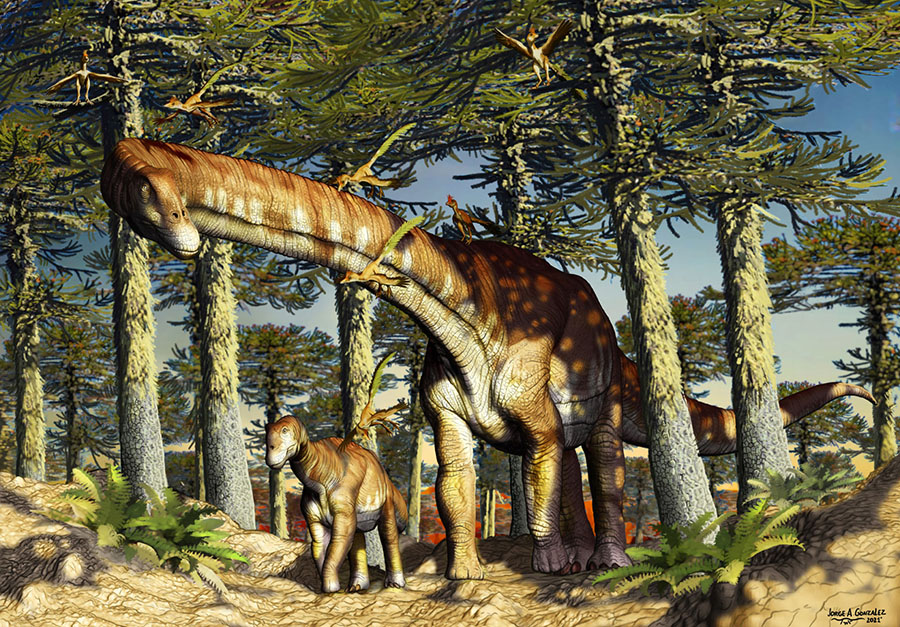
Paleontologists Discover Oldest Known Titanosaur: Ninjatitan zapatai

Tuesday, March 2, 2021

Ninjatitan zapatai. Image credit: Jorge González.

Ninjatitan zapatai lived approximately 140 million years ago (Early Cretaceous period) in what is now Patagonia, Argentina.

Ninjatitan zapatai belongs to Titanosauria, a diverse group of sauropod (long-necked plant-eating) dinosaurs.

This group includes species ranging from the largest known terrestrial vertebrates to ‘dwarfs’ no bigger than elephants.

“During evolutionary history, sauropods had different moments, different pulses of gigantism, which were not only related to the group of titanosaurs,” said Dr. Pablo Ariel Gallina, a paleontologist at the Fundación Azara in Maimonides University and CONICET.

“There were large animals towards the end of the Jurassic period, such as Apatosaurus and Brachiosaurus. And, already in the line of titanosaurs, the pulse with the largest giants occurs towards the middle of the Cretaceous period, with species such as PatagotitanArgentinosaurus or Notocolossus.”

Ninjatitan zapatai was about 20 m (66 feet) in length, and had a long neck and tail.

“The main importance of Ninjatitan zapatai, beyond the fact that it is a new species of titanosaur, is that it is the earliest record worldwide for this group,” Dr. Gallina said.

“This discovery is also very important for the knowledge of the evolutionary history of sauropods, because the fossil records of the Early Cretaceous period, in around 140 million years ago, are really very scarce throughout the world.”

The 140-million-year-old postcranial remains of Ninjatitan zapatai were discovered in the Bajada Colorada Formation in Neuquén province, Patagonia region, Argentina.

“The presence of a basal titanosaurian sauropod in the lowermost Cretaceous of Patagonia supports the hypothesis that the group was established in the southern hemisphere and reinforces the idea of a Gondwanan origin for Titanosauria,” the researchers said.

The discovery of Ninjatitan zapatai is described in a paper in the journal Ameghiniana.

_____

P.A. Gallina et al. 2021 The earliest known titanosaur sauropod dinosaur. Ameghiniana 58 (1): 35-51; doi: 10.5710/AMGH.20.08.2020.3376

Source: www.sci-news.com/

One Thing Jurassic Park Changed About Dennis Nedry’s Death

Monday, March 1, 2021

Spielberg's Jurassic Park was fairly faithful to Michael Crichton's novel, but the movie left out a notable detail with Dennis Nedry's death.

Steven Spielberg's Jurassic Park changed a major aspect surrounding Dennis Nedry's death from the book. Based on the 1990 novel by Michael Crichton, the sci-fi adventure film from 1993 marked the first installment in the dinosaur-centric franchise. Wayne Knight starred in the film adaptation as Nedry, an antagonist who also had a pivotal role in Crichton's original novel. Though his arc in the movie greatly matched with the book counterpart, Spielberg's interpretation left out one important aspect in Nedry's memorable death scene.

Fans of Crichton's Jurassic Park book would consider the movie a fairly faithful adaptation. That said, page-to-screen adaptations always take a few liberties. While Crichton worked on the movie's screenplay, some key scenes from the book were altered or cut altogether from the movie. For example, Dr. Alan Grant was cornered in the books by three raptors in the laboratory, forcing him to use a deadly toxin to kill them. The novel also featured a scene that expanded Lex and Tim's face-off with raptors in the Jurassic Park buildings. After finding a baby raptor in the nursery, Tim threw the small creature to distract the fully grown raptors for an escape attempt.

Some of the characters' fates were also adjusted for the live-action adaptation of Jurassic Park. Whereas John Hammond survived the events of the first film, the character met his death in Crichton's book after falling down a hill where a pack of Procompsognathus ate him. Nedry, the morally corrupt computer scientist for Hammond's park, was killed in both the book and the movie in a similar fashion. After being blackmailed, Nedry made a deal with Dr. Lewis Dodgson of the rival company, Biosyn, to steal and deliver dinosaur embryos with a modified Barbasol can. Upon taking the embryos, Nedry took a Jurassic Park Jeep to meet with a Biosyn agent at the docks. Due to the intense tropical storm, Nedry crashed the vehicle before having a deadly encounter with a Dilophosaurus. Still, the movie left out one stomach-churning detail during his death scene.

What Happened To Dennis Nedry In The Jurassic Park Book

After Nedry lost the Barbasol can, he was spit in the face with poison from a Dilophosaurus. The man returned from the Jeep, where another Dilophosaurus was waiting for him. The dinosaur attacked, killing Nedry, but the extent of the event was left up to the viewers' interpretation with only the outside of the Jeep being shown. In the book, Nedry also returned to the vehicle after the venomous Dilophosaurus blinded him. He then felt a sharp pain in his stomach before the specific point in Nedry's arc took an even darker turn. Nedry realized he was holding his own intestines after inspecting his wound, indicating his initial encounter with the Dilophosaurus caused a gut-busting wound before finishing him off.

Seeing as Nedry's disembowelment served as one of the most disturbing moments in the books, it made sense why it was left out of the Jurassic Park movie. Spielberg's film carried a PG-13 rating, but showing a character holding his own intestines would have been too gory. In this case, Nedry's demise was still integral to the plot, but keeping the exact details of his death was unnecessary. The movie also left out the fact other surviving characters found dinosaurs snacking on Nedry's remains. Having a dinosaur devour Nedry from inside a Jeep was seemingly enough for Spielberg.

Source: https://screenrant.com/

Did A Comet Fragment Kill The Dinosaurs? Not Likely, Say Researchers

Monday, March 1, 2021

Asteroid impact. Illustration of a large asteroid colliding with Earth on the Yucatan Peninsula in Mexico. This impact is believed to have led to the death of the dinosaurs some 65 million years ago. The impact formed the Chicxulub crater, which is around 200 kilometres wide. The impact would have thrown trillions of tons of dust into the atmosphere, cooling the Earth's climate significantly, which may have been responsible for the mass extinction. A layer of iridium-rich rock, known as the K-pg boundary, is thought to be the remnants of the impact debris. GETTY

The global extinction event that meant curtains for the dinosaurs was unlikely to have been triggered by an Earth-impacting comet fragment, several planetary scientists now argue. 

This most recent hypothesis to explain how a comet fragment (or fragments) might have slammed into the Gulf of Mexico near Chicxulub has been challenged. The hypothesis’ recent supporting paper in the journal Nature Scientific Reports posits that a fragment (or fragments) from a large, long-period comet were pushed into sun-grazing orbits by Jupiter. This, in turn, they write led to an impact that caused the extinction of both the dinosaurs and three-quarters of all living species on Earth. 

In their paper, Harvard University astronomers Amir Siraj and Avi Loeb argue that during close passages to the Sun, such large comets are gravitationally disrupted, producing fields of cometary shrapnel, a portion of which likely slammed into gulf some 66 billion years ago.

But David Kring, Principal Scientist at the USRA’s Lunar and Planetary Institute (LPI) in Houston, remains doubtful.

“A surviving fragment of the Chicxulub impactor is similar to meteoritic fragments of asteroids and does not resemble the one sample we have from a comet,” Kring told me. Moreover, Kring says that chemical traces of the impactor in debris ejected from the Chicxulub crater resemble the chemical compositions of known meteoritic fragments of asteroids.

Impact shock waves radiating across the surface are trailed by very high velocity winds called an airblast. The phenomenon was observed around nuclear weapon test explosions during the Cold War. Emiliani, Kraus, and Shoemaker (1981, Earth and Planetary Science Letters 55, 317-334) estimated the radius of damage before the site of the impact was known. Their airblast is shown here applied to the Chicxulub impact site. The damage would have been severe across southern and central North America. ILLUSTRATION CREDIT: DAVID A. KRING

There’s also the iridium abundance problem.

Most of Earth’s Iridium is sequestered in our planet’s core and mantle, Kring writes in an essay. Thus, any anomalously large quantity found in Earth’s crust would imply that there was a new supply delivered to the surface via some sort of impactor, Kring notes.

Now known colloquially among researchers as the K-Pg Boundary, to mark the Cretaceous-Paleogene (K-Pg) mass extinction event, it’s now widely-accepted that boundary is characterized by globally-elevated concentrations of iridium, the authors of a new paper appearing in the journal Scientific Advances, noted this past week. This iridium anomaly “thus reflects the global dispersal of meteoritic matter following the hypervelocity impact of an asteroid approximately 12-km in diameter,” write the authors.

“The K-Pg meteorite fragment I found was compact and similar to carbonaceous chondrites which are certainly asteroidal in origin; there’s no reason to believe that comets are identical to this,” Frank Kyte, a geophysicist at the University of California, Los Angeles (UCLA), told me. If anything, Kyte says that comets contain lots of volatile ices, so they may have significantly less iridium than meteorites.

The asteroid impact led to the extinction of 75% of life, including all non-avian dinosaurs. WILLGARD KRAUSE/PIXABAY.

In fact, the comet story conflicts with the iridium values found at more than 100 K-Pg boundary sites worldwide, Philippe Claeys, a geochemist at Belgium’s Free University of Brussels (VUB), told me. 

Yet Siraj, a Harvard University undergraduate studying astrophysics at the Harvard & Smithsonian Center for Astrophysics, and the paper’s lead author, told me that there is no conflict whatsoever with their model and the iridium concentration at the K-Pg Boundary. In fact, thorough and up-to-date analysis of iridium data favors the impactor mass used in our model, he told me.

Even so, “the Siraj and Loeb paper makes no mention of iridium,” Stephen Kane, a planetary astrophysicist at the University of California, Riverside, told me.

Yet Siraj asserts that their model is not fine-tuned, but rather can accommodate a wide range of impactor sizes to within orders of magnitude in mass.

If that’s the case, Kane counters, these objects’ projected size parameters become so large, they no longer provide meaningful results.

Why not asteroids?

Siraj and Loeb assert asteroids that produce Chicxulub size events do not occur more often than once every 750 million years or so, Kring notes. “Yet Chicxulub-size events from a near-Earth population of objects is nominally estimated to occur on average once per 100 million years,” he writes.

Yet Siraj and Loeb’s model begins with a long period comet some 60-km in diameter that, once disrupted, produces a comet fragment with a diameter of some 7-km, which they propose to be the Chicxulub impactor, Kring notes. The paper does not demonstrate how a roughly 7-km comet can produce Chicxulub, when computer simulations published by other investigators show that a much larger object is needed, Kring writes.

“[Thus], the modeled comet diameter is far too small to produce the Chicxulub impact crater,” Kring told me.

A section of rock core pulled from the crater left by the asteroid impact that wiped out the dinosaurs. Researchers found high concentrations of the element iridium –a marker for asteroid material –in the middle section of the core.  INTERNATIONAL OCEAN DISCOVERY PROGRAM

Siraj and Loeb note that cometary fragments smaller than 7-km will also strike the Earth. The authors noted in their paper that one of these cometary fragments may have even hit Earth within the last one million years, possibly producing Kazakhstan’s 14-km diameter Zhamanshin crater.

If so, Kring writes in his essay, that this would require cometary fragments to survive for more than 60 million years without being ejected from the Solar System, disrupted further, and/or colliding with other bodies. This only further pushes the envelope of credulity.

And why reinvent the Chicxulub impactor wheel when asteroid impactors might work after all?

If a fragment of a long-period comet struck Earth, it would likely do so at speeds as high as 50 km per second as opposed to 20 km per second for asteroid impactors, Simone Marchi, Principal Scientist at the Southwest Research Institute in Boulder, Colo., told me. Therefore, he says, a cometary impactor larger than 5-10 km coupled with such a high impact speed, would probably produce a crater much larger than Chicxulub. 

In other words, because of it impact velocity, the cometary impactor glove simply might never fit.

“So, there may be no need to invoke a cometary origin for the K-Pg impact to start with,” said Marchi.

It all gives pause to wonder whether the dinosaurs themselves would have put that much thought into the cause of their own demise. 

As for who’s right about the true origin of the Chicxulub impactor?

I think it’s just such a random event, that trying to force it into some kind of a statistical probability doesn’t really prove anything, says Kyte.

Or as Kring puts it: “While we cannot prove the impactor was not a comet, available data suggest it was an asteroid.”

Source: www.forbes.com/

Dinos will be Reborn on Xbox, PlayStation and PC in 2022

Saturday, February 27, 2021

We’ve had Jurassic World Evolution, we know that Dino Crisis is on the way back, and Second Extinction is kicking around in the background. But it seems like the dinosaur is the current love affair for many gaming devs, especially now that Dinos Reborn has been announced for console and PC.

Dinos Reborn comes from the development team at HardCodeWay and will be published on Xbox, PC, and PlayStation by the Vision Edge Entertainment team in 2022. when it does arrive you should expect to find a mysterious planet at the fore of what is going on, one in which you’ll be slap bang in the middle of, left to fend for yourself, crafting, navigating and full on surviving as you try to discover your identity and work out what is going on. The problem is, this land will have many predators, but also, much prey.

Running as an open world FPP survival title, Dinos Reborn on Xbox (we would suspect Xbox One and Xbox Series X|S), PlayStation (okay to call it now on PS4 and PS5?) and PC doesn’t, on the face of it sound like anything new – after-all, ARK: Survival Evolved has tried pretty much the same thing. But the announcement trailer down below is well worth a watch anyways, and the Steam page is ready and willing to take your Wishlisting cash, so feel free to hop in. We’re definitely interested to see where this dino adventure goes to though, mainly as, well, we’re just like those devs and can’t get enough of the Jurassic lark.

Key features include:

  • Survive in the wild – In this world, the number of ways you can die and things that can kill you is essentially limitless. Hunger, thirst, fatigue – fail to manage them, and you’re gone. An infected wound that you didn’t take care of. The world around you is as dangerous as it is beautiful and mysterious. Exploring vast amounts of the terrain might reveal more wonders and unexpected encounters than you would expect. It’s up to you which direction to go next.
  • Explore the unknown – The world around you is as dangerous as it is beautiful and mysterious. Exploring vast amounts of the terrain might reveal more wonders and unexpected encounters than you would expect. It’s up to you which direction to go next.
  • Develop your crafting skills – You begin on this unknown planet with only your bare hands, sticks, and stones. You need food, water, shelter, fire, medicine, weapons, and many other things if you want to stay alive. The catch – you need to do all of this yourself. Tools will lead you to weapons, weapons to food, food to strength, strength to the ability to build traps, snares, fortifications, shelters, and eventually an entire base. The last will be crucial to your survival, which is your ultimate goal.
  • Become a hunter – The rules of this planet are quite simple. Kill or be killed. Hunt or become prey. Eat or be eaten. Here, even the smallest insect can become the cause of your doom. Simultaneously, you will often encounter creatures that will tolerate or even like you. Discovering who is friend versus foe will be one of the most important tasks ahead of you.
  • Become a professional animal tracker – Learn how to sneak up on creatures. Analyze their tracks, observe their habits, look for their weak points, and find the best moment to attack. Remember that each animal has a different sense of smell, hearing, and sight. As an experienced hunter, you will be able to hunt at night, but so will the creatures hunting you, so you should be all eyes and ears at all times.
  • Fast learning will be your key to success – Forget about typical stat tables or character development trees. If you want to master a particular skill, you’ll need first to learn it the old-fashioned way. That means reading books, tutorials, and notes, as well as observing and repeating the same actions over and over until you start performing them automatically.

Use the dynamically-changing weather conditions to your advantage – For reasons unknown to you, the weather here is very unstable. It changes frequently, rapidly, and without any warning. Make sure you make the most of it. Move unnoticed and unheard in heavy rain. Use cloudless days for work. Avoid thick fog as it’s easy to get lost in, and beware of thunderstorms that will try to destroy what you have built.

Let us know in the comments what you think though. There’s still some way to go before we see Dinos Reborn hitting PC and console, so we’ll keep you totally in the loop with any developmental progress.

Source: www.thexboxhub.com/

Why the ‘Jurassic Park’ Reference in ‘Toy Story 2’ Was an Extra Special Easter Egg

Saturday, February 27, 2021

Andy’s Rex isn’t like dinosaurs from other movies. However, there is more than one Jurassic Park reference in the Disney and Pixar Toy Story movies.

The easter egg in the second Toy Story movie was special for more than one reason. Here are just some of the moments from Andy’s lovable dinosaur, Rex.

Disney has a few ‘Jurassic Park’ related references in ‘Toy Story’

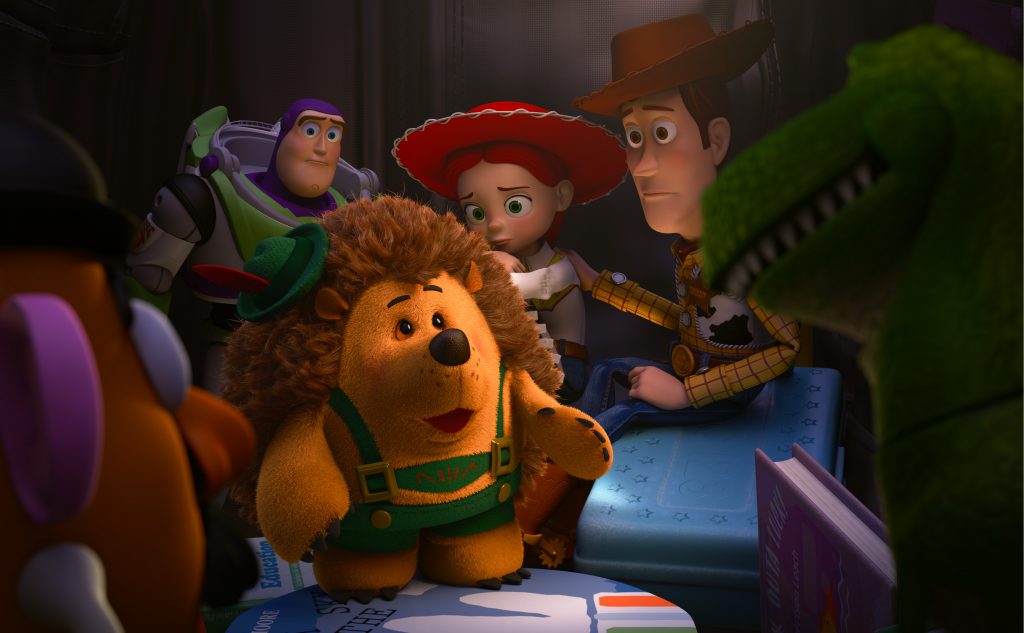
Rex may love video games and Andy, but he doesn’t love his stubby arms. In fact, this Toy Story character is always trying to be more ferocious. During the first Toy Story film, the green t-rex took dinosaur lessons from the space ranger, Buzz Lightyear. 

As one of the first Jurassic Park references in this franchise, Rex’s roar after being coached by Buzz sounded similar to the t-rex’s roar from the other film. 

This wouldn’t be the last time that rex showed off his new and improved roar. In the third Toy Story movie, this character had another roar just like the Jurassic Park dinosaur. However, this reference was not a coincidence. 

One ‘Jurassic Park’ actor appears in ‘Toy Story 2’ 

One of the most subtle references in this sequel took place inside Al’s Toy Barn, while Rex, Ham, Potato Head, Slinky, and Buzz were looking for Woody. One of the Barbies in the store took the wheel of their car to give a tour. Unfortunately, Rex fell out along the way. 

While he tried to catch up with his friends, viewers see him in the rearview mirror, similar to a scene from Jurassic Park, where the main characters were being chased in their car by a T-Rex. Of course, these were very different circumstances, as the Jurassic Park dinosaur tried to eat the people in their Jeep.

What made this reference even more special was the location of Andy’s toys during this part of Toy Story 2. On their search to find Woody, these characters landed in Al’s Toy Barn. The actor who voiced this chicken-esque shop owner, Al, actually appeared in Jurassic Park in a similar role. 

Wayne Knight, the voice of Al, also played Dennis Nedry in Jurassic Park. According to Pixar Fandom, “Michael Giacchino, who composed many Pixar movies, also composed the fourth Jurassic Park film Jurassic World and its sequel Fallen Kingdom.

Rex appears in most ‘Toy Story’ movies and spinoffs

As one of Andy and eventually Bonnie’s toys, Rex appears as a fan-favorite in several Toy Story-related productions. That includes the 2019 animated movie, Toy Story 4, which took these characters to a carnival. 

In this Pixar franchise, Rex wasn’t Andy’s only dinosaur. There was also Trixie, a blue triceratops with a love for online video-chatting. This character is also the star of the spinoff Toy Story That Time Forgot. 

Toy Story 2 is available for streaming on Disney+.

Source: www.cheatsheet.com/

Pioneering Prehistoric Landscape Reconstruction Reveals Early Dinosaurs Lived on Tropical Islands

Saturday, February 27, 2021

A new study using leading edge technology has shed surprising light on the ancient habitat where some of the first dinosaurs roamed in the UK around 200 million years ago.

The research, led by the University of Bristol, examined hundreds of pieces of old and new data including historic literature vividly describing the landscape as a "landscape of limestone islands like the Florida Everglades" swept by storms powerful enough to "scatter pebbles, roll fragments of marl, break bones and teeth."

The evidence was carefully compiled and digitised so it could be used to generate for the first time a 3D map showing the evolution of a Caribbean-style environment, which played host to small dinosaurs, lizard-like animals, and some of the first mammals.

"No one has ever gathered all this data before. It was often thought that these small dinosaurs and lizard-like animals lived in a desert landscape, but this provides the first standardised evidence supporting the theory that they lived alongside each other on flooded tropical islands," said Jack Lovegrove, lead author of the study published today in Journal of the Geological Society.

A new map showing the location of series of small tropical islands 200 million years ago in the area that is now Bristol sheds new light on how British dinosaurs lived

The study amassed all the data about the geological succession as measured all round Bristol through the last 200 years, from quarries, road sections, cliffs, and boreholes, and generated a 3D topographic model of the area to show the landscape before the Rhaetian flood, and through the next 5 million years as sea levels rose.

At the end of the Triassic period the UK was close to the Equator and enjoyed a warm Mediterranean climate. Sea levels were high, as a great sea, the Rhaetian Ocean, flooded most of the land. The Atlantic Ocean began to open up between Europe and North America causing the land level to fall. In the Bristol Channel area, sea levels were 100 metres higher than today.

High areas, such as the Mendip Hills, a ridge across the Clifton Downs in Bristol, and the hills of South Wales poked through the water, forming an archipelago of 20 to 30 islands. The islands were made from limestone which became fissured and cracked with rainfall, forming cave systems.

The findings have provided greater insight into the type of surroundings inhabited by the Thecodontosaurus, a small dinosaur the size of a medium-sized dog with a long tail also known as the Bristol dinosaur.

"The process was more complicated than simply drawing the ancient coastlines around the present-day 100-metre contour line because as sea levels rose, there was all kinds of small-scale faulting. The coastlines dropped in many places as sea levels rose," said Jack, who is studying Palaeontology and Evolution.

The findings have provided greater insight into the type of surroundings inhabited by the Thecodontosaurus, a small dinosaur the size of a medium-sized dog with a long tail also known as the Bristol dinosaur.

Co-author Professor Michael Benton, Professor of Vertebrate Palaeontology at the University of Bristol, said: "I was keen we did this work to try to resolve just what the ancient landscape looked like in the Late Triassic. The Thecodontosaurus lived on several of these islands including the one that cut across the Clifton Downs, and we wanted to understand the world it occupied and why the dinosaurs on different islands show some differences. Perhaps they couldn't swim too well."

The team created a 3D topographical map that allowed them to better understand how sea levels rose and fell over millions of year to create the British isles

"We also wanted to see whether these early island-dwellers showed any of the effects of island life," said co-author Dr David Whiteside, Research Associate at the University of Bristol.

"On islands today, middle-sized animals are often dwarfed because there are fewer resources, and we found that in the case of the Bristol archipelago. Also, we found evidence that the small islands were occupied by small numbers of species, whereas larger islands, such as the Mendip Island, could support many more."

The study, carried out with the British Geological Survey, demonstrates the level of detail that can be drawn from geological information using modern analytical tools. The new map even shows how the Mendip Island was flooded step-by-step, with sea level rising a few metres every million years, until it became nearly completely flooded 100 million years later, in the Cretaceous.

Co-author Dr Andy Newell, of the British Geological Survey, said: "It was great working on this project because 3D models of the Earth's crust can help us understand so much about the history of the landscape, and also where to find water resources. In the UK we have this rich resource of historical data from mining and other development, and we now have the computational tools to make complex, but accurate, models."

Source: www.newswise.com/

Dinosaur Species: 'Everyone's Unique'

Saturday, February 27, 2021

On loan from the Frick Dinosaur Museum, on display at the Zoological Research Museum Alexander Koenig (ZFMK) in Bonn.  CREDIT © Volker Lannert/Uni Bonn

Paleontologists from the Universities of Bonn and Liverpool examined 14 skulls of Plateosaurus trossingensis.

"Everyone's unique" is a popular maxim. All people are equal, but there are of course individual differences. This was no different with dinosaurs. A study by researchers at the University of Bonn and the Dinosaur Museum Frick in Switzerland has now revealed that the variability of Plateosaurus trossingensis was much greater than previously assumed. The paleontologists examined a total of 14 complete skulls of this species, eight of which they described for the first time. The results have now been published in the scientific journal "Acta Palaeontologica Polonica".

Plateosaurus lived during the Late Triassic, about 217 to 201 million years ago. "With well over 100 skeletons, some of them completely preserved, it is one of the best known dinosaurs," says Dr. Jens Lallensack, who researched dinosaur biology at the University of Bonn and has been working at Liverpool John Moores University (UK) for several months. The herbivore had a small skull, a long neck and tail, powerful hind legs and strong grasping hands. The spectrum is considerable: Adult specimens ranged from a few to ten meters in length, weighing between about half a ton and four tons.

The first bones of Plateosaurus were found as early as 1834 near Nuremberg, making it the first dinosaur found in Germany, and one of the first ever. Between 1911 and 1938, excavations unearthed dozens of skeletons from dinosaur "graveyards" in Halberstadt (Saxony-Anhalt) and Trossingen (Baden-Württemberg). A third such cemetery was discovered in the 1960s in Frick, Switzerland. "It's the only one where there are still digs every year," Lallensack says. The material from Frick, which is described in detail for the first time, includes eight complete and seven fragmentary skulls excavated by Swiss paleontologist and dinosaur researcher Dr. Ben Pabst and his team.

Natural variation between individuals

Dinosaurs have been preserved for posterity mainly through bones. Paleontologists rely on anatomical details to distinguish different species. "A perpetual difficulty with this is that such anatomical differences can also occur within a species, as natural variation between individuals," Lallensack reports. Researchers at the University of Bonn and the Dinosaur Museum Frick (Switzerland) have now been able to show that Plateosaurus anatomy was significantly more variable than previously thought - and the validity of some species needs to be re-examined. These findings were made possible by analyses of 14 complete and additional incomplete skulls of Plateosaurus. "Such a large number of early dinosaurs is unique," says paleontologist Prof. Dr. Martin Sander of the University of Bonn.

Can all these fossils from Germany and Switzerland really be assigned to a single species? Answering this question has become all the more urgent since Martin Sander and Nicole Klein of the University of Bonn published in "Science" in 2005. According to this, Plateosaurus was probably already warm-blooded like today's birds, but was able to adapt its growth to the environmental conditions - something that today can only be observed in cold-blooded animals. "This hypothesis is of great importance for our understanding of the evolution of warm-bloodedness," reports Lallensack. However, until now the observed individually distinct growth patterns could alternatively be explained by the assumption that there was not only one, but several species present. The current study debunks this.

Bone deformations during fossilization

The researchers have now carefully documented the variations in skulls of different sizes. A significant portion of the differences can be attributed to bone deformation during fossilization deep below the Earth's surface. Individual variations must be distinguished from this: The posterior branch of the zygomatic bone, which is sometimes bifurcated and sometimes not, appeared most striking to the researchers. A strongly sculptured bone bridge over the eye was also present only in some skulls. The relative size of the nasal opening also varies.

"It becomes apparent that each skull has a unique combination of features," Lallensack notes, emphasizing the distinct individuality of these dinosaurs. The uniquely large number of skulls studied made it possible to show that the differences in characteristics were variations within a species and not different species. "Only if as many finds as possible are excavated and secured will we obtain the high quantities needed to prove species affiliation and answer fundamental questions of biology" says Sander.

###

Funding:

The study was funded by the German Research Foundation (DFG). The project received financial support for the excavation and preparation from the municipality of Frick and the Canton of Aargau (Swisslos Fund) of Switzerland.

Publication: Lallensack, J.N., Teschner, E.M., Pabst, B., and Sander, P.M.: New skulls of the basal sauropodomorph Plateosaurus trossingensis from Frick, Switzerland: Is there more than one species? Acta Palaeontologica Polonica, DOI: https://doi.org/10.4202/app.00804.2020; http://app.pan.pl/article/item/app008042020.html

Source: www.eurekalert.org/

Pages