nandi's blog

How This Dinosaur Fossil Became Worth $32 Million

Saturday, March 6, 2021

The rare fossil set has been valued in the tens of millions, and it's for good reasons.

Collecting dinosaur fossils have been a unique trend in the last decade. Perhaps gaining the most interest in 2007 when celebrities Leonardo DiCaprio and Nicholas Cage ended up in a bidding war over a $276,000 tyrannosaurus batarr dinosaur skull. Cage won but later returned the fossil in 2015 to Mongolia, because the artifact had been stolen for auction from the country.

Just last fall, a 40-foot-long Tyrannosaurus Rex, nicknamed Stan, sold to an anonymous buyer for $32 million, a record figure for the now-popular public auctions.

What is the draw to owning dinosaur fossils and causing the bidding war to continue to escalate?

Appeal Of Owning Dinosaurs

The likes of DiCaprio, Cage and Russell Crowe have established the collections as super exclusive and coveted pieces to have in one’s home.

The cost of owning your own dinosaur fossil is comparable to owning a famous painting and artists don’t have their equivalent of Jurassic Park, making the collections cool and modern with the film franchise’s popularity.

Herbivore dinosaur fossils can go for $500,000 to $1 million and carnivores such as the T. Rex and the Velociraptor go for $3 million to $10 million.

DiCaprio is a known art trader as well, with drawings by Picasso, Dali and Jean-Michel Basquiat according to Art Net which put them in the same ballpark as a 60-million-year-old artifact.

Australian actor Crowe recently held a large auction following his divorce from Danielle Spencer. Among the auctioned items, was the fossil of a giant marine reptile, a Mosasaur for approximately $40,000 and leading many to believe Crowe has a small collection of fossils at home.

As the trend grew, auction houses and galleries like Aguttes, Christie’s and Sotheby’s have regularly sold a variety of dinosaur fossils to ultra-rich collectors, but scientists say the practice can be detrimental to the science community.

Scientists Speak Out

Art collectors and enthusiasts claim skeletons are truly a work of art, requiring paleontologists, artisans, designers and historian experts to restore the large pieces, according to W Magazine. However, scientists say the private trade among celebrities and rare collectors result in historical artifacts standing idle in someone’s living room versus open for investigation, study and new discoveries in the science world.

According to Mercury News, the Paris auction house Augettes recently sold a dinosaur fossil to an anonymous buyer for $2.1 million, excavated in 2013 and thought to be a new species of dinosaur but has not yet been identified by scientists.

The Society for Vertebrate Paleontology (SVP) spoke against the sale before the auction began saying “Fossil specimens that are sold into private hands are lost to science.”

While some buyers loan their purchase to a museum or for further scientific study, scientists fear the vast majority will remain the property of someone that only sees the fossil as “art” and not something rich in scientific discovery.

All of the collectors bidding for the worlds most rare and unique fossils has led to the largest sale in history – $32 million for one T. Rex named Stan.

Stan’s Rich History

The men behind Stan, brothers Peter and Neal Larson have a sad and sorted history together. The two have spent decades searching and digging for dinosaur fossils, excavating 11 T. Rexes and many other fossils now housed in museums and collections around the world.

They are the pair behind Chicago’s famous Field Museum T. Rex, Sue. She was the most expensive dinosaur to date at $8,400,000 until Stan was sold in 2020.

After a lifetime of working together and discovering new scientific evidence, the two had a falling out and wanted to separate their assets at the Black Hills Institute of Geological Research in Hill City, S.D., including their coveted Stan.

According to the Wall Street Journal, two years ago a circuit-court judge ordered the brothers to divide their assets and part ways.

Pete received the institute, 100,000 fossils and private museum valued at $5 million and Neal was given the right to sell Stan, estimating its value around $5 million to $6 million. However, as the live auction began on Oct. 6 both brothers watched virtually as bidders began to rise higher and higher for the famous piece.

In the end, a $32 million price tag took Stan off the market and Neal is a lot richer than originally anticipated.

“That’s more than we’ve grossed in the entire history of our business,” Peter commented.

The brothers have had their share of misfortune and disappointment over their work. In the mid-1990’s they lost a legal battle over Sue, handing her over to a local for ultimate auction. The family began falling apart after that, and Stan is perhaps the final blow.

“The trauma from that older case still grates on this family, and I think it exacerbated any existing cracks,” said Kristin Donnan, Peter’s former wife. “Stan did what Sue couldn’t do: It broke up the family.”

Lawsuits, one brother firing another and the need to part ways grew over the years, culminating with the court’s decision two years ago,” said the Wall Street Journal.

Despite the brothers amazing discoveries and personal story of loss and disconnect, the questions remain how to protect science and allow all to enjoy.

While fossil collecting doesn’t seem to be losing steam, hopefully the world as a whole doesn’t suffer in scientific discovery and education.

Sources: www.therichest.com/, Art NetW MagazineMercury NewsWall Street Journal

How Jurassic Park Unintentionally Inspired Octodad & Surgeon Simulator

Friday, March 5, 2021

While one 90s Jurassic Park game failed to find its own critical success, it did manage to inspire other devs to create their own hilarious titles.

Despite the titles having seemingly nothing to with each other, it was in fact a Jurassic Park title that inspired the indie video games Octodad and Surgeon Simulator. Generally, when thinking of Jurassic Park, be it video game, film or book, most minds immediately go towards rampaging dinosaurs and tranquilizer darts. They do not tend to venture towards a sterile surgical environment, or to a world where an octopus can maintain the guise of a vaguely functioning human with a wife and kids. But despite these differences, there is still something that connects these three games together.

In 1998, Jurassic Park’s Trespasser released for Microsoft Windows. The game takes places a year after the events of The Lost World: Jurassic Park and acts as a digital sequel to the film. Within Trespasser, players take control of Anne, the sole survivor of a plane crash on the remote island of Isla Sorna - An island that happens to be inhabited by genetically modified dinosaurs. Players must help Anne escape the island (and certain death) by solving puzzles and defeating the merciless island dinos. Even with its relatively simple plot, Trespasser was an extremely ambitious game for its time. It was one of the first 3D FPS games to include a vast open world environment, complete with hundreds of trees littering its landscape. This was something that was incredibly scarce in 90s videogames. It was also the first game to make use of ragdoll physics.

Sadly though, the ambitiousness of Trespasser was too advanced for the late 90s technology. This meant that a lot of the game’s promises, such as the idea that the dinosaurs’ AI would cycle through a variety of emotions depending on their environment, never lived up to their pre-launch expectations. The game was widely criticized and was even named as the worst game of 1998 by Game Spot. And yet, even with these scathing reviews, one aspect of the game did manage to capture the attention of Surgeon Simulator’s Bossa Studios, as well as a group of DePaul University students who went on to make Octodad.

What Links Jurassic Park, Surgeon Simulator And Octodad?

Within Jurassic Park Trespasser, players can use Anne’s right arm to engage with the world around them. With her arm, Anne can pick up objects such as crates to throw and wave around, as well as using items such as keypads to progress to new areas on the island. This arm mechanic, however, was unmanageable and not what Trespasser’s developers had hoped for. Its awkwardness to control meant that the arm often looked unnatural and its physics seldom resembled that of a human. But, while a disappointing addition to Trespasser, it was this happy accident that inspired Octodad and Surgeon Simulator.

Trespasser may have been panned for its poor controls and gameplay, however Octodad and Surgeon Simulator took inspiration from it and are praised for it. One of Octodad's original creators, Phil Tibitoski told Gamasutra that "In that game (Trespasser) it was meant to be this serious cool feature, but it ended up being this glitchy, disastrous, but hilarious, mess. It was really funny, and I think that's why we realized it could be a comedy game, not only because of the concept of the octopus being in a suit and stuff, but because of how funny it is to watch that stuff go wrong." This sentiment is echoed by Bossa Studio's designer, Luke Williams. Also speaking to Gamasutra, Williams stated how Surgeon Simulator had a very organic development stemming from Trespasser's influence. "The initial idea was just a bumbling surgeon, having to perform heart surgery with a Jurassic Park Trespasser type of hand."

Octodad and Surgeon Simulator are both ludicrously fun games. They each take the arm physics that was meant to be a intuitive and innovative feature in Trespasser and embrace the comic glitchyness of it instead. The results are farfetched, totally unrealistic, and utterly hilarious. The slapstick gameplay that comes with the unruly manipulation of each games' characters has been lauded by critics and the public. Unfortunately for the team behind Jurassic Park Trespasser's open world first-person shooter, it was just too ambitious too soon. But, at least its legacy still lives on in other more successful titles. After all, as Charles Caleb Colten famously said, “Imitation is the sincerest form of flattery.

Source: https://screenrant.com/ Gamasutra (1 and 2)

Is The Neo-Jurassic Age The Future Of The Jurassic Park / World Franchise?

Thursday, March 4, 2021

With the recent release of season 2 of Jurassic World Camp Cretaceous on Netflix, the opening of the brand new “Jurassic World VelociCoaster” this summer at Universal’s Islands of Adventure, and the sixth film in the franchise “Jurassic World: Dominion” scheduled for release June 10, 2022, there’s no doubt the franchise has been and will continue to be booming with new content for quite some time. But what clues can we find about the future of the Jurassic Park / World franchise?

Dominion was originally slated to be released this June, but like many other movies, the release was pushed back due to COVID-19. Since we have a solid year to go until its release, not much information has been released regarding the plot, but we do have a general sense of where the next installment is taking us.

Toward the end of the previous film, “Jurassic World: Fallen Kingdom”, we saw dinosaurs (and their DNA) that had been saved from Isla Nublar’s destruction being sold to the highest bidders and shipped out around the world. The dinosaurs that didn’t end up being sold were then released en masse into the California wilderness by the film’s protagonists to prevent their extinction. This marks the beginning of a “new age”, as its put by Jeff Goldblum’s Ian Malcom in the film’s closing speech, which gives a new meaning to the words “Jurassic World”, a world where dinosaurs and humans must learn to coexist.

In Fallen Kingdom’s end credits scene we see a shot of a pair of pteranodons perching atop the Eiffel Tower at the Paris hotel in Las Vegas. But this isn’t the last we’ve seen of the new Neo-Jurassic age, the Jurassic World YouTube channel has since released multiple new stories in the new world, starting with a “motion comic” series following a reporter who goes into more detail about the specific situations depicted at the end of fallen kingdom, including the T-Rex seen breaking into a zoo, the Pteranodons in Vegas, and the Mosasaurus seen under the waves of a bustling beach.

But even more epic than the motion comics was a live-action short film titled “Battle at Big Rock”, which depicts an epic battle between an naustoceratops and an allosaurus in a California national park as a family of campers try and survive the confrontation. During the credits of this short, we also see some shots of dinosaurs causing chaos around the world. Definitely give this short a watch if you haven’t already.

Now that we’re all caught up, let’s talk the future of the franchise. Sure VelociCoaster is opening about a year before Dominion comes out, and while we don’t know for certain that the coaster’s story won’t take place after the events of Fallen Kingdom, we believe they’ll most likely take place in the park on Isla Nublar sometime before the park’s failure. (This is assuming they don’t have some new story incorporating Islands of Adventure’s original story of a successful attempt at an operating Jurassic Park on “Isla Aventura” into the universe of Jurassic World, but I digress.) 
Plus there’ll be season three of Camp Cretaceous, which could potentially be released before Dominion. The Netflix show’s story was left open ended yet again, and presumably has to come to a close before the events of Fallen Kingdom since the island is eventually going to be engulfed in a massive volcanic eruption.

So where exactly is Dominion headed? Let’s start with everything we know for certain about the upcoming film. Of course actors Bryce Dallas Howard, Chris Pratt, Isabella Sermon, and BD Wong will be returning as Claire, Owen, Maisie, and Dr. Wu. And the original Jurassic Park characters Alan, Ellie, and Ian, portrayed by their original actors Sam Neill, Laura Dern, and Jeff Goldblum, will finally be reunited. Amidst the return of a very large supporting cast, a notable character is that of Lewis Dodgson, the Biosyn spy that hired Dennis Nedry to steal the embryos back in the original Jurassic Park movie, and ultimately caused the park’s downfall. 

We’ve seen from set leaks online that the Biosyn company is returning in a big way, with images of lab coats, trucks, and even airplanes being seen with the corporation’s logo stamped on them. Newer Jurassic merchandise can be found with snowy mountains seen behind dinosaurs, emphasizing that dinosaurs can be found all over the world, in all climates. 

Our newest piece of speculation and the thing that sparked the writing of this article is a new collection of Jurassic World T-shirts from Uniqlo, many of the shirts depict the franchise’s most popular dinos accompanied by quotes from Jurassic World, and a series of illustrations of robotic dinosaurs by artist Hajime Sorayama. But two of the shirts stand out in particular. They talk about spotting dinosaurs in the wild, and mention an organization we’ve never seen before. The shirt says “Brought to you by The Dinosaur Transitional Integration Authority” circling the classic T-rex Skeleton we all know as the symbol of the franchise. Could this be a new organization to deal with the transition to a new way of life? It also says to report your findings to the U.S. Department of Fish and Wildlife, could the “DTIA” be a subset of that U.S. government department? 

The other shirt merely states “Protect and preserve local dinosaur wildlife. Let ’em roam. Local outreach.” Sounds like perhaps the Dinosaur Protection Group or “DPG” that much of Fallen Kingdom’s merchandise was centered around may have branched out and has begun advocating for dinosaur wellbeing even in the wild? Or maybe this is yet another statement from the new “DTIA”? (Or maybe we’re just looking way too hard into some new shirt designs.)

Whether the film centers around the rounding up of the world’s newly released dinosaurs, a fight against a greedy corporation that wants the newfound genetic power all to themselves, the straight-up chaos of a world where humans must live alongside prehistoric beasts, or some combination of these, the one thing we know for certain is that the Neo-Jurassic age is filled with a ton of storytelling potential.

Let’s hope the departure from the theme park roots of the story doesn’t take too much away from the franchise. After all, now that dinosaurs are all over the world, what’s stopping every park from becoming one that’s running rampant with the beauty and danger that are dinosaurs. Here’s to many more stories and the future of the Jurassic Park / World franchise.

Source: https://attractionsmagazine.com/

Mammoths Co-Existed with Early Americans in New England, Study Suggests

Friday, March 5, 2021

The woolly mammoth (Mammuthus primigenius) at the Royal BC Museum, Victoria, British Columbia. Image credit: Tracy O / CC BY-SA 2.0.

The so-called Mount Holly mammoth (Mammuthus sp.) lived approximately 12,800 years ago in what is now New England, a region comprising six states in the Northeastern United States, and potentially overlapped with the first human settlers of the region, according to new research from Dartmouth College.

The remains of Pleistocene megafauna, including proboscideans (elephant-like animals), are well documented in northeastern North America, but well dated finds are rare in New England with only eight examples in the region and none from the state of Vermont.

The Mount Holly mammoth discovered during railroad construction in the summer of 1848 is the most complete and best documented set of proboscidean remains from Vermont, but remained undated.

One molar, two tusks, and an unknown number of bones were excavated from a hilltop bog near Mount Holly.

“It has long been thought that megafauna and humans in New England did not overlap in time and space and that it was probably ultimately environmental change that led to the extinction of these animals in the region but our research provides some of the first evidence that they may have actually co-existed,” said Dartmouth College researchers Dr. Nathaniel Kitchel and Dr. Jeremy DeSilva.

The researchers’ goal was to obtain a radiocarbon date for the fragmentary rib bone of the Mount Holly mammoth.

They took a 3D scan of the material prior to taking a small (one gram) sample from the broken end of the rib bone.

They then sent the sample to the Center for Applied Isotope Studies at the University of Georgia for radiocarbon dating and a stable istotopic analysis.

“The Mount Holly mammoth was one of the last known occurring mammoths in the Northeast,” Dr. DeSilva said.

“The radiocarbon date for the fossil of 12,800 years old overlaps with the accepted age of when humans may have initially settled in the region, which is thought to have occurred during the start of the Younger Dryas.”

The findings were published in the journal Boreas.

_____

Nathaniel R. Kitchel & Jeremy M. DeSilva. First AMS radiocarbon date and stable C:N isotope analysis for the Mount Holly Mammoth, Vermont, USA. Boreas, published online March 4, 2021; doi: 10.1111/bor.12517

Source: www.sci-news.com/

We Need a Jurassic Park Survival Horror Video Game

Thursday, March 4, 2021

We've had a number of Jurassic Park video games over the years but there is a big opportunity still sitting out there for the taking.

Jurassic Park is, aside from being my favorite movie of all time, one of the biggest movies of all time. One that has inspired a multi-billion dollar franchise that continues to expand to this day. While the sequels have been a mixed bag, it is a world ripe with opportunity. Dinosaurs and humans don't mix well together. Bringing man and prehistoric beasts together results in disaster, often with horrific results. That being the case, it is downright baffling to me that we have yet to truly be offered a survival horror video game set within this world.

Video games have been a part of the Jurassic Park franchise from the earliest days. Many of us likely have fond memories of playing the tie-in game for the original Steven Spielberg blockbuster on the NES and/or Sega back in 1993. But video games have come a long way since then. We recently entered the next generation with both the PlayStation 5 and the Xbox Series X hitting the market. So, as much fun as some of us might have had with those early, 2D games, there is a great deal of opportunity to make the most of a high-definition, story-based game set within this universe.

A sense of wonder has been infused into the Jurassic Park movies, along with a sense of danger and adventure. But, at times, it has devolved into pure horror. The "don't go into the long grass" scene from The Lost World. The cold open of the original 1993 Michael Crichton adaptation that started it all. Just imagine being stranded on an island with prehistoric animals that, for all intents and purposes to unprepared humans, are well-oiled killing machines. This world is ripe for a full-blown survival horror adventure. What if people were left on the island following the disaster of the original movie? How would they defend themselves? How would they navigate the danger and all for help? Imagine being in that person's shoes, having to carefully navigate Isla Nublar without getting killed by a dinosaur.

Horror video games, like Resident Evil, for example, work so well because the player is in control. They are immersed in the danger. It's not just watching the horror happen. It's active participation. Fusing that concept with the horrors inherent in the Jurassic Park universe seems like a no-brainer. Especially in a time when studios are doing everything they can to exploit franchises in multiple forms of media. Just look at what Netflix is doing with Jurassic World: Camp Cretaceous. A survival horror game is another way to go about it.

This is not to say that attempts have not been made over the years to do something more with Jurassic Park in the video game arena. There have. It's just that many of them have been, at best, decent (Jurassic Park: The Game) and, at worst, downright terrible (Jurassic Park III: The DNA Factor). But improvements have been made more recently. Jurassic World: Evolution was released in 2018 and it was, in many ways, the game fans had been waiting a long time to play. Like Jurassic Park: Operation Genesis before it, this theme park builder, which is essentially Zoo Tycoon with dinosaurs in it, allows you to build and operate your own dino-filled version of Disneyland. It is one of the best, if not the single best, JP games ever produced.

While Evolution did a lot to try and weave in a narrative, especially with some of the DLC, it was still a theme park simulator. This was not a story-driven game. It did not put the player in the shoes of someone dealing with these dinosaurs first-hand in an up-close and dirty sort of way. The biggest swing (and miss) in this regard came with the infamously disastrous Trespasser. The first-person game was released in 1998 and served as a sequel to 1997's The Lost World. It was, on paper, a great idea, but one that was ahead of its time. It was a glitchy mess upon arrival and the technology of the day simply couldn't handle the ambition contained within. Much like John Hammond's original theme park. But the technology is there now. Video games are not only technically marvelous achievements in many cases, but they are also a source for tremendous storytelling. And they can serve as brilliant additions to established universes.

Star Wars: Jedi Fallen Order is a premium example of a recent video game that told a story, inside the canon of that franchise, that worked incredibly well, in addition to serving as a great experience for the player. Universal could, theoretically, team up with a premiere video game studio and do something similar with Jurassic Park/Jurassic World. Undoubtedly, it would not be hard to find a creative partner for such an endeavor.

Sure, we had Dino Crisis in the 90s (another game that is begging for a modern reboot/remaster by the way). Yes, Jurassic Park has had more than a few video games in its day. But that code has yet to be cracked. It's a code that deserves to be cracked. Preferably, in one fan's humble opinion, with a horror-theme in mind.

Source: https://movieweb.com/

Asteroid Dust in Chicxulub Crater Seals Deal on Dino Extinction

Thursday, March 4, 2021

Artist’s concept of an asteroid striking Earth during the age of dinosaurs. Image via Britannica.com/ NASA/ Don Davis.

Scientists examined rock cores taken from the Chicxulub crater in Mexico, site of the asteroid impact that triggered dinosaur extinction, and found iridium, a telltale sign of asteroids.

In February 2021 scientists announced the discovery of asteroid dust in the Yucatan’s famous Chicxulub crater, which has been linked for years to the dinosaurs’ extinction 66 million years ago. The scientists examined rock cores taken from the crater. They found iridium, a telltale element – rare on Earth – but abundant in certain asteroids. In the 1980s, a spike in iridium found in geologic layers across Earth led to the hypothesis that an asteroid wiped out the dinosaurs. In the 1990s, scientists found Chicxulub crater, off the Yucatan Peninsula of Mexico, and heralded it as a possible impact site. Now, scientists have found iridium in portions of Chicxulub crater itself. That discovery “seals the deal,” these researchers said.

Sean Gulick of University of Texas at Austin co-led the 2016 expedition to the Chicxulub crater with Joanna Morgan of Imperial College London. The expedition extracted nearly 3,000 feet (914 meters) of rock cores from the crater under the seafloor. Analyses of these rock cores led to the iridium discovery. Gulick said:

We are now at the level of coincidence that geologically doesn’t happen without causation. It puts 

Sean Gulick, a research professor at University of Texas at Austin, and Joanna Morgan, a professor at Imperial College London, are shown examining rock cores retrieved from Chicxulub crater during a 2016 research mission. Image via University of Texas at Austin.

The results of the new study were published February 24 in the peer-reviewed journal Science Advances. The discovery of iridium at ground zero in the crater is in a thick enough layer that scientists could precisely date its deposition between days to two decades after the strike. Thus, the dust that was forced into the atmosphere from the impact remained there for up to two decades before falling back to Earth and coating surfaces worldwide. As Gulick said:

If you’re actually going to put a clock on extinction 66 million years ago, you could easily make an argument that it all happened within a couple of decades, which is basically how long it takes for everything to starve to death.

The Chicxulub crater, where an asteroid crashed millions of years ago and triggered the extinction of the dinosaurs, is located on the Yucatan Peninsula of Mexico. Image via University of Texas at Austin/ Google Maps.

Scientists have estimated that the dinosaur-killing asteroid was about seven miles (11 km) wide and left behind a crater 125 miles (200 km) wide. The dust ejected into the atmosphere from the force of the impact blocked out the sun for decades, causing the extinction of 75% of life on Earth, scientists believe.

The researchers found the greatest concentrations of iridium near the top of the crater’s peak ring. A peak ring on a crater is an interior circular area where material has splashed back to the ground around the impacting object. Peak ring craters do not have a central peak.

Scientists examined rock samples pulled from the crater left by the impact that wiped out the dinosaurs, such as the section of rock core shown here. Researchers found high concentrations of the element iridium – a marker for asteroid material – in the middle section of the core, which contains a mixture of ash from the impact and ocean sediment deposited over decades. The iridium is measured in parts per billion. Image via University of Texas at Austin/ International Ocean Discovery Program.

The scientists sent their rock-core samples to labs in four different countries in order to verify their findings. Iridium was not the only elevated element found in the section of crater they examined. The specimens contained other elements associated with asteroids that coincide with 52 locations across the globe dated to the same geologic layer. One of the “Earth bound” elements found in the layer was sulfur, which would have been launched into the atmosphere, seeding clouds with acid rain and contributing to the cooling climate.

The scientists plan to return to the crater this summer to survey the crater’s center, the target of future core sample return missions.

Researchers drilled cores from Chicxulub crater, which lies partly under the Gulf of Mexico. Image via University of Texas at Austin/ Constantino Panagopulos.

Bottom line: Rock cores excavated from the rim of the Yucatan’s Chicxulub crater revealed a layer of iridium, a common component of asteroids. Scientists believe this evidence confirms that Chicxulub crater is the impact site of an asteroid that disrupted global climate and led to the dinosaurs’ extinction 66 million years ago.

Source: Globally distributed iridium layer preserved within the Chicxulub impact structure

Via University of Texas at Austin / https://earthsky.org/

Teenage T. rexes Outcompeted Smaller Rivals, New Study Suggests

Wednesday, March 3, 2021

The theory could account for why there are so few fossils of medium-sized dinosaurs.

Prehistoric heavyweights such as the Tyrannosaurus rex may have outcompeted their smaller rivals whilst in their teens, leaving medium-sized dinosaurs missing from the fossil record, researchers from The University of New Mexico and at the University of Nebraska-Lincoln have found.

Palaeontologists have long been puzzled why the number of different dinosaurs types known around the globe is so low, particularly among small and medium-sized species. Now, a new study published in the journal Science suggests this may be because they were outcompeted by adolescent megatherapods that were not yet fully grown.

Despite growing to the size of double decker buses, colossal dinosaurs such as the T. rex started life relatively small – roughly the size of a Chihuahua – on account of being born from eggs. This means that they would likely have been in competition with smaller dinosaurs as they grew, the researchers say.

“We wanted to test the idea that dinosaurs might be taking on the role of multiple species as they grew, limiting the number of actual species that could co-exist in a community,” said Kat Schroeder, a graduate student in the UNM Department of Biology who led the study.

“Dinosaur communities were like shopping malls on a Saturday afternoon – jam-packed with teenagers. They made up a significant portion of the individuals in a species and would have had a very real impact on the resources available in communities.”

To investigate the question of decreased dinosaur diversity, the team gathered data from multiple well-known fossil locations scattered across the globe, comprising fossils from more than 550 dinosaur species. They then organised the dinosaurs by mass, diet, size, and location.

They then built up a picture of what the dinosaur communities would have looked like by combining data from growth rates taken from lines found in cross-sections of bones and the number of infant dinosaurs surviving each year based on the fossil record. This enabled them to calculate what proportion of a megatheropod species would have been juveniles.

“There is a gap – very few carnivorous dinosaurs between 100-1000kg exist in communities that have megatheropods,” said Schroeder. “And the juveniles of those megatheropods fit right into that space.”

They also found that the gap was much smaller in Jurassic communities, which ran from 200 to 145 million years ago, than Cretaceous communities, which ran from 145-65 million years ago – the period when the T. rex was king.

“Jurassic megatheropods don’t change as much — the teenagers are more like the adults, which leaves more room in the community for multiple families of megatheropods as well as some smaller carnivores,” said Schroeder. “The Cretaceous, on the other hand, is completely dominated by Tyrannosaurs and Abelisaurs, which change a lot as they grow.”

Source: www.sciencefocus.com/

Hungarian-led Team Rediscovers ‘Magyarosaurus’ Dinosaur Site in Transylvania

Wednesday, March 3, 2021

photo by Gábor Botfalvai/ELTE Faculty of Science

An international team led by Budapest palaeontologist Gábor Botfalvai has rediscovered a unique dinosaur site in Romania’s Transylvanian region, the Hungarian Natural History Museum.

The fossilised bone fragments found in the western part of Hátszeg Basin provide a unique insight into the late cretaceous period that preceded the sudden mass extinction of dinosaurs, the museum said in a statement.

The site was first mapped just before the first world war by Hungarian geologist Ottokár Kadic, who amassed a particularly rich collection of dinosaur and other reptile fossils, including the first dinosaur species referring to Hungary, Magyarosaurus dacus.

Under the post-WWI Trianon peace treaty, the area was ceded to Romania, putting an end to further exploration work. Even the bits of information concerning the exact location of the site were lost, it said.

Most recently, however, the map used by Kadic at that time was found, enabling the team to exactly identify the site, the statement cited Botfalvai, a staff member of the Museum and the department of palaeontology at ELTE University, as saying.

The team spent several weeks at the site, collecting over a hundred vertebrate fossils, including the whole backbone of a Sauropod and bone fragments of crocodiles and turtles, it said.

A detailed description of the unique find was published in the journal Cretaceous Research.

Source: https://hungarytoday.hu/

San Antonio, Texas was Home to Biggest Flying Pterosaur Ever: Quetzalcoatlus

Wednesday, March 3, 2021

A flock of giant Quetzalcoatluses in flight during the Cretaceous Period.  Mark Stevenson / Stocktrek Images /Getty Images

Of all the prehistoric creatures that once filled the skies, you don’t get much bigger — or weirder — than the Quetzalcoatlus.

“You’re talking an animal that stands up like a giraffe, the size of a small plane,” said Gary Staab, the Missouri sculptor behind “Quetzy,” the 26-foot-long replica that looms over the entrance inside the Witte Museum. “I mean, they’re weird, right? Pterosaurs are really beautifully strange.”

With its Cessna-size wings and long neck, the Quetzalcoatlus (ket-suhl-kow-AT-luhs) was one of the largest known animals to ever take flight. But it also made quite the impression on land, including what’s now Texas and San Antonio, where it would tread on all fours and shred its prey with its long pointy beak.

“It was one of the primary predators in its ecosystem,” said Thomas Adams, Witte Museum curator of paleontology and geology, who noted the Quetzalcoatlus probably even took on the mighty Tyrannosaurus rex in its day.

Quetzy shares the air at the Witte with other flying pterosaurs on a 30-by-30 foot LCD screen, and a couple of skeletal models of the Quetzalcoatlus grace the Witte, as well. Here’s a closer look at the Quetzalcoatlus, a true winged wonder.

Some Texas-size proportions. The Quetzalcoatlus did indeed loom large, with a wingspan alone around 33 to 36 feet, about half the length of a bowling lane.

It’s believed the Quetzalcoatlus flew at speeds up to 100 miles per hour. That must have looked like a giant sand storm, what with the Quetzalcoatlus’ sandy color and hairlike structures called pycnofibers.

The Quetzalcoatlus weighed around 550 pounds and stood 8 feet tall at the shoulder, with a 10-foot-long neck and a 6-foot-long pointy beak.

A big flier, but not a dinosaur. Quetzalcoatlus (Quetzalcoatlus northropi) existed around 70 to 65 million years ago during the Late Cretaceous period. The Quetzalcoatlus is a pterosaur, which basically means a flying reptile. So it’s not a dinosaur.

“Pterosaurs evolutionarily are closely related to dinosaurs,” Adams said, “but they are just really close cousins.” Quetzalcoatlus, however, did live in the time of dinosaurs in what’s now Texas and North America.

A Texas titan named after a god and an aircraft buff. Geology grad student Douglas Lawson discovered the first Quetzalcoatlus fossils in 1971 at Big Bend National Park in southwest Texas.

Lawson named his find “Quetzalcoatlus northropi,” with nods to Quetzalcóatl, the Aztecs’ feathered serpent god, and John Northrop, an American aircraft industrialist who was an early proponent of tail-less aircraft design.

But they probably started out small. It’s believed pterosaurs laid eggs, so Quetzalcoatlus young likely hatched. And those kids grew up fast.

“The fact that this is an animal that goes from an egg the size of a papaya or maybe smaller to the size of a giraffe in a fairly short amount of time is amazing,” Adams said.

It ate like a heron, or perhaps a vulture. Early theories suggested the Quetzalcoatlus ate fish by skimming over water, but the Quetzalcoatlus’s size and inland fossils point to feeding on land or near streams.

The Quetzalcoatlus did not have teeth, so it likely speared its prey with its long beak like a heron. It’s believed to have picked off small dinosaurs but also to have fed on carcasses like a giant vulture.

“They were carnivores,” Adams said. “I imagine something this large would have had a high metabolism.”

It likely used all four limbs to walk and to get in the air. You’d think an animal as big as the Quetzalcoatlus would not even get off the ground. But recent study shows that not only did the Quetzalcoatlus walk on all fours, it likely used all four limbs to push itself up into air.

“It would have been a magnificent flier, more of a soarer,” Adams said.

The Quetzalcoatlus was no Rodan. Despite its massive size, the Quetzalcoatlus doesn’t pop up much in pop culture. Movies and television shows tend to give screen-time to other pterosaurs or variations such as Rodan, the flying monster that debuted in 1956 and appeared in several Godzilla films.

But even if the Quetzalcoatlus never gets its Hollywood due, at least it steals the show in San Antonio with its larger than life stand-in at the Witte.

“The whole goal of creating these sculptures is to elicit a wow,” Staab said. “And if we can get that and cause kids to think about the world in a different way ... they can make a tiny discovery that might influence further investigation. We need visual impact and we want to inspire.”

Source: www.expressnews.com/

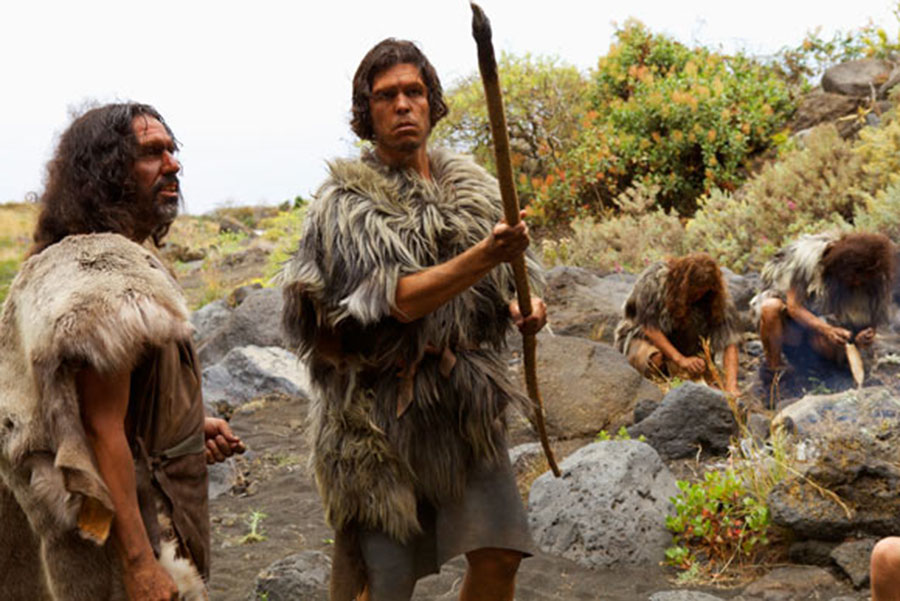
Study: Neanderthals Had Capacity to Produce Human-Like Speech

Wednesday, March 3, 2021

Neanderthals. Image credit: University of Utah via kued.org.

Neanderthals evolved the auditory capacities to support a vocal communication system as efficient as modern human speech, according to new research led by Universidad de Alcalá scientists.

The linguistic capacities in Neanderthals have long been an area of active research and debate among scientists, albeit with little resolution.

The last two decades have seen increasing archaeological discoveries documenting complex behaviors in this sister species to Homo sapiens. These have been linked to the possible presence of language, since it seems reasonable to suggest that such behaviors require the presence of a complex and efficient oral communication system.

Nevertheless, a different point of view maintains that the distinctive features of human language, absent in other organisms, include a symbolic element as well as a recursive syntactic process called merge.

This latter process, at its simplest, uses two syntactic elements and assembles them to form a set and is argued to be exclusive to Homo sapiens and to have appeared no earlier than 100,000 years ago.

Tracing the presence of symbolism and syntactic processes in the course of human evolution currently lies outside the realm of possibility in paleontology.

Nevertheless, the study of human fossils can prove key to determining whether past human species, and in particular the Neanderthals, possessed the anatomy necessary to produce and perceive an oral communication system as complex and efficient as human speech, the usual vehicle for language.

In other words, although paleontology cannot study the evolution of the ‘software’ of language it can contribute to our understanding of the evolution of the ‘hardware’ of speech.

“For decades, one of the central questions in human evolutionary studies has been whether the human form of communication, spoken language, was also present in any other species of human ancestor, especially the Neanderthals,” said Professor Juan Luis Arsuaga, a researcher at the Centro Mixto (UCM-ISCIII) de Evolución y Comportamiento Humanos and the Departamento de Geodinámica at the Universidad Complutense de Madrid.

Using high-resolution CT scans, Professor Arsuaga and his colleagues created 3D models of the ear structures of Homo sapiens, Neanderthals, and the Sima de los Huesos hominins, considered ancestors of the later Neanderthals.

They then entered the new data into a software-based model, developed in the field of auditory bioengineering, to estimate the hearing abilities up to 5 kHz, which encompasses most of the frequency range of modern human speech sounds.

Compared with the Sima de los Huesos hominins, Neanderthals showed slightly better hearing between 4-5 kHz, resembling modern humans more closely.

In addition, the researchers calculated the frequency range of maximum sensitivity, technically known as the occupied bandwidth, in each species.

“The occupied bandwidth is related to the communication system, such that a wider bandwidth allows for a larger number of easily distinguishable acoustic signals to be used in the oral communication of a species,” they explained.

“This, in turn, improves the efficiency of communication, the ability to deliver a clear message in the shortest amount of time.”

The Neanderthals had a wider bandwidth compared with their ancestors from Atapuerca, more closely resembling modern humans in this feature.

“This really is the key. The presence of similar hearing abilities, particularly the bandwidth, demonstrates that the Neanderthals possessed a communication system that was as complex and efficient as modern human speech,” said Professor Mercedes Conde-Valverde, a researcher in the Cátedra de Otoacústica Evolutiva y Paleoantropología at the Universidad de Alcalá.

“One of the other interesting results from the study was the suggestion that Neanderthal speech likely included an increased use of consonants,” said Professor Rolf Quam, a researcher in the Department of Anthropology at the Binghamton University, the Division of Anthropology at the American Museum of Natural History, the Universidad de Alcalá, and the Centro Mixto (UCM-ISCIII) de Evolución y Comportamiento Humanos.

The team’s results show that Neanderthals had a similar capacity to us to produce the sounds of human speech, and their ear was ‘tuned’ to perceive these frequencies.

This change in the auditory capacities in Neanderthals, compared with the ancestral Sima de los Huesos hominins, parallels archaeological evidence for increasingly complex behavioral patterns, including changes in stone tool technology, domestication of fire and possible symbolic practices.

“These results are particularly gratifying. We believe, after more than a century of research into this question, that we have provided a conclusive answer to the question of Neanderthal speech capacities,” said Dr. Ignacio Martinez, a researcher at the Centro Mixto (UCM-ISCIII) de Evolución y Comportamiento Humanos and the Departamento de Geodinámica at the Universidad Complutense de Madrid.

The findings were published in the journal Nature Ecology & Evolution.

_____

M. Conde-Valverde et al. Neanderthals and Homo sapiens had similar auditory and speech capacities. Nat Ecol Evol, published online March 1, 2021; doi: 10.1038/s41559-021-01391-6

Source: www.sci-news.com/

Pages