nandi's blog

World’s Smallest Stegosaur Footprint Found

Saturday, April 17, 2021

A life reconstruction of the stegosaur trackmakers and paleoenvironment 110 million years ago. Image credit: Kaitoge.

An international team of paleontologists has discovered a 5.7-cm-long stegosaur footprint in Xinjiang province, China.

The newly-discovered stegosaur footprint was left around 110 million years ago (Early Cretaceous period).

It belongs to the ichnogenus Deltapodus and co-occurs with the tracks of larger individuals.

Found in the Tugulu Group, China’s Xinjiang province, it is only 15% as long as the type of Deltapodus curriei from the same locality.

“This footprint was made by an herbivorous, armored dinosaur known broadly as a stegosaur — the family of dinosaurs that includes the famed Stegosaurus,” said Dr. Anthony Romilio, a paleontologist in the School of Biological Sciences at the University of Queensland.

“Like Stegosaurus, this little dinosaur probably had spikes on its tail and bony plates along its back as an adult.”

“With a footprint of less than 6 cm, this is the smallest stegosaur footprint known in the world.”

“It’s in strong contrast with other stegosaur prints found at the Chinese track site which measured up to 30 cm, and prints found in places like Broome in Western Australia where they can be up to 80 cm.”

The world’s smallest stegosaur footprint, Xingjiang province, China. Image credit: Lida Xing.

The tiny stegosaur footprint has similar characteristics of other stegosaur footprints with three short, wide, round toe impressions.

However, Dr. Romilio and colleagues found the print wasn’t elongated like larger counterpart prints discovered at the track sites, which suggests the young stegosaur had a different behavior.

“Stegosaurs typically walked with their heels on the ground, much like humans do, but on all fours which creates long footprints,” Dr. Romilio said.

“The tiny track shows that this dinosaur had been moving with its heel lifted off the ground, much like a bird or cat does today.”

“We’ve only previously seen shortened tracks like this when dinosaurs walked on two legs.”

“It was plausible young stegosaurs were toe-walkers,” said Dr. Lida Xing, a paleontologist in the State Key Laboratory of Biogeology and Environmental Geology and the School of the Earth Sciences and Resources at the China University of Geosciences.

“This could be possible as this is the ancestral condition and a posture of most dinosaurs, but the stegosaur could also have transitioned to heel-walking as it got older.”

“A complete set of tracks of these tiny footprints would provide us with the answer to this question, but unfortunately we only have a single footprint.”

The study was published online in the journal Palaios.

_____

Lida Xing et al. 2021. Stegosaur track assemblage from Xinjiang, China, featuring the smallest known stegosaur record. Palaios 36 (2): 68-76; doi: 10.2110/palo.2020.036

Source: www.sci-news.com/

Paleontologists Unlock Secret of Azhdarchid Pterosaurs’ Extremely Long Necks

Friday, April 16, 2021

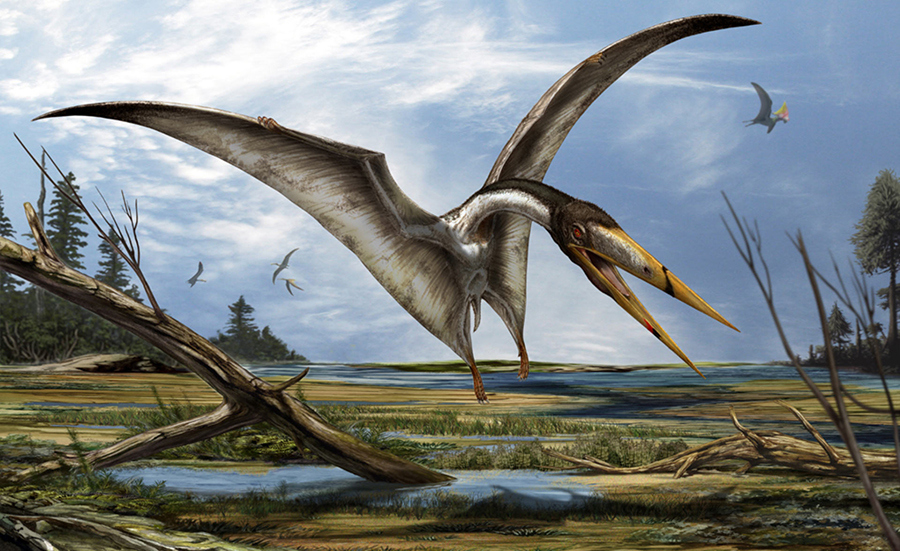
An artist’s impression of the azhdarchids pterosaur Alanqa saharica. Image credit: Davide Bonadonna.

Paleontologists have found that the thin neck vertebrae of the azhdarchid pterosaurs got their strength from an intricate internal structure.

Pterosaurs — flying reptiles of the Mesozoic era – made their first appearance in the fossil record in the Late Triassic and survived until the end of the Cretaceous approximately 66 million years ago.

Although some pterosaurs were small, with wingspans of less than 1 m, members of the enigmatic pterosaur family Azhdarchidae achieved wingspans of up to 10 m, possibly even as high as 12 m.

The azhdarchids are notable for elongation of the neck as a result of hyper-elongation of their cervical vertebrae.

“These animals had ridiculously long necks,” said Cariad Williams, a Ph.D. candidate at the University of Illinois at Urbana-Champaign.

“In some species, the fifth vertebra of the neck from the head end is as long as the animal’s body. It makes a giraffe look perfectly normal.”

“We wanted to know a bit about how this incredibly long neck functioned, as it seems to have very little mobility between each vertebra.”

Williams and colleagues investigated the internal micro-architecture of a well-preserved cervical vertebra from the Cretaceous azhdarchid pterosaur Alanqa sp. found in the Kem Kem Group of Morocco.

“One of our most important findings is the arrangement of cross-struts within the vertebral centrum,” said Dr. Dave Martill, a paleontologist at the University of Portsmouth.

“It is unlike anything seen previously in a vertebra of any animal.”

“The neural tube is placed centrally within the vertebra and is connected to the external wall via a number of thin rod-like trabeculae, radially arranged like the spokes of a bicycle wheel and helically arranged along the length of the vertebra. They even cross over like the spokes of a bicycle wheel.”

“Evolution shaped these creatures into awesome, breathtakingly efficient flyers.”

The vertebra of Alanqa sp. shows the bicycle wheel-like spoke arrangement. Image credit: Williams et al., doi: 10.1016/j.isci.2021.102338.

The team’s analysis suggests that as few as 50 of the spoke-like trabeculae increased the amount of weight azhdarchid necks could carry without buckling by 90%.

Together with the basic tube-within-a-tube structure, it explains how the relatively light-weight animals could capture and carry heavy prey items without breaking their necks.

“It appears that this structure of extremely thin cervical vertebrae and added helically arranged cross-struts resolved many concerns about the biomechanics of how these creatures were able to support massive heads — longer than 1.5 m — on necks longer than that of the modern-day giraffe, all whilst retaining the ability of powered flight,” Dr. Martill said.

“While pterosaurs are sometimes thought of as evolutionary dead ends, the new findings reveal them as fantastically complex and sophisticated. Their bones and skeletons were marvels of biology — extremely light yet strong and durable,” the paleontologists said.

“There’s still much to learn in future work about pterosaurs, including seemingly basic questions about their flight abilities and feeding ecology.”

The findings appear in the journal iScience.

_____

Cariad J. Williams et al. Helically arranged cross struts in azhdarchid pterosaur cervical vertebrae and their biomechanical implications. iScience, published online April 14, 2021; doi: 10.1016/j.isci.2021.102338

Source: www.sci-news.com/

98-Million-Year-Old Pollen-Feeding Beetle Found Preserved in Amber

Thursday, April 15, 2021

Ecological reconstruction of Pelretes vivificus in the Burmese amber forest; the flowers in the reconstruction are based on Lijinganthus revoluta. Image credit: J. Sun.

Paleontologists have found an exceptionally preserved short-winged flower beetle and associated pollen aggregations and coprolites in a piece of mid-Cretaceous amber originating from northern Myanmar. The discovery provides the direct evidence of pollen-feeding in a Cretaceous beetle and confirms that diverse beetle lineages visited early angiosperms (flowering plants) in the Cretaceous period.

Beetles are often cited as likely candidates for the earliest pollinators of angiosperms due to their long evolutionary history.

Ii has been suggested that early associations between beetles and angiosperms in the Cretaceous played a key role in the diversification of both groups.

Until now, pollination in beetles has been determined only on the basis of amber inclusions being preserved alongside pollen grains, possessing morphological features interpreted as possibly facilitating pollination, and having living relatives that are known to feed on pollen.

The newly-identified pollen-feeding beetle, named Pelretes vivificus, lived 98.2 million year ago in what is now Myanmar.

Its closest relatives are short-winged flower beetles (family Kateretidae) that today occur in Australia, visiting a diverse range of flowers and feeding on their pollen.

Pelretes vivificus is associated with clusters of pollen grains, suggesting that short-winged flower beetles visited angiosperms in the Cretaceous,” said Professor Chenyang Cai, a paleontologist at the Nanjing Institute of Geology and Palaeontology.

“Some aspects of the beetle’s anatomy, such as its hairy abdomen, are also adaptations associated with pollination.”

The piece of amber examined by the team came from a mine in the Hukawng Valley, Kachin State, northern Myanmar.

“Besides the unparalleled abundance of fossil insects, the amber dates back to the mid-Cretaceous, right when angiosperms were taking off,” said Dr. Erik Tihelka, an entomologist and paleontologist at the University of Bristol.

Photomicrographs of Pelretes vivificus from mid-Cretaceous Burmese amber: (a) habitus, dorsal view, with inset highlighting a Tricolpopollenites pollen grain; (b) head of Pelretes vivificus, dorsal view; (c) habitus, ventral view; (d) head of Pelretes vivificus, ventral view (area indicated in c); (e) protarsus of Pelretes vivificus; (f) metatarsus of Pelretes vivificus; (g) abdominal apex of Pelretes vivificus, dorsal view (area indicated in a), with arrowheads highlighting pollen grains. Abbreviations: a1–11 – antennomeres 1–11; abd – abdomen; el – elytra; ey – eye; he – head; ma – mandibles; mp4 – maxillary palpomere 4; mtt1–5 – metatarsomeres 1–5; pg – pollen grain; mtv – metaventrite; pr – pronotum; ps – prosternum; pt2, 4 and 5 – protarsomeres 2, 4 and 5; se – sensory cell. The images in a, b, e and f were obtained under normal reflected light; the others were obtained under confocal laser scanning microscopy. Scale bars – 200 μm in a and c; 100 μm in b, d and g; 50 μm in e and f. Image credit: Tihelka et al., doi: 10.1038/s41477-021-00893-2.

While Pelretes vivificus is not the first pollinating beetle to be described from Cretaceous amber, this unique specimen preserves a bizarre clue about its diet.

The fossil is associated with beetle coprolites that provide a very unusual but important insight into the diet of short-winged flower beetles in the Cretaceous.

The coprolites are completely composed of pollen, the same type that is found in clusters surrounding the beetle and attached to its body, which suggest that Pelretes vivificus visited angiosperms to feed on their pollen.

This finding provides a direct link between early flowering plants in the Cretaceous and their insect visitors.

It shows that these insect fossils were not just incidentally co-preserved with pollen, but that there was a genuine biological association between the two.

“The pollen associated with the beetle can be assigned to the fossil genus Tricolpopollenites,” said Dr. Liqin Li, a fossil pollen specialist at the Nanjing Institute of Geology and Palaeontology.

“This group is attributed to the eudicots, a living group of derived angiosperms, that includes the orders Malpighiales and Ericales.”

“This shows that pollinators took advantage of early angiosperms soon after their initial diversification and visited a diverse range of groups by the mid-Cretaceous,” Professor Cai added.

The team’s paper was published in the journal Nature Plants.

_____

E. Tihelka et al. Angiosperm pollinivory in a Cretaceous beetle. Nat. Plants, published online April 12, 2021; doi: 10.1038/s41477-021-00893-2

Source: www.sci-news.com

Kunpengopterus antipollicatus: Small Jurassic Pterosaur Had an Opposed Thumb

Wednesday, April 14, 2021

Life reconstruction of Kunpengopterus antipollicatus in the Tiaojishan paleoforest; opposed pollex depicted as being utilized in handling food items (a palaeontinid) and in clinging to trees (a ginkgo). Image credit: Chuang Zhao.

Opposed thumbs are adaptations to arboreal life and rare for non-mammal vertebrates; Kunpengopterus antipollicatus, a newly-discovered species of arboreal pterosaur that inhabited a unique forest ecosystem in what is now China during the Jurassic period, shows the oldest record of such a feature.

Kunpengopterus antipollicatus is thought to have lived between 161 and 158 million years ago (Jurassic period).

The flying reptile had a small body, a primitive, elongate tail, and an estimated wingspan of 85 cm (33.5 inches).

It was a type of a darwinopteran, a primitive subgroup of predatory pterosaurs with transitional anatomy.

“Darwinopterans are a group of pterosaurs from the Jurassic of China and Europe, named after Charles Darwin due to their unique transitional anatomy that has revealed how evolution affected the anatomy of pterosaurs throughout time,” explained Dr. Rodrigo V. Pêgas, a paleontologist at the Federal University of ABC.

Nicknamed ‘Monkeydactyl,’ Kunpengopterus antipollicatus is the first known pterosaur with an opposed pollex (thumb).

This species also represents the earliest record of a true opposed thumb in Earth’s history.

“The fingers of ‘Monkeydactyl’ are tiny and partly embedded in the slab,” said Dr. Fion Waisum Ma, a Ph.D. researcher at the University of Birmingham.

“Thanks to micro-CT scanning, we could see through the rocks, create digital models and tell how the opposed thumb articulates with the other finger bones.”

“This is an interesting discovery. It provides the earliest evidence of a true opposed thumb, and it is from a pterosaur — which wasn’t known for having an opposed thumb.”

Holotype specimen of Kunpengopterus antipollicatus (A) and a schematic skeletal drawing (B). Scale bar – 50 mm. Abbreviations: ca – caudal series, cri – cervical rib, cv – cervical vertebra, d – digit, de – dentary, fe – femur, hu – humerus, hy – hyoid apparatus, mc – metacarpal, ph – phalanx, pop.il – postacetabular process of the illium, pp – prepubis, pt – pteroid, rd – radius, sk – skull, ti – tibia, ul – ulna. Image credit: Zhou et al., doi: 10.1016/j.cub.2021.03.030.

By studying its forelimb morphology and musculature, the paleontologists suggest that Kunpengopterus antipollicatus could have used its hand for grasping, which is likely an adaptation for arboreal life.

“A true opposed pollex is mostly present in mammals (e.g. primates) and some tree frogs, but extremely rare among extant reptiles except for chameleons,” the researchers said.

“This discovery adds to the list that darwinopteran pterosaurs such as Kunpengopterus antipollicatus also evolved an opposed thumb.”

The two fossilized specimens of Kunpengopterus antipollicatus — one of which with two associated eggs — were recovered form the Tiaojishan Formation of Liaoning in China.

“Tiaojishan paleoforest is home to many organisms, including three genera of darwinopteran pterosaurs,” said Dr. Xuanyu Zhou, a paleontologist at China University of Geosciences.

“Our results show that Kunpengopterus antipollicatus has occupied a different niche from Darwinopterus and Wukongopterus, which has likely minimized competition among these pterosaurs.”

“On top of that, a particular darwinopteran fossil has been preserved with two associated eggs, revealing clues to pterosaur reproduction,” Dr. Pêgas said.

“They’ve always been considered precious fossils for these reasons and it is impressive that new darwinopteran species continue to surprise us!”

The study was published in the journal Current Biology.

_____

Xuanyu Zhou et al. A new darwinopteran pterosaur reveals arborealism and an opposed thumb. Current Biology, published online April 12, 2021; doi: 10.1016/j.cub.2021.03.030

Source: www.sci-news.com/

Yukon Wolves Survived Ice-Age Extinction Thanks to Changes in Their Diet

Tuesday, April 13, 2021

Gray wolves take down a horse on the mammoth-steppe habitat of Beringia during the Late Pleistocene, around 25,000 years ago. Image credit: Julius Csotonyi.

Gray wolves (Canis lupus) from the Yukon Territory, Canada, survived the extinction at the end of the last Ice Age by adapting their diet over thousands of years — from a primary reliance on horses (Equus sp.) during the Pleistocene, to moose (Alces alces) and caribou (Rangifer tarandus) today.

A research team led by Dr. Danielle Fraser from the Canadian Museum of Nature, Carleton University, and Smithsonian National Museum of Natural History, investigated if and how diets of Yukon gray wolves changed from the Pleistocene (50,000 to 26,000 years ago) to the recent times.

“We can study the change in diet by examining wear patterns on the teeth and chemical traces in the wolf bones,” said Zoe Landry, a student at Carleton University.

“These can tell us a lot about how the animal ate, and what the animal was eating throughout its life, up until about a few weeks before it died.”

Dr. Fraser, Landry and their colleagues relied on established models that can determine an animal’s eating behavior by examining microscopic wear patterns on its teeth.

Scratch marks indicate the wolf would have been consuming flesh, while the presence of pits would suggest chewing and gnawing on bones, likely as a scavenger.

The analysis showed that scratch marks prevailed in both the ancient and modern wolf teeth, meaning that the wolves continued to survive as primary predators, hunting their prey.

Their modern diet is well established; the diet of the ancient wolves was assessed by looking at the ratios of carbon and nitrogen isotopes extracted from collagen in the bones. Relative levels of the isotopes can be compared with established indicators for specific species.

The results showed that horses, which went extinct during the Pleistocene, accounted for about half of the gray wolf diet. About 15% came from caribou and Dall’s sheep, with some mammoth mixed in.

At this time, the ancient wolves would have co-existed with other large predators such as scimitar cats and short-faced bears.

The eventual extinction of these predators could have created more opportunity for the wolves to transition to new prey species.

“This is really a story of Ice Age survival and adaptation, and the building up of a species towards the modern form in terms of ecological adaptation,” said Dr. Grant Zazula, a paleontologist with the Palaeontology Program of Government of Yukon.

The team’s paper was published in the journal Palaeogeography, Palaeoclimatology, Palaeoecology.

_____

Zoe Landry et al. 2021. Dietary reconstruction and evidence of prey shifting in Pleistocene and recent gray wolves (Canis lupus) from Yukon Territory. Palaeogeography, Palaeoclimatology, Palaeoecology 571: 110368; doi: 10.1016/j.palaeo.2021.110368

Source: www.sci-news.com/

Ornatops incantatus: New Species of Duck-Billed Dinosaur Unearthed in New Mexico

Tuesday, April 13, 2021

Life restoration of Ornatops incantatus. Illustration by Brian Engh – http://dontmesswithdinosaurs.com, commissioned by Western Science Center.

Paleontologists have announced the discovery of a new genus and species of hadrosaurid (duck-billed) dinosaur, based on the skeletal remains found in New Mexico, the United States.

Dubbed Ornatops incantatus, the new dinosaur roamed Earth around 80 million years ago (Late Cretaceous period).

Its partial skeleton, including part of the skull, was found at a single locality in the Menefee Formation in San Juan County, New Mexico.

“The Menefee Formation represents one of the most promising frontiers for exploring the early evolution of major dinosaur groups in Laramidia, the Upper Cretaceous landmass consisting of Mexico, the western United States, western Canada, and Alaska,” Dr. Andrew McDonald from the Western Science Center and colleagues wrote in their paper.

“Dating to approximately 84-78 million years ago, the Menefee Formation predates the most productive Upper Cretaceous dinosaur-bearing units in western North America, such as the Kirtland Formation of New Mexico, the Kaiparowits Formation of Utah, and the Dinosaur Park Formation of Alberta.”

Ornatops incantatus is a member of Brachylophosaurini, a group of hadrosaurid dinosaurs that inhabited western North America during the Campanian age (84-72 million years ago) of the Cretaceous period.

“Features of the skull roof and braincase identify the new hadrosaurid as a member of Brachylophosaurini, one of several subclades within Saurolophinae, the ‘solid-crested’ hadrosaurids,” the paleontologists explained.

The new species is closely related to — and possibly intermediate between — two other brachylophosaurin species: Probrachylophosaurus bergei and Brachylophosaurus canadensis.

Ornatops incantatus is the first brachylophosaurin hadrosaur from New Mexico and the southernmost occurrence of the group,” the researchers wrote.

“It is also the first crested brachylophosaurin discovered in the southern part of Laramidia.”

The team’s paper was published online April 2, 2021 in the journal PeerJ.

_____

A.T. McDonald et al. 2021. A new brachylophosaurin (Dinosauria: Hadrosauridae) from the Upper Cretaceous Menefee Formation of New Mexico. PeerJ 9: e11084; doi: 10.7717/peerj.11084

Source www.sci-news.com/

Jurassic World Evolution: How to Get a 5 Star Park Rating

Monday, April 12, 2021

A guide explaining how to get a 5-star park rating in Jurassic World: Evolution. It goes over things like visitor satisfaction and dinosaur ratings.

Serving as a dinosaur-themed zoo tycoon, Jurassic World Evolution allows players to create and manage their own prehistoric theme parks. They can clone dinosaurs, engage in gene manipulation, build enclosures, and drive ranger vehicles as they attempt to make Hammond’s Jurassic Park dream a reality.

Cloning dinosaurs and manipulating their genes is something every player will get into, it’s practically the main feature of the Jurassic Park series as a whole. But what will be a bit more difficult to accomplish is getting each park a 5-star rating. It requires players to create an optimized balance of entertainment, capacity, safety, and shopping ability within each island within the archipelago. But how do players achieve that?

Dinosaur Diversity And Visibility In Jurassic World Evolution

As any player can guess, dinosaurs serve as the park’s main money-maker and visitor attraction. But getting a high dinosaur rating is actually fairly simple. Have a variety of dinosaurs on the islands, ensure they are well taken care of, add genetic modifications, and continue trying to breed dinosaurs with a 100% complete genome.

If the player is having difficulty raising this rating or is dealing with a small island like Isla Pena, players can try increasing a dinosaur’s combat infamy by encouraging fights or dinosaur predation. It will likely result in a dinosaur getting injured or dying, but people really like it when a dinosaur has a reputation for violence. But creating dinosaurs for that purpose can be expensive. In which case, players can try getting a scenery bonus by building scenery items like fancy trees and shrubs. Provided that dinosaurs are near said scenery, this should give the dinosaur rating a bit of a boost.

Just as important is dinosaur visibility. When an enclosure is being created, always ensure to build a viewing gallery or two. Preferably with a feeding station placed in its sight range to encourage dinosaur visibility. It is also advised to leave room around the enclosure in the event players want to add gyro sphere stations to the enclosure later on in the game.

Emergency Shelters And Storm Defense Centers In Jurassic World Evolution

If creating dinosaurs is considered the park’s main money-maker, consider safety shelters and storm centers as the park’s main money-savers. Their main purpose is to limit the amount of money lost on things like property damage from tropical storms and lawsuits from dinosaur attacks that the player may or may not have initiated.

But the main building that affects the park’s rating are the emergency shelters. These shelters are imperative for a high safety rating, so players should always try to ensure that there are enough shelters on the island to give the island a 95% evacuation range. Players can see this safety coverage by going into management view and selecting the appropriate overlay.

Visitor Transport And Housing In Jurassic World Evolution

Another aspect of increasing a park’s rating is increasing the number of visitors that can enter the park and ensuring they are able to traverse the park with relative ease. In simple terms, this means players need to build two things: hotels and a monorail. These buildings will increase a park’s visitor capacity and transport rating respectively.

The amount of hotels a player should build varies depending on the island, but having 2-4 tends to be a healthy number. These hotels should be located close to an enclosure, restrooms, and a few shopping buildings to increase visitor satisfaction.

The monorail is relatively easier to implement. So long as the player ensures that there is a monorail station near the entrance to the park, all players really need to do is ensure that the monorail is able to take stops to other popular sections of the park. But it should also be noted that monorails can also increase visitor satisfaction rating. How? Well, those monorails allow visitors to get a decent view of areas around the monorail while it is in transit. Meaning that if the player is clever about it and lays the rails through dinosaur enclosures, they can boost the park’s dinosaur visibility rating.

Visitor Food And Shopping In Jurassic World Evolution

This is admittedly one of the more boring aspects of park management, but it has to be done. Shop building and inventory management. The park’s visitor satisfaction rating is based on several variables, including dinosaur visibility and restroom rating. But it also includes variables like the food, drink, fun, and shopping rating.

To increase these ratings, build the appropriate buildings close to popular dinosaur enclosures and hotels. Players can determine the amount of demand for each category by selecting the appropriate option in management view. Players can also determine how much a building will affect a given rating by looking at a building's facility rating stats.

Once a player feels like they have constructed enough buildings, it is now time to micromanage the shop’s inventory and personnel. After all, optimizing ratings is not just about having a lot of patrons. It’s about ensuring that visitors are able to buy what they want to buy—even if that something is of a higher price range.

When a shop is selected, players will find that they have the ability to change what the shop sells, the number of employees, management focus, etc. It will require a bit of finagling and experimenting, but there should be a combination where visitors can get quality goods and services for the maximum amount of park profit. When making these changes, players should constantly be checking the management view to ensure that all consumer demands are being met.

Source: https://screenrant.com/

Jurassic World: Every Original Trilogy Character Who Could Still Return

Sunday, April 11, 2021

Jurassic World: Dominion and Camp Cretaceous have the chance to bring back even more legacy characters from the original Jurassic Park Trilogy.

The newest entries in the Jurassic World franchise have the potential to bring back even more characters from the original Jurassic Park trilogy. Both the animated spin-off series Jurassic World: Camp Cretaceous and the upcoming third film Jurassic World: Dominion feature characters from the original trilogy, but there are individuals that haven't been announced yet that could still make an appearance.

The original Jurassic Park was a landmark moment in blockbuster history, both in terms of how popular the movie was and how much it pioneered CGI special effects. Steven Spielberg's 1993 film spawned two sequels, each with decreasing popularity and quality. A fourth film was in development for over a decade, until a soft reboot came in the form of 2015's Jurassic World. While the movie had mostly a brand new cast, it was still filled with references and callbacks to the original movie. It even brought back BD Wong's Dr. Henry Wu, who had a minor role in the first film but a larger one in the World trilogy and the cartoon. The sequel then had a very brief cameo from Jeff Goldblum as his character Dr. Ian Malcolm, and Dominion is selling itself on bringing back Malcolm along with Dr. Alan Grant and Dr. Ellie Sattler, again being played by Sam Neil and Laura Dern respectively.

This begs the question that if the new movie is selling itself on bringing back legacy characters, then what other characters from the original trilogy could make an appearance? There are a number of characters who survived the first three films who could do anything from having major roles in the new movie to simply making cameo appearances in it, or in Camp Cretaceous. There are ones that seem like obvious picks, but others are less obvious yet can bridge the gap between all the entries in the Jurassic Park franchise.

Tim And Lex Murphy

The kids from the original movie seem like a clear choice for legacy characters to bring back, especially since they'd both be adults by now and would have the familial connection to John Hammond and the Park's legacy. Tim even had an active interest and knowledge of dinosaurs, so even if his sister would never want to return to Isla Nublar he could still be tempted by all kinds of new dinosaurs.

Dr. Sarah Harding

Ian Malcolm's former love interest at the time of The Lost World: Jurassic Park, she's still an accomplished scientist in her own right. She specialized in animal behaviors, including that of dinosaurs, and could possibly take an interest in the genetically engineered creatures that have escaped from Jurassic World. The only issue would be that she's played by Julianne Moore, who may not have much interest in reprising her role for a small/cameo appearance. It's why it's unlikely for someone like Vince Vaughn to reprise his The Lost World character either. She could potentially be recast and appear in Camp Cretaceous.

Kelly Malcolm

Ian Malcolm's daughter seems like another obvious pick. She probably wouldn't have a major role of any kind, but her and her unseen siblings could make a cameo in the film as they would still be a part of Ian's life at the time of Dominion's story.

Billy Brennan

Billy was Alan Grant's assistant in Jurassic Park III and was believed to have died from a pteranodon attack, but he actually survived. He could be a character who can appear in the cartoon show, possibly as an experienced guide or mentor to the younger heroes.

Eric Kirby

Eric was the boy who Alan Grant saved from Isla Sorna and who he formed an emotional connection to. It's unlikely he would play any kind of major part in new stories, but he could be seen keeping in contact with Alan Grant at the time of Dominion, just as a nod to the series's history.

These are just some of the characters from the original Jurassic Park trilogy who could make appearances in new Jurassic World installments, each of them being an opportunity to honor and acknowledge the history of the franchise.

Source: https://screenrant.com/

The Missing Lost World: Jurassic Park Detail That Bothers Fans

Saturday, April 10, 2021

Ah Jurassic Park. You can hear John Williams' resplendent theme music already, can't you? Well, after the wild success of the first film back in 1993, Michael Crichton, the author of the original book, was under pressure to deliver a second chapter of dino action. So in 1995, The Lost World arrived on bookshelves everywhere, with Steven Spielberg directing the movie adaptation, The Lost World: Jurassic Park, in 1997.

The story revolved around John Hammond's nephew taking over the nefarious company, InGen, intending to set up a small Jurassic Park in San Diego using genetically engineered dinosaurs that were hidden on a second island, Isla Sorna. However, it wasn't as well-received as the iconic first film, with Roger Ebert criticizing it for being "written on autopilot." Ouch — that's got to hurt more than a velociraptor bite. But it's easy to see what he means, with certain elements of the movie not making much sense aside from delivering fast-paced action sequences to recreate the magic from the first film.

One such moment toward the movie's finale — just before a T-Rex gets loose in the streets of San Diego — has confused fans for over two decades. How exactly did the entire crew of the boat die on the way to the city?

Maybe the T. Rex isn't the culprit

When InGen loaded the tranquilized T-Rex onto the cargo ship, it's surprising nobody stopped to wonder whether this was a recipe for disaster. Because lo and behold, the ship crashes into the docks and unleashes the prehistoric predator on the world. Then, the entire crew is found dead on the ship, with a severed hand still clutching the controls on the bridge. As a Reddit post pointed out, the T-Rex was locked away in a cage before the crash, and the dinosaur was so large that maneuvering around the ship while trying to munch the crew would be very difficult.

Many fans suggested that raptors attacked the boat before it left Isla Sorna, mainly because the T-Rex would've been too big to attack the bridge of the ship, leaving behind that dangling hand. But surely that would mean the vicious hunters would still be on board by the time the boat arrived in San Diego. And if there were a handful of velociraptors hunting civilians, that should've definitely stayed in the movie.

There's some debate online over whether footage left on the cutting room floor would've explicitly explained the death of the crew. But of all the deleted scenes seemingly confirmed from The Lost World, a raptor boat attack isn't one of them. Another theory suggests that John Hammond hired a team of mercenaries to assassinate the crew as part of InGen's coverup of the incident. But there's some serious narrative legwork to be done in making that convincing. How would the mercenaries escape the rampaging T-Rex? Whose idea was it to frame the dinosaurs for the killings? That's some heavy conjecture.

Or maybe it's just a simple scene meant to underscore the idea that the T-Rex got loose... It seems we'll never know.

Source: www.looper.com/

Jurassic World Denies Involvement With Giant Lizard Running Wild in Thai Supermarket

Friday, April 9, 2021

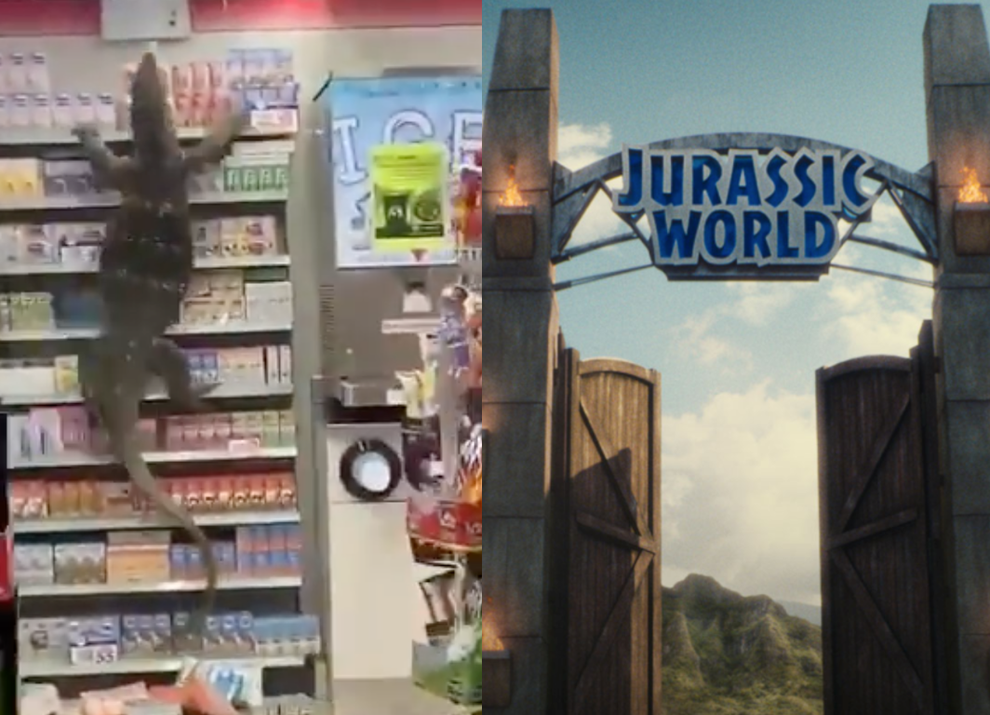
Jurassic World social media account joked that they did not claim responsibility for this lizard’s behaviour in a Thai shop (Facebook)

The Jurassic World film franchise have tried to absolve itself for any blame for their rowdy lizard cousin, who in footage that emerged yesterday, ravaged a shop.

Comparisons between the intruding Asian Water Monitor Lizard were also made to Godzilla were made after it tore up a display in a Thai supermarket, climbing up shelves and causing boxes to tumble down.

It appears that it was looking for a resting spot, as when at the summit of the shelving unit, the lizard made itself comfortable. His conduct stressed his fellow shoppers, who are heard screaming in the background.

The video was first shared yesterday morning, since then the travel agent Mundo Namoda deleted their tweet, but before it did it gathered over 77,000 views and 3000 retweets.

Jurassic World, who might have been worried about reputational damage, even though the behaviour of one reptile should not mare all reptiles, especially extinct ones from beloved film franchises.

On their Twitter account, they shared the video, which was reposted by another user, with the comment that it “wasn’t us.”

Guess we’ll never know where this lad came from.

Source: www.indy100.com/

Pages