nandi's blog

Genome-Wide Data from Stone Age Bears Recovered from Cave Sediments

Wednesday, April 21, 2021

Reconstruction of the giant, short-faced North American bear Arctodus simus. Image credit: Daniel Reed / CC BY-SA 3.0.

Scientists have reconstructed the genomes of the extinct giant short-faced bear (Arctodus simus) and the American black bear (Ursus americanus) using environmental DNA fragments from the remote Chiquihuite Cave in Mexico.

Fossil records are incomplete, and many species of mammals, in particular those that lived at low population densities, are seldom found.

For these ancient species, destructive DNA extraction from fossil remains has the potential to reveal new insights into population and evolutionary history; however, it also causes irreversible damage to high-value specimens.

The discovery that DNA from past populations of organisms could be obtained directly from sediment, therefore, held great promise for ancient population genetics and phylogenetics.

Commonly known as environmental DNA (eDNA) research, this approach relies on sequencing DNA fragments derived from shed cells, hair, feces, and urine preserved within sediment.

Standard eDNA techniques allow species composition to be determined in the absence of macrofossils across a variety of environments including sediments, cave formations, ice cores, lakes, rivers, and oceans.

To date, however, analyses of ancient eDNA have been restricted to mitochondrial and chloroplast DNA or, more recently, to short and highly diverse sequences generated using a shotgun sequencing approach.

“When an animal or a human urinates or defecates, cells from the organism are also excreted. And the DNA fragments from these cells are what we can detect in the soil samples,” said Professor Eske Willerslev, a researcher in the Department of Zoology at the University of Cambridge and the Lundbeck Foundation GeoGenetics Centre at the University of Copenhagen.

“Using extremely powerful sequencing techniques, we reconstructed genomes — genetic profiles — based on these fragments for the first time.”

“We have shown that hair, urine and feces all provide genetic material which, in the right conditions, can survive for much longer than 10,000 years.”

In the study, Professor Willerslev and his colleagues retrieved ancient genome-wide data from 16,000- to 14,000-year-old sediments in Chiquihuite Cave in Astillero Mountains, Mexico.

Their analysis shows that the Late Pleistocene black bear population in Mexico is ancestrally related to the present-day Eastern American black bear population, and that the extinct giant short-faced bears present in Mexico were deeply divergent from the earlier Beringian population.

“The short-faced bears that lived in northern Mexico were distinctly different from the population of black bears living in north-western Canada,” said Dr. Mikkel Winther Pedersen, a researcher in the Lundbeck Foundation GeoGenetics Centre at the GLOBE Institute at the University of Copenhagen.

“This is an excellent example of the new knowledge that suddenly becomes available when you reconstruct genomes based on eDNA fragments extracted from soil.”

“All over the world, everyone scientifically involved in the study of ancient DNA recognised the need to reconstruct genomes from fragments found in soil or sediment,” Professor Willerslev said.

“Being able to do that for the first time means we have opened up a new frontier.”

“Analysis of DNA found in soil could have the potential to expand the narrative about everything from the evolution of species to developments in climate change — this is the moon landing of genomics because fossils will no longer be needed.”

paper describing the research was published in the journal Current Biology.

_____

Mikkel Winther Pedersen et al. Environmental genomics of Late Pleistocene black bears and giant short-faced bears. Current Biology, published online April 19, 2021; doi: 10.1016/j.cub.2021.04.027

Source: www.sci-news.com/

Arackar licanantay: New Giant Dinosaur Species Discovered in Chile

Thursday, April 22, 2021

Credit: Universidad de Chile/AFP

Chilean paleontologists announced Monday the discovery of a new species of giant dinosaurs called Arackar licanantay.

The dinosaur belongs to the titanosaur dinosaur family tree but is unique in the world due to features on its dorsal vertebrae.

The Arackar licanantay—a Kunza indigenous language name that means "Atacameño bones"—lived in what is now the Atacama Region, during the end of the Cretaceous period, 80 to 66 million years ago.

The fossil specimen belongs to a large, quadruped, herbivore measuring some 6.3 meters (20'8") in length but scientists determined the remains are that of a juvenile.

Adults are estimated to have grown to reach 8 meters in length (26').

The bones—a femur, humerus, ischium and vertebral elements of the neck and back—were initially discovered in the 1990's by geologist Carlos Arévalo.

Arévalo excavated the specimen with experts from Chile's National Geology and Mining Service, during a dig 75 kilometers (46 miles) south of the city of Copiapó, in the Atacama Region.

David Rubilar, the Head of the Paleontology Department at Chile's National Museum of Natural History (MNHN) led the team responsible for making the discovery made up of experts from Chile's National Museum of Natural History, the University of Chile's Paleontological Network, and the Laboratory of Dinosaurs of Argentina's National University, in Cuyo, Argentina.

The discovery of a new species of dinosaur was formally announced in an article published in the journal Cretaceous Research.


More information: David Rubilar-Rogers et al. Arackar licanantay gen. et sp. nov. a new lithostrotian (Dinosauria, Sauropoda) from the Upper Cretaceous of the Atacama Region, northern Chile, Cretaceous Research (2021). DOI: 10.1016/j.cretres.2021.104802
Journal information: Cretaceous Research 

Source: https://phys.org/

Pokemon Museum Using Fossils to Teach Paleontology

Wednesday, April 21, 2021

The Pokemon Fossil Museum will be a traveling exhibit exclusive to Japan that intends to both educate and entertain attendees.

The Mikasa City Museum in Hokkaido, Japan will be the first stop for a brand new traveling exhibit that aims to teach Paleontology to visitors with Pokemon. The Pokemon Fossil Museum will be host to a variety of special activities and Pokemon-related paleontological exercises, including never-before-seen reveals of the inspirations behind some of the most well-known Pokemon in the series. It will be a Pokemon event aimed at children, but that hasn't stopped international fans from wondering what new information might be revealed.

The exhibit will be led by a new character Dr. Kaseki, a Pokemon Paleontologist, with the aid of none other than Pikachu. The two will explain paleontological concepts with both real fossils and Pokemon fossils that were greatly inspired by real-life dinosaurs and other ancient creatures. The touring Pokemon Fossil Museum is scheduled to begin on July 4, 2021, and end next year once the Pokemon Fossil Museum has stopped at each of four different cities – first Hokkaido, then Shimane, Tokyo, and lastly Aichi in Summer 2022.

The main attraction of the Pokemon Fossil Museum will be the "real" Pokemon skeletons on display next to real fossils – the comparison is intended to foster scientific awareness through Pokemon. There will also be illustrated comparisons between Pokemon and Dinosaurs, as well as a full-scale imaginary skeleton of what appears to be a Tyrantrum, whose appearance was based almost directly off of that of the T-Rex.

Additionally, the Pokemon Fossil Museum will also unveil official skeletal diagrams of several well-known Pokemon. In a promotional teaser, the Pokemon Fossil Museum showed an image of a Tyrantrum skeletal system compared to a T-Rex's one. There are a lot of differences between the two where the Pokemon team gave Tyrantrum its own flair, and it will be interesting to see what other Pokemon are put on display in this exhibit.

According to the Mikasa City Museum event announcement, the Pokemon Fossil Museum will have 30 total paleontological materials (original, real-life fossils), 8 new full models of Pokemon fossils and skeletal systems, and a large number of original, licensed artwork of both Pokemon and Dinosaurs drawn in the Pokemon style.

The Pokemon franchise is celebrating its 25th birthday in 2021, and while it doesn't appear to be an anniversary-related event, it nonetheless coincides with the series' milestone. It's a fantastic chance for Pokemon fans to learn about their favorite hobby while also learning about real-life science and how it inspired one of the most recognized franchises in the world, but it'll be tough to see the exhibit in-person if you don't live in Japan.

Source: Pokemon Fossil Museum / https://gamerant.com/

Jurassic World Makes the Same Mistake as Jurassic Park

Monday, April 19, 2021

Although Jurassic World tried to avoid Jurassic Park's past mistakes, it didn't succeed in one important way and paid the price for it.

Colin Trevorrow's Jurassic World acts as both a continuation and a reboot of the original Jurassic Park trilogy, and in doing so doesn't miss many chances for callbacks. From showing the original visitor's center to sampling the soundtrack, the Jurassic World trilogy happily links itself back to the original trilogy whenever possible.

Jurassic World also makes it a point to address some of the original park's mistakes. Dinosaurs are given much more space than before, provided with enrichment, and kept in containment more effectively. By the time of the first Jurassic World movie, the park has run several years without incident and on the surface, things are going well. This, of course, changes when the Indominus Rex escapes and wreaks havoc. But there's something about the I. Rex that doesn't compute, aside from the questionable decisions leading to its creation. It is viewed as a monster from the start, even by the behavioral experts -- and yet, its behavior makes sense when viewed through the lens of the first movie.

One main issue the fandom brings up about the original park is that the dinosaurs lack enrichment, something all animals need to thrive. They need to be interacting with things that spark their interest -- it's why zoo animals are given toys or new food or sometimes even ice and snow to play with. Something that's different and interesting keeps them stimulated and healthy, as boredom often leads to destructive behavior. As Dr. Grant says in the first movie, "the T. Rex doesn’t want to be fed, it wants to hunt."

This is shown when the dinosaurs escape and start interacting with new things outside their environment. The T. Rex interacts with the cars much like any curious animal, smelling them, nosing them to see how they react and biting them because her jaws are her main way of interacting with the world, much like how a parrot will gingerly bite something new. The Dilophosaurus, in its interactions with Nedry, is constantly watching him, tipping its head to evaluate him as he moves, looking when he throws away the stick before returning its attention to him, the new living thing worth investigating. Even the raptors, possibly the most maladjusted dinosaurs in the park, interact with the world around them with an animalistic curiosity -- nosing and licking the ladle that fell, running after a fast-moving object because of predator instincts and hunting in coordinated fashion. As Dr. Grant tells Lex, they're animals, and they behave as such.

With that in mind, the I. Rex is put in a situation much like the raptors in the first movie: a too-small enclosure where it's fed via a crane. It is made from at least two apex predators that prefer active hunting and yet is passively fed and kept in a small space. Even considering how it grew past projected sizes, the shown enclosure doesn't seem like nearly enough space. And so when the I. Rex escapes, it behaves much like a high-energy dog breed let into a chicken yard: suddenly, it's surrounded by wide-open spaces with things running and screaming and reacting when it bites into them.

The I. Rex is now over-stimulated and engaging in common predatory behavior, that of surplus killing. This can be seen every time it encounters something new -- Owen Grady gets close when he says it's trying to find where it sits on the food chain, but misses the mark when he says it's killing for sport as though it's willfully malicious. While the I. Rex is killing for sport, this is because it's never been given the necessary enrichment. Instead, it's viewed as a thing, and then punished for it.

What makes this worse is the fact that there's no clear reason to do this to this specific dinosaur --especially compared with how the other animals are treated. The raptors and the Mosasaurus are shown engaging in hunting activities initiated and controlled by their handlers--the Mosasaurus may be made to reach for its meal for show, but it's no different from how crocodiles are fed in the Australian Zoo; it shows off the animal and simulates how they hunt in the wild. The raptors, which in Jurassic Park III are theorized to have intelligence comparable to primates, are shown being trained, as any intelligent animal in captivity might be, and interacting with humans routinely. They're still fairly wild, but much better along for the enrichment they receive.

Compare and contrast how the I. Rex is treated from birth. Unlike John Hammond's approach in the first movie, no one seems to be monitoring the I. Rexes hatching -- which, considering Dr. Wu's apathy towards the raptor hatching in the movie, makes some sense. Viewers are told that the I. Rex ate its sibling, but they are not given any context; baby chickens will peck each other to death if they perceive weakness, to give a real-life example. Without being monitored, there's no saying how long the infant dinosaurs were left to their own devices, or if it happened later from some complication of the genetic manipulation. The narrative wants the audience to believe that this is an irredeemable monster so they can feel triumphant at its eventual demise, and yet its behavior is still that of an animal, as with the first movie.

And this is where Jurassic World not only makes the mistake that Jurassic Park did, but makes it worse. The I. Rex is only ever seen as an asset, not an animal, and its behavior is considered willfully malicious. Yet when compared to animal behavior -- when compared to the first movie, even -- its situation and subsequent behavior have natural explanations. With the first park and the other animals to consider, the I. Rex was purposefully put in this situation, making it an abused animal with a tragic end rather than a vicious movie monster that got what it deserved.

Source: www.cbr.com/

Species Come and Go – Their Ecosystems Persist Over Millions of Years

Monday, April 19, 2021

Paleoenvironmental reconstruction of the extinct mammal community recovered at the fossil site of Els Casots (Spain), dated around 16 million years ago, which is an example of the earliest major stage of Iberian ecosystems of the past 21 million years. During this period, fossil relatives of modern deer and elephants lived in a dry, warm environment, with less diverse ecological interactions than geologically younger communities. Credit: Artwork by Oscar Sanisidro (Universidad de Alcalá de Henares)

A research study sheds new light upon an ongoing debate among conservation biologists: whether we should conserve sets of endangered species, or whether we should preserve ecosystem functioning, that is, the processes inherent to ecosystems, including those that benefit humans – also called ecosystem services.

Using a deep-time approach from today to 21 million years ago, the authors compared communities defined by their inhabiting species against those defined by their species’ different ecological roles. For example, a community may include many different plant-eating species, but these may all be browsing to gather their food, whereas in another community there are fewer plant-eaters, but only a handful are browsing while all others are grazing. How do these different communities behave when, for example, climate is changing?

“Understanding the behavior of past ecosystems under environmental change will help us to anticipate future changes and make better conservation policies,” explains Fernando Blanco, researcher at the Museum für Naturkunde Berlin (Germany) and lead author of the study.

The study draws on the exceptional fossil record of the large mammals that inhabited the Iberian Peninsula during the last 21 million years. “The Iberian mammalian paleontological record is one of the most complete and best studied records in the world for this time interval, which allows us to carry out this type of studies and to know in detail how ecosystems evolved millions of years ago,” adds Soledad Domingo, co-author of the work and professor at the Complutense University of Madrid.

The researchers used a so-called Network Analysis to group extinct communities with similar species composition on the one hand, and with similar ecological structure on the other. To do so, they gathered information on the diet, body size and type of locomotion for each species, and grouped them under different ‘functional entities’, that is, sets of species with similar ecological roles. “This functional information condenses multiple aspects of a species’ ecological role. The general conviction is that conserving a higher functional diversity should help to stabilize ecosystems in the face of disturbances, which is also called the ‘insurance effect’, increasing the persistence of ecosystem functioning, and ensuring yet-unknown future benefits to humanity,” says Joaquin Calatayud, co-author and researcher at Universidad Rey Juan Carlos (Spain).

This approach allowed the researchers to assess how fast the species composition of communities changed in comparison to their ecological structure over millions of years. “By looking into the past, we can ask fundamental questions regarding the persistence of ecosystem functioning over evolutionary time and may also be able to guide long-term future conservation actions,” adds Johannes Müller, co-author and professor at the Museum für Naturkunde and Humboldt University Berlin (Germany).

The researchers found that the ecological assemblages were more resistant than the species compositions under environmental change, and only major disturbances were able to push ecosystems into a new ecological organization. Their results showed that today’s Iberian ecological assemblage shares structural elements with the mammalian communities of the last 8 million years.

“This means that, surprisingly, the functional structure of the Iberian mammal communities has remained stable despite facing dramatic changes in the environment, such as the drying up of the Mediterranean Sea around 6 million years ago or the climatic fluctuations associated with the Ice Age glaciations, which started around 2.5 million years ago,” explains Manuel Hernández Fernández, co-author and professor at Universidad Complutense de Madrid (Spain). “In the last 20 million years only two environmental changes significantly affected this ecological structure, 14 and 9 million years ago, both associated with changes in the distribution of precipitation on a global scale.”

The findings challenge again the notion that conservation should primarily focus on the preservation of sets of endangered or iconic species, since from an evolutionary perspective species associations are transitory in comparison to their ecological roles. “Actions carried out to preserve ecosystem functioning will tend to endure more than actions oriented towards protecting individual species,” adds Juan L. Cantalapiedra, senior author and researcher at the Universidad de Alcalá de Henares (Spain).

However, preserving long-lasting ecological assemblages does not ensure that their species will have a better chance at surviving in the future. “We found that even species in assemblages that are ecologically very rich do not have a lower extinction risk than those in poorer assemblages, so betting on these species-rich communities would not necessarily prevent species loss in the long term” concludes Blanco. “Of course we’re aware that conservation efforts are often guided by politics in addition to science, but we consider that it is important to think more explicitly about our long-term priorities.”

Reference: “Punctuated ecological equilibrium in mammal communities over evolutionary time scales” by Fernando Blanco, Joaquín Calatayud, David M. Martín-Perea, M. Soledad Domingo, Iris Menéndez, Johannes Müller, Manuel Hernández Fernández and Juan L. Cantalapiedra, 16 April 2021, Science. DOI: 10.1126/science.abd5110

Source: https://scitechdaily.com/

VIDEO: Florida Woman Says She Spotted a 'Baby Dinosaur' Running Through Yard

Sunday, April 18, 2021

Florida woman says she spotted a ‘baby dinosaur’ running through yard A Palm Coast woman is trying to figure out what kind of animal ran across her yard late at night.

Is there a raptor on the loose in Palm Coast?

One homeowner is questioning whether the prehistoric creatures are back after seeing a dinosaur-like animal running across her yard. 

FOX 35 viewer Cristina Ryan says her security camera captured the footage this week.

"Any animal we can come up with that would be 'walking' at 3:40 in the morning, wouldn't walk this way," she told FOX 35 News. "Maybe I've watched 'Jurassic Park' too many times, but I see a raptor or other small dinosaur!"

She says everyone she's shown the video to comes up with the same conclusion: it looks like a baby dino.

"Some say a large bird, but that makes no sense -- since whatever it is appears to have front legs.  So not sure? Lol. I'm sticking with raptor myself," she joked. 

Viewers online debated about what the animal could be.

"Looks like a Komodo dragon or some type of lizard!" one person commented.

"That is a dog wearing a harness dragging a leash. You can see all four legs and the harness and leash dragging behind it," another said.

One commenter wrote, "UFO recently sighted and guess this could be the CEO checking things out."

We're sure there is a logical explanation for this, but watch the video above and decide for yourself.

Source: www.fox35orlando.com/

Jurassic Park Games That Are Perfect for Your Dinosaur-Obsessed Kid

Sunday, April 18, 2021

Jurassic Park spawned dinosaur obsessions all over the world, and these games should make sure that obsession continues to thrive.

There are a lot of things about the Earth that are simply fascinating to study, and one of those things is the history of the dinosaurs. The prehistoric beasts may be long extinct, but their effects on the world are still felt in the fields of science and entertainment to this day. One of the biggest questions surrounding dinosaurs is what it would be like to live among them, and the Jurassic Park series has answered that question and shown why it's a bad idea a few times over. At the same time however, Jurassic Park has also shown just how cool dinosaurs are, and stoked the interest of generations of fans.

The popularity of dinosaurs is so prevalent, that it often becomes an obsession of young children. There's something undeniably enchanting about the massive size of a Tyrannosaurus Rex, or the incredible speed of a Velociraptor, and they're often so awe-inspiring that they can seem like a work of fantasy. Luckily for young fans of the prehistoric, dinosaurs have been brought back to life through the magic of video games on more than one occasion. It may not compare to the real thing, but these Jurassic Park games are the safest way to interact with a T-Rex without becoming its lunch.

LEGO Jurassic World

The LEGO franchise is known for adapting some of the most iconic film franchises to ever be shown in theaters, and Jurassic Park is one of many to receive such treatment. LEGO Jurassic World reimagines the original three films, as well as Jurassic World, with the charm of LEGO bricks. All of the iconic characters from each film are present and playable, as well as a handful of the different dinosaurs. Young players even get the opportunity to create their own LEGO dinosaurs using the game's character creator, mixing up pieces of different beasts to make one all their own.

Jurassic World Evolution

Just about every single Jurassic Park film has shown why it's a bad idea to make an amusement park filled with prehistoric creatures that could eat a person in one bite, but it still begs the question, could a "Jurassic Park" be run successfully? Well, the question doesn't have to linger in the air for too long thanks to Jurassic World Evolution. This building simulation game allows players to create and manage their very own Jurassic Park, setting up dinosaur sanctuaries and making sure nothing goes horribly wrong. Much like the Indominus Rex in Jurassic World, players can even alter the genes of dinosaurs to make new variants.

Jurassic World Alive

One of the hottest new video game trends is the location-based augmented reality genre that took the world by storm when Pokemon GO released in 2016. The popularity of that game has proven that the gameplay mechanic of using a phone to explore a world modified by AR has some staying power, and the Jurassic Park series has jumped on to this trend. Jurassic World Alive is a game very similar to Pokemon GO, in that players walk around the real world in search of dinosaurs to add to their collections. Players can then do battle with others to see which dinosaur is the strongest, and they can project their prehistoric pets on to the real world using their phone's camera.

As long as more information on dinosaurs is discovered by scientists across the world, the global fascination with the creatures is likely to never stop. Dinosaurs are often a gateway for children to get into the sciences, and the Jurassic Park series has further ensured that that interest remains solid. For any young dinosaur fanatics that also find themselves to be gamers, the world of video games fulfills the dream of interacting with some of the most fascinating beings to ever walk the Earth. It's also infinitely safer than actually being face to face with the beasts, as the Jurassic Park films have demonstrated.

LEGO Jurassic World and Jurassic World Evolution are available now on PS4, PC, Switch, and Xbox One. Jurassic World Alive is available now on iOS and Android devices.

Source: https://gamerant.com/

A Fast & Furious/Jurassic Park Crossover Is Apparently Possible

Thursday, May 6, 2021

F9 director Justin Lin won't rule out a future crossover between Universal's Fast & Furious movies and the Jurassic Park/World franchise.

"Well, I've never said never to anything," Lin said, when asked about the possibility during a virtual press conference attended by CNET. "And the fact that part of our philosophy is not to ever be boxed in or labeled. And that's all I will say."

Because the Fast & Furious and Jurassic Park/World films are based at Universal Studios, a crossover is theoretically more plausible than it would've been, had the pair been set up at separate studios. This is also what allowed Warner Bros. to combine its different film and TV properties in The LEGO Movie series, along with the upcoming Space Jam: A New Legacy. What's more, as Fast & Furious mainstay Michelle Rodriguez has argued, crossing over has become inevitable for a lot of franchises in the current landscape.

"Once you reach a certain pinnacle, there's nowhere to go but to cross brand and merge, it's what big corporations do with each other when they get too big, you know what I mean?" Rodriguez pointed out. "You just have to brand and merge with each other. But the only thing standing in the way is lawyers and studios. Because, usually the brands that you're trying to merge belong to different studios or whatever. But it's under the same umbrella. I don't know. I'm just saying. It works."

The official synopsis for F9 reads,

Vin Diesel’s Dom Toretto is leading a quiet life off the grid with Letty and his son, little Brian, but they know that danger always lurks just over their peaceful horizon. This time, that threat will force Dom to confront the sins of his past if he’s going to save those he loves most. His crew joins together to stop a world-shattering plot led by the most skilled assassin and high-performance driver they’ve ever encountered: a man who also happens to be Dom’s forsaken brother, Jakob.

Directed by Justin Lin, F9 stars Vin Diesel, John Cena, Michelle Rodriguez, Tyrese Gibson, Chris "Ludacris" Bridges, Jordana Brewster, Nathalie Emmanuel and Sung Kang, with Helen Mirren, Charlize Theron and Cardi B. The film arrives in theaters June 25.

Source: www.cbr.com/

Dracopristis hoffmanorum - ‘Godzilla Shark’: 300 Million-Year-Old Fossil Discovered in New Mexico

Saturday, April 17, 2021

Dracopristis hoffmanorum, a 6.7-foot-long shark that lived 300 million years ago based on a complete skeleton found in the Manzano Mountains, about 30 miles southeast of Albuquerque.  Courtesy photo

A team of researchers from several institutions dubbed a 6.7-foot-long shark that lived 300 million years ago “Godzilla Shark” after discovering a fossilized skeleton in the Manzano Mountains about 30 miles southwest of Albuquerque, New Mexico.

According to the New Mexico Museum of Natural History & Science (NMMNHS), the complete skeleton of the shark named Dracopristis hoffmanorum was discovered and identified to have 12 rows of teeth along with two, 2.5-foot-long fin spines on its back.

A press release from NMMNHS states that the features of the shark, which was found in May, 2013, resulted in its popular nickname. The museum says the name Dracopristis hoffmanorum, or Hoffman’s Dragon Shark, recognizes the creature’s Godzilla-like traits as it’s the largest fish found at the site so far and has large jaws and spines. The name also honors the Hoffman family who owns the land where the shark fossil was collected.

The Museum reports that a group of scientists who were participating in a scientific meeting at NMMNHS visited the mountains to learn about the rocks as well as fossils of the late Pennsylvanian Period plants and animals preserved there.

Paleontologist and program coordinator of the Maryland-National Capital Parks and Planning Commission’s Dinosaur Park, John-Paul Hodnett, who was a graduate student at the time, made the discovery.

“I was just sitting in a shady spot using a pocket knife to split and shift through the shaley limetones, not finding much except fragments of plants and a few fish scales, when suddenly I hit something that was a pit denser,” stated Hodnett in the press release. “At first, I thought what was flipped over was the cross section of a limb bone, which was exciting as no tetrapod had been found at that site before.”

A team from NMMNHS was able to expose more of the fossil while the rest of the meeting participants returned to the museum. According to the press release, the next day Hodnett was told by the museum fossil preparatory that the creature wasn’t a tetrapod but a large shark.

Curator of paleontology at NMMNHS Dr. Spencer Lucas urged Hodnett to research the fossil which was determined to be the most complete ctenacanth shark fossil to be discovered in North America. The museum reports that the following seven years were spent working in the preparation lab in order to clean and stabilize the fossil, research the discovery and compare it to other sharks. Hodnett’s team was able to identify it as a new kind of ctenacanth shark.

A CT scan of the fossil by Presbyterian Rust Medical Center in Rio Rancho aided research around the discovery.

According to the museum, the shark’s large dorsal fin spines were used as a deterrent against larger predators. “In the same rocks that yielded the fossil of Dracopristis, we have found teeth of a larger shark called Glikmanius, which is known almost worldwide at this time, and it would have been a large and dangerous predator,” said Hodnett in the press release.

The museum explained that the skeleton provides a new look at how ctenacanths fall in the family tree of sharks. Additionally, NMMNHS states that Dracopristis and other ctenacanth sharks display an individual evolutionary branch of sharks that split off from the modern sharks and rays about 390 million years ago but that went extinct by the end of the Paleozoic Era about 252 million years ago.

The research team was made up of Hodnett, Eileen D. Grogan and Richard Lund of St. Joseph’s University in Pennsylvania, Spencer G. Lucas, Curator of Paleontolgy at NMMNHS, Tom Suazo, former fossil preparator at NMMNHS, David K. Elliot of Northern Arizona University and Jesse Pruitt of Idaho State University and was assisted by NMMNHS.

Source: https://kfor.com/

Paleontologists Stunning Conclusion: 2.5 Billion T. Rexes Roamed North America Over the Cretaceous Period

Saturday, April 17, 2021

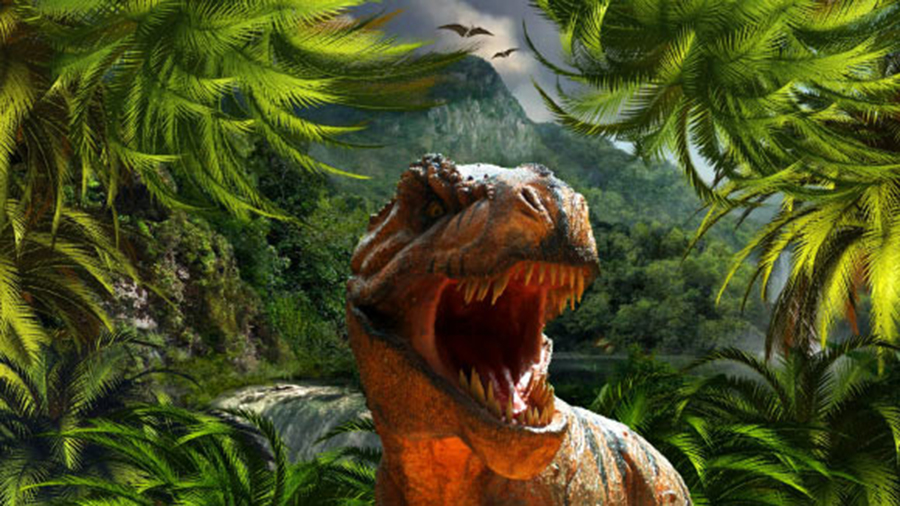
Tyrannosaurus rex. Image credit: Az Dude.

Paleontologists estimate that the abundance of one of the best-known dinosaurs, Tyrannosaurus rex, at any one time was about 20,000 individuals, that the species persisted for 127,000 generations, and that the total number of Tyrannosaurus rex that ever lived was 2.5 billion individuals.

Much can be learned from the fossil record about extinct species like the dinosaurs.

However, due to the record’s fragmented nature, understanding ecological variables such as population density and abundance remains challenging.

In living species, one way to understand more about these variables is by using the established relationship between population density and body mass, or Damuth’s Law, which states that the average population density of a species decreases with body size at a predictable rate.

Using this law and the large body of paleontological data for Tyrannosaurus rexProfessor Charles Marshall from the University of California Museum of Paleontology and his colleagues estimated population-level traits and the rate of fossil preservation for the species.

The researchers mined the scientific literature for data they used to estimate that the likely age at sexual maturity of a Tyrannosaurus rex was 15.5 years; its maximum lifespan was probably into its late 20s; and its average body mass as an adult was about 5.2 tons.

They also used data on how quickly Tyrannosaurus rex grew over their life span: they had a growth spurt around sexual maturity and could grow to weigh about 7 tons.

From these estimates, they calculated that each generation lasted about 19 years, and that the average population density was about one dinosaur for every 100 km2.

Then, estimating that the total geographic range of Tyrannosaurus rex was about 2.3 million km2, and that the species survived for roughly 2.5 million years, they calculated a standing population size of 20,000.

Over a total of about 127,000 generations that the species lived, that translates to about 2.5 billion individuals overall.

What’s more, the scientists estimate that the population density of the species equated to 3,800 Tyrannosaurus rex in an area the size of California.

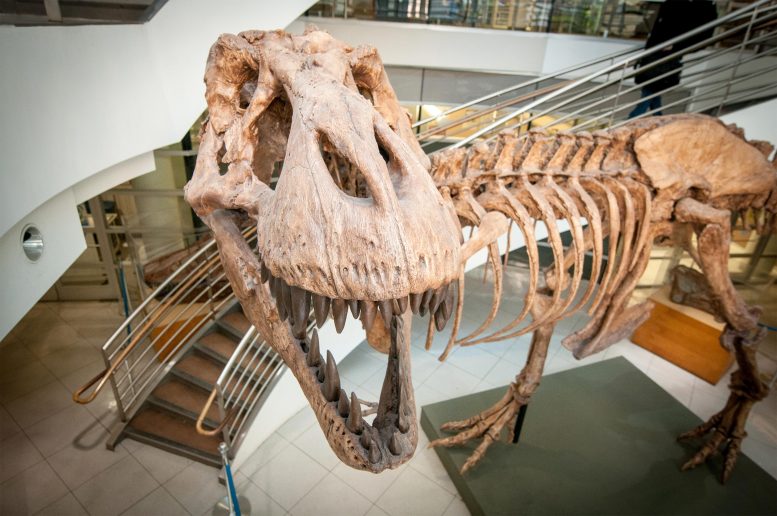
A cast of a T. rex skeleton on display outside the UC Museum of Paleontology at the University of California, Berkeley. The original, a nearly complete skeleton excavated in 1990 from the badlands of eastern Montana, is at the Museum of the Rockies in Bozeman, Montana. Credit: Keegan Houser, UC Berkeley

The results also allowed them to determine that only about 1 in 80 million Tyrannosaurus rex survived the eons as fossilized remains.

“There are about 32 relatively well-preserved, post-juvenile Tyrannosaurus rexes in public museums today,” Professor Marshall said.

“Of all the post-juvenile adults that ever lived, this means we have about one in 80 million of them.”

“If we restrict our analysis of the fossil recovery rate to where Tyrannosaurus rex fossils are most common, a portion of the famous Hell Creek Formation in Montana, we estimate we have recovered about one in 16,000 of the Tyrannosaurus rexes that lived in that region over that time interval that the rocks were deposited.”

“We were surprised by this number; this fossil record has a much higher representation of the living than I first guessed.”

“It could be as good as one in a 1,000, if hardly any lived there, or it could be as low as one in a quarter million, given the uncertainties in the estimated population densities of the beast.”

The team’s results were published today in the journal Science.

_____

Charles R. Marshall et al. 2021. Absolute abundance and preservation rate of Tyrannosaurus rexScience 372 (6539): 284-287; doi: 10.1126/science.abc8300

Source: www.sci-news.com/

Pages