nandi's blog

Crateromys ballik: Paleontologists Find Fossils of Extinct Giant Cloud Rats in Philippines
Saturday, April 24, 2021

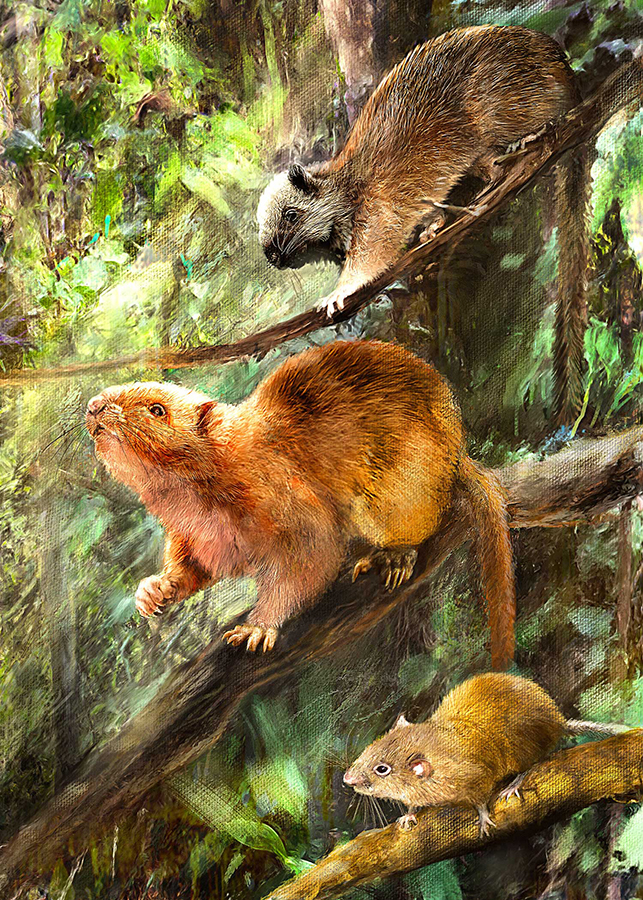
Illustration showing how Crateromys ballik, Carpomys dakal and Batomys cagayanensis might have looked. Image credit: Velizar Simeonovski, Field Museum.

Paleontologists have unearthed the 67,000-year-old fossilized remains from three extinct species of giant cloud rats in several caves on the Philippine island of Luzon.

Cloud rats are 18 living species of rodents with fluffy tails in the tribe Phloeomyini.

They can be found in the misty mountain forests of the Philippines.

They range in size from 18 g to 2.7 kg, typically live in trees, and eat leaves, buds and seeds.

Their evolutionary history in the region stretches back around 14 million years, when their ancestors first arrived in the Philippine archipelago from the Asian mainland.

The three newly-discovered species of cloud rats — Crateromys ballikCarpomys dakal, and Batomys cagayanensis — are thought to be extinct.

Their fossils were found in Callao Cave, where a previously unknown species of human, Homo luzonensis was found in 2019, as well as smaller caves in the Cagayan province.

“Specimens of all three of the new species of fossil rodent were found in the same deep layer of the cave as the enigmatic Homo luzonensis indicating that they co-existed some 60,000 years ago,” said Professor Philip Piper, a researcher in the School of Archaeology and Anthropology at the Australian National University.

“Our records show they were able to adapt and survive profound climatic changes over millions of years, so the question is what might have caused their final extinction?”

The timing of the last recorded occurrence of two of the species might offer a clue — around 2,000 years ago or shortly after.

This is after the first arrival of agricultural societies and the introduction of animals like domestic dogs, pigs and macaque monkeys to the Philippines.

“That seems significant, because that is roughly the same time that pottery and Neolithic stone tools first appear in the archeological record, and when dogs, domestic pigs, and probably monkeys were introduced to the Philippines, probably from Borneo,” said Professor Armand Mijares, a researcher at the University of Philippines.

“While we can’t say for certain based on our current information, this implies that humans likely played some role in their extinction.”

Crateromys ballik and Carpomys dakal became extinct just a few thousand years ago.

They were giants among rodents, both weighing about a kilogram — big enough that it might have been worthwhile to hunt and eat them.

“We have had evidence of extinct large mammals on the Philippine island of Luzon for a long time, but there has been virtually no information about fossils of smaller-sized mammals,” said Dr. Janine Ochoa, a researcher at the University of the Philippines

“The reason is probably that research had focused on open-air sites where the large fossil mammal faunas were known to have been preserved, rather than the careful sieving of cave deposits that preserve a broader size-range of vertebrates including the teeth and bones of rodents.”

“Our previous studies have demonstrated that the Philippines has the greatest concentration of unique species of mammals of any country, most of which are small animals, less than half a pound, that live in the tropical forest,” said Dr. Larry Heaney, a researcher at Field Museum.

“These recently extinct fossil species not only show that biodiversity was even greater in the very recent past, but that the two that became extinct just a few thousand years ago were giants among rodents, both weighing more than two pounds.”

By comparing the fossils to the 18 living cloud rat species, the scientists have a decent idea of what Crateromys ballikCarpomys dakal and Batomys cagayanensis would have looked like.

“The bigger ones would have looked almost like a woodchuck with a squirrel tail,” Dr. Heaney said.

“Cloud rats eat plants, and they’ve got great big pot bellies that allow them to ferment the plants that they eat, kind of like cows. They have big fluffy or furry tails. They’re really quite cute.”

The findings were published in the Journal of Mammalogy.

_____

Janine Ochoa et al. Three new extinct species from the endemic Philippine cloud rat radiation (Rodentia, Muridae, Phloeomyini). Journal of Mammalogy, published online April 23, 2021; doi: 10.1093/jmammal/gyab023

Source: www.sci-news.com/

Jurassic World: Camp Cretaceous Introduces a New Dino-Threat in Season 3 Trailer

Friday, April 23, 2021

Jurassic World: Camp Cretaceous is one of those rare streaming shows that doesn't make fans wait an interminable amount of time between seasons. The Netflix series — animated by DreamWorks — has a seemingly endless backlog of seasons that continue to premiere in all defiance of both God and man. But that's expected; after all, the entire Jurassic franchise is predicated on the idea of breaking all the natural laws (it usually doesn't turn out so well, but we'll let it slide if it means we get more dino-action).

That's just a long-winded way of saying that the official trailer for Season 3 of Camp Cretaceous has dropped online, and it introduces a brand-new threat for our young heroes: another Frankenstein-like experiment from the secret genetics lab of Dr. Henry Wu. If you can believe it, this new hybrid is even more agressive and cunning than the Indominus Rex. Is it another Indoraptor — the primeval abomination introduced in 2018's Fallen Kingdom — or something else entirely?

Take a look for yourself:

After unearthing more dastardly secrets connected with Wu's research, the campers-turned-rugged-outdoorsmen — Darius (Paul-Mikél Williams), Brooklynn (Jenna Ortega), Kenji (Ryan Potter), Sammy (Raini Rodriguez) Ben (Sean Giambrone), and Yaz (Kausar Mohammed) — hatch (pun intended) a dangerous plan to escape Isla Nublar once and for all. A dino-sized wrench is thrown into that plan when a tropical storm destroys their homemade raft and delays their departure. Then the new dino amalgum gets out and Hell breaks loose...yet again. The Season 3 tagline of "Chaos breaks loose" is a big I-told-you-so for Ian Malcolm.

Speaking with SYFY WIRE earlier this year, showrunner/executive producer Scott Kreamer teased that a potential third season would be all about survival. "If this season's about trying to get rescued [referring to Season 2], these kids, as they've grown together as a team, it seems the natural progression of things to have enough of waiting for help," he said. "We've got to help ourselves."

During last year's virtual edition of New York Comic Con, Kreamer stated: "This isn't a show about where adults come and save kids. This is a show about kids alone and having no one to count on, but each other."

Colin Trevorrow, Steven Spielberg, and Frank Marshall also serve as executive producers. Zack Stentz developed the project and is credited as a consulting producer.

Take a big bite out of the rainy poster and a collection of production stills below:

All 10 episodes of Camp Cretaceous's third season fly onto Netflix Friday, May 21. Jurassic World: Dominion stomps into theaters next June.

Source: www.syfy.com/

Tyrannosaurus rex Walked Slower than Previously Thought

Thursday, April 22, 2021

The skeleton of Trix. Image credit: Mike Bink.

Animals display a variety of gaits and walking speeds. It is commonly assumed that they minimize locomotor energy expenditure by selecting gait kinematics tuned to the natural frequencies of relevant body parts. In a new study, Pasha van Bijlert, a researcher at the Vrije Universiteit Amsterdam and Naturalis Biodiversity Center, and his colleagues demonstrated that this allows estimation of the preferred step frequency and walking speed of Tyrannosaurus rex.

“There were already some studies investigating dinosaur walking speed, but they mostly looked at the legs and ignored the tail — which is what makes dinos so unique,” Van Bijlert said.

“They usually found much higher walking speeds. The one we calculated is lower, but it’s similar to that of other animals.”

Tyrannosaurus rex was one of the largest carnivorous dinosaurs to ever roam the Earth.

The ancient animal lived in the forested river valleys of western North America between 68 and 66 million years ago (Late Cretaceous period).

It measured an average of 12 m long and 4.5 to 6 tall, had large jaws and serrated teeth.

Tyrannosaurus rex didn’t just have two legs, it also had an enormous tail that helped it move around.

Like the bones in our necks, the bones in tails are held together by ligaments.

“You could compare it with a suspension bridge. A suspension bridge with a ton of muscle in it,” Van Bijlert said.

“Every step the tail swings up and down. That means that like the swing, it has a natural frequency at which it resonates.”

To find out what that frequency is, Van Bijlert and co-authors built a 3D model of Trix, an individual of Tyrannosaurus rex on display at the Dutch National Museum of Natural History, Naturalis.

The paleontologists added digital muscles to the famous skeleton, and on this muscular model they could perform biomechanical analyses.

They determined the tail natural frequency of Tyrannosaurus rex (0.66 times/s, range 0.41-0.84), and the walking speed (1.28 m/s, range 0.8-1.64).

“Our results for preferred walking speed of Tyrannosaurus rex are lower than previous estimations for large theropods, but more closely match the preferred walking speeds of a variety of extant animals, regardless of gait pattern and body size,” they said.

The team’s results were published in the journal Royal Society Open Science.

_____

Pasha A. van Bijlert et al. Natural Frequency Method: estimating the preferred walking speed of Tyrannosaurus rex based on tail natural frequency. R. Soc. open sci 8 (4): 201441; doi: 10.1098/rsos.201441

Source: www.sci-news.com/

Tyrannosaurs Lived in Groups, New Evidence Suggests

Thursday, April 22, 2021

Two theropod dinosaurs attack a smaller dinosaur. Image credit: Jorge Gonzalez / Pablo Lara.

Tyrannosaurs — theropod dinosaurs that lived in what is now North America and Asia between 100 and 66 million years ago (Cretaceous period) — may not have been solitary hunters as popularly envisioned.

The idea that tyrannosaurs were social with complex hunting strategies was first formulated by Canadian paleontologist Professor Philip Currie in 1998.

It was based on the discovery of skeletons of over 12 Albertosaurus sarcophagus individuals at a site in Alberta, Canada.

The idea has been widely debated, with many paleontologists doubting the giant predators had the brainpower to organize into anything more complex than what is observed in modern crocodiles.

Because the Alberta site appeared to be an isolated case, skeptics claimed it represented unusual circumstances that did not reflect normal tyrannosaur behavior.

The 2005 discovery of a second tyrannosaur mass death site in Montana again raised the possibility of social tyrannosaurs, but that site was still not widely accepted by the scientific community as evidence for social behavior.

“Localities that produce insights into the possible behavior of extinct animals are especially rare, and difficult to interpret,” Professor Currie said.

In the new research, Bureau of Land Management paleontologist Alan Titus and colleagues examined a recently-discovered large bonebed containing at least four individuals of the tyrannosaur species Teratophoneus curriei.

Called the Rainbows and Unicorns Quarry, the site is located in the northern Kaiparowits Plateau area of Grand Staircase-Escalante National Monument in southern Utah.

Using analysis of stable carbon and oxygen isotopes and concentrations of rare earth elements within the bones and rock, the researchers found that the remains from the site all fossilized in the same environment and were not the result of an attritional assemblage of fossils washed in from a variety of areas.

They concluded that a group of Teratophoneus curriei died together during a seasonal flooding event that washed their carcasses into a lake, where they sat, largely undisturbed until the river later churned its way through the bone bed.

“Traditional excavation techniques, supplemented by the analysis of rare earth elements, stable isotopes and charcoal concentrations convincingly show a synchronous death event at the Rainbows site of four or five tyrannosaurids,” Professor Currie said.

“Undoubtedly, this group died together, which adds to a growing body of evidence that tyrannosaurids were capable of interacting as gregarious packs.”

“The new Utah site adds to the growing body of evidence showing that tyrannosaurs were complex, large predators capable of social behaviors common in many of their living relatives, the birds,” said Dr. Joe Sertich, curator of dinosaurs at the Denver Museum of Nature & Science.

“This discovery should be the tipping point for reconsidering how these top carnivores behaved and hunted across the northern hemisphere during the Cretaceous.”

The study was published online in the journal PeerJ.

_____

A.L. Titus et al. 2021. Geology and taphonomy of a unique tyrannosaurid bonebed from the upper Campanian Kaiparowits Formation of southern Utah: implications for tyrannosaurid gregariousness. PeerJ 9: e11013; doi: 10.7717/peerj.11013

Source: www.sci-news.com/

One Of The X-Men’s Greatest Foes Just Ruined Jurassic Park

Wednesday, April 21, 2021

In a new preview for Women of Marvel #1, Mystique is working a prehistoric-themed job, and she may have ruined Jurassic Park as a result.

In a preview for Marvel's new series focused on its female heroes, Women of Marvel #1 will feature a story where one of the X-Men's greatest villains may have just ruined Jurassic Park. The Brotherhood of Mutants' Mystique is looking for new recruits and the Dinosaur Man Stegron is apparently looking to audition and prove his worth. However, a fun Easter egg is featured in the preview, as the pair of villains are seen at what appears to be a dig site in Montana, and they've tied up two very familiar paleontologists.

While Mystique is currently a member of the Quiet Council on the independent mutant island nation of Krakoa, this new story from Women of Marvel will see her years prior when she was still leading the Brotherhood of Mutants, seeking to establish mutant dominance over the world. Her latest potential recruit is Stegron, a scientist who took stegosaurus DNA and paired it with the Lizard formula of Dr. Curt Connors, turning him into the Dinosaur Man. Stegron's classic weapon is his retro-generation ray, which can animate fossilized skeletons of dinosaurs. Seeing as how he and Mystique are in Montana, it seems likely that Stegron is planning a demonstration of his ray in order to secure a spot on Mystique's Brotherhood.

However, the far more interesting element of this preview is the two paleontologists that Mystique and Stegron have captured and tied up. For fans familiar with Steven Spielberg's Jurassic Park, the two captives are clearly meant to look like Dr. Alan Grant and Dr. Ellie Sattler from the 1993 film. So now it's possible that Mystique may have just prevented the entire plot of the film from ever happening. Here's the synopsis for the issue and preview pages for the Mystique story from Marvel Comics:

WHO RUNS THE WORLD? YOU ALREADY KNOW. CELEBRATE THE WOMEN OF MARVEL WITH AN EXTRAVAGANZA OF EXTRAORDINARY TALENT!The future is female! Get in on the ground floor with this amazing assembly of writers and artists from all over entertainment. Comics legend Louise Simonson kicks things off with a must-read introduction! Nadia Shammas punches the glass ceiling with the Jade Giantess! Elsa Sjunneson grits her way to the front line with Captain Peggy Carter! Sophie Campbell goes feral with a bone-grinding Marrow story! Video game-and-comics writer Anne Toole makes her Marvel debut in a blaze of glory! Natasha Alterici of Heathen fame charges sword-first into the Marvel Universe! With astonishing art from new and established artists Kei Zama (Transformers, DEATH'S HEAD), Eleonora Carlini (Power Rangers, Batgirl), Skylar Patridge (Resonant, Relics of Youth), Joanna Estep (Fantastic Four, Fraggle Rock) and more, you're sure to come away powered up and ready to slay - in high heels and boots alike.

While it looks as though Stegron is struggling with his device, Mystique decides to stall for the Dinosaur Man by posing as "Dr. Sattler," heading out to speak to a group of waiting students. While it's more than likely that these paleontologists are just fun Easter eggs for fans and not actually the doctors played by Sam Neill and Laura Dern, it's fun to theorize and imagine that the Jurassic Park universe fits within the greater Marvel Universe, though having been forever altered due to the actions of the shape-shifting X-Men villain.

In any case, this story looks as though it's going to be a lot of fun, as will as the other stories that will be featured in the first issue, like Peggy Carter as Captain America, She-Hulk at the Museum of Natural History, Gamora fighting a giant space worm, and much more. However, fans will just have to wait and see what lies in store for Mystique and her meta-Jurassic Park crossover when the issue releases soon from Marvel Comics.

Source: https://screenrant.com/

Mass Dinosaur Death Site in Utah May Prove Tyrannosaurs Lived in Packs

Tuesday, April 20, 2021

This photo provided by the Bureau of Land Management shows a “Hollywood” dinosaur specimen that was discovered approximately two miles north of the Rainbows and Unicorns Quarry on Grand Staircase-Escalante National Monument in Utah on Feb. 26, 2019. Ferocious tyrannosaur dinosaurs may not have been solitary predators as long envisioned, but more like social carnivores such as wolves, new research unveiled Monday, April 19, 2021, found. (Dr. Alan Titus/Bureau of Land Management via AP)

Ferocious tyrannosaur dinosaurs may not have been solitary predators as long envisioned, but more like social carnivores such as wolves, new research unveiled Monday found.

Paleontologists developed the theory while studying a mass tyrannosaur death site found seven years ago in the Grand Staircase-Escalante National Monument in southern Utah, one of two monuments that the Biden administration is considering restoring to their full size after former President Donald Trump shrunk them.

Using geochemical analysis of the bones and rock, a team of researchers with the University of Arkansas determined that the dinosaurs died and were buried in the same place and were not the result of fossils washing in from multiple areas.

The new Utah site is the third mass tyrannosaur grave site that’s been discovered in North America — bolstering a theory first developed 20 years ago that they lived in packs. However, more research needs to be done to make that argument, said Kristi Curry Rogers, a biology professor at Macalester College who wasn’t involved in the research but reviewed the finding Monday.

“It is a little tougher to be so sure that these data mean that these tyrannosaurs lived together in the good times,” Rogers said. “It’s possible that these animals may have lived in the same vicinity as one another without traveling together in a social group, and just came together around dwindling resources as times got tougher.”

In 2014, Bureau of Land Management paleontologist Alan Titus discovered the site, which was later named the Rainbows and Unicorns quarry because of the vast array of fossils contained inside. Excavation has been ongoing since the site’s discovery because of the size of the area and volume of bones.

“I consider this a once-in-a-lifetime discovery for myself,” Titus told reporters during a virtual news conference. “I probably won’t find another site this exciting and scientifically significant during my career.”

The social tyrannosaurs theory began over 20 years ago when more than a dozen tyrannosaurs were found at a site in Alberta, Canada. Another mass death site in Montana again raised the possibility of social tyrannosaurs. Many scientists questioned the theory, arguing that the dinosaurs didn’t have the brainpower to engage in sophisticated social interaction, Titus said.

“Going that next step to understand behavior and how animals behave requires really amazing evidence,” Joseph Sertich, curator of dinosaurs at the Denver Museum of Nature & Science, said at the news conference. “I think that this site, the spectacular collection of tyrannosaurs but also the other assembled pieces of evidence … pushes us to the point where we can show some evidence for behavior.”

In addition to the tyrannosaurs, researchers have also found seven species of turtles, multiple fish and ray species, two other kinds of dinosaurs and a nearly complete skeleton of a juvenile Deinosuchus alligator. These other animals do not appear to have all died together.

Paleontology groups have been among those pushing the federal government to restore the Bears Ears National Monument and Grand Staircase-Escalante to their original sizes to protect the region’s rich paleontological and archaeological record.

Interior Secretary Deb Haaland visited southern Utah earlier this month as she prepared to submit recommendations on whether to reverse Trump’s decision to downsize the monuments. Titus said he showed Haaland some of the fossils at his lab during her visit and said she “appreciated getting to see the material.”

“The (Bureau of Land Management) is protecting these fossils as national treasures.” Titus said. “They’re part of the story of how North America came to be and how ultimately we came to be.”

Source: https://ktla.com/

Mosasaurus: Apex Ocean Predator of the Dinosaur Age

Wednesday, April 21, 2021

An artist's impression of a Mosasaurus. (Image credit: dotted zebra / Alamy Stock Photo)

Mosasaurus and other mosasaurs ruled the seas for millions of years.

Mosasaurus was a ferocious predator in the ancient oceans of the Cretaceous period (145.5 million to 65.5 million years ago). While dinosaurs dominated the land, Mosasaurus used its long tail and stumpy, paddle-like limbs to cruise through the water, devouring all kinds of prey with its massive jaws and sharp, cone-shaped teeth. 

Mosasaurus is one genus, or group of species, out of dozens that made up a diverse family of marine reptiles called mosasaurs. The mosasaurs ruled the ocean in the late Cretaceous period. They were not sea dinosaurs, but a separate group of reptiles, more closely related to modern snakes and lizards, according to the Philip J. Currie Dinosaur Museum

Mosasaurs went extinct 65.5 million years ago in the same mass extinction event that wiped out the dinosaurs, Live Science previously reported. A Mosasaurus species has since been fictionally resurrected on the big screen, most notably in the 2015 movie blockbuster "Jurassic World," increasing the profile of this mighty group of marine reptiles.

HOW BIG WAS MOSASAURUS AND OTHER MOSASAURS?

Skeleton of M. beaugei by Ghedoghedo. Fossil – Took the picture at Musee des Confluences, Lyon

Mosasaurus species are among the largest members of the mosasaur family, according to the Philip J. Currie Dinosaur Museum. One of the biggest specimens ever found was identified as Mosasaurus hoffmanni and was estimated to be about 56 feet (17 meters) long in life, according to a 2014 study published in the journal Proceedings of the Zoological Institute RAS. Not all mosasaurs were giants though. Some species, such as Xenodens calminechari, were only about the size of a porpoise, Live Science previously reported. 

The biggest Mosasaurus would have been comparable in size to the mighty Megalodon — a giant shark that dominated oceans in the middle Miocene and Pliocene epochs (15.9 million to 2.6 million years ago), long after the mosasaurs went extinct 65.5 million years ago. Megalodons could have reached up to 49 to 59 feet (15 to 18 meters) long, according to the Natural History Museum (NHM) in London. Neither of these predators, however, were ever as big as the modern blue whale, which can reach up to 110 feet (34 meters) long and is the biggest known animal to have ever existed. 

WHAT DID MOSASAURS EAT, AND HOW DID THEY CATCH IT?

The food chain of marine predators in the Cretaceous period. A nondescript vertebrate, followed by a Enchodus, followed by a Dolichorhynchops, followed by a large mosasaur.  (Image credit: Stocktrek Images, Inc. / Alamy Stock Photo)

Mosasaurs were the ocean's most dominant predator at the end of the Cretaceous period and lived across the world's oceans. Large mosasaurs would have likely eaten almost any kind of prey they were able to catch, including fish, sharks, sea birds and even other mosasaurs, according to the U.S. National Park Service. These mosasaurs were apex predators and could be compared to modern orcas, while other mosasaur species were more specialized feeders and adapted to eat shellfish, like modern sea otters, Live Science previously reported.


Occasionally, mosasaur fossils were preserved with their stomach contents intact, which helps paleontologists learn more about their hunting strategies. For example, paleontologists in Canada uncovered a specimen from the species Mosasaurus missouriensis with large fish bones inside it, according to National Geographic. The fish was larger than the mosasaur's head, and the placement of the bones suggested the mosasaur had devoured its prey piece by piece.

In another fossil find, a juvenile Mosasaurus was found in the stomach of another mosasaur species, Prognathodon kianda. The fossil, from the Smithsonian National Museum of Natural History (NMNH), demonstrates that even the largest mosasaur species could be preyed upon. In fact, Mosasaurus hoffmanni fossils have been uncovered with severely broken and healed jaws that indicate they led a violent or dangerous lifestyle, according to a 1995 study published in the journal Philosophical Transactions of the Royal Society B.

Mosasaurus probably hunted in fairly deep waters, but would not have traveled too far from the shore, according to the NMNH.

Mosasaurs may have started out swimming through the water like a snake or an eel, but mosasaur tails changed over time. The animals evolved to have a shark-like tail to propel themselves through the water. They may also have been capable of a powerful breaststroke, using their paddle-like forelimbs to assist in sudden bursts of speed to catch prey.

HOW ACCURATE WAS “JURASSIC WORLD” MOSASAUR?

The Mosasaurus depicted in "Jurassic World". (Image credit: AF archive / Alamy Stock Photo)

The movie "Jurassic World" (2015) features an iconic shot of a giant Mosasaurus rocketing out of the water to snatch a dangling shark. This big-screen depiction of the ancient sea monster made several other appearances in the "Jurassic World" series, but experts didn't consider the depiction scientifically accurate. 

The real Mosasaurus species were simply not that big, paleontologists told Live Science shortly after "Jurassic World" was released in 2015. The creature in the film is about twice the size of the largest known mosasaur fossil, according to ReBecca Hunt-Foster, a paleontologist at the Bureau of Land Management Canyon Country District, and John Foster, the director of the Museum of Moab. 


Kenneth Lacovara, then a professor of paleontology and geology at Drexel University, also acknowledged the marine reptile was too large but gave the film "kudos" for including an accurate depiction of the mosasaur's palatal teeth — a specialized second set of teeth in the animal's upper mouth, similar to those in some snakes and lizards that hold prey in place and prevent its escape. 

According to Philip J. Currie Dinosaur Museum, the movie mosasaur's movement is also inaccurate, based on a dated interpretation of Mosasaurus swimming like eels or snakes.

WHAT HAPPENED TO MOSASAURS?


The mosasaurs disappeared from the fossil record alongside non-avian dinosaurs 65.5 million years ago, after a giant asteroid crashed into Earth at the end of the Cretaceous period. The rich marine ecosystems that mosasaurs inhabited and depended upon for food collapsed after the asteroid strike, according to a 2005 study in the Netherlands Journal of Geosciences. This collapse caused all mosasaurs to die out, never to return. 


The role of dominant ocean predator was once held by marine reptiles that resembled modern dolphins, known as ichthyosaurs. Those animals were succeeded by the plesiosaurs, which were then replaced by the mosasaurs, according to the Naranjo Museum of Natural History. After mosasaurs disappeared, crocodilians increased in numbers and took over the role of large marine predators, according to the Netherlands Journal of Geosciences study.

Source: www.livescience.com/

Hasbro Reveals Jurassic Park Monopoly & Tiger Electronics Games

Wednesday, April 21, 2021

A look at the box art for Monopoly Jurassic Park, courtesy of Hasbro.

Hasbro revealed Two new items this week with a Jurassic Park theme as we're getting new Monopoly and Tiger Electronics titles. The two official names for both of them are Monopoly: Jurassic Park and Tiger Electronics Jurassic Park LCD Video Game, both of which are based on the original 1993 film, and in the case of the handheld game, it includes the original theme song in the games. The Monopoly game is out right now as you can snag it for $30 at Walmart and Amazon. The Tiger Electronics game, however, won't be released until August 1st, 2021, and will be sold for $20 at major retailers. We have more info on both games below as these both look like amazing must-own titles for anyone who loves the first film. Just looking at them you can hear the theme song now.

Monopoly: Jurassic Park

Credit: Hasbro

Secure dinosaur paddocks and other areas but beware of the T. Rex; it doesn't follow rules! Build fences to protect paddocks from the attack and earn money by charging rent, but prepare for damaged property. Activate the gate to hear the Jurassic Park movie theme song or a dinosaur roar, which will determine how much money to collect. The last player with money when all others have gone bankrupt wins. The game also ends if the T. Rex damages all properties before they can be protected with fences or repaired. Then everyone loses! Available at most major retailers.

Tiger Electronics Jurassic Park

The complete packaging for the Tiger Electronics game, courtesy of Hasbro.

Imagine going back in time! Gamers who are die-hard fans of retro-tech, or are new to this genre, will love this Tiger Electronics Jurassic Park LCD Video Game, inspired by the original from the 1990s. Players imagine getting a sneak peek at the world's only amusement park featuring real dinosaurs. Tim, Lex, and Dr. Alan Grant must try to survive when dinosaurs wreak havoc on the park! The design and technology were created with the original Jurassic Park handheld game unit in mind. Look for other retro-inspired Tiger Electronics LCD video games. (Each sold separately. Subject to availability.) Available at most major retailers.

Credit: Hasbro

Source: https://bleedingcool.com/

Fossils Show Mass Extinction Occurred 10 Times Faster in Ocean

Tuesday, April 20, 2021

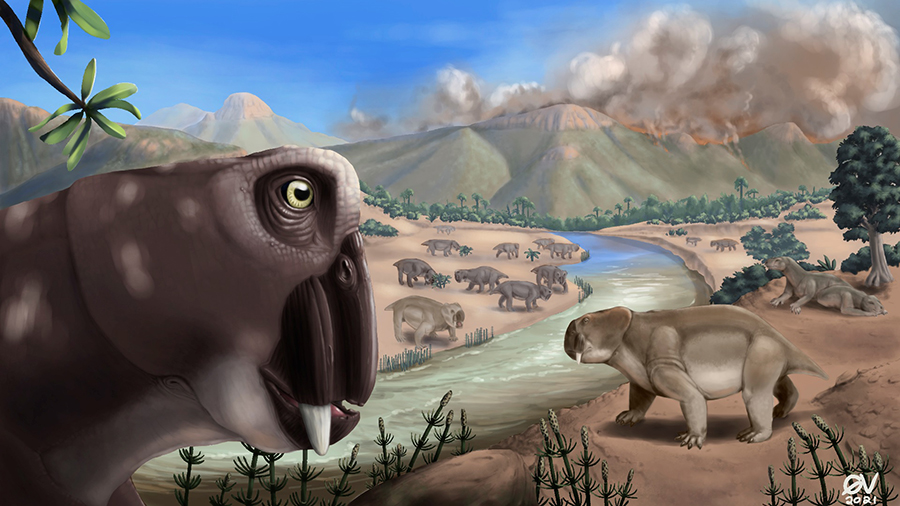
An illustration shows Lystrosaurus during the end-Permian mass extinction. (Credit: Gina Viglietti)

Studies of ancient mammal remains reveal how the planet’s biggest extinction event played out on land and in the sea.

Some 250 million years ago, Earth’s warming climate and extreme volcanic activity caused most animal species to go extinct, an event now known as the End-Permian Extinction which eventually ushered in the early days of the dinosaurs. 

To study trends in how the mass extinction happened, researchers looked at the difference between terrestrial and marine die-offs. They found that, on land, the process took 10 times as long as it did in the ocean. 

“The focus for studying terrestrial extinction has basically been, ‘Can we match up the pattern in the terrestrial realm with what’s observed in oceans?’ And the answer is, ‘Not really,'” said Ken Angielczyk, the paper’s senior author and curator of vertebrate paleontology at Chicago’s Field Museum, in remarks released along with the research. 

Previously, it had been assumed that since extinction happened quickly in the ocean, the same would have been true for land-dwellers. Part of the reason for the focus on marine extinction is that the fossil record underwater is better-preserved, with sediment blanketing fossilized animals. 

Now, researchers can compare the previously known submarine extinction patterns to what happened on land. 

“This paper is the first really focusing on vertebrates and saying, ‘No, something was going on that was unique to the terrestrial realm,'” Angielczyk said. 

The results were published in the journal Proceedings of the National Academy of Sciences

Angielczyk and colleagues examined fossils from 588 four-legged animals, discovered in the modern-day Karoo Basin in South Africa. Grouping fossils by age, they created a database spanning 4 million years, in 300,000-year intervals.

With the data in-hand, researchers used a statistical analysis to characterize the array of animals present during the transition period between the Permian and Triassic geologic periods. 

That helped the team “quantify how much extinction is happening and how quickly new species are appearing,” said Pia Viglietti, the study’s lead author and a postdoctoral researcher at the Field Museum

“Instead of putting too much focus on any one fossil,” Viglietti said, “you compile hundreds of observations roughly in the same time interval.”

However, one species in particular helped elucidate patterns of extinction and recovery: an ancient mammal called Lystrosaurus, a name meaning “shovel lizard.” 

Lystrosaurus, an herbivore, included species ranging between the size of a small dog to 2.5 meters long. It made up 54% of species by the onset of the mass extinction, and 70% in its aftermath.

“It had a beak and tusks, it wasn’t the most attractive animal, but I have a soft spot for Lystrosaurus because it was like the first animal I studied as a grad student,” Viglietti said. “So coming full circle with Lystrosaurus in this study made me quite happy.” 

Lystrosaurus is an example of a “disaster taxon,” or a species that thrived when most other life was struggling to survive. 

“Lystrosaurus is like a poster child for the end-Permian extinction that’s always been portrayed as this animal that flourishes in the aftermath of all this extinction and just takes over,” Viglietti said. “But we see Lystrosaurus appearing before the extinction even got started, it was already abundant.”

The researchers believe that Lystrosaurus’ expansion was facilitated by adapting to environmental changes, rather than an ability to expand its range after other species went extinct. 

Fossils like Lystrosaurus help to confirm that the Permian extinction was a longer, more drawn-out process on land, compared to the sea. The reason for that difference may come down to the ocean’s ability to absorb chemicals like carbon dioxide, which can break down ocean ecosystems rather quickly. 

Researchers also drew a parallel between the mass extinctions that happened hundreds of millions of years ago, and the current threat to many of Earth’s species, brought on by climate change. 

“The changes to the Earth’s climate were cumulative and added up over time. Ecosystems were slowly disrupted, and then it just got to a point where everything collapsed, like the straw that breaks the camel’s back,” Viglietti said. “Everything’s fine, until it’s not.”

Source: www.courthousenews.com/

Pages