nandi's blog

58-Million-Year-Old Mammal Footprints Found in Wyoming

Friday, May 14, 2021

A reconstruction of brown-bear-sized mammals that made thousands of tracks in a 58-million-year-old brackish water lagoon in what is now southern Wyoming, the United States. Image credit: Anton Wroblewski.

The newly-discovered fossilized footprints were made by at least two mammalian species around 58 million years ago in a brackish water lagoon in what is now southern Wyoming, the United States, and may represent the earliest evidence of mammals gathering by the sea.

“Trace fossils like footprints record interactions between organisms and their environments, providing information that body fossils alone cannot,” said Dr. Anton Wroblewski, a geologist in the Department of Geology and Geophysics at the University of Utah.

“In this case, trace fossils show that large-bodied mammals were regularly using marine environments only 8 million years after non-avian dinosaurs went extinct.”

Dr. Wroblewski and his colleague, Dr. Bonnie Gulas-Wroblewski from the Texas A&M Natural Resources Institute, examined and photographed several sets of fossilized footprints in the Hanna Formation in southern Wyoming.

The tracks include underprints, impressions in soft sediment made when heavy animals walk on overlying sediment layers, as well as prints pressed into the surfaces of ancient tidal flats.

Now preserved in sandstone, they are 1,032 m long and were made by a minimum of two mammalian species: one associated with relatively large, narrow-gauge, five-toed tracks, and the other with medium-sized, four-toed tracks.

Section of the 58-million-year-old tracksite demonstrating near-vertical tilting of the originally horizontal bedding with three separate trackways made by five-toed mammals walking in parallel. Image credit: Anton Wroblewski.

“Candidates for the five-toed tracemakers are pantodonts such as Titanoides primaevusBarylambda faberi, or Coryphodon proterus. The owner of the four-toed tracks remains a mystery,” the researchers said.

Fossilized plants and pollen helped the team determine the age of the tracks to be around 58 million years old (Paleocene epoch).

Before this finding, the earliest known evidence of mammals interacting with marine environments came from the Eocene epoch, around 9.4 million years later.

“The Hanna Formation tracks are the first Paleocene mammal tracks found in the United States and only the fourth in the world, with two sets of tracks previously found in Canada and one in Svalbard, Norway,” Dr. Wroblewski said.

“It’s also the largest accumulation of Paleocene mammal tracks in the world in both aerial extent and the absolute number of tracks.”

“With at least two species leaving the tracks, it’s also the most taxonomically diverse.”

The team’s paper was published in the journal Scientific Reports.

_____

A.FJ. Wroblewski & B.E. Gulas-Wroblewski. 2021. Earliest evidence of marine habitat use by mammals. Sci Rep 11, 8846; doi: 10.1038/s41598-021-88412-3

Source: www.sci-news.com/

How Jurassic Park's Future Can Fix Its Biggest Dinosaur Mistake

Thursday, May 13, 2021

There's a thematically appropriate explanation that the Jurassic Park series should use for why the velociraptors and T-Rex don't have feathers

Jurassic Park has long established the T-Rex and velociraptors as some of the franchise’s most terrifying threats, but the future of the series can cleverly work around the biggest mistake that the original movies made. Beginning with Jaws helmer Stephen Spielberg’s adaptation of sci-fi author Michael Crichton’s Jurassic Park back in 1993, the Jurassic Park franchise has since expanded to included two direct sequels, a rebooted “Jurassic World” follow-up trilogy, and even a television series spin-off in the animated Camp Cretaceous.

Both the original Jurassic Park movies and the Jurassic World trilogy have been financially successful, but some fans have questioned how realistic the depiction of the many dinosaurs seen in the movies is. Getting the prehistoric characters of Jurassic Park right has always been a major concern for the series as, while viewers are willing to suspend disbelief in a story of a theme park filled with dinosaurs run amok, unconvincing effects or silly exposition can often sink this kind of potentially fun adventure story.

Some digressions from realism are inevitable when a living T-Rex is the villain of Jurassic Park, but there is some science that both the original trilogy and the Jurassic World movies ignore which is harder to overlook. For example, both velociraptors and the T-Rex are thought to have had feathers according to a large swathe of scientific consensus, a change that makes them look significantly sillier to audiences who are expecting a terrifying dinosaur and not an oversized, man-eating chicken. Luckily, though, there is an easy out that the Jurassic Park franchise can use to paper over this potential problem.

Mentioning that these feather-coated, silly-looking dinosaurs “went wrong” in the cloning process, causing them to appear as the more intimidating, featherless version that audiences are used to, would make them seem even more monstrous and could also be used to explain their heightened aggression, their territoriality, and everything else that makes the monsters so scary. This would not be a difficult retcon for the series to work in, with Jurassic Park III already changing the velociraptors from the appearance they had in the first two films. Whether it is in Camp Cretaceous, Jurassic World: Dominion, or another upcoming Jurassic Park property, explaining away the lack of feathers found on the carnivores of the series could lend credence to the idea that Jurassic Park’s dinosaurs are uniquely dangerous and even more of a threat than a “normal” velociraptor or T-Rex.

This explanation also fits a recurring thematic preoccupation of the series, namely the idea that humans playing god and interfering with genetics can result in disastrous consequences. Already, the Indominus Rex of Jurassic World was referred to in the movie as the result of excessive experimentation and gene-altering, meaning there is an in-series precedent for the dinosaur’s lack of feathers to be explained away via reference to the imperfect cloning process that created them. Explaining the lack of feathers on the T-Rex and velociraptors of the Jurassic Park franchise would not only reinforce the theme of humans risking life and limb through their hubris but also further illustrate that the beasts seen in the series are more dangerous and unpredictable than their prehistoric predecessors.

Source: https://screenrant.com/

Menefeeceratops sealeyi: New Ceratopsid Dinosaur Uncovered in New Mexico

Thursday, May 13, 2021

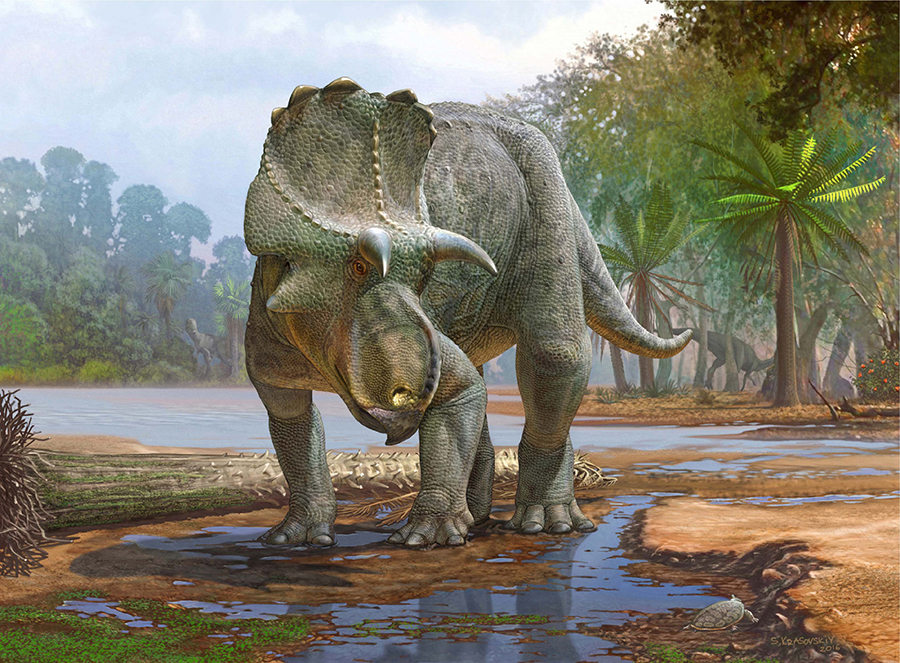
Life reconstruction of Menefeeceratops sealeyi. Image credit: Sergey Krasovskiy.

A new genus and species of horned (ceratopsid) dinosaur has been identified from an incomplete skeleton found in New Mexico, the United States.

The newly-identified dinosaur species belongs to Centrosaurinae, a group of ceratopsid dinosaurs known primarily from the northern region of the ancient continent Laramidia.

It lived some 82 million years ago (Cretaceous period), making it one of the, if not the, oldest members of the group.

Named Menefeeceratops sealeyi, it was a relatively small ceratopsid dinosaur, growing to 4-4.6 m (13-15 feet) long.

“Ceratopsids are better known from various localities in western North America during the Late Cretaceous near the end of the time of dinosaurs,” said Dr. Steven Jasinski, a paleontologist in the Section of Paleontology and Geology at the State Museum of Pennsylvania.

“But we have less information about the group, and their fossils are rarer, when you go back before about 79 million years ago.”

A partial skeleton of Menefeeceratops sealeyi, including parts of the skull and lower jaws, forearm, hindlimbs, pelvis, vertebrae, and rib, was discovered in 1996 in the Cretaceous rocks of the Menefee Formation in northwestern New Mexico.

“Some of the key features that distinguish Menefeeceratops sealeyi from other horned dinosaurs involve the bone that make up the sides of the dinosaur’s frill, known as the squamosal,” the paleontologists said.

“While less ornate than those of some other ceratopsids, Menefeeceratops sealeyi’s squamosal has a distinct pattern of concave and convex parts.”

“The fossils also show evidence of a potential pathology, resulting from a minor injury or disease, on at least one of the vertebrae near the base of its spinal column.”

The new dinosaur was part of an ancient ecosystem with numerous other dinosaur species, including hadrosaurids, dromaeosaurids, the recently-discovered ankylosaur Invictarx zephyri, and the tyrannosaurid dinosaur Dynamoterror dynastes.

Menefeeceratops sealeyi provides new information about the diversity of morphologies throughout different species and the temporal and paleobiogeographic distribution of these animals throughout Laramidia during the Late Cretaceous,” Dr. Jasinski and colleagues said.

“Its presence as one of the, if not the, oldest members of Centrosaurinae also suggests centrosaurines originated in the southern portions of western North America and the southern Rocky Mountain region, and subsequently radiated north during the Upper Middle to Late Campanian.”

The team’s paper was published in the journal PalZ.

_____

S.G. Dalman et al. The oldest centrosaurine: a new ceratopsid dinosaur (Dinosauria: Ceratopsidae) from the Allison Member of the Menefee Formation (Upper Cretaceous, early Campanian), northwestern New Mexico, USA. PalZ, published online May 10, 2021; doi: 10.1007/s12542-021-00555-w

Source: www.sci-news.com/

Paleontologists Find 18.5-Million-Year-Old Liana Fossil

Thursday, May 13, 2021

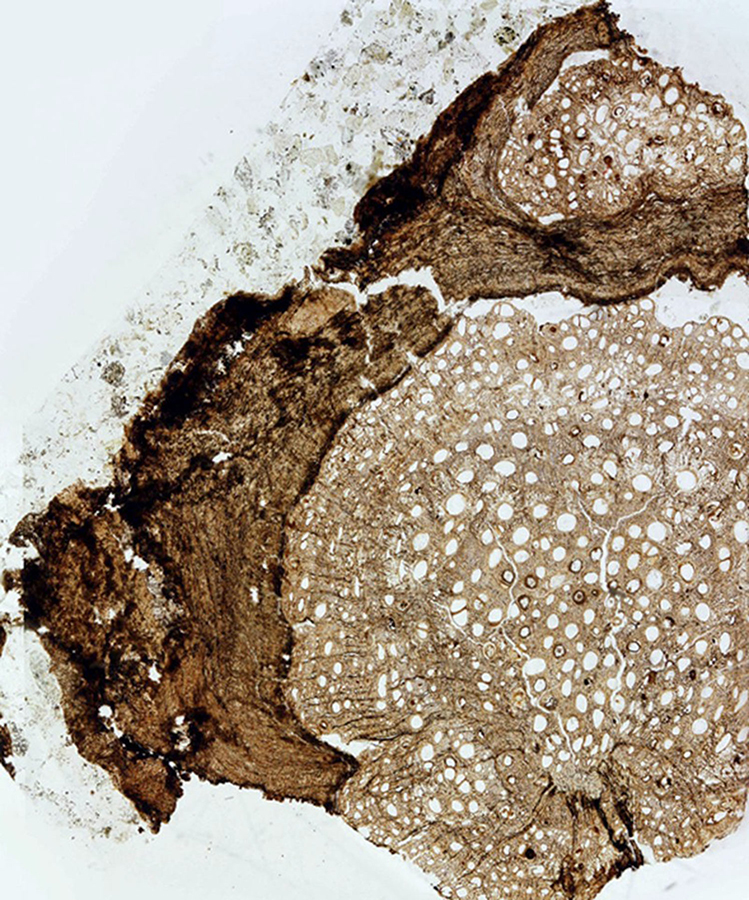
Transverse section of Ampelorhiza heteroxylon. Image credit: Jud et al., doi: 10.1371/journal.pone.0248369.

Paleontologists have discovered what they say is the oldest macrofossil evidence of Paullinieae, a diverse group of tropical and subtropical climbing plants that belong to the soapberry family Sapindaceae.

Paullinieae are tropical and subtropical woody vines, herbaceous climbers, and seldom shrubs.

With six genera and 475 species, they comprise nearly one quarter of all species in the Sapindaceae family.

Although the fossil record of Sapindaceae is rich, Paullinieae macrofossils are extremely rare.

The newfound Paullinieae fossils are roots, but nonetheless provide strong evidence of the climbing habit based on wood anatomy associated with climbing in Sapindaceae.

“This is evidence that lianas have been creating unusual wood, even in their roots, as far back as 18 million years ago,” said Dr. Joyce Chery, a wood anatomist in the School of Integrative Plant Sciences at Cornell University.

“Before this discovery, we knew almost nothing about when or where these lianas evolved or how rapidly they diversified,” added Dr. Nathan Jud, a plant biologist at William Jewell College and the Florida Museum of Natural History.

The 18.5-million-year-old fossils of the new species, named Ampelorhiza heteroxylon, were recovered from the Cucaracha Formation in Panama.

“Panama was a peninsula 18.5 to 19 million years ago, a volcanic landscape covered with tropical forest in North America and separated from South America by a Central American seaway,” Dr. Jud said.

“While these forests contained North American animals, the plants mostly descended from South American tropical plants that had dispersed across the seaway.”

“The fossil we described is the oldest macrofossil of these vines, and they were among the plants that made it to North America long before the Great American Biotic Interchange when large animals moved between the continents some 3 million years ago.”

The findings were published in the journal PLoS ONE.

_____

N.A. Jud et al. 2021. Climbing since the early Miocene: The fossil record of Paullinieae (Sapindaceae). PLoS ONE 16 (4): e0248369; doi: 10.1371/journal.pone.0248369

Source: www.sci-news.com/

Jurassic World: Dominion Image Shows Chris Pratt On A Boat

Wednesday, May 12, 2021

A new BTS image from the set of Jurassic World: Dominion shows returning stars Chris Pratt and Omar Sy on a boat in an underground location.

An official behind the scenes image from Jurassic World: Dominion shows Chris Pratt on a boat alongside Omar Sy. In 2015, Universal revived the Jurassic Park franchise and turned it into Jurassic World, an updated effort that finally saw the titular park opened up for the public. Both the first film and the second were box office hits, and Jurassic World: Dominion looks to bring everything to a close in a supersized finale. Uniting several characters from across both the Park and World sides of the franchise, Jurassic World: Dominion is particularly exciting because it will feature the returns of Laura Dern, Sam Neill, and Jeff Goldblum.

Plot details for Jurassic World: Dominion are still being kept under wraps, but the ending of the previous film provides at least one major clue. 2018's Jurassic World: Fallen Kingdom concluded with the remaining dinosaurs escaping into the real world, with the post-credits scene showing several flying over Las Vegas. All signs point to Dominion then dealing with the threat of dinosaurs running loose in cities and towns, leaving it up to the heroes (including Pratt's Owen Grady and Bryce Dallas Howard's Claire Dearing) to save the day.

The latest behind the scenes image from Jurassic World: Dominion has arrived online courtesy of Empire, and it reveals a new peek at the set and stars. In what looks like a man-made underground cavern, Pratt stands atop a small boat with Lupin star Sy, who returns to the franchise for the first time since the first Jurassic World as Barry. Check it out down below.

Jurassic World: Dominion endured a difficult production last year. It began in February, but weeks later had to be shut down due to the coronavirus pandemic. The film was later one of the first major productions to pick up in July, but still had some difficulties over the coming months. Jurassic World: Dominion finally wrapped in the fall, but it wasn't enough to stop Universal from pushing it back from 2021 to 2022. With still over a year to go before the movie is released, it remains to be seen when further official looks will debut.

The location in the above picture looks interesting and unlike the spots seen in previous Jurassic World movies. One of the benefits of leaving the park behind will be exploring locations out in the real world, providing a new layout for the dinosaurs to roam. Instead of being kept on a tropical island, or even an expansive mansion (per Fallen Kingdom), the dinos are finally outside. That is bound to make for some thrilling set pieces. Jurassic World: Dominion can explore new ground for the franchise, and that already makes it really exciting.

Source: Empire / https://screenrant.com/

Southern African dinosaur had irregular growth

Wednesday, May 12, 2021

Reconstruction of Massospondylus carinatus  CREDIT: Dorling Kindersley

Anyone who's raised a child or a pet will know just how fast and how steady their growth seems to be. You leave for a few days on a work trip and when you come home the child seems to have grown 10cm! That's all well and good for the modern household, but how did dinosaurs grow up? Did they, too, surprise their parents with their non-stop growth?

A new study lead by Dr Kimberley Chapelle of the American Museum of Natural History in New York City and Honorary Research Fellow at the University of the Witwatersrand suggests NOT. At least for one iconic southern African dinosaur species. By looking at the fossil thigh bones under a microscope, researchers can count growth lines, like those of a tree. This allows them to study how much the individuals grew each year. By looking at growth rings in the bones of Massospondylus carinatus, Dr Chapelle was able to show that its growth varied season-to-season, more like a tree than a puppy or a baby human.

"These things were just all over the show" said Chapelle, "one year they might gain 100kg of body weight and the next year they'd only grow by 10kg!"

Massospondylus was a medium sized dinosaur, up to 500kg in body weight, that lived in the Early Jurassic, so 200 million years ago. It fed on plants like ferns. The study suggests that Massospondylus' growth directly responded to its environmental conditions. In a good year with lots of rain and food, the species might race ahead, almost doubling their size. In a bad year where nutrients were scarce, it might hardly grow at all.

Chapelle and her colleagues suggest that such a growth strategy might have helped Massospondylus cope with the harsh environmental conditions following the end-Triassic Mass Extinction 200 million years ago, when more than 50% of species were wiped out.

"Massospondylus was one of the first Southern African dinosaurs named back in 1854 and we are still learning so much from it. It teaches us so much about our past environments and what southern Africa was like 200 million years ago" said Chapelle.

"This study shows the power of big sample sizes," said Jonah Choiniere, Professor at Wits University and co-author of the study, "when we can study a dinosaur from embryo to adult, like Massospondylus, we can begin to understand them as living animals."

"It is exciting to see such varied growth patterns in a dinosaur, showing us there is still so much to learn about these unique creatures!" said Dr Jennifer Botha from the National Museum, Bloemfontein, a co-author on the study.

Source: www.eurekalert.org/

Film Disasters: 10 Things That Went Wrong While Making Jurassic Park

Monday, May 10, 2021

Not everything was easy behind the scenes of Jurassic Park. Here are some things that went wrong during the filming of the movie.

Steven Spielberg's Jurassic Park is truly a wonder of a movie that seems to never age even as decades go by. With its revolutionary special effects and an exciting and unusual story, it was inevitable that the movie would become such a massive critical and commercial success and a true classic.

But even though it may seem like the production of Jurassic Park went smoothly, not everything was as easy behind the scenes. From issues with adapting the novel to the difficult task of creating realistic dinosaurs, there were numerous challenges that the filmmakers had to overcome to achieve such success.

10 - Film Rights For The Novel Were Sought-After By Four Major Studios

Before Michael Crichton's Jurassic Park was even published, Steven Spielberg found out about the existence of the novel while discussing a screenplay with Crichton (one that would become the TV series ER).

According to Joseph McBride's Steven Spielberg, four students had put out bids for the film rights for the novel: Warner Bros. with Tim Burton, Columbia Pictures with Richard Donner, and 20th Century Fox with Joe Dante. Crichton had demanded a non-negotiable fee of $1.5 million which was paid out by Universal Studios for Spielberg. The movie could have been a completely different creation in the hands of any other director.

9 - Spielberg Didn't Immediately Want To Direct The Movie

Allegedly, Spielberg wanted to direct Schindler's List after he had completed HookSchindler's List had already been in the works for decades, but Universal only acquired rights to the novel several years prior with Spielberg attached to the project.

According to Steven Spielberg, Sid Sheinberg (president of Music Corporation of America which was Universal Pictures' parent company at the time), gave the green light to Spielberg to direct Schindler's List only once he has completed Jurassic Park.

8 - Dinosaurs Didn't Look Realistic Initially

To create the dinosaurs, Spielberg enlisted the help of Stan Winston (for animatronic dinosaurs), Phil Tippett (for go-motion dinosaurs, a type of stop motion animation), Michael Lantieri (for on-set effects supervision), and Dennis Muren of ILM (for digital compositing). Paleontologist Jack Horner also supervised the dinosaur designs.

According to The Making of Jurassic Park, Tippett's stop-motion animatics (of the kitchen scene with the raptors and the Tyrannosaurus attack on the car) didn't satisfy Spielberg who believed they couldn't be used for a live-action film. Luckily, Muren convinced the director that the dinosaurs could be created with CGI.

7 - The Script Went Through Multiple Rewrites

Along with the $1.5 million for the film rights, Universal also paid Crichton an additional $500,000 to adapt the novel into a screenplay. His script was quite different from the book and, according to The Making of Jurassic Park: An Adventure 65 million Years in the Making, Malia Scotch Marmo was hired to rewrite it in October 1991 (Crichton's script was ready when Spielberg was filming Hook).

But the rewrites didn't stop there. Spielberg wanted another reworking of the script and, according to Backstory 5: Interviews with Screenwriters of the 1990s, the studio recommended him David Koepp who had at the time co-written Death Becomes Her. Koepp's version was the one used in the end and the screenwriter himself would become known for his work on the first two movies of the Jurassic Park trilogy and movies like Indiana Jones and the Kingdom of the Crystal SkullCarlito's WayMission: Impossible, Raimi's Spider-Man, and others.

6 - Actors Kept Turning Down Roles

It's a common phenomenon to have actors turning down roles even for big movies, but it can still end up being bad for the movie (for example, miscasting). Jurassic Park was no different.

The role of Alan Grant was offered to William Hurt who turned it down. Before Sam Neill was cast, Harrison Ford was also offered the role. Robin Wright turned down the role of Ellie Sattler while Laura Dern (who ultimately got the role) was Spielberg's initial choice anyway.

5 - Hurricane Iniki Was A Problem

The filming of Jurassic Park started on August 24, 1992, in Hawaii. Though the pre-production was quite lengthy (twenty-five months of it), the filmmakers soon found out that there were some things they couldn't have prepared for.

One of these was Hurricane Iniki which, according to The Making of Jurassic Park: An Adventure 65 million Years in the Making, had passed directly over the island of Kaua'i on September 11 costing the production a day of shooting. That being said, some storm scenes in the movie actually used footage of this storm. Hurricane Iniki also destroyed the set that was planned to be used for the scene where Samuel L. Jackson's character is chased and killed by raptors.

4 - Shooting The T. Rex Attack Scene In The Rain Proved To Be Challenging

One of the most iconic scenes in the movie is the one where the T. rex attacks the SUVs in the pouring rain. For the scene, an animatronic dinosaur was used which resulted in some challenges during the filming.

According to The Making of Jurassic Park: An Adventure 65 million Years in the Making, the water used for the rain would soak the foam that the animatronic's rubber skin was made of. This made the animatronic dinosaur shudder and it would have to be dried with chamois leather between takes.

3 - Filming The Triceratops Scene Was A Logistical Nightmare

Another famous scene (or even storyline) from the movie is that of the ill Triceratops. The dinosaur had supposedly fallen ill because of a toxic plant.

The problem was that shooting the scene turned out to be more difficult than expected - at least, than what animatronics supervisor Stan Winston expected. According to The Making of Jurassic Park: An Adventure 65 million Years in the Making, Spielberg had asked Winston to shoot the scene way earlier than expected which ended up being a logistical nightmare for Winston.

2 - Post-Production Also Had Its Problems

One thing that Jurassic Park is known for is its revolutionary approach to computer-generated imagery or CGI. It took many hours to do the job right: compositing dinosaurs onto the scenes took about an hour, rendering them took 2-4 hours per frame, rendering the T. rex in the rain took 6 hours per frame. All of this had to be supervised by Spielberg from Poland where he was filming Schindler's List.

For creating the film's unique digital sound, Spielberg created the DTS (digital theater system) and funded it himself. According to Return to Jurassic Park: The Next Step in Evolution and The Making of Jurassic Park: An Adventures 65 million Years in the Making, the sound effects crew was supervised by George Lucas while Spielberg would occasionally fly from Poland to Paris on the weekends to check on their progress.

1 - Marketing Required A Lot Of Planning

While the movie's $63 million budget was impressive at the time, it actually had a marketing budget even bigger - $65 million. In total, the marketing campaign included deals with 100 companies that would market a thousand products.

According to Blockbuster: How Hollywood learned to stop worrying and love the summer, Universal planned the campaign beforehand and included such deals as McDonald's "Dino-Sized meals", a dedicated toy line from Hasbro, three Jurassic Park video games from Sega and Ocean Software, and others.

Source: https://screenrant.com/

Jurassic World 3: 4 Dinosaurs We Hope To See Return In Dominion

Monday, May 10, 2021

Even with an extra summer separating us all from Jurassic World: Dominion, there are some things we’re already set up to expect out of director Colin Trevorrow’s big threequel. For instance, fans will be reintroduced to Drs. Alan Grant, Elle Sattler and Ian Malcolm; who are together for the first time since Jurassic Park. And when it comes to the dinosaur content, you know that Blue the Velociraptor will be on hand, as she’s basically the featured creature in the Jurassic World trilogy.

But there are other species of dinosaurs that have either been absent from the series for some time, as well as particular dinosaur characters we’re hoping to see return in Jurassic World: Dominion. So since there’s some extra time between now and the return of Chris Pratt's Owen Grady and Bryce Dallas Howard’s Claire Dearing, why not bring up the dinosaurs we’re hoping to see return to the Jurassic World fold? Hold onto your butts, because we're delving into that subject now.

Dilophosaurus

One of the coolest dinosaurs in Jurassic Park, the Dilophosaurus is an iconic creature of mayhem. Last seen delivering Dennis Nedry (Wayne Knight) his just desserts, every time a Jurassic series sequel has come around, there’s been hope that we’d see this spitting siren yet again. So far, almost thirty years later and over the span of four sequels, all we’ve gotten is a holographic cameo in Jurassic World.

Oh sure, it almost sounded like a Dilophosaurus was present in Jurassic World: Fallen Kingdom’s big opening showdown. But apparently the species was cut from director J.A. Bayona’s film before the final edit. So if there was any dinosaur that was hotly anticipated for a return, it has to be the Dilophosaurus. If Jurassic World: The Ride canon has anything to say about it, that very species is still roaming the park’s grounds.

Spinosaurus

It’s rather odd that the Spinosaurus would be introduced as a challenger to the T-Rex in a Jurassic film again. Sure, it was seen as a villain for killing the Rex on Isla Sorna in a rather quick fashion, but even then, you have to remember it’s a dinosaur. Massive creatures like the Spinosaurus need to eat, and like it or not, the T-Rex was just as likely to be taken down as a human.

Jurassic World referenced this species as well, as we saw Roberta the Tyrannosaurus Rex smash through a Spinosaurus skeleton before her huge fight with the Indominous Rex. Surely the folks at InGen, or whatever company allowed Jurassic World: Dominion to reintroduce the villainous Lewis Dodgson into the franchise, has plans to bring this gigantic beast back into the world, right? Let’s see some stomping terror in the sixth Jurassic film.

Bumpy The Ankylosaurus

During the run of Netflix’s Jurassic World: Camp Cretaceouswe’ve been introduced to Bumpy the Ankylosaurus. Starting out as a cute little baby, this Ankylosaurus has grown into a true badass that the stranded campers can still depend on. But with the Camp Cretaceous timeline taking place between Jurassic World’s disastrous day at the park and Jurassic World: Fallen Kingdom’s volcanic disaster, it’s still a question of whether we’ll see Bumpy taken off the island or not.

There was no indication of an Ankylosaurus being taken off the island in Fallen Kingdom; in fact, it looked like quite a few ran off a cliff in one of the earlier set-pieces. While we definitely know that Jurassic World: Dominion will connect with some of the stuff we see in Camp Cretaceous, it’s not a given that this brave dinosaur will make it out of the animated series alive. That won’t stop us from still hoping she does.

Roberta The Tyrannosaurus Rex

Perhaps the most anticipated return that fans are hoping for in Jurassic World: Dominion is that of series legend, defender of humanity and challenger to the mighty lion, Roberta the Tyrannosaurus Rex. Yes, some call her “Rexy,” but Phil Tippett’s storyboards called her Roberta. So it’s canon, and it stays; much like Roberta herself should do when it comes to this third Jurassic World entry.

Roughly as old as the franchise itself, Roberta has been around since Jurassic Park and is still kicking. She’s survived a brand new park being built, an Indominous Rex attack and even a volcanic eruption that threatened the life of every dinosaur on Isla Nublar. However, Tyrannosaurus Rexes have a lifespan of roughly 29-30 years, and by the time Jurassic World: Dominion is released, Roberta will be in that range.

Maybe inGen and Masrani Global have been able to keep Roberta happy and healthy enough that she’ll be in Jurassic World: Dominion. It’s still a possibility that we won’t have to see the treasured mascot of all things Jurassic die in combat. At the very least, if Roberta has to go, it’d be nice to say goodbye to her with one last adventure. She’s earned it after all she’s done, and fans of the Jurassic World saga wouldn't want anything less.

Jurassic World: Dominion isn’t in theaters until June 10, 2022, but the anticipation is already running hot. Among all of the exciting plot twists and revelations we’re expecting to see on the human side of things, there’s a promise of bigger and more epic dinosaur action in the works. With any luck, the creatures we’ve discussed above will be along for the ride, in the franchise that’s been 65 million years in the making. In the meantime, we’ll have Jurassic World: Camp Cretaceous to look forward to, as Season 3 premieres on Friday, May 21, only on Netflix.

Source: www.cinemablend.com/

The Adventures Of Jurassic Pet Is The Weirdest Jurassic Park Rip-Off

Sunday, May 9, 2021

Jurassic Park is a classic movie and as such has spawned many a rip-off, but The Adventures Of Jurassic Pet may be the weirdest copycat to date.

The Adventures Of Jurassic Pet is by no means the only Jurassic Park rip-off but it’s definitely one of the weirdest. Steven Spielberg’s Jurassic Park became an instant classic when it was released nearly 30 years ago, wowing cinemagoers with its ground-breaking special effects and gripping plot. The blockbuster spawned a multi-billion-dollar franchise that features five movies to date with a sixth – Jurassic World: Dominion – slated for a 2022 release and set to reunite Sam Neill, Laura Dern and Jeff Goldblum for the first time since the original 1993 film.

The Jurassic Park franchise has spawned many a low-budget rip-off too. Roger Corman's Carnosaur, for example, was released a few months before the original Jurassic Park to capitalize on its marketing campaign and starred Diane Ladd as a mad scientist who wants to repopulate the world with dinosaurs by impregnating women with dino embryos. There’s also Dinosaur Island, which focuses more on its bikini-clad actresses than actual dinosaurs, while Raptor Island pits a team of Navy SEALs against not only a group of terrorists but a pack of radioactively mutated dinosaurs too.

The Adventures Of Jurassic Pet is a more recent addition to the ranks of weird Jurassic Park rip-offs. Directed by Ryan Bellgardt, the movie follows a teenage kid named Chris (Kyler Charles Beck) who is gifted a mysterious egg by an even more mysterious man (Ben Hall) who owns a curio shop and soon turns out to be a ghost. Being a Jurassic Park rip-off, the egg naturally hatches a bad CGI dinosaur that Chris names Albert and proceeds to wreak havoc in the small town where he lives. Albert’s antics attract the attention of crazy scientist Dr. Jost (David Fletcher-Hall) who is conducting top-secret research into dinosaur DNA, but luckily the aforementioned mysterious old ghost man reappears disguised as a homeless dude who helps Chris liberate Albert from Jost’s clutches.

Exactly what Dr. Jost intends to do with Albert’s dinosaur DNA is never revealed, nor does The Adventures Of Jurassic Pet explain why a ghostly curio store owner came back from the afterlife to entrust a random kid with a dinosaur in the first place. Perhaps most implausibly, the movie’s full title is The Adventures Of Jurassic Pet: Chapter 1 which implies somebody intends to make a follow-up film to the weird Jurassic Park rip-off.

The Adventures Of Jurassic Pet isn’t the only dinosaur-centric movie director Ryan Bellgardt has helmed; in fact, it seems the filmmaker is carving out a niche in Jurassic Park rip-offs. Alongside The Adventures Of Jurassic Pet, his other credits include The Jurassic Games, which pits death row convicts against dinosaurs in a virtual reality game with a premise that also lifts from The Hunger Games, and Dinosaur World – a Mandarin-language movie that pits gamers against dinosaurs in yet another virtual reality game and so rips off not only Jurassic Park but The Jurassic Games too.

Source: https://screenrant.com/
Jurassic World Evolution: 10 Best Mods That Change The Game

Friday, May 7, 2021

Jurassic World Evolution lets players build and run their very own Jurassic Park. But if that ever starts to get old, these mods help shake things up.

Those in the PC gaming crowd know that mods are an integral part of a game's longevity. If a particular title has a passionate fan base and room for expansion, a plethora of mods will emerge. These not only show off people's creativity, but they can potentially lengthen the title's life cycle. Some mods are purely aesthetic; however, others can completely change how players view and experience the game.

The latter is largely the case with Jurassic World: Evolution. This tycoon sim has attracted contributions from countless fans. Whether they alter the facilities, environments, or animals themselves, the mods here will make players marvel at the passion (and mental state) of devoted players.

10 - Indestructible Fence

Gamers and movie viewers alike know that a recurring issue with these dinosaur them parks is the fences. No matter their size or how electrified they are, the animals always bust out of their pen.

Thanks to mods, that's no longer a problem. These new fences must be made of adamantium; they stand up to the toughest attacks without a scratch. Granted, players will still need to deal with whatever's stressing the dinosaur out, but at least they can do it within the safety of the enclosure. Fixing the fence, containing the creatures, and protecting the people are all things of the past. Unless players use the plethora of cheats, it's the closest the game comes to a God Mode.

9 - Additional Hybrids

Players can already create some crazy combos with the dinosaur genomes. The Secrets of Dr. Wu DLC is instrumental in that, which couldn't be more appropriate. That said, it's still no match for people's demented imagination.

Modders have made several new dinos. Some of them are simply regular species not included in the base game, but others are horrifying hybrids that make Dr. Wu's look tame by comparison. Excavaraptor and Inspinedoraptor are just a couple of examples. If this is really how to "play God," why not go all the way?

8 - Prehistoric Mammals

After the dinosaurs and other giant reptiles died out, mammals inherited the Earth. Furry creatures such as Elasmotherium (woolly rhinos), Mastodons (woolly mammoths), and Smilodons (saber-toothed cats) dominated the post-dinosaur world.

Most of these creatures were just as spectacular as the giant lizards that came before. On these grounds alone, not including them does a huge disservice to any prehistoric park. The game wants to recreate the animal kingdom of yesteryear. Why not strive to cover as many previous eras as possible?

7 - Deinosuchus, The Ancestor Of Crocodiles

Though technically not dinosaurs, sea animals were a prominent presence in prehistory. The Mosasaurus was one of the most popular parts of Jurassic World, but ocean-dwellers are absent from the base game. Omitting this corner of the animal kingdom is a missed opportunity.

A great step would be a reptile of both land and sea. Measuring 40-50 feet long, Deinosuchus was a colossal crocodilian capable of preying on dinosaurs. The fact that it can stay on land gives it an advantage over other marine predators. Breeding this monster could shift the entire food chain of the park. Indominus rex, eat your heart out. There's a new top dog to wow audiences.

6 - Feathered Raptors

It's now widely accepted that raptors were "birds of prey" in every sense, possessing an array of feathers across their bodies. The films and, by extension, games have gone for the more traditional, reptilian approach. The only deviation came in Jurassic Park III, where the raptors boasted a few quills.

The modding community took this further. Now, the Velociraptors are adorned with feathers, echoing how they likely looked in real life. Sensationalism obviously plays a huge role in Jurassic World, but a little authenticity goes a long way.

5 - Let It Snow...In The Tropics?

Considering the tropical location of Los Cincos Muertes, a cold climate doesn't make much sense. However, winter still occurred during prehistoric times. Whether they were warm or cold-blooded, dinosaurs had to survive the changing seasons. Let them do what all animals do and bear it, if for no other reason than authenticity.

Even on an aesthetic level, the snowy environments are a welcome change of pace. Gamers can only look at so many green island locales before the novelty wears off. Splash a wintery mix in there to transport audiences to another corner of the Jurassic World.

4 - Arthropleura, A Colossal Creepy-Crawly

Before giant lizards, there were giant bugs. The Paleozoic Era was home to countless strange creatures, and many of them were creepy-crawlies of considerable size. One of these was a millipede several feet long.

Much like with the prehistoric mammals, it's only fair for Jurassic World to represent lifeforms of this period. Sure, it'll freak out more people than even the most bloodthirsty dinosaur, but that's not necessarily a bad thing for this title. If anything, it might keep the kids coming back. The more the creatures scare them, the more enticing the attraction is.

3 - Godzilla, King Of The Dinos

With all the creatures cooked up in the modding community, it was only a matter of time before they started emulating famous movie monsters. One includes the mightiest cinematic colossus of all: Godzilla.

For any Godzilla purists out there who lambast the "giant iguana" look from 1998, don't worry. This version redeemed himself as a formidable force of nature and ingenuity in the animated show. That likely holds true here, since the mod used the Indominus rex as a template. With a foundation like that, no land predator is going to mess with the King of the Monsters.

2 - Walking With Dinosaurs In Tasmania

It's safe to say that many of this game's players are dinosaur lovers. A number of them have probably seen their share of documentaries on the subject. Walking with Dinosaurs is among the more acclaimed miniseries about the prehistoric planet, and the jungles of Tasmania served as a prominent filming location.

Making the islands resemble these woods would not only vary up the environments, but it would also let these niche audiences feel like they're contributing to their own version of the show. It'd be even more attractive for those using the game's Photo Mode, possibly spawning more mods.

1 - Operation Genesis

This game is hardly the first dinosaur sim or tycoon builder. It's not even the first one with the Jurassic Park brand. Within this genre, longtime fans gravitate toward Jurassic Park: Operation Genesis.

This title had similar mechanics of breeding dinosaurs, building a park, and maintaining customer satisfaction. Since it came out after the third movie, it didn't have the newer creatures and facilities of Evolution, but that didn't stop gamers from comparing the two. With this mod, players can make those comparisons even more blatant by styling paths and buildings like the old game. All the nostalgic John Hammond wannabes of the world can party like it's 2004.

Source: https://gamerant.com/

Pages