nandi's blog

Tlatolophus galorum: New Species of Duck-Billed Dinosaur Unearthed in Mexico

Tuesday, June 1, 2021

Life reconstruction of Tlatolophus galorum. Image credit: Marco A. Pineda.

Paleontologists have identified a new species of lambeosaurine hadrosaur from fossils found in northern Mexico.

The new dinosaur roamed our planet during the Campanian age of the Late Cretaceous period, 72-73 million years ago.

It belongs to Parasaurolophini, a tribe of hadrosaurs with elaborate bony head crests in the subfamily Lambeosaurinae.

Scientifically named Tlatolophus galorum, it grew to between 8 and 12 m (26-39 feet) long.

Its bony hollow crest was about 1.3 m (4.3 feet) in length and was likely red in color.

“We know that Tlatolophus galorum had ears with the ability to receive low-frequency sounds, so they must have been peaceful but talkative dinosaurs,” said Dr. Ángel Ramírez-Velasco, a paleontologist in the Instituto de Geología at the Universidad Nacional Autónoma de México.

“Some paleontologists theorize that they emitted loud sounds to scare off carnivores or for reproduction purposes, which suggests that their crest was possibly brightly colored.”

Paleontologists with the fossilized tail of Tlatolophus galorum. Image credit: Ramírez-Velasco et al., doi: 10.1016/j.cretres.2021.104884.

The fossilized remains of Tlatolophus galorum were recovered in the 2000s from the Cerro del Pueblo Formation near Presa de San Antonio, Coahuila, Mexico.

Currently, it is the most complete lambeosaurine hadrosaur so far found in this country.

“This fossil, which is still under investigation, is an exceptional case in Mexican paleontology, because highly favorable events had to occur millions of years ago, when Coahuila was a tropical region, for it to be preserved in the conditions under which we find it,” said Dr. Felisa Aguilar, a paleontologist at the Centro INAH Coahuila.

The team’s paper was published online in the journal Cretaceous Research.

_____

Ángel A. Ramírez-Velasco et alTlatolophus galorum, gen. et sp. nov., a parasaurolophini dinosaur from the upper Campanian of the Cerro del Pueblo Formation, Coahuila, northern Mexico. Cretaceous Research, published online May 11, 2021; doi: 10.1016/j.cretres.2021.104884

Source: www.sci-news.com/

The Scary Truth About Velociraptors

Monday, May 31, 2021

V. mongoliensis, showing large wing feathers as evidenced by the discovery of quill knobs

Behind the movie star persona, there's a dinosaur more fascinating than anything Hollywood dreamt up.

On screen, it’s portrayed as a smirking, stealthy pack hunter with a brain as sharp as its claws, but the Velociraptor we all know and fear is rather different to the animal that bobbed about the Late Cretaceous some 70 million years ago. Its appearance in Jurassic Park and the film’s sequels means the Velociraptor is, at once, one of the best known yet little understood dinosaurs that ever lived.

Palaeontologists have found Velociraptor fossils in central Asia and China, although related species have appeared in North and South America. It was a small, fast, carnivorous therapod that walked on three-toed feet with a distinctive sickle-shaped claw.

Not only was it smaller than the raptors in Jurassic Park, it also looked very different. A light, feathery coating that would have made it look more like an aggressive turkey than the scaly creatures we know from the movies.

Velociraptor size

V. mongoliensis compared in size to a human

Around 2m in length, half a metre in height and 7kg in weight, the Velociraptor was half the size of the creatures portrayed in Jurassic Park. (Although related species such as the Deinonychus and Utahraptor were actually bigger than the creatures onscreen.) It was a mid-sized Dromaeosaurid, a family of feathered therapods. As well as a turkey, the actual velociraptor is also commonly described as a ‘land eagle’.

“Pound-for-pound, Velociraptor was the champion predator among the dinosaurs,” says Prof Steve Brusatte, a palaeontologist at the University of Edinburgh. “It was small, much smaller than usually shown in films and documentaries, just about the size of a poodle, and not one of those big poodles, but a miniature poodle. But it was feisty, and fast, and brainy. There’s nothing quite like Velociraptor alive today, but I imagine it as a hybrid of a wolf and a cassowary.”

Velociraptor fossils

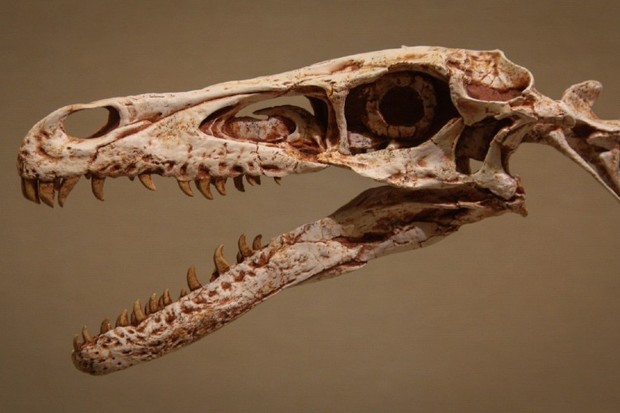
A fossilised Velociraptor skull, displaying its long head and sharp teeth © MarkWeich / Getty Images

The first Velociraptor fossil was discovered in the Gobi Desert in Outer Mongolia in 1923. It consisted of a crushed skull and the raptor’s sharp, terrifying, sickle-shaped claw. Specimens discovered later pieced the whole picture together: a bipedal, bird-like creature with several distinctive features.

The Velociraptor‘s skull was long with an upturned snout and a long jaw with serrated teeth. Like other Dromaeosaurids, it had a long tail and large feet with three strongly curved claws similar to the wing bones of modern birds. It also had long, wing-like arms and a wishbone similar to those of modern birds, but they were not big enough to support flight.

One of the most famous Velociraptor discoveries is known as “fighting dinosaurs” because it was found preserved, apparently in mid-combat with a Protoceratops. Palaeontologists believe both animals were buried very quickly, perhaps by a collapsing sand dune or sandstorm, because they were found in incredibly lifelike poses. The Velociraptor‘s sickle claw seems to be embedded in the throat of the Protoceratops.

Velociraptor claws

A distinctive Velociraptor sickle claw © Walter Geiersperger / Getty Images

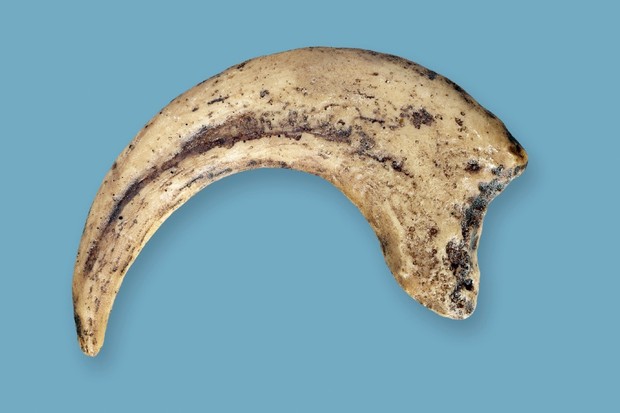
That distinctive sickle claw, found on a Velociraptor‘s second digits, was used to great effect in Jurassic Park. In the movies, raptors tapped them menacingly on the ground and slashed at victims with them. Some palaeontologists, however, believe that rather than disembowelling their prey, the claws – which could be more than 6cm on its outer edge – clutched or pinned prey down, using them like a bird of prey uses its talons today.

“There is a lot of debate about this,” says Brusatte. “[The claws] do seem to be a bit too thin and curved to be used as disembowellers, as some experiments based on model claws have shown. It seems like they were particularly good at latching onto prey, kind of like crampons. But I’m sure something that sharp would have been used in killing and eating, too. So I suspect those big foot claws were multipurpose tools, like a bunch of Swiss army knife functions combined into one.”

Did Velociraptors have feathers?

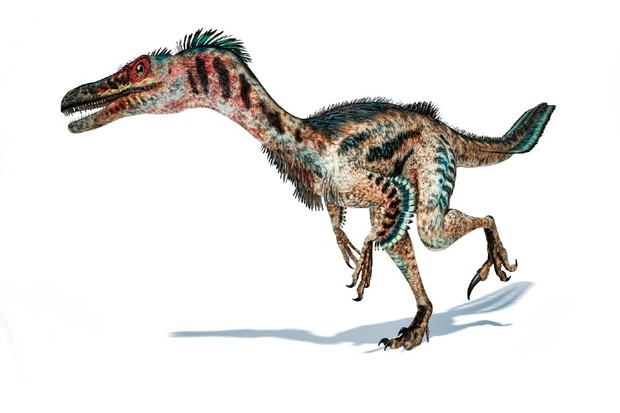
This illustration shows what palaeontologists believe Velociraptor actually looked like © Leonello Calvetti / Science Photo Library

Yes, lots of them. Contrary to the common lizard-like portrayal, all Dromaeosaurid species had feathers. Some palaeontologists even wonder whether all kinds of dinosaurs had feathers. In raptors, it’s actually confirmed in the fossil record. A 2007 Velociraptor discovery had ‘quill knobs’ on its arm bones where long feathers would have been attached.

“The real Velociraptor had feathers all over its body, and even wings on its arms, made up of quill pen feathers lined up along the arm and hand,” explains Brusatte. “It would not have looked like a green, scaly overgrown crocodile or lizard, but more like a ferocious bird, one with a long tail and a murderous toothy grin.

Velociraptor almost certainly couldn’t fly, so its feathers and wings were used for other purposes – to keep its body warm, and as display structures to intimidate rivals or attract mates. We don’t know their colours yet – but based on close relatives, they probably were pretty colourful, and maybe with even iridescent feathers or camouflage patterns.”

Velociraptor sound

In Jurassic Park III, it’s suggested that Velociraptor vocals were not just terrifying, they were actually a sophisticated mode of communication. This, sadly, is another case of how science is basically extinct in Hollywood. Velociraptors were smart, but only by dinosaur standards and the sounds they made were more likely to be rumbling hums, murmurs and squawks. Listen to what a cassowary sounds like for scientists’ current best guess.

Velociraptors in Jurassic Park

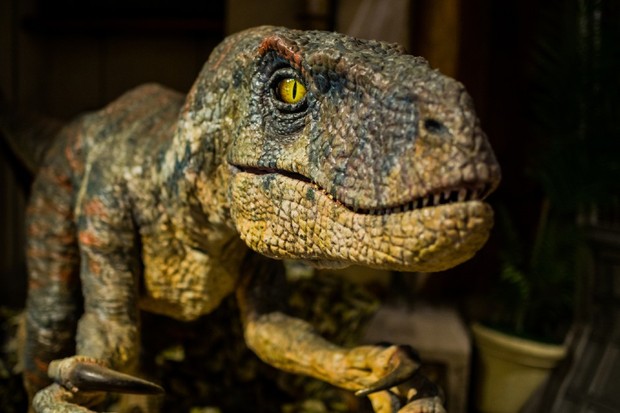
The Velociraptors in Jurassic Park were scaly and much bigger than the real thing © paikong / Shutterstock

As will be obvious by now, the so-called “clever girls” of the Jurassic Park series were not scientifically accurate. They were twice the size of real Velociraptors, and covered in scales instead of feathers. However, like the onscreen version, raptors were smart, fast and vicious – although it’s disputed whether they hunted in packs or not.

It’s also worth noting that the Velociraptors in Jurassic Park were actually based on another species of Dromaeosaurid, the Deinonychus. “Velociraptor and Deinonychus are very similar,” says Brusatte. “The main difference is size: Velociraptor was the size of a small dog, while Deinonychus was more like a pony. I believe the Jurassic Park Velociraptor was also based in part on Utahraptor, which is even bigger – horse-sized.”

Species related to the Velociraptor

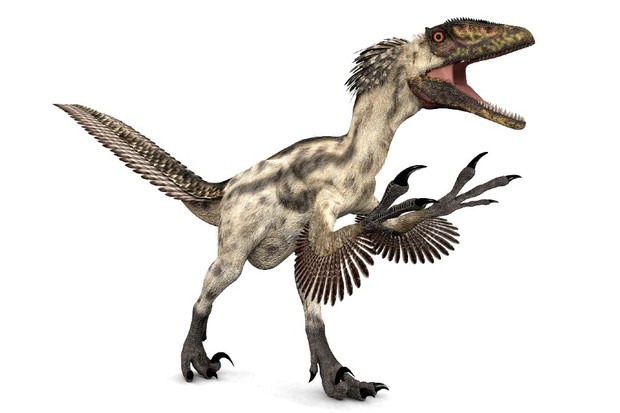
Deinonychus was closer in size to the Velociraptors seen in Jurassic Park © MR1805 / Getty Images

Deinonychus

The real inspiration for Jurassic Park’s raptors, this species was first discovered in the 1930s and was one of the species that led palaeontologists to suspect that birds may have evolved from dinosaurs. Deinonychus is Greek for “terrible claw”. Fitting, because it has the same sickle-shaped slasher as the Velociraptor, only bigger.

Utahraptor

More terrifying than anything in the movies, this feathered nightmare shared a lot of Velociraptor characteristics but could be taller than a man and was built like a polar bear. The earliest Utahraptor specimens were found in the 1970s but the species was only formally described in 1993, the same year that the first Jurassic Park movie was released.

Microraptor

Judge no raptor by its size, even this relative minnow. The Microraptor was about the size of a chicken but it had sharp teeth and sharp claws. Some specimens suggest this weird dinosaur may even have been capable of glided flight, making surprise aerial attacks possible. We’d pay to see that in the next Jurassic World movie.

About our expert, Prof Steve Brusatte

A vertebrate palaeontologist and evolutionary biologist at the University of Edinburgh, Prof Brusatte has hunted for dinosaur fossils all over the world and written over 110 scientific papers, as well as several books. He was a scientific consultant for the BBC’s Walking With Dinosaurs team.

Source: www.sciencefocus.com

10 Best Video Games For Fans Of The Jurassic Park Series

Sunday, May 30, 2021

Jurassic Park is a beloved franchise, but there haven't been many video games in the series. Here are some games like the series.

Over the years, the Jurassic Park franchise has turned the dinosaur-themed amusement park from an iconic setting in the original film to a downright pop culture phenomenon, redefining the way that fans see both dinosaurs and theme parks forever. The series has had a relatively small presence in the world of video games, though.

All is not lost for fans who are running out of Jurassic Park video games to play, though, as there are plenty of exciting games that take both the series' powerful dinosaurs and unique theme park premise to fun new heights. These games offer many different experiences for all kinds of players, but they all share connections with the Jurassic Park franchise.

10 - The Park

The first Jurassic Park film revolves around one of the most iconic examples of theme-park-gone-awry stories in American popular culture. So, while the psychological horror game The Park is lacking in dinosaurs, it will satisfy fans with plenty of twisted amusement park thrills and chills.

Players in The Park take control of Lorraine, a mother seeking her lost son Callum at the now-closed Atlantic Island Park, but not everything is as it seems at this abandoned funfair. The game is played in the first person and lacks combat, instead focusing on exploring the park and unwrapping the game's many mysteries.

9 - Monster Hunter Stories

In general, the Monster Hunter series seems like a great fit for fans of Jurassic Park, as the games, which are especially big in Japan, involve taking down massive beasts that often resemble prehistoric creatures. Monster Hunter Stories, however, offers a somewhat different experience that involves befriending dinosaur-like creatures.

Anyone who always wanted one of Jurassic Park's dinosaurs as a companion will probably appreciate this RPG's core mechanics that involve befriending monsters as a monster rider living in the vibrant world of the game. With combat that involves players and their beastly companions fighting off foes together, the game is action-packed, too.

8 - Saurian

While much of the Jurassic Park franchise shows humanity's attempts to control dinosaurs or keep them in captivity, Saurian is a survival game that focuses on the prehistoric beasts in the wild. Simulating the Hell Creek Formation's prehistoric ecosystem, Saurian is notable for its fidelity to nature and history.

This game has players taking on the role of one of several species of dinosaurs with different traits and needs, avoiding danger and finding resources in order to survive. The game is currently in early access, so more content is planned for fans of science and dinosaurs alike to enjoy.

7 - Dino D-Day

Fans of Jurassic Park and WWII fiction may find the perfect game in Dino D-Day, a first-person shooter centered on an alternate history in which Adolf Hitler has resurrected dinosaurs for the war effort. This irreverent take on the WWII FPS is a multiplayer game that resembles titles like Call Of Duty and Battlefield.

Players in the game select from one of two factions (the Allies and the Axis), as well as a combat class with unique tools, with more classes being added to the game with updates, including an Allied dinosaur character. With many modes and maps to play on, new players will have a lot at their fingertips right away.

6 - Carnivores: Dinosaur Hunter Reborn

Players looking for classic dinosaur-hunting action are probably looking for something like Carnivores: Dinosaur Hunter Reborn, part of the Carnivores series. In this first-person shooter, players are tasked with going on dinosaur hunts where they must hunt down and defeat a variety of prehistoric targets.

The game's approach to dinosaur-human relations is a bit more aggressive than the idealized utopia visualized by John Hammond in Jurassic Park, but fans will still find fun in the hunting simulator. A survival mode also lets players take on waves of dinosaurs and test their skills.

5 - Primal Carnage: Extinction


In this unique asymmetrical multiplayer game, players take on the role of either dinosaurs or humans in different modes that see them capturing locations and competing for the most kills, among other goals. With several dinosaur species and human classes to choose from, there are plenty of options for different playstyles in Primal Carnage: Extinction.

Fans of Jurassic Park will appreciate the game's approach to the tense man vs. nature conflict seen throughout the films, as well as the game's exciting, action-packed clashes. Being able to play both sides of the conflict may also give fans a new perspective on the films.

4 - RollerCoaster Tycoon 3

Although it's lacking in real-life dinosaurs, RollerCoaster Tycoon 3 is a highly acclaimed theme park simulation game that fans of Jurassic Park's theme park and zoo elements will enjoy. In building and managing the regular operation of extravagant and highly themed amusement parks, players have to keep guests happy and profits high.

With the game's expansions, players can also add more elements to their parks, like pools and zoos, and the Wild! expansion also features some prehistoric décor, perfect to recreate Jurassic Park with. While there's no dinosaurs-on-the-loose chaos to be found here, this game does provide an in-depth and dynamic theme park management experience.

3 - Ark: Survival Evolvedhttps://amzn.to/3xD1ww3


A recent hit in the world of survival games, Ark: Survival Evolved is an enormous open-world game filled with prehistoric creatures, as well as the occasional mythical or robotic one. Players in this game spend their time surviving in the harsh environment of a dinosaur-infested island.

Unlike Isla Nublar in the original Jurassic Park, though, this island has no built-in infrastructure, meaning that players must gather resources and build a home base all by themselves. In addition to more expected survival mechanics, though, fans will delight in the game's dinosaur taming system that can be used to recruit prehistoric companions.

2 - Turok: Dinosaur Hunter

This first game in the classic Turok series was recently remastered, making now the perfect opportunity for Jurassic Park fans to start hunting dinosaurs. Players in Turok: Dinosaur Hunter step into the shoes of Tal'Set, a Native American with the mantle of "Turok," a time-traveling warrior who protects the barrier between Earth and the time-displaced Lost Land.

In the Lost Land, players will search for important items while facing off with a plethora of enemies, ranging from poachers and soldiers to demons and aliens. Most importantly, though, players will be facing off with mighty dinosaurs in fast-paced first-person shooter gameplay.

1 - Parkasaurus

Drawing directly from the core concept of the Jurassic Park series and fully realized in Jurassic World, the adorable and fun Parkasaurus tasks players with operating their very own dinosaur zoo. Much like similar tycoon games, players here can hire employees and build the layout of their zoo any way they want.

It's the dinosaurs themselves that will really start to bring in guests, though, as players' zoos are filled with prehistoric exhibits that constantly grow with new dinosaur eggs hatching all the time. Since each dinosaur species has different needs and can potentially escape, players will need to carefully build and manage their enclosures.

Source: https://screenrant.com/

10 Reasons Why We Need A Survival-Horror Jurassic Park Game

Friday, May 28, 2021

The Jurassic Park franchise has an opportunity to potentially create a great survival-horror video game. Here are some reasons why.

The survival-horror gaming genre experienced some of its biggest booms in mainstream popularity with the likes of Resident Evil back in the '90s. As a genre, it's obviously synonymous with zombies, monsters, and demons, but there's still potential for games to venture out further in terms of thematic setting.

Jurassic Park could offer such a premise, with the dinosaur theme being something that could potentially fit a survival-horror game like a glove. There's plenty of timeline to work with to tell inventive, yet isolated stories without stepping on any movies and different ways to approach the genre (first/third-person), so here's 10 reasons why need a survival-horror Jurassic Park game.

10 - The Extinction Of Dino Crisis

Capcom, as of now, still seems dead-set on refusing to acknowledge the '90s cult classic Resident Evil clone Dino Crisis. There have been rumors with a trademark filing in 2019 for the series and Capcom saying they intend to revive older IPs, but nothing is remotely concrete yet.

Should Dino Crisis continue to remain extinct, a Jurassic Park survival-horror game could easily fill that void as long as it's handled with care. The core dinosaur theme is already there, so as long as it's rated appropriately and developed by a team with a strong vision for making survival-horror games, this could be forgiven--at least in part--by fans of the forgotten series.

9 - Survival-Horror Resurgence

With Silent Hill being out of commission under Konami's stranglehold for ages now, the aforementioned RE franchise takes the lion's share of the spoils in that mainstream market. Given Resident Evil 6 proved to be a big disappointment and shook up faith in the series and Capcom, it took Resident Evil 7 and a series of remakes to redeem their name.

Along with other smaller games, RE and Capcom's overall redemption arc have helped push the genre back into the mainstream. With that said, perhaps now is as good a time as any to capitalize on the rise in popularity with survival-horror but expand with a separate IP, whether Capcom publishes/develops it or not.

8 - Jurassic Park As A Brand

While there are other IPs out there in the mainstream that are definitely more popular, the Jurassic Park brand isn't exactly a slouch. Though Fallen Kingdom disappointed critically, it still made a killing at the box office. If nothing else, it shows that it's still a big blockbuster brand name, and will at least hold onto the nostalgic legacy of the critically-acclaimed 1993 original.

Even though gaming is a different medium altogether, should a publisher and developer take on a licensed triple-A horror game with the rights of the IP, it'll still have some hefty name recognition going behind its hype--coupled with the fact it'd be exploring a new frontier in terms of genre.

7 - Alien: Isolation, But With Raptors

Alien: Isolation proved to be a surprise critical hit given that the IP has been used for gaming before but to little fanfare. It particularly did well critically with general audiences, as it provided one of the most harrowing experiences for a modern survival-horror game. The game succeeded in giving players an engrossing, terrifying, claustrophobic, and tense experience in being actively hunted by an apex predator in its element.

That game alone provides an excellent blueprint for a Jurassic Park game. The world's Velociraptors would make prime choices as ever-present hunters stalking the player character. Other dinosaurs should be included, but the intelligence, lethality (and popularity) would make perfect replacements for what the Xenomorph gave to Isolation.

6 - Current-Gen Hardware

With the current generation only recently having begun, the capabilities at developers' disposal are great. The PS5, XSX, and the new RTX GPUs are capable of incredible graphical and mechanical feats, increasing the possibilities of a game like this. Given what was possible with last gen's Resident Evil games on PS4/XBO, the potential here has a much higher ceiling.

Especially so if a JP game were to be developed and be exclusive to current-gen hardware since it wouldn't need to compensate for a last-gen version of a hypothetical game. The haptic button features on PS5 controls could make for fun features on a horror game like this. Accessibility is currently a major issue of this hardware for the general public, but over time something like this could be executed well.

5 - Indie Developers

While handing this off to Capcom's dev teams who've made themselves partly synonymous with the biggest horror titles, tackling this genre with a different franchise could benefit from looking for some indie outfits to take a stab at what would essentially be an "experimental" project.

Indie developers and publishers have put out a variety of cult-hit horror games, with some of them ending up becoming popular in the mainstream as well. For instance, Frictional Games were responsible for successes like Amnesia: The Dark Descent and Soma. Those proved to be blood-curdling for players, and while they don't necessarily need to do this kind of game, it's definitely an example of the capabilities the indie scene has.

4 - Good JP & Dinosaur Games Are Hard To Come By

Though dinosaurs are a seemingly endlessly relevant topic in pop culture despite being extinct for ~65 million years, it isn't reflected in gaming so much. Good Jurassic Park--and just dinosaur-themed games in general--are rare to nonexistent. There are some games in the indie department, but are mostly buggy or waiting their turn in Steam Early Access.

Prehistoric Kingdom is coming up on Early Access and hopefully turns out well, but it's an indie Park Simulator game, not horror. Injecting a dose of excitement in this scarcely-tapped genre could be done with a new twist on the formula through survival-horror and a widely-recognized franchise name, bringing their representation in gaming out of extinction.

3 - Use Novel Lore

The franchise started with author Michael Crichton's original novel, but also got The Lost World as a sequel. Despite Spielberg seemingly peer-pressuring him into writing a second book, the second movie hardly used it for reference, and, believe it or not, the books together actually have a good bit of lore to them. In their canon, there are five islands, known as the "Cinco Muertes" (Five Deaths) that were used in some fashion during the lead-up to building Jurassic Park in dinosaur cloning.

The five theatrical adaptations only acknowledged all five in an easter egg--and only ever using Nublar and Sorna as settings--so a game could theoretically craft an isolated story in between events of the movies that still expands the world the movies brought to the screen. It could prove exciting, opening up opportunities for unique environments and not-yet-seen species.

2 - Movie Scenes Show How It's Done

While the movies themselves aren't horror and--particularly with the last two--lean more into sci-fi action-thriller, the first two certainly demonstrated elements of horror. Perhaps the most iconic scenes being Tim and Lex hiding from the Velociraptors in the kitchen and the T-Rex breakout from the original, but even The Lost World: Jurassic Park had its moments.

The Raptors streaking through the tall grass and picking people off looked great, and the ones hiding from the T-Rex behind a waterfall, only for one to get snatched up and leave a bloody waterfall behind are also memorable. Those scenes can basically be a proof of concept for how a horror JP game could work.

1 - T-Rex "Mr. X/Nemesis"

While Raptors would make thrilling equivalents of the Xenomorph, should a game like this go more in the Resident Evil direction--or really just Dino Crisis--the T-Rex could be used as an equivalent for Mr. X and Nemesis in the remakes of RE2 and 3. The original Dino Crisis did something similar on the PS1, but a modern-day version of this would be anxiety-inducing in the best possible way within the context of survival horror.

It could be an insurmountable foe that makes both scripted and spontaneous appearances hunting the player through jungles. Players would need to hide and make high-stake escapes--and including nocturnal and jungle rain settings would add to the thrill.

Source: https://screenrant.com/

Paleontologists Find First Complete Egg of Extinct King Island Dwarf Emu

Thursday, May 27, 2021

Reconstruction of Sea Elephant Bay circa 1802, with southern elephant seals and King Island emus. Image credit: Julian Hume.

While the egg was about the same size as those laid by mainland emus, a duo of avian paleontologists from Australia and the United Kingdom used it to calculate the King Island emu (Dromaius novaehollandiae minor) was about 44% smaller than the living species.

Islands off the southern coast of Australia once harbored three subspecies of the mainland emu (Dromaius novaehollandiae): the smaller Tasmanian emu (D. n. diemenensis) and two dwarf emus — the King Island emu and the Kangaroo Island emu (D. n. baudinianus).

Due to limited distribution and small population size, they all became extinct rapidly after discovery by human settlers due to over-hunting.

They disappeared from King Island by 1805, with a captive pair surviving in Paris until 1822; from Kangaroo Island by 1830; and from Tasmania by 1850.

Little was recorded about their life histories and only a few historical museum specimens exist, including a number of complete eggs from Tasmania and one egg from Kangaroo Island.

In new research, avian paleontologists Julian Hume and Christian Robertson performed a detailed analysis of eggs of dwarf emus.

They examined 38 intact eggs of the mainland emu, 6 eggs of the Tasmanian subspecies, and the first known complete egg of the King Island subspecies.

The unique egg was found at Yellow Rock River on King Island in association with a skeleton of the King Island emu, other individual emu bones and eggshell.

The results show that despite the reduction in size of all island emus, especially the King Island emu that averaged 44% smaller than mainland birds, the egg remained similar sized in linear measurements, but less in volume and mass, and seemingly had a slightly thinner eggshell.

“This was a response to reduced resources and harsh environmental conditions on their respective island homes, where evolution likely favored larger emu chicks that were relatively mature and mobile at hatching, and could immediately forage for food and maintain body heat to combat cold,” the researchers said.

“This scenario provides an interesting evolutionary response to insular environmental conditions in dwarf emu breeding strategy, but due to their complete and rapid extinction, the true extent of these adaptations is now impossible to determine.”

paper on the findings was published in the journal Biology Letters.

_____

Julian P. Hume & Christian Robertson. 2021. Eggs of extinct dwarf island emus retained large size. Biol. Lett 17 (5): 20210012; doi: 10.1098/rsbl.2021.0012

Source: www.sci-news.com/

Jurassic World's Creation Actually Broke U.S. Law

Wednesday, May 26, 2021

Jurassic World proved that a dinosaur theme park could be possible following Jurassic Park, but its creation involved breaking U.S. law.

Following the T-Rex rampage through the streets of San Diego in The Lost World: Jurassic Park, U.S. Congress decided to take an active role in handling the genetic creations brought to life by John Hammond's company, InGen. The Gene Guard Act was put into law in 1997 and effectively prohibited creating any more prehistoric creatures and plant life. The bill made Isla Nublar and Isla Sorna restricted areas and gave the dinosaurs residing on them the same rights as endangered species. While the Gene Guard Act was concrete in protecting existing assets, this didn't stop InGen from "innovating" by aiding in the creation of Jurassic World. By its opening, the park had already violated the act on more than one occasion.

During the transition phase that eventually led to Jurassic World, Masrani Global purchased InGen following John Hammond's death. In Jurassic Park III, while stranded on Isla Sorna, Dr. Alan Grant and a group of survivors began uncovering secrets in a genetic lab. It was evident that even though the lab was abandoned, the work taking place within it was more advanced than what had occurred in Jurassic Park. The biggest examples of this came in the forms of the Ankylosaurus and the Spinosaurus that actively hunted them throughout the film. Not only were both new creations, but they were also never on InGen's list of dinosaurs to be created before the Gene Guard Act.

Only two years after Jurassic Park III, Masrani Global succeeded in working out amendments to the Gene Guard Act that allowed the cloning of more dinosaurs for Jurassic World. This new, flimsier bill was supposedly created "for reasons of medical advancement." It later came to pass that many of the dinosaurs present on Isla Nublar were actually created sometime earlier on Isla Sorna, tying directly into what was shown in Jurassic Park III.

In 2005, Jurassic World opened to huge attendance and revenue, proving that Hammond's dream was not only possible but a massive success. Due to lax laws in the Gene Guard Act and multiple interested parties, including CEO Simon Masrani, Dr. Henry Wu began work on genetic hybrids. This led to the creation of the Indominus Rex, which was meant to be a new attraction until she escaped and destroyed Jurassic World only ten years after its opening. Following the incident, InGen's past and the creation of the park were under scrutiny.

After the Jurassic World incident, multiple employees brought up what they had learned, calling into question potential violations of the Gene Guard Act. Following the allegations, U.S. Congress learned that the survivors from Jurassic Park III vocalized their discoveries as well, but the officials who handled it were bribed into silence. Furthermore, some of the creations that appeared in Jurassic World were being created long before the relaxation of the Act in 2003.

While Jurassic World succeeded in proving that it was possible to run a theme park with dinosaurs, its illegal origins were the reason for its downfall. The Gene Guard Act was designed to protect all creatures on the islands and prevent InGen from creating even more, but it failed in its mission. Instead of being known as the first functioning dinosaur park, Jurassic World represents the greed of humanity and how desire for power can ruin a beautiful thing.

Source: www.cbr.com/

Jurassic World Homages Spielberg's Original Movie Ending

Wednesday, May 26, 2021

Camp Cretaceous season 3 brings back a classic Jurassic Park location and contains several tributes to key scenes from Steven Spielberg's movie.

Warning: SPOILERS for Jurassic World: Camp Cretaceous Season 3.

Jurassic World: Camp Cretaceous season 3 calls back to Steven Spielberg's Jurassic Park, including an homage to its unforgettable ending of the T-Rex fighting Velociraptors in the visitors' center. Netflix's animated series is set six months after Jurassic World as the six teenage Campers take it upon themselves to escape Isla Nublar but they have to contend with a new hybrid predator, the Scorpios Rex, only there are two of them!

Spielberg's Jurassic Park is one of the most beloved blockbusters of all time and it established the rules and tropes of every Jurassic movie since. In fact, Colin Trevorrow's Jurassic World is a soft reboot that recycles many of Spielberg's original plot points and action sequences, and it featured a return to the remains of Jurassic Park's visitors' center. Jurassic World: Camp Cretaceous also pays homage to Spielberg, who is one of the show's executive producers, and season 3 showcases the most tributes yet as Darius (Paul-Mikél Williams), Kenji (Ryan Potter), Brookynn (Jenna Ortega), Sammi (Raini Ramirez), Ben (Sean Giambrone), and Yasmina (Kausar Mohammed) also set foot in Jurassic Park's visitors' center, which is now the home of Blue the Velociraptor.

In Camp Cretaceous season 3, episode 8, "Escape from Isla Nublar," the Campers learn that there are two Scorpios Rex and they return to the visitors' center as the hybrid dinosaurs give chase. Camp Cretaceous honors Spielberg's seminal "Raptors in the Kitchen" sequence where Lex (Ariana Richards) and Tim Murphy (Joseph Mazzello) are stalked by Velociraptors by doing their own version as the Scorpios Rex hunts the Campers in the ruins of the same kitchen. Later, the kids are trapped in the main lobby of the visitors' center as both Scorpios Rex try to kill them, but they find an unlikely ally in Blue (whose life Darius had previously saved). The cobalt Velociraptor decides to fight the Scorpios Rex, who also turn on each other, in a brilliant echo of the memorable battle between the T-Rex and the raptors in Jurassic Park.

The Scorpios Rex battle ultimately destroy the visitors' center, which is Camp Cretaceous' final farewell to that all-important location in Spielberg's Jurassic Park. After all, Jurassic World: Fallen Kingdom established that all of Isla Nublar is eventually destroyed by a volcanic eruption, which means no one can ever return to the site of four of the Jurassic movies and Camp Cretaceous. However, Blue survived the visitors' center's destruction; the Velociraptor had made her home in the ruins of the structure so Blue became displaced and would be loose on the island until Owen Grady (Chris Pratt) returned to rescue her in Fallen Kingdom.

However, Camp Cretaceous season 3's final two episodes had more notables tribute to Jurassic Park, including the return of Dr. Henry Wu (Greg Chun). After mercenaries arrived on Isla Nublar to retrieve the DNA of the Indominus Rex, Kenji, Ben, and Sammy are taken aboard a helicopter, which then crashes thanks to the Pteranodons. The chopper is stuck in a tree and the Campers have to escape before it crashes into the ground just like how Lex and Tim were trapped in a Jeep and were rescued by Dr. Alan Grant (Sam Neill) after the T-Rex attacked them in Jurassic Park.

Finally, the Campers escaped Isla Nublar aboard a boat at the end of Jurassic World: Camp Cretaceous season 3, and while the final shot is a cliffhanger of a mystery dinosaur locked in the bowels of their vessel, the sense of relief among the Campers echoes the uplifting feeling of how Dr. Grant and the others felt when they flew away from Isla Nublar in at the end of Jurassic Park.

Source: https://screenrant.com/
Oligocene Whale Had Both Teeth and Baleen, New Research Shows

Wednesday, May 26, 2021

An artist’s reconstruction of Aetiocetus weltoni. Image credit: C. Buell.

A duo of paleontologists from San Diego State University and the San Diego Natural History Museum has explored the transition from raptorial feeding in early baleen whales (Mysticeti) to filter-feeding in living species.

“A strange phenomenon happens with modern blue whales, humpback whales and gray whales: they have teeth in the womb but are born toothless,” said Dr. Eric Ekdale and Dr. Thomas Deméré.

“Replacing the teeth is baleen, a series of plates composed of thin, hair- and fingernail-like structures growing from the roof of their mouths that act as a sieve for filter feeding small fish and tiny shrimp-like krill.”

Aetiocetus weltoni, an evolutionary cousin of today’s baleen whales, had both teeth and baleen simultaneously in adulthood, making for a very crowded mouth.”

The paleontologists examined the 25 million year-old skull of Aetiocetus weltoni using the high-resolution computed tomography.

They found grooves and holes on the roof of the animal’s mouth that connect internally with a vascular canal in a fashion consistent with the pattern of blood vessels that lead to baleen in modern mysticetes.

What that demonstrates is that the blood supply for the teeth was co-opted for a new function, to support the growth of baleen in living baleen whales.

The study also revealed separate connections between the major internal canal and smaller canals that would have delivered blood to the upper teeth, which is consistent with the pattern of blood supply to teeth in living toothed whales such as sperm whales and killer whales, porpoises, dolphins, and terrestrial mammals.

“We have found evidence that supports a co-occurrence of teeth and baleen, indicating the tooth-to-baleen transition occurred in a stepwise manner from just teeth, to teeth and baleen, to only baleen,” Dr. Ekdale said.

“Our study provides tangible fossil evidence of a major shift in feeding behavior from a raptorial carnivorous feeding mode to a bulk filter-feeding mode for obtaining food, among the largest animals that have ever lived in Earth’s oceans,” he added.

“Krill are around 1/600th the size of blue whales. That’s like us humans eating nothing larger than sesame seeds floating in a pool.”

“The four main living groups of baleen whales each pursue different diets and use their baleen filter in different ways, so they divide up ocean resources rather than compete with each other for the same prey.”

The study was published in the Zoological Journal of the Linnean Society.

_____

Eric G. Ekdale & Thomas A. Deméré. Neurovascular evidence for a co-occurrence of teeth and baleen in an Oligocene mysticete and the transition to filter-feeding in baleen whales. Zoological Journal of the Linnean Society, published online May 24, 2021; doi: 10.1093/zoolinnean/zlab017

Source: www.sci-news.com/

Jurassic World: The Indominus Rex Began as...a Plant?!

Tuesday, May 25, 2021

Before the Indominus Rex terrorized civilians in Jurassic World, the idea for the creature was born from the most unlikely places, a plant.

Following the failure of Jurassic Park, geneticist Dr. Henry Wu became fascinated by the idea of genetic hybrids. This thought was born following his discovery of the intelligence in the velociraptors and how the frog DNA they used to fill the gaps in the genome allowed the dinosaurs to switch gender and reproduce. Without the ability to recreate dinosaurs, Wu's efforts were put into plant hybrids. Following the first hybrid plant's creation, the pieces were in place to eventually create the Indominus Rex.

After 12 years of work, Dr. Wu's hybrid plants quickly brought him into the focus of Simon Masrani, CEO of InGen. With his new park, Jurassic World, slowly losing attendance, the decision was made that he could continue his work on genetic hybrids for a new attraction. What came from this research was the genetic equivalent of Frankenstein's Monster -- the Indominus Rex. Unbeknownst to Masrani, Wu also dealt with InGen Security Division commander Vic Hoskins to create a specimen to use for military applications.

The genetic makeup of the Indominus Rex is similar to Wu's initial plant hybrid in that it's a cocktail of genetic samples. Some samples were a mixture of carnivorous dinosaurs, including the T-Rex and velociraptor. It also carries the genes of cuttlefish, tree frogs and the pit viper. The modern DNA samples, more specifically the cuttlefish and tree frog, contribute to giving the I-Rex the ability to camouflage and regulate its temperature so that the naked eye or thermal scanners can't track it.

Because of its heightened intelligence, the Indominus Rex didn't appreciate being in captivity and set up distractions all around its pen. In Jurassic World, it uses its distractions and camouflage ability to execute an escape where it rampages through the park, killing dinosaurs and humans for sport. It takes the combined might of humans, velociraptors, the T-Rex and the mosasaurus to take down the hybrid. While most scientists would never tamper with genetic power again, after these events, Dr. Wu saw an opportunity to perfect his creation.

Using the research from his initial plants and the Indominus Rex, Dr.Wu put his efforts into developing an improved version of the creature. Smaller and deadlier, the next iteration was called the Indoraptor. However, this creature is even more unpredictable and inevitably becomes another failed hybrid. The timeline of creation from the plant to the Indoraptor shows how power can corrupt an individual, and for Dr. Wu the absolute power he discovered corrupted him absolutely.

The Indominus Rex proves that while humans have the ability to create new life through genetics, it shouldn't be within their power to decide when and how they do it. Dr. Wu saw an inspiration following the events of Jurassic Park, and rather than see it as a lesson, he saw it as an opportunity to push the boundaries, beginning with a plant. In the end, the deadliest creatures in the entire franchise metaphorically and literally began as nothing more than a seed.

Source: www.cbr.com/

Jurassic World: Project IBRIS Uncovered a Unique Side of Velociraptors

Tuesday, May 25, 2021

The trained Velociraptors in Jurassic World were a first for the series, debuting as the result of Project IBRIS.

The Velociraptor's vast intelligence has been a cornerstone of the Jurassic Park franchise since they learned how to open doors in the original film. As the franchise progressed, characters in the series learned even more about the creatures, such as their ability to communicate on a level that surpasses chimps and dolphins. By Jurassic World, InGen Security Division Commander Vic Hoskins became the point man in a project titled the Integrated Behavioral Raptor Intelligence Study, aka IBRIS.

Four Raptors, named Blue, Charlie, Echo and Delta, were created for the study and the attraction that was to come from it. Along with the Raptors, InGen added animal behaviorist Owen Grady to the staff for the Raptors to imprint on and learn from. Though it's known that Raptors are brilliant creatures, it wasn't until these four that Grady and the other Jurassic World members unearthed the deeper layers to their thought processes.

When Project IBRIS began, there was reasonable apprehension toward the idea as dinosaur encounters prior to the project often led to violent ends. But in video footage from Blue's infancy, Grady tried eliciting an empathetic response from the Raptors while appearing injured. All of the Raptors except Blue gave in to their instinct to hunt. Instead of attacking, Blue took on a more maternal approach, nurturing Grady rather than harming him. From that moment, Blue became the key to the other Raptor's success.

Years progressed, with Grady acting even more comfortable in his role as alpha and Blue keeping her siblings in line as the beta. By the events of Jurassic World, Grady could line up the Raptors and even have them respond to commands like staying in place. But as his bonds with the Raptors grew, Hoskins saw the potential in military application. To him, the ability to command intelligent and strategically minded animals like Raptors could yield massive results when weaponized and used in military exercises. Grady, now treating the animals like family, adamantly shut down the idea as Hoskin's personal goals were never the project's purpose. But even without the Raptors being used in combat exercises, it didn't stop other geneticists like Dr. Wu from pursuing the idea with new hybrid creatures like the Indoraptor.

As Project IBRIS began to reveal Velociraptors' true mental range, it also showcased how these animals could bond with humans. More than any Raptor in the pack, the bond between Blue and Grady was the strongest. Because Raptors hunt in packs, there was a small society that existed between them. Much like how wolves accept humans into their pack, Grady quickly learned that Velociraptors could do the same. Even when the Indominus Rex turned the Raptors against Grady, Blue differentiated and returned herself and her siblings to Owen since she knew deep down who the real alpha was.

At its inception, Project IBRIS was created to be nothing more than a way to train Raptors to follow orders for a future attraction. While an attraction never came, the study's research changed what people know about Raptors forever. It uncovered just how layered Raptor intelligence really is and how people like Owen Grady are capable of forming powerful bonds that last for years. In the end, Project IBRIS finally erased the stigma that Velociraptors are nothing more than mindless killing machines.

Source: www.cbr.com/

Pages