nandi's blog

Famous Crystal Palace Dinosaur Given Emergency Facelift

Wednesday, May 19, 2021

The sculpture was built in the Victorian era and suffered damage last May. FRIENDS OF CRYSTAL PALACE DINOSAURS

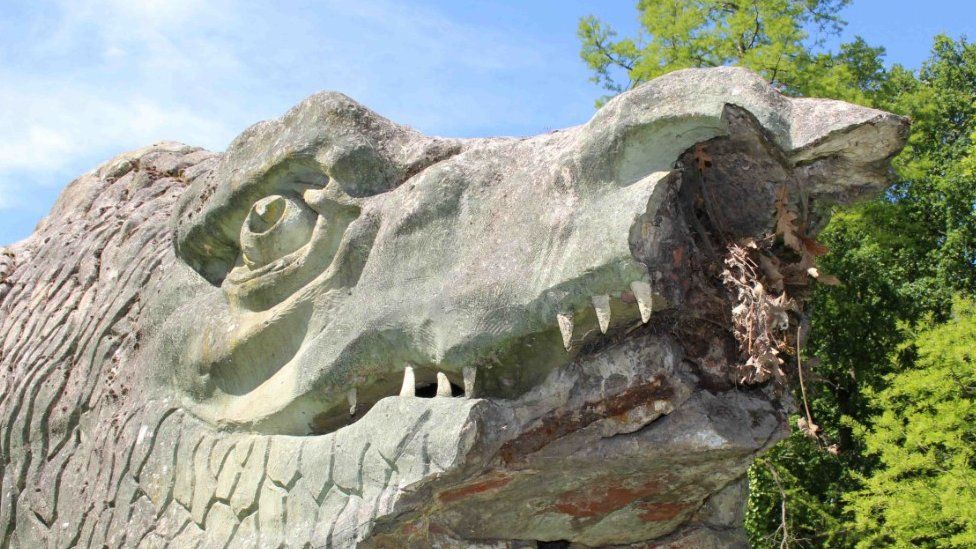
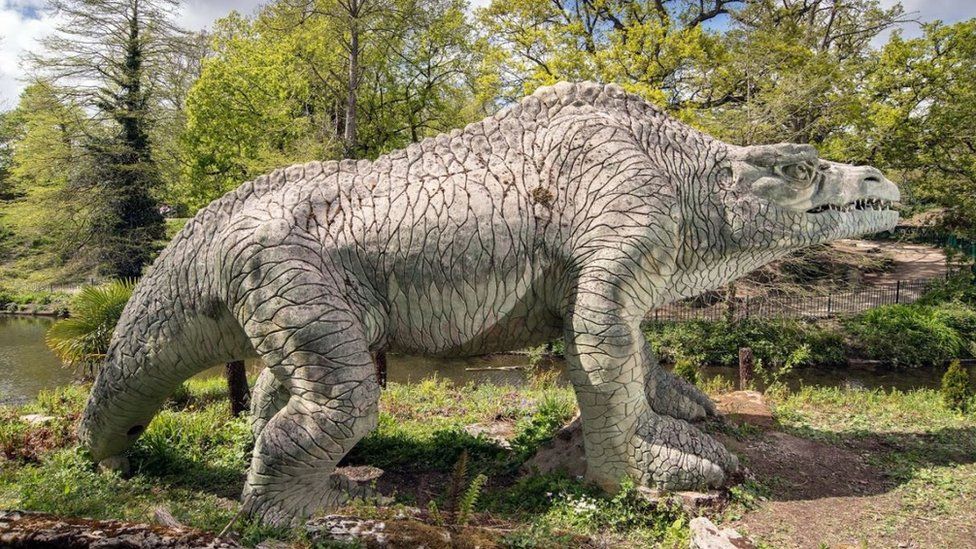
A Grade I-listed dinosaur sculpture which has stood in a south London park since the Victorian era has had an "emergency facelift".

The nose and mouth of the Megalosaurus, which is on an island in Crystal Palace Park, broke off last May.

Intricate work has seen 22 new teeth and a "prosthetic jaw" installed on the 167-year-old sculpture.

The Megalosaurus is part of more than 30 animal sculptures in the park, which are on the Heritage At Risk register.

Historic England said the "emergency rescue mission" was made possible due to a grant from the Culture Recovery Fund.

Fundraising from the Friends of Crystal Palace Dinosaurs also helped.

The giant Grade I listed statue stands at 3.5m high and 10m long. HISTORIC ENGLAND

Duncan Wilson, Historic England's CEO, said: "The towering Megalosaurus is loved by children and adults alike, with a fan club across the capital, the country and indeed the world.

"It is heartening to think that this restoration work will give so much pleasure to so many people, as we begin to explore historic places again."

They were created between 1852-1855 by Benjamin Waterhouse Hawkins, a natural history artist, and represent the first major worldwide outreach project of science as "edu-tainment".

Historic England said the creatures represented the cutting edge of scientific knowledge at the time and would have been "an extraordinary sight" to the Victorians.

Queen Victoria and Prince Albert were said to have been fascinated by the dinosaur displays in Crystal Palace and had visited the site several times.

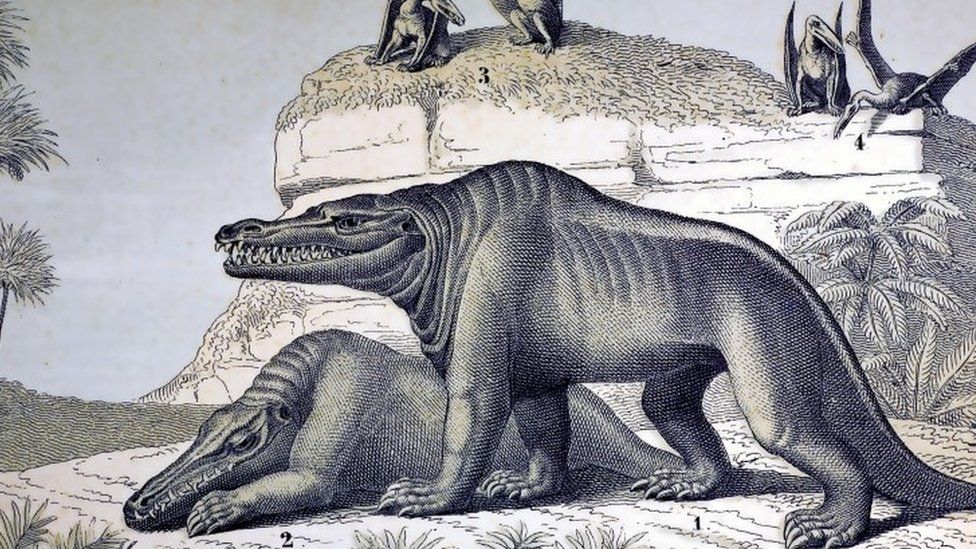
Megalosaurus facts

SCIENCE PHOTO LIBRARY

  • Its name means "giant lizard"
  • They lived in England between 166.1 and 168.3 million years ago
  • They were 20ft (6m) long
  • Charles Dickens imagined meeting a Megalosaurus on the muddy streets of London in the opening lines of Bleak House. They are also mentioned in Conan Doyle's Lost World

Source: www.bbc.com/

180-Million-Year-Old Fossil Reveals Three Levels of Ancient Food Chain

Tuesday, May 18, 2021

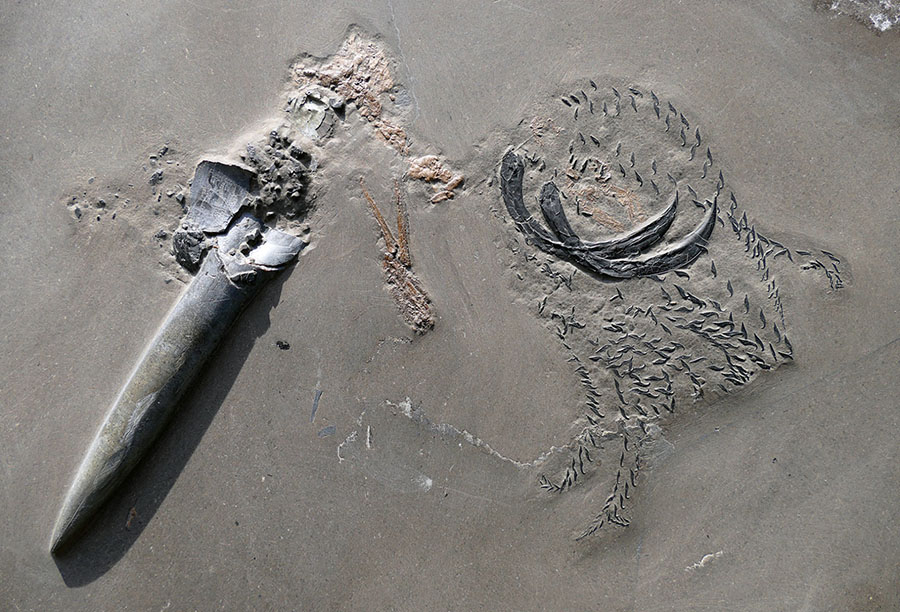
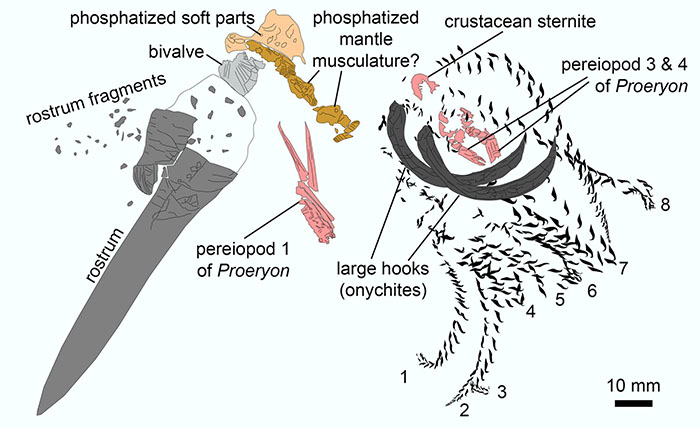
The belemnite Passaloteuthis bisulcata with preserved arm crown and remains of its prey. Image credit: Klug et al., doi: 10.1186/s13358-021-00225-z.

A fossilized squid-like cephalopod holds crustacean remains in its arm crown and, in turn, represents the remains of the meal of a predatory shark, according to a new study.

The unique fossil dates back from the Early Jurassic period, approximately 180 million years ago, and was originally found in 1970 by the fossil collector Dieter Weber.

The slab was extracted from the Posidonienschiefer Formation (Posidonia Shale) exposed in the now abandoned Gonser quarry at Ohmden near Holzmaden in Germany.

One of the study authors, Dr. Günter Schweigert, recognized its importance during a visit of Dieter Weber’s collection in 2019 and the specimen was subsequently purchased by the Staatliches Museum für Naturkunde Stuttgart.

“For paleontology, the Posidonia Shale offered a rare combination of a shallow to moderately deep continental marine basin, in which oxygen became depleted numerous times during the Toarcian age of the Jurassic period,” Dr. Schweigert and colleagues explained.

“Often, the oxygen content was too low to sustain scavengers and, in the absence of strong currents, skeletons had a reasonable likelihood to preserve in articulation and soft parts of embedded carcasses could become fossilized.”

Camera lucida drawing of the fossil. Image credit: Klug et al., doi: 10.1186/s13358-021-00225-z.

The specimen examined by the team preserves a belemnite and the remains of the decapod crustacean Proeryon in the belemnite’s arm crown.

“We suggest the term leftover fall for the event and the term pabulite for the fossilized meal when it never entered the digestive tract,” the paleontologists said.

“Usually, pabulites are incomplete organismal remains and show traces of the predation.”

The belemnite belongs to Passaloteuthis laevigata, a well-known and frequent belemnite species in the lowermost Toarcian of Europe and Morocco.

It preserves the rostrum, a few soft part remains, while the arm crown is one of the best-preserved of its kind.

“Belemnites played a key role in the marine basins of Europe during the Jurassic,” the researchers said.

“There is a growing body of evidence that belemnoids and their relatives preyed upon fish nearly as long as their mantle.”

“It is still a matter of debate whether they were ambush predators or able to chase their prey to some extent.”

“With their pointed beaks, they were able to hold, immobilize and cut prey.”

“Recently, it was suggested that they might have been able to break ammonite conchs in order to facilitate withdrawal of the soft parts.”

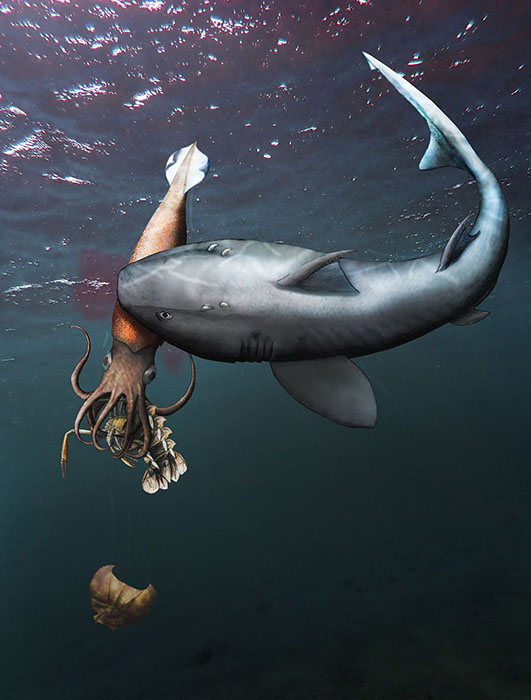
Possible scenario explaining the taphonomy of the belemnite: Hybodus hauffianus is known to have fed on belemnites, although it is unclear whether some individuals learned how to avoid the swallowing of the calcitic rostrum; the belemnite Passaloteuthis laevigata holds remains of the exuvia of Proeryon in its arm crown. Image credit: Klug et al., doi: 10.1186/s13358-021-00225-z.

The fossilized belemnite also displays damage indicative of predation by a larger animal.

“Remarkably, most of the belemnite soft parts between the arm crown and the calcitic rostrum are missing,” the scientists said.

“We suggest that this represents remains of a meal of a vertebrate predator, possibly of the Early Jurassic shark Hybodus hauffianus.”

“This is remarkable, because it informs about the behavior of a cephalopod and a vertebrate predator.”

paper on the findings was published in the Swiss Journal of Palaeontology.

_____

C. Klug et al. 2021. Fossilized leftover falls as sources of palaeoecological data: a ‘pabulite’ comprising a crustacean, a belemnite and a vertebrate from the Early Jurassic Posidonia Shale. Swiss J Palaeontol 140, 10; doi: 10.1186/s13358-021-00225-z

Source: www.sci-news.com/

Jurassic Park Turned Its Scariest Dinosaur Into a Hero

Monday, May 17, 2021

The Jurassic Park franchise is host to many terrifying dinosaurs. But its most powerful has transformed from the main antagonist to a consistent hero.

Of all of the dinosaurs in the franchise, few are as synonymous with Jurassic Park as the T. rex. Each film, in some way, makes the massive creature's appearances count. While starting as an antagonist to the first film's main characters, the T. rex consistently became the franchise's unlikely hero.

One of the earliest instances of the dinosaur's heroics comes in the same film that introduced the T. rex as an aggressor. When velociraptors corner Dr. Alan Grant and the other survivors in the Visitor's Center, the Rex conveniently arrives to save the day and challenge the pack. Thanks to the T. rex, the survivors have enough time to escape and get off the island. The dinosaur appears again in the sequel, The Lost World: Jurassic Park, where, just like the previous film, its presence is more antagonistic.

Though Ian Malcolm and his friends set a fracture on a baby Tyrannosaurus, its parents still respond protectively, trying to kill them. This is a crucial set up to the creature's protective nature as parents. It pays off later when the tyrant lizard king and prince earn the glory kill of the film. After terrorizing San Diego, the father and infant T. rex return to the ship to be taken back to the island. However, InGen CEO and the culprit for the infant's fracture and kidnapping, Peter Ludlow, is also onboard. As a comeuppance for kidnapping the child, the father Rex, incapacitates Ludlow so the infant can eat the trip. While dark, Ludlow's demise serves as another moment when the T. rex was used to dish out justice in the series.

Another way the Rex became the hero was by challenging other apex predators for the top spot. In doing so, this often gave the protagonists enough time to escape, making the Rex seem like an ally to the humans. This is first shown in Jurassic Park III when a Tyrannosaurus chases Dr. Grant and the other survivors. The group runs right into the film's new dinosaur, the Spinosaurus. A fight breaks out between the two, which provides Grant and the others a window to escape. Ultimately, the Rex dies in the fight, establishing the Spinosaurus as the new apex predator.

However, the release of Jurassic World reestablished the Rex as the apex predator and firmly set her as the franchise's unlikely hero. With the help of the Velociraptor, Blue, she and the T. rex take on the deadly hybrid dinosaur, the Indominus Rex, also saving the film's survivors. Jurassic World: Fallen Kingdom continues the trend as the Rex saves the day not once but twice. First, she saves Owen from a Carnotaurus during the eruption of Mount Sibo. The second time comes when the Rex eats the film's villain, Eli Mills, and immediately steps on the only sample of the Indominus Rex. By destroying the sample, she unknowingly ensures it can't be used to make more dangerous hybrids.

Since the first film, the Tyrannosaurus Rex has become the unlikely go-to hero for the Jurassic Park franchise. Thankfully, this hasn't diminished the impact and danger that the T. rex inherently brings with each appearance. But, rest assured, if the protagonists are ever in a situation where there is seemingly no hope, the Rex will almost always come in to save the day.

Source: www.cbr.com/

Jurassic World: Fallen Kingdom Turned Ian Malcolm Into a Prophet

Sunday, May 16, 2021

Jurassic Park's fate was predicted early in the franchise by Ian Malcolm. Since then, his thoughts have made him something of a prophet.

In 1993, Jurassic Park introduced the world to Dr. Ian Malcolm, a mathematician invited to explore the groundbreaking park before its grand opening. Malcolm posited an ethical idea before a power outage unleashed its deadliest dinosaurs on the island's inhabitants. He believed that the dangers of wielding genetic power and creating these creatures would ultimately backfire as evolution and nature find a way to expand into the modern world. His comment was treated as a joke when he presented it, but years later, his words of wisdom have turned him into a prophet.

The Jurassic Park franchise has always been popular for its dinosaurs and the terrifying situations that arise from interacting with them. But at its core, in both the films and books, the series is about genetic power and how its misuse can do more harm than good. The original film teases the applications of genetic science when Dr. Wu says they deny the necessary chromosome to make dinosaurs male, effectively halting unmonitored breeding. While that plan ultimately failed and the dinosaurs began to produce offspring, the concept of designing dinosaurs is the point of interest for Wu and other parties.

In the first film, Malcolm stated to John Hammond that "genetic power is the most awesome force the planet has ever seen, but you wield it like a kid who has found his Dad's gun." What Malcolm couldn't have predicted was that Hammond and his scientists wouldn't be the only ones trying to wield the gun. As the franchise continued, companies like InGen desperately tried to obtain samples or live dinosaurs to create their own Jurassic Park. While their plans were thwarted, the Jurassic World films continued the idea with a new park that was not only functioning but, with the help of Dr. Wu, also creating entirely new dinosaurs that never existed.

In the more recent films, interested parties wanted to use dinosaurs like the Velociraptor for military applications. Since that raised ethical issues, Dr. Wu used the same hybrid make-up of the Indominus Rex to create the Indoraptor, a smaller, deadlier and slightly more obedient version of its predecessor. By creating these creatures, Dr. Wu proved that everything Malcolm warned him of decades ago was finally going to come true.

By the end of Jurassic World: Fallen Kingdom, the final steps in genetic power and the evolution of these dinosaurs had come to pass. The young girl in the film, named Maisie, was revealed to be the cloned daughter of Hammond's old business partner Benjamin Lockwood and decided to free the dinosaurs into the United States. Maisie's creation, along with the dinosaur's freedom, strengthened Malcolm's words two-fold, as he was now alive in a time that genetic engineering had made human life and the illusion of control established in Jurassic Park had finally faded away.

When a volcano threatened to make the dinosaurs on Isla Nublar extinct again, Dr. Malcolm believed that nature was telling humanity that the dinosaur's time had passed once again. However, the higher powers of the world went against this logic and stole a percentage of them to sell to the highest bidder. Had Hammond and his scientists heeded Malcolm's warnings decades ago, his adage that "life finds a way" wouldn't come to pass, and his prophetic warnings of the future wouldn't weigh so heavy on his shoulders.

Source: www.cbr.com/

How Do Paleontologists Remove Fossils From Rock?

Saturday, May 15, 2021

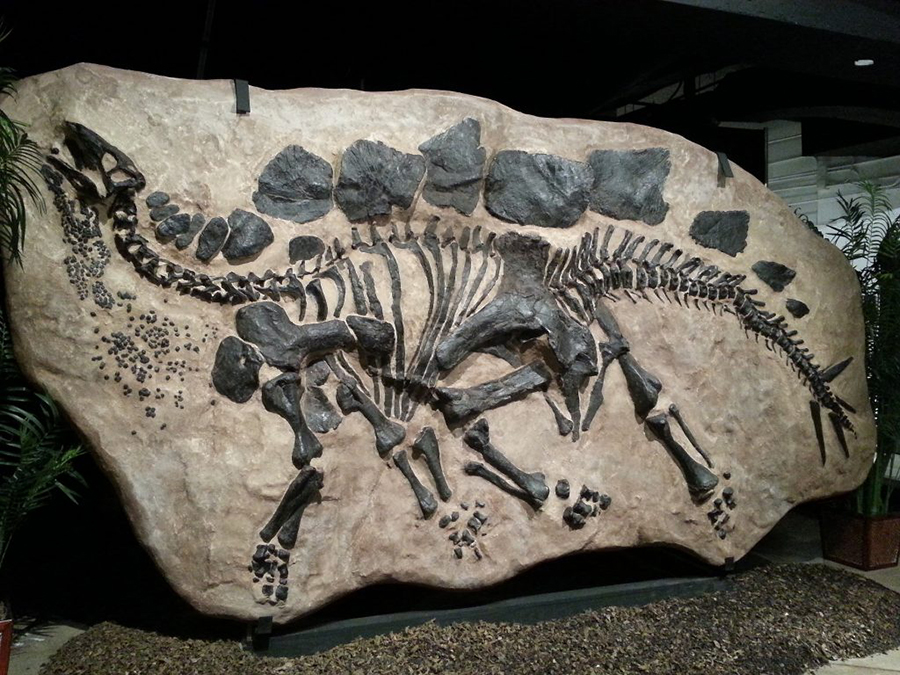
Fossilized in-ground Stegosaurus at Houston Museum of Natural Science

Ancient bones and teeth gleam under bright lights in the Melbourne Museum, surrounded by throngs of excited children — and more than one captivated adult.

But beneath this hustle and bustle, in the building's basement, is where such fossils are broken out of their rocky tombs and cleaned up for display and scientific research.

Pieces of limestone at various stages of processing lie around the room. They're all sizes — from tiny delicate bones lodged in matchbox-sized pebbles to hefty slabs that need a hydraulic lift to move them around.

And forget what you saw on Jurassic Park, where palaeontologists gently sweep sand and stones away from perfectly preserved skeletons. In reality, it's a much noisier process.

Fossils last millions of years because, quite often, they're surrounded by hard rock.

So palaeontologists often enlist the help of special power tools, plus acid — and a whole lot of patience.

Rocking out

Many of the bones and teeth in the museum's basement are the fossilised remains of ancient whales and dolphins that swam the oceans 15 million years ago.

When they died, the animals' bodies sank to the sea floor and were covered in silt and mud. Over time, that squishy sediment solidified into limestone.

These days, that limestone forms towering wheat-coloured cliffs that trace Victoria's Surf Coast. As the wind and waves bash away at the cliffs, they expose bones and teeth embedded within, which are sometimes spotted by eagle-eyed surfers and fossil-hunters.

Palaeontologist Ben Francischelli is one such fossil-hunter. He is part of a group that regularly scouts the coast at low tide for ancient remains, which stand out black against the limestone.

And while finding a fossil takes some skill, that's the easy part compared to what's to come.

Before trying to remove a fossil they've found, they pour on and soak it in a liquid called paraloid that cures like a glue, giving strength to the ancient remains.

Then if they can, the crew uses chisels and crowbars to safely remove the fossil and surrounding chunk of limestone, which they then load into a waiting car. This can be hard yakka ... but the hardest work happens back at the museum.

The limestone and embedded fossil is taken to the Melbourne Museum basement. Here, the process begins to remove the fossil from its rocky nest where it's rested for millions of years.

Chemical help

First, palaeontologists need to remove as much of the surrounding limestone as possible without damaging the precious fossil within. Often this means sticking it in acid for a couple of days.

To do this, the fossil is taken to the museum's acid process room, where plastic tubs and sinks line the walls.

Despite being quite hard, limestone — which is made of a material called calcium carbonate — dissolves in acid.

Pop a piece of limestone in acetic acid, also known as vinegar, and bubbles of carbon dioxide start forming on the rock surface.

The paraloid, which the fossil-hunters added earlier, helps protect the fossil from the acid. Palaeontologists will often also coat the exposed fossil with lacquer too.

After a couple of days, depending on the volume of limestone, the fossil is flushed with fresh water to wash away calcium salts that build up during the chemical reaction between the acetic acid and calcium carbonate.

Then it's time to give the fossil its first clean, Dr Francischelli says.

"[The acid bath] usually turns some of the sediments into a slush, which we can then just gently wipe away with a brush," he says.

And then he brings out the power tools.

The big guns

Next door to the acid process room is the main fossil preparation workshop.

It has tall ceilings and industrial fans, a little like a standard workshop, but instead of an array of screwdrivers and drills, these tools range from delicate brushes to modified dentist drills.

Before getting stuck into the fossil, Dr Francischelli says, "you have a look at the ways in which the bone is contouring through it, because that very first bath usually strips a lot of the surrounding sediment".

"And then you've got to ask yourself the question: do I need to trim this specimen down further?

"If that is the case, then you'd get the big guns out."

The big guns aren't as big as your standard household drill, but these palaeo-tools pack a punch.

Before getting started, Dr Francischelli dons protective ear wear, goggles and mask, because this part is incredibly noisy and dusty.

The air chisel chips away at the rock while the fine-tipped drill is best used for the most delicate work. Still, the sound is not pleasant, to say the least.

And not everything always goes to plan.

"This limestone’s really hard," Dr Francischelli yells over the drill. "It dents the tools every now and again."

Sometimes, the bone can shatter — perhaps because it was accidentally hit by a tool or simply vibrated too much.

When that happens, so begins the slow job of picking up all the shards and painstakingly gluing them together again.

Once the fossil is cleaned up, Dr Francischelli says, he and his colleagues can properly identify exactly what it is they have.

"And if we know that we've got something special, which is why we take the time to actually prepare it in the first place, we can try and figure out what kind of species it is, [or] if it's a new species," he says.

"And if that is the case, or if it's something really important, we can name it in a paper, we can describe it in the scientific literature, and use it to educate the masses about palaeontology as a whole."

Source: www.abc.net.au

Jurassic Park: One Dinosaur's Story Continued AFTER the First Film

Sunday, May 16, 2021

In Jurassic Park, one standout dinosaur's story didn't end with the credits. Even now, the T-Rex has grown into something even more exciting.

Fans of the original Jurassic Park find it difficult to talk about the movie without mentioning its breakout star, the Tyrannosaurus rex. Known as Rexy, she was introduced as an aggressor to the human survivors. Never an outright villain, she operated on her predatory instincts to survive. Ironically, this had her become an unlikely savior to the survivors at the end of the film, taking on a pack of raptors in the Visitor's Center. Following the movie's conclusion, Rexy has been the only carnivore whose story continued after the credits rolled, with her growth displayed through her personality and expanding intelligence.

Rexy was born years before the first film's events and was one of, if not the largest, Tyrannosaurus in the canon. As she continued to grow, she was moved from Isla Sorna to Isla Nublar to be integrated into Jurassic Park. Her instincts began to take full effect as she developed her own predator tactics that were still implied even in later films. One strategy that she has consistently implemented has been stealth. Though she is a massive creature, Rexy managed to sneak up on unsuspecting prey like the velociraptors at the end of 1993's Jurassic Park and a worker during a rainstorm in Jurassic World: Fallen Kingdom.

Her intelligence has also played a large part in her stealth skills and overall growth. One of the earliest signs of her intelligence is in Jurassic Park when she tests the electric fences after the power goes out. Much like the Velociraptors, she knew that the fences were dangerous but frequently tested their integrity regardless. As her story continued past the first film, she became even smarter, gaining a personality able to differentiate between threats.

In Jurassic Park, Rexy was showcased as more of an anti-hero. She never protected the survivors on purpose but saw a threat in the raptors that needed to be eliminated instead. Jurassic World built off this idea with Claire Dearing using Rexy's aggression to kill the newly created Indominus Rex. Surprisingly, she acknowledged that the accompanying Velociraptor, Blue, aided her in the fight and didn't challenge her. Her ability to recognize faces and the actions of others was also evidenced in the animated series Jurassic World: Camp Cretaceous. After a big game hunter named Mitch became tangled in his own snare trap, Rexy recognized him as the one who put a cattleprod in her nose and shocked her. For a moment, she hesitated, remembering who he was before devouring him.

Since the original and her subsequent appearances, Rexy is almost always shown getting the best moments in each film. Jurassic World: Fallen Kingdom was a great example when she killed a Carnotaurus in front of Owen Grady during a volcanic eruption. Perfectly timed, Rexy let out her iconic roar just as another eruption took place in the background, mirroring her other big moment in the first film. It shows that even though she is an animal, the movies have made sure to recognize how important she is to the story and why she's still around.

For now, Rexy's whereabouts are unknown, but now that she is let loose in the modern world, she will become even more intelligent and dangerous. Continuing her story after Jurassic Park served to make the animal more than just another dinosaur. Much like the brilliant Blue, Rexy has become one of the smartest dinosaurs on the planet with a personality that has grown for almost three decades and will continue to develop in the years to come.

Source: www.cbr.com/

What Happened To Blue Between Jurassic World & Fallen Kingdom

Saturday, May 22, 2021

Blue returns in Jurassic World: Camp Cretaceous. Season 3 fills in what happened to Owen Grady's pet Velociraptor before the events of Fallen Kingdom.

Warning: SPOILERS for Jurassic World: Camp Cretaceous season 3.

Blue the Velociraptor plays a major role in Jurassic World: Camp Cretaceous season 3, which fills in the blanks between the carnivorous dinosaur's appearances in Jurassic World and Jurassic World: Fallen KingdomCamp Cretaceous season 3 continues the efforts of the six teenage campers to escape Isla Nublar, which has been overrun by escaped dinosaurs. The kids run into Blue several times throughout Camp Cretaceous and their dispositions toward each other evolve after each encounter.

Blue was introduced in Jurassic World alongside her sisters Echo, Delta, and Charlie. The Velociraptor pack was trained by Owen Grady (Chris Pratt) and, despite the dangers the super-predators posed, Blue and her sisters formed a bond with Owen, who mobilized them against the Indominus Rex when it broke out of its paddock and rampaged in Jurassic World. Only Blue survived her encounter with Indominus Rex and she was left behind on Isla Nublar when the humans evacuated. In Jurassic World: Fallen Kingdom set two years later, Grady and Claire Dearing (Bryce Dallas Howard) returned to rescue Blue and the other dinosaurs from a volcanic eruption destroying Isla Nublar. But Blue was also needed by Dr. Henry Wu (B.D. Wong) for her DNA because the geneticist wanted to breed Indoraptors that had Blue's characteristics. Like the rest of the captured dinosaurs, Blue was set loose by Maisie Lockwood (Isabella Sermon) and was last seen roaming suburban California.

Jurassic World: Camp Cretaceous season 1 took place concurrently and immediately after the events of Jurassic World and Blue made an early appearance in the animated series' second episode. Blue and her sisters terrified Darius (Paul-Mikel Williams) and Kenji (Ryan Potter) when they mistakenly entered the Velociraptor pen. After the park fell and the humans evacuated, Blue was seen roaming the newly abandoned Isla Nublar. In Camp Cretaceous season 2, which was set in the days immediately after Jurassic World was abandoned, Blue was sighted twice more as she roamed the hidden tunnels beneath the island and later returned to the Velociraptor paddock. In Camp Cretaceous season 2's finale, Blue was targeted by big game hunters Tiff (Stephanie Beatriz) and Mitch (Bradley Whitford) as she drank in the island's watering hole, but the Velociraptor's life was saved by the campers.

Blue makes a significant and memorable series of appearances in Camp Cretaceous season 3. In episode 4, "Clever Girl", Blue has made her home in the dilapidated remains of the original Jurassic Park's visitor's center, where she stalks Darius, Kenji, and Yasmina (Kausar Mohammed). After they escape the visitor's center and Blue gives chase, a turn of events causes a jeep crash and Blue is pinned beneath the vehicle. Darius takes pity on Blue as a pack of Procompsognathus threatens to kill her, so he frees the Velociraptor. Blue returns the goodwill by not killing the teenagers and allowing them to escape.

In Camp Cretaceous' season 3 finale, Blue reappears when the kids are chased into the visitor's center by the new hybrid dinosaurs invented by Dr. Wu, the Scorpios Rex. This time, Blue comes to the campers' defense and fights the Scorpios Rex before the building collapses and kills the twin hybrid monsters. Blue is left behind on Isla Nublar when the teenagers finally leave the island by boat, but the climactic events of Jurassic World: Camp Cretaceous line up with the prologue of Jurassic World: Fallen Kingdom when mercenaries came to Isla Nublar for the Indominus Rex's DNA in the Mosasaurus' lagoon. Blue remains on Isla Nublar until Owen Grady comes for her in Fallen Kingdom and the cobalt Velociraptor will appear next in Jurassic World: Dominion.

Source: https://screenrant.com/

Jurassic World: One Forgotten Location Could Save the Dinosaurs

Saturday, May 22, 2021

Jurassic World: Fallen Kingdom saw the destruction of Isla Nublar, but there is one other location that the dinosaurs could be taken to.

When creating the dinosaurs found in Jurassic Park, John Hammond spared no expense in making sure the newborns had the perfect environment to grow up in. To accomplish this goal, Hammond purchased a second island called Isla Sorna, which was used solely for research and to raise newborns before sending them off to Jurassic Park. What Hammond couldn't have expected was that this second island could be the perfect way to save the remaining dinosaurs after the destruction of Isla Nublar in Jurassic World: Fallen Kingdom.

Isla Sorna was first introduced in The Lost World: Jurassic Park and audiences could see dinosaurs roaming in the wild, free of fences. While there weren't any systems to fail them like in the first film, the humans had to contend with all new problems. The primary one being the rigors of surviving on an island where dinosaurs had territories and hunted regularly. Jurassic Park III dug deeper into Isla Sorna's activities, revealing that it's where InGen conducted genetic research on new dinosaurs while raising the newborns.

Since Isla Nublar's destruction following the eruption of Mount Sibo, the surviving dinosaurs have been bought and sold by rival companies and countries who want to wield the same genetic power Hammond did decades ago. Those that never made it to the auction were released into the United States, taking over national parks and suburban neighborhoods. Right now, nothing is policing these creatures or the humans they are interacting with. There is a strong need for these creatures to return to an environment where they can live away from the dangers of humans.

With no mention of Isla Sorna since the third film, it's possible that the island still isn't affected by humans, meaning the dinosaurs that live on it are thriving. With an order in place and a community amongst the dinosaurs established, Isla Sorna will be the best place for these refugee dinosaurs to call home. Over the decades, it has been established that the carnivores are in the island interior while the herbivores remain on the outside perimeter. This means that as the dinosaurs are dropped off on the island, rescue workers can pinpoint the exact hunting grounds their species operates in and lower the risk of attacks to the new additions and themselves.

Another benefit of the island is its restricted status between the United States and the Costa Rican governments. Since the events of The Lost World, venturing into the island is now considered an offense. With the dinosaurs being protected under the laws of two governments, they can be allowed to live freely and flourish with their own species. Integrating the new dinosaurs will also boost the population and increase each species' lifespan.

As the world of Jurassic Park continues to change, with dinosaurs living alongside humans, there is still hope for these creatures to survive potential extinction. Right now, the best way for that to happen is to collect and transport as many dinosaurs as possible to the protected Isla Sorna. The location will bolster the populations of many species and save those left out in humanity following their escape in Jurassic World: Fallen Kingdom.

Source: www.cbr.com/

Paleoart That Makes Fossils Come Alive

Monday, May 17, 2021

The unusual bird Gastornis that lived across Europe, North America and Asia not long after non-avian dinosaurs went extinct. Photo: Mark Witton

Not only do they give arms and legs to prehistoric findings, paleoartists help research to reach larger audiences.

Close your eyes and imagine a dinosaur. Did you think of a tall, sinewy, sharp-fanged creature? How did this image pop up in your head considering that dinosaurs lived millions of years before the first modern humans appeared? Of course, there’s Jurassic Park, but the actual credit goes to the discipline of paleoart, or paleo illustration, which helps create the most realistic depictions of long-extinct animals.

In the early 19th century, artists mingled science with fantasy to recreate dinosaurs for popular imagination, usually showing them in apocalyptic forests with an erupting volcano in the background.

American paleoartist Doug Henderson, who was credited as a “dinosaur specialist” in the film Jurassic Park, says dinosaurs were part of popular culture when he was a child in the 50s. “There were books and movies that made deep impressions on me — illustrations by Charles Knight and Zdeněk Burian — and one movie in particular, King Kong, made in 1933.” The septuagenarian starts with a simple doodle and the ideas get refined eventually into fully developed outlines, with all the image’s components orchestrated into a workable composition.

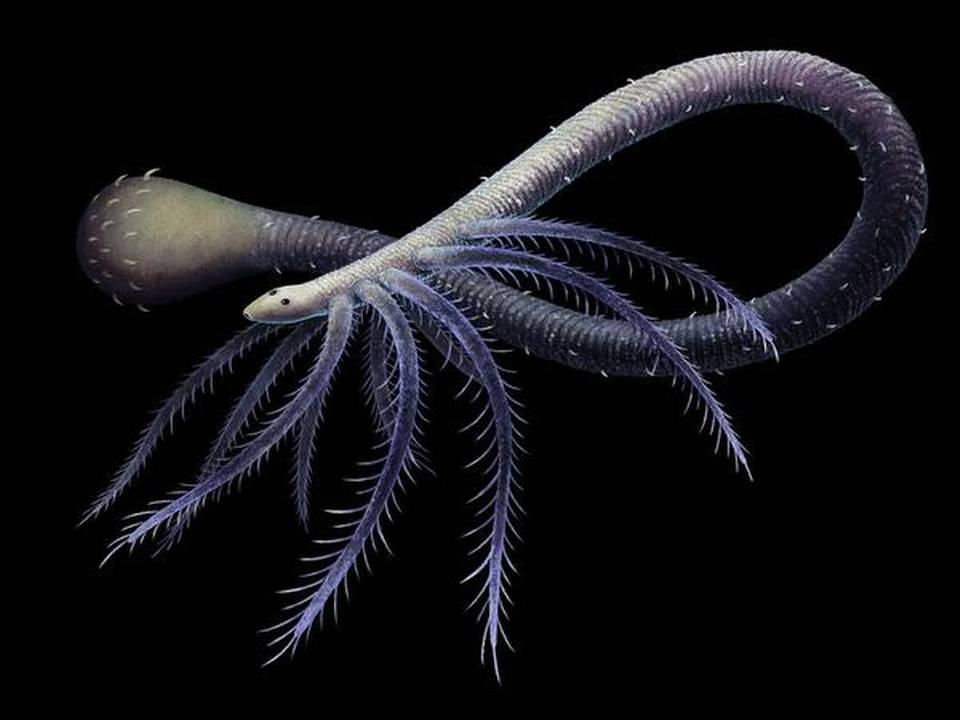
The worm Facivermis yunnanicus. Photo: Franz Anthony

Prehistoric life was more than just dinosaurs. Even before plants and life on land evolved, creatures thrived in marine environments and now their fossils tell those stories. In 2019, while studying the fossils of a worm, Facivermis, that lived 500 million years ago, researcher Richard Howard noted that the creature didn’t have lower limbs, and that it may be a missing link in evolution. Now, this mere imprint on a rock needed flesh, skin, and colours. “Facivermis looks so strange and alien because there’s nothing like it living today,” says Franz Anthony, a professional paleoartist from Indonesia. “To illustrate this creature, Howard and I looked at other marine animals for inspiration, and we agreed that it might have resembled modern featherduster worms, even if they’re not closely related!”

An image of Teleocrater. Photo: Mark Witton

Paleoart is a complex art form. The reconstruction of an extinct animal involves vast research, only the beginning of which is examining the fossil. Scientists cover much ground here, and their detailed research papers give most of the details needed for reconstruction. David Hone, a palaeontologist and senior lecturer at Queen Mary University of London, explains how paleoart has advanced over the decades. “In the 70s and 80s, you would see drawings where everything lived in a rainforest. But in the last few years, there’s been a real intensity to the art form. Artists try to recreate what trees there were or depict how hot the location was in summer. Would there be snow in winter? Would it be deep snow? What was the daylight like?”

Moon in paleoart

Paleoartists also analyse the geological time period the animal lived in, to recreate its habitat as truly as possible. Dr. Hone talks of how Julius T. Csotonyi, a paleoartist in Canada, even paid close attention to the moon in his paleoart. “About 80 to 90 million years ago, the moon was closer to Earth and would have looked bigger. And some of those really big craters that we look at weren’t there, because we know they’re more recent. He did a painting of the moon with a dinosaur in front of it, where he took out the craters and made the stars brighter. Not just because you didn’t have light pollution. But again, 100 million years ago, we were in a different position in the galaxy. It makes quite a difference — what stars you see, and how bright they are.”

Ancient and modern

It is also important to know the closest relatives of the creature in the evolutionary tree. Artists compare the fossil with modern animals that may have had similarities in anatomy and behaviour.

Archaeopteryx, the first feathered dinosaur. Photo: Mark Witton

However, one can never be sure what a prehistoric creature really looked like. When American paleoartist Emily Willoughby finished painting the Anchiornis huxleyi, a small dinosaur from China, she thought it was a perfect reconstruction. “But a week later, a new study came to light that described in fantastic detail the coloration that this animal’s feathers would have had. I had painted it brown and black but the study showed that it was black and white with a red crest like a woodpecker. I painstakingly repainted the animal to reflect the new findings.” She says that paleoartists have to come to terms with the fact that everything they draw may become outdated or inaccurate at some point.

More fossils are being discovered today than ever before, and palaeontologists have realised that good art helps their work reach a wider audience. Mark Paul Witton, a vertebrate palaeontologist and paleoartist from the U.K., says that paleoart is scientifically informed art. “At its most fundamental level, paleoart is not reconstructing extinct creatures as they were, it is reconstructing our ideas about them. This is what we thought about that creature when this art was constructed. We can never be 100% confident about our illustrations. We are visualising hypotheses, not recreating the creatures themselves.”

Source: www.thehindu.com/

Pluridens serpentis: New Mosasaur Species Unearthed in Morocco

Friday, May 14, 2021

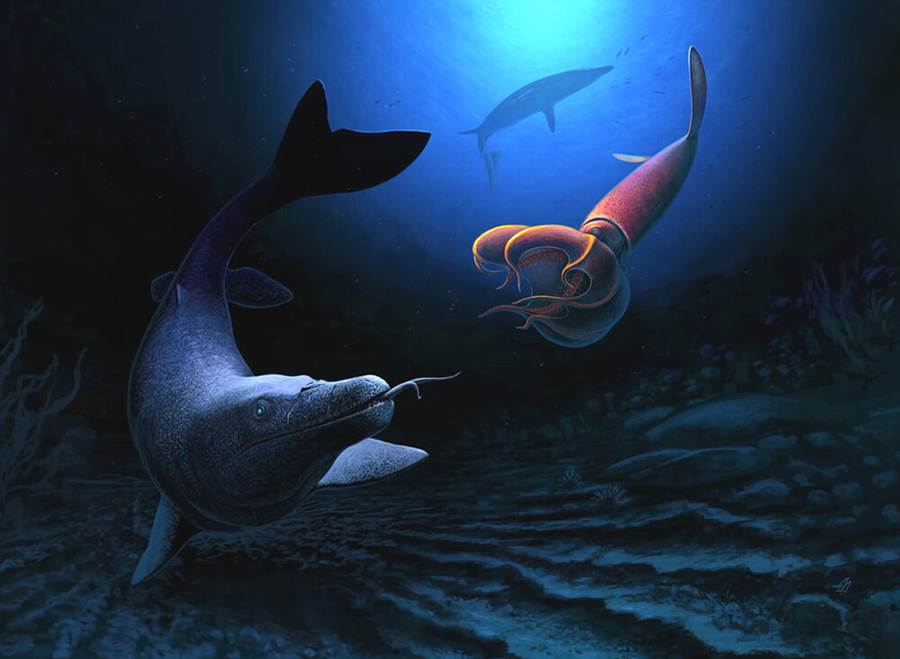
An artist’s impression of Pluridens serpentis. Image credit: Andrey Atuchin.

Paleontologists have described a new species of mosasaur based on two complete skulls and jaws found in Morocco.

Mosasaurs (family Mosasauridae) were specialized marine lizards that evolved and diversified during the Late Cretaceous period.

Their diversity peaked in the Maastrichtian age of the Cretaceous, between 72 and 66 million years ago, with the most diverse faunas known from Morocco.

While most of its relatives were small, just a few meters long, the new Moroccan species got big, perhaps 8 meters long.

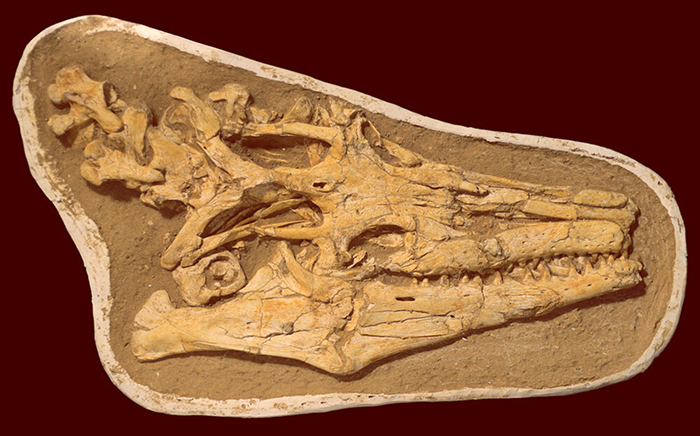
Named Pluridens serpentis, the marine creature had long, slender jaws with numerous small, hooked, snake-like teeth to grab small prey like fish and squid.

Compared to related mosasaur species, it had smaller eyes, suggesting poor vision.

But its snout had dozens of openings for nerves, hinting at the ability to hunt by sensing water movements and changes in pressure. These nerves may have been sensitive to tiny variations in water pressure, an adaptation seen in marine snakes.

“Typically, when animals evolve small eyes, it’s because they’re relying more heavily on other senses,” said Dr. Nick Longrich, a paleontologist in the Milner Centre for Evolution at the University of Bath.

“The fact that Pluridens serpentis had so many nerves in the face may mean that it was using changes in water pressure to detect animals in low-light conditions, either at night or in deep, dark water.”

“If it wasn’t using the eyes, then it’s very likely that it was using the tongue to hunt, like a snake. Many aquatic snakes and lizards — sea snakes, filesnakes, water monitors — flick their forked tongues underwater, using chemical cues to track their prey.”

The well-preserved skull of Pluridens serpentis. Image credit: Longrich et al., doi: 10.1016/j.cretres.2021.104882.

The discovery of Pluridens serpentis brings the number of mosasaurs known from the latest Cretaceous of Morocco up to 13.

“The diversity in these fossils is just astonishing. Far from declining in diversity, the mosasaurs seem to be peaking just before they went extinct,” Dr. Longrich said.

“We’re not seeing any evidence that this group was struggling before they went extinct. From an evolutionary standpoint, they were succeeding, they did everything right, but nothing can prepare you for an asteroid.”

“It’s a new species of a large predator which, with its 8 meter length, comes to confirm the diversity of the faunas of the seas just before the Cretaceous crisis,” said Dr. Nour-Eddine Jalil, a paleontologist at the Natural History Museum of Sorbonne University.

Pluridens serpentis highlights the importance of the paleontological heritage of Morocco to help illustrate the history of life.”

“The latest discoveries show perfectly that the list of species present here is far from being closed and that the future still holds great surprises and discoveries,” said Dr. Nathalie Bardet, a paleontologist at the Muséum National d’Histoire Naturelle of Paris.

paper describing the discovery was published in the journal Cretaceous Research.

_____

Nicholas R. Longrich et alPluridens serpentis, a new mosasaurid (Mosasauridae: Halisaurinae) from the Maastrichtian of Morocco and implications for mosasaur diversity. Cretaceous Research, published online May 8, 2021; doi: 10.1016/j.cretres.2021.104882

Source: www.sci-news.com/

Pages