nandi's blog

The Dinosaurs Among Us

Monday, May 24, 2021

If it looks like a duck, it’s probably a theropod dinosaur.  This is an artist’s rendition of the 11 foot-long Deinonychus antirrhopus, which lived about 110 million years ago in the western United States.  Photo courtesy of Emily Willoughby and Wikimedia under CC BY-SA 4.0.

There is something really primordial about the way wild turkeys run.  Each spring, a lot of turkeys seem to be running away from me as I move through the woods in search of a gobbler.  It’s almost worth it to watch them run away, though, because it looks just like a scene out of Jurassic Park.  Although they are poor flyers, they are fast, agile runners, and their cadence and head bobbing as they run looks eerily similar to the film’s Velociraptor.

That is not mere coincidence, however.  Jurassic Park portrays many dinosaurs running like turkeys because scientists have realized that birds are dinosaurs, and that many of them likely moved just like turkeys.  Although many dinosaurs went extinct after a large asteroid changed the future of the planet 66 million years ago, some did not.  Those dinosaurs—many already quite bird-like when their cousins died off—evolved into the modern birds we know and love.

In fact, although birds are separated into their own specific group of animals—Class Aves—many scientists think this is a mistake, and believe they are better placed within the same class as lizards, snakes, turtles, and their closest living relatives, the alligators and crocodiles.  Birds are, like all dinosaurs, part of the Class Reptilia, the reptiles.

Birds and Velociraptor are “theropod” dinosaurs, a group of carnivorous animals that range in size from the diminutive Compsognathus (“compys” in the movies) to the monstrous Tyrannosaurus, and some that were even larger than T. rex.  Birds and these ancient dinosaurs share many traits, including hollow, air-filled bones, an elongate, flexible neck, identical feet, and even the wishbone.  Fossil evidence also shows that some ancient dinosaurs had feathers, probably originally used to regulate their temperature.  Other fossils have revealed evidence that some dinosaurs brooded their eggs and slept just like modern birds.

The most famous fossil bird reveals its reptilian ancestry perfectly.  Archaeopteryx (which literally means “old wing”) is a 150 million year old fossil that was unearthed in 1861, which coincidentally was two years after Charles Darwin published his seminal work On the Origin of Species By Means of Natural Selection.  The discovery soon dissolved much of the doubt among scientists about the origins of birds, and in many ways solidified Darwin’s revolutionary ideas as well.

Archaeopteryx had numerous reptilian traits, but many bird traits as well.  For example, it had teeth, a long, jointed tail, and front claws, much like a lizard, all traits that modern birds lack.  The front claws are particularly amazing because they are part of the bird’s wing.  Although all of these traits suggested “reptile”, the wings, the number and shape of the flight feathers, and the structure of its wishbone and other skeletal features clearly showed that this was a flying, feathered reptile, or in other words, a bird.

The science didn’t stop in the late 19th century, however.  Discoveries in the late 1960s suggested, for the first time, that dinosaurs were endothermic, meaning they are “warm-blooded”, generating their own heat, and were active predators.  Before this, it was assumed that dinosaurs were like other reptiles, which are ectothermic, or “cold-blooded”, and because of this their activity was limited.  The discovery of new theropods with a small body, sleek posture, and those same enlarged claws that made Velociraptor so famous suggested an active, agile predator.  By the late 1990s, scientists had found even more dinosaur fossils with feathers on the bodies, making it clear that, unlike their scaled reptilian cousins, these feathered dinosaurs were warm-blooded, more like birds than reptiles.

Think about the implications of the dinosaurs among us the next time you are enjoying an Easter egg hunt with dyed dinosaur eggs, or when you eat some Buffalo dinosaur wings, a dino-omelet, Kentucky Fried Dinosaur, or Dino-fil-A.  Think about it when you watch any team named after a bird: the St. Louis Cardinalosaurs, Pittsburgh Penguinosaurs, Seattle Seahawkosaurs and the Atlanta Hawkosaurs come to mind.  Perhaps remember it as you are making a wish with the broken end of a dinosaur’s wishbone in your hand at Thanksgiving, not that much different than the one that used to help Tyrannasaurus rex run after prey.  Consider it as you fill your dinosaur feeders each day, get your binoculars out to add to your dinosaur life list, or listen as your dinosaur clock strikes noon with a very melodic, dinosaur-like call. Perhaps, like me, you will be thinking about it when you go out hunting for dinosaurs with (gasp) only a shotgun.  Whether in a duck blind or sitting silently against a large tree, many hunters spend an inordinate amount of time trying to mimic the sounds of dinosaurs, often with dinosaur decoys in front of them.

One of the greatest things about science is its ability to show connections among seemingly disparate things, like how the gravitational pull of the moon controls the tides, how carbon dioxide pollution contributes to climate change, or how wolf restoration can benefit endangered trout.  We can safely add birds to that list.  Although some birds, such as hummingbirds, seem far removed from their reptilian ancestors, a closer look shows that hummingbirds are no different than other birds: they share many of the same traits as any other theropod dinosaur.  Thankfully humans never interacted with dinosaurs like Velociraptor except in the movies, but there is something elegantly beautiful about the fact that we are living with dinosaurs now, and they are literally all around us.

Source: www.murrayledger.com/
Marvel Drops an Awesome Jurassic Park Easter Egg

Wednesday, May 5, 2021

(Photo: Marvel)

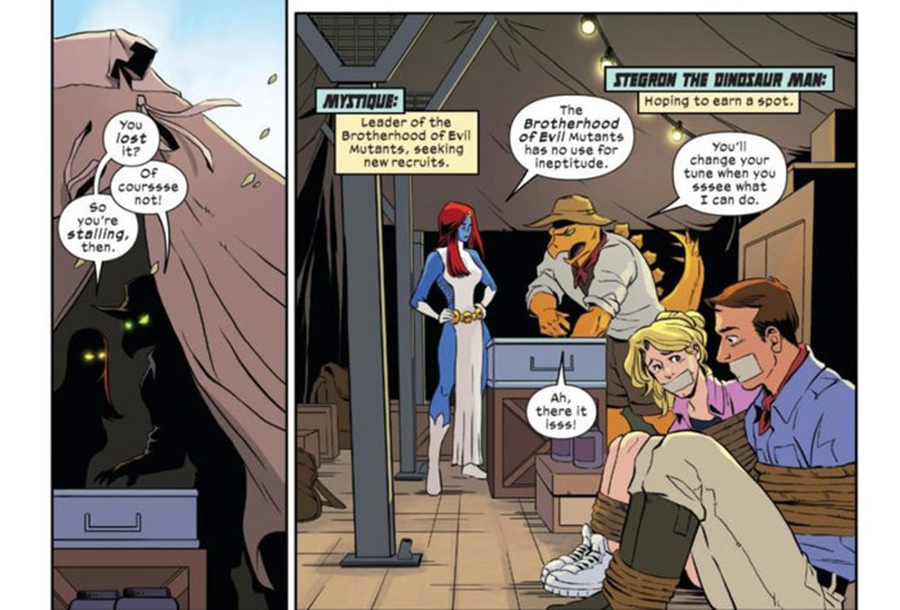
Every so often a comic will cross the streams as it were and bring in another franchise for an unexpected crossover, though at times the crossover is a bit more subtle. Marvel is always having some fun with pop culture references or nods to things going on in the outside world, and the latest example of that is in Women of Marvel #1. For those who checked out the Mystique starring Cretaceous Flirtatious story, you might have noticed that two well-known characters from the Jurassic Park franchise were featured throughout, but if you didn't notice we wouldn't blame you either.

The story starts off at an archaeological dig site with instructors starting to gather the students on hand. In a tent nearby we see that Mystique is talking with Stegron the Dinosaur Man, but it's who is in the corner that will catch your eye.

They've taken two of the instructors captive, and while they never say their names, you can clearly see that these two are Laura Dern's Ellie Sattler and Sam Neill's Alan Grant. You can spot Sattler thanks to her blonde hair and pink shirt, and Grant's blue shirt and red bandana are accounted for as well.

It's a fun Easter Egg that fans of the original Jurassic Park movies will get a kick out of, and you can check it out in the image above.

Mystique ends up taking Sattler's form to keep the students busy while Stegron gets his new device up and running, and Rogue ends up being part of the students on the trip. Mystique does a decent job of feigning that she's an expert until she becomes more curious about the boy Rogue's into, and coupled with Stegron's being...well, Stegron, her cover is quickly blown.

You can check out the official description for Women of Marvel #1 below.

"WHO RUN THE WORLD? YOU ALREADY KNOW. CELEBRATE THE WOMEN OF MARVEL WITH AN EXTRAVAGANZA OF EXTRAORDINARY TALENT! The future is female! Get in on the ground floor with this amazing assembly of writers and artists from all over entertainment. Comics legend Louise Simonson kicks things off with a must-read introduction! Nadia Shammas punches the glass ceiling with the Jade Giantess! Elsa Sjunneson grits her way to the front line with Captain Peggy Carter! Sophie Campbell goes feral with a bone-grinding Marrow story! Video game-and-comics writer Anne Toole makes her Marvel debut in a blaze of glory! Natasha Alterici of Heathen fame charges sword-first into the Marvel Universe! With astonishing art from new and established artists Kei Zama (Transformers, DEATH’S HEAD), Eleonora Carlini (Power Rangers, Batgirl), Skylar Patridge (Resonant, Relics of Youth), Joanna Estep (Fantastic Four, Fraggle Rock) and more, you’re sure to come away powered up and ready to slay – in high heels and boots alike."

Source: https://comicbook.com/

100 Million-Year-Old Bones of Sauropod Dinosaurs Discovered in Meghalaya, India

Wednesday, May 5, 2021

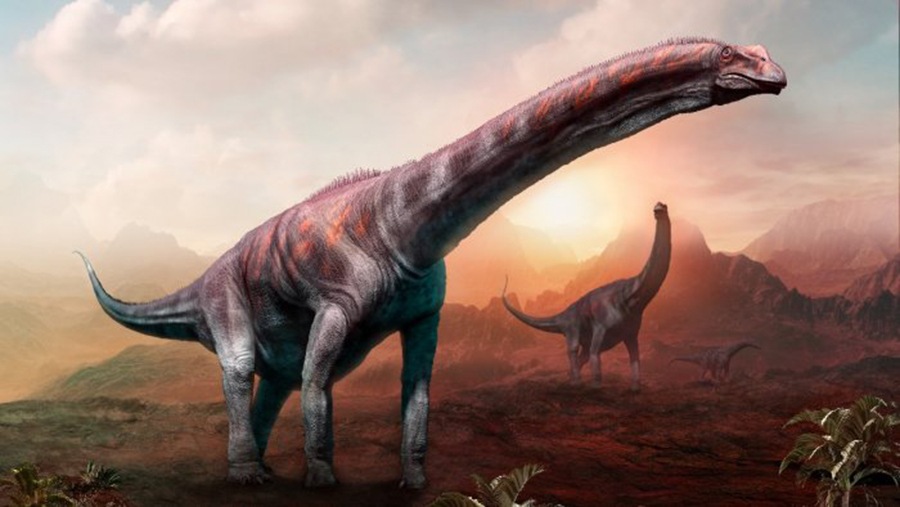
Representative illustration. Credit: iStock Photo

The finding makes Meghalaya the fifth state in India after Gujarat, Madhya Pradesh, Maharashtra, and Tamil Nadu to report sauropod bones having titanosaurian affinity.

Researchers have identified fossil bone fragments of long-necked dinosaurs called sauropods, dating back to about 100-million-years from an area around West Khasi Hills District in Meghalaya.

The yet-to-be-published findings were made during a recent field trip by researchers from the Geological Survey of India's Palaeontology division in North-East.

The GSI researchers noted that this is the first record of sauropods of probable Titanosaurian origin discovered in the region.

Sauropods had very long necks, long tails, small heads relative to the rest of their body, and four thick, pillar-like legs. They are notable for the enormous sizes attained by some species, and the group includes the largest animals to have ever lived on land.

The finding makes Meghalaya the fifth state in India after Gujarat, Madhya Pradesh, Maharashtra, and Tamil Nadu and the only state in the North-East to report Sauropod bones having titanosaurian affinity, they said.

Titanosaurs were a diverse group of sauropod dinosaurs, including genera from Africa, Asia, South America, North America, Europe, Australia and Antarctica.

"Dinosaur bones from Meghalaya were reported by GSI in 2001 but they were too fragmentary and ill-preserved to understand its taxonomic identification," said Arindam Roy, Senior Geologist, Palaeontology Division, GSI. "The present find of bones is during fieldwork in 2019-2020 and 2020-21. The last visit of the team was in February 2021. The fossils are presumably of Late Cretaceous, about 100 million years ago."

He noted that the best-preserved fossils are limb bones, adding the type of curvature, development of lateral and proximal margins of the partially preserved bone are indicative of it being a humerus bone.

He, however, noted that the conclusions are drawn from preliminary studies and detailed work is going on.

The bone fragments were collected from poorly sorted, purplish to greenish very coarse-grained arkosic sandstone interlaid with pebbly beds. More than twenty-five disarticulated, mostly fragmentary bone specimens were recovered, which are of different sizes and occur as isolated specimens but some of them were found in close proximity to each other, the researchers said.

Taxonomic identification up to genus level is difficult due to poorly preserved, incomplete, fragmentary nature of the bones and most of the recovered bones are partially petrified and partially replaced, they said.

Therefore, only three of the best-preserved ones could be studied. The largest one is a partially preserved limb bone of 55 centimetres (cm) long. It is comparable with the average humerus length of titanosaurids.

Robustness of the bone, the difference in curvature in the lateral margins and the proximal border being relatively straight, are some of the morphological characters that hint at the titanosaurid affinity, according to the researchers.

Another incomplete limb bone measuring 45cm in length is also comparable with the limb bones of titanosauriform clade, they said.

“The abundance of bones recovered during the present work and especially the finding of few limb bones and vertebrae having taxonomic characters of titanosauriform clade are unique,” Roy said. “The record of the sauropod assemblage of probable titanosaurian affinity from Meghalaya extends the distribution and diversity of vertebrates in the Late Cretaceous of India.”

An incomplete chevron of caudal vertebrae and also cervical vertebra have also been reconstructed from a few recovered bone specimens.

The other fragmentary specimens though partially preserved might probably be parts of limb bones of a sauropod dinosaur.

Titanosaurian sauropod dinosaurs were the most diverse and abundant large-bodied terrestrial herbivores in the Southern Hemisphere landmasses during the Cretaceous Period but they were not endemic to the Gondwanan landmasses, the researchers said.

Gondwana is the southern half of the Pangaean supercontinent that existed some 300 million years ago and is composed of the major continental blocks of South America, Africa, Arabia, Madagascar, Sri Lanka, India, Antarctica, and Australia.

In India, the Late Cretaceous sauropod dinosaur generally belong to the titanosaurian clade and has been reported from the Lameta Formation of Gujarat, Madhya Pradesh and Maharashtra and Kallamedu Formation of Tamil Nadu, the researchers said.

Source: www.thehindu.com/

Paleontologists Find One-Billion-Year-Old Multicellular Microfossils

Tuesday, May 4, 2021

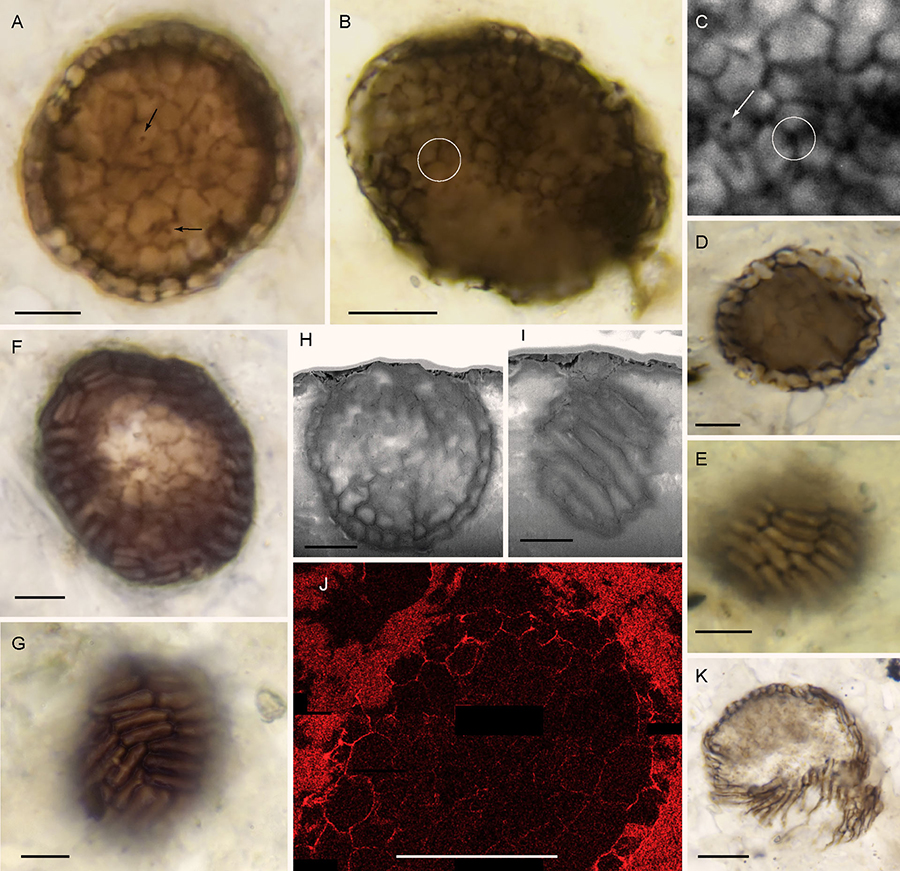
Bicellum brasieri in mature form; all specimens were preserved in petrographic thin sections from the Diabaig Formation stratotype, Lower Diabaig, Scotland, UK. Scale bars – 5 μm in (A-J), 10 μm in (K). Image credit: Strother et al., doi: 10.1016/j.cub.2021.03.051.

Bicellum brasieri, a freshwater protist that lived nearly one billion years ago, had two distinct cell types and could be the earliest multicellular animal ever recorded. Found in the Scottish Highlands, the microfossil reveals a new insight into the transition of single-celled holozoans into more complex multicellular animals.

“The origins of complex multicellularity and the origin of animals are considered two of the most important events in the history of life on Earth, our discovery sheds new light on both of these,” said Professor Charles Wellman, a researcher in the Department of Animal and Plant Sciences at the University of Sheffield.

Professor Wellman and colleagues examined thin sections of phosphatic lenses from the Diabaig Formation in Scotland that preserve populations of organisms trapped in ancient lake bottom sediments.

In several thin sections, they observed cell clusters that are composed of aggregations of two distinct cell types, indicating a condition that constitutes a step toward complex multicellularity.

Further investigation revealed a second set of cell clusters that appeared very similar in size and form but that lacked the fully differentiated second cell type.

“We have found a primitive spherical organism made up of an arrangement of two distinct cell types, the first step towards a complex multicellular structure, something which has never been described before in the fossil record,” Professor Wellman said.

“The discovery of this new fossil suggests to us that the evolution of multicellular animals had occurred at least one billion years ago and that early events prior to the evolution of animals may have occurred in freshwater like lakes rather than the ocean.”

“Biologists have speculated that the origin of animals included the incorporation and repurposing of prior genes that had evolved earlier in unicellular organisms,” said Professor Paul Strother, a researcher in the Department of Earth & Environmental Sciences at the Weston Observatory of Boston College.

“What we see in Bicellum brasieri is an example of such a genetic system, involving cell-cell adhesion and cell differentiation that may have been incorporated into the animal genome half a billion years later.”

The findings are published in the journal Current Biology.

_____

Paul K. Strother et al. A possible billion-year-old holozoan with differentiated multicellularity. Current Biology, published online April 13, 2021; doi: 10.1016/j.cub.2021.03.051

Source: www.sci-news.com/

Remembering the Insane ‘Jurassic Park’ Arcade Game

Friday, April 30, 2021

Very few movies from the last few decades have had the lasting cultural impact of Jurassic Park. The 1993 film was an awe-inspiring — and occasionally terrifying — peek into a world where dinosaurs roamed once again. But forget about all of that. Why? Because who needs a well-made film stuffed with childlike wonder when there exists a Jurassic Park arcade game where you drive around like a maniac shooting dinosaurs?

The ‘Jurassic Park’ arcade game: death, uh, finds a way

A year after Jurassic Park hit theaters in 1993, an arcade-game adaptation of the film was released. This game may have had the Jurassic Park name on it, but the “plot” owed nothing to the movie. Instead, the game was — believe it or not — a super-intense, absolutely insane driving/shooting game.

After sacrificing a few quarters to the cabinet’s coin slot, you took on the role of Dr. Grant from the film. However, instead of standing in awe at the sight of living dinosaurs, Grant sits in the passenger seat of a fast-moving car shooting dinosaurs in the face. Armed with what appears for all the world to be a machine gun, you control Grant as hordes of dinos appear to attack you. As your vehicle moves forward through the island, more and more creatures jump out and have to be gunned down.

The action is nonstop, and the situations your vehicle finds itself in are completely bonkers. At one point, you literally pilot your car onto the tail, along the back, and up the neck of a perfectly innocent Brachiosaurus. You then fly over the scenery, collide with the ground, and just keep right on driving and shooting.

However, the strangest part of this entire game isn’t that you’re driving around murdering dinosaurs. It’s that — and hear me out on this — you’re actually not killing them at all. As it turns out, the “machine gun” Grant is using is actually just a tranquilizer gun. None of the beasties are dead; they’re merely unconscious, and ready to be transported to safety where they can live their lives in peace. What a twist.

Source: https://thenewswheel.com/

Jurassic Park: 5 Ways The Opening Scene Is Perfect (& 5 The Ending Is)

Thursday, April 29, 2021

Jurassic Park is a total thrill. Under Steven Spielberg's direction, the dinosaur movie hooks viewers from the start, while the conclusion is epic.

Just under two decades after Steven Spielberg broke the record for the highest-grossing film ever made with one monster movie, he did it again with an acclaimed adaptation of Michael Crichton’s sci-fi bestseller Jurassic Park. The movie is a Frankenstein story with themes about the hubris of humanity and the dangers of playing God, but it also has plenty of popcorn thrills along the way.

Any great movie is bound to have the perfect opening scene to get audiences hooked on the story right away and the perfect ending that wraps everything up in a neat bow. As one of the greatest movies ever made, Jurassic Park has both.

10 - Opening: It’s Shrouded In Mystery

The opening scene of Jurassic Park doesn’t introduce any of the main protagonists or even explain what the park is. Everything is shrouded in mystery as a large cage is transferred by a bunch of workers hanging in suspense.

The job of a movie’s opening scene isn’t to set up the characters and the premise right away. All it has to do is get the audience on the edge of their seats, wanting to know more, and that’s what Jurassic Park’s first scene does.

9 - Opening: It Establishes That The Park Is A Bad Idea

Throughout Jurassic Park, Spielberg makes it abundantly clear that a dinosaur-infested theme park is a terrible idea, despite how cool it may sound. This is established in the opening scene as a dinosaur handler is brutally killed by a velociraptor.

John Hammond can’t see it because he’s blinded by his own ego, but all the other characters — and the audience — can see that filling an island with live dinosaurs for tourism is a bad idea.

8 - Opening: Unseen Monsters Are Always More Terrifying

Spielberg first made his name with Jaws, another monster movie with a Hitchcockian command of suspense. One of that movie’s greatest strengths was the shark’s limited screen time. In the whole two-hour movie, the shark only appears on-screen for collectively about four minutes.

This technique was fiercely effective because unseen monsters that force the audience to use their imagination are always more terrifying. Spielberg reused this technique in Jurassic Park’s opening scene, which depicts a killing by a velociraptor without actually showing the raptor.

7 - Opening: It Immediately Introduces The Danger Posed By The Dinosaurs

The opening scene of Jurassic Park immediately introduces the danger posed by the dinosaurs as one of them manages to kill an InGen employee while still confined to its cage.

Spielberg doesn’t change gears into full-on dino action until the midpoint when the T. rex escapes, but the opening scene instantly establishes the awesome power of Hammond’s cloned prehistoric attractions.

6 - Opening: The Nighttime Setting Makes It Much Creepier

A cage containing a velociraptor being moved around by some handlers who quickly find themselves under attack is already a terrifying scenario on its own.

But setting that scenario in the dead of night makes the opening of Jurassic Park much creepier than if it was set in the middle of the day.

5 - Ending: The Happy Ending Feels Earned

Like most of Spielberg’s movies, Jurassic Park has a happy ending. The only characters who get viciously killed by the dinosaurs are the sleazeballs who deserve it, like the corner-cutting lawyer trying to save John Hammond’s deadly business venture.

But after everything they’ve been through, from Dr. Malcolm using a flare to draw a T. rex away from the kids to Dr. Sattler fleeing from raptors on her way to turn on the backup power generator, that happy ending feels completely earned.

4 - Ending: John Hammond Realizes The Error Of His Ways

At the end of Jurassic Park, as the survivors flee from the visitor center and hop into John Hammond’s car to get off the island as quickly as possible, Dr. Grant quips, “Mr. Hammond, after careful consideration, I’ve decided not to endorse your park.”

Hammond simply replies, “So have I.” After his Frankenstein-adjacent experimentations put his grandchildren’s lives in danger, he realized the error of his ways.

3 - Ending: Life Finds A Way

When Hammond and his team of scientists assure Ian Malcolm that they have their dinosaur attractions under control, Malcolm warns them, “Life, uh... uh... finds a way.”

This is proven in the movie’s finale when Dr. Grant is being chased by a T. rex and Dr. Sattler is being chased by velociraptors and the T. rex and the raptors end up fighting each other. This climactic brawl suggests that, no matter how badly humanity messes up, nature will figure it out.

2 - Ending: Dr. Grant Has Warmed To The Kids

Dr. Grant’s emotional arc in Jurassic Park has nothing to do with the dinosaurs themselves. At the beginning of the movie, as he tells an arrogant little kid what a bloodthirsty raptor would do to him, it’s established that Grant doesn’t have much patience for children.

He’s forced to change after he becomes the sole guardian of John Hammond’s grandkids when they’re stranded in the park. By the end of the movie, as he sits on the helicopter with Lex and Tim, smiling at a family of birds flying alongside them, he’s clearly warmed to them.

1 - Ending: It Wraps Up The Movie’s Themes

The message in Jurassic Park is that playing God is wrong and nature is much bigger than humankind, so humanity’s hubris-driven efforts to alter nature will always fail miserably.

These themes are wrapped up perfectly in the movie’s final scene. Even Hammond himself comes to agree with the sentiment. Jurassic Park’s final scene tied everything up in a neat bow, so there was no need for a sequel. Of course, since it became the highest-grossing movie of all time, there was a sequel, and a couple more after that.

Source: https://screenrant.com/

Mario: Why Yoshi Is A Dinosaur

Thursday, April 29, 2021

Super Mario World's Yoshi is one of Nintendo's most recognizable characters. An archived interview with Satoru Iwata reveals how Yoshi was designed.

Super Mario World was the first Nintendo game to introduce Mario's dinosaur companion, Yoshi, who assisted the plumber in rescuing Princess Toadstool from the clutches of Bowser and his minions. The 1990 SNES title is often considered one of the greatest games ever made and has cemented Yoshi as a mainstay character in the Super Mario universe. Despite Yoshi's beloved debut, the shell-eating dinosaur's original design was actually born out of necessity.

Super Mario World was one of the SNES's two launch games in Japan (alongside racing game F-Zero), and Nintendo wanted to push its hardware to its limits. Series creator Shigeru Miyamoto, lead director Takashi Tezuka, and Nintendo's late Global President Satoru Iwata had conceptualized Yoshi during the development of the Super Mario Bros. series on the NES but had to wait until the 16-bit processor of the SNES to bring him to life. Even with this new hardware, Yoshi's character model was not a stylistic choice. It was created purely so it could function on the SNES.

The English translation of Ask Iwata - a collection of interviews with Nintendo's former president - revealed that Yoshi looks like he does today because that's all Nintendo could muster out of the SNES's hardware. Retro consoles had exponentially fewer places to store information compared to modern-day gaming systems. This limited the sprites, or bitmap graphics, that could be displayed on the screen at once. Nintendo knew that it wanted to give Mario a sidekick, but it hadn't determined that it would be a bright green dinosaur with a shell on its back until developers began cobbling pixels together.

Super Mario World: Why Is Yoshi A Dinosaur?

Yoshi's early concepts show that Nintendo was experimenting with more realistic designs for the friendly dinosaur. One Yoshi prototype even shows that the company wanted to make Yoshi into something akin to a bipedal pterodactyl. A passage from Ask Iwata explains that his final design was decided not because Nintendo wanted him to look like he does today, but because that's all the SNES could support.

"Miyamoto's idea...to have Mario ride on Yoshi's back in Super Mario World sprang from a place of functionality. To be specific, the [SNES] did not allow for us to display a large number of sprites...in a row. Yoshi is shaped the way he is in order to limit the number of sprites in a row when Mario is riding him. If you look at the diagrams of Yoshi, it's easy to see that he was designed purely from a place of functionality. We made Yoshi a dinosaur not because we wanted Mario to ride a dinosaur, but because the space we had, in terms of functionality, was shaped much like a dinosaur."

Much like Yoshi, the retro aesthetic of iconic 8-bit and 16-bit games were all spawned out of necessity instead of stylistic choice. The developers of yesteryear essentially had to master how to operate within the confines of the limited technological capabilities available to them. This essentially birthed a game art style that's primary focus wasn't expression and beauty but entirely efficiency.

Today, game developers can choose if they want their creations to take on the appearance of retro, 16-bit games. Modern titles like Yacht Club Games' Shovel Knight and Nexile's Jump King might look like they could run on a SNES, but their developers had far more influence over how they wanted their designs' colors and shapes. All the while, Iwata and the Super Mario World team crafted Yoshi and the entirety of the Mushroom Kingdom with their figurative hands tied behind their backs.

Source: https://screenrant.com/

Meet Yamatosaurus izanagii, New Hadrosaur from Japan

Thursday, April 29, 2021

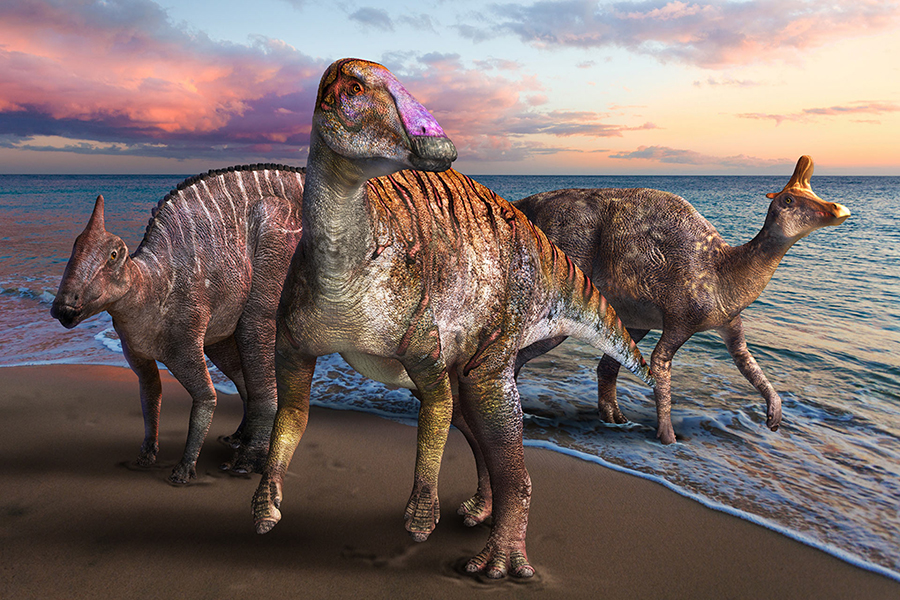
This artist’s illustration of Yamatosaurus izanagii (center) represents its ancestry to more advanced hadrosaurs (in the background). Image credit: Masato Hattori.

Yamatosaurus izanagii roamed our planet 71.8 million years ago during the Late Cretaceous period.

Hadrosaurs, or duck-billed dinosaurs, were successful herbivorous dinosaurs during the Cretaceous period.

Their fossil record is known mainly from the Early Cretaceous deposits of Europe and eastern Asia, whereas derived forms are known from the Late Cretaceous rocks of all continents except Australia and the Indian subcontinent.

Uniquely adapted to chewing, hadrosaurs had hundreds of closely spaced teeth in their cheeks. As their teeth wore down and fell out, new teeth in the dental battery, or rows of teeth below existing teeth, grew in as replacements.

“The dental structure of Yamatosaurus izanagii distinguishes it from known hadrosaurs,” said Dr. Anthony Fiorillo, a paleontologist in the Institute for the Study of Earth and Man at Southern Methodist University and the Hokkaido University Museum.

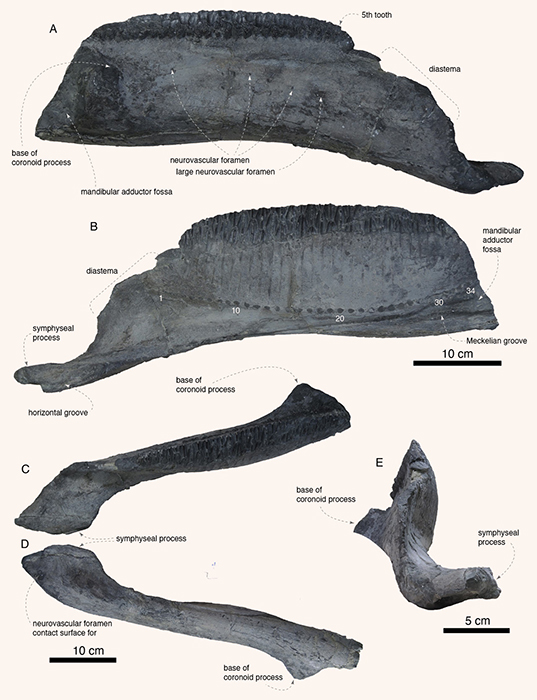
“Unlike other hadrosaurs, the new hadrosaur has just one functional tooth in several battery positions and no branched ridges on the chewing surfaces, suggesting that it evolved to devour different types of vegetation than other hadrosaurs.”

Yamatosaurus izanagii also is distinguished by the development of its shoulder and forelimbs, an evolutionary step in hadrosaurid’s gait change from a bipedal to a quadrupedal dinosaur.”

The right dentary of Yamatosaurus izanagii distinguishes it from other known hadrosaurs; it has just one functional tooth in several battery positions and no branched ridges on the chewing surfaces, suggesting that it evolved to devour different types of vegetation than other hadrosaurs. Image credit: Kobayashi et al., doi: 10.1038/s41598-021-87719-5.

The fossilized remains of the new hadrosaur — a lower jaw, teeth, neck vertebrae, shoulder bone, and tail vertebra — were found in 2014 by amateur fossil hunter Shingo Kishimoto.

They were recovered from blocks of dark gray mudstones of the upper part of the Kita-ama Formation exposed at a quarry in Yura Town on Japan’s Awaji Island.

“In the far north, where much of our work occurs, hadrosaurs are known as the caribou of the Cretaceous,” Dr. Fiorillo said.

“They most likely used the Bering Land Bridge to cross from Asia to present-day Alaska and then spread across North America as far east as Appalachia.”

The discovery of Yamatosaurus izanagii is reported in a paper in the journal Scientific Reports.

_____

Y. Kobayashi et al. 2021. A new basal hadrosaurid (Dinosauria: Ornithischia) from the latest Cretaceous Kita-ama Formation in Japan implies the origin of hadrosaurids. Sci Rep 11, 8547; doi: 10.1038/s41598-021-87719-5

Source: www.sci-news.com/

Ancient DNA Sheds Light on Evolutionary History of Extinct ‘Horned’ Crocodile

Wednesday, April 28, 2021

A skull of Voay robustus collected at Ampoza during the joint Mission Franco-Anglo-American expedition from 1927-1930. Image credit: Hekkala et al., doi: 10.1038/s42003-021-02017-0.

An international team of scientists has recovered and analyzed partial mitochondrial genomes from 1,300-1,400-year-old specimens of Voay robustus, a recently extinct species of ‘horned’ crocodile that lived in Madagascar. Their results indicate that this endemic represented the sister lineage to true crocodiles (Crocodylus) and that the ancestor of modern crocodiles likely originated in Africa.

The arrival of modern humans in Madagascar between 9,000 and 2,500 years ago preceded the extinction of much of the island’s vertebrate megafauna including giant tortoises, elephant birds that ranged to enormous size, dwarf hippos, and several lemur species.

One lesser-known extinction that occurred during this period was the demise of Voay robustus.

Early explorers to the island noted that Malagasy peoples consistently referred to two types of living crocodiles on the island, a large robust crocodile and a more gracile form with a preference for rivers.

This suggests that both types persisted until very recently, but only the gracile form, now recognized as an isolated population of the Nile crocodile (Crocodylus niloticus), is currently found on the island.

Voay robustus was hiding out on the island of Madagascar during the time when people were building the pyramids and was probably still there when pirates were getting stranded on the island,” said Dr. Evon Hekkala, a researcher at Fordham University and the American Museum of Natural History.

“They blinked out just before we had the modern genomic tools available to make sense of the relationships of living things. And yet, they were the key to understanding the story of all the crocodiles alive today.”

Despite nearly 150 years of investigation, the position of Voay robustus in the tree of life has remained controversial.

In 1872, French naturalists Alfred Grandidier and Léon Vaillant described it as a new species and placed it within the true crocodile group, which includes the Nile, Asian, and American crocodiles.

Then, in the early part of the 20th century, it was thought that the specimens simply represented very old Nile crocodiles.

And finally, in 2007, a study based on physical characteristics of the fossil specimens concluded that the horned crocodile was actually not a true crocodile, but in the group that includes dwarf crocodiles.

“Teasing apart the relationships of modern crocodiles is really difficult because of the physical similarities,” Dr. Hekkala said.

“Many people don’t even realize that there are multiple species of crocodiles, and they see them as this animal that’s unchanging through time. But we’ve been trying to get to the bottom of the great diversity that exists among them.”

To fully examine the place of Voay robustus in the evolutionary tree, Dr. Hekkala and her colleagues made a number of attempts to sequence mitochondrial DNA from fossil specimens.

“This project we’ve tried to do on and off for many years, but the technology just hadn’t advanced enough, so it always failed,” said Dr. George Amato, emeritus director of the Institute for Comparative Genomics at the American Museum of Natural History.

“But in time, we had both the computational setup and the paleogenomic protocols that could actually fish out this DNA from the fossil and finally find a home for this species.”

The results place Voay robustus right next to the true crocodile branch of the evolutionary tree, making it the closest species to the common ancestor of the crocodiles alive today.

“This finding was surprising and also very informative to how we think about the origin of the true crocodiles found around the tropics today,” Dr. Amato said.

“The placement of this individual suggests that true crocodiles originated in Africa and from there, some went to Asia and some went to the Caribbean and the New World. We really needed the DNA to get the correct answer to this question.”

The results appear in the journal Communications Biology.

_____

E. Hekkala et al. 2021. Paleogenomics illuminates the evolutionary history of the extinct Holocene ‘horned’ crocodile of Madagascar, Voay robustusCommun Biol 4, 505; doi: 10.1038/s42003-021-02017-0

Source: www.sci-news.com/

40 Dinosaur Jokes for Every Laugh-O-Saurus

Friday, May 7, 2021

RD.COM, GETTY IMAGES

We've had about 65 million years to brainstorm these roaring good jokes.

Dinosaur jokes are a guaranteed roaring good time for everyone and are certain to have you dino-laughter. Ok, sorry, we’ll leave the rest of the punning and joking to the comedians.

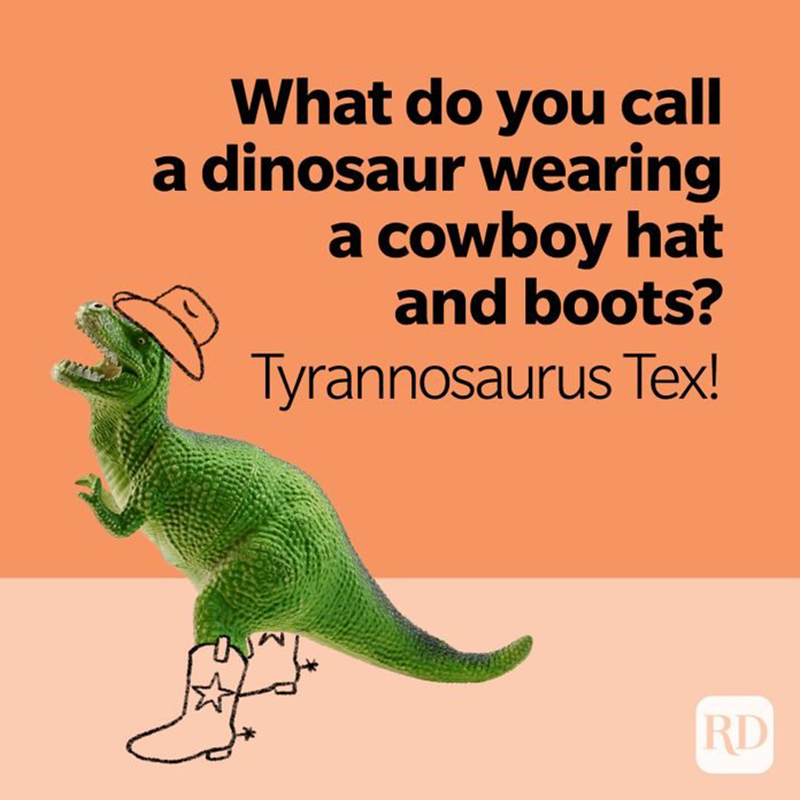
1. What do you call a dinosaur wearing a cowboy hat and boots?
Tyrannosaurus Tex!

2. Why did the Archaeopteryx catch the worm?
Because it was an early bird!

3. What do you get if you cross a dinosaur with a pig?
Jurassic Pork!

4. What do you call twin dinosaurs?
Pair-odactyls!

5. What do you call a dinosaur car accident?
A tyrannosaurus wreck!

6. Why do museums exhibit old dinosaur bones?
Because they can’t afford new ones!

7. Why did the Tyrannosaurus Rex cross the road?
Because the chickens hadn’t evolved yet.

8. Who makes the best prehistoric reptile clothes?
A dino-sewer.

9. What did the dinosaur call her blouse business?
Try Sara’s Tops!

10. What do you call a dinosaur that never gives up?
Try-try-try-ceratops!

11. Scientists discovered a new dinosaur that is very intelligent.
It’s called a thesaurus.

12. Do you know how long dinosaurs lived?
The same as short ones.

13. What’s the best thing to do if you see a Tyrannosaurus Rex?
Pray that it doesn’t see you.

14. What’s the nickname for someone who put their right hand in the mouth of a T-Rex?
Lefty

15. What do you call a dinosaur with one eye?
Eye-saur

16. What do you call a group of dinosaurs who sing?
A tyranno-chorus.

17. What do you call a dinosaur ghost?
A scaredactyl.

18. What’s a dinosaur’s favorite quote?
“Jurassic times call for Jurassic measures!”

19. What do you call a dinosaur who is a noisy sleeper?
A Tyranno-snorus!

20. How do you know if there is a dinosaur in your fridge?
The door won’t shut!

21. What’s the best way to raise a baby dinosaur?
With a crane.

22. What came after the dinosaur?
Its tail.

23. What kind of materials do dinosaurs use for the floor of their homes?
Rep Tiles

24. How do you ask a Tyrannosaurus out to lunch?
“Tea, Rex?”

25. What dinosaur could jump higher than a house?
All of them. Houses can’t jump.

26. What should you do if you find a blue Dilophosaurus?
Try to cheer him up!

27. How many dinosaurs can you fit in an empty box?
After that, the box isn’t empty.

28. What do you get when a dinosaur sneezes?
Out of the way as fast as you can.

29. What is found in the middle of dinosaurs?
The letter S.

30. What’s the best thing to do if you see a T-Rex?
Hope he doesn’t see you.

31. What kind of dinosaur is made of cheese?
Gorgonzilla.

32. What did Rex say to Woody after eating a toy?
You got a friend in me.

33. What do you call a blind dinosaur?
Doyouthinkysaurus

34. What do you call a paleontologist who naps on the job?
Lazy bones.

35. What did the dinosaur use to build his house?
A dino-saw.

36. What is a dinosaur’s least favorite reindeer?
Comet!

37. Can you name 10 dinosaurs in 10 seconds?
Yes, one Gorgosaurus and nine velociraptors!

38. Why does the brontosaurus have a long neck?
Its feet smell.

39. What do you call a T-Rex who hates losing?
A saur loser.

40. What sport is a brontosaurus good at?
Squash.

Source: www.rd.com/

Pages