nandi's blog

Fossil Carbon Burned By Asteroid Impact Contributed To Dinosaur Extinction

Tuesday, October 6, 2020

An asteroid impact 66 million years ago may have released trillions of pounds of partially burned fossil carbon into Earth’s upper atmosphere as a cloud of black soot, significantly contributing to the ensuing global darkness, cooling and mass extinction that wiped out the dinosaurs, according to an international team of scientists.

“Following the impact, a massive amount of rock was ejected and vaporized, and the burned carbon from that rock made it into Earth’s upper atmosphere within an hour or so,” said Shelby Lyons, who led the research as a doctoral student at Penn State. “This would have exacerbated global cooling and darkness and been one of the major causes of the mass extinction when you couple it with sulfur and dust that also made it into the atmosphere.”

Traces of burned organic material are found in the global geologic record of the Chicxulub impact, which is thought to have occurred when an asteroid slammed into a shallow sea in what is now the Yucatán Peninsula, just off the coast of Mexico. The impact unleashed catastrophic damage, and scientists have debated whether the burned material resulted from global wildfires that consumed the planet’s vegetation, or from the burning of ancient carbon in the sedimentary rock that was ejected from the crater during the impact.

A team led by Penn State researchers conducted a new analysis of the burn markers, chemical compounds called polycyclic aromatic hydrocarbons (PAHs), and found the initial release of carbon came from a fossil source that experienced rapid heating. That is consistent with rock being ejected from the impact site, vaporized and dispersed by the atmosphere, the scientists said.

“We have had all this great evidence that something was burning,” Lyons said. “Our research shows soot from the impact site would have immediately contributed to global cooling and darkening that led to the loss of photosynthesis and to the extinction of three quarters of life on Earth, including the dinosaurs.”

The impact ejected an estimated 1.6 to 5.5 trillion pounds of black carbon from sediments into the atmosphere, the scientists said. They reported their findings recently in the Proceedings of the National Academy of Sciences.

The occurrence of charcoal, which could not have been released from sediments, suggests massive wildfires also occurred following the impact. But the wildfires were delayed, releasing soot to the atmosphere slowly and less efficiently in the months after the impact, and would not have had the same impact on the global cooling, the scientists said.

The scientists analyzed sections of three cores samples from the Chicxulub crater and in ocean sediments distant from the impact site.

Using tools developed at Penn State, scientists can differentiate between PAHs that are naturally found in fossil sources like coal, crude oil, and sedimentary rocks, and those that are created by the burning of wood and plants. The scientists took the research a step further, identifying patterns that suggest the PAHs formed slowly over geological time like oil, and then burned quickly following the impact.

“One thing we know a lot about today from the retrieval and burning of fossil fuels is that not all carbon is new,” Lyons said. “There are natural ways for this old carbon to be recycled and reintroduced to Earth’s biosphere and atmosphere, and this study is a reminder that overlooking that can mean missing an important part of the puzzle.”

Katherine Freeman, Evan Pugh University Professor and Lyons’ adviser, contributed to this research. Also contributing from Penn State were Timothy Bralower, professor of geosciences, and Allison Karp, a recent doctorate recipient in geosciences.

Sean Gulick, research professor at the University of Texas at Austin; Joanna Morgan, professor at Imperial College London; and Kliti Grice, professor, and Bettina Schaefer, a doctoral candidate, at Curtin University in Australia, also contributed.

The National Science Foundation and the National Environment Research Council funded this research.

Source: https://scienceblog.com/

Jurassic Park Has Always Undervalued Dinosaurs’ Worth

Sunday, October 4, 2020

Jurassic Park and Jurassic World: Fallen Kingdom both share the same problem: characters in both films undervalue the dinosaurs' worth.

The Jurassic Park franchise understands bringing back dinosaurs from extinction is awe-inspiring, but it constantly undervalues the existence of those dinosaurs. Michael Chrichton's book and Steven Spielberg's 1993 movie captured the imaginations of people around the world, and the idea of using genetic engineering and cloning to revive the dinosaurs - or any extinct species, for that matter - has become a subject of intense apprehension whenever scientists get closer to producing those results, similar to anytime an A.I. gets closer to Terminator's Skynet system.

Of course, the biggest barrier in scientists' abilities in reviving dinosaurs - or even species like mammoths - is the necessary technology and scientific research. This was a subplot of Jurassic Park; Dr. Ian Malcolm even pointed out to John Hammond that his scientists had simply taken what others had done and took the next step. They didn't earn the discoveries they made and, instead, were chasing a dream without fully comprehending the consequences of achieving it. But they weren't the only ones with that dream; InGen's rival genetics company, Biosyn, was also interested in the dinosaurs, so they recruited Dennis Nedry to steal the embryos for a fee.

Lewis Dodgson hired Nedry to sneak dinosaur embryos off Isla Nublar for $1.5 million, which Nedry said would help Biosyn catch up on 10 years of research. Even in the early 1990s, $1.5 million for up to 15 dinosaur embryos ($100,000 each), including for the Tyrannosaurus rex, seems incredibly low; $1.5 million for each embryo would've made more sense - if not more. Granted, Nedry accepted the deal because he was having financial troubles and needed the money, so it's possible Dodgson low-balled his offer. Then again, this particular detail resurfaced in Jurassic World: Fallen Kingdom when Benjamin Lockwood's assistant, Eli Mills, sold off the surviving dinosaurs from the Jurassic World park.

In Fallen Kingdom, Mills had mercenaries retrieve the dinosaurs from the island and then he worked with the black market dealer and auctioneer Gunnar Eversoll to sell off the park's assets (the dinosaurs) to shady businessmen. But like the first movie, Jurassic World: Fallen Kingdom also undervalued the dinosaurs' worth; an Ankylosaurus sold for $10 million, a Stegosaurus for $11.6 million, and a Baryonyx for $21 million. Even the Indoraptor, a genetically-modified dinosaur that was created to respond to commands/targets, was sold for just $41 million. Comparatively, the Mona Lisa painting can be valued upwards of $860 million.

Perhaps the writers and producers of both Jurassic Park and Jurassic World: Fallen Kingdom were too focused on figuring out how the dinosaurs would escape that the price of each one of those dinosaurs became superfluous to their stories. Perhaps the original movie can be forgiven since it was only one line, but Fallen Kingdom's valuations for dinosaurs seems bizarre since the auction was a core part of the story. The Indoraptor itself should at least be worth as much as a Da Vinci painting; it's a dinosaur, after all.

Source: https://screenrant.com/

Jurassic World 3 Star Heaps Praise on Original Jurassic Park Trio's Return

Saturday, October 3, 2020

Jurassic World: Dominion star Mamoudou Athie has nothing but praise for Jeff Goldblum, Sam Neill, and Laura Dern.

Jurassic World 3 is bringing back franchise heroes Dr. Ian Malcolm, Dr. Alan Grant, and Dr. Ellie Sattler into the prehistoric fray, newcomer Mamoudou Athie has nothing but praise for the legacy performers. In a recent interview, Mamoudou Athie discussed the honor of performing alongside Jeff Goldblum, Sam Neill, and Laura Dern in the upcoming sequel.

"My experience has been wonderful. Director Colin [Trevorrow], the whole cast, the legacy characters, have been wonderful to work with. I've never done a movie on this kind of scale so I've certainly learned a lot, but at the end of the day, the thing that was comforting about it is it's a movie and you just come in there and whatever the scope of the thing is, it's still between two people, or a dinosaur, and you do your thing."

Not much is known about the character Mamoudou Athie plays in the movie, but the actor is best known for roles in the likes of the sci-fi thriller The Circle, the political drama The Front Runner, the claustrophobic horror flick Underwater, and the Facebook Watch series Sorry for Your Loss.

As for the Jurassic Park trio, director Colin Trevorrow recently revealed that their roles in Jurassic World: Dominion are far more important than we may have anticipated. "This is the movie I've been waiting to make since the beginning," Treverrow said. "It's the one we have spent the past two movies building to. It really was part of a larger story and part of a design. I think people may be underestimating the size and importance of Laura Dern and Sam Neill and Jeff Goldblum's characters in this movie; it is very much an ensemble. That element - the ability to take these beloved characters from almost 30 years now and understand how they interact with each other in the context of a world we've really never seen before and not been able to witness until now is very exciting for me."

With the last movie in the ongoing franchise, Jurassic World: Fallen Kingdom, ending with several different species of dinosaur now let loose upon the world, it's likely that Jurassic World: Dominion will find Jeff Goldblum's Dr. Ian Malcolm, Sam Neill's Dr. Alan Grant and Laura Dern's Dr. Ellie Sattler brought in to help stop the prehistoric beasts alongside Jurassic World's Chris Pratt and Bryce Dallas Howard.

Specific details of how the three legacy characters will feature in the movie are being kept largely under wraps, but Jeff Goldblum has previously teased a life and death scenario for the trio. "The three of us were in a tiny little space and we were being menaced by - I can't even tell you - a surprising faction of prehistoric creatures that you've never seen before. We saw some amazing things. We were acting in a life and death situation. We think it might be the last moments of our lives and we're all bonding with each other in an emotional and somewhat hilarious way," Goldblum said.

Jurassic World: Dominion returned to filming recently following a forced hiatus, with reports claiming that the implementation of the new health and safety procedures has cost the production somewhere in the region of $5 million, with testing equipment alone costing as much as $3 million. Hopefully, the extra cost will be worth it when Jurassic World: Dominion stomps into theaters on June 11, 2021. This comes to us courtesy of Comicbook.com.

Source: https://movieweb.com/

Universal Studios’ New ‘Jurassic World’ Roller Coaster Looks Amazing

Sunday, October 4, 2020

Adrenaline junkies and film buffs can finally agree on one thing, a Jurassic World roller coaster is a good idea, right? Universal Studios has unveiled the new ride that's being built in the Jurassic World area of its park. Titled the VelociCoaster, we're not giving out prizes for guessing what dinosaur the ride is centred around.

This ride looks pretty fossil-nating if you ask us - Universal even says it's a "new breed" of roller coaster. From the way the trailer of the ride shows off the new attraction, it looks like passengers will be taken on an intense journey along with Velociraptors as they stalk through the jungle. If you've ever wanted to ride a dinosaur, this probably the closest you're going to get.

The trailer on YouTube gives us a few more details about what the actual ride, including "two intense launches" and four inversions. It's a roller coaster so we're sure it has its ups and downs too.

Further details reveal that once completed, the VelociCoaster will be Florida's tallest and fastest launch coaster, reaching speeds of 70 miles per hour in 2.4 seconds and an almighty height of 150 feet. Those sorts of numbers just fill us with terror(dactyl).

Not only will the ride feature the favourite velociraptors of Jurassic World, but it will also feature some of the big Hollywood names of the films, from Chris Pratt as dino keeper Owen Grady to Bryce Dallas Howard as park manager Claire Dearing.

Both Pratt and Howard are set to reprise these roles in the third Jurassic World film, Dominion which will be out (hopefully) in June 2021.

If you're interested in giving the coaster a try the Jurrasic World VelociCoaster will be coming to Universal's Islands of Adventure in Summer 2021, and don't worry, we'll have more dinosaur terrible puns and jokes ready for you by the time it opens.

Featured Image Credit: Universal Studios

Source: www.ladbible.com/

How Bumpy’s Baby Yoda-Like Response Has Ensured More Of Her In Jurassic World's Netflix Series

Saturday, October 3, 2020

It doesn’t work for every TV show, but if you’re not at the very least trying to fit in a cute, adorable sidekick that’s easily marketable, what are you even doing? For sure you can blame The Mandalorian and its absurdly successful weaponization of The Asset, also known as “The Child”, and more colloquially, “Baby Yoda” for the renewed intensity of this particular craze. However, a new player has entered the field of streaming cuteness, and it comes from a most unusual source, as Bumpy the Ankylosaurus from Jurassic World: Camp Cretaceous has basically won herself a place in the hypothetical Season 2, should it be greenlighted.

WARNING: Spoilers for Jurassic World: Camp Cretaceous are in play. If you haven’t seen all eight episodes of the Netflix series, you’re going to want to turn back around and come back once you’ve caught up.

This is yet another revelation that came from the recent press day for the recent Netflix series, which I attended on behalf of CinemaBlend, and while it’s a pretty obvious point, it’s still something that’s worth bringing up. This is especially true when considering the fact that before the world had even laid eyes on the cute baby dinosaur that would become camper Ben Pincus’ best friend and companion, there was already a lot of love put into this “imperfect” dinosaur. Showrunner Scott Kreamer filled us in on this fact, as well as why Bumpy would be so important for Season 2, as follows:

We all loved Bumpy before it went out there, and to see the adoration and the Baby Yoda-like love that Bumpy is getting has been incredibly gratifying. So yeah, if we went forward, I mean Bumpy is one of our gang. So I would imagine we’d see more of Bumpy.

Much like Baby Yoda itself, Bumpy’s introduction in Jurassic World: Camp Cretaceous nailed home the fact that this adorable tagalong was going to serve a purpose. Throughout the eight episodes of Season 1, we see the overly anxious Ben go from worry wart to protector of the dinosaur that Jurassic World antagonist Dr. Wu gave the side eye to, as he found its asymmetrical horns to be undesirable. Practically imprinting on the young boy as she hatched in the genetics lab, Bumpy and Ben became inseparable.

Which makes the mid-credits scene in Jurassic World: Camp Cretaceous’ finale all the more heartwarming. Presumed lost after an incident separates Bumpy from the campers, we spend a good portion of the last two episodes wondering where she’d gone. And as if that wasn’t enough, we’re also treated to Ben Pincus’ presumed death after being yanked out of the monorail to safety by a roaming pack of Pteranadons, Sure enough, while there was a believable threat present for those closing acts of Season 1, audiences weren’t sent away totally bummed out, as Bumpy finds Ben and licks him as we see his fingers twitch.

Ensuring that Bumpy will be hanging around in the Jurassic World: Camp Cretaceous universe also provides some interesting questions when it comes to the future of the Jurassic World series on the whole. After Jurassic World: Fallen Kingdom had no reservations killing off the first Brachiosaurus we saw in Jurassic Park history, could there be a chance that Bumpy is eventually revealed to be left on Isla Nublar after the chaotic eruption of its on-site volcano? Or did Bumpy somehow make it into the pack of dinosaurs recovered for auction, only to be released into the wilds of the United States?

How this particular creature ties into the very canonically-driven Netflix animated series is going to be interesting to watch, as well as the development of some other human characters we might hopefully see take the stage in the silver screen. With Scott Kreamer, Colin Trevorrow, and the entire Jurassic World: Camp Cretaceous team plotting out the interweaving storyline between the films and the series, anything is possible; and for now, the survival of Bumpy means we’ll get even more adorable, meme-worthy content if Season 2 gets that greenlight. Which is an eventuality that, if the below video is any indication, the folks in charge have already banked on:

For now, we’re going to have to wait for more information, as Jurassic World: Camp Cretaceous’ future is wide open, and no second season has yet been announced. However, you can see the entirety of Season 1 for yourself, as all eight episodes are currently streaming on Netflix. Even if you’ve already watched the whole run, you might want to watch it again. Bumpy will thank you for it in Season 2!

Source: www.cinemablend.com/

Scientists Say They've Solved 159 Year-Old Dinosaur Feather Mystery

Saturday, October 3, 2020

Scientists say the oldest fossil feather ever discovered belongs to a flying bird-like dinosaur called Archaeopteryx following the conclusion of a new research project./Ryan Carney.

Scientists believe they have settled a dispute going back 159 years, by showing that the first fossil feather ever discovered belonged to a flying bird-like dinosaur called Archaeopteryx.

The origin of the fossil, which was unearthed in Berlin back in 1861, has puzzled scientists ever since, with experts attributing it to a host of different dinosaur species - but now believe they have a definitive answer.

A team of scientists at the University of Florida led by lead author Ryan Carney have unearthed new conclusive evidence that they say confirms it belongs to Archaeopteryx.

The scientists found that the fossil matched a type of wing feather known as a primary covert that covers other feathers and helps to propel birds into the air.

The team examined nine different elements of the feather in great detail and also compared it to the structure of other modern living birds.

Scientists found that the fossil matched a type of wing feather known as a primary covert that was identical in size and shape those found on Archaeopteryx./Ryan Carney.

The structures of 13 Archaeopteryx fossil feathers were also analysed and revealed that its primary coverts were identical in size and shape to their mystery fossil.

The fossil was also found on the exact same site in Germany as several other Archaeopteryx skeletons, which scientists say confirms their conclusion and ends the 159-year mystery.

The fossil found on the exact same site in Germany as several other Archaeopteryx skeletons./Ryan Carney.

Carney, who is the Assistant Professor of Integrative Biology at the University of South Florida,  revealed he and his team had used cutting edge techniques to unearth new evidence. 

He said: "There's been debate for the past 159 years as to whether or not this feather belongs to the same species as the Archaeopteryx skeletons, as well as where on the body it came from and its original color.

"Through scientific detective work that combined new techniques with old fossils and literature, we were able to finally solve these centuries-old mysteries."

Source: https://newseu.cgtn.com/

Jurassic World: Dominion Set Photos Reveal New Locations

Friday, October 2, 2020

New set photos from behind the scenes of Jurassic World: Dominion don’t show us any new dinosaurs but they impart that the second sequel in the latest trilogy is going global.

Universal Pictures released the photos which offer sparing glimpses of new locations in the story.

One, though the background is out of focus, looks a little like a museum interior you would typically find in Indiana Jones, which is fitting.

It’s safe to assume we’ll be seeing some dinosaur bones again if that’s the case. What else do you expect to see in a museum?

Another possibility is the place is the lobby of the Jurassic Park Visitor’s Center, meaning the Park is theoretically open again for business. That, as history tells us, never ends well.

You can also see that pandemic protocols are in place and no corners are apparently being cut. The crew member slating the scene is wearing a mask and PPE.

Shooting in the UK was allowed to resume as long as precautions were taken and they moved to a controlled studio environment.

And judging by the slate, the original JP logo and font from the first two movies are being used, sure to tickle that nostalgia bone even further after the pronouncement there will be animatronic dinos for the first time in decades.

Hopefully, they keep the same classic logo and font on the posters.

Universal’s next BTS photo has three crew members in masks – no PPE since they’re outside, presumably – and they’re assembling an absurdly larger clapperboard.

Behind them is an artificial mountainside covered in snow. Why anybody is climbing snowy mountains in Dominion is a mystery, but it is a mild spoiler.

Perhaps somebody is looking for fossils, eggs, bones, or all three. And maybe there are pterosaurs nesting up there that attack in a tense sequence of hell-frozen-over action.

A frigid climate might also indicate we’re in for some Ice-Age beasts. Seeing a mammoth or a sabretooth tiger, for example, is an exciting prospect.

The jury is out on cameos by post-Cretaceous creatures but new dinosaurs and old favorites are cryptically confirmed for the flick based on the words of director Colin Trevorrow and star Jeff Goldblum.

It’s clear now we can expect some globe-hopping too beyond the return to Site B on Isla Sorna when Jurassic World: Dominion hits theaters June 11, 2021.

Source: https://boundingintocomics.com/

Jurassic World: Camp Cretaceous Is the Franchise's DARKEST Story

Thursday, October 1, 2020


As lighthearted as it is at times with its wandering teens, Jurassic World: Camp Cretaceous is the darkest story in the franchise.

WARNING: The following contains spoilers for the first season of Jurassic World: Camp Cretaceous, now streaming on Netflix.

The Jurassic Park movies, as fun and filled with wonder as they are, do have some sinister elements to them. It's no surprise since audiences are shown how scientists love playing god, and with every film revolving around dinosaurs breaking free, whether in a park or the city, there are a few scenes with people getting eaten.

In reality, though, it's not that gory or explicit, as the franchise is geared towards kids and teens, after all. However, Jurassic World: Camp Cretaceous takes it to a whole new level because, while it's initially positioned as an adventurous family series, it's the property's darkest story to date.

There are many heavy themes at play in Jurassic World: Camp Cretaceous, with tragic backstories and issues of abandonment informing the kids' personalities and how they handle themselves in the wild. The lead, Darius, has a very somber arc as he lost his terminally ill dad and is now living their dream of experiencing the park together. These moments are quite sentimental and offer an emotional respite from the kids being chased by monsters, which adds a dimension not really explored in the movies. The other kids are placed in very serious backgrounds as well, with Kenji being ignored by his rich family and Ben being shunted to the park as his parents don't like how he's an introvert.

Sure, they seem like light arcs at first, but it's pretty dire knowing families rather shove kids off to areas where it's known dinosaurs can escape and kill humans rather than spend time together and bond. It's even worse with Sammy, whose family ranch is in debt, which leads her to go behind her friend's backs as a spy. This trope is a familiar one, as seen with Wayne Knight's Dennis Nedry in the first film and Alessandro Nivola's Billy in Jurassic Park III. But to see a kid as a spy, infiltrating labs and aiding corporate espionage for Mantah Corp. is quite intriguing. Not to mention, there's Brooklynn's addiction to social media and blogging that puts her in dangerous situations for the likes and shares, something that speaks to problems with teens today.

But while all this could be chalked up to character development and carving out dynamics, the show is surprisingly violent. There are a lot of kills as the teens see many people being eaten by the Indominus Rex, not to mention Ben falls off the monorail, giving the initial impression he's picked off by Pteranodons. It also gets psychotic with Eddie, a research lab assistant who has a breakdown and tries to flee, only to be eaten by the Indominus. It shows the kids how the park takes a mental toll on people, and in times of desperation and survival, people abandon each other and turn into monsters themselves. Coupling all this with the plethora of near-death experiences for the kids, it's startling to see there are no adults around like Chris Pratt's Owen or Bryce Dallas Howard's Claire to help out. The kids' handlers never make it back to them, and with so many monsters running around, one has to wonder why there aren't people equipped for emergency rescues in this highly-dangerous zoo.

The finale, "End of the Line," best sums it up when the youngsters have to fight off their archnemesis, the Carnotaurus, at the tunnel leading to the docks. They're damaged, tired and after seeing multiple adults devoured, they have no choice but to use aggressive tactics. This leads to them blowing up the beast, Toro. However, the beast doesn't die, it just gets burned up. It stares the kids down and walks away in defeat, but seeing as they're stranded there, it could be coming back for revenge. It's a bit sad because the kids invaded the natural environment of these creatures so to see them celebrating this means there's still a lot to learn about nature and mankind. Lastly, the fact the kids are abandoned on the island says it all, as T-Rexes and such are still roaming, and as fans know, the volcano will soon erupt and destroy the place. This makes the ending quite bleak and reminds us that these parks are often run by idiots who have no clue how to protect people.

Jurassic World: Camp Cretaceous is executive produced by Steven Spielberg, Frank Marshall, Colin Trevorrow, Scott Kreamer and Lane Lueras, with Zack Stentz serving as a consulting producer. The series is streaming now on Netflix.

Source: www.cbr.com/

5 Cool Dinosaurs Discovered After You Were a Kid

Thursday, October 1, 2020

There are probably more paleontologists out there than you’d expect. In my mind, it’s Dr. Grant, Dr. Satler, and whoever got off Isla Nubar before the storm hit, and everything went sideways. There’s not that many more of them in the actual world. A 2008 issue of Palaeontologia Electronica places the number of paleontologists at around 1,000. That number hasn’t skyrocketed since. Given how few people are out there looking, it’s even more impressive that they discover a new dinosaur species every week or two. Here are five dinosaurs found in the last decade.

Patagotitan mayorum

Meet Patagotitan, the Biggest Dinosaur Ever Found

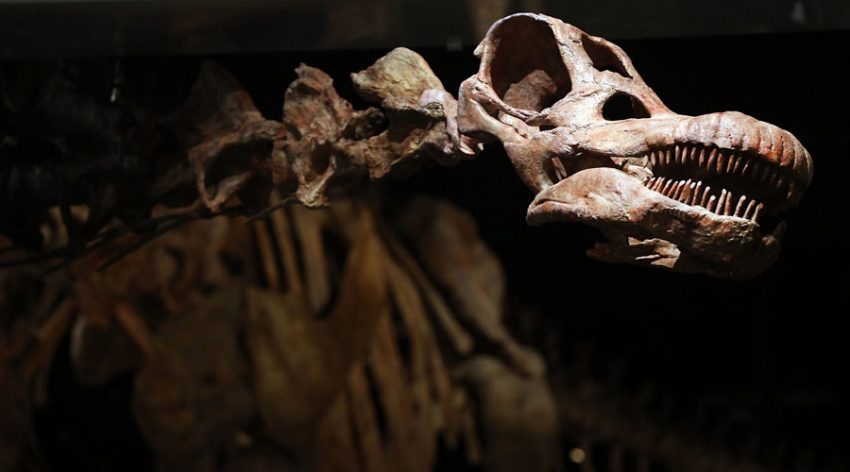
The scientific name means the mayor of titan town. Just kidding. The discovery took place in 2014, with the most in-tact skeleton found in Argentina on the property of the Mayo family (where the name actually comes from). Titanosaurs, the family the Patagotitan belongs to, are the biggest of all dinosaurs, and frequently found in Argentina. The skeleton on the Mayo property is over 122 feet long, almost half the length of a football field.

Borealopelta markmitchelli

STUNNING DISCOVERY Some 110 million years ago, this armored plant-eater lumbered through what is now western Canada, until a flooded river swept it into open sea. The dinosaur’s undersea burial preserved its armor in exquisite detail. Its skull still bears tile-like plates and a gray patina of fossilized skins. PHOTOGRAPH BY ROBERT CLARK

Scientists discovered an unbelievable specimen preserved by its final resting spot in a prehistoric river’s silty bottom. It’s a species of nodosaur, one of the armored herbivores that cruised across the Jurassic and Cretaceous periods unperturbed. How do we know it lived its life without hassle until sinking in a river? Because an armor of spikes covered its 2800-pound body, crowned by two-foot spikes on its shoulders.

Coelurosauria tail in amber

A small coelurosaur, shown here in this artist’s representation, approaching a resin-coated branch. CHUNG-TAT CHEUNG

In 2018, scientists discovered a preserved dinosaur tail in amber. If we don’t have Jurassic Park in the next ten years, what is science even doing with these discoveries? Also, are you starting to wonder what’s up with dinosaurs dying in these absurd ways? Did the dinosaur fall asleep, and tree sap covered its tail? What’s more, the tail’s covered in little feathers, supporting Dr. Grant’s theory that dinosaurs turned into birds.

Vectaerovenator inopinatus

An artist’s impression of Vectaerovenator inopinatus’ final moments. Image credit: Trudie Wilson.

This discovery took place in three separate incidents over 2019 and sounds like a very British way of doing paleontology. An English fossil hunter visited the Isle of Wight with his family and made the first discovery while walking on the beach. The second discovery happened the same way, to another scientist. The third discovery was a guy kicking rocks who realized that he was about to kick a dinosaur bone. Scientists categorized Vetaerovenator in the same family as the T. Rex and modern-day birds because its bones have hollow air pockets.

Sauropod embryo

Magnified perspective of the titanosaurian embryonic skull with the preorbital and orbital region in left lateral view. Image credit: Kundrat et al, doi: 10.1016/j.cub.2020.07.091.

The crazy thing about being a “digger” like Dr. Grant is you never know what you’re going to discover. Like, a fossilized dinosaur embryo in an egg, revealing what a well-known dinosaur looked like as a baby. According to Science Daily, “Sauropod embryology remains one of the least explored areas in the life history of dinosaurs.” Which makes sense. You can’t declare your specialty is embryos and then spend your life digging, hoping to find another fossilized nest.

Source: www.oddee.com/

How Jurassic World: Camp Cretaceous Connects to the New Films

Tuesday, September 29, 2020

Netflix's Camp Cretaceous holds a few important connecting scenes that tie the animated series into the Jurassic World trilogy.

WARNING: The following contains spoilers for the first season of Jurassic World: Camp Cretaceous, now streaming on Netflix.

Jurassic World: Camp Cretaceous focuses on kids heading to the other side of Isla Nublar, hunkering down in an adventure camp to get the full dinosaur experience. Lead character Darius is super-excited, as he'll get to spend a few days being educated and watching creatures in their natural habitat. However, seeing as Camp Cretaceous is connected to 2015's Jurassic World, a dinosaur outbreaks ensues.

Here are some of the key ways Camp Cretaceous connects to Jurassic World.

DR. WU'S SNEAKY PLANS

B.D. Wong reprised his role as the sinister Dr. Henry Wu for Jurassic World, and Camp Cretaceous provides a glimpse at his shady behavior when Brooklynn breaks into his office to find secrets to talk about on social media. The vlogger can't get into his computer after their tour, but she finds paperwork about new experiments, namely the Indominus, hinting at the danger to come.

This foreshadows when Wu is caught in the film splicing genes together from the likes of the Carnotaurus and T-Rex, which angers Chris Pratt's Owen, as he doesn't like Wu playing god. Later in the series, Sammy also breaks into the lair to steal data for rival companies, who want to know what Wu's been creating for the exhibitions. The kids also hear about him being saved over the radio, setting up more of his experiments in Fallen Kingdom.

CLAIRE DEARING'S ABSENCE STUNS THE TOUR GUIDES

Camp Cretaceous' tour guides Roxie and Dave keep complaining about the lack of manpower for their camp, which for all intents and purposes is still in prototype. They try calling Bryce Dallas Howard's Claire, as they don't want her to send her nephews -- Zach and Gray -- over. In the film, Claire and Chris Pratt's Owen had to save the two from Indominus and the other dinosaurs running amok.

The handlers aren't aware of what's happening, though, and they're unable to get in contact with her. She's already off trying to ensure the boys don't die, and it's at this point Roxie and Dave realize the situation must be dire, as she's abandoned ship. This is the red flag that leads to them discovering the park is imploding and they need to find their kids.

SIMON MASRANI'S DEATH CAUSES MORE CHAOS

In Jurassic World, Masrani Global Corporation and park owner Simon Masrani tried to undo his mistakes by piloting a helicopter while his soldiers shot at the Indominus when it got loose. Unfortunately, the giant beast crashed into the Pteranodon enclosure, and when the winged dinosaurs escaped, they attacked the chopper and caused it to crash and explode, killing everyone inside.

The animated series shows this scene but from a distance, as the kids look on when the chopper falls from the sky. However, Camp Cretaceous then shows Indominus running out the enclosure, further fleshing out the scene from the film. While the kids don't know who died, they know not to stick around as the Pteranodons give chase, ready to devour them now that they're free.

THE MONORAIL CIRCUIT SIGNALS DOOM

This series gives the monorail a much bigger role, since the kids have to board it to head to the docks as they try and escape the Carnotaurus with Bumpy the Ankylosaurus. The train gives us a wider view of the park as they go around, showing more of what was featured in the movie.

The Mosasaurus tank is also shown at night, referencing to how it's abandoned at the end of Jurassic World, which invites mercs to come in to steal DNA in Fallen Kingdom. The sea dino did feature a bit earlier too, as the kids had to paddle away from it when it tried to eat them after their canoes ended up in the tank. Still, it's all quiet when they go around it this time, emphasizing to the kids that the park is truly abandoned.

BLUE MAKES SOME CAMEOS

Owen's velociraptor buddy, Blue, appears early on in the paddocks, which seems to be before the training session from the film. In that scene, Owen showed he could get his velociraptors to obey commands, fashioning him soldiers to help save the remaining humans when chaos ensued.

As Camp Cretaceous Season 1 ends, the kids realize they're all alone on Isla Nublar. However, there's a shot of Blue again in the wild. It foreshadows Claire recruiting Owen in Fallen Kingdom to rescue the last of the pack and suggests maybe Blue might help the teens survive the dangers to come.

Source: https://www.cbr.com/

Pages