nandi's blog

How T. rex Came to Rule the World

Sunday, October 18, 2020

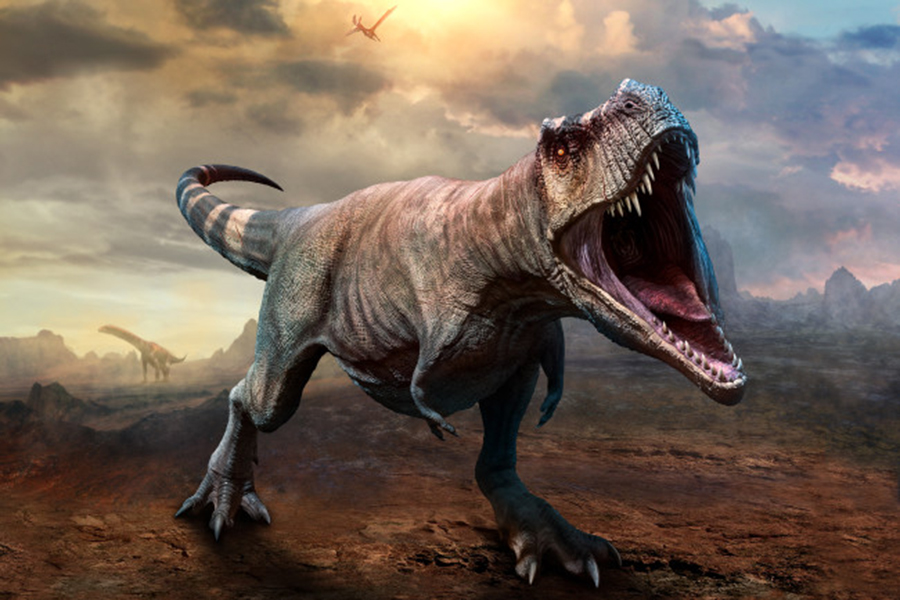
(Credit: Warpaint/Shutterstock)

To understand how adult Tyrannosaurus rex rose to world domination, you must look at how they grew up from babies.

Tyrannosaurus rex was a dinosaur that lived up to its name. If you were to visit its haunts between 68 and 66 million years ago, you wouldn’t find another carnivore quite like it. Growing up to 40 feet long and weighing as much as nine tons, the dinosaur was far larger than any other meat-eater of the time. And that’s strange. In other times and places, habitats were full of carnivorous dinosaurs of all sizes. How did the “tyrant lizard” come to stomp out the competition?

The way T. rex grew up holds the key. At this week’s virtual Society of Vertebrate Paleontology conference, scientists have pointed out how the big, meat-munching dinosaurs had a disproportionate effect on the landscape just by how they aged during their lives.

Baby T. rex

When they hatched, baby T. rex were about the size of a chihuahua. These little nippers didn’t look quite like their parents. They were a little more awkward, with long legs and short, shallow snouts. As they grew up, though, they began to change, their jaws becoming longer as they packed on body mass. By the time they were adults, T. rex had wide, deep skulls with powerful jaws, capable of cutting flesh and punching through bone. In short, baby, adolescent and adult T. rex were so different from each other that they acted almost like different species. “The transition from a baby T. rex to an adult T. rex is truly fascinating,” Oklahoma State University paleontologist Evan Johnson-Ransom says. 

The dramatic changes T. rex underwent may have allowed the dinosaur to take up a greater amount of ecological space than other meat-eaters that came before it. Consider the number of carnivorous dinosaurs on the landscape long before T. rex, during the end of the Jurassic. This was the time of favorites like Allosaurus and Ceratosaurus, large carnivores of the ancient floodplains. But they shared their habitats with an array of medium- and small-sized carnivores, all of them connected in a complex food web. Carnivores from the size of ravens all the way up to 40-foot-long monsters all lived in the same place.

King Tyrannasaur

By the time of T. rex, though, the largest non-T. rex carnivore was about the size of an adult human, with a huge gap between these smaller raptors and the tyrant king. To put it another way, it would be like visiting the grasslands of East Africa today and not seeing any carnivores between the size of a bat-eared fox and a lion, as University of New Mexico paleontologist Kat Schroeder pointed out in her presentation.

Differences in size translate to differences in diet. “Carnivores will have their own respective niches and hunt prey that best suits them,” says Johnson-Ransom, meaning that T. rex of different ages ate very different foods. Babies were not taking down Triceratops and adults were not pouncing on juicy insects.

Given that the fossil record is incomplete to start with, though, could it be that paleontologists just haven’t found the mid-sized carnivores yet? That’s unlikely, University of Maryland paleontologist Thomas Holtz, Jr. notes, because experts have been sampling the geologic formations where large tyrannosaurs are found every year for over a century. In that time, Holtz says, experts haven’t found a trace of medium-sized carnivores living alongside big tyrannosaurs — not even isolated teeth. Schroeder found a similar pattern in her research. “We’re observing a somewhat unique situation in which only certain body size classes from certain groups are missing from Mesozoic communities,” Schroeder says. The gap seems to be real.

T. rex Takeover

The looming question is how tyrannosaurs managed to stage their takeover. They were not the first or only form of meat-eating dinosaur around. In fact, the earlier tyrannosaurs that lived around 160 million years ago were tiny, with “much more blade-like teeth and weaker bites” Holtz says. It was only around 80 million years ago that tyrannosaurs staged their coup in the Northern Hemisphere. That’s when tyrannosaurs showed a big change, with deeper, bone-crushing skulls, small arms and increased speed and agility. These changes go along with the proliferation of horned dinosaurs and duck-billed dinosaurs — both favored prey — and, Holtz notes, the sudden absence of other forms of predatory dinosaurs may have given tyrannosaurs an opening to evolve into new roles. 

Future expeditions and research will certainly refine the story. Paleontologists know very little about the middle of the Cretaceous period, Holtz notes, and this is the critical time when tyrannosaurs were starting to change. And there’s lots more to uncover about what tyrannosaurs ate at different times in their lives. “There are specimens of the duckbill Edmontosaurus with bite marks from teenage tyrannosaurids,” Holtz notes, but experts should keep an eye out for tyrannosaur bite marks on smaller prey. Not to mention fossil feces — or coprolites — from younger tyrannosaurs that might contain bones that can identify the tyrannosaur menu.

The upshot, though, is that dinosaurs need to be understood on their own terms. How they lived is fundamentally different from any creature alive today, and, in the case of tyrannosaurs, that’s partly because of their impressive size. “An animal that is born from an egg the size of a volleyball that winds up as big, or bigger, than an elephant cannot help but pass through many ecological niches as it grows,” Holtz says. That means that big dinosaur species weren’t just one animal that behaved the same all its life. A single T. rex, Holtz says, “is practically the equivalent to an ecological community.”

Source: www.discovermagazine.com/

Jurassic Park: Every Dinosaur In The Original Trilogy

Monday, October 19, 2020

Jurassic Park ushered in a new love for dinosaurs in audiences young and old when it released in 1993 highlighting dinosaur species big and small.

Steven Spielburg’s 1993 classic, Jurassic Park is the movie that brought so many kids’ dreams of seeing real, moving dinosaurs to life. Based on Michael Crichton’s book of the same name, Jurassic Park went on to spawn a massive franchise including five feature films, several animated projects from Lego, a Netflix animated TV series, and numerous video games and comic books.

The story of Jurassic Park focuses on a set of islands located near Costa Rica where wealthy benefactor John Hammond has figured out how to extract DNA from fossils in order to create living dinosaurs. He intends to turn the islands into a theme park attraction, but in the course of setting it up things go horribly wrong as the dinosaurs escape their enclosures and begin running free across the islands.

But, the part of Jurassic Park that keeps audiences coming back is the dinosaurs. From the highly intelligent Velociraptors to the mighty Tyrannosaurus rex, fans love the beautiful depiction of dinosaurs in the films using a combination of CGI and practical effects as both amazing creatures deserving of respect and monstrous killing machines that should be feared and avoided.

Velociraptor

The first dinosaur shown in Jurassic Park, and the highly intelligent antagonist of many different scenes throughout the original trilogy and the Jurassic World spinoff series is the velociraptor. In the original 1993 Jurassic Park, velociraptors are shown in the opening scene killing a trainer and spurring John Hammond to bring the scientists to his island to inspect it. They’re also the focus of Dr. Grant and Dr. Sattler’s opening scene at their dig where they uncover the skeleton of a velociraptor.

Later, velociraptors appear once more as the creatures hatching from eggs in Dr. Henry Wu’s lab when Dr. Grant, Dr. Sattler, and Dr. Malcolm visited for the first time, and again attacking Dr. Sattler and Robert Muldoon as they try to get the power at the park back on. Then, finally, once more as they attack Tim and Lex, chasing them around in the notorious kitchen scene.

In Lost World: Jurassic Park, the velociraptors appear again in the second act of the film, hiding in the tall grass as everyone is making their way across the island to safety. They then reappear, attacking Dr. Malcom, his daughter, and Dr. Harding as they enter the facility to find Nick. They remain the antagonists for the rest of the scene, until the trio is able to make it to a chopper and escape the island.

Brachiosaurus

In the big reveal scene when Dr. Grant and Dr. Sattler arrive at Jurassic Park for the first time, the first dinosaur they see is the Brachiosaurus. The dinosaurs appear once again when Dr. Grant is asleep in the trees with Tim and Lex and awakes to find the dinosaur eating leaves nearby. Later, in Jurassic Park 3, a herd of Brachiosaurus are seen by Dr. Grant and the Kirby family at a river bank.

Parasaurolophus

The long-horned Parasaurolophus appears in the first Jurassic Park movie as part of the sweeping shot that reveals dinosaurs on the island. They appear once more on Site B, Isla Sorna as part of the stampede that the InGen hunters are driving through in Lost World. The hunters then shoot and capture one of the Parasaurolophus in that scene as well. In Jurassic Park 3, the Tyrannosaurus was seen eating a Parasaurolophus, and Eric Kirby’s search team runs through a mixed pack of Parasaurolophus and Corythosaurus as they are running from Velociraptors.

Dilophosaurus

Appearing only in the first Jurassic Park, Dilophosaurus is seen both as the first dinosaur in the tour and then again when Dennis Nedry is trying to escape. The Dilophosaurus pack attacks and kills Nedry in that scene, spitting acid in his face, an ability that does not exist in the real Dilophosaurus.

Tyrannosaurus Rex

Appearing in all three of the original Jurassic Park movies, the T-Rex serves as the major antagonist throughout all three films. However, in Jurassic Park 3, the T-Rex meets its match with the Spinosaurus, though its allowed to take its revenge in the Jurassic World series.

Triceratops

The Triceratops is another dinosaur used in all three of the original movies, first appearing during the initial tour of Jurassic Park as an ill female laying on her side near the tour route. The Triceratops appears again in Lost World as one of the dinosaurs caged at the InGen campsite when Hammond’s team visits, being freed and then ramming through Peter Ludlow’s projector screen. Then, in Jurassic Park 3, Dr. Grant saw a herd of Triceratops and pointed it out to his group as they travelled aboard the N622DC.

Gallimimus

Gallimimus appears as part of most mixed dinosaur herds in the first two movies in the original trilogy. They appear this way in the original Jurassic Park, and then are seen again in Lost World during the stampede hunting scene as part of that herd as well. They also appear in the scene when Dr. Grant, Tim, and Lex are making their way back to the visitor center and come across a herd of gallimimus exhibiting flocking behaviors.

Compsognathus

Compsognathus appear in Lost World and Jurassic Park 3, showing up in the opening scene to attack the young child of the wealthy couple. Then, one appears to Dieter Stark who shocks it with his cattle prod. Later, Stark is killed by a swarm of Compsognathus when he wanders off alone to urinate. In Jurassic Park 3, Compsognathus were present during the battle between the Spinosaurus and Tyrannosaurus rex as the smaller dinosaurs ran for their lives.

Stegosaurus

Stegosaurus appears for the first time in Lost World, when Dr. Sarah Harding is taking photos of them and their nest. They are the first dinosaur shown in the film when everyone arrives on the island. Peter Ludlow's hunters captured both an infant and an adult Stegosaurus, who were later freed by Hammond’s team. Then, in Jurassic Park 3, Stegosaurus were briefly encountered twice by Dr. Grant and the Kirby family when they flew over Sorna and when they traveled through one of the rivers of Isla Sorna.

Pachycephalosaurus

Appearing exclusively in Lost World, Pachycephalosaurus appears as part of the stampede when the hunters are picking off and capturing dinosaurs. One was captured by the hunters, and then shown briefly escaping by utilizing its powerful domed head to head-butt one of the hunters before ultimately being captured by InGen and the set free by Hammond’s team, once caged.

Mamenchisaurus

Another dinosaur who only appears in Lost World, Mamenchisaurus appear during the InGen stampede. Two of the creatures walk out of the forest into the open field and Peter Ludlow is amazed by how large they are.

Pteranodon

First appearing briefly at the end of Lost World, Pteranodon play a larger role in Jurassic Park 3, when one snatches Eric Kirby off of the bridge leading to the Pteranodon enclosure. Eric spends a whole sequence with the Pteranodons as the creature drops him off by its nest of hungry babies. Later, Dr. Grant and the Kirby family encounter the Pteranodons on the aviary bridge as well.

Ankylosaurus

The Ankylosaurus appears for the first time in Jurassic Park 3. While Billy Brennan and the Kirby family were looking for Dr. Grant and Eric, a small group of Ankylosaurs passed by the forest they were in. Another herd of Ankylosaurus was briefly encountered near a river when Dr. Alan Grant and the Kirby family were passing by on a boat.

Ceratosaurus

Briefly appearing only in Jurassic Park 3, Dr. Grant and the Kirby family run into a Ceratosaurus on a riverbank as they were digging through Spinosaurus dung. While the group originally expected that the creature would attack them, it was deterred by the dung and left them alone.

Corythosaurus

In Jurassic Park 3, a herd of Corythosaurus and Parasaurolophus were grazing just outside of the InGen Compound as Dr. Grant, Billy Brennan, the Kirbys, and Udesky were being chased by a pack of Velociraptor.

Spinosaurus

Serving as the main antagonist of Jurassic Park 3, the final movie of the original trilogy stepped away from the T-Rex and moved up to an even larger predator, the Spinosaurus. During his time lost on Isla Sorna Eric Kirby learned that though Tyrannosaurus rex urine can scare off small dinosaurs like Compsognathus, it can also attract Spinosaurus. Dr. Grant and the rest of Eric’s rescue team spend most of the movie running from and trying to avoid this terrifying creature in the third movie of the original Jurassic Park trilogy.

Source: https://screenrant.com/

End-Permian Extinction Triggered Switch to Warm-Bloodedness

Saturday, October 17, 2020

Posture shift at the end of the Permian period, 252 million years ago. Before the crisis, most reptiles had sprawling posture; afterwards they walked upright. This may have been the first sign of a new pace of life in the Triassic. Image credit: Jim Robins, University of Bristol.

The ancestors of both mammals and birds became warm-blooded at the same time, some 250 million years ago, in the time of the end-Permian mass extinction, according to new research from the University of Bristol.

The end-Permian extinction, also known as the Permian-Triassic extinction event and the Great Dying, is the Earth’s most severe mass extinction that peaked about 252.3 million years ago.

The catastrophe killed off nearly 96% of all marine species and 70% of terrestrial vertebrate species on the planet over the course of thousands of years.

Calculations of sea water temperature indicate that at the peak of the extinction, the Earth underwent hot global warming, in which equatorial ocean temperatures exceeded 40 degrees Celsius (104 degrees Fahrenheit).

Among the possible causes of this event, and one of the most long-hypothesized, is that massive burning coal led to catastrophic global warming, which in turn was devastating to life.

Two main groups of tetrapods survived, the synapsids and archosaurs, including ancestors of mammals and birds respectively.

Paleontologists had identified indications of warm-bloodedness (endothermy) in these Triassic survivors, including evidence for a diaphragm and possible whiskers in the synapsids.

More recently, similar evidence for early origin of feathers in dinosaur and bird ancestors has come to light.

In both synapsids and archosaurs of the Triassic, the bone structure shows characteristics of warm-bloodedness.

The evidence that mammal ancestors had hair from the beginning of the Triassic has been suspected for a long time, but the suggestion that archosaurs had feathers from 250 million years ago is new.

But a strong hint for this sudden origin of warm-bloodedness in both synapsids and archosaurs at exactly the time of the Permian-Triassic mass extinction was found in 2009.

In their research, University of Bristol’s Professor Mike Benton and Masters student Tai Kubo analyzed fossilized footprints and found that all medium-sized and large tetrapods switched from sprawling to erect posture right at the Permian-Triassic boundary.

The paleontologists looked at a sample of hundreds of fossil trackways, and they were surprised to see the posture shift happened instantly, not strung out over tens of millions of years, as had been suggested. It also happened in all groups, not just the mammal ancestors or bird ancestors.

“Modern amphibians and reptiles are sprawlers, holding their limbs partly sideways,” Professor Benton said.

“Birds and mammals have erect postures, with the limbs immediately below their bodies. This allows them to run faster, and especially further.”

“There are great advantages in erect posture and warm-bloodedness, but the cost is that endotherms have to eat much more than cold-blooded animals just to fuel their inner temperature control.”

The evidence from posture change and from early origin of hair and feathers, all happening at the same time, suggested this was the beginning of a kind of ‘arms race.’

“The Triassic was a remarkable time in the history of life on Earth. You see birds and mammals everywhere on land today, whereas amphibians and reptiles are often quite hidden,” Professor Benton said.

“This revolution in ecosystems was triggered by the independent origins of endothermy in birds and mammals, but until recently we didn’t realize that these two events might have been coordinated.”

“That happened because only a tiny number of species survived the Permian-Triassic mass extinction — who survived depended on intense competition in a tough world.”

“Because a few of the survivors were already endothermic in a primitive way, all the others had to become endothermic to survive in the new fast-paced world.”

The study was published in the journal Gondwana Research.

_____

Michael J. Benton et al. The origin of endothermy in synapsids and archosaurs and arms races in the Triassic. Gondwana Research, published online September 3, 2020; doi: 10.1016/j.gr.2020.08.003

Source: www.sci-news.com/

10 Best Dinosaur Movies, Ranked By IMDb Score

Sunday, October 18, 2020

Dinosaurs on film date back to the 1910s, and the creatures have seen a lot of highs and lows in their 100+ years as movie stars.

Dinosaurs have been a part of human fascination ever since their bones were unearthed. Both kids and adults love them, making them a great topic for film. Some of the films are animated and the dinosaurs talk, while others are thrillers where the dinosaurs are hunting man. They span through different genres from comedies to monster flicks and dramas.

If you are into dinosaur movies, then there is good news and bad news. The good news is that there are a lot of films with dinosaurs in them. The bad news is that not all of them are highly reviewed, especially from the era before technology allowed them to be convincingly portrayed on the big screen.

10 - The Valley Of Gwangi (1969) - 6.3

This western fantasy has created somewhat of a legacy in terms of the gaining interest of monster flicks at the time. There is debate that some of its scenes were actually copied by Jurassic Park. That is flattery for this film, as it got far worse reviews than Jurassic Park.

The story follows a cowboy that seeks to capture an Allosaurus to sell to a Mexican circus. It lives in a place called the Forbidden Valley, and isn't too keen on being a public showpiece. For the late '60s, the special effects in this film were masterful. While IMDb doesn't have the highest rating for it, it is known to be a cult classic.

9 - Dinosaur (2000) Score - 6.5

Many dinosaur films are animated and aimed more towards children, and Dinosaur is one of those films. It follows an orphaned dinosaur that is raised by lemurs. They join a herd of dinosaurs after a meteorite destroys their home.

For Disney, this film is pretty unique. It isn't sugar-sweet and is more gritty in visuals, story, and characters.  No musical numbers here, just dinosaurs trying to survive in a harsh world.

8 - The Good Dinosaur (2015) - 6.7

This film is known to be a failure, at least by the standards of what audiences expect from Pixar. However, that is just a really high bar. The film has stunning visuals, and has won a number of awards for it. It also explores the interesting idea of what dinosaur life could be like if they never went extinct.

It is definitely no Finding Nemo or Toy Story, but it is still a fun film for people of any age. It even has some cool Easter Eggs.

7 - Ice Age: Dawn Of The Dinosaurs (2009) - 6.9

Since its first film, the Ice Age franchise has gotten worse but keeps dealing out sequels anyway. The original film has an IMDb score of 7.5 and that's the highest in the series.

However, if you want dinosaurs, the third film of the Ice Age series has dinosaurs and does not have a wretched score. In fact, it outscores The Good Dinosaur. That is a big deal for a third movie in a series versus an original tale. If you watched and disliked Ice Ages' sequel, it is possible you may still like this one.

6 - Jurassic World (2015) - 7.0

Jurassic Park is such a well-loved series that it got revived with Jurassic World. Fans mostly enjoyed Jurassic World, especially since it updated ideas of what dinosaur park tourism would look like. We even get to see some new kinds of dinosaurs.

What the film suffers from is that the creators felt the story should have a bigger and badder dinosaur than previous films. With that mind, they started making-up new completely new ones. Dinosaurs are already dangerous, so a lot of fans found that aspect of the film to be a little too ridiculous.

5 - King Kong (2005) - 7.2

This film was record-breaking in terms of how much it cost to make, so the prehistoric creatures in this Peter Jackson adventure look pretty great. Of course the star of the show isn't a dinosaur, its the giant gorilla. However, dinosaur fans still have a lot to love in this film. Skull Island is full of dinosaurs and they look pretty unique as the designers for these creatures decided to add some extra details with the idea that these creatures have evolved in an isolated location.

4 - You Are Umasoudana (2010) - 7.3

This anime movie is a hidden gem. It followed a Tyrannosaurus named Heart who was raised by herbivores. Once he learns that he is actually a meat-eater, he runs away and tries to live on his own. He then adopts an Ankylosaurus. The whole movie follows Heart as he struggles to decided where he really belongs. The animation is super cute and all the characters are likable.

3 - The Land Before Time (1988) - 7.4

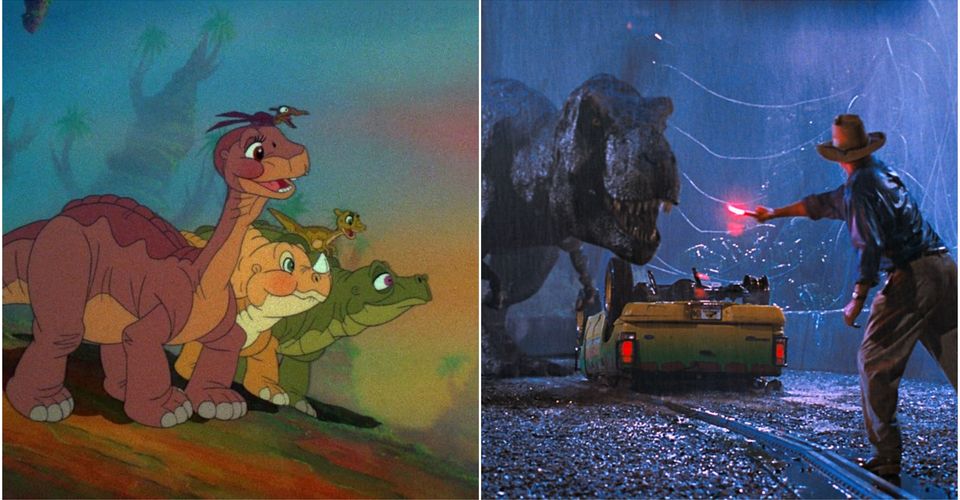
The Land Before Time may have just a 7.4 on IMDb, but it has a 10 in the hearts for many who watched the film as a kid. It got a ton of sequels to the point where Ice Age looks like is has self-control— there are 13 Land Before Time sequels so far. However, the many sequels don't take away from the beauty of the original film.

The film not only showcases many dinosaurs, but it also delves into emotional moments that can get even grown ups to shed a tear.

2 - King Kong (1933) - 7.9

Besides the 2005 version, there is the original King Kong. Its rating is higher on IMDb, despite the limited technology available at the time. This film is a good case study for why bigger and better special effects does not always a better film make. The dinosaurs seen in the original King Kong are some of the first to ever appear on the big screen, so needless to say, audiences were wowed and a love affair with the creatures on film arguably began right here.

1 - Jurassic Park (1993) - 8.1

No surprises here, Jurassic Park remains the gold standard by which all other dinosaur films are judges. It is one of the highest-grossing films of all time. It won three technical awards at the 1994 Oscars including, not surprisingly, Best Visual Effects. In 2018, this film was preserved in the Library of Congress due to its cultural significance. Not bad for a summer blockbuster about dinosaurs.

Source: https://screenrant.com/

1st Of Their Kind Baby Tyrannosaur Fossils Unearthed

Saturday, October 17, 2020

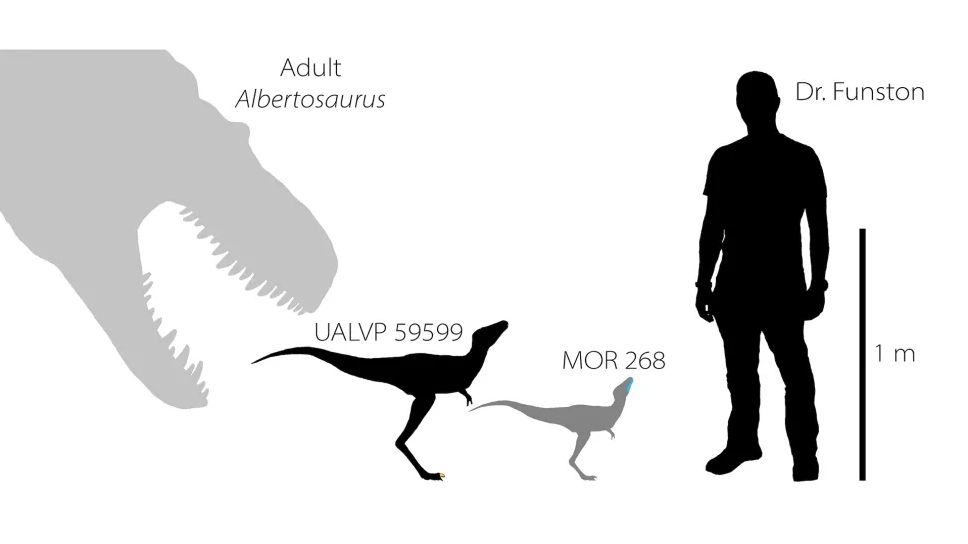
Researchers have found a toe claw (shown in yellow, second from left) and jawbone (shown in blue, third from left) of baby tyrannosaurs that lived between 75 million and 70 million years ago in North America. For scale, here are reconstructions of the tyrannosaur babies compared with an adult Albertosaurus tyrannosaur (left) and lead researcher Gregory Funston. (Image: © Gregory Funston 2020)

Even as babies, tyrannosaurs had a "distinct chin."

A fossil of what may be a tyrannosaur embryo shows that the gigantic apex predator started out with a skull the size of a mouse.

That conclusion came after the study authors found a toe claw from a baby tyrannosaur in Alberta, Canada in 2017 — which prompted them to analyze  a previously known baby tyrannosaur jawbone, found in Montana in 1983. Because the jawbone was too delicate to be removed from the surrounding rock, it had never been properly studied. But now, an analysis of both fossils is revealing all kinds of secrets about these baby beasts.

"These are incredibly rare finds — the first of their kind in the world," lead researcher Gregory Funston, a paleontologist at the University of Edinburgh in Scotland, told Live Science in an email. "Juvenile tyrannosaurs of any kind are exceedingly rare, and we've never found any bones that we suspected might be embryos, until now." 

The research, which is not yet published in a peer-reviewed journal, was presented online Tuesday (Oct. 13) at the Society of Vertebrate Paleontology's annual conference, which is virtual this year due to the COVID-19 pandemic. 

The teensy, 1.1-inch-long (2.9 centimeters) tyrannosaur jawbone still sports eight little teeth. Because it was stuck in the surrounding rock, the researchers scanned the jawbone with a particle accelerator, which let them image the fossil without excavating it. Despite the jawbone's miniature size, "it looks surprisingly like other juvenile tyrannosaurid jaws," Funston said. "It has a deep groove on the inside and a distinct chin, which are both features that distinguish tyrannosaurs from other meat-eating dinosaurs."

These features helped convince other paleontologists that the jawbone truly is from a tyrannosaur — "we can know that these features can be used to identify tyrannosaurs no matter how immature they are," Christopher Griffin, a postdoctoral associate in the Department of Earth & Planetary Sciences at Yale University, who wasn't involved with the research but attended the presentation at the conference, told Live Science.

The teeth on the jawbone aren't fully developed, and one tooth in particular offers clues that this fossil might belong to an embryonic tyrannosaur, meaning the tiny tyrannosaur would have died before it had hatched. 

"In one of the tooth sockets, a replacement tooth is being developed, but in an unusual way: Typically, replacement teeth lie directly below the older tooth, and they eat away at the root to release the older tooth," Funston said. "In our case, the replacement tooth is beside the older tooth, and there's no evidence of root disintegration. This style of replacement has recently been found in the first generation of teeth in reptile embryos."

(The toe-claw fossil might also be from an embryo because one surface wasn't fully formed, Funston noted.) 

Embryonic mysteries

It's a mystery which genus of tyrannosaur these fossils are from, but a few well-known predators from this group include Tyrannosaurus rexGorgosaurus and Albertosaurus. But even without knowing the genus, "finding the remains of extremely young tyrannosaurs is very exciting," said Kat Schroeder, a doctoral student of biology at the University of New Mexico, who wasn't involved with the research but attended the conference presentation. Embryonic fossils are rare, she told Live Science in an email, because "even before they were born, dinosaurs would have been under threat of predation from egg-stealing mammals, and had this baby tyrannosaur hatched, it likely would have had to avoid being eaten by dromaeosaurs (Velociraptor-like dinosaurs), older tyrannosaurs, crocodilians and possibly even giant pterosaurs."

More is known about tyrannosaurs older than 2 years — for instance, for a study published in June in the journal PeerJ, a paleontologist exhaustively analyzed T. rex's growth from tiny tot to hulking adult. Other tyrannosaurs also have extreme growth patterns, "hatching out not much heavier than a house cat, and growing to the size of an elephant over 15 years or so," Schroeder said. 

Funston noted that researchers have yet to find any tyrannosaur eggshells, so perhaps these dinosaur kings laid soft-shelled eggs, which don't fossilize well. This wouldn't be without precedent: Earlier this year, two studies published in the journal Nature offered evidence that the Triceratops-like dinosaur Protoceratops and the long-necked sauropodomorph Mussaurus likely laid soft-shelled eggs, as did the marine reptile Mosasaurus.

"We don't have any direct evidence of these soft-shelled eggs yet, but these clues tell us we should start looking," Funston said.

Originally published on Live Science.

Leptostomia begaaensi: Small Pterosaur from Mid-Cretaceous Period Had Adaptations for Sediment Probing

Friday, October 16, 2020

An artist’s impression of Leptostomia begaaensis. Image credit: Megan Jacobs, University of Portsmouth.

Paleontologists in Morocco have discovered the fossilized remains that belonged to a unique small, long-beaked pterosaur.

The new pterosaur species, named Leptostomia begaaensis, lived between 113 and 94 million years ago (mid-Cretaceous period).

The flying reptile had a very long flattened toothless beak, and was similar in size to a turkey.

It likely used its beak to probe dirt and mud for hidden prey.

“The diets and hunting strategies of pterosaurs were diverse — they likely ate meat, fish and insects. The giant pterosaurs probably ate whatever they wanted,” said co-author Professor David Martill, a paleontologist at the University of Portsmouth.

“Some species hunted food on the wing, others stalked their prey on the ground. Now, the fragments of this remarkable little pterosaur show a lifestyle previously unknown for pterosaurs.”

Leptostomia begaaensis may actually have been a fairly common pterosaur, but it’s so strange — people have probably been finding bits of this beast for years, but we didn’t know what they were until now,” said senior author Dr. Nick Longrich, a paleontologist in the Milner Centre for Evolution at the University of Bath.

The upper and lower jaws of Leptostomia begaaensis were recovered from the Cretaceous-period layers of the Kem Kem Basin in Morocco, North Africa.

Professor Martill, Dr. Longrich and their colleagues used CT scans to reveal an incredible network of internal canals for nerves that helped detect the prey underground.

“We’ve never seen anything like this little pterosaur before,” Professor Martill said.

“The bizarre shape of the beak was so unique, at first the fossils weren’t recognized as a pterosaur.”

The morphology of Leptostomia begaaensis’ beak most closely resembles that of probing birds such as kiwis, ibises, and curlews that probe in mud or earth for invertebrates.

The pterosaur could probably have done either, but its presence in the Kem Kem Formation — representing a rich ecosystem of rivers and estuaries — suggests it was drawn there to feed on aquatic prey.

“You might think of the pterosaur as imitating the strategy used successfully by modern birds, but it was the pterosaur that got there first,” Dr. Longrich said.

“Birds just reinvented what pterosaurs had already done tens of millions of years earlier.”

The team’s paper was published in the journal Cretaceous Research.

_____

Roy E. Smith et al. 2021. A long-billed, possible probe-feeding pterosaur (Pterodactyloidea: ?Azhdarchoidea) from the mid-Cretaceous of Morocco, North Africa. Cretaceous Research 118: 104643; doi: 10.1016/j.cretres.2020.104643

Source: www.sci-news.com/

Dimitri Vegas Joins Jurassic World: Dominion Cast

Friday, October 16, 2020

DJ and music producer Dimitri Vegas is the latest person to join Jurassic World: Dominion's sprawling cast, though his character hasn't been revealed.

DJ and music producer Dimitri Vegas has joined the cast of Jurassic World: Dominion. The third and final installment in the Jurassic World franchise already boasts quite the cast, with numerous performers returning from previous installments. In addition to leading duo Chris Pratt and Bryce Dallas Howard, Dominion will feature the likes of Justice Smith, Omar Sy, Daniella Pineda, and BD Wong. Perhaps most excitingly, Dominion will also bring back the original Jurassic Park trio: Sam Neill, Laura Dern, and Jeff Goldblum. Director Colin Trevorrow has returned to the franchise after helming 2015's Jurassic World, the movie that revived the beloved dinosaur property.

Dominion was originally slated for release in June 2021, but recent delays caused by the coronavirus pandemic led to Universal bumping it a year later to June 2022. Production on the film was first halted in mid-March because of the pandemic; Dominion was later one of the very first films to resume work in July. Unfortunately, however, Dominion's set was shut down again once more just last week, with only three weeks left on the film. It's expected that it will pick back up in the coming weeks.

Vegas, who has also appeared in films such as Rambo: Last Blood and Men in Black: International, announced his Jurassic World casting on social media. "Thrilled to join the cast of @JurassicWorld: Dominion and super grateful to be a small part of the legacy that made my childhood awesome," Vegas wrote. He didn't share who he will be playing, only that this is a "Dream come true." Vegas is one half of the renowned DJ duo Dimitri Vegas & Like Mike.

Vegas is one of the few franchise newcomers boarding Dominion. In addition to him, the film will feature Dichen Lachmen,  Mamoudou Athie, and DeWanda Wise, among others. Their characters are still being kept under wraps, like much of Dominion's plot. It's expected that this installment will pick up from where the previous one, Jurassic World: Fallen Kingdom, left off, as dinosaurs were let loose in the world.

As any good franchise ending should, Dominion is shaping up to be a truly epic event. The concept of dinosaurs running amuck outside of the park is one that hasn't really been explored in the larger Jurassic franchise, and hopefully Dominion will truly make the most of it. The returns of the Jurassic Park stars only serve to make things more exciting, though it'll be interesting to see where all the newcomers fit in. The only sad thing about Dominion is that audiences still have to wait well over a year to see it, but at least what they're hearing now suggests it's a movie that'll be worth the wait.

Source: Dimitri Vegas/Twitter / https://screenrant.com/

12 Most Iconic Moments In Jurassic Park Franchise History

Thursday, October 15, 2020

"Welcome to Jurassic Park"

Jurassic Park is one of the biggest, and most popular movie franchises in the world. Adapted from Michael Crichton's brilliant 1990 novel, the first installment back in 1993 caught the imagination of the entire world, and has since seen four sequels across the next 30 years, with a fifth currently in development.

The world has been mesmerized by the dinosaurs brought to the big screen, a feeling that didn't even subside through the 14 years between Jurassic Park III and Jurassic World. There is just something about these creatures that will seemingly keep drawing audiences in for years to come.

Though none of the sequels have ever since been able to match the masterpiece that was Steven Spielberg's Jurassic Park, that doesn't mean that there haven't been incredible moments in each movie that have since become synonymous with the legendary franchise.

Jurassic World: Dominion is set to complete the Jurassic World trilogy, whilst also bringing back the three main characters of Jurassic Park; Alan Grant, Ellie Sattler, and Ian Malcolm. With the movie being pushed back to June 2022, what better time is there to look back on some of the best moments the franchise has ever had to offer?

12. Leaving The Dinosaurs Behind - Jurassic World: The Fallen Kingdom

For the most part, Jurassic World: Fallen Kingdom was something of a disappointment. The fact that there had been yet another genetically modified hybrid dinosaur created seemed almost lazy after the Indominus Rex of Jurassic World, however the movie was not all bad.

There was one scene that stood out in particular. As the volcano that had threatened the entire island erupted, Grady and co. made it onto the boat to escape, but their relief soon turned to anguish as they looked back to see a single Brachiosaurus left behind.

There has been no shortage of dinosaur deaths throughout the franchise, but this one was harder to watch than any other. As the boat sailed away, the gigantic sauropod was left behind to die, engulfed by the flames and the smoke that almost killed the park's visitors.

This scene was shot spectacularly, as the dinosaur was reduced to a silhouette behind the the veil of deadly smoke. This wasn't just any dinosaur however, this has been confirmed by director J.A. Bayona to be the very same Brachiosaurus that Alan Grant and Ellie Sattler first saw when they landed on Isla Nublar in 1993. This represented our attachment to these dinosaurs, and is one of the most heart breaking scenes throughout any of the five movies.

11. The Long Grass - The Lost World: Jurassic Park

Though the Tyrannosaurus Rex played a big part in the original Jurassic Park movie, it was the Velociraptors that were the biggest threat to Alan Grant and co. on their trip to Isla Nublar. The pack hunters were the subject of Grant's terrifying lecture to the kid who didn't show them enough respect, and were just as fast and vicious as expected in real life.

The creatures took something of a back seat in the sequel, as the T-Rex itself became the biggest threat to those John Hammond and Peter Ludlow had sent to Isla Sorna, but they weren't left out completely.

While fleeing from the Rex after it attacked the camp in the middle of the night, the company fled in any way they could. Some, despite Ajay's pleas not to, ran into the long grass, out of the frying pan and into the fire.

In all the confusion of the Rex attack, everyone forgot about the threat posed by the raptors. This was one of the movie's best, and most terrifying scenes, as the Velociraptors hunted under the cover of the shoulder length grass, picking off several people before the rest even knew they were there.

10. The Dilophosaurus Attack - Jurassic Park

As the group embarked on their official tour of Jurassic Park and its exhibits, the first dinosaur that they were supposed to see was the Dilophosaurus. This would have been a dinosaur of relative obscurity to the audience, and was unfortunately a no show for Alan, Ellie, and the kids.

Thanks to the voice over in the tour car, we knew that such a dinosaur was dangerous and potentially deadly, thanks to its ability to spit venom at its enemies.

It's not until much later that we actually get to see the Dilophosaurus in the flesh. After Dennis Nedry got lost driving through the park in the rain, he was confronted by the creature, and ultimately got the comeuppance he deserved for putting everyone on the island in danger in the first place.

The dinosaur used its venom to perfection, spitting in Nedry's face to blind him, before somehow making it into his car and finishing the job to the sound of screams. This attack was both unique and horrifying, and proved that it wasn't just the big dinosaurs that the visitors had to worry about.

9. "Mommy's Very Angry" - The Lost World: Jurassic Park

Despite hearing stories of the horrors of Jurassic Park from her boyfriend, Sarah Harding traveled to Isla Sorna without even letting Ian Malcolm know. As a paleontologist, she felt that this was an opportunity to learn just too much for her to pass up.

When she first arrived, there was a misconception that the T-Rex was not a particularly maternal creature, and would have abandoned its young at the first opportunity. However, when she and Nick decided to treat a baby Tyrannosaur's broken leg, they found out that this was very wrong.

Malcolm tried to warn them that the infant's mother was on the way, but didn't get there in time, and the following attack was easily the best part of the movie. The two adult T-Rexes coaxed their young from out of the trailer, then began to systematically destroy the vehicle, and push it halfway off a cliff.

Not only did this scene include the stunning visuals of the attack, and of the trailer plummeting around the suspended Sarah, Nick, and Ian, it also saw the death of Eddie. The weapons expert was literally torn in half by the two dinosaurs in what was one of the most horrific deaths in Jurassic history.

8. The Full Park Reveal - Jurassic World

Did we really need another Jurassic Park movie in 2015? Probably not. Jurassic Park III had seen the franchise seemingly limp over the finish line 14 years prior, but nostalgia is a powerful thing, particularly in cinema, and one of the biggest franchises in the world was reborn.

From the very beginning, Jurassic World needed to establish how it would be different from the previous three movies, and almost immediately we were shown how. Whereas Jurassic Park had never truly opened, with several groups finding themselves stranded on the two islands after the initial events, the doors to Jurassic World were truly opened.

As Zach and Gray were let loose, the entire park was revealed like never before - alive and thriving, and full of tourists. This was John Hammond's dream when he purchased Isla Nublar, and it wasn't until all these years later that it finally came true.

From rides, to exhibits, bars and even merchandise stands, Jurassic World was far more advanced than Jurassic Park ever managed to be. On the one hand, we were shocked by how dumb Simon Masrani could be by opening the attractions to the public after all we'd seen, but on the other hand, the completed park was something truly spectacular to behold.

7. The Mosasaurus - Jurassic World

The Jurassic Park franchise had portrayed three different dinosaurs as the major threats throughout its first three movies, the Velociraptors, the Tyrannosaurus Rex, and the Spinosaurus. These were all incredibly dangerous, and killed numerous people, but were all supposed to be trumped by the Indominus Rex.

The half T-Rex, half Velociraptor was unlike anything Isla Nublar or Isla Sorna had ever seen, killed for sport as well as for survival, and simply could not be predicted because it was the very first of its kind. However, there still had to be a way for the dinosaur to ultimately be vanquished.

Enter the leviathan that is the Mosasaurus. Introduced in the movie as part of a show for the tourists, the huge sea creature stunned the audiences at Jurassic World and in cinemas with its pure size, agility, and power. This would all come in to play once again at the very conclusion of the movie.

After the Indominus Rex had run amok across the entire park, killing people and dinosaurs at will, there seemed to be nothing that could stop it, until it was dragged down into the deep by the Mosasaurus. This genuinely came out of nowhere, and made for a shocking end to the dinosaur's rampage.

6. Ian Malcolm's Pose - Jurassic Park

When the power went out and everything started going wrong at Jurassic Park, Ian Malcolm suffered a serious injury. Trapped under the debris of a fallen building thanks to the T-Rex, the chaotician was lucky to be found alive by Ellie Sattler and Robert Muldoon.

While everyone else was either lost out in the park itself, or trying to figure out any way of preventing further catastrophe, Ian was stuck trying to recover from what really should have been a fatal T-Rex attack.

After a while, he felt well enough to prop himself up and join the conversation. Leaning on one elbow, with his shirt undone and a serious look on his face, this was an image that has since become synonymous with both the movie and the character, and has stuck around long in the memory of the fans.

Back in 2018, there was even a 10 feet tall statue erected of the pose in London, celebrating Jurassic Park's 25th anniversary, and Jeff Goldblum himself has recently recreated the iconic image on his Instagram page on the set of Jurassic World: Dominion.

5. When Dinosaurs Ruled The Earth - Jurassic Park

After Ellie is quite miraculously reunited with Alan, Lex, and Tim, they are hunted throughout the Jurassic Park visitors centre by the Velociraptor pack. The huge, museum like room, highlighted by a life size T-Rex skeleton and "When Dinosaurs Ruled The Earth" banner that we had seen earlier in the movie became the stage for its conclusion.

The scene is wonderfully chaotic, as the four visitors are forced to climb on the huge T-Rex bones, and are ultimately scattered each on a different part of the skeleton, before finding themselves surrounded by the most dangerous creatures on the entire island.

In what was nothing short of a miracle, literally a fraction of a second before the raptors sunk their teeth into their prey, they were saved by their old adversary, the T-Rex, who elected to target the pack of smaller dinosaurs rather than the humans.

Though this was something of a deus ex machina that came out of absolutely nowhere, it is one of the most memorable moments from the entire movie, and the wonderful irony of being saved by the same T-Rex that nearly killed them all earlier is certainly not lost on anyone.

4. Owen Training The Raptors - Jurassic World

Though they were made to look something of a joke in Jurassic Park III, John Hammond's Velociraptors were among the deadliest animals throughout the first three movies. The pack hunters communicated with each other, and strategised on how to make their kills, making them absolutely lethal.

In the gap between the end of the Jurassic Park franchise and the beginning of the Jurassic World franchise, Owen Grady was able to actually train and almost domesticate a group of these deadly creatures, so well that they were wanted in the military.

This was something that we never thought would be possible, but seeing the relationship Owen had with them, in particular Blue, and how he saved the park worker who fell in the enclosure with them, was amazing. Immediately, Chris Pratt's character confirmed his status as an ultimate badass, and protagonist worthy of continuing the Jurassic franchise.

Not only was he able to act as their alpha, Owen was able to utilise their hunting abilities, using them to track the Indominus Rex. Human tracking through the jungle side by side with dinosaur has been one of the highlights of the Jurassic World franchise so far.

3. "Life... Uh... Finds A Way" - Jurassic Park

After a worker at Jurassic Park was attacked by one of the dinosaurs, John Hammond needed the signatures of a couple of experts to sign off on the stability of the island. The owner of InGen brought along Alan Grant and Ellie Sattler, while his lawyer brought the rock star chaotician, Ian Malcolm.

From the very beginning, Malcolm doubted the park, and was never shy about giving his opinion. Though he found time to take constant jabs at Hammond and his latest venture, he didn't get a chance to fully articulate his thoughts until after they saw the birth of the baby Velociraptor.

This was the first time the character truly took centre stage in the movie, and the monologue was simply captivating. Jeff Goldblum portrayed Ian Malcolm wonderfully, lending the character a certain authority when speaking, with his speech about life not being contained being one of the best examples of this.

We could listen to Ian Malcolm talk about literally anything, and he was ultimately correct. Life found a way, as he foretold in what is one of the franchise's most notable, most well known quotes.

2. The T-Rex Attack - Jurassic Park

Before the Tyrannosaurus Rex inadvertently saved the lives of Grant and co. from the raptors, her attack on the two tour cars almost killed everyone involved. The power went from the park just as the group were stuck outside the T-Rex paddock, giving her something to hunt.

Donald Gennaro bit the dust while sitting on the toilet after abandoning the kids in the first car, Tim found himself stuck in a tree, and Ian Malcolm suffered the brutal attack that saw him crushed under building debris. This was the first calamity for the visitors of Jurassic Park.

From the vibrating cups of water, to the carcass of the goat landing on the roof of the car, and Alan and Ian trying to get the dinosaur away from the kids with a flare, the entire scene was both captivating and incredibly tense. We simply couldn't look away.

The Tyrannosaurus Rex was hinted at when the group first arrived at the park, but this was our proper introduction to the greatest predator in the history of the world, and it lived up to every expectation possible.

1. The Brachiosaurus Is Revealed - Jurassic Park

Not only is this the most iconic moment from any of the five Jurassic movies, it is one of the most iconic moments in cinema history. An island full of dinosaurs is something truly terrifying, but there is a certain wonderment about seeing these creatures brought back to life.

In the build up to seeing the island for the first time, naturally the excitement surrounded the likes of the T-Rex, and the Velociraptors, but it was the humble Brachiosaurus that welcomed us to the world of Jurassic Park.

When Dr. Grant and Dr. Sattler see the majestic sauropod for the first time in the flesh, it is something truly moving. At the time in 1993, this was simply groundbreaking in terms of special effects, and still holds up to this day almost 30 years later.

Using the Brachiosaurus as the first dinosaur was a fantastic decision, as it showed exactly what John Hammond had in mind for his park, transporting everyone watching back to childhood, as it's the closest we'll ever get to the real thing. To the backdrop of one of the most recognisable scores John Williams has ever put together, this moment never, ever gets old.

Source: https://whatculture.com/

Dinosaur Fossil Sells For 10 Times What Jurassic World 2 Imagined

Thursday, October 15, 2020

Jurassic World: Fallen Kingdom's famous dinosaur auction undervalued the creatures, considering how much money a T-Rex fossil recently fetched.

The auction in Jurassic World: Fallen Kingdom imagined the prices of living dinosaurs, but it turns out the movie didn't get it quite right. As a follow up to the Jurassic Park franchise, the Jurassic World films have introduced a new set of fans to the beloved world. The third and final film in the new trilogy, Jurassic World: Dominion, is currently set to release in June 2022. It will again feature Chris Pratt and Bryce Dallas Howard but also bring back familiar faces from the original films. These include Laura Dern as Dr. Ellie Sattler and Sam Neill as Dr. Alan Grant. Though the movie has only three weeks of shooting left, filming is currently shut down due to positive coronavirus tests on set.

While looking ahead to the release of Jurassic World: Dominion, it makes sense to consider the movies that came before it. This is especially true considering the upcoming film will wrap up the new trilogy. One part of Jurassic World: Fallen Kingdom showed people betting in a dinosaur auction. When the movie was released to theaters, many took issue with the relatively low price of the dinosaurs, especially considering they were living creatures. Some compared the costs to fossils being sold today, which would likely have less value.

Now, the auction in Jurassic World: Fallen Kingdom is back in the spotlight thanks to the sale of "one of the most complete" T-Rex fossils currently known. Per Insta Science, the fossil went for $31.8 million, making it significantly more expensive than the dinosaurs at the auction in Jurassic World: Fallen Kingdom.

Though the Jurassic Park and Jurassic World movies are far from realistic, what makes them so enjoyable is imagining a world where dinosaurs still roam. To make this feeling as believable as possible, the films need to be as realistic as they can be within the world they've created. It's understandable viewers are still quick to call out the auction scene, especially with this new real-life fossil comparison available. The recent sale probably won't matter to some fans but gives those already frustrated by the auction in Jurassic World: Fallen Kingdom a little more evidence.

Sci-fi and fantasy movies have always had a fine line to walk, and this news illustrates that. Audiences are looking for an escape, of course. However, part of what makes those genres so popular is their ability to find moments viewers can relate to their own experience or world. Otherwise, audiences are taken out of the movie, causing them to question scenes like this one in Jurassic World: Fallen Kingdom.

Source: Insta Science / https://screenrant.com/

Meet Skybalonyx skapter, The Newest Prehistoric Reptile To Be Found In Arizona

Wednesday, October 14, 2020

The new species of drepanosaur, Skybalonyx skapter, emerging from a burrow in the Late Triassic at Petrified Forest. Art by Midiaou Diallo

A new species of prehistoric reptile has apparently been discovered within the depths of the Petrified Forest National Park in northeastern Arizona.

Named "Skybalonyx skapter," the fossilized remains are believed to be a new species of drepanosaur, a reported 220-million-year-old burrowing reptile that potentially looked like a combination of an anteater and chameleon, the Petrified Forest National Park said in a news release.

Skybalonyx skapter, though, may have looked even more peculiar, the release said.

Drepanosaurs have been noted to have interesting features, such as "enlarged second claws, bird-like beaks, and tails ending with a claw," the release said.

The discovery was made by research teams from Petrified Forest National Park, Virginia Tech, University of Washington, Arizona State University, Idaho State University, and the Virginia Museum of Natural History, according to the release.

Their findings were reportedly published on Oct. 8 in the Journal of Vertebrate Paleontology. The study compared the claws of drepanosaurs to Skybalonyx skapter to modern animals, and reportedly found that Skybaonyx skapter's claws were similar to moles, echidnas, and mole-rats.

Adam Marsh, the lead paleontologist at the Petrified Forest, said in an email that the bones were discovered during the summers of 2018 and 2019 as part of a paleontological dig.

Due to their small size, the remains were reportedly difficult to find using traditional methods. Essentially, research teams used a series of metal screens and water to sift and break down rocks to find the fossils.

He said the bones were found in the eastern expansion of the forest that was acquired in 2011. He said more than 3,000 fossils have been discovered there in the last two years.

As for the drepanosaurs project, he said "we are just starting this project, and we will be continuing to collect fossils from this and other sites."

Source: www.abc15.com/

Pages