nandi's blog

Jurassic World 3 Returning To Site B Can Properly End The Franchise

Thursday, October 22, 2020

Jurassic World: Dominion's return to Site B could end the franchise perfectly and wrap up loose ends of both the original and rebooted trilogies.

Jurassic World: Dominion looks set to return to Site B, and this could be the perfect way to end the franchise as it wraps up the loose ends of both Jurassic World and Jurassic Park trilogies. Set for a 2021 release, Jurassic World: Dominion sees Safety Not Guaranteed director Colin Trevorrow return to helm the final installment of the rebooted Jurassic Park series.

Despite wrapping up the original Jurassic Park story, the second Jurassic’s World installment Fallen Kingdom left some serious plot holes in its wake after the original setting Isla Nublar was permanently destroyed by a volcano. Site B, the setting of The Lost World last seen in Jurassic Park III, could provide a home for the dinos currently on the loose in human habitats and a fitting ending for the franchise. Also known as Isla Sorna, Site B is the secondary island setting of the series.

Jurassic World: Dominion could wrap up the Jurassic World series perfectly by using Isla Sorna as a safe haven for the now-free dinosaurs. According to an onset photo from Trevorrow, the film will feature scenes set on Site B but it’s not yet known how much of the action will take place on the Five Deaths archipelago. The island was originally home to InGen’s dinosaur-cloning factory, but by the time Jurassic Park III took place the island was reclaimed by dinosaurs and monitored by the Costa Rican government. That may not have deterred thrill-seekers but Fallen Kingdom's ending looks like it left the in-universe public’s appetite for dinosaurs permanently sated, so the island could be put to perfect use by the final film in the series, and the Jurassic Park franchise would wrap up a lot of loose ends in the process.

The franchise-changing ending of Fallen Kingdom left dinosaurs rampaging through human-inhabited areas, meaning the creatures will need another safe home (or a new environment removed from humanity at least). This time, though, adrenaline junkies will be less likely to track them down to Isla Sorna since they’re presumably now relieved to be rid of them. That, in itself, is a necessary part of the arc, because humans seeking to remove themselves from the dinosaur's existence brings a full-stop to the cycle and sidesteps the warnings of the first Jurassic Park that humans and dinosaurs simply cannot co-exist.

In Jurassic World: Dominion, the dinosaurs that Fallen Kingdom carelessly left roaming around the human world could be safely taken to Isla Sorna as viewers already know the island has been a safe home to them earlier in the series. There, they could be left to their own devices, allowing the creatures to exist in harmony without human interference. Seeing the human and dinosaur worlds interacting is one of the biggest appeals of Jurassic World: Dominion, and giving the island back to the dinosaurs feels like the most fitting end for the series (as well as the only option which doesn't result in dinosaurs or people dying out). It's a satisfying full-circle wrap up for the Frankenstein-style dinosaurs, monsters that never asked to be created and which were always somewhat tragic villains, stuck in a cage and put on display for the public.

This ending would tie together the speech given by Jeff Goldblum’s Dr. Ian Malcolm in the original film and the one he offered in his Fallen Kingdom cameo, as this would restore the dinosaurs to natural peace after InGen’s genetic meddling caused chaos which then inevitably begat further chaos. To wrap up the new Jurassic World trilogy properly, the third film needs to show the consequences of their irresponsibility by underlining that the dinosaurs aren’t a threat when left to themselves, and instead it's human hubris that drives them to violence. The original Jurassic Park series began with an amoral corporation using Isla Sorna to clone dinosaurs and the film’s heroes trying to clean up their mess, so rehoming the dinosaurs in the site of their creation is the perfect way for Jurassic World: Dominion to leave the characters of the series (both human and otherwise) at peace. At least, until the next reboot trilogy.

Source: https://screenrant.com/

We Finally Know What a Dinosaur’s Butthole Looks Like

Thursday, October 22, 2020

Photo illustration by Slate. Photo by Robert Nicholls/Wikipedia.

What a new fossil tells us about dinosaurs, paleontology, and us.

For the entirety of my career as a journalist covering paleontology, I’ve been wanting to know: What does a dinosaur’s butthole look like? When I wrote My Beloved Brontosaurus, a book about dinosaur biology, the chapter on reproduction required a lot of time imagining the nature of a Jurassic behind; one had yet to be found preserved. Even dinosaur models and sculptures often demur on the point of the dino butt, leaving the terrible lizards with terrible constipation.

Now I finally have a clearer view, thanks to a fossil of a horned dinosaur called Psittacosaurusdescribed in a paper online earlier this month. These dinosaurs, which lived over 100 million years ago in what’s now northeastern China, were odd little creatures. While belonging to the same branch of the dinosaur family tree as Triceratops, these Labrador retriever–size dinos walked around on two legs and had beaks like those of parrots, cheeks that were each adorned with a flared horn, and, jutting from the tail, a spray of featherlike bristles. Now we also know that they had buttholes like those of crocodiles.

It’s rare to get a look at something soft and fleshy on a dinosaur. We know most of what we know about Psittacosaurus the same way that we know things about most dinosaurs: from their bones. Durable skeletal parts are much more likely than skin and organs to survive the fossilization process, which involves burial and at least partial replacement of the original tissues. Most of the time, after a dinosaur dies, all the soft stuff just decays. But every now and then paleontologists find dinosaur “mummies” that preserve remnants of the soft bits either as impressions or geologically modified pieces of the original flesh. There’s no one way to make an exquisitely preserved dinosaur: Sometimes it happens when a dinosaur is quickly buried in ash; others dry out in the open for a while. For whatever reason, experts have uncovered several Psittacosaurus with preserved soft tissues. The fossilization in some of these specimens is so refined that we even know what colors these dinosaurs were, brown on top and lighter along the belly. The new fossil is one of the more detailed ones. It includes patches of skin and scales as well as the ornamental bristles on the tail. The most remarkable part is a patch of tissue between the hips and the base of the tail—aka a butt.

The actual description of the butthole, which appears in a paper that hasn’t yet been peer-reviewed, makes me have sympathy for a dinosaur that probably didn’t expect to have its posterior formally presented in the technical literature over 100 million years after its death. On the fossil, just below the tail, the butthole appears as a “blackish mottled ovoid area,” the paleontologists write (the image is on Page 4 of the PDF, found at this link). To the naked eye, the spot looks like a series of dark, stacked bands running between the base of the tail and hip bones, clearly different from the skin around it.

What those bands mean, the paper tells us, is that Psittacosaurus had a downstairs setup known as a cloaca. This is pretty different from our own mammalian plumbing. While we all know the old joke about “a playground next to a sewage system” in reference to the locations of our own sex organs and waste exits, we’ve got nothing to complain about compared with animals that have a cloaca. This orifice—its very name meaning “sewer”—is the only opening for the reproductive, urinary, and excretory systems. Something to keep in mind if books like Taken by the T-Rex are your jam.

By itself, evidence that non-avian dinosaurs had cloacae isn’t a huge shocker. While it’s possible that future peer review might interpret the fossil differently, the placement, color, and wrinkly texture of the tissue all seem to line up with what experts have long expected a dino butt to look like. Living dinosaurs—birds!—have cloacae, after all. Bird cloacae are round or square and normally covered up by feathers, unless you’ve ever seen an ostrich evacuate and wondered what the hell you’re looking at. Crocodiles and alligators, which are the closest living cousins of dinosaurs, have cloacae that are horizontal slits. According to a form of logic called extant phylogenetic bracketing, the fact that both birds and crocs have cloacae hints that the trait goes back to the last common ancestor of both groups—a creature called an archosaur that likely would have resembled a crocodile crossed with a greyhound—and would be present in the extinct animals that fall within those goalposts. A dinosaur butt, we’ve long known, should look something like a bird butt or a croc butt.

An educated guess is great, but firm evidence is better. Having a fossilized dinosaur cloaca actually available for study is like finally getting the pony you were always begging for on your birthday. The entire end goal of paleontology is to envision organisms as they were in their heyday. That involves drawing from what we know about modern animals and comparing that to the information we have so far on extinct dinosaurs and dinosaur relatives, generating cartloads of hypotheses about what a particular feature on a dinosaur might have looked like, and then testing them against what we are lucky enough to find preserved in the ground. This new fossil tells us that not only were we probably right about dinosaurs having cloacae, but that this species had cloacae that resembled those of crocodiles in particular. Though the drainpipes stashed behind the cloaca itself were not preserved—the penis in this setup, just so you can picture it, extends out of the butthole during mating—this fossil helps us imagine that dinosaurs might have had croclike genitalia, too. In crocodiles the female’s clitoris is so large and pronounced that the pink, tapering organs can easily be confused for the male’s penis.

Finding genitalia would go a long way toward filling in some dinosaur mysteries. Paleontologists are still perplexed by how dinosaurs mated with those big, thick tails in the way. Did they have to contort into difficult positions to align their butts, or did males have the necessary equipment to bridge the gap? Likewise, knowing more about the other tubes could make sense of the various splats dinosaurs left behind. Paleontologists have reported urolites, or pee fossils, from a few places, as well as hundreds upon hundreds of coprolites, aka poop fossils. One such fossil—a bone-filled pat attributed to T. rex—seems to have moved through the digestive system quickly. Having a fossilized excretory tract to study might help explain if a morsel’s rapid trip from mouth to cloaca was normal, or if the tyrant king was dealing with some dino-diarrhea. I’m having fun here, but even just a little more information about these organs could help experts better understand the physiology of creatures that lived a long, long time ago.

This is the reason I’ve been sharing Figure 1 of the paper, where the cloaca appears, with everyone I know: not just because of the information it presents, or the fact that it’s cheeky. The dinosaur butthole is a testament to how wonderful the sheer luck of fossilization can be, and how there’s so much more detail about dinosaur bodies that could be out there. For all the CGI renderings, toys, and even erotic imaginings of dinosaurs, so much of their basic biology—from body temperature to differences between dinosaur sexes and even what sounds they made—remains unknown. Every year, there seems to be another example of a one-of-a-kind fossil that gives us that much more information about dinosaur lives. Even familiar species can surprise, whether we’re talking about a fleshy little beanie on the head of Edmontosaurus, signs of parasitic infection in Tyrannosaurus, or, now, a Psittacosaurus booty. Surely we’re nowhere near the tail end of dinosaur discoveries.

Source: https://slate.com/

Profanity Filter Censors the Word 'Bone' at Paleontology Conference

Thursday, October 22, 2020

Image courtesy Jon Butterworth on Unsplash.

“Most funny to us was the censorship of ‘bone,’ which, after all, are the main thing we work with."

Per the recent usual, the Society of Vertebrate Paleontology conference was held online this year. The 80th annual gathering of fossil and bone enthusiasts used a virtual platform, provided by Convey Services, that came with a pre-packaged naughty-word-filter. While the filter was surely good-intentioned, it had unintended consequences.

Thomas R. Holtz Jr., a Tyrannosaurus rex expert at the University of Maryland, typed out “Hell Creek Formation” to answer a colleague’s question. Holtz’s message appeared in the chat, but read instead as “**** Creek Formation.”

Holtz and others came together on Twitter to suss out all the banned words they could find. There were the usual suspects—your four-letter obscenities—but there were tons of words that paleontologists use all the time that have an uncouth slang meaning.

“Most funny to us was the censorship of ‘bone,’ which, after all, are the main thing we work with,” said Holtz.

Other banned words included ball, beaver, crack, dyke, enlargement, erection, jerk, knob, pubis, stream, stroke, and wang.  

“Words like ‘bone,’ ‘pubic’, and ‘stream’ are frankly ridiculous to ban in a field where we regularly find pubic bones in streams,” said Brigid Christison, a masters' student in biology at Carleton University.

Stephanie Drumheller, a paleontologist at the University of Tennessee, described how the problem began to be fixed in a Reddit thread.

“After getting a good belly laugh out of the way on the first day and some creative wording (my personal favorite was Heck Creek for Hell Creek), some of us reached out to the business office and they've been un-banning words as we stumble across them," said Drumheller. "It takes a little time to filter from Twitter to the platform programmers, but it's getting fixed slowly.”

Unintended Bias

Z. Jack Tseng, an assistant professor of integrative biology at UC Berkeley and an assistant curator at the University of California Museum of Paleontology, noticed something particularly egregious about the profanity filter:

“At first, when fellow conference attendees noted on Twitter that ‘Hell’ and ‘bone’ were banned, I was very amused by it. I figured the filter was simply over-tuned to prevent many slang words used by schoolchildren from being shown in a professional meeting. I became disturbed when I saw that the crowd-sourced list of banned words included ‘Wang'. I personally know of several vertebrate paleontologists by that surname. It didn't seem right, so I typed in other synonymous slangs into the Q&A platform and realized the bias that I tweeted about.”

Have you had a worse virtual conference experience? Would you appreciate a profanity filter for your online engagements, or does it cause more harm than good? Leave a comment and let us know!

In the meantime, please bear with us while we offer one more Friends reference. Obviously, this whole situation required some pivoting on the part of the paleontologists ... Sounds like they pivoted better than Ross did!

Source: https://ourcommunitynow.com/

Brazilian Paleontologists Find ‘Zombie Dino’

Wednesday, October 21, 2020

Those who watched the animated series Primal must remember the episode “Plague of Madness” – even historically and palentogically incorrect, she was right about one thing: “zombie dinos” existed, and the discovery came from three Brazilian researchers.

Authors of the work published on the last 15th in the scientific journal Cretaceous Research, the three scientists from the federal universities of Rio Grande do Norte (UFRN) and São Carlos (UFSCar) and more from the State University of Campinas (Unicamp) discovered, by the bones of a titanosaur, that he suffered from an extremely painful acute bone infection and that attacks both animals and humans, called acute osteomyelitis.

The finding of paleobiologist Aline Ghilardi, co-author of the study, started from the bones with “spongy lumps” that she studied for her postdoctoral research. She and paleontologist Tito Aureliano, the study’s lead author, examined the 80 million-year-old fossils using a tomography and found the disease.

The research’s originality rests on the next step: paleontologist Fresia Ricardi-Branco, now part of the research group, performed a biopsy on the fossilized tissue, finding a microfossil within the vascular channels of the dinosaur bone. Aureliano, in the light of this discovery, found more than ten fossilized microorganisms.

Zombie Dino

“When we discovered that there was a parasite inside the bones of the dinosaur, we were nervous: we do not believe that they had ever done a biopsy on a fossilized bone,” Aureliano told the G1 portal. The researchers, however, do not know whether the parasites caused osteomyelitis or whether they arose because of the disease. A colony of bacteria was also found in the fossil.

For the paleontologist, “Titanosaurus felt a lot of pain until he died. He was rotting alive. The stage of the disease was so advanced that we call this specimen ‘Dino Zumbi’ “. According to him, if a parallel is made of how the disease evolves today, the animal should have open wounds expelling pus through the legs, head and trunk.

Source: www.somagnews.com/

New Research Provides Comprehensive Reconstruction of End-Permian Mass Extinction

Wednesday, October 21, 2020

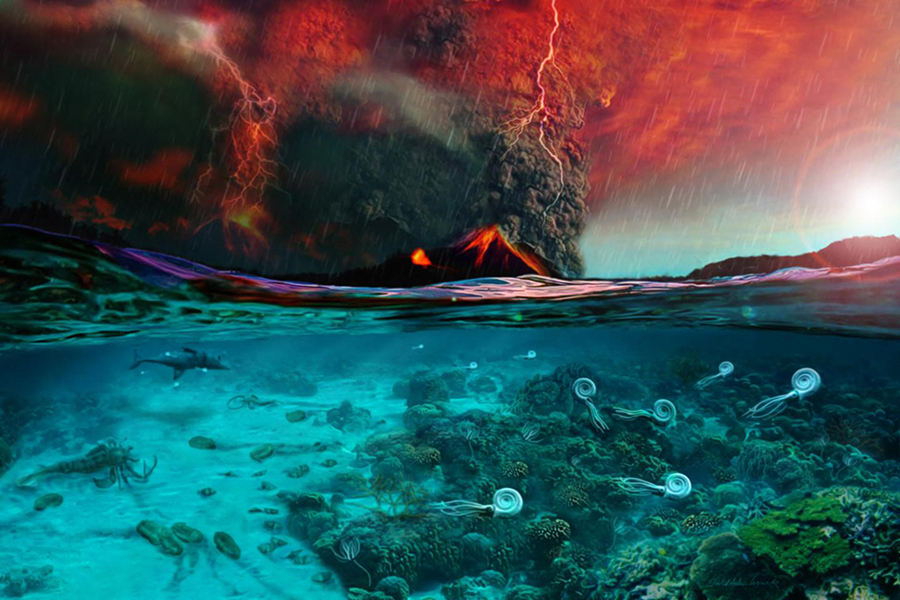
An illustration depicting the onset of the end-Permian mass extinction. Image credit: Dawid Adam Iurino / PaleoFactory, Sapienza University of Rome / Jurikova et al, doi: 10.1038/s41561-020-00646-4.

The end-Permian mass extinction, also known as the Permian-Triassic extinction event and the Great Dying, is the largest mass extinction event in Earth’s history that peaked about 252.3 million years ago. The catastrophe killed off nearly 96% of all marine species and 70% of terrestrial vertebrate species on the planet over the course of thousands of years. Massive eruptions in a volcanic system called the Siberian Traps are thought to have played an important role, but the causational trigger and its feedbacks are yet to be fully understood. Now, a research team led by Dr. Hana Jurikova from the GEOMAR Helmholtz-Zentrum für Ozeanforschung Kiel and the Helmholtz Zentrum Potsdam has assembled a consistent biogeochemical reconstruction of the mechanisms that resulted in the end-Permian extinction.

Dr. Jurikova and her colleagues studied isotopes of the element boron in the calcareous shells of fossil brachiopods and determined the rate of ocean acidification over the Permian-Triassic boundary.

“These are clam-like organisms that have existed on Earth for more than 500 million years,” Dr. Jurikova said.

“We were able to use well-preserved brachiopod fossils from the Southern Alps for our analyses.”

“These shells were deposited at the bottom of the shallow shelf seas of the Tethys Ocean 252 million years ago and recorded the environmental conditions shortly before and at the beginning of extinction.”

Because the ocean pH and atmospheric carbon dioxide are closely coupled, the researchers were able to reconstruct changes in atmospheric carbon dioxide at the onset of the extinction from boron and carbon isotopes.

They then used an innovative geochemical model to study the impact of the carbon dioxide injection on the environment.

“With this technique, we can not only reconstruct the evolution of the atmospheric carbon dioxide concentrations, but also clearly trace it back to volcanic activity,” said co-author Dr. Marcus Gutjahr, a researcher at the GEOMAR Helmholtz-Zentrum für Ozeanforschung Kiel.

“The dissolution of methane hydrates, which had been suggested as a potential further cause, is highly unlikely based on our data.”

“Without these new techniques it would be difficult to reconstruct environmental processes more than 250 million years ago in the same level of detail as we have done now,” said co-author Professor Anton Eisenhauer, also from the GEOMAR Helmholtz-Zentrum für Ozeanforschung Kiel.

The team’s findings showed that volcanic eruptions in Siberian Traps released immense amounts of carbon dioxide into the atmosphere.

This release lasted several millennia and led to a strong greenhouse effect on the late Permian world, causing extreme warming and acidification of the ocean.

Dramatic changes in chemical weathering on land altered productivity and nutrient cycling in the ocean, and ultimately led to vast de-oxygenation of the ocean.

The resulting multiple environmental stressors combined to wipe out a wide variety of animal and plant groups.

“We are dealing with a cascading catastrophe in which the rise of carbon dioxide in the atmosphere set off a chain of events that successively extinguished almost all life in the seas,” Dr. Jurikova said.

“Ancient volcanic eruptions of this kind are not directly comparable to anthropogenic carbon emissions, and in fact all modern fossil fuel reserves are far too insufficient to release as much carbon dioxide over hundreds of years, let alone thousands of years as was released 252 million years ago.”

“But it is astonishing that humanity’s carbon dioxide emission rate is currently 14 times higher than the annual emission rate at the time that marked the greatest biological catastrophe in Earth’s history.”

The study was published in the journal Nature Geoscience.

_____

H. Jurikova et al. Permian-Triassic mass extinction pulses driven by major marine carbon cycle perturbations. Nat. Geosci, published online October 19, 2020; doi: 10.1038/s41561-020-00646-4

Source: www.sci-news.com/

Video Game Preview – Jurassic World Evolution: Complete Edition on Nintendo Switch

Tuesday, October 20, 2020

Jurassic World Evolution: Complete Edition is the latest video game to “hatch” from the Jurassic Park series of films. This time around we’re tasked with creating our own version of Jurassic World and dealing with all the fun (and occasional chaos) that comes with it. Jurassic World Evolution: Complete Edition is coming to the Nintendo Switch eShop on 3rd November and I’ve been lucky enough to preview the game before its release.

In the current gaming climate its not unfamiliar for a game to launch with a subtitle such as “definitive” or “enhanced”. Occasionally it can be difficult to spot what exactly is “definitive” or “enhanced” about the title, however Jurassic World Evolution: Complete Edition changes this and it does exactly as its name suggests.

The Complete Edition brings the 2018 base game, every DLC pack, update and patch all together in one complete package to Nintendo’s Switch console. As Switch ports go Jurassic World Evolution: Complete Edition is pretty close to the console versions and even with the limitations of the Switch’s hardware, Frontier has done a pretty good job of translating the game to the hybrid console.

Playing the main campaign is a clear indication that maintaining the full park building experience was one of Frontier’s top priorities. My time in the main campaign was a smooth experience and the Switch handled it pretty well. Playing in both docked and handheld modes works exceptionally well and the game looks just as good in both modes. Considering the console’s hardware limitations when compared to the Xbox One and PlayStation 4 then this is a pretty big deal. Obviously there are some graphical differences and we’re not getting the highest level of detail or the crispest foliage or even a locked frame rate. There were also times when distant trees and shadows fade into view when panning around the islands terrain but considering the nature of the game and the scale of the island itself then this is a very minor issue, even if you could call it that.

Dinosaurs are the main attraction of the game and each one I bred looked just as good as their console ‘sisters’. The game features dinosaurs from across the entire film franchise and are faithfully reproduced for you to unleash into your parks. Even the newer hybrids such as the Indoraptor and the Indominus Rex are available for you to create. When playing the Return to Jurassic Park DLC you are treated to a slight change in dinosaur behaviour which Frontier have faithfully reproduced from the way the dinosaurs behaved back in 1993. Its small details like this that made my inner child geek out in delight. This impressive attention to detail also extends to the various buildings and facilities that we can place around our park.

Guest satisfaction is the main objective throughout both the main campaign and optionally in the sandbox mode. To achieve this goal we are tasked with building the appropriate amenities for our guests to enjoy, as well as maintaining dinosaur variety and their overall health. We also have to deal with various other crises as they occur such as tropical storms, facility sabotage, sick dinosaurs and breakouts. Your ability in maintaining your guests satisfaction and dinosaur welfare is reflected in your parks overall rating. Creating a well performing Jurassic World park is your ticket to the next island and the wealth of challenges that come with it.

The attention to detail will excite any fan of the film franchise. As I mentioned earlier, the complete edition comes with the expansion packs (Return to Jurassic ParkClaire’s Sanctuary and Secrets of Dr. Wu). We also get four dinosaur packs and a Raptor team texture pack thrown into the experience as well. If you simply want to build the best dinosaur theme park without any of the hassle then the Sandbox mode has you covered. Taking place on a empty Isla Nublar, Sandbox is a fully customisable experience. We have the ability to turn off threats, the day/night cycle and a wealth of other options to then simply create the park in anyway we see fit. It’s a great way to test out the options available and given a little creativity you can create a truly stunning piece of art with the parks layout.

One of the main draws to the Nintendo Switch is its touchscreen, but sadly there is no implementation of it within this game. I would imagine this is due to the shear amount of behind the scenes work required to implement such options. User Interface and text scaling between docked and hand held mode isn’t in play either but its only really noticeable if you really look hard. Onscreen text however can be a little hard to read when playing in hand held mode but considering most of its voiced then its not a major concern.

Speaking of voice acting, the majority of the movie’s cast reprise their roles for the game. The only omissions are Chris Pratt and Richard Attenborough, with both Owen Grady and John Hammond being portrayed by sound-a-likes. Throughout the main campaign we get the silky smooth voice of Jeff Goldblum talking about chaos theory and his famous “life finds a way” sneaks its way in. John Williams’ famous score also makes a return and is just as epic sounding on the Switch as it is at the cinema. Everything from the vehicles, architecture and atmosphere is expertly captured from the movies and is a real treat for fans awaiting the sixth film.

Overall Jurassic World Evolution: Complete Edition translates to the Nintendo Switch extremely well. Everything is here from the console edition and more. With the addition of three expansion packs and even more dinosaurs, the world of Jurassic Park/World is truly at your finger tips.

Jurassic World Evolution: Complete Edition launches on Nintendo Switch 3/11/2020 and will be exclusive to the Nintendo eShop.

Source: www.flickeringmyth.com/

If We Could Resurrect Dinosaurs Using Gene Editing, Could They Survive With Our Current Plants And Climate?

Wednesday, October 21, 2020

Credit: Netflix
 

Jurassic Park makes a big deal out of how it brought dinosaurs back to life after millions of years of extinction. However, while that bit of fantasy science is obviously incredible, it's only the first step in maintaining a dinosaur zoo.

The Jurassic Park franchise, including spin-offs like Netflix's new Jurassic World: Camp Cretaceous series, makes it clear that operating a dinosaur theme park is tricky, but keeping your revived dinosaurs from eating the guests isn't the only thing you've got to worry about. You've got to keep those prehistorical animals alive in modern times — and that would be harder than you might expect.

LIFE AFTER BIRTH

The first and most ambitious hurdle to returning living dinosaurs to Earth is, of course, reconstructing their DNA. At current, that’s a scientific impossibility. DNA just doesn’t last that long. The oldest DNA from a fossil record is about a million years old. That’s impressive, to be sure, but it’s a long way off from the 65 million years we’d have to traverse to get to even the most recent of Cretaceous dinosaurs. Not to mention the even larger historical distances we’d need to travel in order to find the Jurassic period dinos that lend the franchise its name.

Let’s assume, though, for the sake of argument, that we figure it out. Tucked away inside a lab on a remote island, scientists have quietly grown baby dinosaurs. Now the second and more longstanding problem begins: how to keep them alive and happy.

Surely, once we’ve gone out of our way to return a disappeared species to the face of the earth, we have some obligation to protect and care for those animals. Trouble is, doing so might be beyond our capabilities.

FINDING FOOD

This wouldn’t be as much of a concern for the carnivorous dinosaurs who are responsible for most of the action in the Jurassic Park films, as well as the recently released Camp Cretaceous. For the most part, meat is meat, and it’s likely the raptors, carnotaurus, T. rexes, and other predators would be perfectly happy chowing down on cows, sheep, or whatever we threw their way. The herbivores, however, would have a much harder time in their search for food.

The main issue is the drastic ways Earth's ecosystem has changed over the past 100 million years. Plant life in the Mesozoic era differed quite a bit from what’s available today. That isn’t to say that sauropods (we’ll use them as an example because of their large size and because they’re cool) wouldn’t be able to find something to eat in the modern world, but they’d have a harder time of it.

For one thing, the evidence suggests there was just more plant life to go around during the dinosaur age. Scientists believe the distant past was extra lush because of higher CO2 levels that allowed plants to trap more energy. It’s this abundance of vegetative food sources that is thought to be one of the primary causes for sauropods’ incredible size.

While it’s difficult to know precisely what sauropod diets were like, it’s believed they were fond of conifers, which aren’t endemic to the fictional Jurassic Park's location in Costa Rica or, presumably, its fictional outlying islands like Isla Nublar.

It’s true that there is plenty of vegetation to go around in Earth’s modern tropical regions, but what’s less clear is whether sauropods would recognize much of it as food. And considering the massive intake of nutrients needed to sustain an animal of that size, let alone an entire population, they might just starve to death, surrounded by food.

THIN AIR

A side effect of the mass proliferation of plant life around the globe was a marked increase in atmospheric oxygen. Some estimates indicate oxygen levels might have been upward of 35 percent of what they are now during parts of the Mesozoic.

All of that extra oxygen filled in the atmosphere to a point that the air was quite literally thicker than it is today. The higher oxygen levels and thicker atmosphere may have contributed to the gigantism of some species, particularly large flying insects that took advantage of the atmospheric conditions to grow larger than they could in the modern day.

Our current atmosphere has an average oxygen level of 21 percent, amounting to a dropoff of almost half since that high mark a few hundred million years ago. For comparison, it’s about the same difference as the amount of oxygen available at Everest base camp compared to the amount of oxygen in the air at sea level.

All of which is to say, your roaming theme park sauropods might be able to breathe today’s air, but it won’t be pleasant, and it might not be sustainable for long periods of time. The life of a modern-day dinosaur could be one of cramped quarters, even if it was allowed to roam freely over an entire island. Large dinosaurs would likely struggle to find food, and they would be consistently short of breath.

Bringing dinosaurs back tens or hundreds of millions of years after they died out would be exciting, enlightening, and awe-inspiring for us humans, but they’d arrive into a world unrecognizable to the one they left — a world in which they don’t belong. A world to which they are not adapted.

Crafting a park in which ancient animals could survive comfortably would involve recreating their environment as closely as possible, including the climate, plant life, and atmospheric conditions to which they are accustomed. It’s unclear whether we’ll ever be capable of bringing back our long-dead dinosaur predecessors, but to paraphrase Dr. Ian Malcolm, it’s pretty clear we probably shouldn’t. Not for our sake, but for theirs.

Source: www.syfy.com/

Kalaallitkigun jenkinsi: 215-Million-Year-Old Fossil from Greenland Sheds Light on Origin of Mammals

Tuesday, October 20, 2020

An artist’s impression of Kalaallitkigun jenkinsi. Image credit: Marta Szubert.

A new genus and species of mammaliaform that lived during the Triassic period has been identified from a partial jaw with teeth found on the eastern coast of Greenland. It represents the earliest known example of a dentary bone with double molariform roots and a crown with two rows of cusps, and offers insight into mammal tooth evolution, particularly the development of double-rooted teeth.

The newly-discovered mammaliaform species was a shrew-like animal about the size of a large mouse, probably covered with fur.

Named Kalaallitkigun jenkinsi, it lived during the Late Triassic period, around 215 million years ago.

Its partial left dentary, with two teeth still preserved in their respective alveoli, was found at the Liasryggen site located on the left bank of the Carlsberg Fjord, Jameson Land, East Greenland.

“I knew it was important from the moment I took this 2 cm (0.8 inches) specimen off the ground,” said Dr. Grzegorz Niedzwiedzki, a paleontologist in the Department of Organismal Biology in the Evolutionary Biology Centre at Uppsala University.

Kalaallitkigun jenkinsi exhibits the earliest known dentary with two rows of cusps on molars and double-rooted teeth.

These anatomical features place it as an intermediate between the mammals and the insectivorous morganucodontans, another type of mammaliaform.

Digital rendering of the holotype left dentary of Kalaallitkigun jenkinsi from the mid-to-late Norian of the Fleming Fjord Formation, East Greenland: (A) the life position of the preserved part of the dentary; (B-D) the dentary in labial (B), lingual (C), and occlusal (D) views; (E-G) the only preserved premolariform in labial (E), lingual (F), and occlusal (G) views; (H-J) the only preserved molariform (m2) in lingual (H), labial (I), and occlusal (J) views. M1-3 mark the position of molariforms (2 is double rooted); pm1-4 mark the position of the premolariforms (1 is single, 2 is double rooted); c marks the position of the canine; (A, G, and B) 1-b4 indicate cusp assignments in the molariform. Abbreviations: ang. reg. – angular region, cre. – crest, premolar. – premolariform, molar. – molariform, cor. pr. – coronoid process, cor. fos. – coronoid fossa, M. tempo. fos. – M. temporalis fossa, V3 no. – V3 notch for the mandibular nerve entering the mandibular canal, Mec. sul. – Meckel’s sulcus, mand. ca. for. – mandibular canal foramen, mas. fos. – masseteric fossa, lat. rid. – lateral ridge, postd. tr. – postdentary trough, med. rid. – medial ridge, and sym. – symphysis. Image credit: Sulej et al., doi: 10.1073/pnas.2012437117.

“The structural changes in the teeth are related to changed feeding habits,” the researchers said.

“The animals were switching to a more omnivorous/herbivorous diet and the tooth crown was expanding laterally.”

“Broader teeth with ‘basins’ on the top surface are better for grinding food. This development also forced changes in the structure of the base of the tooth.”

“Our discovery of the oldest mammalian ancestor with double-rooted molars shows how important the role of teeth was in the origin of mammals,” said Dr. Tomasz Sulej, a researcher in the Institute of Paleobiology at the Polish Academy of Sciences.

“I had this idea to look at the biomechanics and the collaboration with the engineers turned out great.”

“It seems that the fossils of close mammalian ancestors must be looked for in even older rocks.”

The discovery is reported in a paper in the Proceedings of the National Academy of Sciences.

_____

Tomasz Sulej et al. The earliest-known mammaliaform fossil from Greenland sheds light on origin of mammals. PNAS, published online October 12, 2020; doi: 10.1073/pnas.2012437117

Source: www.sci-news.com/

12-Year-Old Boy Makes 'Significant' Dinosaur Discovery

Monday, October 19, 2020

12-year-old Nathan Hrushkin discovered the fossils. (Royal Tyrrell Museum of Palaeontology and NatureConservancy.ca)

Discovery was made at Horseshoe Canyon in the Alberta Prairies.

A 12-year-old boy in Canada has found fossils that paleontologists have hailed as a “significant” dinosaur discovery.

The discovery was made at Horseshoe Canyon in the Alberta Prairies, according to the Nature Conservancy of Canada.

“In July, 12-year-old aspiring paleontologist Nathan Hrushkin and his father, Dion, discovered the partially exposed bones while hiking on the conservation site,” said the Nature Conservancy, in a statement last week. “They sent photos of their find to the Royal Tyrrell Museum, who identified that the bones belonged to a young hadrosaur, commonly known as a duck-billed dinosaur.”

The Royal Tyrrell Museum sent a team of experts to the conservation site, who uncovered between 30 and 50 bones from the canyon’s wall.

“All of the bones collected belong to a single specimen, a juvenile hadrosaur approximately three or four years old,” the Nature Conservancy said, in the statement. “While hadrosaurs are the most common fossils found in Alberta’s Badlands, this particular specimen is noteworthy because few juvenile skeletons have been recovered and also because of its location in the strata, or the rock formation.”

The fossils are believed to be 69 million years old.

“My dad and I have been visiting this property for a couple of years, hoping to find a dinosaur fossil, and we’ve seen lots of little bone fragments,” said aspiring paleontologist Nathan Hrushkin, in the statement. “This year I was exploring higher up the canyon and found about four bones. We sent pictures and to the Royal Tyrrell Museum and François, the paleontologist who replied, was able to identify one of the bones as a humerus from the photos so we knew we’d found something this time.”

Last year, paleontologists in Canada touted the discovery of the world’s largest Tyrannosaurus rex.

Source: www.foxnews.com/

Switch to Warm-Bloodedness Triggered by World’s Greatest Mass Extinction

Monday, October 19, 2020

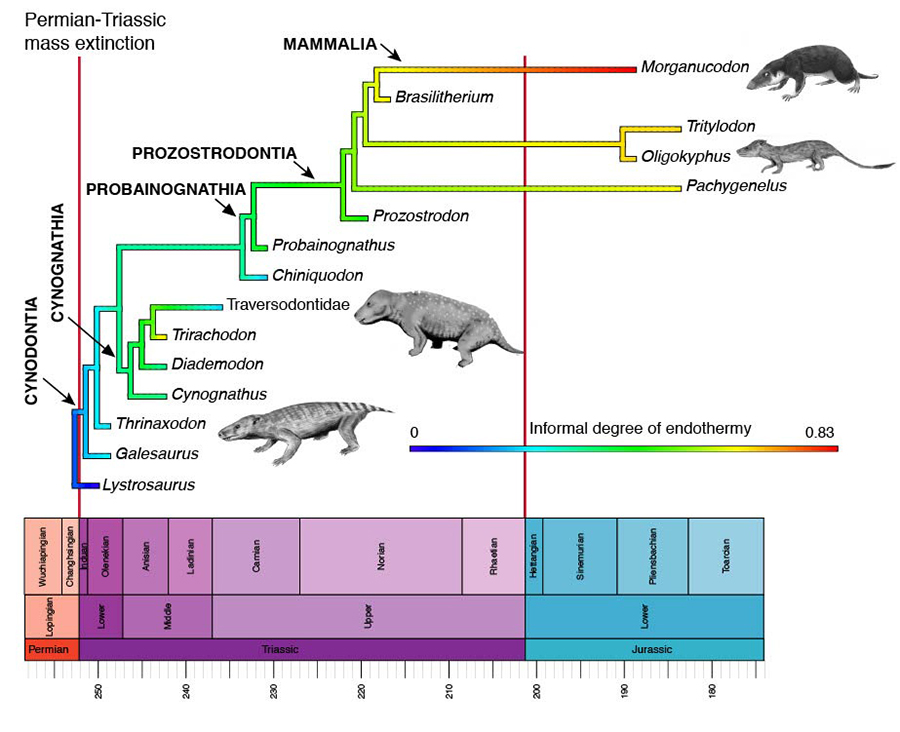
The origin of endothermy in synapsids, including the ancestors of mammals. The diagram shows the evolution of main groups through the Triassic, and the scale from blue to red is a measure of the degree of warm-bloodedness reconstructed based on different indicators of bone structure and anatomy. Credit: Mike Benton, University of Bristol. Animal images are by Nobu Tamura, Wikimedia

Mammals and birds today are warm-blooded, and this is often taken as the reason for their great success.

University of Bristol paleontologist Professor Mike Benton identifies in the journal Gondwana Research that the ancestors of both mammals and birds became warm-blooded at the same time, some 250 million years ago, in the time when life was recovering from the greatest mass extinction of all time.

The Permian-Triassic mass extinction killed as much as 95 percent of life, and the very few survivors faced a turbulent world, repeatedly hit by global warming and ocean acidification crises. Two main groups of tetrapods survived, the synapsids and archosaurs, including ancestors of mammals and birds respectively.

Paleontologists had identified indications of warm-bloodedness, or technically endothermy, in these Triassic survivors, including evidence for a diaphragm and possible whiskers in the synapsids.

More recently, similar evidence for early origin of feathers in dinosaur and bird ancestors has come to light. In both synapsids and archosaurs of the Triassic, the bone structure shows characteristics of warm-bloodedness.

The evidence that mammal ancestors had hair from the beginning of the Triassic has been suspected for a long time, but the suggestion that archosaurs had feathers from 250 million years ago is new.

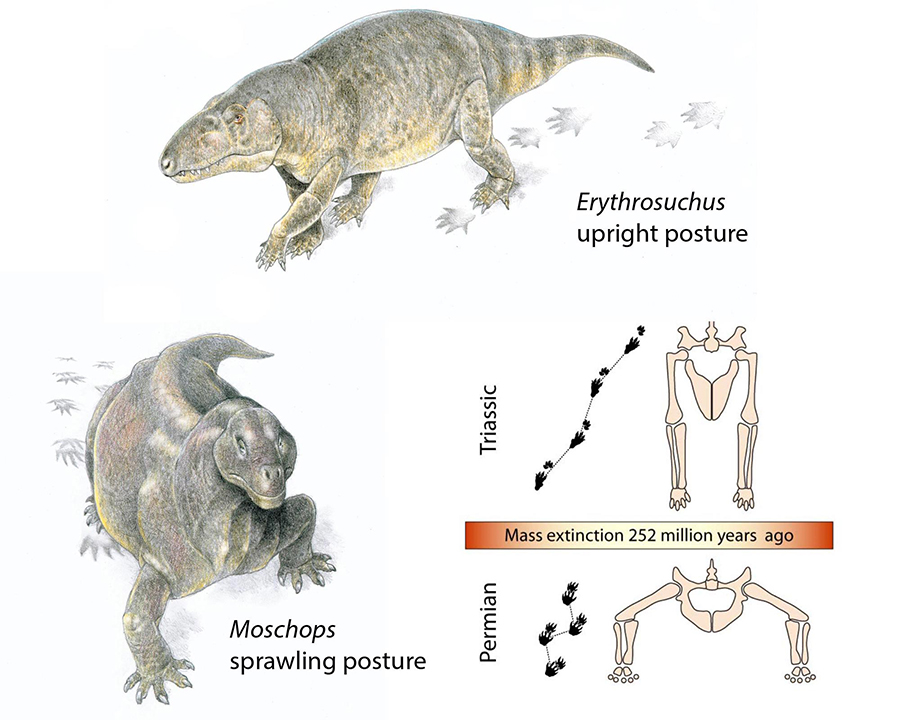
Posture shift at the end of the Permian, 252 million years ago. Before the crisis, most reptiles had sprawling posture; afterward, they walked upright. This may have been the first sign of a new pace of life in the Triassic. Credit: animal drawings by Jim Robins, University of Bristol

But a strong hint for this sudden origin of warm-bloodedness in both synapsids and archosaurs at exactly the time of the Permian-Triassic mass extinction was found in 2009. Tai Kubo, then a student studying the Masters in Palaeobiology degree at Bristol and Professor Benton identified that all medium-sized and large tetrapods switched from sprawling to erect posture right at the Permian-Triassic boundary.

Their study was based on fossilized footprints. They looked at a sample of hundreds of fossil trackways, and Kubo and Benton were surprised to see the posture shift happened instantly, not strung out over tens of millions of years, as had been suggested. It also happened in all groups, not just the mammal ancestors or bird ancestors.

Professor Benton said: “Modern amphibians and reptiles are sprawlers, holding their limbs partly sideways.

“Birds and mammals have erect postures, with the limbs immediately below their bodies. This allows them to run faster, and especially further. There are great advantages in erect posture and warm-bloodedness, but the cost is that endotherms have to eat much more than cold-blooded animals just to fuel their inner temperature control.”

The evidence from posture change and from early origin of hair and feathers, all happening at the same time, suggested this was the beginning of a kind of “arms race.” In ecology, arms races occur when predators and prey have to compete with each other, and where there may be an escalation of adaptations. The lion evolves to run faster, but the wildebeest also evolves to run faster or twist and turn to escape.

Something like this happened in the Triassic, from 250 to 200 million years ago. Today, warm-blooded animals can live all over the Earth, even in cold areas, and they remain active at night. They also show intensive parental care, feeding their babies and teaching them complex and smart behavior. These adaptations gave birds and mammals the edge over amphibians and reptiles and in the present cool world allowed them to dominate in more parts of the world.

Professor Benton added: “The Triassic was a remarkable time in the history of life on Earth. You see birds and mammals everywhere on land today, whereas amphibians and reptiles are often quite hidden.

“This revolution in ecosystems was triggered by the independent origins of endothermy in birds and mammals, but until recently we didn’t realize that these two events might have been coordinated.

“That happened because only a tiny number of species survived the Permian-Triassic mass extinction – who survived depended on intense competition in a tough world. Because a few of the survivors were already endothermic in a primitive way, all the others had to become endothermic to survive in the new fast-paced world.”

Reference: “The origin of endothermy in synapsids and archosaurs and arms races in the Triassic” by Michael J.Benton, 3 September 2020, Gondwana Research.
DOI: 10.1016/j.gr.2020.08.003

Source: https://scitechdaily.com/

Pages