nandi's blog

Cretophengodes azari: 99-Million-Year-Old Bioluminescent Beetle Found Preserved in Amber

Thursday, January 21, 2021

An artistic reconstruction of Cretophengodes azari; the larviform female in the background is reconstructed based on extant Phengodidae and Rhagophthalmidae beetles. Image credit: Li et al., doi: 10.1098/rspb.2020.2730.

Found in a piece of mid-Cretaceous amber from northern Myanmar, the wonderfully-preserved male of Cretophengodes azari has a light organ on the abdomen which presumably served a defensive function.

Bioluminescence, the production of light by living organisms, evolved over 30 times independently on diverse branches of the tree of life including algae, cnidarians, fishes and marine worms.

On land, light-producing beetles are the most widespread and abundant bioluminescent organisms. Their elaborate flash displays play a role in mate recognition as well as in signaling, communication and luring prey.

The majority of these beetles — over 2,300 species — belong to the megadiverse superfamily Elateroidea (fireflies, fire beetles, glow-worms).

The evolution of bioluminescence in these beetles is associated with unusual morphological modifications, such as soft-bodiedness and neoteny (delaying or slowing of the physiological development), but the fragmentary nature of their fossil record discloses little about the origin of these adaptations.

“Most light-producing beetles are soft-bodied and quite small, and so have a scant fossil record,” said Dr. Chenyang Cai, a researcher in the School of Earth Sciences at the University of Bristol and the Nanjing Institute of Geology and Palaeontology and the Centre for Excellence in Life and Palaeoenvironment of the Chinese Academy of Sciences.

“However, the new fossil, found in amber from northern Myanmar, is exceptionally well-preserved, even the light organ on its abdomen is intact.”

“Elateroidea is one of the most heterogeneous groups of beetles and that has always been very difficult for entomologists to deal with, particularly because important anatomical innovations evolved many times independently in unrelated groups,” said Dr. Erik Tihelka, a researcher in the School of Earth Sciences at the University of Bristol.

“The discovery of a new extinct elateroid beetle family is significant because it helps shed light on the evolution of these fascinating beetles.”

General habitus of Cretophengodidae and representatives of the closely related Phengodidae and Rhagophthalmidae, under incident light: (a, b) Cretophengodes azari, dorsal and ventral views, respectively, with arrowhead showing the photic organ; (c, d) Zarhipis sp. (Phengodidae), dorsal and ventral views, respectively; (e, f) Rhagophthalmus sp. (Rhagophthalmidae), dorsal and ventral views, respectively. Scale bars – 2 mm in (a, b, e, f) and 4 mm in (c, d). Image credit: Li et al., doi: 10.1098/rspb.2020.2730.

A specimen of Burmese amber with Cretophengodes azari came from amber mines near the Noije Bum Hill in Myanmar’s Kachin State.

The ancient beetle was so unique that the researchers created a new family, Cretophengodidae, for it.

“The unique combination of characters in Cretophengodes azari is unknown in any currently defined beetle lineage,” they said.

“Therefore, Cretophengodes azari deserves family status in Elateroidea.”

Cretophengodes azari also represents a transitional fossil linking soft- and hard-bodied elateroid beetles.

“The newly-discovered fossil, preserved with life-like fidelity in amber, represents an extinct relative of the fireflies and the living families Rhagophthalmidae and Phengodidae,” said Dr. Yan-Da Li, a researcher at Peking University and the Nanjing Institute of Geology and Palaeontology and the Centre for Excellence in Life and Palaeoenvironment of the Chinese Academy of Sciences.

“We think that light production initially evolved in the beetle’s soft and vulnerable larvae as a defensive mechanism to ward off predators.”

“The fossil shows that by the Cretaceous period, light production was taken up by the adults as well,” said Dr. Robin Kundrata, a researcher in the Department of Zoology at Palacký University.

“It could have than been co-opted to serve other functions such as locating mates.”

The findings were published in the Proceedings of the Royal Society B.

_____

Yan-Da Li et al. 2021. Cretophengodidae, a new Cretaceous beetle family, sheds light on the evolution of bioluminescence. Proc. R. Soc. B 288 (1943): 20202730; doi: 10.1098/rspb.2020.2730

Source: www.sci-news.com/
Did DINOSAURS Beat Man To The MOON?

Saturday, February 6, 2021

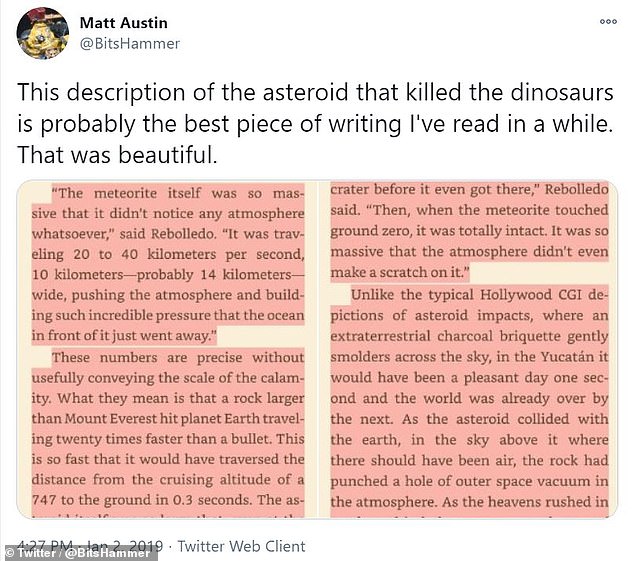
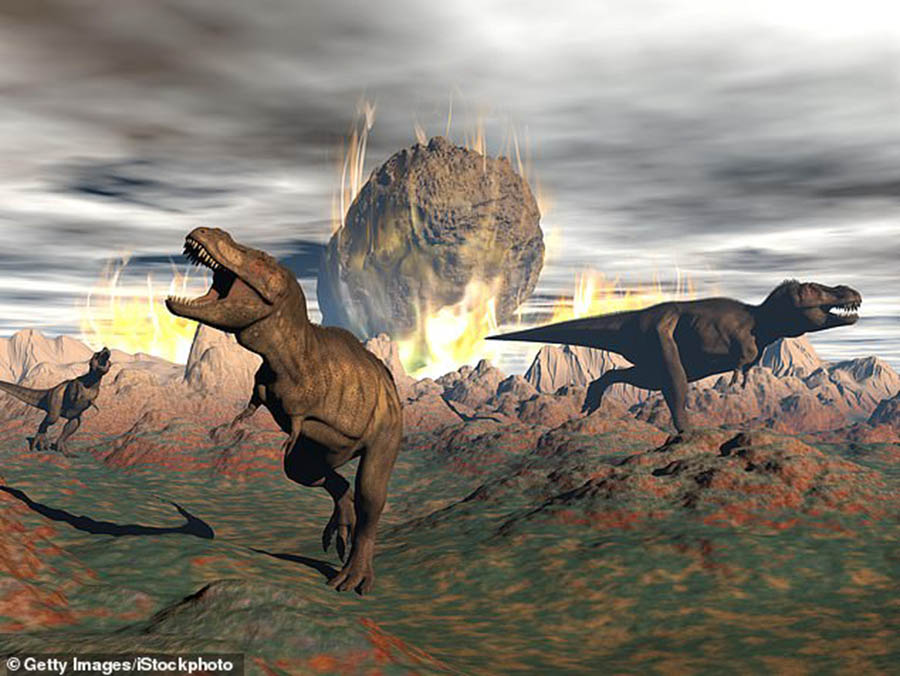
Peter Brannen's 2017 book 'The End of the World' suggests the asteroid that wiped out the dinosaurs flung debris into space that carried along dinosaurs bones - all of which settled on the moon

Bones from giant reptiles were flung into space when the extinction-event asteroid smashed into the Earth 66 million years ago, scientists claim.

  • An excerpt from 'The End of the World' by Peter Brannen was shared to Twitter
  •  It describes the asteroid that wiped out the dinosaurs 66 million years ago 
  • The asteroid 'punched a hole of outer space vacuum in the atmosphere'
  • Debris  was expelled from the impact that was mixed with dinosaur bones 
  • With this in mind, the scientists says there are probably bones on the moon 

Although Neil Armstrong was the first human to step foot on the moon in 1967, dinosaurs may have beat him to it 66 million years prior – or at least pieces of the prehistoric creatures did.

The claim stems from Peter Brannen's 2017 book, 'The End of the World,' which was recently shard on Twitter by blogger Matt Austin.

An excerpt describes the violent asteroid as it ripped a 'hole of outer space vacuum in the atmosphere.'

This sent debris flying into to orbit and 'bits of dinosaurs' may have been mixed up in the enormous volume of earth that expelled into space - all of which settled on the moon.

The catastrophic asteroid crashed into what experts say was at the 'deadliest possible angle' when it came barreling into what is now Mexico's Yucatán Peninsula.

Brannen, who is an award-winning science journalist, writes that the asteroid was larger than Mount Everest and came crashing through the atmosphere 20 times faster than a speeding bullet.

'This is so fast that it would have traversed the distance from the cruising altitude of a 747 to the ground in 0.3 seconds,' the book reads.

The book includes comments from geophysicist Mario Rebolledo at the Centro de Investigación who told Brannen: 'The pressure of the atmosphere front of the asteroid started excavating the crater before it even got there.'

Although the book was published in 2017 blogger Matt Austin recently shard excerpts on Twitter

Although there is no evidence to support claims in 'The End of the World,' scientists have been able to piece together the events that unfolded.

The asteroid left a 120-mile-wide crater at the disaster zone, vaporizing rock and sending billions of tons of sulfur and carbon dioxide into the prehistoric skies.

All living things within hundreds of miles of the impact site would have been incinerated within minutes. 

Meanwhile, the dust cloud generated by the impact would have blocked out the sun — likely triggering a 'nuclear winter' and seeing temperatures plunge, acid rain falling from the skies and 75 percent of living species wiped out.

'It would have felt like the ground beneath your feet had become a ship in the middle of the ocean,' said earth and space science professor Mark Richards at the University of Washington. 

'Then rocks would have bombarded you from a boiling sky that was beginning to take on a hazy glow. It would have seemed like the end of the world.'

Source: www.dailymail.co.uk/

1st Preserved Dinosaur Butthole is 'Perfect' and 'Unique,' Paleontologist Says

Friday, January 22, 2021

A reconstruction of Psittacosaurus illustrating how the cloacal vent may have been used for signaling during courtship. Image credit: Robert Nicholls / Paleocreations.com.

Although paleontologists know now much about dinosaurs and their appearance, they have not known anything about how their cloacal region — the all-purpose opening used for defecation, urination and breeding — appears. Paleontologists from the United Kingdom and the United States have now described the cloacal opening of Psittacosaurus, an ornithischian dinosaur that lived about 110 million years ago (Early Cretaceous period) in what is now China, and compared it to vents across modern land-dwelling vertebrate animals.

Dr. Jakob Vinther from the School of Earth Sciences at the University of Bristol and colleagues examined an exceptionally well-preserved specimen of Psittacosaurus sp. from the Early Cretaceous Jehol deposits of Liaoning, China.

The fossil is currently housed at the Senckenberg Museum in Frankfurt, Germany.

“I noticed the cloaca several years ago after we had reconstructed the color patterns of this dinosaur using a remarkable fossil on display at the Senckenberg Museum which clearly preserves its skin and color patterns,” Dr. Vinther said.

“It took a long while before we got around to finish it off because no one has ever cared about comparing the exterior of cloacal openings of living animals, so it was largely unchartered territory.”

“Indeed, they are pretty non-descript,” said co-author Dr. Diane Kelly, a researcher in the Department of Psychological and Brain Sciences at the University of Massachusetts Amherst.

“We found the vent does look different in many different groups of tetrapods, but in most cases it doesn’t tell you much about an animal’s sex.”

“Those distinguishing features are tucked inside the cloaca, and unfortunately, they’re not preserved in this fossil.”

Close up of the preserved cloacal region in Psittacosaurus and the reconstruction of it. Image credit: Vinther et al., doi: 0.1016/j.cub.2020.12.039.

The cloaca of Psittacosaurus is unique in its appearance but exhibits features reminiscent to living crocodylians such as alligators and crocodiles, which are the closest living relatives to dinosaurs and other birds.

Its outer margins are highly pigmented with melanin. This pigmentation provided the vent with a function in display and signaling, similar to living baboons and some breeding salamanders.

The large, pigmented lobes on either side of the opening could have harbored musky scent glands, as seen in living crocodylians.

Birds are one the few vertebrate groups that occasionally exhibit visual signaling with the cloaca, which the study authors now can extend back to the Mesozoic dinosaur ancestors.

“As a paleoartist, it has been absolutely amazing to have an opportunity to reconstruct one of the last remaining features we didn’t know anything about in dinosaurs,” said Robert Nicholls, of Paleocreations.

“Knowing that at least some dinosaurs were signaling to each other gives paleoartists exciting freedom to speculate on a whole variety of now plausible interactions during dinosaur courtship. It is a game changer!”

The team’s paper was published in the journal Current Biology.

_____

Jakob Vinther et al. A cloacal opening in a non-avian dinosaur. Current Biology, published online January 19, 2021; doi: 10.1016/j.cub.2020.12.039

Source: www.sci-news.com/

Three New Species of Extinct Marsupials Identified

Wednesday, January 27, 2021

Kramadolops maximus, the youngest known species of polydolopid marsupial. Image credit: Gabriel Lío.

Dr. Laura Chornogubsky, a paleontologist in the Museo Argentino de Ciencias Naturales ‘Bernardino Rivadavia’ and CONICET, has described one new genus and three new species in the marsupial family Polydolopidae.

Polydolopidae is a family of extinct marsupials that lived in the Antarctic Peninsula and South America, including Chile, Argentine, Brazil, and Bolivia, during the Paleogene period.

First described by Florentino Ameghino in 1897, these animals appeared at the beginning of the Paleocene epoch, about 66 million years ago, and disappeared during the Oligocene epoch, about 23 million years ago.

They likely went extinct due to climatic deterioration in the Early Oligocene, when temperature and the humidity dropped, provoking desertification in the region where polydolopids evolved.

“In the past, South American marsupials were much more abundant than they are today, with hundreds of species of widely varying shapes and sizes,” Dr. Chornogubsky said.

“Despite the fact that the debate is still open, some of the hypotheses focus on the relationship of polydolopids with Australian marsupials.”

“The polydolopids could have evolved on a large continental mass without major barriers that isolated them. For this reason, the current records of Antarctica show us remains of these groups.”

Dr. Chornogubsky carried out a new taxonomic and systematic revision and the first extensive phylogenetic analysis of the Polydolopidae family.

She examined the fossilized remains of almost every polydolopid species and five related marsupials: Bonapartherium hinakusijumEpidolops ameghinoiMicrobiotherium tehuelchumPrepidolops didelphoides, and Roberthoffstetteria nationalgeographica.

“The Polydolopidae was recovered as a monophyletic group, even though no resolution about its sister-group can be found,” she said.

Dr. Chornogubsky redescribed seven previously known genera of polydolopids: AntarctodolopsAmphidolopsArchaeodolopsEudolopsKramadolopsPliodolops, and Pseudolops.

She also described one new genus, Hypodolops, two yet-to-be-named genera, and three new species: Hypodolops sapoensisAmphidolops intermedius, and Amphidolops minimus.

“This research piece shows advances in the understanding of the evolutionary history of marsupials,” Dr. Chornogubsky said.

The study was published in the Zoological Journal of the Linnean Society.

_____

Laura Chornogubsky. Interrelationships of Polydolopidae (Mammalia: Marsupialia) from South America and Antarctica. Zoological Journal of the Linnean Society, published online November 26, 2020; doi: 10.1093/zoolinnean/zlaa143

Source: www.sci-news.com/

Tyrannosaur Hatchlings Were as Big as Medium-Sized Dog

Wednesday, January 27, 2021

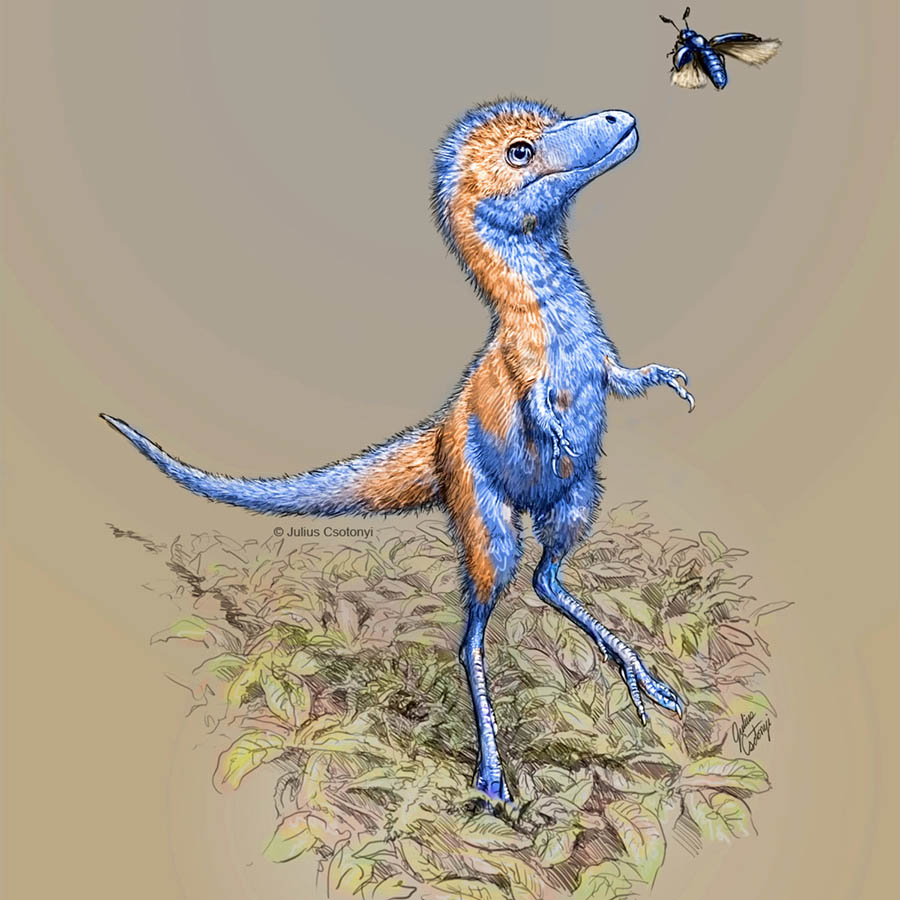
An artist’s impression of a juvenile tyrannosaur. Image credit: Julius Csotonyi.

An international team of paleontologists has examined the fossilized remains of baby tyrannosaurid dinosaurs found in Alberta, Canada, and Montana, the United States.

Tyrannosaurids were the apex predators of the supercontinent Laurasia in the Late Cretaceous period, and were among the largest terrestrial predators ever.

These dinosaurs have garnered considerable interest since their discovery, both in the popular and scientific realms.

As a result, they are well studied and much is known of their anatomy, diversity, growth, and evolution.

In contrast, little is known of the earliest stages of their development.

Tyrannosaurid eggs and embryos remain elusive, and juvenile specimens — although known — are rare.

“Tyrannosaurs are represented by dozens of skeletons and thousands of isolated bones or partial skeletons,” said co-author Mark Powers, a Ph.D. student at the University of Alberta.

“But despite this wealth of data for tyrannosaur biology, the smallest identifiable individuals are aged three to four years old, much larger than when they would have hatched.”

In the new research, Powers and colleagues examined 75 to 71.5-million-year old fossilized jaw bone, tooth and claw of baby tyrannosaurids.

“A perinatal tooth and an embryonic claw from the Horseshoe Canyon Formation of Alberta are probably attributable to Albertosaurus sarcophagus,” they said.

“From the Two Medicine Formation of Montana, an embryonic jaw with teeth probably pertains to Daspletosaurus horneri.”

“They provide information on the size of tyrannosaurid hatchlings and some preliminary clues to the nesting habits of tyrannosaurids.”

The paleontologists found that baby tyrannosaurs were around 0.9 m (3 feet) long when they hatched.

“There were two surprising results,” Powers said.

“The first is that the small tyrannosaur teeth were distinct from the teeth of older individuals — having not yet developed true serrations along the cutting edge of its teeth, as is iconic of the juveniles all the way through to adults.”

“The second was the estimated size of the embryos. The specimen belonging to the claw was estimated to be about 1.1 m (3.6 feet) long, while that of the jaw bone was about 71 cm (2.3 feet).”

Their findings also suggest that tyrannosaur eggs — the remains of which have never been found — were around 43 cm (17 inches) long. This could aid efforts to recognize such eggs in the future and gain greater insights into the nesting habits of tyrannosaurs.

“The discovery of embryonic material is a huge find in our efforts to understand how some of the most popular and charismatic dinosaurs began their life, and grew to immense sizes,” Powers said.

“It provides a much-needed — and until now, missing — data point depicting the starting point for tyrannosaur growth.”

The researchers also found that the 3-cm- (1.2-inch) long jaw bone of Daspletosaurus horneri had distinctive tyrannosaur features, including a pronounced chin, indicating that these physical traits were present before the animals hatched.

“These bones are the first window into the early lives of tyrannosaurs and they teach us about the size and appearance of baby tyrannosaurs,” said lead author Dr. Greg Funston, a researcher at the University of Edinburgh.

“We now know that they would have been the largest hatchlings to ever emerge from eggs, and they would have looked remarkably like their parents — both good signs for finding more material in the future.”

paper on the findings was published in the Canadian Journal of Earth Sciences.

_____

Gregory F. Funston et al. Baby tyrannosaurid bones and teeth from the Late Cretaceous of western North America. Canadian Journal of Earth Sciences, published online January 25, 2021; doi: 10.1139/cjes-2020-0169

Source: www.sci-news.com/

Camp Cretaceous Tells Its Own Version Of Jurassic Park 3's Hidden Story

Tuesday, January 26, 2021

Camp Cretaceous season 2 is about six teenagers surviving alone on Jurassic World, which is a spin on Jurassic Park III's teen hero's unseen subplot.

Warning: SPOILERS for Jurassic World: Camp Cretaceous season 2.

Jurassic World: Camp Cretaceous season 2 details how the show's six teenage Campers survived on Isla Nublar and it told a different spin on a similar subplot in Jurassic Park IIICamp Cretaceous season 1 ended with Darius (Paul-Mikel Williams), Brooklynn (Jenna Ortega), Kenji (Ryan Potter), Sammy (Raini Rodriguez), Yasmina (Kausar Mohammad), and Ben (Sean Giambrone) stranded on Isla Nublar after the events of the 2015 Jurassic World film. But they're not the first kids to be lost alone on an island of dinosaurs - Jurassic Park III's Eric Kirby (Trevor Morgan) was.

Directed by Joe Johnston, Jurassic Park III began with 12-year-old Eric and his family's friend Ben (Mark Harelik) parasailing near Isla Sorna, AKA Site B, where the dinosaurs had been loose since before the events of The Lost World: Jurassic Park. Their boat is attacked by dinosaurs, which resulted in Ben and Eric being forced to glide into the island. By the time Eric's parents, Paul (William H. Macy) and Amanda (Tea Leoni), hired Dr. Alan Grant (Sam Neill) to lead a rescue mission to find their son, Eric had been lost in Isla Sorna for 8 weeks (and Ben had died). Grant found Eric, who made a shelter in an overturned water truck, and the boy had managed to survive on the island all by himself. Eric knew the terrain and the dinosaurs of Isla Sorna well enough that he was invaluable in helping Dr. Grant and his parents navigate the island and its prehistoric creatures until they were rescued.

Camp Cretaceous season 2 did a variation of Eric's unseen story and delved into how the six Campers managed to survive after the fall of the Jurassic World theme park. The kids were left behind by the island's evacuation, and Camp Cretaceous season 2 picks up immediately afterward, with Darius, Brooklyn, Sammy, Yasmina, and Kenji trying to come up with a strategy to stay alive and call for a rescue. This involved returning to the park's Main Street to look for food and also learning that there was an emergency distress beacon which, unfortunately, the T-Rex made part of its nest. Working together, the Campers distracted the Tyrannosaur so that Darius and Kenji could activate the beacon. Later, the kids returned to the site of the Camp Cretaceous treehouse, which the Indominus Rex destroyed in season 1, and they rebuilt it to be their home - a far better place to live than Eric's makeshift overturned water truck.

Eric's story in Jurassic Park III actually has a bit more in common with what happened to Ben, who was separated from the others and presumed dead when he fell from the monorail. Ben not only survived, alongside his pet Ankylosaur named Bumpy, but the sheltered and neurotic boy also underwent a gradual transformation into a survivalist who was at home in the jungle. Unlike his fellow Campers, who had each other to rely on, Ben spent almost a month on his own (with Bumpy) and had to learn to thrive on Isla Nublar before he reunited with his friends in the back half of Camp Cretaceous season 2.

However, Eric's ordeal was 8 weeks before he was rescued, which is far more time than the Campers spent alone in Jurassic World. There's a time jump during Camp Cretaceous season 2 so that about 22 days pass in between episodes 2 and 3, but that's still less than half the total time Eric spent alone in Jurassic Park III. But Eric was able to rely on his passion and expertise about dinosaurs that he got as someone who read Dr. Alan Grant's books.

Similarly, Darius is also a dinosaur expert who is knowledgeable about Alan Grant, and his dino smarts continue to pay off for himself and his Campers. While Lex (Ariana Richards) and Tim Murphy (Joseph Mazello) were the original kids lost in Jurassic Park, they always had Dr. Grant with him. Eric Kirby, who would be about 26 during the events of Jurassic World: Camp Cretaceous, was the true forerunner of the Netflix animated series' teenage heroes.

Source: https://screenrant.com/

Jurassic World: Camp Cretaceous Recaptures The Original Park's Magic

Tuesday, January 26, 2021

Camp Cretaceous season 2 has all of the dino action Jurassic fans could want but there were also moments that understood the magic of Jurassic Park.

Warning: SPOILERS for Jurassic World: Camp Cretaceous season 2.

Jurassic World: Camp Cretaceous season 2, episode 3, "The Watering Hole", recaptured the original magic of Steven Spielberg's Jurassic Park. Camp Cretaceous season 2 details how the six teenage Campers fight to survive on Isla Nublar after Jurassic World fell and the dinosaurs overran the island. But among its thrills and scares, Camp Cretaceous also paused to celebrate the wonder of the prehistoric creatures just like Spielberg's beloved blockbuster did.

Jurassic Park was a state-of-the-art techno-thriller when it premiered in 1993 and it endures as a beloved classic film. This is because, at its heart, Spielberg understood the power and majesty dinosaurs hold on the human imagination. Certainly, Jurassic Park had terrifying moments where the human characters were eaten by Isla Nublar's rampaging predators, and moments like the T-Rex attack and the Velociraptors in the kitchen are now indelibly part of pop culture and cinema history. But before the scares began, Spielberg vividly introduced his island of dinosaurs when the human heroes, including Dr. Alan Grant (Sam Neill), Dr. Ellie Sattler (Laura Dern), and Dr. Ian Malcolm (Jeff Goldblum), feasted their eyes on a living Brachiosaurus for the first time. The scientists - and the audience - were left wide-eyed and speechless, and it was truly an unforgettable "welcome to Jurassic Park". Even after Grant was stranded on the island gone amok with young Lex (Ariana Richards) and Tim (Joseph Mazzello), Spielberg paused the action for a quietly poignant scene where the kids met a Brachiosaurus face-to-face.

Jurassic World: Camp Cretaceous season 2 certainly contains all of the intense dino-action that a Jurassic fan would want. Picking up immediately after the show's heroic Campers were stranded on Isla Nublar at the end of season 1, Camp Cretaceous season 2 jumps right into the chaos as Darius (Paul-Mikel Williams), Brooklynn (Jenna Ortega), Kenji (Ryan Potter), Yasmina (Kausar Mohammad), and Sammy (Raini Rodriguez) traverse the jungle to Main Street hoping for food and rescue. But the T-Rex made a nest in Main Street, which meant that the kids had to go back to the site of Camp Cretaceous' treehouse and create a refuge there. About 22 days later, Darius and Kenji separated from the group and were chased by their old enemy, Toro the Carnotaurus, and the two kids stumbled upon the most magical location in Isla Nublar: the Watering Hole where all of the dinosaurs came to drink.

The Watering Hole is a special place where Jurassic World's dinosaurs all communed; whether they were peaceful herbivores like the Stegosaurus and the Sinoteratops or super predators like the Baryonyx and the Carnotaurus, all of the prehistoric clones inherently understood that the Watering Hole was a common ground where everyone was allowed to drink in peace. And at the Watering Hole, the dinos do drink in herds. Even Kenji became emotional at the sight of the mighty creatures coming together as one, and the sweeping scene - accompanied by John Williams' unforgettable score - evoked the feeling of seeing the dinos for the first time in Jurassic Park. It was pure Spielbergian magic replicated by Netflix's animated series.

Indeed, the Watering Hole ended up being the focal point of Camp Cretaceous season 2: the villainous big-game hunters Mitch (Bradley Whitford) and Tiff (Stephanie Beatriz) wanted to find the lagoon so they could shoot and kill the dinos and turn them into trophies. The six Campers worked together to stop Mitch and Tiff and save the dinosaurs. The island's super predators ultimately decided the evil couple's fate, with the T-Rex taking center stage as the ruler of the island once again, just like in Jurassic Park.

Further, Brooklynn, Kenji, Yasmina, and Ben (Sean Giambrone) discovered a control center in the tunnels beneath the park and they were able to restore power to the island temporarily. This meant that a hologram of the T-Rex activated and the flesh and blood Tyrannosaur came face-to-face with its virtual clone, which became another clever spin by Jurassic World: Camp Cretaceous on the memorable way Steven Spielberg chose to end Jurassic Park.

Source: https://screenrant.com/

How Jurassic World: Camp Cretaceous Could Tie Into Dominion

Tuesday, January 26, 2021

With Netflix's Camp Cretaceous bridging the first two Jurassic World films, here's how Season 2 could tie into Dominion.

Jurassic World: Camp Cretaceous has filled in some big gaps as to what happened between 2015's Jurassic World and 2018's Jurassic World: Fallen Kingdom, showing viewers what happened to Isla Nublar before volcanic activity destroyed the place. However, Jurassic World: Dominion director Colin Trevorrow, has said that elements from Camp Cretaceous, which he's an executive producer on, will connect to his film.

With that in mind, here are some of the revelations in Camp Cretaceous Season 2 that can be expanded on in Dominion.

More Dino Experiments

In the Jurassic World trilogy, Dr. Wu's team has conducted some sinister experiments, resulting in such beasts as Indominus Rex and the Indoraptor. Brooklynn's detective work in Camp Cretaceous clearly confirms Wu was running a lot more secret projects off the books, so those dinosaurs could have been shipped out before the island was destroyed. One experiment called E750 even broke free at some point.

Some of these experimental dinosaurs may have escaped into the rest of the world at the end of Fallen Kingdom. Their existences would pose a massive threat, as Owen, Claire, Dr. Grant and the other experts might not know how to deal with such hybrids. These creatures could also alter the entire food chain in major ways, which would have a huge impact on ecosystems across the world. Wu might even have experimented with flying or aquatic dinos, which would really make containment difficult, as they'd be a new breed of alphas.

A Shocking Sense Of Unity

In the Jurassic Park series, herbivores usually stick together and avoid carnivores. However, in Camp Cretaceous Season 2, Darius discovers a watering hole around which are both herbivores and carnivores. Both groups coexist without conflict, and this nearly brings Kenji to tears.

This indicates dinosaurs can live alongside one another and even -- potentially -- humans in the outside world. The entire event is the first sign dinosaurs might not be the threats they once seemed and that mankind might even be able to domesticate or tame them. Humanity can create certain conditions to achieve this peace, which will certainly be thought-provoking discussion when Ellie and Ian Malcolm come into the fray.

The Game Hunters

Camp Cretaceous Season 2 revealed Mitch, Tiff and Hap weren't eco-tourists, but from a fraternity of dino-hunters. They snuck onto Isla Nublar for trophies, and come Dominion, it'll be open season on the beasts. Owen and Claire could end up coming into conflict with these hunters, especially if someone tries to target Blue. This fraternity would be more aggressive than regular buyers, who simply wanted exotic animals for display in Fallen Kingdom, so it won't be an easy task to take them down.

This also ties into legislation and Claire's political views about people killing for sport. Authorities will have a tough time making the right choice on infestation and anti-extermination laws. These hunters did show Darius in Camp Cretaceous Season 2 that mankind can really be the nastier monster, but they might also be used to takedown dangerous or destructive dinosaurs. Dr. Grant and his scientists will have their work cut out, because not everyone cares about the sanctity of life and preserving dinos like they do.

Jurassic World: Camp Cretaceous is executive produced by Steven Spielberg, Frank Marshall, Colin Trevorrow, Scott Kreamer and Lane Lueras, with Zack Stentz serving as a consulting producer. Seasons 1 and 2 are currently available to stream on Netflix.

Source: www.cbr.com/

Study Sheds New Light on the Behaviour of Spinosaurus

Wednesday, January 27, 2021

Life restoration depicting swimming pose

New research from Queen Mary University of London and the University of Maryland, has reignited the debate around the behaviour of the giant dinosaur Spinosaurus.

Since its discovery in 1915, the biology and behaviour of the enormous Spinosaurus has puzzled palaeontologists worldwide. It was recently argued that the dinosaur was largely an aquatic predator, using its large tail to swim and actively pursue fish in the water.

The new study, published today in Palaeontologia Electronica, challenges this recent view of Spinosaurus suggesting that whilst it likely fed from the water, and may have swum, it wasn't well adapted to the life of an aquatic pursuit predator. Instead it was like a giant (if flightless) heron or stork - snatching at fish from the shoreline while also taking any other small available prey on land or in water.

The researchers compared the features of Spinosaurus with the skulls and skeletons of other dinosaurs and various living and extinct reptiles that lived on land, in the water or did both. They found that whilst there were several pieces of evidence that contradicted the aquatic pursuit predator concept, none contradicted the wading heron-like model, and various lines of evidence actively supported it.

Dr David Hone, Senior Lecturer at Queen Mary and lead author on the project said: "The biology and ecology of Spinosaurus has been troubling palaeontologists for decades. Some recent studies have suggested that it was actively chasing fish in water but while they could swim, they would not have been fast or efficient enough to do this effectively. Our findings suggest that the wading idea is much better supported, even if it is slightly less exciting."

Co-author Tom Holtz, Principal Lecturer in Vertebrae Paleontology, University of Maryland, said: "Spinosaurus was a bizarre animal even by dinosaur standards, and unlike anything alive today, so trying to understand its ecology will always be difficult. We sought to use what evidence we have to best approximate its way of life. And what we found did not match the attributes one would expect in an aquatic pursuit predator in the manner of an otter, sea lion, or short-necked plesiosaur."

One of the key pieces of evidence unearthed by the researchers related to the dinosaur's ability to swim. Spinosaurus was already shown to be a less efficient swimmer than a crocodile, but also has fewer tail muscles than a crocodile, and due to its size would have a lot more drag in the water.

Dr Hone said: "Crocodiles are excellent in water compared to land animals, but are not that specialised for aquatic life and are not able to actively chase after fish. If Spinosaurus had fewer muscles on the tail, less efficiency and more drag then it's hard to see how these dinosaurs could be chasing fish in a way that crocodiles cannot."

Dr Holtz added: "We certainly add that the evidence points to Spinosaurus feeding partly, even mostly, in the water, probably more so than any other large dinosaur. But that is a different claim than it being a rapid swimmer chasing after aquatic prey." Though as Dr Hone concludes: "Whilst our study provides us with a clearer picture of the ecology and behaviour of Spinosaurus, there are still many outstanding questions and details to examine for future study and we must continue to review our ideas as we accumulate further evidence and data on these unique dinosaurs. This won't be the last word on the biology of these amazing animals."

Originally found in Egypt, Spinosaurus is thought to be one of the largest carnivorous dinosaurs to exist probably reaching over 15 m in length. The first known Spinosaurus fossils were destroyed by Allied bombing during World War II, which has hampered palaeontologist's attempts to understand these unusual creatures. More recently the dinosaur found fame in the 2001 film Jurassic Park III, where it battles and defeats a Tyrannosaurus rex.

###

Notes to editors

Image 1- Reconstructed skeleton of a moderately sized Spinosaurus showing its famous sail-back and tail plume. Scale bar is 1 m. Image by Genya Masukawa who retains the copyright but this is free to use in conjunction with this story.

Image 2- Life reconstruction of a Spinosaurus wading in the water and fishing. Image by Robert Nicholls who retains the copyright but this is free to use in conjunction with this story.

Image 3- Saddle-billed storks in Africa foraging with their beaks partly below water - Spinosaurus may have done something similar. Photograph by David Hone who retains the copyright but this is free to use in conjunction with this story.

* For more information please contact:

Sophie McLachlan
Faculty Communications Manager (Science & Engineering)
Queen Mary University of London
[email protected]
Tel: 020 7882 3787

About Queen Mary

Queen Mary University of London is a research-intensive university that connects minds worldwide. A member of the prestigious Russell Group, we work across the humanities and social sciences, medicine and dentistry, and science and engineering, with inspirational teaching directly informed by our world-leading research. In the most recent Research Excellence Framework we were ranked 5th in the country for the proportion of research outputs that were world-leading or internationally excellent. We have over 25,000 students and offer more than 240 degree programmes. Our reputation for excellent teaching was rewarded with silver in the most recent Teaching Excellence Framework. Queen Mary has a proud and distinctive history built on four historic institutions stretching back to 1785 and beyond. Common to each of these institutions - the London Hospital Medical College, St Bartholomew's Medical College, Westfield College and Queen Mary College - was the vision to provide hope and opportunity for the less privileged or otherwise under-represented. Today, Queen Mary University of London remains true to that belief in opening the doors of opportunity for anyone with the potential to succeed and helping to build a future we can all be proud of.

Source: www.eurekalert.org/

The World Is Ready for a Dino Crisis Remake

Tuesday, January 19, 2021

It's been over 20 years since Dino Crisis launched for the original PlayStation, but the franchise is dormant today and long overdue for a revival.

The ninth console generation saw a resurgence of Resident Evil games. Resident Evil 7 took the franchise in an exciting new direction while the remakes reacquainted gamers with some of their favorite Resident Evil classics. Although Resident Evil continues to be one of Capcom's most successful IPs, it isn't the only horror franchise fans would like to see flourish on next-gen systems. Many gamers would love to see Dino Crisis make a triumphant return to home consoles.

Dino Crisis took Resident Evil's iconic survival horror gameplay and combined it with the unsettling aura of Jurassic Park. Players must make their way through a secluded research facility hidden within the jungles of Ibis Island after a special agent goes missing. After a group of highly trained special agents attempts a rescue mission, they find out nothing is what it seems. The island is overrun by prehistory dinosaurs that want nothing more than to feed on human flesh.

Dino Crisis' gameplay aged like fine wine, but its controls are stuck in the late 1990s. While some hardcore gamers enjoy the old-school tank control layout, many others find them clunky and off-putting. A next-gen remake could fix many of the game's control issues and make them more appealing to mainstream audiences. It could even include a classic tank control option for players looking to relive the original experience.

Like most PS1 games, Dino Crisis isn't the most aesthetically pleasing game to look at. The polygonal graphics and rudimentary character designs can hinder the game's immersion effect. Updated graphics could take Dino Crisis places never thought imaginable. The dense jungle could be digitally enhanced and expanded upon, taking the ghastly atmosphere to unfathomable new heights.

Video game fans rarely see horror titles with bloodthirsty dinosaurs. Reviving Dino Crisis could give players a unique horror experience that few games can replicate, pleasing longtime fans and new players. It's been 17 years since the last Dino Crisis launch, and it was one of the most disappointing games of the early 2000s. A remake could get the series back on track and could even lead to more remakes or a new sequel.

With remakes and horror games enjoying unbelievable success, there isn't a better time for Capcom to resurrect the Dino Crisis series. The first game helped define survival horror on the original PlayStation and laid the groundwork for many of the games horror fans enjoy today. With a few rumors sprouting up across the internet of Capcom taking an interest in the series, a Dino Crisis remake may not be completely out of the question.

Source: www.cbr.com/

Pages