nandi's blog

Documentary Provides the Full Story of Scotty, the World’s Largest T. rex

Thursday, January 28, 2021

A life-sized replica of Scotty the T. rex is on display at the T.rex Discovery Centre in Eastend.  Photo courtesy of Overtime Studios

The unearthing of the world’s largest Tyrannosaurus rex skeleton near Eastend three decades ago continues to be a fascinating story of scientific discovery.

The latest documentary in the Stories from the Great Southwest series by Overtime Studios tells the full story of Scotty the T. rex and provides a behind-the-scenes look at the paleontological research happening at the T.rex Discovery Centre.

It was written and directed by George Tsougrianis, who is a managing partner in the Swift Current based production company Overtime Studios. The story of Scotty was an obvious choice for this documentary series, which was started in 2012 by the Swift Current Museum to highlight the rich history of the city and the entire region.

Scotty received renewed attention across the world in 2019, when a scientific study was published in which it was declared to be the largest T. rex skeleton ever found by paleontologists. It made the decision to produce this documentary even more relevant.

“So because it was the biggest, we felt it was just timely, even though the story has been told,” he said. “And we wanted to add a little bit more in terms of where are things now. We may know the story, but obviously the T.rex Discovery Centre and the work that goes on there is a continuation of the work. So when we put all of that together, we felt it was a good story.”

He also considered this to be a good opportunity to highlight the interesting work done by paleontologists. He met T.rex Discovery Centre paleontologist Dr. Emily Bamforth a few years ago at a Fossil Fever event in the Grasslands National Park, which was a fascinating experience.

RELATED: Meet Scotty, World’s Largest Specimen of Tyrannosaurus rex

“Over the last couple of years, I've run into Emily subsequent to that and had more conversations, and I just really became more interested in what these people actually do,” he said. “We've been to the T.rex Discovery Centre a number of times for various projects, but the part that I really wanted to show that I don't think anybody has really seen is what happens behind the glass in that restricted area where they actually have all the bones, but also more importantly where they do a lot of the ongoing work.”

Scenes in the documentary therefore show staff at work in the area where bones collected during field trips are carefully cleaned and analyzed. Scotty’s original bones are stored at the T.rex Discovery Centre and he had the opportunity to see and film them.

“I've never seen the bones the way that they were able to show them to me, like literally open up the various shelves, and to actually see not just Scotty's fossils, but the reams and reams of bones that they've catalogued over the many years that they've been doing the work,” he recalled.

He also had an opportunity to accompany Dr. Bamforth and another paleontologist, Dr. Hallie Street, on a fieldwork trip.

“That was really exciting for me,” Tsougrianis said. “I went out with them to one of the active dig sites. They're actually working on it and Emily was really good. She explained things and what they were doing and what the fossil remains were at that particular site.”

A life-sized replica of Scotty is the showpiece of the exhibits at the T.rex Discovery Centre, but the displays also feature other examples of Saskatchewan’s rich prehistoric period, including marine reptiles and prehistoric mammals.

The documentary therefore includes details about these other exhibits and Dr. Street provides information about ancient marine reptiles that once lived in a vast inland sea that covered a large part of present-day Saskatchewan.

A significant challenge for Tsougrianis during the making of this documentary was to ensure the factual correctness of the scientific information presented to viewers.

“That was probably my biggest concern,” he said. “I was even going back and forth with Emily on how do you pronounce some of these long names, whether it was the animals or the period. I just wanted to make sure that it was accurate and that we didn't say something falsely.”

The documentary, which is just over 20 minutes long, presents the story of Scotty and the T.rex Discovery Centre through three segments.

“There is the origin story of Scotty, how Eastend fits into the picture, and then the latter half is really about that behind the scenes and what does a paleontologist actually do,” he said.

The documentary includes historical footage as well as interviews with retired teacher Robert Gebhardt, who discovered the first pieces of Scotty in 1991, and paleontologists Tim Tokaryk, who realized the importance of the discovery when he visited the site in 1994. Tokaryk was also an original member of the scientific team that unearthed Scotty over a period of several years.

The intention was to officially launch this documentary in 2020 during an event in Eastend, but the COVID-19 public health restrictions made it impossible. Scotty the T. Rex, the Full Story was therefore released towards the end of the year on the Overtime Studios website. To watch the documentary and for more information about becoming an Overtime Studios subscriber, visit the website at www.otime.ca

Source: www.prairiepost.com/

First People to Settle in Americas were Accompanied by Their Dogs

Thursday, January 28, 2021

The first people to reach and disperse across the Americas did so in tandem with their dogs. Image credit: Ettore Mazza.

new study, published in the Proceedings of the National Academy of Sciences, suggests that dogs were domesticated in Siberia by 23,000 years ago, possibly while both people and wolves were isolated during the harsh climate of the most recent Ice Age; dogs then accompanied the first people into the Americas and traveled with them as humans rapidly dispersed into the continent beginning 15,000 years ago.

The Americas were one of the last regions in the world to be settled by people.

By this same time, dogs had been domesticated from gray wolf ancestors and were likely playing a variety of roles within human societies.

“When and where have long been questions in dog domestication research, but here we also explored the how and why, which have often been overlooked,” said lead author Dr. Angela Perri, a researcher in the Department of Archaeology at Durham University.

“Dog domestication occurring in Siberia answers many of the questions we’ve always had about the origins of the human-dog relationship.”

“By putting together the puzzle pieces of archaeology, genetics and time we see a much clearer picture where dogs are being domesticated in Siberia, then disperse from there into the Americas and around the world.”

“The only thing we knew for sure is that dog domestication did not take place in the Americas,” added co-author Dr. Laurent Frantz, a researcher in the Department of Veterinary Sciences at the Ludwig Maximilian University and the School of Biological and Chemical Sciences at Queen Mary University of London.

“From the genetic signatures of ancient dogs, we now know that they must have been present somewhere in Siberia before people migrated to the Americas.”

“The combined evidence from ancient humans and dogs is helping to refine our understanding of the deep history of dogs, and now points toward Siberia and Northeast Asia as a likely region where dog domestication was initiated,” said co-author Professor Greger Larson, a researcher in the Research Laboratory for Archaeology and History of Art at the University of Oxford.

During the most recent Ice Age, from 23,000-19,000 years ago, Beringia and most of Siberia were extremely cold, dry, and largely unglaciated.

The harsh climatic conditions leading up to, and during this period may have served to bring human and gray wolf populations into close proximity given their attraction to the same prey.

This increasing interaction, through mutual scavenging of kills from wolves drawn to human campsites, may have began a relationship between the species that eventually led to dog domestication, and a vital role in the populating of the Americas.

“We have long known that the first Americans must have possessed well-honed hunting skills, the geological know-how to find stone and other necessary materials and been ready for new challenges,” said co-author Dr. David Meltzer, an archaeologist in the Department of Anthropology at Southern Methodist University and the GLOBE Institute at the University of Copenhagen.

“The dogs that accompanied them as they entered this completely new world may have been as much a part of their cultural repertoire as the stone tools they carried.”

_____

Angela R. Perri et al. 2021. Dog domestication and the dual dispersal of people and dogs into the Americas. PNAS 118 (6): e2010083118; doi: 10.1073/pnas.2010083118

Source: www.sci-news.com/

Spinosaurus Wasn’t Aquatic Pursuit Predator, New Research Shows

Thursday, January 28, 2021

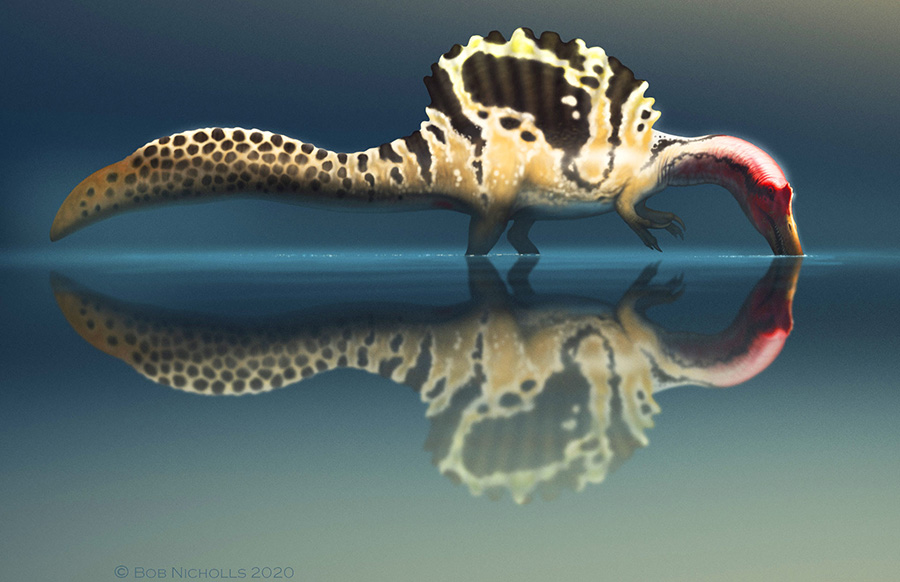
Capable of capturing both aquatic and terrestrial prey, and perhaps an opportunistic scavenger, adult Spinosaurus likely took aquatic prey by standing in shallow water or at the margins of water bodies. Image credit: Robert Nicholls.

The giant dinosaur Spinosaurus acted like modern herons or storks, taking fish and other aquatic prey from the edges of water or in shallow water, but also foraging for terrestrial prey and scavenging on occasion, according to new research by paleontologists from Queen Mary University of London, the University of Maryland and the National Museum of Natural History in Washington.

Spinosaurus is a giant theropod dinosaur that lived in what is now North Africa, about 95 million years ago (Cretaceous period).

Since its discovery in 1915, the biology and behavior of this ancient creature has puzzled paleontologists worldwide.

It was recently argued that Spinosaurus was largely a pursuit predator of aquatic prey, using its large tail to swim and actively pursue fish in the water.

The new study challenges this view, suggesting that whilst it likely fed from the water, and may have swum, it wasn’t well adapted to the life of an aquatic pursuit predator.

“The biology and ecology of Spinosaurus has been troubling paleontologists for decades,” said lead author Dr. David Hone, a paleontologist at Queen Mary University of London.

“Some recent studies have suggested that it was actively chasing fish in water but while they could swim, they would not have been fast or efficient enough to do this effectively.”

“Our findings suggest that the wading idea is much better supported, even if it is slightly less exciting.”

Dr. Hone and his colleague, Dr. Tom Holtz, compared the features of Spinosaurus with the skulls and skeletons of other dinosaurs and various living and extinct reptiles that lived on land, in the water or did both.

They found that whilst there were several pieces of evidence that contradicted the aquatic pursuit predator concept, none contradicted the wading heron-like model, and various lines of evidence actively supported it.

Spinosaurus was a bizarre animal even by dinosaur standards, and unlike anything alive today, so trying to understand its ecology will always be difficult,” Dr. Holtz said.

“We sought to use what evidence we have to best approximate its way of life. And what we found did not match the attributes one would expect in an aquatic pursuit predator in the manner of an otter, sea lion, or short-necked plesiosaur.”

Spinosaurus had fewer tail muscles than a crocodile, and due to its size would have a lot more drag in the water.

“Crocodiles are excellent in water compared to land animals, but are not that specialized for aquatic life and are not able to actively chase after fish,” Dr. Hone said.

“If Spinosaurus had fewer muscles on the tail, less efficiency and more drag then it’s h ard to see how these dinosaurs could be chasing fish in a way that crocodiles cannot.”

“Whilst our study provides us with a clearer picture of the ecology and behavior of Spinosaurus, there are still many outstanding questions and details to examine for future study and we must continue to review our ideas as we accumulate further evidence and data on these unique dinosaurs. This won’t be the last word on the biology of these amazing animals.”

The team’s paper was published online in the journal Palaeontologia Electronica.

_____

David W.E. Hone & Thomas R. Holtz, Jr. 2021. Evaluating the ecology of Spinosaurus: Shoreline generalist or aquatic pursuit specialist? Palaeontologia Electronica 24 (1): a03; doi: 10.26879/1110

Source: www.sci-news.com/

Paleontologists Find Well-Preserved Skull of Tube-Crested Dinosaur

Thursday, January 28, 2021

Life reconstruction of the head of Parasaurolophus cyrtocristatus. Image credit: Andrey Atuchin.

The exquisite preservation of a new, partial skull of Parasaurolophus cyrtocristatus, a species of duck-billed dinosaur that lived during the Cretaceous period, finally revealed the structure of its bizarre ornamental crest after decades of disagreement.

Parasaurolophus is a genus of herbivorous ornithopod dinosaurs that is most strikingly characterized by a tubular crest.

Three currently recognized species, Parasaurolophus walkeriP. tubicen, and P. cyrtocristatus, lived in what is now North America, about 76.5-73 million years ago (Cretaceous period).

Unlike Parasaurolophus walkeri and P. tubicen, which have long slightly curving crests, P. cyrtocristatus is unique in having a shorter crest that curves sharply over the back end of the skull roof.

Parasaurolophus cyrtocristatus was previously known from a single, partial specimen collected in New Mexico in 1923 by legendary fossil hunter Charles H. Sternberg.

The new skull was discovered in 2017 in the Fossil Forest Member of the Fruitland Formation in northwestern New Mexico.

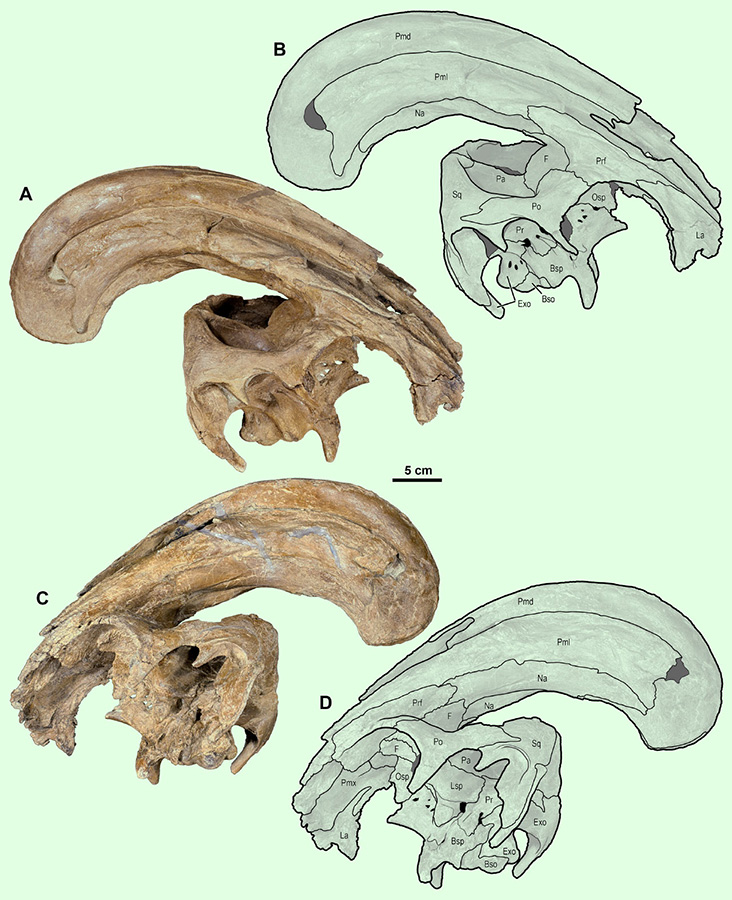
Skull of Parasaurolophus cyrtocristatus: (A) photograph of right lateral side; (B) illustration of right lateral side; (C) photograph of left lateral side; and (D) illustration of left lateral side. Abbreviations: Bso – Basioccipital; Bsp – Basisphenoid; Exo – Exoccipital; F – Frontal; La – Lacrimal; Lsp – Laterosphenoid; Na – Nasal; Osp – Orbitosphenoid; Pa – Parietal; Pmd – premaxilla dorsal process; Pml – premaxilla lateral process; Po – Postorbital; Pr – Prootic; Prf – Prefrontal; Ps – Presphenoid; Sq – Squamosal. Image credit: Gates et al., doi: 10.7717/peerj.10669.

“The preservation of this new skull is spectacular, finally revealing in detail the bones that make up the crest of this amazing dinosaur known by nearly every dinosaur-obsessed kid,” said co-author Dr. Joe Sertich, curator of dinosaurs at the Denver Museum of Nature & Science.

“This just reinforces the importance of protecting our public lands for scientific discoveries.”

“My jaw dropped when I first saw the fossil. I’ve been waiting for nearly 20 years to see a specimen of this quality,” said lead author Dr. Terry Gates, a paleontologist at North Carolina State University.

“This specimen is truly remarkable in its preservation,” said co-author Dr. David Evans, the Temerty chair in vertebrate paleontology and vice president of natural history at the Royal Ontario Museum.

“It has answered long-standing questions about how the crest is constructed and about the validity of this particular species. For me, this fossil is very exciting.”

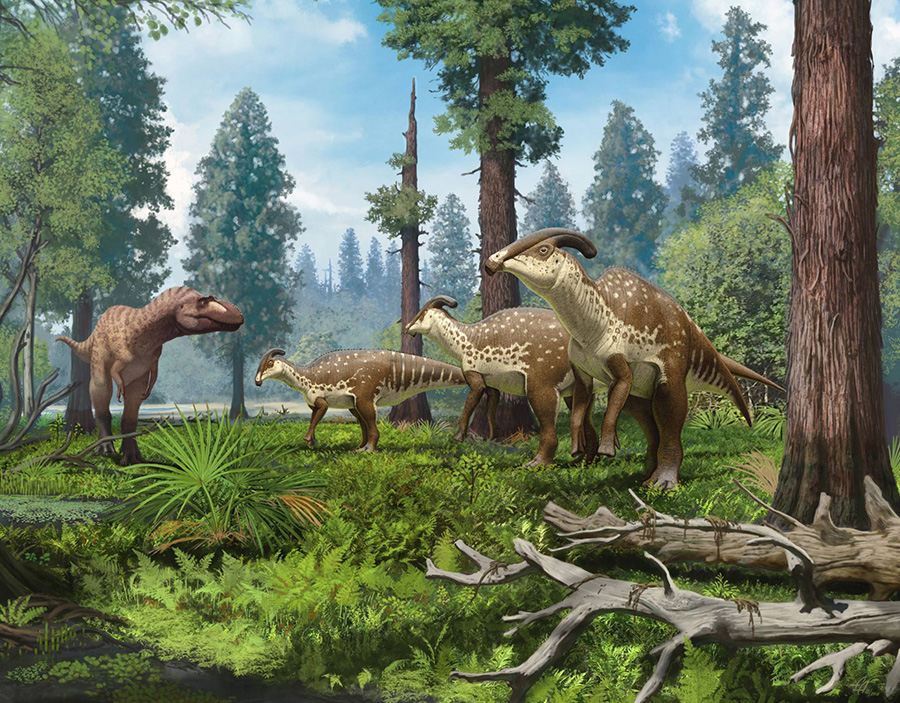
A group of Parasaurolophus cyrtocristatus being confronted by a tyrannosaurid in the subtropical forests of New Mexico 75 million years ago. Image credit: Andrey Atuchin.

About 75 million years ago, when Parasaurolophus cyrtocristatus lived in the region, North America was divided into two landmasses by a broad seaway.

Laramidia, the ribbon of land to the west, extended from today’s Alaska to central Mexico, hosting multiple episodes of mountain building in early stages of the construction of today’s Rocky Mountains.

These mountain-building events helped preserve diverse ecosystems of dinosaurs along their eastern flanks, some of the best-preserved and most continuous anywhere on Earth.

Parasaurolophus cyrtocristatus shared lush, subtropical floodplains with other, crestless duck-billed dinosaurs, a diverse array of horned dinosaurs, and early tyrannosaurs alongside many emerging, modern groups of alligators, turtles and plants.

“The skull of Parasaurolophus cyrtocristatus is still incompletely known, so more complete material will likely reveal new features that further differentiate this species and aid in determining the pace of ornamental crest evolution,” the paleontologists said.

The findings were published in the journal PeerJ.

_____

T.A. Gates et al. 2021. Description and rediagnosis of the crested hadrosaurid (Ornithopoda) dinosaur Parasaurolophus cyrtocristatus on the basis of new cranial remains. PeerJ 9: e10669; doi: 10.7717/peerj.10669

Source: www.sci-news.com/

Original Jurassic Park Trio Helped Write Jurassic World 3: Dominion Dialogue

Wednesday, January 27, 2021

Director Colin Trevorrow has revealed that Sam Neill, Laura Dern, and Jeff Goldblum helped craft the dialogue for Jurassic World 3.

Director Colin Trevorrow is bringing back Jurassic Park stars Sam Neill, Laura Dern, and Jeff Goldblum for Jurassic World 3, and the filmmaker has now revealed that the original trio were heavily involved in crafting their dialogue. Seeing as the actors first brought their respective characters to life nearly three decades ago, who better to decide what they say when they return to the screen for what could be the final time?

"These people have so many attributes, so many things about themselves that are just like Alan Grant and Ellie Sattler and Claire Dearing. It didn't end at the end of the shoot day. It didn't end on the weekend. We would write dialogue together and find ways to make sure that all of these actors, who are so deeply associated with this specific set of characters that they've played, not just felt their characters were respected but dug into who they are now."

It sounds like Trevorrow had a lot of the original Jurassic Park cast offer their own ideas when it came to dialogue, with Bryce Dallas Howard, who will reprise the role of Jurassic World's Claire Dearing in Dominion, also contributing to the script. The idea of the multi-generational ensemble cast adding their two cents to Jurassic World: Dominion was a crucial factor for Trevorrow; "It is a true ensemble of all of these people, even if they may not be side by side the whole time," says the filmmaker. "There is just something really exhilarating, just from a generational standpoint, to be able to put all of these characters into a situation where they are again having to not just survive together, but make sure that we all don't go extinct just like the dinosaurs."

Jurassic World: Dominion brings franchise heroes Dr. Ian Malcolm, Dr. Alan Grant, and Dr. Ellie Sattler into the prehistoric fray, with the characters played once again by Jeff Goldblum, Sam Neill, and Laura Dern respectively. While plot details remain under wraps, the last movie in the ongoing franchise, Jurassic World: Fallen Kingdom, ended with several different species of dinosaur now let loose upon the world, making it likely that Jurassic World: Dominion will find the legacy characters brought in to help stop the prehistoric beasts alongside Jurassic World's Bryce Dallas Howard and Chris Pratt. Pratt has even gone so far as to compare Jurassic World: Dominion to Avengers: Endgame in scope.

Trevorrow recently described Dominion as "a celebration of the whole franchise," before further explaining his approach to the final movie in the trilogy. "To me, [Dominion] is a culmination of one story that's been told," he revealed. "When you got to the end of the Jurassic Park trilogy, it may not have been as clear in what the complete story of those three movies was because they were a bit more episodic in the way that they were approached. But this trilogy is not that way. It's very much a serialized story."

Following several delays in production due to the ongoing global situation, Jurassic World: Dominion is now scheduled for theatrical release on June 10, 2022. This comes to us courtesy of The Hollywood Reporter.

Source: https://movieweb.com/

Jurassic World Introduces A New Mystery Dinosaur

Wednesday, January 27, 2021

Camp Cretaceous hints at a new mystery dinosaur's arrival. Let's take a look at what has been frozen in the underground tunnels of Jurassic World.

Jurassic World: Camp Cretaceous season 2 premiered on Netflix last weekend, and fans are already speculating about the mysterious new dinosaur hidden in an underground cryotube. As the Camp Cretaceous kids are still stranded on the island at the end of season 2, this unknown specimen poses a likely threat in future seasons. Here's what new terror the campers could be up against if Camp Cretaceous is renewed for a third season.

The specimen, simply known as E750, is mentioned in Camp Cretaceous season 1 when Brooklynn is snooping around Dr. Wu's computer in the Jurassic World lab. She finds a file entitled "E750 Clinical Trial Results." In the second season, Brooklynn finds documents labeled E750 in the now-abandoned lab facility. Later, in a control center in the underground tunnels, she discovers a door marked E750 on the security cameras. When she's busy turning the power back on, Kenji repeatedly presses a glowing green button. In another section of the tunnels, wires misfire, causing an occupied tank to thaw.

Brooklynn doesn't get a chance to investigate what's behind E750's door, but the season does end focused on that door and the newly awakened danger lurking beyond. Just before the credits roll, a screech drowns out the alarms. It sounds closest to a Velociraptor, or an amalgamation including that species' DNA. Dr. Henry Wu is known for his questionable genetic splicing practices, so it makes sense that this creation could be something in the vein of a Velociraptor. Based on the roar and the look of the specimen - it either has a spiny tail or jagged teeth - two likely possibilities are another Indoraptor or a Spinoraptor. The Indoraptor, or the big hybrid baddie in Jurassic World: Fallen Kingdom, is a volatile cross between a raptor and the Indominus Rex. Perhaps Dr. Wu had an Indoraptor brewing before the prototype we see in Fallen Kingdom, and it was cryogenically frozen to ensure the Indominus Rex was a success first.

The Spinoraptor has not been seen yet in the Jurassic Park films, but it would be a notable addition if the tank dinosaur was revealed to be this. Seen in the video games Jurassic World: The Game and Jurassic World Evolution, the Spinoraptor is a highly aggressive and intelligent Spinosaurus and Velociraptor hybrid. Judging by what is seen of the tank, it doesn't look like it's housing an excessively large specimen. The Spinoraptor is medium-sized with a long snout and a sail on its back, so it is possible that the dinosaur in that tank is another hybrid gone wrong.

Conversely, the mystery dino could also be a Gigantosaurus, which in many variations sports a spiny back and tail. It's taller and longer than the T-Rex and a formidable predator in its own right. Sam Neill, who is reprising his role as Dr. Alan Grant in Jurassic World: Dominion, revealed in an interview last year that Gigantosaurus appears in the last film, so it would make for a compelling arc if a young Gigantosaurus was introduced earlier in the animated series. Yet, it doesn't make sense for Dr. Wu to keep it so secretive or to abandon it on the island, unless it was being produced for a rival company like Mantah Corp.

Colin Trevorrow has said in interviews that Camp Cretaceous will eventually connect to Dominion, so this mystery dinosaur could be that link between the films. If the tank dinosaur is a hybrid, then it would probably need to be destroyed somewhere between the events of Camp Cretaceous and Fallen Kingdom, since Trevorrow is focusing on the traditional dinosaurs of the original trilogy rather than on Dr. Wu's specialties. Whatever E750 turns out to be, the campers of Jurassic World: Camp Cretaceous will have their hands full regardless.

Source: https://screenrant.com/

If Your Kid Can’t Get Enough Dinosaurs, They’ll Love These 15 Shows

Monday, January 25, 2021

Educational, funny, and cuter than a T-Rex's tiny arms!

It seems that every kid will, at some point in their lives, enter a dinosaur phase. Everything from toys to snacks to TV must involve dinosaurs. But our childhoods, like dinosaurs themselves, were in the prehistoric period of the '90s, and finding really good dinosaur shows for kids could be a challenge. Not only were there limited options but if you weren't parked in front of the TV at a certain time, this week's episode of Denver the Last Dinosaur* was going to pass you by.

But no longer do we need a VHS to record cool documentary about dinosaurs. Nowadays, with multiple streaming services like Hulu, Netflix, and Disney+, in addition to network and cable programming, dino-loving kids are living the sweet life. New shows are coming out all the time and, yup, the old classic ones are still available to watch today. The possibilities are endless. So much so that it can be hard to know where to begin!

To get you started, we've gathered 15 kids' shows with and about dinosaurs to get your future paleontologist started!

*available, incidentally, on the Little Amigo YouTube channel...

Dino Ranch

Disney Junior, 12:30 p.m. ET/PT and streaming on Disney Now

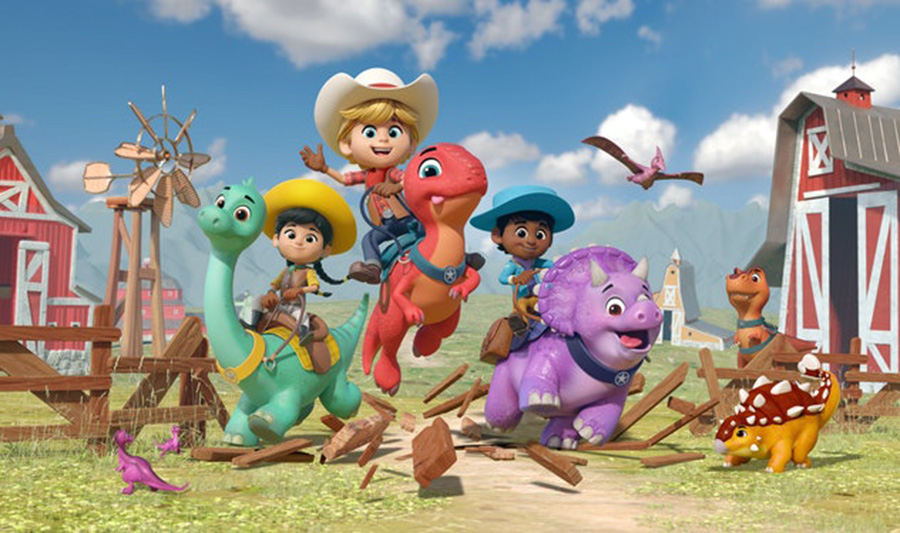
The Dino Ranch is home to siblings Jon, Min, and Miguel ... and their dinosaur friends Blitz, Clover, and TangoThis pre-historic western follows their adventures adventures... and we just might learn something along the way!

Rated TV-Y

LEGO Jurassic World: Legend of Isla Nublar

Streaming on Netflix

Jurassic Park's velociraptor handler and operations manager work together to avoid the disasters at the famous dino theme park... LEGO style!

Rated TV Y7

Harry and His Bucketful of Dinosaurs

Streaming on Amazon Prime and YouTube

When Harry receives a bucket full of toy dinosaurs, they open up a whole new world of imagination called Dino World!

Rated TV-G

Jurassic World: Camp Cretaceous

Streaming on Netflix

Six teens are excited for a summer of adventure at a camp on Isla Nublar... until the dinosaurs get loose and they must rely on one another to survive.

Rated TV-PG

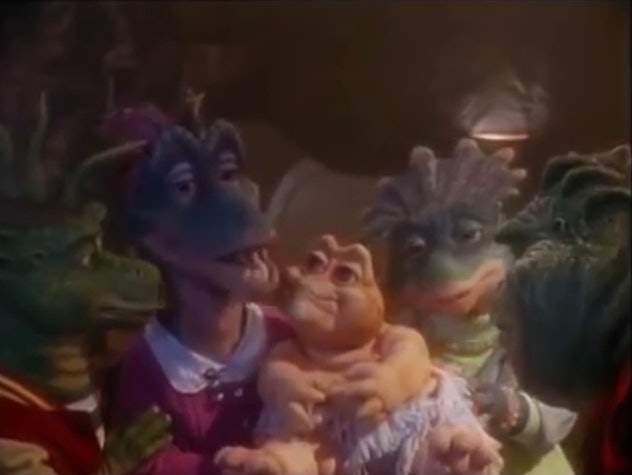
Dinosaurs

Streaming on Disney+

Earl Sinclair is a family man... erm... family dinosaur, trying to navigate the modern world of 65 million B.C. with his wife, Fran, and children, Robbie, Charlene, and baby named Baby. Every Millennial who gleefully shouted "Not the Mama!" will love sharing this classic with their kids.

Rated TV-PG

Super Dinosaur

Streaming on Amazon Prime

Derek Dynamo, a 10-year-old genius, and his best friend Super Dinosaur, a genetically engineered, hyper-intelligent Tyrannosaurus Rex who loves video games. Together, they must fight crime and protect Inner-Earth from Max Maximus.

Rated TV-Y7

Dino Dan

Streaming on Hulu with Premium Membership

Ten-year-old Dan is a future paleontologist who explains, through a blend of live-action and animation, all about dinosaurs.

Rated TV Y-7

Dino Dana

Streaming on Amazon Prime

Nine-year-old Dana loves learning about dinosaurs... until the day she realizes she can imagine them into the real world! Even better!

Rated TV-Y7

Dinosaur Train

Available on PBS Kids On Demand, PBS Kids' YouTube Channel, and streaming on Amazon Prime (Season 1 only)

Tiny, Shiny, Don, and Buddy learn about their prehistoric world — and all the different dinosaurs who inhabit it — by boarding the magical Dinosaur Train!

Rated TV-G

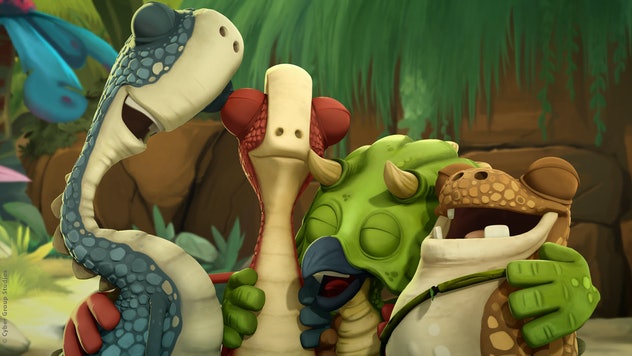
Gigantosaurus

Streaming on Netflix

Four dinosaur friends team up with you, the viewer, to discover the biggest most ferocious dinosaur of all: Gigantosaurus!

Rated TV-Y7

Dinosaur King

Streaming on Netflix

When friends Max, Rex, and Zoe discover tablets near a downed meteorite, they realize it can lead them to living dinosaurs... that is, if the evil Alpha Squad doesn't get to them first!

Rated TV-Y7

DinoCore

Streaming on Amazon Prime

Rex is a pizza delivery boy turned Dino Master. He teams up with his friends defeat Darkno from trying to conquer the universe... including peaceful Dino Island.

Rated TV-Y7

Dino the Dinosaur

Streaming on Amazon Prime

Geared toward toddler and preschoolers (and their short attention spans — each episode is only about 5 minutes), Dino the Dinosaur is all about learning as Dino and his friend Dina learn colors, shapes, numbers, and letters through play.

Rated TV-Y

Barney and Friends

Streaming on Amazon Prime

Barney is a dinosaur from our imagination who has been entertaining the preschool set for almost 30 years.

Rated TV-Y

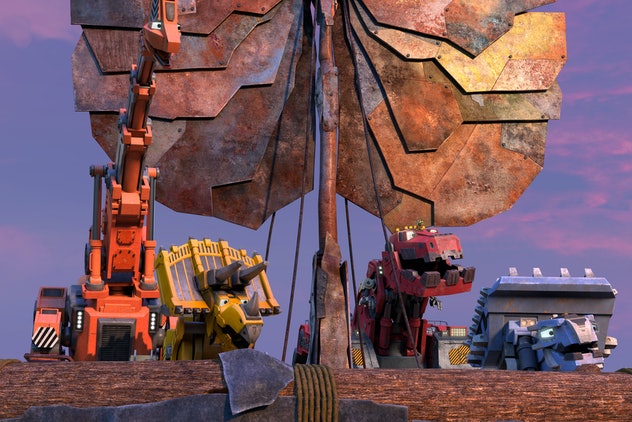
Dinotrux

Streaming on Netflix

The Dinotrux are part dinosaur, part truck, 100% every kid's dream come true. Together with the Reptools (get it?) they work together to make the world a better place and battle against the villainous D-Structs.

Rated TV-Y7

Source: www.romper.com/

The 5 Best Dinosaur Cards in Magic: The Gathering

Monday, January 25, 2021

Image via WOTC

Dinosaur cards in Magic: The Gathering are powerful and beefy creatures which usually have Trample to do excess damage to the opponent.

There are plenty of Dinosaurs to choose from to strengthen your deck. While some provide powerful effects from the get-go, others might need some time before they can unleash devastation on your opponent. Due to this, it might be difficult to choose the best Dinosaurs to play in your deck, so we’ve listed the most powerful creatures which you should include in your decks.

Here are the five best Dinosaur cards in MTG.

Ghalta, Primal Hunger

  • CMC: 12(GG)
  • Type: Legendary Creature – Elder Dinosaur
  • Stats: 12/12
  • Keyword: Trample
  • First ability: Ghalta, Primal Hunger costs X less to cast, where X is the total power of creatures you control.

Ghalta, Primal Hunger is one of the more expensive Dinosaur cards, but its 12 mana cost can be reduced if you have a lot of power on board. He is one of the strongest creatures with 12/12 stats and his Trample ability allows him to deal the excess damage to your opponent, giving them a difficult choice between blocking with a cheap creature or just letting it pass through for a lot of damage.

Overall, Ghalta is a great Dinosaur and should be included in your Dinosaur tribal decks due to how powerful it is.

Etali, Primal Storm

  • CMC: 6(RR)
  • Type: Legendary Creature – Elder Dinosaur
  • First ability: Whenever Etali, Primal Storm attacks, exile the top card of each player’s library, then you may cast any number of nonland cards exiled this way without paying their mana costs.

Etali, Primal Storm is a six mana 6/6 Dinosaur with great stats even without its additional effect. But the additional effect that allows you to exile the top card from you and your opponent every time you attack with it elevates it to another level. If you have some Scry effects, you can easily make the next draw without having to spend its mana, but even without Scry, being able to play nonland cards without a mana cost allows you to have explosive turns.

Zacama, Primal Calamity

  • CMC: 9(RGW)
  • Type: Legendary Creature – Elder Dinosaur
  • Stats: 9/9
  • Keyword: Vigilance, Reach, Trample
  • First ability: When Zacama, Primal Calamity enters the battlefield, if you cast it, untap all lands you control.
  • Second ability: Three mana cost (R), Zacama deals three damage to target creature.
  • Third ability: Three mana cost (G), Destroy target artifact or enchantment.
  • Fourth ability: Three mana cost (W), You gain three life.

Zacama, Primal Calamity is another expensive Dinosaur with 9/9 stats and great abilities. For start, it has three keywords in Vigilance, Reach, and Trample, allowing you to attack and defend every turn alongside blocking opposing Flying creatures. When you play it, you immediately regain all your mana back due to its effect, allowing for powerful turns. On top of that, this card has various abilities for a three-mana cost to deal damage, destroy an artifact, or regain life.

Regal Behemoth

  • CMC: 6(GG)
  • Type: Creature – Lizard
  • Keyword: Trample
  • First ability: When Regal Behemoth enters the battlefield, you become the monarch.
  • Second ability: Whenever you tap a land for mana while you’re the monarch, add one of mana of any color to your mana pool.

Regal Behemoth is a great six-mana cost Dinosaur with 5/5 stats and Trample. On top of this, it allows you to become the Monarch, which allows you to draw an extra card at the end of the turn. Lastly, the Regal Behemoth allows you to increase your mana with any mana color if you’re the Monarch every turn if you tap a land.

Gishath, Sun’s Avatar

  • CMC: 8(RGW)
  • Type: Legendary Creature – Dinosaur Avatar
  • Stats: 7/6
  • Keywords: Trample, Vigilance, Haste
  • First ability: Whenever Gishath, Sun’s Avatar deals combat damage to a player, reveal that many cards from the top of your library.
  • Second ability: Put any number of Dinosaur creature cards from the first ability onto the battlefield and the rest on the bottom of your library in a random order.

Gishath, Sun’s Avatar is an amazing Dinosaur for it’s eight-mana cost, boasting 7/6 stats and three keywords such as Trample, Vigilance, and Haste. On top of it, if you deal combat damage to the opponent, you can look at the top of your library and summon Dinosaur creatures revealed onto the battlefield allowing you to create a wide board which might prove to be to difficult for your opponent to deal with.

Source: https://dotesports.com/

Fossilized Skull Reveals How Crested Dinosaur Got Its Fancy Headgear

Tuesday, January 26, 2021

An illustration of the head of Parasaurolophus cyrtocristatus based on newly discovered remains.

First discovered in 1922 and best known for its distinctive crest, Parasaurolophus is one of the most recognizable dinosaurs -- a staple of childhood books and a background player in the Jurassic Park movie franchise.

An exceptionally well-preserved fossilized skull found in New Mexico in 2017 -- the first to be found in 97 years -- has revealed new details about its bizarre Elvis-style pompadour. Its analysis has allowed paleontologists to definitively identify how such a structure grew on this dinosaur.

"Imagine your nose growing up your face, three feet behind your head, then turning around to attach above your eyes. Parasaurolophus breathed through eight feet of pipe before oxygen ever reached its head," said Terry Gates, a paleontologist from North Carolina State University's department of biological sciences, in a news statement.

The hollow tube on its head contained an internal network of airways and acted a bit like a trumpet.

"Over the past 100 years, ideas for the purpose of the exaggerated tube crest have ranged from snorkels to super sniffers," said David Evans, the Temerty chair in vertebrate palaeontology at the Royal Ontario Museum in Canada.

New skull of Parasaurolophus as originally exposed in the badlands of New Mexico.

"But after decades of study, we now think these crests functioned primarily as sound resonators and visual displays used to communicate within their own species."

The animal would have lived about 75 million years ago -- a time when North America was divided by a shallow sea and many duck-billed dinosaurs, horned dinosaurs and early tyrannosaurs would have roamed the land.

"The preservation of this new skull is spectacular, finally revealing in detail the bones that make up the crest of this amazing dinosaur known by nearly every dinosaur-obsessed kid," said Joe Sertich, curator of dinosaurs at the Denver Museum of Nature & Science and the leader of the team who discovered the specimen.

Sertich and his team discovered the partial skull in 2017 while exploring the badlands of northwestern New Mexico. Only a tiny portion of the skull was visible on a steep sandstone slope, and the volunteers were surprised to find the crest intact. Bone fragments found at the site indicated that much of the skeleton may have once been preserved on an ancient sand bar, but only the partial skull, part of the lower jaw, and a handful of ribs survived erosion.

The skull belonged to Parasaurolophus cyrtocristatus, previously known from a single specimen collected in the same region of New Mexico in 1923 by legendary fossil hunter Charles H. Sternberg. It has a shorter, more curved crest than other species of this dinosaur -- although this may be related to its age at death. There are three species of Parasaurolophus currently recognized, with fossils found in New Mexico and Alberta and dating between 77 million and 73.5 million years ago.

An illustration of a group of Parasaurolophus dinosaurs being confronted by a tyrannosaurid in the subtropical forests of New Mexico 75 million years ago.

"It has answered long-standing questions about how the crest is constructed and about the validity of this particular species. For me, this fossil is very exciting," said Evans, who has also worked on unraveling the mysteries of this dinosaur for almost two decades.

The research was published in the journal PeerJ.

Source: https://edition.cnn.com/

Jurassic Park Characters Continue To Make The Same Dumb Mistake

Sunday, January 24, 2021

Jurassic World: Camp Cretaceous season 2 shows its characters continuing to make the same absurd mistake other characters have made in the past.

One of the biggest mistakes so many characters make in the Jurassic Park and Jurassic World series is yelling on the islands, which is noticeable again in Jurassic World: Camp Cretaceous season 2. When it comes to being chased by velociraptors and being confronted up close by a T-rex, it's not easy for people to keep their cool, so they scream. It's a normal response when faced with a dinosaur that dominated the food chain millions of years before.

However, there's a difference between screaming out of fear and yelling or shouting, especially when it's avoidable. This was pointed out by Dr. Alan Grant in Jurassic Park 3 when Amanda Kirby used a megaphone to call out for her son, Eric. Alan noted that it was a very bad idea, which, of course, it was, because it would attract dinosaurs. Then in Jurassic World, Owen Grady stopped Claire Dearing from shouting for her nephews, Zach and Gray, at the waterfall the Indominus Rex was just at. Shouting in terrible situations is a common problem and Camp Cretaceous season 2 proves it once again.

Throughout season 2, whenever the kids aren't around dinosaurs, they act somewhat normal and begin yelling. It was noticeable at the start of the season, but especially so when they reach the photographers' campsite. They treat it like it's a green zone when it's really just as perilous as any other area. Then again, when Ben wakes up in his solo episode, he begins shouting for help, which, of course, attracts a large group of Compies that terrorize him for weeks.

On one hand, the kids in Camp Cretaceous could be forgiven for shouting since they're not professionals, but on the other hand, they were selected to attend a unique camp at Jurassic World to learn about the animals there, not to mention the fact that they've had to sneak around multiple times to avoid more deadly dinosaurs. So they should be aware of what to do and, more importantly, what not to do in most situations, such as yelling. Perhaps one day they will learn, because based on how Camp Cretaceous season 2 ends, they will be on the island for some time.

With one more Jurassic World film on the way, Jurassic World: Dominion, the franchise has one more shot at having its characters be smarter. Beyond the shouting, it's almost guaranteed that certain characters will find themselves in absurd situations simply because it serves to push the movie forward. This is something the original Jurassic Park movie avoided, because everything everyone did was true to their character and it made sense for the circumstances they were in.

Source: https://screenrant.com/

Pages