Blogs

Pentaceratops

Saturday, April 1, 2017

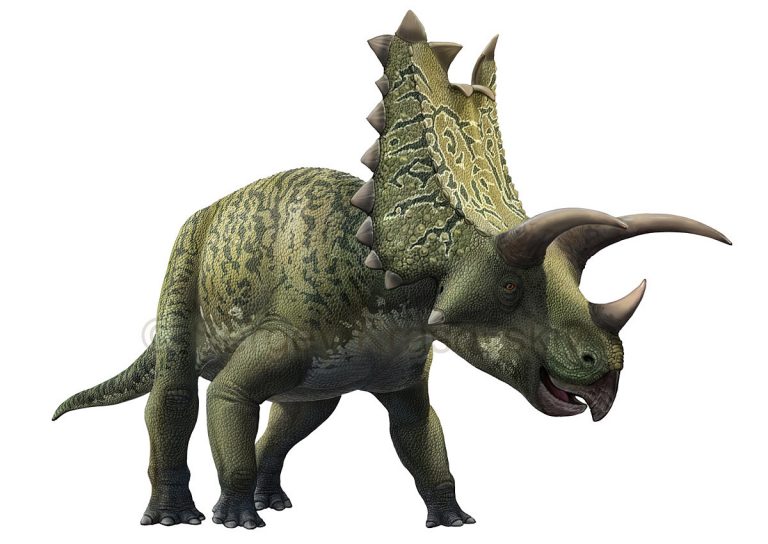
Pentaceratops by Sergey Krasovskiy

Pentaceratops (“five-horned face”) is a genus of herbivorous ceratopsid dinosaur from the late Cretaceous Period of what is now North America.

Pentaceratops fossils were first discovered in 1921. The genus was named in 1923 when its type species Pentaceratops sternbergii was described. Pentaceratops lived around 76–73 million years ago, its remains having been mostly found in the Kirtland Formation in the San Juan Basin in New Mexico. About a dozen skulls and skeletons have been uncovered, so that most bones are known. One exceptionally large specimen later became its own genus, Titanoceratops, due to its more derived morphology closer to Triceratops and lack of unique characters shared with Pentaceratops proper, although the author that originally assigned it to Pentaceratops has decided to ignore this in subsequent publications.
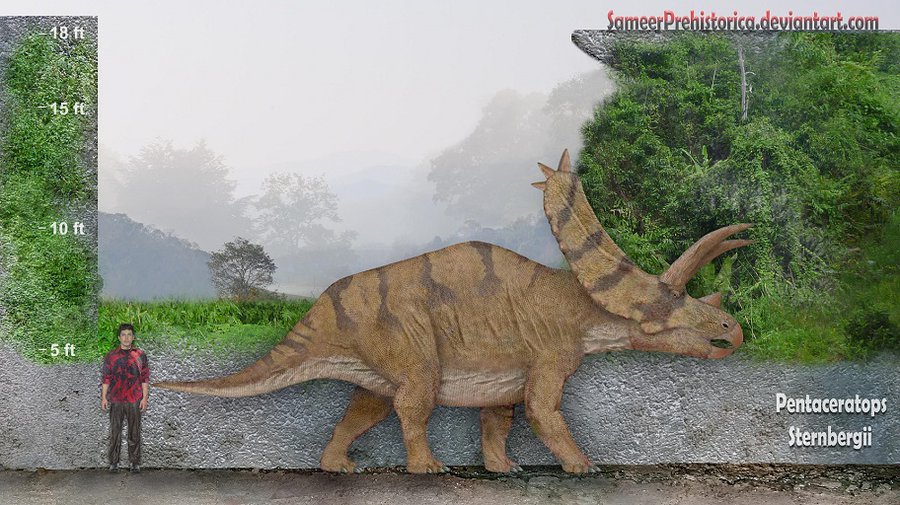
Pentaceratops by SameerPrehistorica

Pentaceratops was about six meters (twenty feet) long, and has been estimated to have weighed around five tonnes. It had a short nose horn, two long brow horns, and long horns on the jugal bones. Its skull had a very long frill with triangular hornlets on the edge.

Pentaceratops is a large ceratopsid, Dodson estimated the body length at six meters, the skull length of AMNH 1624 at 2.3 meters while PMU R.200 has a length of 216 centimeters. The nose horn of Pentaceratops is small and pointing upwards and backwards. The brow horns are very long and curving strongly forwards. The somewhat upward tilted frill of Pentaceratops is considerably longer than that of Triceratops, with two large holes (parietal fenestrae) in it. It is rectangular, adorned by large triangular osteoderms: up to twelve episquamosals at the squamosal and three epiparietals at the parietal bone. These are largest at the rear corners of the frill, that are separated by a large U-shaped notch at the midline, a feature not recognized until 1981 when specimen UKVP 16100 was described. Within the notch the first epiparietals point forwards. The very thick jugal and the squamosal do not touch each other, a possible autapomorphy.

The torso of Pentaceratops is tall and wide. The rear dorsal vertebrae bear long spines from which perhaps ligaments ran to the front, to balance the high frill. The prepubis is long. The ischium is long and strongly curves forward. With the smaller specimens the thigh bone bows outwards.

The species was named and described by Henry Fairfield Osborn in 1923, as Pentaceratops sternbergii. The generic name means “five-horned face”, derived from the Greek penta (πέντα, meaning five), keras (κέρας, horn) and -ops (ὤψ, face), in reference to its two long epijugal bones, spikes which protrude out sidewards from under its eyes, in addition to the three more obvious horns as with Triceratops. Osborn obligingly gave it the specific name sternbergii honoring its discoverer as a veteran fossil hunter. The name had been suggested to Osborn by William Diller Matthew; the specific epithet served as a consolation to the almost bankrupt Sternberg whose 1923 fossils were initially not acquired by the museum that had to use its 1923/1924 budget to process the finds of the great Asian expeditions by Roy Chapman Andrews.
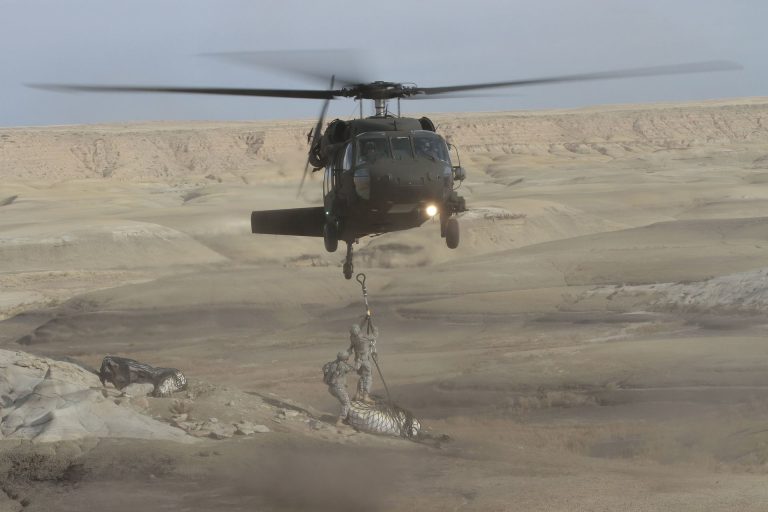
Specimen being airlifted with help from the New Mexico National Guard, 2015

The holotype was the skull discovered by Sternberg in 1922, specimen AMNH 6325. It was found in a layer of the Fruitland Formation, dating from the Campanian, about seventy-five million years old. The other three AMNH specimens were AMNH 1624, a smaller skull; AMNH 1622, a pair of brow horns; and AMNH 1625, a piece of skull frill.

Osborn originally assigned Pentaceratops to the Ceratopsia. Within this group Pentaceratops belonged to the Ceratopsinae or Chasmosaurinae. It appears to be most closely related to Utahceratops. Their clade was perhaps more derived than the earlier genus Chasmosaurus but more basal than Anchiceratops, the latter representing a line of which Triceratops was a member, which lived a few million years later, right at the end of the Cretaceous period, when all ceratopsians died out.
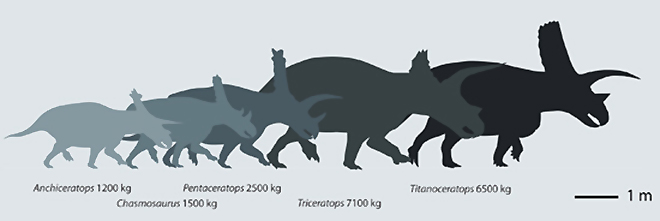
Nicholas Longrich/Yale University

Pentaceratops, like all ceratopsians, was an herbivore. During the Cretaceous, flowering plants were “geographically limited on the landscape”, and so it is likely that this dinosaur fed on the predominant plants of the era: ferns, cycads and conifers. It would have used its sharp ceratopsian beak to bite off the branches which then were shredded, leaves, needles and all, by the tooth batteries, providing a self-sharpening continuous cutting edge in both upper an lower jaws. Ultimately the plant material was digested by the large gut.

Pentaceratops lived around 76–73 million years ago, its remains having been mostly found in the Kirtland Formation in the San Juan Basin in New Mexico. Other dinosaurs which shared its habitat include Parasaurolophus cyrtocristatus, the pachycephalosaur Sphaerotholus, the armored dinosaur Nodocephalosaurus and the tyrannosauroid Bistahieversor.

Shantungosaurus

Saturday, April 1, 2017

Shantungosaurus by PaleoGuy on DeviantArt

Shantungosaurus, meaning “Shandong Lizard”, is a genus of saurolophine hadrosaurid dinosaurs found in the Late Cretaceous Wangshi Group of the Shandong Peninsula in China. The stratigraphic interval of Shantungosaurus ranges from the top of the Xingezhuang Formation to the middle of the Hongtuya Formation, middle to late Campanian in age. Shantungosaurus is so far the largest hadrosauroid taxon in the world: the greatest length of its femur is about 1.7 m, and the greatest length of its humerus is about 0.97 m.

Shantungosaurus giganteus is one of the largest known ornithischians, the type skull is 1.63 metres (5.3 ft) long and the composite skeleton mounted at the Geological Institute of China in Beijing measures 14.7 metres (48 ft) in length while another mounted skeleton, originally referred to “Zhuchengosaurus maximus”, measures 16.6 metres (54 ft) in length. The largest individuals may have weighted as much as 16 tonnes (18 short tons). Like all hadrosaurs its beak was toothless, but its jaws were packed with around 1,500 tiny chewing teeth. A large hole near its nostrils may have been covered by a loose flap of skin, which could be inflated to make sounds.

Shantungosaurus (blue) compared with other giant ornithopods. Scale diagram of the largest known ornithopod dinosaurs, compared in size with a human. Each grid section represents 1 square meter. Blue: Shantungosaurus giganteus (type specimen). Red: Magnapaulia laticaudus (LACM 17712). Violet: Anatosaurus annectens (specimen MOR 003). Green: Edmontosaurus regalis (specimen USNM 12711). Adapted from illustrations and scale diagrams by ArthurWeasley, Dropzink, and Prieto-Márquez et al. 2012

First described in 1973, Shantungosaurus is known from over five incomplete skeletons. Chinese scientist Xing Xu and his colleagues indicate that Shantungosaurus is very similar to and shares many unique characters with Edmontosaurus, forming an Asian node of an EdmontosaurusShantungosaurus clade, based on the new materials recovered in Shandong. Remains of several individuals, including skull bones, limb bones, and vertebrae, were found in Shandong, China. These specimens were classified in the new genus and species Zhuchengosaurus maximus in 2007. However, further study showed that the supposedly distinct features of Zhuchengosaurus were simply a result of different growth stages.

Restored skeletons

Recent maximum parsimony analyses of Hadrosauroidea recovered a stable sister group relationship between Edmontosaurus and ShantungosaurusShantungosaurus is the single hadrosaurid from the Zhucheng area that is considered valid. Zhuchengosaurus and Huaxiaosaurus, both of which are known from the same region, are interpreted here as junior synonyms of Shantungosaurus. All unequivocal morphological discrepancies among these three taxa could be attributed to intraspecific variation (ontogenetic and polymorphic variation) and post-depositional distortion.

Lythronax

Friday, March 31, 2017

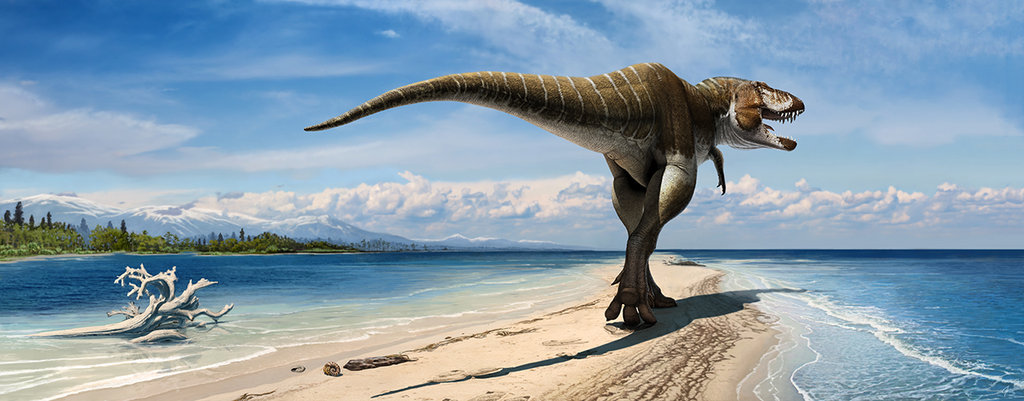
Lythronax on a sand spit near the east coast of Laramidia. By Olorotitan on DeviantArt

Lythronax is a genus of tyrannosaurid theropod dinosaur that lived around 80.6 to 79.9 million years ago in what is now southern Utah, USA. The generic name is derived from the Greek words lythron meaning “gore” and anax meaning “king”. Lythronax was a large sized, moderately-built, ground-dwelling, bipedal carnivore that could grow up to an estimated 8 m (26.2 ft) in length and weighed 2.5 tonnes (5,500 lb).

L. argestes is the oldest known tyrannosaurid, based on its stratigraphic position. It is known from a specimen thought to be from a single adult that consists of a mostly complete skull, both pubic bones, a tibia, fibula, and metatarsal II and IV from the left hindlimb, as well as an assortment of other bones. Its skull anatomy indicates that, like TyrannosaurusLythronaxhad both eyes facing the front, giving it depth perception.

Reconstructed skeleton of Lythronax

It has been estimated that Lythronax would have been about 7.3 m (24.0 ft) long, with a weight of around 2.5 tonnes (5,500 lb), based on comparisons to close relatives, and had a large skull filled with sharp teeth. The rostrum of its skull is comparatively short, since it makes up less than two thirds of the total skull length. The whole skull is very broad, and is only about 2.5 times as long as it is wide. Overall, the skull is morphologically most similar to that of Tyrannosaurus and Tarbosaurus. Its robust maxilla possessed a heterodont dentition, as its first five teeth are a lot larger than the other six. Like other tyrannosaurids, Lythronax has large, distally expanded pubic boot which is approximately 60% the length of the pubic bone. The postcranial morphology is similar to that of other tyrannosaurids.

Lythronax is known from the most complete tyrannosaurid specimen discovered from southern Laramidia. The careful excavation took nearly a year. This specimen is housed in the collection of Natural History Museum of Utah in Salt Lake City, Utah. The holotype specimen UMNH VP 20200 was recovered in the UMNH VP 1501 locality of the Wahweap Formation at Grand Staircase-Escalante National Monument (GSENM), in Kane County, southern Utah. It was discovered in 2009 and collected from the lower part of the middle member of this formation in terrestrial sediments. The sediments were radioisotopically dated as being 79.6 to 80.75 million years old, meaning that Lythronax is approximately 80 million years old. Based on its stratigraphic position, L. argestes is the oldest tyrannosaurid dinosaur discovered so far.

Skeletal reconstructions of Lythronax, the yellow bones at top showing known elements. Art by Scott Hartman

Lythronax was named for its likeness to Tyrannosaurus. Loewen et al. wanted to symbolize that the fossil was alike in most features to the much later tyrannosaurid. They decided to keep the ‘king’ in the name and without using ‘rex’, named it Lythronax, the “Gore King”, accordingly. For the specific name they agreed to use argestes, relating to the area where the fossil was found, southwest Utah. The generic name is derived from the Greek λύθρον, lythron, ‘gore’ and ἄναξ, anax, ‘king’. The specific name is the Greek ἀργεστής, “clearing”, used by the poet Homer as the epithet of the southwind.

Lythronax argestes belongs to the family Tyrannosauridae, a family of large-bodied coelurosaurs, with most genera known from North America and Asia. A detailed phylogenetic analysis, based on 303 cranial and 198 postcranial features, places it and Teratophoneus within Tyrannosaurinae. Lythronax is a sister taxon of a clade consisting of the Maastrichtian taxa Tarbosaurus and Tyrannosaurus and the late Campanian ZhuchengtyrannusLythronax probably was not a direct ancestor of Tyrannosaurus. If not, they clearly shared a common ancestor that was even older than Lythronax.

A 2013 study edited by Alan L. Titus and Mark A. Loewen on dinosaurs of southern Utah suggested the separation of TeratophoneusBistahieversor and Lythronax (UMNH VP 20200 – the Waheap tyrannosaurid). That means that there are three or more tyrannosaurid taxa present in the Western Interior Basin. Their analysis found that the three southern tyrannosaurid form a clade to the exclusion of other tyrannosaurids from northern Campanian formations.

The Wahweap Formation has been radiometrically dated as being between 81 and 76 million years old. During the time that Lythronax lived, the Western Interior Seaway was at its widest extent, almost completely isolating southern Laramidia off from the rest of North America.

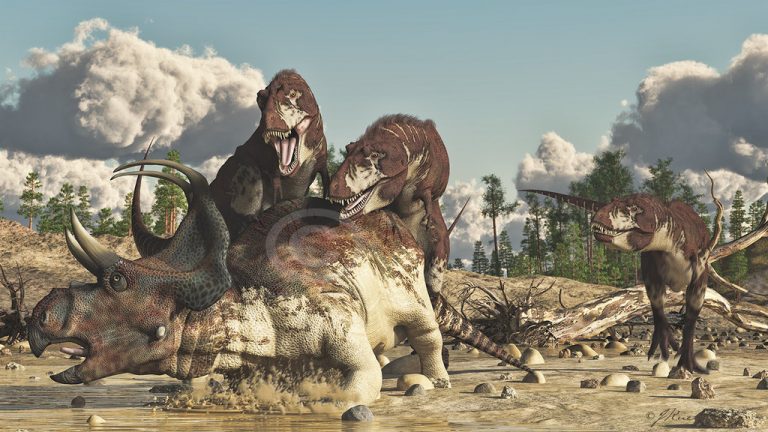
Lythronax vs Machairoceratops by paleoguy

Lythronax shared its paleoenvironment with other dinosaurs, such as the hadrosaur Acristavus gagslarsoni and lambeosaur Adelolophus hutchisoni, the ceratopsian Diabloceratops eatoni, and unnamed ankylosaurs and pachycephalosaurs. Vertebrates present in the Wahweap Formation at the time of Lythronax included freshwater fish, bowfins, abundant rays and sharks, turtles like Compsemys, crocodilians, and lungfish. A fair number of mammals lived in this region, which included several genera of multituberculates, cladotherians, marsupials, and placental insectivores.

Yutyrannus

Friday, March 31, 2017

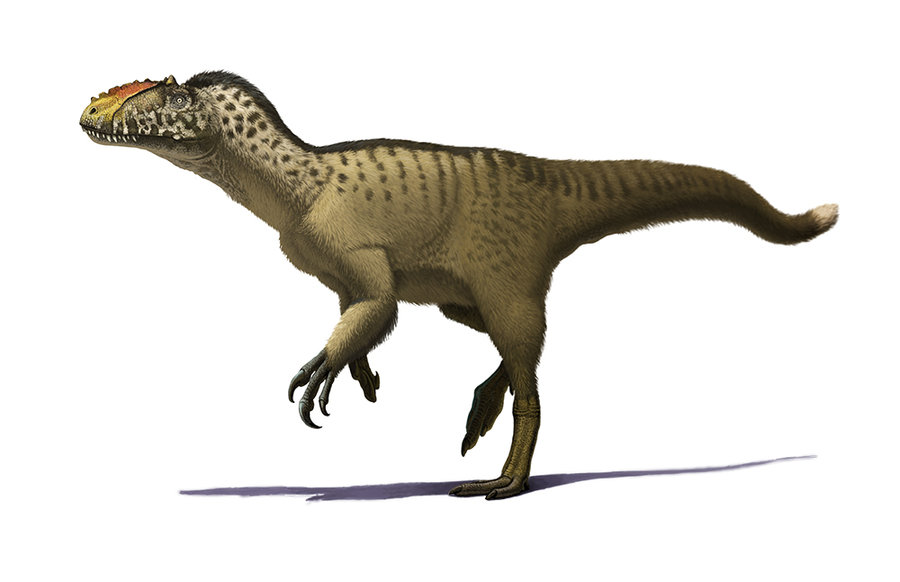
Yutyrannus by Olorotitan on DeviantArt

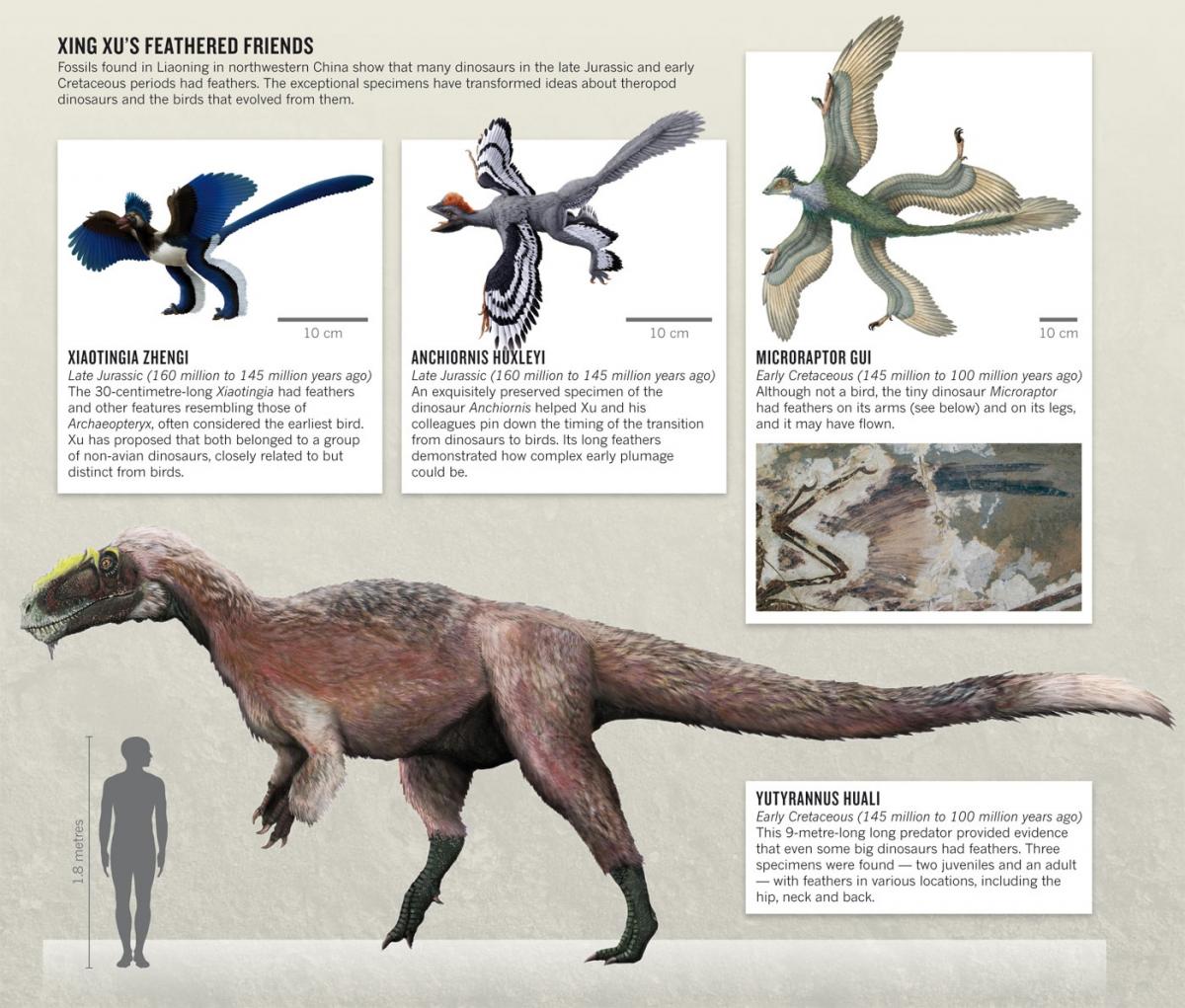
Yutyrannus (meaning “feathered tyrant”) is a genus of tyrannosauroid dinosaurs which contains a single known species, Yutyrannus huali. This species lived during the early Cretaceous period in what is now northeastern China. Three fossils of Y. huali – all found in the rock beds of Liaoning Province – are currently the largest known dinosaur specimens that preserve direct evidence of feathers.

Yutyrannus huali was named and scientifically described in 2012 by Xu Xing et al. The name is derived from Mandarin Chinese  (羽, “feather”) and Latinised Greek tyrannos (τύραννος, “tyrant”), a reference to the classification as a feathered member of the Tyrannosauroidea. The specific name consists of the Mandarin huáli (华丽(simplified, 華麗 traditional, “beautiful”), in reference to the beauty of the plumage.

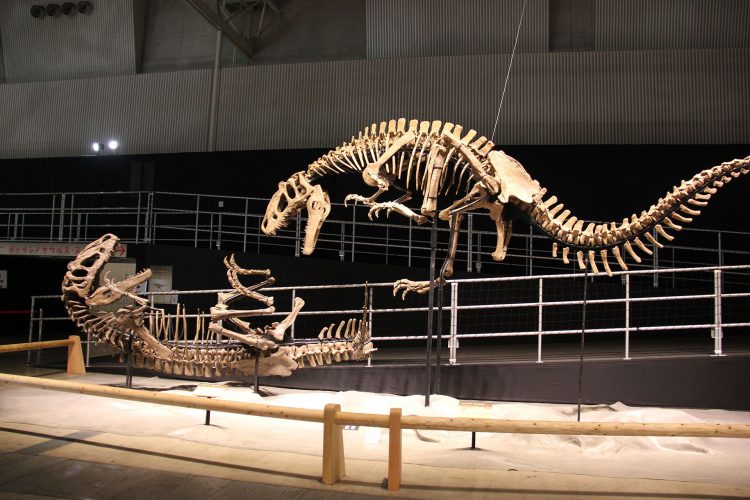
Restored skeletons mounted in fighting poses by Laika ac

Yutyrannus is known from three nearly complete fossil specimens (an adult, a subadult and a juvenile) acquired from a fossil dealer who claimed all three had their provenance in a single quarry at Batuyingzi in Liaoning Province, China. They thus probably were found in a layer of the Yixian Formation, dating from the Aptian, approximately 125 million years old. The specimens had been cut into pieces about the size of bath mats, which could be carried by two people.

Xing Xu's feathered dinosaur discoveries in China, including Yutyrannus Huali, a large predator (three specimens: one adult 9m long and two juveniles with feathers on neck, hips, and back. X. ZHENGI: XING LIDA/LIU YI; A. HUXLEYI: J. T. CSOTONYI/SPL; M. GUI RECONSTRUCTION: P. SLOAN; M. GUI PHOTOGRAPH: REF. 3; Y. HUALI: BRIAN CHOO

The holotype, ZCDM V5000, is the largest specimen, consisting of a nearly complete skeleton with skull, compressed on a slab, of an adult individual. The paratypes are the two other specimens: ZCDM V5001 consisting of a skeleton of a smaller individual and part of the same slab as the holotype; and ELDM V1001, a juvenile estimated to have been eight years younger than the holotype. The fossils are part of the collections of the Zhucheng Dinosaur Museum and the Erlianhaote Dinosaur Museum but have been prepared by the Institute of Vertebrate Paleontology and Paleoanthropology, under guidance of Xu.

Maxakalisaurus

Thursday, March 30, 2017

Maxakalisaurus skeleton

Maxakalisaurus is a genus of aeolosaurid dinosaur, found in Brazil, 45 kilometers (28 miles) from the city of Prata, in the state of Minas Gerais in 1998. It was related to Saltasaurus, a sauropod considered unusual because it had evolved apparently defensive traits, including bony plates on its skin and vertical plates along its spine; such osteoderms have also been found for Maxakalisaurus. The genus name is derived from the tribe of the Maxakali; Topa is one of their divinities.

Comparisons between Brazilian dinosaurs, from smallest to largest: gondwanatitan (8 meters), maxakalisaurus (13 meters) and Austroposeidon magnificus (25 meters).

The type specimen of Maxakalisaurus belonged to an animal about 13 meters (43 feet) long, with an estimated weight of 9 tons, although, according to paleontologist Alexander Kellner, it could have reached a length of approximately 20 meters (66 feet). It had a long neck and tail, ridged teeth (unusual among sauropods) and lived about 80 million years ago. Because sauropods seem to have lacked significant competition in South America, they evolved there with greater diversity and more unusual traits than elsewhere in the world.

“This is the biggest dinosaur yet described in Brazil,” said Alexander Kellner, lead author of the scientific description. “We have found the bones of what appear to be larger dinosaurs, but we still haven’t been able to put them together for scientific descriptions.”

Temporal and geographic distribution of Brazilian Cretaceous Sauropods.

In 2016, a new specimen comprising a dentary and teeth was described as belonging to Maxakalisaurus. The phylogenetic analysis recovered Maxakalisaurus as an aeolosaurine along with Aeolosaurus and Gondwanatitan.

Pycnonemosaurus

Thursday, March 30, 2017

Pycnonemosaurus nevesi by atrox1 on DeviantArt

Pycnonemosaurus (meaning ‘thick forest lizard’) is a genus of carnivorous theropod dinosaur that belonged to the family Abelisauridae. It was found in the Upper Cretaceous Bauru-type red conglomerate sandstone, Mato Grosso, Brazil, and it lived about 70 million years ago during the Late Cretaceous (Maastrichtian stage). Initial size estimations put this animal at 7 metres (23 ft) in length, but later analyses have found that it was likely larger, being about 8.9 metres (29.2 ft) long. This new size estimate currently makes Pycnonemosaurus the largest formally described member of the Abelisauridae thus far.

Size comparison of the Carnotaurus (left to right) Carnotaurus, Abelisaurus, Pycnonemosaurus, Aucasaurus and Quilmesaurus. Basis for all skeletons is Carnotaurus skeletal by Jaime Headden (on commons) with modified proportions and heads to fit other taxa. Author: IJReid

Thus far, the remains of Pycnonemosaurus have been fragmentary. No elements were well preserved, and the bone surface is well abraded that indicates the elements were partially exposed at the discovery location before being collected. The type specimen (DGM 859-R), housed at the Earth Sciences Museum, Rio de Janeiro, consists of five incomplete teeth, parts of seven caudal vertebrae, the distal part of a right pubis, a right tibia, and the distal articulation of the right fibula. The small pubic foot and hatchet-shaped cnemial crest of the tibia distinguishes this species within the abelisaurs. The caudal vertebra has distinct abelisaurid features, such as a fan-shaped transverse process and a cranial projection. However, these awl-like projections are somewhat unlike related abelisaurids, such as Aucasaurus, in that they diminish more towards the distal caudals. All remains were found associated and are presently regarded as belonging to the same individual.

Pycnonemosaurus and Maxakalisaurus by maurilio

Initial size estimates put the animal at 7 metres (23 ft) in length and 1.2 tonnes in weight (1.3 short tons),[1] but later analyses have found that it was likely larger, being about 8.9 metres (29.2 ft) long. This new size estimate currently makes Pycnonemosaurus the largest formally described member of the Abelisauridae thus far. Another estimation gave a length of 9.3 meters (30.5 feet) and a weight of 3.6 tonnes (~4 short tons).

Pycnonemosaurus is the best known abelisaurid from Brazil, where most theropod material is presently rare besides preserved teeth and footprints. Even though only a few species are known from Brazil, it is one of the most informative countries concerning the Lower Cretaceous period.

The Cast of ‘The Lost World: Jurassic Park’ Then and Now

Wednesday, March 29, 2017

The Cast of ‘The Lost World: Jurassic Park’ Then and Now

In 1997, Steven Spielberg unleashed ‘The Lost World: Jurassic Park,’ the sequel to the wildly successful box office smash ‘Jurassic Park,’ following Dr. Ian Malcolm (Jeff Goldblum) and a team of experts as they investigate a second island where the dinosaurs from the first film were secretly engineered. The film broke several box office records, and became the second highest-grossing film of all time, just behind ‘Titanic.’ Twenty years later, we revisit the cast of this awesome sequel and see what they’re up to now.

Jeff Goldblum, Dr. Ian Malcolm

Universal/Getty Images

Then: Jeff Goldblum reprised his role from the first film as Dr. Ian Malcolm, a mathematician and chaos theorist who is called upon by Jurassic Park creator John Hammond to head to Isla Sorna, the sister island of Isla Nubar, to document the dinosaurs still living there.

Now: Goldblum since appeared in such films as ‘Igby Goes Down,’ Wes Anderson’s ‘The Life Aquatic with Steve Zissou’ and ‘Morning Glory.’ He starred on the short-lived network series ‘Raines,’ and has had recurring roles on ‘The League,’ ‘Portlandia’ and ‘Glee.’ You can see him next in ‘Le Week-End’ and reuniting with director Wes Anderson in ‘The Grand Budapest Hotel.’ Director Roland Emmerich said the actor will also return for the ‘Independence Day’ sequel to reprise his role as David Levinson, and he’ll also return to guest in ‘Portlandia’ season 4.

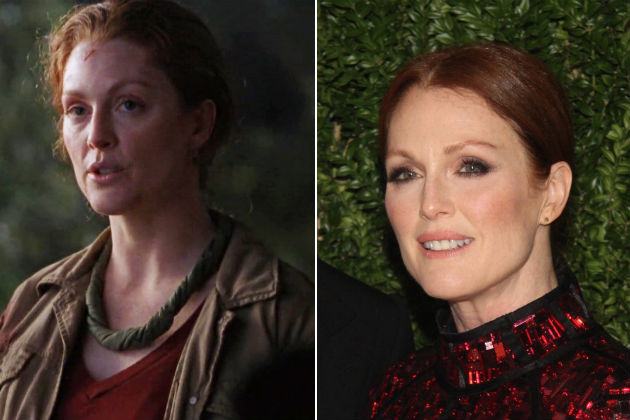
Julianne Moore, Dr. Sarah Harding

Universal/Getty Images

Then: Julianne Moore played Dr. Sarah Harding, Ian Malcolm’s girlfriend and a behavioral paleontologist whom John Hammond sends to join the expedition to Isla Sorna against Ian’s wishes. Moore’s star was on the rise at the time — she was also featured in Paul Thomas Anderson’s ‘Boogie Nights’ that same year.

Now: Moore went on to appear in the films ‘The Big Lebowski,’ ‘Magnolia,’ ‘Hannibal,’ ‘Children of Men’ and ‘A Single Man,’ among many others on her lengthy and impressive resume. More recently, she appeared in the films ‘What Maisie Knew,’ ‘Don Jon’ (directed by and starring Joseph Gordon-Levitt) and the remake of ‘Carrie.’ She can be seen next in ‘Non-Stop’ with Liam Neeson, which hits theaters this week, and in both parts of ‘The Hunger Games: Mockingjay’ films.

Vince Vaughn, Nick Van Owen

Universal/Getty Images

Then: Vince Vaughn had only recently become someone to watch with roles in ‘Rudy’ and ‘Swingers’ when he was cast as Nick Van Owen, environmentalist and documentarian along for the ride to Isla Sorna.

Now: Vaughn reunited with Julianne Moore a year later in the remake of ‘Psycho,’ but he’s known better for his quick-talking comedic style in films like ‘Old School,’ ‘Starsky and Hutch,’ ‘Dodgeball,’ ‘Wedding Crashers,’ ‘The Break-Up’ (which he also wrote) and ‘Couples Retreat.’ His more recent credits include leading roles in ‘The Dilemma,’ ‘The Watch,’ ‘The Internship’ (which he also wrote and produced) and ‘Delivery Man,’ and he reprised his cameo role as Wes Mantooth in ‘Anchorman 2: The Legend Continues.’ Next on the docket are two Vince Vaughn-sounding titles, ‘Business or Pleasure’ and ‘Term Life.’

Arliss Howard, Peter Ludlow

Universal/Getty Images

Then: Arliss Howard played Peter Ludlow, John Hammond’s nephew who takes over InGen as acting CEO and plans to open a new park on Isla Sorna unless Ian Malcolm and his team can help stop him. Howard, previously known for his role in ‘Full Metal Jacket,’ also appeared in Steven Spielberg’s ‘Amistad,’ which was also released in 1997.

Now: Howard appeared in the films ‘Birth,’ ‘The Time Traveler’s Wife’ and ‘Moneyball.’ He starred on the hit series ‘Medium’ from 2005 to 2007, and on the short-lived AMC series ‘Rubicon.’ More recently he played the nefarious Governor Truman Burell on the HBO series ‘True Blood.’

Richard Schiff, Eddie Carr

Universal/Getty Images

Then: Richard Schiff played Eddie Carr, a cynical field equipment expert on the team documenting dinosaurs on Isla Sorna. Spielberg cast Schiff after noticing his performance on the TV series ‘High Incident.’

Now: Schiff went on to star on Aaron Sorkin’s acclaimed White House drama series ‘The West Wing’ from 1999 to 2006. He appeared in the films ‘What’s the Worst That Could Happen,’ ‘Ray’ and more recently ‘Man of Steel.’ Schiff had recurring roles on ‘House of Lies’ and ‘NCIS,’ and guest starred on ‘Once Upon a Time’ and ‘The Mindy Project.’ He can be seen next in the upcoming films ‘The Gambler’ and ‘Kill the Messenger.’

Vanessa Lee Chester, Kelly Malcolm

Universal/Getty Images

Then: Vanessa Lee Chester played Kelly Malcolm, Ian’s teen daughter from his previous marriage who sneaks her way into the Isla Sorna trip against her father’s wishes. Chester was known for her previous roles in ‘A Little Princess’ and ‘Harriet the Spy.’

Now: Chester went on to have small roles in the films ‘She’s All That,’ ’17 Again’ and ‘Extreme Movie.’ She guest starred on several television shows over the years, including ‘Malcolm in the Middle,’ ‘Crossing Jordan,’ ‘Without a Trace’ and ‘Veronica Mars.’ More recently you may have seen her on episodes of ‘Switched at Birth’ or ‘How I Met Your Mother.’

Peter Stormare, Dieter Stark

Universal/Getty Images

Then: Peter Stormare played Dieter Stark, the second-in-command leader of the competing InGen team of mercenaries and hunters sent to capture dinosaurs to help Peter Ludlow open his new park. Stormare was an up-and-coming actor, previously known for his role in ‘Fargo.’

Now: Stormare reunited with Julianne Moore for ‘The Big Lebowski,’ and is also known quite well for roles in ‘Armageddon,’ ‘Minority Report,’ ‘Bad Boys II’ and ‘Constantine.’ He remains an incredibly busy actor, and in the last couple of years you’ve probably seen him in films like ‘Get the Gringo,’ ‘Hansel and Gretel: Witch Hunters,’ ‘The Last Stand’ and ‘Bad Milo.’ He recently guest starred on ‘Psych’ and ‘Rake,’ and can be seen next in Terry Gilliam’s ‘The Zero Theorem.’

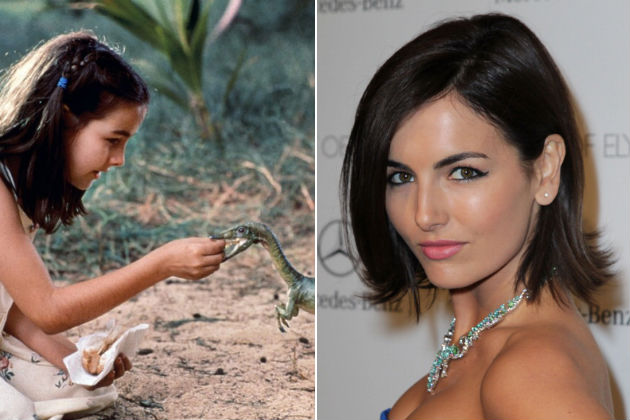
Camilla Belle, Cathy Bowman

Universal/Getty Images

Then: Camilla Belle played Cathy Bowman, the young girl from the opening scene of the film who is attacked and killed by tiny dinosaurs on the island of Isla Sorna when her family unwittingly stops there for lunch. Belle previously made her feature film debut in ‘A Little Princess’ with ‘The Lost World’ co-star Vanessa Lee Chester.

Now: As a young woman, Belle appeared in the films ‘When a Stranger Calls,’ ‘The Quiet,’ ‘The Ballad of Jack and Rose,’ ‘Push’ and ‘10,000 B.C.’ More recently she starred in ‘Open Road’ and ‘Cavemen,’ and can be seen next in ‘Amapola’ and ‘Love Is All You Need?’

Source: www.screencrush.com

Dacentrurus

Tuesday, March 28, 2017

Dacentrurus by Oscar Sanisidro

Dacentrurus (meaning “tail full of points”), originally known as Omosaurus, was a large stegosaur of the Late Jurassic Period (154 – 150 mya) of Europe. Its type species, Omosaurus armatus, was named in 1875, based on a skeleton found in England. In 1902 the genus was renamed into Dacentrurus because the name Omosaurus had already been used for a crocodilian. After 1875, half a dozen other species would be named but perhaps only Dacentrurus armatus is valid.

Finds of this animal have been limited and much of its appearance is uncertain. It was a heavily built quadrupedal herbivore, adorned with plates and spikes.

Dacentrurus by Prehistoric Wildlife

Dacentrurus was a large stegosaurid. Some specimens have been estimated to reach lengths between 7–8 m (23–26 ft) and to weigh up to 5 t (5.5 short tons). Many books claim that Dacentrurus was a small stegosaur, when in fact finds such as a 1.5 metres (4.9 ft) wide pelvis indicate that Dacentrurus was among the largest of them. For a stegosaur the gut was especially broad, and a massive rump is also indicated by exceptionally wide dorsal vertebrae centra. The hindlimb was rather short, but the forelimb relatively long, largely because of a long lower arm.

Although Dacentrurus is considered to have the same proportions as Stegosaurus, its plate and spike configuration is known to be rather different, as it probably had both two rows of small plates on its neck and two rows of longer spikes along its tail. The holotype specimen of Dacentrurus armatus contained a small blunt asymmetrical neck plate and also included a tail spike which could have been part of a thagomizer. The tail spike had sharp cutting edges on its front and rear side.

Dacentrurus has sometimes been portrayed with a spike growing near the shoulder, similarly to a Kentrosaurus. Whether this portrayal is accurate or not is not yet determined.

Dacentrurus armatus reconstruction at the Natural History Museum in London, UK. Photo by Emőke Dénes

Due to the fact it represented the best known stegosaurian species from Europe, most stegosaur discoveries in this area were referred to Dacentrurus. This included finds in Wiltshire and Dorset in southern England (among them a vertebra ascribed to D. armatus in Weymouth), fossils from France and Spain and five more historically recent skeletons from Portugal. Most of these finds were fragmentary in nature; the only more complete skeletons were the holotypes of D. armatus and D. lennieri. .

1.Dacentrurus 2.Lexovisaurus 3.Huayangosaurus 4.Wuerhosaurus 5.Gigantspinosaurus – by Kawasaki Satoshi

Study of late Jurassic ecosystems in North America has brought the strong suggestion that stegosaurs regularly came into conflict with theropod dinosaurs like Allosaurus.‭ ‬This predator/prey interaction may have also happened in late Jurassic Europe,‭ ‬although most of the large theropods such as Dubreuillosaurus and Poekilopleuron are so far only known from earlier in the Jurassic.

The Origin of Tetrapods

Tuesday, March 28, 2017

The Origin of Tetrapods

The word “tetrapod” means “four feet” and includes all species alive today that have four feet — but this group also includes many animals that don’t have four feet. That’s because the group includes all the organisms (living and extinct) that descended from the last common ancestor of amphibians, reptiles, and mammals. So, for example, the ichthyosaur, an extinct swimming reptile, is a tetrapod even though it did not use its limbs to walk on land. So is the snake, even though it has no limbs. And birds and humans are tetrapods even though they only walk on two legs. All these animals are tetrapods because they descend from the tetrapod ancestor described above, even if they have secondarily lost their “four feet.”

Tetrapods evolved from a finned organism that lived in the water. However, this ancestor was not like most of the fish we are familiar with today. Most animals we call fishes today are ray-finned fishes, the group nearest the root of this evogram. Ray-finned fishes comprise some 25,000 living species, far more than all the other vertebrates combined. They have fin rays — that is, a system of often branching bony rays (called lepidotrichia) that emanate from the base of the fin.

In contrast, the other animals in the evogram — coelacanths, lungfishes, all the other extinct animals, plus tetrapods (represented by Charles Darwin) — have what we call “fleshy fins” or “lobe fins.” That is, their limbs are covered by muscle and skin. Some, such as coelacanths, retain lepidotrichia at the ends of these fleshy limbs, but in most fleshy-finned animals these have been lost.

Tetrapod evolution

The common ancestor of all those different organisms (ray-fins, coelacanths, lungfishes, tetrapods, etc.) was neither a lobe-fin nor a ray-fin. This ancient vertebrate lineage had fins (with lepidotrichia), scales, gills, and lived in the water. Yet they also had air bladders (air-filled sacs) connected to the back of their throats that could be used for breathing air (i.e., as lungs) or for buoyancy control. The air bladders of many ray-fins no longer connect to their throats, and so they are not able to breathe air. In these ray-fins, the air bladder is used mainly for buoyancy control and is known as a swim bladder. By contrast, tetrapods have taken an alternative route: they have lost the buoyancy control function of their air bladders, and instead this organ been elaborated to form the lungs that we all use to get around on land.

When we get past coelacanths and lungfishes on the evogram, we find a series of fossil forms that lived between about 390 and 360 million years ago during the Devonian Period. During this interval, this lineage of fleshy-finned organisms moved from the water to the land. Many parts of the skeleton changed as new innovations that permitted life on land evolved.

For example, the ancestors at the base of this evogram lived fully in the water and had skulls that were tall and narrow, with eyes facing sideways and forwards. This allowed them to look around in their watery environments for predators and prey. However, as ancestors of the first tetrapods began to live in shallower waters, their skulls evolved to be flatter, with eyes on the tops of their heads. This probably allowed them to look up to spot food. Then, as tetrapods finally moved fully onto land and away from the water, many lineages once again evolved skulls that were tall and narrow, with eyes facing sideways and forwards, allowing them to look around their terrestrial environments for predators and prey.

As lineages moved into shallower water and onto land, the vertebral column gradually evolved as well. You may have noticed that fishes have no necks. Their heads are simply connected to their shoulders, and their individual vertebrae look quite similar to one another, all the way down the body. Mobile necks allow land animals to look down to see the things on the ground that they might want to eat. In shallow water dwellers and land dwellers, the first neck vertebra evolved different shapes, which allowed the animals to move their heads up and down. Eventually, the second neck vertebra evolved as well, allowing them to move their heads left and right. Later tetrapods evolved necks with seven or more vertebrae, some long and some short, permitting even more mobility.

The vertebrae you are probably most familiar with (like our own!) consist of a spool-like centrum, which connects in front and back with other centra. On top of the centra are vertebral spines and arches to which muscle segments attach, and lateral to the centra are the ribs; these anchor muscles that flex as the animals move. Fishes swim with simple lateral motions, so their arches are relatively straight and needle-like, and so are their ribs. When you eat fish and pick out the bones, these are mostly what you’re finding. Because fishes live in the water, gravity is not a big problem for them. But on land, a quadruped with a backbone between forelimbs and hindlimbs faces the same problems as a bridge designer: sag. As the fleshy-finned organisms began to venture onto land, they evolved a series of interlocking articulations on each vertebra, which helped them overcome sag and hold the backbone straight with minimal muscular effort.

Vertebra shape and connections in the early tetrapod Acanthostega.


One element of the human vertebral column.

The connection between the pelvis and hindlimbs in early tetrapods is a prime example of exaptation. We call this fused connection the sacrum. It is extremely useful for terrestrial organisms because it allows them to use their hindlimbs efficiently for locomotion on land. Since the aquatic ancestors of fishes and tetrapods had no such connection, one might guess that this feature first evolved serving the function of enabling terrestrial locomotion. However, the earliest form of this connection (as seen in Acanthostega) evolved while these tetrapod precursors were still living in the water. Based on current evidence, Acanthostega appears to have been fully aquatic, so this connection likely evolved to function in something other than terrestrial locomotion. Only later, as tetrapod ancestors moved onto land, was this trait co-opted for terrestrial support — and as it was, additional vertebrae were fused in the same way, providing further support.

As the limbs and their connections to the rest of the skeleton evolved, limb bones took on distinct roles and many bones were lost. The humerus and the femur were already connected to two outer bones (the radius and ulna in the forelimb, the tibia and fibula in the hindlimb). This is something that evolved about 30 million years before vertebrates came onto land. However, muscular connections between these bones began to change on the road to land and allowed the limbs to be used for terrestrial locomotion. The ankle was originally composed of many small bones arranged in two rows, but gradually many of these small bones were lost. The first animals to get close to walking on land had eight digits on each limb. Over time, some of these digits were lost, leading to animals with seven digits, then six, and then five, which is the common condition now seen in living tetrapods.

In Late Devonian vertebrate speciation, descendants of pelagic lobe-finned fish — like Eusthenopteron — exhibited a sequence of adaptations: *Panderichthys, suited to muddy shallows *Tiktaalik with limb-like fins that could take it onto land *Early tetrapods in weed-filled swamps, such as: **Acanthostega, which had feet with eight digits **Ichthyostega with limbs Descendants also included pelagic lobe-finned fish such as coelacanth species.

As these animals evolved to live on land, other changes in the rest of their bodies evolved. Many would eventually lose their gills, which only work well for getting oxygen when wet, and their tail fins got smaller. Similarly they lost the lateral line system, a network of vibration-sensitive canals along the skull and jaw, which doesn’t work out of water.

The environments of the animals shown in this evogram also changed through time. In fact, if you were to venture back to Arizona at the beginning of the “Age of Dinosaurs” in the Triassic Period, some 225 million years ago, you would find ray-fins, coelacanths, and lungfishes living in the marshes, streams, and temporary ponds of that day, along with freshwater sharks. So the habitats that these animals occupy today are not necessarily the ones in which they have always lived, or in which they originally evolved. It is still unclear exactly where the transition from water to land took place ecologically. Paleontologists have discovered fossils involved in this transition preserved from freshwater, brackish, and marine habitats. Regardless of where the transition occurred, eventually early ancestors of the first tetrapods came up onto land — although not all stayed. Some, like the whales, made the transition back into the water.

Original article published on http://evolution.berkeley.edu

Torvosaurus

Sunday, March 26, 2017

Torvosaurus - Discovery Channel

Torvosaurus is a genus of carnivorous megalosaurid theropod dinosaurs that lived approximately 153 to 148 million years ago during the later part of the Jurassic Period in what is now Colorado and Portugal. It contains two currently recognized species, Torvosaurus tanneri and Torvosaurus gurneyi.

In 1979 the type species Torvosaurus tanneri was named: it was a large, heavily built, bipedal carnivore, that could grow to a length of about 10 m (33 ft). T. tanneri was among the largest carnivores of its time, together with Epanterias and Saurophaganax (which could be both synonyms of Allosaurus). Specimens referred to Torvosaurus gurneyi were initially claimed to be up to eleven metres long, but later shown to be smaller. Based on bone morphology Torvosaurus is thought to have had short but very powerful arms.

The genus name Torvosaurus derives from the Latin word torvus, meaning “savage”, and the Greek word sauros (σαυρος), meaning “lizard”. The specific name tanneri, is named after first counselor in the First Presidency of The Church of Jesus Christ of Latter-day Saints Nathan Eldon Tanner. Torvosaurus gurneyi is dedicated to the paleoartist James Gurney, creator of the Dinotopia series of books. Torvosaurus was described and named by Peter M. Galton and James A. Jensen in 1979 and the type species is Torvosaurus tanneri.

Torvosaurus vs ‘Edmarka’ by EoFauna

Fossilized remains of Torvosaurus have been found in North America and Portugal. In 1971, Vivian Jones, of Delta, Colorado (USA), in the Calico Gulch Quarry in Moffat County, discovered a single gigantic thumb claw of a theropod. This was shown to James Alvin Jensen, a collector working for Brigham Young University. In an effort to discover comparable fossils, Vivian’s husband Daniel Eddie Jones directed Jensen to the Dry Mesa Quarry, where abundant gigantic theropod bones, together with Supersaurus remains, proved present in rocks of the Morrison Formation. From 1972 onwards the site was excavated by Jensen and Kenneth Stadtman. The genus and the type species T. tanneri were named and described in 1979 by Peter Malcolm Galton and Jensen. In 1985 Jensen could report a considerable amount of additional material, among it the first skull elements. The fossils from Colorado were further described by Brooks Britt in 1991.

This is the main lobby of the Museum of Ancient Life at Thanksgiving Point in Lehi, Utah, U.S.A. It displays a depiction of a Torvosaurus dinosaur skeleton pursuing a herd of Othnielosaurus. Author leon7

Torvosaurus was a very large predator, with an estimated maximum body length of 10 metres (33 ft) and mass of 3.6–4.5 tonnes (4–5 short tons) for both T. tanneri and T. gurneyi, making Torvosaurus among the largest carnivores of the Jurassic. Claims have been made indicating even larger sizes. The synonymous Edmarka rex was named thus because it was assumed to rival Tyrannosaurus rex in length and weight. Likewise “Brontoraptor” was supposed to be a torvosaur of gigantic size. The T. gurneyi specimens from Portugal initially prompted larger size estimates to be made. In 2006 a lower end of a thighbone, specimen ML 632, was referred to Torvosaurus sp. and later to T. gurneyi. This specimen was initially stated to indicate a length of 11 m (36 ft). Applying the extrapolation method of J.F. Anderson, correlating mammal weights to their femur circumference, resulted in a weight of 1930 kilogrammes. However, revised estimates performed in 2014 suggested a slightly smaller total body size for this specimen, of about 10 m (33 ft). Among the differentiating features between T. gurneyi and T. tanneri are the number of teeth and size and shape of mouth. While the upper jaw of T. tanneri has more than 11 teeth, that of T. gurneyi has less.

Torvosaurus and Miragaia by Davide Bonadonna

Pages