Blogs

Tyrannosauroidea

Thursday, May 11, 2017

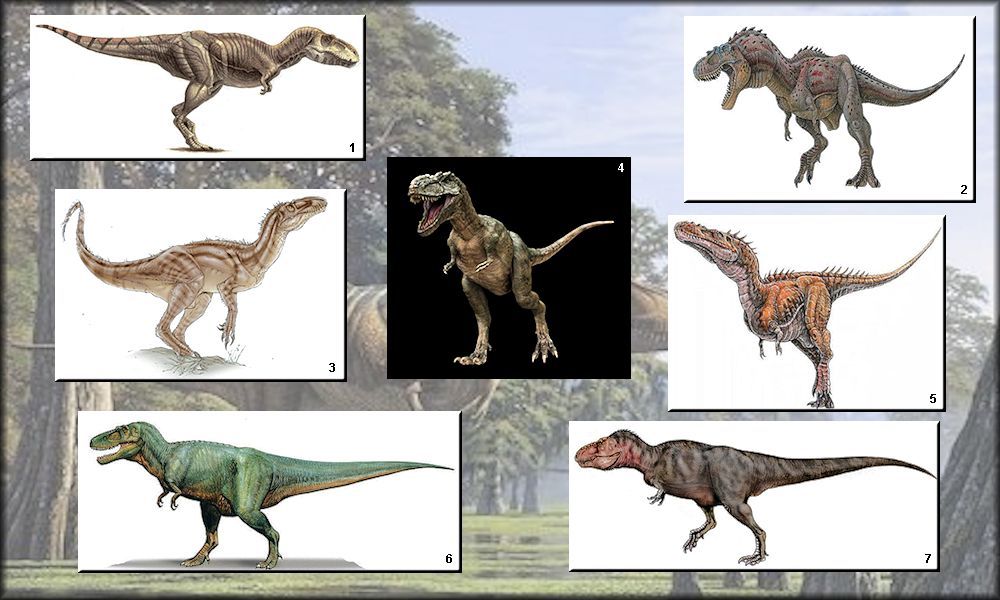
Some tyrannosaurids

Tyrannosauroidea (meaning ‘tyrant lizard forms’) is a superfamily (or clade) of coelurosaurian theropod dinosaurs that includes the family Tyrannosauridae as well as more basal relatives. Tyrannosauroids lived on the Laurasian supercontinent beginning in the Jurassic Period. By the end of the Cretaceous Period, tyrannosauroids were the dominant large predators in the Northern Hemisphere, culminating in the gigantic Tyrannosaurus itself. Fossils of tyrannosauroids have been recovered on what are now the continents of North America, Europe, Asia, South America and Australia.

Family: Tyrannosauridae. Dinosauria, Saurischia, Theropoda, Tyrannosauroidea. Author: Oktaytanhu, 2015.

Tyrannosauroids were bipedal carnivores, as were most theropods, and were characterized by numerous skeletal features, especially of the skull and pelvis. Early in their existence, tyrannosauroids were small predators with long, three-fingered forelimbs. Late Cretaceous genera became much larger, including some of the largest land-based predators ever to exist, but most of these later genera had proportionately small forelimbs with only two digits. Primitive feathers have been identified in fossils of two species, and may have been present in other tyrannosauroids as well. Prominent bony crests in a variety of shapes and sizes on the skulls of many tyrannosauroids may have served display functions.

Tyrannosauroids varied widely in size, although there was a general trend towards increasing size over time. Early tyrannosauroids were small animals. One specimen of Dilong, almost fully grown, measured 1.6 meters (5.3 ft) in length, and a fully-grown Guanlong measured 3 meters (10 ft long). Teeth from lower Lower Cretaceous rocks (140 to 136 million years old) of Hyogo, Japan, appear to have come from an approximately 5 metres (16 ft) long animal, possibly indicating an early size increase in the lineage. An immature Eotyrannus was over 4 meters (13 ft) in length, and a subadult Appalachiosaurus was estimated at more than 6 meters (20 ft) long, indicating that both genera reached larger sizes. The Late Cretaceous tyrannosaurids ranged from the 9 meter (30 ft) Albertosaurus and Gorgosaurus to Tyrannosaurus, which exceeded 12 meters (39 ft) in length and may have weighed more than 6400 kilograms (7 short tons). A 2010 review of the literature concluded that tyrannosaurs were “small- to mid-sized” for their first 80 million years but were “some of the largest terrestrial carnivores to ever live” in their last 20 million years.

Replica Yutyrannus huali skeletons mounted in a fighting pose inspired by Charles R. Knight’s painting of Laelaps. Dino-Kingdom 2012, Tokyo, Japan. Author: Laika ac

Skulls of early tyrannosauroids were long, low and lightly constructed, similar to other coelurosaurs, while later forms had taller and more massive skulls. Despite the differences in form, certain skull features are found in all known tyrannosauroids. The premaxillary bone is very tall, blunting the front of the snout, a feature which evolved convergently in abelisaurids. The nasal bones are characteristically fused together, arched slightly upwards and often very roughly textured on their upper surface. The premaxillary teeth at the front of the upper jaw are shaped differently from the rest of the teeth, smaller in size and with a D-shaped cross section. In the lower jaw, a prominent ridge on the surangular bone extends sideways from just below the jaw joint, except in the basal Guanlong.

Tyrannosauroids had S-shaped necks and long tails, as did most other theropods. Early genera had long forelimbs, about 60% the length of the hindlimb in Guanlong, with the typical three digits of coelurosaurs. The long forelimb persisted at least through the Early Cretaceous Eotyrannus, but is unknown in Appalachiosaurus. Derived tyrannosaurids have forelimbs strongly reduced in size, the most extreme example being Tarbosaurus from Mongolia, where the humerus was only one-quarter the length of the femur. The third digit of the forelimb was also reduced over time. This digit was unreduced in the basal Guanlong, while in Dilong it was more slender than the other two digits. Eotyrannus also had three functional digits on each hand. Tyrannosaurids had only two, although the vestigial metacarpal of the third are preserved in some well-preserved specimens. As in most coelurosaurs, the second digit of the hand is the largest, even when the third digit is not present.

A simplified cladogram showing the systematic position of Y. huali among the Tyrannosauroidea. From: A gigantic feathered dinosaur from the Lower Cretaceous of China Xing Xu, Kebai Wang, Ke Zhang, Qingyu Ma, Lida Xing, Corwin Sullivan, Dongyu Hu, Shuqing Cheng & Shuo Wang- Nature 484, 92–95 (05 April 2012)

Tyrannosaurus was named by Henry Fairfield Osborn in 1905, along with the family Tyrannosauridae. The name is derived from the Ancient Greek words τυραννος/tyrannos (‘tyrant’) and σαυρος/sauros (‘lizard’). The superfamily name Tyrannosauroidea was first published in a 1964 paper by the British paleontologist Alick Walker. The suffix -oidea, commonly used in the name of animal superfamilies, is derived from the Greek ειδος/eidos (‘form’).

Scientists have commonly understood Tyrannosauroidea to include the tyrannosaurids and their immediate ancestors. With the advent of phylogenetic taxonomy in vertebrate paleontology, however, the clade has received several more explicit definitions. The first was by Paul Sereno in 1998, where Tyrannosauroidea was defined as a stem-based taxon including all species sharing a more recent common ancestor with Tyrannosaurus rex than with neornithean birds. To make the family more exclusive, Thomas Holtz redefined it in 2004 to include all species more closely related to Tyrannosaurus rex than to Ornithomimus veloxDeinonychus antirrhopus or Allosaurus fragilis. Sereno published a new definition in 2005, using Ornithomimus edmontonicusVelociraptor mongoliensis and Troodon formosus as external specifiers. The Sereno definition was adopted in a 2010 review.
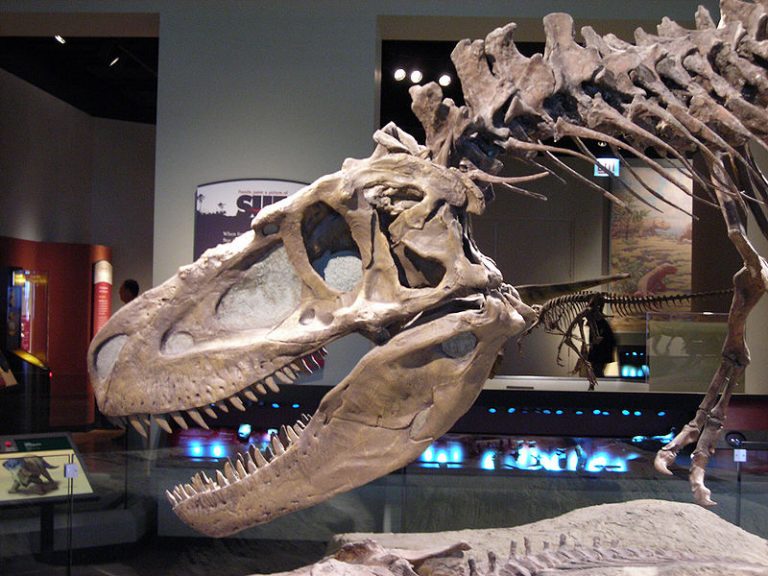
Skull and neck of Daspletosaurus, from the Field Museum of Natural History in Chicago.

The most basal tyrannosauroid known from complete skeletal remains is Guanlong. Other early taxa include Stokesosaurusand Aviatyrannis, known from far less complete material. The better-known Dilong is considered slightly more derived than Guanlong and Stokesosaurus.

The tyrannosauroids lived on the supercontinent Laurasia, which split from Gondwana in the Middle Jurassic, as well as on the northern continents, which separated from Laurasia later in the Mesozoic era. The earliest recognized tyrannosauroids lived in the Middle-Late Jurassic, including Guanlong and Kileskus from the Far East, Stokesosaurus from the western United States and AviatyrannisJuratyrant, and Proceratosaurus from Europe.

Map of tyrannosauroid fossil localities as of December 2007. I used the blank political map of the world commonly used on Wikipedia ((BlankMap-World.png). Keep in mind that the land masses would not have been in the same places they are today in the Jurassic and Cretaceous periods. Author: Sheep81


Early Cretaceous tyrannosauroids are known from Laurasia, being represented by Eotyrannus from England and DilongSinotyrannus, and Yutyrannus from northeastern China. Early Cretaceous tyrannosauroid premaxillary teeth are known from the Cedar Mountain Formation in Utah and the Tetori Group of Japan.

Basal tyrannosauroids may have also been present in what is now southeastern Australia during the Aptian of the Early Cretaceous. NMV P186069, a partial pubis (a hip bone) with a distinctive tyrannosauroid-like form, was discovered in Dinosaur Cove in Victoria, indicating that tyrannosauroids were not limited to the northern continents as previously thought.

Feathers

Long filamentous structures have been preserved along with skeletal remains of numerous coelurosaurs from the Early Cretaceous Yixian Formation and other nearby geological formations from Liaoning, China. These filaments have usually been interpreted as “protofeathers,” homologous with the branched feathers found in birds and some non-avian theropods, although other hypotheses have been proposed. A skeleton of Dilong was described in 2004 that included the first example of feathers in a tyrannosauroid. Similarly to down feathers of modern birds, the feathers found in Dilong were branched but not pennaceous, and may have been used for insulation. Even large tyrannosauroids have been found with evidence of feathers. Yutyrannus huali, also from the Yixian Formation, is known from three specimens, each preserving traces of feathers on various parts of the body. While not all areas of the body preserve impressions across all three specimens, these fossils demonstrate that even in this medium-sized species, most of the body was covered in feathers.

The presence of feathers in basal tyrannosauroids is not surprising, since they are now known to be characteristic of coelurosaurs, found in other basal genera like Sinosauropteryx, as well as all more derived groups. Rare fossilized skin impressions of some Late Cretaceous tyrannosaurids lack feathers, however, instead showing skin covered in fine, non-overlapping scales. It is possible that feathers were present on areas of the body not preserved with skin impressions (which are very small and come primarily from the legs, pelvic region and underside of the tail).

Source: www.NatGeo.com, www.metalfloss.com

Bahariasaurus

Thursday, May 11, 2017

Bahariasaurus by Todd Marshall

Bahariasaurus (meaning “Bahariya lizard”) is a genus of large theropod dinosaur found in the Bahariya Formation in El-Waha el-Bahariya or Bahariya (Arabic: الواحة البحرية meaning the “northern oasis”) oasis in Egypt, and Kem Kem Beds of North Africa, which date to the late Cretaceous Period, (Cenomanian age), about 95 million years ago. It was a huge theropod, in the same size range as Tyrannosaurus and the contemporary genus Carcharodontosaurus.

Bahariasaurus ingens by Teratophoneus on DeviantArt

The type species, B. ingens, was described by Ernst Stromer in 1934, though the type specimen was destroyed during World War II. The exact placement of Bahariasaurus is uncertain, although it has been variously assigned to several theropod groups, including Carcharodontosauridae (by Rauhut in 1995) and Tyrannosauroidea (by Chure in 2000). It is potentially synonymous with Deltadromeus, another theropod from the early Late Cretaceous of North Africa, this would possibly make it the largest ceratosaur. More specimens would be needed to more accurately classify it, and to determine its relationship to Deltadromeus.

In 2016 the description and analysis of AoniraptorBahariasaurus was found along with Aoniraptor and Deltadromeus to probably form a still poorly known clade of megaraptoran tyrannosauroids different from the Megaraptoridae.

Source: Dinomovies.net, Wiki.com

Saurophaganax

Thursday, May 11, 2017

Saurophaganax skeleton

Saurophaganax (“lord of the eaters of saurians”) is a genus of allosaurid dinosaur from the Morrison Formation of Late Jurassic Oklahoma (latest Kimmeridgian age, about 151 million years ago), USA. Some paleontologists consider it to be a species of Allosaurus (A. maximus). Saurophaganax represents a very large Morrison allosaurid characterized by horizontal laminae at the bases of the dorsal neural spines above the transverse processes, and “meat-chopper” chevrons. The maximum size of S. maximus has been estimated at anywhere from 10.5 metres (34 ft) to 13 m (43 ft) in length, and around 3 tonnes (3.0 long tons; 3.3 short tons) in weight.

Saurophaganax maximus by sinammonite

In 1931 and 1932 John Willis Stovall uncovered remains of a large theropod near Kenton in Cimarron County, Oklahoma in layers of the late Kimmeridgian. In 1941 these were named Saurophagus maximus by Stovall in an article by journalist Grace Ernestine Ray. The generic name is derived from Greek σαυρος, sauros, “lizard”, φάγειν, phagein, “to eat”, with the compound meaning of “eater of saurians”. The specific epithetmaximus means “the largest” in Latin. Because the naming article did not contain a description, the name remained a nomen nudum. In 1987 Spencer George Lucas erroneously made OMNH 4666, a tibia, the lectotype, unaware that “Saurophagus” was a nomen nudum.

Later it was discovered that the name Saurophagus was preoccupied: it had already in 1831 been given by William Swainson to a tyrant-flycatcher, an extant eater of taxonomically true lizards. In 1995 Daniel Chure named a new genus: Saurophaganax, adding Greek suffix -άναξ, anax, meaning “ruler”, to the earlier name. Chure also found OMNH 4666 undiagnostic in relation to Allosaurus, so he chose OMNH 01123, a neural arch, as the holotype for Saurophaganax. — and Saurophaganax is not a renaming of “Saurophagus”. Much of the material informally named “Saurophagus maximus”, namely those diagnostic elements that could be distinguished from Allosaurus, were by Chure referred to Saurophaganax maximus. They contain disarticulated bones of at least four individuals.

Saurophaganax is the official state fossil of Oklahoma, and a large skeleton of Saurophaganax can be seen in the Jurassic hall in the Sam Noble Oklahoma Museum of Natural History. Although the best known Saurophaganax material was found in the panhandle of Oklahoma, possible Saurophaganax material, NMMNH P-26083, a partial skeleton including a femur, several tail vertebrae, and a hip bone, has been found in northern New Mexico.

Relationship with Allosaurus

The identification of Saurophaganax is a matter of dispute. It has been described as its own genus, or as a species of AllosaurusAllosaurus maximus. The most recent review of basal tetanurans accepted Saurophaganax as a distinct genus. New possible Saurophaganax material from New Mexico may clear up the status of the genus.

Saurophaganax | BBC Planet Dinosaur

Saurophaganax was one of the largest carnivores of Late Jurassic North America. Chure even gave an estimate of 14 m (46 ft), though other estimations have been lower. The fossils known of Saurophaganax (both the possible New Mexican material and the Oklahoma material) are known from the Brushy Basin Member, which is the latest part of the Morrison Formation, suggesting that this genus was either always uncommon or that it first appeared rather late in the Jurassic. Saurophaganax was large for an allosaurid, and bigger than both its contemporaries Torvosaurus tanneri and Allosaurus fragilis. Being much rarer than its contemporaries, making up one percent or less of the Morrison theropod fauna, not much about its behavior is known.

The Morrison Formation is a sequence of shallow marine and alluvial sediments which, according to radiometric dating, ranges between 156.3 million years old (Ma) at its base, to 146.8 million years old at the top, which places it in the late Oxfordian, Kimmeridgian, and early Tithonian stages of the Late Jurassic period. This formation is interpreted as a semiarid environment with distinct wet and dry seasons. The Morrison Basin where dinosaurs lived, stretched from New Mexico to Alberta and Saskatchewan, and was formed when the precursors to the Front Range of the Rocky Mountains started pushing up to the west. The deposits from their east-facing drainage basins were carried by streams and rivers and deposited in swampy lowlands, lakes, river channels and floodplains. This formation is similar in age to the Solnhofen Limestone Formation in Germany and the Tendaguru Formation in Tanzania. In 1877 this formation became the center of the Bone Wars, a fossil-collecting rivalry between early paleontologists Othniel Charles Marsh and Edward Drinker Cope.

Source: Wikipedia, NatGeo, umld.net

Irritator

Thursday, May 11, 2017

Irritator skeleton

Irritator is a genus of spinosaurid dinosaur that lived in the early Cretaceous Period (Albian stage), around 110 million years ago. Current estimations indicate a length of 8 meters (26 feet). In 2010, Gregory S. Paul gave lower estimations of 7.5 metres and one tonne. It was found in Brazil. Irritator was a theropod with an unusually shaped crest at the rear of its head, and most likely consumed fish.

Size compared to a human by Matt Martyniuk (Dinoguy2)

So far the only fossil that has been found was an 80 centimeter long fossil skull in the Romualdo Member, a layer member of the Santana Formation. This skull strongly resembles the skulls of Suchomimus and Spinosaurus. The genus is often regarded today as identical (synonymous) with Angaturama, which lived in the same time and the same place as Irritator.

In the year 2004 parts of a spinal column were discovered in the Santana Formation. These have been assigned, due to their structure, to the Spinosauridae. With very high probability these fossils belong to Irritator, since this is the so far the only well-known spinosaurid in the formation.

I. challengeri was a member of the Spinosauridae, more specifically the subfamily Spinosaurinae. It shares a close relationship with Spinosaurus and possibly Siamosaurus, though this last genus is not well known from fossil material.

Irritator was originally described as a Maniraptoran within the Tetanurae. It was assigned to the family Baryonychidae, along with AngaturamaBaryonyxSuchomimus and Spinosaurus by Oliver Rauhut in 2003. Holtz et al. (2004) considered the Baryonychidae synonymous with the family Spinosauridae, and placed these genera within that family. Most later revisions have upheld these classifications.

Skeleton mounted as attacking a pterosaur at Museu Nacional da Universidade Federal do Rio de Janeiro, na Quinta da Boa Vista, Rio de Janeiro, Brasil. Photo by Celso Abreu

Irritator probably nourished itself on fish, like the pterosaurs found in large number in the Santana Formation. Irritator was probably, like today’s crocodiles, a food generalist, eating all other animals that it could catch besides fish. A tooth belonging to Irritator still inserted into a fossil neck vertebral column of a pterosaur, indicates that Irritator ate pterosaurs as well, although it is not known if it actively hunted these animals, or simply scavenged the remains.

Source: NatGeo.com, Wiki.org, ifls.com

Ichthyovenator

Thursday, May 11, 2017

Ichthyovenator by PaleoGuy on DeviantArt

Ichthyovenator is a spinosaurid theropod dinosaur from the Early Cretaceous of Laos.

Ichthyovenator by Prehistoric Wildlife

Ichthyovenator is known from the type species Ichthyovenator laosensis. The species was named and described in 2012 by Ronan Allain, Tiengkham Xeisanavong, Philippe Richir and Bounsou Khentavong. The generic name is derived from Greek ἰχθύς (ichthys), “fish”, and Latin venator, “hunter”, in reference to a piscivorous lifestyle. The specific name refers to the provenance from Laos.

Casts of the type vertebrae. Photo by ★Kumiko★

Unlike other spinosaurids, Ichthyovenator has at least two separate sails. The preserved axial column, over a metre long, shows a very high spine on the penultimate, twelfth, back vertebra, representing a crest extending from the back, and a lower rounded sail extending from the sacral vertebrae of the hip, with its highest point above the third and fourth sacrals. The 546 millimetre long spine of the twelfth dorsal vertebra widens towards the top, giving it a trapezoidal shape, whereas the spines of other spinosaurids are roughly rectangular. Its front corner forms a three centimetre long narrow process, pointing upwards. The spine of the thirteenth dorsal vertebra has only been partly preserved, its upper and lower ends having broken off. From its general shape the describers inferred however, that it was about as long as the preceding spine. This would imply that the back edge of the front sail would form a rectangular corner, as the spine of the first sacral vertebra is with about twenty-one centimetres much lower, creating a sudden hiatus. The spine of the second sacral vertebra steeply curves upwards again, joining the forty-eight centimetres high broad fan-shaped spines of the third and fourth sacrals. The spine of the fifth sacral gradually descends. The sacral spines are not fused, nor have any extensive contacts.

Ichthyovenator was by its describers assigned to the Spinosauridae and more precisely to the Baryonychinae, in a basal position, as the sister species of a clade formed by Baryonyx and Suchomimus.

Oxalaia

Thursday, May 11, 2017

Oxalaia quilombensis by pauloomarcio

Oxalaia is a genus of carnivorous theropod. It is a spinosaurine spinosaurid which lived during the late Cretaceous (early Cenomanian stage, about 98 mya) in what is now Brazil.

Oxalaia is known from the holotype MN 6117-V, fused premaxillae of a very large individual and from the referred fragment MN 6119-V, an isolated and incomplete left maxilla, which were found on Cajual Island, Maranhão of northeastern Brazil. Fossils of Oxalaia were recovered in 2004 from the Laje do Coringa locality of the Alcântara Formation, part of the Itapecuru Group of the São Luís Basin. Besides these bone fragments, numerous spinosaurid teeth had earlier been reported from the site.

Spinosaur size comparison by Prehistoric Wildlife 1 – Spinosaurus, 2 – Baryonyx, 3 – Ichthyovenator, 4 – Oxalaia, 5 – Suchomimus, 6 – Irritator.

The genus was named by Alexander Wilhelm Armin Kellner, Sergio A.K. Azevedeo, Elaine B. Machado, Luciana B. Carvalho and Deise D.R. Henriques in 2011 and the type species is Oxalaia quilombensis. The specific name quilombensis refers to the quilombo settlements, such as on Cajual Island, which were founded by escaped slaves. Estimates suggest that it was 12 to 14 metres (39 to 46 ft) in length and 5 to 7 tonnes (5.5 to 7.7 short tons) in weight —- it is the largest theropod known from Brazil and the eighth officially named species of theropod from Brazil.

Source: www.wikipedia.org

T. Rex May Have Had Lips

Thursday, May 11, 2017

T. rex may have had lips. Yes, you read that right. Lips.

Robert Reisz, a paleontologist at the University of Toronto, is challenging the long-standing image of meat-eating theropod dinosaurs such as T. rex. Specifically, Reisz suggests that theropods’ teeth were not bared all the time, extending outside their mouths and fully visible whether their jaws were open or closed. Rather, these teeth were kept hidden, covered by scaly lips, he said in a presentation May 20 at the Canadian Society of Vertebrate Paleontology’s annual meeting in Ontario.

Reisz told Live Science in an email that he had always been bothered by the typical “permanent smile” portrayal of theropod dinosaur teeth. He first looked to the closest living relatives of theropod dinosaurs — crocodiles — for clues about tooth exposure.

At first glance, it could seem like the expectation for large theropods to have exposed teeth was on the right track. Crocodiles’ teeth are covered by gums for about one-quarter of their length, but lips are absent and the tooth crowns are permanently exposed, Reisz explained.

However, if you look closer at tooth structure, a different story might emerge, he noted in his presentation.

The hard enamel of animals’ teeth has low water content, and is typically kept hydrated by saliva. Without lips to keep moisture in and prevent the teeth from drying out, the tough enamel would become brittle and more prone to damage and wear, Reisz told Live Science.

Crocodiles live in watery environments and would rely on their habitat to keep exposed teeth hydrated. But land-dwelling theropods’ large teeth — which are known to have enamel — could have been compromised by perpetual exposure, and likely needed to be covered by lips in order to stay moist, Reisz said in the presentation.

T. rex by pheaston on DeviantArt

But crocodiles aren’t the only animals with exposed teeth — elephants, for instance, have exposed teeth as well, and many extinct saber-toothed predators had very long canines that were also exposed when their mouths were closed. Wouldn’t their teeth have been vulnerable to serious drying out, too?

Not necessarily. A mammal’s tooth structure is actually quite different from a reptile’s, said Zhijie Jack Tseng, a paleontologist who studies bite-force biomechanics in extinct carnivores at the American Museum of Natural History in New York City.

“Mammalian teeth are prismatic — they have a crisscrossing structure,” Tseng told Live Science. He explained that when mammal teeth grow, the enamel emerges from the root area and “races outward in all directions,” creating a 3D shape that may be better at keeping water inside.

In reptile teeth, the enamel grows in one direction, creating a different type of structure that may not retain water as effectively — potentially making their teeth more likely to chip or crack, Tseng suggested.

But for reptiles — and theropod dinosaurs — damaging or losing a tooth simply isn’t as big a deal as it would be for a mammal, Tseng added. Mammals typically grow a set of baby teeth followed by a set of adult teeth, whereas reptiles — and likely many, if not all, dinosaurs — replace individual teeth throughout their lifetimes, scientists have found.

“Each tooth — relatively speaking — doesn’t have as much value to the animal as in mammals,” Tseng said. “T. rex could chip a tooth or get one stuck in prey, and just replace it. Evolving protection for teeth is not a critical component of how they eat.”

The dinos, they are a-changin’

Reisz suggested in a statement that people may be reluctant to abandon the terrifying but familiar image of a “ferocious-looking” T. rex with bared teeth.

But now more than ever, scientists are challenging traditional ideas about how dinosaurs may have looked and behaved. New fossil evidence, computer modeling and comparisons with living creatures are helping scientists to paint a clearer picture of these extinct animals, overturning many historic conceptions of their postures, gaits, skin coverings and colors.

Long gone are the days when dinosaurs were almost uniformly pictured as grayish-green, ponderous reptiles with scaly skin. Contrary to their portrayal in popular films, dinosaurs are now widely accepted by scientists as having been covered in feathers, possibly in a range of colors, much like the colorful plumage of modern birds, which are a living dinosaur lineage.

Is it really so far-fetched to suggest that T. rex‘s toothy grin should also be relegated to the past? Time — and further research — will tell, Reisz said.

Source: www.LiveScience.com

Spinosaurus aegyptiacus: Bipedal or Quadrupedal?

Wednesday, May 10, 2017

Spinosaurus aegyptiacus: Bipedal or Quadrupedal?

Spinosaurus was the largest theropod to ever walk on the earth, discovered in 1912 for the first time, it has been nominated to be larger than the mighty Tyrannosaurus rex.

This giant theropod was suggested to be between 12.6–18 metros long (41–59 ft) and 4.25-5 meters tall, even new evidence has came to light to show that it was smaller than this…

Spinosaurus, an important dinosaur of Africa. Photo Credit: Wikimedia Commons

This one is the original Spinosaurus skeleton, larger than most of the other adult ones but strangely it’s bones are thinner, his skull was long but fragile, with a bite estimated to be between 1-2 tons ( it’s very difficult to determine a Spinosaurus bite force).

This skeleton has proven that Spinosaurus was bipedal too, even in 2014 something different has been found…

An a passionated paleontologist, named Ibrahim decided to paste all the bones of a new found spinosaurus and this was the final result:

This reconstruction was way different than the original one and from that moment it started to think that Spinosaurus was not bipedal, but quadrupedal , also it has been proven that Spinosaurus was not a dinosaur hunter, but a fish eater which spent most of the time in water as a crocodile.

10 Facts You Don’t Know About Spinosaurus

There is the 2014 reconstruction of spinosaurus:

So with this new evidence, Spinosaurus wasn’t  considered to be the biggest theropod ever (in terms of height and size, it was still the longest).

In 2015-16 all this has been debunked because some paleontologists started think that left legs of spinosaurus were incomplete and to prove that it is real we need to find more skeletons like this, even there are some others quadrupedal exemplars skeletons.

So for once again Spinosaurus is bipedal, but not as the jurassic park 3 one which is very inaccurate.

Jurassic Park 3 Spinosaurus

But still considered to be a fish eater because his jaws were designed to catch fishes and his body was adapted to swim.

So in your opinion… was Spinosaurus bipedal or was it quadrupedal?

Source: www.scified.com

Dakotaraptor

Monday, May 8, 2017

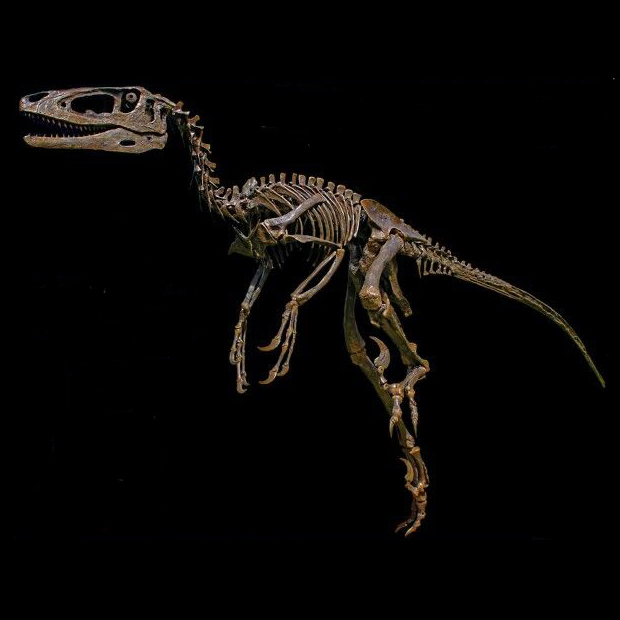
Dakotaraptor skeleton

Dakotaraptor is a genus of large carnivorous theropod dromaeosaurid dinosaur from the Late Cretaceous of North America.

The first fossils of Dakotaraptor were found in South Dakota, United States, in 2005. In 2015, the genus Dakotaraptor received its name, meaning “plunderer of Dakota”, when the type species Dakotaraptor steini was described. The fossils contain an incomplete skeleton without a skull and some individual bones. They have been found in the Maastrichtian-age Hell Creek Formation, dated to the very end of the Cretaceous period, making Dakotaraptor one of the last surviving dromaeosaurids.

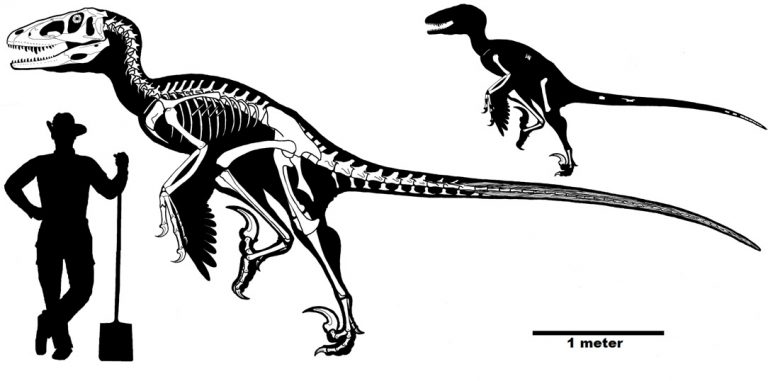
Size of Dakotaraptor steini (green) compared to a human. Author: Matthew Martyniuk

Dakotaraptor was about 5.5 metres (18 ft) long, which makes it one of the largest dromaeosaurids known. It had long arms. One of the lower arm bones shows quill knobs, demonstrating that it was most likely feathered. It also had long rear legs with a very large sickle claw on the second toe; this claw could be used to kill relatively large plant-eating dinosaurs. It lived in the same time and area as Tyrannosaurus.

Dakotaraptor is exceptionally large for a dromaeosaurid; it has an estimated adult length of 5.5 m (18 ft). This approaches the size of the largest known dromaeosaurid, UtahraptorDakotaraptor however, does not have the proportions and adaptations of Utahraptor, but more closely resembles smaller dromaeosaurids like Deinonychus.

In 2005, paleontologist Robert DePalma in Harding County, South Dakota discovered the skeleton of a large dromaeosaurid. Subsequently, the same site produced additional dromaeosaurid remains, as well as abundant other fossils in 2010 described by DePalma in his master’s thesis. In 2015, the type species Dakotaraptor steini was named and described by Robert A. DePalma, David A. Burnham, Larry Dean Martin, Peter Lars Larson and Robert Thomas Bakker. The generic name combines a reference to South Dakota and the Dakota people with a Latin raptor, “plunderer”. The specific name honours paleontologist Walter W. Stein. Dakotaraptor was one of eighteen dinosaur taxa from 2015 to be described in open access or free-to-read journals.

The known elements of Dakotaraptor and a reconstructed skeleton. From DePalma et al., 2015.

The foot claws of Dakotaraptor include a typical dromaeosaurid raptorial second claw, or “sickle claw”, which was used for killing or holding down prey. It is large and robust with a diameter of 16 centimetres (6.3 in) and a length of 24 centimetres (9.4 in) measured along the outer curve. This equals 29% of the length of the thighbone, compared to 23% in Deinonychus.

Dakotaraptor was placed in the Dromaeosauridae. A cladistic analysis showed that it was the sister species of Dromaeosaurus. They again formed a clade with Utahraptor, of which clade Achillobator was the direct side branch. Despite being related to other gigantic dromaeosaurids, Dakotaraptor was suggested to represent a separate fourth instance of dromaeosaurid size increase, besides DeinonychusUnenlagia, and the Achillobator plus Utahraptor clade.

12 Terrifying Prehistoric Monsters

Sunday, May 7, 2017

Sarcosuchus

Who hasn’t heard of a Tyrannosaurus rex or a velociraptor thanks to movies like Jurassic Park? When we think of dinosaurs, we almost all think of a very small subset of these giant creatures from history. But perhaps more interesting are those which are far less familiar to us all. This list is just a small selection of monstrous or weird-looking creatures from ancient times, most of which are little known to the public.

12 – Estemmenosuchus

Estemmenosuchus uralensis by Dinoraul

They don’t make animals like this anymore. Estemmenosuchus is one of the most bizarre-looking prehistoric monsters; it belonged to the group of the dinocephalians, and despite their dinosaur-like appearance, they were actually more closely related to mammals… including us! Estemmenosuchus was the size of a rhinoceros, and it too had a horn on its nose, but it also had antler-like horns on the top of its head, and strange, bony protrusions coming out of its cheeks; no one knows what they were used for. It also had a set of monstrous, sharp teeth, but scientists aren’t sure about its food preferences. Personally, I believe this thing was big and scary enough to eat anything it wanted. Fossil remains of Estemmenosuchus have been found in Russia; it lived in the Permian period, long before the appearance of dinosaurs.

11 – Acrophyseter

Acrophyseter deinodon by Bran Artworks

This was an ancient relative of today’s sperm whale, which as we all know (or should know) is huge, eats lots of squid and has never been known to attack humans without provocation. Acrophyseter was the complete opposite; it was moderately sized, and didn’t feed on squid but rather on other marine mammals and even on sharks! Its horrible-looking teeth were deadly weapons and have given Acrophyseter and its ancient relatives the nickname of “killer sperm whales”. Acrophyseter’s fossil remains have been found in Peru; it lived in the Miocene period, which seems to have been the best epoch for scary marine monsters including giant dolphins, colossal sharks and even monster penguins and seals.

10 – Epicyon

Epicyon vs Canis lupus by Mauricio Anton

Epicyon could well be described as a giant pitbull on steroids. It was a member of the Canidae or dog family, but whereas modern day canids are built for speed and endurance, Epicyon was built for brute strength, and had jaws so powerful that they could crush bone as if they were crackers! This beast ruled the plains of North America for fifteen million years, before it was replaced by big cats (including sabertooths).

9 – Edestus

Edestus by Prehistoric Wildlife

Today’s great white shark probably has some of the most nightmarish set of teeth in Nature, but its distant prehistoric relative Edestus was so scary that it would make the great white look almost cute. Edestus was about seven meters long and was one of the top predators of the Carboniferous seas. However, scientists still don’t know how it used its extraordinary teeth; instead of constantly losing the worn out teeth and replacing them with the new ones growing in rows behind, as modern day sharks do, Edestus didn’t lose its teeth at all; instead, the new teeth pushed the old teeth out of the mouth and, eventually, the gums and teeth would protrude out of the mouth like a pair of monstrous scissors. Regardless of how it did it, it seems obvious that Edestus could possibly cut any other creature in two with ease. But we still have trouble to imagine how a very old Edestus would “function”, or even how would it look!

8 – Gorgonopsid

Two dinogorgons — described as reptile-like mammals — squabble over a meal. By atrox1

This creature has earned some popularity recently thanks to the British sci fi show “Primeval”, where it was the very first monster to appear. Although real life gorgonopsids where a tad smaller than the TV version (the largest species, such as Inostrancevia and Leontocephalus, could grow up to six meters long), they were just as terrifying; as a matter of fact, they were the dominant predators during the late Permian, before dinosaurs and their relatives took over. Gorgonopsids had a set of deadly saber-teeth (some species had two sets of them) which came handy when hunting some of the largest Permian herbivores, often the size of rhinos or bigger.
They were quite agile and could probably run quite fast, unlike the predators that came before them. Despite their reptilian appearance, gorgonopsids were actually closely related to mammals, and it is even possible that they were covered in fur!

7 – Terror birds

Two big South American Terror Birds (Phorusrhacidae) by Roberto Díaz Sibaja

Terror birds, formally known as Phorusrhacids, were the top predators in South America and parts of North America during the Miocene, Pliocene and Early Pleistocene periods, before they were replaced by big cats and other carnivorous mammals. They were unable to fly, but could run very fast (as fast as a cheetah, according to some scientists!) and were very large; the largest species could grow up to three meters tall and weigh up to half a ton. Their main weapon was their head, which could be up to one meter long, allowing them to swallow prey as large as a dog in one single gulp! However, thanks to the hooked tip of the bill, similar to that of eagles and hawks, the terrors birds could kill and devour prey much larger than a dog, including horses, camels, etc.

6 – Madtsoia

Madtsoia by James Gurney

Madtsoia would be the worst nightmare of anyone with a phobia of snakes. Although only fragmentary remains are known, it is claimed to have reached the immense length of 15-20 meters! This creature appeared in the Cretaceous period and possibly dined on dinosaurs. It was similar to today’s boas and pythons in that it was not venomous, but rather squeezed its victims to death using its immense muscular strength. Madtsoia was such a successful predator, that it managed to survive the extinction that wiped out dinosaurs and other animals, but it finally went extinct about 45 million years ago. Other giant snakes are known to have existed, including one that was said to reach 29 meters in length.

5 – Purussaurus

Tick Tock by randomdinos

Purussaurus was a gigantic caiman (a relative to alligators) that lived in what is today known as the Amazonian rainforest. Back in Purussaurus’ days, 8 million years ago, that region was actually a vast inland sea teaming with crocodiles, gharials, fresh water whales, giant rodents and enormous turtles. Purussaurus was the top predator in that sea, and with good reason; at 12-15 meters long, maybe more, it was one of the largest crocodilians ever to have existed. The remains of other animals missing limbs or bitten in half are a macabre proof of this giant caiman’s appetite.

4 – Entelodon

Entelodons intimidating Hyaenodon by Petr Modlitba

Although pigs, wild boars and warthogs today are known to eat meat on occasion, they are basically vegetarian. On the other hand, the Entelodon, a prehistoric pig relative, was a full time carnivore and possibly one of the most monstrous-looking mammals ever. Standing on all fours, this beast was as tall as a man, and had an immense head armed with powerful jaws and sharp teeth. Scientists believe that it was able to hunt live prey, but that it also scared other predators away from their kills (which should have been very easy). Its bite marks also suggest that it fought viciously with its own kind, and it is even possible that Entelodonts were cannibalistic. Entelodons were quite successful beasts, existing for about 9 million years.

3 – Pulmonoscorpius

Pulmonoscorpius by Prehistoric Wildlife

This is by far the smallest creature of the list, but it would still cause hysteria, and perhaps even some heart attacks, if it showed up today. It was very similar to today’s scorpions but could grow up to one meter long, perhaps more, and was armed with sharp chelae (claws) and a venomous stinger. Of course, we don’t know how toxic its venom was, but considering the considerable amount it injected with each attack, it was most likely a very deadly critter indeed. A predator, Pulmonoscorpius roamed the swampy forests of the Carboniferous in what is today Scotland. Just so you know, during the Carboniferous there were also giant roaches the size of house cats, dragonflies the size of hawks, and centipede-relatives up to three meters long. No kidding.

2 – Xenosmilus

Pleistocene big cats of North America comparison by Prehistoric Wildlife 1 – Smilodon (large), 2 – Miracinonyx (American cheetah), 3 – Xenosmilus, 4 – Panthera leo atrox (American lion), 5 – Homotherium.

Since the formidable Smilodon (better known as saber-toothed tiger) is too well known, we have decided to go for a refreshing change. Enter Xenosmilus, possibly the nastiest feline ever to have existed. The remains of this very large cat (the size of a lion or tiger, but more robust) were recently found in Florida along with the remains of many unlucky giant peccaries (similar to wild pigs) that fell prey to it. Instead of strangling prey or breaking their neck as lions do, or stabbing them as the sabertoothed tiger did, Xenosmilus acted more like a shark or a carnivorous dinosaur, biting off a huge chunk of flesh and causing massive blood loss and shock in a matter of seconds. Compared to modern day felids, a Xenosmilus’ kill would probably be extremely bloody; so much in fact that it would probably not be shown in Animal Planet! Since we don’t know when exactly Xenosmilus became extinct, we can’t tell if humans ever met this cat, or fell prey to it.

1 – Megalodon

Carcharocles Megalodon by SameerPrehistorica

This is a fairly well known prehistoric monster, but it is just so big and scary that it deserves to be in this list. Megalodon (technically called a Carcharocles megalodon) was a gigantic shark, closely related to today’s makos and great whites. It could grow up to 20 meters long and weigh up to 60 tons, being almost two times larger than Tyrannosaurus rex! Obviously, the only thing in the sea big enough to feed Megalodon where whales, and indeed, the giant shark’s bite marks have been found in the fossil remains of whales all around the world. Although many people like to imagine encounters between Megalodon and T. rex, or dinosaur-like marine reptiles, the truth is Megalodon appeared long after the extinction of such creatures, and it wasn’t seen alive by any humans either, although it was still roaming the oceans when our australopithecine relatives took their first steps out of the jungle.

Source: www.listverse.com

Pages