Blogs

Atrociraptor

Saturday, April 29, 2017

Atrociraptor. Art by Jonathan Kuo.

Atrociraptor (meaning “savage robber”) is a genus of dromaeosaurid theropod dinosaur from the Late Cretaceous (Maastrichtian stage) of Alberta, Canada.

Atrociraptor marshalli by Teratophoneus on Deviantart

The type (and only) specimen of Atrociraptor, holotype RTMP 95.166.1, was discovered by Wayne Marshall in 1995, in layers of the Horseshoe Canyon Formation also containing an Albertosaurus bonebed, near Drumheller. This bonebed is located at the top of Unit 4 of the Horseshoe Canyon Formation, which dates to about 68.5 million years ago. The only known specimen consists of parts of the upper and lower jaws — both premaxillae, a right maxilla, both dentaries — teeth and numerous small fragments. The skull appears to have been unusually short and tall. The teeth are relatively straight, but they emerge from the tooth sockets at an angle to the jaw line, resulting in a strongly raked row of teeth. A number of isolated teeth (previously referred to Saurornitholestes) have also been recovered from the Horseshoe Canyon Formation; they can be recognized by their unusually large serrations.

Photograph of the maxilla fossil of Atrociraptor marshalli of the Horseshoe Canyon Formation, late Cretaceous. From the Royal Tyrrell Museum of Drumheller, Alberta, August of 2006. Author: Ferahgo the Assassin (Emily Willoughby)

In 2004 Philip J. Currie and David Varricchio named and described the type species of AtrociraptorAtrociraptor marshalli. The generic name is derived from the Latin atrox, “savage”, and raptor, “seizer”. The specific name honours Marshall.

In 2010 Gregory S. Paul estimated its length at two metres, its weight at fifteen kilogrammes. Atrociraptor differs from Bambiraptor and other velociraptorines in its more isodont dentition — the teeth have different sizes but the same form — and short deep snout. A skull opening, the maxillary fenestra, is relatively large and positioned right above another opening, the promaxillary fenestra, a condition not known from other species.

Atrociraptor was by its describers assigned to the Velociraptorinae within a larger Dromaeosauridae. However, in 2009 Currie published a cladistic analysis showing Atrociraptor to be a member of the Saurornitholestinae.

Teratophoneus

Friday, April 28, 2017

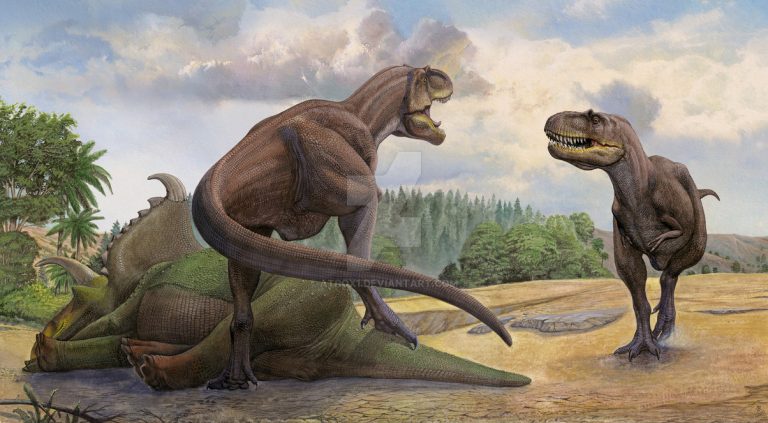
Teratophoneus and Kosmoceratops by atrox1

Teratophoneus is a genus of carnivorous tyrannosaurid theropod dinosaur which lived during the late Cretaceous period (late Campanian age, about 77 to 76 million years ago) in what is now Utah, United States. It is known from an incomplete skull and postcranial skeleton recovered from the Kaiparowits Formation. The Teratophoneus or “monstrous murderer” (Greek: teras, “monster” and phoneus, “murderer”) was specifically named T. curriei in honor of Philip J. Currie.

The holotype of Teratophoneus consists of a fragmentary skull and parts of the postcranial skeleton. The fossils were originally assigned to four different individuals, but are probably only of a single subadult animal. The specimen of Teratophoneus was not fully grown: according to an estimate by Carr et al. was about 6 metres (20 ft) in length and 667 kg in weight.

Compared to the skull of an AlbertosaurusTeratophoneus is roughly twenty-three percent shorter in proportion between the lacrimal bone of the orbital fenestra and the tip of the snout. The skull of Teratophoneus is also comparably deeper. It is unclear if there was a specific reason for these differences, but the extra depth may have allowed for stronger jaw muscles, increasing the bite force of Teratophoneus.

Teratophoneus curriei skeleton in Japan. Author ★Kumiko★

Fossils of Teratophoneus were first found in the Kaiparowits Formation of southern Utah. Later, fossils from the same formation were discovered and identified as the genus. Argon-argon radiometric dating indicates that the Kaiparowits Formation was deposited between 76.1 and 74.0 million years ago, during the Campanian stage of the Late Cretaceous period. This date means that Teratophoneus lived in the middle of the Campanian stage of the Late Cretaceous. Three different fossils of Teratophoneus have been found. Originally, Teratophoneus was described based on the holotype UMNH VP 16690. More recently, the specimens UMNP VP 16691 and BYU 8120 have been assigned to it.

Teratophoneus was named by Thomas D. Carr, Thomas E. Williamson, Brooks B. Britt and Ken Stadtman in 2011. The type and only species was named T. curriei. The generic name is derived from the Greek teras, “monster”, and phoneus, “murderer”. The specific name honors Philip J. Currie.

Restored skull and fossils Skull reconstructions and selected cranial elements of Teratophoneus curriei. These stippled reconstructions (A) are based on all available material. Some of the preserved elements of the referred specimen T. curriei (UMNH VP 16690) including: (B) left maxilla in lateral view, (C) both lacrimals superimposed and in lateral view; (D) photoreversed postorbital in lateral view; (E) frontals, parietals, and laterosphenoids in lateral and dorsal views; (F) braincase in caudal and lateral view; (G) squamosal in lateral and dorsal views; (H) quadratojugal in lateral view; (I) quadrate in lateral and caudal views; (J) left palatine in lateral view; (K) prearticular in left lateral view; (L) angular in left lateral view; (M) surangular in lateral view. Element recovery maps (N) of T. curriei (UMNH VP 16690) from which the reconstruction in A are derrived. Other Kaiparowits T. curriei specimens include two right jugals (UMNH VP 16691 & BYU 8120) and a left dentary from BYU 8120. Abbreviations: bpt, basipterygoid process; bt, basal tubera; bsr, basisphenoid recess; cb, cornual boss; fpc, frontoparietal midsagittal crest; jf, jugal flange of the quadrate; ls, laterosphenoid; lva, lacrimal vacuity; mf, maxillary fenestra; nc, nuchal crest; oc, occipital condyle; p, parietal; pop, paroccipital process; qc, quadrate cotylus; qf, quadrate foramen; sf, surangular foramen; so, supraoccipital; sof, suborbital flange; sog, supraorbital groove. All scale bars represent 10 cm except N which represents 50 cm.

Loewen et al. (2013) conducted a phylogenetic analysis and confirmed the assignment of Teratophoneus to the theropod sub-family tyrannosaurinae. Teratophoneus was closely related but more primitive than the large theropods Tarbosaurus and Tyrannosaurus, but more derived than Daspletosaurus.

Tyrannosauridae by Teratophoneus

The only known specimens of Teratophoneus were recovered at the Kaiparowits Formation, in southern Utah. Argon-argon radiometric dating indicates that the fossils were buried during the Campanian stage of the Late Cretaceous period. During the Late Cretaceous period, the site within the Kaiparowits Formation was located on Laramidia near its eastern shore on the Western Interior Seaway, a large inland sea that split North America into two landmasses, the other being Appalachia to the east. The plateau where dinosaurs lived was an ancient floodplain dominated by large channels and an abundance of wetland peat swamps, ponds and lakes, and was bordered by highlands. The climate was wet and humid, and supported an array of different and diverse groups of organisms. This formation contains one of the best and most continuous records of Late Cretaceous terrestrial life in the world.

Teratophoneus vs Kosmoceratops by PaleoGuy.deviantart.com

Teratophoneus shared its paleoenvironment with theropods such as dromaeosaurids, the troodontid Talos sampsoni, ornithomimids like Ornithomimus velox, the tyrannosaurid Albertosaurus, armored ankylosaurids, the duckbilled hadrosaurs Parasaurolophus cyrtocristatus and Gryposaurus monumentensis, the ceratopsians Utahceratops gettyiNasutoceratops titusi and Kosmoceratops richardsoni and the oviraptorosaurian Hagryphus giganteus. Paleofauna present in the Kaiparowits Formation included chondrichthyans (sharks and rays), frogs, salamanders, turtles, lizards and crocodilians. A variety of early mammals were present including multituberculates, marsupials, and insectivorans.

Ian Malcolm returns as Jeff Goldblum joins the cast of Jurassic World 2

Wednesday, April 26, 2017

Ian Malcolm returns as Jeff Goldblum joins the cast of Jurassic World 2

Life Finds a Way as Jeff Goldblum Heads to Jurassic World 2!

There’s some exciting Jurassic Park franchise news breaking today as The Hollywood Reporter brings word that Jeff Goldblum is set to return for next summer’s still untitled Jurassic World sequel! He joins a cast that currently includes returning stars Chris Pratt and Bryce Dallas Howard alongside Toby Jones, Daniella Pineda, Justice Smith and Rafe Spall. Frank Marshall and Steven Spielberg are returning to produce the film, which has JA Bayona (When a Monster CallsThe Impossible) in the director’s chair.

Bayona (The ImpossibleA Monster Calls) will direct the Jurassic World sequel from a script by Colin Trevorrow and Derek Connolly.

Trevorrow previously revealed the quote from the original Jurassic Park that inspired their idea for the sequel, which comes from Sam Neil’s Alan Grant: “Dinosaurs and man, two species separated by 65 million years of evolution have just been suddenly thrown back into the mix together. How can we possibly have the slightest idea what to expect?”

“Every story is different and you need to find the depth of every story and try to express it on the screen,” Bayona recently told CS. “The ‘Jurassic World’ sequel is a more collaborative filmmaker experience, not only with Colin Trevorrow, but also with Steven [Spielberg] and with Frank Marshall. It’s their baby as much as it is mine. It’s about sharing views and working together to bring the story to life. But, at the same time, the way I face telling a story is to find something very personal. I think there will be plenty of myself also in the film.”

Jeff Goldblum previously reprised the Ian Malcolm role for 1997’s The Lost World: Jurassic Park. Although eagle eyed viewers can glimpse his photo in Jurassic World, the new film will mark the first full appearance of the character in more than two decades.

The Jurassic World sequel is set for release on June 22, 2018.

Source: www.comingsoon.net

Dinosaurs of Argentina

Tuesday, April 25, 2017

Dinosaurs of Argentina

The richness of paleontological sites in Neuquén province turns it into “the center of paleontology”.

SALTASAURUS LORICATUS

Saltasaurus, from which Argentinosaurus was reconstructed (Alain Beneteau).

“Salta’s Lizard” was discovered in 1980. This small titanosaurus sauropod from the Late Cretaciaous made a revolution in the field of Paleontology as its back was covered by hard bone plates. This led the scientists to consider the possibility that other sauropods would also have this kind of armour.
It was approximately 12 meters long and would weigh about 8 tons. As all sauropods, it was purely a plant-eater and could stand on its hind legs to reach the higher branches.

NOASAURUS LEALI
This small South American carnivore dwelled the soils of Northwestern Argentina about 73 million years ago. It was discovered in the Lecho Formation, at estancia El Brete, in the South of Salta. It was between 1 and 3 meters long and would weigh approximately 15 kilos. It was slender and light but its fearful curve claws would move fast. Even if it had certain features in common with the Velociraptors dwelling North America and Asia, it was a totally different species. In fact, it was an Abelisaurus, a relative of the Carnotaurus.
This voracious creature proved that dinosaurs did not have to be large to be the most fearful hunters on the planet. It is believed that it fed on young sauropods.

HERRERASAURUS ISCHIGUALASTENSIS

Herrerasaurus ischigualastensis by Sergey Krasovskiy

It is one of the most ancient dinosaurs with very primitive features. It dates from approximately 228 million years ago. It became extinct at the end of the Triassic. It was a medium-sized carnivore of about 3.5 meters of length. It was similar to the theropods. It would walk on two legs and had sharp teeth and claws. Its arms were short. It was discovered in the Ischigualasto Formation, in San Juan, in 1958 by Don Victorino Herrera, a local rancher.

RIOJASAURUS INCERTUS

Riojasaurus, shown in comparison with humans. Debivort. Author: Debivort

A representative of the primitive family of the prosauropods, the Melanosauridae, this is the most common genre registered in the upper sections of the Los Colorados layers, in the Province of La Rioja. It dwelled this area during the Late Triassic, about 220 million years ago. “La Rioja’s lizard” was one of the first large herbivorous dinosaurs. This heavily-built quadruped was about 10 meters long. It had a long neck, a long tail, a small head, a long, bulky body, and thick, elephant-like legs with claws. The back legs were only slightly larger than the front legs. Its limb bones were solid and thick, but its backbone was hollow. It had spoon-shaped, serrated teeth.

LAGOSUCHUS TALAMPAYENSIS
This archosaur reptile was found in the Talampaya Canyon, in the Province of La Rioja, by an expedition organized by the paleontologist Alfred Romer, from the University of Harvard in 1964. This creature lived 225 million years ago. It shared certain features with the dinosaurs. After two decades, it was considered a new genre and species which was named Marasuchus lilloensis. From the point of view of evolution, only a step separated this animal from the dinosaurs.
It had a pointed long head and a long thin tail. Among its most outstanding features, the skull had two openings behind each eye, one on top of the other, which would allow for the muscles of the jaw to be enlarged while they chewed. It also had an opening in front of each eye, which might have contained a gland. It is precisely due to these characteristics that it has been classified as an archosaurus, from the Greek: “ruling reptile”.

PISANOSAURUS MERTII
This herbivore of the order of the ornithischia lived in Las Lajas, in the Province of La Rioja, around 200 million years ago, when the area was humid and tropical, with lakes, rivers and conifers. It would be 90 centimeters long and would weigh from 7 to 10 kilograms. Its compact teeth allowed it to chew the hard plants typical from semi-arid areas. Its hind limbs were thin and they could reach high speed.

SILLOSUCHUS LONGICERVIX
Found in the Valley of the Moon, in San Juan, it has been considered the ancestor of the present crocodile. It had a graceful and light skeleton. According to the proportions of the bones found, this animal would stand on two legs. It was a carnivore. It lived 220 million years ago and it belongs to the group of the poposaurus.

EORAPTOR LUNENSIS
It is considered the most primitive and complete dinosaur from the inferior section of the Late Triassic 215 millon years ago and it has very valuable anatomical information to understand the first dinosaur evolution stages. This small carnivore was found in the Ischigualasto Formation, in the Valley of the Moon, in San Juan.

PROTEROCHAMPSA BARRIONUEVOI
It was an amphibious carnivore that lived during the Late Triassic, around 215 million years ago in the area of the Ischigualasto Formation, in the Valley of the Moon, in the Province of San Juan. It may be compared to the present crocodiles, but its anatomical structure was much more primitive.
It would hunt small dinosaurs that approached the rivers. It was discovered by Professor Osvaldo A. Reig in 1959.

PTERODAUSTRO GUINAZUI
This pterosaurus, whose name means “South Wing”, was found at Lagarcito, in the Province of San Luis. Due to the characteristics of the area where it was found, it is estimated that it would dwell the lagoons of the arid zones and not the sea coast, like most members of this group. It lived 125 million years ago during the Cretaceous. As every pterosaurus, it is not classified as a dinosaur. It could fly long distances using its large light wings.
It was a carnivore: it would eat fish, mollusk and insects. It had 500 bristle-like teeth on either side of is lower jaw to sieve small organisms out of the water. Its upper jaw contained a series of short blunt teeth, enabling the pterosaur to chop its catch into smaller pieces.

ARGYROSAURUS ENTRERRIENSIS
The “Silver Lizard” was a herbivorous sauropod that lived 70 million years ago during the Late Cretaceous. Being 8 meters high and 30 meters long, it was one of the largest dinosaurs. It was found in the area of Colón, Province of Entre Ríos.

ABELISAURUS COMAHUENSIS

Abelisaurus size by Nobu Tamura

“Abel’s Lizard”, named after its discoverer, Roberto Abel, former director of the Argentinian Museum of Natural Science, dwelled the area of Río Negro during the Late Cretaceous, approximately 75 million years ago. This bipedal carnivore had a single skull which measured 85 centimeters long.
Discovered in 1985 in the surroundings of Lake Pellegrini, in the Province of Río Negro, its heavy teeth indicate that it was possibly in part a scavenger. It was approximately 7 meters long and 2 meters high and it would weigh 1.5 tons. It is believed to have been related to the Carnotaurus.

GASPARINISAURA CINCOSALTENSIS
It has been found recently in the district of Cinco Saltos, in the Province of Río Negro. This herbivore would be very small (1.50 meters), graceful and very fast. According to scientists speculations, it would live in herds, as several adult, young and offspring specimens have been found within an area of 100 m2. It had a tight row of teeth to grind resistant vegetables. The hind legs indicate that it could run quite fast.
It dates back from the Late Cretaceous, about 90 million years ago, when South America was still joined to Antarctica in the South and this to Australia. The fact that fossils of this dinosaur were found in Africa, Australia and Antarctica indicates that they were distributed all through the world before Pangea was fragmented.

ANTARCTOSAURUS WICHMANNIANUS
With a small head and a short flat skull, the “Southern Lizard” may have been one of the largest sauropods, according to the fossils found in the Río Colorado Formation sediments, in the Province of Río Negro in the early XX, which include a 2.20-meter-long femur. It is believed that this reptile was approximately 18 meters long and 6 meters high, which turned it into the largest sauropod in South America. It is related to the similarly gigantic Argentinosaurus and it belongs to the group of the titanosaurs.
It dwelled the southernmost tip of the present American continent during the Cretaceous about 75 million years ago. Its teeth were located at the front of its jaw, which indicates that it would rip the food without chewing.

GIGANOTOSAURUS CAROLINII

Giganotosaurus carolinii by durbed

The “Carolinii”, considered the largest carnivorous dinosaur in the world, surpasses the famous Tyranosaurus rex in size. It was discovered in July, 1993, by Rubén Darío Carolini, present Director of the Villa El Chocón Municipal Museum, in a former lagoon located 18 kilometers to the South of Villa El Chocón.
80% of the fossil material of this specimen has been rescued and preserved in optimum condition. This carnivore, with reduced fore limbs, biped gait and with three toes in each leg, would measure 13.5 meters of length and its hip could reach 4.6 meters. It is estimated that it would weigh 9.5 tons when it was alive. Its head would measure 2 meters and its longest tooth, 21 centimeters. This specimen belongs to the Mid Cretaceous from the Mesozoic Era and it dwelled the Plaza Huincul area 90 million years ago.

AMARGASAURUS CAZAUI

Amargasaurus by Raul Lunia

“Amarga’s Lizard” was a sauropod from the Early Cretaceous. Its fossils were discovered by paleontologist José Bonaparte in 1991 in a canyon in La Amarga, a town in the Province of Neuquén, located approximately 70 kilometers from Zapala. The species name cazaui is due to Dr. Luis Cazau, a geologist who worked for the state oil company YPF and with Bonaparte’s team in 1983 at La Amarga.
This herbivore dwelled the area approximately 120 million years ago. It was 10 meters long and would weigh about five tons. It was differenciated from other sauropods by two parallel rows of large “spikes” that ran along its neck up to the tail. They may have been connected by a skin membrane, forming a double “sail” that might have worked as a thermoregulatory structure, used to absorb and release heat, for mating and dominance rituals, and for making this creature look much larger than it was to predators. Otherwise, the spines were probably used for protection. Amargasaurus was a quadruped, had a small head, a long neck and a very long whip-like tail.
Its front legs were shorter than its back legs, and all the legs had five-toed feet and a thumb claw, probably used for protection.
According to Bonaparte’s investigations, the Amargasaurus is closely related to two species from the Jurassic found in Tanzania.
It is believed that it ate large amounts of plant material a day to sustain itself and that it would swallow leaves without chewing. It had blunt teeth to rip the foliage easily.
It moved in herds and it may have migrated when food supply became scarce.

ARGENTINOSAURUS HUINCULENSIS
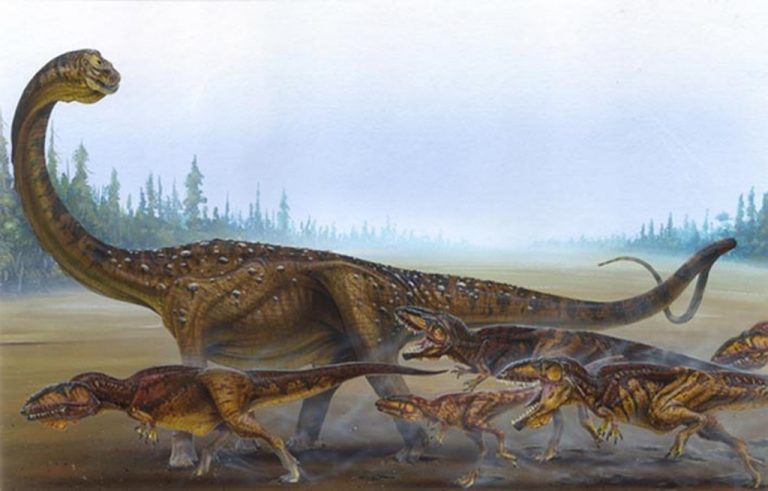
Argentinosaurus chased by Giganotosaurus by WillDynamo55

Named Huinculensis after the district of Plaza Huincul where its fossil remains were found, in the Province of Neuquén. This is the largest herbivorous dinosaur found so far. Its size is even larger than the “Carolinii”, which was a carnivore.
It belongs to the Mid Cretaceous period. It is estimated that it is 98 million years old. It was rescued by the staff of the Carmen Funes Museum in Plaza Huincul, where original pieces of the find are exhibited.
This is a great sauropod, some of its dorsal vertebras are the largest ever recorded. They are 1.70 meters high.

ANDESAURUS DELGADOI
In 1987, a campaign organized by the Comahue National University extracted some vertebras and part of the hip of a dinosaur that was later called Andesaurus delgadoi after its discoverer Alejandro Delgado.
It was found several meters under the waters of Lake Exequiel Ramos Mejía, formed by the El Chocón Dam. The rescue took place when the level of the lake went lower than its historical records. It is estimated that the creature was 15 meters long.
At present, it is exhibited at the Comahue National University Geology and Paleontology Museum.

REBBACHISAURUS TESSONEI
In 1988, the most complete specimen in South America was found in Villa El Chocón. It was called Rebbachisaurus Tessonei. This is a sauropod, herbivorous middle-sized dinosaur, which would weight about 10 tons and measure 17 meters of length. Nowadays, it is exhibited at the Geology and Paleontology Museum. In turn, the Rebbachisaurus tessonei was one of the favourite dishes of the largest carnivore of all times -the Giganotosaurus carolinii.
According to experts Jorge Calvo and Leonardo Salgado, these huge animals with very long tails and necks would wander about the area on their four legs over one hundred million years ago, devouring the exuberant vegetation that would cover the marshlands.

CARNOTAURUS SASTREI

This large predator, similar to the Tiranosaurus rex lived in the Argentinian Patagonia around 90 million years ago and was discovered in Chubut by José F. Bonaparte, discoverer of many other South American dinosaurs.
Its most outstanding features include two thick bull-like horns above the eyes that are the reason for its name, and the extremely reduced forelimbs with four fingers. It had a small skull, a thick chest, and a thin tail. The eyes of the Carnotaurus faced forward, which is unusual in a dinosaur, and may indicate binocular vision and depth perception. It was 10 meters long and 4 meters high, and it belonged to the group of the most spectacular South American dinosaurs: the Abelisauridae.

TITANOSAURUS AUSTRALIS
This is one of the sauropod dinosaurs that has been most thouroughly studied. It did not surpass the 8 meters of length, although other representatives of its family (also exhibited in the museum) would loosely surpass this measure. Almost spherical fossil eggs of these animals have been found. One of these eggs belongs to the collection of the museum and may be observed by visitors. This dinosaur stepped on Patagonia approximately 85 million years ago, during the Upper Cretaceous.

PIATNITZKYSAURUS FLORESI
Found in the Cañadón Asfalto Formation in the Province of Chubut, this carnivorous dinosaur would belong to the group of the theropods. It dwelled the area during the Mid Jurassic, 165 million years ago. This 5-meter-long creature was an active hunter that may have attacked in groups. It would feed on young sauropods. Its large curve claws were used while hunting as a complement to its formidable conical very compressed long teeth, which were bent backwards and quite sharp. This suggested that the animal was not a fierce predator of large prey but of small vertebrates. It walked on two legs for its hind limbs were long and strong in comparison with its reduced fore limbs. Its strong head would measure approximately 50 centimeters.

MEGARAPTOR NAMUNHUAIQUII
The “Giant Robber”, a large predator from the Late Cretaceous, had fearful sickle-shaped claws. It walked on two slender, bird-like legs. It had a curve flexible neck, a huge head and serrated teeth in its powerful jaw. It used its tail to manage perfect balance and turn fast. This 7-meter- long carnivore dwelled the Northwestern area of the Argentinian Patagonia and was discovered by paleontologist Fernando E. Novas.

NOTOCERATOPS
This quadruped dinosaur was herbivorous and had horns and a beak similar to that of a parrot. It had a large head, a bulky body, a parrot-like beak, cheek teeth, and a small frill on its head. It was quite slow.
It lived in the Late Cretaceous, approximately 80 million years ago, towards the end of the Mesozoic, the Age of Reptiles.
In 1918, Augusto Tapia found part of a lower jaw that would belong to this specimen in Chubut.

QUILMESAURUS CURRIEI
Named after the Quilmes Indians, this medium-sized carnivore lived during the Late Cretaceous. It is estimated that it was 5-6 long. Fossil remains of this theropod were found in the Allen Formation, Salitral Ojo de Agua, in the Province of Río Negro.

UNENLAGIA COMAHUENSIS

Skeletal reconstruction of Unenlagia comahuensis. Jaime A. Headden

This is the most bird-like dinosaur ever discovered. This theropod from the Mid-Cretaceous is 90 million years ago. The first birds appeared 150 million years ago, evolving from dinosaurs long before Unenlagia lived. This proves that it is not an ancestor of modern-day birds.
With the size of an ostrich, but shaped like a Velociraptor, this fightless carnivore was 1.20 meters tall and 2 meters long. Its fossil remains have provided evidence to prove how dinosaur forearms evolved into the wings of modern-day birds.
The Unenlagia had a special shoulder structure that allowed it to move its short arms forwards, backwards and inwards to catch their prey, and upwards and downwards in a flapping motion which, even if not used for flying, because its wing-like arms were too short to support the heavy dinosaur, were used for balancing and turning. Although there is no fossil evidence of feathers from its fossils, it may well have had them.
Fernando Novas, from the Museum of Natural History of Buenos Aires gave this dinosaur the name of Unenlagia comahuensis, which means “half-bird from Northwestern Patagonia”.

Source: www.welcomeargentina.com

10 Facts About Sarcosuchus

Monday, April 24, 2017

10 Facts About Sarcosuchus

Meet Sarcosuchus, the 10-Ton Prehistoric Crocodile

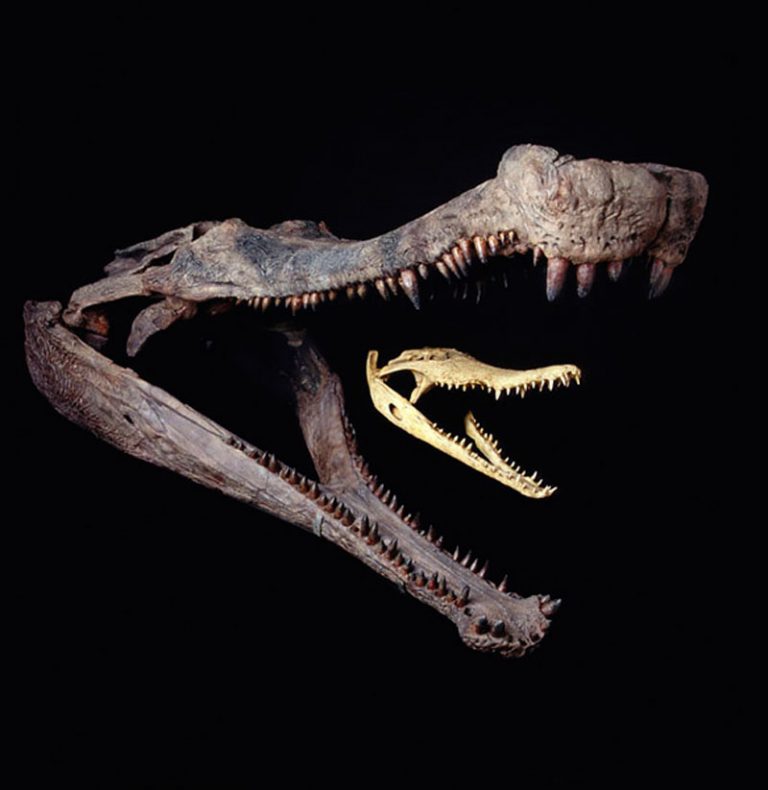
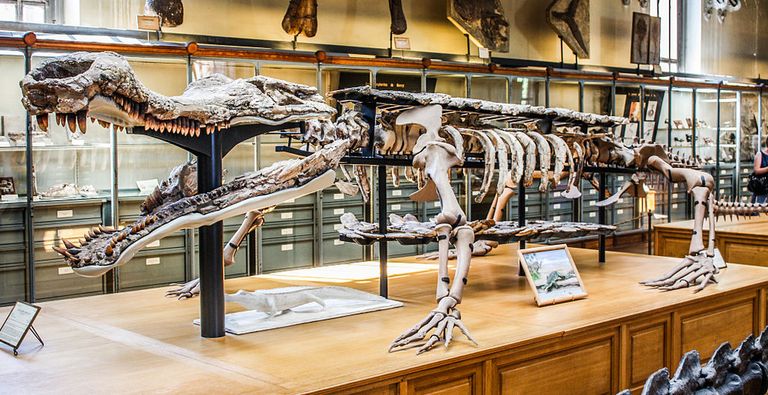
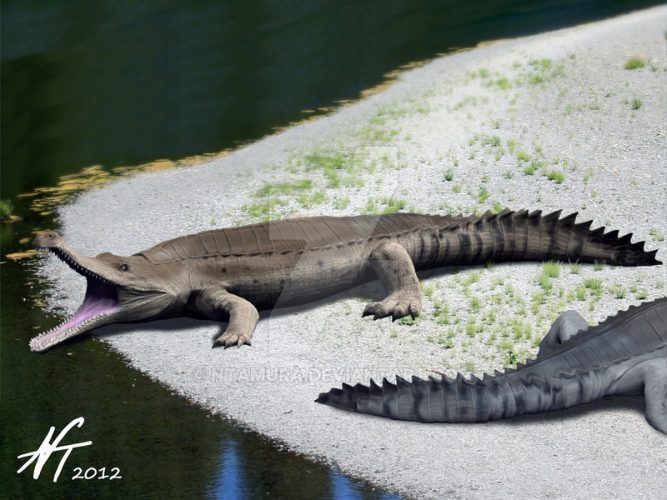
Sarcosuchus (meaning “flesh crocodile”) is a genus of crocodyliform and distant relative of living crocodylians that lived 112 million years ago. It dates from the early Cretaceous Period of what is now Africa and South America and is one of the largest crocodile-like reptiles that ever lived. It was almost twice as long as the modern saltwater crocodile and weighed up to 8 tonnes.

Sarcosuchus – SuperCroc

Sarcosuchus Is Also Known as the SuperCroc

Sarcosuchus vs Carcharodontosaurus

The name Sarcosuchus is Greek for “flesh crocodile,” but that apparently wasn’t impressive enough for the producers at National Geographic. In 2001, this cable channel bestowed the title “SuperCroc” on its hour-long documentary about Sarcosuchus, a name that has since stuck in the popular imagination. (By the way, there are other “-crocs” in the prehistoric bestiary, none of which are quite as popular as SuperCroc: for example, have you ever heard of the BoarCroc or the DuckCroc?)

Sarcosuchus Kept Growing Throughout its Life Span

Sarcosuchus by Sameer Prehistorica

Unlike modern crocodiles, which attain their full adult size in about ten years, Sarcosuchus seems to hve kept growing and growing at a steady rate throughout its lifetime (paleontologists can determine this by examining bone cross-sections from various fossilized specimens). As a result, the largest, most superannuated SuperCrocs reached lengths of up to 40 feet from head to tail, compared to about 25 feet max for the biggest croc alive today, the Saltwater Crocodile.

Sarcosuchus Adults May Have Weighed More than 10 Tons

Wikimedia Commons

What made Sarcosuchus truly impressive was its dinosaur-worthy weight: more than ten tons for those 40-foot-long senior citizens described in the previous slide, and perhaps seven or eight tons for the average adult. If the SuperCroc had lived after the dinosaurs had gone extinct, rather than right alongside them during the middle Cretaceous period (about 100 million years ago), it would have counted as one of the largest land-dwelling animals on the face of the earth!

Sarcosuchus May Have Tangled With Spinosaurus

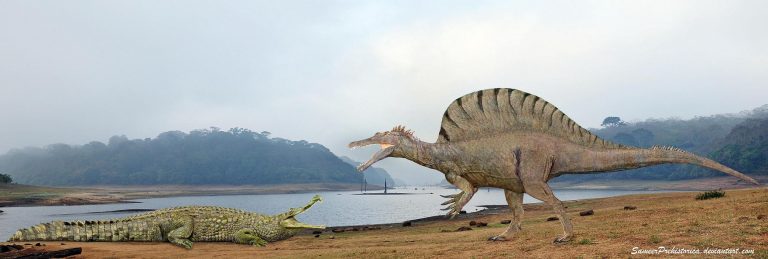
Sarcosuchus vs Spinosaurus by sameerprehistorica

Although it’s unlikely that Sarcosuchus deliberately hunted dinosaurs for lunch, there’s no reason it had to tolerate other predators that competed with it for limited food resources. A full-grown SuperCroc would have been more than capable of breaking the neck of a large theropod, such as, say, the contemporary, fish-eating Spinosaurus, the largest meat-eating dinosaur that ever lived.

The Eyes of Sarcosuchus Rolled Up and Down, not Left and Right

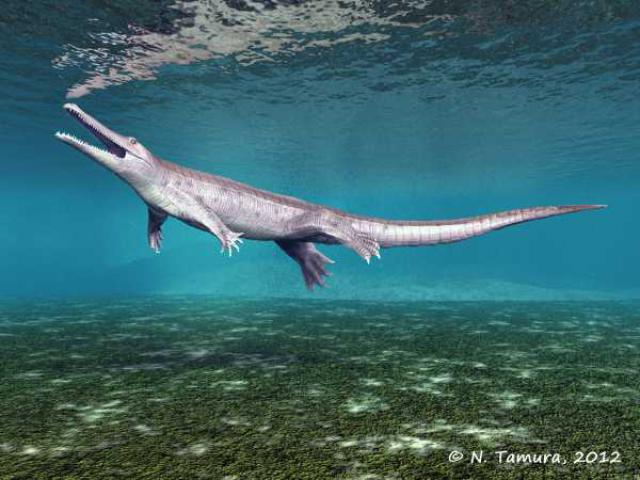
Sarcosuchus by Nobu Tamura

You can tell a lot about an animal”s accustomed behavior by observing the shape, structure, and placement of its eyes. The eyes of Sarcosuchus didn’t move left and right, like those of a cow or panther, but rather up and down, indicating that the SuperCroc spent much of its time submerged partway below the surface of freshwater rivers (like modern crocodiles), scanning the banks for interlopers and occasionally breaching the surface to snap at encroaching dinosaurs and drag them into the water.

Sarcosuchus Lived in What (Today) Is the Sahara Desert

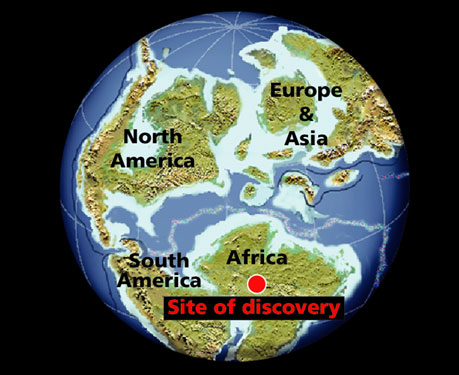
The SuperCroc fossils were found in sub-Saharan Africa, in what is now Niger. The map above shows the Earth as it may have looked about 110 million years ago, when Sarcosuchus imperator lived. Map by Ron Blakey

One hundred million years ago, northern Africa was a lush, tropical region crisscrossed by numerous rivers; it has only been relatively recently (geologically speaking) that this area dried out and became overspread by the Sahara, the largest desert in the world. Sarcosuchus was only one of a wide variety of plus-sized reptiles that took advantage of this region’s natural abundance during the later Mesozoic Era, basking in its year-round heat and humidity; there were also plenty of dinosaurs to keep this croc company!

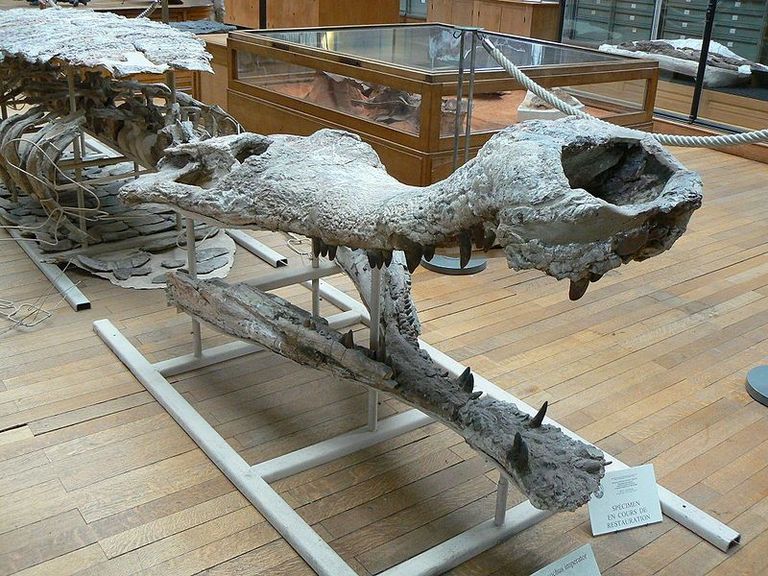
The Snout of Sarcosuchus Ended in a “Bulla”

Wikimedia Commons

The bulbous depression, or “bulla,” at the end of Sarcosuchus’ long, narrow snout continues to be a mystery to paleontologists. This may have been a sexually selected characteristic (that is, males with larger bullas were more attractive to females during mating season, and thus managed to perpetuate the trait), an enhanced olfactory (smelling) organ, a blunt weapon deployed in intra-species combat, or even a sounding chamber that allowed Sarcosuchus individuals to communicate with each other over long distances.

Sarcosuchus Mostly Subsisted on Fish

Sarcosuchus by Renata Cunha

You’d think a crocodile as big and heavy as Sarcosuchus would have feasted exclusively on the plus-sized dinosaurs of its habitat–say, half-ton hadrosaurs that wandered too close to the river for a drink. Judging by the length and shape of its snout, though, it’s likely that the SuperCroc ate fish pretty much exclusively (gigantic theropods equipped with similar snouts, like Spinosaurus, also enjoyed piscivorous diets), only feasting on dinosaurs when the opportunity was too good to pass up.

Sarcosuchus Was Technically a “Pholidosaur”

A typical pholidosaur (Nobu Tamura).

Its catchy nickname aside, the SuperCroc wasn’t a direct descendant of modern crocodiles, but rather an obscure type of prehistoric reptile known as a “pholidosaur.” (By contrast, the almost-as-big Deinosuchus was a genuine member of the crocodile family, though it has technically been classified as an alligator!) The crocodile-like pholidosaurs went extinct millions of years ago, for reasons that are still uncertain, and haven’t left any direct living descendants.

Sarcosuchus Was Covered Head to Tail in Osteoderms

Wikimedia Commons

The osteoderms, or armored plates, of modern crocodiles aren’t continuous–you can detect a break (if you dare to venture close enough) between their necks and the rest of their bodies. Not so with Sarcosuchus, the entire body of which was covered with these plates, except for the end of its tail and the front of its head. Tellingly, this arrangement is similar to that of another crocodile-like pholidosaur of the middle Cretaceous period, Araripesuchus, and may have had a deleterious effect on Sarcosuchus’ overall flexibility.

Source: www.thoughtco.com

Plesiosauria

Monday, April 24, 2017

Liopleurodon ferox, a pliosaur much like those that once prowled the Jurassic Coast, hunts an unfortunate plesiosaur (above). Jaime Chirinos/Science Photo Library/Corbis

The Plesiosauria (Greek: πλησίος, plesios, meaning “near to” and Sauria) or plesiosaurs are an order or clade of Mesozoic marine reptiles (marine Sauropsida), belonging to the Sauropterygia.

Plesiosaurs first appeared in the latest Triassic Period, possibly in the Rhaetian stage, about 203 million years ago. They became especially common during the Jurassic Period, thriving until their disappearance due to the Cretaceous–Paleogene extinction event at the end of the Cretaceous Period, about 66 million years ago. They had a worldwide oceanic distribution.

Kronosaurus – the largest plesiosaur.

Plesiosaurs were among the first fossil reptiles discovered. In the beginning of the nineteenth century, scientists realised how distinctive their build was and they were named as a separate order in 1835. The first plesiosaurian genus, the eponymous Plesiosaurus, was named in 1821. Since then, more than a hundred valid species have been described. In the early twenty-first century, the number of discoveries has increased, leading to an improved understanding of their anatomy, relationships and way of life.

Plesiosaurs had a broad flat body and a short tail. Their limbs had evolved into four long flippers, which were powered by strong muscles attached to wide bony plates formed by the shoulder girdle and the pelvis. The flippers made a flying movement through the water. Plesiosaurs breathed air, and bore live young; there are indications that they were warm-blooded.

Basal Pistosauria, like Augustasaurus, already bore a strong resemblance to Plesiosauria by Nobu Tamura

Plesiosaurs showed two main morphological types. Some species, with the “plesiosauromorph” build, had (sometimes extremely) long necks and small heads; these were relatively slow and caught small sea animals. Other species, some of them reaching a length of up to seventeen metres, had the “pliosauromorph” build with a short neck and a large head; these were apex predators, fast hunters of large prey. The two types are related to the traditional strict division of the Plesiosauria into two suborders, the long-necked Plesiosauroidea and the short-neck Pliosauroidea. Modern research, however, indicates that several “long-necked” groups might have had some short-necked members or vice versa. Therefore, the purely descriptive terms “plesiosauromorph” and “pliosauromorph” have been introduced, which do not imply a direct relationship. “Plesiosauroidea” and “Pliosauroidea” today have a more limited meaning. The term “plesiosaur” is properly used to refer to the Plesiosauria as a whole, but informally it is sometimes meant to indicate only the long-necked forms, the old Plesiosauroidea.

Size

In general, plesiosaurians varied in adult length from between 1.5 metres (5 ft) to about 15 metres (49 ft). The group thus contained some of the largest marine apex predators in the fossil record, roughly equalling the longest ichthyosaurs, mosasaurids, sharks and toothed whales in size. Some plesiosaurian remains, such as a 2.9 metres (10 ft) long set of highly reconstructed and fragmentary lower jaws preserved in the Oxford University Museum and referable to Pliosaurus rossicus(previously referred to Stretosaurus and Liopleurodon), indicated a length of 17 metres (56 ft). However, it was recently argued that its size cannot be currently determined due to their being poorly reconstructed and a length of thirteen metres is more likely. MCZ 1285, a specimen currently referable to Kronosaurus queenslandicus, from the Early Cretaceous of Australia, was estimated to have a skull length of 2.85 m (9 ft).

Skeleton

The typical plesiosaur had a broad, flat, body and a short tail. Plesiosaurs retained their ancestral two pairs of limbs, which had evolved into large flippers. Plesiosaurs were related to the earlier Nothosauridae, that had a more crocodile-like body. The flipper arrangement is unusual for aquatic animals in that probably all four limbs were used to propel the animal through the water by up-and-down movements. The tail was most likely only used for helping in directional control. This contrasts to the ichthyosaurs and the later mosasaurs, in which the tail provided the main propulsion.

Restored skeleton of Plesiosaurus. Paleo Hall at HMNS

To power the flippers, the shoulder girdle and the pelvis had been greatly modified, developing into broad bone plates at the underside of the body, which served as an attachment surface for large muscle groups, able to pull the limbs downwards. In the shoulder, the coracoid had become the largest element covering the major part of the breast. The scapula was much smaller, forming the outer front edge of the trunk. To the middle, it continued into a clavicle and finally a small interclavicular bone. As with most tetrapods, the shoulder joint was formed by the scapula and coracoid. In the pelvis, the bone plate was formed by the ischium at the rear and the larger pubic bone in front of it. The ilium, which in land vertebrates bears the weight of the hindlimb, had become a small element at the rear, no longer attached to either the pubic bone or the thighbone. The hip joint was formed by the ischium and the pubic bone. The pectoral and pelvic plates were connected by a plastron, a bone cage formed by the paired belly ribs that each had a middle and an outer section. This arrangement immobilised the entire trunk.

To become flippers, the limbs had changed considerably. The limbs were very large, each about as long as the trunk. The forelimbs and hindlimbs strongly resembled each other. The humerus in the upper arm, and the thighbone in the upper leg, had become large flat bones, expanded at their outer ends. The elbow joints and the knee joints were no longer functional: the lower arm and the lower leg could not flex in relation to the upper limb elements, but formed a flat continuation of them. All outer bones had become flat supporting elements of the flippers, tightly connected to each other and hardly able to rotate, flex, extend or spread. This was true of the ulna, radius, metacarpals and fingers, as well of the tibia, fibula, metatarsals and toes. Furthermore, in order to elongate the flippers, the number of phalanges had increased, up to eighteen in a row, a phenomenon called hyperphalangy. The flippers were not perfectly flat, but had a lightly convexly curved top profile, like an airfoil, to be able to “fly” through the water.

Source: www.wikipedia.com, www.ifls.com

Ammonoidea

Monday, April 24, 2017

 Ammonite Promicoceras (Charmouth, Dorset)

Ammonoids are an extinct group of marine mollusc animals in the subclass Ammonoidea of the class Cephalopoda. These molluscs are more closely related to living coleoids (i.e., octopuses, squid, and cuttlefish) than they are to shelled nautiloids such as the living Nautilus species. The earliest ammonites appear during the Devonian, and the last species died out during the Cretaceous–Paleogene extinction event.

Ammonites are excellent index fossils, and it is often possible to link the rock layer in which a particular species or genus is found to specific geologic time periods. Their fossil shells usually take the form of planispirals, although there were some helically spiraled and nonspiraled forms (known as heteromorphs).

Fossil Focus: Ammonoids

The name “ammonite”, from which the scientific term is derived, was inspired by the spiral shape of their fossilized shells, which somewhat resemble tightly coiled rams’ horns. Pliny the Elder (d. 79 AD near Pompeii) called fossils of these animals ammonis cornua (“horns of Ammon”) because the Egyptian god Ammon (Amun) was typically depicted wearing ram’s horns. Often the name of an ammonite genus ends in –ceras, which is Greek (κέρας) for “horn”.

Ammonites (subclass Ammonoidea) can be distinguished by their septa, the dividing walls that separate the chambers in the phragmocone, by the nature of their sutures where the septa joint the outer shell wall, and in general by their siphuncles.

Septa

Ammonoid septa characteristically have bulges and indentations and are to varying degrees convex from the front, distinguishing them from nautiloid septa which are typically simple concave dish-shaped structures. The topology of the septa, especially around the rim, results in the various suture patterns found.

Ammonite interiors showing septa; Pierre Shale, Upper Cretaceous, South Dakota

Suture patterns

Three major types of suture patterns are found in the Ammonoidea:

  • Goniatitic – numerous undivided lobes and saddles; typically 8 lobes around the conch. This pattern is characteristic of the Paleozoic ammonoids.
  • Ceratitic – lobes have subdivided tips, giving them a saw-toothed appearance, and rounded undivided saddles. This suture pattern is characteristic of Triassic ammonoids and appears again in the Cretaceous “pseudoceratites”.
  • Ammonitic – lobes and saddles are much subdivided (fluted); subdivisions are usually rounded instead of saw-toothed. Ammonoids of this type are the most important species from a biostratigraphical point of view. This suture type is characteristic of Jurassic and Cretaceous ammonoids, but extends back all the way to the Permian.

Siphuncle

The siphuncle in most ammonoids by far is a narrow tubular structure that runs along the outer rim, known as the venter, connecting the chambers of the phragmocone to the body or living chamber. This distinguishes them from living nautiloides (Nautilus and Allonautilus) and typical Nautilida. However, the very earliest nautiloids from the Late Cambrian and Ordovician typically had ventral siphuncles, although often proportionally larger than those in ammonites and more internally structured. The word “siphuncle” comes from the New Latin siphunculus, meaning “little siphon”.

Originating from within the bactritoid nautiloids, the ammonoid cephalopods first appeared in the Devonian (circa 400 million years ago) and became extinct at the close of the Cretaceous (66 Mya) along with the dinosaurs. The classification of ammonoids is based in part on the ornamentation and structure of the septa comprising their shells’ gas chambers; by these and other characteristics we can divide subclass Ammonoidea into three orders and eight known suborders. While nearly all nautiloids show gently curving sutures, the ammonoid suture line (the intersection of the septum with the outer shell) is variably folded, forming saddles (or peaks) and lobes (or valleys).

De Baets et al. Fossil Focus: Ammonoidea

Orders and suborders

The Ammonoidea can be divided into eight orders, listed here starting with the most primitive and going to the more derived:

  • Anarcestida, Devonian
  • Clymeniida, Upper Devonian
  • Goniatitida, Middle Devonian – Upper Permian
  • Prolecanitida, Upper Devonian – Upper Triassic
  • Ceratitida, Permian – Triassic
  • Phylloceratida, Triassic – Cretaceous
  • Lytoceratida, Jurassic – Cretaceous
  • Ammonitida, Lower Jurassic – Upper Cretaceous

In some classifications, these are left as suborders, included in only three orders: Goniatitida, Ceratitida, and Ammonitida.

De Baets et al. Fossil Focus: Ammonoidea – Diversity

Taxonomy of the Treatise on Invertebrate Paleontology

The Treatise on Invertebrate Paleontology (Part L, 1957) divides the Ammonoidea, regarded simply as an order, into eight suborders, the Anarcestina, Clymeniina, Goniatitina, and Prolecanitina from the Paleozoic; the Ceratitina from the Triassic; and the Ammonitina, Lytoceratina, and Phylloceratina from the Jurassic and Cretaceous. In subsequent taxonomies, these are sometimes regarded as orders within the subclass Ammonoidea.

Extinction

The extinction of the ammonites, along with other marine animals and non-avian dinosaurs, has been attributed to the K-Pg extinction event, marking the end of the Cretaceous Period.

Eight or so species from only two families made it almost to the end of the Cretaceous, the order having gone through a more or less steady decline since the middle of the period. Six other families made it well into the upper Maastrichtian (uppermost stage of the Cretaceous), but were extinct well before the end. All told, 11 families entered the Maastrichtian, a decline from the 19 families known from the Cenomanian in the middle of the Cretaceous.

One reason given for their demise is the Cretaceous ammonites, being closely related to coleoids, had a similar reproductive strategy in which huge numbers of eggs were laid in a single batch at the end of the lifespan. These, along with juvenile ammonites, are thought to have been part of the plankton at the surface of the ocean, where they were killed off by the effects of an impact. Nautiloids, exemplified by modern nautiluses, are conversely thought to have had a reproductive strategy in which eggs were laid in smaller batches many times during the lifespan, and on the sea floor well away from any direct effects of such a bolide strike, and thus survived.

Many ammonite species were filter-feeders, so they might have been particularly susceptible to marine faunal turnovers and climatic change.

Ichthyosaur

Monday, April 24, 2017

Ichthyosaurs (Greek for “fish lizard” – ιχθυς or ichthys meaning “fish” and σαυρος or sauros meaning “lizard”) are large marine reptiles. Ichthyosaurs belong to the order known as Ichthyosauria or Ichthyopterygia (‘fish flippers’ – a designation introduced by Sir Richard Owen in 1840, although the term is now used more for the parent clade of the Ichthyosauria).

Ichthyosaurs thrived during much of the Mesozoic era; based on fossil evidence, they first appeared approximately 250 million years ago (mya) and at least one species survived until about 90 million years ago, into the Late Cretaceous. During the early Triassic Period, ichthyosaurs evolved from a group of unidentified land reptiles that returned to the sea, in a development parallel to that of the ancestors of modern-day dolphins and whales, which they gradually came to resemble in a case of convergent evolution. They were particularly abundant in the later Triassic and early Jurassic Period, until they were replaced as the top aquatic predators by another marine reptilian group, the Plesiosauria, in the later Jurassic and Cretaceous Period. In the Late Cretaceous, ichthyosaurs became extinct for unknown reasons.

Stereosternum to Utatsusaurus – the Origin of Ichthyosaurus

Science became aware of the existence of ichthyosaurs during the early nineteenth century when the first complete skeletons were found in England. In 1834, the order Ichthyosauria was named. Later that century, many excellently preserved ichthyosaur fossils were discovered in Germany, including soft tissue remains. Since the late twentieth century, there has been a revived interest in the group leading to an increased number of named ichthyosaurs from all continents, over fifty valid genera being now known.

Ichthyosaur species varied from one to over sixteen metres in length. Ichthyosaurs resembled both modern fish and dolphins. Their limbs had been fully transformed into flippers, which sometimes contained a very large number of digits and phalanges. At least some species possessed a dorsal fin. Their heads were pointed, the jaws often equipped with conical teeth to catch smaller prey. Some species had larger bladed teeth to attack large animals. The eyes were very large, probably for deep diving. The neck was short and later species had a rather stiff trunk. These also had a more vertical tail fin, used for a powerful propulsive stroke. The vertebral column, made of simplified disc-like vertebrae, continued into the lower lobe of the tail fin. Ichthyosaurs were air-breathing, bore live young, and were probably warm-blooded.

Source: www.NatGeo.com, www.Wikipedia.com

Sue

Wednesday, April 19, 2017

Tyrannosaurus Rex specimen "SUE" on display at the Field Museum of Natural History in Chicago, Illinois.

Sue” is the nickname given to FMNH PR 2081, which is the largest, most extensive and best preserved Tyrannosaurus rex specimen ever found at over 90% recovered by bulk. It was discovered in August of 1990, by Sue Hendrickson, a paleontologist, and was named after her. After ownership disputes were settled, the fossil was auctioned in October 1997, for US $7.6 million, the highest amount ever paid for a dinosaur fossil, and is now a permanent feature at the Field Museum of Natural History in Chicago, Illinois. It has a length of 12.3 meters (40 ft), stands 3.66 m (12 ft) tall at the hips, and according to the most recent studies estimated to have weighed between 8.4 to 18.5 metric tons when alive. In one of these studies, estimations by Hutchinson et al. (2011) point out to a figure of 13.99 metric tonnes being the average estimate. Authors have stated that their upper [18.5 metric tonnes] and lower [9.5 metric tonnes] estimates were based on models with wide error bars and that they “consider [them] to be too skinny, too fat, or too disproportionate”. Historically older estimations have produced figures as low as 6.4 metric tonnes for this specimen.

"Sue" and other specimens to scale with a human

Discovery

During the summer of 1990, a group of workers from the Black Hills Institute, located in Hill City, searched for fossils at the Cheyenne River Indian Reservation in western South Dakota near the city of Faith. By the end of the summer, the group had discovered Edmontosaurus bones and was ready to leave. However, a flat tire was discovered on their truck before the group could depart on August 12.  While the rest of the group went into town to repair the truck, Sue Hendrickson decided to explore the nearby cliffs that the group had not checked. As she was walking along the base of a cliff, she discovered some small pieces of bone. She looked above her to see where the bones had originated, and observed larger bones protruding from the wall of the cliff. She returned to camp with two small pieces of the bones and reported the discovery to the president of the Black Hills Institute, Peter Larson. He determined that the bones were from a T. rex by their distinctive contour and texture. Later, closer examination of the site showed many visible bones above the ground and some articulated vertebrae. The crew ordered extra plaster and, although some of the crew had to depart, Hendrickson and a few other workers began to uncover the bones. The group was excited, as it was evident that much of the dinosaur had been preserved. Previously discovered T. rex skeletons were usually missing over half of their bones. It was later ascertained that Sue was a record 90 percent complete by bulk. Scientists believe that this specimen was covered by water and mud soon after its death which prevented other animals from carrying away the bones. Additionally, the rushing water mixed the skeleton together. When the fossil was found the hip bones were above the skull and the leg bones were intertwined with the ribs. The large size and the excellent condition of the bones were also surprising. The skull was nearly five feet long (1394 millimeters), and most of the teeth were still intact. After the group completed excavating the bones, each vertebra was covered in burlap and coated in plaster, followed by a transfer to the offices of The Black Hills Institute where preparators began to clean the bones.

Paleontologist Peter Larson, his team from the Black Hills Institute, and paleontologist Sue Hendrickson and their August 12, 1990 discovery of one of the largest and most complete Tyrannosaurus Rex skeletons… Sue.

Dispute and auction

Soon after the fossils were found, a dispute arose over their legal ownership. The Black Hills Institute had obtained permission from the owner of the land, Maurice Williams, to excavate and remove the skeleton, and had, according to Larson, paid Williams US$5,000 for the remains. Williams later claimed that the money had not been for the sale of the fossil and that he had only allowed Larson to remove and clean the fossil for a later sale. Williams was a member of the Sioux tribe, and the tribe claimed the bones belonged to them. However, the property that the fossil had been found within was held in trust by the United States Department of the Interior. Thus, the land technically belonged to the government. In 1992, the FBI and the South Dakota National Guard raided the site where The Black Hills Institute had been cleaning the bones and seized the fossil. The government transferred the remains to the South Dakota School of Mines and Technology, where it was stored until the legal dispute was settled. After a lengthy trial, the court decreed that Maurice Williams retained ownership, because as a beneficiary he was protected by the law against an impulsive selling of real property, and the remains were returned in 1995. Williams then decided to sell the remains, and contracted with Sotheby’s to auction the property. Many were then worried that the fossil would end up in a private collection where people would not be able to observe it. The Field Museum in Chicago was also concerned about this possibility, and decided to attempt to purchase Sue. However, the organization realized that they might have had difficulty securing funding and requested that companies and private citizens provide financial support. The California State University system, Walt Disney Parks and Resorts, McDonald’s, Ronald McDonald House Charities, and individual donors agreed to assist in purchasing Sue for The Field Museum. On October 4, 1997, the auction began at US$500,000; less than ten minutes later, The Field Museum had purchased the remains with the highest bid of US$7.6 million. The final cost after Sotheby’s commission was US$8,362,500. Williams received the $7.6 million tax free due to being a sale of Trust Land.

Preparation

The Field Museum hired a specialized moving company with experience in transporting delicate items to move the bones to Chicago. The truck arrived at the museum in October 1997. Two new research laboratories funded by McDonald’s were created and staffed by Field Museum preparators whose job was to slowly and carefully remove all the rock, or “matrix”, from the bones. One preparation lab was at the Field Museum itself, the other was at the newly opened Animal Kingdom in Disney World in Orlando. Millions of visitors observed the preparation of Sue’s bones through glass windows in both labs. Footage of the work was also put on the museum’s website. Several of the fossil’s bones had never been discovered, so preparators produced models of the missing bones from plastic to complete the exhibit. The modeled bones were colored in a purplish hue so that visitors could observe which bones were real and which bones were plastic. The preparators also poured molds of each bone. All the molds were sent to a company outside Toronto to be cast in hollow plastic. Field Museum kept one set of disarticulated casts in its research collection. The other sets were incorporated into mounted cast skeletons. One set of the casts was sent to Disney’s Animal Kingdom in Florida to be presented for public display. Two other mounted casts were placed into a traveling tour that was sponsored by the McDonald’s Corporation.

Here’s Sue’s head. Her head is too heavy (600 lbs.) to put on the rest of the skeleton, so they put it on display in this glass case.

Once the preparators finished removing the matrix from each bone, it was sent to the museum’s photographer who made high-quality photographs. From there, the museum’s paleontologists began the study of the skeleton. In addition to photographing and studying each bone, the research staff also arranged for CT scanning of select bones. The skull was too large to fit into a medical CT scanner, so Boeing’s Rocketdyne laboratory in California agreed to let the museum use their CT scanner that was normally used to inspect space shuttle parts.

Bone damage

Close examination of the bones revealed that Sue was 28 years old at the time of death—the oldest T. rex known until Trix was found in 2013. A Nova episode said that the death occurred in a seasonal stream bed, which washed away some small bones. During life, this carnivore received several injuries and suffered from numerous pathologies. An injury to the right shoulder region of Sue resulted in a damaged shoulder blade, a torn tendon in the right arm due most likely from a struggle with prey, and three broken ribs. This damage subsequently healed (though one rib healed into two separate pieces), indicating Sue survived the incident. The left fibula is twice the diameter of the right one, likely a result of infection. Original reports of this broken bone were contradicted by the CT scans which showed no fracture. Multiple holes in the front of the skull were originally thought to be bite marks by some. A subsequent study found these to be areas of infection instead, possibly from an infestation of an ancestral form of Trichomonas gallinae, a protozoan parasite that infests birds and ultimately leads to death by starvation due to internal swelling of the neck. Damage to the back end of the skull was interpreted early on as a fatal bite wound. Subsequent study by Field Museum paleontologists found no bite marks. The distortion and breakage seen in some of the bones in the back of the skull was likely caused by post-mortem trampling. Some of the tail vertebrae are fused in a pattern typical of arthritis due to injury. The animal is also believed to have suffered from gout. Scholars debate exactly how the animal died; the cause of death is ultimately unknown.

Exhibition

Sue as originally mounted in Stanley Field Hall

After the bones were prepared, photographed and studied, they were sent to New Jersey where work began on making the mount. This work consists of bending steel to support each bone safely and to display the entire skeleton articulated as it was in life. The real skull was not incorporated into the mount as subsequent study would be difficult with the head 4 m (13 ft) off the ground. Parts of the skull had been crushed and broken and thus appeared distorted. This also provides scientists with easier access to the skull as they continue to study it. The museum made a cast of the skull, and altered this cast to remove the distortions, thus approximating what the original undistorted skull may have looked like. The cast skull was also lighter, allowing it to be displayed on the mount without the use of a steel upright under the head. The original skull is exhibited in a case that can be opened to allow researchers access for study. Originally, the Field Museum had plans to incorporate SUE into their preexisting dinosaur exhibit on the second floor, but had little left in their budget to do so after purchasing it. Instead, the T.rex was put on display near the entrance on the first floor of the museum where it would remain for the next 18 years.

Sue was unveiled on May 17, 2000, with more than 10,000 visitors. John Gurche, a paleoartist, painted a mural of a Tyrannosaurus for the exhibit.

New suite (2019)

 Sue has new digs, more bones and a new pose in its new exhibit opening Friday at the Field Museum. | Field Museum/Martin

In early 2018, Sue was dismantled and moved to its own gallery in the Evolving Planet exhibit hall. Opened on December 21, 2018, the reassembly is intended to reflect the newest scientific theories, as well include the proper furcula and attachment of the gastralia to the rest of the skeleton. The new, 5,100 square-foot exhibit includes animated videos of Sue that are projected in 6K onto nine-foot tall panes behind its skeleton. Atlantic Productions worked with the Field Museum, as well as Chicago's Adler Planetarium, to create multiple animated sequences, including Sue scavenging an Ankylosaurus carcass, battling a Triceratops, and hunting an Edmontosaurus. According to the Field Museum's curator of dinosaurs, paleontologist Pete Makovicky, the suite was designed to accentuate the size and stature of Sue, and although smaller, the exhibit allows for a more intimate display of the T. rex. Along with the skull of a Triceratops and other Cretaceous period artifacts, such as shark teeth and pachycephalosaurid bones. Sue's real skull is studied so often that it is kept in a separate display in the exhibition.

Size

Sue has a length of 12.3 meters (40 ft), stands 3.66 m (12 ft) tall at the hips, and has in 2011 been estimated by Hutchinson e.a. at between 9.5–18.5 metric tons (10.5–20.4 short tons), though the authors stated that their upper and lower estimates were based on models with wide error bars and that they “consider them [these extremes] to be too skinny, too fat, or too disproportionate”. Another recent estimate portraying a leaner build placed the specimen at 8.4 metric tons (9.3 short tons). Historically more out of date estimations placed this specimen as low as 6.4 metric tons (7.1 short tons) in weight. Currently this is the largest known complete tyrannosaur specimen on record.

Tyrannosaurus rex skeleton size comparison to Lythronax

In the media

A 1997 episode of the PBS show Nova, “Curse of the T. Rex”, discussed the history of the discovery and ensuing legal challenges.

Director Todd Miller’s documentary Dinosaur 13, which is about Sue’s discovery and subsequent legal actions, appeared at the 2014 Sundance Film Festival.

Dinosaur 13 (2014) poster

In Jim Butcher’s novel Dead Beat, protagonist Harry Dresden raises Sue from the dead as a massive zombie and uses her as a steed during part of the final battle of the book.

In Richard Polsky’s nonfiction book Boneheads: My Search for T. Rex, Polsky travels to Faith, South Dakota, and meets with Peter Larson and Maurice Williams to write about the search, discovery, and legal battle over Sue, and to search for another T.rex on Williams’s ranch.

The children’s computer game I See Sue engages children in the lives of the dinosaurs. They play a turn-based tile-match board game for the reward of seeing Sue. The game was published by Simon and Schuster Interactive and created by GamesThatWork under the guidance of Field Museum.

The fantasy/promotional web series Lil BUB’s Big SHOW included a Halloween-based episode where cat host Lil Bub pays a visit to the Field Museum, checking the animal exhibits there. After Lil Bub notices Sue, she becomes infatuated with Sue’s perfection as a T-Rex skeleton. Sue later calls in Lil Bub at her studio, and instantly turns Lil Bub’s infatuation to horror when Sue reveals its fondness for eating cats.

2015 episode 660 of NPR’s Planet Money concerning the economics of Dinosaur Bones.

Source: www.wikipedia.com

Tylosaurus

Tuesday, April 18, 2017

This illustration shows Tylosaurus proriger hunting a shark. National Geographic Kids

Tylosaurus was a mosasaur, a large, predatory marine lizard closely related to modern monitor lizards and to snakes.

A distinguishing characteristic of Tylosaurus is its elongated, cylindrical premaxilla (snout) from which it takes its name and which may have been used to ram and stun prey and also in intraspecific combat. Early restorations showing Tylosaurus with a dorsal crest were based on misidentified tracheal cartilage, but when the error was discovered, depicting mosasaurs with such crests was already a trend.

Tylosaurus kansasensis with large flippers.  Tylosaurus proriger with mid-sized flippers.  Tylosaurus dyspelor with small flippers, all about 30 feet (9.1m) long.

Along with plesiosaurs, sharks, fish, and other mosasaurs, Tylosaurus was a dominant predator of the Western Interior Seaway during the Late Cretaceous. The genus was among the largest of the mosasaurs (along with Mosasaurus hoffmannii), with the possibly conspecific Hainosaurus bernardi reaching lengths up to 12.2 m (40 ft), and T. pembinensis reaching comparable sizes. T. proriger, the largest species of Tylosaurus, reached lengths up to 14 m (46 ft).

A 43 ft. (13 m) complete fossil specimen of T. proriger (with a human for scale) on display at the Academy of Natural Sciences in Philadelphia.

Like many other mosasaurs, the early history of this taxon is complex and involves the infamous rivalry between two early American paleontologists, Edward Drinker Cope and Othniel Charles Marsh. Originally, the name “Macrosaurus” proriger was proposed by Cope  for a fragmentary skull and thirteen vertebrae collected from near Monument Rocks in western Kansas in 1868. It was placed in the collections of the Harvard Museum of Comparative Zoology. Only a year later, Cope redescribed the same material in greater detail and referred it, instead, to the English mosasaur taxon Liodon. Then, in 1872, Marsh named a more complete specimen as a new genus, Rhinosaurus (“nose lizard”), but soon discovered that this name had already been used for a different animal. Cope suggested that Rhinosaurus be replaced by yet another new name, Rhamposaurus which also proved to be preoccupied. Marsh finally erected Tylosaurus later in 1872, to include the original Harvard material as well as additional, more complete specimens which had also been collected from Kansas. A giant specimen of T. proriger, recovered in 1911 by C. D. Bunker near Wallace, Kansas is one of the largest skeleton of Tylosaurus ever found. It is currently on display at the University of Kansas Museum of Natural history.

Mounted specimen of T. pembinensis, specimen nicknamed “Bruce” – Canadian Fossil Discovery Centre, Morden MB.

A 34 feet (10 m) long Tylosaurus found in Kansas by Alan Komrosky in 2009 is now on display at the Museum of World Treasures in Wichita, Kansas.

Though many species of Tylosaurus have been named over the years, only a few are now recognized by scientists as taxonomically valid. They are as follows: Tylosaurus proriger (Cope, 1869), from the Santonian and lower to middle Campanian of North America (Kansas, Alabama, Nebraska, etc.) and Tylosaurus nepaeolicus (Cope, 1874 ), from the Santonian of North America (Kansas). Tylosaurus kansasensis, named by Everhart in 2005 from the late Coniacian of Kansas, has been shown to be based on juvenile specimens of T. nepaeolicus. It is likely that T. proriger evolved as a paedomorphic variety of T. nepaeolicus, retaining juvenile features into adulthood and attaining much larger adult size.

Pages