
Blogs

Hatzegopteryx

Monday, April 17, 2017

Hatzegopteryx thambema by paleopeter

Hatzegopteryx (“Hațeg basin wing”) is a genus of azhdarchid pterosaur found in the late Maastrichtian deposits of the Densuș Ciula Formation, outcropping in Transylvania, Romania. It is known only from the type species, Hatzegopteryx thambema, named by Buffetaut et al. in 2002 based on parts of the skull and humerus. Additional specimens, including a neck vertebra, were later placed in the genus, representing a range of sizes. The largest of these remains indicate it was among the biggest pterosaurs, with an estimated wingspan of 10 to 12 metres (33 to 39 ft).

Size comparison of Hatzegopteryx (red) with Pelagornis sandersi (orange) and royal albatross (green). Author: Foolp

Unusually among giant azhdarchids, Hatzegopteryx had a very wide skull bearing large muscular attachments; bones with a spongy internal texture instead of hollow; and a short, robust, and heavily muscled neck measuring 1.5 metres (4 ft 11 in) long, which was about half the length of other azhdarchids with comparable wingspans, and was capable of withstanding strong bending forces. Hatzegopteryx inhabited Hațeg Island, an island situated in the Cretaceous subtropics within the prehistoric Tethys Sea. In the absence of theropods, Hatzegopteryx was likely the apex predator of Hațeg Island, tackling proportionally larger prey (including dwarf titanosaurs and iguanodontians) than other azhdarchids.

Skull

The skull of Hatzegopteryx was giant, with an estimated length of 3 metres (9.8 ft) based on comparisons with Nyctosaurus and Anhanguera, making it one of the largest skulls among non-marine animals. The skull was broadened in the rear, being 0.5 metres (1 ft 8 in) wide across the quadrate bones. While most pterosaur skulls are composed of gracile plates and struts, in Hatzegopteryx the skull bones are stout and robust, with large ridges indicating strong muscular attachments.

The massive jaw bore a distinctive groove at its point of articulation (also seen in some other pterosaurs, including Pteranodon) that would have allowed the animal to achieve a very wide gape. Unpublished remains attributed to Hatzegopteryx suggest that it had a proportionally short, deep beak, grouping with the “blunt-beaked” azhdarchids rather than the “slender-beaked” azhdarchids (including Quetzalcoatlus sp.).

The first remains of Hatzegopteryx were found from the upper part of the Middle Densuș Ciula Formation of Vălioara, northwestern Hațeg Basin, Transylvania, western Romania, which has been dated to the late Maastrichtian stage of the Late Cretaceous Period, around 66 million years ago. The holotype of Hatzegopteryx, FGGUB R 1083A, consists of two fragments from the back of the skull and the damaged proximal part of a left humerus. One of these fragments, namely the occipital region, was initially referred to a theropod dinosaur when it was first announced in 1991. A 38.5 cm (15.2 in) long middle section of a femur found nearby, FGGUB R1625, may also belong to Hatzegopteryx. FGGUB R1625 would have belonged to a smaller individual of Hatzegopteryx (assuming it pertains to the genus), with a 5 to 6 m (16 to 20 ft) wingspan. Additional reported specimens from the locality include an unpublished mandible, also from a large individual.

Map showing diverse Late Cretaceous azhdarchid assemblages worldwide Image rendering courtesy of Mark Witton; map imagery by kind permission of Ron Blakey, Colorado Plateau Geosystems, Inc. Outdated Hatzegopteryx silhouette has been replaced with newer one by Witton. Map to show the global distribution of faunas containing small-medium and giant-sized azhdarchids, evidence for niche partioning. Temporal range: Late Cretaceous, 108–66 Ma

Hatzegopteryx was named in 2002 by French paleontologist Eric Buffetaut, and Romanian paleontologists Dan Grigorescu and Zoltan Csiki. The generic name is derived from the Hatzeg (or Hațeg) basin of Transylvania, where the bones were found, and from Greek pteryx (ἡ πτέρυξ, -υγος (also ἡ πτερύξ, -ῦγος), or ‘wing’. The specific name thambema is derived from the Greek for ‘terror, monster’ (τό θάμβημα, -ήματος), in reference to its huge size.

Similarities between the humerus of Hatzegopteryx and Quetzalcoatlus northropi have been noted; both have a long, smooth deltopectoral crest, and a thickened humeral head. These were initially the basis of the taxon’s referral to the clade Azhdarchidae, but they are also similar enough to be a basis for the synonymy of Hatzegopteryx and Quetzalcoatlus. However, this is likely due to the relatively non-diagnostic nature of the humerus in giant azhdarchid taxonomy, and the lack of a detailed description for the elements of Q. northropi. However, the neck and jaw anatomy of Hatzegopteryx is quite clearly distinct from the smaller Q. sp., which warrants the retention of Hatzegopteryx as a taxon separate from Quetzalcoatlus.

Like all azhdarchid pterosaurs, Hatzegopteryx was probably a terrestrially foraging generalist predator. It is significantly larger than any other terrestrial predator from Maastrichtian Europe; due to its large size in an environment otherwise dominated by island dwarf dinosaurs, with no large hypercarnivorous theropods in the region, it has been suggested that Hatzegopteryx played the role of an apex predator in the Haţeg Island ecosystem. The robust anatomy of Hatzegopteryxsuggests that it may have tackled larger prey than other azhdarchids, including animals too large to swallow whole; similarly, some modern storks (particularly the marabou stork and the jabiru) are known to attack and kill large prey such as flamingoes, and occasionally children, with their beaks.

Amargasaurus

Saturday, April 15, 2017

Amargasaurus Cazaui by Sergey Krasovskiy

Amargasaurus (“La Amarga lizard”) is a genus of sauropod dinosaur from the Early Cretaceous epoch (129.4–122.46 mya) of what is now Argentina. The only known skeleton was discovered in 1984 and is virtually complete, including a fragmentary skull, making Amargasaurus one of the best-known sauropods of its epoch. Amargasaurus was first described in 1991 and contains a single species, Amargasaurus cazaui. The animal was small for a sauropod, reaching 9 to 10 meters (30 to 33 feet) in length. Most distinctively, it sported two parallel rows of tall spines down its neck and back, taller than in any other known sauropod.

Size comparison between a human, Dicraeosaurus, Amargasaurus, and Brachytrachelopan by Nobu Tamura

Amargasaurus was discovered in sedimentary rocks of the La Amarga Formation, which dates back to the Barremian and late Aptian stages of the Early Cretaceous. A herbivore, it shared its environment with at least three other sauropod genera, which might have exploited different food sources in order to reduce competition. Amargasaurus probably fed at mid-height, as shown by the orientation of its inner ear and the articulation of its neck vertebrae, which suggest a habitual position of the snout some 80 centimeters (31 inches) above the ground and a maximum height of 2.7 meters (8.9 feet). Within the Sauropoda, Amargasaurus is most closely related to the Late Jurassic genera DicraeosaurusBrachytrachelopan and Suuwassea. Together, these genera form the family Dicraeosauridae, which differs from other sauropods in showing shorter necks and smaller body sizes.

The only known skeleton (specimen number MACN-N 15) was discovered in February 1984 by Guillermo Rougier during an expedition led by the famous Argentine paleontologist José Bonaparte. This was the eighth expedition of the project “Jurassic and Cretaceous Terrestrial Vertebrates of South America”, which was supported by the National Geographic Society and initiated in 1975 to improve on the sparse knowledge of the Jurassic and Cretaceous tetrapod life of South America. The same excursion uncovered the nearly complete skeleton of the horned theropod Carnotaurus. The discovery site is located in the La Amarga Arroyo in the Picún Leufú Department of Neuquén Province in northern Patagonia, some 70 kilometers (43 miles) south of Zapala. The skeleton stems from sedimentary rocks of the La Amarga Formation, which dates to the Barremian through early Aptian stages of the Early Cretaceous, or around 130 to 120 million years ago.

Amargasaurus skeleton cast in the Melbourne Museum foyer.

Amargasaurus is classified as a member of the Dicraeosauridae, a family ranked clade within the Diplodocoidea. Currently, this clade consists of five species belonging to four genera. These are, besides Amargasaurus cazaui, the species Dicraeosaurus hansemanni and Dicraeosaurus sattleri from the Late Jurassic Tendaguru beds of Tanzania, as well as Brachytrachelopan mesaifrom the Late Jurassic of Argentina. Whitlock (2011) argued that Suuwassea emilieae from the Morrison Formation of the United States has to be placed inside the Dicraeosauridae as well, which was supported by subsequent studies. Amargasaurusis the only named dicraeosaurid from the Cretaceous; however, an unnamed specimen from Brazil indicates that this group persisted until the end of the Early Cretaceous. Most analyses find Dicraeosaurus and Brachytrachelopan to be more closely related to each other than to AmargasaurusSuuwassea was recovered as the most basal member of the family. A 2015 analysis by Tschopp and colleagues came to the preliminary result that two poorly known genera from the Morrison Formation, Dyslocosaurus polyonychius and Dystrophaeus viaemalae, might be additional members of the Dicraeosauridae.

Amargasaurus stems from sedimentary rocks of the La Amarga Formation, which is part of the Neuquén Basin and dates to the Barremian and late Aptian of the Early Cretaceous. Most vertebrate fossils, including Amargasaurus, have been found in the lowermost (oldest) part of the formation, the Puesto Antigual Member. This member is approximately 29 meters (95 ft) in thickness and mainly composed of sandstones deposited by braided rivers. The Amargasaurus skeleton itself was recovered from a layer composed of sandy conglomerates. The sauropod fauna of the La Amarga Formation was diverse and included the basal rebbachisaurid Zapalasaurus, the titanosaur Amargatitanis, and unnamed remains of basal titanosauriforms.

Casts of Amargasaurus and Carnotaurus, both discovered by the same 1984 expedition in Argentina, Museo storia naturale di Pisa

Other dinosaurs of the La Amarga Formation include the stegosaur Amargastegos; predatory dinosaurs include the small ceratosaur Ligabueino, and the presence of a large tetanuran is indicated by teeth. Other than dinosaurs, the formation is notable for the cladotherian mammal Vincelestes, the only mammal known from the Early Cretaceous of South America. Crocodylomorphs are represented by the trematochampsid Amargasuchus – the holotype of this genus was found in association with the Amargasaurus bones.

10 Awesome Dinosaur Names

Sunday, April 9, 2017

MANY LARGE words that are used every day are made up of small, pieces of words called roots or combining forms. The roots come from other languages like Greek and Latin and, when combined, form common English words. For instance, using the four roots:

tele-, from Greek meaning far

micro-, from Greek meaning small

scope, from Greek meaning to look, watch or see

phone, from Greek meaning sound

several common words can be made such as:

telephone, allows far-away sound to be heard

telescope, allows far away objects to be seen

microphone, allows small sounds to be heard

microscope, allows small objects to be seen

The names of dinosaurs are formed the same way. Although they often seem to be merely long strings of random letters designed by scientists specifically to be difficult to pronounce, the names of the animals are combinations of word roots that always describe something about the animal. For example, combining the following three roots:

tri-, from Latin meaning three

cerat-, from Greek meaning horn

-ops, from Greek meaning face gives the name for

Triceratops, a dinosaur with a three-horned face.

Another difficult sounding dinosaur name is Pachycephalosaurus. Broken down into its combining forms it means:

pachy-, from Greek meaning thick

cephalo-, from Greek meaning head

-saurus, from the Greek meaning lizard

This is not a comment on the animal's intelligence. It is a description of an animal with a projection on the upper part of the skull making the head look thicker than normal.

Dinosaur names can also describe where the animal was first discovered:

Albertosaurus was discovered in the province of Alberta, Canada

Bactrosaurus was discovered in Bactria, Mongolia

Other dinosaur names honor the person who was instrumental in the discovery:

Lambeosaurus was named for Lawrence Lambe, a paleontologist with the Geological Survey of Canada.

Diplodocus carnegii was named for Andrew Carnegie who financed the expedition for its discovery.

Sinraptor – “Chinese thief”

Sinraptor dongi by cheungchungtat

Sinraptor is a genus of theropod dinosaur from the Late Jurassic. The name Sinraptor comes from the Latin prefix “Sino”, meaning Chinese, and “Raptor” meaning thief. The specific name dongi honours Dong Zhiming. Despite its name, Sinraptor is not related to dromaeosaurids (often nicknamed “raptors”) like Velociraptor.

Gigantoraptor – “Giant thief”

Gigantoraptor vs Alectrosaurus by Dimitri Bogdanov

Gigantoraptor is a genus of giant oviraptorosaurian theropod dinosaur.

It was clear to Xu et al. that Gigantoraptor belonged to the Oviraptorosauria, a group named after Oviraptor, but compared to other known members, Gigantoraptor was much larger, approximately three times as long and 35 times more massive than the heaviest earlier discovered oviraptorosaurid Citipati. Xu et al. estimated the length at 8 metres (26 ft) and the weight at 1400 kilogrammes. In 2010, Gregory S. Paul even gave an estimate of two tonnes (2.2 tons).

Afrovenator – “African hunter”

Afrovenator by atrox1

Afrovenator is a genus of megalosaurid theropod dinosaur from the middle Jurassic Period of northern Africa. It was a bipedal predator, with three claws on each hand.

The generic name comes from the Latin afer, “African”, and venator, “hunter”. There is one named species, Afrovenator abakensis. The generic name refers to its predatory nature, and its provenance from Africa. The specific name refers to Abaka, the Tuareg name for the region of Niger where the fossil was found.

Austroraptor – “Southern thief”

Austroraptor by PaleoGuy

Austroraptor is a genus of dromaeosaurid dinosaur that lived about 70 million years ago during the Cretaceous Period in what is now modern Argentina. Austroraptor was a medium sized, moderately-built, ground-dwelling, bipedal carnivore, that could grow up to 5 m (16.4 ft) long. Its length makes Austroraptor one of the largest dromaeosaurids known, with only AchillobatorDakotaraptor, and Utahraptor approaching or surpassing it in length. It is the largest dromaeosaur to be discovered in the Southern Hemisphere. Particularly notable about the taxon were its relatively short forearms, much shorter in proportion when compared to the majority of the members of its group.

Skorpiovenator – “Scorpion hunter”

Skorpiovenator | Planet Dinosaur

Skorpiovenator is a genus of abelisaurid theropod dinosaur from the late Cretaceous period of Argentina.

Skorpiovenator was estimated to have grown up to 6 m (19.7 ft) in length. In 2010, Gregory S. Paul gave larger estimations of 7.5 m (24.6 ft) and 1.67 tonnes (1.84 short tons). In 2016, a similar size to the original estimate at 6.2 m (20.3 ft) was estimated. It had short, stubby, near-useless arms, but strong legs with powerful thighs and sturdy shins over which its large body was balanced.

Raptorex – “King of thieves”

Raptorex kriegsteni by Teratophoneus

Raptorex is a dubiousgenus of tyrannosaurid dinosaur. Its fossil remains consist of a single juvenile specimen probably uncovered in Mongolia, or possibly northeastern China. The type species is R. kriegsteini, described in 2009 by Sereno and colleagues. The genus name is derived from Latinraptor, “robber”, and rex, “king”. The specific name honours Roman Kriegstein, a survivor of the Holocaust, whose son Henry Kriegstein donated the specimen to the University of Chicago for scientific study.

Sauroposeidon – “Lizard earthquake god”

Sauroposeidon by Prehistoric Wildlife

Sauroposeidon (meaning “earthquake god lizard”, after the Greek god Poseidon) is a genus of sauropod dinosaur known from several incomplete specimens including a bone bed and fossilized track ways that have been found in the American states of Oklahoma, Wyoming, and Texas. The fossils were found in rocks dating from near the end of the Early Cretaceous (Aptian–early Albian), a time when sauropod diversity in North America had greatly diminished. It was the last known North American sauropod prior to an absence of the group on the continent of roughly 40 million years that ended with the appearance of Alamosaurus during the Maastrichtian.

Lythronax argestes – “Gore king of the Southwest”

Reconstruction of the skull of Lythronax argestes. Illustration: Lukas Panzarin

Lythronax is a genus of tyrannosaurid theropod dinosaur that lived around 80.6 to 79.9 million years ago in what is now southern Utah, USA. The generic name is derived from the Greek words lythron meaning “gore” and anax meaning “king”. Lythronax was a large sized, moderately-built, ground-dwelling, bipedal carnivore that could grow up to an estimated 8 m (26.2 ft) in length and weighed 2.5 tonnes (5,500 lb).

L. argestes is the oldest known tyrannosaurid, based on its stratigraphic position. It is known from a specimen thought to be from a single adult that consists of a mostly complete skull, both pubic bones, a tibia, fibula, and metatarsal II and IV from the left hindlimb, as well as an assortment of other bones. Its skull anatomy indicates that, like TyrannosaurusLythronax had both eyes facing the front, giving it depth perception.

Teratophoneus – “Monster murderer”

Teratophoneus and Kosmoceratops by atrox1

Teratophoneus is a genus of carnivorous tyrannosaurid theropod dinosaur which lived during the late Cretaceous period (late Campanian age, about 77 to 76 million years ago) in what is now Utah, United States. It is known from an incomplete skull and postcranial skeleton recovered from the Kaiparowits Formation. The Teratophoneus or “monstrous murderer” (Greek: teras, “monster” and phoneus, “murderer”) was specifically named T. curriei in honor of Philip J. Currie.

Colepiocephale – “Knuckle head”

Colepiocephale by Prehistoric Wildlife

Colepiocephale is a genus of pachycephalosaurid dinosaur from Late Cretaceous (middle Campanian stage) deposits of Alberta, Canada. It was collected from the Foremost Formation (middle Campanian, 80-77.5 ma). The type species, C. lambei, was originally described by Sternberg (in 1945 as Stegoceras lambei), and later renamed by Sullivan in 2003. C. lambeiis a domed pachycephalosaur characterized principally by the lack of a lateral and posteriosquamosal shelf, a steeply down-turned parietal, and the presence of two incipient nodes tucked under the posterior margin of the parietosquamosal border.

Source: www.imgur.com

The Origin of Birds

Saturday, April 8, 2017

The Origin of Birds

The discovery that birds evolved from small carnivorous dinosaurs of the Late Jurassic was made possible by recently discovered fossils from China, South America, and other countries, as well as by looking at old museum specimens from new perspectives and with new methods. The hunt for the ancestors of living birds began with a specimen of Archaeopteryx, the first known bird, discovered in the early 1860s. Like birds, it had feathers along its arms and tail, but unlike living birds, it also had teeth and a long bony tail. Furthermore, many of the bones in Archaeopteryx‘s hands, shoulder girdles, pelvis, and feet were distinct, not fused and reduced as they are in living birds. Based on these characteristics, Archaeopteryx was recognized as an intermediate between birds and reptiles; but which reptiles?

Bird Evogram

In the 1970s, paleontologists noticed that Archaeopteryx shared unique features with small carnivorous dinosaurs called theropods. All the dinosaur groups on this evogram, except the ornithischian dinosaurs, are theropods. Based on their shared features, scientists reasoned that perhaps the theropods were the ancestors of birds. When paleontologists built evolutionary trees to study the question, they were even more convinced. The birds are simply a twig on the dinosaurs’ branch of the tree of life.

As birds evolved from these theropod dinosaurs, many of their features were modified. However, it’s important to remember that the animals were not “trying” to be birds in any sense. In fact, the more closely we look, the more obvious it is that the suite of features that characterize birds evolved through a complex series of steps and served different functions along the way.

Take feathers, for example. Small theropods related to Compsognathus (e.g., Sinosauropteryx) probably evolved the first feathers. These short, hair-like feathers grew on their heads, necks, and bodies and provided insulation. The feathers seem to have had different color patterns as well, although whether these were for display, camouflage, species recognition, or another function is difficult to tell.

Archaeopteryx lithographica Origin: Germany Late Jurrasic 155 – 150 million years ago

In theropods even more closely related to birds, like the oviraptorosaurs, we find several new types of feathers. One is branched and downy, as pictured below. Others have evolved a central stalk, with unstructured branches coming off it and its base. Still others (like the dromaeosaurids and Archaeopteryx) have a vane-like structure in which the barbs are well-organized and locked together by barbules. This is identical to the feather structure of living birds.

This fossil of Sinosauropteryx preserves evidence of hair-like feathers.

Another line of evidence comes from changes in the digits of the dinosaurs leading to birds. The first theropod dinosaurs had hands with small fifth and fourth digits and a long second digit. As the evogram shows, in the theropod lineage that would eventually lead to birds, the fifth digit (e.g., as seen in Coelophysoids) and then the fourth (e.g., as seen in Allosaurids) were completely lost. The wrist bones underlying the first and second digits consolidated and took on a semicircular form that allowed the hand to rotate sideways against the forearm. This eventually allowed birds’ wing joints to move in a way that creates thrust for flight.

The functions of feathers as they evolved have long been debated. As we have seen, the first, simplest, hair-like feathers obviously served an insulatory function. But in later theropods, such as some oviraptorosaurs, the feathers on the arms and hands are long, even though the forelimbs themselves are short. What did these animals do with long feathers on short arms? One suggestion comes from some remarkable fossils of oviraptorosaurs preserved in the Cretaceous sediments of the Gobi Desert. The skeleton of the animal is hunched up on a nest of eggs, like a brooding chicken. The hands are spread out over the eggs as if to shelter them. So perhaps these feathers served the function of warming the eggs and shielding them from harm.

This oviraptorid dinosaur, Citipati osmolskae, may have been protecting a nest of eggs.

Birds after Archaeopteryx continued evolving in some of the same directions as their theropod ancestors. Many of their bones were reduced and fused, which may have helped increase the efficiency of flight. Similarly, the bone walls became even thinner, and the feathers became longer and their vanes asymmetrical, probably also improving flight. The bony tail was reduced to a stump, and a spray of feathers at the tail eventually took on the function of improving stability and maneuverability. The wishbone, which was present in non-bird dinosaurs, became stronger and more elaborate, and the bones of the shoulder girdle evolved to connect to the breastbone, anchoring the flight apparatus of the forelimb. The breastbone itself became larger, and evolved a central keel along the midline of the breast which served to anchor the flight muscles. The arms evolved to be longer than the legs, as the main form of locomotion switched from running to flight, and teeth were lost repeatedly in various lineages of early birds. The ancestor of all living birds lived sometime in the Late Cretaceous, and in the 65 million years since the extinction of the rest of the dinosaurs, this ancestral lineage diversified into the major groups of birds alive today.

Source: www.NatGeo.com

Nanuqsaurus

Friday, April 7, 2017

Arctic Tyrant (Nanuqsaurus hoglundi) by MicrocosmicEcology

Nanuqsaurus (meaning “polar bear lizard”) is a genus of carnivorous tyrannosaurid theropod known from the Late Cretaceous (early Late Maastrichtian stage) Prince Creek Formation of the North Slope of Alaska, USA. It contains a single species, Nanuqsaurus hoglundi, known only from a partial skull.

Nanuqsaurus has been estimated to have been about six meters (twenty feet) long, about half the length of Tyrannosaurus rex. This diminutive size was postulated by Fiorillo and Tykoski as being an adaptation to its high-latitude habitat.

Nanuqsaurus bears a particularly shaped ridge on its head indicating the carnivore was related to Tyrannosaurus rex. The length of the reconstructed skull, based on the proportions of related animals, is 60–70 cm (24–28 in).

Size of Nanuqsaurus compared to other theropods. A, Nanuqsaurus hoglundi, based on holotype, DMNH 21461. B, Tyrannosaurus rex, based on FMNH PR2081. C, Tyrannosaurus rex, based on AMNH 5027. D, Daspletosaurus torosus, based on FMNH PR308. E, Albertosaurus sarcophagus, based on TMP 81.10.1. F, Troodon formosus, lower latitude individual based on multiple sources and size estimates. G, Troodon sp., North Slope individual based on extrapolation from measurements of multiple dental specimens. Scale bar equals 1 m.

Classified as a tyrannosaurine, Nanuqsaurus is diagnosed by: a thin, rostrally forked, median spur of the fused parietals on the dorsal skull roof that overlaps and separates the frontals within the sagittal crest, frontals with a long, rostrally pointed process separating the prefrontal and lacrimal facets and that the first two dentary teeth are much smaller than the dentary teeth behind them.

In 2006, at the Kikak-Tegoseak Quarry, in North Slope Borough in the north of Alaska, fossils were found of a medium-sized theropod, with an estimated skull length of 600–700 mm (24–28 in). These were first referred to Gorgosaurus and later to Albertosaurus. After preparation in the Perot Museum of Nature and Science (Dallas Museum of Natural History) it was recognised these represented a species new to science. The holotype, DMNH 21461, has been found in a layer of the Prince Creek Formation, dated at 69.1 million years. It consists of a partial skull with a lower jaw, which were found very close together. It contains the nasal branch of the right maxilla; a partial skull roof including partial parietals, frontals and a right laterosphenoid; and the front of the left dentary. The specimen is from a fully mature individual, as it has a smooth nasal contact.

Skeletal reconstruction of Torvosaurus gurneyi from Hendrickx & Mateus (2014).

Nanuqsaurus was first described and named by Anthony R. Fiorillo and Ronald S. Tykoski in 2014. The type species is Nanuqsaurus hoglundi. The generic name is derived from the Iñupiaq word for “polar bear”, nanuq, and the Greek word sauros, meaning “lizard”. The specific name honours the philanthropist Forrest Hoglund, for his work on philanthropy and cultural institutions.

According to paleontologists, about 70 million years ago northern Alaska was a part of an ancient subcontinent called Laramidia and experienced cold weather and long periods of darkness and light, in addition to seasons in which food was not readily available. Prey availability likely would have increased suddenly during the summer, but then declined in the dark winter, leaving predators with little to eat.

The shape of its skull suggested it had an inflated area of its brain devoted to smell, which suggests the animal relied heavily on scent to hunt its prey, similar to Tyrannosaurus rex. The heightened sense of smell in tyrannosaurines suggests that it is more likely that they actively hunted prey instead of scavenging carcasses.

Quetzalcoatlus

Thursday, April 6, 2017

Quetzalcoatlus by Johnson Mortimer

Quetzalcoatlus northropi is an azhdarchid pterosaur known from the Late Cretaceous of North America (Maastrichtian stage) and one of the largest known flying animals of all time. It is a member of the family Azhdarchidae, a family of advanced toothless pterosaurs with unusually long, stiffened necks. Its name comes from the Mesoamerican feathered serpent god, Quetzalcoatl.

When it was first named as a new species in 1975, scientists estimated that the largest Quetzalcoatlus fossils came from an individual with a wingspan as large as 15.9 meters (52 feet), choosing the middle of three extrapolations from the proportions of other pterosaurs that gave an estimate of 11, 15.5 and 21 meters, respectively (36 feet, 50.85 feet, 68.9 feet). In 1981, further advanced studies lowered these estimates to 11–12 meters (36–39 ft).

Wingspan of Quetzalcoatlus

More recent estimates based on greater knowledge of azhdarchid proportions place its wingspan at 10–11 meters (33–36 ft). Remains found in Texas in 1971 indicate that this reptile had a minimum wingspan of about 11 metres.

Mass estimates for giant azhdarchids are extremely problematic because no existing species share a similar size or body plan, and in consequence, published results vary widely. Generalized height in a bipedal stance, based on its wingspan, would have been at least 3 meters (10 feet), much taller than a human.

Generalized weight, based on some studies have historically found extremely low weight estimates for Quetzalcoatlus, as low as 70 kilograms (150 lb) for a 10-meter (32-foot-10-inch) individual, a majority of estimates published since the 2000s have been higher, around 200–250 kilograms (440–550 lb).

Skull

Skull material (from smaller specimens, possibly a related species) shows that Quetzalcoatlus had a very sharp and pointed beak. That is contrary to some earlier reconstructions that showed a blunter snout, based on the inadvertent inclusion of jaw material from another pterosaur species, possibly a tapejarid or a form related to Tupuxuara. A skull crest was also present but its exact form and size are still unknown.

Bones and remains of prehistoric animals one of the largest flying animals ever, with a 40ft wingspan in Houston Museum of Natural Science. Photo by Yinan Chen

The first Quetzalcoatlus fossils were discovered in Texas, United States, from the Maastrichtian Javelina Formation at Big Bend National Park (dated to around 68 million years ago) in 1971 by Douglas A. Lawson, a geology graduate student from the Jackson School of Geosciences at the University of Texas at Austin. The specimen consisted of a partial wing (in pterosaurs composed of the forearms and elongated fourth finger), from an individual later estimated at over 10 m (33 ft) in wingspan.

Flight

The nature of flight in Quetzalcoatlus and other giant azhdarchids was poorly understood until serious biomechanical studies were conducted in the 21st century. One early (1984) experiment by Paul MacCready used practical aerodynamics to test the flight of Quetzalcoatlus. MacCready constructed a model flying machine or ornithopter with a simple computer functioning as an autopilot. The model successfully flew with a combination of soaring and wing flapping; however, the model was half scale based on a then-current weight estimate of around 80 kg, far lower than more modern estimates of over 200 kg. The method of flight in these pterosaurs depends largely on weight, which has been controversial, and widely differing masses have been favored by different scientists. Some researchers have suggested that these animals employed slow, soaring flight, while others have concluded that their flight was fast and dynamic.

Revised Qiuetzalcoatlus from Flying Monsters 3D with David Attenborough.

Alamosaurus

Thursday, April 6, 2017

Alamosaurus by  Bogdanov,2006

Alamosaurus (meaning “Ojo Alamo lizard”) is a genus of titanosaurian sauropod dinosaurs, containing a single known species, Alamosaurus sanjuanensis, from the late Cretaceous Period of what is now southern North America. Isolated vertebrae and limb bones indicate that it reached sizes comparable to Argentinosaurus and Puertasaurus, which would make it the largest dinosaur known from North America. Its fossils have been recovered from a variety of rock formations spanning the Maastrichtian age of the late Cretaceous period. Specimens of a juvenile Alamosaurus sanjuanensis have been recovered from only a few meters below the Cretaceous-Paleogene boundary in Texas, making it among the last surviving non-avian dinosaur species.

The size of Alamosaurus sanjuanensis by teratophoneus on DeviantArt

Alamosaurus was a gigantic quadrupedal herbivore with a long neck and tail and relatively long limbs. Its body was at least partly covered in bony armor. Though most of the complete remains come from juvenile or small adult specimens, three fragmentary specimens, SMP VP−1625, SMP VP−1850 and SMP VP−2104, suggest that adult Alamosaurus could have grown to enormous sizes comparable to the largest known dinosaurs like Argentinosaurus, which has been estimated to weigh 73 tonnes (72 long tons; 80 short tons). The total estimate length of Alamosaurus is estimated at 30 m (98 ft) long. Scott Hartman estimates Alamosaurus being slightly shorter at 28–30 m (92–98 ft) and is equal in weight to other massive titanosaurs such as Argentinosaurus and Puertasaurus. However, he says that at the moment, scientists do not know whether the massive tibia belongs to an Alamosaurus or a completely new species of sauropod.

Reconstructed and restored skeletons of Tyrannosaurus rex harassing a Alamosaurus sanjuanensis by FunkMonk

Though no skull has ever been found, rod-shaped teeth have been found with Alamosaurus skeletons and probably belonged to this dinosaur. The vertebrae from the middle part of its tail had elongated centra. Alamosaurus had vertebral lateral fossae that resembled shallow depressions. Fossae that similarly resemble shallow depressions are known from SaltasaurusMalawisaurusAeolosaurus, and GondwanatitanVenenosaurus also had depression-like fossae, but its “depressions” penetrated deeper into the vertebrae, were divided into two chambers, and extend farther into the vertebral columns. Alamosaurus had more robust radii than Venenosaurus.

FMNH PR2081 compared to Alamosaurus sanjuanensis by Scott Hartman

Alamosaurus remains have been discovered throughout the southwestern United States. The holotype was discovered in June 1921 by Charles Whitney Gilmore, John Bernard Reeside and Charles Hazelius Sternberg at the Barrel Springs Arroyo in the Naashoibito Member of the Ojo Alamo Formation (or Kirtland Formation under a different definition) of New Mexico which was deposited during the Maastrichtian stage of the Late Cretaceous Period. Bones have also been recovered from other Maastrichtian formations, like the North Horn Formation of Utah and the Black Peaks, El Picacho and Javelina Formations of Texas. Undescribed titanosaur fossils closely associated with Alamosaurus have been found in the Evanston Formation in Wyoming. Three articulated caudal vertebrae were collected above Hams Fork, and are housed at the Museum of Paleontology, University of California, Berkeley. These specimens have not been described.

Gilmore in 1922 was uncertain about the precise affinities of Alamosaurus and did not determine it any further than a general Sauropoda. In 1927 Friedrich von Huene placed it in the Titanosauridae.

Skeletal elements of Alamosaurus are among the most common Late Cretaceous dinosaur fossils found in the United States Southwest and are now used to define the fauna of that time and place, known as the “Alamosaurus fauna”. In the south of Late Cretaceous North America, the transition from the Edmontonian to the Lancian faunal stages is even more dramatic than it was in the north. Thomas M. Lehman describes it as “the abrupt reemergence of a fauna with a superficially ‘Jurassic’ aspect.” These faunas are dominated by Alamosaurus and feature abundant Quetzalcoatlus in Texas. The AlamosaurusQuetzalcoatlus association probably represent semi-arid inland plains.

Jurassic World 2 Set Photo Teases Old School Animatronic Dinosaurs

Sunday, April 2, 2017

Jurassic World 2 Set Photo Teases Old School Animatronic Dinosaurs

Director J.A. Bayona has just shared a new behind-the-scenes photo from Jurassic World 2 that is arguably the most encouraging thing we have seen since shooting started on the sequel. It had previously been stated that there would be more animatronics used in Jurassic World 2, but the director just put his money where his mouth is. He has now showcased the massive team of puppeteers who are on set to help bring these dinosaurs to life.

J.A. Bayona, who is taking over directing duties from Colin Trevorrow this time around, took to his personal Twitter account to share this latest photo from the set of Jurassic World 2. In it, we see a group of eleven puppeteers who are bringing an unidentified, animatronic dinosaur to life in the movie. Here is what the director had to say about the photo in the caption he provided with his tweet.

“11 puppeteers working under our feet giving life to a dinosaur. Great work! #JW2”

JURASSIC WORLD 2—director JA Bayona posted a photo emphasizing his promise to feature practical effects dinosaurs instead of CGI dinosaurs.

Despite the fact that Jurassic World was tremendously successful (to the tune of $1.67 billion worldwide), the lack of animatronics in the movie was a big complaint. There was one scene which featured a dying apatosaurus that implemented animatronics but that was about it. So the fact that Jurassic World 2 will be returning to the franchises heavy roots in practical effects is something that is surely going to build some goodwill with the fanbase. Though, it is interesting that the Jurassic Park series is probably more beloved for the animatronic dinosaurs since it pretty much ushered in the era of CGI. Jurassic World director Colin Trevorrow revealed in an interview with Jurassic Outpost back in November that the lack of animatronics in the movie had to do with the Indominus Rex. Here is what he had to say.

“I think the lack of animatronics in Jurassic World had more to do with the physicality of the Indominus, the way the animal moved. It was very fast and fluid, it ran a lot, and needed to move its arms and legs and neck and tail all at once. It wasn’t a lumbering creature. We’ve written some opportunities for animatronics into [Jurassic World 2] – because it has to start at the script level-and I can definitely tell you that Bayona has the same priorities, he is all about going practical whenever possible. There will be animatronics for sure. We’ll follow the same general rule as all of the films in the franchise which is the animatronic dinosaurs are best used when standing still or moving at the hips or the neck. They can’t run or perform complex physical actions, and anything beyond that you go to animation. The same rules applied in Jurassic Park.”

The idea that there will be more practical effects in Jurassic World 2 should make fans happy. Outside of that, we still don’t have much in the way of official word in terms of plot details, but we have learned some bits and pieces recently. The movie will probably be dealing with the dilemma of what to do with the dinosaurs now that the park is shut down and what rights they will have. This was alluded to via a couple of domain names that the studio recently purchased; IslaNublarRescueMission.com and AllCreaturesHaveRights.com. It also seems that there will be some kind of rescue mission taking place. Some rumors suggest that it will be to save the dinosaurs from government officials who want to weaponize the dinosaurs, or kill them off entirely. Another rumor points to the possibility of a volcanic eruption threatening to wipe them out.

The Jurassic World cast includes Chris Pratt, Bryce Dallas Howard, B.D. Wong, Toby Jones, Rafe Spall, Daniella Pineda, James Cromwell, Geraldine Chaplin and Ted Levine. Jurassic World 2 is written by Jurassic World director Colin Trevorrow and Derek Connolly. The movie is being directed by J.A. Bayona and is set for release on June 22, 2018.

Source: www.movieweb.com

Jurassic World 2: The Cast, Plot And Latest Spoilers

Sunday, April 2, 2017

Jurassic World 2: The Cast, Plot And Latest Spoilers

The raptors will return! All the details on 2018’s eagerly-awaited Jurassic sequel.

After $1.6 billion in box office takings, a sequel to Jurassic World was always going to be a sure thing. Fans of Rexy, raptor Blue and her crew are in luck because the wheels are in motion for a follow-up.

Details might be scant at the moments, but consider this article (which we’ll update as new info drops) your one-stop shop for cast, plot rumors and potential spoilers on Jurassic World 2

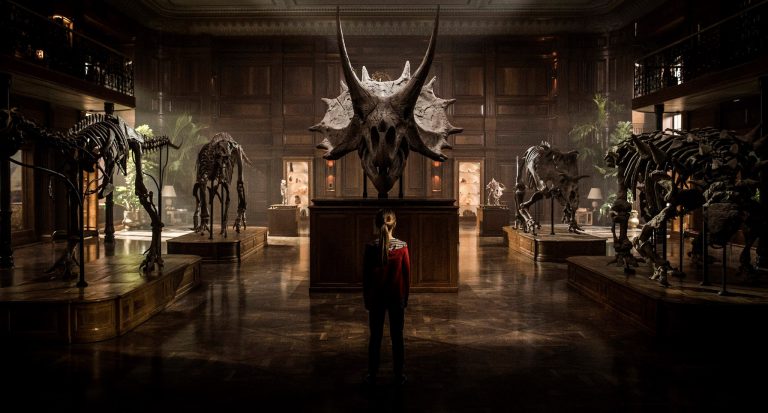
Jurassic World 2 first look: who’s that girl?

Walking in giant footsteps. #JW2

Our first official look at Jurassic World 2 appeared via the instagram account and reveals a new character and some old bones.

We spy a Triceratops and possibly a few raptors but where are the bones of the Indominus Rex? The first genetically-engineered dinosaur species seems to be missing.

In terms of the young girl, recent leaked casting calls seemingly revealed that a 9-year-old girl named Lucy will be one of the central characters – no news yet on who the actress is.

Jurassic World 2 plot: Dinosaurs get weaponised

© UNIVERSAL

With Jurassic World seeing John Hammond’s dream of a dinosaur theme park in tatters (again), it’s difficult to figure out where things will head next. Our prediction: the sequel will be Jurassic War.

Vincent D’Onofrio’s character Vic Hoskins pushed hard to turn raptors into weapons for war, and going by what Colin Trevorrow has to say, it looks like this thread is something that’ll be explored in the follow-up.

© UNIVERSAL PICTURES

“[It will not be] just a bunch of dinosaurs chasing people on an island. That’ll get old real fast,” he explained.

However, even if it does mean war, it’s definitely not going to be a game of Dinosaur Top Trumps. According to Trevorrow, new director J.A Bayona will bring a different flavour.

“I don’t think that bigger, better dinosaurs or bigger, more epic-in-scope action sequences are what people are necessarily looking for from this franchise and what they love about it.” Trevorrow told Jurassic Outpost.

“It will be more suspenseful and scary. It’s just the way it’s designed; it’s the way the story plays out. I knew I wanted Bayona to direct it long before anyone ever heard that was a possibility, so the whole thing was just built around his skill set.”

© UNIVERSAL

It might be a parable about animal rights too.

“Both Jack [Horner – palaeontology consultant] and me, we are concerned about man’s relationship with animals,” Bayona told Jurassic Outpost.

“Dinosaurs are a parable of the treatment of today’s animals: abuse, experiments in medicine, pets, [you] have wild animals in zoos like prisons, military use has been made of them, animals and weapons.”

Universal Pictures chief Donna Langley has also revealed that fans can expect at least two more Jurassic movies. “Colin Trevorrow is busy working on an outline,” she said.

“He’s been working with Steven [Spielberg]. And they have an idea for the next two movies actually. It was designed as a trilogy, unbeknown to us. It’s a happy surprise.”

Bayona is also viewing it as Jurassic Park 5, which presumably means he’s acknowledging 2 and 3 as well…

Jurassic World 2 cast: The stars come out again

Jurassic World

Chris Pratt and Bryce Dallas Howard will be back reprising their roles as dino trainer Owen Grady and former park chief Claire Dearing (who won’t be running in heels this time).

Having cemented himself as squad alpha by the close of Jurassic World, we’re expecting Owen’s raptors to be involved in some form. Let’s just say there better be Blue!

Director Juan Antonio Bayona announced on Twitter that Geraldine Chapman would be joining the cast too – she’s appeared in all three of his previous movies The Orphanage, The Impossible and A Monster Calls.

Sadly, although he’s definitely up for it, it doesn’t look like there are any plans to get Jeff Goldblum back. Make it happen, guys!

And it looks like Jake Johnson won’t be back as wisecracking park employee Lowery Cruthers either. Sad times.

Jurassic World 2 director: Colin Trevorrow is back (sort of)

© FRAZER HARRISON/GETTY IMAGES FOR VARIETY

Jurassic World director Colin Trevorrow is now hot property following the runaway success of the film. But as he’s onboard to direct Star Wars Episode 9, it’s The Impossible‘s JA Bayona who’ll be stepping into his directorial shoes.

“We’re moving it into new territory,” Trevorrow told The Playlist. “JA Bayona is an incredible director and I know he’ll push the boundaries of what a ‘Jurassic’ movie is. I think it’s important that we take risks. A franchise must evolve or perish.”

Bayona was apparently considered for the first Jurassic World, but declined.

Trevorrow and his Jurassic World co-writer Derek Connolly will be cooking up the story again. Steven Spielberg will also be serving as a guiding hand behind the scenes as executive producer.

© UNIVERSAL PICTURES

“I feel like the idea that this isn’t always going to be limited to theme parks, and there are applications for this science that reach far beyond entertainment. And when you look back at nuclear power and how that started, the first instinct was to weaponise it and later on we found it could be used for energy.”

Trevorrow added that dino tech will be going “open source”. “It’s almost like InGen is Mac, but what if PC gets their hands on it? What if there are 15 different entities around the world who can make a dinosaur?”

As with all highly publicised sequels of late, then came the comparisons with Star Wars Episode V.

“It will be darker and scarier than the previous film,” Bayona told Scified. “Obviously when you have Chris Pratt it will also be very funny. But it will be darker. It is a second step in a trilogy, and the second step is always dark as in The Empire Strikes Back or The Wrath of Khan which are the examples you always get.”

Jurassic World 2 budget: it’s gonna be big

JA Bayona really that he’ll have an even bigger toy box to play with on the new movie. While Jurassic World was made for $150mm the sequel will apparently command a budget of $260MM. Oof. That’s quite the investment.

We can’t say we’re surprised however – the first film took $1.67 billion world wide, making it the fourth most profitable movie of all time. What that extra $110mm will afford Bayona we can only imagine.

Jurassic World 2 release date: It’s got some serious Marvel competition in 2018

The sequel to #JurassicWorld will be in UK cinemas ahead of its release in the US.

The park will officially be open for business again on June 22, 2018, slotting into the mid-summer US release date that powered Jurassic World to box office success.

© UNIVERSAL

Right now there’s no direct rival for Jurassic World 2, but close by there’ll be competition for eyeballs from Godzilla 2 (June 8) and Marvel’s Black Panther (July 6).

UK fans you’re in for an early raptor-based treat – Jurassic World will hit cinemas in Blighty on June 7, a whole two weeks before its US debut.
First Official Still From Jurassic World 2 Released!

Sunday, April 2, 2017

First Official Still From Jurassic World 2 Released!

As the first month of filming on Jurassic World 2 is completed, Colin Trevorrow has taken to twitter to release the first still from the movie. This still shows the inside of what appears to be a museum or private collection.

The set picture is intriguing as it shows a large private collection of complete dinosaur skeletons. The child in the picture may be a guest in this house, or close relation to the owner of the skeletons. Also on the far back wall can be seen some specimens of Amber.

It is currently unknown to whom this collection belongs to in the film. Although the presence of Amber may indicate that whoever owns the manor may be connected to InGen in some fashion.

Walking in giant footsteps. #JW2

The girl in the picture may be the new child character, or ‘Lucy’ as early reports said. ‘Lucy’ was first reported in a Casting Call earlier this year. The casting call initially reported that Lucy was between the age of 9-10 which fits the profile of the girl seen here, as well as she apparently shared scenes with her father.

Bryce Dallas Howard and Chris Pratt will be returning as Owen Grady and Claire Dearing, respectively. The cast of the film currently includes Ted Levine, BD Wong, Rafe Spall, Daniella Pineda, Toby Jones, James Cromwell, Justice Smith and Geraldine Chaplin.

Source: Colin Trevorrow

Original article from www.scified.com

Pages