Blogs

“Dinosaur” Movie Goofs

Thursday, May 18, 2017

“Dinosaur” Movie Goofs

Even though you may forgive this movie for its great character designs and great blend of visual effects, Computer Animated characters, and live action environments, Disney, the producing studio that made it, still barely made a profit from this one. Well, I’m talking about Dinosaur (2000), one of the most problematic milestones in visual effects and animation history: artistically, it is the first and only attempt at realizing a blend of all-digital characters and live action backgrounds for film; Ideologically, it was nearly forgotten, probably because of, directly, or indirectly, the attacks on the talking dinosaurs and lemurs of that film, and the attacks on, directly, or indirectly, on the film’s inaccuracies and the story.

Anachronisms

Lemurs and all other primates did not co-exist with dinosaurs, but first appeared millions of years after the dinosaur era. The directors knew this, but felt the real mammals of the Cretaceous (the era in which the film takes place) were “hideous”, thus supplanted them with “cute” mammals.

Many of the reptiles depicted (eg. Brachiosaurus, Iguanodon, Styracosaurus) did not live in the same time or place.

Audio/visual unsynchronised

While Aladar does look similar to the rest of the Iguanodons, he is the only one who looks slightly different than the other Iguanodons, while the rest of them are completely identical, as well as Neera looking slightly different from the female Iguanodons, while they all looked the same. It is presumed that the filmmakers did this, so that viewers wouldn’t confuse Aladar and Neera with the rest of the Iguanodons.

Continuity

In quite a few shots of the movie, Aladar’s eyes turn from a bright green to bright blue and then back again in the next camera shot.

At one point during the migration, Aladar is talking to one of the lemurs who are riding on his back, but the other three lemurs are missing. In the next shot, all four are again on his back.

When Aladar accidentally smacks into Neera’s head after discovering the herd, she snaps at him and immediately turns away to continue on. However, in the next shot in which we see her from Aladar’s point of view, she is just beginning to turn away.

When Baylene is running to jump in the lake at the Nesting Grounds, she is shown to run right near the water’s edge. After three shots, she is back where she started to run.

Errors in geography

The movie takes place in prehistoric North America, yet the Carnotaurs, the main antagonists were actually South American dinosaurs. The characters do claim that they haven’t been seen “this far up north” before, however this doesn’t rectify the mistake, since North and South America weren’t connected back then. The Carnotaurs would have had to swim through the sea to reach North America, which would have been impossible.

The opening scene takes place in North America, yet several animals are present that belonged to other continents. The Oviraptor, the dinosaur that steals Aladar’s egg, was native to Asia, while the large amphibian Koolasuchus only lived near the antarctic circle.

Aladar

Factual errors

There are many other inconsistencies between the fictional representation of dinosaurs in the movie and accepted scientific knowledge at the time the movie was made. It should, perhaps, be remembered that it’s family entertainment, not a documentary.

The main characters are iguanodons. Iguanodons actually had hard beaks for mouths, except when the film makers decided to have the dinos speak, the beaks just didn’t work well with speech movements. So fleshy lips were modeled over the beaks for speech, and the beaks underneath act like pseudo-teeth in the final film.

Both Aladar and his newborn child urinate on Yar after hatching. It is doubtful dinosaurs could urinate like this. Like their modern relatives, they most likely excreted a substance called uric acid, which wouldn’t exactly look like mammalian urine, as seen in the movie, more like bird droppings.

The Carnotaurs seen in the film were much bigger than their real life counterparts. In reality the were smaller than Iguanodon (Aladar’s species), whereas here they are made even larger than some of the biggest dinosaur predators (like Tyrannosaurus). This was presumably done for dramatic effect and wouldn’t be the first time such a change has been made (the Velociraptors from Jurassic Park are also several times the size of the actual animals).

Throughout the film, all of the Iguanodonts (including Aladar, Neera, Kron and Bruton) are shown running on all four legs. According to modern paleontological theories, however, it is likely they would’ve been able to rear up on their hind legs to run, if they chose.

The raptors in this film are scaly, even though in real life they were covered in feathers. The movie makers knew this, but animating feathers at the time proved too difficult. Only when the movie was almost done did animation software developments allow for feathers to be animated, but by that time it was too late to include them.

Miscellaneous

In one scene where Zini is trying to wake up Aladar by pulling on his eye, Aladar’s sclera appears black, as the white of his eye had not been rendered. Shortly after, the tail of one of the lemurs clips into his side.

Incorrectly regarded as goofs

Many scenes contain grass. Grass didn’t evolve until the early Cenozoic era, shortly after the dinosaurs died out. However, recent discoveries indicate that grass did, in fact, exist in at least the Cretaceous period. Naturally, according to science at the time of the production, it was still incorrect.

Revealing mistakes

When Aladar goes back to rescue the herd. He exits the cave and its night time but the cuts of the herd before and after its day time.

Best 25 Dinosaur Movies

Thursday, May 18, 2017

Best 25 Dinosaur Movies

The success of Jurassic World, which has secured the title of one of the highest global box-office opening ever, has got dinosaurs on everyone’s mind. Whether you’re debating with your friends about whether or not you’d go to an actual dinosaur theme park (even though you know that  everyone would possibly die, admit it, you’d go) or you’re considering re-watching a personal dinosaur movie favorite, you are definitely not alone.

There are actually a number of films that feature dinosaurs in one way or another, and now is as good a time as any to revisit those classics. This is a list of the Top 25 Dinosaur Films, but as always, certain rules were made to better streamline the choices.

THE RULES

  1. The film must have at least one major sequence involving a dinosaur and/or a supporting character who is a dinosaur.

  2. Next, the creature featured in the film must be an actual dinosaur. That means no kaiju (sorry, Pacific Rim fans), no Godzilla, and no Toy Story (although Rex will always remain in our hearts).

  3. Finally, any franchise installments are counted under the original, but reboots (like Jurassic World) can be considered their own entry. Sound good? Okay, let’s get prehistoric!

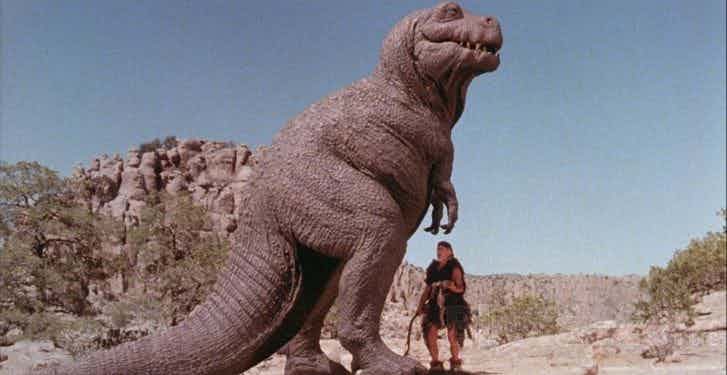
25. CAVEMAN (1981)

Caveman, 1981

A slapstick comedy starring Ringo Starr, Shelley Long, and Dennis Quaid tells the heartwarming tale of a scrawny caveman named Atouk (Starr) who hopes to find love and overthrow the bullying leader of his tribe (John Matuszak). When Atouk and his friend Lar (Quaid) are banished, they meet other outcasts and have a number of encounters with ravenous dinosaurs before finding their own happy ending. The film is considered a cult-classic, despite making little money when it debuted.

24. LOST CONTINENT

The Lost Continent Movie

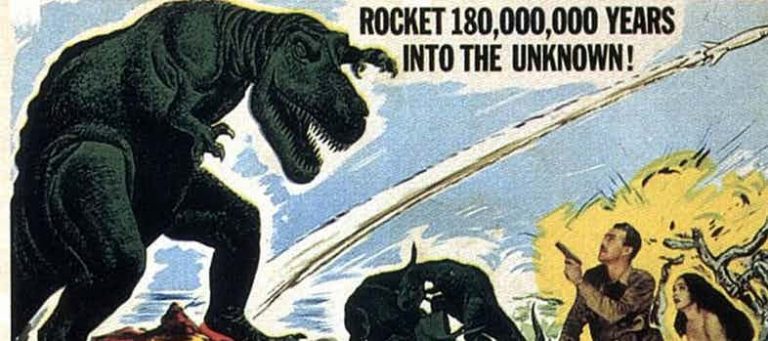
Lost Continent starring Cesar Romero is a 1951 film about an expedition into the South Pacific to find a missing rocket. Unfortunately, the individuals on the expedition also find a mysterious jungle full of (you guessed it) dinosaurs. Isn’t that just always the way, though? The film was pretty low-budget and not very well received; however, it was featured in an episode of the cult-TV classic, Mystery Science Theater 3000.

23. THE LAND THAT TIME FORGOT

The Land that Time Forgot

A sleeper hit from 1975, The Land that Time Forgot takes place during World War I, where a group of German and British soldiers stumble upon Caprona, a land populated with dinosaurs and neanderthals. The film is based on the 1924 novel of the same name by Edgar Rice Burroughs, and it inspired a direct sequel, The People that Time Forgot.

22. THE LOST WORLD (2001)

The Lost World, 2001

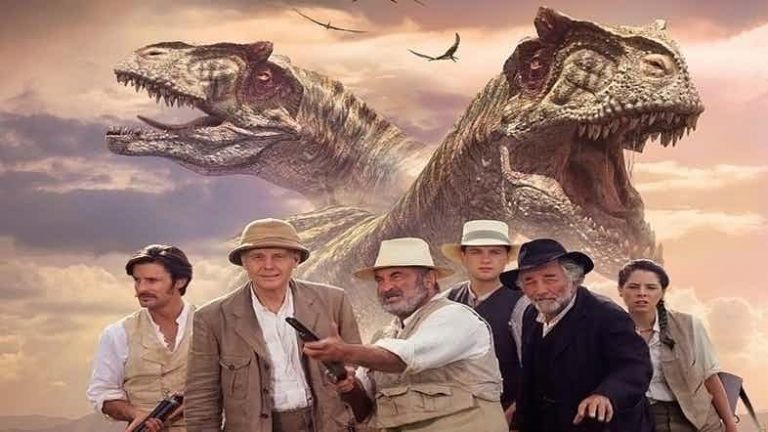
The Lost World is a made-for-TV adaptation of the novel written by Sir Arthur Conan Doyle. In it, an expedition is led by Professor George Challenger (Bob Hoskins) to a plateau in the Amazon where he insists dinosaurs still roam. He’s right, of course, and though the film was one of many adaptations of the Doyle novel, it still remains the best.

21. JOURNEY TO THE CENTER OF THE EARTH
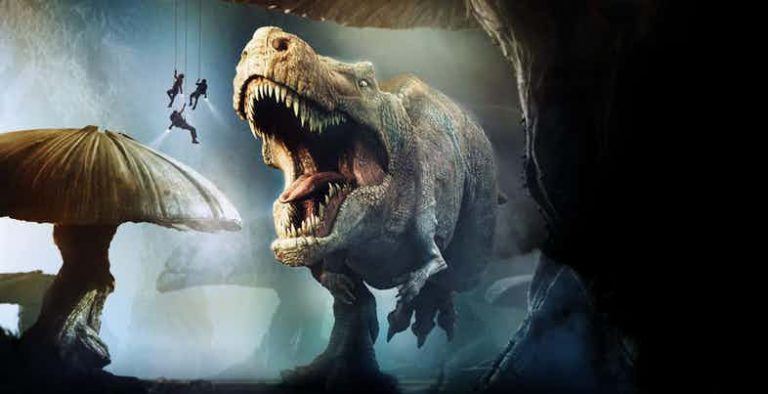
Journey to the Center of the Earth

There are two film versions of note for Journey to the Center of the Earth: one in 1959 and one in 2008. However, the update made it on the list by a hair with its fun-for-the-family vibe and CGI effects (not to mention Brendan Fraser, who can charm anyone, human or dinosaur).

20. 100 MILLION B.C. (2008)

100 Million BC

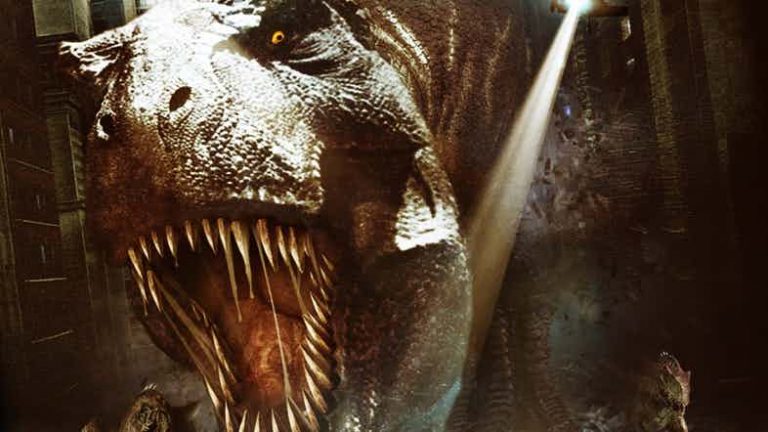
As the trailer describes, the film centers around “an elite military team sent on a daring mission backward in time. But they didn’t return… alone!” If you enjoy watching dinosaurs wreck Los Angeles, then look no further than this action/disaster film. The movie is basically awful, but Asylum’s direct-to-videos are sort of a bucket list item for any dinosaur movie lover.

19. MEET THE ROBINSONS

Meet the Robinsons

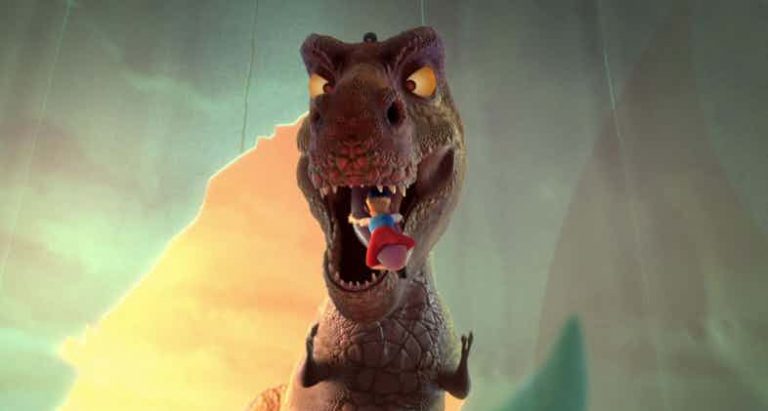
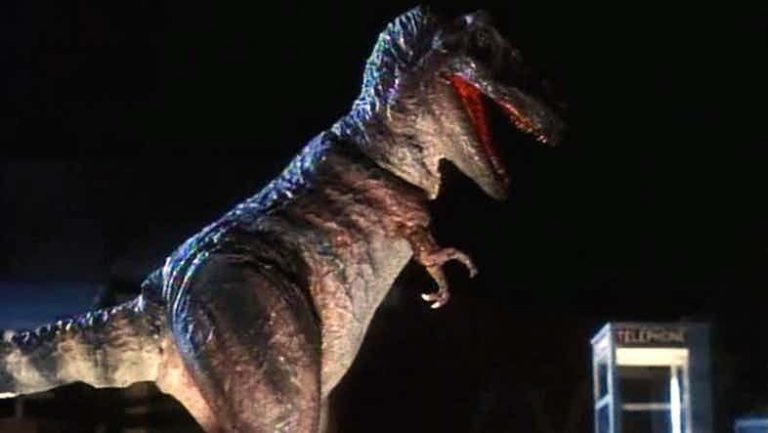
Meet the Robinsons is one of Disney’s lesser-remembered but still enjoyable animated features. Although critics were positive in their reviews, the film grossed only $25 million on its opening weekend and came in second behind Blades of Glory. It features one heavily dinosaur-centric scene with a T-Rex named Tiny who menaces the main characters under the direction of the film’s villain, but is later revealed to be quite adorable.

18. ADVENTURES IN DINOSAUR CITY

Adventures in Dinosaur City

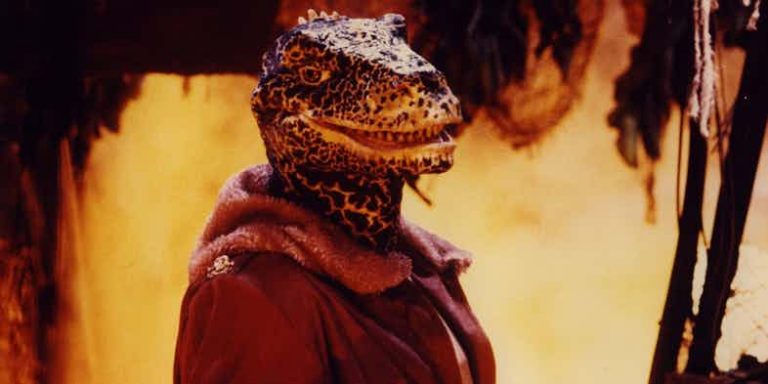
Adventures in Dinosaur City involves a group of teenagers who are sucked into their television set and end up hanging out with hard-partying, sharp-dressed dinosaurs. This (all but forgotten) film received mixed reviews but is still enjoyed as a cult-favorite – especially by those who loved it as kids.

17. PREHYSTERIA!

Prehysteria

Prehysteria!, and its following sequels Prehysteria! 2 and 3, was a family film series that centered around a group of baby dinosaurs all named after famous musicians. The only actor who shows up in all three installments is Frank Welker, who provided the voices for the dinosaurs as well as Megatron in The Transformers television series.

16. WALKING WITH DINOSAURS

Walking with Dinosaurs

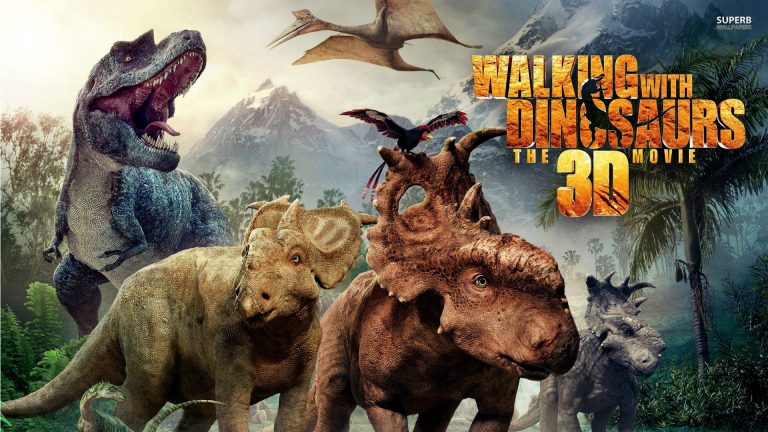
A CGI adventure about dinosaurs in the Late Cretaceous period, Walking with Dinosaurs centers around Patchi, a pachyrhinosaurus and runt of his litter, who eventually becomes the leader of his entire herd. Because the film used live settings for its CGI creatures, its visuals were considerably striking. However, the somewhat juvenile choice to use actor voiceovers hurt the film critically.

15. CARNOSAUR

Carnosaur

The story of a mad scientist (Diane Ladd) who wants to end humanity by bringing back dinosaurs, Carnosaur is a cult-classic that was followed by two sequels and two spinoffs. Both miniature and full-sized dinosaur models were created on a shoe-string budget by creature designer John Carl Buechler. However, the best bit of trivia about the film is that it was released four weeks before Jurassic Park, which starred Ladd’s daughter, Laura Dern.

14. THEODORE REX
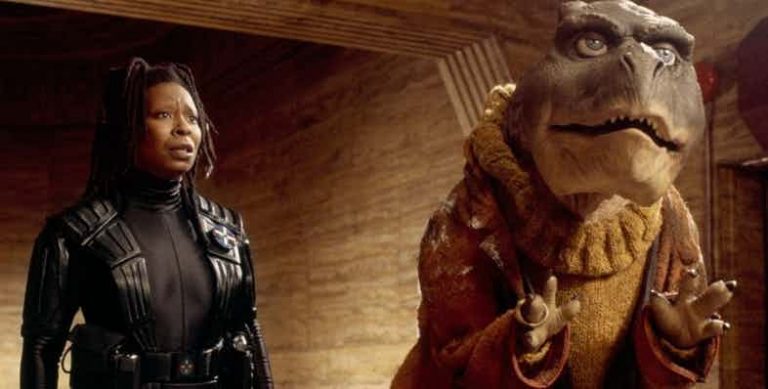
Theodore Rex

The ’90s was a time where people wanted two things: buddy-cop films and talking dinosaurs. Theodore Rex answered the call for both, and starred Whoopi Goldberg and the voice talents of George Newbern as Teddy. The film wasn’t considered a hit by anyone, and Goldberg even attempted to back out of her agreement to star before producer Richard Gilbert Abramson filed a lawsuit against her. However, it’s still a fun trip down memory lane for any ’90s kid.

13. THE VALLEY OF GWANGI

The Valley of Gwangi

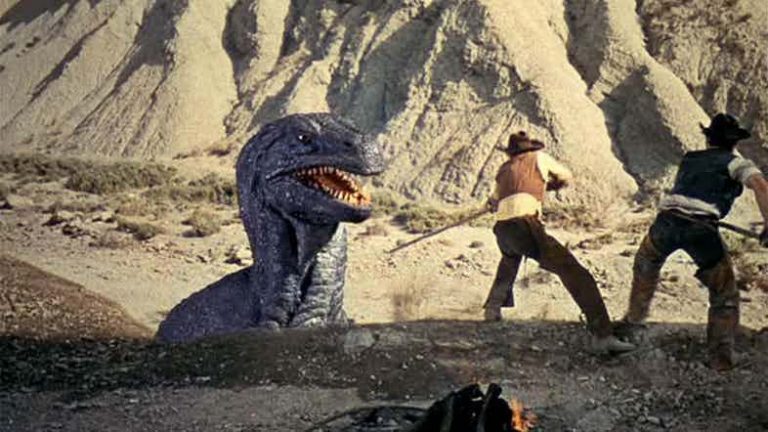
The Valley of the Gwangi revolves around a group of individuals who find a place called the Forbidden Valley where dinosaurs roam free. They then attempt to capture an allosaurus for their circus sideshow. This is the last of the classic 1960s films featuring Ray Harryhausen’s stop-motion work with dinosaurs.

12. ONE MILLION YEARS B.C. (1966)

One Million Years B.C. – 1966

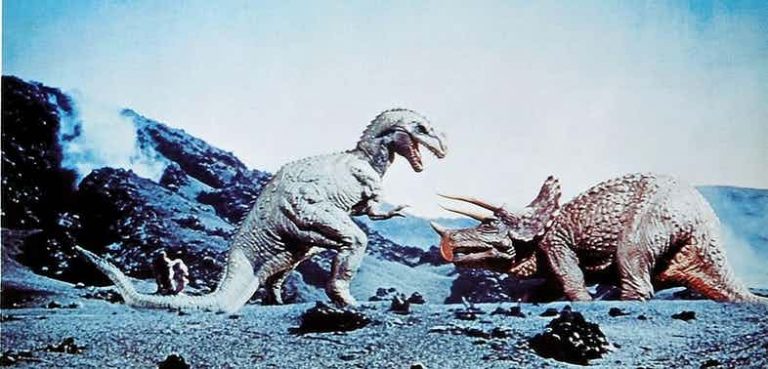
Another of Ray Harryhausen’s stop-motion films, One Million Years B.C. is considered to be one of the classic dinosaur films – even if its story is riddled with historical inaccuracies (just like the original 1940 film). In this British remake, live actors were used with the stop-motion Allosaurus portrayed in the film, and it is one of the most impressive uses of special effects of that time. The film did well and also contains the now famous image of Raquel Welch in her fur bikini.

11. WE’RE BACK! A DINOSAUR’S STORY

We’re Back! A Dinosaur’s Story

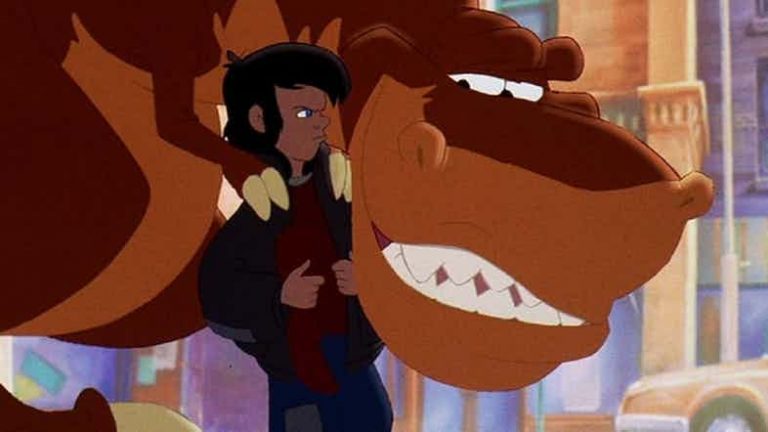
We’re Back! A Dinosaur’s Story follows a group of dinosaurs who are transported to modern-day Manhattan, make friends with two lonely kids, and attempt to avoid the evil plans of the film’s villain, Professor Screweyes. The movie was produced by Steven Spielberg’s animation studio, Amblimation, and was released the same year as Jurassic Park. While it didn’t perform well at the box office, its worth another watch, if just for the hodgepodge of interesting voice talent like John Goodman, Julia Child, and Walter Cronkite.

10. LAND OF THE LOST (2009)

Land of the Lost

In this 2009 film adaptation of the 1974 television show, a disrespected scientist (Will Ferrell) uses his latest invention to send himself and two others through a time warp and into a strange new dimension. There are several funny sequences of Ferrell running from an angry T-Rex named Grumpy, and while the film won a Golden Raspberry Award for Worst Prequel, Remake, or Sequel, it remains good for a laugh.

9. THE FLINTSTONES

The Flintstones

The Flintstones, and its prequel The Flintstones in Viva Rock Vegas, is a fun film despite receiving negative reviews when released. It of course features Dino, one of the most beloved dinosaur house pets of all time. Dino was created by Jim Henson’s Creature Shop, voiced by Mel Blanc, and shows up in both installments.

8. ICE AGE: DAWN OF THE DINOSAURS

Ice Age: Dawn of the Dinosaur

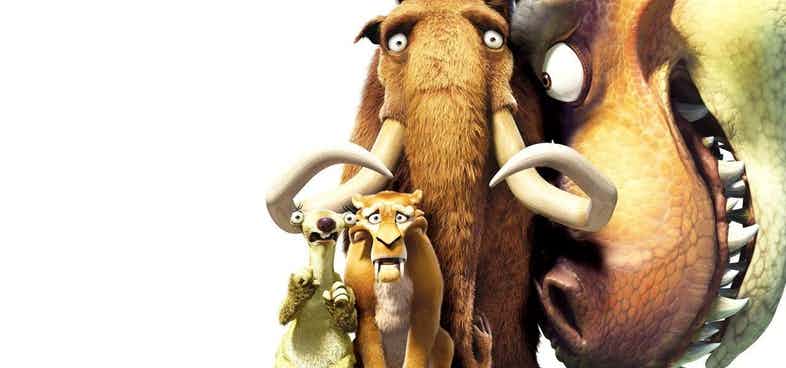
In Ice Age: Dawn of the Dinosaur film, the original actors (Ray Romano, Denis Leary, and John Leguizamo) all reprise their roles as Manny, Diego, and Sid encounter dinosaurs in a tropical world buried beneath the ice. The film earned $886.7 million globally and is the seventh highest-grossing animated movie of all time.

7. NIGHT AT THE MUSEUM

Night at the Museum

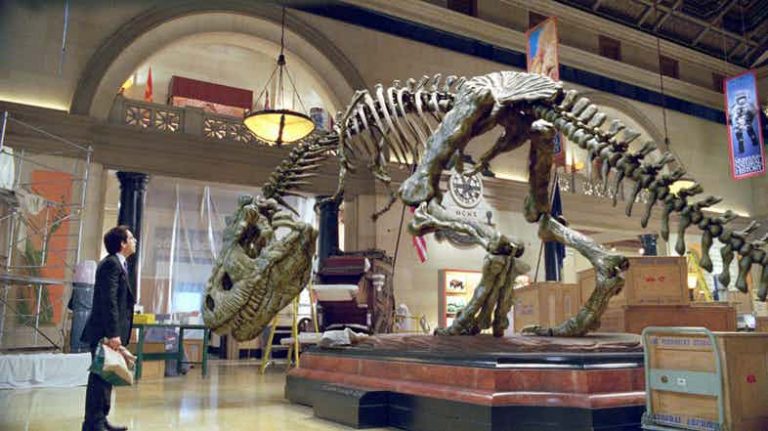
The T. rex fossil in all of the Night at the Museum installments ranks this franchise among the top ten for certain. The sequence in the first film where Ben Stiller runs in terror from the living dinosaur skeleton is still outstanding today, and the series is also one the whole family can enjoy.

6. KING KONG (2005)

King Kong, 2005

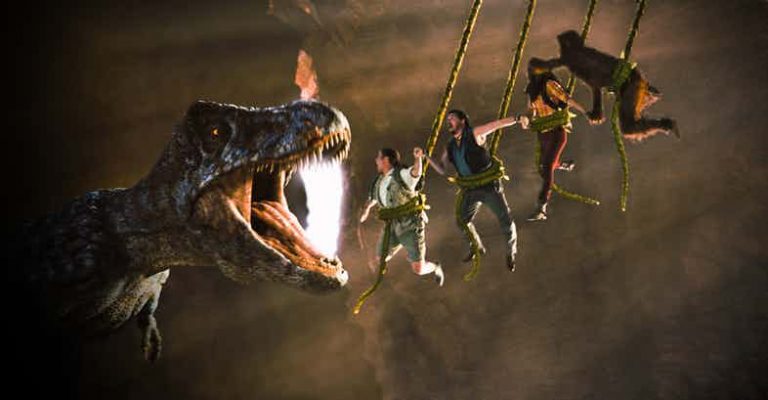
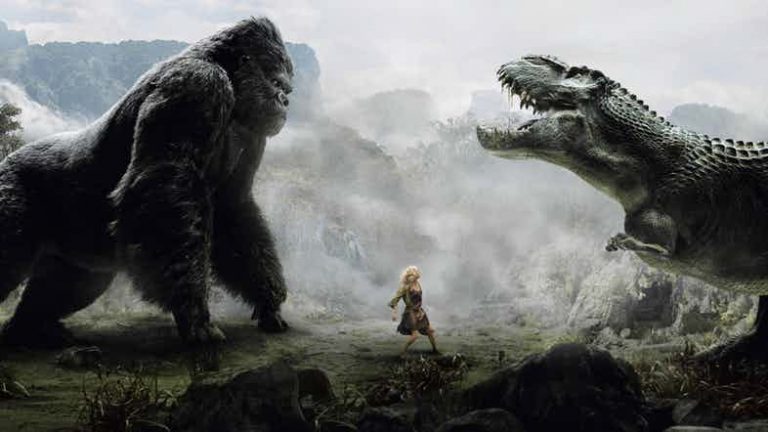
Peter Jackson’s 2005 remake was one of the top five highest-grossing films of the year, and there is much to enjoy about its visual effects. One scene in particular involves  Jack Black, Kyle Chandler, and Adrien Brody’s characters running to avoid a dinosaur stampede, but the big show comes when King Kong has to battle two T-Rex’s in order to protect Naomi Watts’ Ann Darrow. Watching the film can also help you get excited for the 2017 film Kong: Skull Island, set to star Tom Hiddleston, Michael Keaton and J.K. Simmons.

5. DISNEY’S DINOSAUR (2000)

Disney’s Dinosaur, 2000

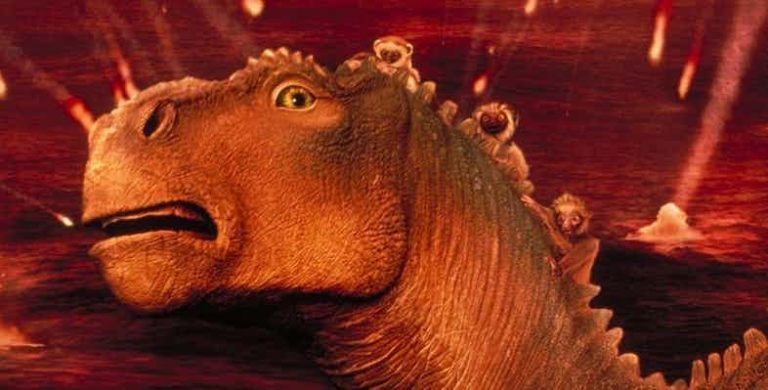
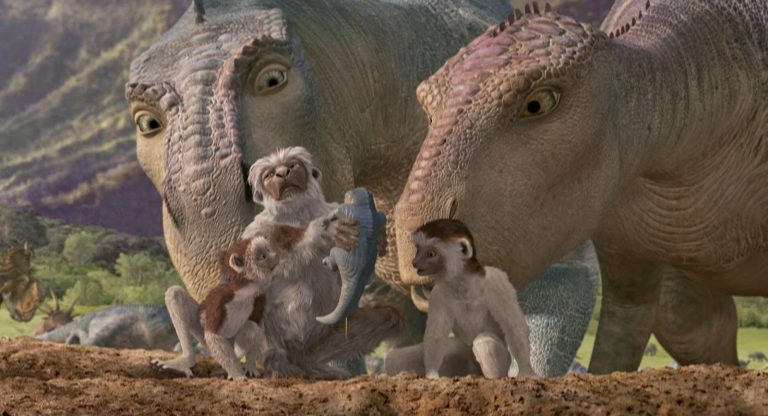
Thirteen years before Walking with Dinosaurs 3D, Disney’s Dinosaur told the story of an orphaned iguanodon that is raised by a group of lemurs. The film was a box-office success and was lauded for its magnificent CGI effects, although some critics were not fond of the celebrity voices for the dinosaur characters provided by D.B. Sweeney, Alfre Woodard, and Hayden Panettiere.

4. THE GOOD DINOSAUR

The Good Dinosaur

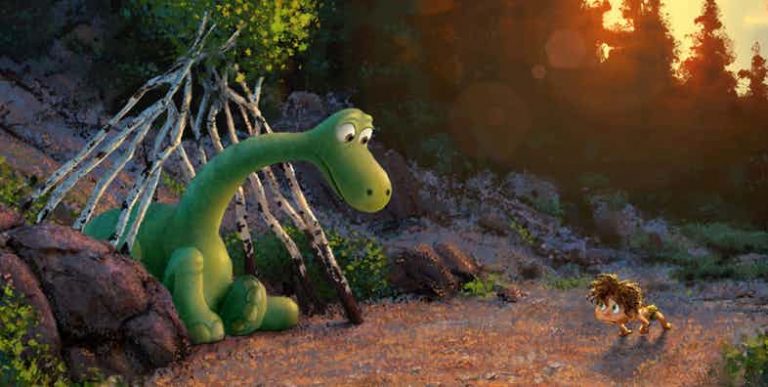
Just hedging our bets, but it’s probably fair to assume that Pixar’s The Good Dinosaur will deserve a place on our list – and a high one at that (if history is any indicator). With a trailer that presents a concept like “What if all the dinosaurs didn’t become extinct?” it’s definitely a film we can get behind.

3. THE LAND BEFORE TIME

Land Before Time

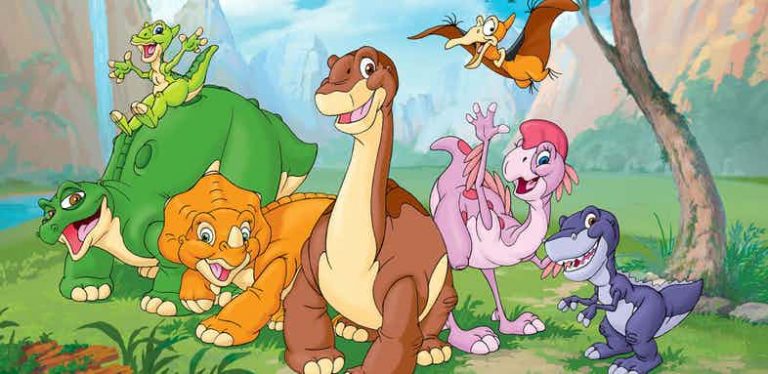
The first of The Land Before Time films was released in 1988 and directed by Don Bluth (An American Tale, Rock-a-Doodle, Anastasia, and about twelve other classics). Although it has twelve sequels to the date (and another one in production), the original Land Before Time tells the story of an Apatosaurus named Littlefoot, who will probably always be one of our favorite dinosaurs of all time.

2. JURASSIC WORLD

Jurassic World

Love it or not, Jurassic World is definitely a dinosaur-sized smash at the box-office today. Okay, yes, the romance may be hollow, and the humans in the movie do tend to fall into two categories – “cookie-cutter” personalities and “dinosaur food” – but there is really no point where the movie offends overly, and it remains entertaining throughout. However, the film’s dinosaur scenes, while its biggest strong suit, are second to only one other film…

1. JURASSIC PARK

Jurassic Park

The 1993 original still takes top prize, partly because of its own global box-office success and major critical acclaim, and partly because the special effects remain impressive and impactful, even today. The film used both CGI and animatronics to create its groundbreaking special effects, and it contains nearly all of the most well-remembered movie scenes involving dinosaurs. It was also directed by Steven Spielberg at the height of his abilities, and based on Michael Crichton’s 1990 bestselling book of the same name, which everyone was still frantically reading at the time of the film’s release. And while it has been followed by three sort-of sequels (of which Jurassic World counts as a soft-reboot), it remains any dinosaur film lover’s top choice.

10 Facts About Megalosaurus

Thursday, May 18, 2017

Megalosaurus ©Alexander Lovegrove

This English predator was among the first dinosaurs ever discovered—and, back in those early days of paleontology, its fearsome jaws must have fueled countless Victorian nightmares.

1. Megalosaurus Used to Be Called “Scrotum humanum.”

Cover of Robert Plot’s Natural History of Oxfordshire, 1677 (right), and illustration of a fossilized lower extremity of a Megalosaurus femur (left) taken from that book. The bone was described by Richard Brookes in 1763 and jokingly named Scrotum humanum. Author: Robert Plot, Michael Burghers

The illustration on the left was drawn by an artist/naturalist named Robert Plot in 1676. At the time, scholars hadn’t yet learned of the existence of dinosaurs, so nobody could identify the fossil Plot’s picture depicts. For his part, Plot theorized that this bone (which had turned up in an Oxfordshire quarry) once belonged to a Roman war elephant.

Nearly a century later, physician Richard Brookes copied Plot’s sketch, but didn’t buy his interpretation. To Brookes, it looked suspiciously like a certain piece of masculine anatomy, so he dubbed the specimen “Scrotum humanum.” Today, most scientists agree that the fragment in question actually came from a Megalosaurus leg bone.

2. It was The First Dino to be Scientifically Described.

In 1824, a large jawbone from some ancient reptile emerged near Oxford, prompting British geologist William Buckland to do something that had never been done before: formally describe a dinosaur specimen in an academic paper. His paper, “Notice on the Megalosaurus or great Fossil Lizard of Stonesfield,” saw publication via the Geological Society of London.

3. Megalosaurus Was Named by a Guy With Really Weird Dietary Habits.

William Conybeare drew this cartoon of Buckland poking his head into a prehistoric hyaena den in 1822 to celebrate Buckland’s ground breaking analysis of the fossils found in Kirkdale Cave.

Buckland’s quirks were legendary. When he wasn’t examining fossils or coining the word “Megalosaurus,” he enjoyed dressing up his pet bear (!) in academic robes. He owned a table made with dinosaur droppings which “was often much admired by persons who had not the least idea of what they were looking at.” And, stranger still, the man literally attempted to eat his way through the animal kingdom. Striving to sample every living thing in existence, Buckland devoured such main courses as panthers, crocodiles, and toasted mice. Apparently, the nastiest entrees he ever tried were mole and blue-bottle fly.

4. Megalosaurus was Mentioned in a Charles Dickens Novel.

Published serially between 1852 and 1853, Bleak House is, among other things, notable for having one of the world’s first literary dino references. While describing a gloomy day cloaked in fog, Dickens writes:

“As much mud in the streets as if the waters had but newly retired from the face of the earth, and it would not be wonderful to meet a Megalosaurus, forty feet long or so, waddling like an elephantine lizard up Holborn Hill.”

5. Scientists Aren’t Exactly Sure What Its Skull Looked Like.

Skull and life restoration of Megalosaurus bucklandii skull. Megalosaurus was one of the first described dinosaurs. Author: Conty

Aside from some bits of snout and upper and lower jaw, no significant cranial material has been attributed to Megalosaurus.

6. Megalosaurus Helped Inspire the Word “Dinosaur.”

In 1842, MegalosaurusIguanodon, and Hylaeosaurus were three recently-discovered prehistoric reptiles which many scientists imagined as little more than overgrown lizards. Sir Richard Owen felt very differently. Seeing them as dynamic, active animals, he lumped them together in a brand-new group he called the “Dinosauria.”

7. … And Buckland’s Son Believed it May Have Also Inspired European Dragon Myths.

Buckland family silhouette – artist Mary Buckland, née Morland (1797-1857), British palaeontologist. Author: Mary Buckland, née Morland (1797-1857)

Franklin Trevelyan Buckland followed in his father’s footsteps and became an accomplished zoologist in his own right. At one point, he posited that dinosaurs like Megalosaurus may well have given rise to Europe’s greatest mythical monsters.

“May not the idea of the dragons,” he wrote, “curious stories of which are chronicles in various parts of England, owe their origin, in some way or other, to the veritable existence of these large lizards in former ages? To point out the train of ideas or circumstances which led to these ancient dragon stories is of course impossible, particularly as man was not coexistant with Megalosaurus and Co.—still there is a certain shadow of connexion [sic] between them.”

8. Scientists Have Dramatically Reduced Megalosaurus’ Top Length Estimates.

William Buckland suggested that adult Megalosaurus were about 40 feet long, though newer specimens indicate amaximum measurement closer to 21.

9. History Buffs Can See a Bear-Like Megalosaurus in London’s Crystal Palace Park.

Megalosaurus at Crystal Palace Park, London. Author C. G. P. Grey

During the 1850s, sculptor Benjamin Waterhouse Hawkins was commissioned to build more than 30 life-sized prehistoric animal models which were to populate a glasshouse inside this historic English park. The house burned down in 1936, but the statues survived and are still being enjoyed (thanks, in no small part, to the efforts of local volunteers). Because scientists hadn’t yet learned that predatory dinosaurs were bipedal, Waterhouse’s Megalosaurus stands stoutly on all fours.

10. The Protagonist of TV’s Dinosaurs Sitcom is Purportedly a Dim-Witted Megalosaurus.

Dinosaurs TV Series

In 1991, ABC premiered Dinosaurs, a nuclear family-style comedy revolving around sentient dinos. Originally conceived by Jim Henson, the program’s patriarch is one Earl Sinclair, a beer-drinking, lunchbox-toting, television-loving Megalosaurus with less-than-exemplary parenting skills.

Source: www.mentalfloss.com

10 Interesting Facts About The Geological Time Scale

Wednesday, May 17, 2017

10 Interesting Facts About The Geological Time Scale

1) The geological time scale (GTS) is a system of chronological measurement that relates stratigraphy to time, and is used by geologistspaleontologists, and other Earth scientists to describe the timing and relationships between events that have occurred throughout Earth’s history.

2) Evidence from radiometric dating indicates that Earth is about 4.54 billion years old. The geology or deep time of Earth’s past has been organized into various units according to events which took place in each period.

This clock representation shows some of the major units of geological time and definitive events of Earth history. The Hadean eon represents the time before fossil record of life on Earth; its upper boundary is now regarded as 4.0 Ga (billion years ago).

3) Different spans of time on the GTS are usually delimited by changes in the composition of strata which correspond to them, indicating major geological or paleontological events, such as mass extinctions. For example, the boundary between the Cretaceous period and the Paleogene period is defined by the Cretaceous–Paleogene extinction event, which marked the demise of the non-avian dinosaurs and many other groups of life. Older time spans which predate the reliable fossil record (before the Proterozoic Eon) are defined by the absolute age.

4) The first serious attempts to formulate a geological time scale that could be applied anywhere on Earth were made in the late 18th century. The most influential of those early attempts (championed by Abraham Werner, among others) divided the rocks of Earth’s crust into four types: Primary, Secondary, Tertiary, and Quaternary.

5) The first geologic time scale that included absolute dates was published in 1913 by the British geologist Arthur Holmes.

6) Geologists have divided Earth’s history into a series of time intervals. These time intervals are not equal in length like the hours in a day. Instead the time intervals are variable in length. This is because geologic time is divided using significant events in the history of the Earth.

7) The largest defined unit of time is the supereon, composed of eons. Eons are divided into eras, which are in turn divided into periodsepochs and ages. The terms “eonothem“, “erathem“, “system“, “series“, and “stage” are used to refer to the layers of rock that correspond to these periods of geologic time in Earth’s history.

8) Geologists qualify these units as “early“, “mid“, and “late” when referring to time, and “lower“, “middle“, and “upper” when referring to the corresponding rocks. For example, the lower Jurassic Series in chronostratigraphy corresponds to the early Jurassic Epoch in geochronology. The adjectives are capitalized when the subdivision is formally recognized, and lower case when not; thus “early Miocene” but “Early Jurassic.”

9) The term “Anthropocene” is used informally by popular culture and a growing number of scientists to describe the current epoch in which we are living. The term was coined by Paul Crutzen and Eugene Stoermer in 2000 to describe the current time, in which humans have had an enormous impact on the environment.

10) The Carboniferous is often treated in North America as two geological periods, the earlier Mississippian and the later Pennsylvanian.

Source: www.geologyin.com

The Geological Time Scale: Timeline of Life on Earth

Wednesday, May 17, 2017

The Geological Time Scale: Timeline of Life on Earth

Evolution is a complicated subject. While everybody understands that black bears are related to grizzly bears and we can even figure they are related to extinct bears, lots of people wonder how scientists can be so sure that bears are related to salmon as well.

One evidence is rock layers specifically, what is called the geologic column. Basically, scientists have learned that rocks are stacked in layers containing fossils with the oldest fossils at the deepest layers, and the youngest, or most recent fossils, near the top. It’s as if rock layers are a vertical timeline. At the bottom of the timeline there are no fossils of modern animals. As you move towards the surface, you find fish, then amphibians, then reptiles, mammals, birds, and finally modern mammals including humans.

We’re not talking about an abstract diagram: this is the actual record of the earth’s crust, recorded in rocks around the world.

But how do we know this evolutionary sequence of layers, one on top of the other, is accurate? Why is there any order at all to rock layers?

Two laws, or principles of geology explain why rock layers are formed in this way.

Geological Timeline by Ray Troll

THE LAW OF ORIGINAL HORIZONTALITY

This law of science tells us that dirt, mud, sand and other sediments are almost always deposited in horizontal layers. As these sediments stack up vertically, they often harden, forming rock layers.

The Law of Original Horizontality was first proposed by Danish geological pioneer Nicholas Steno in the 17th century. The law states that layers of sediment were originally deposited horizontally under the action of gravity.

THE LAW OF SUPERPOSITION

Rock layers are usually ordered with the oldest layers on the bottom, and the most recent layers on top. The Law of Faunal Succession explains that fossils found in rock layers are also ordered in this way.

Grand Canyon Geological Layers

THE THREE LAYER CAKE

There are thousands upon thousands of layers in the earth’s crust. However, scientists have grouped the layers into major groups. The most recent three layers are the Paleozoic, Mesozoic, and Cenozoic. These layers represent the last 500 million years of life on earth.

In the Paleozoic, you find fish, amphibian, and reptile fossils (in that order), but never dinosaurs, birds, modern mammals, or even flowering plants.

Think of that: despite the billions of plant fossils in the Paleozoic layer, nobody has ever found one fossil of a flower, including any kind of deciduous tree or even a single blade of grass. Why not? The obvious explaination is flowers had not evolved yet.

The next layer, the Mesozoic, is often called the age of dinosaurs. The Mesozoic has dinosaurs like crazy. Of course, dinosaurs are reptiles and that’s why you won’t find any until after the Paleozoic which contains the first reptiles. The Mesozoic also has the first flowering plants, birds, and mammals, though few if any birds or mammals that we know of today.

On top of the Paleozoic and Mesozoic is the Cenozoic. This is the current layer that is still being deposited in oceans, deserts and swamps all around the earth today. The Cenozoic is the first major layer where we find modern mammal fossils like cats, dogs, monkeys and humans. This layer, or “era” is often referred to as the age of mammals.

These three layers make up a sort of 3-layer cake. Just like a cake, the bottom layer went down first, followed by the middle and the top. Since fossils progress from fish at the bottom to humans at the top, we have clear evidence that life evolved through time.

A HALF-EATEN CAKE

Of course, there isn’t one place in the world to go and see every fossil animal from all time stacked one on top of the other. In fact, it’s rare to find all three major layers on top of one another. Why not?

Well the first obvious answer is that even in the world today there are places where sediments (layers) are deposited but in other places (like mountains) they are eroded. So gaps are a common occurrence in many regions.

Also, while the layers are usually deposited in a clear order, those layers are often disturbed later on by volcanoes, rivers, mountains, and shifting continents.

Look at the diagram at right. If you were to stand on the cliff to the left side of the cross section, you would see the top layer in two places. The cracks, or faults, in the rock have slid the layers out of alignment. Only when you view the entire area can you piece the original order back together.

The crust of the earth is made of several huge plates. These plates “float” on the hot, soft mantle below the crust. We can actually measure the movement of the plates using satellites in space. Every year, they shift in different directions, each on their own path. Sometimes the plates collide, causing mountains. Other times, they separate and hot magma flows up to form volcanic islands and new land. It happens slowly but surely and as it does, our nice three layer cake becomes a little messier.

It’s as if somebody slid the cake off the table, and the dog ate half of it before dad comes to the rescue. Look at any one spot and you might not find all three layers in the right order, but look at the big picture and the original order is still visible.
There are many evidences of evolution, but the geologic column remains the most obvious clue to the history of life on earth.

Related Links: http://en.wikipedia.org/wiki/Geologic_column

21 Things Everyone Who Loves “Jurassic Park” Will Appreciate

Wednesday, May 17, 2017

Ah ah ah, you didn’t say the magic word.

1. When you realised you weren’t the only person who thought this.

2. And the best closed caption there ever was.

3. The comic strip that shows you how it really went down.


4. This graduation cap.

5. This detailed map of Isla Nublar.


6. This perfect two-person cosplay.


7. This very important banner.

8. The wedding invitations you wish you’d sent.

9. The joke on this mug that was 65 million years in the making.


10. This Mr DNA costume.


11. The signs in this bird sanctuary.


12. This cross-stitched truth from Dr Malcolm and Dr Sattler.


13. And that same truth perfectly illustrated.

14. This super high-tech T. rex alarm.


15. This pizza menu.

16. The sequel we’ve been waiting 22 years for.

17. The time you realised the Central line must terminate at Isla Nublar.


18. This questionable offer.


19. This dog’s uncanny impression of a dilophosaurus.


20. This outtake.


21. And, of course, Phil…

Miragaia

Sunday, May 14, 2017

Miragaia by Mohamad Haghani

Miragaia (named after Miragaia, the parish in Portugal and geologic unit where its remains were found) is a genus of herbivorous stegosaurid dinosaur. Its fossils have been found in Upper Jurassic rocks in Portugal. Miragaia has the longest neck known for any stegosaurian, which included at least seventeen vertebrae.

Miragaia is based on holotype ML 433, a nearly complete anterior half of a skeleton with partial skull (the first cranial material for a European stegosaurid). The remains were found after the construction of a road between the villages of Miragaia and Sobral. The rear half of the skeleton was probably destroyed by the roadcut. The fossils were dug up in August 1999 and August 2001. Among the recovered bones were most of the snout, a right postorbital, both angulars of the lower jaws, fifteen neck vertebrae (the first two, which articulated with the skull, were absent), two anterior dorsal vertebrae, twelve ribs, a chevron, the shoulder bones, most of the forelimbs including a possible os carpi intermedium, a right first metacarpal and three first phalanges; and thirteen bony plates plus a spike. The bones were not articulated but dispersed over a surface of about five to seven metres, though there was a partial concentration of fossils that could be salvaged within a single block.

Miragaia longicollum fossil. Photo by Ghedoghedo

The total length of Miragaia has been estimated at 5.5 – 6 metres (18–20 ft). In 2010, Gregory S. Paul estimated the length at 6.5 metres, the weight at two tonnes. Histology shows that the holotype specimen was agout 21 years old.

Miragaia, like all known stegosaurians, showed an array of plates and spikes, consisting of skin ossifications or osteoderms. Paired triangular plates ran down the midline of the neck, reconstructed as eight pairs. They were asymmetrical with a convex outer side and a concave inner side. Their bases were not very expanded with the exception of a possible last pair, located on the front back. They were obtuse but lightly hooked at the front. A rather long, narrow and straight preserved spike was at first considered to have been a shoulder spine, but was later seen as part of some tail arrangement.

Miragaia is from Mateus et al. (2009), and Brachytrachelopan from Rauhut et al. (2005). Both critters come with the 1 meter scale bars from their respective figures. Sauroposeidon looms in the background, just to keep things in perspective. The entire neck of Miragaia might have been about as long as one of the middle cervicals of Sauroposeidon or Supersaurus.

Miragaia was placed in the Stegosauridae in 2009. Mateus and colleagues performed a phylogenetic analysis and found Miragaia to group with Dacentrurus in a clade Dacentrurinae, newly named for the occasion, the sister group to Stegosaurus (the latter genus was in the cladistic analysis considered to include Hesperosaurus and Wuerhosaurus).

Source: www.NatGeo.com, www.mentalfloss.com

Borealopelta: ‘Sleeping dragon’ Fossil the Best Preserved Armored Dinosaur Ever Found

Saturday, May 13, 2017

STUNNING DISCOVERY Some 110 million years ago, this armored plant-eater lumbered through what is now western Canada, until a flooded river swept it into open sea. The dinosaur’s undersea burial preserved its armor in exquisite detail. Its skull still bears tile-like plates and a gray patina of fossilized skins. PHOTOGRAPH BY ROBERT CLARK

A newly unveiled 110 million-year-old fossil, described as “the best preserved armored dinosaur ever found,” is providing researchers with invaluable information about the recently discovered species.

The ancient fossil was accidentally discovered by machine operator Shawn Funk at a mine near Fort McMurray in Alberta, Canada, in 2011.

MANUEL CANALES, NGM STAFF; PATRICIA HEALY. ART: DAVIDE BONADONNA. SOURCES: CALEB MARSHALL BROWN AND DONALD HENDERSON, ROYAL TYRELL MUSEUM OF PALAEONTOLOGY; JAKOB VINTHER; C. R. SCOTESE, PALEOMAP PROJECT

Further investigation revealed that the extraordinary fossil was a newfound species of plant-eating ‘nodosaur.’ The beast was so remarkably well preserved because its remains ended up in a river, possibly swept up by a flood, shortly after it died.

Its carcass was then carried out to sea where it sank to the ocean floor, becoming enveloped in mud which both preserved and petrified the nodosaur’s remains, giving the fossil the appearance of a sleeping dragon.

COMPOSITE OF EIGHT IMAGES PHOTOGRAPHED AT ROYAL TYRRELL MUSEUM OF PALAEONTOLOGY, DRUMHELLER, ALBERTA (ALL)

Usually just a dinosaur’s bones and teeth survive long enough to be fossilized, however, in this case because of its quick burial, intricate details of the nodosaur’s scale armor were preserved. The fossil has revealed valuable details to researchers about the makeup of the animal’s armor.

Nodosaur fossil cave spots

“We don’t just have a skeleton… we have a dinosaur as it would have been,” postdoctoral researcher Caleb Brown told National Geographic of the extraordinary find.

For researchers, finding the fossil was like winning the lottery. Jakob Vinther, a Paleobiologist from University of Bristol, said that it’s so well preserved it “might have been walking around a couple of weeks ago…I’ve never seen anything like this.”

Nodosaur fossils close up ridges

The public can watch the careful restoration of the nodosaur via a lab gallery window at the Royal Tyrrell Museum in Drumheller, Alberta. The fossil now forms the centerpiece of a new exhibit focusing on Alberta’s fossil finds.

The job of preserving the fossil fell to museum technician Mark Mitchell, who worked on the nodosaur for more than 7,000 hours over five years to painstakingly expose the fossil’s skin and bone. “You almost have to fight for every millimeter,” he said.

Article by www.RT.com, Photographs by Robert Clark

10 Cool Facts About Corythosaurus

Friday, May 12, 2017

Corythosaurus by unlobogris

You might not have known this week’s dino by name, but there’s a good chance you’ve seen it before. From Philly to Ontario to western Kansas, Corythosaurus appears in dozens of museums across North America.

1. CORYTHOSAURUS HAD A TWIGGY DIET.

Corythosaurus is known exclusively from Alberta, where excellent skeletons have cropped up in droves over the past hundred-plus years. An especially awesome individual even has a gut filled with pulverized plant fossils, which reveal that the herbivore gobbled up prehistoric twigs.

2. SCIENTISTS USED TO THINK THAT ITS FEET WERE WEBBED.

Wikimedia Commons // Public Domain

Impressions of fleshy pads can be seen around some Corythosaurus feet. Today, we now know that these helped support its massive weight on dry land, but back in the 1910s, they were believed to serve an aquatic function. At first, paleontologists mistook them for membranous webs situated between the toes and fingers. Hence, early drawings (like the one above) wrongly cast Corythosaurus as a duck-like, river-going doggie paddler.

3. THERE’S A LINK BETWEEN CORYTHOSAURUS AND ANCIENT GREEK BATTLE GEAR.

When fossil hunter Barnum Brown (who also discovered T. rex) named this dinosaur in 1914, he felt that its circular head crest looked a lot like the curved helmets worn 2700 years ago by soldiers of Corinth—so he dubbed it Corythosaurus, meaning “Corinthian helmet lizard.”

4. IT MAY HAVE LIKED DAWN AND DUSK.

If you’re a mammal and you know it, roll your eyes. Like all members of this particular class, your sight organs don’t contain buried bony circles called “sclerotic rings.” These can, however, be found in many reptiles, birds, and—yes—dinosaurs. So what’s their function? Though experts aren’t 100 percent sure, they probably play a role in supporting the pupil. But not all pupils are created equal: Nocturnal creatures tend to have proportionally larger ones than diurnal animals.

By comparing the sclerotic rings of prehistoric and modern creatures, paleontologists Lars Schmitz and Ryosuke Motani hope to learn when certain dinosaurs might have been active. The pair’s research suggests that Velociraptor was a night owl, Archaeopteryx enjoyed broad daylight, and Corythosaurus preferred going about its business at sunrise and sunset.

5. NYC’S AMERICAN MUSEUM OF NATURAL HISTORY HAS TWO SKELETONS PRESERVED IN THEIR “DEATH POSES.”

Mounted skeletons are great, but sometimes it’s best to present your fossils as you found them. At this Manhattan landmark, visitors can gaze upon two complete Corythosaurus specimens, both in the same position they held while still in the ground. Neat, huh?

6. THOSE CRESTS STARTED TO FORM DURING ADOLESCENCE.

By comparing multiple juvenile and fully grown Corythosaurus, a 2013 survey found that an individual’s crest didn’t begin development until the dinosaur’s skull had reached fifty percent of its final length.

7. WE KNOW A LOT ABOUT WHAT ITS HIDE LOOKED LIKE.

Certain Corythosaurus skeletons—including one of those AMNH guys we mentioned earlier—came with extensive skin impressions. This tells us that the scales on this animal’s inner thighs were smaller than the ones spread over its sides, which were in turn dwarfed by those coating the tail tip. Shape-wise, most Corythosaurus scales were polygon-esque.

8. DINOS LIKE CORYTHOSAURUS WERE REAL ENDURANCE RUNNERS.

When some hungry tyrannosaur comes charging, what’s a poor, “duck-billed” dinosaur to do? Last year, Scott Persons of the University of Alberta took a good whack at this question. His conclusions lend a bit of credence to Aesop’s whole “slow-and-steady-wins-the-race” bit.

It turns out that Corythosaurus and its kin (collectively called hadrosaurs) took much shorter strides than did tyrannosaurids like T. rex. This means that, in a brief chase, the predators would have easily caught their hapless victims. But here’s the trade-off: They would also have gotten tired sooner. So what would happen if the pursuit raged on over a vast distance? In this situation, since hadrosaurs expended less energy per step, the plant-eaters could keep going and going like giant Energizer Bunnies long after their attackers got pooped.

9. IT WAS QUITE ADEPT AT HEARING DEEP NOISES.

According to a 2008 CT scan performed by Ohio University, Corythosaurus had a “delicate inner ear” that allowed it to “hear low-frequency” sounds. This correlates with the leading hypothesis about what the animal did with its headgear: Hollow chambers that connected directly to the nasal passages are present inside the crests of Corythosaurus and its closest cousins. Perhaps these apparatuses acted like giant resonating chambers, emitting plangent cries to each other that might travel for miles.

10. ONE CORYTHOSAURUS SPECIES WAS NAMED AFTER AN INCREDIBLY DANGEROUS BIRD.

Do yourself a favor: Never mess with cassowaries. Though they’re usually on the passive side, these 130-pound avians can leap almost seven feet off the ground, hit a dizzying top speed of 31 mph, slash through their enemies with blade-like, 4-inch toe claws, and—unsurprisingly—kill people.

Because it rocks a similar-looking bulge atop its noggin, the best-known Corythosaurus species was christened Corythosaurus casuarius in honor of the southern cassowary’s scientific name, Casuarius casuarius. Apart from nomenclature, these two creatures might also have something else in common.

Source: www.mentalfloss.com

Siamosaurus

Thursday, May 11, 2017

Siamosaurus suteethorni

Siamosaurus (meaning “Siamese lizard”) is a genus of theropod dinosaur from Early Cretaceous Thailand. The size of the animal is unknown, but it may have reached a length of about 9.1 meters (30 ft). The type species, Siamosaurus suteethorni, was formally described by Buffetaut and Ingavat in 1986. There is very little information on this Cretaceous meat-eater, but it is known from teeth that closely resemble those of Spinosaurus; it may have eaten fish.

Siamosaurus suteethorni by Teratophoneus

Isotope ratios from teeth from the spinosaurids BaryonyxIrritatorSiamosaurus, and Spinosaurus were compared with isotopic compositions from contemporaneous theropods, turtles, and crocodilians. The study found that, among theropods, spinosaurid isotope ratios were closer to those of turtles and crocodilians. Siamosaurus specimens tended to have the largest difference from the ratios of other theropods, and Spinosaurus tended to have the least difference. The authors concluded that spinosaurids, like modern crocodilians and hippopotamuses, spent much of their daily lives in water. The authors also suggested that semiaquatic habits and piscivory in spinosaurids can explain how spinosaurids coexisted with other large theropods: by feeding on different prey items and living in different habitats, the different types of theropods would have been out of direct competition.

Pages