Blogs

Gorgosaurus

Friday, January 20, 2017

Gorgosaurus

Gorgosaurus (meaning “dreadful lizard”) is a genus of tyrannosaurid theropod dinosaur that lived in western North America during the Late Cretaceous Period, between about 76.6 and 75.1 million years ago. Fossil remains have been found in the Canadian province of Alberta and possibly the U.S. state of Montana. Paleontologists recognize only the type species, G. libratus, although other species have been erroneously referred to the genus.

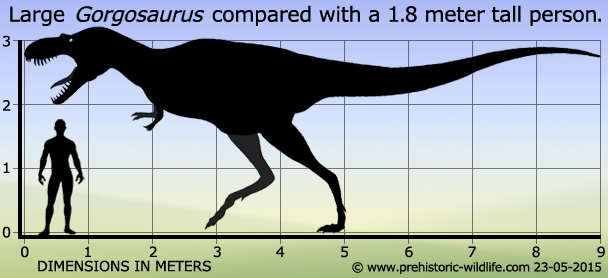
Gorgosaurus by Prehistoric Wildlife

Like most known tyrannosaurids, Gorgosaurus was a bipedal predator weighing more than two metric tons as an adult; dozens of large, sharp teeth lined its jaws, while its two-fingered forelimbs were comparatively small. Gorgosaurus was most closely related to Albertosaurus, and more distantly related to the larger TyrannosaurusGorgosaurus and Albertosaurus are extremely similar, distinguished mainly by subtle differences in the teeth and skull bones. Some experts consider G. libratusto be a species of Albertosaurus; this would make Gorgosaurus a junior synonym of that genus.

Gorgosaurus lived in a lush floodplain environment along the edge of an inland sea. It was an apex predator, preying upon abundant ceratopsids and hadrosaurs. In some areas, Gorgosaurus coexisted with another tyrannosaurid, Daspletosaurus. Although these animals were roughly the same size, there is some evidence of niche differentiation between the two. Gorgosaurus is the best-represented tyrannosaurid in the fossil record, known from dozens of specimens. These plentiful remains have allowed scientists to investigate its ontogeny, life history and other aspects of its biology.

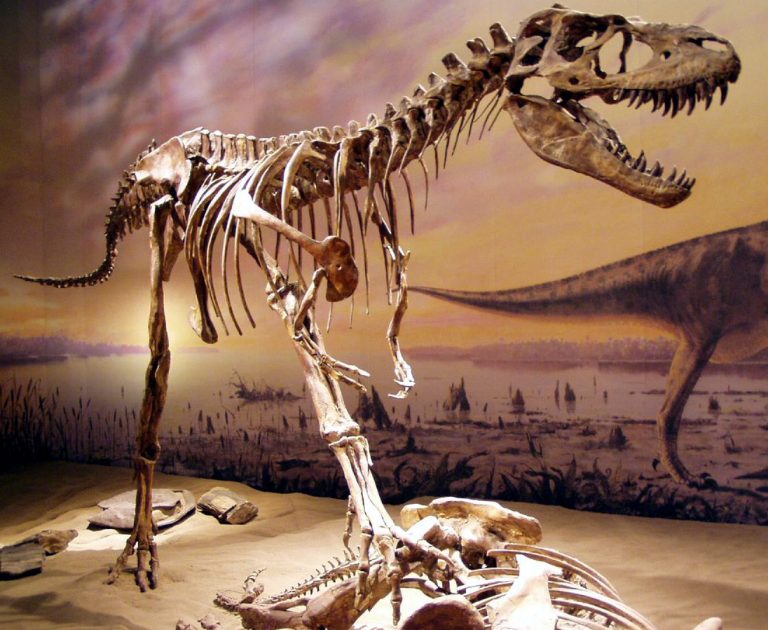
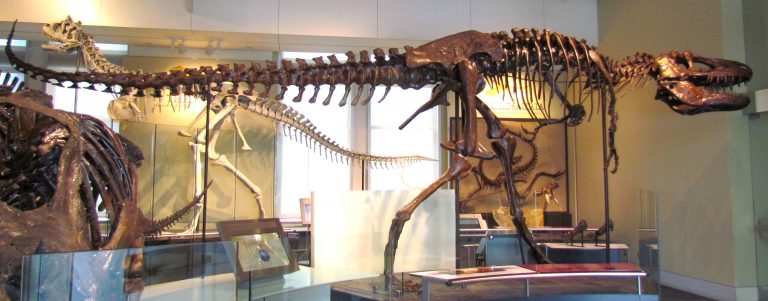
Gorgosaurus at the Royal Tyrrell Museum. Author: Sebastian Bergmann

Gorgosaurus was smaller than Tyrannosaurus or Tarbosaurus, closer in size to Albertosaurus and Daspletosaurus. Adults reached 8 to 9 m (26 to 30 ft) from snout to tail. Paleontologists have estimated full-grown adults to weigh about 2.5 tonnes (2.8 short tons), perhaps approaching 2.8 tonnes (3.1 short tons). The largest known skull measures 99 cm (39 in) long, just slightly smaller than that of Daspletosaurus. As in other tyrannosaurids, the skull was large compared to its body size, although chambers within the skull bones and large openings (fenestrae) between bones reduced its weight. Albertosaurusand Gorgosaurus share proportionally longer and lower skulls than Daspletosaurus and other tyrannosaurids. The end of the snout was blunt, and the nasal and parietal bones were fused along the midline of the skull, as in all other members of the family. The eye socket was circular rather than oval or keyhole-shaped as in other tyrannosaurid genera. A tall crest rose from the lacrimal bone in front of each eye, similar to Albertosaurus and Daspletosaurus. Differences in the shape of bones surrounding the brain set Gorgosaurus apart from Albertosaurus.

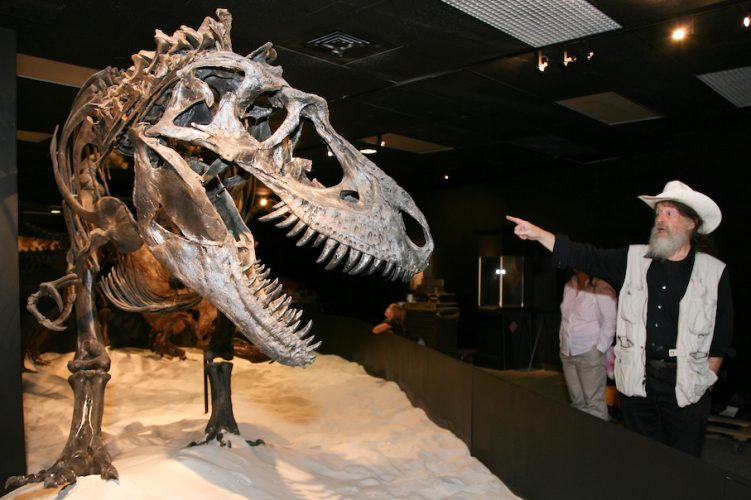
Dr. Bob Bakker of the Houston Museum of Natural Science (HMNS) with Gorgosaurus.

Most specimens of Gorgosaurus libratus have been recovered from the Dinosaur Park Formation in Alberta. This formation dates to the middle of the Campanian, between 76.5 and 74.8 million years ago, and Gorgosaurus libratus fossils are known specifically from the lower to middle section of the formation, between 76.6 and 75.1 million years ago.

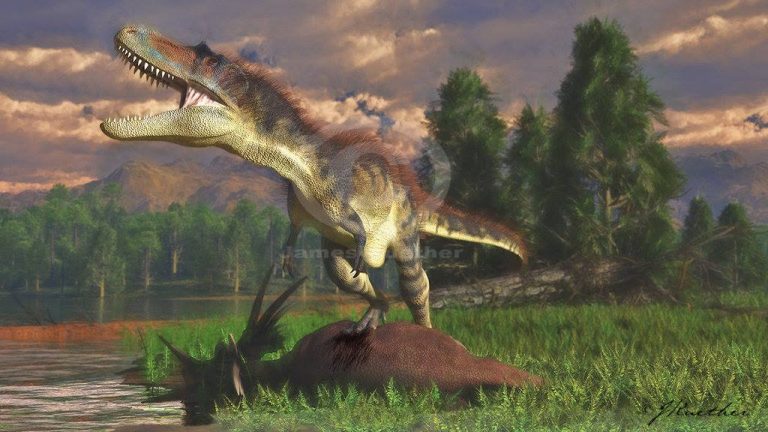
Gorgosaurus with Styracosaurus Art by PaleoGuy

Source: www.Wikipedia.org, www.NatGeo.com

Dinosaurs Migrated Out of Europe when Ancient Supercontinent Broke Up

Thursday, January 19, 2017

A map showing the migration of dinosaurs from Europe during the Early Cretaceous period (125-100 million years ago).

Between 230 million and 66 million years ago, dinosaurs plodded across the supercontinent Pangea, and migrated from Europe to other parts of the world. Now, by gathering and comparing all the data about their fossils, paleontologists have been able to visually map the dinosaurs’ migration during the time they ruled the Earth.

The researchers used “network theory” in a new way to see how different dinosaur fossils were connected.

“A network is just as you imagine it being; it’s a series of points which are your entities that you want to investigate,” said study lead author Alex Dunhill, a paleobiologist at the University of Leeds, in the United Kingdom. “And then you look at how they interact or are connected together, by simply drawing lines between them.”

The team chose continents as points and then drew connecting lines if the same types of dinosaurs were found on two or more continents.

“We can then use some really simple maths to look at how the level of connectivity and the strength of the connection changes through time,” Dunhill told Live Science. “It’s something that’s used really commonly in computing.”

For example, network theory is used all over the internet, which is basically one giant network itself. Things like Facebook friends and Twitter interactions can all be calculated and mapped by network theory.

Dinos on the move

The researchers looked at what happened when Pangaea broke up into smaller continents in the Triassic period, which is when dinosaurs first evolved. By the end of the Cretaceous, about 65.5 million years ago, the continents had broken up and drifted, almost to the positions we know today. High sea levels during this era also meant that some land masses appeared to be completely isolated, the researchers said. Using the fossil data, the scientists mapped where the dinosaurs trekked as the supercontinent was becoming fractured.

“One thing we actually find is that even though the migration of dinosaur groups slows down, it doesn’t completely stop,” Dunhill said. “We’re still getting the movement of dinosaur groups between major continental land masses, even when the continents appear to be really isolated.”

In other words, dinosaur families cropped up on continents even when they were completely separate from their original areas. Dunhill said this conclusion had been reached in previous studies using different methods, so the researchers were sure they were looking at the correct historical movements.

Dinosaurs may have been able to move across continents, and between islands, by the formation of temporary land bridges, which could have formed because of fluctuating sea levels during the Cretaceous era, Dunhill said.

Great migration

To make the mapping exercise more manageable, the researchers separated the dinosaurs by type: the sauropodomorphs, which are huge, long-necked plant-eaters like the Diplodocus and Brachiosaurus; the theropods that include all the carnivorous dinosaurs like the Tyrannosaurus rex; and the ornithischians, which include all other plant-eaters, such as the Triceratops and Stegosaurus.

“One thing we found was that sauropodomorphs tend to be less mobile, particularly [compared to] the theropods,” Dunhill said. “These were really big animals, and probably less likely to swim, and less likely to be able to get across sea waves than some of the other smaller dinosaurs.”

During the breakup of the supercontinent Pangea, dinosaurs migrated from Europe to other parts of the world. Credit: Catmando | Shutterstock.com

The theropod family also includes birds, and although they probably weren’t great at flying, Dunhill said they were probably mobile enough to be able to still disperse across narrow sea ways.

But figuring out whether the results show real patterns of dinosaur migrations — or whether the findings simply reflect limitations in the fossil record — has been challenging.

“The fossil record is incomplete and biased in quite a severe way, and the terrestrial vertebrate fossil record is incredibly patchy,” Dunhill said. “The main problem we tried to overcome was working out if these were true biological patterns of dinosaur movement or just that we’ve got a varying quality of fossil records through time.”

Europe has been sampled for fossils for more than 250 years, and North America and Asia have strong records of fossils. However, other parts of the world, such as Australia, Africa and Antarctica, have a poor history of digging up and documenting fossils, the researchers said.

To combat this, the researchers removed some of the areas where the fossil record isn’t as strong from the analysis, and ran it again to see if the overall patterns changed through time. When they did this, they found that there was a decline in connectivity, meaning there were fewer connections between the dinosaur families across the world (thus they weren’t as widespread). Using all the data showed more lines of connections, which showed the families were distributed further away, giving the impression that they travelled more distance.

Out of Europe

But what caused the dinosaurs to flee? Instead of a natural disaster happening in Europe that prompted the animals’ migration, Dunhill said the dinosaurs’ exit could have two possible explanations.

“There’s a biological possible explanation where Europe had been isolated for a while, had a burst of speciation, and then re-connections occurred with the rest of the world,” he said. “Then, these new groups of dinosaurs that have evolved in Europe have then radiated out and expanded their geographic ranges.”

The other explanation, he admits, is a little less exciting.

“It may just be an artifact of this patchy fossil record, and that maybe Europe has a really good fossil record throughout all this time period and other areas don’t,” Dunhill said. “It’s always really difficult to distinguish between the two.”

Dunhill says that more data is needed to really know what the dinosaurs were up to during that period, but the next stages of the research will involve integrating dinosaur phylogeny into the networks, and looking at relationships between the different groups.

The study’s findings were published April 25, 2016 in the Journal of Biogeography.

Original article on www.livescience.com

Amurosaurus

Thursday, January 19, 2017

Amurosaurus by atrox1 on DeviantArt

Amurosaurus (“Amur lizard”) is a genus of lambeosaurine hadrosaurid dinosaur found in the latest Cretaceous period (66 million years ago) of eastern Asia. Like most lambeosaurs, it would have been a primarily bipedal herbivore with a “duckbill” shaped snout and a hollow crest on top of its head, although such a crest has not been found. Fossil bones of adults are rare, but an adult would most likely have been at least 6 metres (20 ft) long. According to Gregory S. Paul, it was about 8 metres (26 ft) long and weighed about 3,000 kilograms (6,600 lb)

Skeletal reconstruction of Amurosaurus riabinini Bolotsky and Kurzanov, 1991. Black elements are not preserved in the available material. By Pascal Godefroit, Yuri L. Bolotsky, and Jimmy Van Itterbeeck

Russian paleontologists Yuri Bolotsky and Sergei Kurzanov first described and named this dinosaur in 1991. The generic name is derived from the Amur River and the Greek word sauros (“lizard”). The Amur (called Heilongjiang or “Black Dragon River” in Chinese) forms the border of Russia and China, and is near where this dinosaur’s remains were found. There is one known species (A. riabinini), named in honor of the late Russian paleontologist Anatoly Riabinin, who conducted the first Russian expeditions to recover dinosaur remains in the Amur region in 1916 and 1917.

In cahoots with Godefroit and Itterbeeck, Bolotsky revisited the Blagoveschensk bone pile in 2004 and realised that many of the bones belonged to Amurosuarus, albeit seperate individuals, and it instantly became the most abundantly known dinosaur ever discovered on Russian territory. On top of that the age of the Udurchukan Formation bodes well for the “Asian origin for lambeosaurines” hypothesis, and experts surmise that these duck-billed critters and other Asian vertebrate groups travelled across the Beringian isthmus into western North America via a land route that may have opened during the Aptian–Albian and persisted during the Late Cretaceous.

Amurosaurus is characterized by many autapomorphies, or unique features, of the skull, as well as the sigmoidal shape of the ulna (a lower arm bone) when viewed from the front or side. Most other known lambeosaurines have hollow crests on the top of their skulls, and although the bones that would make up such a crest are unknown in this dinosaur, the bones of the roof of the skull are modified to support one, so it can be assumed that Amurosaurus was crested as well.

Olorotitan and Amurosaurus belong to the same group as the iguanodons. These two hadrosaurs were excavated by a team made up of our paleontologists and their Russian counterparts, in 2001 and 2003. Photo: Royal Belgian Institute of Natural Sciences

As most of its features were described recently, as of early 2006, Amurosaurus has only been subjected to one cladistic analysis, which placed it as a basal member of the lambeosaurine subfamily of hadrosaurs, but more derived than either Tsintaosaurus or Jaxartosaurus.

All known basal lambeosaurines come from Asia, which has led to the hypothesis that lambeosaurines originated there and then later dispersed across the Bering Strait to North America. Two derived groups, the parasaurolophins (ParasaurolophusCharonosaurus) and lambeosaurins (CorythosaurusNipponosaurusLambeosaurus, etc.) evolved later. As members of both groups are found in North America and Asia (And one from Europe, which one is not solidly known.), there must have been further dispersal after their evolution, although in which direction that dispersal occurred is still unclear.

Did Dinosaurs Have Lips?

Thursday, January 19, 2017

“In popular culture, we imagine dinosaurs as more ferocious-looking, but that is not the case”

Can a crocodile’s smile reveal whether dinosaurs had lips? What if lips and gums hid most of dinosaur’s teeth?

New findings from University of Toronto vertebrate palaeontologist Robert Reisz challenge the idea of what therapods might have looked like when dinosaurs roamed the earth.

His research was presented May 19th at a conference at U of T Mississauga – and has made headlines all over the web.

According to a new study, dinosaurs may have lips. (Photo : Dan Kitwood/Getty Images)

 “When we see dinosaurs in popular culture, such as in the movie Jurassic Park, we see them depicted with big teeth sticking out of their mouths,” Reisz says. Large dinosaurs, such as Tyrannosaurus rex, bare a ferocious grin, while smaller creatures such as velociraptors are shown with scaly lips covering their teeth.

The U of T Mississauga expert was curious about which version might be most accurate. “We have very little information about dinosaurs’ soft tissue,” he says.

For clues about how therapods might have appeared, he looked to modern-day reptilian predators like crocodiles and monitor lizards. According to Reisz, lipless crocodiles have exposed teeth, much like a Jurassic Park predator, while monitor lizards conceal teeth behind scaly lips that are similar to the movie version of velociraptors.

Lips help to protect teeth, in part by helping to enclose them in a moist environment where they won’t dry out, Reisz says. Crocodiles, which spend their time submerged in water, don’t need lips for protection. “Their teeth are kept hydrated by an aquatic environment,” Reisz says.

Reptiles with lips, such as monitor lizards, typically live on land (much like their movie counterparts) where their teeth require different protection. From this, Reisz concludes that dinosaur teeth would likely have been covered by scaly lips.

Artist interpretation shows 190-million-year-old nests, eggs, hatchlings and adults of the prosauropod dinosaur Massospondylus in Golden Gate Highlands National Park, South Africa (image credit: Julius Csotonyi)

“It’s also important to remember that teeth would have been partially covered by gums. If we look at where the enamel stops, we can see that a substantial portion of the teeth would be hidden in the gums. The teeth would have appeared much smaller on a living animal.

“In popular culture, we imagine dinosaurs as more ferocious-looking, but that is not the case.”

Reisz presents his findings on May 20 at the annual meeting of the Canadian Society of Vertebrate Palaeontolgy at UTM. The two-day conference, which began on May 19, brings together 60 Canadian researchers working in Canada and around the globe.

“Canada has some very significant locations for understanding vertebrate evolution, ranging from the late Cretaceous in Alberta to the Pleistocene in the Arctic and the early stages of terrestrial vertebrate evolution in the Atlantic region,” says Reisz, who helped to organized the conference.

“There are about 1,000 people worldwide who study vertebrate fossils. It’s important to come together and exchange ideas and unite a community that is so widespread geographically.”

The conference features presentations on the latest research in palaeontology, including a crocodile-like creature from Sudan discovered by U of T researcher David Evans; a talk on the evolution of how birds hear; what a recently discovered ceratops from Montana tells us about horned dinosaurs; and deciphering the social behaviour of oviraptorsaurs found in Mongolia.

Attribution: University of Toronto

Daspletosaurus

Wednesday, January 18, 2017

Daspletosaurus by Dmitri Bogdanov

Daspletosaurus (meaning “frightful lizard”) was a type of tyrannosaurid dinosaur that lived in western North America between about 77 and 74 million years ago, during the Late Cretaceous Period. The genus Daspletosaurus contains two species. Fossils of the earlier type species, D. torosus, have been found in Alberta, while fossils of the later second species, D. horneri, have been found only in Montana. A possible third species, also from Alberta, awaits formal identification.

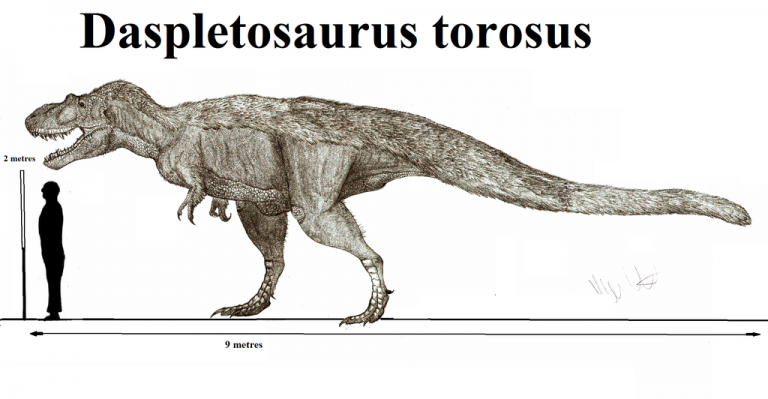
Daspletosaurus size by Robinson Kunz

The theropod dinosaur Daspletosaurus or frightful lizard had a head as huge as the later Tyrannosaurus rex, with just as cruel teeth. With such big teeth, this carnivorous dinosaur may have been clever to attack and kill heavily plated species of dinosaurs, like ankylosaurs. A contempary of Gorgosaurus, Daspletosaurus was founded on a frame originally believed to be an undescribed species of Gorgosaurus. Dale A. Russell hypothesized that while the more lightly built and more common Gorgosaurus may have specialized in preying on the more ordinary species of hadrosaurids, the heavier, more robust Daspletosaurus may have specialized in the less prevalent armored species of the time such as the ceratopsids.

The fossils of a Daspletosaurus torosus were found in The Canadian Museum of Nature. It has been suggested that Daspletosaurus is a direct ancestor to Tyrannosaurus. The massive, stocky construct of the two tyrannosaurus and certain similarities in skull structures seem to be indicators of a close phylogenetic relationship between the two genera. Some have even gone further to suggest that Daspletosaurus is in fact a species of Tyrannosaurus (Daspletosaurus torosus = Tyrannosaurus torosus), but this has not been universally acknowledged. Currently, one species of Daspletosaurus, D. torosus, (torosus = “brawny”) has been officially documented.

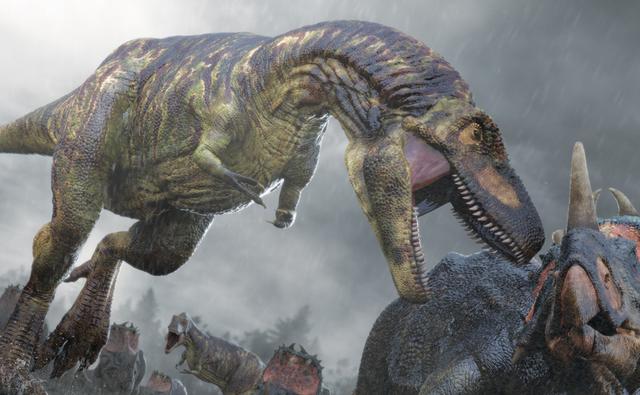
Planet Dinosaur: Daspletosaurus attack the herd of Centrosaurus.

Daspletosaurus is closely related to the much larger and more recent tyrannosaurid Tyrannosaurus rex. Like most tyrannosaurids, Daspletosaurus was a multi-tonne bipedal predator equipped with dozens of large, sharp teeth. Daspletosaurus had the small forelimbs typical of tyrannosaurids, although they were proportionately longer than in other genera.

As an apex predator, Daspletosaurus was at the top of the food chain, probably preying on large dinosaurs like the ceratopsid Centrosaurus and the hadrosaur Hypacrosaurus. In some areas, Daspletosaurus coexisted with another tyrannosaurid, Gorgosaurus, though there is some evidence of niche differentiation between the two. While Daspletosaurus fossils are rarer than other tyrannosaurids’, the available specimens allow some analysis of the biology of these animals, including social behavior, diet and life history.

Daspletosaurus torosus, holotype CMN 8506, Canadian Museum of Nature, Ottawa. Author: D. Gordon E. Robertson

While very large by the standard of modern predators, Daspletosaurus was not the largest tyrannosaurid. Adults could reach a length of 8–9 meters (26–30 ft) from snout to tail. Mass estimates have centered on 2.5 tonnes (2.75 short tons) but have ranged between 1.8 and 3.8 tonnes (2.0 and 4.1 short tons).

Daspletosaurus had a massive skull that could reach more than 1 meter (3.3 ft) in length. The bones were heavily constructed and some, including the nasal bones on top of the snout, were fused for strength. Large fenestrae (openings) in the skull reduced its weight. An adult Daspletosaurus was armed with about six dozen teeth that were very long but oval in cross section rather than blade-like. Unlike its other teeth, those in the premaxilla at the end of the upper jaw had a D-shaped cross section, an example of heterodonty always seen in tyrannosaurids. Unique skull features included the rough outer surface of the maxilla (upper jaw bone) and the pronounced crests around the eyes on the lacrimal, postorbital, and jugal bones. The orbit (eye socket) was a tall oval, somewhere in between the circular shape seen in Gorgosaurus and the ‘keyhole’ shape of Tyrannosaurus. Split carinae have been found on Daspletosaurus teeth.

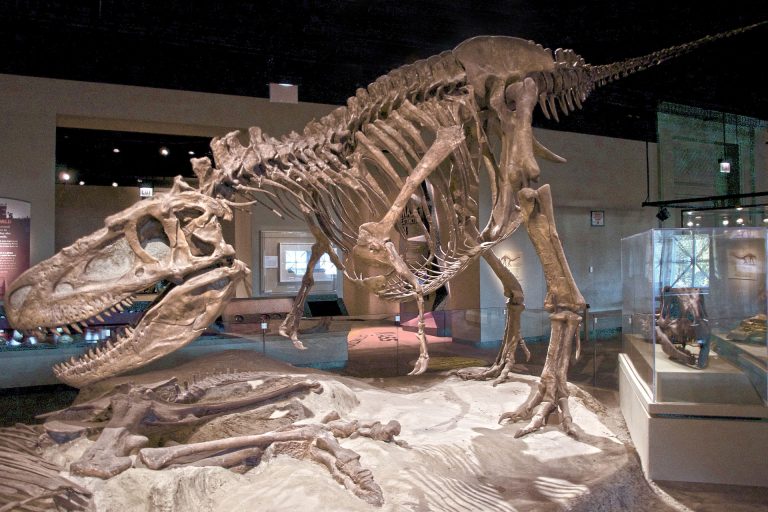
Dinosaur Park specimen (FMNH PR308), mounted at the Field Museum. Author: Scott Robert Anselmo

The 10 Most Important Dinosaurs of Africa

Sunday, January 17, 2016

In the past Africa has often been overlooked when people review dinosaurs,‭ ‬which is odd given that Africa is home to so many unique genera of dinosaurs that upon many occasions have led to many interesting discoveries and new ideas about the wider development of dinosaur palaeontologists in general.‭

From Aardonyx to Spinosaurus, These Dinosaurs Ruled Mesozoic Africa.

Carcharodontosaurus, an important dinosaur of Africa. Photo Credit: James Kuether

Compared to Eurasia and North and South America, Africa isn’t particularly well-known for its dinosaur fossils–but the dinosaurs that did live on this continent during the Mesozoic Era were among the fiercest on the planet. Here’s a list of the 10 most important African dinosaurs, ranging from Aardonyx to Spinosaurus.

Spinosaurus

The biggest meat-eating dinosaur that ever lived, even larger than Tyrannosaurus rexSpinosaurus was also one of the most distinctive looking, with its sailed back and long, narrow, crocodile-like skull (which were probably adaptations to a partially aquatic lifestyle). As was the case with its fellow plus-sized African theropod, Carcharodontosaurus, the original fossils of Spinosaurus were destroyed during an Allied bombing raid on Germany in World War II.

Spinosaurus, an important dinosaur of Africa. Photo Credit: Wikimedia Commons

Aardonyx

Beside its pride of place at the top of any complete, A to Z list of dinosaurs, the recently discovered Aardonyx was one of the earliest prosauropods, and thus distantly ancestral to the giant sauropods and titanosaurs of the later Mesozoic Era. Dating to the early Jurassic period, about 195 million years ago, the slender, half-ton Aardonyx represented an intermediate stage between the two-legged “sauropodomorphs” that preceded it and its giant descendants tens of millions of years down the line.

Aardonyx, an important dinosaur of Africa. Photo Credit: Nobu Tamura

Ouranosaurus

One of the few identified hadrosaurs, or duck-billed dinosaurs, to live in northern Africa during the Cretaceous period, Ouranosaurus was also one of the strangest. This multi-ton plant-eater had a series of spines jutting out from its backbone, which may have supported either a Spinosaurus-like sail or a fatty, camel-like hump (which would have been an important source of nutrition and hydration in its parched habitat).

Assuming it was cold-blooded, Ouranosaurus may also have used its sail to warm up during the daytime and dissipate excess heat at night.

Ouranosaurus, an important dinosaur of Africa. Photo Credit: Wikimedia Commons

Carcharodontosaurus

Carcharodontosaurus, the “great white shark lizard,” shared its African habitat with the even bigger Spinosaurus, yet it was most closely related to another gigantic theropod of South America, Giganotosaurus (an important clue to the distribution of the world’s land masses during the Mesozoic Era; South America and Africa were once joined together in the giant continent of Gondwana).

Sadly, the original fossil of this dinosaur was destroyed in a bombing raid on Germany during World War II.

Carcharodontosaurus, an important dinosaur of Africa. Photo Credit: Sameer Prehistorica

Heterodontosaurus

The early Jurassic Heterodontosaurus represents an important intermediate stage in dinosaur evolution: its immediate predecessors were ancient theropods like Eocursor, but it had already begun to evolve in a plant-eating direction. That’s why this “differently toothed lizard” possessed such a confusing array of teeth, some seemingly suited to slicing through flesh (though they were really wielded on hard-to-clip vegetation) and others to grinding up plants.

Even given its early Mesozoic lineage, Heterodontosaurus was an unusually tiny dinosaur, only about three feet long and 10 pounds.

Heterodontosaurus, an important dinosaur of Africa. Photo Credit: Wikimedia Commons

Eocursor

As explained in picture #5, during the Triassic period, South America and Africa were both part of the supercontinent of Gondwana. That helps to explain why, even though the earliest dinosaurs are believed to have evolved in South America about 230 million years ago, ancient theropods like the tiny, two-legged Eocursor (Greek for “dawn runner”) have been discovered in southern Africa, dating to “only” about 20 million years later.

The omnivorous Eocursor was probably a close relative of the similarly sized Heterodontosaurus, described in the previous slide.

Eocursor, an important dinosaur of Africa. Photo Credit: Nobu Tamura

Afrovenator

Although it wasn’t nearly as big as its fellow African theropods Spinosaurus and Carcharodontosaurus, Afrovenator is important for two reasons: first, its “type fossil” is one of the most complete theropod skeletons ever to be discovered in northern Africa (by the noted American paleontologist Paul Sereno), and second, this predatory dinosaur seems to have been closely related to the European Megalosaurus, yet more evidence for the slow drift of the earth’s continents during the Mesozoic Era.

Afrovenator, an important dinosaur of Africa. Photo Credit: Wikimedia Commons

Suchomimus

A close relative of Spinosaurus (see picture #2), Suchomimus (Greek for “crocodile mimic”) possessed a similarly long, crocodile-like snout, though it lacked Spinosaurus’ distinctive sail. Its narrow skull, combined with its long arms, point to Suchomimus having been a devoted fish-eater, which implies its kinship with the European Baryonyx (one of the few spinosaurs to live outside of South America or Africa).
Like Spinosaurus, Suchomimus may also have been an accomplished swimmer, though direct evidence for this is comparatively lacking.

Suchomimus by Andrey Atuchin

Massospondylus

Yet another important transitional dinosaur from southern Africa, Massospondylus was one of the first prosauropods ever to be named, way back in 1854 by the famous British naturalist Richard Owen. This sometimes bipedal, sometimes quadrupedal plant-eater of the early Jurassic period was an ancient cousin of the sauropods and titanosaurs of the later Mesozoic Era, and itself evolved from the earliest theropods, which evolved in then-adjoining South America about 230 million years ago.

Massospondylus carinatus by atrox1 on DeviantArt

Vulcanodon

Although few classic sauropods seem to have lived in Mesozoic Africa, this continent is littered with the remains of their much smaller ancestors. One of the most important discoveries in this vein is Vulcanodon, a relatively small (“only” about 20 feet long and four to five tons) plant-eater that occupied a position intermediate between the earliest prosauropods of the Triassic and early Jurassic periods (such as Aardonyx and Massospondylus) and the giant sauropods and titanosaurs of the late Jurassic and Cretaceous periods.

Vulcanodon by Prehistoric Wildlife

Article first appeared on www.thoughtco.com

10 Terrific Facts About Trilobites

Sunday, January 17, 2016

Redlichiida, such as this Paradoxides, may represent the ancestral trilobites.

For nearly 300 million years, these ancient mariners dotted our ocean floors—surviving, thriving, and fossilizing beneath the waves.

1. OVER 20,000 SPECIES ARE CURRENTLY KNOWN.

Realistic 3d render of trilobites

Every single continent has yielded trilobite remains. The biggest species (Isotelus rex) was some 28 inches long, while the smallest measured less than a millimeter from end to end. Some sported defensive spines, while others had smooth, rounded shells. And whereas certain trilobites came with disproportionately large eyes, many deep-sea species were blind.

2. TRILOBITES FIRST APPEARED AROUND 540 MILLION YEARS AGO.

Their debut roughly coincided with the dawn of the Cambrian period. During this game-changing chapter in Earth’s history, multi-celled organisms went through an apparent explosion in diversity, or at least an explosion in life forms that leave fossils. New creatures—including a barrage of mollusks and arthropods—seem to have evolved at an unprecedented rate.

The Cambrian also saw trilobites become the most common and diverse animals on the planet. However, trilobites began to decline when the period ended some 500 million years ago. Though the invertebrates stuck around for another 240 million years, they’d never again be so successful.

3. MANY WOULD CURL UP INTO LITTLE BALLS FOR PROTECTION.

Close-up of a ten to fifty million year old trilobite fossil

When danger struck, some trilobites could ball themselves up like underwater pill bugs, with their rear end flexed under their head. Specimens dating as far back as the late Cambrian have been found in this defensive position.

4. AT FIRST, SCIENTISTS DIDN’T KNOW WHAT TO MAKE OF THEM.

Fæ, Wikimedia // Public domain

In a 1679 letter, Welsh linguist and naturalist Edward Lhuyd misidentified one as “the sceleton [sic] of some Flat-fish.” Bishop Charles Lyttleton came a little closer to the mark in 1750 when he wrote London’s Royal Society about a “petrified Ins[e]ct” that he’d dug up a year before. While trilobites were, in fact, arthropods, the creatures appear to have been more closely akin to crustaceans and/or chelicerates (i.e. arachnids and horseshoe crabs) than insects.

5. MOST TRILOBITE FOSSILS ARE ACTUALLY MOLTED EXOSKELETONS.

ellenm1,Wikimedia // CC BY 2.0

Over the course of its life, a trilobite outgrew many shells. During the molting process, these discarded husks would often get preserved for posterity. One trilobite could therefore leave behind several trilobite-shaped fossils. Specimens that represent the actual creature—as opposed to its shuffled-off shell—are comparatively rare.

6. THREE STATES HAVE MADE A TRILOBITE THEIR OFFICIAL FOSSIL.

JMCC1, Wikimedia // CC BY-SA 3.0

In 1985, Ohio chose the entire Isotelus genus and Wisconsin went with Calymene celebra. Three years later, Pennsylvania picked Phacops rana after an elementary school class lobbied for its appointment.

 7. TRILOBITES GATHERED FOOD IN A VARIETY OF WAYS.

Generally speaking, early trilobites seem to have hunted down aquatic worms and eaten them alive. It’s been theorized that a few other species evolved to eat plankton or algae—with some making use of a filter-feeding mechanism.

8. TRILOBITES WERE WIPED OUT BY THE BIGGEST EXTINCTION IN HISTORY.

Trilobites had bounced back from previous extinction events because of the lack of competition. This time, though, the combination of the worst ever extinction event and the competition from fishes was too much.

Some call it the “Great Dying”—250 million years ago, 90 percent of all species on earth suddenly perished. Possible causes include everything from increased volcanic activity to exploding supernovas. Regardless, the event—also known as the Permian Extinction —killed off a number of insects, sharks, armored fish, mammal-like creatures, and countless other organisms. Trilobites, however, are by far the most famous lineage to have met their end this way.

9. NATIVE AMERICANS USED THEM AS AMULETS.

Long before Europeans first set foot on the continent, the Pahvant Ute people, from what is now called Utah, gathered Cambrian trilobites. Believing that the fossils harbored special powers, the natives carried them around as protective charms. These odd, petrified critters were given the name “Timpe-Konitza-Pachuee,” or “little water bug living in a house of stone.”

10. ONE CHINESE TRILOBITE WAS NAMED AFTER A STAR WARS CHARACTER.

Dwergenpaartje, Wikimedia // CC BY-SA 3.0

Around the start of the last decade, paleontologist Samuel Turvey happened upon several new species of trilobites while exploring in China. He gave one new invertebrate the genus name Han, which it shares with China’s biggest ethnic group. When the time came to pick species names, Turvey couldn’t resist bolstering his Star Wars cred, and named one particular trilobite Han solo. (It helped that Han solo was the only species in the genus.)

All photos courtesy of iStock unless otherwise noted.

Original article on www.mentalfloss.com

10 Terrifying Flying Reptiles

Friday, January 6, 2017

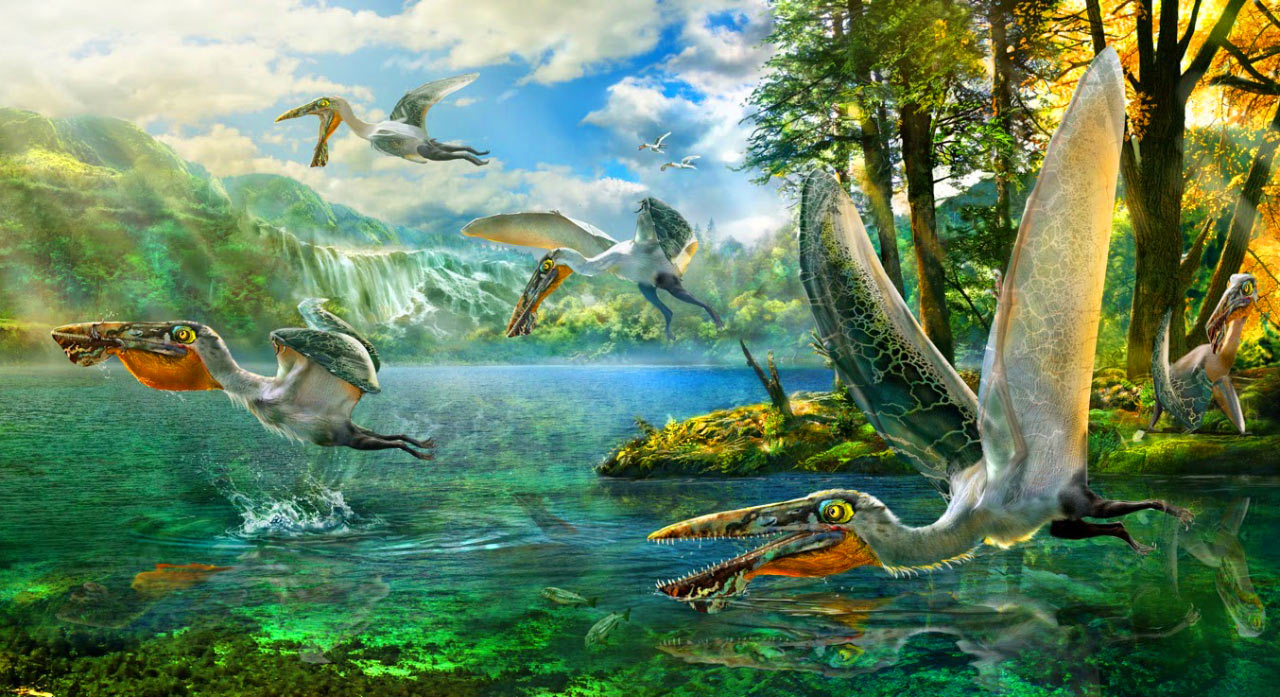
Ikrandraco avatar had about 40 pairs of teeth and a throat pouch for catching fish. Image credit: © Chuang Zhao.

When most people think about prehistoric reptiles, many inevitably think of the lumbering dinosaurs. There’s good reason for that as they were the most dominant life-form on the Earth for over 160 million years (compared to modern humans’ puny 200,000 years) and have captured the imaginations of both children and adults.

One group that is relatively forgotten, however: the pterosaurs. Pterosaurs were not true dinosaurs but rather placed in their own class of flying reptiles. Here we will take a look at 10 of the most bizarre and terrifying pterosaurs.

Ikrandraco avatar

Starting out the list is a unique pterosaur that was only recently discovered and identified in 2014. Ikrandraco is notable for an unusual crest that protruded from its lower jaw. In fact, it is this protrusion that caused paleontologists to name it after Ikran, the flying creature from the movie Avatar, which had a similar lower jaw crest. Crests on the heads of pterosaurs were not uncommon; however, Ikrandraco is the only known pterosaur that sported one on its mandible.

It is believed that the unique lower jaw combined with an expandable throat pouch allowed Ikrandraco to skim the tops of freshwater lakes for fish in what is now China and would have trapped its prey in jaws that contained at least 40 small teeth. Ikrandraco lived in the early Cretaceous period, approximately 120 million years ago.

Rhamphorhynchus muensteri
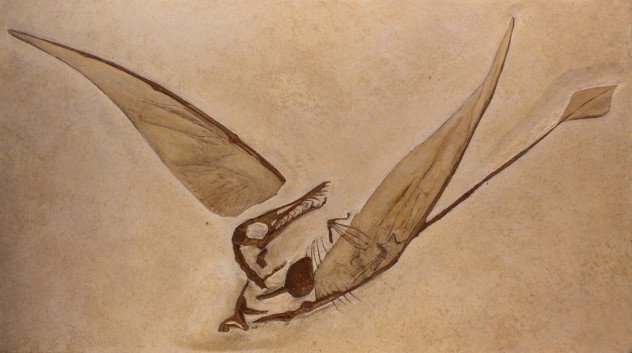
Photo credit: M0tty

Rhamphorhynchus, whose name means “beak snout,” was a small but fierce-looking pterosaur that lived in the Jurassic period approximately 150 million years ago.

Rhamphorhynchus was small, averaging about 1 meter (3 ft) from wingtip to wingtip, with a long tail ending with a diamond-shaped lobe. It likely skimmed lakes and rivers for fish, catching them in its fearsome tooth-filled jaws.

What really makes this pterosaur special, however, is the extraordinary fossils it left behind, with some fossils even showing the outlines of internal organs. One incredible fossil shows what appears to be a Rhamphorhynchus locked in battle with a large prehistoric fish called Aspidorhynchus.

Paleontologists have pieced together the fight from the remains, which shows the large-toothed Aspidorhynchus with its jaws firmly clamped on the wing of the hapless Rhamphorhynchus. Even more amazing is the fact that Rhamphorhynchus has a small fish in its larynx, suggesting that the predator quickly became the prey. Aspidorhynchus likely struggled to swallow Rhamphorhynchus and was unable to expel the pterosaur in its mouth. The deaths of the three prehistoric creatures became immortalized when they sank into the soft sediment, providing paleontologists a rare glimpse into life in the Jurassic period.

Dimorphodon macronyx

Photo credit: Dmitry Bogdanov

While many pterosaurs featured long, graceful heads and necks, Dimorphodon went the completely opposite direction. Looking more like a flying bulldog, Dimorphodon had a short stubby neck on which perched a head and jaw that was much shorter and deeper than many of its pterosaur cousins. Dimorphodon’s head was large for its body, but despite this, was lightly built due to several large openings in the skull.

Dimorphodon was one of the earliest pterosaurs, and it lived in the Jurassic period approximately 176 million years ago. Most early pterosaurs had long tails, and Dimorphodon was no exception. Paleontologists believe the tail was used as a stabilizer while the animal was in flight. It probably used flapping motions to fly, unlike later larger pterosaurs who were primarily gliders.

The limbs were well-developed in Dimorphodon which probably allowed it to move on the ground on its hind legs. Discovered in 1828 by famed British paleontologist Mary Anning, Dimorphodon was the first pterosaur to be found and identified in the United Kingdom.

Jeholopterus ninchengensis

Photo credit: Laikayiu

Probably more cute than terrifying, Jeholopterus may have more closely resembled a fuzzy bat than a reptile. Thanks to an extraordinarily well-preserved fossil specimen, paleontologists have determined that Jeholopterus was actually covered in a special type of fiber.

The amazing fossil discovery was made in China and appears to show an adult Jeholopterus that was covered in hair-like fibers. At first, paleontologists thought that they were early forms of feathers known as “protofeathers.” However, they discovered they were actually thick filaments called pycnofibers that differed in structure from mammalian hair. All pterosaurs had them to some degree, but Jeholopterus is the first fossil to conclusively show that they weren’t protofeathers, which directly led to the coining of the term “pycnofibers.”

Jeholopterus probably lived in trees as its claws had a protective covering on them to prevent wear. This shows that it would have been an adept climber as the claws would not wear out quickly. Jeholopterus was a small pterosaur with an approximate 1-meter (3 ft) wingspan and would have fed primarily on insects.

Nyctosaurus gracilis
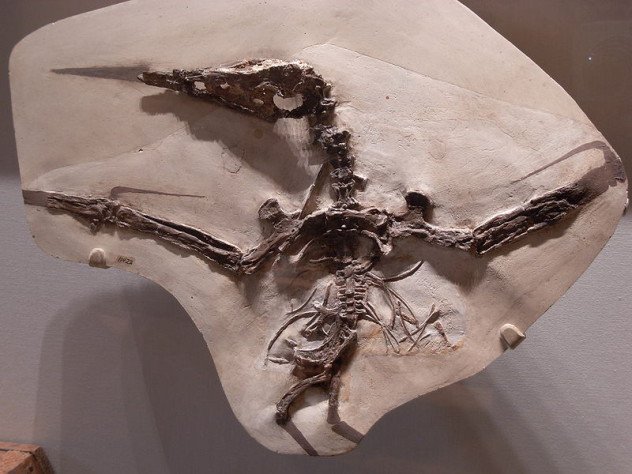
Photo credit: Piotrus

While many pterosaurs sported cranial crests, Nyctosaurus may have taken home the grand prize for the most impressive headgear. Displaying a massive forked crest that was about two and a half times the length of the skull, Nyctosaurus looked like some Frankenstein mashup between a deer and pterosaur.

It is thought that Nyctosaurus soared the skies above ancient oceans, like the modern-day albatross, feeding on fish and other small marine animals. Nyctosaurus was a moderately sized pterosaur, with a wingspan of approximately 2–3 meters (6–9 ft), but what made it unique was the large crest that paleontologists believe may have been used as a display during mating periods. If this was the case, the crest may have been brightly colored and used to impress females and ward off rival males.

Nemicolopterus crypticus

Photo credit: JConway

Contrary to popular belief, not all of the pterosaurs were giants. One only has to look at the diminutive Nemicolopterus to see that the flying reptiles came in all shapes and sizes. This mini-pterosaur only measured 25 centimeters (10 in) from wing tip to wing tip, making it only about twice as large as a modern hummingbird.

Nemicolopterus is among the smallest of the pterosaurs so far discovered, and it is a far cry from its gigantic fish-eating relatives. The tiny reptile had curved toes that it would have used to grip branches in the trees in which it lived. Nemicolopterus likely fed on insects during the early Cretaceous period in what is now China, catching them in its tiny toothless jaws.

Nemicolopterus crypticus, which means “hidden flying forest dweller,” is providing paleontologists with new insight on the lives of inland pterosaurs as well as the evolutionary history of the pterosaurs.

Pterodaustro guinazui
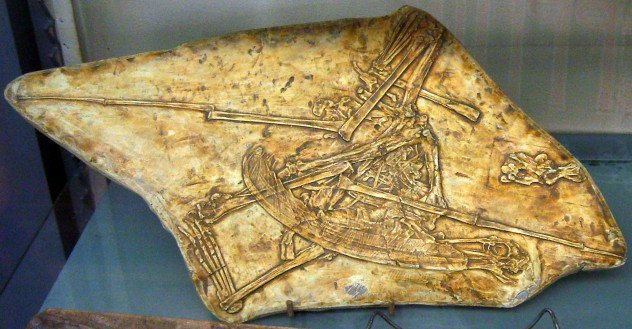
Photo credit: FunkMonk

When most people think of pterosaurs, they think of flying creatures snapping up fish and small animals in their large jaws. Pterodaustro is one pterosaur that breaks this traditional line of thinking. Whereas some pterosaurs may have acted like modern-day gulls, Pterodaustro seems to have been the equivalent of a Cretaceous flamingo.

Unlike other pterosaurs that either had long toothless bills or dozens of sharp teeth, Pterodaustro’s jaws were filled to the brim with nearly 1,000 needle-like, modified teeth. Pterodaustro probably scooped up water in its jaws and strained it through these teeth, filtering out small shrimp and other aquatic animals.

Even more interestingly, fossils show that Pterodaustro had a diet similar to modern-day flamingos, which may have caused it to have a similar pink coloration.

Pterodactylus antiquus
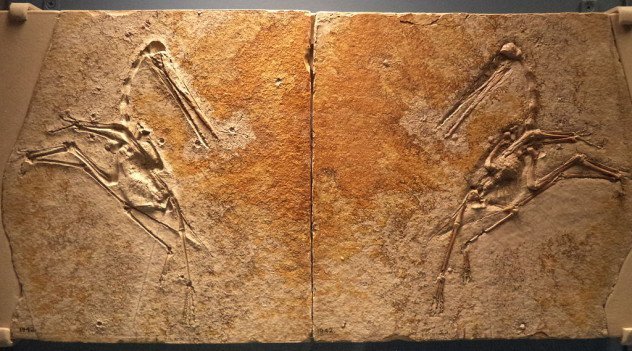
Photo credit: Meg Stewart

There may be no pterosaur more well-known than Pterodactylus, more commonly known as the pterodactyl. This may be due to the fact that Pterodactylus was the first pterosaur to be discovered in 1784, although it was not identified as a flying reptile until years later.

In fact, when it was discovered, scientists believed that Pterodactylus was a sea creature. They believed that the elongated fourth finger that supported the wing structure was actually a paddle used to propel the creature through the water.

Pterodactylus was an early pterosaur that lived in the Jurassic period approximately 150 million years ago. It was a smaller creature, with a wingspan of about 1.5 meters (5 ft), and cruised the skies of what is now Germany. It survived by feeding on fish and other small animals which it captured in jaws lined with nearly 100 sharp teeth.

Pteranodon longiceps
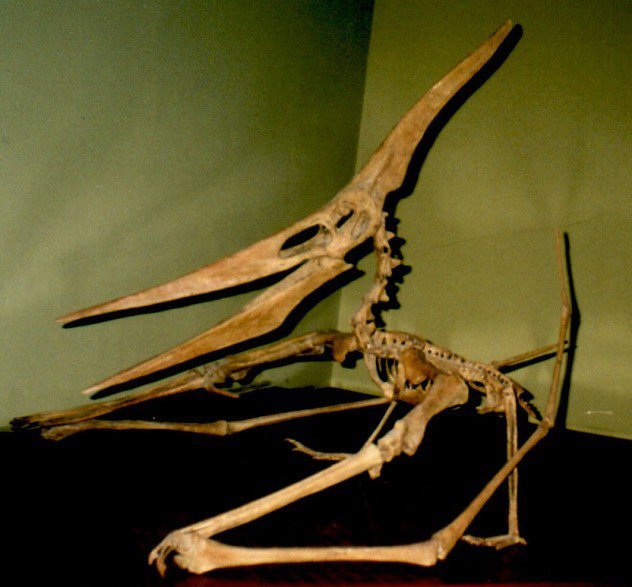
Photo credit: Cropbot

The iconic and arguably most studied of the pterosaurs, Pteranodon is instantly recognizable by the large crest protruding from its head. Living in the Cretaceous period, approximately 85 million years ago, Pteranodon was one of the largest of the flying reptiles with males having wingspans of over 7.6 meters (25 ft). Despite this, Pteranodon was remarkably light with some estimates putting its weight as little as 15 kilograms (35 lb) This is due to a lightweight, hollow bone structure similar to those of modern birds.

Thousands of fossils of this giant have been found throughout North America with the first being described in scientific papers in 1876. Even with this large sample size, paleontologists are still unsure what purpose the large head crest served. Some believe that it may have served as a mating display, as males typically had a larger crest than females. It is believed that Pteranodon fed on fish, but it is not known how it caught them in its large, toothless beak.

Quetzalcoatlus northropi

With a wingspan of 33 feet, this pterosaur, Quetzalcoatlus northropi, lived around 70 million years ago in what is now western Texas. (American Museum of Natural History)

This terrifying pterosaur is perhaps the one that ruled the skies above all others. Imagine a creature that stands as tall as a giraffe and has a wingspan the size of an F-16 fighter plane. Now imagine that creature cruising the skies above you and you’ll be imagining Quetzalcoatlus.

Named after the Aztec feathered serpent god Quetzalcoatl, Quetzalcoatlus dominated the air in the late Cretaceous period, soaring on wings up to 12 meters (39 ft) across. Quetzalcoatlus was probably a glider, using its massive wings to cruise at up to 107 kilometers per hour (67 mph).

Despite these huge dimensions, Quetzalcoatlus could not escape the fate that befell all of the flying reptiles, dinosaurs, and large marine reptiles. A large asteroid eventually wiped them all out approximately 66 million years ago, clearing the way for the new rulers of the sky—modern birds.

Source: www.listverse.com

10 Facts About Argentinosaurus

Friday, December 30, 2016

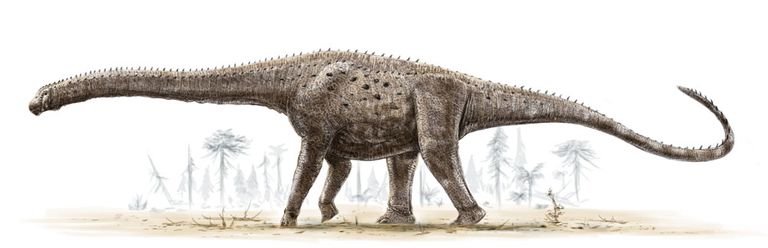
Damir G. Martin - Argentinosaurus vs Bus

How Much Do You Know About Argentinosaurus?

When it was discovered in Argentina in 1987, Argentinosaurus literally shook the world of paleontology to its foundations. On the following article, you’ll discover 10 facts about this enormous dinosaur of middle Cretaceous South America.

A Full-Grown Argentinosaurus Weighed Close to 100 Tons

Ever since its discovery, in 1987, paleontologists have been arguing about the length and weight of Argentinosaurus. Some reconstructions put this dinosaur at 75 to 85 feet from head to tail and up to 75 tons, while others are less restrained, positing (somewhat less credibly) a total length of 100 feet and a weight of a whopping 100 tons. If the latter estimates hold, that would make Argentinosarus the biggest dinosaur the weight of which has been derived from well-attested fossil evidence.

Argentinosaurus Was a Type of Dinosaur Known as a Titanosaur

 Saltasaurus, from which Argentinosaurus was reconstructed (Alain Beneteau).

Given its gigantic size, it’s appropriate that Argentinosaurus is classified as a titanosaur, the family of lightly armored sauropods that spread to every continent on earth during the later Cretaceous period. This dinosaur’s closest titanosaur relative appears to have been the much smaller (only 10 ton) Saltasaurus, which actually lived a few million years later. (In fact, many of the Argentinosaurus reconstructions discussed in slide #2 are based on extrapolations from Saltasaurus specimens.)

Argentinosaurus May Have Been Preyed on by Giganotosaurus

 Wikimedia Commons

The scattered remains of Argentinosaurus are “associated” with those of the 10-ton carnivore Giganotosaurus, meaning these two dinosaurs shared the same territory in middle Cretaceous South America. While there’s no way even a desperately hungry Giganotosaurus could have taken down a full-grown Argentinosaurus all by itself, it’s possible that these large theropods hunted in packs, thus leveling the odds.

The Top Speed of Argentinosaurus Was Five Miles Per Hour

 Alain Beneteau

Given its enormous size, it would be surprising if Argentinosaurus could move much faster than a slowly taxiing 747 jet airplane. According to one analysis, this dinosaur ambled along at a top speed of five miles per hour, presumably inflicting plenty of collateral damage (toppled trees, squished mammals, etc.) along the way. If Argentinosaurus congregated in herds, as seems likely, even a slow-moving stampede (triggered by a hungry Giganotosaurus) could have wiped the average watering hole completely off the Mesozoic map.

Argentinosaurus Lived in Middle Cretaceous South America

BBC

When most people think of giant dinosaurs, they picture behemoths like ApatosaurusBrachiosaurus and Diplodocus, which lived in late Jurassic North America. What makes Argentinosaurus slightly unusual is that it lived at least 50 million years after these more familiar sauropods, in a place (South America) the breadth of whose dinosaur diversity is still unappreciated by the general public. (Here’s another exotic example: Spinosaurus, the largest-ever carnivorous dinosaur, which stomped around northern Africa at around the same time.)

Argentinosaurus Eggs (Probably) Measured a Full Foot in Diameter

 Wikimedia Commons

Because of physical and biological constraints, there’s an upper limit to how large any given dinosaur egg can be–and considering its huge size, Argentinosaurus probably brushed up against that limit. Based on comparisons with the eggs of other titanosaurs (such as the eponymous genus Titanosaurus), it seems likely that Argentinosaurus eggs measured about a foot in diameter, and that females laid up to 10 or 15 eggs at a time–increasing the odds that at least one hatchling would evade predators and survive into adulthood.

It Took Up to 40 Years for Argentinosaurus to Attain its Maximum Size

 Sameer Prehistorica

There’s still a lot we don’t know about the growth rates of plant-eating dinosaurs like sauropods and titanosaurs; most likely, juveniles reached maturity at a much slower pace than that of warm-blooded tyrannosaurs and raptors. Given the ultimate heft of Argentinosaurus, it’s not inconceivable that a newborn hatchling took three or four decades to reach its full adult size; that would represent (depending on the model you use) about a 25,000 percent increase in bulk from hatchling to herd alpha!

Paleontologists Have Yet to Find a Complete Argentinosaurus Skeleton

Photo Credit: Wikimedia Commons

One of the frustrating things about titanosaurs in general is the fragmentary nature of their fossil remains: it’s extremely rare to find a complete, articulated skeleton, and even then the skull is usually missing (since the skulls of titanosaurs were easily detached from their necks after death). This said, Argentinosaurus is better attested than most members of its breed: this dinosaur was “diagnosed” based on a dozen or so vertebrae, a few ribs, and a five-foot-long femur (thigh bone) with a circumference of four feet.

No One Knows How Argentinosaurus Held its Neck

Photo Credit: Vladimir Nikolov

Did Argentinosaurus hold its neck vertically, the better to nibble the leaves of tall trees, or did it forage in a more horizontal posture? The answer to this question is still a mystery, not only for Argentinosaurus, but for pretty much all long-necked sauropods and titanosaurs. The issue is that a vertical posture would have placed enormous demands on this hundred-ton herbivore’s heart (imagine having to pump blood 40 feet into the air, 50 or 60 times per minute!), given our current state of knowledge about Argentinosaurus’ physiology.

Plenty of Dinosaurs Are Vying for Argentinosaurus’ Size Title

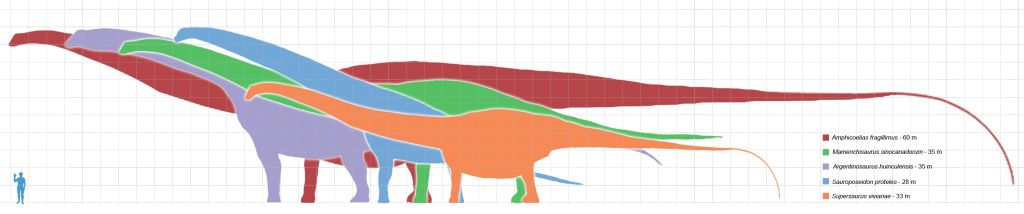
Art by Matt Martyniuk (CC BY-SA 3.0). A COMPARISON OF LARGE SAUROPODS: AMPHICOELIAS (RED), ARGENTINOSAURUS (PURPLE), MAMENCHISAURUS (GREEN), SAUROPOSEIDON (BLUE), SUPERSAURUS (ORANGE).

Depending on who is doing the reconstructions–and how they evaluate the fossil evidence–there are plenty of pretenders out there for Argentinosaurus’ “world’s biggest dinosaur” title, and not surprisingly, all of them are titanosaurs. The three leading candidates are the tongue-twistingly named Bruhathkayosaurus (from India) and Futalognkosaurus, as well as a more recently discovered contender, Dreadnoughtus, which generated major newspaper headlines in 2014 (but which may not have been as big as first advertised).

Source: www.thoughtco.com

Top 10 Largest Dinosaurs (to date)

Saturday, December 24, 2016

Sauropods

Newly discovered dinosaur fossils, plus a new assessment of dino size, have led to a revised list of the top 10 largest dinosaurs to date.

The top 10 largest terrestrial animals on Earth were all dinosaurs, and a new analysis of dinosaur fossils reveals the biggest of the big.

The new study, published in the journal Scientific Reports, determined that the most gargantuan dinosaurs were all herbivores.

Sauropod dinosaurs — long-necked plant eaters — include the largest land animals that have ever existed,” lead author Kenneth Lacovara of Drexel University told Discovery News.

“Multiple studies have shown that the body weight of a four-legged animal corresponds closely with measurements taken from its humerus (upper arm bone) and femur (thigh bone),” Lacovara said.

Diplodocus

Diplodocus longus by Dmitry Bogdanov

Calculations based on such fossil measurements put Diplodocus longus in the No. 10 spot. The estimated mass (a measure of how much matter is in an individual or object) of this dinosaur is 16.3 tons.

Giraffatitan

Dmitry Bogdanov, Wikimedia Commons

Weighing in at No. 9 is Giraffatitan brancai. Its mass was calculated to be 37.5 tons.

Girth is only one component of size, but the longest dinosaurs tended also to be the heftiest. Lacovara said many such dinosaurs spent their days pursuing “a life-long obsession with eating.” Dinosaurs like Giraffatitan would devote hour after hour to consuming tree and fern leaves, not moving much from their feasting spots.

Futalognkosaurus

Skeleton of Futalognkosaurus – Wikimedia Commons

No. 8 on the list is Futalognkosaurus dukei, which had an estimated mass of 42 tons. That’s equivalent to 84,000 pounds.

Elaltitan

Elaltitan lilloi by Dmitry Bogdanov

Next in the lineup is Elaltitan lilloi. According to the new study, its mass was 47.2 tons. This dinosaur lived in what is now southern Argentina.

Turiasaurus

Turiasaurus – Wikimedia Commons

Turiasaurus riodevensis is one of the largest dinosaurs ever to be found in Europe. The dinosaur, which had a mass of 56.1 tons, was excavated in what are now eastern Spain and Portugal.

 Brachiosaurus

Brachiosaurus by Dmitry Bogdanov

Weighing in at 62 tons is Brachiosaurus altithorax, which was hailed as “the largest-known dinosaur” by discoverer Elmer Riggs in 1903. While it’s No. 5 on the list now, at 62 tons, this dinosaur still made the top 10.

Sauroposeidon

Sauroposeidon by Manuel Gil Jaramillo

Sauroposeidon proteles was not included in the Scientific Reports study. This species, and the entire genus, are only known from several incomplete specimens. So it’s more challenging to accurately estimate its weight and height. Some paleontologists theorize that it weighed anywhere from 55-66 tons. It could, therefore, move even higher on this list should more fossils be found.

Lacovara

Dmitry Bogdanov, Wikimedia Commons

Lacovara and a team of his colleagues discovered Paralititan stromeri in 2001. “We only recovered the humerus of Paralititan, and therefore cannot be sure about its limb proportions,” Lacovara told Discovery News.

Based on the fossil that was excavated, however, it was an enormous dinosaur. The humerus, measuring about 5 1/2 feet, is lengthier than that of any other known Cretaceous sauropod. Paralititan is another contender for possible top spot placement on this list if additional fossils are found and support the speculation about its size.

Dreadnoughtus

Mark A. Klinger, Carnegie Museum of Natural History

Dreadnoughtus schrani has the largest reliably calculable weight of any known land animal,” Lacovara said. Announcement of its discovery was made just this week, reminding that on any day, new fossil finds could change this list.

The mass of Dreadnoughtus was 65.4 tons. This dinosaur had no known enemies during its lifetime.

Argentinosaurus

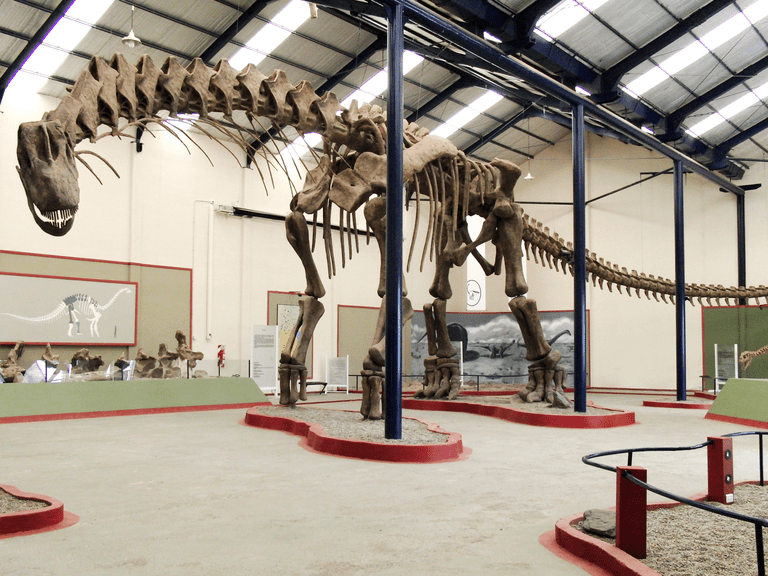
Argentinosaurus huinculensis, reconstructed skeleton at Naturmuseum Senckenberg

Most paleontologists, including Lacovara, believe that Argentinosaurus huinculensis was the world’s largest-ever land animal. “I think it is very likely that Argentinosaurus is the most massive dinosaur yet known,” Lacovara said. “However, I don’t think we can make a reliable estimation of its mass.”

He explained that the femur sometimes associated with this species has never formally been referred to in a peer-reviewed journal. Rough estimates by others estimate that Argentinosaurus could have been 115 feet in length with a weight of anywhere from 88–110 tons.

Source: www.seeker.com / www.wikipedia.com

Pages