Blogs

Ancient Whales Were Predators Not Gentle Giants, Scientists Say

Saturday, October 14, 2017

Ancient Whales Were Predators Not Gentle Giants, Scientists Say

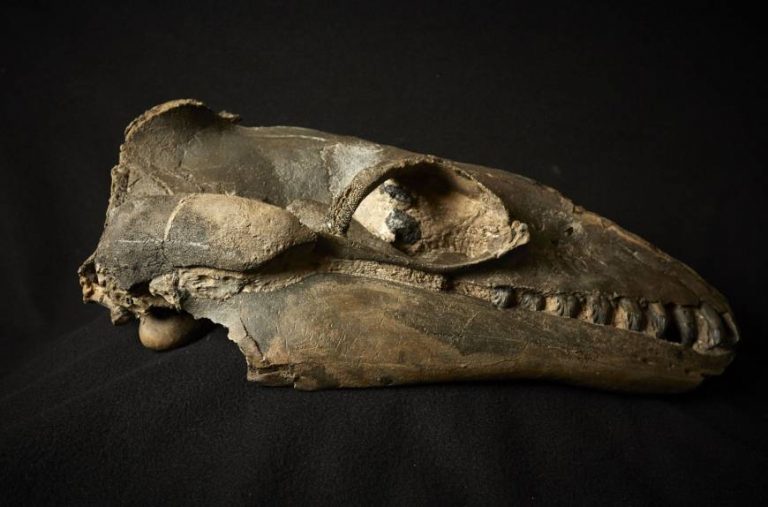
Ancient whales had extremely sharp predator teeth similar to lions, Australian scientists said Wednesday in a discovery they believe debunks theories the mammals used their teeth to filter feed like today’s gentle giants.

There are two major groups of whales — toothed creatures such as killer whales, and baleen, which filter plankton and small fish from the ocean for food with special bristlelike structures in their mouths.

Using 3-D scanners, Museums Victoria and Monash University paleontologists made digital teeth models of fossil baleen whales and today’s mammals from specimen collections around the world.

They found that teeth in ancient baleen whales — the ancestors of the southern right and blue whale — were different to the present-day and were instead much sharper.

“These results are the first to show that ancient baleen whales had extremely sharp teeth with one function — cutting the flesh of their prey,” Museums Victoria’s senior curator of vertebrate paleontology Erich Fitzgerald said.

“Contrary to what many people thought, whales never used their teeth as a sieve, and instead evolved their signature filter feeding technique later — maybe after their teeth had already been lost.”

A previous theory about ancient whales suggested they filtered feed using teeth that when closed formed a zigzag-like sieve, in a similar manner to some living Antarctica seals.

The sieve trapped food in the mouth and also allowed water to flow between the teeth. They were eventually replaced by baleen, the theory added.

The discovery, published Wednesday in the journal Biology Letters, meant “whales completely turned their feeding biology upside down” when they evolved to filter feed, Museums Victoria and Monash University research fellow David Hocking said.

The researchers said there was more work to do to understand the origins of baleen whales, which are Earth’s largest animals, but which feed on some of the smallest ocean creatures.

Source: www.japantimes.co.jp

The Asteroid That Killed the Dinosaurs Caused Catastrophic Climate Change

Saturday, October 14, 2017

The Asteroid That Killed the Dinosaurs Caused Catastrophic Climate Change

Most of us learned the demise of the dinosaurs went something like this: monster asteroid head-butted Earth, everything exploded with fire, and whatever was alive perished and ended up a fossil to be unearthed millions of years later.

The phenomenon sort of went like that, but the impact of this asteroid was infinitely more monstrous. Like, global thermonuclear war monstrous.

Think of an object from space about the size of San Francisco (about 6 miles wide) slamming into Mexico’s Yucatan peninsula during the late Cretaceous period—and spreading its influence far beyond the point of impact. It wasn’t just the dinosaurs that descended into extinction, either. Try 75% of anything that breathed. Besides the massive volcanic eruptions that are pictured in so many dinosaur-mageddon visions, the asteroid Chicxulub also rocked the planet with massive earthquakes and tsunamis. It vaporized rock that shot miles above the earth and rained down as searing dust hot enough to send wildfires blazing across the surface.

The only living thing that could possibly survive breathing fire is a dragon, and dragons don’t exist outside fantasy epics like Game of Thrones.

That was just the opening act. So much soot blasted back into the sky from the wildfires that it blacked out the sun. Total darkness lasted two years, and in the absence of sunlight, plants wither when photosynthesis cannot occur. These plants were the main food source of many species of dinosaurs and the last edible thing around for any that weren’t obliterated by the initial blast. But even if an extended dust eclipse hadn’t meant the end of most plant life, average land temperatures of 50° Fahrenheit that plummeted to 20° over the oceans would have. The effect of hundred Hiroshima-sized nuclear weapons wouldn’t come remotely close to that.

Fires created by an asteroid impact and fires created by a nuclear war can put large amounts of soot high up above where the rain happens, so they can exist for a longer period of time and have these global consequences,” said Charles Bardeen of the National Center of Atmospheric Research, whose team’s research was recently published in Proceedings of the National Academy of Sciences. “As long as that soot gets injected above where the rain would happen, it can stay in the atmosphere for a long time.”

It took seven years for temperatures on land to have some semblance of normality again. With colleagues from NASA and the University of Colorado Boulder, Bradeen simulated the post-collision climate using advanced technology. He believes that the plunge in temperature and the impact on Earth’s climate was so extreme that next to this kind of destruction, nuclear war would be nothing.

This also explains why prehistoric creatures like the coelacanth have been found to exist in the depths of the ocean. So long as you could survive in depths past 1,600 feet, you were pretty much protected from extinction-level chaos.

At least we won’t have to worry about another such apocalypse for at least 200 million years.

(via http://www.syfy.com / Seeker)

This Ancient Sea Worm Sported a Crowd of ‘Claws’ Around its Mouth

Saturday, October 14, 2017

This Ancient Sea Worm Sported a Crowd of ‘Claws’ Around its Mouth

Newly discovered animal had about double the number of spikes as its modern counterparts

Predatory sea worms just aren’t as spiny as they used to be.

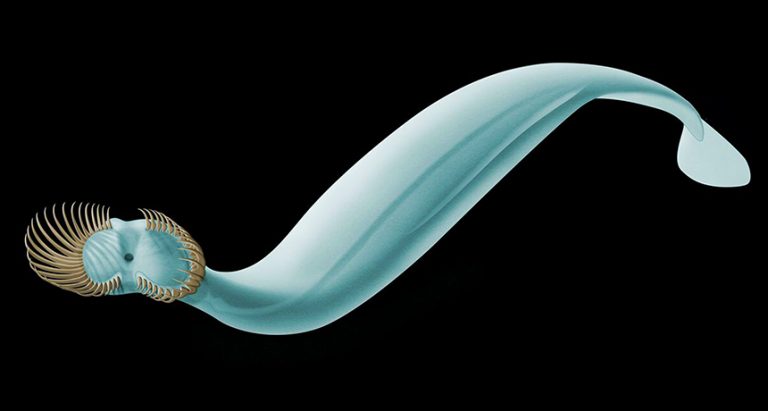
These arrow worms, which make up the phylum Chaetognatha, snatch prey with Wolverine-like claws protruding from around their mouths. Researchers now report that a newly identified species of ancient arrow worm was especially heavily armed. Dubbed Capinatator praetermissus, the predator had about 50 curved head spines, more than twice as many as most of its modern relatives. Arranged in two crescents, the spines could snap shut like a Venus flytrap to catch small invertebrates.

More than 100 species of chaetognaths are alive today, but evidence of their ancient relatives is spotty. C. praetermissus lived a little more than 500 million years ago during the Cambrian Period and was identified from 49 specimens found in the fossil-rich Burgess Shale in British Columbia, the scientists report in the Aug. 21 Current Biology. Often, only arrow worms’ clawlike spines appear in the fossil record, without soft tissue. But many of the new finds had such tissue preserved, which provided clues to body size and shape.

C. praetermissus was different enough from other chaetognaths to be labeled not only a new species, but also a new genus. The animal was at the larger end of the scale for arrow worms: about 10 centimeters from spines to tail. And while today’s arrow worms have teeth to mash up their meal after capturing it, this ancient species appears to have been toothless.

But arrow worm teeth, which are found closer to the mouth, are quite similar to spines, says study coauthor Derek Briggs, a paleontologist at Yale University. Shorter spines seen on some ancient specimens could have functioned somewhat like teeth and might have been an early evolutionary step toward tooth development, Briggs proposes.

Source: www.sciencenews.org

Dino-Killing Chicxulub Asteroid Inhibited Photosynthesis, Cooled Earth for Up To Four Years

Saturday, October 14, 2017

Dino-Killing Chicxulub Asteroid Inhibited Photosynthesis, Cooled Earth for Up To Four Years

A team of researchers from the National Center for Atmospheric Research, the University of Colorado Boulder and NASA has used a world-class computer model to paint a rich picture of how Earth’s conditions might have looked during the K-Pg extinction.

Paleontologists estimate that more than three-quarters of all species on Earth, including all non-avian dinosaurs, disappeared about 65 million years ago, at the Cretaceous-Paleogene boundary, an event known as the K-Pg extinction.

Evidence shows that the mass extinction occurred at the same time that a 10-km-diameter asteroid, dubbed Chicxulub, hit our planet in what is now the Yucatán Peninsula. The collision would have triggered earthquakes, tsunamis, and even volcanic eruptions.

Researchers also calculate that the force of the impact would have launched vaporized rock high above Earth’s surface, where it would have condensed into small particles known as spherules.

As the spherules fell back to Earth, they would have been heated by friction to temperatures high enough to spark global fires and broil Earth’s surface. A thin layer of spherules can be found worldwide in the geologic record.

“The extinction of many of the large animals on land could have been caused by the immediate aftermath of the impact, but animals that lived in the oceans or those that could burrow underground or slip underwater temporarily could have survived,” said lead author Dr. Charles Bardeen, of the National Center for Atmospheric Research (NCAR).

“Our study picks up the story after the initial effects — after the earthquakes and the tsunamis and the broiling. We wanted to look at the long-term consequences of the amount of soot we think was created and what those consequences might have meant for the animals that were left.”

Dr. Bardeen and co-authors used the NCAR-based Community Earth System Model (CESM) to simulate the effect of the soot on global climate going forward.

The team used the most recent estimates of the amount of fine soot found in the layer of rock left after the Chicxulub impact (15,000 million tons), as well as larger and smaller amounts, to quantify the climate’s sensitivity to more or less extensive fires.

In the simulations, soot heated by the Sun was lofted higher and higher into the atmosphere, eventually forming a global barrier that blocked the vast majority of sunlight from reaching Earth’s surface.

“At first it would have been about as dark as a moonlit night,” said co-author Owen ‘Brian’ Toon, a professor in the Department of Atmospheric and Oceanic Sciences and a research associate in the Laboratory for Atmospheric and Space Physics at the University of Colorado at Boulder.

While the skies would have gradually brightened, photosynthesis would have been impossible for up to two years, according to the simulations.

Because many of the plants on land would have already been incinerated in the fires, the darkness would likely have had its greatest impact on phytoplankton, which underpin the ocean food chain.

The loss of these tiny organisms would have had a ripple effect through the ocean, eventually devastating many species of marine life.

The researchers also found that photosynthesis would have been temporarily blocked even at much lower levels of soot.

For example, in a simulation using only 5,000 million tons of soot — about a third of the best estimate from measurements — photosynthesis would still have been impossible for an entire year.

In the simulations, the loss of sunlight caused a steep decline in average temperatures at Earth’s surface, with a drop of 50 degrees Fahrenheit (28 degrees Celsius) over land and 20 degrees Fahrenheit (11 degrees Celsius) over the oceans. These freezing temperatures persisted at middle latitudes for 3-4 years.

While Earth’s surface cooled in the study scenarios, the atmosphere higher up in the stratosphere actually became much warmer as the soot absorbed light from the Sun.

The warmer temperatures caused ozone destruction and allowed for large quantities of water vapor to be stored in the upper atmosphere. The water vapor then chemically reacted in the stratosphere to produce hydrogen compounds that led to further ozone destruction. The resulting ozone loss would have allowed damaging doses of UV light to reach Earth’s surface after the soot cleared.

“The large reservoir of water in the upper atmosphere formed in the simulations also caused the layer of sunlight-blocking soot to be removed abruptly after lingering for years,” the authors said.

“As the soot began to settle out of the stratosphere, the air began to cool. This cooling, in turn, caused water vapor to condense into ice particles, which washed even more soot out of the atmosphere.”

“As a result of this feedback loop — cooling causing precipitation that caused more cooling — the thinning soot layer disappeared in just a few months.”

The research appears this week in the Proceedings of the National Academy of Sciences.

_____

Charles G. Bardeen et al. On transient climate change at the Cretaceous−Paleogene boundary due to atmospheric soot injections. PNAS, published online August 21, 2017; doi: 10.1073/pnas.1708980114

Source: www.sci-news.com

How Paleontology Can Inform us About the Necessity of Conservation

Saturday, October 14, 2017

Dinosaurs are more than just scary monsters featured in Hollywood blockbuster movies; they are one of the best subjects to educate the general public about natural history. 

Dinosaurs ruled the Earth for nearly 165 million years (from 230 million years ago until 66 million years ago). If we include birds, dinosaurs would be considered to rule the Earth to this day. They represent one of life’s greatest success stories, having lived through and survived the consequences of countless environmental and climatic changes, including massive volcanic eruptions, the breakup of continents as well as the collision of land masses to form huge mountain belts. Consequently, the study of dinosaurs and the myriad animals and plants that lived alongside them, can inform us about how ecosystems respond to periods of change.

Dinosaurs provide us with context and perspective when attempting to understand the possible ecological consequences of human-made and natural changes that our world is facing today. Through paleontology, it’s possible to educate the public about the necessity of conservation.

Fossil records tell us that animal and plant species don’t last forever; eventually they will go extinct (more than 99 per cent of all life forms that have ever lived on Earth are now extinct). While most extinctions occur gradually and regionally as species evolve into or are replaced by new ones (known as “background extinctions”), there are 18 time intervals over the course of the past 600 million years when species went extinct rapidly and globally. These are called mass extinctions, and are responsible for the disappearance of vast numbers (sometimes more than 80%) of life forms that were present on Earth at the time.

Although the exact mechanisms responsible for the disappearance of large numbers of species are often the subject of scientific debate, mass extinctions appear to occur with episodes of major environmental upheaval.

Mass extinctions are often followed by extended periods, some lasting millions of years, of low biodiversity and highly unstable ecosystems. As such, these extinction events are most informative about the sensitivity and response of various species to environmental change and the amount of time required for ecosystems to recover once destabilized. For example, we learned that species characterized by limited geographic distribution, narrow habitat preferences and slow reproductive rates are more susceptible to becoming extinct.

We also learned that during periods of rapid global warming, such as during the Paleocene-Eocene transition 55 million years ago, surviving mammal species shrank dramatically in size compared to their ancestors. And in instances of food web collapses, such as what happened at the end of the Age of Dinosaurs 66 million years ago, cold-blooded animals with a small body size (weighing less than 20 kilograms) that have a scavenging diet and live in close association with water bodies are more likely to survive than large, warm-blooded animals with a specialized diet (such as herbivores and carnivores).

Following the extinction of dinosaurs, while it took only around 5,000 years for forests to recover from the devastation caused by the meteorite impact, it took nearly 1 million years for mammals to recover and nearly 4 million years for marine ecosystems to return to normal.

Knowing how ancient ecosystems responded to past environmental crises and what species suffered extinction can guide us in our efforts to develop effective conservation policies and to determine what habitats should be protected to conserve long-term biodiversity in light of modern environmental disturbances.

While paleontology can assist with conservation, the reverse is equally true. Numerous fossil zones occur in highly scenic landscapes, such as those in the Alberta badlands. With expanding urban development and industrialization, many fossil areas are at risk of being destroyed or greatly reduced in size. This is where the role of conservation can be expanded to protect the paleontological resources preserved in the ground in these areas.

The protection and conservation of paleontological resources shouldn’t mean that fossils and the outcrops that encased them should be left undisturbed for the force of erosion to take its natural course, resulting in the loss of valuable knowledge about past organisms and ecosystems. Rather, conservation would allow for the excavation of fossils to be conducted in a responsible and respectful fashion that minimizes adverse effects on the local ecosystem. With such a balanced approach, paleontology and conservation can mutually benefit each other.

Source: www.natureconservancy.ca

Elephant Evolution

Thursday, October 12, 2017

Elephant Evolution

The order under which Elephants are classified is the Proboscidea. This is for one of the elephant’s most interesting physical features. It is something that attracts curiosity from around the world for elephants along with many other aspects in the past only ascribed to the human, such as, rudimentary tool use, complex social behaviors, and reverence for a dead family member or friend. It is their trunk or proboscis; the meaning of Proboscidea species is simply animals with trunks/proboscis.

Henry F. Osborn identified some 352 proboscidean species and subspecies of which only half are recognized and valid today. About 50-60 million years ago, the ancestors of the modern elephant occupied a variety of extreme environments; this includes from tropical rain forests to deserts in both low and high altitudes. Incredibly, with the exception of Australia and Antarctica, the proboscideans have over time inhabited every single continent on Earth. Why did all but two become extinct? One possible explanation for their disappearance may be found in the inability of the order to evolve to environmental change fast enough. One of the determining factors in this is the more specialized a particular genus of animals, then the more likely they they will become extinct in periods of dramatic climate and environmental change. Both of the surviving African and Asian elephants have a wide range of attributes which give them the ability to survive and to even thrive in mild to extreme environmental conditions. Obviously, this is probably not the only reason for the disappearance of  most of the order, but serves as a good generalization for a reason why the multiple families of the order disappeared over time.

Another surprise to many is to find that elephants have some relationship to manatees which are commonly referred to a sea cows. It is believed that early on many species of elephants had two sets of tusks – one in the upper jaw and one in the lower jaw. What is very sad is that many experts believe at one time there were more than 350 species of elephants in the world. Now there are almost none at all left.

Early elephants were very different in their size and their appearance back then compared to what we see of them today. During the Ice Age the elephants likely had very thick hair like the mammoth. However, as the temperatures got warmer they didn’t have a need for it. This is why they got thicker skin and very little hair on it at all. This allowed the to live in regions where the temperatures were extremely hot. They have to be able to reduce their body temperatures and to regulate them. This can also account for the larger size of the ears; they use them as fans to cool down.

The length of the trunk as well as the ability to use it for so many different things is also something that happened for elephants through evolution. Their needs to be able to grasp things are one of the main reasons why this likely. While early elephants did have trunks they weren’t as versatile as what these animals have today.

It is believed that the ability adapt to a variety of different environments allowed elephants to evolve about 50 to 60 million years ago. Some of them lived in the rainforests while others resided in the desert. They are still considered to be on of the most adaptable animals in the world. However, with humans taking these areas away from them at an alarming rate there is a limit to what they are able to do and where they are able to survive today.

What has been noted by experts it that this evolution process takes place very slowly. This is why so many other species of elephants weren’t able to survive those necessary changes and they are no longer with us today. With that in mind humans have to understand that we can’t simple continue to do what we want to and expect that elephants are going to be able to change fast enough to adapt to all of it.

As you can see the evolution for elephants is one that is quite amazing. Even though we know quite a bit about these animals and their past, many questions still have to be answered. They have continually fought though for survival and due to the evolution process they have been quite successful for millions of years.

References

Michael Garstang. Elephant Sense and Sensibility. Academic Press, 2015.

Raman Sukumar. The Living Elephants: Evolutionary Ecology, Behaviour, and Conservation. Oxford University Press, 2003.

http://www.ucmp.berkeley.edu/mammal/mesaxonia/elephantidae.php

http://www.birds.cornell.edu/brp/elephant/cyclotis/evolution.html

A Brief History of Whale Evolution

Thursday, October 12, 2017

The evolutionary history of cetaceans is thought to have occurred in the Indian subcontinent from even-toed ungulates 50 million years ago, over a period of at least 15 million years. Cetaceans are fully aquatic marine mammals belonging to the order Artiodactyla, and branched off from other artiodactyls around 50 mya (million years ago). Cetaceans are thought to have evolved during the Eocene or earlier, sharing a closest common ancestor with hippopotamuses. Being mammals, they surface to breathe air; they have 5 finger bones (even-toed) in their fins; they nurse their young; and, despite their fully aquatic life style, they retained many skeletal features from their terrestrial ancestors. Discoveries starting in the late 1970s in Pakistan revealed several stages in the transition of cetaceans from land to sea.

Whalevolution: A Brief History of Whale Evolution

Article from 9gag.com

The Best Peculiar & Unpronounceable Prehistoric Animal Names

Thursday, October 12, 2017

When it comes to naming ancient species, some palaeontologists have a little more fun than others.

Every species – alive or extinct – receives a two-part scientific name, made up of its genus and species. From Homo sapiens to Tyrannosaurus rex, each of those monikers has a meaning and a story, and while most names are pretty straightforward, sometimes palaeontologists get a bit more creative.

So, in a nod to National Fossil Day in the US, here’s a list of some of the greatest prehistoric naming hits from across the fossil record.

The devil frog: Beelzebufo

An artist’s depiction of Beelzebufo ampinga munching on a small theropod dinosaur. Image: Nobu Tamura/Wikimedia Commons

In the land of Madagascar, 70 million years ago, near the end of the “Age of Dinosaurs”, there lived one hell of a frog.

Weighing a hefty five kilograms (10lbs) or more, this ancient amphibian might be the largest frog of all time: it boasted an armoured skull with jaws 15cm (6in) wide, capable of delivering a bite wicked enough to put small dinosaurs on the menu.

Faced with the task of naming this demon-frog in 2008, Susan Evans and colleagues came up with Beelzebufo, combining “Bufo” from the Latin for “toad” and Beelzebub, a most devilish namesake.

Fun fact: the frog’s full name is Beelzebufo ampinga. The species epithet, ampinga, comes from the Malagasy word for “shield”, referring to the frog’s bony-armoured head.

The once-mighty mastodon

Mammoth chompers. Image: James St. John/Flickr

Mastodon means “boob tooth” – no kidding.

The easiest way to tell a mastodon from a mammoth is to look at the teeth: mammoth chompers are flat and grooved, while mastodon teeth are bumpy and look … well, like breasts. At least that’s what the father of palaeontology, Georges Cuvier, thought! (The first half of the name “mastodon” comes from the same Greek root as the word “mastectomy”.)

The meaning of mastodon has changed over the years. When Cuvier came up with the name in 1817, he intended Mastodon to be the genus for one specific extinct proboscidean (a member of the mammal group that includes elephants and their extinct relatives), but that ancient animal turned out to be no different from a genus that had already been named Mammut. By the rules of taxonomy (scientific naming), the original name stuck, and “Mastodon” was dropped, but the word became so popular that we now use it to refer to a whole section of the elephant family tree, including Mammut and its relatives: the mastodons.

Fun fact: An alternative name given to Mammut, and later dropped for the same reason, was Leviathan!

Han solo, the trilobite

Artist’s recreation of Han solo (left), and the fossil of a related trilobite (right). Images: Apokryltaros, Parent Géry/Wikimedia Commons

Trilobites, the ubiquitous bugs of the Paleozoic Era (a long time ago), are some of the most famous fossils on the planet, but few have such famous names.

In 2007, Samuel Turvey described a collection of trilobites from China, including a few new species. For one of them, he invented the genus Han, named – as he explained – after the Han Chinese of the region. And since this was the very last known trilobite of its kind (a group called diplagnostids), he gave it a lonesome species name: solo.

(And that’s how a scientist cleverly justifies naming a 514-million-year-old arthropod after the legendary captain of thMillennium Falcon.)

Fun fact: Another new trilobite species Turvey named in the same paper was Geragnostus waldorfstatleri, a nod to the famous hecklers from The Muppet Show.

Owen’s ninja turtle

Ninjemys oweni (the crusty one on the right). Image: Wikimedia Commons

During the last Ice Age (the Pleistocene Epoch), Australia was home to some gnarly reptiles, including a species of turtle with horns on its head, a club on its tail and a body weight upwards of 200 kilograms (440lbs). An animal like that requires a bodacious name, so Eugene Gaffney named it Ninjemys, the “ninja turtle”.

Unlike Turvey’s Han solo, Gaffney made no effort to reason around his nerdery. He explained right there in the scientific paper that the name is “in allusion to that totally rad, fearsome foursome epitomising shelled success”.

The turtle’s full name is Ninjemys oweni, in honour for palaeontologist Richard Owen (this species was originally Meiolania oweni, but Gaffney re-assigned the genus).

Fun fact: Pop-culture references abound in paleontological naming! Just this year, we’ve seen a dinosaur named after a Ghostbusters villain and a mammal-relative with a moniker suspiciously similar to a Pokémon.

Hallucigenia

Image: Scorpion451/Wikimedia Commons Imagine encountering a fossil creature so bizarre you don’t know which end is up.

In 1977, Simon Conway Morris struggled to describe a positively phantasmagorical animal with 14 paired “stilts” and 14 paired “tentacles” running along its wormy body, and a strange bulb-like structure at one end. Its remains are found in the Burgess Shale, a Canadian fossil site that hosts some of the earliest and strangest animal life in the fossil record, from over 500 million years ago.

The creature defied the palaeontologist’s attempts to explain its body features, or to identify it among known animals (indeed, many of his initial guesses turned out to be incorrect), and he gave it a fittingly fantastic name: Hallucigenia, referring to “the bizarre and dream-like appearance of the animal”.

Fun fact: Another enigmatic fossil creature that received a suitably fanciful name is the 309-million-year-old Illinois creature Tullimonstrum, the “Tully Monster”.

Kimmeridgebrachypteraeschnidium

Try saying that name three times fast. Or even one time slowly.

Kimmeridgebrachypteraeschnidium etchesi is an extinct dragonfly from the Jurassic Period, around 150 million years ago, named in 2003. It makes the list simply because, as far as I can tell, it has the world’s longest genus name! And if it isn’t the longest, it’s gotta be close!

Crammed into the 31 letters of its genus are references to the location where it was found – Kimmeridge Bay, in the UK – its short wings, and the group of dragonflies it belongs to: the Aeschnidiidae.

Fun fact: Fossil genus names can also be ridiculously short, such as the dinosaurs Yi and Zby.

Baby dragon

An artist’s reconstruction of a fully grown Beibeilong, incubating its giant eggs. Image: Zhao Chunag

More than two decades ago, a 90-million-year-old dinosaur embryo was discovered among a nest of giant eggs in China. This tiny fossil eventually earned the affectionate name “Baby Louie”, and when researchers finally got to assign it a scientific name earlier this year, they opted for the adorable moniker Beibeilongfrom Chinese words meaning “baby dragon”.

Funnily enough, the palaeontologists estimated that an adult Beibeilong would have been a feathery giant around eight metres (30 feet) long and weighing over two tons, so if an adult is ever discovered, you may someday walk into a museum to see a bus-sized skeleton labelled “baby dragon”!

Fun fact: Beibeilong isn’t the only dinosaur that received a cutesy name based on the fossil’s informal nickname. There’s a similar story behind the little predator Bambiraptor.

The “bird mimics”

Aepyornithomimus, one of the ostrich-like “bird mimic” dinosaurs. Image: Masato Hattori/Wikimedia Commons

Some fossil names are trendsetters! In 1890, palaeontologist Othniel Charles Marsh named a long-legged, fast-running bipedal dinosaur Ornithomimus, the “bird mimic”, because it strongly resembled modern-day flightless birds. Years later, another closely related dinosaur was named Struthiomimusthe “ostrich mimic”.

Since then, this group of dinosaurs (the ornithomimosaurs) has welcomed many more additions, including: Dromiceiomimus, the “emu mimic”; Gallimimus, the “chicken mimic”; Garudimimus, the “Garuda (a bird of Hindu legend) mimic”; Harpymimus, the “harpy mimic”; Anserimimus, the “goose mimic”; Pelecanimimus, the “pelican mimic”; and Tototlmimus, another “bird mimic”.

Not all of those names are still in use, but more continue to be added to the list, such as Aepyornithomimus, a “mimic” of the extinct Madagascar elephant bird (Aepyornis)named just this year.

Fun fact: There are other “mimics” on other parts of the dinosaur family tree! For example, there’s the big predator Suchomimus (“crocodile mimic”) and the fluffy-tailed Sciurimimus (“squirrel mimic”).

Nqwebasaurus

Press the centre of your tongue against the high roof of your mouth and make a “click” noise. That is a post-alveolar click, the sound at the beginning of this dinosaur’s name: “n-*click*-webasaurus”.

Nqwebasaurus was a small, early relative of the “ostrich-mimics” that lived 140 million years ago in South Africa. It is named after the region where it was discovered, which is called Nqweba in the local language, Xhosa.

The Latinised pronunciation of this animal’s name would be “n-KWE-ba” – this is actually how the authors of the original paper spelled it out – but if you want to pay homage to the original language, and impress your friends, then practice that post-alveolar click!

Fun fact: Weaving local languages into dinosaur names can produce lots of memorable results, such as the Argentinian sauropod Futalognksosaurus and the Arctic tyrannosaur Nanuqsaurus.

The conquered lorikeet

Image: FunkMonk/Wikimedia Commons

Take a trip around the tropical islands of the Pacific, and you might encounter the ostentatiously coloured lorikeets of the genus Vini. There are several species alive today, but when palaeontologists David Steadman and Marie Zarriello explored the fossils of the Marquesas Islands, they discovered that when humans arrived in the birds’ home, not all Vini species survived the encounter.

In naming those extinct species, Steadman and Zarriello came up with one of the cleverest puns in all of fossil nomenclature: Vini vidivici, inspired by Caesar’s famous declaration, “Veni, vidi, vici”.

The scientists explain the name in their paper: “The meaning, ‘I came, I saw, I conquered’, may be projected into the prehistoric situation in the Marquesas and elsewhere in Polynesia, where people came to an island, saw the native parrots, and then conquered them, leaving behind only the bones.”

Fun fact: This list would be incomplete without mentioning that, in 1763, before the word “dinosaur” was even invented, physician Robert Brookes assigned a binomial name to the bulbous end of a dinosaur femur. Some have called this the first scientific name ever assigned to a dinosaur, but for various reasons it did not stick – which might be for the best, because he called it Scrotum humanum.

Source: www.earthtouchnews.com

How Hollywood’s Decades-Later Sequels Stack Up

Thursday, October 12, 2017

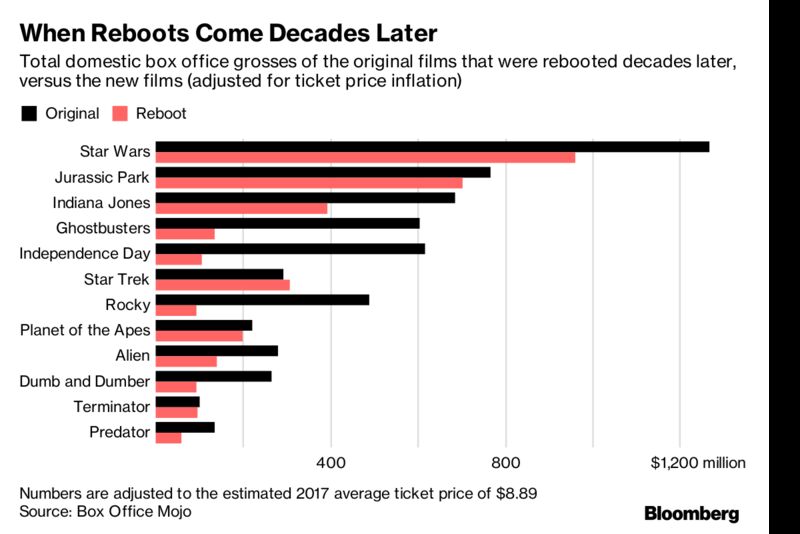
Harrison Ford appears destined to reappear as much-aged versions of the characters that made him a star: Han Solo, Indiana Jones, and now Blade Runner’s Rick Deckard. These decades-later followups rarely match the box office power of the original when inflation is taken into account.

That pattern was evident with both Star Wars (38 years between A New Hope and The Force Awakens) and Indiana Jones (27 years between Raiders of the Lost Ark andKingdom of the Crystal Skull). Now Blade Runner 2049, with its 35-year gap between Blade Runner and the newly released sequel, hopes to avoid that fate. It’s off to a slow start, taking in a disappointing $31.5 million in its opening weekend in North America, according to an estimate by ComScore.

Movie studios have made the reboot tactic commonplace: Take an old franchise steeped in fan nostalgia, revive it with an ample budget for stars and modern special effects, and hope to score big. Blade Runner 2049 cost $150 million to produce, not including marketing costs, and the opening box office take fell short of expectations, despite glowing reviews from critics. It still might be the rare example of later-date followup that outperforms the original at the inflation-adjusted box office, in larger part because 1982’s Blade Runner wasn’t a huge success and gained a hardcore following only after its initial run.

These followup films are often sold as soft reboots. Rather than resetting the series entirely, they maintain the storyline continuity from previous films, either as a prequel or sequel often set many years away from the original. The category includes revamps of such cult films as Blade Runner and Evil Dead as well as extensions of commercial powerhouses such as Star Wars and Rocky. Few of these films following decades after the original title totally bomb at the box office, helped by preexisting fan bases loyal to the franchise.

But a look at inflation-adjusted ticket sales data, which includes sales from multiple releases, casts doubt on the ability of these soft reboots to pull in more viewers than the initial title. Most come up short at the domestic box office compared with their hugely successful predecessors.

It’s not that these next-generation films aren’t commercially successful—they’re just going up against some of the biggest hits of all time. In unadjusted sales, in fact, many will come out on top of the originals, thanks to wider distribution.

Jurassic World, the sequel to Jurassic Park released 22 years later, was the No. 2 movie at the box office worldwide in 2015. The Force Awakens topped global charts at more than $2 billion in global sales. The new Planet of the Apes trilogy has fared well, too, nearly a half century after Charlton Heston first crashed on a world full of aggressive gorillas.

Mad Max: Fury Road may be the most critically acclaimed of all these new tales. George Miller’s new narrative in the barren dystopia of 1979’s Mad Max was rewarded with six Academy Awards and hauled in $378.4 million at the global box office. It far outpaced the original, too, since the first film never enjoyed blockbuster status.

Many of these new films, such as 2015’s Terminator: Genisys, took advantage of an international market that wasn’t available when the original came out. The first Terminator, which came out in 1984, made about 51 percent of its box office haul overseas. Its wildly popular sequel, Terminator 2: Judgement Day, made about 60 percent of ticket sales overseas. By the time Genisys appeared, markets outside the U.S. accounted for about 80 percent of its global gross.

Then there are the failures. The much-hyped new Ghostbusters, released in 2016, didn’t gain much traction and was severely outperformed by the the 1984 film despite showing in thousands of additional theaters. A 2017 full reboot of The Mummy, a franchise that has been reset numerous times since the 1930s, flopped at the box office despite casting Tom Cruise in the lead.

There are plenty more reboots to look forward to (or dread). Dwayne Johnson is set to star in a remake of the 1986 cult classic Big Trouble in Little China. A new Cliffhanger film is in the works, although there’s no word yet if Sylvester Stallone will rejoin the mountain climbing franchise as he did in Rocky Balboa and Creed. Sci-fi saga The Matrix is reportedly coming back for more slow-motion action sequences as well.

Oh, and Harrison Ford still has a few roles from the 1980s he could renew.

Source: bloomberg.com

Jurassic World: Fallen Kingdom T-Rex & Owen Banner Revealed at Licensing Expo 2017

Thursday, October 12, 2017

A never-before-seen banner for Universal Pictures’ Jurassic World: Fallen Kingdom has been unveiled at a licensing expo in London this week. With 2018 shaping up to be a year when multiple blockbuster tentpoles and franchise sequels are set to be hitting the big screen, Universal’s planned sequel to Jurassic World is shaping up to be the most anticipated. That’s not only because it’s going to be the follow-up installment to one of the most profitable films of all time, but also because of how much of a change in creative direction Jurassic World: Fallen Kingdom appears to be when compared to its Colin Trevorrow-directed predecessor.

With A Monster Calls director JA Bayona taking over, the film will feature a whole new cast of supporting characters, in addition to the returning Chris Pratt and Bryce Dallas Howard, who will be reprising their roles from Jurassic World. But following the film’s title announcement earlier this year, there has been little-to-no actual marketing, photos, or footage released from Fallen Kingdom up until this point, much to the chagrin of Jurassic Park fans everywhere.

While those fans will have to wait a little bit longer before they get to see a teaser trailer for the film, a small, but exciting new look at Jurassic World: Fallen Kingdom has arrived today. Spotted at the Brand Licensing Europe Expo in London this week by Mega Power Brasil, a new banner for the film has been unveiled by Universal Pictures, featuring Chris Pratt’s Owen alongside a T-Rex and Raptor. You can check out the banner for yourself down below:

Jurassic World Fallen Kingdom banner with Owen, Blue & Rexy

As expected, very little is actually known about the plot of Jurassic World: Fallen Kingdom at this point, including how it builds off of the events of all the previous Jurassic films or what its standalone story even is. Aside from some occasional set photos from Fallen Kingdom, not much has been teased regarding its story, although, Colin Trevorrow did compare the Jurassic World sequel to a Spanish horror film earlier this year. And the addition of Jeff Goldblum’s Ian Malcolm to its cast only further makes its connections to the previous films that much more interesting and mysterious.

Fortunately, it’s only a matter of time before fans can get their first real look at the film, with some recent rumors even indicating the first trailer for Jurassic World: Fallen Kingdom could be premiering sometime next month. Whether or not any of that comes to fruition will have to wait to be seen, however, this new look at the film could be a sign of some marketing movement being made behind-the-scenes. And if this banner is any indication, it looks like Jurassic World: Fallen Kingdom won’t just feature the return of some notable human players from the first Jurassic World, but some of its dinosaurs as well.

Pages