Blogs

Discovery of Lystrosaurus and a Scientific Revolution

Saturday, December 1, 2018

Lystrosaurus hedini skeleton at the Museum of Paleontology, Tübingen

Fifty years ago, as astronauts trained for the Apollo 11 moon mission, Earth-bound geologists at the Museum of Northern Arizona trained for an expedition that would rock the world of paleontology.

Geology was in the throes of a revolution — from fixed continents and fixed oceans to continents that split apart in slow motion, drifted, collided, fragmented, and realigned. As they drifted, these landmasses uplifted mountains, opened new oceans and destroyed older oceans, isolated animals and plants, then reunited in different continental configurations. This concept was so revolutionary many scientists refused to accept the mounting evidence for the theory of plate tectonics and continental drift. Many paleontologists were among the Resistance.

In December of 1967, New Zealand geologists mapping 240-million-year-old Triassic rocks in the desolate interior of Antarctica stumbled upon some fragmentary bones. A few months later they brought the fragments to paleontologist Edwin H. Colbert for identification. Colbert was in the process of retiring after 40 years as Curator of Paleontology at the American Museum of Natural History in New York City and relocating to the Museum of Northern Arizona in Flagstaff. He wasn’t ready for this surprise.

Colbert recognized the bones as an extinct labyrinthodont amphibian, so named for details in their characteristic teeth. Like modern frogs and salamanders, these distant relatives from the Permian and Triassic Periods could never have swum across the cold, salty water of the Antarctic Sea from other southern continents, nor survived the frozen landscape of Antarctica.

Colbert and other paleontologists had struggled with the new ideas of drifting continents, but he knew instantly this discovery would be a decisive, paleontological blow to the long-held theory of fixed continents. He and two New Zealand paleontologists published an article in Science the following year entitled “Triassic Amphibian from Antarctica.” The paper drew immediate attention, including from the Office of Polar Studies at the National Science Foundation.

At the retirement age of 63 years, Colbert hadn’t considered the possibility that he, himself, would be the one to return to Antarctica – that would be the work of younger, more physically fit geologists. Other paleontologists and officials in the National Science Foundation declared otherwise: if Colbert could pass the physical exams and fitness training, he would be their first choice to lead a return expedition. Simultaneously thrilled and reluctant, he agreed to this ultimate challenge. Astronauts must have felt the same way.

Colbert and his wife, Margaret, completed their move to Flagstaff in the summer of 1968, and then his supreme adventure began. The austral spring in Christchurch, New Zealand, was resplendent with flowers and fresh greenery, as he and his crew made ready for their flight to the all-white, frozen continent. He had invited MNA Curator of Geology Bill Breed, paleontologist James Jensen from Brigham Young University and geologist Jon Powell from the University of Arizona for his own field crew. An international team of 16 scientists and their assistants accompanied them.

Once they reached McMurdo Station, the U.S. headquarters located on Ross Island, they also had support of three Navy helicopters, five pilots, and more than a dozen mechanics and other personnel.

They pushed to the interior of the continent toward the Transantarctic Mountains, with some dramatic side stories, one involving the crash of a companion helicopter and death of two occupants from New Zealand.

Despite this terrifying crash and the ensuing rescue of others in the field party, Colbert’s team continued. First they discovered the fernlike plant, Dicroidium, widely known from Triassic sediments of other continents, stimulating considerable excitement again for the implications related to continental drift (Colbert simply wrote “Drift” in his notes). Soon thereafter, others in their field party explored the slopes of a remote exposure called Coalsack Bluff and found bone fragments.

Colbert’s team followed and discovered another animal, which became the centerpiece of this epic expedition. It was Lystrosaurus, a rather squat, dog-sized primitive reptile with very characteristic skull and jaws, furnished only with two tusk-like teeth and no other dentition. Lystrosaurus was strictly terrestrial, known from many sites in Triassic rocks in southern Africa, and in peninsular India. Relatives were known from other continents as well, including in North America a large oxen-sized form from the Chinle Formation of northern Arizona.

Coalsack Bluff, one of the most remote fossil sites ever encountered on our planet, had yielded a direct link to the supercontinent called Gondwana (also “Gondwanaland”). This was the southern supercontinent, containing Africa, peninsular India, Australia, South America and Antarctica before they split apart and separated.

Those land connections were the routes taken by populations of Lystrosaurus, the labyrinthodont amphibians, and the fernlike Dicroidium before Gondwana fragmented in the Triassic, soon to be separated by the deep, cold, southern ocean and rendered utterly impassable to land-bound animals and plants. This was remarkable evidence of continental drift, even to those paleontologists who resisted all previous discoveries.

The Resistance crumbled, and the world of geology became united in this revolution-in-slow-motion, not as spectacular as the moon, perhaps, but every bit as arresting for the utter joy of discovery.

Colbert and Breed returned to Flagstaff and the Museum of Northern Arizona, and other members went their respective ways, but the fundamental importance of their work continues today. Fifty years later, Flagstaff can celebrate two anniversaries during the year we recognize here as Lunar Legacy.

Source: https://azdailysun.com
China's Star Dinosaur Hunter Has Rapid Urbanisation To Thank For Record Haul

Sunday, December 2, 2018

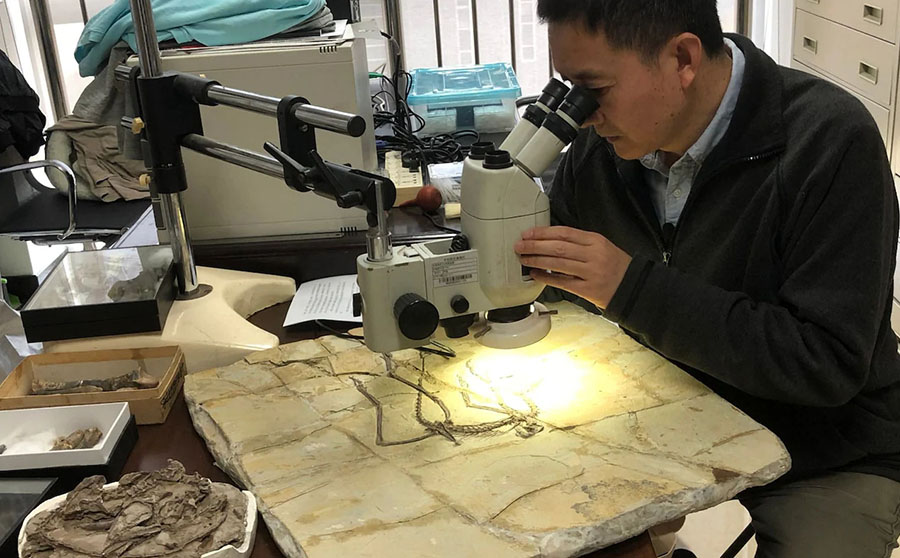
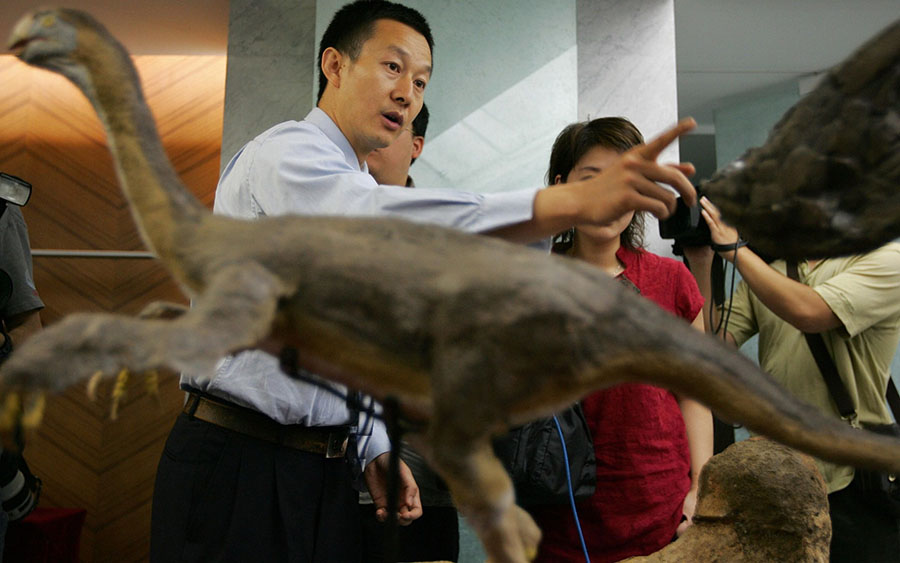
Dinosaur hunter Xing Xu (L) briefs the media on the fossilized bones of a gigantic theropod dinosaur, Gigantorraptor Erlianensis, on display for the media in Beijing CREDIT: AFP


Chinese paleontologist Xu Xing is on a roll. This year alone he has discovered seven new species of dinosaur, including one that is 200 million years old - the most ancient specimen he has unearthed so far.

In all, Mr Xu has named over 70 dinosaurs, more than any other living paleontologist. But his discoveries aren't just down to long hours at dusty archaeological digs. His success is owed to China's construction boom churning up soil and fossils as vast cities continue to rise from the ground.

While bulldozers have unearthed prehistoric sites in many countries, the scale and speed of China's urbanisation is unprecedented, according to the United Nations Development Program.

Mr Xu, 49, spends his time racing all over the country following leads from the building boom, earning him the moniker of 'China's Indiana Jones'.

"Basically we are reconstructing the evolutionary tree of life," he says. "If you have more species to study, you have more branches on that tree, more information about the history of life on Earth."

Chinese paleontologist Xu Xing has discovered seven new species of dinosaur this year alone CREDIT: SOPHIA YAN FOR THE TELEGRAPH

The population of Chinese cities has quintupled in 40 years, to nearly 900 million. By the year 2030, one in five of every city-dweller in the world will be Chinese.

Whole new cities are being planned to alleviate pressure in some of China's biggest metropolises, as urban sprawl continues to spread in major city clusters in Beijing-Tianjin-Hebei, and the Yangtze River Delta and Pearl River Delta regions.

This is all music to Mr Xu's ears, whose celebrity as a world-leading scientist continues to grow. One of his latest finds, from a construction site in Jiangxi province, will shed light on how modern birds' reproductive systems evolved from dinosaurs.

His work has attracted attention from schoolchildren in multiple countries who mail him handwritten notes and crayon drawings of dinosaurs, several of which hang in his Beijing office.

Mr Xu, 49, spends his time racing all over the country following leads from the building boom, earning him the moniker of 'China's Indiana Jones'. CREDIT: SOPHIA YAN FOR THE TELEGRAPH

Toru Sekiyu, a paleontologist from the Fukui Prefectural Dinosaur Museum in Japan who assisted on the Yanji dig, called his Chinese colleague "a superstar paleontologist".

Embracing new technology, his team also uses CT scanners to study the interior of fossils and builds 3-D computer simulations to make inferences about what range of motions a dinosaur may have had.

Mr Xu's previous discoveries have included the eight-metre long gigantoraptor, which would have towered over humans today, and the microraptor, a tiny, four-winged dinosaur weighing in at about a kilogram.

His most revolutionary work has been in excavating fossils of feathered dinosaurs, providing evidence to back the once-controversial theory that today’s birds evolved from the prehistoric creatures.

A dinosaur model stands near the site of a future dinosaur museum in Yanji, China CREDIT: AP

Experts had kicked the idea around for more than a century, but it remained a theory until 1996, when farmers stumbled upon the first feathered dinosaur in northeast China. The 125-million-year-old Sinosauropteryx, the Chinese lizard bird, had bristle-like structures running down its back and tail.

Mr Xu, 49, and his colleagues rushed to search for more feathered specimens, finding the beipiaosaurus by the city of Beipiao the following year.

Evidence of rainbow plumage on these ancient creatures was a departure from the typical Hollywood depiction of dinosaurs as cold-blooded and scary.

“It totally changed your idea about dinosaurs,” he told The Telegraph. “Dinosaurs are really colourful animals…they are so beautiful.”

New finds give Mr Xu the opportunity to be creative, he says, coming up species names inspired by Chinese culture, such as the Mei Long (“sleeping dragon”), the Dilong paradoxus (“emperor dragon”), and the Nanyangosaurus, named after a city close to its origins that is also the hometown of a famous military strategist in Chinese history.

When Xu discovered fossils in Yanji, an hour from the North Korea border, in 2016, city authorities halted construction on adjacent high-rise buildings, in accordance with a national law.

"The developer was really not happy with me," he said, but the local government has since embraced its newfound claim to fame.

The city is now facilitating Xu's work, and even built an on-site police station to guard the fossils from theft. Once the excavation is complete, a museum is planned, to display recovered fossils and photos of Xu's team at work.

Source: www.telegraph.co.uk

What's Behind The Scenes Of The Carnegie Museum Of Natural History?

Saturday, December 1, 2018

In the Carnegie Museum of Natural History's Big Bone Room, large bones including vertebrae of Diplodocus carnegii are available for scientists to study. KATIE BLACKLEY / 90.5 WESA

The Carnegie Museum of Natural History is expansive — a person could spend hours walking the different exhibitions. But what's on display is only a small portion of what's in the museum's possession.

Some of the off-display materials are viewable in the museum's Paleo Lab, through a thick wall of glass.

"The Paleo Lab is our fossil preparation laboratory that's actually on display," said Matt Lamanna, a dinosaur paleontologist at the museum. "So it's a literal window into scientific activities that happen here at the museum."

Dan Pickering, head of the museum's Paleo Lab, arranges the rib bones of a 12,000-year-old mastodon. The museum's specimens are ordered by number of acquisition. This one is 67. CREDIT KATIE BLACKLEY / 90.5 WESA

Those activities include matching vertebrae to joint pockets and cleaning up dust. On this day, the restoration is on a 12,000-year-old mastodon skeleton. The ancient elephant ancestor was purchased by museum benefactor Andrew Carnegie in 1898, but was taken off display a few years ago for restoration.

The museum's vertebrate paleontology specimens are ordered in the number of acquisition. The mastodon is number 67.

These are filled with fossils of dinosaurs, amphibians and other types of reptiles. Lamanna calls the Big Bone Room a library for fossils.

"Being on display for over 100 years, even people walking by, like the subtle vibrations, add up over the course of hundreds of thousands of visitors a year," Lamanna said. "So the fossil was starting to degrade."

The rest of the museum's off display collection is down a hidden hallway, behind some curiously labeled doors. Most of the paleontology specimens are kept in the Big Bone Room.

"This is where we keep roughly 90 percent of our dinosaur fossils," Lamanna said. "Along with fossils of fishes, amphibians, other types of reptiles and birds."

The room is enormous, and filled floor to ceiling with organized bones. Some are large, like pelvises that are several feet wide. The majority, however, are small -- the room has vials upon vials of teeth.

These specimens, many of them teeth, are labeled by order of acquisition. CREDIT KATIE BLACKLEY / 90.5 WESA

"There's even some mammal fossils in here, but the bulk are across the hall in the Little Bone Room," Lamanna said. The rooms get their names from their square footage, not the contents -- though Lamanna said the Big Bone Room actually does have some of the biggest bones.

The Carnegie Museum of Natural History keeps lots of  items in storage because they have a lot of duplicates, and some are too fragile for display. But many fossils are simply better used for research, and less visually interesting to the public. Scientists fly in from around the world to study pieces in the collections archives, which Lamanna describes as a kind of library system.

There's a lot for them to sift through, because the archives go beyond paleontology. The museum's invertebrate zoology collection — meaning insects and crustaceans — has about 11 million specimens. This is the largest of the museum's sections, and is thought to be one of the most comprehensive in the world.

The museum has nearly 1.5 million artifacts from Native American, pre-European cultures, including artwork and traditional garments. They also have hundreds of thousands of birds and botany specimens. Altogether, the museum says it has an estimated 22 million specimens and artifacts.

Lamanna digs through the archives and pulls out an important piece — an abdominal rib bone from the first Tyrannosaurus rex skeleton ever found. Its discovery was a big deal at the time, and because it's the first, every subsequent T. rex skeleton that's uncovered is compared to it.

Lamanna holds an abdominal rib bone of the first Tyrannosaurus rex skeleton discovered. The rest of the body is on display in the musuem. CREDIT KATHLEEN J. DAVIS / 90.5 WESA

That skeleton, unearthed in 1902, was sold to the museum in 1941. Most of the bones are on display.

"This particular one is down here because it actually came to us after we completed the renovated mount back in 2008," Lamanna said. 

Researchers at the American Museum of Natural History in New York realized this bone belonged to Pittsburgh and returned it. Replacing the bone on the rest of its body on display would be expensive, and Lamanna said it's more useful for researchers to have easy access to it. Paleontologists like to view a fossil from all sides, photograph it, measure it, and maybe examine it under a microscope.

That bone, once a part of the body of a T. rex that lived about 66 million years ago, now sits among countless other bones in a basement in Pittsburgh.

Source: www.wesa.fm

Lifelike Raptor Scares Mom At Theme Park

Sunday, December 2, 2018

FACEBOOK: LADBIBLE, REDDIT: MOGTAKU

We Can’t Stop Laughing At This Video Of A Mom Getting Scared By A Theme Park Dinosaur

A mom, encouraging her apprehensive daughter to pose for a photo in front of an animatronic dinosaur at a theme park, got the scare of a lifetime—and the video just gets better with every viewing. 

Recently re-posted on Facebook by LADbible, this hilarious video, which originally appeared about a year ago, is enjoying a resurgence.

In the video, Illinois mom Shelby Tuggle and her family are trying to pose for a photo in front of an animatronic raptor in the Jurassic Park section of Universal Studios Islands of Adventure in Orlando, Florida.

Both Shelby and her husband, Brycin, can be seen encouraging their young daughter to come into the camera’s frame and stand in front of the dinosaur for that perfect family picture. The little girl eventually makes her way over, but just after the photo is taken the raptor, which has been restlessly moving about the whole time, takes things up a notch.

One thing’s for sure—this raptor is certainly not Blue:

And there were those who just couldn’t wait to debate the authenticity of the look of the animatronic beast:

Source: https://guacamoley.com

Toothless, 33-Million-Year-Old Whale Could Be an Evolutionary ‘Missing Link’

Friday, November 30, 2018

Carlos Peredo with the fossilized Maiabalaena nesbittae skull(Credit: Ryan Lavery)

A closer examination of a fossil found more than four decades ago has led to the identification of a new species of whale—a 33-million-year-old cetacean featuring neither teeth nor baleen. Its discovery could solve a longstanding mystery about the origin of filter-feeding whales, but some scientists say the new analysis isn’t wholly convincing.

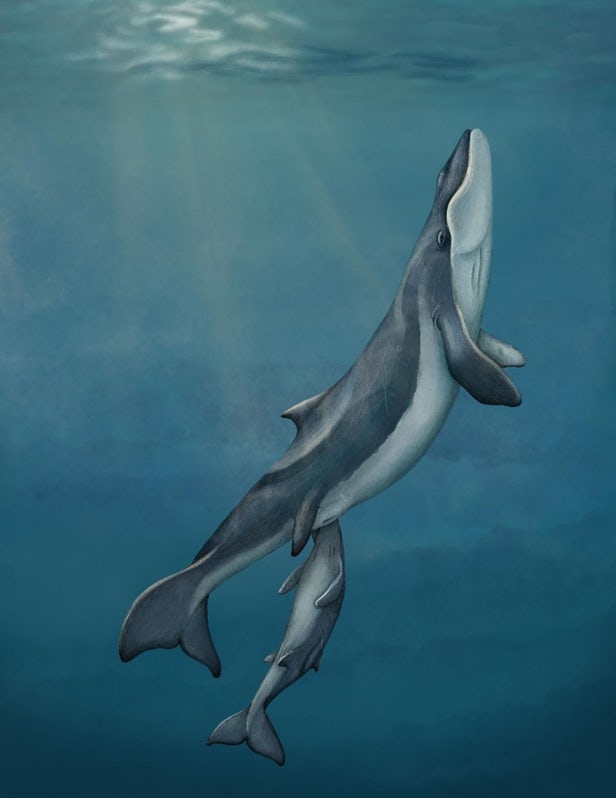
Introducing Maiabalaena nesbittae, an entirely new genus and species of ancient whale. Roughly the size of a modern beluga whale, this 15-foot-long cetacean didn’t have teeth or baleen (rows of hair-like plates that whales use to filter tiny prey from the water), relying instead on suction feeding. As such, Maiabalaena nesbittae, meaning “mother whale,” represents an intermediate stage between ancient toothed whales and modern filter-feeders, according to new research published in Current Biology.

Today, whales can be broadly lumped into two main groups: toothed whales, such as orcas and dolphins, and filter-feeding whales (or mysticeti), such as humpbacks, fin whales, blue whales, and minke whales. Baleen is the remarkable evolutionary invention that makes filter feeding possible, allowing large marine whales to consume several tons of food each day without ever having to chomp or chew.

Whales are the first and only mammals to evolve baleen, but the origin of this feeding strategy isn’t entirely clear. Whales are descended from terrestrial mammals, who retained their teeth after adapting an aquatic lifestyle. With their razor-sharp teeth, ancient whales continued to chew their food. But the environment changed, as did their prey, so these whales had to adopt new feeding strategies. Eventually, this resulted in the emergence of filter feeding whales. As to how whales went from having teeth to having baleen—a substance made of keratin, which is what hair and fingernails and made of—is the subject of much controversy.

Some scientists have speculated that ancient whales used their teeth for sifting water, and that this feeding strategy led directly to baleen. This theory took a direct hit last year by Monash University paleontologists who showed that the sharp teeth employed by ancient whales couldn’t have possibly been used as filters, concluding that ancient whales never passed through a tooth-based filtration phase, and that some kind of intermediary, yet-to-be-found species must have existed.

Artist’s impression of Maiabalaena nesbittae with calf. Illustration: Alex Boersma

Part of the problem is that keratin doesn’t preserve well in the fossil record. For paleontologists who study ancient whales, this mystery is akin to the study of flight in ancient animals, and the seemingly endless quest to discover the “missing link” between gliding birds and those capable of self-powered flight. In the case of whales, paleontologists have been searching for an intermediate species of whale positioned between toothed whales and filter-feeding whales. The discovery of the toothless, baleenless Maiabalaena nesbittae could very well be this missing link.

The partial skeleton of Maiabalaena nesbittae, which includes a nearly complete skull, was uncovered in Oregon back in the 1970s, and it has languished at the Smithsonian’s national collection ever since. To this point, a detailed analysis of the fossil wasn’t possible because it’s inundated with rock and other materials. The lead author of the new study, Carlos Mauricio Peredo of George Mason University and the National Museum of Natural History, took a look at this old fossil with new eyes using state-of-the-art CT scanning technology. By peering into the rock, the researchers were able to identify the tell-tale signs of a toothless and baleenless whale—including a thin and narrow upper jaw that had no proper surface from which to suspend baleen.

“A living baleen whale has a big, broad roof in its mouth, and it’s also thickened to create attachment sites for the baleen,” said Peredo in a statement. “Maiabalaena does not. We can pretty conclusively tell you this fossil species didn’t have teeth, and it is more likely than not that it didn’t have baleen either.”

Other evidence points to this animal as a filter feeder. Muscle attachments on the bones of its throat imply the presence of strong cheeks and a retractable tongue—characteristics that would have allowed this whale to suck water into its mouth, sopping up fish and small squid in the process. Equipped with this ability, these whales no longer needed their chompers, so their teeth gradually faded away. The eventual loss of teeth and the origin of baleen, the researchers, argue, where therefore separate evolutionary events.

As to why toothed whales abandoned biting and chewing in favor of sucking, the researchers say it was a transition forced upon them by a changing environment. Maiabalaena lived during the transitional period that divided the Eocene from the Oligocene, which happened some 33 million years ago. This was a critical time for whales, as the continents shifted and separated, and as ocean currents from the Antarctic cooled the oceans. As the planet’s geology changed, so too did the ocean environment—and its animals. The prey of toothed whales changed or disappeared, forcing them to find new prey, which resulted in the transition from toothed to suction feeding, the researchers speculate. Eventually, some 5 million to 7 million years later, around 26 million to 28 million years ago, the toothless whales began to sprout baleen, facilitating yet another transition, this time from suction feeding to filter feeding.

Illustration of the proposed feeding transitions in ancient whales. Graphic: C. M. Peredo et al., 2018 (Current Biology)

“In general, I think this is a good study, and I agree with its general conclusions,” Felix G. Marx, a paleontologist at Monash University not affiliated with this new research, told Gizmodo. “Crucially, though, Maiabalaena seems to be right in the middle of this transition, with no teeth, and possibly no baleen.”

Possibly no baleen.

That’s the the key phrase, here. As noted, baleen, which is made from soft tissue, doesn’t fossilize very well. Typically, scientists can detect the presence of baleen in a fossil by looking for traces of corresponding blood vessels on their bones. And in fact, traces of blood vessels were detected in the Maiabalaena fossil. The question, however, is whether these blood vessels always correlate with baleen.

“The new study says no, and argues that similar structures also existed in ancient toothed whales that clearly did not filter feed,” said Marx. “I agree, but this is still an interpretation, and I suspect not everyone will buy into it. Luckily, there are more things we can do to tackle this question, for example by examining how baleen actually develops in the womb.”

Monash University paleontologist Alistair Evans, a co-author of the aforementioned 2017 study, agrees with Marx’s assessment, saying the absence of teeth in this species is fairly evident, but the absence of baleen, not so much.

“Because baleen is so rarely fossilized, its presence can rarely be seen directly,” Evans told Gizmodo. “As has been suggested before—and [as this new paper] gives more evidence—there are no silver bullets in the bones that can tell us for sure that baleen was present. So unfortunately there is no strong evidence of baleen being absent, but we also may never find such evidence.”

Evans says the conclusions made in the new study are “fairly reasonable,” but he would like to see other specimens of this species and related ones that are better preserved in the region where baleen would be if present.

“I was happy that they found a fossil that we predicted would occur, but the evidence is not a slam dunk that it really did fit in this slot,” added Evans.

So is Maiabalaena nesbittae the missing link we’ve been looking for? Quite possibly yes—but we won’t know for sure until more fossils are recovered.

[Current Biology]

Source: https://gizmodo.com

Paleontologist: Dalton Wells Dinosaur Sites Threatened by Visitors, Vandals

Saturday, December 1, 2018

Moab Dinosaur Park-Museum

Utah is home to the most dinosaur fossils on the planet – and Grand is home to more fossils than any other county in the state. 

So said Dr. Jim Kirkland during a teleconference regarding Utah Sovereign Lands’ proposal for the future management of the Dalton Wells dinosaur site north of Moab near Arches National Park.

A land exchange is going through the appraisal process that will open up the site to official and monitored recreation – with official campgrounds rather than the dispersed camping currently occurring. But which entity will manage the 1,200 or so acres remains unresolved.

Whether that ultimately turns out to be Grand County or some other political subdivision is a decision that will be made later, but one fact is uncontested by anyone from the county, state or federal government: Vandalism at Dalton Wells is ongoing and threatens to do real harm to what Kirkland, the state paleontologist, considers a key part of “the most complete record of the history of life in the world.”

“We’re where it all began,” said Kirkland in a Tuesday, Nov. 27 interview. “This is an incredible resource.”

Kirkland, who just completed his 20th year with the state, said there are more than 100 different dinosaurs represented in the fossils of Utah. He named the Utahraptor in 1989, a discovery that validated the giant raptors that appeared in “Jurassic Park.” Gov. Gary Herbert earlier this year proclaimed it the state dinosaur.

While Kirkland advocates for the creation of Utahraptor State Park for the site, it was pointed out at Monday’s teleconference that some type of control has to be exercised lest vandals and others with less-than-responsible habits destroy Dalton Wells.

It was reported that acts of vandalism occur “almost daily,” and it isn’t uncommon for people to dump on the ground the black and grey water tanks from their RVs.

Grand County Council Member Evan Clapper said the county might be willing to manage the site, but it doesn’t look like a decision will be made anytime soon. 

Campgrounds – which will require a fee to stay at – would have to be built and other questions, such as whether a second entrance to Arches National Park could be constructed – need to be resolved.

In the meantime, Kirkland, who said he serves the state primarily in a scientific advisory capacity, said the importance of paleo sites in Grand County, and specifically Dalton Wells, is “extraordinary.” He said Grand County is home to over 50 species of dinosaurs, many more than have been discovered in Grand Staircase Escalante National Monument. 

Grand County, he said, has the “most complete lower Cretaceous dinosaur record anywhere,” one that spans a staggering 45 million years. 

There are two Basal dinosaur levels, meaning two species that never overlapped, in Grand County. This exists nowhere else in North America. The Utahraptor can be found only in Grand County.

If Grand County is a hotbed for dinosaur fossils, Dalton Wells is the heat source. The site has been excavated for 45 years and more than 5,000 bones have been removed and 10 species recovered, said Kirkland. 

Full-cast skeletons excavated at the site are on display in more than 30 museums around the world.

“The site needs to be protected. I pointed out it is vandalized every day and these fossils can never be replaced,” he said. 

Kirkland said there are other historical sites in the area that have nothing to do with fossils but still need to be preserved – and doing so would provide a wider appeal to visitors, such as the Civilian Conservation Corps site that existed in the 1930s, the Japanese internment camp in the 1940s, and the uranium mining history on display from the 1960s. 

“I’m a big believer in the local benefits of doing this,” said Kirkland. “A lot of it is waiting to see what the response is to management. Sovereign Lands doesn’t want to deal with a paleo site. That isn’t what they do.” He said he would like to see Sovereign Lands retain control of the site while Grand County manages it – particularly if the county hires a paleontologist. 

“You have a great local and active volunteer group through Moab’s Gastonia Chapter of the Utah Friends of Paleontology,” he said, “but they can’t do anything without a supervising paleontologist. I guarantee you would get 100 applicants.”

He would like to see the Museum of Moab become a repository for the site, noting that thousands of fossils have left Grand County already and they are not coming back. 

“I think it’s a great opportunity,” he said. “Let’s show the world we can care-take a world-class paleo site the whole world is interested in … we’ve got to get after it.”

Source: www.moabtimes.com

Giant Siberian Rhinoceros Lived alongside Early Modern Humans

Thursday, November 29, 2018

An artist’s impression of Elasmotherium sp. Image credit: W. S. Van der Merwe, www.deviantart.com/willemsvdmerw.

For a long time it was believed that a giant rhinoceros called Elasmotherium sibericum went extinct around 200,000years ago — well before the Quaternary megafaunal extinction event, which saw the end of the woolly mammoth, Irish elk and saber-toothed cat. Now improved dating of fossils suggests that the species survived in Eastern Europe and Central Asia until at least 39,000 years ago, overlapping in time with the existence of early modern humans.

Today there are just five surviving rhinoceros species, although in the past there have been as many as 250 species at different times.

Weighing up to 3.5 tons, Elasmotherium sibericum — also known as the ‘Siberian unicorn’, due to its extraordinary single horn — was undoubtedly one of the most impressive.

It has long been assumed that this ancient creature went extinct well before the Ice Age. However, a new study challenges the date of this species’ demise.

“This megafaunal extinction event didn’t really get going until about 40,000 years ago,” said study senior author Professor Adrian Lister, a researcher in the Department of Earth Sciences at the Natural History Museum, London, UK.

“So Elasmotherium sibericum with its apparent extinction date of 100,000 years ago or more has not been considered as part of that same event.”

“We dated a few specimens and to our surprise they came in at less than 40,000 years old.”

The radiocarbon dating results show that Elasmotherium sibericum survived until at least 39,000 years ago, and possibly as late as 35,000 years ago.

Further study revealed more about the giant rhinoceros’ biology and possible behavior.

Professor Lister and co-authors studied the stable isotope ratios in the species’ teeth, which involved looking at the levels of different carbon and nitrogen isotopes and then comparing them to different plants, allowing them to determine what the animals were eating.

The results confirm that Elasmotherium sibericum was most likely grazing on tough, dry grasses.

Elasmotherium sibericum’s final days were shared with early modern humans and Neanderthals,” the researchers said.

“It is, however, unlikely that the presence of humans was the cause of extinction. Instead it is more probable that dramatic fluctuations in climate during this time period, coupled with the specialized grazing lifestyle and the rhinos’ naturally low population numbers pushed the species to the edge.”

The researchers were also able to extract DNA from some of the fossil. This helped to settle a debate about where Elasmotherium sibericum, along with all other members of the genus Elasmotherium, fit on the rhino evolutionary tree.

“The ancient group split from the modern group of rhinos roughly 43 million years ago making Elasmotherium sibericum the last species of a highly distinctive and ancient linage,” the study authors said.

The research appears in the journal Nature Ecology & Evolution.

_____

Pavel Kosintsev et al. Evolution and extinction of the giant rhinoceros Elasmotherium sibiricum sheds light on late Quaternary megafaunal extinctions. Nature Ecology & Evolution, published online November 26, 2018; doi: 10.1038/s41559-018-0722-0

Source: www.sci-news.com

39 Baby Dinosaurs Died 125 Million Years Ago. A Fossil May Reveal Why

Thursday, November 29, 2018

The Childrens Museum of Indianapolis - Psittacosaurus skeleton cast

The intact fossil contains a group of 39 Psittacosaurus, a small dinosaur with a parrot-like beak. It has been displayed at Paleontological Museum of Liaoning province in China.

Why did a group of 39 baby dinosaurs die together around 125 million years ago? A dinosaur fossil on display in the Paleontological Museum of Liaoning province can reveal the secret.

The intact fossil contains a group of 39 Psittacosaurus, a small dinosaur with a parrot-like beak, according to Liu Sen, Director with the museum's display department, reports Xinhua news agency Each dinosaur measures between 25cm and 40cm long.

The fossil was discovered in the city of Chaoyang and is believed to have existed during the Cretaceous period.

"Psittacosaurus lived in groups and usually gathered and fed juveniles together. Adult dinosaurs sought food in turns," Liu said, adding that under this behavioural habit the juvenile dinosaurs were likely to be buried if there was a flood or mudslide.

Researchers believe such a tragedy happened.

"In this group of fossilized dinosaurs, their bodies all faced in the same direction. We believe that they had gone through a catastrophe like a flood or mudslide," Liu said.

At that time, Liaoning was rich in forest and lakes, while volcanoes occasionally erupted. Psittacosaurus ate grass and served as prey for other carnivorous dinosaurs.

Source: www.ndtv.com

How Dinosaurs Chewed without Cheeks

Thursday, November 29, 2018

Hadrosaurs such as Hypacrosaurus had specialized chewing muscles. Credit: Brian Switek

A unique anatomical setup helped some herbivorous dinosaurs crunch through their Cretaceous world.

What did extinct dinosaurs look like? We’ve been wondering this since the time before the word “dinosaur” was even coined, strange bones inspiring thoughts of creatures unlike any we see around us today. That fascination still draws our imaginations and drives scientific discovery, although this is not cumulative exercise of simply acquiring more bones and data. It’s a messy process, what we think we know and what could possibly be constantly colliding with each other. Even something as seemingly simple as whether some dinosaurs had cheeks is fertile ground for debate.

Think of a dinosaur like Triceratops. This massive, three-horned herbivore had jaws like garden shears, only with teeth instead of blades. And given this animal’s plant-munching habits, some kind of cheek would have been advantageous to keeping those clumps and shreds inside the mouth as the dinosaur chewed. But how can we tell? No one has found a delicately-preserved Triceratops skull with pristine skin impressions solving the problem for us (if such a fossil even exists). The answers, so far as the current collection of evidence goes, relies on what we know about the relationships between muscle and bone. That’s what anatomist Ali Nabavizadeh drew upon to investigate the chewing muscles of some herbivorous dinosaurs.

Nabavizadeh focused on ornithischian dinosaurs, or the major dinosaur group that contains familiar Mesozoic stars like the armored dinosaurs, horned dinosaurs, hadrosaurs, and more. (The other herbivorous dinosaurs - the long-necked sauropodomorphs and the varied theropods who evolved a plant-eating diet independently - were not part of the study.) These are the dinosaurs that seemed to be the best candidates for having cheeks, particularly the later and more derived species that had evolved their own ways of chewing plant material. If we’re going to call dinosaurs like Edmontosaurus the “cows of the Cretaceous,” then it’s worth asking if they had cheeks like cows do.

The problem, Nabavizadeh points out, is that no birds, crocodylians, or reptiles have cheeks like mammals do. If dinosaurs had cheeks, the underlying musculature would be very different. So here’s where the bones come in. Muscle scars and other clues can help reveal the anatomy and extent of musculature in extinct animals. If dinosaurs had their own type of cheek, there should be anatomical signs of it.

What Nabavizadeh found differs from what’s been proposed before. There appears to have been a “rostrally-expanded muscular support system” from the lower jaw to the cranium of dinosaurs like TriceratopsEdmontosaurusAnkylosaurus and some other ornithischian dinosaurs - that is, a muscular connection between lower jaw and cranium that reached further forward. This not only made biting and chewing more efficient from a biomechanical point of view, but would have helped contain food within the mouth without requiring a specialized and novel sort of cheek to evolve. Large, herbivorous ornithischians had their own, unique anatomical solution to chewing on plants all day, further evidence that life, uh, finds a way.

Source: https://blogs.scientificamerican.com

11 Awesome Dinosaur Toys & Robots For Kids

Thursday, November 29, 2018

Including a roaring dino mask and a Raptor-bodied Power Wheels racer that, yes, is a very clever girl.

Kids love dinosaurs. It is this truth that we hold self-evident. As such there are always lot of excellent dinosaur centric toys hitting shelves. But which are the ones you should consider? From pterano-drones and T-Rex play sets to roaring velociraptor masks and good ‘ole Lego sets, here are some of our favorites.

FurReal Munchin’ Rex

The latest in Hasbro’s FurReal line of interactive animals/creatures, Munchin’ Rex is an adorable baby dinosaur that eats ‘broccoli’ and caveman cookies. He also has more than 35 sounds and motions including slurping, burping, and sipping and will roar if you pet his head.

BUY NOW $80


Melissa & Doug Dinosaur Party Play Set

Consider this set from Melissa & Doug a starter kit for dino lovers. It features nine mini dinosaurs and a wooden case which serves and transports them (it’s way better than using the bottom of a shaving cream can). Yes, a T-Rex, Stegosaurus, Velociraptor, and Triceratops are included. But it also includes such lesser known creatures as Parasaurolophus, Pachycephalosaurus, Ankylosaurus, Apatosaurus, and Plesiosaurus.

BUY NOW $29.99


Laser Pegs 20-in-1 T-Rex

Comprised of 403 plastic building blocks — including six light-up power bricks, three light up pegs, for a total of 15 LEDS that flash and pulse — this set lets kids construct a 12-inch tall T-Rex with glow-in-the-dark teeth that can roars and move its legs and (oh-so-short) arms. The finished product looks more like a cartoon-y Godzilla with dentures (the glow-in-the-dark teeth snap in place and look a little silly). But we say that adds to its character.

BUY NOW $43


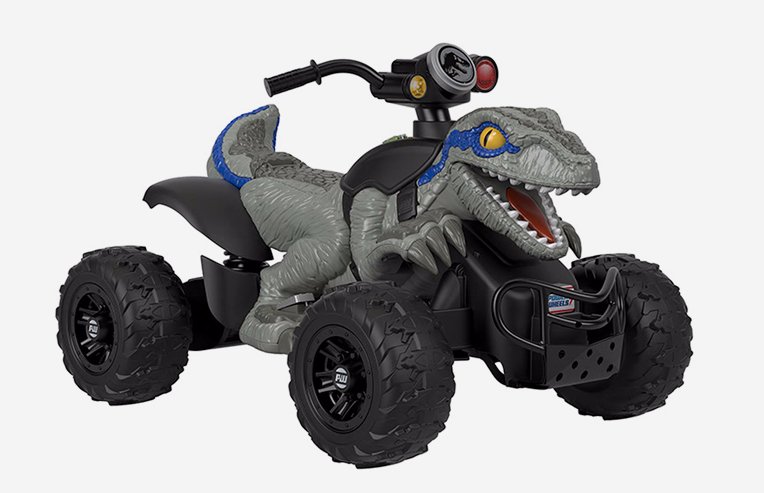
Power Wheels Jurassic World Dino Racer

Inspired by Blue, the star Velociraptor of Jurassic World, this 12-volt Dino ATV can go off-road and hit top speeds of six mph. It also offers a parental high-speed lock for beginner dinosaurs wranglers. Clever girl, indeed.

BUY NOW $249


Chomp ‘N Roar Velociraptor Masks

This mask is ideal for anyone who wants to play the part of a very clever girl. The eyes move inward so you can focus on your next meal, and the electronic jaws open to different degrees — each with its own unique roaring sound effect. So if you want to show off their intimidating set of teeth, just open wide.

BUY NOW $65


Kamigami Dinosaur Robots

Built by folding and snapping together flat sheets of plastic, Kamigami robots include a bevy of sensors (3-axis accelerometer, gyroscope, etc.) and are programmed using a tablet or smartphone ⏤ so kids get those highly touted STEM skills. The Jurassic World “Blue” or Villain Dino versions come with anatomically correct legs and life-like dinosaur movements.

BUY NOW $65


WowWee 14” R/C RoboRaptor

WowWee’s bionic beast measures in at more than a foot long. It can walk, run, or stalk via its included remote, or by using the app on your smart device. The RoboRaptor features multi-speed dynamic movement, plus fast, full-function arms with dual grippers. It’s even programmed to play tug-of-war with you, or your Goldendoodleasaurus.

BUY NOW $137


Jurassic World: Fallen Kingdom Super Colossal T-Rex

Based on the iconic beast from the JW series, this toy, one of our favorites of the year,  is a whopping three feet tall and features authentic detail, movie-inspired markings, and articulated arms and legs for realistic action. It has extra-wide jaws that, when opened, can swallow mini dino action figures without even a burp. Want them back? No problem — just open up SC T-Rex’s belly and watch them fall right out. It’s like the miracle of birth, but much less messy.

BUY NOW $49


Jurassic World Pterano-Drone

A full-function, quadcopter drone married with a realistic Pteranodon, this remote control toy performs stunts and flies up to 25 feet in the air. The Pteranodon’s wings flap as it rises and falls, while an “Auto Circle” mode recreates the hunting of prey. Even better is the“Auto Land” mode, which swoops you in for the kill — or helps your kids land it without clipping the patio furniture. It charges via USB, and comes with a handful of replacement propeller parts, should it sneak up on the wrong woodpecker.

BUY NOW $50


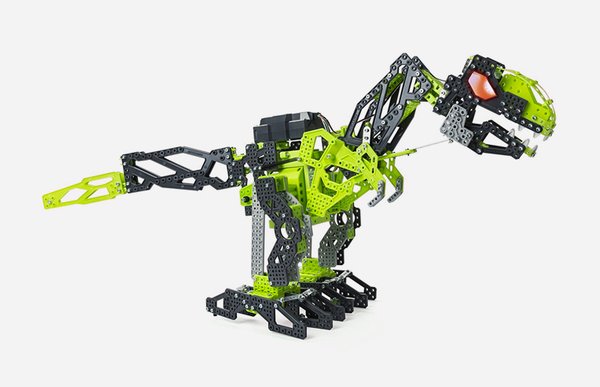
Meccano Mecasaur

If you can’t dig up a dino in your backyard, why not build one with the kids instead? The Meccano Meccasaur, which is from the same company that makes the classic Erector sets, is a 715 piece programmable robot that you build up to be your new prehistoric pal.  Once assemble this fully mobile, three-food T-Rex roars, responds to being pet, “attacks” on command, and stomps around.

BUY NOW $55


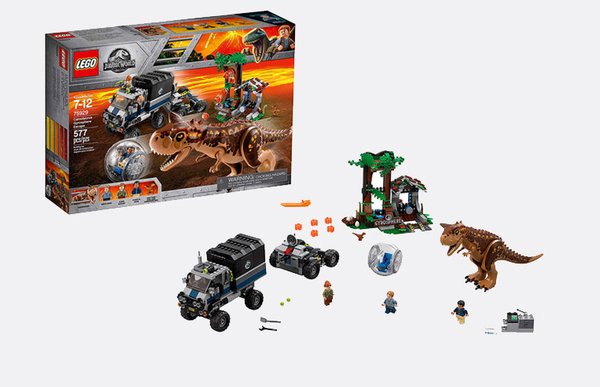
Lego Jurassic World Carnotaurus Gyrosphere

This 577-piece packs a lot of punch for $80 and includes everything from a gyrosphere (those transparent balls Chris Pratt and Bryce Dallas Howard run around in during the movies), truck, and trailer, to three mini figurines, a baby dinosaur, and a not-baby Carnotaurus. And in the spirit of the Jurassic World franchise, you can mix-and-match the dinosaur parts to play God and laugh in the face of nature.

BUY NOW $64


Source: www.fatherly.com

Pages