nandi's blog

The Ultimate Dinosaur Hunting Guide To The Midwest
Friday, April 13, 2018

The Children's Museum of Indianapolis

Roar! If you’re like me, you have one or more dinosaur fans in your household that can’t seem to stop stomping around or sharing the latest dinosaur fact they’ve learned: “Mom, did you know that chickens are descendants from dinosaurs?” 

Dinosaurs have ruled my house for years, and we’ve done our fair share of dino hunting. Check out these dino-mite Midwest spots you and your own dino-lovers can’t miss. 

Illinois

The Field Museum, Chicago

Kids will dig: SUE, the famous T. rex we all know and love, will no longer be featured on the lower level. But don’t worry, she will still be in the building. Sue will have a new home in the Evolving Planets area of the museum in the spring of 2019. 

In the prime viewing space will be a cast of a Titanosaur, the largest dinosaur ever discovered! She will be on display in late spring 2018. Some of her real bones will also be on display, including an 8-foot-long thigh bone.

Burpee Museum of Natural History, Rockford

Kids will dig: Jane, the most complete juvenile T. rex, and Homer, a Triceratops. Want more dino fun? Sign kids up for one-day summer dino camps.

Bess Bower Dunn Museum, Libertyville

Kids will dig: Standing up close to the world’s most scientifically accurate Dryptosaurus, complete with fleshed out skin, protofeathers and claws. Then try a hand at pit digging to find an ancient treasure. 

Chicago Children’s Museum

Kids will dig: Being a part of Chicago paleontologist Paul Sereno’s team and exploring a recreated Saharan expedition, then find a life-size Suchomimus skeleton in a huge dino pit.

Wisconsin

Dinosaur Discovery Museum, Kenosha

Kids will dig: Hanging out with more than 20 meat eating dinosaurs! Don’t miss the newest exhibit, Little Clint: The Story of a Baby Dinosaur. Kids can follow the journey of a juvenile T. rex (excavated in Montana) from its birth to being displayed in a museum. Expect interactive activities, including pretending to hatch in a nest and climbing into a dino dig to excavate fossils. 

Milwaukee Public Museum, Milwaukee

Kids will dig: The Third Planet exhibit features dinosaurs in a diorama complete with thunder and the roaring of a life-sized replica of T. rex.

Madison Geology Museum, Madison

Kids will dig: The Edmontosaurus and Triceratops, and a roomful of other dinosaurs in this small “gem” of a museum. Stick around and explore other real gems, a cool fluorescent display and extraterrestrial geology.

Indiana

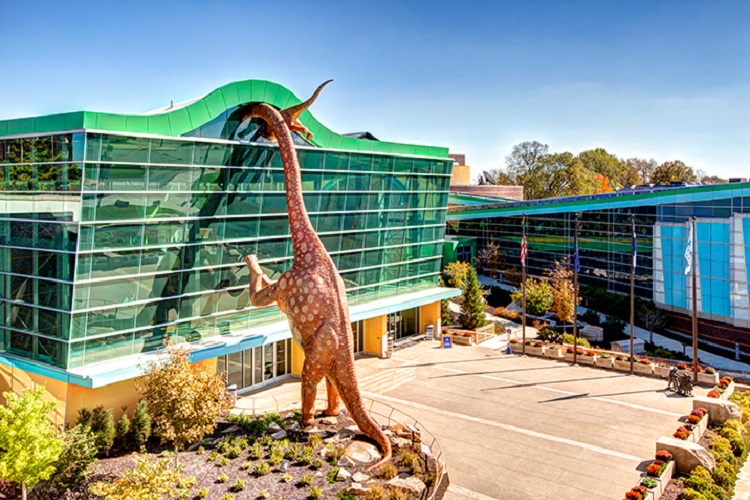
Children’s Museum of Indianapolis, Indianapolis

Kids will dig: The dinosaurs ON the outside of the building welcoming you, plus everything in Dinosphere! Kids can literally spend hours here by digging for dino bones and learning all about the dinosaur skeletons on display. Check out Leonardo, a mummified Brachylophosaurus, which is important to science for its first real look at the skin and scales of a dinosaur. Learn more about Dracorex, the newest dinosaur on the block, which bears a resemblance to a fairytale dragon.  

Ohio

Cleveland Museum of Natural History, Cleveland

Kids will dig: Meeting "Happy," a 70-foot-long "Haplocanthosaurus delfsi" sauropod, plus other dinosaur friends in the Kirtland Hall of Prehistoric Life. The latest exhibit, Pterosaurs, should also not to be missed.

COSI: Center of Science and Industry

Kids will dig: Getting face to face with a full-size cast skeleton of a T. rex or the 60-foot-long metallic model of the long-necked Apatosaurus. With a one-of-a-kind partnership with the American Museum of Natural History, there are many interactive and educational elements to learn from.

Cedar Point, Sandusky

Kids will dig: Dinos that move and roar. “Dinosaurs Alive!” is the perfect diversion for when you want to take a break from riding roller coasters. The walk-thru attraction is full of 50 animatronic dinos and offers the chance to dig into an archeological site.  

Michigan

Detroit Zoo, Royal Oak

Kids will dig: The forty lifelike animatronic dinosaurs are invading the Detroit Zoo this summer as part of Dinosauria, the largest exhibit of its kind in the country. Enter your own “Zoorassic World” and explore the five-acre Dino Trail. Watch out though, these creatures may be lurking close by. (May 25-Sept. 3)

Minnesota

The Science Museum of Minnesota, St. Paul

Kids will dig: Saying they’ve seen one of only four real Triceratops on display in the world. Plus, it’s the museum’s largest complete specimen on display. You also can’t miss the 82-foot Diplodocus.

Kansas

Sternberg Museum, Hays

Kids will dig: Walking through the land and sea diorama complete with a life-sized animated model of a T. rex. Ever see a fish within a fish fossil? This, along with other Cretaceous Period fossils can be found here. 

Field Station: Dinosaurs, Derby

Kids will dig: Walking through the 14 dino-infested acres with thirty life-size animatronic dinosaurs. Find out which dinosaurs were unique to Kansas, then dig for fossils and play mini golf. 

Keystone Gallery, Oakley

Kids will dig: A 20-foot Mosasaur and 14-foot Xiphactinus, plus other fish, turtle and bird fossils.

Museum at Prairiefire, Overland Park

Kids will dig: Meeting AMNH 5027, the first complete T .rex ever assembled by famous paleontologist and Kansas native Barnum Brown. The Discovery Room awaits for those interested in more hands-on fun, including Paleontology. 

Fick Fossil & History Museum, Oakley

Kids will dig: Seeing the oldest known mosasaur fossil along with more than 11,000 shark teeth.  

KU Natural History Museum, Lawrence

Kids will dig: Annabelle, a 50-foot-long, 140-million-year-old Camarasaurus. Interested in seeing Comanche, the preserved 7th Cavalry horse that survived Custer’s Last Stand? Well, it’s here for your viewing. 

Museum of World Treasures, Wichita

Kids will dig: Ivan the T .rex, Cutie the Daspletosaurus and Ed the Edmontosaurus, along with a number of other prehistoric fossils. For more interactive fun, there is a fossil and cast touching station. 

South Dakota

Dinosaur Park, Rapid City

Kids will dig: Totally fun road trip diversion, Dinosaur Park, which lures travelers and dino lovers with their life-size dinosaur sculptures. It’s kitschy fun at its best!

Source: www.chicagoparent.com

Arizona Now Has a State Dinosaur Thanks To An 11-Year-Old From Scottsdale

Friday, April 13, 2018

Arizona now has a state dinosaur thanks to an 11-year-old boy from Scottsdale. 

Jax Weldon, a student at Hopi Elementary School, wrote a letter to Gov. Doug Ducey making the case for a state dinosaur for Arizona. Ducey then asked State Senator Kate Brophy-McGee to run a state dinosaur bill.

"He [Jax] touted the case for economic development, he touted the case for tourism. He made the case that this is something that will put Arizona in a good light," Brophy-McGee said.

Jax suggested the Sonorasaurus for the state dinosaur, a dinosaur that was discovered in Arizona. 

"And he knew of a dinosaur that was discovered in Arizona back in 1995, named the Sonorasaurus Thompsoni and he thought that would be a good candidate for an official state dinosaur," Brophy-McGee said.

Ducey signed the bill (SB1517) into law declaring the Sonorasaurus the state dinosaur on Tuesday. 

Jax, an aspiring paleontologist, knows all about the new state dinosaur said it is 27 feet tall, 50 feet long and had a long neck to reach the tree tops. 

The Sonorasaurus Thompsoni is not necessarily Jax's favorite dinosaur,  but he is still proud to help it take its place in Arizona history.

Source: www.tucsonnewsnow.com

Dinosaur ‘Menu’ Reveals How So Many Fearsome Predators Coexisted 100 Million Years Ago

Friday, April 13, 2018

Meat-eating dinosaurs: special serrations kept teeth extra sharp

Around 100 million years ago, large carnivorous dinosaurs and reptiles dominated the landscape in what we now call Africa. But how were so many fearsome predators able to exist side by side without outcompeting one another?

This is the question that a team of researchers from the Laboratory of Geology in Lyon, France, have tried to answer in a new study published in the journal Proceedings of the Royal Society B.

Using a new technique they developed themselves, the team examined fossilized remains from the time of the dinosaurs in order to reconstruct ancient food chains, enabling them to determine how so many predators could have coexisted.

Both sites—Gadoufaoua in Niger and the Kem Kem Beds in Morocco—contain fossils ranging in age from between 100 million and 120 million years old.

“In the ecosystems that we studied, predators are far more abundant than herbivorous dinosaurs, their most likely terrestrial preys,” palaeobiologist and geochemist Auguste Hassler, lead author of the study, told Newsweek.

The researchers measured the proportions of calcium isotopes—variants of calcium which differ in the number of neutrons—in the fossilized remains of tooth enamel and fish scales.

Because calcium in vertebrates is derived almost exclusively from food, the team was able to compare the proportion of calcium isotopes of potential prey, such as fish and herbivores, with that of carnivores to retrace the diets of these predators.

Teeth from the Gadoufaoua deposit (Niger). From left to right: teeth of a giant crocodile, Sarcosuchus imperator, a spinosaurid, a non-spinosaurid theropod (abelisaurid or carcharodontosaurid), a pterosaur, a hadrosaurid (a herbivorous dinosaur), a pycnodont (fish), and a small crocodylomorph. AUGUSTE HASSLER / LGL-TPE / CNRS-ENS DE LYON-UNIVERSITÉ LYON 1

They found that in both locations, the carnivores had similar food preferences. For example, large carnivorous dinosaurs, like abelisaurids and carcharodontosaurids, liked to hunt land-dwelling herbivorous dinosaurs, while others, such as spinosaurids, preferred to eat fish.

Meanwhile, the diet of Sarcosuchus —which is not a dinosaur but a giant ancestor to modern crocodilians—consisted of a mixture of land and water-based prey.

Because of this, the researchers concluded that the different predators avoided competition by subtly sharing food resources.

“All these predators were able to coexist in the same environments because they had different prey preferences,” Hassler said. “This prey partitioning is thus a key to understand their high abundance.”

The latest study provides rare evidence for the diet of dinosaurs, which are generally not well-studied. The scientists hope, however, their calcium isotope method could provide new avenues for research in this area because calcium is abundant and does not get altered through fossilization.

Source: www.newsweek.com

Dinosaur Skeletons Sold For $3.4 Mil.

Saturday, April 14, 2018

Two skeletons of late Jurassic period dinosaurs have been sold for over 2.8 million euros, or about 3.4 million dollars, at an auction in Paris.

The skeletons of a 12-meter-long Diplodocus and an Allosaurus with a length of 3.8 meters were put up for auction on Wednesday.

Both dinosaurs roamed the Earth more than 140 million years ago. About 40 percent of the allosaurus skeleton was missing, but it was completed after 6 months of restoration work.

The auctioneers say they were surprised by the high prices, as they had expected the 2 skeletons to sell for about 1.4 million dollars.

Sources say that dinosaur skeletons are mostly bought by museums in Europe and the United States.

They add that there has been an increase in purchases by wealthy Chinese collectors who appreciate their artistic qualities.

Source: www3.nhk.or.jp

Jurassic World 2 Rating Promises Intense Dinosaur Violence

Thursday, April 12, 2018

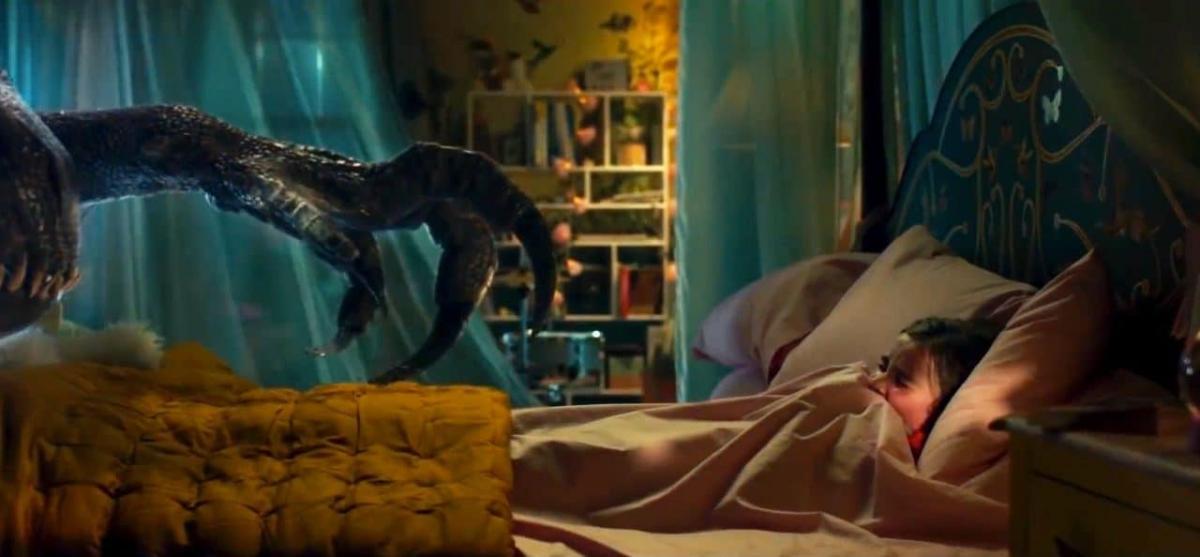
Jurassic World: Fallen Kingdom is going to be violent and intense, promises the MPAA. The Motion Picture Association of America has officially rated the upcoming sequel, the fifth entry in the Jurassic Park franchise overall, PG-13, for "intense sequences of science-fiction violence and peril." That sounds like what audiences have come to expect from the dino-centric series over the years, but the real question is, can this movie actually justify its existence beyond making Universal a whole lot of money?


The explanation for the MPAA's rating doesn't come as a surprise. At bare minimum, watching dinosaurs run around on an island, or in the case of Jurassic World 2, quite possibly on the mainland, chasing humans and killing people is going to warrant some intensity, violence and peril. It's also worth mentioning that the four previous entries in the Jurassic Park franchise were all rated PG-13 as well. This is a series that can't quite get away with PG and be any fun and doesn't really need to go for an R, unless they really want to ratchet up the violence. But that's not what these movies are about.

Director J.A. Bayona has said that this movie will be darker than Jurassic World, and it's also not going to be the end of the dinosaur-filled movies either. Universal recently announced that Jurassic World 3 will arrive in June of 2021, with Colin Trevorrow, who directed the first Jurassic World, returning to helm the final installment of this new trilogy. He's set to co-write the final movie with franchise newcomer Emily Carmichael. So the studio is banking on this upcoming entry to be a big hit. But that's not really a surprise, given what happened with the previous movie.

Following the release of the disappointing Jurassic Park III in 2001, which didn't do much for fans or critics and grossed just $368 million worldwide, the studio has trouble figuring out what to do with the movies moving forward. What would ultimately become Jurassic World went through many stages of development, but the idea of seeing a fully functioning dinosaur theme park clearly appealed to moviegoers. It also didn't hurt giving fans a 14-year break to build up anticipation. The result? Jurassic World became one of the highest-grossing movies ever, making $1.67 billion worldwide. That demolished expectations and gave the studio confidence to proceed with the rest of this new trilogy.


But can this be more than a cash grab? Who knows? Heading into the fifth movie, it's become tough to find reasons to mix humans with these killer man-made creatures, but it's been promised that this won't just be dinosaurs chasing people around on an island. Plus, we've got that huge volcanic eruption to look forward to. However the chips may fall, Jurassic World: Fallen Kingdom, which arrives in theaters on June 22, has been rated by the MPAA and is complete. Now it's just a matter of waiting to see if this movie can not only be as successful as its predecessor, which is a tall order on its own, but if it can also tell a satisfying story.

Source: https://movieweb.com


Before the Dinosaurs

Friday, April 13, 2018

The disarticulated skeleton of a dinocephalian was excavated from middle Permian rocks in Zambia in 2014.  Shown are Seb Steyer (Museum national d’Histoire naturelle, Paris, on left) and Chuck Beightol (UW; on right).  Courtesy Photo

252 million years ago, the Permian extinction wiped out much of the life on Earth. Unlike the K-T extinction event, this wasn’t the one that killed the dinosaurs, this was the one that paved the way for their existence.

“That was the biggest extinction,” said Christian Sidor, a professor of biology who studies the years around Permian-Triassic extinction. “Some people have said that [it killed] maybe 70 percent [of life] on land and 90 percent in the oceans.”

The Permian-Triassic extinction paved the way for new species who are the precursors of mammals and archosaurs, the precursors to the dinosaurs. These species repopulated the Earth and evolved into the creatures known today.

The best place to find fossils from this era, according Sidor, is in South Africa, specifically in the Karoo Basin. Though it is a good place to look for fossils from this era, only utilizing this one site can be problematic. These fossils help shed light on what life was like in that region, but are less informative about the extinction event far away.

“At the same time the extinction is happening in South Africa, there is interpreted to be this big mountain-building,” Sidor said. “Paleontologists have been worried. Is what we’re seeing in terms of mass extinction actually mass extinction or is it mass extinction because of the mountain-building?”

Mountain-building is essentially the process of uplift when two tectonic plates collide. This idea drove Sidor to look for Permian-Triassic fossils in other areas to help control for the diverse geographies in different regions. Sidor wanted to see if the same patterns in the fossil record were seen regionally so he went to Tanzania in 2007 and 2008 to dig for fossils.

In 2009, they received a grant to go to Zambia. One of the big differences is that in Tanzania and Zambia, the tectonic activity resulted in rift basins instead of mountains. Rift valleys often have much more detailed fossils because their geological development is much shorter than mountains. 

“The rocks in Zambia and Tanzania are 242 million years old and we’ve found some very close relatives of dinosaurs,” Sidor said. “You don’t see those species in the same rocks in South Africa. One of the other things we discovered is that before the extinction, the fossil record of Tanzania and Zambia is more or less the same [as in South Africa]. And then you go after the extinction, the three different places end up looking very different. After the mass extinction, everything gets wiped out, and different groups can actually repopulate in different ways in different places.”

The fossils the team found were early relatives of amphibians, mammals, and reptiles. The rise of the archosaur after this extinction event paved the way for the era of dinosaurs. Today, the only living relatives of archosaurs are birds and crocodiles.

“Archosaurs really radiated after the mass extinction,” Sidor said. “And one of their groups, dinosaurs, by the time of the late Triassic, they were the dominant animals. This was the beginning of the dinosaur era.”

Since first visiting Tanzania in 2007, they’ve gone back about ten times and collected around 2,200 fossils, which Sidor calls “a pretty substantial collection.”

“The fossils that we find are totally unique,” said Savannah Olroyd, one of Sidor’s current graduate students. “It was great to be a part of something where you’re finding something that’s totally new.”

This summer, the team will return to Zambia to look for more fossils. The expedition will be led by Brandon Peecook, a former student of Sidor’s who is now at the Field Museum of Natural History in Chicago. 

“The work in Zambia especially is pretty awesome because the fossil sites are in the national parks,” Peecook said. “So not only are you finding very cool extinct animal fossils, but you’re doing it and having to deal with elephants and lions and giraffes and stuff. It’s a pretty fun place to be.”

Researchers excavate a gorgonopsian from upper Permian rocks in Zambia in 2014. Shown are (left to right): Ken Angielczyk (Field Museum), Chuck Beightol (UW), and Sterling Nesbitt (Virginia Tech).  Courtesy Photo

Researchers on the Zambia expedition are exploring how mammals became mammals, the evolution of teeth and jaws in early species, and filling in missing evolutionary links. Peecook is interested in studying the Permo-Triassic ecosystem, particularly “how ecosystems fall apart and how they put themselves back together.”

Finding fossils is no easy task, so even though they all have different interests, everyone on the expedition will be looking for whatever fossils they can find. According to Sidor, 90 percent of the process is prospecting. Nowadays, the team uses technology such as Google Earth and GPS units to figure out where they will look for fossils.

“It’s really hard work,” Olroyd said. “You’re hiking for a really long way, several kilometers every day, you’re out there all day, and you’re basically by yourself. It’s just you and Africa, basically.” 

But in Zambia, there are still new horizons and fossils waiting to be discovered.

“We’ve barely started.” Peecook said.

Source: www.dailyuw.com

Most Primitive Kangaroo Ancestor Rediscovered After 30 Years in Obscurity

Thursday, April 12, 2018

Ancestors of Modern-Day Kangaroos Walked Upright on Two Feet

A handful of tiny teeth have led scientists to identify the most distant ancestor of today's kangaroos. The fossils were found in the desert heart of Australia, and then hidden away, and almost forgotten in a museum collection for over three decades. The findings are published in the Journal of Vertebrate Paleontology.

Kangaroos are icons of Australia's unique living fauna. However, their earliest ancestry is shrouded in mystery. At the beginning of the 1980's, a few enigmatic molar teeth were excavated by palaeontologists hunting for fossils around a dry salt lake in northern South Australia. The rare specimens were recognised as an ancient kangaroo ancestor, but had to wait for over 30 years before modern computer-based analyses could confirm the significance of the discovery.

Originally dubbed Palaeopotorous priscus, Latin for '[very] ancient', 'ancient rat-kangaroo', by the now eminent Australian palaeontologists Prof. Tim Flannery (University of Melbourne) and Dr Tom Rich (Museums Victoria), the importance of these remains was suggested in their first unveiling to science.

"The teeth of Palaeopotorous were initially described in 1986. Even then they were stated as representing possibly the most primitive relative of the entire modern kangaroo radiation. Yet, nobody ever evaluated this claim, and despite being occasionally mentioned in the scientific literature, they were never again examined in detail," said Dr Wendy den Boer, who studied the fossils as part of her recently awarded PhD from Uppsala University in Sweden.

"The name Palaeopotorous was established using a single molar tooth, although, eleven other anatomically very similar teeth were recovered during the expedition. None of these fossils were found in association, so it is still unclear whether we are dealing with one, or more species," said Dr Benjamin Kear, Dr den Boer's PhD supervisor and co-author on the published article. "This uncertainly means that we have had to use a complex series of analyses to assess its morphological similarity and evolutionary relationships relative to other members of the kangaroo family tree".

"Our results showed that Palaeopotorous was most similar to living rat-kangaroos, as well as some other extinct kangaroo relatives. Using information from fossils, and the DNA of living species, we were able to further determine that at around 24 million years old, Palaeopotorous is not just primitive, but likely represents the most distant forerunner of all known kangaroos, rat-kangaroos and their more ancient ancestors," said Dr den Boer.

"Palaeopotorous was about the size of a small rabbit, and probably did not hop, but would have bounded on all four legs. Nevertheless, a few bones found at the same site in central Australia indicate that the earliest kangaroos already possessed some key adaptations for hopping gaits," said Dr Kear.

Palaeopotorous lived at a time when central Australia was much wetter than it is today. Its fossils were buried in clay deposits left by a river, but these earliest kangaroo ancestors would have foraged amongst vegetation growing nearby and along the banks. The teeth of Palaeopotorous were washed into the river after death, along with the remains of many other ancient marsupials.?

UPPSALA UNIVERSITY

Source: www.eurekalert.org

Scientists Have Grown 'Dinosaur Legs' on a Chicken For The First Time

Friday, April 15, 2016

To achieve the long dinosaur-like bone, the researcher inhibited a maturation gene called Indian Hedgehog. With this suppressed, the chickens maintained their tubular fibula, which remained long and connected to the ankle like a dinosaur    Read more: http://www.dailymail.co.uk/sciencetech/article-3487977/Scientist-grow-dinosaur-leg-CHICKEN-bizarre-reverse-evolution-experiment.html#ixzz5ClNCp1gX  Follow us: @MailOnline on Twitter | DailyMail on Facebook

Whoa.

Until very recently, one of the biggest myths in science was that all dinosaurs have been extinct for the past 65 million years. But thanks to new fossil discoveries that filled in our knowledge about avian dinosaurs, we now know that only some dinosaurs went extinct following an asteroid collision with Earth - others survived and gave rise to the birds we live with today.


To figure out how this evolution occurred, researchers in Chile have manipulated the genes of regular chickens so they develop tubular, dinosaur-like fibulas on their lower legs - one of the two long, spine-like bones you’ll find in a drumstick.

In avian dinosaurs such as the Archaeopteryx, the fibula was a tube-shaped bone that reached all the way down to the ankle. Another bone, the tibia, grew to a similar length alongside it.

As evolution progressed through to a group of avian dinosaurs known as the Pygostylians, the fibula became shorter than the tibia, and sharper and more splinter-like towards the end, and it no longer reached the ankle.

While modern bird embryos still show signs of developing long, dinosaur-like fibulae, as they grow, these bones become shorter, thinner, and also take on the splinter-like ends of the Pygostylian bones, and never make it far enough down to the leg to connect with the ankle.

Researchers led by Joâo Botelho from the University of Chile decided to investigate how this transition from a long, tubular fibula in dinosaurs to a short, splinter-like fibula in birds actually came to be.

They achieved this by inhibiting the expression of a gene called IHH or Indian Hedgehog (seriously), which saw their chickens continue to grow the long, dinosaur-like fibulae that originated in their embryonic form. 

In doing so, the team discovered something bizarre. Regular bone development sees cell division and therefore growth halt in the shaft long before the ends stop growing, but in modern chickens, the growth of the fibula halts first at the ends. This means the fibulae of modern chickens are actively blocked from reaching the lengths of their ancient relatives’ bones.

Joâo Botelho et. al.

Publishing their observations in the journal Evolution, the researchers suggest that the early maturation of the lower end of the fibula in modern chickens is prompted by a bone in the ankle, called the calcaneum. 

"Unlike other animals, the calcaneum in bird embryos presses against the lower end of the fibula," the team explains in a press release. "They are so close, they have even been mistaken for a single element by some researchers."

The team suggests that in regular chickens, interactions between the calcaneum and the end of the fibula result in signals that are similar to the ones that prompt the bone shaft to stop growing, preventing the fibula from reaching anywhere near the ankle bone. 

But when the Indian Hedgehog gene was turned off, the calcaneum strongly expresses the gene Parathyroid-related protein (PthrP), which allows for growth at the ends of bones. This caused their chickens to grow long fibulae that connected with the ankle, just like they would in the Archaeopteryx. 

"Experimental downregulation of IHH signalling at a postmorphogenetic stage led to a tibia and fibula of equal length," the team writes in the report. "The fibula is longer than in controls and fused to the fibulare, whereas the tibia is shorter and bent."

Unfortunately, the 'dino-chickens' did not make it to the hatching stage, but the point of the research wasn't to raise them into adulthood, but to figure out the biological processes that led to the transition from dinosaur legs to modern bird legs. 

"The experiments are focused on single traits to test specific hypotheses," one of the team, Alexander Vargas, explains. "Not only do we know a great deal about bird development, but also about the dinosaur-bird transition, which is well-documented by the fossil record. This leads naturally to hypotheses on the evolution of development, that can be explored in the lab."

This isn't the first time dinosaur traits have been 'recreated' in modern chickens. Last year, the same team achieved the growth of dinosaur-like feet on their chickens, and a separate team in the US managed to grow a dinosaur-like 'beak'on its chicken embryos.

Source: www.sciencealert.com


Turns Out, Dinosaurs Probably Had Feathers. This Artist is Using Science to Draw More Accurate Pictures.

Wednesday, April 11, 2018

Contrary to classic depictions of a tyrannosaurus rex, paleoartist Gabriel Ugueto says that the massive carnivores likely were covered in small feathers on the top of their bodies. Credit: Credit: Gabriel Ugueto

What does a Tyrannosaurus rex actually look like? You might immediately think of the iconic, roaring lizard from the Jurassic Park films. But scientific illustrator Gabriel Ugueto turns to paleontology studies and fossil finds—poring over the science to accurately reimagine creatures that no longer exist today. And what he renders might surprise you.

Ugueto, a former herpetologist, is a paleoartist, or an artist that creates representations of animals that have gone extinct. He has illustrated everything from extinct marine reptiles, insects, mammals, flying pterosaurs, and—of course—dinosaurs. His work helps scientists better understand and visualize the species they study. But bringing these animals back to life takes just as much imagination as careful precision. Ugueto draws upon the latest research, looks to fossilized bones, and collaborates with researchers to get a little closer to what these animals may have looked like when they roamed Earth. His more scientifically accurate reconstructions of chubby, scaly plesiosaurs or fluffy, feathery dromaeosaurs might not match the terrifying, reptilian dinosaurs of pop culture.

More recent discoveries provide scientists and artists a new perspective on dinosaurs, Ugueto explains. “Contrary to popular media and what we’ve shown in movies, in paleoart, there is a huge renaissance to make these animals more accurate as to what they would have looked like,” Ugueto tells Science Friday.

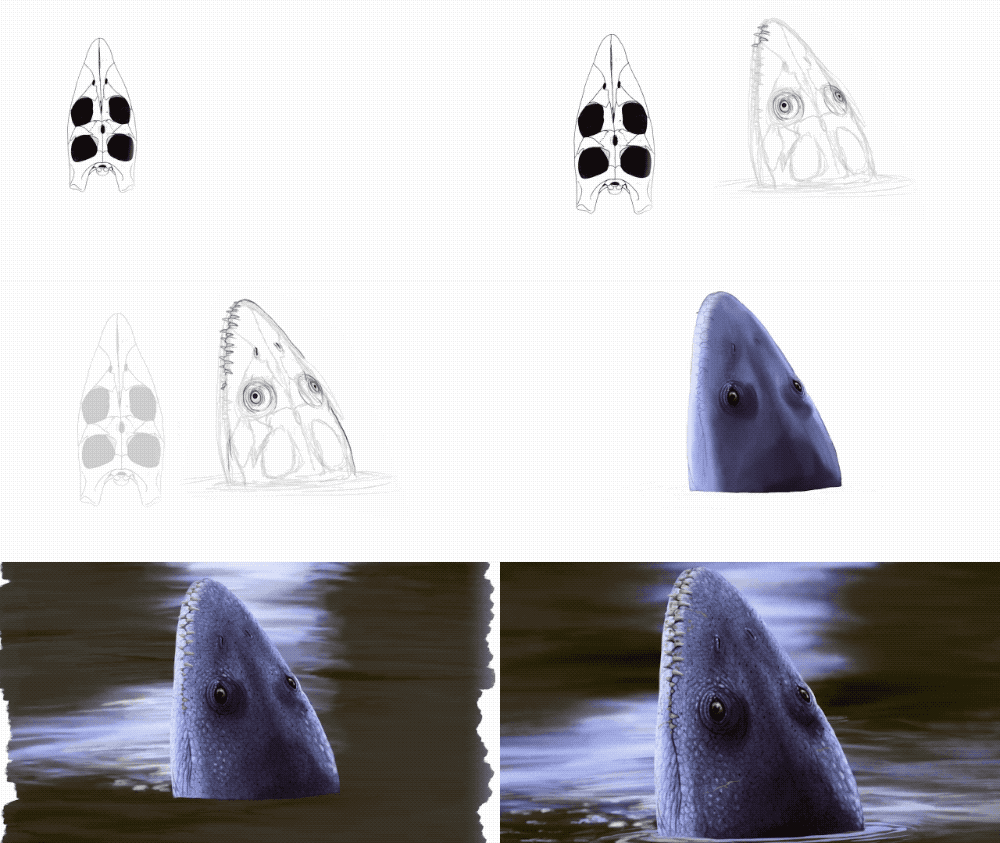
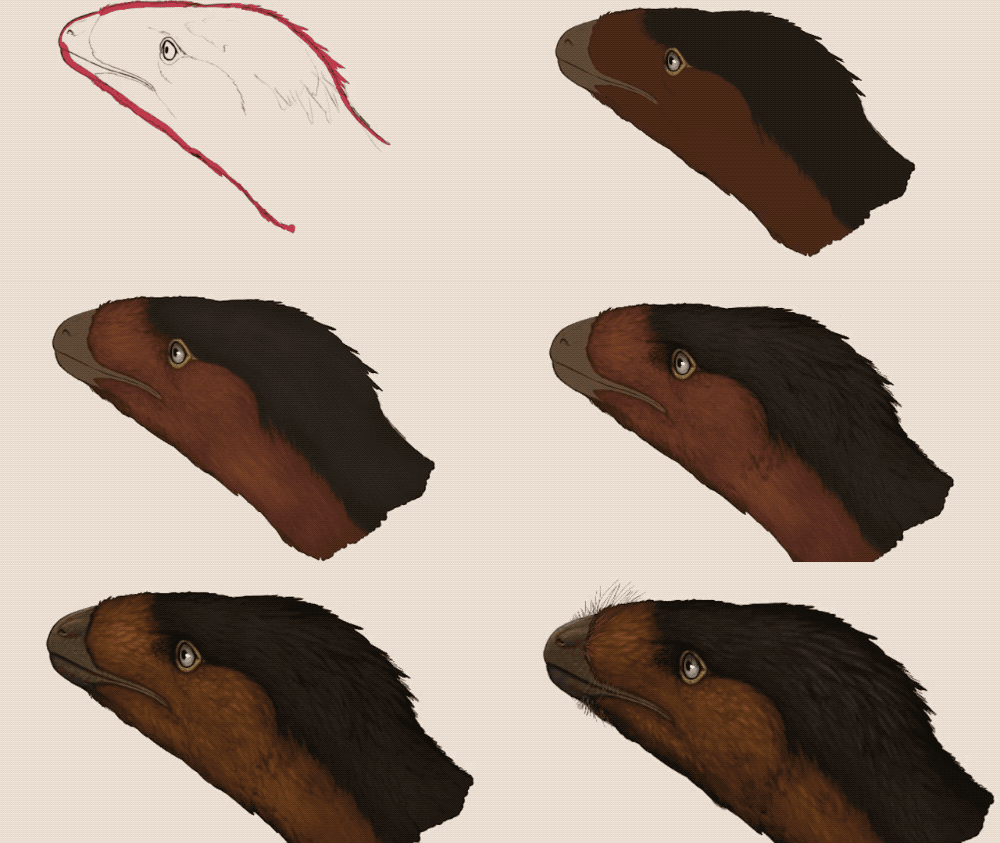
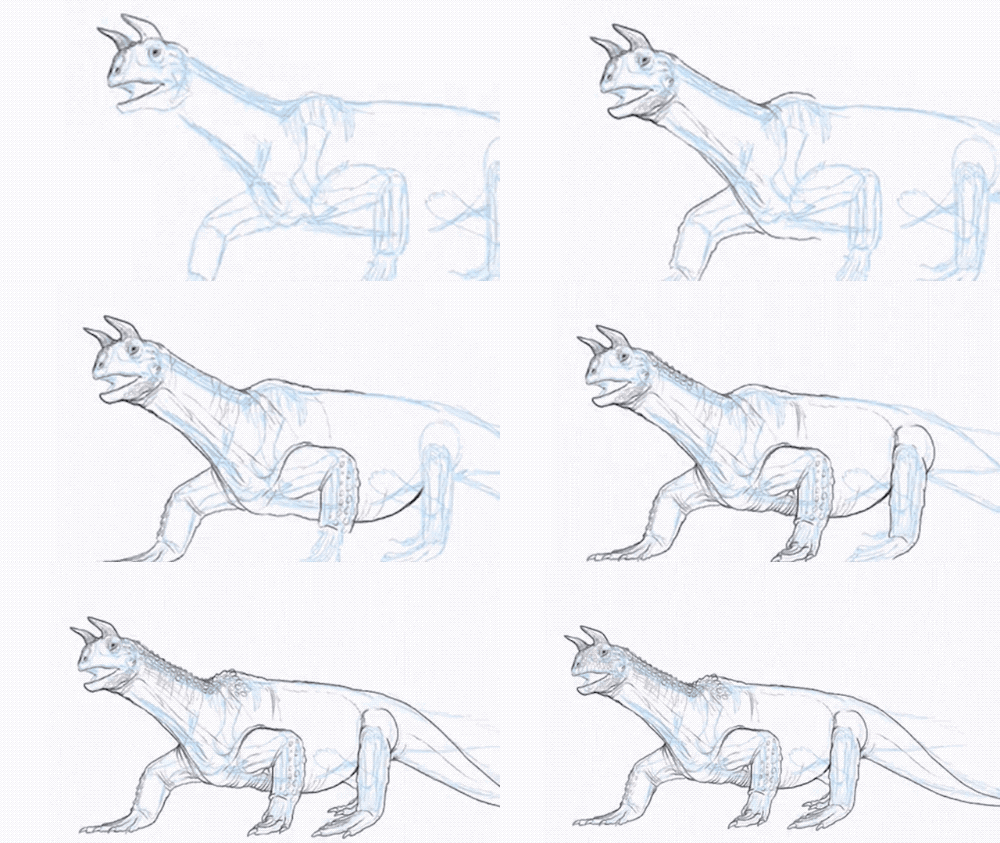
Ugueto, profiled in the latest SciArts video, explains the challenges and wonders of his craft and breaks the stereotypes of how dinosaurs are depicted in popular media with guest host Flora Lichtman. View an animated breakdown of some of the important steps in Ugueto’s illustration process below.

It Begins With A Bone

Ugueto reconstructs a Plesiosaurus dolichodeirus using fossil information. Credit: © Gabriel Ugueto

“When I get an assignment, I first try to look at the bones,” Ugueto says. “You start with the bones and then work outward from that.”

For example, “right now, I’m reconstructing a series of birds from the Cenozoic, and a lot of those birds are just known from one bone, a thigh bone. So I have to basically reconstruct the rest of the animal knowing what it could look like based on what animals it is closely related to.”

Finding Modern Inspiration

A dromaeosaurid. Credit: © Gabriel Ugueto

Since he often receives fragments of remains or photographs of the fossils, Ugueto then tries “to see what the animal that I’m going to reconstruct was related to,” he says. “It’s very important to have reference material from modern-day animals and to be very familiar with anatomy of modern-day animals when you try to reconstruct something from the past. Because not only will it give you analogues to what they could have looked like, but also, in a way, we’re all related at the end of the day. It’s important that we are familiar with that. For dinosaurs, for example, we know that birds are dinosaurs. So they probably share a lot of things in common.”

Feather-covered dinosaurs continue to be a controversial conversation. But, scientists have evidence that many groups of non-avian dinosaurs, including several dromaeosaurs, had different types of feathers. Some suggest that certain species may have even had feathers “exactly like the feathers that you would see on a pigeon,” Ugueto says.

Fleshing Out Muscles

A shringasaurus. Credit: © Gabriel Ugueto

Understanding anatomy, like how muscles attach to bones, is important in accurately capturing different animals, Ugueto says. You can visualize how Ugueto carefully draws muscles and flesh in the illustration of a shringasaurus above.

“You definitely have to have a detailed knowledge of how muscles attach to different bones in different animals, because it’s not the same muscle attachment in mammals that it is for birds or reptiles,” he says. “After I’ve decided what position I’m going to put it in, I do a full skeletal reconstruction and then I try to see where the muscles could have attached. I continue with the reconstruction of putting skin, bones, and colors.”

Setting The Scene

A proceratosaurus. Credit: © Gabriel Ugueto

The ecological backdrop is just as essential to depict correctly as the animal itself. Here, Ugueto poses a proceratosaurus dipping for a drink of water.

A big part of the process “is thinking where the animal lived [and] at what period in time, because there are different climatic conditions at different times during the history of life. Based on suggested habits of the animal, I think about what integument or covering I’m going to use, my coloration and all that.”

Basking In The Beauty

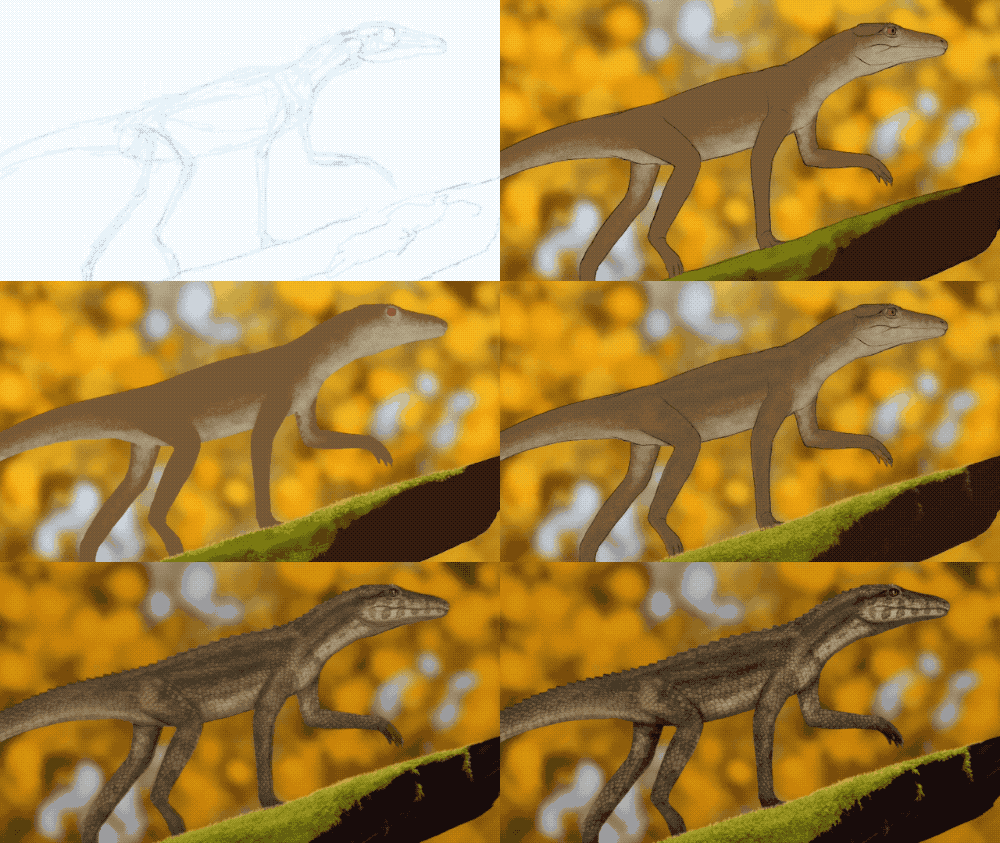
Terrestrisuchus. Credit: © Gabriel Ugueto

“I think [scientists] all have an idea of what the animal is going to look like, because you have to remember that these are people that have been looking at these bones for a long time, much longer than I have,” Ugueto says. “They have an idea of what the animal could have looked like, but I do get this feeling that they are pleased and very happy to see the animal finally fleshed out, with flesh, and bones, and muscles, and color, and looking alive.”

“I would have loved to see it alive,” Ugueto says.

Source: www.sciencefriday.com

'Montana is a Hotbed for T. Rex,' but Researchers Unsure if Partial Dinosaur Skull is One of Them

Saturday, April 14, 2018

After being cleaned up in the lab, this fossil unearthed from Montana reveals the jaw and teeth of what could be a teenage Tyrannosaurus rex.  University of Kansas

Struggling with identity makes being a teenager tough — even for a 66-million-year-old teen.

The partial skull of a dinosaur unearthed this summer, north of the eastern Montana town of Jordan, faces just such a struggle. The teeth and bones seem to point to the discovery being from a young Tyrannosaurus rex, that huge meat-eating dinosaur that has fueled many dark dreams.

Or is the skull that of a Nanotyrannus, a smaller, more nimble species that shares similarities with T. rex?

“My gut says it’s a juvenile,” said Greg Liggett, a Bureau of Land Management paleontologist based in Billings. “It makes a lot of sense. There had to have been babies before they got big, so where are they?”

The fossil of a lower jaw and teeth was unearthed by a team from the University of Kansas this summer and is being cleaned in the school’s lab.

“It’s a pretty dramatic specimen,” Liggett said, one of only three similarly sized Nanotyrannus, or young T. rexes, ever unearthed. “So not many have been found, and we’ve been looking for 100 years.”

Heaven in Hell

Montana’s Hell Creek Formation is a hotbed for dinosaur bones. During that geologic time period 66 million years ago, tons of sediment poured into what was then a low-lying area that stretched from Saskatchewan in the north to Wyoming in the south. Captured in those massive sediment flows were duck-billed and three-horned fringed beasts.

In a 1908 article for Scribner’s Magazine, William Hornady described finding fossil remains while hunting mule deer years earlier in eastern Montana’s badlands.

“It was very evident that in the age of reptiles some gigantic species had inhabited that spot,” he wrote after being shown a fossilized skull half as large as a full-grown elephant.

After returning to New York City, he informed a colleague. In response to the report, the American Museum sent Barnum Brown to investigate.

“Mr. Brown found the remains of a new genus of gigantic reptiles — predatory and carnivorous to the utmost … in due time the world was introduced to Tyrannosaurus rex, the Tyrant Lizard, late of Hell Creek.”

And so the legend was born and continues to live on.

“Montana is a hotbed for T. rex,” said David Burnham, preparator of vertebrate paleontology at the KU Biodiversity Institute. “In fact, I call it T. rex world.”

Chance

It was Burnham who led the KU crew in 2016 that discovered the possibly young T. Rex. It was almost by accident. Suffering equipment delays on a separate dig, he sent everyone out to look for fossils.

“We started to find bones, teeth and claws,” he said. “Everyone was hyper excited. They were in soft sand. You could dig it with hand tools.”

Toward the end of what turned into a three-week exploration, Burnham spotted what he thought may be a skull. Rather than expose it to the weather and have to leave it until the following summer, he decided to wait. Encased in harder rock, once the fossil was cleaned in the lab this year, the stone revealed a set of jaws riddled with large teeth.

“We had some kind of an idea what it was, but we were confused,” he said. “We called it a mystery theropod.”

Theropods are meat-eating dinosaurs, typically the two-legged kind.

First to best

In addition to being a hotbed for T. rexes for more than 100 years, Montana’s Hell Creek Formation also yielded another first. In 1942 the Cleveland Museum unearthed a specimen in eastern Montana’s Carter County that was christened the first Nanotyrannus.

In 2001, a more complete skeleton was uncovered in Carter County, this one by the Burpee Museum of Natural History. Based on the earlier classification of the 1942 find, it was initially called a Nanotyrannus. But since then the museum has decided the skeleton is instead a teenage T. rex, only 11 years old and still growing.

A copy of the skull of the young T. rex, named Jane, is on display in the BLM office in Miles City. Archaeologist Doug Melton often asks paleontologists visiting the office for their summer dig permits what they think: Is Jane a young T. rex, or a Nanotyrannus? He’s gotten both answers.

“I really don’t have any theories,” he said. “But you would expect, since there’s a pretty good number of T. rexes that have come from Montana, that you would see an age range.”

Counting teeth

One of the factors dividing scientists is the number of teeth in the skulls of the smaller dinosaurs — there are more than the adult T. rexes. Burnham plans to study in detail the teeth of the fossil his team uncovered to possibly settle the dispute once and for all. The university has a privately-owned true baby T. rex on loan to help with the comparison.

The discovery, and what the study might reveal, has drawn a lot of attention to the University of Kansas program. Burnham had just spoken to someone from Paris on Friday and prior to that had given dozens of interviews and answered numerous emails since the discovery was made public.

“We’re pretty excited about it,” he said.

And more pieces of the unique specimen could be waiting in the same soils.

“I don’t think we’re finished digging there yet,” Burnham said. “We’ll roll the dice and hopefully get a more complete skeleton.”

Melton is convinced that out of the 10 to 15 permits his Miles City office will issue to museums at Yale, in Denver or in St. Louis for paleontological explorations next summer, those folks will find something.

“I would expect this year, once the snow melts and things start eroding again, we’ll probably by the end of the season see some spectacular things come out.”

Source: http://trib.com

Pages