Blogs

12 World’s Best Dinosaur Museums

Sunday, May 7, 2017

American Museum of Natural History - The Best?

While real-life scientists have yet to resurrect the terrible lizards from mosquito DNA, they have recently discovered remnants of what look like red blood cells and soft tissue in the fossils of a 75-million-year-old dinosaur.

But they say it’ll be a long time before a “Jurassic Park”-style theme park is feasible. (As if anyone who’s seen any of the films would want to visit one anyway.)

Fortunately there are already plenty of museums worldwide that (safely) bring humans face to face with dinosaurs — and not always just their skeletons.

1. Museum für Naturkunde (Berlin)
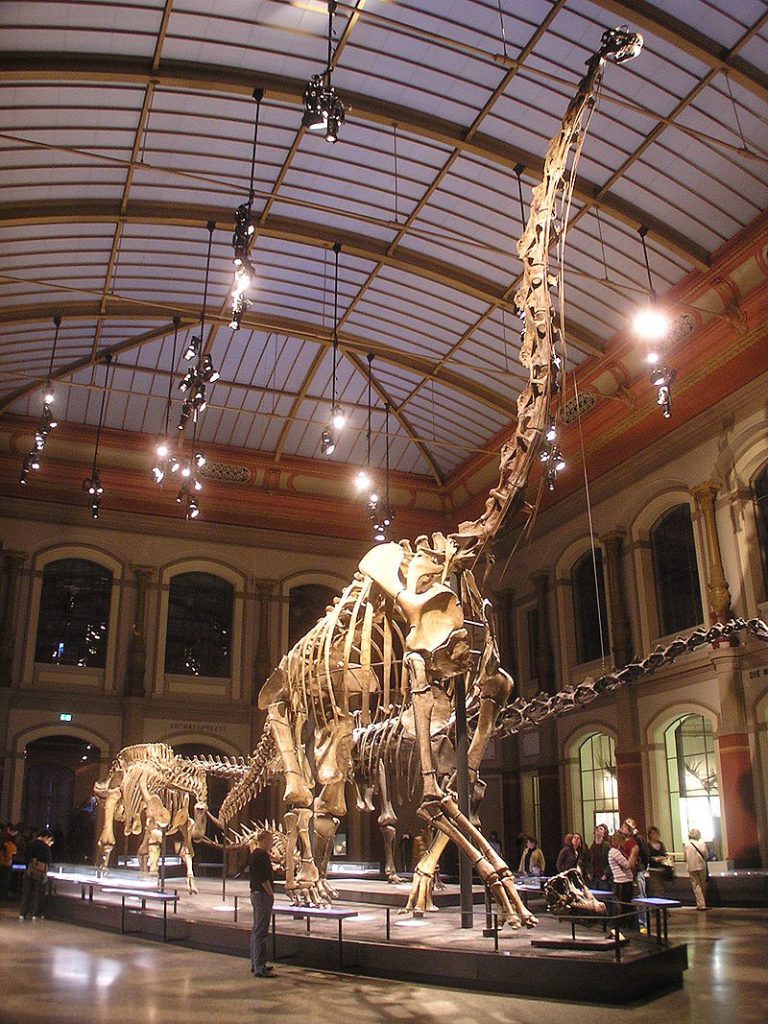
The Dinosaur Hall seen from the entrance, with the skeleton of Giraffatitan (formerly Brachiosaurus) brancai in the center. Photo by Axel Mauruszat

Berlin’s natural history museum houses a serious collection of bones excavated largely from Tanzania in the 20th century, featuring all sorts of species.

Most impressive is the 41-foot, 5-inch Brachiosaurus, the tallest dinosaur in the world on display. It’s a Guinness World Record holder and dominates the first gallery.

The museum also has the most important Archaeopteryx fossil in the world, demonstrating the birdlike link between dinosaurs and birds.

Museum fur Naturkunde, Invalidenstrasse 43 Leibniz-Institut Fur Evolutions- Und Biodiversitatsforschung, 10115 Berlin Germany; +49 (0)30 2093 8591

2. Field Museum (Chicago)

The world’s biggest version of the world’s most famous dinosaur: ‘Sue’, the T.rex

The museum’s Evolving Planet exhibit, dedicated to the last 4 billion years of evolution, features dinosaurs from as far away as Madagascar and Antarctica.

The main attraction stands at the entrance. Meet Sue, the largest Tyrannosaurus in the world, who greets visitors at Chicago’s natural history museum.

She’s a terrific specimen — the original skull, weighing 600 pounds and flashing 58 teeth, is on display in the museum’s balcony level along with information on the most notorious of dinosaurs.

It’s easy to imagine the enormous tooth-filled snout crashing through the sunroof of a “Jurassic Park” jeep.

The Field Museum, 1400 S Lake Shore Dr, Chicago, IL 60605-2496; +1 312 922 9410

3. Royal Belgian Institute of Natural Science (Brussels)

Mounted Iguanadon skeletons at the Dinosaur hall. Photo by Paul Hermans

With the largest dinosaur hall in the world, this museum has an impressive collection of fossilized skeletons and casts.

The standouts are 30 Iguanodons, the second dinosaur to be classified in the 1800s.

They’re the ones with the curious spike that early paleontologists mistook for a horn on their nose.

Interactive displays in the gallery also detail the fossilization process and dinosaur digs, among other topics.

Museum of Natural Sciences, Rue Vautier 29, Brussels 1000 Belgium; +32 (0)2 627 4211

4. National Dinosaur Museum (Canberra, Australia)

Exhibit – Archaeopteryx Diorama. Photo by NationalDinosaurMuseum

This is the place to explore prehistory in Australia.

The place has the country’s largest collection of dinosaur fossils.

Alongside fossils, bones and impressive footprints from all sorts of animals and beasts, the museum features a garden with imposing dinosaur sculptures and animatronics inside that add a bit of Spielberg magic to displays.

Fossil digs, children’s learning events and weekend tours help attract 200,000 people a year, making it one of the area’s biggest tourist attractions.

National Dinosaur Museum, Cnr Gold Creek Road and Barton Highway Nicholls, 2913 Australia; +(02) 6230 2655

5. Royal Tyrrell Museum of Paleontology (Alberta, Canada)

Inside the largest display area. Photo by Steven Mackaay

More than 130,000 fossils call this paleontological research center home, including the original “Black BeautyTyrannosaurus skeleton with its unique dark sheen.

A recreation of a pack of Albertosaurus, inspired by a bone bed of 22 specimens found in Alberta, pays homage to Joseph Tyrrell, who discovered the carnivore in 1884.

The museum also displays sabertooth tigers attacking a mammoth as well as a living garden that recreates life during the Cretaceous period in Alberta.

Visitors can watch paleontologists at work in the preparation lab to see how they prepare fossilized bones, like those of an Ankylosaur found in a Canadian mine.

Royal Tyrrell Museum, Midland Provincial Park P.O. Box 7500, Drumheller, Alberta T0J 0Y0 Canada;

6. Wyoming Dinosaur Center (Wyoming)
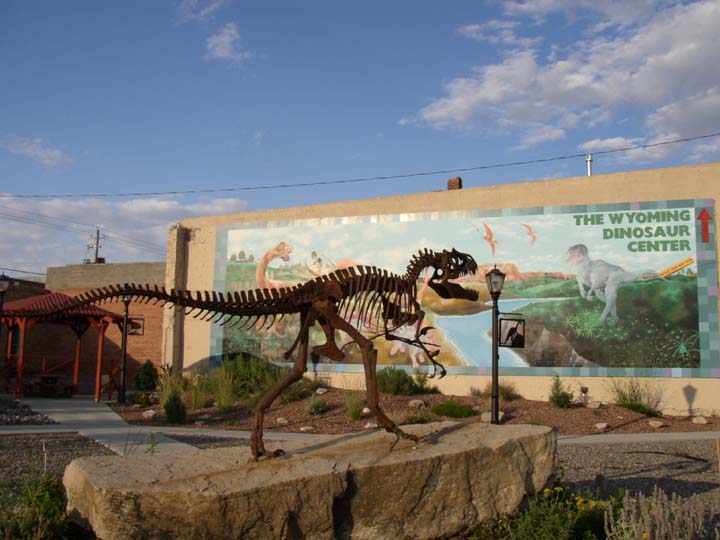
Wyoming Dinosaur Center entrance

This museum’s standout attraction is a 106-foot Supersaurus.

The museum has acquired the most complete archaeopteryx in the world (after the one in Berlin) and boasts skeletons of Triceratops, Stegosaurus and Velociraptor, among others in all sorts of dynamic poses.

The real draw is getting to talk with real paleontologists, like those who inspired Alan Grant’s character in “Jurassic Park.”

All ages are invited to “dig for a day” by signing up to participate in excursions to one of the world’s richest bone fields, just down the street.

Wyoming Dinosaur Museum, 110 Carter Ranch Road, Thermopolis, WY 82443; +1 307 854 2997

7. Zigong Dinosaur Museum (Zigong, China)
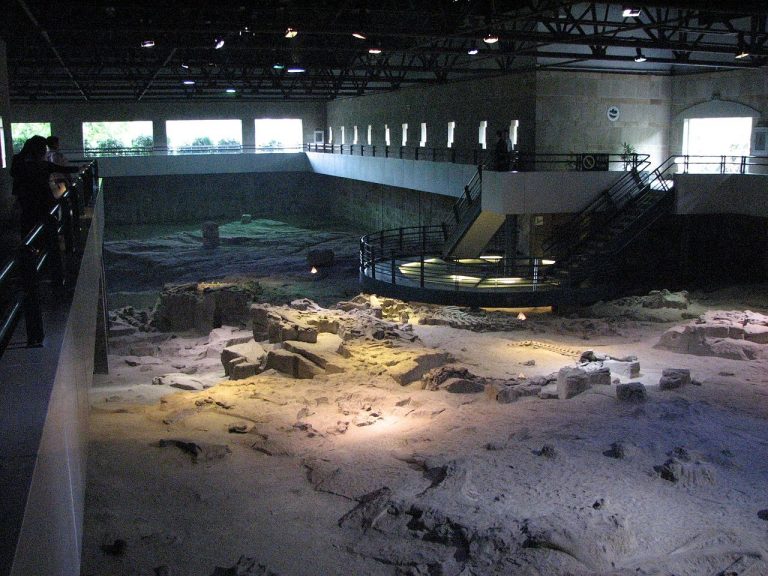
One of the excavation pits of the Zigong Dinosaur Museum. Photo by Phreakster 1998

Another vast space given to prehistoric fossils, the Dinosaur Museum in Zigong sits atop the Dashanpu fossil site, allowing visitors to get a firsthand glimpse of an excavation site.

This top Chinese attraction has 18 complete skeletons among the 200 individuals pulled from the graveyard, and they’re displayed among foot prints, skin fossils and other prehistoric finds.

Specimens are renowned in the dinosaur community and attract nearly 7 million people a year in China.

Zigong Dinosaur Museum, Dashanpu Town, Da’an District, Zigong 643013 China; +86 813 580 1236

8. Iziko Museum (Cape Town, South Africa)
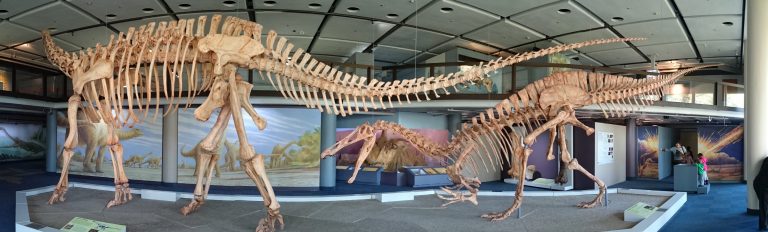
Mounted skeletons of the spinosaur theropod Suchomimus and the juvenile sauropod dinosaur Jobaria

South Africa doesn’t conjure images of T. rex and Brachiosaurus, but the Izikio Museum does feature some of the prehistoric beasts from its Karoo region.

In addition to dozens of other exhibits, the prehistoric section deals with lesser known dinosaurs and their cousins that inhabited the continent from Cape Town to Marrakech.

The “African Dinosaurs” exhibit features the Euparkeria, a distant relative of the dinosaurs, native to South Africa; as well as the Jobaria, a sauropod from Africa.

The Carcharodontosaurus skull from North Africa is part of a creature that trumped the mighty T. rex in size and stature, making it one of Africa’s most imposing killers.

Iziko South African Museum and Planetarium, Between Government Avenue and Queen Victoria Street, Cape Town Central South Africa; +27 (0)21 481 3800

9.  Jurassic Land (Istanbul)
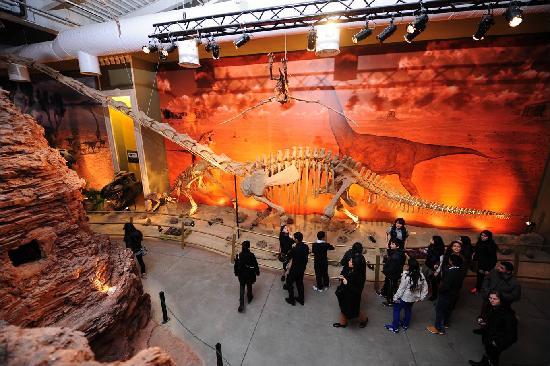
Jurassic Land: The detailed story of the dinosaur age is told with examples.

Opened in 2011, Jurassic Land is as close as you’ll get to fleeing dinosaurs alongside Sam Neil and Laura Dern.

One part education, another part entertainment, the 10,000-square-meter experience mixes skeletons and fossils with writhing animatronic dinosaurs in an Ingen-esque setting, including a “veterinarian” taking care of an injured Stegosaurus and egg incubators.

While Spielberg may not have given his blessing, the center does offer a creative and engaging educational experience for children, though connoisseurs may question the seemingly anachronistic placing of a Spinosaurus next to a Triceratops.

Jurassic Land, Kocatepe Mah. Sehir Parki Cad. 12. Sok. Bayrampaşa Forum İstanbul Kat : 2, Istanbul 34045 Turkey; +90 212 640 8088

10. Fernbank Museum of Natural History (Atlanta)
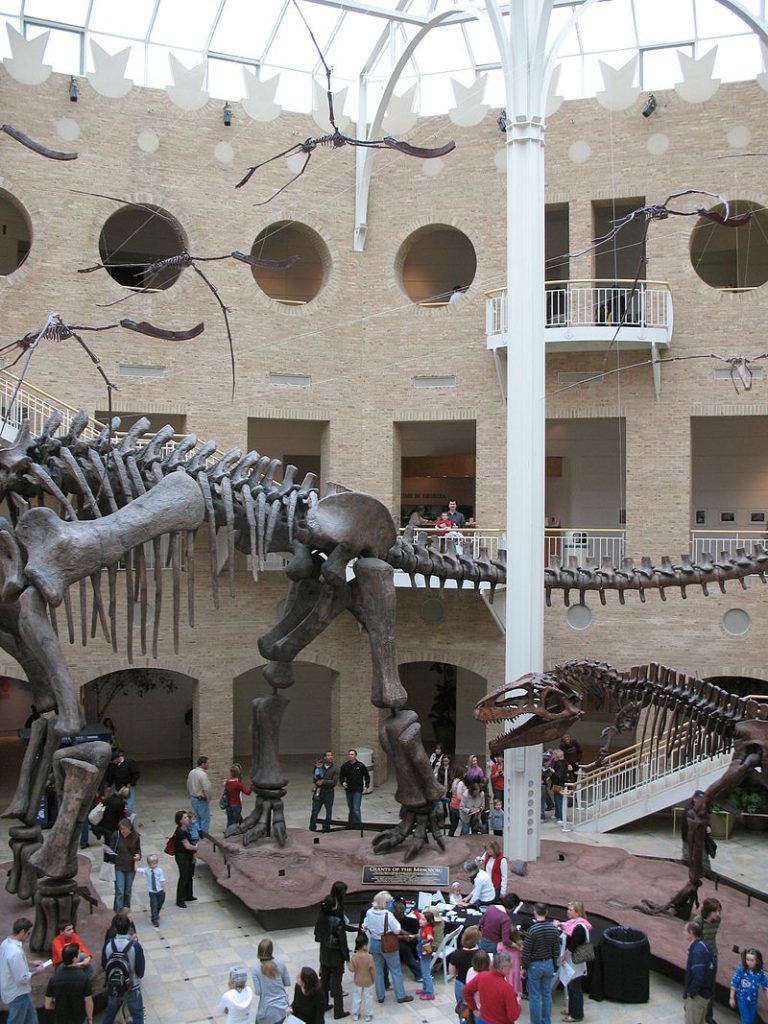
Inside Fernbank. Photo by James Emery

The true giants of the prehistoric world may have been unearthed in Patagonia, but you have to go to Atlanta to see them on display.

The Giants of the Mesozoic exhibit features the carnivorous Gigantosaurus, which rivaled the T. rex in size, as well as the Argentinosaurus, the 100-ton sauropod that scientists say is the largest dinosaur ever classified.

A flock of more than 20 pterosaurs glides overhead. The museum also offers a glimpse into prehistoric Georgia, with murals and life-sized dinosaur models.

Fernbank Museum of Natural History, 767 Clifton Rd NE, Atlanta, GA 30307; +1 404 929 6300

11. American Museum of Natural History (New York)
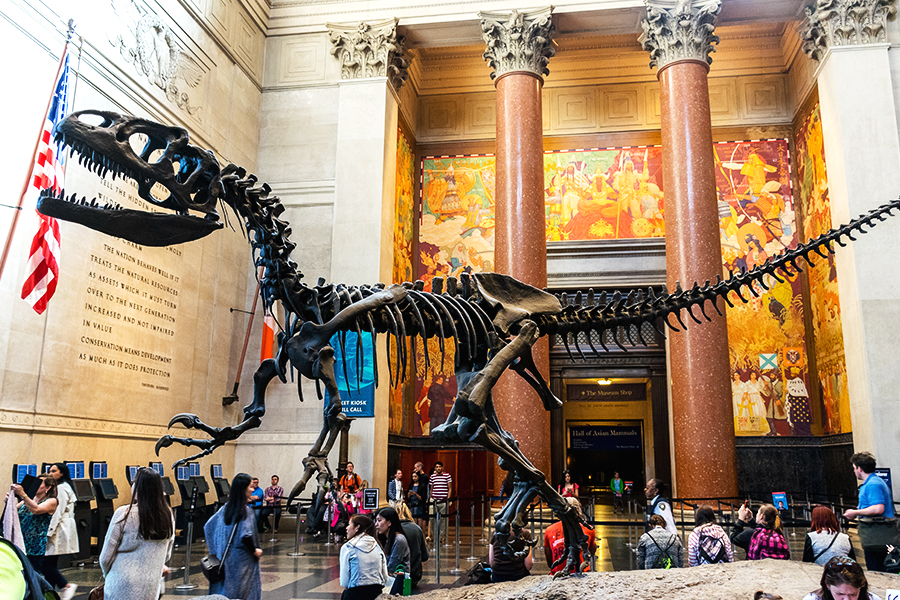
American Museum of Natural History

The American Museum of Natural History, located on the Upper West Side of Manhattan, New York City, is one of the largest museums in the world. 

Did you know: Dark Universe was developed by the American Museum of Natural History, New York (www.amnh.org), in collaboration with the California Academy of Sciences, San Francisco, and GOTO INC, Tokyo, Japan.

Address: Central Park West & 79th St, New York, NY 10024, USA

Hours: 10AM–5:45PM

TOP 9 T. Rex ANTAGONISTS

Sunday, May 7, 2017

TOP 10 T. Rex ANTAGONISTS

T. rex doesn't really need an introduction, but let's provide one anyway. This "tyrant lizard king" was one of the most fearsome killing machines in the history of life on earth; full-grown adults weighed in the neighborhood of seven or eight tons and were equipped with massively muscled jaws studded with numerous, sharp, shearing teeth. For all that, though, there remains some disagreement about whether T. rex actively hunted for its food, or preferred to scavenge already-dead carcasses.

Below are 9 of his most powerful theropod antagonists.

Mapusaurus

Mapusaurus by James Kuether

“Earth lizard” The pack hunter known as Mapusaurus lived in the late Cretaceous of South America, about 95 million years ago. It grew to sizes that are comparable to Tyrannosaurus, about 10.2 (33 ft) to 12.2 meters (40 ft) but not as large as its cousin: Giganotosaurus. Some people suggest that this comparison to the larger and more powerful Giganotosaurus caused Mapusaurus to become self conscious.

Acrocanthosaurus

Acrocanthosaurus with Tenontosaurus by paleoguy

“High spined lizard” Found in the southern United States, this wannabe Spinosaurus roamed the coasts of an inland sea that separated North America into three islands in the Cretaceous period. Growing up to 11.5 meters long (38 ft) and weighing almost 6 tons, it still was not as large as the famed Giganotosaurus of the south.

Zhuchengtyrannus

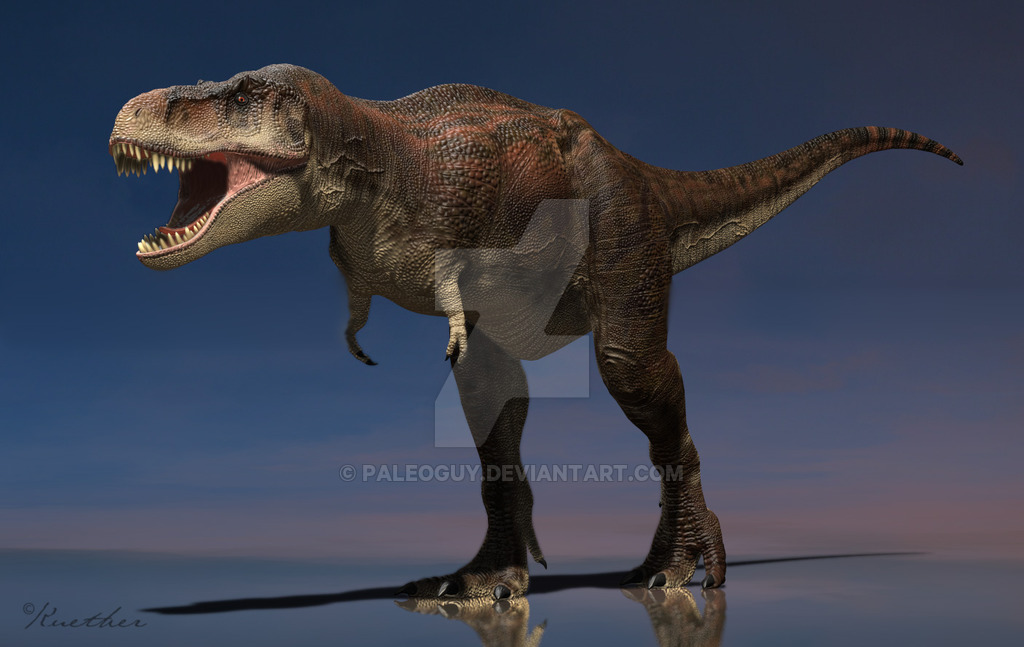
Zhuchengtyrannus by PaleoGuy on DeviantArt

“Zucheng tyrant” This Asian tyrannosaurid rivaled its North American counterpart both in size and weight, growing up to 12 meters in length (39 ft). Zhuchengtyrannus ruled China long before the emperors that lived after it, and defended its territory from invading Mongolian dinosaurs even without the help of a rousing song about manhood.

Saurophaganax

Saurophaganax by Manuel Gil

“The lizard-eating master” The oldest dinosaur on this list, Saurophagnax lived at a time where dinosaurs weren’t so prissy and ornate. The predators didn’t have sails and it sure didn’t have stubby useless little arms. Nope. Everything in the Late Jurassic was meant for REAL killing. Scavenging is for the weak. Hunting is for REAL dinosaurs. If you want it done right, use your own 13 meter (43 ft) bulk to overrun them. Yep, everything was better back then. And don’t get it started on herbivores.

Bahariasaurus

Bahariasaurus ingens by Teratophoneus on DeviantArt

“Bahariya lizard” There is not that much known about this dinosaur. It may or may have not been related to Deltadromeus, a skinny little scavenger. It may have been related to Carcharodontosaurus, which was pretty much the lovechild of a Terminator and a lizard. At around 13 meters (43 ft), it may be the largest ceratosaur ever (a group that was kinda dying out when this guy came along).

Carcharodontosaurus

Carcharodontosaurus, an important dinosaur of Africa. Credit: James Kuether

“Shark toothed lizard” Once thought to have had the longest skull of any predatory dinosaur, this African predator unfortunately had to hand its title over to its South American relative, Giganotosaurus. Needless to say, Carcharodontosaurus was devastated. Years spent on expensive prehistoric gyms and surgeries to look the part, evolving teeth that looked horrifyingly similar to shark teeth, and growing to sizes of 13 meters (43 ft) and it was bested by some runt across the pond? This will not stand.

Giganotosaurus

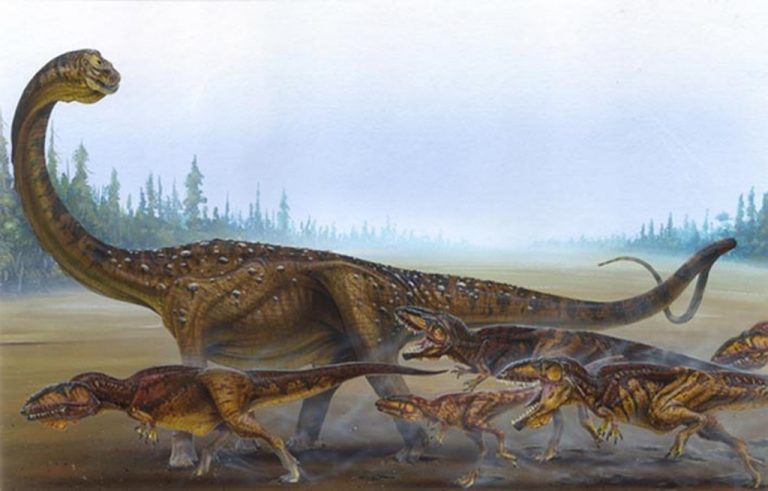
Argentinosaurus chased by Giganotosaurus by WillDynamo55

“Giant southern lizard” Gathering from the past dinosaurs on this list, Giganotosaurus is kind of a “king”. It makes other dinosaurs look weak. It steals titles from its own kin. It probably also cannibalized its young when times were tough. This 13 meter (43 ft) predator, however, was a perfect hunter. There is evidence of Giganotosaurus and Mapusaurus hunting together.

Oxalaia

Oxalaia by dragnathus on DeviantArt

“Oxala” Spinosaurus’ South American cousin, Oxalaia was much like its larger relative. Like all spinosaurs, Oxalaia fed almost exclusively on fish and occasionally scavenged on carrion left by more well adapted predators. Its 14 meter long (46 ft), 7 ton bulk would have scared other predators into giving up their food for it. Its like that school bully you had back in Grade 3 only it had a sail to help it keep warm.

Spinosaurus

Spinosaurus hunting Onchopristis by atrox1 on DeviantArt

“Spine lizard” 18 meters long (59 ft) and 21 tons, this monster from Africa made history by breaking Tyrannosaurus’ neck in Jurassic Park 3. However, this wouldn’t have been possible considering that Spinosaurus itself has claimed that it is a strict piscivore (fish eater) and wouldn’t dare hurt a scale/feather on the Tyrant Lizard King’s head. Spinosaurus, however, does enjoy swimming and fishing, especially when fish back in the Cretaceous grew to enormous sizes. Mawsonia, a relative of the coelocanth, was around at an average of 6 meters (19 ft); and Onchopristis, the sawfish pictured, was around 10 meters long (32 ft).

Source: imgur.com

8 Prehistoric Creatures Worse Than Your Nightmares

Thursday, April 6, 2017

Gorgonopsid

Prehistory had no shortage of terrifying monsters, with everything from the more well-known Raptors and Rexes to super rats and three-eyed shrimp.

8 - A Carnivorous Monster With a 40-Foot Wingspan.

The concept of a flying, carnivorous lizard is plenty terrifying on its own. Even in movies, pterodactyls and such are pretty small, because you simply don’t need to up the fear quotient by depicting the things as 40 feet across or like 400 pounds. But that didn’t stop nature from being the unholy little achiever that it is and doing just that.

The Azhdarchidae family were a group of gigantic pterosaurs that plied the skies of the late Cretaceous. Members of the group included Quetzalcoatlus (named after the Aztec sun god Quetzalcoatl, a giant feathered serpent), Azhdarcho (named after a type of Uzbek dragon) and Titanopteryx (whose name means “really big opteryx”). Now, let’s not get carried away and start picturing leathery-winged reptilian bird-things hunting you down from the skies and carrying you off to feed their younglings. Evidence shows that they were simply too large to have effectively grabbed prey and flown off with it.

Oh, is that not comforting? That the bird monster’s only problem was being too fucking gargantuan to fly away with your corpse after it killed you? Sorry. Does this scale diagram help?

Revised Qiuetzalcoatlus from Flying Monsters 3D with David Attenborough.

The Azhdarchidae didn’t fly away with its prey like modern-day hawks, but only because that’s nowhere near terrifying enough. No, the Azhdarchidae would spot you from the air, slam down into the ground next to you and creepily hobble-wing-charge your ass, scooping you up into its huge, jagged beak. We’re not exaggerating that disturbing, high-speed death-waddle — scientists believe that Azhdarchidae had a “particularly efficient terrestrial locomotion,” which they were able to discern from preserved tracks that showed it placing its feet in front of its wing-claws as it moved.

7 - The T. rex … Dog?

Inostrancevia illustration by Raul Martin

No, that’s not real, is it? That looks like the end boss of a Resident Evil game. It looks like one of the slags from Borderlands. It looks like the terrifying gritty reboot of Dino for the new Flintstones movie.

Sadly, that beast is not the fever dream of a horror game designer, but rather a real, once-living predator called a gorgonopsid, which was essentially a bear-sized saber-toothed dog-lizard with a 3-foot-long skull. Gorgonopsids of the genus Inostrancevia were even larger — about the size of a rhino — with canines roughly 4 inches long. Gorgonopsids were the dominant predator on land for the bulk of the Permian period, only being wiped out by the Permian-Triassic extinction event, which rebooted 90 percent of all life on Earth.

6 - The Giant Alligator-Shark That Ate Sea Monsters

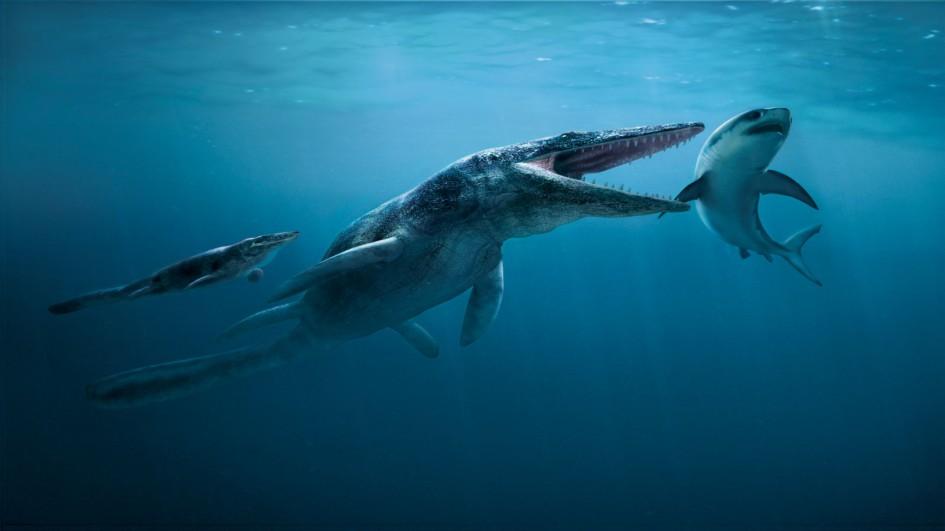
This illustration shows Tylosaurus proriger hunting a shark. National Geographic Kids

The Cretaceous period was basically the Earth’s goth phase, when all it cared about was finding something evil and monstrous enough to freak out its conservative parents. And it finally found that in the Hainosaurus and Tylosaurus, two types of prehistoric sea lizard that mama sharks used to scare their little shark babies into finishing their mackerel. Oh, and hey: You don’t need to imagine what those freaky shark nightmares looked like; National Geographic has done that for you.

But don’t worry; it’s not what it looks like. Tylosaurus didn’t really use that row of vicious teeth, nor even the two additional rows behind it. They were just there to make sure anything it swallowed whole didn’t wriggle free.

Oh, right: They swallowed sharks whole.

They mostly only used those three rows of giant razor-sharp fangs as a barb-wire fence to keep their prey from escaping being digested alive. It was like a sarlacc the size of a school bus, except this one could actually chase you down and force you into its belly.

They ate literally anything they could catch, including plesiosaurs, which is basically the Loch Ness Monster. Isn’t that comforting? Even monsters have monsters they’re scared of.

5 - The Terrible Pigs

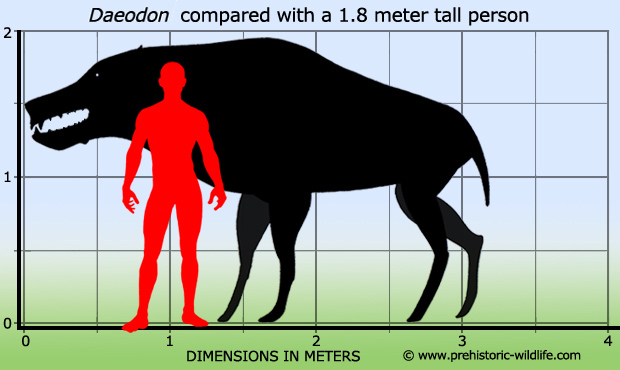
Daeodon by Prehistoric Wildlife

Funny. Who slipped concept art from the first Ghostbusters into our article research?

Wait, what? That’s not Zuul? That’s Daeodon, the granddaddy of modern pigs? That’s what bacon used to look like?!

Daeodon was about the size of a rhino, and while modern boars are just angry pigs with fur, this thing was also equal parts Cape buffalo and leopard.

The name literally means “hostile destructive teeth,” but the creature was for a time known simply as Dinohyus, or “terrible pig.” They were “massive opportunistic omnivores,” meaning that they pretty much ate whatever they could get their considerable jaws around. Which, uh … would be most things, by the look of it. Here, have a screenshot from the BBC’s Walking With Beasts.

4 - The Sea Monsters That Ate the Other Sea Monsters

If there is one thing you take away from your time on Cracked, let it be this: No matter how terrified you are of the sea, you aren’t terrified enough. Kronosaurus and Liopleurodon embody everything that could possibly be frightening about the ocean (well, except for maybe tentacles, but that’s likely only because they thought tentacles were delicious).

Liopleurodon looked like a rough draft of a crocodile rejected by God with a note to “Tone it way, way down, man.” It regularly reached 33 feet long, with one specimen discovered that had a jawbone 10 feet long. Given the proportions of some of the more complete remains found, some scientists speculate that Liopleurodon actually grew up to 50 feet long. Much like the Tylosaurus, the only prey big enough to quell the mighty hunger of Liopleurodon was other crazy, huge monsters, seen here in BBC’s insane artistic rendering:

Liopleurodon reconstructed by the BBC. “Walking With Dinosaurs”. © BBC 2000

Speaking of the living avatars of fear on Earth, let’s talk about the Kronosaurus, which was likely even bigger than Liopleurodon. Kronosaurus was named after the Titan Kronos, who was such a grand, evil bastard that he ate his own children (who were already pretty giant and terrifying themselves).

Kronosaurs had large “banana-shaped” teeth and thick jaws designed to crush the shells of ammonites, which were ancient shelled squids from back before nature decided that armoring the Kraken was “perhaps a bit overkill.”

3 - T. rex: The Xtreme Editions

Coming face-to-face with a T. rex would be a bad day for anyone. The only thing worse would be somehow surviving that encounter only to find out he’s got a pissed-off big brother waiting around the corner. But don’t freak out, the T. rex doesn’t have a more terrifying rivalry.

It has two: Giganotosaurus and Carcharodontosaurus.

Carcharodontosaurus skull cast, Science Museum of Minnesota. Photo by Matthew Deery

Both lived about 100 million years ago, were roughly 45 feet long and made the T. rex look like the neurotic, asthmatic nerd of the Rex family. The Carcharodontosaurus is pictured above, and is considered to be the second largest land predator in history (that’s called foreshadowing, friends). While Gigonotosaurus lived in South America and looked like this:

Giganotosaurus carolinii by durbed

2 – The Gargantuan Buck-Toothed Fang Fish

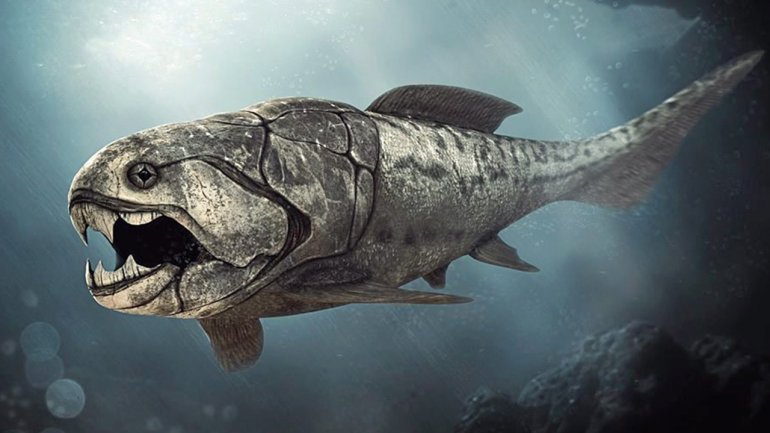
Dunkleosteus by Nobu Tamura

There’s a unique subgenre of terror that’s actually augmented by a bit of goofiness. It’s like spotting a clown holding a carving knife: Somehow the big floppy shoes make him so much worse than a normal knife-wielding maniac. So it is with the Dunkleosteus, a 30-foot murder-fish bred with a tank and armed with giant, buck-toothed blades all up in its face.

We’re not embellishing a harmless thing because it looks scary: The Dunkleosteus is estimated to have possessed the strongest bite out of anything. Ever. For some perspective, one of the strongest bites on Earth today comes from the hyena, at 2,000 Newtons (about 500 pounds of force). They easily crack bones with their mouths. The T. rex is estimated to have had a bite around 13,000 Newtons (3,000 pounds of force), which, once you realize bones crack at 1/6 that force, just seems like spite.

The Dunkleosteus had around 150 million Pascals of bite force, roughly 22,000 pounds of force per square inch. That is so powerful they changed units of measurement just to calculate it. If you came across a Dunkleosteus while exploring the ocean in the world’s most well-armored time-traveling submarine, Dunkleosteus would not only still eat you, but complain that, if anything, you were a bit soggy.

Dunkleosteus could also open its mouth in a 50th of a second, meaning that it vacuumed in animals that would normally be fast enough to swim away from it. Usually, fish either have a fast bite or a powerful one, because you can get plenty of food with only one of the two. But Dunkleosteus had both, because evolution is a spiteful bitch that hates life like they used to date and life banged its sister the night before the wedding.

1 - The Largest Land Predator Ever

Hey, remember that foreshadowing from earlier? Here’s the thing casting that unusually large, spiky, quickly approaching shadow.

That’s a Spinosaurus, and it grew up to 60 feet long. Its “crocodile-like” jaws easily reached 5 feet in length alone, and it sported a jaunty sail on its back, because who was going to say anything about it?

Spinosaurus, an important dinosaur of Africa. Photo Credit: Wikimedia Commons

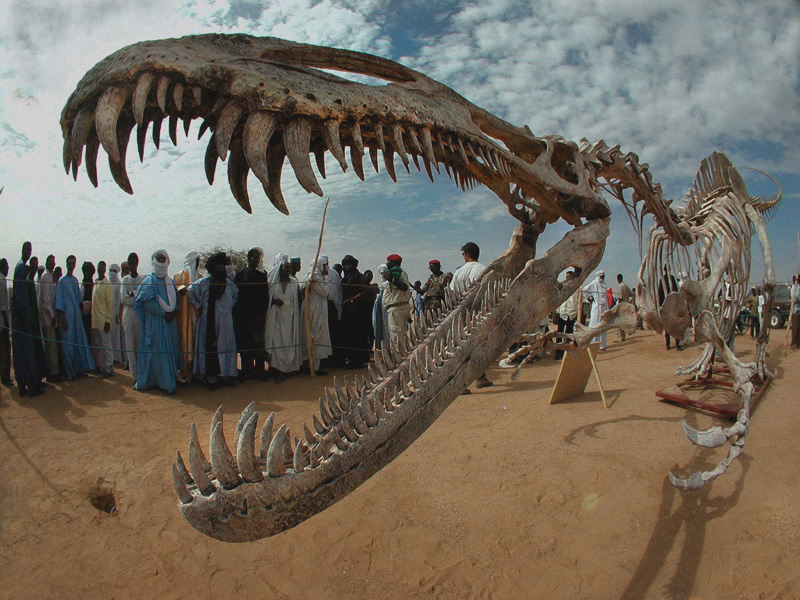
Believed to be the largest predator ever to walk the Earth, Spinosaurus is, at least for now, the King Scary Bastard in an entire epoch of the scariest bastards in history. Here’s the mouth of one of Spinosaurus’ smaller, gentler cousins, Suchomimus:

"Dino Suchomimus Eating Crowd", photo by Mike Hettwer

Jesus, is that a skull or industrial logging equipment? That’s it: We’re starting a collection to distribute cyanide pills to toddlers, females and Internet comedians. Because if Jurassic Park ever comes to life and gets a hold of any of these things, humanity’s best option is to just get the hell out of this whole “nature” thing altogether, and brother, we’re calling it now — it is women, children and Cracked writers first.

Source: www.cracked.com

Morelladon: Spain’s High-Spined Herbivore

Tuesday, May 2, 2017

Life reconstruction of Morelladon beltrani. Image credit: Carlos de Miguel Chaves.

Sail backs were all the rage back in the Mesozoic. Some spinosaurs had them, with Spinosaurus itself bearing one of the most ornate of all, as well as the herbivorous Ouranosaurus, the shark-finned Concavenator, and the strange Deinocheirus, among others. And now, thanks to paleontologist José Miguel Gasulla and colleagues, another high-spined dinosaur has joined the club.

Morelladon beltrani by javifel on DeviantArt

The Early Cretaceous herbivore, named Morelladon beltrani, didn’t have the most ornate ornament of the various sailbacks. The tall spines would have given it more of a high, narrow bump, superficially similar to the midline ridge of the carnivorous Acrocanthosaurus that was terrorizing North America around the same time.

The partially complete fossil of the new ‘sail-backed’ dinosaur was discovered in Mas de La Parreta quarry near Morella in Spain (illustrated). The name is derived from the region of Spain where the dinosaur was found, the Greek word for ‘tooth’, as well as Victor Beltran, the man who helped unearth the fossil

What has continued to puzzle paleontologists, however, is why so many lineages of dinosaurs repeatedly evolved tall backs. No one knows for sure. The answer isn’t environmental, as high-spined dinosaurs lived in disparate habitats, and hot-running dinosaurs did not require sails to heat up, as early hypotheses supposed. The frontrunner right now is that they evolved for decoration, either to impress potential mates, intimidate rivals, or help members of the same species identify each other at a distance.

The latter possibility might be a good fit for Morelladon. During the Early Cretaceous, Gasulla and colleagues write, the Iberian Peninsula was home to a diverse group of dinosaurs that were variations on the theme of Iguanodon. They were so similar to each other that paleontologists have only just started to recognize how many different species and genera there were within a collection of bones that used to bear the Iguanodon title, and so it may be that the high spines of Morelladonhelped the dinosaur stick with its own kind and avoid embarrassing encounters like approaching the wrong species come mating season.

The high spines of Morelladon. From Gasulla et al., 2015.

Fossil Facts

Name: Morelladon beltrani

Meaning: Morelladon means “Morella tooth” in reference to the place the dinosaur was found, and beltrani honors Victor Beltrán “for his involvement and collaboration in the localization of the different fossil sites at the Mas de la Parreta Quarry.”

Age: Around 125 million years old.

Where in the world?: Castellón, eastern Spain.

What sort of critter?: An ornithopod dinosaur related to Iguanodon.

Size: About 20 feet long, similar to its relative Mantellisaurus.

How much of the creature’s body is known?: A tooth, six nearly-complete vertebrae and additional fragments of spine, the sacrum, most of the hips, a tibia, rib fragments, and two chevrons.

Reference:

Gasulla, J., Escaso, F., Narváez, I., Ortega, F., Sanz, J. 2015. A new sail-backed styracosternan (Dinosauria: Ornithopoda) from the Early Cretaceous of Morella, Spain. PLOS ONE. doi:10.1371/journal.pone.0144167

Source: www.nationalgeographic.com/2016

Is Rexy Going To Be In Jurassic World 2?

Monday, May 1, 2017

Fury Rexy at Jurassic World

Two tourist destinations have been constructed on Isla Nubar in the Jurassic Park universe, and both locales have shared the same dinosaur resident: Rexy, everyone’s favorite Tyrannosaurus rex. Rexy was by far one of the best parts of 1993’s Jurassic Park, and she made her grand return in 2015 for Jurassic World, proving once again just how powerful she is. The Jurassic Parkfranchise is continuing next year with Jurassic World 2, and while specific plot details are still light, Colin Trevorrow was gracious enough to confirm that Rexy will be returning for the fifth movie in this series.

The Jurassic Park movies aren’t exactly kid-friendly, but that doesn’t mean that the young’uns can’t enjoy certain elements from them. In the case of fan Kevin Rodenfer II, his daughter loves her Rexy stuffed animal, prompting Rodenfer to ask Colin Trevorrow on Twitter whether or not the formidable T-Rex would return for Jurassic World 2, and sure enough, she will. It’d be wise for that little girl wait many years until seeing Rexy wreak havoc in this franchise, but no doubt she’ll be excited to learn that she has at least one more appearance to look forward to.

‘Rexy’ is the specific fandom nickname for the T-rex seen in Jurassic Park as well as Jurassic World.

In Jurassic Park, Rexy refused to come out into the open when Alan Grant, Ellie Sattler, Ian Malcolm and the others were touring the site, but at night when the tropical storm raged and the island’s electrical fencing was disabled, she made her big debut, figuratively and literally. The T-Rex made quick work of money-hungry lawyer Donald Gennaro, and it was only through quick thinking that Grant and Malcolm, as well as the kids Lexi and Tim, were able to survive her wrath. Rexy later returned to eat some of the raptors that were attacking the main characters. In Jurassic World, Rexy was back in captivity, but she was eventually freed by Claire Dearing to battle the Indominus rex. With the help of Owen Grady’s surviving raptor Blue, they killed the hybrid dinosaur, and just like two decades earlier, Rexy roared triumphantly when all the remaining humans had evacuated the island. Assuming that Rexy wasn’t somehow transported to a different location, it looks like Jurassic World 2 will be revisiting her on Isla Nubar.

Even though Jurassic World 2‘s story is being kept secret, the sequel has already assembled most, if not all, of its main cast. Bryce Dallas Howard, Chris Pratt and B.D. Wong are all reprising their respective roles, while Rafe Spall, Toby Jones, Justice Smith, James Cromwell, Geraldine Chaplin, Daniella Pineda and Ted Levine have all been brought aboard. The last surprise was Jeff Goldblum who returns as Ian Malcolm. Colin Trevorrow is still attached as a writer and producer, but he’s passed off directing duties to J.A. Bayona. The story is rumored to be about the government having trained the dinosaurs to be used for battle.

Jurassic World 2 will stampede into theaters on June 22, 2018.

Source: www.cinemablend.com

Daeodon

Monday, May 1, 2017

Daeodon by Pablo Lara

Daeodon (from Greek, δαίος, daios “hostile” or “dreadful”, and οδον, odon “teeth”) is a genus of entelodont artiodactyl that inhabited North America between 29 and 19 million years ago during the late Oligocene and early Miocene epochs. The type species is Daeodon shoshonensis, the last and largest of the entelodonts; known adults of this species possessed skulls about 90 cm (3 ft) in length. It had a broad distribution across the United States, but it was never abundant.

Daeodon by Prehistoric Wildlife

Although not specified in Cope’s original description, the name Daeodon comes from the Greek words daios, meaning “hostile” or “dreadful” and odon, meaning “teeth”.

The genus Daeodon was erected by the American anatomist and paleontologist Edward Drinker Cope in 1878. He classified it as a perissodactyl and thought that it was closely related to “Menodus”. This classification persisted until the description of “Elotherium” calkinsi in 1905, a very similar and much more complete animal from the same rocks, which was promptly assigned as a species of Daeodon by Peterson (1909). This led to Daeodon’s reclassification as a member of the family Entelodontidae. The exact relationships between Daeodon and other entelodonts are not well understood, some authors (Lucas et al., 1998) consider the greater morphological similarity of Daeodon to Paraentelodon rather than to earlier North American entelodonts, like Archaeotherium, as evidence for Daeodon being a descendent from a Late Oligocene immigration of large Asian entelodonts to North America. However, the existence of distinct specimens of Archoetherium showing characters reminiscent of those present in both Paraentelodon and Daeodon raises the possibility of both genera actually descending from a North American common ancestor.

Entelodons intimidating Hyaenodon by Petr Modlitba

The type species of Daeodon is D. shohonensis, which is based on a fragment of a lower jaw from the John Day Formation of Oregon. Several other species were assigned to the genus in the subsequent decades, like D. calkinsiD. mento and D. minor. Since 1945, it had been suggested that two other taxa were actually junior synonyms of Daeodon, but the formalization of this referral didn’t take place until the work of Lucas et al. (1998). Ammodon leidyanum, named by Cope’s rival, O. C. Marsh, and Dinohyus hollandi, a complete skeleton from the Agate Springs quarry of Nebraska, were found to be indistinguishable from each other and in turn both were indistinguishable from D. shoshonensis. With the exception of D. calkinsi, which was tentatively excluded from Daeodon, the other previously recognized species of Daeodon were also synonymized to D. shoshonensis. That same year, an obscure entelodont, Boochoerus humerosum, was also synonymized to Daeodon by Foss and Fremd (1998) and, albeit its status as a distinct species was retained, they note that the differences could still be attributed to individual or population variation or sexual dimorphism.

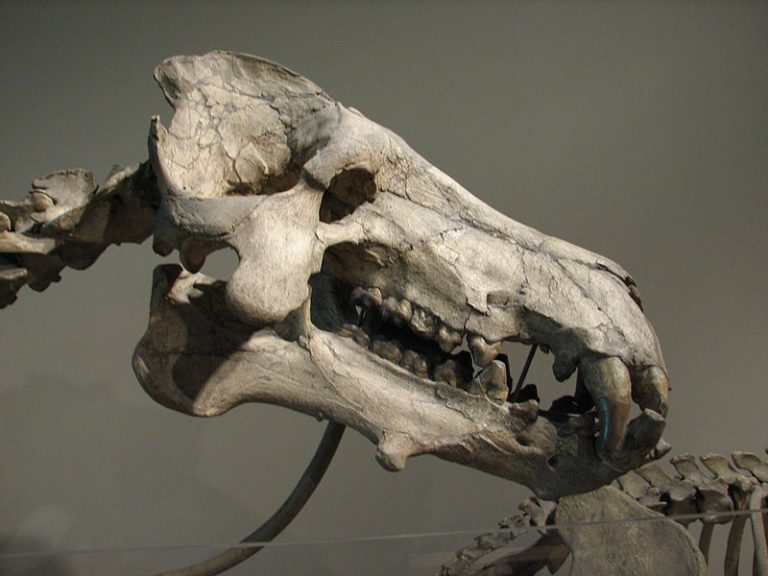
A skull of Daeodon shoshonensis at the Carnegie Museum of Natural History. Author: Matt Celeskey

Daeodon shoshonensis is the largest known entelodont; known adult individuals had skulls about 90 cm (3 ft) long and were around 1.8 m (5.9 ft) tall at the shoulders. It’s differentiated from other entelodonts by a suite of unique dental characters, the shape and relatively small size of the cheekbone flanges of its skull compared to those of Archaeotherium, the small size of its chin tubercle, as well as features of its carpus and tarsus and the fusion of the bones of the lower leg. Like other entelodonts, its limbs were long and slender with the bones of the foreleg fused together and with only two toes on each foot. It also had a relatively lightly constructed neck for the size of its head, whose weight was mostly supported by muscles and tendons attached to the tall spines of the thoracic vertebrae, similar to those of modern-day bison and white rhinoceros.

Alioramus

Monday, May 1, 2017

Artist's impression of A. remotus by Fred Wierum

Alioramus (meaning ‘different branch’) is a genus of tyrannosaurid theropod dinosaurs from the Late Cretaceous period of Asia. The type species, A. remotus, is known from a partial skull and three foot bones recovered from Mongolian sediments which were deposited in a humid floodplain about 70 million years ago. These remains were named and described by Soviet paleontologist Sergei Kurzanov in 1976. A second species, A. altai, known from a much more complete skeleton, was named and described by Stephen L. Brusatte and colleagues in 2009. Its relationships to other tyrannosaurid genera are unclear, with some evidence supporting a hypothesis that Alioramus is closely related to the contemporary species Tarbosaurus bataar.

Alioramus remotus was estimated at 5 to 6 metres (16 to 20 ft) in length when originally described by Sergei Kurzanov in 1976. Kurzanov, however, did not correct for lengthening of the skull by deformation during fossilization, which may indicate a shorter overall body length for this individual. If this specimen is a juvenile, then adult Alioramus would have reached greater lengths, but no confirmed adult specimens are known.

Alioramus were bipedal like all known theropods, and their sharp teeth indicate that they were carnivores. Known specimens were smaller than other tyrannosaurids like Tarbosaurus bataar and Tyrannosaurus rex, but their adult size is difficult to estimate since both Alioramus species are known only from juvenile or sub-adult remains. The recent discovery of Qianzhousaurus indicates that it belongs to a distinct branch of tyrannosaur. The genus Alioramus is characterized by a row of five bony crests along the top of the snout, a greater number of teeth than any other genus of tyrannosaurid, and a lower skull than other tyrannosaurids.

Alioramus, Tyrannosauridae. Late Cretaceous (68mya) from Mongolia. Taken in Wyoming Dinosaur Center, Thermopolis by Clément Bardot

The skull of A. remotus was approximately 45 centimetres (18 in) long. In general, it is long and low, a shape typical of more basal tyrannosauroids and juveniles of larger tyrannosaurids. The premaxillary bones at the tip of the snout in Alioramus remotus have not been found, but are taller than wide in all tyrannosauroids for which they are known. The nasal bones are fused and ornamented with a row of five irregular bony crests that protrude upwards from the midline, where the nasal bones are sutured together. These crests all measure more than 1 centimetre (0.39 in) tall.

Strict consensus topology of five most parsimonious trees recovered from the cladistic analysis. Numbers by nodes indicate Bremer and jackknife support values. Thick lines next to each taxon depict temporal range, which in most cases is age uncertainty and not true range, and colors of lines denote geographic areas. Branches of the phylogeny are not scaled to time. Silhouettes are in relative proportion and scaled to total body length (T. rex = 13 meters). Geographic silhouettes from Loewen et al.13 and taxon silhouettes from phylopic.org (Kileskus: T.M. Keesey; Guanlong: S. Hartman; Yutyrannus: S. Hartman; Dilong: FunkMonk; Juratyrant: S. Hartman, T.M. Keesey; Eotyrannus: S. Hartman; Dryptosaurus T.M. Keesey; Albertosaurus C. Dylke; Nanuqsaurus J. Headden; Daspletosaurus S. O’Connor, T.M. Keesey; Tyrannosaurus S. Hartman).

At the back of the skull there is a protrusion, called the nuchal crest, arising from the fused parietal bones, a feature shared with all tyrannosaurids. In Alioramus, the nuchal crest is greatly thickened, similarly to Tarbosaurus and Tyrannosaurus. Like the rest of the skull, the lower jaw of Alioramus was long and slender, another possible juvenile characteristic. As in Tarbosaurus, a ridge on the outer surface of the angular bone of the lower jaw articulated with the rear of the dentary bone, locking the two bones together and removing much of the flexibility seen in other tyrannosaurids. Other tyrannosaurids had four premaxillary teeth, D-shaped in cross section, on each side. Including 16 or 17 in each maxilla, and 18 in each dentary, Alioramus had 76 or 78 teeth, more than any other tyrannosaurid. The braincase of A. altai was intermediate between the basal theropod and avialan conditions.

The rest of the skeleton of Alioramus remotus is completely unknown except for three metatarsals (bones of the upper foot), but the discovery of A. altai, which is known from substantially more complete remains, has shed light on the anatomy of the genus.

Paleontologists have long classified Alioramus within the superfamily Tyrannosauroidea, but because its remains were for many years poorly known, a more precise classification had remained elusive until the discovery of A. altai. A cladistic analysis published in 2003 found Alioramus could be further classified into the family Tyrannosauridae and the subfamily Tyrannosaurinae, alongside TyrannosaurusTarbosaurus and Daspletosaurus. A 2004 study supported this result but suggested it was equally probable that Alioramus belonged outside the family Tyrannosauridae entirely, with its supposed juvenile characters actually reflecting a more basal position within Tyrannosauroidea. Another study omitted Alioramusaltogether due to the only specimen’s fragmentary nature. The discovery of A. altai in 2009 confirmed the placement of the genus within the Tyrannosaurinae.

Texas Alioramus. Author: Texas A&M University-Commerce Marketing Communications Photography

Tarbosaurus and Alioramus shared several skull features, including a locking mechanism in the lower jaw between the dentary and angular bones, and both lacked the prong of the nasal bones which connected to the lacrimal bones in all other tyrannosaurids except adult Daspletosaurus. The two genera may be closely related, representing an Asian branch of the Tyrannosauridae. Some specimens of Tarbosaurus have a row of bumps on the nasal bones like those of Alioramus, although much lower. The long and low shape of the only known Alioramus remotus skull indicated that it was immature when it died and might even have been a juvenile Tarbosaurus, which lived in the same time and place. The more prominent nasal crests and much higher tooth count of Alioramus, however, suggested it was a separate taxon, even if it is known only from juvenile remains, confirmed by the discovery of A. altai. Specimens identified as immature Tarbosaurus have the same tooth count as adults.

The holotype (PIN 3141/1) of Alioramus is a partial skull associated with three metatarsals. A joint Soviet-Mongolian expedition to the Gobi Desert in the early 1970s found these remains at a locality known as Nogon-Tsav in the Mongolian province of Bayankhongor. Alioramus was named and described by Russian paleontologist Sergei Kurzanov in 1976. Its crests and low skull profile looked so different from other tyrannosaurids that Kurzanov believed his find was far removed from other members of the family. Accordingly, he gave it the generic name Alioramus, derived from the Latin alius (‘other’) and ramus (‘branch’), and the specific name A. remotus, which means ‘removed’ in Latin. Alioramus is known from the holotypes of A. remotus and A. altai.

Jurassic World 2 Is Going To Feature An Epic Submarine Scene

Sunday, April 30, 2017

Will Jurassic World 2 Feature a Dinosaur vs Submarine Action Sequence?

The main appeal of the Jurassic Park franchise is watching dinosaurs run around and seeing how many of the human characters will survive. Most of these moments have taken place on land, but for Jurassic World 2, the fifth entry in the cinematic series, some of the action will be heading underwater, as there’s news about a big submarine sequence that will take place. According to actor Kevin Layne, who scored a role in the movie:

I read for two parts, and ended up getting the role of ‘submarine pilot’, which was the role I wanted as it is quite an epic scene. So I should have a nice cinematic moment on screen in a massive studio film.

Obtaining a part in Jurassic World 2 is definitely a notable accomplishment, but being a submarine pilot? That’s especially cool. Since Kevin Layne called the submarine scene “epic,” presumably it will be an important part in the movie. After talking about his casting process and scoring the role, Layne provided some details about what’s in store for him on the shoot, confirming that his character will indeed have to face off against dinosaurs in Jurassic World 2, as opposed to the crew on the submarine being separated from the main action. He told Management in Stage Film and Television:

Filming starts in May hopefully I’ll be in one of their amazing contraptions, pretending that there’s dinosaurs around me. I’ve never worked with CGI before so it’s fun and challenging. But I can now say to people You know there’s no dinosaur there right?

One would think that if you were in a submarine while it was submerged, you’d be safe from most of the dinosaurs. Still, since Kevin Layne’s character and the other submarine operators are supposedly being surrounded by dinosaurs in the scene, it’d be wise not to bet money on the T-Rex or another one of these land-based terrors not finding a way to attack. Plus, as we saw in 2015’s Jurassic World, Isla Nublar has at least one ancient creatures that’s swimming around, the Mosasaurus. Maybe it’s this creature that tries to kill the submarine crew. The question then is if they can fire off something that can kill it or if they’ll be devoured despite being surrounded by a thick hull. I can’t help thinking it will be the latter.

Jurassic World 2 plot details are still being kept under wraps, although it has been rumored that the story will involve the government using dinosaurs as weapons. Returning faces include Chris Pratt as Owen Grady, Bryce Dallas Howard as Claire Dearing, B.D. Wong as Dr. Henry Wu and Jeff Goldblum as Dr. Ian Malcolm. The newcomers will include Toby Jones, Rafe Spall, Justice Smith, Ted Levine, Daniella Pineda, Gerladine Chaplin and James Cromwell.

Jurassic World 2 rampages into theaters on June 22, 2018.

From www.cinemablend.com

Zhuchengtyrannus

Saturday, April 29, 2017

Zhuchengtyrannus by PaleoGuy

Zhuchengtyrannus (meaning “Zhucheng tyrant”) is a genus of large carnivorous theropod dinosaur known from the Late Cretaceous period of Shandong Province, China. It is a tyrannosaurine tyrannosaurid, and contains a single species, Zhuchengtyrannus magnus.

Zhuchengtyrannus was first described and named by David W. E. Hone, Kebai Wang, Corwin Sullivan, Xijin Zhao, Shuqing Chen, Dunjin Li, Shuan Ji, Qiang Ji and Xing Xu in 2011 and the type species is Zhuchengtyrannus magnus. The generic name is derived from the word Zhucheng, which refers to the type locality, and tyrant in reference to its phylogenetic position as a tyrannosaurid. The specific name magnus meaning “great” in Latin refers to the relatively large size of Zhuchengtyrannus.

Zhuchengtyrannus magnus by sinammonite

Zhuchengtyrannus is known solely from the holotype ZCDM V0031, a nearly complete right maxilla and associated left dentary (lower jaw, both with teeth) housed at Zhucheng Dinosaur Museum. Casts of the holotype, IVPP FV 1794, are held at the Institute of Vertebrate Paleontology and Paleoanthropology. ZCDM V0031 was collected in situ from the Wangshi Group at Zangjiazhuang quarry, Zhucheng City, dating to the Campanian stage, at least 73.5 million years ago. A second tyrannosaurid dentary (ZCDM V0030) and maxilla (ZCDM V0032) have also been collected at Zangjiazhuang quarry. Even though they were not associated with one another, both specimens are different from other tyrannosaurids, including Zhuchengtyrannus, implying the existence of at least one additional tyrannosaurid from the quarry. Apart from the tyrannosaurid material, specimens of Sinoceratops, hadrosaurids (probably Shantungosaurus) and ankylosaurs were recovered from it. Zhuchengtyrannus was found in an area that was a floodplain in the Cretaceous period and contains one of the highest concentrations of dinosaur bones in the world.

It is one of the largest known carnivorous theropods, and the holotype has been estimated to have been 10–12 m (33–39 ft) in length and up to 6 short tons (5.4 t) in weight. The holotype dentary is slightly smaller than that of most specimens of Tyrannosaurus rex and slightly bigger than most of Tarbosaurus bataar, but significantly smaller than the corresponding bones of the largest Tyrannosaurus specimen (“Sue”).

Restored skeletons of Zhuchengtyrannus and Shantungosaurus.

Zhuchengtyrannus can be distinguished from all other tyrannosaurines by a single autapomorphy, the presence of a horizontal shelf on the lateral surface of the base of the ascending process of the maxilla, and a rounded notch in the anterior margin of the maxillary fenestra. Zhuchengtyrannus also possesses a ventral margin of the antorbital fenestra that lies well above that of the ventral rim of the antorbital fossa. Additionally, the total length of the maxillary fenestra is more than half the distance between the anterior margins of the antorbital fossa and fenestra. Unlike the contemporaneous TarbosaurusZhuchengtyrannus lacks a subcutaneous flange on the posterodorsal part of the jugal ramus of the maxilla, and a ventrally convex palatal shelf that covers the bulges of the roots of the rear teeth in medial view.

It is possible that several isolated teeth from one of the Zhucheng dinosaur quarries, previously given the name Tyrannosaurus zhuchengensis, belong to this or a related species. The T. zhuchengensis teeth are characterized by serrations that extend all the way to the base of the tooth crown, a feature not seen in any other tyrannosaurine species. All known teeth of Zhuchengtyrannus are too poorly preserved in this area to compare with T. zhuchengensis, but further finds may clarify their relationship.

Tyrannosauridae by Teratophoneus

A phylogenetic analysis published with the description of the tyrannosaurine Lythronax in the journal PLOS ONE recovered Zhuchengtyrannus as the sister taxon of Tarbosaurus. It also suggests that Zhuchengtyrannus and other currently known Asian tyrannosaurids were part of an evolutionary radiation descending from the same North American stem that later gave rise to Tyrannosaurus, recovered as their closest known relative. Below is a cladogram by Loewen et al. in 2013.

Tyrannosauridae cladogram

Jurassic World 2 Character Has Ties to the Original Jurassic Park

Saturday, April 29, 2017

James Cromwell joined the cast of Jurassic World 2

Even though production on Jurassic World 2 is currently at the halfway point, we still know very little about the sequel. Jeff Goldblum surprisingly joined the sequel this week, and the tyrannosaurus rex that injured him and chased him in a Jeep will be back again (hopefully there will be some kind of reunion played for laughs), and there is supposedly a submarine sequence. Beyond that, all we have are some vague details on what the movie will be about. But today we get a little tidbit of information about one of the new cast members.

James Cromwell joined the cast of Jurassic World 2 back in February, though details on his character weren’t revealed at the time. We guessed that since the movie has something to do with dinosaur rights that Cromwell’s character might be a dinosaur sympathizer since in real life he’s a staunch vegan and animal rights activist. Some new Jurassic World 2 character details from Cromwell indicate that we might be right, at least partially.

During an interview on Larry King Now (via CinemaBlend), the discussion briefly turned to James Cromwell’s work on the blockbuster sequel. Larry King asked the actor who he was playing in the movie and Cromwell said:

“The character Richard Attenborough played, I’m his partner, Benjamin Lockwood. We developed the technology of being able to clone the genes. And so I’m trying to deal with the blowback from what we have done.”

So James Cromwell is playing John Hammond’s partner who worked with him on the original gene experiment to clone dinosaurs. John Hammond didn’t seem like the kind of guy who needed extra money to fund this ambitious venture, so maybe Benjamin Lockwood was more of a collaborative partner on the science side of things. Or maybe he was responsible for dealing with the red tape of creating the park, which is why he’s dealing with the blowback from the cloning of dinosaurs after the events of Jurassic World.

All things considered, if Jurassic World is partially about dinosaur rights, it would make sense if James Cromwell’s character was fighting for the dinosaurs to be kept alive instead of destroyed. There would undoubtedly be blowback from the public after the park’s major incident in Jurassic World that would have people demanding the animals be killed, and maybe Cromwell’s character is doing his best to keep them safe. We’ll have to wait and see.

In addition to James Cromwell and the return of Jeff Goldblum, the cast also features Chris Pratt and Bryce Dallas Howardback in their respective roles along with franchise newcomers Toby Jones, Rafe Spall, Justice Smith, Daniella Pineda, Geraldine Chaplin and Ted Levine. Hopefully, we find out more about the sequel from director J.A. Bayona soon.

Jurassic World 2 will arrive next summer on June 22, 2018.

Article first appeared on www.slashfilm.com

Pages