Blogs

Ankylosauridae Facts

Wednesday, May 24, 2017

Famous Ankylosaurids

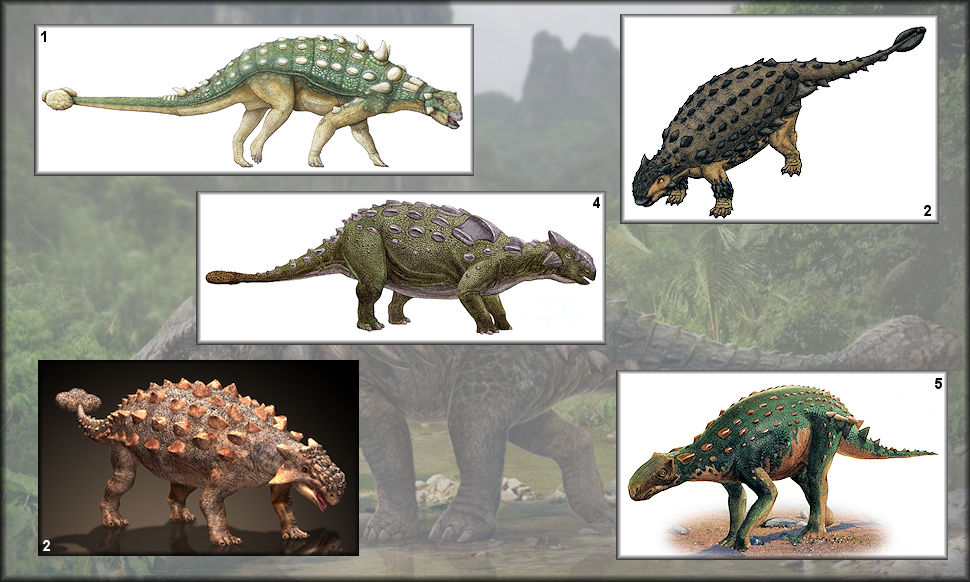
Given the ferocious dinosaurs that roamed the planet during the Jurassic and Cretaceous periods–toothy beasts like AllosaurusUtahraptor and T. rex–it would be surprising if some plant-eaters didn’t evolve elaborate defenses. The ankylosaurs (Greek for “fused lizards”) are a case in point: to avoid being lunched on, these herbivorous dinosaurs developed tough, scaly body armor, as well as spikes and bony plates, and some species had dangerous clubs on the ends of their long tails that they swung at approaching carnivores.

Ankylosauridae phylogeny

Although Ankylosaurus is by far the best-known of all the ankylosaurs, it was far from the most common (or even the most interesting, if the truth be told). By the end of the Cretaceous period, ankylosaurs were among the last dinosaurs standing; hungry tyrannosaurs couldn’t wipe them off the face of the earth, but the K/T Extinction did. In fact, 65 million years ago, some ankylosaurs had developed such impressive body armor–Euoplocephalus even had armored eyelids!–that they would have given an M-1 tank a run for its money.

Tough, knobby armor wasn’t the only feature that set ankylosaurs apart (though it was certainly the most noticeable). As a rule, these dinosaurs were stocky, low-slung, short-legged, and probably extremely slow quadrupeds that spent their days grazing on low-lying vegetation and didn’t possess much in the way of brain power.

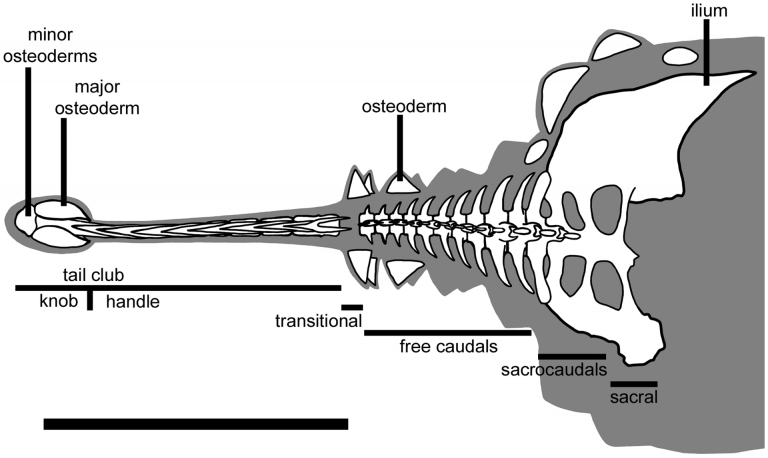
Dyoplosaurus tail reconstruction, showing terms used for parts of ankylosaurid tails

As with other types of herbivorous dinosaurs, such as sauropods and ornithopods, some species may have lived in herds, which would have afforded even more defense against predation. (By the way, the closest relatives of ankylosaurs were stegosaurs, both groups being classified as “thyreophoran” (“shield-bearing”) dinosaurs.)

ANKYLOSAUR EVOLUTION

Although the evidence is spotty, paleontologists believe that the first identifiable ankylosaurs–or, rather, the dinosaurs that subsequently evolved into ankylosaurs–arose in the early Jurassic period. Two likely candidates are Sarcolestes, a middle Jurassic herbivore known only from a partial jawbone (this dinosaur received its name–Greek for “flesh thief”–before it had been identified as a plant eater) and Tianchisaurus. On much better footing is the late Jurassic Dracopelta, which measured only about three feet from head to tail but possessed the classic armored profile of later, bigger ankylosaurs, minus the clubbed tail.

Scientists are on much firmer ground with later discoveries. The nodosaurs (a family of armored dinosaurs closely related to, and sometimes categorized under, the ankylosaurs) flourished in the mid-Cretaceous period; these dinosaurs were characterized by their long, narrow heads, small brains, and lack of tail clubs. The most well-known nodosaurs included Nodosaurus, Sauropelta and Edmontonia, the last being especially common in North America.

One notable fact about ankylosaur evolution is that these creatures lived just about everywhere on earth.

The first dinosaur ever discovered in Antarctica–named, appropriately enough, Antarctopelta–was an ankylosaur, as was the Australian Minmi, which possessed one of the smallest brain-to-body ratios of any dinosaur (a nice way of saying that it was very, very dumb). Most ankylosaurs and nodosaurs, though, lived on the land masses, Gondwana and Laurasia, that later spawned North America and Asia.

LATE CRETACEOUS ANKYLOSAURS

During the late Cretaceous period, ankylosaurs reached the apex of their evolution. From 75 to 65 million years ago, some ankylosaur genera (most notably Ankylosaurus and Euoplocephalus) developed incredibly thick and elaborate armor, doubtless a result of the ecological pressures applied by bigger, stronger predators like Tyrannosaurus rex. One can imagine that very few carnivorous dinosaurs would dare to attack a full-grown ankylosaur since the only way to kill it would be to flip it onto it back and bite its soft underbelly.

Still, not all paleontologists agree that the armor of ankylosaurs (and nodosaurs) had a strictly defensive function. It’s possible that some ankylosaurs used their spikes and clubs to establish dominance in the herd or to joust with other males for the right to mate with females, an extreme example of sexual selection. This is probably not an either/or argument, though: since evolution works along multiple paths, it’s likely that ankylosaurs evolved their armor for defensive, display and mating purposes all at the same time.

Source: www.NatGeo.com, www.Wikipedia.org

Stegosauria Facts

Wednesday, May 24, 2017

Stegosauria

Stegosauria is a group of herbivorous ornithischian dinosaurs that lived during the Jurassic and early Cretaceous periods. Stegosaurian fossils have been found mostly in the Northern Hemisphere, predominantly in what is now North America, Europe and China, though one species (Kentrosaurus aethiopicus) is known to have lived in Africa. Their geographical origins are unclear; the earliest unequivocal stegosaurian, Huayangosaurus taibaii, lived in China.

Stegosaurus, the classic Jurassic stegosaur that gave this breed its name (Senckenberg Museum)

Stegosaurs are classified as ornithischian (“bird-hipped”) dinosaurs. Their closest relatives were the armored dinosaurs known as ankylosaurs, and they were more distantly related to other four-footed plant-eaters like hadrosaurs (aka duck-billed dinosaurs) and ornithopods. In a crucial way, though, stegosaurs were less successful than these other dinosaurs: they only flourished toward the end of the Jurassic period (about 160 to 150 million years ago), with only a handful of species managing to survive into the ensuing Cretaceous.

Stegosaurians were armored dinosaurs (thyreophorans). Originally, they did not differ much from more primitive members of that group, being small, low-slung, running animals protected by armored scutes. An early evolutionary innovation was the development of tail spikes, or “thagomizers”, as defensive weapons. Later species, belonging to a subgroup called the Stegosauridae, became larger, and developed long hindlimbs that no longer allowed them to run. This increased the importance of active defence by the thagomizer, which could ward off even large predators because the tail was in a higher position, pointing horizontally to the rear from the broad pelvis. Stegosaurids had complex arrays of spikes and plates running along their backs, hips and tails. Their necks became longer and their small heads became narrow, able to selectively bite off the best parts of cycads with their beaks. When these plant types declined in diversity, so did the stegosaurians, which became extinct during the first half of the Cretaceous period.

There are still some mysteries, though: for example, the tantalizingly named Gigantspinosaurus had two huge spikes protruding from its shoulders, making its exact classification within the stegosaur line (if it even belongs there) a matter of controversy. The last stegosaur to appear in the fossil record is the mid-Cretaceous Wuerhosaurus, though it’s possible that some as-yet-undiscovered genus may have survived to the brink of the K/T Extinction 65 million years ago.

WHY DID STEGOSAURS HAVE PLATES?

The most enduring mystery about stegosaurs is why they possessed those characteristic double rows of plates and spikes along their backs, and how these plates and spikes were arranged. To date, no stegosaur fossil has been unearthed with the plates still attached to its skeleton, leading some paleontologists to conclude that these scutes (as they’re technically called) lay flat along the dinosaur’s back, like the thick armor of ankylosaurs. However, most researchers still believe that these plates were arranged semi-vertically, as in popular reconstructions of Stegosaurus.

Stegosaurus plates

This leads naturally to the question: did these plates have a biological function, or were they strictly ornamental?

Because scutes pack a large surface area into a small volume, it’s possible that they helped to dissipate heat during the night and absorb it by day, and thus regulated their owner’s presumably cold-blooded metabolism. But it’s also possible that these plates evolved to deter predators, or to help differentiate males from females. The trouble with these latter two explanations is that a) it’s hard to see how an upright array of blunt plates could possibly have intimidated a hungry Allosaurus, and b) there has been very little evidence to date of sexual dimorphism among stegosaurs.

One of the earliest skeletal reconstructions of Stegosaurus published by O. C. Marsh in 1896 shows a single row of plates and a tail with eight spikes, as well as a very short neck. Othniel Charles Marsh, 1896

The first stegosaurian finds in the early 19th century were fragmentary. Better fossil material, of the genus Dacentrurus, was discovered in 1874 in England. Soon after, in 1877, the first nearly-complete skeleton was discovered in the United States. Professor Othniel Charles Marsh that year classified such specimens in the new genus Stegosaurus, from which the group acquired its name, and which is still by far the most famous stegosaurian. During the latter half of the twentieth century, many important Chinese finds were made, representing about half of the presently known diversity of stegosaurians.

Source: www.NatGeo.com, www.wiki.org

Pleistocene Epoch

Wednesday, May 24, 2017

Pleistocene modern humans hunting a Mammoth with spears

The Pleistocene Epoch is typically defined as the time period that began about 1.8 million years ago and lasted until about 11,700 years ago. The most recent Ice Age occurred then, as glaciers covered huge parts of the planet Earth.

There have been at least five documented major ice ages during the 4.6 billion years since the Earth was formed — and most likely many more before humans came on the scene about 2.3 million years ago.

The Pleistocene Epoch is the first in which Homo sapiens evolved, and by the end of the epoch humans could be found in nearly every part of the planet. The Pleistocene Epoch was the first epoch in the Quaternary Period and the sixth in the Cenozoic Era. It was followed by the current stage, called the Holocene Epoch.

Earth during Pleistocene, 18,000 years ago Timescale

Worldwide ice sheets

At the time of the Pleistocene, the continents had moved to their current positions. At one point during the Ice Age, sheets of ice covered all of Antarctica, large parts of Europe, North America, and South America, and small areas in Asia. In North America they stretched over Greenland and Canada and parts of the northern United States. The remains of glaciers of the Ice Age can still be seen in parts of the world, including Greenland and Antarctica.

But the glaciers did not just sit there. There was a lot of movement over time, and there were about 20 cycles when the glaciers would advance and retreat as they thawed and refroze. Scientists identified the Pleistocene Epoch’s four key stages, or ages — Gelasian, Calabrian, Ionian and Tarantian.

The name Pleistocene is the combination of two Greek words: pleistos (meaning “most”) and kainos (meaning “new” or “recent”). It was first used in 1839 by Sir Charles Lyell, a British geologist and lawyer.

As a result of Lyell’s work, the glacial theory gained acceptance between 1839 and 1846, and scientists came to recognize the existence of ice ages. During this period, British geologist Edward Forbes aligned the period with other known ice ages. In 2009, the International Union of Geological Sciences established the start of the Pleistocene Epoch at 1.806 million years before the present.

Defining an epoch

While scientists haven’t been able to determine the exact causes of an epoch, changes in ocean current, composition of the atmosphere, changes in the position of the Earth in relation to the sun are believed to be key contributors.

Overall, the climate was much colder and drier than it is today. Since most of the water on Earth’s surface was ice, there was little precipitation and rainfall was about half of what it is today. During peak periods with most of the water frozen, global average temperatures were 5 to 10 degrees C (9 to 18 degrees F) below today’s temperature norms.

There were winters and summers during that period. The variation in temperatures produced glacial advances, because the cooler summers didn’t completely melt the snow.

Life during the Ice Age

While Homo sapiens evolved, many vertebrates, especially large mammals, succumbed to the harsh climate conditions of this period.

One of the richest sources of information about life in the Pleistocene Epoch can be found in the La Brea Tar Pits in Los Angeles, where remains of everything from insects to plant life to animals were preserved, including a partial skeleton of a female human and a nearly complete woolly mammoth.

In addition to the woolly mammoth, mammals such as saber-toothed cats (Smilodon), giant ground sloths (Megatherium) and mastodons roamed the Earth during this period. Other mammals that thrived during this period include moonrats, tenrecs (hedgehog-like creatures) and macrauchenia (similar to a llamas and camels).

Although many vertebrates became extinct during this period, mammals that are familiar to us today — including apes, cattle, deer, rabbits, kangaroos, wallabies, bears, and members of the canine and feline families — could be found during this time.

Other than a few birds that were classified as dinosaurs, most notably the Titanis, there were no dinosaurs during the Pleistocene Epoch. They had become extinct at the end of the Cretaceous Period, more than 60 million years before the Pleistocene Epoch began.

Birds flourished during this period, including members of the duck, geese, hawk and eagle families. There were also some flightless birds such as ostriches, rheas and moas. The flightless birds did not fare as well, as they had to compete with mammals and other creatures for limited supplies of food and water, as a good portion of the water was frozen.

Crocodiles, lizards, turtles, pythons and other reptiles also thrived during this period.

As for vegetation, it was fairly limited in many areas. There were some scattered conifers, including pines, cypress and yews, along with some broadleaf trees such as beeches and oaks. On the ground, there were prairie grasses as well as members of the lilly, orchid and rose families.

Mass extinction

About 13,000 years ago, more than three-fourths of the large Ice Age animals, including woolly mammoths, mastodons, saber-toothed tigers and giant bears, died out.  Scientists have debated for years over the cause of the extinction, with both of the major hypotheses — human overhunting and climate change — insufficient to account for the mega die-off.

Recent research suggests that an extraterrestrial object, possibly a comet, about 3 miles wide, may have exploded over southern Canada, nearly wiping out an ancient Stone Age culture as well as megafauna like mastodons and mammoths.

Source: www.wikipedia.org

30 Coolest Jurassic Park Facts

Wednesday, May 24, 2017

30 Coolest Jurassic Park Facts

Trivia 65 million years in the making.

Deleted scenes
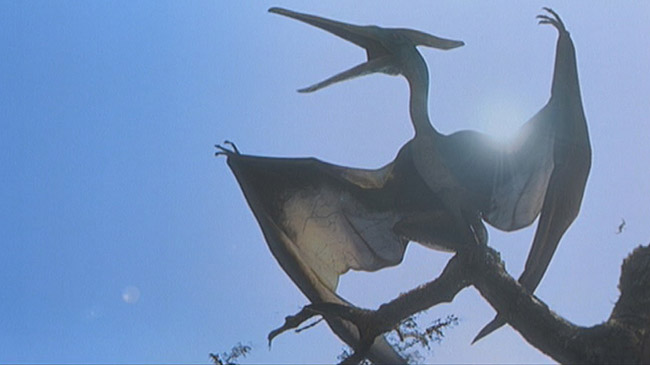
Set-pieces that were cut from the original Jurassic Park include one in which the T. rex terrorizes a river ride, and a scene involving a pterodactyl, which was cut for budget reasons. Both of these were incorporated into Jurassic park III.

There was also a planned scene in which young Lex rides a baby triceratops. This was cut and the model dinosaur was later used in The Lost World: Jurassic Park .

Setting a bad example
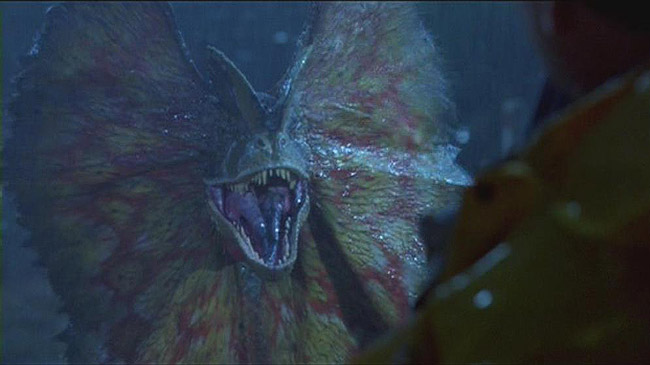
One of the scariest dinosaurs seen in the first film is the all-frills, all-spills Dilophosaurus. And yet, it’s most memorable features were all made up one way or the other.

Michael Crichton, author of the original novel, invented the dino’s deadly venom-spitting ability, and Spielberg added the terrifying rattling neck-frill. In real life, the Dilophosaurus didn’t have either of these traits. And yet everyone who grew up watching the film now thinks differently. Tsk.

Special effects
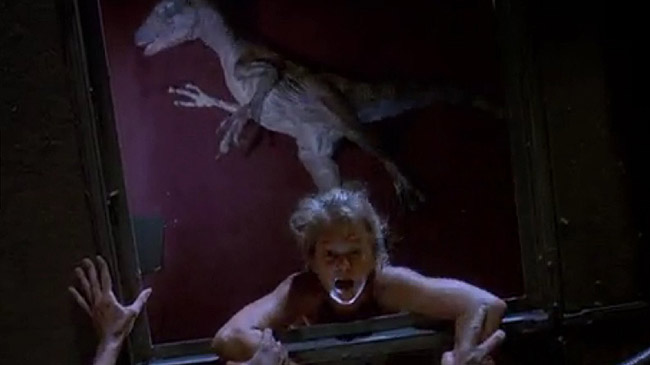
While the film has long been praised for advancing computer-animated graphics in order to resurrect all manner of extinct creatures, making the dinos walk and roar weren’t the only things on ILM’s to-do list.

In the scene where Lex falls through the ceiling, the stunt double for actress Ariana Richards accidentally looked directly at the camera, and so ILM had to CGI-paste Richards’ face over hers to cover up the error.

Black and white
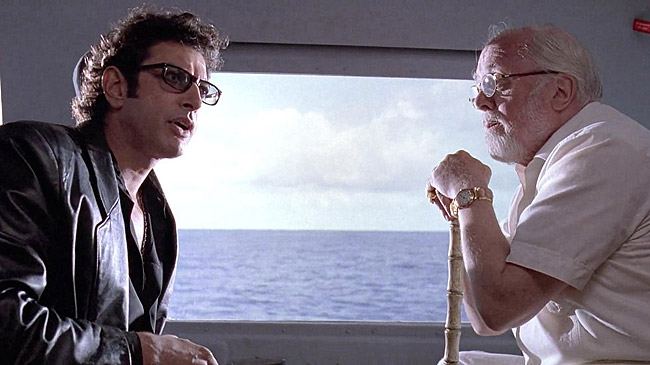
It’s no coincidence that Ian Malcolm wears black throughout most of the film, while Hammond wears mostly white. This is to represent the fact that the two are diametrically opposed idealistically.

During production of the film, Spielberg identified himself as Hammond – the dreamer – and author Michael Crichton as Malcolm – the voice of reason.

UNIX system
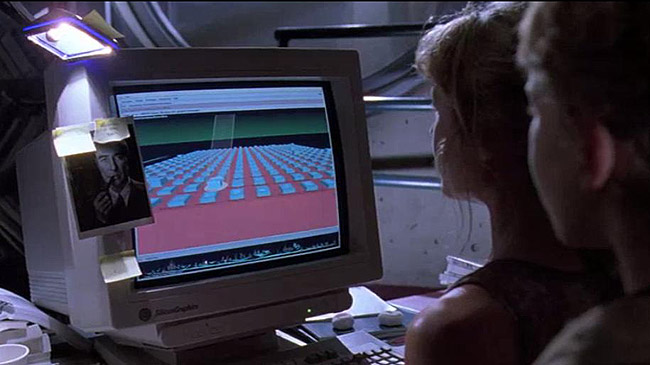
For all of the resurrected dinos and extreme action sequences, one of the more ridiculous moments in the film comes when Lex recognises the park’s UNIX system.

Instantly dating the film with an ancient computer software program that looks entirely fake, the UNIX system seen in the film is actually a real 3D file management browser called Fsn (‘fusion’). No one has ever found a practical use for it (probably).

Suit up
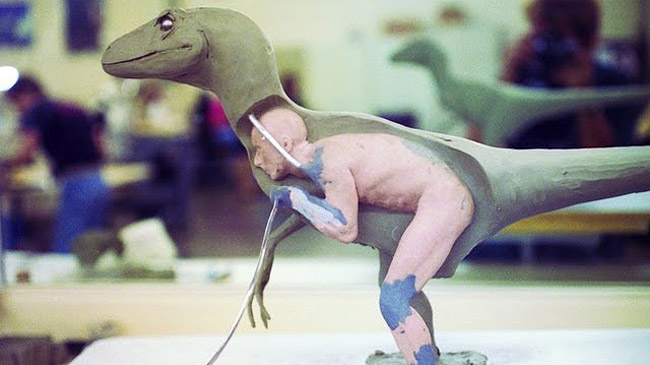
Everyone knows that ILM worked wonders with the CGI effects, while Stan Winston’s studio made good with the realistic animatronics, but did you know that the dinosaurs were brought to life in another – much more B-movie – way?

Some of the shots of the velociraptors in the climactic kitchen scene were actually achieved by animators wearing rubber suits. In Jurassic Park III, the animators had specially-made ‘raptor pants’ to wear for shots of the dinos’ legs.

We would give anything to own a pair.

Science wrongs
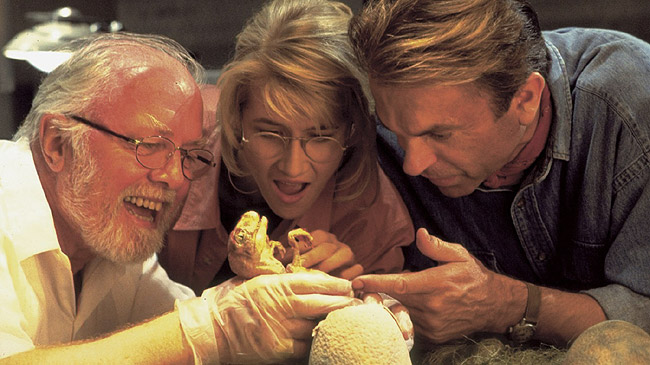
Sadly, for all the film’s monster blockbuster entertainment, there always has to be someone to come along and ruin the fun. In this case, it’s the scientists who have since proven inaccuracies of many of the dinosaur depictions seen.

For example, velociraptors were actually the size of turkeys, with many palaeontologists believing that they were actually covered in feathers. They wouldn’t be nearly as scary though, right?

The follow-up
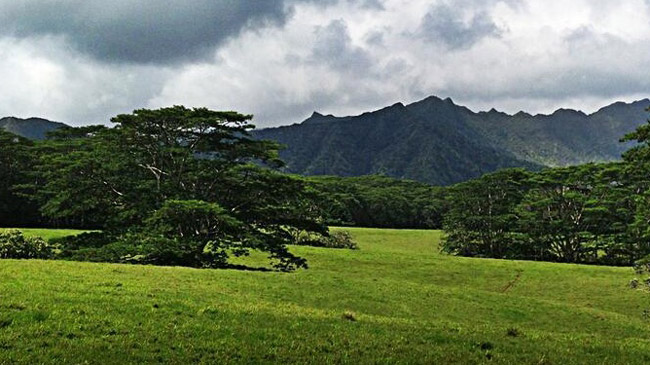
Despite the aforementioned corrections that scientists have made about the dino assumptions in Jurassic Park , it seems that this won’t affect how they are portrayed in Jurassic World .

Director Colin Trevorrow is quoted as saying that there will be no feathered dinosaurs in Jurassic Park 4 . He has also tweeted a pic of Kauai in Hawaii along with the word “Nublar”, the island from the previous films.

Other things that have been teased about the sequel include consultant Jack Horner saying that there will be a brand new dinosaur cast as the villain of the film, and Trevorrow clarifying where the film sits in the franchise: “Reboot is a strong word. This is a new sci-fi terror adventure set 22 years after the horrific events of Jurassic Park ”.

Weathering the storm
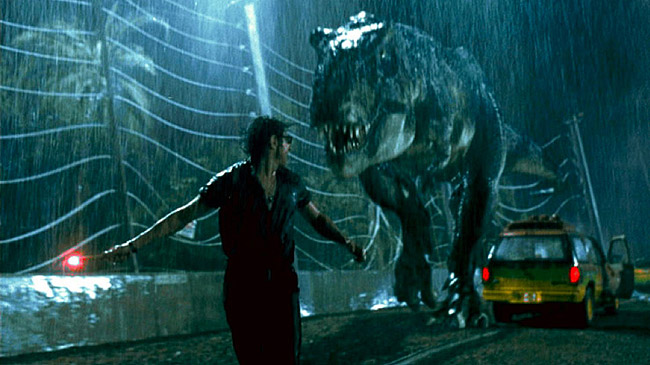
During the filming of Jurassic Park , the film’s central location – the Hawaiian island of Kauai – was hit by Hurricane Iniki. Thankfully, it didn’t cause too much damage. In fact, for some people, it barely disturbed sleep.

Richard Attenborough awoke the next day, having slept all the way through it. When Spielberg met this with disbelief, Attenborough said: “Dear boy, I survived the blitz!”

Skimping on the goods
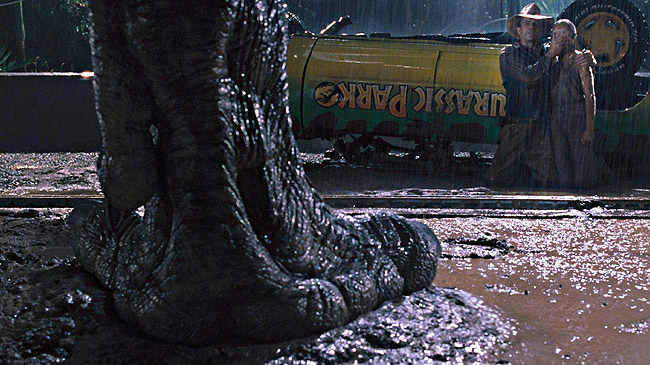
If there was ever proof needed that less is more when it comes to showing all your cards in a blockbuster movie, this is it.

Despite having a running time of 127 minutes, Jurassic Park only actually contains roughly 15 minutes of actual dinosaur footage. Anyone cheeky enough to ask for their money back?

Alternate casting
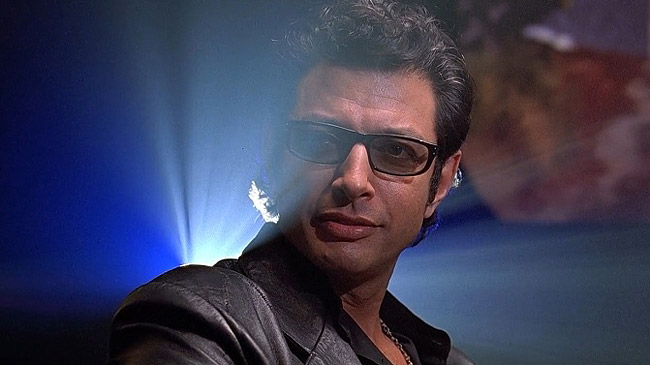
Oh, what could have been.

During casting of Jurassic Park , William Hurt turned down the role of Alan Grant without even reading the script. Harrison Ford also turned the role down, while Richard Dreyfuss, Tom Sizemore and Dylan McDermott were all also considered.

Sean Connery was first sought for the role of Hammond, and Sandra Bullock, Gwyneth Paltrow, Robin Wright-Penn, Teri Hatcher, Julianne Moore, Helen Hunt, Elizabeth Hurley and Juliette Binoche all tested for the role of Ellie Sattler.

Aaaand Christina Ricci auditioned to play Lex. And, most amazingly of all, Jim Carrey auditioned for the part of Ian Malcolm, and according to casting director Janet Hirshenson, he performed really well..

Tech error
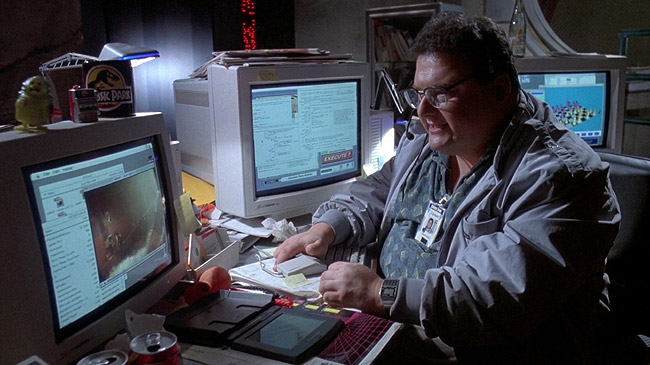
For all of the film’s sophistication in advancing computer effects, there is a glaring rookie mistake of an error in the film when it comes to depicting real-world technology.

When Nedry communicates with the dock via webcam, it is actually just a Quicktime video playing on screen. You can even see the time bar moving along the bottom of the screen as it plays. D’oh!

Terrifying-Rex
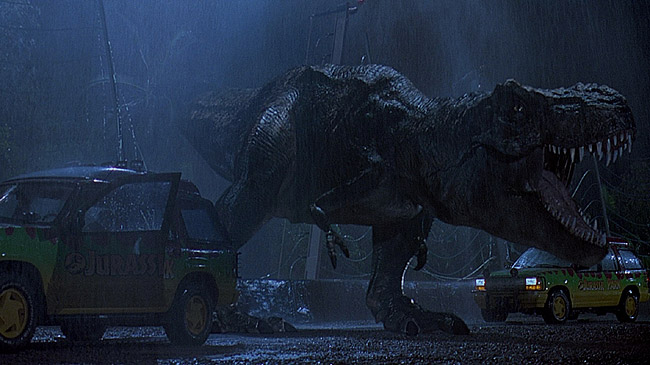
If you thought the T. rex looked scary on screen, apparently things weren’t all that different during filming either. Thanks to the rain, the animatronic T. rex would frequently short circuit and ‘come alive’ of its own accord.

Producer Kathleen Kennedy has said: “We’d be, like, eating lunch, and all of a sudden a T. rex would come alive. At first we didn’t know what was happening, and then we realized it was the rain. You’d hear people start screaming.”

Enjoy the ride
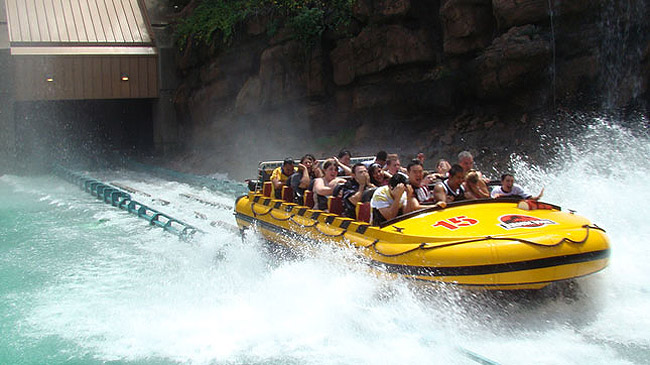
In 1996, Jurassic Park: The Ride opened at Universal Studios Hollywood and went on to become a hugely successful theme park attraction that has got many, many people soaking wet with its massive final splashdown.

Cast members Jeff Goldblum, Ariana Richards and Joseph Mazzello all attended the launch, as did Steven Spielberg – who surprised everyone by proving to be a bit of a wimp and asking to exit the ride just before it’s big 84-foot drop.

Dino love
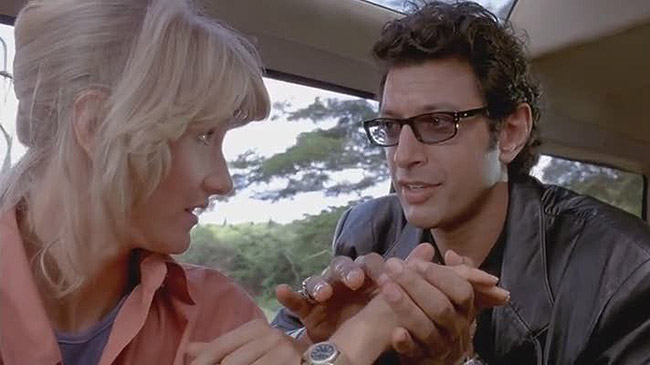
Did you enjoy the clear spark between Ellie Satler and Dr Ian Malcolm as the latter spouted chaos theory philosophy to flirt outrageously with Alan Grant’s wife?

Well, it seems there was a reason that the two seemed so well suited – Jeff Goldblum and Laura Dern actually got engaged after Jurassic Park , and stayed engaged for two years before eventually splitting up.

Flare up
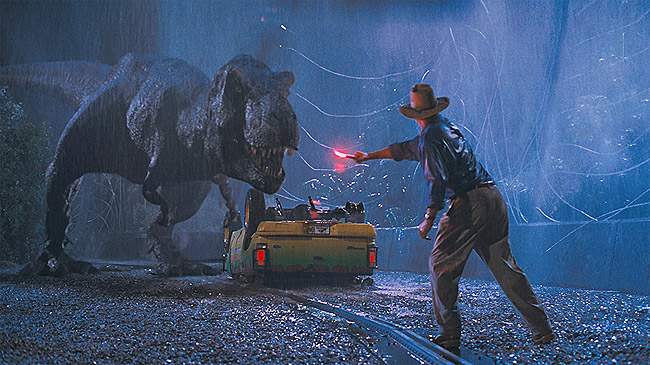
The extreme danger depicted in Jurassic Park wasn’t just contained to the big screen. Sam Neill managed to injure himself during filming with… um… a flare.

According to Neill, during the scene in which Grant uses the flare to distract the T. rex: “It dropped some burning phosphorous on me and got under my watch and took a chunk of my arm out.” Still better than a dinosaur taking a chunk of your arm out though, eh?

Extinction
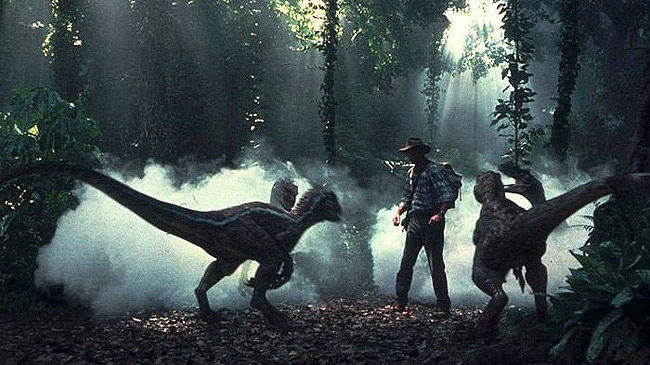
Ian Malcolm’s line about being extinct is actually stolen from animator Phil Tippett (he of “You had one job, Phil” Internet meme fame).

After all his work developing stop-motion techniques for the film, Spielberg had to break the news to him that he was going to use digital effects instead, to which Phil replied “I think we’re extinct”.

Mr. DNA
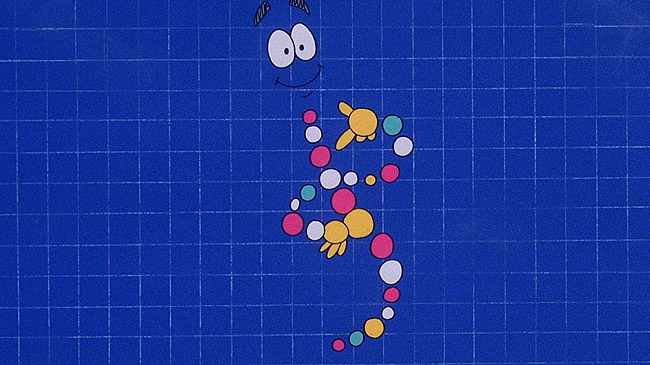
The lovable exposition-providing cartoon character was originally conceived out of an off-the-cuff sarcastic comment.

According to screenwriter David Koepp, he and Spielberg were struggling with ways to explain the science behind the concept. He says: “One of us said, ‘What are we supposed to do? Have a little animated character called Mr. DNA?’ And the other one said, ‘Yes! That’s exactly what we’re going to do!'”

Cameo time
Steven Spielberg actually makes an appearance in The Lost World: Jurassic Park, but you’ll be forgiven for having not spotted it. This has to be one of the most subtle cameos on record…

During the CNN broadcast about the dinosaurs’ return, if you look really closely, you can see Jeff Goldblum in the reflection of the TV. And sitting next to him? Mr Spielberg, eating popcorn.You have to REALLY want to see it to spot him.

Casting Tim
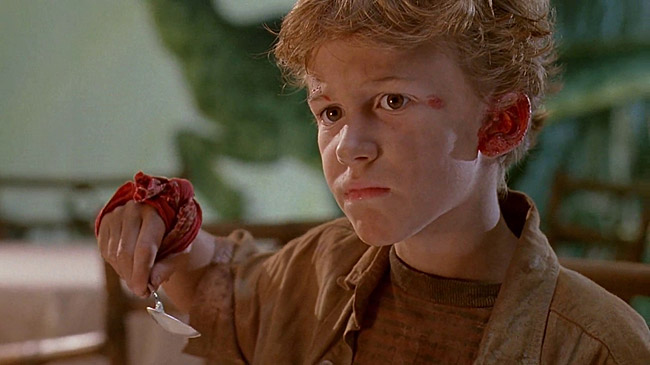
Joseph Mazzello, who plays young Tim in the movie, originally auditioned for Hook. Spielberg turned him away then for being too young, but was still impressed and told him “Don’t worry, Joey. I’m going to get you in a movie this summer”.

And his casting as Tim actually led Spielberg to reverse the ages of the children. In Crichton’s novel, Tim is the older sibling, but Spielberg felt that he couldn’t have a girl so young put in mortal peril, so he made Lex the older sister to Tim.

Good vibrations
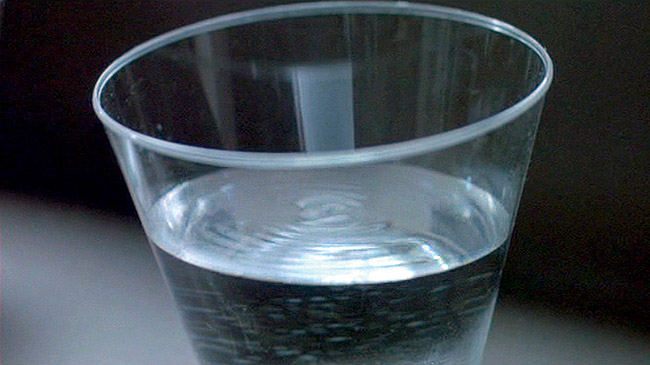
The film’s most iconic shot – the glass of water vibrating at every step of the thunderous T. rex – actually first came to Spielberg when he saw his rearview mirror shake while listening to Earth, Wind & Fire in the car.

It proved problematic to recreate, but FX expert Michael Lantieri eventually made the rippling effect happen by strumming a guitar string, that was attached under the dashboard beneath the glass.

Pet sounds
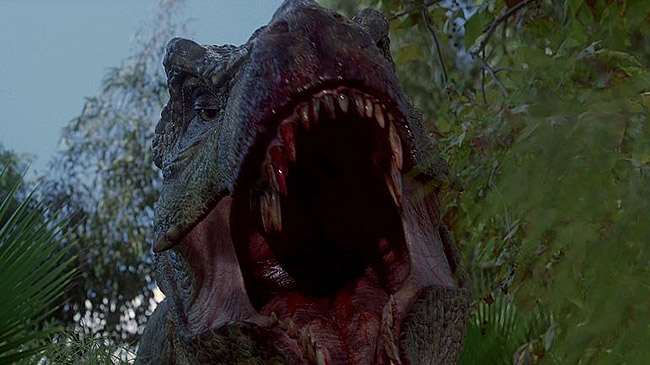
Want to know how all those wonderful roars and growls were created? The T. rex was a combination of an elephant trumpeting and, hilariously, penguin mating sounds, as well as dog, tiger and alligator noises.

The Dilophosaurus was given a voice made up of howler monkeys, hawks, swans and rattlesnakes, while the Velociraptor squeal is a combo of elephant seal pups, walruses and dolphin squeaks.

And when the T-Rex catches a Galliminus in its mouth and shakes it? What you’re hearing there is a dog with a chew toy.

Apportioning blame
Apportioning blame

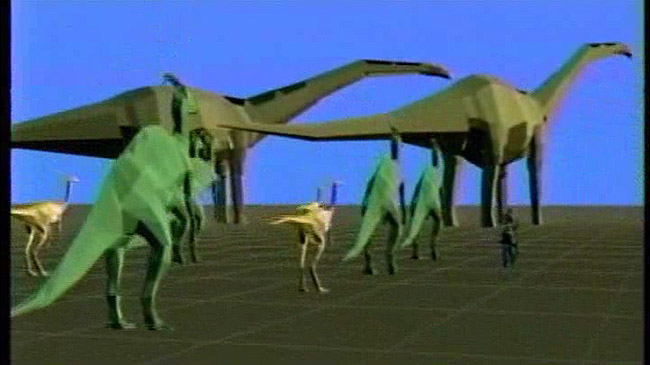
Jurassic Park is indirectly responsible for Star Wars: Episode I – The Phantom Menace .

After completing principal photography on Jurassic Park , Spielberg left the post-production process early in order to start making Schindler’s List , and he left George Lucas in charge of overseeing the film’s digital effects. And it was while doing this that Lucas saw the improvements that had been made in CGI and decided that he could make his long-mooted Star Wars prequels.

Sick as a Triceratops
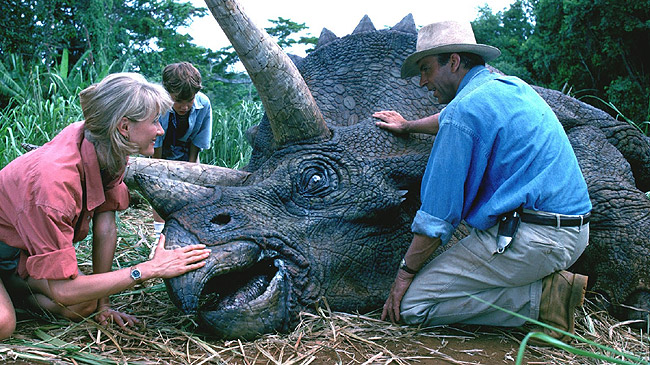
So, why exactly was that Triceratops so ill?

We don’t get an answer for Trikey’s sickness in the movie but Michael Crichton’s novel and screenplay (in which it was actually a Stegosaurus) supplies an answer.

It is explained that the dino lacks suitable teeth for chewing and so, like birds, would swallow rocks and use them to grind food in its digestive tract. After six weeks, the rocks would become too smooth to be useful, and the animal would regurgitate them. When finding new rocks to use, the Triceratops also swallowed toxic berries

Computer games
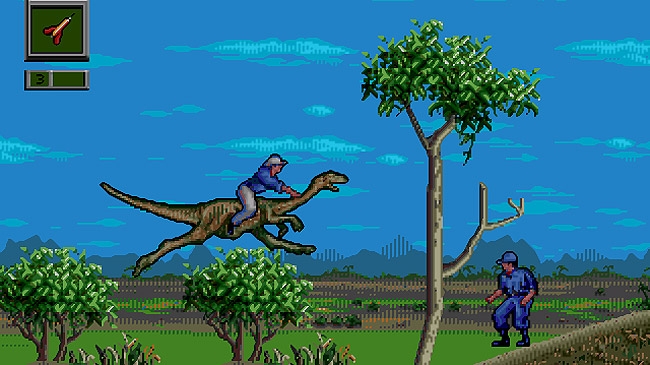
Computer games

Since the film’s release there have been several Jurassic Park console games, for many different platforms. Subtitles for these games include The Chaos Continues, Trespasser, Chaos Island, Warpath, Scan Command, Survival, Operation Genesis, Dino Defender, Dinosaur Battles and Danger Zone !

All of which sound awesome.

Canny casting
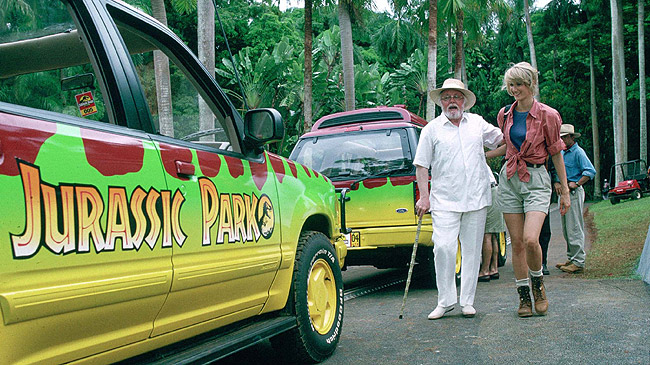
Here’s a rare case of the source material dictating a real-life actor to be cast in the eventual movie adaptation…

In Michael Crichton’s original novel, he specifically mentions that the Jurassic Park audio tour is narrated by Golden Globe-winning actor Richard Kiley.

So, of course, Spielberg hired Kiley to provide the voiceover in the park vehicles.

Shattered glass
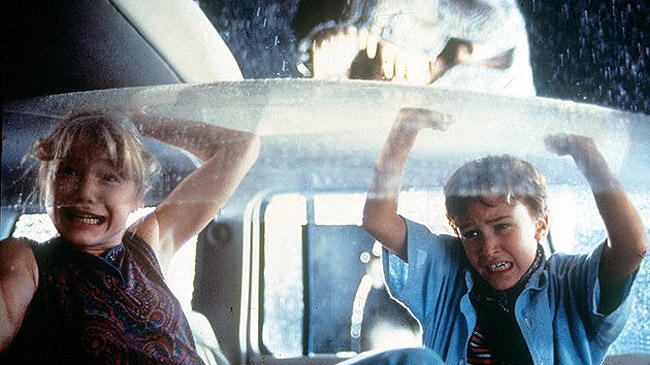
If you thought that the young kids Lex and Tim were particularly convincing during the T-Rex’s attack on their car, there’s a reason.

When the monster dinosaur comes through the roof of the Explorer, the glass wasn’t meant to break, so the children’s screams were very real.

Alternate ending
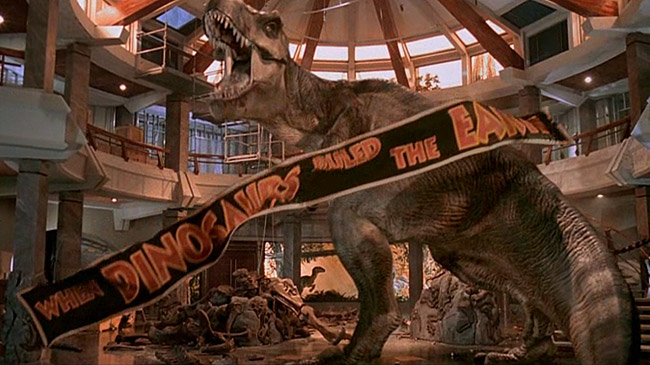
Originally, Jurassic Park was going to end just with Grant saving the kids from the raptors. He was going to shoot one dead and then use a mechanical T. rex skeleton in the foyer to kill the other.

However, Spielberg realised that he needed one last triumphant return for the T. rex and so changed the ending to include him in. Maybe this late change explains the long-debated question of how the T-Rex seems to appear out of nowhere?

The Indy connection
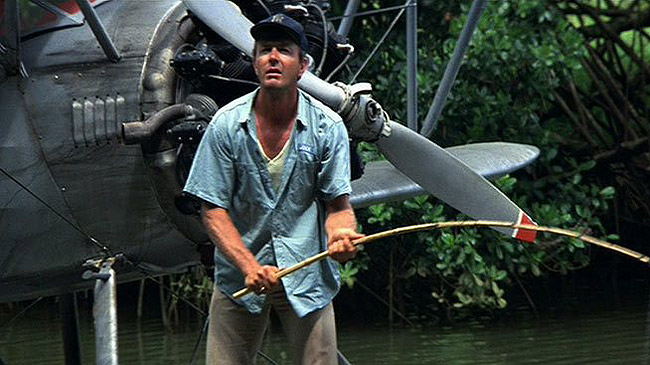
The Indy connection

In incredible movie-crossover trivia, the helicopter pilot who rescued the cast and crew when Hurricane Iniki hit the filming location is one Fred Sorenson.

Sorenson has a film credit of his own to his name. He plays Jock, the seaplane pilot who rescues Indiana Jones at the start of Raiders Of The Lost Ark .

The Jurassic Park 4 that nearly happened
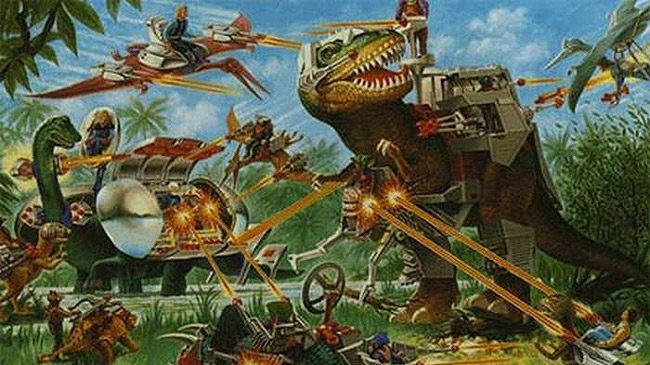
The new sequel, Jurassic World , very nearly ended up as a very different film.

Before production was dropped and the idea shelved many years ago, a script was written for Jurassic Park 4 that involved genetically altered dinosaurs being bred for war and trained to carry weapons for battle.

There is no part of this that we don’t want to see.

Original article source: www.gamesradar.com (2014)

Jurassic Park III: Trivia & Cool Facts

Tuesday, May 23, 2017

Jurassic Park III (2001) Trivia

≠ According to an interview with William H. Macy, the actor said the film’s animatronic Spinosaurus had a 1,000-horsepower motor and that creature could turn its head at twice the force of gravity, with the tip of its nose moving at a speed of more than 100 miles per hour.

≠ The effects crew used 250 gallons of oatmeal to simulate Spinosaur droppings.

≠ The establishing wide shot of the dig site was actual footage filmed in early summer 2001 of Jack Horner’s excavation, which contained several large Tyrannosaurs and some Hadrosaurs.

≠ The Spinosaurus was the largest animatronic ever built. It weighed 12 tons and was operated by hydraulics. This allowed it to operate while completely submerged in water.

≠ A few of the action sequences are borrowed from left over ideas from the first two Jurassic Park films, some of which were in the original scripts and made it as far as being storyboarded before they were scrapped due to time and budget constraints. These scenes include the pteranodon and river boat sequences.

≠ Sam Neill, as part of his contract, requested that the Australasian premiere of the film took place in his hometown of Dunedin, New Zealand.

≠ Jeff Goldblum confirmed in an interview that he was not invited back to reprise his role from the earlier Jurassic Park titles.

≠ The Raptors refusing to abandon their young is taken from Jack Horner’s research.

Jurassic Park 3: Sam Neill vs raptors

≠ When the paleontologists enter the bar for dinner with the Kirby’s, you can see a Jurassic Park (1993) pinball machine in the background.

≠ Mirroring the latest palaeontologic finds that were made at the time, feathers were added onto various parts of the Velociraptor males, most noticeably on the top of their head. More recent finds suggest that raptors were indeed covered in feathers, a fact most members of the general public still find hard to digest. However the type of feather they used in the movie is incorrect: real raptors had the same kind of feathers as modern birds, and these covered their entire body, save for the tip of their snout.

≠ Michael Crichton worked with the screenwriters several days to brainstorm about a story, but left after some days when he could not come up with a satisfactory idea.

≠ After the Spinosaurus’ attack on the airplane, Grant asks Billy how he would classify the animal. Billy’s first inclination is to say the dinosaur is a Suchomimus or Baryonyx, due to the large snout. This is a joke meant for many fans of the film who, when the new movie’s logo was first revealed, said the exact same thing Billy did. Many long pages on the message boards of fan pages and the official page were dedicated to this debate.

≠ Shooting for the film began before the final script was completed.

≠ Original scripts and storyboards had a Baryonyx as the main dinosaur instead of the Spinosaurus. Baryonyx is a close relative of the Spinosaurus and they looked basically the same. Baryonyx was a little smaller, and did not have the fin like the Spinosaurus did. Director Joe Johnston wanted a main dinosaur that would not be confused with the T-Rex. Though the Baryonyx would have been vastly different, the Spinosaurus had a bizarre look no other carnivore had.

≠ When Ellie is talking to Grant she mentions getting a quote from Jack Horner for her book. Jack Horner is a paleontologist who was Michael Crichton’s inspiration for the character of Alan Grant; he was also a consultant on all of the three “Jurassic Park” films.

≠ Steven Spielberg initially devised a story idea which involved Dr. Alan Grant living on one of InGen’s islands to study dinosaurs. Because he was not allowed in for research, he was living in a tree like Robinson Crusoe. However, Johnston rejected the idea because he couldn’t imagine Dr. Grant returning to any island inhabited by dinosaurs after the events of the first film.

Jurassic Park III Cast

≠ When Billy and Dr. Grant are on the plane, Dr. Grant sleeps like Indiana Jones, by putting his hat over his head when he sleeps.

≠ The second script involved a Pteranodon escaping from Isla Sorna and causing a string of mysterious killings on the mainland, which was to be investigated by Dr. Alan Grant and other characters. The project was green-lit but, five weeks before shooting began, the entire script was rejected by Steven Spielberg and Joe Johnston; Johnston felt that the story was too complicated. By that time, $18 million were already spent on the project.

≠ The computer-controlled “rapid prototyper” portrayed in the film is real technology, able to mechanically sculpt parts and objects in three dimensions using computerized drawings and scanned information. The machine in the film uses Laminated Object Manufacturing (LOM). Using one thin layer of bond paper and resin at a time, it carves away the unwanted material as each layer is added, until all the cross-sections have been built up into a solid replica of the original. The carving action of each layer creates a great deal of shavings and dust during the process, which you can see when Billy lifts the lid up to remove the finished model.

≠ Billy has a lucky backpack. The character Sarah Harding in The Lost World: Jurassic Park (1997) also has a lucky backpack.

≠ First time in the franchise that a T-Rex is killed and a Raptor is not.

≠ Although this Jurassic Park movie had no book of its own, most of the scenes were taken from the first and second Jurassic Park books.

≠ This is the shortest of the Jurassic Park franchise. Jurassic Park 3 (2001) runs at 1h 32min, Jurassic Park (1993) runs at 2h 7min, The Lost World: Jurassic Park (1997) runs at 2h 9min, and Jurassic World (2015) runs at 2h 4min.

≠ Dr. Grant’s brown truck with the Museum of the Rockies and Montana State University logos on it is actually based on the vehicle that belongs to Dr. Jack Horner, paleontologist consultant on the Jurassic Park films as well as the man that the character of Grant is based on. It was a difficult and time consuming process to find an exact match of Dr. Horner’s truck to be used in the movie.

≠ When Dr. Grant and Billy enter the bar to meet with the Kirbys, the song “Big Hat, No Cattle” by Randy Newman is playing. This is not a mere coincidence. The song is about lying and making yourself out to be someone who you are not; exactly what the Kirbys do in order to fool Dr. Grant into being their guide. This is further evidenced when Paul takes out his checkbook and claims to be capable of writing whatever amount he wants on it. In the background, you can hear the song saying: “And I lie, lie, lie…” right as the scene ends.

The smartest thing Jurassic Park III does is keep the story nice and simple.

≠ The first of the Jurassic movies not scored by John Williams.

≠ First Jurassic Park film without a book counterpart.

≠ Probably as a joke, Barney & Friends (1992) is shown on television and then the Spinosaurus growling. Trevor Morgan was one of the kids on”Barney.”

≠ Stellan Skarsgård, Steve Buscemi, and Tony Shalhoub were considered for the role of Cooper.

≠ The only Jurassic Park movie so far where a park is not part of the main plot.

≠ The Einhorn 20mm, the large weapon used by the mercenaries, was actually a Barrett M82A2 Bullpup sniper rifle, developed for the US military, but never adopted.

≠ John Williams was contacted to write the music, but he was busy writing the music for Steven Spielberg’s A.I. Artificial Intelligence (2001). Don Davis was chosen as composer at Williams’ recommendation.

≠ Keeps with Steven Spielberg’s theme of broken families.

≠ The 25 September 2000 draft of the screenplay credits revisions to John August. He is not credited in the final film.

≠ The original Jurassic Park (1993) came about while Steven Spielberg and Michael Crichton were developing ER (1994). William H. Macy was on that show.

≠ The first draft of the script involved a group of teenagers marooned on Isla Sorna.

≠ As he leaves Dr. Sattler’s house, Dr. Grant says that he is “The last of my breed.” Ironically, he is driving an Oldsmobile Intrigue, which was one of the last Oldsmobiles made. General Motors closed the Oldsmobile division less than three years after the film’s release.

≠ The twin engine airplane that takes them to the island is a Hawker-Beechcraft King Air 200.

≠ Stephen Sommers and Jan de Bont were both in the running to direct when Steven Spielberg declined to return to the director’s chair.

≠ Trevor Morgan, who plays Eric Kirby, also played Scott Anspaugh on ER (1994). Scott Anspaugh was the son of Dr. Donald Anspaugh (John Aylward), who was Chief of Staff. In Jurassic Park III, he plays William H. Macy’s son. William H. Macy played Dr. David Morganstern on ER, who was the Chief of Surgery. ER was also created by Michael Crichton, the creator of the Jurassic Park franchise.

≠ Téa Leoni’s husband, David Duchovny, has impersonated Jeff Goldblum, star of the previous films, on Saturday Night Live.

≠ Sam Neill plays a character in the The Hunt for Red October (1990). During the climax of that movie, his character says that he would have liked to have seen Montana. Dr Grant meets the character Billy in Montana at a dig site.

≠ During the flight to Isla Sorna, Billy tells Dr Grant a story about hang-gliding off cliffs in New Zealand. Sam Neill, who plays Dr Grant, is born in Ireland but grew up in New Zealand.

≠ When Dr. Grant, Billy and the Kirby’s are in the bar, the last shot is on Grants face as he prepares to name his price. The background musical lyrics are “Lies, Lies, Lies.”

≠ In the original shooting script, the character Udesky (Michael Jeter) was called Ordesky.

≠ William H. Macy would again play a character named Kirby in Blood Father (2016).

≠ The novelization for Young Sherlock Holmes (1985), another Steven Spielberg production, said “prehistoric times”, foreshadowing Spielberg’s Jurassic Park series; also, both this film and Jurassic Park (1993) have scenes with dinosaur dung.

Jurassic Park III: Epic scene with Spinosaurus

Spoilers 

The trivia items below may give away important plot points.

≠ Near the end of the movie, when the Spinosaurus attacks Amanda Kirby (Téa Leoni) in the water and tries to grab her, the actress admits that she was injured by accident during those scenes when its claws would scratch her. When Leoni returned home from work one night and her husband David Duchovny saw the various slashes on her back she received during filming, he asked “At what point in this movie do they whip you?”

≠ The original script had Billy Brennan killed, but Alessandro Nivola protested and director Joe Johnston had him brought back for the end.

≠ The closing scene, which depicts Dr. Grant watching a flock of Pteranadons was the original closing scene for the first film, but the footage was replaced with pelicans in a last minute change.

≠ Pterosaurs were included in the original “Jurassic Park” novel, and had been considered for both of the previous films, but these ideas were abandoned except for a brief scene at the end of The Lost World: Jurassic Park (1997). They are finally featured in this film, in a sequence that is largely based on the aviary subplot in the first novel.

≠ The other reason the Tyrannosaurus is not featured in this movie is because the animatronic puppet was damaged at the neck and was too costly to repair. They instead changed the outcome of the Spinosaur vs. T-Rex fight to have the T-Rex’s neck broken and Spinosaur win.

≠ In the end scene of Jurassic Park (1993) Dr. Alan Grant looks out the helicopter’s window and sees a flock of pelicans, flying beside the helicopter. At the end of this film, Dr. Alan Grant looks out of the plane’s window and sees a group of Pterodons flying beside the plane.

≠ It is subtly implied that Billy was in on the expedition to search for Paul and Amanda Kirby’s son from the beginning, with his own agenda in mind. There are four distinct moments: 1. Billy gives a look that implies he was aware that Paul Kirby would be arriving after showing Dr. Grant the velociraptor resonating chamber 2. Paul Kirby, after introducing himself to Grant, says “how ya doin’, Billy?” implying that the two already knew each other 3. In the same scene, Billy hastily responds “We’d love to” Paul Kirby’s request. 4. On the plane ride to the island Billy turns around, with a clearly facetious look on his face, asks Cooper “how do you know the Kirby’s?” with which Cooper responds “through our church” with an equally sarcastic look. The fact that Billy steals raptor eggs in an effort to fund the dig site, along with his initial excitement of travelling to Isla Sorna is further evidence of this fact.

≠ According to the Masrani Global website, John Hammond was dead by the time of the events of this film.

≠ Body count: 6.

≠ There is a Fan theory that the adult male T rex killed by the Spinosaurus in this is the infant T rex from the lost world (1997) however it could be a rogue T rex as the Infant had a skin color like his parent’s while the T rex in this was more green in color.

≠ This is the second Jurassic Park movie in which actors from the television series, Miami Vice (1984), get eaten by a dinosaur. In the original Jurassic Park, it was Martin Ferrero, who played a recurring character named Izzy Moreno on Vice, as the lawyer who gets eaten by T-Rex. In JP:III, Miami Vice regular John Diehl plays Cooper, the mercenary who gets devoured by Spinosaurus as the plane is trying to take off, and Julio Oscar Mechoso, who plays the Dino-Saur boat captain eaten in the beginning of the film, played first season Miami Vice character Lester Kosko, the Vice squad’s surveillance tech expert. Cooper was also often used as an alias by Ricardo Tubbs, played by Philip Michael Thomas on Miami Vice.

Seismosaurus

Tuesday, May 23, 2017

 Seismosaurus by James Kuether

ABOUT SEISMOSAURUS

Once considered among the biggest and most impressive of all dinosaurs, most experts now agree that the house-sized Seismosaurus was probably an unusually large species of the much better-known Diplodocus. Not to further disillusion you, but there’s also a distinct possibility that Seismosaurus wasn’t quite as big as once believed. Some researchers now say this late Jurassic sauropod weighed as little as 25 tons and was considerably shorter than its stated length of 120 feet, though not everyone agrees with these drastically scaled-down estimates. By this accounting, Seismosaurus was a mere runt compared to the gigantic titanosaurs that lived millions of years later, such as Argentinosaurus and Bruhathkayosaurus.

Seismosaurus has an interesting taxonomic history. Its type fossil was discovered by a trio of hikers, in New Mexico in 1979, but it was only in 1985 that the paleontologist David Gillette embarked on a detailed study.

Diplodocus skeletal mount at the Carnegie Museum of Natural History, Pittsburgh

In 1991, Gillette published a paper announcing Seismosaurus halli, which in a burst of reckless enthusiasm he said may have measured over 170 feet long from head to tail. This certainly generated impressive newspaper headlines, but one imagines it didn’t do much for Gillette’s reputation, as his fellow scientists re-checked the evidence and calculated much more petite proportions (in the process, of course, stripping Seismosaurus of its genus status).

The (indisputably) extreme length of Seismosaurus’ neck–at 30 to 40 feet, it was much longer than the necks of most other sauropod genera, with the possible exception of the Asian Mamenchisaurus –raises an interesting question: could this dinosaur’s heart possibly have been strong enough to pump blood all the way to the top of its head? This may seem like an arcane question, but it bears on the controversy of whether or not plant-eating dinosaurs, like their meat-eating cousins, were equipped with warm-blooded metabolisms. In any case, it’s most likely that Seismosaurus held its neck roughly parallel to the ground, sweeping its head back and forth like the hose of a giant vacuum cleaner, rather than in the more taxing vertical position.

Source: www.NatGeo.com

Mosasaurus

Tuesday, May 23, 2017

Mounted skeleton cast of M. hoffmannii, Maastricht Natural History Museum

Mosasaurus (“lizard of the Meuse River”) is a genus of mosasaurs, carnivorous aquatic lizards. It existed during the Maastrichtian age of the late Cretaceous period, between about 70 and 66 million years ago, in western Europe and North America. The name means “Meuse lizard”, as the first specimen was found near the Meuse River (Latin Mosa + Greek sauroslizard).

Skeleton of M. beaugei by Ghedoghedo. Fossil – Took the picture at Musee des Confluences, Lyon

Mosasaurus was among the last of the mosasaurids, and among the largest. As with most mosasaurids, the legs and feet of Mosasaurus were modified into flippers, and the front flippers were larger than the hind flippers. The largest known species, M. hoffmannii reached lengths up to 17 m (56 ft), slightly longer than its relatives Tylosaurus and HainosaurusMosasauruswas also more robust than related mosasaurids. The skull was more robust than in other mosasaurids, and the lower jaws (mandibles) attached very tightly to the skull. They had deep, barrel-shaped bodies, and with their fairly large eyes, poor binocular vision, and poorly developed olfactory bulbs, experts believe that Mosasaurus lived near the ocean surface, where they preyed on fish, turtles, ammonites, smaller mosasaurs, birds, pterosaurs, and plesiosaurs. Although they were able to dive, they evidently did not venture into deeper waters.

The skull of Mosasaurus tapered off into a short, conical tip. The jaws were armed with massive conical teeth. Their paddle-like limbs had five digits in front and four in back. The body ended in a strong tail, which other mosasaurid fossils suggest had a fluke similar to those of sharks and some ichthyosaurs. The body probably remained stiff to reduce drag through the water, while the end of the tail provided strong propulsion.

Mosasaurus was the first genus of mosasaurs to be named. The first remains known to science were a fragmentary skull from a chalk quarry in the St Pietersberg, a hill near Maastricht, the Netherlands, found in 1764 and collected by lieutenant Jean Baptiste Drouin in 1766. It was procured for the Teylers Museum at Haarlem in 1784 by Martinus van Marum, the first director of the museum, who published its description only in 1790. He considered it to be a species of “big breathing fish” (Pisces cetacei, in other words: a whale). It is still part of the collection as TM 7424.

Mosasaurus hoffmani, Late cretaceous of Europe. Artwork by Nobu Tamura

The family Mosasauridae is split into several subfamilies, with Mosasaurus being placed within Mosasaurinae. This subfamily, in turn, is further split into smaller tribes, with Mosasaurus being grouped with ClidastesMoanasaurus, and Liodon in the tribe Mosasaurini.

Since the genus was first named in the early 19th century, numerous species have been assigned to Mosasaurus, both from North America and Europe. Many researchers have suggested that certain European species are actually synonyms of their American counterparts, though because many of the specimens involved are incomplete, scientists have gone back and forth regarding which species are synonyms and which are not. For example, the giant American species M. maximus is regarded by most researchers as a junior synonym of the European M. hoffmannii, though a few scientists maintain that the two can be distinguished by features of their skull bones.

Five species are generally recognized as valid today: M. hoffmannii Mantell, 1829 (the type species), M. conodon Cope, 1881,M. lemonnieri Dollo, 1889, M. beaugei Arambourg, 1952, and M. missouriensis (Harlan, 1834).

Source: www.Wiki.org, www.NatGeo.com

The 10 Types of Dinosaur Bones that Paleontologists Study

Monday, May 22, 2017

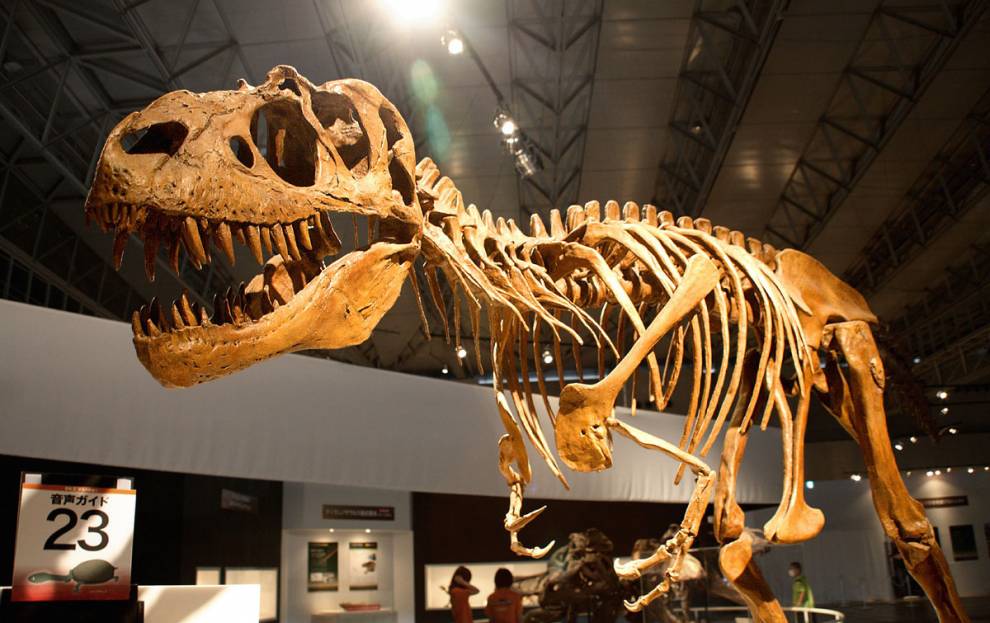
Gorgosaurus skeleton

Many paleontologists are also evolutionary biologists. Evolutionary biology is the study of the origin, development, and changes (evolution) in species over time. Other scientists that contribute to evolutionary biology are geologists and geneticists.

THE THIGH BONE’S CONNECTED TO THE HIP BONE….

The vast majority of dinosaurs are diagnosed by paleontologists based not on complete skeletons, or even near-complete skeletons, but scattered, disconnected bones like skulls, vertebrae and femurs. On the following slides, you’ll discover a list of the most important dinosaur bones, and what they can tell us about the dinosaurs of which they were once a part.

SKULL AND TEETH (HEAD)

The overall shape of a dinosaur’s head, as well as the size, shape and arrangement of its teeth, can tell paleontologists a lot about its diet (for example, tyrannosaurs possessed long, sharp, backward-curving teeth, the better to hang onto still-wriggling prey). Herbivorous dinosaurs also boasted bizarre skull ornamentation – the horns and frills of ceratopsians, the crests and duck-like bills of hadrosaurs, the thick crania of pachycephalosaurs–which yield valuable clues about their owners’ everyday behavior. Oddly enough, the biggest dinosaurs of all–sauropods and titanosaurs–are often represented by headless fossils, since their relatively tiny noggins were easily detached from the rest of their skeletons after death.

CERVICAL VERTEBRAE (NECK)

As we all know from the popular song, the head bone’s connected to the neck bone–which ordinarily wouldn’t cause much excitement among fossil hunters, except when the neck in question belonged to a 50-ton sauropod. The 20- or 30-foot-long necks of behemoths like Diplodocus and Mamenchisaurus were made up of a series of huge, but relatively lightweight, vertebrae, interspersed with various air pockets to lighten the load on these dinosaurs’ hearts. Of course, sauropods weren’t the only dinosaurs to have necks, but their disproportionate length–about on a par with the caudal vertebrae (see below) constituting these creatures’ tails–put them, well, head and shoulders above others of their breed.

METATARSALS AND METACARPALS (HANDS AND FEET)

About 400 million years ago, nature settled on the five-fingered, five-toed body plan for all terrestrial vertebrates (though the hands and feet of many animals, such as horses, bear only vestigial remnants of all but one or two digits). As a general rule, dinosaurs possessed anywhere from three to five functional fingers and toes at the end of each limb, an important number to keep in mind when analyzing preserved footprints and trackmarks. Unlike the case with human beings, these digits weren’t necessarily long, flexible, or even visible: you’d have a hard time making out the five toes at the end of the average sauropod’s elephant-like feet, but rest assured they were really there.

ILIUM, ISCHIUM AND PUBIS (PELVIS)

In all tetrapods, the ilium, ischium and pubis make up a structure called the pelvic girdle, the crucial part of an animal’s body where its legs connect to its trunk (slightly less impressive is the pectoral girdle, or shoulder blades, which does the same for the arms). In dinosaurs, the pelvic bones are especially important because their orientation allows paleontologists to distinguish between saurischian (“lizard-hipped”) and ornithischian (“bird-hipped”) dinosaurs. The pubis bones of ornithischian dinosaurs point down and toward the tail, while the same bones in saurischian dinosaurs are oriented more horizontally (oddly enough, it was a family of “lizard-hipped” dinosaurs, the small, feathered theropods, that wound up evolving into birds!)

HUMERUS, RADIUS AND ULNA (ARMS)

In most ways, the skeletons of dinosaurs aren’t all that different from the skeletons of human beings (or of just about any tetrapod, for that matter). Just as people possess a single, solid upper arm bone (the humerus) and a pair of bones comprising the lower arm (the radius and ulna), the arms of dinosaurs followed the same basic plan, though of course with some major differences in scale. Because theropods had a bipedal posture, their arms were more differentiated from their legs, and thus are studied more often than the arms of herbivorous dinosaurs (for example, no one knows for sure why Tyrannosaurus rex and Carnotaurus had such small, puny arms, though there’s no shortage of theories.)

DORSAL VERTEBRAE (SPINE)

Between a dinosaur’s cervical vertebrae (i.e., its neck) and its caudal veterbrae (i.e., its tail) lay its dorsal vertebrae–what most people refer to as its backbone. Because they were so numerous, so big, and so resistant to “disarticulation” (i.e., falling apart after their owner died), the vertebrae comprising dinosaurs’ spinal columns are among the most common bones in the fossil record, and also some of the most impressive from an aficionado’s point of view. Even more tellingly, the vertebrae of some dinosaurs were topped by strange “processes” (to use the anatomical term), a good example being the vertically oriented neural spines that supported the distinctive sail of Spinosaurus.

FEMUR, FIBULA AND TIBIA (LEGS)

As was the case with their arms (see slide #6), the legs of dinosaurs had the same basic structure as the legs of all vertebrates: a long, solid upper bone (the femur) connected to a pair of bones comprising the lower leg (the tibia and fibula). The twist is that dinosaur femurs are among the biggest bones excavated by paleontologists, and among the biggest bones in the history of life on earth: the specimens from some species of sauropods are about as tall as a full-grown human being. These foot-thick, five- or six-foot-long femurs imply a head-to-tail length for their owners of well over a hundred feet and weights in the range of 50 to 100 tons (and the preserved fossils themselves tip the scales at hundreds of pounds!)

OSTEODERMS AND SCUTES (ARMOR PLATES)

The herbivorous dinosaurs of the Mesozoic Era required some form of protection against the ravenous theropods that preyed on them. Ornithopods and hadrosaurs relied on their speed, smarts and (possibly) the protection of the herd, but stegosaurs, ankylosaurs and titanosaurs evolved often-elaborate armor plating made up out of bony plates known as osteoderms (or, synonymously, scutes). As you can imagine, these structures tend to be well-preserved in the fossil record, but they’re often found beside, rather than attached to, the dinosaur in question–which is one reason we still don’t know exactly how the triangular plates of Stegosaurus were arranged along its back!

STERNUM AND CLAVICLES (CHEST)

Not all dinosaurs possessed a full set of sterna (breastbones) and clavicles (collar bones); sauropods, for example, seem to have lacked breastbones, relying on a combination of clavicles and free-floating rib bones called “gastralia” to support their upper trunks. In any event, these bones are only rarely preserved in the fossil record, and thus aren’t nearly as diagnostic as vertebrae, femurs and osteoderms. Crucially, it’s believed that the clavicles of early, less advanced theropods evolved into the furculae (wishbones) of the “dino-birds,” raptors and tyrannosaurs of the late Cretaceous period, an important piece of evidence confirming the descent of modern birds from dinosaurs.

CAUDAL VERTEBRAE (TAIL)

All dinosaurs possessed caudal vertebrae (i.e., tails), but as you can see by comparing an Apatosaurus to a Corythosaurus to an Ankylosaurus, there were major differences in tail length, shape, ornamentation and flexibility. Like cervical (neck) and dorsal (back) vertebrae, caudal vertebrae are well represented in the fossil record, though often it’s their associated structures that say the most about the dinosaur in question. For example, the tails of many hadrosaurs and ornithomimids were stiffened by tough ligaments–an adaptation that helped to maintain their owners’ balance–while the flexible, swinging tails of ankylosaurs and stegosaurs were often capped by club-like or mace-like structures.

Source: www.thoughtco.com

Hadrosaurus

Monday, May 22, 2017

 Hadrosaurus. DEA PICTURE LIBRARY / Getty Images

Hadrosaurus from Greek ἁδρός, hadros, meaning “bulky” or “large”, and σαῦρος, sauros, meaning “lizard”) is a valid genus of hadrosaurid dinosaur. The only known skeleton was discovered in 1858, representing the first dinosaur species known from more than isolated teeth to be identified in North America. In 1868, it became the first ever mounted dinosaur skeleton. Hadrosaurus foulkii is the only species in this genus and has been the official state dinosaur of New Jersey, United States since 1991.

Reconstructed skeleton, Academy of Natural Sciences. Photo by Jim, the Photographer

Leidy recognized that these bones were from a dinosaur by their similarity to those of Iguanodon, discovered in England some decades before, but the skeleton of Hadrosaurus was far more complete. Leidy’s monograph Cretaceous Reptiles of the United States, describing Hadrosaurus more completely and with illustrations, was written in 1860, but the American Civil War delayed its publication until 1865.

Hadrosaurus was named the state fossil of New Jersey, designated in 1994. It is one of the most celebrated dinosaurs ever, and is of great historic importance.

When the skeleton was first assembled, it was displayed with a plaster skull sculpted by Hawkins. Many other artists have recreated Hadrosaurus with skulls from other, related species such as Gryposaurus and Brachylophosaurus. A statue of Hadrosaurus, sculpted by Haddonfield resident John Giannotti, now stands in the center of the town of Haddonfield, commemorating its discovery there.

The New Jersey-born Hadrosaurus is significant for more than just starting off the first wave of dinosaur-hunting fever, however. It also became, in 1868, the first dinosaur skeleton to be mounted, and then displayed, at the Academy of Natural Sciences in Philadelphia, Pennsylvania. The man responsible for that was naturalist and sculptor Benjamin Waterhouse Hawkins, who had previously created life-sized models of dinosaurs (and also some basically imaginary creatures) for the 1851 Great Exhibition in London. Hawkins based his mount of the Hadrosaurus on the work of a University of Pennsylvania paleontologist Joseph Leidy, who significantly identified Hadrosaurus as a bipedal dinosaur (previous artists had largely theorized that most dinosaurs walked on all four legs). This was certainly a step forward in our collective understanding of dinosaurs, but looking at a photo of Hawkins model, it’s still fairly inaccurate-looking to the modern eye, even if you know nothing about actual dinosaur morphology. The almost comical human-like pose, when juxtapositioned with modern artistic renderings of Hadrosaurus (or the modern mounting which was on display at the Academy in 2008) couldn’t be much farther apart. The most visible change in our understanding of the Hadrosaurus since the Hawkins mount has been that scientists no longer believe the dinosaur used its tail as support in addition to its legs, and that it probably leaned much farther forward, using its short front legs for support when necessary. That development was the painstakingly slow result of nearly 100 years of research.

In a 2008 study, Hadrosaurus was found to be more primitive than either lambeosaurines or other “hadrosaurines”, and not a particularly close relative of classic “hadrosaurines” such as Edmontosaurus and Saurolophus. As a result of this, the name Hadrosaurinae was restricted to Hadrosaurus alone, and the subfamily comprising the traditional “hadrosaurines” was renamed the Saurolophinae.

However, the latest phylogeny of the Hadrosauroidea indicates Hadrosaurus is definitely placed within the monophyletic group including all nonlambeosaurine hadrosaurids. Therefore, the traditional Hadrosaurinae should be still valid for designating all non-lambeosaurine hadrosaurids.

The holotype of Hadrosaurus was found in marine sediments, which suggests the skeleton was transported by a river and then deposited in the Cretaceous sea. The Hadrosaurus remains all persist to the Woodbury Formation.

Source: www.Wikipedia.org, www.natgeo.com

Titanosaurus Facts

Monday, May 22, 2017

Titanosaurus colberti

Titanosaurus (meaning ‘titanic lizard’ – named after the mythological ‘Titans’, deities of Ancient Greece) is a dubious genus of sauropod dinosaurs, first described by Lydekker in 1877. It is known from the Maastrichtian (Upper Cretaceous) Lameta Formation of India.

Titanosaurus is estimated to have grown up to 9–12 metres (30–40 ft) long and up to approximately 13 tons in weight. Wilson and Upchurch (2003) treated Titanosaurus as a nomen dubium (“dubious name”) because they noted that the original Titanosaurus specimens cannot be distinguished from those of related animals.

David Attenborough and the Giant Dinosaur

Titanosaurus is the signature member of the family of dinosaurs known as titanosaurs, which were the last sauropods to roam the earth before the K/T Extinction 65 million years ago.

What’s odd is that, although paleontologists have discovered plenty of titanosaurs–the remains of these giant beasts have been dug up all over the globe–they’re not so sure about the status of Titanosaurus: this dinosaur is known from very limited fossil remains, and to date, no one has located its kull. This seems to be a trend in the dinosaur world; for example, hadrosaurs (duck-billed dinosaurs) are named after the extremely obscure Hadrosaurus, and the aquatic reptiles known as pliosaurs are named after the equally murky Pliosaurus.

Titanosaurus was discovered very early in dinosaur history, identified in 1877 by paleontologist Richard Lydekker on the basis of scattered bones unearthed in India (not normally a hotbed of fossil discovery). Over the next few decades, Titanosaurus became a “wastebasket taxon,” meaning that any dinosaur that even remotely resembled it wound up being assigned as a separate species.

The biggest dinosaur ever to be shown at the American Museum of Natural History will be unveiled on Friday, and its head will graze the ceiling. Known as the Titanosaur, it is one of the largest dinosaurs ever discovered, and lived 100 million years ago

Today, all but one of these species have either been downgraded or promoted to genus status: for example, T. colberti is now known as Isisaurus, T. australis as Neuquensaurus, and T. dacus as Magyarosaurus. (The one remaining valid species of Titanosaurus, which still remains on very shaky ground, is T. indicus.)

Lately, titanosaurs (but not Titanosaurus) have been generating headlines, as bigger and bigger specimens have been discovered in South America. The largest dinosaur yet known is a South American titanosaur, Argentinosaurus, but the recent announcement of the evocatively named Dreadnoughtus may imperil its place in the record books. There are also a few as-yet-unidentified titanosaur specimens that may have been even bigger, but we can only know for sure pending further study by experts.

As the type genus of Titanosauria, Titanosaurus at times became a wastebasket taxon for a number of titanosaurs, including those not just from India but also southern Europe, Laos, and South America. Only two among these, however, are currently considered species of TitanosaurusT. indicus and T. blandfordi, both of which are considered nomina dubia.

Other species formerly referred to this genus include:

  • “Titanosaurus” rahioliensis – Described based on teeth, this species is now considered an indeterminate neosauropod.
  • “Titanosaurus” colberti – This species was the most well-known species of Titanosaurus, but has been moved into its own genus, Isisaurus.
  • “Titanosaurus” australis – Known from relatively complete remains, but has been renamed Neuquensaurus.
  • “Titanosaurus” nanus – A small species found to be non diagnostic, and hence a nomen dubium.
  • “Titanosaurus” robustus – Now referred to Neuquensaurus.
  • “Titanosaurus” madagascariensis – nomen dubium; UCB 92305 apparently related to Vahiny, while UCM 92829 has been re-assigned to Rapetosaurus.
  • “Titanosaurus” falloti – This large species, native to Laos, has disputed affinities. It has been considered synonymous with Tangvayosaurus and Huabeisaurus, but the remains are too fragmentary to be sure.
  • “Titanosaurus” valdensis – Referred to a new genus, Iuticosaurus, but still considered a nomen dubium.
  • “Titanosaurus” lydekkeri – Also referred to Iuticosaurus, but its relation to I. valdensis is uncertain.
  • “Titanosaurus” dacus – A dwarf titanosaur; now moved to the genus Magyarosaurus.

Source: www.thoughtco.com, www.Wikipedia.org, www.NatGeo.com

Pages