Blogs

Pregnant T. rex May Contain Dinosaur DNA, an Impossible Find

Tuesday, September 12, 2017

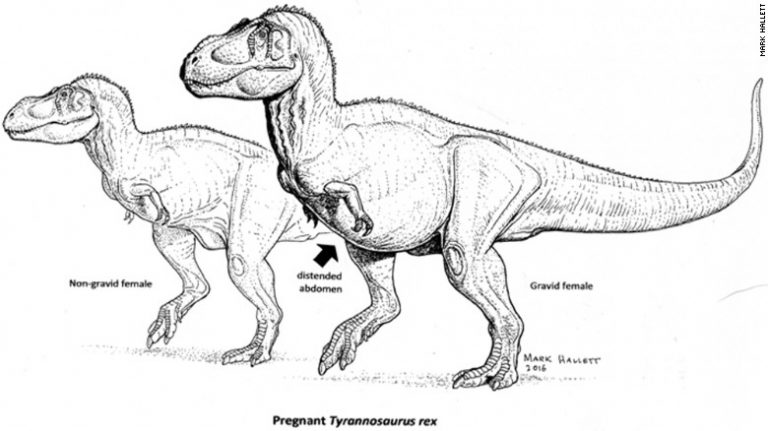
Scientists believe there may be fragments of dinosaur DNA preserved in a pregnant T. rex found in Montana. The 68 million-year-old find may also shed light on the evolution of egg-laying and dinosaur gender differences.

“We have some evidence that fragments of DNA may be preserved in dinosaur fossils, but this remains to be tested further.” assistant research professor of biological sciences at North Carolina State University, Lindsay Zanno, told Discovery News.

The T. rex in question has retained its medullary bone, proving it was pregnant. The medullary bone is only present during egg laying and it could possibly retain preserved DNA.

Zanno explained how the medullary bone functions during egg laying:

“It’s a special tissue that is built up as easily mobilized calcium storage just before egg laying,” she said. “The outcome is that birds do not have to pull calcium from the main part of their bones in order to shell eggs, weakening their bones the way crocodiles do.”

It’s a tricky bone to find. “You’d have to cut up a lot of dinosaur bones to have a good chance of finding this,” Sarah Werning of the University of California, Berkeley explained. One would have to cut open fossils, potentially demineralizing them – not something researchers would normally voluntarily do.

Pregnant T. rex

However this pregnant T. rex’s femur was already broken when the team that discovered the medullary bone received it.

Scientists were able to identify the medullary bone because of a material, found to be consistent with known medullary tissues from ostriches and chickens – keratan sulfate.

The research, published in Nature Scientific Reports, states the dinosaur was 16-20 years old at the time of its death from an unknown cause.

Ancient ‘Hell Ant’ with Metal Horns & Trap Jaw Found Inside Amber (PHOTOS)

Tuesday, September 12, 2017

A lateral view of the newly described species Linguamyrmex vladi. © P. Barden, H.W. Herhold, D.A. Grimaldi

Scientists have discovered that while monstrous dinosaurs roamed the earth, the insect world contained its own fearsome creature – a ‘hell ant’ with a reinforced metal horn on its head.

A number of extinct insects have been given the sinister ‘hell ant’ moniker – including the Haidomyrmex cerberus, which had curious L-shaped mandibles.

But researchers from the New Jersey Institute of Technology have revealed a new hair-raising creature found inside amber, dating back 99 million years.

According to the study, the hell ant, known as Linguamyrmex vladi, hunted and defended itself in ways which differ dramatically from modern ants.

The insect, which turned up in amber mined in Myanmar, displayed rather terrifying ‘weaponry’ around its head.

This included a clypeal horn, or paddle, probably reinforced by metals such as calcium, zinc and iron, usually held in the bodies of insects.

View hell ant's head and thorax. © P. Barden, H.W. Herhold, D.A. Grimaldi

It’s thought the fortified horn was used together with scythe-like mandibles to “pin and potentially puncture soft-bodied prey.”

Dr Phillip Barden, lead author of the study, told RT.com that the reinforcement of the horn would have stopped it from being damaged as the ant’s fast-snapping jaws slammed closed.

“The paddle-horn does appear to contain either increased density or metal reinforcement, as suggested by X-ray imaging,” he said.

“As the mandibles would snap closed to capture prey, the reinforcement would prevent the scythe-like mandibles from damaging the paddle-like horn.”

The ferocious looking ant is likely to have died out during the Late Cretaceous and Paleocene period (K-Pg period).

“The exact cause of their extinction is unknown, however it is interesting to note that hell ants are known from three fossil deposits worldwide – Myanmar, France and Canada, ranging in age from 99 to about 78 million years ago,” Barden added.

“While these ants most probably went extinct sometime around the K–Pg boundary, along with non-avian dinosaurs, 65 millions years ago, they nevertheless appear to have been widely distributed and existed for at least 20 million years or so.”

Source: www.RT.com

10 Common Myths About Evolution

Sunday, September 10, 2017

Evolution is the single most important concept in all of biology. It is absolutely vital for understanding both the history of life on earth and why our modern organisms have their current traits and behaviors. Nevertheless, it is also one of the most misunderstood concepts in modern science. Much of the confusion stems from creationists’ faulty arguments, but even those who accept evolution often don’t really understand it. Therefore, I am going to describe and debunk ten of the most common myths and misconceptions about evolution.

Myth 1: Evolution is just a theory

This is arguably the most common myth about evolution, and it is probably creationists’ most well worn trope. It is also a fundamental misunderstanding of how science works. Briefly, evolution is both fact and theory depending on exactly what we are talking about. The idea that all modern organisms (including humans) evolved from a single celled organism over a period of millions of years is a scientific fact. It has been confirmed by the fossil record, genetics, biogeography, etc. Like it or not, it’s a fact, but there is also a theory component. You see, theories explain facts. So, the theory of evolution by natural selection states that natural selection has been the dominant mechanism causing species to evolve. In other words, it is a fact the evolution occurred, and the theory of evolution by natural selection explains how that evolution occurred. Indeed, it is a common misconception that Charles Darwin came up with the idea of evolution. In reality, many scientists before him thought that organisms evolved, but they couldn’t figure out how or why they evolved. So, what Darwin (along with Alfred Russel Wallace) did that was so extraordinary, was to provide a mechanism that drove evolutionary change (i.e., natural selection).

Finally, it is worth noting that theories are actually among our highest forms of scientific certainty. They have been rigorously tested and consistently make accurate predictions. So gravity (i.e., the theory of universal gravity), the idea that all matter is made of atoms (i.e., atomic theory), the idea that all living things are made of cells (i.e., cell theory), the idea that bacteria make you sick (i.e., the germ theory of disease), etc. are all “just theories.”

Myth 2: We evolved from monkeys/apes

We did not evolve from modern apes, but we share a common ancestor with them. In other words, if we back the clock up a few million years, we will find an ape-like ancestor whose populations split, and different groups went down different evolutionary paths. One group evolved into us, and another group evolved into chimps. So we and chimps share a great, great, great…great grandparent who went extinct a few million years ago, but we did not evolve from chimps, monkeys, or modern apes.

Myth 3: Evolution conflicts with the second law of thermodynamics

People often describe the second law of thermodynamics as, “the disorder of a system always increases,” which leads people to erroneously claim that evolution violates the second law because it says that overtime life becomes more organized. The problem is that the above definition is a terrible one which misrepresents the law and overlooks several key components.

The best way to understand the second law is in conjunction with the first law. The first law (also known as the law of the conservation of energy) states that energy cannot be created or destroyed, but it can change forms (e.g., it can go from potential energy to kinetic energy). The second law then describes the natural flow of energy within a system (i.e., the direction in which the changes take place). Both of these are dealing with energy states, and taken together, they say that a system cannot go from a low energy state to a high energy state without the input of additional energy. The classic example of this is a diving board. Someone standing on a tall diving board is in a higher energy state (i.e., they have more potential energy) than someone standing at the bottom of the ladder. So, to a physicist, the person at the bottom is more “disorganized” than the person at the top, because the person at the top has more potential energy. In technical terms, this concept of disorganization is known as entropy, and the person at the top of the board would have less entropy than the person at the bottom.

Notice, these laws do not state that it is impossible for systems to go from a low energy state to a high energy state. Rather, they say that the transition cannot take place without the input of additional energy. In other words, it is completely possible for the person at the bottom of the ladder to climb up onto the board and reach a higher energy state (i.e., become more organized/have less entropy), but doing so requires an input of energy (i.e., they have to use energy to move their muscles and climb the ladder). Another way to describe this is to say that a closed system cannot become more organized, at least in the long term (a closed system is one that receives no energy from outside sources). These laws do not, however, state that an open system cannot become more organized (an open system is one that does receive energy from outside sources).

Now, let’s apply all of that to evolution. The earth is most definitely an open system. It is constantly receiving energy from the sun. In fact, the sun drives nearly all life on earth. So, since the earth is an open system, there is no conflict between evolution and the thermodynamics. Let me use an example to prove that. I think we can all agree that a tree is more organized (has a higher energy state) than a seed. So, if thermodynamics worked the way that creationists claim, it should be impossible for a seed to grow into a tree, but it clearly is possible for seeds to grow. Why? Quite simply, because the earth is an open system. Even so, it is entirely possible for life to become more organized because organisms are constantly receiving energy from the sun (or from food which grew because of energy from the sun). So there is no conflict between evolution and thermodynamics.

Myth 4: We haven’t found any “missing links”

In each of those cases, we have multiple fossils that are exactly what we would expect if evolution was true, and the only way that you would reject the notion that these are intermediates is if you were already convinced that intermediates don’t exist. This is the fundamental problem with creationism (and a big part of why it is pseudoscience). Creationists have determined ahead of time that no intermediates exist, so no matter how perfect a transitional fossil may be, they will always claim that it is just a unique species that happens to look like a transitional. The term “missing link” is a misnomer because they aren’t missing. We have hundreds of fossils that clearly represent transitions between two groups of organisms. Creationists invariably claim that these fossils are simply uniquely created organisms that happen to look like transitions, but this is a clear and enormous ad hoc fallacy because evolution predicted the existence of these fossils. If, for example, I asked you to describe what an intermediate between a turtle and its lizard-like ancestor would look like, you would inevitably describe a creature with half the features of a lizard and half the features of a turtle (e.g., a partially formed shell, a turtle like skull that still retains lizard like teeth, a somewhat specialized neck, etc.). Well guess what, that’s exactly what we see in the fossil record with species like Odontochelys and Pappochelys which have some lizard features and some turtle features. Similarly, if I asked you to describe an intermediate between a dinosaur and a bird, you would probably describe a featured dinosaur with partially formed wings and some skeletal modifications like an enlarged breastbone, but which still retains some dinosaur features like teeth. Indeed, the creature that you are imagining closely matches fossils like ArchaeopteryxConfuciusornis, and Jeholornis. The same is true for the transition for fish to amphibians, amphibians to reptiles, reptiles to mammals, etc.

Myth 5: Evolution isn’t science because it hasn’t been observed/repeated

First, we have to specify what we mean by “evolution.” You see, evolution on a small scale has been observed numerous times. Bacteria evolving resistance to antibiotics is the most well-known example of this, but there are many others. For example, we have been able to observe finches on the Galapagos evolve and change their beak sizes in response to droughts (Grant and Grant 2002). We have even been able to observe entirely new species form.

Nevertheless, when most people make this claim, there are generally referring to evolution over a long period of time. In other words, they are saying that we have not observed or repeated something like a relative of the T. rex evolving into a chicken. First, it is important to realize that there is no real difference between “microevolution” and “macroevolution.” Macroevolution is just an accumulation of microevolutionary steps. So if evolution on a small scale occurs (as has been observed and experimentally demonstrated) then ipso facto, evolution on a large scale occurs. One inevitably leads to the other.

Finally, the idea that we have to directly observe something and repeat the event itself in order for it to be science is a fundamental misunderstanding of science. Most science is not based on direct observation of the actual event of interest. Rather, we observe clues that are left behind by the event, and we infer information about the event from them. For example, no one has directly observed two hydrogen atoms joining an oxygen atom to form a water molecule, but we know that it happens because we can conduct chemistry experiments which give observable results that we can use to infer the sharing of electrons that lets those atoms combine. Similarly, we constantly solve crimes without either observing or repeating them because there are clues left behind that we can use to infer who committed the crime (this is known as forensic science). Even so, we do not need to observe a dinosaur evolving into a bird to know that it happened because there are clues left behind in the fossils, DNA, etc., which we use to infer evolution. There is nothing unscientific about that, and, in fact, it is how most science works. We make predictions like, “if and only if birds evolved from reptiles, then birds should share more DNA with reptiles than any other group.” We then test those predictions, and when they consistently come true, we conclude that our hypothesis is most likely correct. That is the scientific method at its finest.

Myth 6: Individuals evolve

Populations evolve not individuals. Evolution is just a change in the genetic composition of a population over time, so, since individuals cannot change their genetic composition, they cannot evolve. For example, if a drought comes along and destroys all seed-bearing plants except for ones with very large seeds, an individual bird with a small bill cannot evolve in response to that drought. In other words, it cannot change its genetic makeup and alter its bill size to eat the large seeds. In biological terms, it cannot adapt. As a result, the birds that have small bills will get less food and produce less offspring than the birds with large bills. This means that there will be more genes for large bills in the next generation. So the population will evolve and adapt to the drought, but the individuals will not evolve.

Myth 7: Evolution has a direction or goal

People often talk about evolution “trying to accomplish” something, or they may describe primates and other mammals as being “more evolved” than other animals, but statements like that are extremely problematic because they inherently imply that evolution has a direction or goal, which it doesn’t. Biologist often like to say that, “evolution is blind.” All that evolution can do is adapt an organism for its current environment and way of life (I’m talking specifically about evolution by natural selection here). Evolution has no foresight, and it is completely incapable of predicting what will be useful in the future, so a trait that has been selected for thousands of generations may suddenly become harmful if the environment changes.

Because evolution just adapts organisms to their current environment and way of life, it doesn’t really make sense to describe one species as “more evolved” than the other. For example, a monkey is not “more evolved” than the fly that gets its moisture from the monkey’s poop. The monkey is certainly more complex, but it’s not really more evolved because both the monkey and the fly are extremely well suited to their way of life. If you try to say that the monkey is more evolved than the fly, then you are implying that evolution has a direction, which it doesn’t.

Finally, this explains the common creationist criticism that certain species have “evolved backwards” (e.g., penguins lost the ability to fly, whales went back into the ocean, etc.). This again assumes that evolution has a direction or goal, when in reality, it’s just adapting organisms to their current environment. So, at one point in time, flight was useful so evolution selected for it and produced flying birds, but as those birds invaded the antarctic, the ability to fly was not as important as the ability to swim and stay warm, so evolution selected against adaptations for flight and produced penguins.

Myth 8: Some systems are too complex to evolve

This is one of the oldest criticisms of evolution, and it has recently resurfaced under the moniker “irreducible complexity.” The basic idea is that some systems are too complex to evolve because they aren’t functional until all of the parts are in place. For example, an eye that is missing a single piece no longer sees, and a bacterial flagellum that is missing a single protein can no longer act as a flagellum. So the argument claims that these systems could not have evolved because there would have been steps that served no useful function, and nature could not have selected for those steps. The problem is that this argument ignores the fact that evolution is blind. Traits don’t need to function for some ultimate final product in order to be selected for. Rather, if they provide any useful function at all, nature will select them. Indeed, no one has ever been able to find a truly irreducible system, and we have evolutionary pathways that explain how complex systems evolve. For example, an early precursor of the eye would have simply involved a few light sensitive cells (much like some flatworms have). They don’t function as an eye, but they still function, so nature will select for them. Similarly, the proteins that make up a flagellum all serve other functions in the cell, and we have even figured out a step-wise series of events that would form a flagellum with each step serving a useful function for the cell, even though only the final step actually serves as a flagellum. So there is just no truth to the notion that some systems are too complex to evolve.

Myth 9: Evolution describes the formation of the universe/the first cell

I often hear people argue that, “evolution isn’t true because blah, blah, blah…big bang” or some nonsense about how we haven’t figured out how the first cell formed. Beyond the specific issues with those arguments (which I won’t go into here), those arguments are totally irrelevant to evolution. The big bang theory deals with the formation of the universe, and abiogenesis deals with the formation of life. Evolution only comes into play after life formed. So, even if you managed to disprove the big bang or disprove abiogenesis, you would not have in any way shape or form disproved evolution. Indeed, there are some people who think that God created the first cell, then let evolution take its course. In other words, they reject abiogenesis but accept evolution (to be clear though, there is no good scientific reason to reject abiogenesis or the big bang).

Myth 10: Evolution is faith based

To anyone who makes this claim, I would like to know which part exactly you think is faith based. As I explained in #5, the fact that we did not directly observe millions of years of evolution doesn’t disqualify it as science. In fact, evolution is one of the most well supported ideas in all of science, and if you actually read Origin of the Species it is packed with evidence. Further, Darwin was an exceptional scientist and made clear predictions about what future researchers should find if his theory was correct. For example, he explicitly stated that we should find intermediate fossils, and we have (see #4). Think about that for a second. Evolution predicted the existence of organisms decades before we found them. That is an utterly incredible feat. Similarly, evolution predicted a strong agreement between the fossil record and genetics, and, once again, its predictions have come true with remarkable consistency. So if you are going to claim that evolution is based on faith, I want to know precisely what part of it you think is faith based, because there is no aspect of it which I cannot back up with empirical data.

Finally, it is worth noting that, contrary to popular perception, evolution is not inherently atheistic, rather, it is a scientific fact which is supported by an insurmountable mountain of evidence.

Source: www.sciencetoday.com

‘Jurassic World 2: Fallen Kingdom’ News: How Famous Ian Malcolm Quote Inspired The Movie

Saturday, September 9, 2017

 Famous Ian Malcolm Quote

There is a reason why Jurassic World 2: The Fallen Kingdom will bring back Dr. Ian Malcolm (Jeff Goldblum). Movie writer and producer Colin Trevorrow has revealed that the character from the original Jurassic Park movies has inspired the anticipated sequel.

“Jurassic World” was all about a genetically-engineered, extremely dangerous dinosaur escaping his enclosure in a theme park but the sequel will deal with more important issues. Instead of the typical dinosaur chasing human beings in an environment these creatures control, Trevorrow wants to explore a world where the dinosaurs are once again at the top of the food chain and humans have to co-exist with them.

“There are themes and ideas in here that we’re setting up, such as the co-existence of these animals now,” he explained (as quoted by iBTimes). He also said that a quote from Dr. Ian Malcolm, the mathematician who specializes in the “Chaos Theory” and was one of the main characters in the “Jurassic Park” franchise.

“‘Jurassic World’ is all based on Ian Malcolm’s quote: ‘You stood on the shoulders of geniuses to accomplish something as fast as you could and before you knew what you had, you’d packaged it and slapped it on a plastic lunchbox and now you want to sell it,'” the director said. “So with ‘Jurassic World 2,’ it’s “Dinosaurs and man separated by 65 million years of evolution have been thrown back into the mix together – how can we know what to expect?”

But, more than dinosaurs, there seems to be a more urgent threat to Owen Grady (Chris Pratt) and Claire Dearing (Bryce Dallas Howard) in “The Fallen Kingdom.” The fan site, Jurassic Outpost, has reported that an official merchandise for the anticipated sequel has been leaked and it promises not just dinosaurs, but an exploding volcano as well.

This is not the first time that the publication found evidence that an active volcano might play an important role in the movie. The first poster for the sequel also had ember falling.

“Jurassic World 2: The Fallen Kingdom” will be released on June 22, 2018. The movie will also star James Cromwell, BD Wong and Toby Jones.

Aepyornithomimus tugrikinensis: New Ostrich-Like Dinosaur Discovered in Mongolia

Tuesday, September 5, 2017

Aepyornithomimus tugrikinensis. Image credit: Masato Hattori.

Called Aepyornithomimus tugrikinensis, the new dinosaur is a type of ornithomimosaur (Ornithomimidae), a group of theropods that evolved a toothless beak and were likely omnivorous or herbivorous, superficially resembling extant ostriches.

The ancient creature lived in what is now Mongolia during the Campanian, the fifth of six ages of the Late Cretaceous epoch.

The fossil remains of the beast were found in the eolian deposits of the Djadokhta Formation at the Tögrögiin Shiree locality.

They were analyzed by Dr. Chinzorig Tsogtbaatar, a paleontologist from Hokkaido University and the Institute of Paleontology and Geology at the Mongolian Academy of Sciences, and his colleagues from Japan, Mongolia and Canada.

“This is only the third ornithomimosaur specimen reported from the Djadokhta Formation and is the first ornithomimid record from eolian Tögrögiin Shiree locality,” the researchers said.

“It is also the best preserved specimen of all of aforementioned three specimens known to date, and it provides new insight into ornithomimid dinosaur evolution and paleoenvironment.”

“It is possible that Aepyornithomimus tugrikinensis is a transitional form between the basal and derived ornithomimosaurs,” they added.

“The dinosaur could be stratigraphically the oldest known ornithomimid occurrence in the Upper Cretaceous of Asia, and the easternmost occurrence of ornithomimid dinosaurs from the Campanian in the northern hemisphere.”

According to Dr. Tsogtbaatar and co-authors, the discovery of Aepyornithomimus tugrikinensis sheds light on the evolutionary adaptation of ornithomimosaurs to arid environments.

Aepyornithomimus tugrikinensis is possibly the first evidence of an ornithomimosaur species that could have tolerated more diverse climatic conditions that were shifting from humid to more arid conditions,” they said.

Research describing the new species is published in the journal Scientific Reports.

_____

Chinzorig Tsogtbaatar et al. 2017. First Ornithomimid (Theropoda, Ornithomimosauria) from the Upper Cretaceous Djadokhta Formation of Tögrögiin Shiree, Mongolia. Scientific Reports 7, article number: 5835; doi: 10.1038/s41598-017-05272-6

Source: www.sci-news.com

Jurassic World: Fallen Kingdom – Everything We Know So Far

Sunday, September 3, 2017

It’s been nearly a quarter of a century since Steven Spielberg has taken the world on a safari of truly gargantuan proportions, courtesy of his now legendary film Jurassic Park. With three sequels in the can, and the last one, Jurassic World, becoming a box office smash in 2015, something naturally would survive to chomp another day. Well, it wasn’t long before that very possibility was locked in, as that very year it was announced that Jurassic World 2 was officially happening, and with some returning friends.

So, obviously, we are looking forward to the future, and thinking about what exactly we know about the film that is officially titled Jurassic World: Fallen Kingdom. Which is why we’ve put together this handy guide for all of you adventure lovers, dinosaur fans, and Spielberg devotees out in the world. Apparently, there’s a lot of you, as this movie wouldn’t be happening without the fans that poured out to see Colin Trevorrow’s continuation of an adventure 65 million years in the making. With that in mind, welcome to what we know so far about Jurassic World 2.

What Will Jurassic World: Fallen Kingdom Be Rated?

You could probably put a sizable bet on the fact that Jurassic World: Fallen Kingdom is going to be rated PG-13. A summer blockbuster of mass appeal, it’s not like it’d have a legitimate chance of being rated R; even if that would mean the franchise would match the tone of Michael Crichton’s original writing and content that much closer. While we’d love to see dinosaurs rampaging and scores of carnivorous carnage, this flick’s gotta be good for the kiddies to enjoy as well. If it helps, Jurassic World 2 is planning to be scarier than Jurassic World. So it’s not like this is going to be a mellow walk in the park or anything.

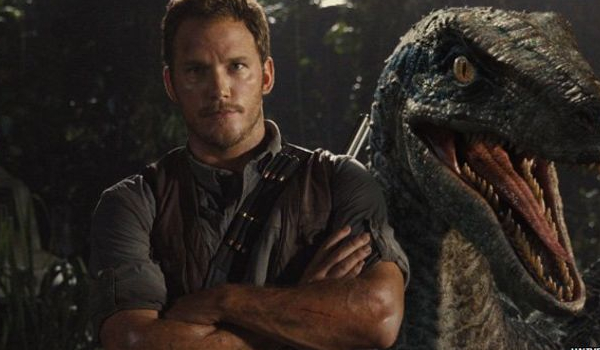
Jurassic World Owen and Blue

What Is The Jurassic World: Fallen Kingdom Release Date?

The release date for Jurassic World 2 is officially set for June 22, 2018. Now, obviously, this puts the film deep in the heart of blockbuster country, and its release date is in a pretty competitive window on both sides of the divide. The week before Jurassic World: Fallen Kingdom drops, The Incredibles 2 will finally hit theaters all over. Meanwhile, the week right after the film’s debut has both Tag and Barbie looking to carve up the box-office pie amongst themselves, with The Purge: The Islandfollowing behind those competitors in the 4th of July time frame.

So, why stick with such a perilous release slot? Well, in addition to ticket sales for most big films dropping pretty heavily in their second weekends, Jurassic World: Fallen Kingdom is being unveiled just 11 days past the 25th anniversary of Jurassic Park’s release date in 1993. With this beautiful historic symmetry, and the potential for Universal to hype up this anniversary in the weeks and months before the new film’s premiere, it almost feels like kismet.

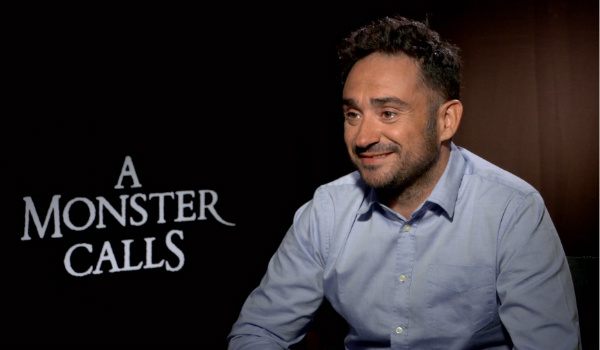
J.A. Bayona

The Director

In the beginning, folks wouldn’t have been wrong to think that Colin Trevorrow might return for Jurassic World 2’sproduction. Sequel talk was built into the discussions between Trevorrow and Steven Spielberg’s meetings for Jurassic World. That probably could have happened, if it wasn’t for the fact that Trevorrow announced that he wasn’t going to be following the franchise into its next phases. This probably had something to do with the fact that Colin Trevorrow was ready to pursue his labor of love known as The Book of Henry, as well as the fact that he landed himself the golden ticket that is Star Wars: Episode IX.

Obviously, a replacement was needed, and that replacement came in the form of Hispanic film director Juan Antonio Garcia “J.A.” Bayona. Bayona was initially noticed for his work on the Guillermo del Toro produced horror film, The Orphanage, and would then go on to make films such as The Impossible and A Monster Calls, as well as lending his talents to direct an episode of Showtime’s Penny Dreadful.

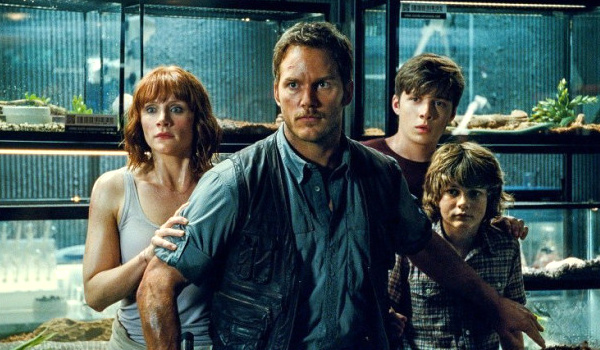
chris pratt bryce dallas howard Jurassic World

The Writers

While Colin Trevorrow didn’t return to direct Jurassic World: Fallen Kingdom, he did work on the film’s story alongside fellow Jurassic World writer Derek Connolly. When it comes to monster adventures, Connolly has a lot of experiences, as he’s also a credited writer on such films as Kong: Skull Island and Monster Trucks. Of course, this is on top of his work as a frequent collaborator of Trevorrow’s, as the two wrote the breakout hit Safety Not Guaranteed together, and are working on the script for Star Wars: Episode IX as well. Not returning to the writer’s room are Jurassic World writers Rick Jaffa and Amanda Silver, who were both involved with the original draft of the preceding film. Though considering their draft was basically rejected wholesale, in favor of Trevorrow and Connolly’s final draft, that isn’t too much of a surprise.

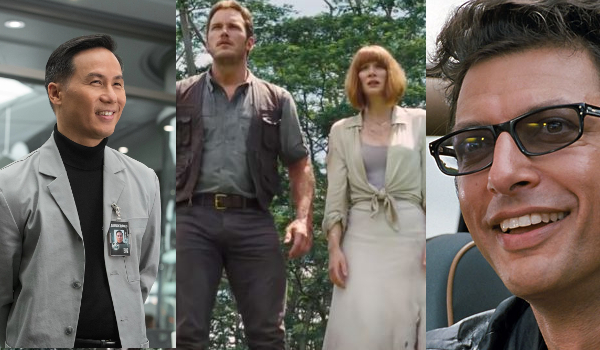
Jurassic World 2 Returning Cast BD Wong Chris Pratt Bryce Dallas Howard Jeff Goldblum

Which Characters Are Coming Back

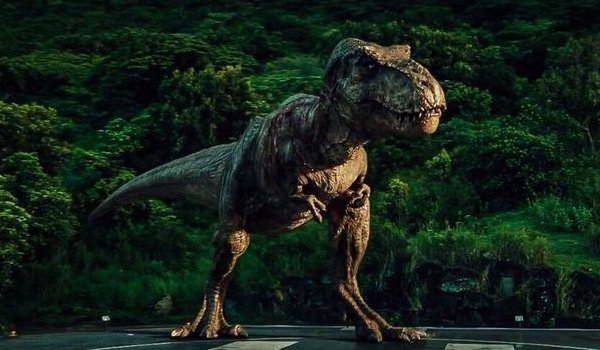
The cast of Jurassic World: Fallen Kingdom is going to be a mix of new figures and well known faces. In the case of the latter, there are five figures of parks past that are returning to mix it up yet again. First off, Chris Pratt’s Owen Grady will be returning, and along with him is Bryce Dallas Howard’s Claire Dearing. The two survivors of the dino crisis in Jurassic World will also be joined by two more returning cast members from the Jurassic Park side of the fence as well. The obvious returning combatant is B.D. Wong’s Dr. Henry Wu, as he jetted off at the end with the means to keep the franchise going in a special case he was holding. But, of course, the most anticipated cast member to return for Jurassic World 2, is none other than Jeff Goldblum, whose Dr. Ian Malcolm has been missing from the fold since 1997’s The Lost World: Jurassic Park. Though it’s still a bit unclear as to whether that adventure will still be canon, or lost to the sands of time. Oh, and last but not least, Rexy the Tyrannosaurus will also be returning for Jurassic World: Fallen Kingdom.

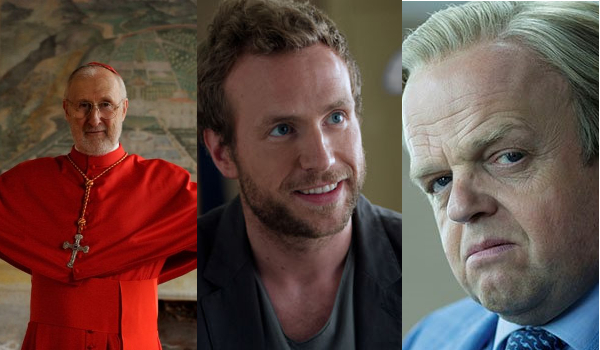
Jurassic World 2 New Cast James Cromwell Rafe Spall Toby Jones

New Cast Members

With new adventures comes new players in the game we know as Jurassic World: Fallen Kingdom. And boy, oh boy do we have some interesting players! Right off the bat, we have veteran character actor James Cromwell playing Benjamin Lockwood, a former partner of John Hammond’s who has to deal with the fallout from these Jurassic ventures going horribly wrong. Considering he has his own mercenaries in the cast for the film, we’re not so sure he’s one of the good guys. Also entering this world of the Jurassic is actor Toby Jones, who is on deck to play a character named Wheaton, although we don’t know anything else about his role in the film’s narrative. Rounding out the named portion of the new cast is Rafe Spall, who is playing a character known as Mills, and naturally, we don’t know much about him, either. The rest of our new players don’t have names or details, but they’ll most assuredly be in the fray with whatever creatures Jurassic World 2 throws their way. Further additions to the cast include Ted Levine, Kevin Layne, Justice Smith, Daniella Pineda, and Geraldine Chaplin.

Jurassic World Rexy sunrise

Where Jurassic World Left Off

Jurassic World left the newer park in the Hammond Legacy in shambles, with the Indominous Rex really wrecking up the place, and a climactic battle between it, Rexy, and Blue the Raptor rendering the entry plaza pretty useless as well. Owen, Claire, and her nephews survived the horrors they saw, and Dr. Henry Wu made it off the island with some interesting treasure. Or, more specifically, the genetic material needed to keep InGen in the dinosaur proliferation game. As for the dinosaurs in Jurassic World, they’re now allowed to free roam, like the beasts they were born to be.

Jurassic World InGen logo

InGen

At the beginning of the Jurassic World legacy, the InGen Corporation was a vital component to the genesis of the original park that John Hammond dreamt up. With their labs, scientists, and operating capital tied up in creating a park full of “biological attractions so astounding that they’d capture the imagination of the entire planet,” Hammond’s company was betting it all on Jurassic Park. Unfortunately, with the disaster that collapsed the original park, InGen found itself ripe for the taking, and it wasn’t too long before the Masrani Corporation bought up the company in 1998. Though, at the end of Jurassic World, it sounded like the company was poised for a takeover of its own, as Dr. Wu boarded an InGen chopper off of Isla Nublar, with a suitcase of dinosaur DNA.

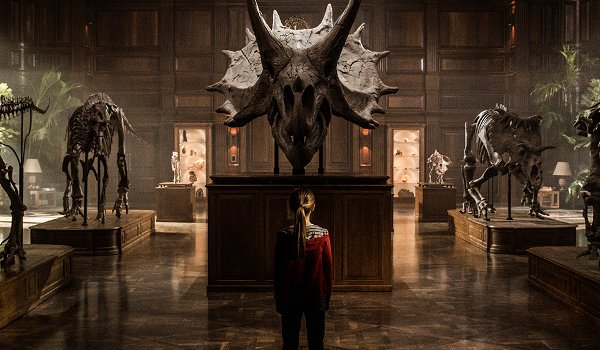
Jurassic World 2 little girl in a museum

Where The Sequel May Go

With both remarks he had made towards the point, as well as the events of Jurassic World’s finale, Colin Trevorrow has already suggested that the technology for dinosaur proliferation could fall into various, and in some cases the wrong, hands. But as recently as a couple of months ago, Trevorrow also made mention of the fact that Jurassic World: Fallen Kingdom will also explore the themes of how animals are treated in contemporary society, with zoos, pets, and medical experimentation being mentioned as focus points. Of course, what would Jurassic World 2 be without action involving dinosaurs? In particular, it sounds like there’s going to be a brand new dinosaur that we’ve yet to see hide or hair of just yet, but that’s not where the only excitement lies.

With pervasive talk about the film having a fiery component to it, particularly thanks to the ember laden teaser poster for the film, there’s rumors mentioning an active volcano being one of the film’s set-pieces. This is in addition to the submarine adventure that’s also been mentioned to take place during one of the film’s more harrowing moments. Considering the world is going to know what happened in Jurassic World, and the fact that there’s outside interest in live dinosaur specimens, there’s a good chance people will try to raid the island for creatures to take home, similar to the plot of 1997’s The Lost World: Jurassic Park.

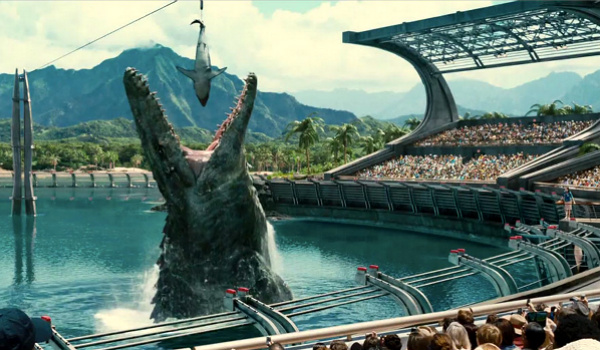
Jurassic world water mosasaur eats shark

How Will Jurassic World: Fallen Kingdom Draw From The Original Novel?

When it comes to Michael Crichton’s writing, there’s one big recurring theme that makes its way into pretty much every corner of his work: humanity’s mastery over science, and the multitude of reasons it can go wrong. Jurassic World definitely fit that pattern, so Jurassic World: Fallen Kingdom has that part of the Crichton legacy cut out for it. Though co-writer / director Colin Trevorrow does admit that when it comes to writing for the new film, he was very much inspired by the late author’s particular brand of dialogue. Though we’ve previously wondered just where else this inspiration may have reared its head.

As pretty much everyone knows, Jurassic Park the movie was pretty different from Jurassic Park the novel. Characters that weren’t meant to live survived to see the end of the film, a bunch of dinosaurs from the book were excised, and in some cases reused in other corners of the Jurassic Park mythos, and, most importantly, Ian Malcolm originally died in that first novel. Of course, that last part was reversed by Michael Crichton himself, as he revived Malcolm for The Lost World, thanks to some extensive surgeries.

Not to mention, that same book saw InGen personnel return to the island to recover as much material as they could, in hopes of giving their rival, BioSyn, a leg up on their own dino efforts. Fans of the original film and novel will remember that Dennis Nedry was the first person to try and complete this exercise, with rather fatal results. There’s no clear blueprint as to where Jurassic World 2 will draw from Michael Crichton’s Jurassic Park, but if the film follows the pattern we think we’re seeing, both novels in the series could inspire quite a few stories to be told in this new Jurassic universe.

Source: www.cinemablend.com

Jurassic World: Fallen Kingdom will Feature the co-Existence of Raptors and Human Beings

Sunday, September 3, 2017

Jurassic World 2, the upcoming science fiction film that is also titled Jurassic World: Fallen Kingdom, will probably surprise franchise fans with a very different story when it hits the big screens in June 2018.

Creator Colin Trevorrow has already revealed he has no plans to show dinosaurs chasing people on an island again. He wants to take the franchise to a new world that features the co-existence of raptors and human beings.

“There are themes and ideas in here that we’re setting up, such as the coexistence of these animals on the planet with humans. In the same way that we exist with animals now. And imagine a world where just like, you know, don’t go into that jungle, there’s tigers in there. They’re gonna eat you. Just replace that with raptors,” the 40-year-old filmmaker said in an interview with SlashFilm.

The creator also explained how Fallen Kingdom is different from the other films in the franchise. According to him, the new trilogy is based on various quotes of Dr Ian Malcolm from the original trilogy.

Trevorrow said: “Jurassic World is all based on Ian Malcom’s quote: ‘You stood on the shoulders of geniuses to accomplish something as fast as you could and before you knew what you had, you’d packaged it and slapped it on a plastic lunchbox and now you want to sell it’.”

He added: “That, to me, is Jurassic World. That’s why I had all the product placement, that’s what it was. So with Jurassic World 2 it’s: ‘Dinosaurs and man separated by 65 million years of evolution have been thrown back into the mix together — how can we know what to expect?'”

He then explained: “That’s not the exact quote, but you get the idea and that’s why it’s exciting the movie did well. I had a beginning, a middle and an end and it was designed this way. So now we get to play that out.”

The filmmaker even admitted that Owen Grady and Claire Dearing will have some new challenges to face in Jurassic World 2. He admitted that the characters will be in a different place and franchise fans cannot expect to see them where the story left off in the first movie.

“Even though Claire is the one who evolves the most over the trilogy, it’s her story that mirrors this changing world. Owen has shit to deal with. They’ve both opened Pandora’s Box in Jurassic World and both of them are responsible for different elements of it. And I think the way these characters are connected to these circumstances of what’s happening; it’s different than previous films,” the creator added.

Some Fan Theories on Jurassic World: Fallen Kingdom

Saturday, September 2, 2017

Some Fan Theories on Jurassic World: Fallen Kingdom

The franchise fans can look forward to the new mission of Owen Grady in the upcoming film.

The creative team behind Jurassic World: Fallen Kingdom has already dished about the new breeds of dinosaurs they are planning to introduce in the movie.

Thanks to eagle-eyed franchise fans, names and descriptions of the new raptors appearing in the science fiction adventure film has made its way online. The leaked details were shared on reddit by a franchise fan, monikered as biosyner.

“I’ve viewed production photos, CG renderings, and animation loops,” stated the reddit user. According to him, Triceratops, Stegosaurus, Tyrannosaurus, Velociraptor, Apatosaurus and Dilophosaurus will also appear in the movie along with the new raptors.

Check out the names and descriptions of the new dinosaurs below:

Stygimoloch – Smaller than the Pachycepholasaurus, but designed to be more robust with a very thick neck. The colouring is mostly reddish, with some warm grey tones beneath. I’ve been told this dinosaur has a particularly interesting role.

Carnotaurus – Very similar to the Sideshow Collectables statue. Less dark markings, and the red was more subdued.

Baryonyx – It is a rather drab gray colour, with a little blue or green. Unlike the Stygimoloch, the Baryonyx is designed pretty much exactly how I’ve always seen it in other mediums.

First look photo of Jurassic World 2. Twitter/Colin Trevorrow

Meanwhile, some of the interesting fan theories suggest militarisation of dinosaurs in Fallen Kingdom. According to a franchise fan named Alex, Owen Grady will have a secret mission in Jurassic World 2.

“He is hired to go back to the island and pick up the embryos that were stolen by Nedry and were lost in the Barbasol. A different company, referred to in the script as Grendle International is the antagonist in the story creating chaos,” stated the reddit user.

Here are few other fan theories on Fallen Kingdom:

Probably set in 30 years time. The ice caps have melted meaning sea levels have raised. Unknown sub-polar lakes which were locked by ice have released menacing prehistoric aquatic creatures. Humans weaponise other dinosaurs to fight them. There’ll be a strong female character that saves the day. Some people will die. Ultimately there’ll be some morals about how we’re raping the world.

This movie is supposed to set up a stage for further movies in the series. But what we may get mostly is something like what we’ve already seen in Jurrasic World. Funny one liners and loveable Chris Pratt who’s my personal favourite. Bigger than life scenes. And the best part, escaping dinosaurs.

Dinosaur-Killing Asteroid Aftermath: Years-Long Darkness

Sunday, August 27, 2017

Dinosaur-Killing Asteroid Aftermath: Years-Long Darkness

The recent solar eclipse plunged a swath of the U.S. into two minutes of gloom, but it’s nothing compared to the years-long night that almost wiped out life on Earth 66 million years ago.

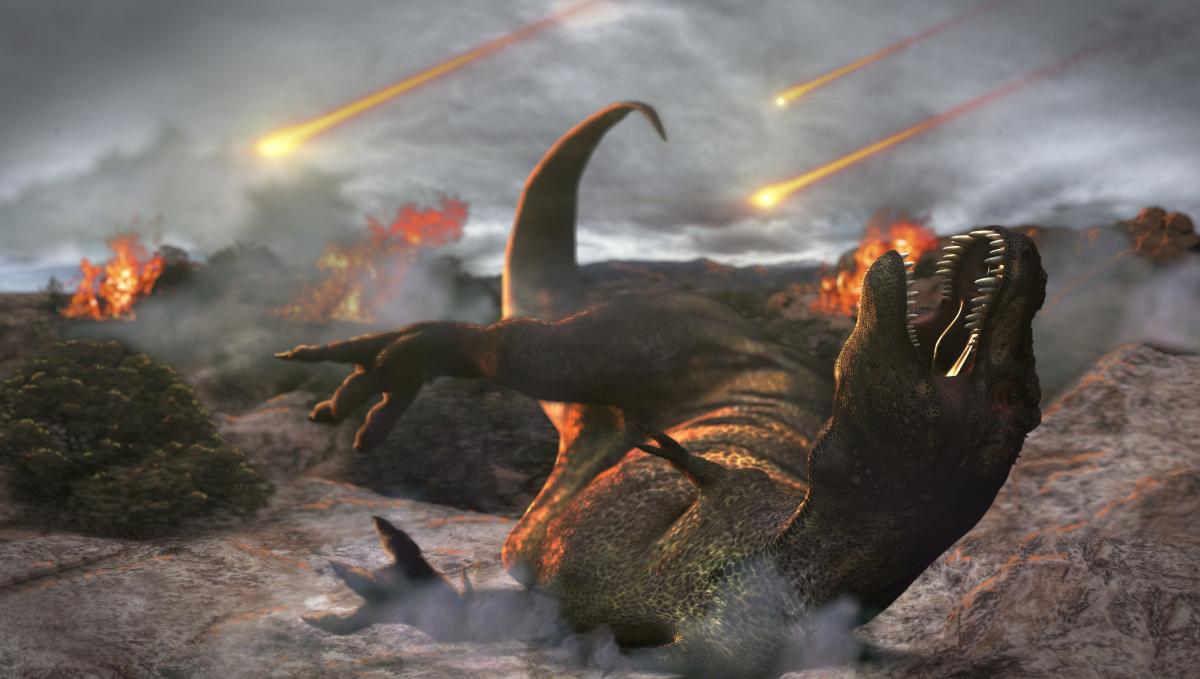
Planet-wide wildfires killed land-dwelling creatures like dinosaurs after a six-mile asteroid struck the Yucatan peninsula, kicking off one of Earth’s five known mass-extinctions.

But it was the long night that fell as 15,000 million tons of fine soot rose into the stratosphere, shutting down global photosynthesis for two years and destroying the ozone layer. The long night likely doomed the rest of the three-quarters of species that died.

Chuck Bardeen of the National Center for Atmospheric Research led the PNAS study, published this week.

“This would have had a great impact on life that might have survived the immediate effects of the impact, because there wouldn’t have been a primary food source,” Bardeen said. “So, plants wouldn’t have grown, and phytoplankton in the ocean would likely have died.”

The soot layer initially shielded the already-stressed survivors from the effects of the global ozone hole, but rain drove the particulates from the sky before the O3 layer could repair itself. This only deepened the disaster, Bardeen said.

The Fifth Mass Extinction - The K-T Extinction

“You start out with broiling the surface. Then you cool things down, precipitation goes away, it gets dark, you don’t have photosynthesis,” Bardeen said. “Then, as you start to warm back up and precipitation comes back, and maybe things start growing, then you get this burst of ultraviolet radiation, which could cause mutations and death.”

Dust, not soot, was the prime suspect initially investigated after physicist Luis Alvarez and his son, geologist Walter Alvarez, proposed in 1980 that a giant asteroid strike had killed the dinosaurs.

In more recent years, and using more advanced models, scientists have investigated the effects of other particulates, such as sulfates that might have erupted from volcanoes or from the impact itself.

“For a while, we have thought that soot was one of the things that went into the atmosphere from the impact, but recently there’s been a renewed interest in looking at it in climate models to understand what the climate effects of that soot would be,” said Bardeen.

The NCAR Community Earth System Model (CESM) is among the most sophisticated simulations ever to tackle the Cretaceous−Paleogene extinction. It incorporates oceanic, land and sea-ice effects, as well as chemistry and advanced microphysics.

Scientists will now apply the model to additional Cretaceous research and to simulating nuclear winter scenarios.

Source: www.nout.org

Altirhinus

Sunday, August 27, 2017

Altirhinus by Dinoraul

Altirhinus was an ornithischian dinosaur that existed on the earth in the early Cretaceous Period. Order Ornithischia includes dinosaurs with pelvic bones similar to present day birds. The most prominent feature of the Altirhinus was the shape of its nasal bone. Such cranial and facial adaptations were very common in ornithischians belonging to infraorder Iguanodontia; the Altirhinus is a part of this taxon.

The fossils of this reptile were found in Mongolia. Mongolia lies on the border of Europe and Asia, being flanked by Russia anteriorly and China posteriorly. Thus, the Altirhinus could inhabited both these continents. The time period of its existence was between 120 and 105 million years ago. This lies in the Aptian and Albian ages of the Cretaceous.

Altirhinus kurzanovi skeletal reconstruction by ornithischophilia

Altirhinus was herbivorous and bipedal when walking or running, but probably became quadrupedal when feeding from the ground. According to the original description, the entire body probably extended 8 m from snout to tail tip. In 2010 Gregory S. Paul estimated the length at 6.5 metres (21 ft), the weight at 1.1 tonnes. The skull alone is about 760 mm long, with a wide mouth and a distinctive tall arch on top of its snout, from which this dinosaur derives its name.

Altirhinus is definitely an advanced iguanodontian, just basal to the family Hadrosauridae, but there is little agreement on the arrangement of genera and species in this area of the ornithopod family tree.

In the original description, it was included with Iguanodon and Ouranosaurus in a family Iguanodontidae (Horman, 1998). More recent analyses all find Altirhinus more derived than either of those two genera, but less than ProtohadrosProbactrosaurus, and hadrosaurids (Head, 2001; Kobayashi & Azuma, 2003; Norman, 2004). The former two studies also place Eolambia between Altirhinus and hadrosaurids, while Norman’s analysis finds that the two genera share a clade.

Fukuisaurus is just basal to Altirhinus according to the only analysis in which the former has been included (Kobayashi & Azuma, 2003).

Nasal Arch

The characteristic arched snout of Altirhinus was formed primarily by the nasal bones, and a similar structure is seen on the snout of the Australian Muttaburrasaurus. Many different functions have been proposed for the nasal arch. It may have housed tissues to cool the blood, conserve water, or enhance the sense of smell. Alternatively, it may have facilitated communication through vocalization or visual display. As only two skulls have been located, it is entirely possible that the arched snout is only found in one gender, in which case it may have been used for sexual display, like in modern-day elephant seals.

Fossil of Altirhinus, an extinct reptile – Took the picture at Dinosaurium, Prague

Pages