Blogs

New Fossil Shows When Worms Developed Heads

Thursday, January 25, 2018

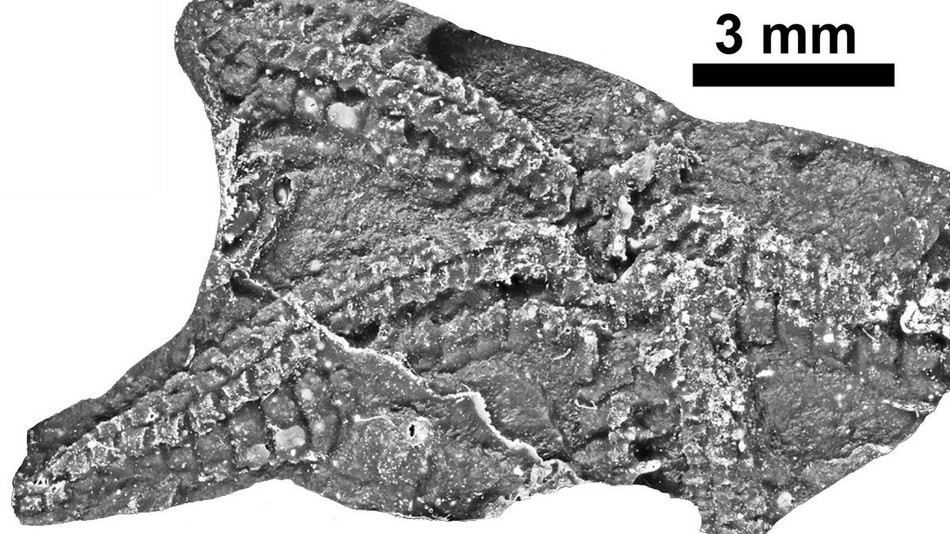
A fossil dating from the Cambrian, more than 500 million years ago. Note the bristles partially covering the head. Image credits: Jean-Bernard Caron/Royal Ontario Museum.

A new study based on recent findings might shed a new light on annelids (ringed worms). Researchers now have solid evidence that these animals developed heads more than 500 million years ago. An extremely well-preserved fossil also suggests how the head evolved in the first place.

We take some of our biological features — such as the head — for granted. But five hundred million years ago, things were much more unfamiliar. Not only was the planet a completely different place, with different landscapes and atmospheric conditions, but heads were a scarce commodity. It’s not clear exactly when creatures started to evolve heads — areas of the body with concentrated sensorial functions — but some of the earliest evidence we have comes from 500 million years ago, during a period called the Cambrian.

Now, paleontologists working in Canada have found an intriguing Cambrian fossil which sheds new light on how annelids developed heads.

The fossil was found in the 508-million-year-old Marble Canyon site in the Burgess Shale in British Columbia. Burgess Shale is one of the best places for Cambrian fossils, with a long list of intriguing finds that enables us to better understand how life evolved. Now, we can add a new entry to that list: Kootenayscolex.

“508 million years ago, the Marble Canyon would have been teeming with annelids,” said Karma Nanglu, a University of Toronto PhD candidate, and a researcher at the Royal Ontario Museum, as well as the study’s lead author. “The fine anatomical details preserved in Kootenayscolex allow us to infer not only its evolutionary position, but also its lifestyle. Sediment preserved inside their guts suggest that, much as their relatives do in modern ecosystems, these worms served an important role in the food chain by recycling organic material from the sediment back to other animals that preyed on them.”

Kootenayscolex barbarensis, as its full name goes, had paired bundles of hair-sized bristles spread along the body, which allows paleontologists to positively identify it as an annelid. But unlike any other discovered fossil, these bristles were partially covering the head — specifically, the mouth. This seems to support the theory that the head evolved from posterior body segments, something which was also suggested by research on modern species.

However, fossil evidence is extremely scarce. Since annelids are invertebrates (Kootenayscolex actually emerged as one of the first annelids), preservation of their soft bodies is extremely rare. The very process of fossilization favors the preservation of bones and other hard body parts, which makes this finding even more valuable: not only is it a rare occurrence of a preserved soft body, but it’s also caught in an important moment of its evolutionary history.

With over 17,000 extant species including ragworms, earthworms, and leeches, annelids are one of the most diverse groups on Earth. They can thrive in a variety of environments, from marine environments as distinct as tidal zones and hydrothermal vents to freshwater lakes and moist terrestrial environments. Wherever there’s some form of humidity, there’s a good chance to find an annelid. This diversity makes them an extremely interesting and important group to study, but it also makes it extremely difficult to look at the broad picture.

“Annelids are a hugely diverse group of animals in both their anatomies and lifestyles,” added Nanglu. “While this diversity makes them ecologically important and an evolutionarily interesting group to study, it also makes it difficult to piece together what the ancestral annelid may have looked like.”

The team’s research is due to be published in the journal Current Biology.

Source: www.zmescience.com

The 10 Best Dinosaur Gifts to Buy in 2018

Thursday, January 25, 2018

Go back to the Jurassic period with these books and toys!

Who doesn't love dinosaurs? They're big, prehistoric and just flat out cool. While dinosaurs are nothing "new", this year they seem to be everywhere, including children's clothing, toys and on the big screens. With Jurassic Park mania still going strong and a sequel in the works — now is the time to give a dinosaur gift to any budding paleontologist you know or just anyone on your list.

Dinosaur lovers aren't just little kids — big kids, teenagers and adults alike all seem to have a great fascination for these prehistoric creatures. So, our roundup of the best dinosaur gifts doesn't just include the best toys we have a few options for every age group, because we are all young at heart.


Prextex Plastic Assorted Dinosaur Figures with Dinosaur Book

We simply could not have a list of dino toys without a set of plastic dinosaur figurines on it. Kids’ imaginations can run the gamut with these realistic-looking dinosaurs. And, as if the dinos were not enough, this set comes complete with a book that teaches kids the history of each of the dinosaurs included in the set, fostering kids’ natural curiosity and love of science. Each of the 12 dinosaurs has a page in the book with full-color, detailed images and facts about the size, habitat, history and diet of each. The dinosaurs included measures approximately seven inches in height — perfect for little hands. This is a great gift for kids ages three and up.


National Geographic Little Kids First Big Book of Dinosaurs - Hardcover

This hardcover book is perfect for the dinosaur enthusiast ages four to eight years old. The world of small, big, giant and gigantic dinos comes to life on the pages of the National Geographic Little Kids First Big Book of Dinosaurs. Easy-to-read text, beautifully detailed illustrations and fun facts make this a kid favorite. The Big Book of Dinosaurs also has parent tips and activities to continue kids’ dino-loving experience, large print and phonetic pronunciation guides for dinosaur names and interactive questions to keep little ones engaged. Also available for Kindle or in paperback, this is a wonderful gift.


LEGO Creator Mighty Dinosaurs 3-in-1 Set

No gift list is complete without at least one LEGO set on it. And with this set kids can build three different dinos: a four inch tall Tyrannosaurus with sharp claws and razor-like teeth, a three inch Triceratops, or a seven inch long Pterodactyl with a nine inch wing span. The T-Rex has moveable joints and a mouth that opens to show his ferocious teeth. This dino-loving set also includes a buildable rib cage for your dinosaurs to prey on. Kids 7 to 12 years old will love building their favorite dinosaurs with this mighty LEGO set.


3 Bees and Me Dinosaur Toys - Set of 4

Preschoolers ages two and up will love these simple, wheeled dino toys by 3 Bees and Me. The four-pack comes with a red rolling T-Rex, a fun-loving stegosaurus, everyone's favorite brontosaurus, and a crested triceratops. Each of the dinos comes on wheels with and ergonomic, easy-grip design so little hands can zoom their new friends around. Certified BPA-, lead-, and phthalate-free, these jurassic friends are safe and built to withstand rough pre-school play. 


Mega Fossil Mine - Dig Up 15 Real Fossils with National Geographic

Young palaeontologists ages eight and up will love this Mega Fossil Dig Up Kit. Kids can unearth 15 different real fossils from the 8x8 gypsum block mold. The set includes three different mini tools for excavating: a magnifying glass, a small brush and a mini knife/saw. This set will keep them engrossed for hours as they unearth real fossils like dino bones, ammonite, coral, clams, gastropods, and more. Included with the set is a full-color guide to the fossils kids find. This award-winning science kit will foster a love of STEM and keep kids excited as they dig through layer after layer to uncover the mysteries beneath. 


Fisher-Price Imaginext Ultra T-Rex

What kid doesn’t want a giant, two-and-a-half foot, monster-stomping, arrow-shooting, dino-roaring T-Rex? This motorized Tyrannosaurus Rex can walk, chomp, roar, fire arrows or boulders, and so much more. Kids ages three to eight can interact with their ferocious Fisher-Price T-Rex by activating any of the three power pads that control various features. LED lights illuminate his eyes and spikes. And of course what would a T-Rex be if he didn’t open his mouth and roar? The Imaginext dino also shoots cool projectiles from his mouth with a touch of the power pad. Included with the set are three cavemen figures that can also be placed on the power pads, in jail or in the dino’s mouth in a “driver’s seat.” Additional buttons let kids launch boulders and dino-claws. This deluxe T-Rex is packed with activities for imaginative play and fearsome fun.


WowWee Roboraptor - Blue

The Roboraptor has received a few modern improvements since its original release in 2005. Now available in ice blue and with bluetooth technology included, this already cool toy is even more impressive. Bluetooth technology lets kids seamlessly connect their smart devices to Roboraptor and free apps available on the App Store and Google Play allow for advanced game play and control of their raptor. The Biomorphic Motion gives this rad robot natural, fluid movement of his neck, arms, tail, and legs. The Roboraptor can run, hunt, walk, play, and interact with kids through intelligent detection sensors. Sound, touch and infrared sensors allow Roboraptor to sense and respond to stimuli in the environment. Kids can control this massive 32” robot with either the included remote control or with their smart device. Cutting edge technology and whole lot of attitude make this one of the coolest gifts you can give a kid between the ages of 8 and 15, but we know a few grown ups that would love this raptor too.


Dinosaur 3D Optical Illusion Night Light

Mood light, night light, or just for fun light, dino fans big and small will definitely think this night light (or cool desk lamp) is the best thing since the Cretaceous period. OK, so no, it isn’t truly 3D, it is an optical illusion, but it’s a cool looking night light at that. The Elstey dinosaur light is a flat piece of durable acrylic inserted into a lighted base. The image is drawn onto the acrylic so that the light will pass evenly over the lines and create a 3D illusion. The base has alight element that can change with the touch of a button, changing color from blue, red, yellow, cyan, green, pink or white. Included is a USB cord for charging. 


Coavas Little Kids Dinosaur Backpack

The Coavas Dinosaur backpack is one of the cutest ones we’ve found for prehistoric-loving preschoolers. Not only is this adorable, but it is incredibly durable. Made out of Neoprene, the dinopack is water resistant and machine washable. Brightly colored 3D orange spikes curve down the back to a spiked tail at the bottom, while a big red mouth with ferocious teeth lines the easy-pull zipper. A padded back and adjustable straps make this comfortable for kids ages one and up to wear. The overall dimensions are: 11.8” x 9.3” x 5.5” and if you love this green dino check out the other dino-favorites such as the blue one covered in spikes or the orange dinosaur for more options.


Jurassic World 3D Limited Edition Gift Set

Prehistoric aficionados are sure to love this Limited Edition Gift Set of the 2015 blockbuster Jurassic World — complete with battling dinosaur figurines. Dino fans know and love the Jurassic World movie and what better way to watch it than in the 3D version packed with special features like deleted scenes, access to a digital version, and Jurassic’s Closest Shaves? This PG-13 rated classic is full of action as main characters Owen and Claire, portrayed by Chris Pratt and Bryce Dallas Howard, race for survival when chaos breaks out at the futuresque dinosaur theme park. This is a 3-disk set with two plastic dinosaurs engaged in battle.

Could Modern Humans Survive an Asteroid Impact, Like What Killed the Dinosaurs?

Friday, January 19, 2018

Meteorite impact

We know that an enormous meteorite hit the Gulf of Mexico some 66 million of years ago, shooting dangerous gases, dust, and debris into the upper atmosphere, blotting out the sun, and killing off most of the plant life on Earth. Large herbivores followed and eventually the carnivores that preyed upon them. Note however that one recent, exhaustive study found that many of the dinosaurs were already in decline, way before the bolide or meteorite’s impact.

Had the asteroid hit just 30 seconds later (or sooner), landing more in the Atlantic or Pacific, rather than just off the coast of Mexico, we may have had more, non-avian dinosaurs running around today. Instead, the bolide smashed into the Earth with a force equivalent to ten billion nuclear bombs.

Our ancient, tiny mammalian ancestors survived, their rodent-like bodies cowering as they witnessed one of the greatest mass extinction events ever to occur on our planet. Of course, they probably didn’t have brains developed enough to fully comprehend it. Besides the stench of death filling the air and the massive bodies piling up hither and yon, acid rain fell and volcanic eruptions shook the Earth, sullied the air, and scarred the landscape.

Smallness and requiring little food helped our ancient, shrew-like ancestors survive, which begs the question, could we modern humans make out okay if such an event happened today? Research surrounding another, similar incident suggests so, but it’s complicated. Around 790,000 years ago another asteroid about a kilometer (approx. 0.62 mi) long struck the Earth with such a force that it sent debris hurtling into the atmosphere, which ended up covering one tenth of the Earth’s surface. The crater has yet to be found. Scientists say it would be about 40–100 km (approx. 24-62 mi) in diameter.

Barringer crater: The impact site of the meteorite that struck nearly 800,000 years ago hasn’t been found. Credit: By USGS/D. Roddy.

What’s been unearthed are these glassy rocks called tektites. Larger varieties can weigh up to 20 kilograms (44 lbs.).  Scientists recently analyzed these stones. Their findings were published in the journal Geology. This was the largest such event to occur during the time when humans were known to be on Earth and evolving (as they always are). Researchers say the event gives us clues as to whether modern humans could survive a dinosaur-size cataclysm today. The answer is yes, but it would be difficult.

So far, tektites have been found in Australia, Asia, and Antarctica. In this study, astrobiologist and geochemist Aaron Cavosie of Curtin University in Australia, along with colleagues, looked into the chemical makeup of three tektites found in Thailand. Researchers studied minute crystals of zircon, each about the width of a human hair, within the tektites.

These showed signs of the rare mineral reidite, which disappears seconds after being formed. “Reidite requires substantially higher shock pressures to form,” Cavosie said. High temperatures are needed as well. The orientation of the zircon in the tektites points to an impact occurring somewhere in Southeast Asia, probably near Thailand. Though these samples tell a lot, what’s missing is the exact location of the impact site. It’s mind-boggling that such a large crater has yet to be found.

Tektite found in the Libyan Desert. Credit: James St. John. Flickr.

“Our not-too-distant ancestors witnessed this impact,” Cavosie said. “They might have been dragging their knuckles, but an event like the formation of a 50- to 100-kilometer-diameter impact is sure to have gotten their attention.” Further studies examining tektites may yet reveal the crater’s location.

Even though this was a catastrophic event, our ancestors were able to survive and thrive, as the debris shot up into the atmosphere must've caused significant changes to the climate. How this influenced our ancestors and perhaps changed the course of human evolution is difficult to discern, though more clues may help us get a better understanding of that.

So what if a comet or a serious asteroid collided with the Earth? Most scientists say our planet is threatened by such an asteroid about every million years or so. We’re not due for one any time soon. Most of the asteroids out there lie between Mars and Jupiter and won’t threaten Earth ever.

There are thousands though which could potentially hit us. Most are the size of a compact car or smaller and burn up in the atmosphere. A few are a bit larger and could do great damage to say a house or even a city, depending on the size, but wouldn’t threaten all life on Earth or anything.

NASA’s Planetary Defense Coordination Office (PDCO) tracks near-Earth objects (NEOs) of significant size with the potential to hit our planet. It’s a collaborative effort involving observatories and universities all over the world. The perennial question is whether or not an asteroid looks as if it’s inside the “keyhole,” meaning it has the potential to make impact with Earth.

Besides a collision, a sizeable object passing close by the Earth could throw the planet’s orbit off. So far, deflection strategies haven’t been decided upon. Planting a nuclear bomb inside a potentially hazardous asteroid, or nudging it off course with rockets or a solar sail, are some other the methods that have been proposed.

Should we fail and a large asteroid once again crash into our world, causing a long-term impact winter, most of the plant life would die off within weeks. Large trees could last decades due to a buildup of sugar in their systems and a slow metabolism. Not much life would exist beyond that, save for microbes and small creatures.

Humans could survive if they went deep underground to take advantage of heat found there, or if we built isolated habitats inside domes. Of course, it’s best to safeguard our precious planet. And although attaching a solar sail to an asteroid may sound fantastical, most scientists believe it’s feasible, using technology that’s already available today.

Source: http://bigthink.com

Animatronic Dinosaurs Snarl at Visitors to Okinawa’s Dino Park

Saturday, January 20, 2018

The Dilophosaurus is among the many attractions at Dino Park in Okinawa, Japan. MATT BURKE/STARS AND STRIPES

“Jurassic Park” was supposed to have taken place on an island off the coast of Central America. But if author Michael Crichton had visited the forest of Yanbaru in northern Okinawa, he might have well set his classic thriller in Japan instead.

To the lay person, the forest is a near-perfect representation of prehistoric times, with exotic plants and animals, ancient trees that bubble out of the ground like rising dough to blot out the sun, thick hanging vines and the smell of millennia of plant decomposition.

Thankfully, some enterprising individual shared Crichton’s vision when staring out into this lush sea of green that is Yanbaru and brought us Dino Park.

Dino Park is a fun family experience for those living on Okinawa, especially for those with children captivated by the now extinct reptiles. It is a surprisingly large operation that features animatronic dinosaurs, big and small, set against Yanbaru’s primordial wilds. The park also offers stunning views of more than a dozen flower varieties that bloom in various seasons.

Source: https://okinawa.stripes.com

6 Things You Need to Know About the Newly Discovered "Rainbow Dinosaur"

Saturday, January 20, 2018

An artist's depiction of Caihong juji, a species of theropod dinosaur that lived 160 million years ago in what's now northeastern China.  ILLUSTRATION BY VELIZAR SIMEONOVSKI, THE FIELD MUSEUM

The newly discovered dinosaur species in China, nicked named the "rainbow dinosaur," has attracted widespread attention and raised many questions. How did researchers examine the colors of its feathers? What does the new species reveal about the evolution from dinosaur to bird? What is the significance of the findings? Here are six things you need to know to better understand the discovery.

What is the rainbow dinosaur?

The rainbow dinosaur is officially named Caihong juji, with caihong meaning rainbow and juji meaning big crest, due to the iridescent plumage on its head, chest and parts of its tail, as well as the bony crest on its head.

Paleontologists have partially reconstructed the dinosaur's original plumage colors based on melanosomes in the fossil. To a large extent, it resembles the iridescent feathers of hummingbirds.

More amazingly, the new dinosaur, a paravian theropod, changes its plumage colors at different observation angles.

The fossil was found by a farmer in Qinglong Manchu Autonomous County, Hebei Province in north China. It is now kept in the Paleontological Museum of Liaoning, northeast China.

When and where did the rainbow dinosaur live?

Paleontological examination shows that the new dinosaur lived around 140 million years ago in the mid-late Jurassic age. The place where it was fossilized might have been a forest surrounded by mountains and shallow lakes.

Given that there are feathers on its hind limbs, which are not suitable for running on the ground, there is a good chance that it lived in trees.

Like other theropods, the rainbow dinosaur may have fed on small mammals and lizards. Though being rooster-sized and beautifully feathered, its half-moon-shaped teeth and sharp digits suggest it was ferocious.

Could the rainbow dinosaur fly?

Imagining giant dinosaurs flying in the sky seems to go against common sense. However, there remains the possibility that the rainbow dinosaur could take off for a short flight due to its similar morphological traits to birds. But this is merely a hypothesis waiting to be proved.

"The basic structure for flying has emerged, but the short forelimbs make its body disproportionate for flying," says Xu Xing, co-author of the thesis on the new dinosaur published in Nature Communication and researcher at the Institute of Vertebrate Paleontology and Paleoanthropology.

Why is the rainbow dinosaur so important?

The discovery of the new dinosaur has drawn widespread attention from across the world, because it completes a critical part of the evolutionary tree from dinosaurs to birds.

According to paleontological studies, the fossil shows the earliest asymmetrical feathers in dinosaur as well as the earliest proof for melanosomes, which are platelet-shaped nanostructures in dinosaur feathers.

"The rainbow dinosaur, which existed at least 10 million years earlier than the Archaeopteryx, already had asymmetrical feathers, which may have helped increase control force and stability and thus been key for flight. It means that the evolution from the dinosaur to the bird might have happened earlier than we thought," Xu Xing says.

"However, while feathers on its tail are asymmetrical, feathers on its forelimbs, commonly considered as a source of power for flight, are still symmetrical.

"It either means that asymmetrical feathers were first developed not for flight, but for other functions such as the display of courtship and confirmation of species identity, or it means that the balance-controlling feathers on tail played a more important role in flight than we thought."

Where does it fit in the evolutionary tree?

In 1868, Thomas Henry Huxley made the controversial hypothesis that birds were evolved from dinosaurs. However, the idea was deemed absurd by most scholars for roughly a century.

In the 1970s, the hypothesis was revived by U.S. paleontologists with a series of fossil evidence. In 1996, the fossil of Sinosauropteryx, which has soft feathers akin to birds, was found in Jehol Biota in northeast China. In the following years, more fossils of feathered dinosaurs were found in west Liaoning regions in northeast China. In 2009, the fossil of Anchiornis huxleyi, the earliest dinosaur with flight feathers, was unearthed in Liaoning Province. Anchiornis huxleyi existed around 160 million years ago, about 20 million to 30 million years earlier than Sinosauropteryx.

The rainbow dinosaur has even longer feathers in its forelimbs and hind limbs than that of Anchiornis huxleyi. It shows more bird-like traits, such as its bony structure and plumage characteristics. In the evolutionary tree, it perfectly fills in the vacancy between Anchiornis huxleyi, Sinosauropteryx and Archaeopteryx, the earliest known bird.

Why did dinosaurs evolve into birds?

Bird-like dinosaurs probably appeared because they had to adapt to the environment, otherwise they would not survive. But it is still unclear what kind of natural changes brought about the external pressure on their evolution.

"It is mostly likely that only those that could fly escaped the dinosaur extinction around 65 million years ago. The rainbow dinosaur, one of the lucky survivors, was a precursor to the evolution from dinosaurs to birds," says Xu Xing.

Source: www.xinhuanet.com

Jurassic World 2 Plot Speculations: Will Fallen Kingdom Feature the Return of Spinosaurus?

Thursday, January 18, 2018

Jurassic Park 3: Spinosaurus vs. T. rex (2001)

The franchise fans are looking forward to see a fight between Spinosaurus and Tyrannosaurus rex in the upcoming Jurassic Park sequel.

Jurassic World 2, the upcoming Jurassic Park sequel titled Fallen Kingdom, is just five months away from its worldwide release, and speculations are rife that the film will feature the return of the Spinosaurus.

Many franchise fans are already looking forward to seeing a fight between the Spinosaurus and Tyrannosaurus rex in the upcoming science-fiction adventure movie.

A section of fans, like reddit user F****ng_ape88, believe the Spinosaurus that might be featured in Fallen Kingdom could be different from the one that appeared in Jurassic Park 3.

"We don't know if the Spinosaurus is in Jurassic world 2. But if it is, will it look like the Jurassic Park 3 or the real Spinosaurus. The skeleton in Jurassic World is different than the one in Jurassic Park 3. The skeleton has a crest on its head and might have shorter legs. The JP3 Spinosaurus might have survived," the fan speculated.

"If the Spinosaurus is in jw2, it's going to look like the JP III one," another franchise fan wrote. Yet another reddit user commented, "I really hope we finally get the rematch and Rexy just nopes it."

Meanwhile, a section of franchise fans said they are hoping to see some new dinosaur species in Jurassic World 2. "I hope we'll get to see more different dinosaurs like the allosaurus, carnotaurus, more pachycephalosaurus and other underrated dinos!" a reddit user wrote.

READ ALSO: Carnotaurus Attack: New Thrilling Look at Jurassic World 2

Agreeing with him, another franchise fan commented: "Yes! Tired of seeing the same ones in every movies! Or at least let us see them get attacked by other dinosaurs than the carnivores (like the stegosaurus scene in JP2)."

However, cast member Bryce Dallas Howard, who portrays former park manager Claire Dearing in the film, has hinted that the upcoming Jurassic Park sequel will focus more on the rescue mission of dinosaurs.

"Claire's founded an organisation, Dinosaur Protection Group, and they're finding a way to get these dinosaurs off the island. She reaches out to Owen Grady to let him know this is happening," Entertainment Weekly quoted the actress as saying.

"When you see them at the beginning of this story, you get caught up as to what's going on. But it's not what you would necessarily expect," she added.

Jurassic World: Fallen Kingdom will hit the screens in the US on June 22. The movie is bringing back some of the fan-favourite characters like Dr Ian Malcolm, and dinosaurs like the velociraptor Blue and Tyrannosaurus rex Rexy.

Source: www.ibtimes.co.in

Morocco Wants to Repatriate the Tail of a Dinosaur Sold in Mexico

Saturday, January 20, 2018

Morocco wants to repatriate the tail of a dinosaur sold in Mexico./Ph. DR   ...More : https://en.yabiladi.com/articles/details/61112/morocco-wants-repatriate-tail-dinosaur.html

The Moroccan authorities will try to repatriate the tail of a Sauropod auctioned in Mexico, proving the illegal nature of its acquisition, said Abdellah Alaoui, head of the Cultural Heritage department at the Ministry of Culture, reports Medias 24, adding that Morocco could buy this fossils if necessary.

The sale of this paleontological discovery is to be used to rebuild or repair 5,000 Mexican schools, damaged by earthquakes that hit the country in September 2017.

According to Abdellah Alaoui, this tail was found in pieces in the Atlas Mountains during the 1980s by locals. They then sold it to intermediaries. The Ministry of Culture has learned about the «illegal export» through media reports, he told the same source.

He also said that the department has opened an investigation that will determine the origins of this dinosaur tail. «We will first contact the auction house to see if the seller has legal import certificates allowing him to resell this piece of our history. If it is in good faith, Morocco will have no choice but to buy it from the new buyer and then repatriate it», he said.

«If we manage to prove that the fossils were exported illegally,  the Moroccan embassy in Mexico will launch a specific procedure to cancel this sale and repatriate this piece of heritage», Abdellah added. 

Source: https://en.yabiladi.com

China is Developing a Dinosaur Theme Park at the Site Where Dinosaurs Roamed Millions of Years Ago

Sunday, January 21, 2018

On Saturday, China opened a global bidding process inviting top paleontologists and planners from across the world to participate in developing a world-class dinosaur theme park at Pu’an Township in Yunyang County. The government wants to build this theme park to promote scientific research of the fossils discovered in different parts of the country. The park will recreate the landscape of the Jurassic era and offer the public an exciting trip into the world of the dinosaurs. It will also let visitors experience the evolutionary history of the massive creatures that were wiped out from the Earth millions of years ago.

“The world-class natural resources should be matched with world-leading vision and wisdom. The invitation for global bids aims to attract a team of the top planners and paleontologists from around the world,” said Qin Changde, head of Yunyang County, as reported by Xinhua News.

The approval for the Yunyang Pu’an Dinosaur Theme Park was given by the Chongqing municipal government in May 2017. The park will feature a world-class gallery exhibiting animated models of the dinosaurs to show how these creatures lived millions of years ago. Visitors will also be able to “interact” with these animated models in the park. The detailed information about the bidding process can be obtained from the website Chinabidding.com.

#Dinosaur fossil site found in Pu'an Township, southwest China's Chongqing, June 22, 2017.(Photos: Xinhua) https://t.co/tx08bTNecu pic.twitter.com/N7Fh6j3emc

— Global Times (@globaltimesnews) June 29, 2017

Yunyang County is a part of the Chongqing Municipality located in the southwestern region of China. This place is famous for Pu’an Township, the site of ancient fossils. In early 2015, a local farmer accidentally discovered some fossils at this place. In October 2016, a team of archeologists started the initial excavation work and found that this area has densely distributed fossils of turtles, dinosaurs, and several other species of great research value. According to experts, these fossils belong to a wide time span. In June 2017, archeologists revealed that they had discovered more than 5,000 fossils from a “fossil wall” in Pu’an.

The dinosaur fossils discovered here belonged to five dinosaur categories, including stegosaurs, sauropods, and ornithopods. Many fossils dating back to the middle Jurassic period were also found. According to experts, these fossils are rarely found in other parts of the world. After the discovery of the fossils from Pu’am, the Chongqing government decided to protect the site and allocated nearly US$2.5 million for the excavation project.

In addition to Pu’an Township, archeologists have also discovered fossils from 65 other areas within the Chongqing Municipality.

Source: www.inquisitr.com

Crepidosoma doyleii: This New Species of Brittle Star Lived 435 Million Years Ago

Monday, January 22, 2018

Scientists say the fossilized remains of a brittle star that lived 435 million years ago belong to a new species. 

The fossil was named Crepidosoma doyleii, after the paleontologist who discovered it. Eamon Doyle was a Ph.D. student when he discovered the remains of the thumbnail-sized creature in the late 1980s, embedded in a layer of fossils on a hillside in the Maam Valley in Ireland. 

Though this species of brittle star (which are closely related to starfish) first developed nearly half a billion years ago, its modern day descendants are remarkably similar.

This particular species was a marine scavenger and lived through continental shifts, oceans rising and draining, and the extinction of the dinosaurs. The brittle star that Doyle found most likely lived in the ocean over what's now Ireland, which disappeared after tectonic plate shifts. 

Researchers published their findings on Crepidosoma doyleii this month in the Irish Journal of Earth Sciences

According to Doyle, this brittle star is incredibly resilient — it was around during the Silurian period, when the first land plants evolved. 

The discovery is significant because it's a "key piece of evidence in the hunt for past life in the ocean that covered Ireland," David Harper, a paleontologist at Durham University and co-author of the study, told the Irish Times

The fossil will be put on display at the National Museum of Ireland.

Source: www.mashable.com

This is the Reason why Samuel L. Jackson’s ‘Jurassic Park’ Death was Never Filmed

Sunday, January 21, 2018

Samuel L. Jackson revealed his character's death in 'Jurassic Park' was supposed to be shown in the film.

The 69-year-old actor played chief engineer John 'Ray' Arnold in Steven Spielberg's iconic 1993 blockbuster , but the character was brutally killed by one of the escaped dinosaurs off-screen and only his dismembered arm was found by Dr. Ellie Sattler - played by Laura Dern.

However, Jackson's alter ego was supposed to be seen by audiences being attacked by a giant reptile, but due to a hurricane he was unable to get to Hawaii to shoot his death scene.

Speaking to The A.V. Club, Jackson said: "I was actually supposed to go to Hawaii, to shoot my death scene, but there was a hurricane that destroyed all the sets, so I didn't get to go. All you see is the residue of my body, my arm. But yeah, I was supposed to be on set."

Jackson is one of Hollywood's most prolific stars and has made over 175 movies - becoming known to new generations by his role as Nick Fury in the Marvel Cinematic Universe.

Despite all his big screen experience, the 'Pulp Fiction' star has no desire to step behind the camera because directing is such a laborious process.

He explained to Vulture: "I'm still not bitten by the directing bug. What's keeping me from directing is the fact that directing takes up almost a year of your life, and when you direct a movie you've got to cut it and then you've got to be dealing with the music and then you've got to run around the world talking about it - and [as an actor] I could do four movies in that time."

Although he is a frequent Quentin Tarantino collaborator, Jackson has no idea if he will be in the director's upcoming movies, which include a new 'Star Trek' installment and Charles Manson biopic 'Helter Skelter'.

Jackson said: "I never take anything for granted in the movie business! You can't assume that you're going to be in something just because you've been in all the rest of them. I can't make that assumption. I'm not in 'Death Proof'!"


Source: www.msn.com

Pages