Blogs

Dinosaur Footprints Dating Back 139-Million-Years Found By Scientists Who Believe Giant Predator Even Pre-Dated The T. Rex

Thursday, June 21, 2018

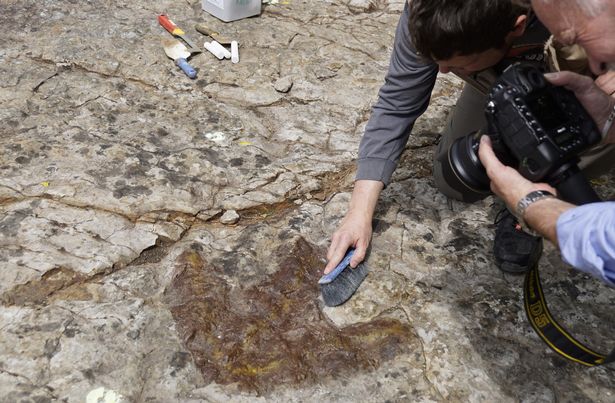
The scientists believe the 50cm footprint belonged to a huge 10 metre predatory dinosaur (Image: CEN/Dinopark Munchehagen)

The scientists think the 50cm footprints belonged to a huge 10 metre beast that lived during the Cretaceous Period.

Dinosaur footprints dating back 139-million-years have been found by scientists who believe the giant predator even pre-dated the T. rex.

The scientists think the 50cm footprints belonged to a huge 10 metre beast that lived during the Cretaceous Period.

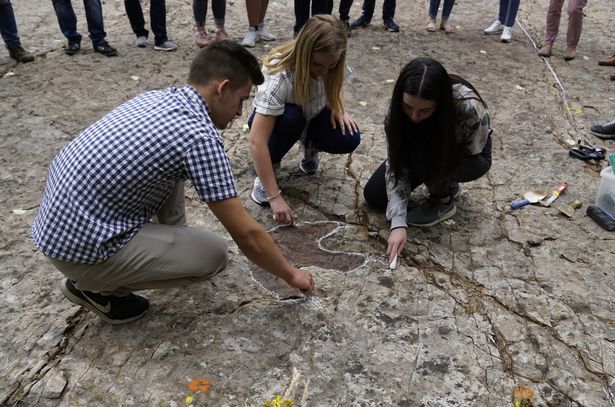
A team of geoscientists and palaeontologists discovered the prints in the Muenchehagen Dino-park in the north-western German state of Lower Saxony.

If their findings are correct, it would mean the dinosaur would have preceded the T. rex by five million years.

Expedition leader Nils Knoetschke said: "Underneath are the footprints of a very big, unknown predatory dinosaur whose body length is indicated at up to ten metres."

According to the team, dinosaur footprints previously found were those of dinosaurs only half that size.

Scientists and officials on the site where the footprint has been discovered (Image: CEN/Dinopark Munchehagen)

They added that no bones of a dinosaur that big and from that period have been found in Central Europe.

The most complete T. rex specimen found measures up to 12.3 metres in length, but this species lived in north-America.

These findings have lead the team to believe that the footprint in fact belongs to a whole new type of dinosaur, which has not yet been discovered.

An excavation team has now been sent out to the site to uncover the footprint and discover as much information as possible.

There are approximately 300 dinosaur footprints in the 2500 square metre surface of the Dino-park.

Remains of prehistoric crocodiles, turtles and sharks have also been discovered here in the past.

Knoetschke thanked modern technology for the findings, saying they were made possible thanks to modern methods like photogrammetry and 3D-scanning.

Excavation director Benjamin Englich plans to publish their findings as soon as the footprint has been uncovered and studied.

Source: www.mirror.co.uk

Dinosaur Footprints Found in China Reveal That Feathered Dromaeosaurid Lived in Groups

Wednesday, June 20, 2018

Four paralleled footprint trackways of dromaeosaurid found on the site suggest the dinosaurs travelled together. Screenshot/v.qq.com

Scientists from China, United States and Australia have discovered over 300 dinosaur footprints in a village in Shandong Province in east China, providing the first evidence of social habits among one family of feathered dinosaurs.

Among the 300 footprints, 70 belonged to Dromaeosaurid, a family of feathered theropod dinosaurs. Notably, four parallel tracks were found on the site, a local news outlet reported.

According to Xing Lida, a dinosaur footprints expert at Beijing-based China University of Geosciences, the tracks of footprints, each about 8 centimetres long, suggest the dinosaurs travelled together, a typical sign that they lived in groups.

“Most of dromaeosaurid footprints found in Gansu Province [northwest China] in 2012 indicated the dinosaurs lived alone,” said Xing. “But our discovery this time is solid evidence to support the notion that they are social for the first time.”

The location of the footprints, a well-preserved but unprotected site, sits in a mountainous area in Shandong's Tancheng County.

Xing stated that although dinosaur footprints have been found in over 100 places in China, many are not well-preserved due to the absence of funding or natural conditions. The footprints of Dromaeosaurid and six other dinosaur species in Tancheng County are all in well-preserved situations.

In early June, a group of animal footprint fossils thought to be more than 541 million years old were found in central China's Hubei Province.

Source: https://gbtimes.com

Brindabellaspis: Remarkable Fossil of Strange Platypus-Like Armored Fish Discovered

Wednesday, June 20, 2018

An artist’s impression of Brindabellaspis, a prehistoric Australian platypus-like fish. Photograph: Flinders University/AAP

Paleontologists have discovered the remarkable fossil of a bizarre armored fish with a long, paddle-like beak resembling that of a platypus.

The strange creature, named Brindabellaspis, belonged to an extinct group of animals called placoderms—primitive-jawed fishes who  existed throughout the Devonian Period (around 416 to 359 million years ago).

The first Brindabellaspis specimen was found in 1980 in limestone near Lake Burrinjuck, southeastern Australia—a region that was once home to an ancient reef and contains some of the earliest known examples of reef fish. However, the fossil was missing its snout area.

But newly discovered specimens have shown that the fish had a long bill extending out in front of its eyes, according to researchers from Flinders University and the Australia National University (ANU). Their findings have been reported in a study published in the journal Royal Society Open Science.

“This was one strange-looking fish,” Benedict King, lead author of the study and a Flinders University graduate now based at the Naturalis Biodiversity Center in Leiden, Netherlands, said in a statement.

“The eyes were on top of the head, and the nostrils came out of the eye sockets. There was this long snout at the front, and the jaws were positioned very far forward.”

The researchers found that the fish had a unique sensory system on its snout, which would have helped it to search for prey on the sea floor, while the eyes at the top of its head kept watch for predators.

The site at Lake Burrinjuck is particularly rich in fossils, many of which are shining a light on animal evolution. Recent discoveries here have helped researchers to better understand electroreception (a specialized sense that allows aquatic animals to detect electrical currents) and the evolution of jaws, among other insights.

“This is a fossil site that just keeps giving,” Gavin Young from ANU, who found the first Brindabellaspis specimen, said in the statement. “There are over 70 species of fish known from this ancient coral reef ecosystem, and this finding shows they came in all shapes and sizes. Clearly this ancient reef was a thriving hotspot for evolution, as are the coral reefs of more recent times”.

According to the researchers, the fish that lived in this ancient ecosystem were by no means primitive and were highly specialized to their environment.

Source: www.newsweek.com

Dinosaurs Quickly Dominated Earth After Mass Extinction, New Study Reveals

Tuesday, June 19, 2018

Agence France-Presse

Extinction events are critical to the history of life on Earth. Although everyone knows about the one that killed the dinosaurs, a mass extinction was also integral to creating a world where dinosaurs reigned—and we now know their takeover was fast.  

Researchers at the University of Bristol in England used a mathematical model of animal life to confirm just how quickly the dinosaurs and their kin came to dominate Earth following the extinction event known as the Carnian Pluvial Episode. The dinosaurs took over in 2 million years—an extremely short time in the history of Earth—according to their study published in the Journal of the Geological Society. 

Using a new statistical method called "breakpoint analysis" to evaluate fossil data, the researchers determined that the Carnian event occurred about 232 million years ago. At that time, volcanic eruptions spewed chemicals in the air, dramatically altering Earth's climate. The resulting intermittent wet and dry periods were unfavorable to succulents, and conifers and other hardy plants took over. This change in the global ecosystem brought diversity of life to a sharp decline.

Soon after, 230 million years ago, the oldest known dinosaur evolved, and the reptiles came to dominate the skies, seas and land.

Mass extinctions "are usually easy to identify because of the sudden extinctions, followed by a gap, and then the recovery of life," according to a University of Bristol press release. The Carnian event, however, "was less easy to identify because the different sites around the world were hard to date and cross-match." 

The Carnian event led to the spread of the dinosaurs across Earth, but it also eventually made way for species including crocodiles, turtles, lizards and even mammals, according to the release. 

The researchers said hope their new approach can be used to pinpoint other mass extinction events in Earth's history.

Source: www.newsweek.com

Jurassic Park "Science" Consultant Says We Could Be Reviving Dinosaurs For Real In Five Years

Tuesday, June 19, 2018

Jurassic World: Fallen Kingdom has been doing a bang-up job on the viral marketing front. First, Chris Pratt went and got single, then Jeff Goldblum announced a sultry lounge jazz odyssey, and now Dr. Jack Horner, the celebrated paleontologist who has served as the scientific consultant on all four Jurassic Park films, has claimed that human beings could be reviving actual dinosaurs in as little as five years if the species is indeed dumb enough (which we almost certainly are).

Horner, who was also the basis for Jurassic Park and Jurassic Park III's Dr. Alan Grant, says that while it's not as simple as extracting that ol' dino DNA from mosquitos, his new hypothesis isn't exactly complicated: Reverse engineer birds—the modern descendant of dinosaurs, of course—to redevelop their original physiology, including snouts for eating, long legs for hunting, and claws that'll open up your abdomen like it's a Jell-O mold. If that's not terrifying enough for you, don't worry, it gets worse.

Apparently, the mad experiments have already begun deep within the bowels of some Harvard/Yale co-op lab where Newman is probably the IT guy or something. Horner alleges that his "proof of concept" team have already proved their concept, transforming the beak of a bird back to a dinosaur-like snout while you were too worried about Phil Mickelson hitting a damn golf ball to notice the ancient army of carnivores being bred beneath your feet.

Source: www.golfdigest.com

Most Decorated Dinosaur Films Outside Jurassic Park

Tuesday, June 19, 2018

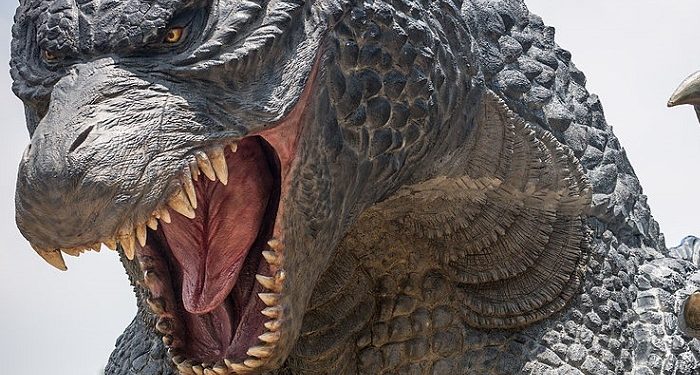
In terms of awards, even Godzilla has been dwarfed by Jurassic Park. With that said, various takes on the Japanese T-Rexian leviathan joins several other dinosaur flicks that has earned respectable arrays of accolades. (Photo by Chris McGrath/Getty Images)

If dinosaur fever was going to reheat amidst the rash of reboots, it had to be through Jurassic Park. Its critical caliber towers over the genre like its unmistakable Tyrannosaurus silhouette.


That dominance is almost, if only a little bit, unfair. There have been a handful or two of other respectable cinematic takes on prehistoric herps.

But enter “dinosaur” in an Internet Movie Database search, and the top three matches come from the Jurassic Park franchise. All five of the completed installments comprise half of the top 10.

In fact, those five are the only IMDB top-10 “dinosaur” films where such animals are a focal point. Several more heavily involve cavemen (hardly surprising), and others center on robots (less likely).

There are also plenty of unremarkable productions (Prehysteria!, anyone?). Then there is the occasional Razzie-caliber dud (e.g. Theodore Rex). But channel a pinch of your inner paleontologist, and you will find more bona fide and well-received dinosaur flicks. Solid sound and visual effects often make a crucial difference.

None have matched the overall legacy of the Jurassic Park movies, but the following have made the most valiant pushes. All dates and award details can be found on IMDB.

T-10. Journey to the Center of the Earth (2008)*
This was one project technically qualifying as a dinosaur movie. The creatures are not central to the plot, but arguably more involved than in others that would loosely pass for the category.

At any rate, this was a BMI winner for film music and a nominee for the Teen Choice Awards’ top action or adventure summer release.

T-10. Land of the Lost (2009)*
Yes, the Teen Choice panel did consider this full-length adaptation of a classic TV series for choice comedy. But the majority of the recognition came through a rash of Razzies.

9. Walking with Dinosaurs 3D (2013)
Following an eponymous BBC miniseries and live adaptation presented on tour, Walking with Dinosaurs hit the silver screen via 20th Century Fox. The rewards were modest compared to the investment, but pointed to a few crucial strengths.

The visual effects earned recognition from the Australian Academy of Cinema and Television Arts (AACTA) Awards. In addition, the sound-mixing crew was nominated for a Cinema Audio Society award.

8. The Great Valley Adventure (1994)
Of the 13 direct-to-video follow-ups on The Land Before Time, the first was the only one to make a critical splash.

That splash was a single drop, but a nonallergenic one at that. The Great Valley Adventure was up for the title of best animated video production at the 1995 Annies.

7. Godzilla (1954)
The original Japanese take on the iconic T-Rexian leviathan is an embodiment of delayed gratification.

Together with its ensuing sequels, it nabbed a 2007 Saturn for best DVD classic film release. One year later, it was up for similar recognition from the same specialized academy.

6. The Land Before Time (1988)
One of the earliest specimens of the pop-culture dinosaur renaissance, this kids’ cartoon found its way to the Saturns. The guild specializing in sci-fi, fantasy and horror nominated it for best fantasy film.

Among other competitors, it was up against Big and Scrooged for that title. It ultimately lost to Who FramedRoger Rabbit. But as noted, starting six years later, it generated a slew of sequels plus a TV series.

As a bonus, for casting child actors to voice the young protagonists, The Land Before Time earned consideration for best family animation from the Youth in Film Awards.

5. Godzilla (2014)
Granted, the Golden Schmoes signified the adaptation’s letdown from its promotions. It was nominated for both “most overrated” and “biggest disappointment” of 2014.

But not everyone passed it by for praise. The Saturns considered Godzilla for best science-fiction film and best music. The visual effects were also singled out for a Gold Derby nomination.

4. Dinosaur (2000)
Disney’s summer blockbuster from the last year of the previous millennium brought dinosaurs back to the Saturns. Like The Land Before Time, it was up for that academy’s best fantasy film title. In addition, its music arguably carried it and was on the Saturn ballot in that category.

Moreover, the Annies had Dinosaur on five lists of finalists, ranging from storyboarding to directing. Less mainstream guilds worldwide combined for a host of other favorable recognitions, including a best-sound victory at the 2001 Satellites.

3. Ice Age: Dawn of the Dinosaurs (2009)
The third of five Ice Age films disregarded scientific consensus on the timeline of prehistoric species. That and other nitpicks aside, the mammal-centered saga cultivated its share of noteworthy accolades upon integrating terrible lizards.

The voice acting and music in Dawn of the Dinosaurs both earned Annie consideration. As a whole, the project was up for best animated film at the Saturns and favorite family movie at the People’s Choice Awards.

2. The Good Dinosaur (2015)
Coming out prior to Thanksgiving, five months after Inside Out, The Good Dinosaur was arguably overshadowed by a fellow Pixar release. With that said, it performed well among some of its best bets for accolades.

With outstanding achievement for animation effects, it prevailed in one of its nine Annie nominations. The Annies, Saturns and even the Golden Globes accounted for its high-profile nominations for best animated film.

At the latter all-encompassing show, The Good Dinosaur brooked no disgrace by losing to its Pixar contemporary.

1. The Lost World (2001)
BBC One boldly undertook an adaptation — the fifth film version — of Sir Arthur Conan Doyle’s prehistory novel. Short of winning anything, the decision paid maximum dividends on two continents.

As a TV movie, this two-and-a-half-hour production was eligible for Emmys. In 2003, it would appear on the prestigious primetime ballot for both its music composition and visual effects.

Across the Atlantic, The Lost World’s visual, sound and music teams were all up for a BAFTA in 2002. It thus garnered esteem for finding the keys to translating a time one can only imagine to a motion picture.

Source: http://pucksandrecreation.com

America’s Top Fossil Sites And Dinosaur Attractions

Tuesday, June 19, 2018

A fossil in the Dinosaur Quarry of Dinosaur National Monument in Utah.

The 5 "Jurassic Park" installments, the blockbuster film series, have expanded its already huge fan base of pint-sized paleontologists.

Parents can best prepare for the dino-mania by including a few fossil sites and dinosaur attractions in the family’s summer/winter vacation plans. That’s easier to do than you might think: there are dino-digs scattered across the country along with a number of natural history museums that feature excellent dinosaur exhibits.

Here’s a list of some of the best sites to help you get started.

Dinosaur National Monument, Jensen, Utah

Discovery of late Jurassic period fossils at this site on the Colorado/Utah border began in 1909 when paleontologist Earl Douglass was searching for fossils for the Carnegie Museum collection.

Douglass uncovered a formation thickly layered with prehistoric plant and animal remains. A quarry was established at the site and in 1915, Dinosaur National Monument was created to protect 80 acres in the quarry area.

Today, the monument covers more than 200,000 acres. You can see some 1,500 dinosaur fossils exposed on a cliff face inside the Quarry Exhibit Hall  and follow a 1.5-mile trail to view the bones of a sauropod, a giant plant-eating dinosaur.

www.nps.gov/dino/, 435-781-7700

U-Dig Fossil Site, Delta, Utah

This 40-acre private quarry, located an hour west of Delta, contains one of the world’s richest deposits of trilobites. These distinctively detailed fossils are a form of hard-shelled invertebrate marine life that lived more than 500 million years ago, roaming the ocean floor in search of food.

The fossils are found in limestone shale, easily split apart into flat sheets revealing the trilobites. For a modest fee — starting at $28 for adults, $16 for kids 7-16  you can experience the thrill of digging up (and keeping) your own fossil trilobites.

www.u-digfossils.com, 435-864-3638

Wyoming Dinosaur Center, Thermopolis, Wyoming

Since excavation began here in the early 1990s, about 60 fossil sites have been located and work continues at four to six sites at any given time.

Begin your visit at the center’s 12,000-square-foot museum where several dozen mounted dino specimens are displayed  including an enormous 106-foot-long Supersaurus, a Triceratops (Wyoming’s state dinosaur) and the country’s only Archaeopteryx.

This is one of the few dinosaur museums in the world to feature active excavation sites, so join a 10-minute bus ride to one of the sites to see hundreds of bones, teeth and tracks made by Allosaurus and Sauropods.

www.wyodino.org, 307-864-2997

Florissant Fossil Beds National Monument, Florissant, Colorado

Beneath this grassy mountain meadow just west of Colorado Springs lies one of the richest and most diverse fossil deposits in America.

During the Eocene epoch, some 34 million years ago, the region was buried in volcanic mud, petrifying the redwood trees growing there and entombing a variety of plants, birds and insects.

Explore hands-on exhibits and fossil displays in the visitor center  then walk the mile-long Petrified Forest Loop to view massive redwood stumps, many of which are 12 to 14 feet wide. Nearby is Florissant Fossil Quarry, a pay-to-dig site where you can find plant, insect and bird fossils.

www.nps.gov/flfo, 719-748-3253

Ashfall Fossil Beds State Historic Park, Royal, Nebraska

More than 260 skeletons, representing 17 species, have been unearthed at this site in northeastern Nebraska. Most of the skeletons are from a prehistoric rhino-like creature named Teleoceras.

The beasts were among those that perished after being enveloped in ash resulting from a giant volcanic explosion 12 million years ago in what is now Idaho.

Your first stop at Ashfall should be the visitor center with its interpretive displays and fossil preparation laboratory where you are invited to ask the paleontologists about their work. A short stroll leads to the Rhino Barn, an enclosure featuring a walkway overlooking a site where excavation is ongoing  and where you can view complete, articulated skeletons of the big barrel-bodied rhinos.

www.ashfall.unl.edu402-893-2000

Waco Mammoth National Monument, Waco, Texas

Designated a national monument by President Barack Obama in 2015, this site presents one of the richest ice age fossil beds in the world, preserving the only known nursery herd of Columbian Mammoths.

These huge animals died in a single event  probably a flood  about 70,000 years ago. Since the site was discovered in 1978, researchers have found 23 mammoths and numerous other fossilized remains, including those of a saber-toothed tiger.

Visitors are welcome to join a ranger-guided tour to view the mammoth fossils in-situ (still in their original position within the bone bed) inside a climate-controlled dig shelter.

www.nps.gov/waco, 254-750-7946

Dinosaur Valley State Park, Glen Rose, Texas

Approximately 113 million years ago, dinosaurs left footprints in the mud at the edge of an ancient ocean. Today, you can walk in those tracks in the bed of the Paluxy River. This long trip to the past is just a short drive south of Fort Worth.

Herbivorous (plant-eating) sauropods came here to browse tropical palms and conifer trees that grew along the shore. Carnivorous (meat-eating) theropods, most likely Acrocanthosaurus  smaller than Tyrannosaurus — followed in search of prey: the plant-eaters.

You’ll see their tracks intermingled along the riverbed  silent reminders of life in prehistoric times.

www.tpwd.texas.gov/state-parks/dinosaur-valley, 254-897-4588

Dinosaur State Park, Rocky Hill, Connecticut

This dinosaur park offers another great opportunity to view dino tracks  these laid down by carnivorous Dilophosaurus some 200 million years ago during the early Jurassic period.

In fact, it’s said to be North America’s largest dinosaur track site, featuring more than 500 distinctive three-toed prints protected beneath a soaring geodesic dome. An additional 2,000+ tracks  discovered in 1966 when workers unearthed them while digging the basement for a new state building  were reburied to preserve them.

The park’s Exhibit Center features interactive exhibits and fossil displays, and there’s an arboretum containing living representatives of plant families  conifers, ginkgoes, magnolias and others — that flourished during the age of dinosaurs.

www.ct.gov/deep/dinosaurstatepark, 800-529-8423

Natural History Museums

American institutions best known for their dinosaur displays include New York’s American Museum of Natural History, featuring nearly 100 dino skeletons and cast specimens, including the first virtually complete Tyrannosaurus rex and a Velociraptor  made famous by the "Jurassic Park" films.

The Smithsonian Museum of Natural History in Washington, D.C., boasts a collection of some 46 million fossils  largest in the world. While the National Dinosaur Hall is undergoing renovation until sometime in 2019, there’s an excellent exhibit, "The Last American Dinosaurs," on view on the museum’s second floor.

At Atlanta’s Fernbank Museum of Natural History, a flock of Pterosaurs flies overhead while murals and life-size dino models — including an Argentinosaurus, one of the largest dinosaurs ever classified  conjure up life in prehistoric Georgia.

Chicago’s Field Museum is justly famous for its dino named Sue, the largest, most complete and best-preserved Tyrannosaurus rex skeleton in the world.

Source: http://exclusive.multibriefs.com

13 Dinosaur “Facts” Scientists Wish You’d Stop Believing

Thursday, June 21, 2018

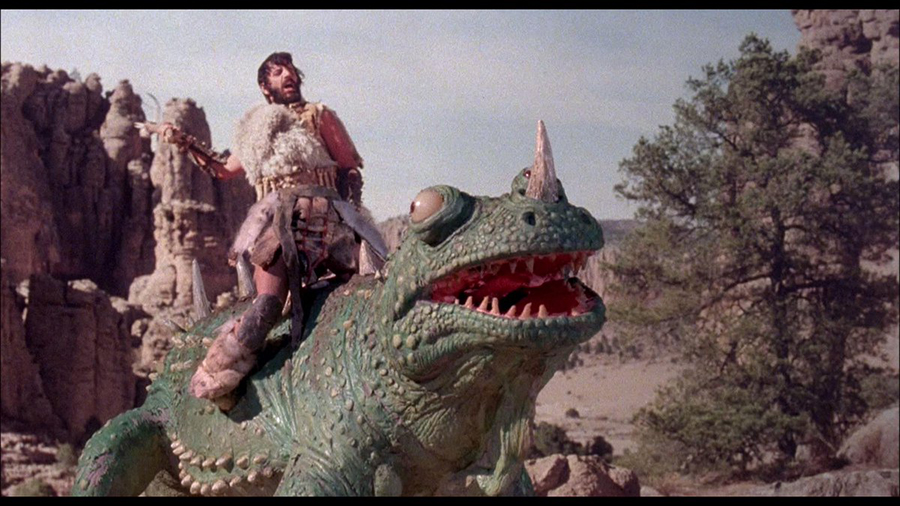
“Caveman: Where @TheBeatles Ringo Starr rides a giant lizard into battle.

When you think of dinosaurs, do you still imagine giant gray scaly beasts that went extinct? Get ready to have your mind blown.

Myth: Dinosaurs are extinct

There was definitely a mass extinction event 65 million years ago (probably related to a giant asteroid that smashed into Mexico’s Yucatán Peninsula), and it did spell the end for most dinosaur species. But not all. “Today’s birds evolved from dinosaurs, which makes them every bit as much of a dinosaur as T. rex or Triceratops,” says paleontologist Steve Brusatte, author of the book, The Rise and Fall of the Dinosaurs. “A good analogy is bats. Bats are a weird type of mammal that developed wings and the ability to fly. Birds are a weird type of dinosaur that did the same thing.”

Daniel Barta, a PhD candidate at the American Museum of Natural History’s Richard Gilder Graduate School, adds that there are more species of birds alive today (at least 10,000) than any other group of land-living animals with backbones. “Dinosaurs are alive and well today in the form of their bird descendants,” he says.

Myth: Dinosaurs were scaly lizards

Not necessarily. “There are thousands of fossils of feather-covered dinosaurs that have been found in China over the last two decades,” Brusatte says. In fact, fossils show that a cousin of the T. rex called Yutyrannus was covered in downy fluff (which probably didn’t make it less scary to its prey). Feathers would have helped dinosaurs regulate their body temperature, so they would have been particularly helpful to smaller animals such as Velociraptors. Even the biggest plant-eaters might have had a little fuzz, like the tufts of hair on elephants.

Myth: Dinosaurs were cold-blooded

Scientists can tell from looking at the microscopic structure of dinosaur bones that they grew rapidly, and only animals like birds and mammals, with fast metabolisms and well-regulated body temperatures, do that. It explains why dinosaurs evolved to have feathers for insulation, but it’s still not totally clear whether their body temperatures worked exactly like ours do. “There are a lot of different ways to be ‘warm-blooded,’” says Barta. “It is probable that dinosaurs were not exactly like birds or mammals in terms of their metabolism.”

Myth: They were all grayish-green

Dinosaurs were actually quite colorful. Amazingly, paleontologists can tell what colors some of them were because they’ve found really well-preserved fossilized feathers containing structures called melanosomes. These held pigments, and their different shapes and arrangements indicate what colors they were. “It’s one of the most amazing things that’s happened in my lifetime as a scientist,” Brusatte says. For example, a small carnivorous dinosaur in northeastern China called a Sinosauropteryx probably had a striped brown tail and a raccoon-like bandit mask.

Myth: They were all giant

The skeletons of the biggest dinosaurs were, of course, the first ones that caught the attention of fossil-hunters. But now that paleontologists know what they’re looking for, they’re finding dinosaurs of all sizes and shapes. Long-necked sauropods like the Dreadnoughtus schrani could be as big as passenger airplanes. “But many dinosaurs were tiny,” Brusatte says. “Some were only the size of pigeons.”

Myth: We’ve found fossils from most of the dinosaur species

Researchers have identified more than 700 species of extinct dinosaurs, but that’s probably a drop in the bucket—we know of about 10,000 species of modern avian dinosaurs, or birds. Fossils are being discovered at a rapid pace, with a new dinosaur species being identified every week, on average. That’s partly because paleontologists are being trained all over the world, Brusatte says, and they’re finding fossils in their countries. “Particularly younger people—women and men—in countries like China, Argentina, and Brazil. These enormous countries are developing quickly, opening up to the world, training their own scientists in new universities and museums.”

Myth: Mammals evolved after dinosaurs died out

Mammals evolved from a reptile called the cynodont, which looked like a scaly rat and lived more than 200 million years ago, before dinosaurs. Mammals had diversified into marsupial and placental lines of evolution by about 165 million years ago, during the Jurassic period when dinosaurs were having their heyday. “There was never a mammal (that we know of) larger than a badger that lived with the dinosaurs,” Brusatte says. “But almost as soon as the non-bird dinosaurs went extinct, mammals started to diversify and spread around the world and grow to much bigger sizes.”

Myth: All big reptiles were dinosaurs

Flying reptiles like pterosaurs (which included pterodactyls) and marine reptiles like plesiosaurs and ichthyosaurs were not dinosaurs, though they lived during the same time period and suffered the same fate during the mass extinction 65 million years ago. They often get lumped in with dinosaurs, though they belong in their own separate categories. But Brusatte says, “There were indeed some flying dinosaurs: birds!”

Myth: Dinosaurs moved really fast

“Some dinosaurs were fast, like the raptor dinosaurs, and some were slow, like the big long-necked dinosaurs,” Brusatte says. A recent study showed that Tyrannosaurus probably didn’t go much faster than jogging human, based on the stress running would have put on its massive foot bones.

Myth: Tyrannosaurus stood upright like Godzilla

No, no, no—museums originally built many T. rex skeleton models in an upright position with their tails on the ground, but researchers have known since the 1960s that they actually must have held their bodies horizontally, like a giant teeter-totter. Somehow, the message doesn’t seem to be getting through to the public: When a Cornell paleontologist asked students to draw a picture of a Tyrannosaurus, most drew it upright. “I think popular culture usually takes a long time to catch up to current scientific thinking,” Barta says. “Even when updated images do arrive, the outdated images still persist and spread alongside the newer ones.”

NOT a myth: Tyrannosaurus was a fearsome hunter

A popular theory in the 1990s held that T. rex wasn’t as tough as we’d long thought—that instead, it was basically a giant scavenger, roaming around eating carcasses that other predators had brought down. That theory was wrong: “Evolution doesn’t produce a bus-sized animal with a bathtub-sized head and 50-some railroad spike teeth that can crush bone just so that animal can walk around picking up dead carcasses,” Brusatte says. Tyrannosaurus probably wouldn’t have turned down a free meal if it came upon a fresh carcass, but it was definitely capable of killing a live prey animal. Researchers have found Triceratops bones with Tyrannosaurus bite marks that had healed up, meaning that the two species definitely tangled (and that Triceratops occasionally made it out alive).

Myth: Tyrannosaurus would have hunted Stegosaurus

In fact, more time separates these two species of dinosaurs than separates T. rex from us todayStegosaurus lived about 150 million years ago, during the late Jurassic period, and Tyrannosaurus evolved around 67 million years ago, during the Cretaceous period, just a few million years before the mass extinction event.

Myth: They were evolutionary failures


“I hate this stereotype that dinosaurs were evolutionary failures, that they were dim-witted, slow-moving, uninteresting animals that just sat around waiting to go extinct,” Brusatte says. “They were an empire that ruled the world for over 150 million years!” To put it in perspective, our own speciesHomo sapiens, has only existed for about 200,000 years so far; our first ancestors only appeared 7 million years ago. And don’t forget: If you listen at a window, you’re likely to hear the call of a modern avian dinosaur in your own backyard.

Source: www.rd.com

Scientists Discover Fossil of Ancient Sea Creature, Name It After President Obama

Wednesday, June 20, 2018

Fossils of an ancient sea creature were found embedded in sandstorne in Australia, and were named Obamus coronatus after President Obama. UC Riverside

Ancient sea creature discovered, named for President Obama.

It lived an uneventful life in Earth's oceans 500 million years ago, but now this newly discovered creature has an unusual honor: It's been given the scientific name Obamus coronatus, a name that honors President Barack Obama's passion for science. ("Coronatus" means "crowned.")

The tiny, disc-shaped animal was about a 1/2 inch long, with raised spiral grooves on its surface. It spent its entire life embedded on the ocean floor, likely never moving, according to scientists from the University of California-Riverside.

A second small animal, an egg-shaped critter that may have looked like a raisin, was also discovered. It was given the name Attenborites janeae, after the English naturalist and broadcaster Sir David Attenborough, who was known for his science advocacy and support of paleontology. (Janeae is a nod to Jane Fargher, a co-owner of the property where the fossils were discovered.)

Both are among the earliest animals to exist on Earth. They were discovered in a remarkably well-preserved fossil bed in a southern Australia mountain range.

“I’ve been working in this region for 30 years, and I’ve never seen such a beautifully preserved bed with so many high quality and rare specimens, including Obamus and Attenborites,” said paleontologist Mary Droser of the University of California-Riverside, the lead author of two new studies about the discoveries.

The researchers dubbed the fossil bed “Alice’s Restaurant Bed,” a tribute to the Arlo Guthrie song and its lyric, “You can get anything you want at Alice’s Restaurant.”

The soft-bodied animals were visible as fossils cast in sandstone that had been preserved for hundreds of millions of years. The species no longer exists.

“The two genera that we identified are a new body plan, unlike anything else that has been described,” Droser said. “We have been seeing evidence for these animals for quite a long time, but it took us a while to verify that they are animals within their own rights and not part of another animal.”

The studies appear in the Australian Journal of Earth Sciences. Other authors include Pete Dzaugis and Scott Evans, both from the University of California – Riverside.

Source: www.13newsnow.com

Jurassic World: Fallen Kingdom Is A Stunning Disappointment

Thursday, June 7, 2018

Photo: Universal Pictures

The new trilogy takes a turn for the worse.

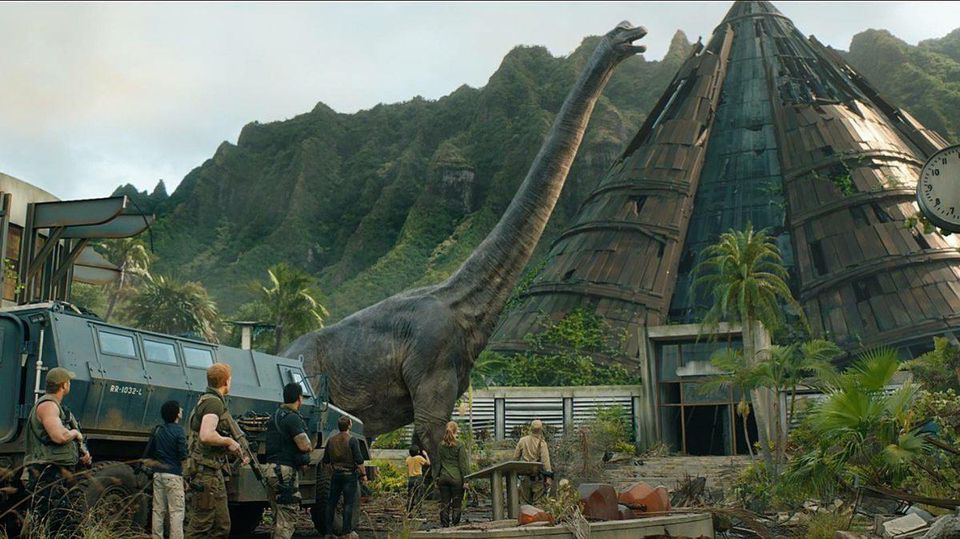
Three years ago, director Colin Trevorrow brought Steven Spielberg’s long-dormant Jurassic Park franchise back to life, with a storyline about a futuristic wildlife park that was so desperate to keep selling tickets, it was willing to genetically modify its creatures in the name of spectacle. Jurassic Worldwasn’t just a blockbuster, it was a meta-movie. The sinister Masrani Corp. was a stand-in for Hollywood and its obsession with bigger-than-big sequels, and the new Indominus rex dinosaur hybrid was the same kind of amped-up cash-in that movie audiences are sold every year. Trevorrow’s mildly subversive take worked for audiences, and the film grossed more than $1.67 billion worldwide, making it one of 2015’s biggest successes.

It’s hard to know where its sequel, Jurassic World: Fallen Kingdom, would fit within that thinly veiled metaphor. Director J.A. Bayona (A Monster CallsThe Orphanage) brings a darker, horror-minded sensibility to the material, but it’s an uneasy match with the franchise’s Spielbergian moments of whimsy and wonder. Rather than amping up the scale and spectacle, the latest franchise installment trades the vast landscapes of Isla Nublar for a claustrophobic setting that ultimately makes the whole thing feel like little more than an average haunted house flick. And the script, by Trevorrow and longtime co-writer Derek Connolly, repeats all the mistakes of the first Jurassic World, while taking so many new bizarre leaps of logic that it becomes difficult to suspend disbelief. They may have wanted Fallen Kingdom to be a self-aware blockbuster asking interesting questions, but they ended up with the kind of dumb, cynical blockbuster that the first Jurassic World was warning audiences against.

The film opens several years after Jurassic World. The park on Isla Nublar has fallen into ruin, and an active volcano is now threatening the lives of all the creatures left on the island. The US government is holding hearings on whether the dinosaurs should be rescued — Jeff Goldblum’s Ian Malcolm briefly pops in to offer his testimony — though they ultimately decide not to intervene.

Photo: Universal Pictures

But Jurassic World’s Claire Dearing (Bryce Dallas Howard) has become an animal rights activist, and is trying to lobby support to save the creatures from extinction. She’s contacted by an old acquaintance named Eli Mills (The Ritual’s Rafe Spall), who works for billionaire philanthropist Benjamin Lockwood (James Cromwell). In a bit of convoluted backstory, Lockwood originally worked with Jurassic Park creator John Hammond (the late Richard Attenborough) until they had a falling-out. Lockwood wants to save the Isla Nublar dinosaurs as a testament to his old friend, and has created a secret island sanctuary where they can live in peace, without humanity meddling. But to pull off the secret rescue mission, Mills needs somebody with park expertise, and that’s where Claire comes in. They also need help capturing the velociraptor Blue, who they prize for her superior intelligence, so Mills asks Claire to bring in Blue’s trainer, Owen Grady (Chris Pratt).

This all sounds like a perfectly serviceable narrative setup. There’s undoubtedly a story to be told about a noble dinosaur-rescue mission that goes horribly awry, and the plotline dovetails nicely with the warning bells the film sounds about the dangers of genetic manipulation. But the creators of Jurassic World: Fallen Kingdom seem utterly disinterested in their own premise, and they rush through this bit of storytelling as quickly as possible, pushing forward until the story can leave the island altogether.

Fallen Kingdom’s first act feels like a Jurassic Park greatest-hits reel. There’s a technician stalked by a dinosaur in the rain. A young hacker named Franklin (The Get Down’s Justice Smith) works magic rebooting the park’s systems. Owen patiently tracks Blue through the forest, until the Bad Guys Who Don’t Get It (led by Ted Levine) shoot her with a tranquilizer. It’s as if the filmmakers are rotely checking off a list of Jurassic Park signifiers, and their apathy is palpable.

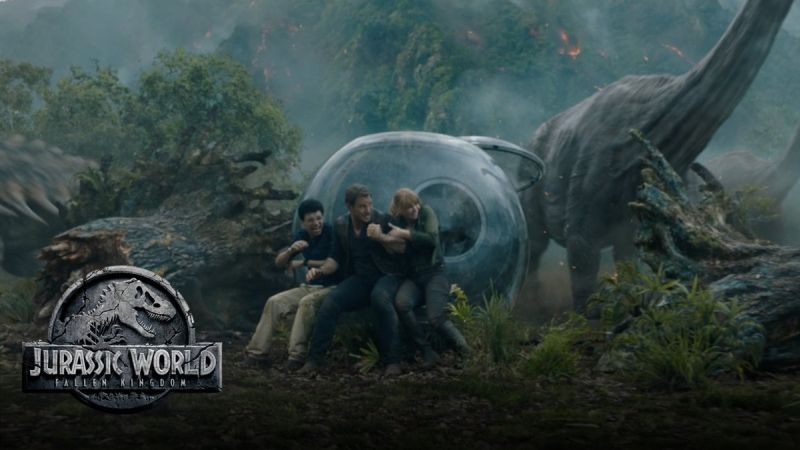
Bayona’s work is the only exception. Throughout his career, he’s excelled at building tension and creating atmospheric unease, and on a sheer filmmaking level, that’s no different here. Occasionally, he even gets to fully embrace his horror-movie sensibilities. But all too often, the script hinders the impact. Fallen Kingdom’s characters are so bland and thinly written that the actors have little to do but look scared and run around, making it nearly impossible to care about what actually happens to them. One particularly bravura moment, a single-shot sequence in which Owen has to rescue Claire and Franklin from a gyrosphere that’s been thrown into the ocean, is remarkable not for Bayona’s technical skill, but in how emotionally unaffecting it actually is.

'Jurassic World: Fallen Kingdom' doesn't just waste Chris Pratt, says Peter Travers – this sequel is nothing but a T. Rex-sized cashgrab.

Fallen Kingdom’s main twist — if you can use that term for something that’s spoiled extensively in the trailers — is that Mills is actually trying to capture the dinosaurs so he can sell them on the black market. His plans include yet another new genetic hybrid — this time, something they’ve dubbed the “Indoraptor.” To its credit, Fallen Kingdom doubles down on making the audience emotionally invest in the dinosaurs as actual animals. One moment in the first half of the film, where a dinosaur faces certain doom, is more emotionally affecting than anything that happens to the human characters. And the attempts to make the dinosaurs relatable and realistic are all driving toward exploring the moral implications of genetic engineering. If an animal is brought back from extinction, should it then be protected as an endangered species? If something is created by man, does it have the same right to exist as something created by nature?

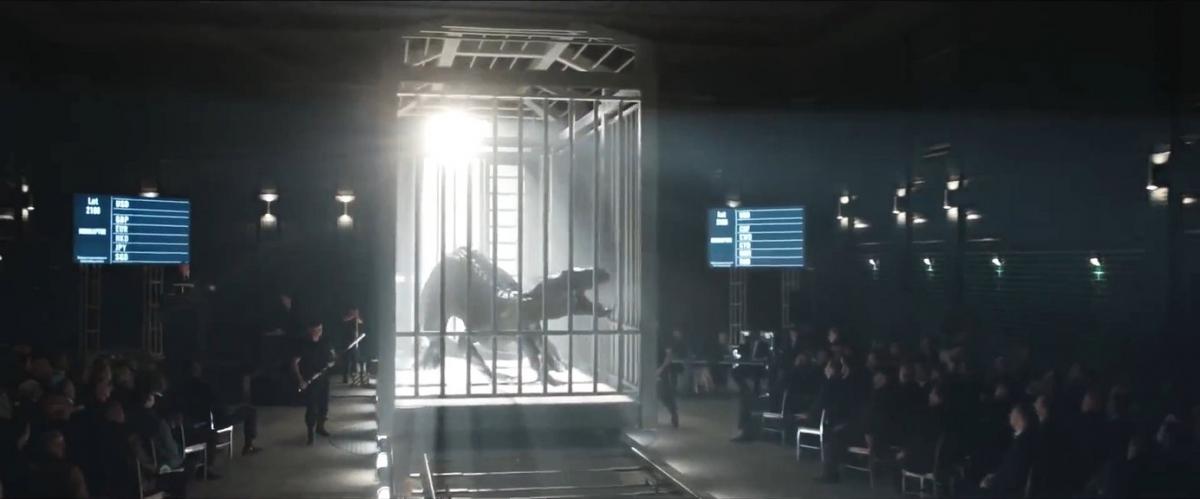
Like its predecessor, Fallen Kingdom is overstuffed with ethical conundrums, and not sophisticated enough to fully engage with them. And the movie’s villains become such cartoony caricatures that it’s impossible to take Fallen Kingdom’s attempted philosophical musings seriously. This is the kind of movie where the audience knows Mills is bad because he yells at a kid, and dinosaurs are auctioned off to an international group of would-be Bond villains. It’s all absurd — even for a movie about man-made dinosaurs — and it becomes even more ridiculous when the movie leaves behind the grand, epic vistas of Isla Nublar for a much smaller dinosaur jail located beneath Lockwood’s estate. Normally, the creatures lend this series a built-in sense of awe and wonder. Jurassic World: Fallen Kingdom strips that majesty away and turns the focus on the human characters, who are markedly unengaging.

Viewers who aren’t already invested in Owen and Claire won’t find anything fresh here to hold onto. Pratt’s familiar dumb-guy schtick is as entertaining as it is in hits like Guardians of the Galaxy and Parks and Recreation, but his scenes with Howard are largely chemistry-free, and one romantic moment plays as shockingly unearned. Justice Smith and Daniella Pineda, as Claire’s eager young colleagues, disappear from the film for long stretches, and when they are on-screen, the script doesn’t give either of them any meaningful material. A subplot with Lockwood’s granddaughter is bafflingly pointless, until it becomes clear that the character exists only to manufacture some third-act jeopardy, and to make a ham-fisted point about genetically engineered dinosaurs that will likely leave audience members shaking their heads.

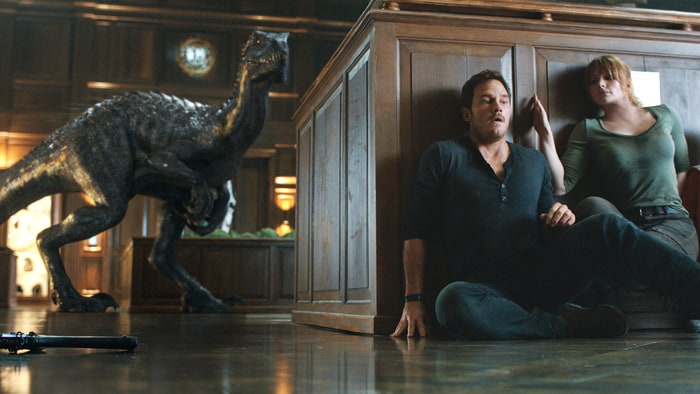
Here is a shot of Indoraptor from Jurassic World Fallen Kingdom. The start of Indoraptor's reign seems to have started as a stage show.


Perhaps the most frustrating aspect of all is the way the film ends, by clearly telegraphing the setup for the third Jurassic World, which already has a 2021 release date. But this movie crosses certain boundaries in a way that can’t be undone, and if audiences don’t like where things are headed at the end of this film, they aren’t likely to have those concerns addressed in the next installment.

If you squint, you can see brief glimpses of a thoughtful, interesting Jurassic World sequel somewhere in Fallen Kingdom’s scattered bones. A particularly generous reading might claim that Fallen Kingdom’s weaknesses are their own clever subversion of the franchise, that they strip away the distracting, pandering spectacle that made this series work in order to reveal how cruel and corrupt the entire conceit has always been. In a post-Last Jedi and Deadpool world, audiences seem particularly open to deconstructing the things they’ve loved in the past. But Jurassic Park: Fallen Kingdom doesn’t have the dedication to pull off that particular magic trick. It tries to echo what came before, while also undercutting it. It tries to ask intelligent questions, without making the characters smart enough to understand them. There is action, and there are explosions, and there are dinosaurs running around and fighting in sequences that will thrill some audiences, but there is no anima behind it. It turns a once indelible franchise into something generic, flat, and utterly forgettable.

Source: www.theverge.com

Pages