Blogs

10 Best Dinosaur Movies

Thursday, June 28, 2018

It’s been a long time - 66 million years ago to be exact - since anyone saw a real life dinosaur. But even though they're all extinct (unless the Loch Ness Monster is a thing - and it might be!), we can still catch them on the big screen. Now, with Jurassic World around the corner, what better time to discuss all of our favorites? So here they are - the 10 Best Dinosaur Movies!

Just a head’s up - to be included in this list, there has to be an actual dinosaur. That means no Godzilla because he’s a radioactive monster, and no Toy Story because Rex is a toy.

Though you better believe if Toy Story counted, it might have got No. 2.

What's your favorite dinosaur movie? Let us know in the comments and make sure you check out our video at the top of the article!

10. LAND OF THE LOST

Starting off the list at No. 10 is Land of the Lost. It was a loose remake based off the 1970s TV show. It’s admittedly pretty silly but worth checking out if you catch it on TV. Plus, it's got Will Ferrell and Danny McBride in it, so even if dinosaur humor isn't your cup of tea, there's a few extra jokes in there for everyone.

9. THE FLINTSTONES

No. 9 is The Flintstones. It might not be considered a classic, but there's plenty of dinosaurs and it's hard to argue that John Goodman as Fred Flintstone is pretty inspired casting. The script was criticized pretty heavily, but the visuals were top-notch, looking like the cartoon has indeed come to life.

8. THE LOST WORLD: JURASSIC PARK

At No. 8 is The Lost World: Jurassic ParkThe highly anticipated sequel was somewhat of a let down following the original, but still packed enough punch to be worth your time. While it might not be as highly regarded as the Jurassic Park, it's still generally favored over the third installment (though that's debatable since Part 3 has pterodactyls and a FREAKIN' SPINOSAURUS!)

7. DINOSAUR

No. 7 is Disney’s Dinosaur. One of the Disney’s first forays into photorealistic CGI animation. Unfortunately, the story is a little dull so it hasn't aged as well because it's not nearly as visually impressive today as it was when it first came out, but at the time of it's release, nothing had looked quite like this.

6. ICE AGE: DAWN OF THE DINOSAURS

Coming in at No. 6 is Ice Age: Dawn of the Dinosaur. The third outing featuring Manny and the gang finally introduced dinosaurs into the mix, and many fans feel like this was the best of the Ice Age flicks.

5. KING KONG

No. 5 - King Kong. Peter Jackson’s epic remake might have been a tad too long, but the fight between Kong and, not one, but two Tyrannosaurus Rex on Skull Island is too awesome to miss. Seriously, even if you don't have time to watch the three-plus hour film, look up this clip on Youtube and check it out. It's great fun.


4. THE GOOD DINOSAUR

No. 4 is  The Good DinosaurPixar’s family friendly picture pitched a fun concept which was simply: “What would have happened if dinosaurs didn’t go extinct?” It wasn't a smash hit at the box office or as well-regarded as most of Pixar's usual fare, but on it's own, it's still an adorable movie perfectly suited for children.

3. THE LAND BEFORE TIME

In the third spot is the animated classic The Land Before TimeBecause this was produced and directed by Don Bluth, it's a little darker than your traditional Disney animation, and featured some pretty heavy themes for a children's cartoon. To date, there have been 12 sequels featuring Littlefoot and his friends, but the first one is the one you’ve got to show your kids.

2. JURASSIC WORLD

At No. 2 is Jurassic World. It turns out, this would be the best of the Jurassic movies (hopefully at least until we get to see Fallen Kingdom), all except what you know is coming next, and that is--


1. JURASSIC PARK

The #1 Dino-Movie of all time with forever and always be Jurassic Park. The CGI used by Steven Spielberg and company was groundbreaking and the movie still holds up today as one of the best ever made. Seriously. If you weren't alive or able to watch this in the theater in 1993 when it was first released, then you truly can't comprehend what a breathtaking marvel it was; the undisputed champion of dinosaur movies.

Source: http://comicbook.com

10 Worst Dinosaur Movies

Thursday, June 28, 2018

Do you love dinosaur movies!? Of course you do, you clicked on this article! But as you'll soon find out, you might not love ‘em as much after you check out a few of these stinkers. Jurassic World: Fallen Kingdom is upon us now, and based on reviews, it sounds like it's not too shabby, so it likely won't ever dethrone anything on this list - the 10 Worst Dinosaur Movies!

Just a head’s up: as much as everyone should (and probably does) despise 1998’s Godzilla, it’s not on this list because Godzilla is a radioactive monster, not a dino.

Drop us a comment and tell us what you think is the worst dinosaur movie you've ever seen is!

10. WE'RE BACK! A DINOSAUR'S STORY

9. THE LAST DINOSAUR

No. 9 - The Last Dinosaur. Made in 1977, starring some guy who looked like Crocodile Dundee’s sidekick. Maybe it’s him, we don’t know for sure because we didn’t make it to the end credits (and don't really feel like googling it, either).

8. THE LAND BEFORE TIME 2: THE GREAT VALLEY

At No. 8 is Land Before Time 2: The Great Valley, and all subsequent Land Before Time straight-to-video sequels. There’s been like 42 of them so far and for some reason, they keep making more no matter how many people they hurt in the process. While the original is a beloved children's classic, you'd be better off to just pretend the rest of them probably don't exist.

7. PREHYSTERIA

No. 7 is Prehysteria. Made by Charles Band, the infamous B-horror director most well known for The Puppet Master movies, Prehysteria and its sequels were, in a word, not good. You might recognize the kid in the movie as Austin O'Brien from Last Action Hero or My Girl 2 (okay, maybe you don't recognize him). The point we're trying to make here is - there's pretty much no reason to ever watch this movie.

6. DINOSAUR ISLAND

No. 6 - Dinosaur Island. It’s hard to be subtle about the fact that you’re just cheaply ripping off Jurassic Park, but boy did they try. That's sarcasm, they didn't try. There's even a cutesy little in-joke about standing still when the T-Rex is about to eat you. On the plus side, they did give their dinos pseudo-feathers in an effort to be as scientific as possible.

5. A NYMPHOID BARBARIAN IN DINOSAUR HELL

At No. 5 is A Nymphoid Barbarian in Dinosaur Hell. Don’t be fooled by the greatest movie title of all time, this movie actually feels like dinosaur hell.

4. JURASSIC PREY

Coming in at No. 4 is Jurassic Prey. You know your movie is terrible when it doesn’t even have its own Wikipedia page. It does have 1-star on IMDB though, which seems fair.

3. TAMMY AND THE T-REX

At No. 3 is Tammy and the T-Rex. Starring Denise Richards and Paul Walker, this movie is insane and if you ever do one thing with your life, it needs to be google this trailer. It's so bad that it's watchable, and if anyone ever wants to make a movie about an awful movie (a la The Disaster Artist), this is an excellent candidate.

2. CARNOSAUR

No. 2 is Carnosaur! This piece of classic cinema was released four whole weeks before Jurassic Park yet somehow never took off. It's a sheer mystery. Fun side note: One of the main characters in Carnosaur is played by Diane Ladd, the mother of Laura Dern, one of the main actresses in Jurassic Park. No word on how awkward Christmas of '93 was at their house.

1. THEODORE REX

But the worst dinosaur movie ever made is Theodore Rex. It’s Whoopi Goldberg as a cop teaming up with a farting T-Rex. Is there anything else you wanna know?

Source: http://comicbook.com

JURASSIC WORLD: FALLEN FRANCHISE

Wednesday, June 27, 2018

Fandor reviews the latest movie from the theme park that wouldn't quit.

Where to start with the mess that is Jurassic World: Fallen Kingdom?

How does one enjoy a film when the main component to keeping the plot moving is the characters (good and bad) making increasingly dumb decisions? Sure, Jurassic World: Fallen Kingdom is a spectacle-driven summer blockbuster, but do we really need to suspend our disbelief so far as to believe that the main antagonist is dumb enough to pry teeth out of the mouths of tranquilized dinosaurs for a necklace he’s making? With this in mind, is it really a spoiler to say that his decisions ultimately lead to his own gruesome death?

But I'm jumping ahead.

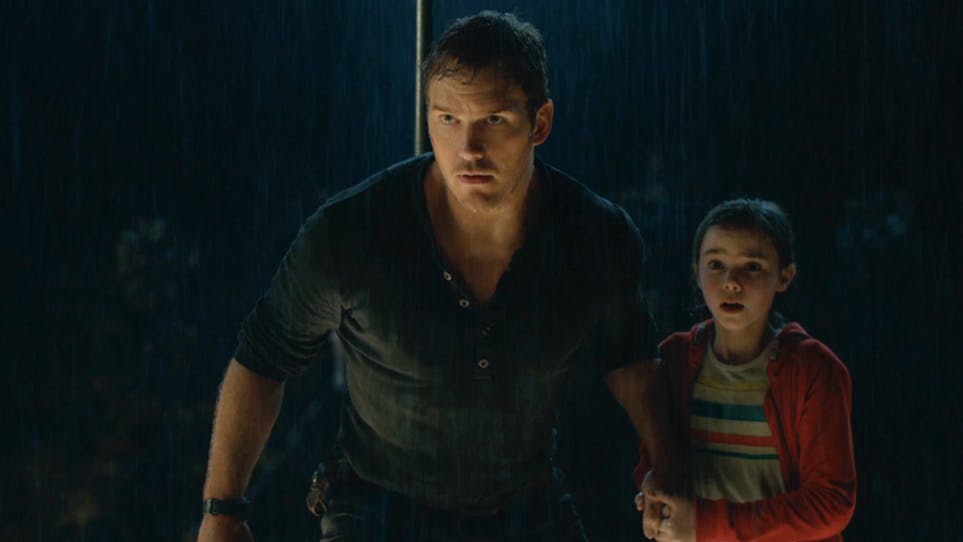
The events of the movie are put into motion when our heroes are hired to conduct a mission to retrieve a selection of dinosaurs before a volcano explodes on Isla Nublar. However, the people who tasked Owen (Chris Pratt) and Claire (Bryce Dallas Howard) with this mission have no interest in really saving the dinosaurs. Instead they intend to auction off the dinosaurs to the highest bidders, and to use the well-trained and compliant velociraptor, Blue, to create a highly intelligent militaristic “Indomraptor” — part Indominus Rex from Jurassic World and part Blue.

Yet, in spite of the poor script, J.A. Bayona’s direction, as well as the visual effects and cinematography, are the best of the series since the original Steven Spielberg-directed Jurassic Park. There’s a moment in the film that recalls the iconic shot from the first movie, of when audiences and Dr. Alan Grant first laid eyes on a brontosaurus. They, (and audiences) were awe-struck. We knew we were watching something new and fantastic. Bayona purposefully subverts this moment by showing a brontosaurus meeting a tragic end when a volcano destroys Isla Nublar. Like the characters in Fallen Kingdom, I found myself getting choked up.

Then the preposterous writing of Colin Trevorrow (director of the first Jurassic World) and his co-writer, Derek Connelly, broke the spell and reminded me how asinine the script and plot are. The film attempts to do for the franchise what The Last Jedi did for Star Wars. It attempts to cast off the tropes of the past movies and shift the franchise towards a more ambiguous and open future — not one just driven by corporate-mandated nostalgia. Because of this, Jurassic World: Fallen Kingdom has significantly more interesting ideas than its predecessor.

Nonetheless, in his writing Treverrow never fully commits to these concepts, and thus, the film feels half-baked. For every gothic horror influenced scare Bayona and his cinematographer, Oscar Faura, conjure up, especially as the Indomraptor silently hunts the heroes and villains in the Lockwood Estate, the haphazard script betrays the film at every turn with laughable dialogue and underdeveloped ideas. In fact, the film ends on such a ludicrous note, it’s impossible to conceive what exactly is going to happen next — and you know what? I don’t really care.

The final nail in the coffin comes in the form of a late “twist” — can I call something a “twist” if it’s straight up absurd? — that is meant to point to the dangers of cloning (which is essentially the message of all the prior films), but really only serves as the shallow set-up for future entries into the series. Speaking of which, after the climax, the audience is left with no clue as to where the series is going. If this was the intention of Treverrow and Bayona then okay, sure, they succeeded.

Jurassic World: Fallen Kingdom has removed all the awe, all the fear, and all the wonder that Spielberg accomplished twenty-five years ago with Jurassic Park. It’s hard to make dinosaurs boring, yet the latest in this franchise has managed just that.

Source: www.fandor.com

History of Side-Necked Turtle Diversification Revealed

Wednesday, June 27, 2018

Fossils of Pleurodira carapaces. Credit: Gabriel Ferreira (FFCLRP-USP)

Brazilian paleontologists have elucidated the evolutionary history of today's Yellow-spotted Amazon River turtle and of the oldest turtle in Brazil which inhabited the country 125 million years ago.

A work authored by a group of paleontologists affiliated to University of São Paulo's Biology Department in Ribeirão Preto, Brazil - published in Royal Society Open Science - is the most comprehensive phylogeny of the Pleurodira suborder of side-necked turtles produced. Pleurodira includes the Yellow-spotted Amazon River turtle (Podocnemis unifilis).

The study gathers phylogenetic, biogeographical and morphological data in search of an explanation for the biogeographical history of Pleurodira, especially the discrepancy between their distribution in the fossil record and in the world today.

The researchers decided to construct a new phylogeny of Pleurodira, tracing the group's evolutionary history as broadly as possible in order to reveal unknown patterns of past biogeographical distribution.

The first step in building the phylogeny was a matrix analysis of 245 morphological characters in 101 species. "This matrix of morphological data for Pleurodira included both living and extinct species. The matrix was analyzed using parsimony, and from the analysis, we obtained a new phylogenetic tree for Pleurodira," said Gabriel Ferreira, lead author of the article. The study is part of his PhD research, which is supported by a scholarship from the Sao Paulo Research Foundation - FAPESP and features supervision by Max Langer, a professor in USP.

"The phylogenies of pleurodires constructed to date have been partial. Our purpose in undertaking the large phylogenetic analysis now published was to understand the lineage's evolution during the Mesozoic and Cenozoic Eras," said Langer, who is the principal investigator of the Thematic Project "The origin and rise of dinosaurs in Gondwana (late Triassic-early Jurassic)", funded by FAPESP.

These turtles are called side-necked because they fold the neck horizontally under their shell, tucking it into the space in front of one of their front legs. The dozens of living pleurodire species are restricted to terrestrial and freshwater environments; they do not tolerate contact with salt water.

Side-necked turtles are found mainly in the South Hemisphere - South America, sub-Saharan Africa, Indonesia, Australia, and New Guinea, the exception being the isolated species inhabiting the Arabian Peninsula. Apart from the Indonesian archipelago, all these regions were once part of Gondwana, the ancient supercontinent that existed between 250 million and 150 million years ago.

Vicariance hypothesis

Pleurodira fossils are spread among all continents. The oldest fossils of pleurodire turtles in North America, Europe and North Africa have been dated to between 105 million and 70 million years ago. In North America and North Africa, they survived until at least 35 million years ago

The oldest pleurodire fossil, Atolchelys, was found in Northeast Brazil. Atolchelys lived 125 million years ago during the Lower Cretaceous, when Africa was starting to separate from South America. It belonged to the extinct Bothremydidae family.

The expansion of Pleurodira geographical distribution occurred as Africa and South America were separating completely from the rest of Gondwana, between 105 million and 100 million years ago, when they started spreading to North Africa and Madagascar, and to Europe, North America, the Middle East and India.

Se há 100 milhões de anos Pleurodira ainda era restrita a habitats terrestres e de água doce, a abertura do Atlântico Sul teria se encarregado de afastar as populações, forçando a sua adaptação a condições diversas para, com o tempo, surgir novos gêneros e espécies.

If pleurodire species living some 100 million years ago were already restricted to terrestrial and freshwater environments, then the South Atlantic opening must indeed have separated populations and forced them to adapt to different conditions, leading over time to the emergence of new genera and species.

New evidence requires new evolutionary narratives

The discovery of many extinct genera in the past decade has revealed gaps in the biogeographical narrative that the traditional theory has proved unable to fill. Differently from today, oceans in the Upper Cretaceous, the Paleogene and continuing into the Cenozoic were not an environment exclusively inhabited by suborder Cryptodira. Pleurodires from the extinct Bothremydidae family were also living in salt waters on today's Northeastern Brazilian coast at least 110 million years ago.

At that time, the South Atlantic was not yet fully open. This development occurred later, between 80 million and 66 million years ago, when Bothremydidae inhabited both sides of the Atlantic. Inaechelys lived on the coast of the Pernambuco State in Northeast Brazil, and on the other side of the still young (and for this very reason narrow), Atlantic Ocean lived the Portuguese Rosasia, as well as Foxemys and Polysternon, found in Spain and France. Another marine genus of Bothremydidae, Bothremys, was more widely distributed, as shown by fossils found in four US states as well as Morocco and Jordan.

The young South Atlantic may not have been a sufficiently formidable barrier to prevent their dispersal to other continents - at least not while the distance between South America and Africa was relatively small, perhaps a few hundred kilometers.

"If the traditional hypothesis was that the current distribution of pleurodires derives from vicariant events linked to continental drift, there was a second hypothesis according to which the group was broadly distributed, and successive extinctions eventually confined its lineages to the areas where they're found today," Ferreira said. "We imagined a third hypothesis: a complex pattern of dispersal from Gondwanan areas explains the broad distribution found in the past."

The new phylogeny leads to the conclusion that Araripemys and Euraxemys were relatives of Pelomedusoides, the ancestral group that gave rise to the families which comprises the Pleurodira suborder - Bothremydidae, Podocnemididae and Pelomedusidae.

Moreover, during the Lower Cretaceous, when Araripemys and Euraxemys were extant, both of the main pleurodire lineages already existed. They were the Pan-Chelidae (the group comprising all Chelidae) and Pan-Pelomedusoides (Bothremydidae, Podocnemididae, Pelomedusidae, and the other extinct families).

The new tree suggests that Atolchelys, the oldest known pleurodire (and the oldest member of Bothremydidae, alive in the Lower Cretaceous 125 million years ago in the Brazilian State of Alagoas) shares a common ancestor with Araripemys and Euraxemys (alive 110 million years ago in what is now Ceará State).

Despite the scarcity of the fossil record for the Lower Cretaceous (half a dozen species are known), the new phylogenetic tree suggests that a large number of lineages of Chelidae and ancestors of Pelomedusoides were already established in the period.

The mass extinction that wiped out the dinosaurs at the end of the Cretaceous apparently did not correspond to a critical period for the pleurodires, involving neither extinction nor diversification. This finding makes sense, as the turtles were the animals that suffered least from the mass extinction among terrestrial vertebrates.

The biogeographical history of Pan-Pelomedusoides, in contrast, is dominated by the occurrence of areas of endemism for each group, with several dispersal events to other areas. The exception is Pelomedusidae, which was always endemic to continental Africa.

Some pelomedusids are currently found in Madagascar, the Arabian Peninsula, the Seychelles and other small islands, but the absence of fossil records other than very scarce and fragmentary remains in continental Africa precludes a more detailed account of the biogeographical history of Pelomedusidae. Given the current data, the researchers believe that Pan-Pelomedusidae were always restricted to the African continent and only recently dispersed transoceanically.

The results also show that the ancestors of Araripemys, Euraxemys and Pan-Podocnemididae originally inhabited Africa, dispersing to South America during the Lower Cretaceous. The ancestors of Podocnemidoidae remained in South America, whereas the ancestors of Bothremydidae returned to Africa.

Bothremydidae diversified significantly in Africa, but several representatives dispersed independently to other areas: at least once to Europe, India, Madagascar and back to South America, and at least three times to North America.

The results highlight the strong dispersal capability of Bothremydidae due to their marine habits. They were the most widespread group of side-necked turtles during the Cretaceous and Paleocene, when they started to decline in diversity until their complete extinction approximately 50 million years ago.

The new phylogenetic tree for pleurodires enabled the researchers to detect and differentiate vicariant events, dispersal events and founding events that occurred in the past 125 million years. The previous hypotheses did not satisfactorily explain the distribution of pleurodires over time.

"Our third hypothesis, which assumes a complex pattern of dispersals to North America, Europe and Asia from Gondwanan areas (South America and Africa), is the best explanation of the past and present distribution patterns," Ferreira said.

"Furthermore, we noted that the pleurodire groups with above-normal diversity were precisely those that diversified in different environments - in other words, those that became sea turtles."

###

About São Paulo Research Foundation (FAPESP)

The São Paulo Research Foundation (FAPESP) is a public institution with the mission of supporting scientific research in all fields of knowledge by awarding scholarships, fellowships and grants to investigators linked with higher education and research institutions in the State of São Paulo, Brazil. FAPESP is aware that the very best research can only be done by working with the best researchers internationally. Therefore, it has established partnerships with funding agencies, higher education, private companies, and research organizations in other countries known for the quality of their research and has been encouraging scientists funded by its grants to further develop their international collaboration. For more information: http://www.fapesp.br/en.

Source: www.eurekalert.org

NC Paleontologists Uncover 97 Million-Year-Old Eggs From Gigantic Chicken-Like Dino

Wednesday, June 27, 2018

A rendering gives a taste of what the new dinosaur species that laid the clutch of eggs would have looked like. COURTESY OF LINDSAY ZANNO

A group of scientists led by a North Carolina paleontologist have uncovered a rare trove of dinosaur eggs from a species that does not even have a name yet. The dinosaur belonged to the oviraptorosaur group: bird-like dinosaurs that looked a little like parrots or chickens and walked on two legs.

The first-ever grouping of oviraptorosaur eggs found in North America is now being carefully prepared under the watchful eyes of North Carolina Museum of Natural Sciences paleontologists, and the many kids who peer eagerly through the museum glass.

Host Frank Stasio speaks with Lindsay Zanno, a professor at North Carolina State University and the museum’s head paleontologist whose team uncovered the eggs in the desert of Utah. Also joining the conversation is the first person to discover the eggs in the field: Terry Gates, a paleontologist and lecturer at NC State.

INTERVIEW HIGHLIGHTS

Terry "Bucky" Gates on stumbling upon the rare dinosaur eggs:

[Zanno] got this hare-brain idea that we're gonna climb a 1,000-foot cliff to look at a set of rocks that no one had looked at before. So toward the end of the day, we were hot and tired and I just happened to be in the right place at the right time and came over the edge of this hill, and I looked down and instead of finding the characteristic black bone we were finding, I found huge pieces of eggshell.

Lindsay Zanno on how intuition and persistence are key to paleontology:

I think we all have the superstition that it's the place you really don't want to go where you're gonna find the best stuff. But you never really know. [We’d] been climbing that cliff for four years or so before Bucky stumbled upon that nest and it made those four years of all that work worth it.

Zanno on how the 15-foot chicken-like dinosaur resembled birds:

It's a cousin group to birds. It didn't survive – of course birds are the only group of dinosaurs that made it through the mass extinction event. But these are very similar. They are convergent with birds, so they have toothless beaks. They have feathers and wings. They actually lay their nests in quite similar ways. They have a lot of similar behaviors to birds.  

Source: http://wunc.org

Enigmatic Fossil Shows Turacos Once Lived in North America

Wednesday, June 27, 2018

Modern turacos, like these Knysna turacos (Tauraco corythaix), are tree-dwelling and live exclusively in sub-Saharan Africa. Image credit: Anton Frolich / CC BY-SA 3.0.

New research reveals that a well-preserved 52-million-year-old bird fossil specimen from the early Eocene of Wyoming, the United States, is from a previously unknown relative of turacos, a group of birds that is presently endemic to sub-Saharan Africa.

Turacos, also known as banana eaters, are brightly colored medium-sized fruit-eating birds.

They make up the bird family Musophagidae, with around 24 currently recognized species.

The ancient relative of turacos, Foro panarium, was originally discovered in western North America in 1982, and named in the 1990s.

However, only now has the fossil been firmly placed in its evolutionary context.

Foro panarium exhibits an enigmatic mix of anatomical features that has prevented a robust assessment of its affinities,” said Dr. Daniel Field of the Milner Centre for Evolution and Dr. Allison Hsiang from the Swedish Museum of Natural History.

“The fossil not only shows that turacos formerly resided well outside of their present geographic range, but also that early turacos had long legs, suggesting they may have been ground dwelling.”

“All the modern turacos live in trees and have relatively short legs suited for perching on branches,” Dr. Field added.

“The fact that their ancestors had long legs indicates they most likely lived on the ground, suggesting that turacos may have moved into the trees much later.”

This finding ties in with Dr. Field’s recent research into how birds transitioned to tree dwelling following the asteroid strike that killed dinosaurs 66 million years ago.

Dr. Field and Dr. Hsiang used the fossil record and genetic data of modern birds to trace the evolutionary tree of life for these birds.

“It’s a really exciting time to be studying bird evolution. Modern techniques allow us to study 3D scans of fossils in great detail, and sequence large amounts of genetic data,” Dr. Field said.

“This fossil raises almost as many questions as it’s answered — why are the modern descendants of these birds now restricted to the tropics when they were previously found in the Northern Hemisphere too?”

“We think changes in climate might be partly responsible for fluctuations in the distributions of these birds, but need to study this further.”

The research is published in the journal BMC Evolutionary Biology.

_____

Daniel J. Field & Allison Y. Hsiang. 2018. A North American stem turaco, and the complex biogeographic history of modern birds. BMC Evolutionary Biology 18: 102; doi: 10.1186/s12862-018-1212-3

Source: www.sci-news.com

What Big Teeth You Have, Edmontosaurus

Wednesday, June 27, 2018

The government minivan pulled up to the entrance of George Washington University, where hospital staff were waiting with two stretchers headed for a 9 a.m. appointment in radiology.

The “patient” was a 68-million-year-old skull of an edmontosaurus — one type of a duck-billed dinosaur — that belongs to the Smithsonian National Museum of Natural History. The 150-pound skull and jaw were getting a CT scan for an upcoming museum exhibition.

The fossil was transported in two parts, the tall and sloping skull in one specially crafted protective case and its lower jaw in another. The first and largest piece presented the biggest challenge for CT supervisor Bruce Payne and radiologist James Earls. They scanned the skull upright first but couldn’t get the top edge in the frame because it was nestled in its protective case. The medical team wanted to take it out of the case — something Steve Jabo, the museum’s fossil preparator, wanted to avoid — so they decided to send it through the machine upside down, resting in the case’s top.

Several in the room gasped as the skull was flipped to reveal the roof of the mouth and rows of spiky teeth arranged in the upper jaw. There were so many teeth, but they were set back a foot from the front of the jaw. How did this creature eat?

Matthew Carrano, the museum’s curator of dinosaurs, explained that the dinosaur would have had a birdlike beak at the front of the skull. “It had a toothy edge, like clippers, to get the food, and then the chewing is going on in the back,” he said. The dinosaur ate plants and grasses.

What and how these giant creatures ate is the subject of an interactive digital display that will be part of the museum’s reimagined Fossil Hall. The digital images collected on Monday create the foundation for this display.

Currently closed for a five-year, $129 million renovation, the popular Fossil Hall is expected to open next summer with new exhibitions and displays.

During the hour-long appointment, a stream of medical professionals in white coats and scrubs stopped by to check out the fossil and snap photos of it during the scan. Payne and Earls took their time positioning the object and did several kinds of scans on it. “We’re not worried about the radiation dose,” Earls said.

This particular edmontosaurus skull was collected in 1931 by Levi Sternberg, a member of a famous fossil-collecting family, according to Carrano, who said it probably entered the museum’s collection soon after. It was found near what is now Dinosaur Provincial Park in Alberta, he said.

The CT scan images of the dinosaur skull fossil are seen on a computer screen at George Washington University Hospital. (Astrid Riecken)


The government minivan pulled up to the entrance of George Washington University, where hospital staff were waiting with two stretchers headed for a 9 a.m. appointment in radiology.

The “patient” was a 68-million-year-old skull of an Edmontosaurus — one type of a duck-billed dinosaur — that belongs to the Smithsonian National Museum of Natural History. The 150-pound skull and jaw were getting a CT scan for an upcoming museum exhibition.

The fossil was transported in two parts, the tall and sloping skull in one specially crafted protective case and its lower jaw in another. The first and largest piece presented the biggest challenge for CT supervisor Bruce Payne and radiologist James Earls. They scanned the skull upright first but couldn’t get the top edge in the frame because it was nestled in its protective case. The medical team wanted to take it out of the case — something Steve Jabo, the museum’s fossil preparator, wanted to avoid — so they decided to send it through the machine upside down, resting in the case’s top.

Several in the room gasped as the skull was flipped to reveal the roof of the mouth and rows of spiky teeth arranged in the upper jaw. There were so many teeth, but they were set back a foot from the front of the jaw. How did this creature eat?

Matthew Carrano, the museum’s curator of dinosaurs, explained that the dinosaur would have had a birdlike beak at the front of the skull. “It had a toothy edge, like clippers, to get the food, and then the chewing is going on in the back,” he said. The dinosaur ate plants and grasses.

What and how these giant creatures ate is the subject of an interactive digital display that will be part of the museum’s reimagined Fossil Hall. The digital images collected on Monday create the foundation for this display.

Currently closed for a five-year, $129 million renovation, the popular Fossil Hall is expected to open next summer with new exhibitions and displays.

During the hour-long appointment, a stream of medical professionals in white coats and scrubs stopped by to check out the fossil and snap photos of it during the scan. Payne and Earls took their time positioning the object and did several kinds of scans on it. “We’re not worried about the radiation dose,” Earls said.

This particular edmontosaurus skull was collected in 1931 by Levi Sternberg, a member of a famous fossil-collecting family, according to Carrano, who said it probably entered the museum’s collection soon after. It was found near what is now Dinosaur Provincial Park in Alberta, he said.

The specimen is from a midsized adult edmontosaurus, an animal that would have been some 40 feet long and weighed more than four tons. Another edmontosaurus is being mounted for display in the new hall. This skull and jaw were perfect for the digital display because they were easily accessible from storage and in good condition.

The scanned skull will be featured in the digital display intended to explain how the dinosaur ate. The hospital delivered the standard medical imaging files to the museum, which will use them to create a 3-D version. The digital exhibit will showcase three dinosaur skulls and show how their bones, muscles, ligaments and tendons worked together. The display will allow the upper and lower jaws to separate to give visitors views inside the mouth. In addition to exploring the skulls, the interactive exhibit will allow visitors to try to “feed” each dinosaur.

The hospital’s images were made to create the exhibition’s interactive display, but they could spur future scientific research.

“We can see the internal structure, all of the nasal openings, the vein density, how everything is formed in there,” Jabo explained.


Source: www.washingtonpost.com

Fossil of ‘One of Last Dinosaurs’ Found on Island in Kagoshima

Wednesday, June 27, 2018

Part of a thighbone of a type of giant plant-eating hadrosaur that lived 70 million years ago and found in Kamikoshikijima island in Satsuma-Sendai, Kagoshima Prefecture (Provided by the Satsuma-Sendai city government)

A fossil found on an island here two years ago was identified as from “one of the last dinosaurs” before their extinction 66 million years ago.

Researchers said the piece of thighbone was from a type of giant plant-eating hadrosaur that was at least 10 meters long.

It was discovered in Kamikoshikijima island, which lies to the west of southern Kyushu and is administered by Satsuma-Sendai city.

The finding was announced by a team of researchers from Satsuma-Sendai, Kumamoto University, the National Museum of Nature and Science, Tokyo, and other institutes at a meeting of the Paleontological Society of Japan in Sendai, Miyagi Prefecture, on June 23.

The fossil was found in exposed rock by Yuka Miyake, a researcher with the Satsuma-Sendai city government, in a coastal area of the island's Kamikoshiki district in July 2016.

She and her colleagues spent about a year extracting the fossil from the rock. It measures 70 centimeters and 28.5 cm at its widest point. The thighbone would have measured more than 120 cm.

Based on the geological layer where it was found, experts said this particular dinosaur lived around 70 million years ago in the last stages of the Mesozoic Cretaceous period.

Hadrosaurs thrived across the Eurasian Continent and North America in the latter part of the Cretaceous.

It was the 10th hadrosaur discovery in Japan and on a par with one of the same age excavated in Awajishima island, Hyogo Prefecture, in 2004.

Dinosaur fossils have also been found in Hokkaido, the northernmost main island of the Japanese archipelago, evidence that the giant creatures roamed a vast area stretching north to south in the vicinity of Japan.

“It is a clue that may enable us to grasp the extent of the diversity of dinosaurs that flourished in Asia,” Miyake said.

The research team also reported at the meeting that dinosaurs thrived in a wet climate and areas with easy access to water, such as mangrove swamps.

Numerous fragments of carnivorous dinosaurs dating to older periods have been found in Shimokoshikijima island, which is close to Kamikoshikijima.

It was the first dinosaur discovery on Kamikoshikijima.

Researchers said they expect more fossil discoveries from the era closer to the period dinosaurs became extinct as the geological formation of Kamikoshikijima is more recent than that of Shimokoshikijima due to crustal movement.

The team refused to pinpoint where the hadrosaur fossil was found to protect the site.

The fossil will go on public display at the city government's Kashima branch office in Shimokoshikijima from July 15. Admission is free.

Source: www.asahi.com

Dinosaurs in Real-Life: Where to Find Them Around the US

Wednesday, June 27, 2018

Another stop is the Fort Peck Interpretive Center, where you can see an exhibit of Peck's Rex, a life-size cast of the T. rex found just 20 miles away. (Photo: Montana Office of Tourism and Business Development)

It seems that we as a country are obsessed with dinosaurs. And we are definitely obsessed with seeing them on the big screen, as is evident by the huge blockbuster success of "Jurassic" movies. This year also marks the 25th anniversary of the debut of the movie franchise, “Jurassic Park.”

Fortunately for us, we don’t have to visit a mythical far away tropical island to see dinosaurs, or evidence of them, anyway. There are plenty of places here in the U.S. to witness evidence of dinosaurs with our own two eyes.

Arizona

Travel east of the Grand Canyon on Highway 160 and you may spot signs pointing towards Dinosaur Tracks near Tuba City. Though it’s a bit rudimentary, it’s definitely worth pulling over and going for a short walk if even to stretch your legs a bit and see evidence of dinosaurs at the same time.

Elsewhere in Arizona, Petrified Forest National Park in the northeastern part of the state conducts paleontological research and studies fossils from the later part of the Triassic Period (about 227-205 million years ago). The Petrified Forest Field Institute offers a variety of classes, including Fossil Dig: Discovery and Excavation on August 18, for those who want to get out and find their own fossils.

Colorado

Start your Colorado dinosaur seeking in the appropriately-named Dinosaur Ridge near Morrison, which is one of the world’s most famous spots for dinosaur fossils. Self-guided and guided tours of excavation sites and fossils are available.

You can see just how big the dinosaurs were when you stand in their fossilized footprints at the Picketwire Canyonlands, south of La Junta in the southeast part of the state. Nearly 1,300 dinosaur tracks from as many as 100 different animals are found here among the country’s largest collection of fossilized dinosaur footprints.

And then, of course, there’s the Dinosaur National Monument in northwest Colorado near the Utah border. In addition to self-guided trails, a visit to Dinosaur Quarry inside the main visitor center is a must – here you can see fossils from the Carnegie Dinosaur Quarry where about 1,500 dinosaur bones are in-place in a cliff wall.

Dinosaurs are so much a part of the Colorado’s history that it has its own state fossil, the stegosaurus, which roamed the area during the late-Jurassic Period (155 to 145 million years ago).

Montana

North America’s first dinosaur remains were found in Montana in 1854 near Judith Landing in the Missouri River Breaks National Monument, and the first baby dinosaur bones in North America were found in 1978 near Choteau; both of these sets of remains are housed at the Two Medicine Dinosaur Center in Bynum.

More recently, one of the most exciting dinosaur finds in Montana was of a nearly-intact juvenile T. rex fossil which was unearthed in the Hell Creek Formation last summer; “Tuft-Loves Rex,” a giant T. rex skeleton, was found in the same area in 2016.

Dig right into Montana’s dinosaur history at dig sites found through the Judith River Dinosaur Institute in Billings; Great Plains Dinosaur Museum and Field Station in Malta; Two Medicine Dinosaur Center in Bynum; and Baisch’s Dinosaur Digs in Glendive.

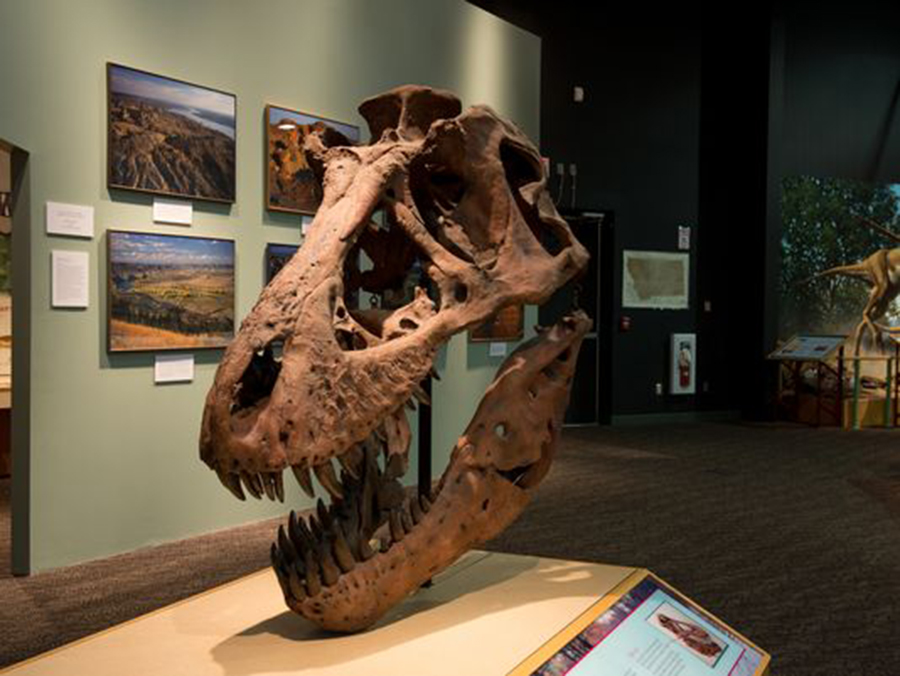
For more Montana dinosaurs, follow the Montana Dinosaur Trail, a collection of 14 locations around the state at which to discover more dinosaurs, and even dig for them yourself. In addition to some of those noted above, stops along the trail include the fossil remains at Makoshika State Park near Glendive, the state’s largest state park and where you can see the fossil remains of Tyrannosaurus rex, Triceratops and more. Another stop is the Fort Peck Interpretive Center, where you can see an exhibit of Peck's Rex, a life-size cast of the T. rex found just 20 miles away.

North Dakota

Dinosaurs once roamed the North Dakota Badlands, and evidence of their existence can be found in several parts of the state. Start with a visit to the North Dakota Heritage Center & State Museum in Bismarck, where a thorough exhibit covers the state’s paleontological history. It’s here, too, that you can see the 67 million year old mummified hadrosaur, a duck-billed dinosaur that was discovered on a ranch in southwest North Dakota in 1999.

If you’re ready to get your hands dirty, join the North Dakota Geological Survey in June, July and August and dig in – you’re nearly guaranteed to uncover fossils. In fact, two Tyrannosaurus rex teeth measuring two-and-a-half inches and four-and-a-half inches were discovered last August at a public dig site south of Bismarck.

For those who want to road trip around the state in search of dinosaurs, the North Dakota Tourism Division has created an 8 Stops on North Dakota Dinosaur Tour route to make the most of your quest.

South Dakota

In the Black Hills of South Dakota, just 30 minutes north of Deadwood, PaleoAdventures is ready to make your “Jurassic” dreams a reality. During the summer months, PaleoAdventures hosts one-, two-, three- and five-day digs and welcomes everyone ages 10 and up to join in the family-friendly fun aimed at educating participants about paleontology. 

Texas

It may be hard to imagine, but dinosaurs did indeed roam not far from what is now Fort Worth. Take some time to roam Dinosaur Valley State Park yourself and the five main track sites found within the park, all of which have smaller sites within them. Within these sites, you may be able to spot Sauropod and theropod tracks. Before your visit, download maps to make the most of your time.

Wyoming

In Thermopolis, The Wyoming Dinosaur Center is, well, all things dinosaurs. In addition to the museum and its exhibitions, the center hosts digs for any age and interest-level. All ages can Dig for a Day on sites from which center staff and visitors have removed more than 10,000 bones, seven days a week through mid-September (weather permitting). Kids ages eight to 12 can really dig in with the Kids’ Dig Program for a full day of paleontology wonder. Or really immerse yourself in a five-day Dinosaur Academy and go from the classroom to the lab to the field.

Aside from The Wyoming Dinosaur Center, visitors to the Glenrock Paleontological Museum can visit the preparation lab to see fossils being prepared, not to mention participate in the museum’s digs geared towards novices and more experienced fossil hunters.

Outside of museums, size yourself up against Middle Jurassic Period (160 million to 180 million years old) dinosaurs that roamed Wyoming at the Red Gulch Dinosaur Tracksite four miles west of Shell. The hundreds of tracks were discovered in 1997, and it’s believed there may be thousands more in the 40-acre area.

When a fifth grade class discovered the bones of a Camarasaurus during a field trip in Alcova, the Cotton Creek Dinosaur Trail was soon created to guide hikers through the Sundance and Morrison formations, which are known for their fossils.

Remains of Triceratops, Tyrannosaurus rex and Pachycephalosaurus have been found on Bliss Dinosaur Ranch in Weston, and guests are invited on two- or three-day digs on the 3,500-acre ranch. Guided by ranch owner Frank Bliss, who has a Master’s degree in geology, anyone who finds teeth or bones on the ranch is welcome to take them home.

Elsewhere

You can always experience “Jurassic World” for yourself at Universal Orlando Resort and Universal Studios Hollywood, where you can go face-to-face with Blue, one of the movie’s most popular dinosaurs, in the parks’ Raptor Encounter.

Alberta, Canada

There's more to do outside the U.S. in North America, as well. You can definitely go full-on “Jurassic Park” with a visit to the Philip J. Currie Dinosaur Museum in Grand Prairie. What’s the connection? The museum is named for paleontologist Philip Currie, who was the inspiration for Dr. Alan Grant, the paleontologist in “Jurassic Park.” Not only can you see some of the most important dinosaur discoveries in the world within the museum, but participate in its Palaeontologist For A Day program and work side-by-side with researchers in the field.

Another museum for budding paleontologists to visit is the Royal Tyrrell Museum of Paleontology in Drumheller. The museum also has dinosaurs on display, and offers public programs ranging from story time for the smallest dinosaur hunters to days-long science camps.

Out in the Canadian Badlands, home to one of the highest concentration of fossils in the world, visit Dinosaur Provincial Park, a UNESCO World Heritage Site where you can watch paleontologists work, or jump in on a guided excursion and do the digging yourself.

Source: www.usatoday.com

Why It Would Have Been Impossible For a T. Rex To Stick Out Its Tongue

Tuesday, June 26, 2018

Many depictions show dinosaurs with long, lizard-like tongues. New research reveals most dinosaur tongues were rooted firmly to the base of their mouths.  Public Domain Pictures

Everything we thought we knew about dinosaur tongues is wrong.

A mouthful of giant, bone-crunching teeth might be the scariest thing about a dinosaur. But there’s something about the image of a wet, waggling Tyrannosaurus tongue that’s particularly disturbing. To our relief, researchers have discovered that most dinosaur tongues—including that of the mighty T. rex—couldn’t waggle much at all.

In a recent study, researchers compared fossilized hyoid bones—a horseshoe-shaped bone that anchors the tongue and supports the opening into your lungs—with those of crocodiles and birds, the closest living relatives to dinosaurs. The study led to some unexpected outcomes, mainly, that most depictions of dino tongues in popular culture are wrong. For some reason (maybe because Tyrannosaurus translates to “tyrant lizard” in Greek), many drawings show dinosaurs with long, lizard-like tongues. But this new research reveals most actually had tongues similar to crocodiles, flat and rooted to the bottom of the mouth.

“The surprising part we found was that most dinosaur hyoid bones are pretty boring,” says Julia Clarke, a paleontologist and co-author of the study published this week in PLOS One. “The evidence really argues for simple, limited tongue movement in most dinosaurs.”

But why think about a slick, fleshy organ if we don’t have to? What’s so great about a tongue, anyway? Without a tongue, we wouldn’t be able to chew, speak or swallow. Frogs rely on their tongues to gulp in air. The okapi, also known as a zebra giraffe, uses its 14-inch long tongue to clean its eyes and strip leaves off trees.

And according to Clarke’s research, there are many more tales an ancient tongue bone can tell, like the origin of flight. Unlike the stubby, simple hyoid bone seen in dinosaurs like the T. rex, researchers found a much more complex structure in pterosaurs—bird-like dinosaurs, or “winged lizards.”

The waterfall scene in The Lost World: Jurassic Park shows Julianne Moore getting licked by a T. rex. We now know such a tongue lick wouldn't have been possible.

“We wanted to know when this crazy evolvement of tongues from bones happened,” Clarke says. “Only after the origin of flight [in vertebrates] do you get these Olympians of the bony tongue movement.”

If tongues didn’t creep you out before, they probably will now. Yes, that innocent looking tongue in a cheerful, chirping bird has a bone in it. The hyoid bone of today’s birds extends all the way from the back of its throat to the tip of its tongue. It’s this flexible bone that enables birds to stick their tongues all the way out (and maybe even a bit further). Hummingbirds have hyoids that are so long, it actually wraps around the skull and rests in the birds’ nares (aka bird nostrils). When unleashed, a hummingbird’s bony tongue can extend twice the length of its bill.

Noting the same structure in pterosaurs, researchers say it’s likely the evolution of the bony tongue and flying are connected. When arms evolved into wings, flying dinosaurs lost the ability to snatch up prey. Clarke says these advanced tongues could have served as a new means to procure food, a feature also seen in modern day birds.

T. rex tongue is definitely not comparable to our own puny, pink pokers, but it is similar in its construction, made not of bone, but thick tissue and muscle. Because its hyoid bone is basically two, short rods that sit way back in the throat, the tongue was moored to the bottom of the mouth, making it impossible to fling it free like the flexible, bony tongue of a bird.

There was one oddity in the study Clarke couldn’t explain. Armored dinosaurs—like a stegosaurus or ankylosaurus—also had complex hyoids, even though they were very different animals than winged dinosaurs. Clarke says she’s also unsure what purpose the rooted tongue of a T. rex would have served, but based on observations of crocodiles—which have a similar simple hyoid bone—it had something to do with food. A flat tongue certainly makes sense for a crocodile, which swallows prey whole—a long, bony tongue would probably interfere with that. Or maybe the tongue was always meant to be a landing strip for the bright, blue birds that pick leftover meat out of crocs’ teeth. Either way, tongues can tell us a lot more than we thought.

Source: www.popsci.com

Pages