Blogs

Paleontologists Find One-Billion-Year-Old Fossil Fungi in Canada

Friday, May 24, 2019

Microphotograph of Ourasphaira giraldae. Image credit: Loron et al, doi: 10.1038/s41586-019-1217-0.

An international team of paleontologists has discovered 1,000- to 900-million-year-old microfossils of a fungus in estuarine shale of the Grassy Bay Formation in Arctic Canada. These multicellular organic-walled microfossils are more than half a billion years older than previously reported occurrences of fungi.

“Fungi are essential components of modern ecosystems and are among the first traces of life to colonize the continents,” said University of Liège researcher Corentin Loron and colleagues.

“To date, the earliest fossil fungi are 410-million-year-old specimens from Scotland and spores of glomeromycotan fungi from Wisconsin that date to 450 million years ago, in the Ordovician Period.”

“The 1-0.9-billion-year-old (Proterozoic era) fossil fungi from the Grassy Bay Formation are older than these previously reported fossils by more than half a billion years.”

The paleontologists discovered abundant microfossils of a fungus named Ourasphaira giraldae.

These fossilized specimens have a wall made of chitin, a fibrous compound that forms fungal cell walls.

“These organic-walled microfossils consist of multicellular, branching filaments with terminal spheres,” the scientists said.

“Transmitted-light and scanning electron microscopy (SEM) examinations show smooth unornamented walls of filaments and spheres.”

“SEM images also reveal the presence of locally well-preserved and intertwined (approximately 15–20-nm thick) microfibrils, which make up the walls.”

“Ultrastructural analyses using transmission electron microscopy show that the flattened microfossils are hollow, with a bilayered wall that consists of an electron-dense thick inner layer and a thin electron-tenuous outer layer.”

This combination of complex morphology, right-angle branching, multicellularity, bilayered wall ultrastructure, compositional recalcitrance and relatively large size permits the unambiguous placement of Ourasphaira giraldae among eukaryotes.”

“Together they indicate the presence of a complex cytoskeleton, which is absent in prokaryotes.”

Extant fungi are mostly terrestrial, although some marine forms are known.

Because Ourasphaira giraldae is preserved in shallow-water estuarine shale of the Grassy Bay Formation, this fungus may have lived in an estuarine environment. The fungus may also have been transported into this estuarine setting from land or marine niches.

“The later colonization of terrestrial settings by fungi may have preceded and aided the colonization of land by plants through symbioses and through soil processing, which would have provided ecological niches, improved the substrate, nutrient uptake and increased aboveground productivity,” the researchers said.

“As multidisciplinary studies of Proterozoic fossil assemblages progress, we predict that more fossil fungi and other early eukaryotes will be discovered and will improve our understanding of the evolution of the early biosphere.”

The discovery is reported in a paper published in the journal Nature.

_____

Corentin C. Loron et al. Early fungi from the Proterozoic era in Arctic Canada. Nature, published online May 22, 2019; doi: 10.1038/s41586-019-1217-0

Source: www.sci-news.com

9 Best Dino Games on PC

Friday, May 24, 2019

T-Rex Breakout (Free Dinosaur Game) by unity5games

There aren’t many Jurassic wonders on PC, so we’ve compiled a list of the best dino games available.

Looking for a list of the best dinosaur games on PC? Whether you’re looking to hunt the Mesozoic monsters or want to stomp and chomp humans while playing as them, the appeal of dinosaurs in gaming is endless. What is endless however, is the number of games that successfully realise that fantasy. Let’s be honest: until recently, fans of dinosaurs and big guns haven’t exactly walked the primrose path, even on PC.

It’s been a long hard road, marked by velociraptors that look like lumpy dogs, rifles that feel as satisfying as lobbing a bullet by hand, and jeeps that seem to magnetically roll themselves into a nearby ditch, no matter what keys to press. Still, the undeniable lure of blasting a T-rex in the face with a grenade launcher continues to resonate with a great portion of the gaming public, and while few triple-A developers have proffered quality dino games, there are a few ambitious indie dinosaur games that fill the gap in the market.

If dino thrills are what you’re looking for, here are the best dinosaur games on PC.

The best dinosaur games on PC are: 


TUROK & TUROK 2

It might be hard to believe now, but before the one-two punch of Gears of War and Call of Duty 4 tethered the blockbuster shooter to beige reality, the genre had its fair share of colourful contenders. The first Turok in particular is a relic of the Quake era, packed with weapons that spin in mid-air, your dinosaur hunter’s frantic footspeed, and endless canyons of baddies to blast through, but it offers some of the best dino-slaughter of its era.

Turok 2: Seeds of Evil is an altogether more sophisticated game, with an emphasis on non-linear labyrinths rather than the traditional corridor crawls of other shooters of the era. However, it’s probably best-known today for its creative weaponry, especially the fearsome Cerebral Bore, which performs exactly the gory deed it says on the tin. Overall, these aren’t the best old games out there, but they’re fondly remembered for a reason, andthey let you wreck some giant reptilians, so they’re perfect for this list.

ARK: SURVIVAL EVOLVED

As the subtitle in its name implies, Ark belongs to the survival genre, which means the dinosaur murdering can only commence after crafting your own spear to chuck at those pesky raptors. The shooting isn’t the tightest, and there are still plenty of bugs, but the sheer range of creatures to fight, hunt, and befriend in Ark will keep you exploring the game’s many biomes for hundreds of hours.

After learning their quirks, you can even ride and tame Ark dinosaurs and use them to help you survive in the world, whether as simple mounts so you can get around faster, or as resource-gatherers, freight carriers, and loyal foot soldiers. On top of that, there’s also plenty of Ark: Survival Evolved mods to pick from.

JURASSIC PARK EVOLUTION

While most PC dinosaur games concern themselves with hunting dinos, Frontier Developments has instead opted to create the opposite with Jurassic Park Evolution: dino ranching. Rather than mowing down rare creatures with a minigun, you try to build a Jurassic Park that doesn’t fall apart before its first day. You don’t necessarily have to build the archetypical theme park – instead, you could build a park dedicated to science, or an ominous “security center” patrolled by genetically beefed-up mega-dinos.

This isn’t the deepest management sim ever made, but it does let you delve deeper into the fantasy of running your very own dinosaur park, right down to letting you mess with the DNA of the most dangerous creatures to ever walk the planet.

LEGO JURASSIC WORLD

Sticking with the Jurassic Park franchise, Lego Jurassic World marries the gameplay of action-adventure games specialist TT Games’ with the storylines of the Jurassic Park trilogy, plus the first Jurassic World movie. This is essentially a greatest hits of series, including more blocky, talky Jeff Goldblum than you can handle.

The real treat here is that the Lego games are among the best co-op games available, making this a great dinosaur game to play with friends and family. There’s not a huge amount that separates this Lego game from others – apart from the setting – but you can play as a huge number of different dinosaurs, which is a lot of fun.

DINO D-DAY

The best multiplayer games with shooter elements can be pretty stodgy, humorless affairs, especially when it comes to those that strive to be period-accurate. Dino D-Day is a refreshing alternative to the traditional WWII shooter, mixing the semi-tactical gunplay of Day of Defeat with the ferocious claws and talons that only dinosaurs can supply.

While it sounds like a joke game in the vein of Blood and Bacon, it’s actually a surprisingly creative class-based shooter with some truly wild ideas, like a tiny dino that boosts the power of its explosive payload by swiping at your ankles, or a raptor that can pin down single targets and take them out in just a few swipes, just like Left 4 Dead’s Hunter.

Unfortunately, D-Day is nearly a decade old and its player count has dwindled considerably. Still, if you can convince some friends to get it on a sale, this is a great palate cleanser.

PRIMAL CARNAGE

Dinosaur-hunting games are all about the battle between man vs. beast, and that’s exactly what you get with Primal Carnage. On one side, you have hunters in sunglasses toting big guns; on the other, you have giant reptiles ready to rumble.

While there are people who go in deep for the roleplay servers, Primal Carnage is at its best when both sides are just throwing everything they have at each other, resulting in a stupid, irresistible melee. Any game where you can play as a pterodactyl, swoop down, pick up a guy, and drop them to their death is worth checking out. Along with Dino D-Day, this is a multiplayer game that lacks player population, so you’ll probably need a few friends if you want to guarantee yourself a game.

CARNIVORES: DINOSAUR HUNTER REBORN

If you’re looking for a triceratops-toppling experience that’s a little closer to traditional hunting sims than the likes of Turok, this is your best bet. This remake of a beloved series from the late ‘90s focuses on tracking, hunting, and killing a variety of dinos.

You have to sneak up on these big boys and hold your breath to get accurate shots, and the size and condition of each target determines what rewards you get for a clean kill.

It’s a bit light on content, but if you’re tired of hunting down deer, boar, and other harmless woodland critters then this could be the change of scenery you need.

MONSTER HUNTER: WORLD

Sure, so they’re not technically dinosaurs, but it’s hard to deny that a Apceros or Anjanath are based on real dinosaurs, even if some of the bigger beasts in the game aren’t. In case you’ve let the series pass you by, Monster Hunter: World is pretty much what is says on the tin: you play a monster hunter, and you have a whole world teeming with fantastical creatures to identify, track, and bring down in cinematic boss battles. Once you’ve secured a kill you can strip the carcass for resources, take them back to your camp, and craft tougher weapons and armour that will let you take on even bigger beasties.

Aside from the seductive power creep, Monster Hunter: World also boasts some of the best action-RPG combat around. There’s a huge range of weapon types, from standard sword and shield combos to more eccentric tools like the gunlance, and learning the movesets of each one promises to be a steep difficulty curve. If you’re willing to put in the time – and we can help you a little with our Monster Hunter: World weapons guide – then this is probably the best dinosaur hunting game out there, even if some of its dinos have wings and breath fire.

FAR CRY: PRIMAL

Yes, for all you amateur archeologists cracking your knuckles to type a lengthy comment out there, we know that Primal is set in the Mesolithic era, millions of years after the dinosaurs were wiped out by a cataclysmic event. However, if you’re a fan of dinosaurs then wooly rhinos, mammoths, and formidable cave bears are the next best thing, and Far Cry Primal has the lot.

Primal lets you hunt all of these creatures and tame some of them as well so you can send them charging into battle on your behalf. And if you find yourself tiring of all the mammalian slaughter then this is still one of the best open-world games around, and there are plenty of distractions and hidden quests to discover along the way. It’s not the best Far Cry, but it captures the feeling of prehistory better than most games.

That’s your lot, the very best dinosaur games on PC. If you’re looking to dig up more classic-feeling greats then check out our list of the best retro games on PC. In the meantime we’ll be quietly waiting for more triple-A studios to realise how much better their games would be with the odd dino sprinkled in.

Source: www.pcgamesn.com

5 Dinosaurs We Hope Come Back For The Next Jurassic World (And 5 We Don't)

Thursday, May 23, 2019

The Jurassic Park and Jurassic World movies have had their ups and downs. With another Jurassic World movie on the horizon, we have started thinking about what we expect and hope to see in this sequel. The main attractions of these films are obviously the dinosaurs. As such, we are looking forward to any new marvelous behemoths the upcoming movie throws our way.

We also know what we aren't looking forward to. Trust us. After three Jurassic Park films and two Jurassic World films, fans know which dinosaurs make the best impact on screen (and which don't).


10 COME BACK: DILOPHOSAURUS

If you can remember the first Jurassic Park movie, you might recall the frightening Dilophosaurus. These small-ish dinosaurs had the ability to spit paralyzing juices in the face of their prey. Aside from the Velociraptors, the Dilophosaurus was one of the more formidable smaller inhabitants of the original park.

They made cute chirping noises, but could flare up and spit when you least suspected it. If they made a return to the big screen, maybe the new Jurassic World film would go back to its dinosaur-horror roots instead of remaining the spectacle it has become.

DON'T COME BACK: INDOMINUS REX

Jurassic World wowed us with its vision of what a fully realized Jurassic Park might look like. Part of its charm lay in the actual success of John Hammond's idea. What Jurassic World failed to do was impress us with its new Indominus Rex. The Indominus was clearly meant to be some kind of replacement for the Tyrannosaurus, but it failed to live up to its predecessor.

Luckily, the movie itself recognizes the T. rex's supremacy. Jurassic World ends with a big fight between the T. rex and the Indominus, with the good old T. rex (eventually) winning. So, please, let's end the Indominus' time with us on a high note, and don't bring it back.

COME BACK: MOSASAURUS

Jurassic World:Fallen Kingdom ended with several dinosaurs free in the continental United States. Honestly, we don't see that as much of a problem as the film tries to convince us it is. What are a few wild animals that need to be captured? The one dinosaur that does delight/concern us is the Mosasaurus.

The ending to Fallen Kingdom showed us that it is now loose in the world's oceans. Did you get a good look at that thing? It is huge! Even so, the ocean is bigger, and we believe the Mosasaurus could live out its days preying on unsuspecting surfers for quite a while. We hope to see more of the Mosasaurus in the upcoming film. It could be the new Jaws.

DON'T COME BACK: SPINOSAURUS

Enough with trying to beat the T. rex. It's been done more than once, or at least it has been attempted more than once. Fans of Jurassic Park were livid when Jurassic Park III released. The film tried to portray the Spinosaurus as an equal, if not superior, contender against the Tyrannosaurus rex. Regardless of whether or not that's scientifically accurate, it was not pleasing for fans.

We don't want to see our boy (or girl) tossed around by a lousy Spinosaurus. Plus, it's been done once already, or twice if you include the T. rex's fight with the Indominus in Jurassic World.

COME BACK: TYRANNOSAURUS REX

Can the new movie really be called a Jurassic World movie if it does not include a Tyrannosaurus rex? That dinosaur is practically the franchise's mascot. The T. rex has made an appearance in every Jurassic Park and Jurassic World movie to date. Not having it make an appearance in the new film would be close to sacrilege.

Is the Tyrannosaurus overused? Maybe. Should the film-makers try to include more unique dinosaurs instead? Possibly. Do we still hope to see the T. rex come back? Most definitely.

DON'T COME BACK: VELOCIRAPTOR

Just hear us out on this one. The Velociraptors we see in the Jurassic World movies are not what they were in the Jurassic Park ones. In the original Jurassic Park, the Velociraptors were a thing of terror, stalking children in a kitchen with splice-and-dice claws. Nowadays, the Velociraptors are kind of the heroes of the series since they have been tamed.

Instead of rehashing the same story between Blue and Owen Grady, it would be better if Velociraptors were not a part of the new movie at all. Or maybe they could be replaced by the scarier, less well-known Deinonychus.

COME BACK: BRACHIOSAURUS

Sadly, the Brachiosaurus makes only the most cursory of appearances in the Jurassic films. It is the first dinosaur that Alan Grant and Ellie Sattler see when they arrive at Jurassic Park. The Brachiosaurus is also the final dinosaur that Owen Grady and Claire Dearing see on the original island.

However, we think it deserves more than just cameo appearances. The Brachiosaurus is one of the tallest dinosaurs that ever existed. We think it should get something like a starring role in the next Jurassic World film. It could be a dinosaur companion, like droid companions in Star Wars. Except bigger. Much, much bigger.

DON'T COME BACK: COMPSOGNATHUS

The Compsognathus (try saying that ten times fast) first appeared in The Lost World: Jurassic Park. They are small dinosaurs, no bigger than the size of a chicken. However, despite their tiny stature, The Lost World makes them out to be one of the most lethal of dinosaurs on the Site B island.

We don't mean to ridicule any characters taken down by these...fearsome...beasts, but they definitely appear to be a step down from the Velociraptors from the original Jurassic Park. If they never make an appearance in the new Jurassic Worldmovie, we'd call that a resounding success.

COME BACK: DIMORPHODON

Dimorphodons were part of the large group of flying dinosaurs that attacked the park in Jurassic World. They were the ones with a beak full of teeth. Honestly, that was one of the most frightening parts of the movie, and one of the most enjoyable.

The Dimorphodon hordes played a huge role in the panic that ensued. They swooped down from the sky and attacked people, occasionally carrying them off. If a pack of those got loose in a city (and Fallen Kingdom suggests they might have) it would make for a perfect, cinematic chase sequence.

DON'T COME BACK: INDORAPTOR

Enough with the hybrid dinosaur menaces. The Indoraptor was just a lame attempt at making another Indominus Rex. The only difference between the Indoraptor and the Indominus Rex is the kind of dinosaur they were based on. The Indominus Rex was a Tyrannosaurus rex rip-off. The Indoraptor was meant to steal the vibe of the Velociraptor.

Still, the "scary" part of Fallen Kingdom, where they're hiding in the mansion from the Indoraptor, does not compare to the Jurassic Park kitchen scene with Velociraptors. The Indoraptor should maintain the same status from last we saw it: extinct.

Source: https://screenrant.com

Construction workers find dinosaur fossils in Denver suburb

Thursday, May 23, 2019

Photo Credit: Denver Museum of Nature and Science

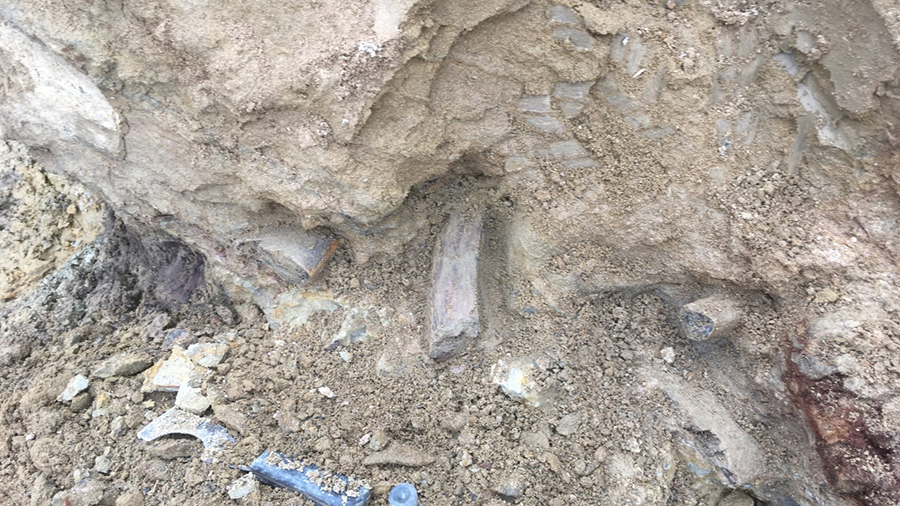
Construction workers have unearthed fossils in a Denver suburb that experts say could be from a rare horned dinosaur.

The Denver Museum of Nature and Science said that it is exploring the construction site near a retirement community in Highlands Ranch where a dinosaur’s lower leg bone and several ribs were found.

Fossil expert Natalie Toth told KDVR-TV the fossils could be from a Torosaurus — a dinosaur similar to the Triceratops but differentiated by three bones.

Toth says the fossils seem to be intact, so crews are hoping to uncover the entire dinosaur.

The fossils are embedded in a 66- to 68-million-year-old rock layer.

Toth says fossils in the Denver formation are from dinosaurs that were among the last “walking around before the big extinction.”

Source: www.washingtonpost.com

Paleontologists Link Fossil Site To Dinosaur-Killing Meteor

Friday, May 24, 2019

The seismic shockwave would have triggered a water surge, known as a seiche. ROBERT DEPALMA

Paleontologists have discovered a fossil site containing fossilized remains of fish, mammals, and plants that were buried as a result of the meteor strike that killed dinosaurs 66 million years ago.

This fossilized graveyard containing fish piled one atop another, burnt tree branches, dead animals, marine microorganisms, and some parts of the carcass of the Triceratops (a genus of herbivorous ceratopsid dinosaur), was unearthed by Robert DePalma, paleontologist in a 6 yearlong study conducted in the Hell Creek Formation, North Dakota. “This is the first mass death assemblage of large organisms anyone has found associated with the K-T boundary,” said DePalma, curator of paleontology at the Palm Beach Museum of Natural History in Florida and a doctoral student at the University of Kansas. “At no other K-T boundary section on Earth can you find such a collection consisting of a large number of species representing different ages of organisms and different stages of life, all of which died at the same time, on the same day.”

Robert DePalma along with a team of researchers which included two geologists from the University of California, Berkeley have co-authored a paper on the subject. According to the team, the fossil trove (dubbed Tanis) contains evidence that associates it with the asteroid impact from 66 million years ago which created a massive crater in the ocean floor and sent vaporized rock and cubic miles of asteroid dust into the atmosphere. The cloud eventually enveloped Earth, and eventually led to Earth’s last mass extinction. Mark Richards, a UC Berkeley professor emeritus of earth and planetary science describes the site as ‘a museum of the end of the Cretaceous in a layer that is a meter-and-a-half thick’.

Source: https://businessherald.co

Canyon Fossils Tell Story of Life Before Dinosaurs

Wednesday, May 22, 2019

Close-up view of the Ichniotherium trackway from Grand Canyon National Park. (Photo courtesy of Heitor Francischini via NPS)

Newly-discovered footprints lead paleontologists to rethink life in the ancient desert.

An international team of paleontologists has united to study important fossil footprints recently discovered in a remote location within Grand Canyon National Park.

A large sandstone boulder contains several exceptionally well-preserved trackways of primitive tetrapods (four-footed animals) which inhabited an ancient desert environment. The 280-million-year-old fossil tracks date to almost the beginning of the Permian Period, prior to the appearance of the earliest dinosaurs.

The first scientific article reporting fossil tracks from the Grand Canyon was published in 1918, just a year before the park was established as a unit of the National Park Service. One hundred years later, during the Centennial Celebration for Grand Canyon National Park, new research on ancient footprints from the park is being presented in a scientific publication released this week. Brazilian paleontologist Dr. Heitor Francischini, from the Laboratory of Vertebrate Paleontology, Federal University of Rio Grande do Sul, is the lead author of the new publication, working with scientists from Germany and the United States.

Francischini and Dr. Spencer Lucas, Curator of Paleontology at the New Mexico Museum of Natural History and Science in Albuquerque, New Mexico, first visited the Grand Canyon fossil track locality in 2017. The paleontologists immediately recognized the fossil tracks were produced by a long-extinct relative of very early reptiles and were similar to tracks known from Europe referred to as Ichniotherium (ICK-nee-oh-thay-ree-um). This new discovery at Grand Canyon is the first occurrence of Ichniotherium from the Coconino Sandstone and from a desert environment. The Coconino Sandstone is an eolian (wind-deposited) rock formation that exhibits cross-bedding and other sedimentary features indicating a desert / dune environment of deposition. In addition, these tracks represent the geologically youngest record of this fossil track type from anywhere in the world.

The Ichniotherium footprint is believed to have been made by an enigmatic group of extinct tetrapods known as diadectomorphs, a primitive group that possessed characteristics of both amphibians and reptiles. The evolutionary relationships and paleobiology of diadectomorphs have long been important and unresolved questions in the science of vertebrate paleontology.

Although the actual track maker for the Grand Canyon footprints may never be known, the Grand Canyon trackways preserve the travel of a very early terrestrial vertebrate. The measurable characteristics of the tracks and trackways indicate a primitive animal with short legs and a massive body. The creature walked on all four legs and each foot possessed five clawless digits.

According to Francischini, "These new fossil tracks discovered in Grand Canyon National Park provide important information about the paleobiology of the diadectomorphs. The diadectomorphs were not expected to live in an arid desert environment, because they supposedly did not have the classic adaptations for being completely independent of water. The group of animals that have such adaptations is named Amniota (extant reptiles, birds and mammals) and diadectomorphs are not one of them."

Lucas also notes that "paleontologists have long thought that only amniotes could live in the dry and harsh Permian deserts. This discovery shows that tetrapods other than reptiles were living in those deserts, and, surprisingly, were already adapted to life in an environment of limited water."

During 2019, in recognition of the Grand Canyon National Park Centennial, the National Park Service is undertaking a comprehensive paleontological resource inventory for the park. A large team of specialists in geology and paleontology will participate in fieldwork and research to help expand our understanding of the rich fossil record for Grand Canyon National Park.

Information provided by NPS

Source: www.grandcanyonnews.com

Rumor: Dinosaurs Are Coming To Battlefield V

Tuesday, May 21, 2019

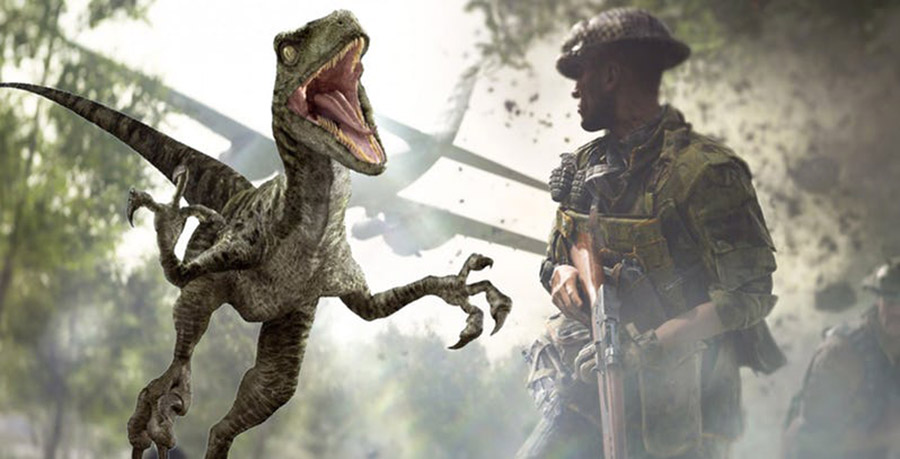
Rumor: Dinosaurs Are Coming To Battlefield V

According to a new rumor, dinosaurs might be coming to Battlefield VWhat are you even doing to us anymore, 2019?

Now, Jurassic Park is an icon of 1990s cinema. The world will never forget Jeff Goldblum prattling about chaos theory, Samuel L. Jackson’s hilariously fake severed arm, or that brachiosaurus with the head cold. Now that we’ve also seen Chris Pratt training velociraptors in Jurassic World for a modern audience (as part of his world domination plan to be cast in every movie ever), one thing’s been made abundantly clear: dinosaurs will always captivate our imaginations.

From Barney to the awe-inspiring specimens seen in museums around the world, there’s just something about these unimaginable titans that fascinates us. Being the pop culture legends they are, it’s no surprise that they’ve popped up in all kinds of video games. Battlefield, however, is probably one franchise that you wouldn’t expect to feature them.

Nevertheless, the word on the gaming grapevine is that dinosaurs are going to be added to Battlefield V in some way. As Game Rant reports, YouTube’s JackFrags has created a video presenting the (somewhat dubious) evidence. In a flow chart documenting the development of the game, we’re told, a message is hidden in Morse code. It reads, “soon preround red flares.”

Battlefield-5-eurogamer-1

As any Jurassic Park fan will tell you, the series would be nowhere without those trusty red flares. That scene where the T. Rex is lured away by them? That’s some unforgettable stuff, right there. Is this a way of indicating that some kind of "dinosaur mode" will be added to the game, without being too overt about it? The internet seems to think so, but then the internet does love to grab at these theories and run away with them.

For those wondering why a World War II-themed shooter would feature dinosaurs, there is an odd precedent for this sort of thing. Remember that megalodon Easter egg in Battlefield I? With members of the dev team posting obscure images that may or may not feature pterodactyls, it’s clear that something’s going on.

Hopefully, the upcoming showcase at E3 2019 will shed some light on this odd situation. Heck, the game could use a shot in the arm, especially with that unfortunate business with Firestorm duos.

Source: www.thegamer.com

Mussaurus patagonicus: This Early Sauropod Went From Walking on Four Legs to Two as it Grew

Tuesday, May 21, 2019

This dinosaur may have first walked on two legs DEAGOSTINI/UIG/SCIENCE PHOTO LIBRARY

Center of mass shifts led to a rare change in walking style for a long-necked dinosaur relative.

Most long-necked sauropods lumbered on four legs all their lives to support their titanic bulk. But an early relative of such behemoths as Brachiosaurus made the unusual transition from walking on four legs to two as it grew, a new study shows.

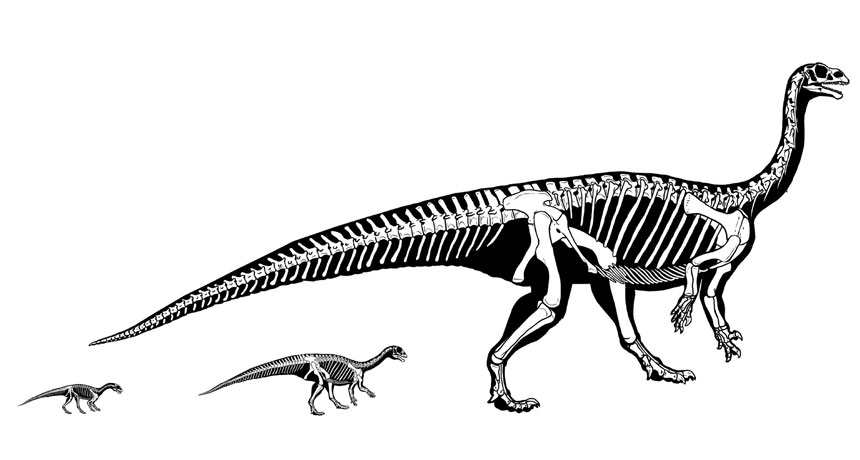
Diminutive at hatching, Mussaurus patagonicus (which means “mouse lizard”) began life walking on all fours. But by the time the 200-million-year-old plant eater reached its 6-meter-long adult size, it roamed what’s now Argentina on two legs.  

The changing length of M. patagonicus’s arm bones relative to its body and its inward facing-palms as an adult had hinted at the transition. But for the first time, computer simulations based on a rich fossil record show how a shift in the creature’s center of gravity as it grew enabled a change to bipedal walking, researchers report May 20 in Scientific Reports.

GROWING UP As Mussaurus patagonicus grew, the long-necked dinosaur’s center of mass shifted back toward its hips and tail, letting it go from a four-legged to two-legged gait even as it ballooned from the size of a chick to that of a rhinoceros.  A. OTERO ET AL./SCIENTIFIC REPORTS 2019

Researchers took CT scans of fossil bones from six individual M. patagonicus — covering different stages of the species’ development, from 60-gram hatchlings the size of baby chickens to 1.5 metric ton adults the size of rhinoceroses. The researchers added virtual flesh to digitized bones to create 3-D models that allowed them to estimate both the weight and center of gravity of M. patagonicus at many different stages of its life.

Reconstructions of the hatchlings showed that the creature’s center of mass was so far forward that the dinosaurs could move around only by walking on all four legs, says Andrew Cuff, a paleontologist of the Structure and Motion Laboratory of the Royal Veterinary College in Hatfield, England.

As the dinos grew, their center of mass moved back toward their hips, allowing them to walk upright on two legs, Cuff and colleagues found. The transition “is incredibly rare,” he says. “We have struggled to find any other animals aside from humans that go through that transition.... Finding it in the fossil record is pretty exceptional.”

The results suggest these adult dinosaurs turned bipedal because their tail muscles became bulkier and heavier as they grew, moving their center of gravity backward, says Stephen Poropat, a paleontologist at Swinburne University of Technology in Melbourne, Australia, who was not involved in the research. “It is not the changing proportions of Mussaurus’s front legs that is necessitating this change from walking on four legs to walking on two legs as an adult,” he says.

As later long-necked dinos bulked up in size (SN Online: 9/4/14), going to two legs may no longer have been an option. Massive sauropods instead probably started on four legs like M. patagonicus and stayed that way, developing trunklike front legs to bear their weight. “What we gain from this [study] is that there may be a size limit of how big you can get being a biped in this group,” Cuff says.


Citations

A. Otero et alOntogenetic changes in the body plan of the sauropodomorph dinosaur Mussaurus patagonicus reveal shifts of locomotor stance during growthScientific Reports. Published online May 20, 2019. doi: 10.1038/s41598-019-44037-1.

Further Reading

C. Gramling. A dinosaur’s running gait may reveal insights into the history of bird flight. Science News Online, May 2, 2019.

C. Gramling. Long-necked dinosaurs grew to be giants in more ways than oneScience News. Vol. 194, August 4, 2018, p. 13.

M. Rosen. World’s largest dinosaur discovered. Science News Online, September 4, 2014.

S. Perkins. Small ancestor of giant sauropods unearthed. Science News Online, November 10, 2009.

Source: www.sciencenews.org

Farting Dinosaurs With Low Sex Drives 'ATE Themselves Into Extinction'

Sunday, May 19, 2019

THEORIES: Several noted scientists have alternative theories for the dinosaurs' extinction (Pic: Getty)

THEORIES for the dinosaurs’ extinction generally revolve around the impact of a large extraterrestrial object 65 million years ago. But there are other explanations…

Entomologist Stanley Flanders, for example, blamed caterpillars. He theorised the emergence of the first moths and butterflies would have had a huge impact on Cretaceous era vegetation.

With no defence against the new creatures, plants would have been denuded of leaves very dramatically. And as dinosaurs didn't wear jumpers – as far as we know – the moths had nothing else to eat. 

According to Dr Flanders’s paper "Did the Caterpillar Exterminate the Giant Reptile?” the giant plant-eating dinosaurs were dependent on eating huge quantities of vegetation daily to sustain their massive bulk, and when the moths and butterflies – or more specifically their caterpillars and grubs – stripped the plants of their leaves, the dinos were left starving.

And once the plant-eaters’ numbers fell, the meat-eaters would have nothing to chow down on but each other.

In time, of course, birds – those lightweight cousins of the dinosaurs – would come to prey on the new order of bug but for a generation or so there would be nothing keeping the caterpillars down.

"Thus," Flanders wrote, "the giant reptiles which had survived during eons characterised by great changes in climate, continental uplifts, and different diets, may have been exterminated by the lowly caterpillar."

SALAD SHORTAGE: Did a sudden disappearance of edible plants cause a mass extinction? (Pic: Getty)

Yale University palaeontologist George Wieland was one of the first scientists to offer a theory about the extinction of the dinosaurs. He thought it was all to do with eggs.

Based on ideas from a couple of pioneering Victorian palaeontologists, Wieland wrote that there emergence of smaller, faster, animals that raided the nests of Triceratops and her cousins for tasty and nutritious eggs.

Because the dinosaurs were huge animals that reached sexual maturity much more slowly than the piratical little mammals that were swiping their eggs, dinosaurs just couldn’t adapt to the threat in time to save themselves.

Baron Franz Nopcsa von Felső-Szilvás was an aristocrat, and adventurer and possibly a spy as well as a pioneer of palaeontology. He was one of the first scientists to suggest that dinosaurs cared for their young, as well as identifying the relationship of birds to dinosaurs. 

He was an eccentric genius, notably naming one prehistoric species of turtle that he discovered after his boyfriend’s arse, but his theories about the end of the dinosaurs were his most eccentric of all. As well as speculation about the size of gigantic beasts’ pituitary glands, he developed a theory that dinosaurs – like pandas today – just lost interest in sex.

The History Channel documentary Ancient Aliens had an even more offbeat reason for the end of the age of the dinosaurs. And it had to do with, surprise surprise, ancient aliens. 

In the show, guest Jason Martell implies that dinosaurs were created by aliens in the first place, saying that we don’t know where they came from in the first place. The idea is echoed by Giorgio Tsoukalos who suggests that the 150 million year reign of the dinosaurs was an ‘experiment’ by these apparently very patient aliens who eventually tired on their saurian proteges and wiped them out.

There’s also some fascinating, if ultimately fairly daft speculation about human and dinosaurs co-existing. In fact, there’s a gap of some 60 million years between them an dinos, in which a variety of other fascinating but lesser-known animals plied their trade apparently without the oversight of mystery space travellers.

Of course, many species survived from the age of the dinosaurs completely intact. Tsoukalos rather brilliantly theorises that “I think it is possible that the coelacanth survived due to a direct guarantee by extraterrestrials.”

The show concludes that because a large number of dinosaur fossils are slightly radioactive that’s evidence that the monstrous beasts were taken out with a massive nuclear strike from an alien spacecraft. Which could be true, but the fact that many dinosaur fossils are found in sediments rich with carnotite – a naturally uranium-bearing ore – might be another explanation for that.

WIPED OUT: The main dinosaur line became extinct (in geological terms) very quickly (Pic: Getty)

Still, the intervention of little black-eyed men from other planets isn’t the best or most educational theory for the end of the age of dinosaurs. We’ve saved that for last. It is, of course, farts.

All we know about dinosaur behaviour and physiology and behaviour is derived from a relatively small sample of individuals that happens have become fossilised, and even then large parts of their bodies have not survived.

Plant-easing dinosaurs seem, in many cases, to have teeth that simply weren’t up to the job of grinding the huge quantities of vegetable matter required to support their colossal bulk.

For a while, it was theories that they deliberately swallowed stones that would help break down the fibrous planet once they were in there stomachs.

Then researchers David Wilkinson, Euan Nisbet and Graeme Ruxton suggested that perhaps the huge beats were hosts to thriving colonies of microorganisms that digested the material on the sauropods’ behalf. 

Only problem with that is, they would have generated colossal amounts of methane as a by-product. That is to say, farts.

Since we know similar emissions from cows and other livestock contribute greenhouse gases to our warming atmosphere today, Wilkinson and his team started to wonder what those epic Apatosaurus, Diplodocus and Barosaurus trumps would have done to the climate of their era.

Guessing that a square kilometre would be home to roughly 10 big plant-eating dinosaurs, and scaling that population up to approximately half the available land area at the time, Wilkinson and his pals theorised that that the giant, long-necked dinosaurs could have produced up to 520 million metric tons of fart gas a year.

That might have helped keep the mighty beasts warm – but did it contribute to runaway climate change that saw them off? 

Maybe yes, maybe no. But it’s a handy reminder that our comparatively short tenure on this planet could soon end unless we get a control on our own emissions. And that doesn’t just mean farts.

Human Meme 'Ancient Aliens' Host Giorgio A. Tsoukalos

Original story on www.dailystar.co.uk

World’s Best Preserved ‘Dinosaur Mummy’ Was 1360 kg When Alive, Weighs 1130 kg After Ages

Sunday, May 19, 2019

(Courtesy of Royal Tyrrell Museum, Drumheller, Canada)

Scientists are hailing this prehistoric dinosaur as the “best-preserved dinosaur on Earth.” In fact, it is so well preserved that it cannot be defined as a fossil. This magnificent ancient 18-foot-long specimen has been called a genuine “dinosaur mummy.”

On May 12, 2017, the Royal Tyrrell Museum of Palaeontology in Alberta, Canada, unveiled a dinosaur exhibit: “We don’t just have a skeleton,” Caleb Brown, a researcher at the museum, told National Geographic. “We have a dinosaur as it would have been.”

Since it was unearthed, it has kept its shape; its bones aren’t visible and even some of its innards are still intact. Researchers were amazed at the extent of the almost unparalleled degree of preservation.

The dinosaur is so well preserved that it “might have been walking around a couple of weeks ago,” Jakob Vinther, a paleobiologist from the University of Bristol, said. “I’ve never seen anything like this.”

The creature was first discovered in 2011 when an oil mine employee named Shawn Funk inadvertently discovered the specimen while at work.

While Funk was excavating that day, he was surprised to find something he had never discovered in 12 years of digging. In the afternoon, Funk’s excavator’s claw struck something different. He and his supervisor, Mike Gratton, started to wonder what these strange colored lumps were. They questioned if these were fossilized wood or an animal’s ribs?

“Right away, Mike was like, ‘We gotta get this checked out,’” Funk said in a 2011 interview. “It was definitely nothing we had ever seen before.” Surprisingly, this wasn’t fossilized wood or a petrified tree stump but a fossilized dinosaur.

From its finding, it took researchers six years and around 7,000 hours to conduct tests on the evidence collected and prepare the remnants to be displayed at the Royal Tyrrell Museum of Palaeontology.

Over 100 million years ago, when this ancient prehistoric creature roamed the earth, it was a member of a newly discovered species and genus named the Nodosaur.

According to paleontologists, this bizarre fossil was first of its kind. Usually, it’s rare to find a fossil that keeps its soft tissue in its true shape. It’s common to see bones and teeth well preserved. So indeed, this was an amazing discovery.

It was a gigantic four-legged herbivore, and its body was protected by spiky, plated “armor.” This nodosaur originally weighed around 3,000 pounds (approx. 1,361 kg) when it was alive. The mummified nodosaur is so unimpaired that it still weighs 2,500 pounds (approx. 1,134 kg)! Truly marvelous!

When the museum put up pictures of the dinosaur on their Facebook page, one curious user commented: “What was it’s favorite plant to eat? Was it prone to calm then hissing and snapping like a turtle when provoked, or was it’s demeanor different? Can you tell if it’s male or female?”

To which Brown replied: “1) We don’t know what its favorite plant food was. We do know that it would have enjoyed plants growing close to the ground, as it would not have been able to reach very high up. Hopefully, analysis of the stomach contents will allow us to determine the last plants that it ate. 2) We don’t know what its demeanor was like. It would have probably been slow moving, but we are unsure if it was a gentle giant or was defensive, snapping creature. 3) We also don’t know if it was male or female. Outside of finding eggs inside the animal, there are few ways to tell male and female dinosaurs apart. Although the skin is preserved on much of the animal, we don’t have the pelvic region preserved, so we also can’t see any structures that may have been preserve there. It is interesting to consider what may have been preserved had that region been recovered.”

The question of how the dinosaur could have remained so intact after it was unearthed still baffles scientists, although according to National Geographic, researchers are putting forth the theory that the creature may have been carried away to sea by a “flooded river” where it sank. As it lay there undisturbed, the armor and skin were replaced by minerals over the course of millions of years. This gave it the form that it is currently in, on exhibit.

Alluding to this amazing find, Brown said: “It will go down in science history as one of the most beautiful and best-preserved dinosaur specimens—the Mona Lisa of dinosaurs.”

With the dinosaur mummy on display at the Royal Tyrrell Museum, visitors have an opportunity to observe what is considered to be the closest thing to an original dinosaur. On seeing this amazing specimen, perhaps visitors will be able to vividly visualize the lives and times of dinosaurs, so many millions of years ago.

Source: www.theepochtimes.com

Pages