nandi's blog

Feeding Habits of Ancient Elephants Uncovered From Grass Fragments Stuck in Their Teeth

Friday, May 18, 2018

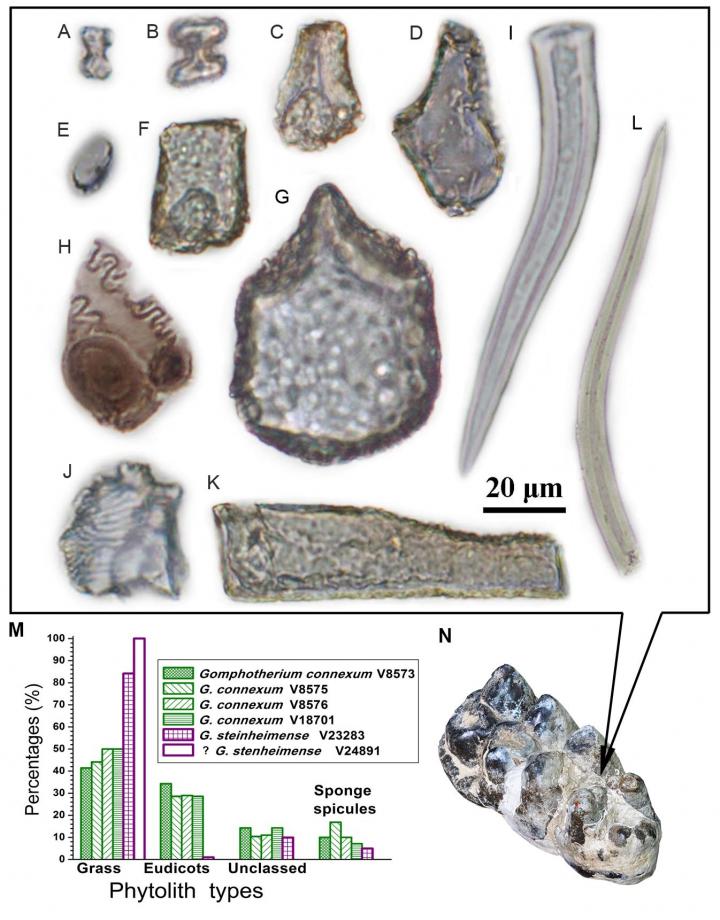
Phytoliths of grass and foliage found adhered to a molar of Gomphotherium connexum (bottom-right) from the Miocene deposits of Junggar Basin, Xinjiang, China. The bar chart from the bottom-left indicate relative abundance of different phytolith types from Gomphotherium teeth examined in this study. Credit  Wu Yan, Institute of Vertebrate Paleontology and Paleoanthropology, Chinese Academy of Sciences, Beijing

A new study, led by scientists at the Institute of Vertebrate Paleontology and Paleoanthropology (IVPP) in Beijing, China, including University of Bristol PhD student Zhang Hanwen, examined the feeding habits of ancient elephant relatives that inhabited Central Asia some 17 million years ago.

Professor Wang Shiqi from IVPP, the study's senior author, said: "We found ancient elephant teeth in the Junggar Basin, in China's far North West and they belong to two species, Gomphotherium connexum, and the larger G. steinheimense."

Zhang Hanwen, from Bristol's School of Earth Sciences, added: "Gomphotherium was most obvi-ously different from modern elephants by its very long lower jaw that still had lower tusks.

"It also had a shorter, more elongate, barrel-like body shape compared to modern elephants. In essence, a small elephant with short legs."

Professor Wang explained: "Our study of their evolution shows that Gomphotherium connexum became extinct, but G. steinheimense was part of the line that eventually gave rise to the modern elephants."

To understand if feeding preference was playing a role in survival and extinction of these ele-phants, Dr Wu Yan of IVPP, the study's lead author, analysed tiny remnants of plant matter found stuck to the fossil teeth, called phytoliths.

About 30 percent of the phytoliths extracted from the teeth of G. connexum are from soft foliage, whereas another 50 percent or so comes from grasses.

Dr Wu said: "Given that foliage naturally produces far less phytoliths than grasses, this indicates that G. connexum was mainly feeding on foliage, maybe a generalist feeder of all kinds of plant matter.

"When I examined the phytoliths extracted from the cheek teeth of G. steinheimense, I saw a very different pattern - grass phytoliths comprise roughly 85 percent of the total, suggesting this spe-cies was perhaps primarily a grazer 17 million years ago."

To confirm these results, the team also examined tiny wear patterns on the fossil tooth surfaces called microwear.

Zhang Hanwen added: "Now things start to get interesting. When our team analysed fossil pollen samples associated with the sediments where the Gomphotherium teeth were found, we realised that woodlands were rapidly transforming into semi-arid savannahs when the two species lived together.

"By adopting a much more grass-based diet, G. steinheimense was apparently responding better to this habitat change than G. connexum.

"Gomphotherium had primitive dentition consisting of low molar crowns, and numerous conical cusps arranged in few transverse enamel ridges on the chewing surface of the teeth.

"This was adapted for feeding on leaves, the primitive diet. But later on, the lineage leading to modern elephants and the extinct mammoths evolved an increased number of enamel ridges, and these eventually became densely packed tooth plates for shearing tough vegetation.

"Our new evidence shows that the diet switch from leaves to grass happened long before the ana-tomical switch in tooth shape." 

Source: www.eurekalert.org

Where To Buy Dinosaur Fingerlings, Because They're *Finally* Available In The U.S.

Saturday, May 19, 2018

If you've been waiting impatiently for the next generation of Fingerlings, your time has come. Unveiled in March, the newest Fingerlings, called UNTAMED Raptors, are finally hitting U.S. stores Friday, May 18, and they will satisfy the kid who loves Fingerlings and the kid who loves dinosaurs, giving you lots of "roar" for your buck. It's fun to be the first in your neighborhood to have any new toy, so now that the new Fingerlings are finally here, where can you find them?

Although kids in Canada, the United Kingdom, and Australia have been playing with their UNTAMED raptors since their release there in March, as Romper learned at the time, the new Fingerlings are available in stores and online to United States customers tomorrow. Head over to your local Walmart or Target (or shop online) to grab them, or order them from Amazon. If you're really ambitious and want to make sure you don't miss out on the first shipment, shoot to get to the store as it opens and surprise your kids when they get home from school. To celebrate their "Ferocious Friday" release on May 18, there are videos you can watch to see the dinosaurs playing around.

There are four raptors to choose from — Stealth, Blaze, Fury, and Razor. For the palatable price of $14.99, you can buy them all at once and give the kids an UNTAMED party or dole them out one by one and let them savor the anticipation.

If you can't wait a few more hours, you could try pre-ordering a Fingerling raptor on Amazon. However, the site lists it as "in stock on May 23rd" and at a cost of $24.99, so it's not the best option if you're looking for immediate gratification. You may want to wait to see if the price comes back to the $14.99 after the release. 

Be prepared for some noise in your house as the kids play with their new UNTAMED Fingerlings. Montreal-based toymaker, WowWee has created four different dinos, all with their own individual personalities. WowWee's public relations firm said that the Fingerlings, "react to touch, motion, and sound with over 40 different sounds and animations." They even fart like the classic monkey Fingerlings. It's a totally interactive experience as the things your kids do to them will affect what the raptor does. The raptors even know the difference between being petted and being poked and react differently to each, according to the introduction video.

Kids can create any storyline they want with their Fingerlings and make each of them the good dino or the bad dino, friend or foe, depending on their mood. The more your child interacts with the Fingerling, the better they will understand what each action will do. Each touch, tap, and tickle brings a different reaction from the raptors. If they rub them from nose to the top of their heads, they shift from ferocious to friendly. They even nap if you lay them down gently. Careful, though, as they can go back to ferocious when you least expect it.

As the Toy Insider said, WowWee has segued from Fingerling monkeys in all different colors and level of sparkle, into the dino-realm. If the monkeys gave the kids "friendship at their fingertips", Toy Insider said that the raptors give them, "ferocious at their fingertips." These toys are really portable and great to keep the kiddies busy in the car, as long as you can handle the noise in a small space.

If you head over to Target or Walmart on Ferocious Friday and grab a few UNTAMED raptors, the kids can have a weekend full of fun. While the toys can't substitute entirely for a babysitter, you may get to sneak into the other room and have some interrupted time to read, think, pay the bills, watch some Netflix, whatever it is you would fill your weekends with if you had total freedom. 

Source: www.romper.com

Check Out the Dinosaurs Set to be Unleashed Near Burton

Saturday, May 19, 2018

Check out the dinosaurs set to be unleashed near Burton

Ever fancied meeting a Tyrannosaurus rex or a crafty Velociraptor?

Dinosaurs will be on the loose at a family attraction near Burton this half-term. Well okay, they are not real, but real enough for the May half-term holiday.

The large scale realistic looking dinosaurs will be at the National Forest Adventure Farm from Saturday, May 26, until Sunday, June 3.

There will be a ferocious Tyrannosaurus rex and a crafty Velociraptor roaming around as part of 'Dino Week at the centre'.

The creatures are realistic, complete with opening jaws, deep frightening roars, blinking eyes and dynamic moving tails, said a spkesman.

Throughout the week there will interactive dinosaur training shows where youngsters will be shown how to tame the beasts that walked the Earth millions of years ago.

Anyone feeling brave enough can even face up to the dinosaurs in the 'Raptor Run', by skipping and running past the two dinosaurs in order to try and take an egg from a nest.

For any younger members of the family, there will be a baby-sized dinosaur available at a meet and greet session.

A fossil mining centre will also be set up, allowing visitors to sieve through sand and rocks to find hidden fossils, which can be taken home for an additional cost.

Bringing activities back into the 21st century, there will be live demonstrations of sheep shearing.

Dino Week will run from 10am until 6pm each day at the National Forest Adventure Farm, in Postern Road, Tatenhill.

Source: www.burtonmail.co.uk

'Jurassic World 2' Clip Features Trex vs. Carnotaurus Fight Scene

Friday, May 18, 2018

A new Jurassic World 2 trailer, featuring a Trex vs. Carnotaurus fight scene, has dropped, and it is quite epic.

The new trailer appears to have been edited together for the films Asian markets, and features quite a bit of previously seen footage, as well as some new scenes.

Among the new footage is a clip featuring the aforementioned Trex vs. Carnotaurus fight, which is more of a decimation, as the Trex clearly dominates.

In other Jurassic news, it was recently announced that Jurassic World director Colin Trevorrow will be returning to direct the forthcoming third film in the franchise. According to Variety, Trevorrow is also co-writing the film alongside Emily Carmichael.

“It’s important to this franchise that we welcome new creative voices to keep our storytelling fresh and alive,” Trevorrow said in a statement. “I’m thrilled with the tension and beauty J.A. [Bayona] has brought to Fallen Kingdom, and I know Emily will add another layer of emotion to the concluding chapter of our trilogy.”

Trevorrow directed Jurassic World, the first film in the Jurassic Park reboot back in 2015, but stepped away for Jurassic World: Fallen Kingdom to direct Star Wars Episode IX.

That, however, did not come to fruition, as Trevorrow left the project in August of 2017 after reportedly not seeing eye-to-eye with Lucasfilm.

"Colin has been a wonderful collaborator throughout the development process but we have all come to the conclusion that our visions for the project differ," the production company said in an official statement at the time.

It seems that his exit from the Star Wars franchise has freed him up to once again work on the Jurassic Park reboot series that he helped launch.

Even though Jurassic World: Fallen Kingdom hasn't even been released yet, Jurassic World 3 already has a 2021 premiere date, but no other official details are available about the film at this time.

As Trevorrow mentioned in his statement, Jurassic World: Fallen Kingdom is directed by J.A. Bayona, and it stars Chris Pratt and Bryce Dallas Howard, who are returning in their respective roles as Owen Grady and Claire Dearing.

However, the most exciting casting addition would have to be that of Jeff Goldblum returning as mathematician Dr. Ian Malcolm. In a recent interview, Goldblum teased some possible other cameos in the film.

After being asked about a previous red-carpet comment he made regarding Laura Dern potentially appearing in the Jurassic World sequel, Goldblum (sort of) teased, “I can’t divulge anything, but maybe...maybe,” later adding, “Maybe she will,” as reported by The Hollywood Reporter.

Dern played paleo-botanist Ellie Sattler in 1993's Jurassic Park, alongside Goldblum and Sam Neill, who played Dr. Alan Grant. Both Neill and Dern reprised their roles in 2001s underrated Jurassic Park III.

Goldblum further addressed the possibility of any other Jurassic Park stars turning up on the announced third Jurassic World film, Goldblum carefully responded, “There’s gonna be another one that some people may or may not be in. That’s all I can say.”

Source: http://popculture.com

Study: 2-Ton 'Big Bird' Dinosaur Found Way to Brood Without Crushing Eggs

Sunday, May 20, 2018

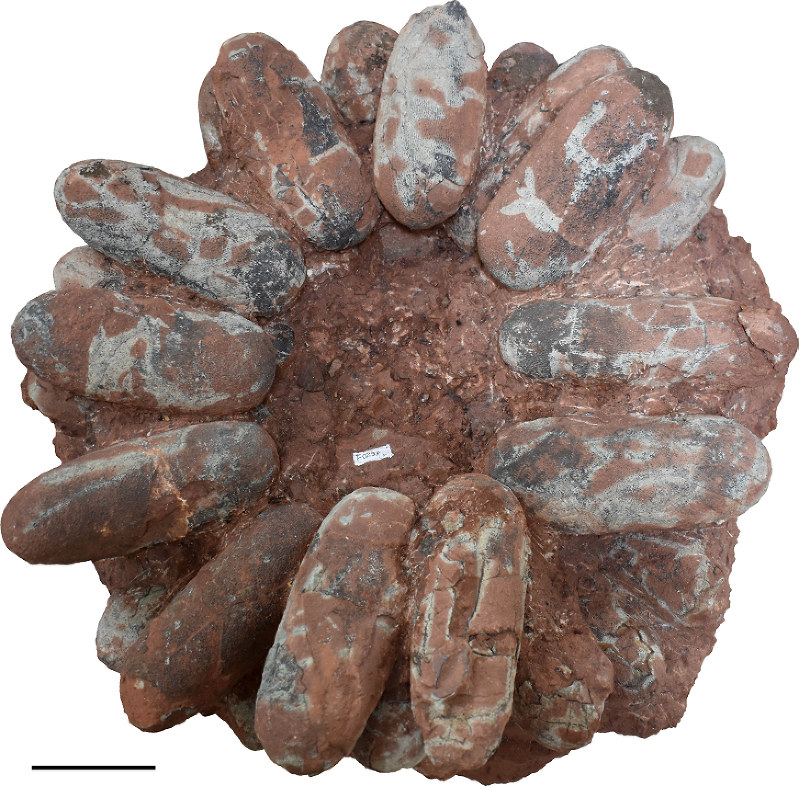
A fossilized nest with eggs of a small type of Oviraptorosauria. (Photo courtesy of Nagoya University)

Large, bird-like dinosaurs weighing up to 2 metric tons possibly made nests and sat on their eggs, specially arranging them so as to avoid crushing the eggshells, an international study by researchers including a scientist from Nagoya University has found. 

The study, published online in the British science journal Biology Letters, focused on Oviraptorosauria, a group of omnivorous, feathered dinosaurs that lived between 66 million and 100 million years ago. Their weights ranged from under 250 kilograms to about 2 tons.

Fossilized nests and eggs found in China showed that the dinosaurs arranged their eggs in the shape of ring. Smaller species placed some 30 eggs in a ring about 60 centimeters in diameter, while larger ones arranged their eggs into a doughnut shape around 2.2 meters in diameter with a central circle about 1 meter in diameter, according to the study.

The team determined that some eggshells had fewer pores -- a feature suggesting that they were exposed in the nest. These characteristics led scientists to conclude that the smaller dinosaurs sat directly on their eggs, while the larger ones sat in the central part of the nest to protect them. Earlier theories suggest that big, heavy dinosaurs avoided sitting on their eggs, so the shells wouldn't be crushed.

Kohei Tanaka, a special researcher at Nagoya University Museum who took part in the study, explained that arranging eggs in a doughnut shape -- a behavior not seen in present-day birds -- was "one of the various breeding tactics employed by the dinosaur."

(Japanese original by Yuka Saito, Science & Environment News Department) 

Source: https://mainichi.jp

Paleontologists Uncover 99-Million-Yr-Outdated Historic Tick, Redefining What We Know About Dinosaurs

Sunday, May 20, 2018

Many individuals are fascinated that dinosaurs truly roamed the earth as much as 100 million years in the past. These creatures had been larger than nearly something that exists immediately, have by no means been seen alive by man, and have given us clues into the prehistory of our very planet and species.

We will thank researchers who commit their lives to this analysis in serving to us paint a clearer image of what truly went on when dinosaurs had been round. A latest discovery is casting perception into the lives of dinosaurs, and those who ate up them…

Groundbreaking Discovery

It’s a discovery that appears straight out of a Jurassic Park film, besides it’s actual. Researchers have efficiently recognized a 99-million-year-old fossilized tick on a dinosaur feather. It’s a brand new discovery that gives us the primary direct proof that animals up to now had been additionally parasitized by creatures corresponding to ticks and lice.

Little Critters

Whereas it sounds reassuring that these bugs didn’t solely wish to suck our blood, however actually, dinosaur’s blood too, we’re curious as to how these ticks had been found. The place did scientists discover the bugs which can be supposedly 99 million years previous?

The place Had been The Ticks Discovered?

Researchers discovered the blood-filled parasites trapped in amber. The specimens embody the oldest dinosaur parasite to be discovered along with stays from its extinct host. This gives us a glimpse into the lengthy historical past between ticks and dinosaurs and their dwelling descendants, birds.

Paleontologist

The examine’s coauthor Ricardo Perez-de la Fuente, a paleontologist on the Oxford College Museum of Pure Historical past mentioned that he was “astonished” by the invention. “It was one thing we weren’t anticipating in any respect.”

The Relationship Between Dinosaurs And Present-Day Birds

Whereas scientists have suspected that the blood-sucking bugs dined on dinosaurs for hundreds of thousands of years, they’re nonetheless feasting on birds to at the present time. It’s been troublesome to ascertain the connection between dinosaurs and birds as a result of discovering the fossils that included ticks and the dinosaurs they lived on had been non-existent.

A Uncommon Discover

That was till now. Perez-de la Fuente says, “Direct proof of an organism and the stays of one other one, the host, is extraordinarily uncommon in paleontology.” So earlier than we clarify extra, I’m positive you’re questioning who found the amber?

The place Was The Amber Discovered?

Personal collectors Scott Anderson and James Zigras bought the items on-line, as Burmese amber is presently offered on-line in mass portions by native merchants. Each males ended up donating their materials to museums and so they bought in contact with researchers specializing within the examine of amber.

Bridging The Hole Between Scientists And Collectors

Perez-de la Fuente says that breaking the wall between collectors and scientists is vital for the development of specimen-based analysis, notably in paleontology. However why is that this discover so notably vital?

Direct Proof

These findings characterize the primary direct proof of a parasite-host relationship between feathered dinosaurs and ticks. Fossil ticks had been discovered beforehand, however by no means in affiliation with stays of their hosts.

Extinct Ticks

Scientists can now describe a brand new, extinct group of ticks primarily based on a number of specimens. A few of these ticks will also be related to feathered hosts and thru the presence of beetle hairs preserved hooked up to their our bodies. However how do these ticks evaluate to the ticks immediately? Do they share any of the identical traits or genetic make-up?

Differentiations

There are two very distinct differentiations between the traditional ticks and ticks immediately. The primary being an immature exhausting tick greedy a feather, which represents proof of ticks parasitizing feathered dinosaurs in mid-Cretaceous.

Extra Proof

The second piece of proof is that 4 of the found ticks are assigned to the brand new species Deinocroton draculi. These ticks are nearer to a single species of tick that solely lives in Southern Africa and never anyplace else on this planet. There are similarities between the ticks however they’re additionally vastly totally different. However what about dinosaur DNA? Might it’s extracted from this tick, like in Jurassic Park?

Extracting DNA

Though Jurassic Park was primarily based on an actual examine that claimed to have extracted DNA from amber, different experiments concluded that the amber pattern was contaminated by trendy DNA. At the moment, the method to extract DNA from amber doesn’t exist, as DNA simply degrades with time.

1993 Jurassic Park

The 1993 movie Jurassic Park featured dinosaurs delivered to life because of a blood-engorged mosquito trapped in amber. Nonetheless, the fact is that DNA has a really brief half-life and this genetic data wouldn’t be recoverable…

Traces Of Blood

The researchers did, nevertheless, search for the chemical signatures of iron in any preserved traces of blood that will have remained, however they didn’t achieve discovering any. Iron can also be frequent in mineral contaminants in these fossils.

DNA Is Tough To Protect

With regards to DNA, Perez-de la Fuente provides that it’s a very fragile molecule and it’s impossible to persist in such historical fossils. He provides that the circumstances of fossilization in amber, corresponding to nice modifications in temperature and excessive dehydration are terrible for the preservation of DNA. However the ticks weren’t the one factor discovered within the amber…

Extra Creepy Crawlers

Together with the ticks, the group discovered microscopic hairs from carpet beetle larvae, creatures that are generally present in birds’ nest immediately. The beetle larvae eat natural materials like hair or pores and skin, that are notably troublesome for them to digest.

Amber’s Particular Options

“A particular characteristic of amber is the power that the resin has to seize small items of the surroundings in an nearly unaltered means,” Perez-de la Fuente. Primarily based on the contents of the amber, the group says that the fossils provide exhausting proof in nesting conduct within the host animals. So what’s subsequent for the scientists?

Hyperlinks Between Different Specimens

Scientists now must work tougher to ascertain the hyperlink between the opposite specimens, recognized as Deinocroton draculi. Many feathered dinosaurs are thought to have constructed nests 100-million-years-ago and the beetle setae provide a clue as to the place the ticks had been getting their meals.

The Significance Of Preserved Specimens

The paleontologist mentioned that it couldn’t have been from the nest of a contemporary chook as a result of the proof signifies that birds emerged a lot later. Total, this discovery reveals simply how a lot data will be gathered from preserved specimens. 

Source: www.standardrepublic.com

LEGO Jurassic World: Fallen Kingdom Dilophosaurus Outpost Attack review

Thursday, May 17, 2018

Poor value for money on the face of it, ingenuity in design rescues 75931 Dilophosaurus Outpost Attack from critical eyes

Price: £44.99 / $39.99 / €49.99 Pieces: 289 Available: Now

If you have not yet worked out that the sets from the LEGO Jurassic World: Fallen Kingdom range have generally higher price-per-piece ratios than almost everything else currently available, then 75931 Dilophosaurus Outpost Attack will surely help your maths. For £44.99, you get 289 pieces and in stark terms that’s not good value for what is already an expensive toy. Certainly, considering the sheer quantity of LEGO you get (or rather, don’t get) for the money, 75931 Dilophosaurus Outpost Attack shouldn’t be a set to truly take into consideration until it hits an inevitable sale. Yet, I am reviewing this set because I felt utterly compelled to purchase it, even at full price and in spite of having already built most of the rest of the LEGO Jurassic World: Fallen Kingdom range. Or perhaps it is because of having built most of the rest of the LEGO Jurassic World: Fallen Kingdom range.

Indeed, where the range of sets released to tie in with the June film offer a plethora of dinosaurs both new and re-coloured in scenarios both new and re-imagined, few have truly captured the simplicity of dinosaurs loose in a park or urban environment running rampage and causing peril for the unfortunates in their way. It’s the set-up that defined Jurassic Park 25 years ago, and what should be driving Jurassic World as a franchise, but isn’t quite working in a number of the LEGO JW:FK sets released this year, and that’s in spite of individual strong points across each set. For one reason or another, releases such as 75929 Carnotaurus Gyrosphere Escape and 75930 Indoraptor Rampage at Lockwood Estate may offer fantastically designed creatures and large scale builds, but, as complete sets they lack true cohesiveness. The Carnotaurus in 75929 doesn’t marry well when put next to the tree and gyrosphere setting or the truck, whilst the Indoraptor and Velociraptor in 75930 will look just as relevant and at home in any Creator house as they do at LEGO Lockwood Estate.

And that’s where 75931 Dilophosaurus Outpost Attack is different, and where, in spite of its high price, it offers something that perhaps arguably only the £10 cheaper 75927 Stygimoloch Breakout can match – a simple yet cohesive play and display scenario. The set-up in 75931 is uncomplicated – three unnamed minifigures are manning a gate whilst also seemingly transporting an un-hatched dinosaur egg (or baby dinosaur, which you can swap in), as a Dilophosaurus is ready – presumably as the set name suggests – to attack. All you get is a fence, but, place the minifigures on one side of it and the Dilophosaurus on the other and the entire scene comes together. It is simple, but also plausible.

What makes this set-up work so well is the clear and clever design of the three-part modular fencing. With acknowledgement to the limited number of pieces available, it is simple to put together. Yet, at the same time, such thought has been put into its design that not only is it surprisingly robust (and ready for a Dilophosaurus attack, actually) but it also brings substantial size and play value into the LEGO Jurassic World: Fallen Kingdom line-up. It’s just a fence, but importantly it’s rather believable in scale, structure and design, particularly when put up against the included dinosaur. It makes for a basis of display and play that not a lot of the other location-based builds in this year’s range nor in the 2015 Jurassic World range can match.

Long flexible tubing makes for an effective main electrical barrier that measures 22 studs long, with three connecting towers that add height and thickness to the construction without compromising scale – it’s not too thin, nor too short. The watchtower is surprisingly brought together by quick details such as the recessed screen on the inside, and a sloped roof at its top, whilst the main gate has a robust nature and ‘built-deep-in-the-mud’ style to it thanks to a nice studs-not-on-top design at its base. Details across the three sub-builds such as the crane, the ladder and the lighting demonstrate how efficient the limited number of bricks included in 75931 Dilophosaurus Outpost Attack have been used.

Whilst the minifigures are notably nameless, they beef up numbers for those looking for more guards, and also offer collectors some very good diversity. Focus, though, is rightly pulled by the eponymous dinosaur included, the Dilophosaurus, which whilst of the same fantastic mould as three years ago, has been coloured as per its Jurassic Park appearance, making for a far more complete and desirable dino design. It’s one of the best in a range packed with new and re-coloured LEGO dinosaurs.

Ultimately, 75931 Dilophosaurus Outpost Attack remains an expensive purchase at £44.99, but, one that thanks to its design offers substantially better value for money than a number of the other sets in the LEGO Jurassic World: Fallen Kingdom line-up. Whether you pick this up at full price or not, this is a must-have set for Jurassic World and LEGO dinosaur fans alike. Be wary in considering waiting for a price reduction in case this proves to be the 75920 Raptor Escape of the 2018 range – in short supply and high demand.

Source: www.brickfanatics.com

10 Fun Facts You Didn’t Know about “The Good Dinosaur”

Thursday, May 17, 2018

The Good Dinosaur seems like a very underrated Disney movie considering that it was so very hyped up when it was about to be released. Truthfully it’s a rather cute movie and despite following the same formulas that get used again and again it was still worth watching. Arlo might not be the most convincing specimen ever rolled out onto the screen but he’s still something special in that he was another shot for Disney to really push the dinosaur epic onto the public yet again. But for all that the movie really didn’t get much play and it kind of came and went without much fanfare.

Not all Disney movies are epic blockbusters, and this proves it.

10. One of the reasons it could have done so poorly was that it followed Inside Out.

Inside Out was a big hit with kids and with two Pixar titles coming out in the same year it could have been that there was no energy left over for this film.

9. There were a lot of production issues that held it back for a while.

Creative differences and other such problems were what held this movie from coming out sooner or being finished on time. These problems could have been why it wasn’t seen to be as good as it could have been.

8. Arlo’s movements were based on those of young elephants.

If you take the images side by side you can see the same gait and the rolling movements of their shoulders.

7. Arlo was originally supposed to be older.

He was supposed to be in his teens but the idea of him and Spot both being younger gave rise to the idea that it would be a better story if they were both learning how to survive.

6. This was the lowest grossing Pixar movie worldwide.

Such a thing doesn’t happen very often since Pixar movies are known for pulling in crowds. This just didn’t have the same kind of attraction that’s been so prevalent in other films.

5. This is Pixar’s sixteenth feature film.

You can assume that it’s one they might like to forget simply because it didn’t pull in the numbers they wanted, but since going to the shelves it’s been a little more popular.

4. There are plenty of Easter eggs in this movie.

Pixar and Disney love to plant Easter eggs in their movies and there are plenty of them. At one point when Arlo and Spot are hallucinating you can see the ball from Toy Story, and there’s one moment when you can see something in the water that looks like Hank from Finding Dory.

3. This is one of the dinosaur movies in which the T. rex is not the villain.

It’s not too often that you see an apex predator being a good guy, but it’s been done before with other vicious hunters such as the sharks in Finding Nemo.

2. The hallucinating scene is the first since Dumbo.

And if you can recall, Dumbo and Timothy were drunk when they hallucinated. This is slightly better since Arlo and Spot ate fermented peaches.

1. There’s some connection between Arlo and Littlefoot from The Land Before Time.

Both are given great responsibilities, both have wise parents, and both take on predators that are much stronger than them and somehow succeed.

It was a cute movie to be honest.

Source: www.tvovermind.com

It Takes Time, Patience to Work With Dinosaur Bones, Olathe North Students Find

Thursday, May 17, 2018

Geoscience Academy teacher Staci Winsor shows a reconstructed dinosaur bone worked on by Olathe students. Beth Lipoff Special to The Star

They’re not recreating Jurassic Park, but students at Olathe North High School are getting some hands-on time with real dinosaur bones and other fossils. As part of the school’s Geoscience Academy, students learn to identify, clean and reassemble various fossils and dinosaur bones.

It all started about 15 years ago when paleontologist and Olathe High School grad Craig Sundell donated a triceratops skeleton to the school, which is now Olathe North, with the idea that middle and high school students could learn how to clean and prepare it for display.

Now, they’re hard at work on a hadrosaur. Alan Detrich, a friend of Sundell, found the hadrosaur bones found in Montana and has loaned them to the school for students to work on them.

“If you go too fast, you’ll break part of the shell or any fossil. It’s all patience. That’s most of what you need,” said 15-year-old Quinton Mindrup.

That applies to other fossils, as well, like the 31-million-year-old tortoise shell they’re also cleaning. The students use tools such as air scribes and micro jacks, which have fine points to work on the delicate subjects.

They examine the color, how the surface absorbs water and other factors to tell the rock from the bone as they uncover pieces.

For the first two years, students in the Geoscience Academy do basic classes, then in the third year, they get to choose either the hydro track, studying water-related science, or the litho track studying rocks and paleontology.

Though he hasn’t taken the litho class yet, Quinton came in after school to learn some of the basics of working with fossils and using the machines from Sundell, who occasionally comes in to work with the students.

“If we can maintain as much of the structure of the bone as (possible), we can actually make guesses and figure out things about what happened,” said 16-year-old Nathan Hurst. “We know the shell’s been bitten, because we can see it on there. We know it was a herd of hadrosaurs that all died together in a flood event. That’s what we can figure out by knowing the shape of the bones and the dirt that they died in.”

It takes a lot of hard work, and it’s not always fun. As they uncover the different bones from the plaster cast that was made in the field, the students make detailed diagrams of the position of each bone relative to the others.

“No one wanted to do it, but we knew it had to happen,” said Weston Shane, 17.

Quinton Mindrup, 15, demonstrates how the students at Olathe North's Geoscience Academy are using tools to clean a 31-million-year-old tortoise shell. Beth Lipoff

They also use a polyvinyl acetate solution called Vinac to help strengthen the fossils so they’re less likely to fall apart.

It’s very unusual for students so young to get the opportunity for hands-on work like this.

It’s not just the Geoscience Academy students who benefit from the program. Groups of elementary students come in on a regular basis to see the fossils and learn about the process. Several of the high school students currently in the program were inspired to be part of it by going on one of these field trips.

Students in the program get to take their own field trips. Every two years, the group heads to do geological field studies and to see fossil-finding firsthand. Last summer, they went to Wyoming, and in 2015, they were in Texas.

A few of the students hope to go on to careers in paleontology, and others plan on going into related fields, such as geology.

Source: www.kansascity.com

Paleoartist Gives Toronto Raptors Logo a Strange Yet Accurate Redesign

Thursday, May 17, 2018

Accurate Toronto Raptors Logo

The Toronto Raptors have only one thing in common with the velociraptors that reigned over Earth between 100.5 to 66 million years ago: Both of them were met with a swift demise at the hands of forces greater than their own. But just because the Cleveland Cavaliers swept Toronto much like a cataclysmic force decimated our prehistoric friends doesn’t mean the team’s semi-menacing dinosaur logo should be equated with the real thing.

Paleoartist and “Torontoish” dinosaur enthusiast, Hannah Moss, took to Twitter on Saturday to ensure all Toronto Raptors and Jurassic Park fans know what an actual velociraptor is supposed to look like: ferocious and feathery.

“There are two big inaccuracies that appear in the logo, and they’re really the two main mistakes you see in most drawings of dinosaurs,” Moss tells Inverse. “One, there aren’t any feathers. Two, the hands and wrists are facing the wrong direction. It is now widely accepted within the paleontology community that raptors had feathers on their arms and tails due to the presence of ‘quill knobs’ found in fossilized bones.”

In her redesign, Moss recreated Velociraptor mongoliensis, the quintessential raptor you see in all the Jurassic Park flicks. While Hollywood might depict our ancient friends as scaly, reptile-like creatures, paleontologists have long established that these dinos — the evolutionary predecessors of modern-day birds — most definitely had feathers.

A 2007 discovery published in the journal Science was the first time researchers found quill knobs in velociraptor fossils. Since then, there have been multiple discoveries of dinosaurs feathers completely encased in amber, so at least Jurassic Park got that right.


Sadly, there’s no evidence suggesting that velociraptors used their flashy feathers to fly, an ability that the team might have found useful in its battle with Lebron James. Air travel was left to pterodactyls; nevertheless, raptor plumage was for much more than just show.

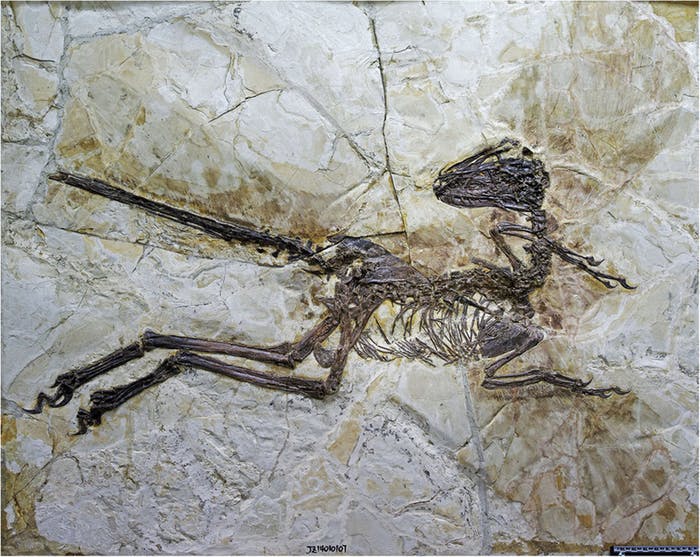
A fossil of a Zhenyuanlong, a genus of dromaeosaurid dinosaur from the Yixian Formation of Liaoning, China. This specimen provides the first evidence of well-developed pennaceous feathers in a large, non-flying dromaeosaur, raising the question of what function such wings would serve.

“The quill knobs found on arm and tail bones, along with fossils bearing the imprints of actual feathers, hint at how these feathers were arranged,” says Moss. “As for their purpose, a coat of feathers all over the body likely served as insulation. Long wing feathers would help aid balance, as would long tail feathers, although it’s also not unlikely that raptors, like modern birds, used their feathers in mating or threat displays.”


Moss curates and showcases other Paleoartists’ work on her other Twitter account, Unique Paleoart. By sharing and drawing her own dinosaur recreations, she hopes to educate the public about what dinosaurs actually might have looked like, based on recent studies.

Live reconstruction of Deinonychus in the Natural History Museum Vienna by Stephen Czerkas.

“Soft tissues and feathers often don’t fossilize, so it’s likely that dinosaurs were a lot chubbier and fluffier than most people think,” she says. “The general public might not be too eager to read through pages and pages of reports on the most recent dinosaur fossil discoveries, but paleoartists will and translate that knowledge into artwork, an instantly understandable medium.”

So, raptors might have actually had thicc bods like Barney the Dinosaur. Time to rework that chiseled logo, Toronto.

Source: www.inverse.com

Pages