nandi's blog

Acantholipan gonzalezi: The Oldest Dinosaur Has Been Discovered in Mexico

Thursday, June 14, 2018

Acantholipan gonzalezi

Acantholipan is a genus of Late Cretaceous herbivorous nodosaurid dinosaur from Mexico. It includes one species, Acantholipan gonzalezi.

A new species of dinosaur has been discovered in Mexico by palaeontologists at the acclaimed Desert Museum.

The creature lived 85 million years ago, making it the oldest dinosaur to have inhabited the region.

The Acantholipan gonzalezi was found in the Ocampo region of Coahuila and is native to the country's northern desert region.

It seems to be a juvenile because of its measurements.

It's 3.5 metres long and weighs more than half a ton.

A replica of the prehistoric animal is on display at the museum which also features the most important collection of dinosaur bones, including the one we all know, the Tyrannosaurus rex.

The First Teeth of Mammoths Were Found in Iran

Thursday, June 14, 2018

The fossilized teeth of the elephant family that lived about 2 million years ago and were found in Iran. A rare find, made in the province of Ardabil in the northwest of the Islamic Republic.

According to Zahra Orak, head of the paleontology department of the Bureau of Natural Sciences and Genetic Resources of the country, the remains of animals that date back to the early Quaternary period (anthropogen) are unique not only because they are well preserved and almost not damaged, but also because they are the first finds of this kind in the territory of modern Iran.

“Previously, such people were not found here,” she said, “one of the fossils belongs to a male, the second to a female of bald mammoths.”

According to the expert, on the basis of the size of the teeth, it is possible to say with a high degree of probability that the individuals were adults. “One of them resembles the teeth of Indian elephants, which probably inhabited Iran about 2 million years ago,” said Orak.

Source: http://earth-chronicles.com

Meet Jason, the Tiny Beetle Stuck in Amber for 99 Million Years

Tuesday, June 12, 2018

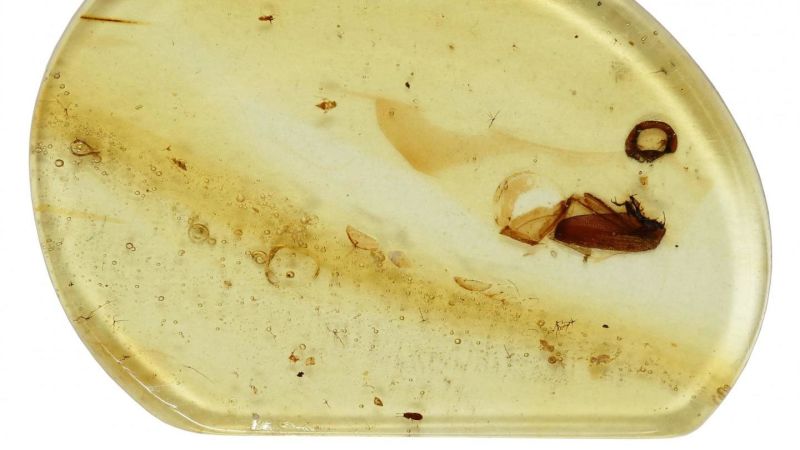
No, not that big, unidentified insect at right; Jason is the teeny beetle at the very bottom. Photo: Shuhei Yamamoto, Field Museum

Featherwing beetles are some of the smallest insects out there—and one researcher managed to spot an ancient specimen in a 99-million-year-old chunk of amber. Just half a millimeter long, this Cretaceous period beetle had its signature fringed wings unfurled when it met its sticky demise.

“These beetles lived in the Cretaceous, so they lived with dinosaurs,” said Shuhei Yamamoto, an entomologist at the Field Museum of Natural History in Chicago, who discovered the beetle. Featherwing beetles don’t flap their wings, but instead use them to glide through the air like a dandelion wisp. Yamamoto told Gizmodo that this beetle was probably gliding when it got caught in some tree sap, where it has remained for millions of years.

The researchers decided to name the little guy Jason, a reference to the ancient Greek hero who sailed around the world looking for the Golden Fleece. The beetle’s official species name is Kekveus jason, as described in a study published last month in the journal Cretaceous Research.

Yamamoto initially wasn’t sure if Jason was an insect or just a bit of dust, but after much cutting, polishing, zooming, and photographing, he could confirm that the speck was indeed a tiny, prehistoric beetle. “It took us more than two years to get the photos we used in the paper,” he said.

“It is very hard to spot tiny things in amber,” said Paul Selden, a paleontologist and arachnologist at the University of Kansas who was not involved with the new study. “However, when you get a polished piece under the microscope, and can spend a lot of time searching it, then all kinds of interesting things emerge. It is time-consuming, but well worth it.”

Jason, whose amber coffin was found in Hukawng Valley in northern Myanmar, is now the oldest known member of the featherwing beetle lineage. Today, you can see featherwing beetles—or maybe not, because they’re so teeny—sailing airspaces all over the world, mostly in temperate and tropical regions. The fact that Jason has many of the same features as today’s featherwing beetles is important, Yamamoto said; it shows the species evolved its gliding ability and tiny stature earlier than entomologists had thought.

This latest amber discovery is one of many in the past year or two. A team including Selden found a spider with a tail in amber earlier this year, and others have found ticks wrapped in spider silk and a bug with bizarre googly-eyes. And there should be many more such discoveries to come—Yamamoto said he is currently working on 30 different projects involving insects trapped in amber.

[Cretaceous Research]

Source: https://gizmodo.com

Brasilestes stardusti: Researchers Discover Oldest Mammal in Brazil That Coexisted with Dinosaurs

Tuesday, June 12, 2018

Brasilestes stardusti existed more than 70 million years ago in what is now São Paulo State. Its description, based on a fossilized tooth, has been published in Royal Society Open Science. Photo: Mariela Castro

Brasilestes stardusti is the name given to the oldest known mammal found in Brazil. It lived in what is now the northwest of São Paulo State at the end of the Mesozoic Era between 87 million and 70 million years ago. It is the only Brazilian mammal known to have coexisted with the dinosaurs.

The discovery of Brasilestes was announced on May 30, 2018, by a team led by Max Langer, a professor at the University of São Paulo's Ribeirão Preto School of Philosophy, Science & Letters (FFCLRP-USP). Langer's team included colleagues at the Federal University of Goiás and the University of Campinas in Brazil, La Plata Museum in Argentina, and the Massachusetts Institute of Technology (MIT) in the US.

Physically speaking, Brasilestes consists of a fossilized premolar tooth with a maximum crown length of 3.5 mm. "The tooth is small and incomplete: the roots are missing," said paleontologist Mariela Cordeiro de Castro, first author of the paper recently published in Royal Society Open Science.

"Small but not tiny," Castro continued. "Although it's only 3.5 mm, the Brasilestes tooth is three times bigger than all known Mesozoic mammal teeth. In the age of the dinosaurs, most mammals were the size of mice. Brasilestes was far larger, about the size of an opossum."

The name of the new species pays tribute to British rock star David Bowie, who died in January 2016, a month after the fossil was found. Brasilestes stardusti alludes to Ziggy Stardust, an extraterrestrial character created by Bowie for a 1972 album.

The research was supported by the São Paulo Research Foundation -- FAPESP as part of the thematic project "The origin and rise of dinosaurs in Gondwana (late Triassic-early Jurassic)" , for which Langer is principal investigator.

The fossilized tooth was found in a rocky outcrop of the Adamantina Formation in General Salgado, São Paulo State. The rocks are in a field on a ranch called Fazenda Buriti.

"We were visiting Mesozoic outcrops when Júlio Marsola [another member of the team], keen-sighted as a lynx, spotted a small tooth sticking up out of a rock," said Castro, a professor at the Federal University of Goiás (UFG).

"The General Salgado deposits are well-known. Several Mesozoic crocodiles have come from them. The particular outcrop where I found Brasilestes is interesting, with dozens of fragments of Mesozoic crocodile eggshells. I bent down to look more closely at a small part of the outcrop to see if there were any eggshells and spotted the tooth. If it had stayed out in the open like that for a few more days, the rain would have swept it away.

"When I noticed what appeared to resemble the base of the tooth's two roots [the roots themselves have broken off], I thought it must be a mammal. Laboratory analysis gave us the certainty that it is indeed from a mammal."

A placental mammal in the Botucatu Desert

While a mere 3.5 mm tooth, especially an incomplete one, may seem insufficient to describe a new species of mammal, in actual, fact extinct mammals are frequently described on the basis of a single fossilized tooth.

This is because teeth are the most durable part of the mammalian skeleton. After all, they have to withstand the wear and tear of chewing for an entire lifetime. In contrast, many fish species and reptiles, for example, grow new teeth continually throughout their lives. Indeed, mammalian teeth are often the only skeletal remains that stay intact long enough to become fossilized.

The fact that a single premolar is all that is left of Brasilestes and that it is incomplete prevented the researchers from distinguishing with absolute confidence the group of mammals to which the species belonged. They know the tooth belonged to a therian, a member of a large subclass of Mammalia that includes marsupials and placentals.

Although there is not enough evidence to support the inclusion of Brasilestes in either infraclass, the researchers believe (but cannot categorically conclude) it was a placental mammal. If so, the fossil is unique.

Today, there are three major groups of mammals, namely, placentals, marsupials and monotremes. All three evolved during the Mesozoic Era. At that time, however, they were by no means the only groups of mammals. There were also multituberculates, which were common in the northern hemisphere, as well as groups typical of the southern hemisphere such as meridiolestids and gondwanatherians -- named for Gondwana, the ancient southern supercontinent that gave rise to Africa, South America, Australia, Antarctica, and India.

The first Mesozoic mammal fossils were found in Argentinian Patagonia in the early 1980s, and some 30 species are now known. Until the Brasilestes announcement, these were the only ones found in South America. None remotely resembles the little tooth found in Brazil.

"When I showed the Brasilestes fossil to Edgardo Ortiz-Jaureguizar, a paleontologist at La Plata Museum, he was very surprised. He said he'd never seen anything like it, and at once showed it to another specialist at the same institution, Francisco Goin, who had the same reaction. Goin said Brasilestes resembled no other Mesozoic mammal found in Argentina, hence in South America," Castro recalled.

Among the 30-odd Argentinian species of Mesozoic mammals, there are meridiolestids, gondwanatherians, and even a few suspected multituberculates. There are no marsupials or placentals. The only fossils in these two groups found in South America date from after the mass extinction that wiped out the dinosaurs 66 million years ago in an event that marks the end of the Mesozoic and the onset of the current geological era, the Cenozoic.

Until the discovery of Brasilestes, the only traces of Mesozoic mammals in Brazil were hundreds of tracks and footprints left by unknown creatures 130 million years ago as they traversed the dunes of the Botucatu Desert in what is now São Paulo State. The solidified surface of those dunes has been preserved as sandstone slabs on which the footprints can be seen.

In 1993, Reinaldo José Bertini , a professor at São Paulo State University (UNESP) in Rio Claro, announced the discovery of a mammalian jawbone fragment with a single tooth far smaller than the Brasilestes premolar. However, Bertini did not publish a detailed study of the fossil and therefore could not name a new species.

"Brasilestes is not just the first Brazilian Mesozoic mammal to be described but also one of the few Mesozoic mammals found in more central regions of South America. The Argentinian fossils were found in geological formations in Patagonia, the southern tip of the continent," Langer said.

"Furthermore, Brasilestes is different from everything found before, suggesting that possibly placental mammals inhabited South America between 87.8 million and 70 million years ago," said the FAPESP thematic project coordinator.

New species possibly related to a mammal from India

Even more surprisingly, the Mesozoic mammal with premolars that most resemble the Brasilestes tooth lived on the other side of the world, in India, between 70 million and 66 million years ago. Its name is Deccanolestes. No other creature in the global fossil record is so similar to Brasilestes.

How could two members of the same lineage have lived so far apart in unconnected regions? Approximately 100 million years ago, when South America and Africa had only just been separated by the opening of the South Atlantic, India was breaking away from Gondwana and starting to wander through the Indian Ocean.

This implies that at least 100 million years ago, the ancestors of Brasilestes and Deccanolestes populated the Gondwana supercontinent. In other words, the lineage to which Brasilestes and Deccanolestes belong is far older than the ages of their fossils -- between 87 million and 70 million years ago for Brasilestes, and between 70 million and 66 million for Deccanolestes.

"The discovery of Brasilestes raises many more questions than answers about the biogeography of South American Mesozoic mammals," Langer said. "Thanks to Brasilestes, we've realized that the history of Gondwana's mammals is more complex than we thought."

Finding triggers speculation on xenarthrans' origins

This could give rise to new hypotheses and new lines of investigation. Who knows, for example, whether future research inspired by the discovery of Brasilestes will reveal the origin of a typical South American group, the xenarthrans, the order of armadillos, anteaters and sloths? Castro's main research interest, in fact, is the evolutionary history of the xenarthrans.

"An interesting feature of the Brasilestes premolar is its superthin enamel, which is only 20 micrometers thick. The Brasilestes enamel is the thinnest of any Cretaceous mammal in the fossil record. Most Mesozoic mammals have enamel in the range of 100 to 300 micrometers," Castro said.

"Tens of known species of xenarthrans are alive now. Hundreds are extinct. Only three have enamel. The microstructure of Brasilestes' premolar enamel is very similar to that of the nine-banded armadillo," said the FAPESP-supported researcher.

According to Castro, "molecular clock evidence suggests the xenarthran lineage started at least 85 million years ago. However, the oldest armadillo fossils, found in Rio de Janeiro, are about 50 million years old."

While it is intriguing to imagine Brasilestes as an ancient xenarthran, it is far too soon for any such affirmation.

"The age and provenance of Brasilestes do match molecular hypotheses for the origin of the xenarthrans, but it would be premature to infer taxonomic affinity in light of the morphological differences between the Brasilestes tooth and armadillo teeth," Castro said.

Langer agreed. "We have only one Brasilestes fossil. That's nowhere near enough to extract conclusions from the fossil record," he said.

The fact that no Mesozoic mammal fossils were found in Brazil before Brasilestes could mean such fossils are rare or too fragile to be preserved. "Who knows, one day we may find new Brasilestes fossils that help us understand its history better. It could take decades," Langer said.


Story Source:

Materials provided by Fundação de Amparo à Pesquisa do Estado de São PauloNote: Content may be edited for style and length.


Journal Reference:

  1. Mariela C. Castro, Francisco J. Goin, Edgardo Ortiz-Jaureguizar, E. Carolina Vieytes, Kaori Tsukui, Jahandar Ramezani, Alessandro Batezelli, Júlio C. A. Marsola, Max C. Langer. A Late Cretaceous mammal from Brazil and the first radioisotopic age for the Bauru GroupRoyal Society Open Science, 2018; 5 (5): 180482 DOI: 10.1098/rsos.180482

Source: www.sciencedaily.com

Stratigraphy: The Study of Rocks And Their Location Relative To Each Other

Tuesday, June 12, 2018

Types of Unconformities

Stratigraphy (noun, “Strah-TIG-grah-fee”)

This is a branch of geology that focuses on geological strata, or rock layers. The ground beneath your feet is not one solid mass. It has layers, like the layers of an onion, on its outer crust. These layers build up over time. Dust settles, and organisms die and turn to mud. That dust, mud and other material eventually turns into rock. The composition of that rock is different depending on what has gone into making it.

Scientists study how these layers were made and how they are organized. That’s because stratigraphy can hint at Earth’s past. For example, studying layers of rock can show when an area changed from a sandy seabed to a muddy swamp. Examining the fossils in the rock layers can show what kinds of ancient creatures lived together at the same time. Rock layers can even provide clues about dramatic events — like the asteroid that helped to wipe out the dinosaurs.

In a sentence

Some scientists who study stratigraphy think that people have altered the Earth’s layers enough that it might be a sign of a new unit of geologic time — the Anthropocene.

Anthropocene: Term coined by scientists to describe the age in which humans have been the strongest force of change on the planet. It is generally believed to date from at least the dawn of the Nuclear Age (in the middle 1940s), and possibly even earlier — from the beginning of the Industrial Revolution in the early 1800s.

asteroid: A rocky object in orbit around the sun. Most asteroids orbit in a region that falls between the orbits of Mars and Jupiter. Astronomers refer to this region as the asteroid belt.

crust: (in geology) Earth’s outermost surface, usually made from dense, solid rock.

dinosaur: A term that means terrible lizard. These ancient reptiles lived from about 250 million years ago to roughly 65 million years ago. All descended from egg-laying reptiles known as archosaurs. Their descendants eventually split into two lines. For many decades, they have been distinguished by their hips. The lizard-hipped line are believed to have led to the saurichians, such as two-footed theropods like T. rex and the lumbering four-footed Apatosaurus (once known as brontosaurus). A second line of so-called bird-hipped, or ornithischian dinosaurs, appears to have led to a widely differing group of animals that included the stegosaurs and duckbilled dinosaurs. But a new 2017 analysis now calls into question that characterization of relatedness based on hip shape.

fossil: Any preserved remains or traces of ancient life. There are many different types of fossils: The bones and other body parts of dinosaurs are called “body fossils.” Things like footprints are called “trace fossils.” Even specimens of dinosaur poop are fossils. The process of forming fossils is called fossilization.

geologic: An adjective that refers to things that are related to Earth’s physical structure and substance, its history and the processes that act on it. People who work in this field are known as geologists.

geological: Adjective to describe things related to Earth’s physical structure and substance, its history and the processes that act on it. People who work in this field are known as geologists.

geology: The study of Earth’s physical structure and substance, its history and the processes that act on it. People who work in this field are known as geologists. Planetary geology is the science of studying the same things about other planets.

organism: Any living thing, from elephants and plants to bacteria and other types of single-celled life.

solid: Firm and stable in shape; not liquid or gaseous.

strata: (singular: stratum) Layers, usually of rock or earthen materials, whose structure tends to vary little. It is usually different from layers above and was produced at a different period of time using different ingredients.

stratigraphy: The study of geological strata — how they were made and what they were made from, their arrangement in the ground and what it tells scientists about the conditions on Earth when these layers were created.

Source: www.sciencenewsforstudents.org

Prehistoric Rhinos, Horses Unearthed at Greek Paleontology Site

Monday, June 11, 2018

Palaeontologists during excavation works on archaeological site at a river bed in Pikermi, Attica, Greece, June 4, 2018. EPA-EFE/ORESTIS PANAGIOTOU

PIKERMI, Greece – Paleontologists slowly peeling back the earth from a dry river bed to the east of Athens have discovered the remains of prehistoric mammals that once roamed the region some 7.2 million years ago.

The excavations in Pikermi, some 26.5 kilometers (16.5 miles) outside the Greek capital, are overseen by Professor Giorgios Theodorou, from the University of Athens, in collaboration with the local municipality.

The fossil-rich site is located on the shores of an ancient lake that existed during the Neogean Miocene period, an era when the distant ancestors of today’s mammals grazed at the water’s edge.

Paleontologists have uncovered a number of bones belonging to prehistoric horses, rhinoceroses, gazelles and extinct members of the elephant family.

Source: www.news4europe.eu

South African Fossils Rewrite Early History of Life on Land

Saturday, June 9, 2018

Fish fossils from the Devonian Period at the Canowindra Museum, NSW.  Photo: Ben Rushton

Fossils of two amphibians that lived within the Antarctic circle 360 million years ago are forcing scientists to rethink the origins of land vertebrates, including where these pioneers first appeared and the climatic conditions that spawned them.

Scientists say they have unearthed partial remains of primitive Devonian Period amphibians named Tutusius umlambo and Umzantsia amazana at a site called Waterloo Farm near Grahamstown, South Africa.

While the fossils are fragmentary, the researchers said Tutusius and Umzantsia most likely shared the four-legged, alligator-crossed-with-a-fish body plan of the earliest amphibians, eating small fish while in the water and perhaps small invertebrates while on land.

Umzantsia was about 70 centimetres long, with a long, slender lower jaw, apparently armed with small pointed teeth. Tutusius, known from a single shoulder girdle bone, was about a metre long. It was named in honour of South African Anglican cleric and human rights activist Desmond Tutu.

They were among the early wave of tetrapods, a group including all land-living vertebrates. The first tetrapods evolved from fish during the Devonian. Until now, it had been thought that this evolution revolution occurred in warm climes because the fossils of all the earliest-known amphibians, as well as their fish forerunners, had been found in places that were tropical or subtropical at the time.

Africa during the Devonian was part of a super-continent called Gondwana that also encompassed South America, India, Australia and Antarctica. The Waterloo Farm site was within the Arctic circle.

"So we now know that tetrapods, by the end of the Devonian, lived all over the world, from the tropics to the Antarctic circle," said paleontologist Robert Gess, based at the Albany Museum in Grahamstown as part of the South African Centre of Excellence in Palaeosciences, centered at the University of the Witwatersrand.

"So it's possible that they originated anywhere and that they could have moved onto land anywhere. It really broadens the scope of possibilities," Gess added.

The Waterloo Farm site was a river-mouth environment, a tidal estuary opening onto the sea, and likely had a cold climate akin to northern Norway's Atlantic coast, said paleontologist Per Ahlberg of the University of Uppsala in Sweden.

"There would certainly have been several months of winter darkness, as well as midnight sun in the summer," Ahlberg said, adding that it probably snowed in winter.

The research was published in the journal Science on Friday.

Source: www.smh.com.au

Paleontologists Discover ‘Monstrous’ Sabre-Toothed Fossils from Russia: The Early Evolution of Mammals

Sunday, June 10, 2018

Paleontologists have analyzed two fossils that have been found in Russia, discovering two new species of predatory creatures that had giant sabre teeth.

These animals are prehistoric, belonging to a group called therapsids or “protomammals.” They lived 250 million years ago, long before the first dinosaurs.

The protomammals are the ancestors of modern mammals, but they were wiped almost entirely at the end of the Permian era when the age of dinosaurs started.

Until now, fossils like these have only been found in Africa, so finding them in Russia is the first discovery of its kind, adding a new piece to the puzzle of the mammals’ family tree.

Gorynychus and Nochnitsa – the Ancient Monsters in Russian Folklore

Having a monstrous” appearance, the species were called after creatures from Russian folklore. One of them has been named after Zmey Gorynych – a three-headed dragon: Gorynychus, and the second one has been named after a night hag, an evil spirit of the night: Nochnitsa.

Gorynychus had the size of a wolf a belongs to a subgroup of protomammals – the therocephalians (“beast heads”), and the Nochnitsa was a small animal, a gorgonopsian (a group named after a Greek mythological monster).

The fossils were discovered on a site close to the town of Kotelnich in western Russia after Vyatka Paleontological Museum sent expeditions. Christian Kammerer (North Carolina Museum of Natural Sciences) said that Kotelnich is a good site where you can find “therapsid fossils – not only because they are amazingly complete and well-preserved there, but also because they provide an all-too-rare window into mammal ancestry in the Northern Hemisphere during the Permian.”

Before gorgonopsians went extinct in the mid-Permian era, they were giant predators. Therocephalians were smaller, but the roles reversed later. Dr. Kammerer explains that “there was a complete flip-flop in what roles these carnivores were playing in their ecosystems — as if bears suddenly became weasel-sized and weasels became bear-sized in their place.”

Looking at the findings in the Russian site, they could see that Gorynychus was a large predator.

A study with the description of the fossils was published in the journal PeerJ.

Why Scientists are Upset About a Dinosaur Fossil’s Sale — and $2.4 Million Price Tag

Friday, June 8, 2018

A skeleton of an unknown carnivorous dinosaur discovered in Wyoming in 2013 is on display at the first floor of the Eiffel Tower in Paris on June 2, 2018. (Stephane de Sakutin /AFP/Getty Images)


Five years after it was discovered in Wyoming, the bones of the creature - it still has no name - have been sold at auction to a private art collector for $2.36 million on Monday, exhuming a debate that is at once economic, political and ethical.

By the time the scientists had catalogued the last bone, they realized they might be staring at the discovery of a lifetime - the 70 percent intact fossil of a carnivorous creature as long as a telephone pole that may represent a new kind of dinosaur.

But that is not all that they unearthed.

Five years after it was discovered in Wyoming, the bones of the creature - it still has no name - have been sold at auction to a private art collector for $2.36 million on Monday, exhuming a debate that is at once economic, political and ethical.

Should the fate of a 150-million-year-old fossil lie in the hands of one deep-pocketed person who happens to be the highest bidder? Or should it be controlled by a museum or another authority who can ensure that it can be studied by scientists and preserved for posterity?

"An auction is a device to get the highest possible price out of something," P. David Polly, the president of the Society of Vertebrate Paleontology and a professor of sedimentary geology at Indiana University, told Live Science. "And, generally speaking, even big museums don't have budgets for purchasing specimens."

The dinosaur in question was dug up between 2013 and 2015 and may be a relative of the Allosaurus, a Jurassic-era biped that was among the earliest and most widely studied dinosaur discoveries, according to Live Science.

Eric Mickeler, who works for the Aguttes auction house that organized the bidding battle, told Agence France-Presse that the dinosaur is "the only one of its species" that has been discovered.

Eric Geneste, a dinosaur expert, told the news organization that scientists can't classify the dino as an allosaurus yet. The number of teeth don't match up, and the new dinosaur has longer shoulder blades.

"In fact, there are as many differences between it and an allosaurus as between a human and a gorilla," he added.

Obviously, the Wyoming fossil needs additional study, scientists say. But paleontologists worry they may never get a close enough look at it - because the fossil belongs to a private buyer, not a person or an organization bound by the mores and rules of the greater scientific community.

A few weeks ago, the Society of Vertebrate Paleontology, which represents more than 2,000 students and professionals, asked the auction house to scuttle the sale.

"Scientifically important vertebrate fossils are part of our collective natural heritage and deserve to be held in public trust," the society said in an open letter.

"Fossil specimens that are sold into private hands are lost to science. Even if made accessible to scientists, information contained within privately owned specimens cannot be included in the scientific literature because the availability of the fossil material to other scientists cannot be guaranteed, and therefore verification of scientific claims (the essence of scientific progress) cannot be performed."

The person who bought the dinosaur doesn't exactly plan to make it the centerpiece of a fountain in his French villa, auctioneers said. The buyer, identified only as a British businessman, has pledged to lend it to a museum and said that it will be made available to scientists.

"Everyone will be able to see it, it will soon be lent to a museum, it will be studied by scientists, everything is perfect," auctioneer Claude Aguttes told Reuters.

But the buyer has remained at least publicly silent on another issue that is vexing scientists: If it is a new species, who gets to name it?

Naming new species "is governed by the International Code of Nomenclature, which award priority to the first validly published name, not to the owner of the specimen that formed the basis of that name," the society said.

Still, it's unclear whether the owner was influenced by the near-promise made on page 51 of the auction brochure.

"The buyer will be acquiring the skeleton of a dinosaur which could be named after them or after one of their children, with the agreement of the scientist who formally describes the species," the auction brochure states. "One's name would thus remain forever linked to a significant cultural and scientific event."


Source: www.ndtv.com

Paleontologists Find Oldest Animal Footprints Ever Discovered

Wednesday, June 13, 2018

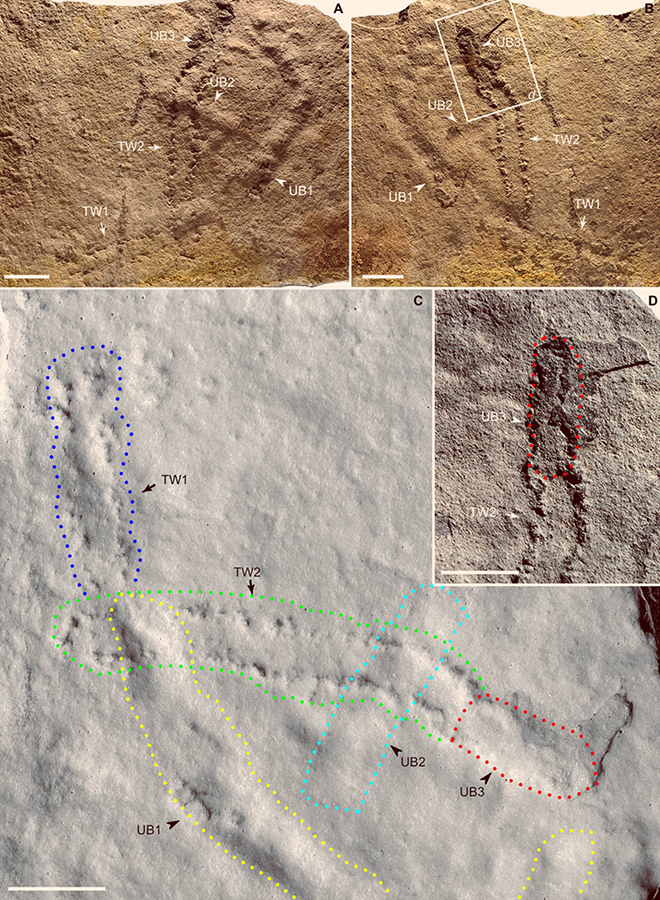
Trackways and burrows excavated in situ from the Shibantan Member, Dengying Formation, China: (A and B) epirelief (top bedding surface) and hyporelief (bottom bedding surface), respectively; trackways (TW1 and TW2) and undermat burrows (UB1 to UB3) are labeled; (C) latex mold of (B), with trackways and burrows marked and labeled; (D) enlargement of rectangle in (B), showing connection between TW2 and UB3 (marked). Scale bars – 2 cm. Image credit: Chen et al, doi: 10.1126/sciadv.aao6691.

The oldest known animal ‘footprints’ on Earth, left by bilaterian animals with paired appendages about 545 million years ago, have been discovered in the Yangtze Gorges area of South China.

Bilaterian animals, such as arthropods and annelids, have paired appendages, and are among the most diverse animals today and in the geological past,” said co-lead author Dr. Zhe Chen from the Nanjing Institute of Geology and Palaeontology and colleagues.

“They are often assumed to have appeared and radiated suddenly during the ‘Cambrian explosion,’ about 541-510 million years ago, although it has long been suspected that their evolutionary ancestry was rooted in the Ediacaran period (635-541 million years ago).”

“Until our discovery, however, no fossil record of animal appendages had been found in the Ediacaran.”

Dr. Chen and co-authors studied trace fossils from the Ediacaran Shibantan Member (551-541 million years old) of the Dengying Formation in the Yangtze Gorges area, China.

These trace fossils include burrows and trackways that are preserved in close proximity and are apparently connected.

The trackways are somewhat irregular, consisting of two rows of imprints that are arranged in series or repeated groups.

They were probably made by millimeter-sized bilaterian animals with paired appendages that raised the animal body above the water-sediment interface.

“These trace fossils represent some of the earliest known evidence for animal appendages and extend the earliest trace fossil record of animals with appendages from the Early Cambrian to the Late Ediacaran period,” the paleontologists said.

“The body fossils of the animals that made these traces, however, have not yet been found. Maybe they were never preserved.”

The study was published in the June 6, 2018 issue of the journal Science Advances.

_____

Zhe Chen et al. 2018. Late Ediacaran trackways produced by bilaterian animals with paired appendages. Science Advances 4 (6); doi: 10.1126/sciadv.aao6691

Source: www.sci-news.com

Pages