nandi's blog

9 Historic Dinosaur Hoaxes You Won’t Believe We Fell For

Tuesday, June 26, 2018

Listen, there’s absolutely nothing that we’d like to believe more than the idea that dinosaurs are still out there walking the earth and chomping down on suckers. There’s a reason we’ve been first in line for just about every Jurassic Park movie since the original. And that makes us easy marks for people trying to pull the wool over our eyes. Since the earliest days of paleontology, scammers and crooks have worked up fake fossils and phony finds to make a quick buck. And some of the most storied names in science have fallen for them.

Let’s open up the case files and remember nine times scammers used prehistory to pull the wool over our eyes. From fraudulent fossils to e-mail hoaxes, these dinosaur stories are too good to be true.

Archaeoraptor

No less an authority than National Geographic got suckered by this one. In 1999, they published an article trumpeting a fantastic fossil find in China, a flying dinosaur of a completely new type that could be the “missing link” between birds and theropod reptiles. Unfortunately, other scientists were airing doubts about the animal’s authenticity even before the magazine went to press. Upon further examination, the head and torso were found to be from a fossil bird while the tail came from a winged microraptor. Instead of the missing link, Nat Geo’s paleontologists had just put together a jigsaw puzzle out of pieces that looked like they matched. The scandal brought new attention to the problem of fossil forgery in China, so it wasn’t all bad, but the storied National Geographic certainly came out of it with a black eye.

Spot

We’ve managed to clone a few different animals, so what’s stopping us from going full Jurassic Park and pulling some fossil DNA to make new dinosaurs? In 2014 a news article started making the rounds that claimed that a British (or sometimes Chinese) university had pulled it off. The most widely spread article said that geneticists at Liverpool’s John Moore University had successfully created a baby apatosaurus in an ostrich’s womb who they’d named Spot. Unfortunately, the article used an image of a baby kangaroo, not a dinosaur, so it was pretty easy for fact checkers to punch through this one. That didn’t stop it from making the rounds through e-mail forwards from your very gullible aunt.

Paluxy River Tracks

Probably the most enduring dinosaur myth is that humans and the great beasts existed on Earth at the same time, as seen on The Flintstones and numerous low-budget caveman movies. The fossil record proves that to be false, but that doesn’t stop enterprising con men from trying to show otherwise. One of the most notorious efforts came out of the Paluxy River valley in Texas, where what looked like human footprints right alongside dinosaur ones captivated Biblical earth truthers. The Paluxy River tracks are interesting because it’s not the dinosaur ones that are questionable – rather, it’s the human footprints that are fake, in reality just heavily eroded prints left by a three-toed prehistoric lizard.

The Berlin Egg

The worldwide adoption of email has made hoaxes easier to spread than ever, and dinosaurs are a popular topic. One that made the rounds in 2014 courtesy of a site called “World News Daily Report,” which sounds trustworthy to us. In the story, a fossilized dinosaur egg at a Berlin museum was being kept in a storage room next to a heating duct, and when the air system started to malfunction it warmed it enough that it hatched. As anybody who’s kept an egg in the fridge too long knows, they sure as hell don’t last a year, let alone 200 million of them, and the newborn “gasosaurus” was just another hoax from a website famous for them.

Aachenosaurus

One of the biggest problems with paleontology is that you’re always getting a partial picture. Lacking a time machine, we’ll never really know what dinosaurs looked like, so scientists sort of have to make their best guesses. When German digger Gerard Smets dug up some unusual fossils in 1888, he was certain that they came from the jaw of a previously undiscovered duck-billed dinosaur. He reconstructed what he supposed the beast looked like, but was quickly humiliated when another scientist proved that they weren’t even bones, but rather fragments of a fossilized plant.

The Cardiff Ichthyosaurus

Once a fossil gets to a museum display, it’s pretty much set for life. But when the staff at the National Museum of Wales decided to clean up an Ichthyosaurus that had been in their collection for over a hundred years, they discovered that they’d been cheated. After it was removed from the frame and examined more closely, the 200 million-year-old marine reptile was discovered to actually be two different animals fused together, with some artificial bones added to make it look more realistic. All was not lost for the museum, though, as they put the restored fossil on display as an example of Victorian-era forgery.

Troodon’s Claw

Here’s another dinosaur hoax that made the rounds by email a few years ago. Certainly this photo looks quite a bit like the well-preserved claw of a dinosaur – in this case, a troodon, a questionable genus of bird-like bipeds from the Cretaceous period. But although this certainly looks prehistoric, it’s not – it’s actually the preserved foot of a moa, a flightless bird native to New Zealand that went extinct around 1300 BC after humans made their way to the islands and ate them. The foot in question is on display at the Natural History Museum of London.

Hydrarchos

The piecemeal nature of fossil finds creates an environment where enterprising hoaxsters can certainly bend the rules a little bit to make impressive “finds.” One of the most notorious is Hydrarchos, a massive sea serpent dinosaur discovered by Albert Koch in the mid-1800s. On display at the Apollo Saloon in New York City, this great beast stretched 114 feet long and was quickly sold to King Friedrich Wilhelm IV, who exhibited it in Berlin’s Royal Anatomical Museum. Unfortunately for the King, the swimming serpent was actually a jigsaw puzzle of bones harvested from at least six prehistoric Basilosaurus whales, along with some ammonite fossils thrown in for decoration. Amazingly enough, even after the first fraud was discovered Koch tried to manufacture and sell another Hyrdrarchos skeleton!

Beringer’s Lying Stones

One of the most famous fossil frauds of all time had its genesis in a cruel prank played on a trusting professor by his colleagues. Professor Johann Bartholomeus Adam Beringer, Dean of the Faculty of Medicine at the University of Würzburg, loved to explore Mt. Eibelstadt hunting for fossils. A group of fellow instructors carved a number of false ones from limestone and planted them for him to find, and he took them so seriously that he published an entire book on them, even as the hoaxers frantically tried to convince him they were fake without revealing their part in the deception. When the truth came out, it destroyed Beringer’s academic reputation as well as the careers of the men who had carved the fake fossils.

Source: www.geek.com

What Prehistoric Creature Each Branch of the Military Would Actually Use in Combat

Tuesday, June 26, 2018

Every Jurassic Park film usually involves the same few things. Man creates dinosaurs. Some military-esque dude comes along and tries to use them for war or whatever. Dinosaurs eat man. Sequels inherit the Earth. It's literally the plot of every single movie but this has us wondering — what would it be like if they just let the military-esque dude actually use the T. rex in combat?

Sure, dinosaurs are difficult to control or whatever, but there really hasn't been a compelling reason not to militarize these animals. Okay the entire series is basically dedicated to why it'd be a terrible idea but it'd still be fun to speculate!

If the military managed to get their very own dinosaurs and learned to control them so they didn't go around killing everyone in sight (genetic modification or wahtever), it could look something like this:

5. Air Force - Quetzalcoatlus

Now only if we could find a way to attach a BRRRRRT to one we'd be set.

Obviously the branch that prides itself on air superiority would have the dinosaurs from the pterosaur family. While many flying dinosaurs existed, most of them were a lot smaller than the films made them out to be.

The Air Force would definitely make use of the absolutely massive Quetzalcoatlus, with its 52 ft wingspan and razor sharp beak, as the best way to pluck out enemy ground troops. 

4. Army - Triceratops

Fun fact: neither of these dinosaurs were from the Jurassic period.

The Army has always been fond of comparing its armored units to rhinos so it would makes sense to bring in their bigger badder, late Cretaceous counterparts: the Triceratops.

It has been speculated that since the Triceratops and the T. rex were both in modern Utah during the late Cretaceous period, the two may have fought for dominance. Just the fact that they could go toe-to-toe with a T. rex makes them worthy of the Army's attention. 

3. Navy - Megalodon

If you thought Bruce from 'Jaws' was terrifying...

The only dinosaur that could match the domination of the sea is the greatest apex predator of all time - the Megalodon. It was a friggin' massive version of the modern great white shark.

Fossil records show that this monster could be found in every corner of the world's oceans and their jaw size meant that they could easily take down even modern whales. It would only make sense that the Navy would use them take down submarines. 

2. Marine Corps - Utahraptor

A squad of Marines is basically already a pack of raptors so it makes sense.

The dinosaur that best suits the Marines would have to be a pack creature with a keen killer instinct. Since the real life Velociraptor would only come up to about the average human's kneecap, this distinction goes to the often misattributed Utahraptor.

Unlike the movies, the Utahraptor (and nearly all raptors) were actually feathered - making them more like giant murder chickens than your typical lizard. 

1. Coast Guard - Mosasaurus

What better beast could there be to make the Coast Guard intimidating as f*ck?

As much as everyone picks on the Coast Guard, they would unarguably get the best dinosaur - the Mosasaurus.

Despite being bigger than freaking buses, these things were only ever discovered around coastlines and there is little evidence that these things would have ever bothered going deeper. Just like the modern Coasties. 

Source: www.wearethemighty.com

Cranium of a Four-Million-Year-Old Hominin Shows Similarities to that of Modern Humans

Tuesday, June 26, 2018

Original picture (left) and virtual rendering of the Jacovec cranium (middle) with two sections revealing the inner structure (right). Credit: Amelie Beaudet

A cranium of a four-million-year-old fossil, that, in 1995 was described as the oldest evidence of human evolution in South Africa, has shown similarities to that of our own, when scanned through high resolution imaging systems.

The cranium of the extinct Australopithecus genus was found in the lower-lying deposits of the Jacovec Cavern in the Sterkfontein Caves, about 40km North-West of Johannesburg in South Africa. Dr. Amelie Beaudet from the School of Geography, Archaeology and Environmental Studies of the University of the Witwatersrand and her colleagues from the Sterkfontein team scanned the cranium at the Evolutionary Studies Institute, based at the University of the Witwatersrand, in 2016 and applied advanced imaging techniques in "virtual paleontology" to further explore the anatomy of the cranium. Their research was funded by the Centre of Excellence in Palaeosciences, the Claude Leon Foundation and the French Institute of South Africa and was published in the Journal of Human Evolution.

"The Jacovec cranium represents a unique opportunity to learn more about the biology and diversity of our ancestors and their relatives and, ultimately, about their evolution," says Beaudet. "Unfortunately, the cranium is highly fragmentary and not much could be said about the identity nor the anatomy of the Jacovec specimen before."

Through  scanning, the researchers were able to quantitatively and non-invasively explore fine details of the inner anatomy of the Jacovec specimen and to report previously unknown information about the genus Australopithecus.

"Our study revealed that the cranium of the Jacovec specimen and of the Ausralopithecus specimens from Sterkfontein in general was thick and essentially composed of spongy bone," says Beaudet. "This large portion of spongy bone, also found in our own cranium, may indicate that blood flow in the brain of Australopithecus may have been comparable to us, and/or that the braincase had an important role in the protection of the evolving brain."

In comparing this cranium to that of another extinct group of our family tree, Paranthropus, that lived in South Africa along with the first humans less than two-million-years ago, their study revealed an intriguing and unexpected aspect of the cranial anatomy in this genus.

"We also found that the Paranthropus cranium was relatively thin and essentially composed of compact bone. This result is of particular interest, as it may suggest a different biology," says Beaudet.

Situated in the Cradle of humankind, a Unesco World Heritage Site, the South African paleontological sites have played a pivotal role in the exploration of our origins. In particular, the Sterkfontein Caves site has been one of the most prolific fossil localities in Africa, with over 800 hominin remains representing 3 genera of hominin recovered since 1936, including the first adult Australopithecus, the iconic "Mrs Ples" and "Little Foot", the most complete single skeleton of an early hominin yet found.

"The Jacovec cranium exemplifies the relevance of the Sterkfontein fossil specimens for our understanding of ," says Beaudet. "Imaging techniques open unique perspectives for revisiting the South African fossil assemblage."

More information: Amélie Beaudet et al. Cranial vault thickness variation and inner structural organization in the StW 578 hominin cranium from Jacovec Cavern, South Africa, Journal of Human Evolution (2018). DOI: 10.1016/j.jhevol.2018.04.004

Provided by: Wits University

Source: https://phys.org

Paleontologists Discover Two New Hoofed Mammals from Miocene Epoch

Friday, June 29, 2018

Theosodon arozquetai (left) and Llullataruca shockeyi. Image credit: Velizar Simeonovski.

An international team of paleontologists has identified two new species of ancient mammals that lived about 13 million years ago (middle Miocene epoch) in what is now Bolivia.

The two newly-discovered Miocene species, named Theosodon arozquetai and Llullataruca shockeyi, belong to the Macraucheniidae family, a group of hoofed mammals (ungulates) in the extinct South American ungulate order Litopterna.

Well-preserved fossil material — including a partial skull, a nearly complete jaw, and a variety of bones — of the animals was recovered from several areas of outcrops of the Honda Group in western Tarija Department, southern Bolivia, that are collectively referred to as Quebrada Honda.

Both Theosodon arozquetai and Llullataruca shockeyi looked similar to small moose or deer.

The body mass of Theosodon arozquetai is estimated at 80-116 kg. Llullataruca shockeyi is among the smallest known macraucheniids and is estimated at 35–55 kg.

The discoveries, described in a paper published online May 30 in the Journal of Vertebrate Paleontology, are important because they come from the tropical latitudes of South America.

“These new species hint at what might be hiding in the northern parts of South America,” said Andrew McGrath, a Ph.D. student at the University of California-Santa Barbara.

“For example, close relatives of Llullataruca shockeyi disappeared from southern South America around 20 million years ago, but based on our research, we now know they were able to persist 7 million years longer in Bolivia and northern South America than in Patagonia.”

“Studying fossils from regions such as Bolivia, where few others have looked, has allowed us discover and describe a variety of new species that are changing our views about the history of South America’s mammals,” said Case Western Reserve University’s Professor Darin Croft.

Since South America was geographically isolated for most of the past 66 million years, its rich fossil record makes it a perfect location to investigate topics such as mammal adaptation, diversification, and community ecology.

“South America was untouched by mammals from other continents for millions of years, so the solutions its native mammals came up with were often different from those developed by mammals elsewhere,” Professor Croft said.

“By comparing how mammals on different continents have evolved to deal with similar ecological situations, we are able to gauge which characteristics developed due to universal ecological principles and which were peculiar to a certain place and time.”

_____

Andrew J. McGrath et al. Two new macraucheniids (Mammalia: Litopterna) from the late middle Miocene (Laventan South American Land Mammal Age) of Quebrada Honda, Bolivia. Journal of Vertebrate Paleontology, published online May 30, 2018; doi: 10.1080/02724634.2018.1461632

Source: www.sci-news.com

11 Weird/Pre-Historic Creatures I’d Rather See in Jurassic World: Fallen Kingdom

Monday, June 25, 2018

The Jurassic Park films have given us a slew of prehistoric creatures for the last 25 years on the silver screen that have absolutely stunned audiences. From very close depictions of what we believe the Tyrannosaurus rex looked like thanks to creature and effects master Stan Winston, to over the top fabrications of dinos like the Dilophosaurus (I wish he had a colorful fan and spat acid too.) I thought it would be fun to list some prehistoric Dinos and creatures that the series has abandoned and would never dream of playing with their Dino-DNA.

CARNOTAURUS

Now before many hardcore Jurassic Park fans jump down my throat. Yes, I understand the Carnotaurus were depicted in Michael Crichton’s The Lost World novel along with being portrayed in a few JP video games and even in small fight with Rexy in the volcano eruption scene, and another few seconds in Fallen Kingdom's ending. But fans have wanted these devil dinos to get a real meaty roll in the series for quite a while now. Carnotaurus were primarily night hunters who had the ability to cloak themselves. This lends itself perfectly to a ton of new scenarios, and many fans would be pleased by its inclusion.

MEGATHERIUM (AKA: The Ground Sloth)

via commons.wikimedia.org (Robert Bruce Horsfall)

While not too intimidating currently due to the pop culture phenomenon of sloths, their Carnotaurus ancestor was a force to be reckoned with. Thousands of years ago during the earth’s last ice age, the giant sloth trudged through north and south America. It was the size of an African elephant who was known to be primarily gentle, but could do major damage with its twelve-inch claws. The Megatherium could walk on all fours and even its hind legs which would reach about sixteen to eighteen feet high. Their skin was as tough as armor which helped them fend off attackers. Fallen Kingdom may have forgotten these lovable creatures, but I’d be happy to see a few dive into the water with Chris Pratt.

PELAGORNIS SANDERSI

via commons.wikimedia.org (Jaime A. Headden)

This massive bird reached six foot long in size with a wingspan of up to twenty-four feet, which is almost the same wing size of a life-size x-wing. The Pelagornis hollow bones helped its large but lightweight body glide purposely towards the water to catch greater gusts of air for smooth sailing. This helped the creature capture prey by the sea. Its sizeable serrated beak helped tear through some of the largest prehistoric fish in the sea. A few of these would make for a fun finale wide shot alongside a hand full of Pterodactyls.

UTAHRAPTOR

via commons.wikimedia.org (Emily Willoughby)

These warm-blooded guys were the largest Raptor to walk the earth. They measured up to twenty-five feet from head to tail while weighing in at one thousand to two thousand pounds! Velociraptors were only thirty pounds. A pack of these things could take out a Brontosaurus quickly. These raptors also sported feathers and had a sharp claw that could gut any giant beast with ease. A few of these in the streets and buildings would fall like in a horrendous Dwayne Johnson film. 

GIGANTOPITHECUS BLACKI

This towering beast resided near South-East Asia nearly one hundred thousand years ago. All that has been discovered of these creatures are their teeth and jaw. It turns out that the Gigantopthecus actually splits off into three different species. The Bilaspurensis, Giganteus and the Blacki (Blacki being the largest of its kind.) These creatures were much too large to live in trees and were ground dwellers who ate fruits and large plants. Maybe Legendary Pictures has the whole large monkey vs. giant lizard thing tapped, but who knows what curve balls Fallen Kingdom shows off?

THERIZINOSAURUS

via commons.wikimedia.org (Nobu Tamura)

This is one I would actually really like to see appear in the Jurassic Park series. These creatures were the Freddy Kruger’s of Dinosaurs. These guys were over ten meters long and seven meters high while weighing up to five tons. They were located in the Mongolian desert and would use their one point five metered claws to pull down branches to access fruits and leaves just like the Megatherium. While not too terrifying fleeing from the island, Therizinosaurus could be terrifying at first glance at night for our fleeing heroes. 

MEGALANIA

via commons.wikimedia.org (Cas Liber)

Australia was home to what was known as the “The Giant Butcher.” Megalania are part of the Komodo Dragon family and reached up to six meters long and weighed over half a ton. These beasts were meat eaters and ruled whatever was in its path. Seeing these things charge a beach alongside a ton of Compsognathus would be a blast to watch for some poor unsuspecting schmuck.  

HELICOPRION

What if Bruce the shark had a saw blade within its jaws? That is basically what a Helicoprion was. Eat was a meat eater who went after boneless meals like squids or sharks.  Even though I compared the sea creature to the shark in JAWS, this creature grew much larger. Twenty-five to thirty feet larger to be exact. A few of these swimming around would looking pretty menacing during the surf scene in Fallen Kingdom, but I think us humans are too bony for their liking. Maybe Dennis Nedry would do?

DEINOSUCHUS

via commons.wikimedia.org (Daderot)

Take a hike Lake Placid! The Deinosuchus was the largest crocodile coming in at thirty-five feet and weighing in from five thousand to eleven thousand pounds. Any prehistoric creatures large or small taking a drink break or snacking on a meal by the waterhole would pay the ultimate price if one of these were around. These would be a great contender for the second installment in the Jurassic World series.   

TITANOBOA

Like a creature straight out of a Ray Harryhausen film, Titanoboa were forty-eight feet long and weighed over a ton. These gigantic reptiles were easily the largest prehistoric snake ever recorded. These creatures did not use deadly venom to attack their prey, but would constrict the daylights out of them. They could crush up to four-hundred pounds per square inch leaving its enemies entrails on the outside to ingest. Basically the equivalent of being squished by three Eiffel towers. This would fit into an all hell breaks loose moment in Fallen Kingdom, showing off something else most moviegoers fear other than dinosaurs, ‘efing snakes!

PLIOSAURUS

via commons.wikimedia.org (Bogdanov)

While the inclusion of the Mosasaurus was a welcomed one in Jurassic World, it would be the Pliosaurus that would really drop some jaws in Fallen Kingdom. These guys were about fifteen meters long and weighed in at forty-five tons. This is the most powerful marine mammal ever discovered. Although underwater, these creatures hunted their prey by smell, channeling water through special internal nostrils. These guys were fast going up to five meters per second, faster than any prehistoric sea creatures. Maybe we could see a two or three Mosasaurus go up against one of the big fellows? I think that would be worth the ticket of admission.

Well, there you have it! That’s a pretty insane list of prehistoric critters. From giant and peaceful sloths and giant apes to the killer raptors and camouflaging carnivores. Let us know what dinos you’d stack above the rest.

Source: www.geek.com
Is the Jurassic Franchise Headed Back to the Stone Age?

Monday, June 25, 2018

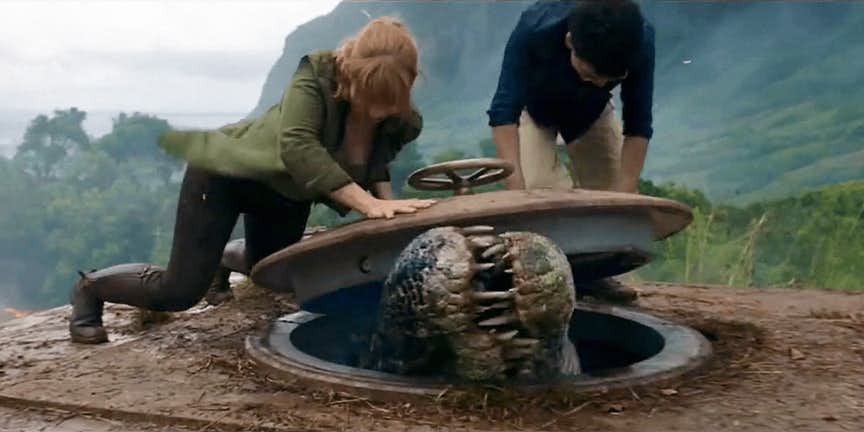
2015’s Jurassic World returned the dinosaur franchise to great heights. After a few disappointing sequels, this was the right movie for the right time, something that moved the story forward all while honoring the past. Now, after four movies of dinosaur-infested islands, Jurassic World: Fallen Kingdom roars into theaters with a bold departure from what has come before. While it starts off with a familiar story that we expect — a return to the island — things take a drastic turn when Isla Nublar is destroyed thanks to a volcano. Then, the action is transported state-side, where an evil businessman is looking to make a profit out of the valuable dinosaurs.

However, things don’t exactly go his way, and the sequel ends by kicking down the door of the pre-conceived, safe notions we had about the Jurassic franchise. Dozens of dinosaurs are now free, out in the wild, and this surprising twist is exactly the move that this new trilogy needed. The tagline that was featured during Fallen Kingdom‘s marketing, “The park is gone,” is more true than we could have ever imagined. Now, we are truly heading into a world of Jurassic proportions. This makes us wonder if, now, the next film might twist the formula on its head.

The basic premise at the heart of all of the Jurassic movies is that mankind was bringing the dinosaurs back into the modern age. But now, there has been a power shift; this time around, the dinosaurs might be the ones to bring mankind back to their own time, in the days before the Stone Age.

These creatures, who once roamed the Earth long before man ever did, are now part of an ecosystem and a world that has gone through many, many changes. But now, it appears as if the dinosaurs might be the ones who will bring the change forward. With the prehistoric creatures out in nature, surely the balance of the ecosystem will be shaken. With new predators to upset nature, entire animal species will be wiped out — something we know can lead to drastic changes for both flora and fauna on a whopping scale.

If dinosaurs are left to roam unchecked, they could end up changing the face of the Earth as we know it. Jurassic World 3 may feature a world we no longer recognize — a world where dinosaurs rule the Earth, not man. This would actually be a neat way of tying back to the first Jurassic Park movie. At the end of Steven Spielberg’s film, viewers might recall a scene where the T-Rex’s screeching roar brings an exhibition banner down, a banner that reads “When dinosaurs ruled the Earth.”

Perhaps the third Jurassic World film will bookend the original film, showing us what this world, ruled by dinosaurs, really looked like. It would definitely be interesting to see how what’s left of mankind handles the new power in charge. And who knows, it could even lead to a whole new beginning for another trilogy.

Source: www.cbr.com

A Paleontologist Explains Why Bringing Back Dinosaurs Is A Really Bad Idea

Monday, June 25, 2018

Even in the name of science, bringing back dinosaurs would be needlessly cruel to the maladapted creatures.

As excitement builds for the just-released "Jurassic Park" sequel, sure to be a summer blockbuster, I am drawn back to the most magical scene in the original film. The paleontologist, played by Sam Neill, has just arrived on the mysterious island, still confused as to why he is even there. He is whisked around in an open-top jeep, which suddenly stops in a clearing. Hands shaking, Neill removes his sunglasses and his wide eyes focus on something high on the horizon. A low roar bellows, and a pot-belled behemoth ambles across the screen, its graceful neck reaching several stories into the canopy. As the Jurassic Park theme tune starts to play, Neill staggers toward the creature. “It’s…it’s a dinosaur,” he fumbles, left almost speechless at his first glimpse of a living version of the fossilized beasts he has spent his career studying.

When I first saw "Jurassic Park" as a 9-year-old, back in the summer of 1993, this was the scene that brought dinosaurs to life in a way that none of my schoolbooks ever could. A quarter century later, it moves me for a different reason, because now I’m a paleontologist. I’ve spent years on dig sites and in the bowels of museums, collecting and measuring and studying bones, trying to use these meager clues to decipher what dinosaurs were like as real growing, moving, breathing animals tens of millions of years ago. How would I react if a flesh-and-blood dinosaur suddenly appeared before me?

It would, I admit, be very improbable. Dinosaur cloning remains a science-fiction fantasy, as not a single fragment of fossil dinosaur DNA has ever been discovered, despite the efforts of hordes of scientists. If it somehow did happen, though, no doubt I would be as dumbstruck as Neill’s character, and intoxicated by the opportunity to see whether our theories about dinosaurs are correct.

Did Allosaurus really hatchet its prey to death with agape jaws? Would a Stegosaurus use its gaudy back plates to woo mates? Was the great Trex actually covered in mangy feathers? How could a long-necked sauropod like Patagotitan — the size of a Boeing 737 — lay eggs and take care of its young? My list of questions would be endless.

With that in mind, what I’m about to say next may sound like sacrilege. Despite the temptation of watching a Velociraptor chase down its prey or a herd of Brontosaurus thunder across the plains, I would not resurrect dinosaurs. If there was a magical button that would deliver a real-life dinosaur, I wouldn’t push it.

Of course, on a practical level, I much prefer a world where I don’t need to worry about a Trex stalking me as I cycle home from work or shop at the mall. I’m also partial to the philosophical treatise that because "nature" killed the dinosaurs with the wallop of a six-mile-wide asteroid, more than 60 million years before the first hominid stood up on its hind legs, it would be the height of human hubris to bring them back.

But there are two arguments that really sway me.

First, bringing back Trex and Triceratops would, I believe, simply be cruel. They lived during the end-Cretaceous period, some 70-66 million years ago, when the world was a much different place. It was considerably warmer, there were no ice caps, sea levels were high and the oceans lapped far onto the land, and the continents were in other positions. Dinosaurs would have breathed different air (there was much more carbon dioxide in the atmosphere then), eaten different food (grasses and flowers had just started to evolve, and there were none of the grasslands or vast flowering forests of today), and interacted with different animals (mammals were little more than ratty creatures scurrying in the shadows).

Could a Trex, which evolved in this time and place, even be able to survive in our modern world? It would be like a human trying to make it on Venus.

Second, and putting all ethics aside, we don’t really need to bring back Trex and its Cretaceous (or Jurassic) kin if we want to be inspired by real, living dinosaurs among us. We should not lose sight of one of the most astounding facts ever discovered by paleontologists: dinosaurs are still here, in the guise of birds. Birds evolved from dinosaurs, which makes them dinosaurs. They have dinosaur DNA in their bodies, dinosaur blood running through their veins, and many of them echo their dinosaur ancestors in the way they hunt with their talons, protect their nests, fight their rivals over territory, wield their flamboyant feathers to attract mates, and use their big brains and keen senses to navigate.

Chickens, ostriches, turkeys, eagles and the other 10,000+ birds of today are every bit as "dinosaur" as Trex or Triceratops — and they already are an integral part of our world. Let’s focus on appreciating and conserving them, rather than with the wild notion of raising Trex from the dead.

Steve Brusatte is on the faculty of the University of Edinburgh and author of the new book "The Rise and Fall of the Dinosaurs," which tells the story of dinosaur evolution from origins to extinction and tales of the women and men around the world piecing together this story.

Source: www.salon.com

How Jurassic Park Changed the Way Movies Looked at Dinosaurs

Saturday, June 23, 2018

Jurassic Park has no shortage of quotable lines — from “Clever girl” to “Hold onto your butts!” — but one of the key bits of dialogue is also one of its least emphatically delivered. “Don’t let the monsters come over here,” Lex, one of two kids stranded in the gone-haywire dinosaur park pleads to Sam Neill’s Dr. Alan Grant as they watch some brachiosauruses grazing nearby. “They’re not monsters, Lex,” he replies. “They’re just animals … they just do what they do.”

Steven Spielberg’s 1993 film was a breakthrough in many ways, most significantly in its innovative use of computer-generated effects. But it also reconfigured how movies portrayed dinosaurs — even if some of the films that followed forgot how to shadow its example.

Adapting Michael Crichton’s novel, the film doesn’t short viewers on dinosaurs, but it also works to make them understand what dinosaurs were, how they fit into the history of the planet, and the ties they have with creatures that still walk the Earth. The screenplay, by Crichton and David Koepp, walks viewers through the science behind the movie, most famously in the instructional video featuring Mr. DNA (a cartoon character who’s part of a tradition of making horrifying scientific breakthroughs seem adorable that stretches back at least to Bert the Turtle). But it also takes time to show dinosaurs being dinosaurs: hatching from eggs, wandering the plains, growing ill, and so on. When the killing starts, that makes sense too. They’re animals. And animals have to eat.

Jurassic Park succeeds in part by breaking with the two approaches that have dominated dinosaur movies from the start: portraying them as bloodthirsty monsters or as cuddly anthropomorphized creatures. And the history of dinosaur movies is a long one, one almost as old as movies themselves. In fact, the medium developed alongside our understanding of what dinosaurs were — even if dinosaur movies didn’t always reflect this growing understanding.

With so many silent movies lost to time, it’s tough to make definitive statements about early film history, but 1914 seems to have been year zero for dinosaur movies, including one from D. W. Griffith, released a year before his revolutionary (and just as racist as you’ve heard) The Birth of a Nation. The three-reel Primitive Man (a.k.a. Brute Force) plays out a drama between two tribes of cavemen and illustrates that some still-persistent clichés about early humans date back much further than The Flintstones. In the film, the tribes go to war after one abducts the other’s women. Dinosaurs make only fleeting, threatening appearances in the form of what appears to be a papier-mâché T. rex and an irritated-looking alligator given wings and other bits of ornamentation. The effects of Primitive Man are, well, primitive, man, but they set up dinosaurs as a threat to humans that have to be avoided or destroyed (never mind that they never lived side by side). It’s a setup that would be much imitated in the years to come.

That same year saw the debut of Gertie the Dinosaur, a far more graceful, if no less scientifically suspect, attempt to bring dinosaurs to life created by Winsor McCay, the artist behind the groundbreaking, reality-bending comic strips Dream of the Rarebit Fiend and Little Nemo in Slumberland. Not content to be a genius in one medium, McCay branched out into another, and though attempts at hand-drawn animation predate Gertie, including some by McCay himself, the form as we known it more or less begins here, with an adorable brontosaurus. Made up of thousands of individual drawings executed by McKay himself, Gertie began as part of a vaudeville act that found him talking to his creation, asking her to perform tricks, making her cry, then riding off on her back. McKay later modified the film for theatrical exhibition, and it’s remarkable just how much he understood about what animation could do at its inception. Gertie emerges as a fully formed personality — sweet, easily distracted, eager to please, and capable of having her heart broken (then easily healed by a treat).

The next major figure in dinosaur movies began by working in the McCay tradition before moving to the other and defining the dangerous world of dinosaurs for generations to come. Willis O’Brien had been a cowboy, bartender, surveyor, professional boxer, and a guide to paleontologists (among other professions) before channeling his gift for sculpture and his interest in filmmaking into stop-motion animation. The comedic The Dinosaur and the Missing Link, released in 1915, pits cavemen against both dinosaurs and an apeman. One of his follow-ups, R.F.D. 10,000 B.C. features a postman riding a stegosaurus.

But it was with the 1918 film The Ghost of Slumber Mountain that O’Brien started to come into his own as a dino visionary. Narratively confusing — it was cut down from a much larger film — it features an uncle telling a pair of nephews about the time a ghost instructed him to look through a magical device, allowing him to see a land filled with dinosaurs. But O’Brien’s creations here are an entirely different sort of dinosaur. They move realistically and have a heft and reality to them that had never been seen before. They look like real animals. And, of course, they fight. Because what’s the point of bringing dinosaurs to life if they’re not going to attack one another?

O’Brien would return to dinosaurs throughout his career, next with 1925’s The Lost World, an adaptation of Arthur Conan Doyle’s influential novel about a group of explorers who find a land untouched by time where dinosaurs still dwell. The film finds O’Brien just as interested in dinosaur-on-dinosaur carnage as he tries out more sophisticated forms of stop-motion animation, approaches that would reach their apex a few years later with 1933’s King Kong, a film most famous for its giant ape, but also one with more than a few violent dinosaurs.

Scary, violent dinosaurs would be the default mode for dinosaur movies in the years that followed, from Fantasia’s “Rite of Spring” sequence to The Beast From 20,000 Fathoms, the first film with an effects team headed by Ray Harryhausen, a stop-motion artist who grew up idolizing O’Brien and worked under him on the 1949 film Mighty Joe Young. That effort featured no dinosaurs, but Harryhausen — whose previous work included an ambitious, abandoned, dino-heavy project called Evolution — made up for it with Beast, which sent a dinosaur awakened by an atomic blast to wreak havoc on New York. Like O’Brien’s creations, Harryhausen’s beast has presence and personality. It feels real and dangerous, responding to the world with the hostility of a creature ripped out of time. If the film’s interest in the monster don’t extend much beyond making it a scary set of teeth looking for a meal, it’s still a remarkable accomplishment. Beast would spawn direct imitators — including the dinosaur Western The Beast of Hollow Mountain, recently mocked on Mystery Science Theater 3000 — and help inspire the creation of Godzilla, a kind of mutant offspring of the violent dinosaur tradition.

But Harryhausen wasn’t done with dinosaurs. Working alongside O’Brien, he created a dinosaur sequence for the Irwin Allen–directed documentary The Animal World. In 1966, he provided the memorable effects for the extremely silly Hammer Films–produced adventure One Million Years B.C., otherwise famous for making Raquel Welch a star by placing her in a fur bikini. The plot and view of prehistoric life comes right out of Primitive Man, but the effects are remarkable, including a pterodactyl that attempts to turn Welch into a snack. Even better, both as a film and as a Harryhausen showcase, 1969’s The Valley of Gwangi sends cowboys into a lost valley filled with dinosaurs, and — shades of Jurassic Park — dramatizes the consequences of trying to bring them into our world. Gwangi began as an O’Brien project picked up by Harryhausen after his mentor’s death, and it’s a masterpiece of the violent dinosaur school, climaxing with an allosaurus destroying a cathedral.

The dinosaur films in the decades that followed, however, showed why Jurassic Park felt like such a revelation in 1993. The ‘70s were filled with lost-world adventures in which dinosaurs served primarily as adversaries to human adventurers. In the 1975 adaptation of Edgar Rice Burroughs’s The Land That Time Forgot, for instance, visitors to a lost world encounter, kill, and eat a dinosaur within a few minutes of arrival. After awhile, it became hard to tell serious efforts from send-ups like the Ringo Starr–starring Caveman, which pits the former Beatle against some (fairly impressive) stop-motion dinosaurs. Elsewhere, the decade favored a cuter approach, be it via the much-liked Don Bluth animated feature The Land Before Time or the laughable Baby: Secret of the Lost Legend, which sends Sean Young and William Katt to save a baby dinosaur and its mother — both of which appear to be props left over from a high-school play — from an evil scientist and some ugly African stereotypes.

Enter Jurassic Park, which gave audiences all the violent dinosaurs after they could want, but only after providing some thoughtful context that helped them understand what dinosaurs mean. Then … exit Jurassic Park. The film’s sequels had a much harder time taking an interest in dinosaurs as dinosaurs, not just as battle beasts. And though The Lost World: Jurassic Park and Jurassic Park IIIare both largely enjoyable, the inexplicably successful, defiantly dumb Jurassic World mostly exists as a showcase for the violent possibilities of letting dinosaurs crash into the modern world. The Colin Trevorrow–directed film tries to have it both ways, both sending up the bigger, faster, more mentality of 21st-century blockbusters while operating as a prime example of the same. It both chides audiences for wanting to see an unholy creation of genetic engineering like the Indominus Rex and then makes sure we get an eyeful of it as it fights it out with all the other dinosaurs.

So it’s surprising that Jurassic World: The Fallen Kingdom, directed by J.A. Bayona from a script by Trevorrow and Derek Connolly, would turn the focus back on the dinosaurs themselves again. The imminent eruption of a volcano that will destroy Isla Nublar, home to a pair of ill-fated dinosaur theme parks, has made the decision of whether or not to evacuate the imperiled dinosaurs a “flashpoint” animal-rights story. (Oh, to have such issues dominating the news.) While the answer might seem obvious given the chaos caused by revived dinosaurs in the four preceding films, Fallen Kingdom takes it seriously, creating an investment in the animals’ survival while acknowledging that, sure, many of them would be happy to eat humans if they got the chance. They’re vicious beasts, but the film makes us worry about them anyway. (It helps that the endearing Blue, a velociraptor that’s deeply bonded with Chris Pratt’s character, has a lot of Gertie DNA swimming alongside her killer instincts.) The film goes full throttle with its pulpy plot — the volcano rescue is just the beginning of a story that, improbably but delightfully, becomes a gothic horror story — but the concern for its prehistoric animals keeps it grounded. As in Jurassic Park, the dinosaurs just do what they do. But Fallen Kingdom is the rare post–Jurassic Park dinosaur movie that makes us care about why they’re doing it.

Source: www.vulture.com

7 Absurd Scenes From ‘Jurassic World: Fallen Kingdom’ (And We Have No Problem With The Dinosaurs)

Saturday, June 23, 2018

Chris Pratt tries to reason with a velociraptor in “Jurassic World: Fallen Kingdom.” (Universal/AP)

The latest “Jurassic World” installment hits theaters this week, and there is an exciting update from the previous iteration: This time, Bryce Dallas Howard runs around in flats. Like a normal human woman!

Well, boots. Whatever — at least it’s not spike heels, which was one of the most-discussed aspects of the last movie in 2015.

But while the “Jurassic World: Fallen Kingdom” writers course-corrected Howard’s footwear problem, there are plenty of other absurd scenes in the much-anticipated action movie. Here are some of the most ridiculous ones. Many spoilers ahead.

1. People thought the former “Jurassic World” theme park would actually be safe.

In the first scene, two men are looking for dinosaur bones underwater at the former site of the dino park. One of them looks very nervous. The other says, “Relax, anything in here will be dead by now.” Guess who gets eaten by a hungry, swimming dinosaur almost immediately?

Also, these guys operating an underwater vehicle are wearing regular clothes. One of them is in a Hawaiian shirt. We don’t know about you, but if we’re going on a deep-sea raid, we’d maybe wear some scuba gear, have an emergency oxygen tank, something!

2. The computerized and mechanical parts of the former “Jurassic World” theme park still function.

It takes the movie’s whiz/token nerd about two minutes to get complex computer systems back up and running. We get it; he’s a genius. But where exactly does this island sit on the power grid? How is there any electricity still in this place?

3. Chris Pratt defies physics.

At one point, Chris Pratt — animal/velociraptor trainer extraordinaire — is immobilized by a tranquilizer dart and left for dead. Then a volcano explodes — and even though he can’t move his limbs, he drags himself away from the flowing lava.

Later, Pratt somersaults through a T. rex’s mouth.

Somehow, in the middle of house-building, Pratt has managed to develop Navy SEAL-like capabilities. The man outruns lava, shoots a gun while free-diving and punches people while running right past them.

4. A bunch of millionaires go to a dinosaur auction.

The bad guys in the movie decide they will sell dinos to the highest bidder, which is fine, but they also display the wild beasts in poorly constructed cages. And people decide to ATTEND this event.

There are about 47 better ways to handle selling off dinosaurs. Also, can we discuss their low, low prices? A bidder was able to snag a last-ever, walking-and-breathing Mesozoic-era creature for the price of a Manhattan condo.

5. There’s a successful dinosaur blood transfusion.

Did you even bother to check to see if they had the same blood type? Also, next time you donate blood and the nurse takes forever to find a vein, try not to think about how easy it was to get a bunch of blood from a Tyrannosaurus rex.

6. The lack of safety protocols at the Lockwood manor.

The secret laboratory has the same level of security as an iPhone 4. Four-digit code — really? Even an iPhone 6 lets you use a fingerprint.

It also seemed very unnecessary to have canisters of cyanide just hanging around.

7. (Almost) no one thinking any of this would go horribly awry.

The “Jurassic Park” movies reliably follow a central theme: Humans think they can handle these dinos; these dinos show them otherwise. Do these people have zero sense of recent history? Read a book! Run a Google search! But, most of all, always listen to Jeff Goldblum.

Source: www.washingtonpost.com

5 Ways Real Science Would Make the New Jurassic World So Much Better

Wednesday, June 13, 2018

We now know that velociraptors were closer to dog-sized than horse-sized, meaning full-grown Blue should be closer to these dimensions. Also: FEATHERS. (Entertainment Pictures / Alamy)

It appears that Fallen Kingdom has not evolved alongside 21st century research.

When Jurassic Park hit screens in 1993, it was more than a cinematic marvel—it was an effective tool of science communication. In broad strokes, the film’s depictions of dinosaurs were in line with the latest paleobiological research of the early 1990s, showcasing for the first time creatures that were fast, clever, and warm-blooded. The film’s breathtaking vision even ushered in a renewed fervor for paleontological research now referred to as “the Jurassic Park phase”: In the 1990s, scientists uncovered ancient DNA for the first time; today, advancements in genetic engineering make talk of woolly mammoth de-extinction sound less and less fantastical. (Thanks, Michael Crichton!)

Yet much of our scientific understanding of terrible lizards has changed since the ’90s. We now know many dinos bore feathers, hooted instead of roared, and exhibited complex social behaviors and mating rituals. But you wouldn’t know that from seeing 2015’s Jurassic World, the fourth installment in the JP series. After its premiere, paleontologists around the world swiftly eviscerated the movie for its purposeful ignorance of the two decades of research that challenged the now outdated depictions of dinosaurs in the original film. Some even said that World was a step backwards from Park, drawing on only the most lumbering, inept, and ultimately unfounded characteristics of our falsely featherless friends.


Scientific tools have never been more powerful, and we have never had such a nuanced portrait of creatures that roamed the earth millions of years ago. Rather than imitate the hand-me-down Hollywood dinosaurs of yore, the newest Jurassic World should learn from the last quarter century’s most astounding advancements in dinosaur science. Here are five ideas.

1. Seriously: where are the feathers?

Paleobiologists have been uncovering strong evidence of that dinosaurs including velociraptors and relatives of Tyrannosaurus rex had downy, colorful plumage since the mid-1990s. Yet virtually all the dinosaurs in the Jurassic Park series have continued their featherless existence. It’s perhaps this omission that most ruffles paleobiologists’, er, feathers: after all, this revelation has implications not only for dinosaurs’ appearance, but also their genetic ties to modern-day birds. “While I didn’t expect the dinosaurs to be accurate, I was a little disappointed that there weren’t any feathers,” admits paleontologist Steve Brusatte at the University of Edinburgh. “That’s the one thing I really would have liked to have seen.”


We get it, it’s hard to suddenly switch from unfeathered to feathered in the same film franchise—and perhaps cinematographers feared that fuzzy dinos would detract from the scare factor. But truthfully, I think I’d be more terrified of a malicious, very real creature than an overblown imaginary one.

2. Bigger isn’t always better

We can understand why a Hollywood movie would want bigger baddies, but scientifically, the proportions of the Jurassic Park and World dinosaurs turn out to be far-fetched. In the former, the horse-sized velociraptors should actually have been the size of dogs. In the latter, the absurdly gigantic mosasaur (which technically wasn’t even a dinosaur) snacking on great white sharks didn’t grow longer than about 50 feet from head to tail. While some gargantuan dinosaurs certainly did exist and may have weighed over 100 tons, those giants tended to be herbivores.

Plus, even with accurate dimensions, T. rex would already have trouble chasing down jeeps. According to Brusatte, T. rex lumbered more than sprinted, chasing its prey in brief bursts of energy. The dino probably maxed out around 10-25 mph—fast enough to make quick work of a human on foot, but not to catch a moving vehicle. To keep pace with speeding cars, T. rex would have needed over 85 percent of its total body mass in its thighs alone, Brusatte writes in his new book, The Rise and Fall of the Dinosaurs.


3. Jurassic soundscape

The roars and bellows in Jurassic Park and World echo those of lions or elephants—appropriately grandiose for surround sound. Yet while sounds don’t fossilize, the shapes and sizes of bits of rib cages and nasal cavities have hinted that dinosaur noises were actually more ostrich- or crocodile-like in nature. Dinosaur communication was probably “not very complex,” says Matthew Carrano, a paleobiologist at the National Museum of Natural History. At least, not compared to the vocal cord vibrations of mammals or serenades of songbirds. Hisses, grunts, booms, and hoots were likely what reverberated through the prehistoric landscape.


Paleontologists have so far been able to construct what they are fairly confident is an accurate simulation of what one dinosaur sounded like: the duck-billed parasaurolophus. The parasaurolophus sported a large cranial crest that protruded in a backwards sweep from the top of its head like a lever. Suspecting the crest that may have served as a resonating chamber, researchers used computer modeling to construct a parasaurolophus crest. The end result: a low bellow that you might otherwise hear from a tuba.

4. Armed and not-so-dangerous

The puniness of T. rex’s arms compared to the rest of the dinosaur’s hulking power has made it the butt of countless jokes. But rather than deriding what were essentially human-sized arms on an animal the size of a school bus, we should be asking why T. rex even had arms—and why they were as muscular as they were.


We now know that the ancestors of T. rex used their forelimbs quite a bit, snatching prey and tearing at them with well-developed claws. As these small, wiry dinosaurs evolved, however, they grew larger, developing massive heads and eventually losing their reliance on their forelimbs. The T. rex was essentially a “giant land shark,” as Brusatte puts it. Yet for some reason, the arms never disappeared completely: evolution kept them around, well-endowed enough to toss around a couple hundred pounds, Carrano says.

Why? They may have been weapons, allowing the T. rex to slash at prey at close distances. Or perhaps, as Brusatte and others believe, T. rex used them as shackles to hold struggling prey while the gnashing teeth did the dirty work. Others theorize that the arms may have played a role in mating, for displaying flashy feathers or bracing mates during copulation. In any case, clearly they were developed enough to be of some regular use. A more accurate dino film would have T. rex utilizing these limbs, rather than just including them as feeble ornaments.


“Their arms were actually more muscular than ours,” says Carrano. What’s more, contrary to most film depictions, the arms of T. rex and many other dinosaurs were built such that their palms would have faced inward rather than downwards. Few dinosaurs had the bone structure required to give their wrists that amount of flexibility, so they constantly looked as though in mid-clap—or about to arm wrestle. Speaking of that prospect, a human “probably wouldn’t win a wrestling contest against a T. rex,” says Carrano. “But you wouldn’t lose that badly.”

5. When facts are stranger than fiction

Sadly, we now know that the dino-DNA-in-amber hypothesis wouldn’t work, at least not for creatures as ancient as T. rex. “For a long time, we thought fossils in amber were perfect … as in, if you got rid of the amber, [what was inside] could just get up and fly away,” says paleontologist Victoria McCoy of the University of Leicester. It turns out that amber and fossils don’t do as good a job preserving organic remains as the movies depict; we now know that DNA is a fickle, delicate molecule, certainly not built to survive 150 million years.


But real-world scientists are finding creative ways to work around this snag. Some are reverse-evolving chickens; others have managed to retrieve dinosaur proteins from fossils (which, thankfully, is still possible). But without an entire dinosaur genome, genetic gaps would need to be bridged using other DNA—likely with something avian or reptilian. In other words, we will never be able to reverse-engineer dinosaurs exactly as they were, because all that’s left of them is, at best, a handful of pieces of a highly degraded biological puzzle.

Perhaps this opens a door for the next Jurassic World: an honest depiction of dinosaur genetic engineering, feathers, chicken genes and all. “I would love to see a Jurassic Park-style movie that was, instead of a disaster movie, a hopeful movie where the scientists are working out how to clone the dinosaurs,” says McCoy. Such a world could also feature the myriad new shapes, sizes, colors, and textures that fossil finds are revealing at an astonishing rate. We don’t need more like the hybrid Indominus rex when there’s already so much diversity still waiting to be discovered.


Part of the legacy of Jurassic Park was the scientific spark it ignited in millions of young future scientists across the world. But there’s also a magic to the pure elation of seeing the latest scientific research brought to life on the big screen. Because let’s face it: dinosaurs were pretty cool, just as they actually were.

Source: www.smithsonianmag.com

Pages