nandi's blog

Research Sheds New Light on How Cave Bears Became Vegetarians

Tuesday, July 31, 2018

Reconstruction of the cave bear (Ursus spelaeus). Image credit: Sergio de la Larosa / CC BY-SA 3.0.

A Middle Pleistocene cave bear, also known as the Deninger’s bear (Ursus deningeri), is generally regarded as the direct ancestor of the mostly vegetarian cave bear (Ursus spelaeus), and the transition between the two species took place around the Middle-Late Pleistocene boundary, about 126,000 years ago. Until now, very little was known about the dietary evolution of cave bears and how they became vegetarians, as the fossils of Deninger’s bear are extremely scarce. However, a study by paleontologists in Germany and Spain sheds new light on this.

To understand the evolution of the cave bear lineageDr. Anneke van Heteren from the Zoologische Staatssammlung München and the Ludwig-Maximilians-Universität München and colleagues compared the mandibles and skull of the Deninger’s bear with that of classic cave bears and modern bears.

They micro-CT scanned the rare fossils and digitally removed the sediments so as not to risk damaging the fossils.

“The analyses showed that Deninger’s bear had very similarly shaped mandibles and skull to the classic cave bear,” Dr. van Heteren said.

“This implies that they were adapted to the same food types and were primarily vegetarian.”

“There is an ongoing discussion on the extent to which the classic cave bear was a vegetarian,” added study co-author Mikel Arlegi, a doctoral candidate at the Universities of the Basque Country and Bordeaux.

“And, this is especially why the new information on the diet of its direct ancestor is so important, because it teaches us that a differentiation between the diet of cave bears and brown bears was already established by 500,000 years ago and likely earlier.”

(A) a subadult male cranium of Ursus deningeri from Sima de los Huesos, Spain, in different views compared to (B) an adult male cranium of Ursus spelaeus; (C, D) mandibles of Ursus deningeri. Image credit: van Heteren et al, doi: 10.1080/08912963.2018.1487965.

Interestingly, the team also found that there are shape differences between Deninger’s bears from the Iberian Peninsula and those from the rest of Europe, which are unlikely to be related to diet.

“There are three possibilities to explain these differences: (i) the Iberian bears are chronologically younger than the rest; (ii) the Pyrenees, acting as natural barrier, resulted in some genetic differentiation between the Iberian bears and those from the rest of Europe; or (iii) there were multiple lineages, with either just one leading to the classic cave bear, or each lineage leading to a different group of cave bears,” they said.

“However, more fossils are necessary to test these hypotheses,” said co-author Dr. Asier Gómez-Olivencia, from the University of the Basque Country.

The research is described in a paper published this month in the Historical Biology, an international journal of paleobiology.

_____

Anneke H. van Heteren et al. Cranial and mandibular morphology of Middle Pleistocene cave bears (Ursus deningeri): implications for diet and evolution. Historical Biology, published online July 26, 2018; doi: 10.1080/08912963.2018.1487965

Source: www.sci-news.com

Scientists Gently Hasten Apocalypse By Reviving Frozen 42,000-Year-Old Worms

Tuesday, July 31, 2018

Scientists Gently Hasten Apocalypse By Reviving Frozen 42,000-Year-Old Worms

The message of the 1993 documentary film Jurassic Park was subtle – buried in dense symbolism for the viewer to tease out after repeated study – but definitely there: messing with Mother Nature is an act of extreme hubris that will likely end in disaster.

But, like Icarus, whose waxy wings bore him euphorically upwards, our scientists are simply too caught up in the thrill of what they’re doing to realise that they are flying too close to the sun. In a paper published in the scientific journal Doklady Biological Sciences, researchers announced that they had successfully brought back to life a number of worms that had been frozen in permafrost for over 30,000 years.

According to the paper, the nematodes (read: tiny worms) were from two different samples of Siberian permafrost, believed to be 32,000 years old and 42,000 years old respectively. The permafrost containing the worms was taken from the Kolyma River Lowland in eastern Siberia, then placed in a petri dish with some food and warmed up at around 20 degrees Celsius.

The worms (all females of either the Panagrolaimus detritophagus or Plectus parvus nematode species) represent “the first data demonstrating the capability of multicellular organisms for longterm cryobiosis in permafrost deposits of the Arctic“, the scientists claim.

 A group of scientists have successfully revived two species of worms they discovered suspended in an icy chunk of Siberian permafrost. East2West News

While this sounds like a combination of Jurassic Park and The Thing just waiting to happen, it’s worth noting that a) neither of the species of nematode was extinct and b) a nematode is generally about half a millimetre in length and not particularly liable to eat you in one bite while you’re hiding on a toilet.

The main takeaway from the study is probably that you can store your nematode for as long as you like, but the researchers also believe that figuring out the mechanisms that allow these gentle worms to survive being cryogenically frozen could have big implications in areas like “cryomedicine, cryobiology, and astrobiology“. Science: what a rush.

Source: www.pedestrian.tv

Hell Creek: KU Researchers Extract Rare Juvenile T. Rex, Fossil Treasures

Sunday, July 29, 2018

Hell Creek: KU researchers extract rare juvenile T-Rex, fossil treasures

University of Kansas bone hunter Kris Super prowled the base of steep-edged hills in the Hell Creek formation for evidence to solve mysteries millions of years in the making.

Fish-fossil exploration in western Kansas helped develop Super’s eye for tiny pieces of bone that had tumbled to the ground when eroded by wind or water. This detective work required quick identification of fragments, or float, among rocky debris. Bone trails might lead up hillsides and, possibly, to the final resting place of a dinosaur. That was the method relied upon as he climbed a steep grade to the exposed bony frill of a bulldozer-like, three-horn Triceratops.

It was a spectacular experience to run a finger over the rounded edge of the frill and along the delicate horn of an animal that lived more than 66 million years ago and was ripe for excavation by paleontologists.

“I don’t mind getting a little dirty, especially if there’s a dinosaur involved,” said Super, who graduated from Fort Hays State University before arriving at KU.

Still, it was just a Triceratops. Relatively common in this desolate, rugged geological formation. It would be the objective of a future extraction team. The immediate prize was nearby.

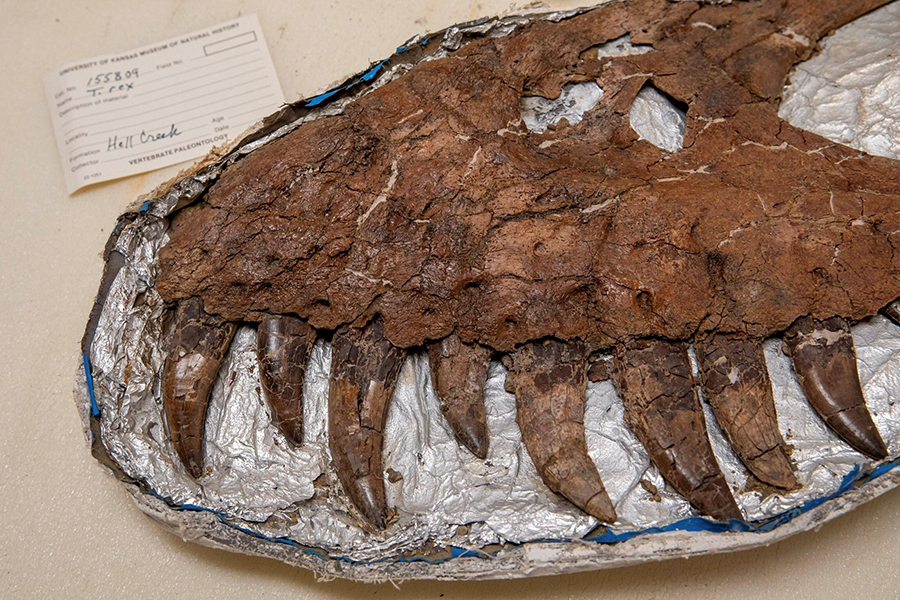
Super relied upon the same scouting technique in 2016 to lock onto bits of what turned out to be a Tyrannosaurus rex, the apex carnivore with massive skull, impressive teeth and heavy tail that more recently added movie star to its list of attributes. “Just luck,” he said. This, however, was no ordinary T. rex. It was the rare discovery of what is believed to be a juvenile. Science has fewer than a dozen of these immature T. rex fossils from which to build a scientific record.

“There haven’t been many discovered,” said David Burnham, a vertebrate paleontologist at the KU Biodiversity Institute. “We’re adding to evolutionary history.”

In 2016, KU began excavating the site of the T. rex about 25 miles off the nearest paved road and far removed from civilization in Jordan, which hosted two bars and one traffic light. On a rocky knoll amid grazing land 1,000 miles northwest of Topeka, the KU researchers unearthed skull, teeth, claws, femur, pelvis and dozens of other pieces of the T. rex.

Consensus among KU researchers: The specimen was a female that died as a youth. Evidence existed of a fractured rib that healed and there were signs of an injury to one of her feet. The T. rex likely perished in a cataclysmic event, such as a massive flood that buried her in a wet forested area approximately 67 million years ago.

Burnham’s crew of graduate and undergraduate students as well as volunteers have returned the past two summers to draw out more of what Hell Creek has to reveal about the T-Rex.

Tools of the trade ranged from jackhammer and shovels to delicate paint brushes, dental tools and X-Acto knives. It’s typically hot, but a breeze could reach hilltops. That wind provided relief or, if robust enough, turned into a sandblaster. The audience out there consisted of beef cattle and the deer and coyotes roaming the scrubby terrain. Pleasantly, no rattle snakes came calling.

This year, enough of the hillside was peeled away to conclude a massive rock and dirt layers above the “bone zone” had to be removed if more of the T. rex was to be dislodged. That required permission of the federal government, which has jurisdiction at the KU site. The U.S. Bureau of Land Management offered to lend heavy equipment for the job.

“These lands are administered by Bureau of Land Management,” Burnham said. “They’re a great help in getting this work done.”

Within proximity of the T. rex, fossil fragments were scattered throughout the soft rock layers. Burnham was working on the edge of the dig site in June when he unearthed a front upper tooth to a T. rex. Rolling it over in his hand, he said: “That’s to our baby.”

KU student Niall Whalen, who grew up in Pennsylvania, found a dinosaur tooth and an abundance of fish scales that resembled small black seeds. Chunks of sandstone were split open to reveal imprints of leaves. Tree branches and grassy plants emerged from the ground — all of it tens of millions of years old.

“I was one of the dinosaur kids,” said Whalen, a reference to a youthful fascination with strange creatures that lived in what became North America.

Now an adult, he said, the experience of participating in a T. rex dig still held fascination. It could be the ultimate conversation starter, he said.

“Oh, yes. That’s one of the best parts,” he said. “Who never heard of a Tyrannosaurus rex?”

KU assistant fossil preparer Kyle Atkins-Weltman, a veteran of Hell Creek formation’s rocky expanse, discovered a Dakota raptor tooth this summer at the site. He anticipated the T. rex found by KU to stand as a 1-in-100-million-specimen based on degree of preservation and completeness.

“The allure is we’re getting to see a group of vertebrates who dominated the land for an inconceivable period of time. That’s 135 million years of being the dominant organism,” Atkins-Weltman said.

Others on the KU expedition — Broden Kaps, Bryce Kellig, Jackson Leibach and Jordan Van Sickler — had divergent backgrounds and different academic goals, but shared willingness in Montana to do unglamorous back-straining work necessary to carve into history. Most of the time when they turned over a section of dirt, it was just another handful to be tossed over the ledge. But mingled in there were new additions to KU’s museum collection. Big and small, the puzzle pieces mattered.

“Figuring out how prehistoric animals lived and died helps us understand what possibly could happen to us,” said Van Sickler, who is interested in earning a doctorate and building a career culminating in creation of a natural history museum in Arkansas.

It will take years for KU to wrap up the digging, clean the bones and prepare the T-Rex for display.

In the past, it was common for Montana ranchers in that region to follow the melt of winter snow with discovery of another huge bone poking out of a hillside. This part of the state has become a maze of private and government ownership, but local property owners have increasingly sought to earn an income from dinosaur bones as they’ve escalated in value.

Brit Murnion, proprietor of MT Mug Coffee Shop on Main Street in Jordan, said locals shared Garfield County with dinosaur diggers during the summer months and with hunters of antelope, elk, deer, bighorn sheep, bison and other game from late summer into winter.

“We have a good time with the dinosaur diggers. They always have good stories to tell,” she said.

The only grocery store in Jordan offered change in golden dollar coins — perhaps because coins couldn’t be traced by the government in the way a dollar bill might. Jordan is part of Garfield County, a politically conservative county that voted 91.2 percent for Donald Trump in the 2016 presidential election. Sit down at the bar, and somebody might ask about your vote. Twenty years earlier, there was a memorable standoff on a Garfield County ranch between the Federal Bureau of Investigation and the anti-government Montana Freemen.

Despite remoteness, the Montana landscape harbored an abundance of evidence to how the planet was shaped by forces difficult to imagine.

Along the dirt road taken in and out of KU’s dig site, Burnham stopped to point out a white line within the rock layers. It was a narrow band wedged between black sediment on the underside and brown sandy deposits on the upside.

He said the light-colored rock marked the moment 66.2 million years ago when an asteroid slammed into what was now called the Gulf of Mexico. The result was mass extinction of three-fourths of animal and plant species. The ash layer consisted partially of iridium — abundant in asteroids but rare in the earth’s crust.

“Everything above is the age of mammals,” he said. “Everything below is the age of dinosaurs.”

Source: www.cjonline.com

The Evolution of Bear Species

Wednesday, August 1, 2018

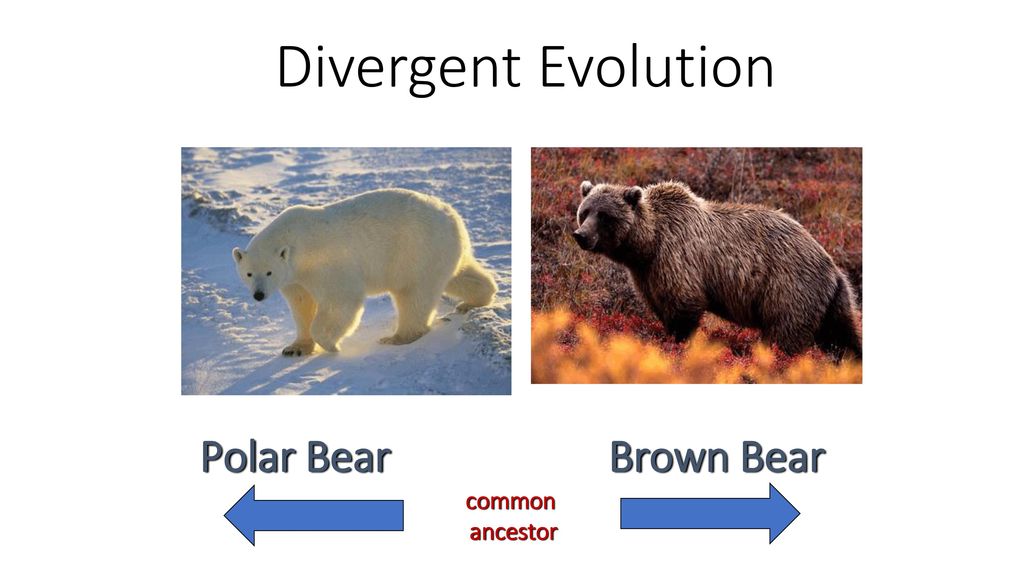
Divergent Evolution Polar Bear Brown Bear common ancestor

Where did the bear really come from? The evolution of bears as we know them today, started around 30 million years ago. Their ancestors evolved into a family of small mammals known as the Miacids (Miacidae). The bears, small bears and also the canines developed from the Miacids. Some of the canine species resembled bears, and we refer to them as bear dogs or Amphicyonidae. The size and appearance of the bear dog varied from small and dog-like to big and bear-like. Please see below diagram which represents this ‘evolutionary tree’.

 Bears family tree

The family of real bears can ultimately be traced back to the oldest genus, the Ursavus, which was roughly the size of a sheepdog and had evolved from a canine ancestor.

Slovak Wildlife Society Esther Tyson, Svetlana Beťková

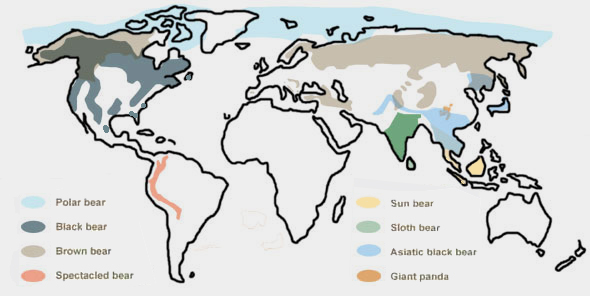
The bears (Ursidae) form a separate family within the order of carnivora. The bear family can be divided into three subfamilies: the giant panda (Ailuropodinae), the spectacled bear (Tremarctinae), and the real bears (Ursinae). The family of Ursinae consists of six different species, all of which have similar external characteristics like strong claws and a robust body. They also have their diet in common. Although these bears are all omnivores, their diet is mainly vegetarian. Bears live in very different regions of the world, from the North Pole to the tropical rainforests around the equator. The projects which are run by Bears in Mind focus mainly on the brown bear, but also on the Asiatic black bear, the Malayan sun bear, the spectacled bear and the sloth bear.

Source: www.bearsinmind.org

5 Dinosaur Movies To Watch With Your Child

Monday, July 30, 2018

The Good Dinosaur

Kids are obsessed with dinosaurs! Here’s a list of movies that you can watch as a family!

Kids and dinosaurs have a longstanding relationship and we’re not kidding! Agreed, movies like Jurassic Park and Jurassic World might throw off your child as they’re made to jump-scare everyone, but there are lots of warm and fuzzy movies that test the theory of “Dinosaur = Scary”. You can keep your googling skills at bay as we’ve put forth a list of movies on cute, not-so-little dinosaurs that won’t give your kid the nightmares.

The Land Before Time

It doesn’t seem like a kid’s movie, considering the topics that it tackles. It revolves around a Brontosaurus who has been orphaned at a really young age, his four friends and the prejudice they face from other species. It has many perky characters that would surely give your kid a chuckle along with serious segments. Another great thing about it is that this movie has almost nailed the environment as it was during the days of dinosaurs, which is an excellent way of introducing kids to the Jurassic era.

The Good Dinosaur

This movie is based on a time where dinosaur and humans co-existed, which according to science is impossible. But who cares about science, right? It’s a touching story of a dinosaur that gets separated from his family due to heavy rains, but meets Spot, a human. It builds on a budding relationship between them as Spot helps in finding his family. It’s a great light entertainment movie for kids, which has its moments for an older audience as well.

Ice Age: Dawn of the Dinosaurs

The third one in an iconic franchise, this movie introduces us to dinosaurs for the first time in this series. Sid, being the mischievous one, tries to steal some dinosaur eggs and gets on the bad side of a Mama T-Rex. Now his friends have to save him from her wrath. This movie is for everyone, although being rated for kids, with lots of clever jokes to keep you busy.

Dinosaur

This one’s more an experience than anything. It’s basically stretching of muscles on Disney’s part as they enter the new age with brilliant animation that keeps everyone’s mouths open. It’s a shame that it still remains under the radar for most people. Of course, it has a story, which is about orphaned dinosaurs raised by a family of lemurs, but honestly, who would care about the story when the movie looks this good?

Jurassic Park

This is a movie not to be rushed with, especially with kids. It’s the Grand Daddy of all dinosaur movies, which has a dinosaur-themed park with artificially engineered dinosaurs but all havoc breaks loose when a power failure lets every dinosaur in the enclosure free. I mean, it’s PG-13 for a reason.

Source: https://indianexpress.com

Paleontologists Discover Prehistoric Whale Bones in San Juan Capistrano Landfill

Sunday, July 29, 2018

Paleontologists discover prehistoric whale bones in San Juan Capistrano landfill

Paleontologists finished extracting the fossilized bones of a prehistoric whale from a San Juan Capistrano landfill Thursday, July 26, and those bones will soon be off for further study.

The whale bones are thought to be 4 to 7 million years old and are possibly from a previously undiscovered species of prehistoric whale, according to Orange County Waste and Recycling spokeswoman Kristina Hamm.

They were first discovered late last month at Prima Deshecha Landfill as a Paleo Solutions’ paleontologist watched crews excavate a portion of the landfill slated for use. That’s when the paleontologist first spotted a large bone.

Hamm said the paleontologist was at the landfill site as part of a requirement of the California Environmental Quality Act (CEQA).

“CEQA mandates that we have paleontologists and archaeologists on site anytime we do any digging,” she said.

More paleontologists arrived and got to work. They uncovered what appears to be a partial skull with a lower jaw as well as a snout, ribs, limb bones and portions of a backbone.

The fossils have been wrapped in a plaster and burlap jacket to stabilize them for when they’re transported.

Hamm said they’re currently still on The Prima Deshecha site but will eventually be transported to the Paleo Solutions lab for further research.

Geraldine Aron, president of Paleo Solutions, was at the dig site for about four days and helped with stabilizing and extracting the bones.

She said paleontologists were surprised by how large the whale bones were and that there were several bones all together to extract.

“Sometimes what happens when these whales die, they kind of float out to the ocean and they get scavenged so their bones get very separated and spread out,” she said.

Aron said the area where the whale bones were found is called the Capistrano Formation, which was once a deep ocean basin where sediment collected and turned into rock. That rock was then uplifted because of tectonic activity. She said whales fossils have been found a number of times within the formation.

An OCWR news release notes that the fossil, “has the potential to provide new information on the paleo-environment and biodiversity of the late Miocene and early Pliocene of Southern California.”

Hamm said that OCWR officials hope the bones will eventually make their way to the Cooper Center or another local museum.

Source: www.thecapistranodispatch.com

Giant Beaver Teeth, Fang from Scimitar Cat among Finds in North Yukon

Sunday, July 29, 2018

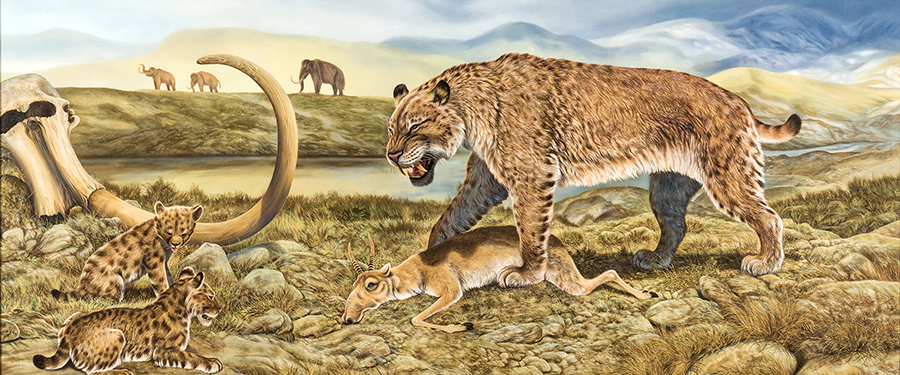
American Scimitar Cat

Annual summer camp on Old Crow River digs up a treasure trove of Ice Age bones.

People working at the Yukon paleontology program's summer camp on the Old Crow River this summer have collected hundreds of kilograms of Ice Age bones.

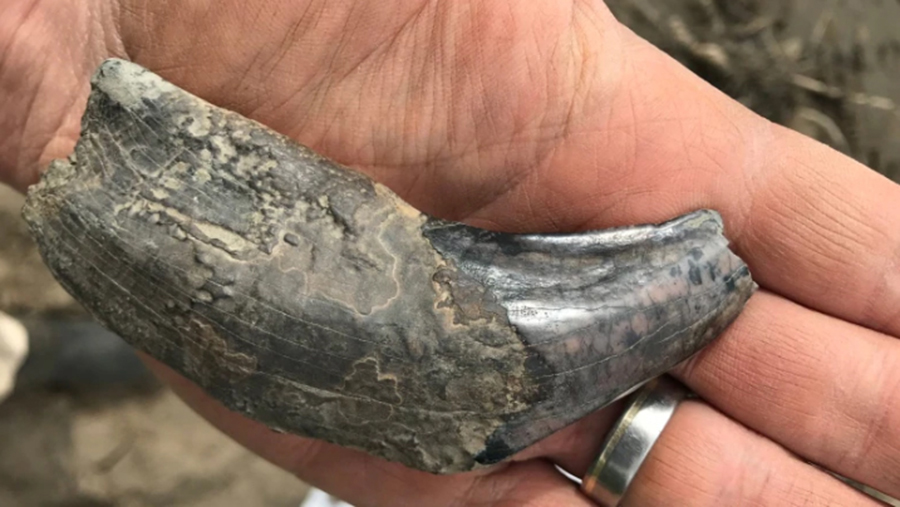
The biggest find was a fang from a scimitar cat, said Yukon government paleontologist Grant Zazula.

"It was a lower fang, probably the first one ever discovered in Canada, so we're super excited," he said.

Zazula said four paleontologists, two Vuntut Gwitchin youth research assistants and two German filmmakers working on a documentary were at the weeklong camp in mid-July, on a river bar not far from Old Crow.

Some of the other discoveries include teeth from five-feet-tall beavers.

Paleontologist Grant Zazula says this may be the first lower fang of a scimitar cat ever found in Canada. (Grant Zazula/Yukon Government)

"When you see their teeth, they're six inches long, they're incredible," Zazula said.

He said scientists have been coming to the Old Crow area for about 100 years because of the research opportunities.

"The Old Crow River is a pretty amazing thing in that as it's flowing, it's eroding banks along the river," said Zazula.

"It erodes fossils out of the banks and then deposits them down on the river bars and along the rivers, and so we can boat up and down and we stop along the river and collect bones."

Old Crow is busy in the summer with researchers in the area studying climate change, he said, as well as archeologists and others conducting oral history interviews with residents.

Source: www.cbc.ca

Study Provides New Evidence of Sauropod Dinosaur Origin and Distribution

Friday, July 27, 2018

An artist's impression of Lingwulong shenqi. Image credit: Zhang Zongda.

After studying a set of fossils, Chinese paleontologists have identified that they belong to a dinosaur species which was previously not believed to have existed in East Asia, challenging previous ideas about how this species originated and spread.

Paleontologists from the Chinese Academy of Sciences have confirmed the fossils belong to a dinosaur species named Lingwulong shenqi from the genus Diplodocus. The fossils, comprised seven to ten partial skeletons ranging from juveniles to adults, were first discovered in northwest China's Ningxia Hui Autonomous Region in 2004.

They found that these dinosaurs were widely distributed in East Asia, a part of the supercontinent Pangaea, which began to break apart about 175 million years ago.

However, it was previously believed that that species had not spread to East Asia, which became an isolated island separated from the supercontinent about 164 million to 158 million years ago.

Diplodocus is one group of the sauropod dinosaurs, which were gigantic long-necked plant-eating dinosaurs that dominated many animals during Jurassic and Cretaceous Periods.

It was also previously believed that the continental breakup had affected the evolution of the sauropod dinosaurs, producing endemic dinosaurs in East Asia during the Middle Jurassic, about 174 to 164 million years ago.

However, according to the new study, these dinosaurs had already evolved and achieved a global distribution when the supercontinent was still a coherent landmass.

The study, led by Xu Xing, a paleontologist with the Chinese Academy of Sciences, was published Monday in the journal Nature Communications. (Xinhua)

Source: http://english.cas.cn

T-Rex Dinosaur Fingerlings Are The Latest Toys That Your Kids Will Go Totally Wild For

Wednesday, July 25, 2018

Courtesy Of WowWee

If your kid is into collectibles, interactive toys, or dinosaurs, then prepare to freak out a little bit, because a brand new toy is going to make their day. Launching soon, the Fingerlings UNTAMED T-Rex is about to become the king of all toys. Just watch your fingers around these guys, because they will almost certainly bite.


Modeled after Tyrannosaurus rex, AKA the king of the dinosaurs, the UNTAMED T-Rex figures are sure to delight any action-loving kid. Finger-gripping creatures, these UNTAMED figures are like Fingerling's wilder cousins. Not only are the dinosaur figures detailed and colorful, but they're also super interactive. When playing in Untamed mode, the T-Rex figures will roar, hiss, and chomp. This is great whenever your UNTAMED T-Rex encounters a foe. But they aren't always so fierce. When you play with the figure in Tame mode, the T-Rex will nuzzle and purr. It's like a little pet dino your kid can take anywhere.

With their snapping jaws and grippy claws, the UNTAMED T-Rex can react to touch, motion, and sound stimuli. In fact, there are over 40 different sound and animation reactions programmed in each figure. It's a lot of interactive tech in a pretty small toy.

Available for sale on August 3, 2018, the UNTAMED T-Rex figures will be on sale for $15. Four different T-Rex figures are available to collect, and they will be available at major retailers including Target, Amazon, Walmart, and Kohl's. They retail for $15 each.

But the T-Rex designs aren't the only creatures in WowWee's UNTAMED line. Four UNTAMED velociraptors are already available, and they look just as fierce as the new T-Rex ones. With loads of interactive features, as well as super grippy claws and tails, these creatures are all set for hours of imaginative play.

If the original Fingerlings figures are any indication, these UNTAMED T-Rex toys are about to become wildly popular. Named the 2018 Toy of the Year by the Toy Association, Fingerlings are little interactive figures that are small enough to grip a kid's finger. With adorable monkey, unicorn, sloth, and other forms, these sweet toys became a mega-seller. Now it looks like their wilder counterparts are set to take on the toy aisle in a big way.

Both Fingerlings and the UNTAMED creatures were created with the idea of reaching kids and their current interests in a big way. "I would say my biggest inspiration is looking around at how kids interact and play, what they are into, and what’s capturing their attention at the moment. Also, key inspiration for me comes from looking online and seeing what concepts and videos have viral potential," said Fingerlings creator Sydney Wiseman in Forbes. It looks like Wiseman has succeeded in creating fun, relevant toys that appeal to today's kids.

So if your little one likes the idea of owning a pocket-sized dinosaur, then consider adding an UNTAMED T-Rex to your collection soon. Chances are, these prehistoric pets are going to become one of the hottest toys of 2018.

Source: www.romper.com

7 Dinosaur Books for Preschoolers: Bring the Dinosaurs Back to Play!

Wednesday, July 25, 2018

The Best Dinosaur Themed Books for Little Kids

I was looking for suggestions for dinosaur books for preschoolers and instead, I found this image by Dave Kellett over at SheldonComics.com. It essentially confirmed I will never know as much about dinosaurs as I did when I was four years old. However, being the parent of a four-year-old is a close second.

Our four year old is our third child, so we’re not new to the dinosaur love. In fact, when the first child hit this craze, we realised we were better off shelving the kids books in accordance with the Dewey Decimal System rather than alphabetical order…or colour or size or anything else really. Well, to be really honest, the dinosaur books were never shelved. There were books on the floor (dinosaur books) and books on the shelves (not-dinosaur books).

As much as it sounds like I’m dissing on the dinosaurs, I really love our dinosaur books! They have been the most inspiring and creative books we have ever owned. The best dinosaur books for preschoolers inspire play! Our dinosaur books have encouraged spontaneous cosplay, dinosaur digs complete with paint-brushes and sifting trays, potted dinosaur gardens, and very excited discussions about meteors and dinosaurs during our star-gazing sessions.


HARRY AND THE DINOSAURS AND THE BUCKETFUL OF STORIES WRITTEN BY IAN WHYBROW AND ILLUSTRATED BY ADRIAN REYNOLDS

Harry and the Dinosaurs and the Bucketful of Stories by Ian Whybrow (2006-05-04)

This is NOT to be mistaken with the TV series—There is no jumping into a bucket or psychedelic rainbow rides. Instead, we have a sweet story about Harry, a preschooler who lives with his mum, sister, and Nan. When Harry discovers some old dinosaur toys hidden away in a dusty box in the attic, we have our first introduction to the magic of this book. The dinosaurs don’t start talking to him straight away; as my preschooler points out, “That’s not how magic works, Mum. Harry has to earn their magic. They don’t start talking to him until AFTER he cleans and fixes and takes care of them. That’s the real magic, Mum. Don’t you know about dinosaur magic?”

There is a whole series of books but if you’re looking for the best place to start, pick up Harry and the Dinosaurs and the Bucketful of Stories. There is also More Adventures with Harry and the Dinosaurs, with another fave five stories to read. And then there are a whole bunch of individual books, like Harry and the Dinosaurs First Sleep-Over. Oh, and then there is a great little chapter book for when your preschooler moves on to primary school and thinks they aren’t allowed to be dinosaur-fans anymore but secretly they are still in love with dinosaurs and always jump at the opportunity to read to their little sister…Oh, c’mon! We all have kids like this, right? If so, then you need to buy Harry and the Dinosaurs Roar to the Rescue!

Activity: Find a beach bucket and fill it with small dinosaur toys. Preschoolers love carrying things and this is the perfect connection for them to share with others. Our middle child carried his bucket with him everywhere for over a year. Yes, I still have the bucket and the books.


CAPTAIN FLINN AND THE PIRATE DINOSAURS WRITTEN BY GILES ANDREAE AND ILLUSTRATED BY RUSSELL AYTO

Captain Flinn and the Pirate Dinosaurs Hardcover – October 1, 2005

This book has been removed from the night-time reading selection and transferred to the ‘reading at any other time of day’ collection. It is the type of book you should not read before bedtime.

Captain Flinn is a preschooler who discovers a pirate in the school’s storage room. Apparently it’s the best place to sulk when your beloved ship has been stolen by Pirate Dinosaurs. The only thing that could make this any better would be an invigorating pirate shanty…Oh, wait! That’s why we can’t read it before bed!! The pirate dinosaurs have the best pirate shanty for preschoolers!! Our preschooler taught the kids at school, and the parents were thanking me for weeks afterward. *grin* Totally read this book for the pirate shanty.

Activity: Compose your own pirate dinosaur sea shanty!! The only requirement is for 50% of the words to be ROAR.


YOU LOOK YUMMY! BY TATSUYA MIYANISHI

You Look Yummy! (Tyrannosaurus Series) Hardcover – November 1, 2015

This is the first of the Tyrannosaurus series, and much loved amongst some of my fellow Book Riot crowd. I like this one the best because I love Ankylosaurus. Hey! Everyone has a favourite, whether or not you have your own preschool buddy to compare notes with.

This is about a newly-hatched Ankylosaurus who bonds fiercely with the first dinosaur it sees: a Tyrannosaurus who looked at it and said “You Look Yummy!”, so, of course, the ankylosaurus assumed its name was Yummy. What transpires is a sweet story about the sacrifices made by a parent for the love of a child. After reading this with our preschooler, we now have our own secret language: “I love you so much, I would give up a hamburger for your plate of berries.” Read the book and you’ll understand just how much I love my kids. *wink*

Activity: Who wants a berry-hamburger? This one is perfect for a ‘swapsies’-picnic. Pack your kid’s favourite food in your lunchbox but offer to swap with them. BFF.


CURIOUS GEORGE’S DINOSAUR DISCOVERY BY MARGRET & H.A. REY

Curious George's Dinosaur Discovery Paperback – April 10, 2006

I love this book almost as much as my kids do. Curious George is a favourite series known all around the world. We have the Chocolate Factory, the Maple Syrup, the Zoo, and a few others. However, none of they have elicited the same level of excitement as Curious George’s Dinosaur Discovery. This book is so good, our preschooler was wondering around our home, dusting everything while she looked for dinosaur bones. Now, given this does say something about the state of our home, it has never looked better than when our youngest was aspiring to be a paleontologist. Thanks to a cute little monkey, she learned about the museums, dinosaur dig sites, all the little tools required, and the lo-o-o-o-ng and arduous task of discovering dinosaur bones.

Activity: Mix about four (4) cups of flour with about ½ cup of vegetable or canola oil. Make sure you mix it really well until it creates a soft, silky, crumbly sand. Put the ‘sand’ in a large kitchen storage container and bury some toy dinosaurs. Give this to your preschooler with a paint brush and spoon. Now you can finally enjoy your  <insert beverage of choice here> for five minutes while your preschooler is entertained.


DINOSAUR KISSES BY DAVID EZRA STEIN

Dinosaur Kisses Board book – December 9, 2014

This one is for the preschooler who has more in common with a newly-hatched T-Rex still discovering its feet. You know the kid I’m talking about: the one who STOMPS! and WHOMPS! and does everything with so much enthusiasm!! However, they simply cannot master the delicate nature of a kiss. Yes, I was that kid (I think I still am…) and this book is perfect for kids just like me. It is all about a gorgeous little dinosaur who wants to try a “kiss”—without whomping, chomping, or stomping the other dino first! It is the sweetest and most innocent little dinosaur book! You will want to go around kissing everything afterward…or at least whomping, chomping, and stomping!!

Activity: Kelly has the perfect DIY project for dinosaur bookends!! You can make it with the dinosaurs kissing your books! Or you could make it with the dinosaurs WHOMPING the books. It is completely up to you. Okay, it is up to you AND your preschooler. These are, after all, dinosaur books for preschoolers (…and parents).


BOY, WERE WE WRONG ABOUT DINOSAURS! WRITTEN BY KATHLEEN V. KUDLINSKI AND ILLUSTRATED BY S.D.SCHINDLER

Boy, Were We Wrong About Dinosaurs! Paperback – September 18, 2008

And then there is the preschooler is knows more about dinosaurs than anyone else in your social circle. This is not helped by Granny Mac gifting them a book she pulled from a garage sale, dating back to the 1970s and referring to Brontosaurus. For those who are not four years old or a paleontologist or the parent of either of those, Brontosaurus is now believed to be an Apatosaurus mistakenly classified as a new species. It was the most famous dinosaur of all time…and not real. *sigh* See, paleontology is still a science; there will be errors and we need to learn from them. Sometimes preschoolers need to be reminded of this, rather than seeing adults as useless idiots who fall into the valleys of ignorance. Thanks to Kudlinski and Schindler, we may have a chance of redeeming some pride in our parenting. I mean, at least we don’t think of dinosaurs as magical dragons anymore, right? And this is why we have dinosaur books for preschoolers to read to their parents.

Activity: Build a potted dinosaur garden, with plants from the time of dinosaurs! It’s a lot easier than you think. You’re looking for ferns and cycads (also known as palms). Small baby plants are best for a kids garden, and a lot more affordable.


MOON GIRL AND DEVIL DINOSAUR BY AMY REEDER AND BRANDON MONTCLARE AND ILLUSTRATED NATACHA BUSTOS

Moon Girl and Devil Dinosaur Vol. 1: BFF Paperback – July 5, 2016

Confession time: this is my personal favourite because it ticks all the boxes: Marvel comics; kick-arse girl in the lead role; diversity; intelligence; and did I mention it is a comic? Lunella is a nine-year-old African American girl who is considered to be the smartest character in the existing Marvel Universe. That’s right, Tony Stark. You just sit your butt back down and wait until you have all that AND A DINOSAUR.

The main character is slightly older than your average preschooler, however, the storytelling for Lunella is insightful and appealing in that inspirational way. I would rather have my preschooler looking up to Lunella than Peppa Pig any day of the week. Side note: I totally agree with fellow Book Rioter, Sonja; This book needs to be a video game. My four-year-old and I would absolutely rock when we team up as Moon Girl and Devil Dinosaur. Hey Marvel!! Make it a thing!

Activity: Release your inner Godzilla and go to town!! Well, you will have to build a town first. This part is fairly easy: Take any boxes, blocks, pillows, anything around the house to create buildings and streets. Then take it in turns with your preschooler to unleash your Devil Dinosaur!! Extra loud RAAWWWWRRRS!! are mandatory.

Source: https://bookriot.com

Pages