nandi's blog

Why Massive Dinosaurs Had Funky ‘Crazy Straw’ Noses?
Thursday, December 20, 2018

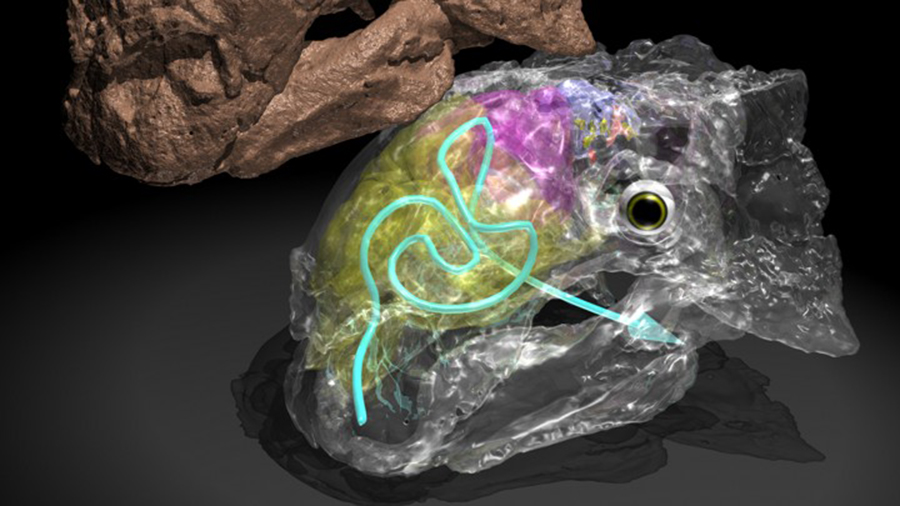
A model of the head of Euoplocephalus, showing its convoluted nasal passages (LAWRENCE WITMER)

The late Cretaceous period, which ended 66 million years ago, was a rough-and-tumble time. Dinosaurs like ankylosaurus left reminders of brutishness in their fossilized armor. Spikes sprouted from their shoulders. Row after row of bony plates covered their backs. With low and well-protected bulks, tipping the scales at a ton or more, they were built like battle tanks.

Their heads, in contrast to their backs, were simple. Other dinosaurs have ornate frills and crests or jaws full of banana-size teeth. But the armored dinosaurs had small, boxy heads. Even dinosaur fans “don’t usually think much about” these skulls, said Jason M. Bourke, a vertebrate paleontologist at the New York Institute of Technology.

At least they hadn’t until some of Bourke’s colleagues, led by Lawrence M. Witmer at Ohio University, digitally pried open an ankylosaur skull. What the paleontologists found, according to a study published in the journal PLOS One, can explain how these walking tanks avoided boiling their brains under the prehistoric sun.

Using a CT scanner, Witmer tracked long, twisty airways that curled like “crazy straws,” Bourke said. No one knew exactly what these nasal loops were for: Perhaps the convolutions aided vocalizations or gave the animals a superior sense of smell.

There was a third possible explanation, which biologists call thermoregulation. Most vertebrate animals must maintain their bodies within a narrow range of temperatures. For smaller animals, especially those in cold climates, thermoregulation is often viewed as a way of preventing heat loss. However, large animals, who hold in lots of heat, have the opposite problem.
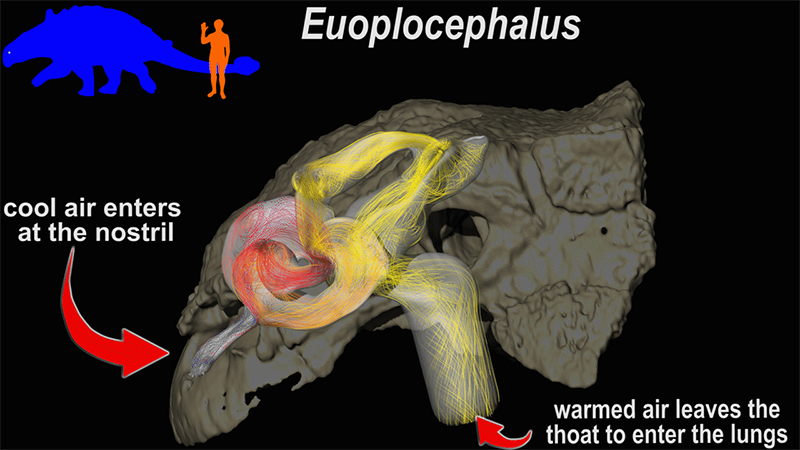
The heat exchange of air passing through the nasal cavity of the Euoplocephalus, an ankylosaur. (Witmer Lab/Ohio University)

Delicate organs like brains must be kept cool. “Neural structures really don’t like undergoing rapid changes in temperature,” Bourke said. The armored dinosaurs must have been particularly vulnerable. Not only were they bulky, which means they accumulated lots of body heat, but their smallish brains had a high ratio of surface area to volume, which means the heads could gain or lose heat readily. It wouldn’t take much to fry an ankylosaur noggin.

Bourke and Witmer, along with Wm. Ruger Porter, a postdoctoral researcher in Witmer’s lab, recently created a detailed computer model to follow heat as it passes through the animals' noses. Bourke, who conducted this work as part of his graduate research at Ohio University, is the first person to use computational fluid dynamics to model dinosaur nose tissues.

Thanks to CT scans of fossilized skulls that retained soft tissue, the scientists reconstructed the passageways and blood vessels of two armored dinosaur species. When they unwound the nasal straws in digital space, the passages, stretched end to end, were 1.4 to two times as long as the dinosaurs' skulls.

They also estimated how much energy it would take for a dinosaur to warm a breath of Cretaceous air, estimated to be about 60 degrees, to a body temperature of around 95 degrees Fahrenheit. Those temperatures are rough estimates, but logical ones. “Estimates for things like body mass, lung volume and body temperature, which feed into the parameters of the model, are justified based on the supporting literature,” said Caleb M. Brown, a paleontologist at the Royal Tyrrell Museum in Alberta, Canada, who was not involved with this work. Anyway, he said, the exact numbers aren’t important. “It is these overall trends that are important.”

To heat a single breath to the body temperature of an Euoplocephalus, an ankylosaurian dinosaur, required more than 1.5 calories. (About three breaths would burn the calories in a cup of lettuce.) Put another way, the looping passages draw heat from blood vessels. This warmed the air headed to the lungs while cooling the blood near the airway. A network of vessels, the study authors said, shuttled that chilled blood back toward the brain, like coolant water piped through a power plant.

This model “shows quite convincingly that the convoluted nasal passages of both armored dinosaurs would have efficiently warmed and moistened air on inhalation, and cooled and dried air on exhalation,” Brown said.

Though this is strong support for the thermoregulation hypothesis, the scientists haven’t ruled out multiple uses. Perhaps the winding noses lowered the timbre of their calls, too, Bourke said.

Armored dinosaur respiration was different from that in the largest animals alive today. An ankylosaurus the size of a rhino probably breathed about a third as frequently. Breathing in air through these passages meant it took a while for air to get to lungs. Bursts of high activity would have been difficult.

“They probably didn’t have to do a lot of running,” Bourke said. When they did, it’s possible they became mouth-breathers.

Source: www.washingtonpost.com
Scientists Study Fossil Evidence of Shark Hunting Flying Reptile Mid-Air

Thursday, December 20, 2018

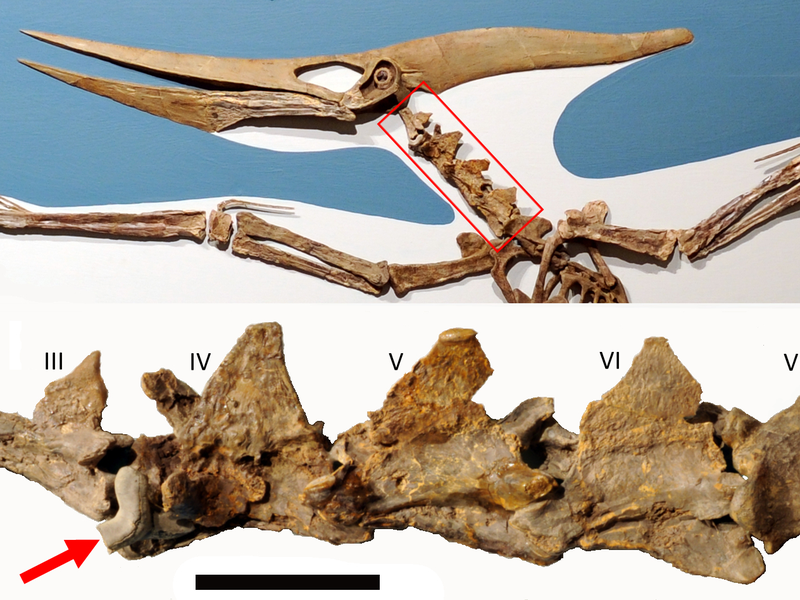
The red arrow points to where the prehistoric shark tooth got lodged in the pterosaur's neck. (David Hone)

A new study suggests that the winged reptile fell prey to a hungry predator lurking in the water.

In 1965, archaeologists working in the Smoky Hill Chalk region of Kansas discovered the fossil of a large Pteranodon, a pterosaur (or flying reptile) that soared through the air during the Late Cretaceous PeriodPteranodon remains are quite common in the fossil record; some 1,100 specimens have been found, more than any other prehistoric winged reptile. But there was something unusual about this particular specimen: it had a shark tooth lodged against its neck vertebrae.

Now, as Stephanie Pappas reports for Live Science, researchers have taken a closer look at the fossil to try and determine how the tooth came to be embedded in the Pteranodon remains. And the results of their inquiry, published in Peer J, suggest that this great predator of the sky may have fallen victim to a great predator of the sea.

The area where the Pteranodon fossil was discovered is a marine deposit created by the Western Interior Seaway, a huge waterway that once stretched from the Gulf of Mexico to Canada. After it was excavated, the Pteranodon was stored at the Los Angeles County Natural History Museum and eventually put on permanent display, shark tooth and all. It was a big creature, with a wingspan stretching more than 16 feet, and it weighed around 100 pounds. Like other members of its species, it had a crested skull and fed by catching fish in its pelican-like jaws.

The shark tooth, according to the study authors, belonged to the species Cretoxyrhina mantelli, a large and fearsome predator that stalked the Late Cretaceous seas. These sharks could grow as long as 23 feet, but the owner of the lost tooth was only around eight feet in length, based on the size of the tooth in question.

Two views of the Cretoxyrhina mantelli tooth with tracings. (David Hone)

When trying to figure out why the remains of two distinct animals were intertwined in the fossil record, the researchers had to consider the possibility that they were pulled together by the sea's currents. But Michael Habib, study co-author and a paleontologist at the University of Southern California, tells Pappas that sediment in the area suggests the waters were relatively calm millions of years ago. Additionally, the study authors write, “the spatial relationship between the tooth and the vertebra is complex and intimate, and unlike that expected to have occurred by chance association.” Other ancient shark species have also been known to feast on flying pteroaurs; earlier this year, a series of bite marks from the prehistoric Squalicorax shark were found on the wing bone of a Pteranodon.

The researchers thus suspected that the Cretoxyrhina mantelli shark had taken a hefty bite out of the pteranodon, losing its tooth in the process. It is possible, they study authors say, that the shark was simply scavenging on a pteranodon carcass. But it is also possible that the pteranodon was actively hunted.

Today’s sharks are known to dramatically breach the water while pursuing prey, but Habib tells Atlas Obscura’s Matthew Taub that the ancient Cretoxyrhina mantelli probably didn’t have to leap out of the sea to catch the pteranodon mid-flight. Pteranodons are thought to have hunted by diving after fish or scooping them up from an alighted position on the water. The winged reptile’s feeding habits, in other words, brought it within range of hungry sharks lurking below the surface.

According to the study authors, an unsuspecting pteranodon would have been no match for even a mid-sized Cretoxyrhina mantelli. “[W]e have little doubt that such predators could subdue these pterosaurs if they caught them,” they write.

Though it is impossible for the researchers to come up with a definitive story of how the pteranodon met its end, the implications of their hypothesis are important to the study of the species. It is rare to find signs of predation on Pteranodon skeletons; only seven of the more than 1,000 known specimens show evidence of predator-prey interaction. The new study also suggests that there may be parallels between the hunting behaviors of today’s sharks, which are known to prey on sea birds, and those that swam through ancient waters.

“Understanding the ecology of these animals is important to understanding life on Earth through time,” Habib says. “We now know sharks were hunting flying animals as long ago as 80 million years.”

Source: www.smithsonianmag.com

Saltriovenator zanellai: New Carnivorous Dinosaur Unveiled

Friday, December 21, 2018

Life reconstruction of Saltriovenator zanellai. Image credit: Davide Bonadonna.

A partial skeleton of a ceratosaurian theropod dinosaur unearthed over two decades ago in Italy has been recognized as belonging to a new genus and species.

The newly-identified dinosaur belongs to Ceratosauria (ceratosaurs), a group of large-bodied theropod dinosaurs.

Named Saltriovenator zanellai, it lived approximately 198 million years ago (Early Jurassic epoch).

With an estimated body length of 25 feet (7.5 m), it is the largest and most robust theropod from the Early Jurassic, pre-dating the occurrence in theropods of a body mass approaching 1,000 kg by over 25 million years.

The ancient creature is also the oldest known ceratosaur and is the first Jurassic dinosaur known from Italy.

Selected elements used in the diagnosis of Saltriovenator zanellai: right humerus in medial (A), frontal (B) and distal (C) views; (D) left scapula, medial view; (E) right scapular glenoid and coracoid, lateral view; (F) furcula, ventral view; tooth, labial (G) and apical (H) views; (I) left humerus, medial view; right second metacarpal in dorsal (J), lateral (L) and distal (N) views; first phalanx of the right second digit in dorsal (K), lateral (M) and proximal (O) views; (P–T) right third digit in proximal, dorsal and lateral views; (U) right distal tarsal IV, proximal view; third right metatarsal in proximal (V) and frontal (X) views; second right metatarsal, proximal (W) and frontal (Y) views; (Z) reconstructed skeleton showing identified elements (red). Abbreviations as in text, asterisks mark autapomorphic traits. Scale bars – 10 cm in (A)–(E), (I), and (U)–(Y); two cm in (F), and (J)–(T); one cm in (G). Image credit: G. Bindellini / C. Dal Sasso / M. Zilioli / M. Auditore.

The partial skeleton of Saltriovenator zanellai was accidentally discovered in 1996 by Angelo Zanella, fossil amateur and collaborator of the Museo di Storia Naturale di Milano, in a huge quarry located in the Alpine foothills, at the Swiss-Italian border near Saltrio, less than 50 miles (80 km) north of Milan, Varese Province, Lombardy.

Many bones of the dinosaur bear feeding marks by marine invertebrates, which represent the first case on its remains and indicate that its carcass floated in a marine basin and then sunk, remaining on the sea bottom for quite a long time before burial.

“Although fragmentary, Saltriovenator zanellai shows a mosaic of ancestral and advanced anatomical features, respectively seen in the four-fingered dilophosaurids and ceratosaurs, and the three-fingered tetanuran theropods, such as allosaurids,” said Dr. Cristiano Dal Sasso, a paleontologist at the Museo di Storia Naturale di Milano.

“Paleohistological analysis indicates that Saltriovenator zanellai was a still growing subadult individual, therefore its estimated size is all the more remarkable, in the context of the Early Jurassic epoch,” added Dr. Simone Maganuco, also from the Museo di Storia Naturale di Milano.

“The evolutionary ‘arms race’ between stockier predatory and giant herbivorous dinosaurs, involving progressively larger species, had already begun 200 million of years ago.”

“The grasping hand of Saltriovenator zanellai fills a key gap in the theropod evolutionary tree: predatory dinosaurs progressively lost the pinky and ring fingers, and acquired the three-fingered hand which is the precursor of the avian wing,” said Dr. Andrea Cau, a researcher at the Museo Geologico ‘Giovanni Capellini.’

The discovery of Saltriovenator zanellai is reported in the journal PeerJ.

_____

C. Dal Sasso et al. 2018. The oldest ceratosaurian (Dinosauria: Theropoda), from the Lower Jurassic of Italy, sheds light on the evolution of the three-fingered hand of birds. PeerJ 6: e5976; doi: 10.7717/peerj.5976

Source: www.sci-news.com

Sue the T. rex — Now With More Bones! — Goes Back on Display

Wednesday, December 19, 2018

Sue has new digs, more bones and a new pose in its new exhibit opening Friday at the Field Museum. | Field Museum/Martin

The largest and most complete Tyrannosaurus rex skeleton ever found is making its debut (again) at the Field Museum — and it’s now even more complete than before.

Sue the T. rex back on display to the public. The T. rex had been living in Stanley Hall on the main floor for nearly two decades, but the fossil is taking up permanent residence upstairs in the Griffin Halls of Evolving Planet exhibit. Her new digs — and new look — were unveiled to the media.

The Field Museum began the de-installation of SUE the Tyrannosaurus rex from Stanley Field Hall earlier this year. | Sun-Times file photo

Officials at the Field Museum say it took years of planning to get Sue’s new exhibit just right. The T. rex gets its name from Sue Hendrickson, who is credited with the dinosaur’s discovery in South Dakota in 1990. Sue has no known gender, but in the years since the Field Museum acquired the fossil for a record-breaking $8.4 million in 1997, experts have learned a lot about T. rex dinosaurs, the museum said in a press release. The new 5,100-square-foot suite incorporates that research and better introduces visitors in the daily life of a 40-foot dinosaur, officials said.

Some of that research includes the addition of a missing puzzle piece: gastralia, a set of bones previously left off Sue  because scientists weren’t sure how to mount them. Scientists believe the bones, which resemble a rib cage, helped the dinosaur breathe. Sue has a new walking pose and its wishbone was adjusted.

“When SUE was discovered, scientists didn’t know exactly how the gastralia fit onto the skeleton, so they were left off,” says Pete Makovicky, the museum’s curator of dinosaurs. “Thanks to the research we’ve been doing on Sue for the last 20 years, we now know what they were for and where they should go.”

In the new exhibit, visitors will be immersed in Sue’s surroundings from the Cretaceous period 67 million years ago, including other life forms from the time. The exhibit offers multimedia presentations on everything from how Sue hunted and interacted with other dinosaurs — to how Sue pooped. Her mounted pose has also been changed.

Sue before (left) and after. Changes include an added set of belly ribs and updates in posture. JOHN WEINSTEIN/FIELD MUSEUM

Sue had been on display in Stanley Hall since May 2000. In early February 2018, scientists began to disassemble the mammoth fossil to make way for a model of a 122-foot titanosaur the museum acquired last year and put on display the summer of that year.

Sue’s comings and goings have been featured on its Twitter account, @SUEtheTrex, which has gained nearly 50,000 followers since the fossil started tweeting in 2009. Sue tweeted: “I’m back on display this week and everything else pales in comparison right now.”

Sue’s colorful new digs feature renderings of environments they once roamed. MARTIN BAUMGAERTNER/FIELD MUSEUM

Source: https://chicago.suntimes.com

After 80 Million Years, Oregon's First Dinosaurs 'Discovered' Within Weeks of Each Other

Wednesday, December 19, 2018

John Griffith/Special to The Oregonian

In November 2018, we reported that a researcher from the University of Oregon made the first discovery of a dinosaur fossil in Oregon, a monumental find for a state that was covered by an ocean when the prehistoric creatures roamed the earth.

The fossil in question was discovered in central Oregon, near the town of Mitchell, by Greg Retallack, a researcher from the university. The find was described as "the first Oregon dinosaur fossil ever reported in a peer-reviewed scientific journal' in a post on the university's website.

Those last five words are an important caveat, though, says Dave Taylor, previously a researcher at U of O and now president of the Northwest Museum of Natural History.

After the November story was posted, Taylor emailed the Oregonian/OregonLive to point out that a fossil was discovered at Oregon's Cape Sebastian in the mid-1960s, excavated in the 1990s and was, just recently, confirmed to be that of a duck-billed dinosaur.  

A discovery in fits and starts

In the early 1960s, Taylor said, a crew from the U.S. Geological Survey happened upon the fossil at Cape Sebastian, an outcropping of sandstone near Gold Beach on Oregon's southern coast.

In 1969, a pair of professors from the University of California, Berkeley, traveled north to inspect the fossil and confirmed that it was the sacrum, or fused vertebrae, of a duck-billed hadrosaur.

And then the fossil sat in the rock for nearly 30 years, much as it had for the previous 80 million or so, before Taylor and a team went back to the cape in 1994 to excavate the ancient bone.

"The fossil appeared in grainy, brownish-gray relief, like a rock inlay, in the otherwise light gray slab of sandstone at the tip of the cape," The Oregonian reported in 1994. "At low tide on a calm day, it was 15 feet above the crests of the gently rolling swells. Just above it, the forested nose of the cape rose sharply toward U.S. 101."

More than 2 feet long and roughly 70 pounds, getting the fossil out of the rock proved no easy task. With the help of a cadre of volunteers, many of them children from around Oregon, Taylor pulled the fossil from the rock and showed it to a number of experts, all of whom agreed that the bone came from a hadrosaur.

And then he brought it up to Portland where, again, it would sit for a three-decade spell before he could turn his attention to it.

It wasn't until he retired in 2013 that Taylor finally had time to prepare the fossil, carefully chipping away at the sandstone that still clung to it, for description in a peer-reviewed paper. 

A second 'first'

In 2015, while Taylor was working to prepare the Cape Sebastian fossil, University of Oregon earth sciences Professor Greg Retallack was in central Oregon, leading a field expedition of students looking for fossilized plants near the town of Mitchell at a hotspot for ancient rocks called the Hudspeth Formation.

The group came upon a pile of ammonites, spiral shaped sea creatures that went extinct around the same time as the dinosaurs. Sitting there, on top of the pile, was a bone, Retallack recounted.

"I knew immediately what it was," he said. "The students were a bit mystified, but I was thrilled."

Kristin Strommer, publicist for the University of Oregon's Museum of Natural and Cultural History, poses with the fossil. Courtesy/University of Oregon

The fossil, a toe bone, belonged to a creature called an ornithopod, a 17-foot-long herbivore that weighed up to 1,500 pounds and walked on two legs. The fossil is thought to be roughly 103 million years old, dating back to the Cretaceous period.

Back then, the Pacific Ocean stretched far inland from the beaches we know today, and the coast started at the Blue Mountains in what is now eastern Oregon. The shoreline was rocky and rugged, and everything west of present day Wallowa was under water.

Courtesy/Liz White/University of Oregon

Source: www.oregonlive.com

Paleontologists Unveil New Herbivore Dinosaur Found In New Mexico

Wednesday, December 19, 2018

Crittendenceratops krzyzanowskii

Fossils unearthed in southern Arizona about 20 years ago have recently been identified as the bones of a new species of dinosaur.

Crittendenceratops krzyzanowskii, from the ceratopsid or horned dinosaur family, existed up to about 73 million years ago. It was named after the Fort Crittenden Formation in Tucson, Arizona where the fossils were found and the late Stan Krzyzanowski, a research associate at the New Mexico Museum of Natural History & Science.

Details of the discovery were published in the museum’s bulletin.

Discovery Of New Dinosaur Species

“We knew what kind of dinosaur it was, but we didn’t know it was that significant,” stated Spencer Lucas, a paleontology curator at the museum.

Krzyzanowski discovered two of the creatures back in the 90s at a mountain range in Arizona. In 2003, the researcher and his colleagues described the dinosaur in a study.

It had taken another 15 years before experts took one more look at the fossils and notice that they have stumbled upon a new species. Sebastian Dalman, also a research associate at the NMMNHS, explained that it was the dinosaur’s unique frills, the shield of bones on the side of its face, that caught their attention.

New Mexico Reveals New Dinosaur

The researchers behind the article said that the Crittendenceratops was a relative of the more popular Triceratops, but a lot smaller. The new dinosaur grew to about 11 feet long and was estimated to weight at around three-quarters of a ton.

In addition, the Triceratops lives at the end of the dinosaur era from 67 million to 65 million years ago. The Crittendenceratops lived until 73 million years ago.

According to the researchers, the new dinosaur thrived by the banks of a great lake along with mud turtles, alligators, duck-billed dinosaurs, and tyrannosaurs. Back then, Arizona was warm, wet, and had a rich environment where the Crittendenceratops found food.

While the dinosaur was thought to have evolved in Asia, it migrated and spread through much of western North America. Lucas, however, was surprised to know that bones of the animal were found so far south.

“Here we have one now way down in southern Arizona,” he stated. “We have added to the geographic range.”

Source: http://infosurhoy.com

Pterosaurs Had Four Types of Feathers, New Study Shows

Tuesday, December 18, 2018

Reconstruction of one of the studied Yanliao Biota pterosaurs, with four different feather types over its head, neck, body, and wings, and a generally ginger-brown color. Image credit: Yuan Zhang.

Pterosaurs lived side by side with dinosaurs, some 230 to 66 million years ago. They were the first vertebrates to achieve true flapping flight, but in the absence of living species, many questions concerning their biology and lifestyle remain unresolved. It has long been known that they had some sort of furry covering called ‘pycnofibers,’ and it was presumed that it was fundamentally different to feathers of dinosaurs and birds. An analysis of two pterosaur specimens with well-preserved pycnofibers shows that these flying reptiles had at least four types of feathers: simple filaments (hairs), bundles of filaments, filaments with a tuft halfway down and down feathers.

Birds have two types of advanced feathers used in flight and for body smoothing, the contour feathers with a hollow quill and barbs down both sides.

These are found only in birds and the theropod dinosaurs close to bird origins. But the other feather types of modern birds include monofilaments and down feathers, and these are seen much more widely across dinosaurs and pterosaurs.

“Our discovery has amazing implications for our understanding of the origin of feathers, but also for a major time of revolution of life on land,” said University of Bristol’s Professor Mike Benton, senior author of the study.

“When feathers arose, about 250 million years ago, life was recovering from the devastating end-Permian mass extinction.”

Integumentary filamentous structures in a pterosaur from Yanliao Biota: (a) overview, showing extensive preservation of soft tissues; (b-p) details of the integumentary filaments in the regions indicated in a on the head and neck (b-d, i and j), forelimb (f and g), wing (l and m) and tail (o and p), and illustrated reconstructions of the filaments (e, h, k and n). Scale bars – 20 mm in (a), 10 mm in (b), 500 µm in (c) and (i), 100 µm in (d), 1 mm in (f, l, m and p), 200 µm in (g) and (j), and 5 mm in (o). Image credit: Yang et al, doi: 10.1038/s41559-018-0728-7.

Professor Benton and co-authors studied two pterosaur specimens from the Middle-Late Jurassic Yanliao Biota (around 165–160 million years ago) in Inner Mongolia, China, and found many examples of all four types of feathers.

“We were able to explore every corner of the specimens using high-powered microscopes, and we found many examples of all four feathers,” said Nanjing University paleontologist Dr. Zixiao Yang, first author of the study.

“Some critics have suggested that actually there is only one simple type of pycnofiber, but our studies show the different feather types are real,” said co-author Dr. Maria McNamara, a researcher at University College Cork.

“We focused on clear areas where the feathers did not overlap and where we could see their structure clearly. They even show fine details of melanosomes, which may have given the fluffy feathers a ginger color.”

“We ran some evolutionary analyses and they showed clearly that the pterosaur pycnofibers are feathers, just like those seen in modern birds and across various dinosaur groups,” Professor Benton said.

“Despite careful searching, we couldn’t find any anatomical evidence that the four pycnofiber types are in any way different from the feathers of birds and dinosaurs. Therefore, because they are the same, they must share an evolutionary origin, and that was about 250 million years ago, long before the origin of birds.”

The study was published in the journal Nature Ecology & Evolution.

_____

Zixiao Yang et al. 2019. Pterosaur integumentary structures with complex feather-like branching. Nature Ecology & Evolution 3: 24-30; doi: 10.1038/s41559-018-0728-7

Source: www.sci-news.com

'Treasure Trove': 85 dinosaur Footprints Found in Southern England

Tuesday, December 18, 2018

A small theropod (carnivore) footprint. Credit: Neil Davies

More than 85 well-preserved dinosaur footprints—made by at least seven different species—have been uncovered in East Sussex, representing the most diverse and detailed collection of these trace fossils from the Cretaceous Period found in the UK to date.

The footprints were identified by University of Cambridge researchers between 2014 and 2018, following periods of coastal erosion along the cliffs near Hastings. Many of the footprints—which range in size from less than 2 cm to over 60 cm across—are so well-preserved that fine detail of skin, scales and claws is easily visible.

The footprints date from the Lower Cretaceous period, between 145 and 100 million years ago, with prints from herbivores including IguanodonAnkylosaurus, a species of stegosaur, and possible examples from the sauropod group (which included Diplodocus and Brontosaurus); as well as meat-eating theropods. The results are reported in the journal Palaeogeography, Palaeoclimatology, Palaeoecology.

Over the past 160 years, there have been sporadic reports of fossilised dinosaur footprints along the Sussex coast, but no new major discoveries have been described for the past quarter century and the earlier findings were far less varied and detailed than those described in the current research.

The area around Hastings is one of the richest in the UK for dinosaur fossils, including the first known Iguanodon in 1825, and the first confirmed example of fossilised dinosaur brain tissue in 2016. However, trace fossils such as footprints, which can help scientists learn more about the composition of dinosaur communities, are less common in the area.

A close up of skin impressions from an iguanodontian footprint. Credit: Neil Davies

"Whole body fossils of dinosaurs are incredibly rare," said Anthony Shillito, a Ph.D. student in Cambridge's Department of Earth Sciences and the paper's first author. "Usually you only get small pieces, which don't tell you a lot about how that dinosaur may have lived. A collection of footprints like this helps you fill in some of the gaps and infer things about which dinosaurs were living in the same place at the same time."

The footprints described in the current study, which Shillito co-authored with Dr. Neil Davies, were uncovered during the past four winters, when strong storms and storm surges led to periods of collapse of the sandstone and mudstone cliffs.

In the Cretaceous Period, the area where the footprints were found was likely near a water source, and in addition to the footprints, a number of fossilised plants and invertebrates were also found.

"To preserve footprints, you need the right type of environment," said Davies. "The ground needs to be 'sticky' enough so that the footprint leaves a mark, but not so wet that it gets washed away. You need that balance in order to capture and preserve them."

"As well as the large abundance and diversity of these prints, we also see absolutely incredible detail," said Shillito. "You can clearly see the texture of the skin and scales, as well as four-toed claw marks, which are extremely rare.

Two large iguanodontian footprints with skin and claw impressions. Credit: Neil Davies

"You can get some idea about which dinosaurs made them from the shape of the footprints—comparing them with what we know about dinosaur feet from other fossils lets you identify the important similarities. When you also look at footprints from other locations you can start to piece together which species were the key players."

As part of his research, Shillito is studying how dinosaurs may have affected the flows of rivers. In modern times, large animals such as hippopotamuses or cows can create small channels, diverting some of the river's flow.

"Given the sheer size of many dinosaurs, it's highly likely that they affected rivers in a similar way, but it's difficult to find a 'smoking gun', since most footprints would have just washed away," said Shillito. "However, we do see some smaller-scale evidence of their impact; in some of the deeper footprints you can see thickets of plants that were growing. We also found evidence of footprints along the banks of river channels, so it's possible that  played a role in creating those channels."

It's likely that there are many more dinosaur footprints hidden within the eroding sandstone cliffs of East Sussex, but the construction of sea defences in the area to slow or prevent the process of coastal erosion may mean that they remained locked within the rock.

More information: Anthony P. Shillito et al, Dinosaur-landscape interactions at a diverse Early Cretaceous tracksite (Lee Ness Sandstone, Ashdown Formation, southern England), Palaeogeography, Palaeoclimatology, Palaeoecology (2018). DOI: 10.1016/j.palaeo.2018.11.018

Source: https://phys.org

Scientists Are Excited Over These 'Weird' Feathers Preserved in 100-Million-Year-Old Amber

Tuesday, December 18, 2018

(Xing et al./Journal of Palaeogeography)

Feathers found in Burmese amber dating back 100 million years are so exquisitely preserved that palaeontologists have been able to make a detailed study of their structure - and they're like nothing seen in living birds today.

In fact, they may have served as a type of decoy, falling away in a predator's grasp, much like a lizard drops its tail to make its escape.

The feathers, found in 31 pieces of Myanmar amber dating back to the Cretaceous (commonly known as Burmese amber) were analysed by a team led by palaeontologist Lida Xing of the China University of Geosciences in Beijing.

You may remember Xing from such Burmese amber smash hits as 100 Million Year-Old Bird Trapped in AmberUnlucky Frogs Trapped in Amber are the Oldest Ever Found, and of course the absolutely epic A Feathered Dinosaur Tail Has Been Found Preserved in Amber.

These feathers now join this list of special finds. They're called tail streamers, and they're long feathers that extend from the tails of these ancient birds - sometimes even longer than the birds themselves.

Because modern birds also often have very long tail feathers for ornamental and mating purposes, it was thought that this is why Cretaceous birds had them, too.

But, although we've known about Cretaceous bird tail feathers for decades, most fossil specimens recovered have been squished flat, which makes a more detailed study of their purpose a little tricky.

The amber specimens - most of which show that the feathers occurred in pairs - are beautifully preserved in all three dimensions. So the team has been able to discern their strange morphology, and understand a little bit about how they might have been used by the birds.

"The way we interpreted these feathers from compression fossils was basically completely, entirely wrong. Looking at them in three dimensions preserved in amber, I was astonished," palaeontologist Jingmai O'Connor of the Institute of Vertebrate Paleontology and Paleoanthropology in Beijing told Science.

"They are the weirdest feathers I have ever seen."

They are dominated by the rachis, or central shaft of the feather (hence the other name they are known by, rachis dominated feathers, or RDFs). But, as the researchers have now ascertained, that rachis is quite different from the closed cylinder seen in modern birds.

Rather, it is open on the underside - like a C- or U-shape - with fewer barbs on either side than modern feathers. The rachis could also be incredibly thin - less than 3 micrometres in some cases (a human blood cell is 7 micrometres in diameter on average). Yet they still would have stuck out, straight and rigid.

The thinness and shape of the rachis leads the researchers to believe that the feathers would have had a lower energy cost to grow - a desirable trait if the feathers are disposable, as clues indicate.

For instance, some feather patterns surrounding the RDFs indicate that the feather struck the oozing sap with some force, while others were found without a sign of a dead bird nearby. According to the researchers, both of these features suggest the feathers were easy to remove.

They also weren't as colourful as you'd expect from a sexy tail feather.

"The apparent ease of removal and muted colours observed in amber RDFs may indicate a sacrificial role in defence, as well as usefulness in visual signalling," the researchers wrote in their paper.

"The reduced amount of material involved in building an elongate RDF with an open and thin-walled rachis may have helped to reduce the energetic costs of producing feathers that were in many cases as long as the total body length of their bearers."

However, the strange shape of the rachis seen in these feathers raises more questions - namely, whether the RDFs evolved from normal feathers, or whether they followed a different evolutionary pathway.

This question will, however, require the study of a larger number of RDF amber samples of exceptionally high quality to answer. Fingers crossed scientists can get their hands on some soon.

The team's research has been published in the Journal of Palaeogeography.

Source: www.sciencealert.com

The ROM’s New Rock Star: Meet Zuul the Dinosaur, Destroyer of Shins

Saturday, December 15, 2018

A replica of the armoured dinosaur Zuul crurivastator, left, stands ready for visitors at the Royal Ontario Museum.  MELISSA TAIT/THE GLOBE AND MAIL

Toronto museum visitors will get a glimpse of an amazing find: The most complete armour-plated dinosaur to be discovered on record. But getting Zuul crurivastator into the public eye was a complicated undertaking. Here’s how it was done.

Some dinosaur fossils – particularly the sharp-toothed, carnivorous kind – evoke a delicious sense of terror when viewed from behind a display-case glass. Who can stare at that rapacious reptilian grin and not wonder: “What if I had to face a live one of those?”

When visitors line up this week to catch a glimpse of the latest dinosaur acquired by the Royal Ontario Museum in Toronto, the feeling they are more likely to experience is respect.

While imposing to behold, the armour-plated reptile known as Zuul crurivastator was, nonetheless, an herbivore that munched peacefully on ferns and other plant stuff during the late Cretaceous period, about 76 million years ago. But it played a mean game of defence, thanks to the crushingly powerful bony club it wielded at the end of its long, muscular tail. That accounts for the second part of the creature’s scientific name, which is Latin for “shin destroyer.” (The first part, Zuul, is the name of a demonic beast in the original Ghostbusters movie, to which the dinosaur bears a passing resemblance.)

Judging by how many carnivorous dinosaurs have been unearthed with battered leg bones, it’s fair to assume that such a feature was not just for show. In the context of this week’s news, one imagines that tail swinging with a menacing force, rather like the paleo-equivalent of a U.S. House Speaker’s gavel keeping an angry president in check.

Length: 6 metres, weight: more than 2.5 tonnes  TRISH McALASTER / THE GLOBE AND MAIL  SOURCE/ILLUSTRATION: PALAEOARTIST DANIELLE DUFAULT, ROYAL ONTARIO MUSEUM

Zuul is a form of armoured dinosaur that paleontologists call Ankylosaurs. They are relatively rare, making up about 5 per cent of dinosaur finds. Zuul is even rarer, because it is a nearly complete specimen, including head and tail.

The evidence suggests it may have drowned in an ancient river and was buried on the sandy bottom rather quickly in successive floods during what would have been frequent tropical storms.

Because of its catchy name and dramatic backstory, Zuul now seems destined for a busy second life as a crowd-pleaser. But its public debut also marks the beginning of a behind-the-scenes scientific investigation that could ultimately reveal far more about dinosaurs than meets the museum-goer’s eye.

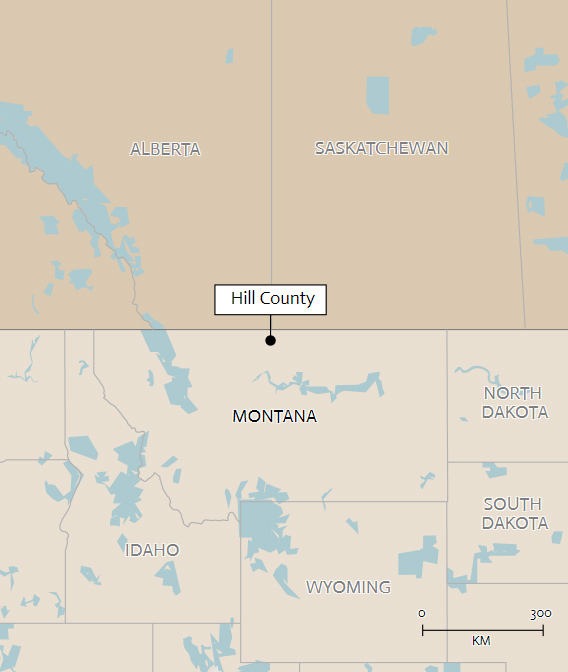
The reason for this has to do with the circumstances in which Zuul was discovered in 2016, when a team of professional fossil hunters working in northern Montana struck the end of its tail with a mechanical excavator. While this caused a bit of minor damage, it was a small price to pay for an unexpected find. At that point, the team was already working many metres deep into hard rock, where they were busy extracting another dinosaur specimen. Without that lucky strike, no one would ever have known Zuul was there.

“They found it thousands of years before it would have naturally eroded out,” says David Evans, a paleontologist and senior curator at the ROM. “And the fact that they found it so deep means it’s really well-preserved.”

TRISH McALASTER / THE GLOBE AND MAIL  SOURCE: TILEZEN; OPENSTREETMAP CONTRIBUTORS; HIU

In practical terms, Zuul’s remains are remarkably unweathered and untouched by plant roots, or unaffected by ice ages and the countless frosts and spring thaws that have played out above its rock coffin for so many millions of years. That makes Zuul a golden opportunity for scientists looking to extract any remaining organic material that is preserved along with dinosaur bones.

Until recently, such an idea was considered a fantasy, as unrealistic at the premise behind Jurassic Park, in which dinosaurs are brought back to life through their preserved DNA. Today, dino-DNA remains an unrealizable goal, owing to the fragility of the DNA molecule over geologic time. But what some exceptional dinosaur specimens may offer are traces of proteins that can be recovered from mineralized skin and bone and analyzed to reveal evolutionary details about the long-lost Age of Reptiles.

“We’ve got reams of data from multiple labs that tell us proteins can persist,” said Mary Schweitzer, a professor at North Carolina State University and a pioneer in the still-emerging field of molecular paleontology. “The question now is how can we access the information locked in the rock record?”

Dr. Schweitzer was part of a team that published a surprising report in the journal Nature last week, showing evidence for soft-tissue preservation in a 180-million-year-old marine reptile. Zuul is less than half as old and beautifully preserved. While it’s not yet known whether it may yield any traces of protein, Dr. Schweitzer said there is every reason to try.

In particular, she said, the dense cortical bones, at the ends of Zuul’s large limbs, where blood vessels are concentrated, would represent a prime location for proteins to linger.

Zuul's remains, which were found in Montana in 2016 (see map above), came with exquisitely preserved armour plating and soft tissue.  ROYAL ONTARIO MUSEUM/ROYAL ONTARIO MUSEUM

Meanwhile, once scientists cut into the massive block of sandstone containing Zuul, they found not only a near-complete skeleton, but fossilized bones and debris from many other species of animals and plants. In some cases, the tiny holes in fossilized leaves are so well-defined that it should be possible to say something about the insects that ate them based on the shapes of the minute bite marks they carry.

“It isn’t just Zuul,” Dr. Evans said. “It’s basically a whole world preserved.”

Source: www.theglobeandmail.com

Pages