Blogs

Smilodon

Sunday, June 18, 2017

Smilodon fatalis life-restoration

Smilodon is a genus of machairodont felid. It is one of the most famous prehistoric mammals, and the best known saber-toothed cat. Although commonly known as the saber-toothed tiger, it was not closely related to the tiger or other modern cats. Smilodon lived in the Americas during the Pleistocene epoch (2.5 mya–10,000 years ago). The genus was named in 1842, based on fossils from Brazil. Three species are recognized today: S. gracilisS. fatalis and S. populator. The two latter species were probably descended from S. gracilis, which itself probably evolved from Megantereon. The largest collection of Smilodon fossils has been obtained from the Rancho La Brea Tar Pits in Los Angeles, California.

S. populator (green), S. fatalis (purple), and S. gracilis (orange) shown to scale by Matthew Martyniuk

Smilodon was around the size of modern big cats, but was more robustly built. It had a reduced lumbar region, high scapula, short tail, and broad limbs with relatively short feet. Smilodon is most famous for its relatively long canine teeth, which are the longest found in the saber-toothed cats, at about 28 cm (11 in) long in the largest species, S. populator. The canines were slender and had fine serrations on the front and back side. The skull was robustly proportioned and the muzzle was short and broad. The cheek bones (zygomata) were deep and widely arched, the sagittal crest was prominent, and the frontal region was slightly convex. The mandible had a flange on each side of the front. The upper incisors were large, sharp, and slanted forwards.

S. populator skull and syntype canine from Lund’s collection, Zoological Museum, Copenhagen. Author: FunkMonk

Overall, Smilodon was more robustly built than any extant cat, with particularly well-developed forelimbs and exceptionally long upper canine teeth. Its jaw had a bigger gape than that of modern cats, and its upper canines were slender and fragile, being adapted for precision killing. S. gracilis was the smallest species at 55 to 100 kg (120 to 220 lb) in weight. S. fatalis had a weight of 160 to 280 kg (350 to 620 lb) and height of 100 cm (39 in). Both of these species are mainly known from North America, but remains from South America have also been attributed to them. S. populator from South America is perhaps the largest known felid at 220 to 400 kg (490 to 880 lb) in weight and 120 cm (47 in) in height. The coat pattern of Smilodon is unknown, but it has been artistically restored with plain or spotted patterns.

In North America, Smilodon hunted large herbivores such as bison and camels, and it remained successful even when encountering new prey species in South America. Smilodon is thought to have killed its prey by holding it still with its forelimbs and biting it, but it is unclear in what manner the bite itself was delivered. Scientists debate whether Smilodon had a social or a solitary lifestyle; analysis of modern predator behavior as well as of Smilodon‘s fossil remains could be construed to lend support to either view. Smilodon probably lived in closed habitats such as forests and bush, which would have provided cover for ambushing prey. Smilodon died out at the same time that most North and South American megafauna disappeared, about 10,000 years ago. Its reliance on large animals has been proposed as the cause of its extinction, along with climate change and competition with other species, but the exact cause is unknown.

Smilodon californicus fossil at the National Museum of Natural History, Washington, D.C. Author: Ryan Somma

Long the most completely known saber-toothed cat, Smilodon is still one of the best-known members of the group, to the point where the two concepts have been confused. The term “saber-tooth” refers to an ecomorph consisting of various groups of extinct predatory synapsids (mammals and close relatives), which convergently evolved extremely long maxillary canines, as well as adaptations to the skull and skeleton related to their use. This includes members of Gorgonopsia, Thylacosmilidae, Machaeroidinae, Nimravidae, Barbourofelidae, and Machairodontinae. Within the family Felidae (true cats), members of the subfamily Machairodontinae are referred to as saber-toothed cats, and this group is itself divided into three tribes: Metailurini (false saber-tooths); Homotherini (scimitar-toothed cats); and Smilodontini (dirk-toothed cats), to which Smilodon belongs. Members of Smilodontini are defined by their long slender canines with fine to no serrations, whereas Homotherini are typified by shorter, broad, and more flattened canines, with coarser serrations. Members of Metailurini were less specialized and had shorter, less flattened canines, and are not recognized as members of Machairodontinae by some researchers.

The earliest felids are known from the Oligocene of Europe, such as Proailurus, and the earliest one with saber-tooth features is the Miocene genus Pseudaelurus. The skull and mandible morphology of the earliest saber-toothed cats was similar to that of the modern clouded leopards (Neofelis).

Along with most of the Pleistocene megafauna, Smilodon became extinct 10,000 years ago in the Quaternary extinction event. Its extinction has been linked to the decline and extinction of large herbivores, which were replaced by smaller and more agile ones like deer. Hence, Smilodon could have been too specialized at hunting large prey and may have been unable to adapt.  A 2012 study of Smilodon tooth wear found no evidence that they were limited by food resources. Other explanations include climate change and competition with humans (who entered the Americas around the time Smilodondisappeared), or a combination of several factors, all of which apply to the general Pleistocene extinction event, rather than specifically to the extinction of the saber-toothed cats.

Source: www.Wikipedia.com, www.NatGeo.com

24 Interesting Facts About Dinosaurs

Sunday, June 18, 2017

1. Dinosaurs had giant fleas with beaks the size of modern syringe needles.

2. Researchers have calculated that DNA has a 521 year half-life, meaning the oldest clone-able samples of DNA could be no more than 2 million years old, ruling out any possibility of ever replicating dinosaurs, as the youngest dinosaurs were around more than 65 million years ago.

3. Earth’s rotation is slowing at a rate of approximately 17 milliseconds a century, and the length of a day for the dinosaurs was closer to 22 hours.

4. The time separating Stegosaurus and Tyrannosaurus is greater than the time separating Tyrannosaurus and us.

5. Canada is eliminating the penny, and has a collectible glow in the dark quarter with a dinosaur on it.

6. New research indicates the asteroid that killed the Dinosaurs did so, not primarily due to dust blocking out the sun, but by ejecting ~500 cubic miles of tiny glass spherules at near escape velocity. Upon falling to earth they incinerated nearly all surface life in a matter of minutes.

7. Only 59% of U.S. adults know humans and dinosaurs did not coexist.

8. Hans Larsson is a scientist who is trying to reactivate dormant dinosaur traits that linger in unexpressed bird genes. So far, he has managed to create chicken embryos that have teeth and long reptilian tails.

9. Taxonomically, modern-day birds aren’t just descended from dinosaurs, but are considered to BE dinosaurs.

10. The spikes at the end of a dinosaur’s tail are called the thagomizer, a term coined by Gary Larson in a 1982 Far Side comic.

11. Some dinosaurs, such as the Apatosaurus, may have been able to break the sound barrier with their tails, creating a sonic boom.

12. Prison officials has used the children’s song “I Love You” by Barney the Purple Dinosaur as a form of torture in Guantanamo Bay.

13. The blue whale, weighing in at 170 tons, is way bigger than any dinosaur ever was and probably the largest known animal to have ever existed.

14. Triceratops had a 15 horned cousin called Kosmoceratops that used to be native to what is now Utah.

15. Tyrannosaurus rex, VelociraptorGallimimus, Triceratops, and all other dinosaurs in the film Jurassic Park other than the Brachiosaurus, did not actually live during the Jurassic Period, but in the late Cretaceous Period.

16. The T.rex doesn’t even qualify as one of the 15 largest dinosaurs to walk the earth.

17. There’s a small town called Dinosaur, Colorado (USA). Some of its street names include Brontosaurus Blvd, Brontosaurus Bypass, Stegosaurus Freeway, and Tyrannosaurus Trail.

18. The Nigersaurus had +500 teeth: 50 columns with 9 replacement teeth behind them. The front ones would be worn out in just a month, making the Nigersaurus the fastest teeth-replacing dinosaur.

19. There is a Civil War/Dinosaur-themed amusement park in Natural Bridge, VA which features statues of Dinosaurs fighting Civil War Soldiers.

20. Seismosaurus is considered the largest dinosaur to ever have existed with a height of 84 feet, 150 foot long and weighing 150 tons.

21. During the Cretaceous period (145 – 100 million years ago), Earth’s climate was so warm that there were no polar ice caps, and forests probably extended all the way to the South Pole. Local plants and dinosaurs evolved to live in continuous sunlight in the summer and darkness in the winter.

22. Chinese villagers used to consume dinosaur fossils as medicine believing the fossils to be “flying dragon bone.”

23. The first dinosaur bone described in scientific literature was thought to be the femur of a giant human.

24. Nicolas Cage owned a copy of Action Comics 1, one of the most haunted houses in the world, and outbid Leonardo DiCaprio in an auction for a dinosaur skull.

The Return of Ian Malcolm in Jurassic World Sequel

Friday, January 5, 2018

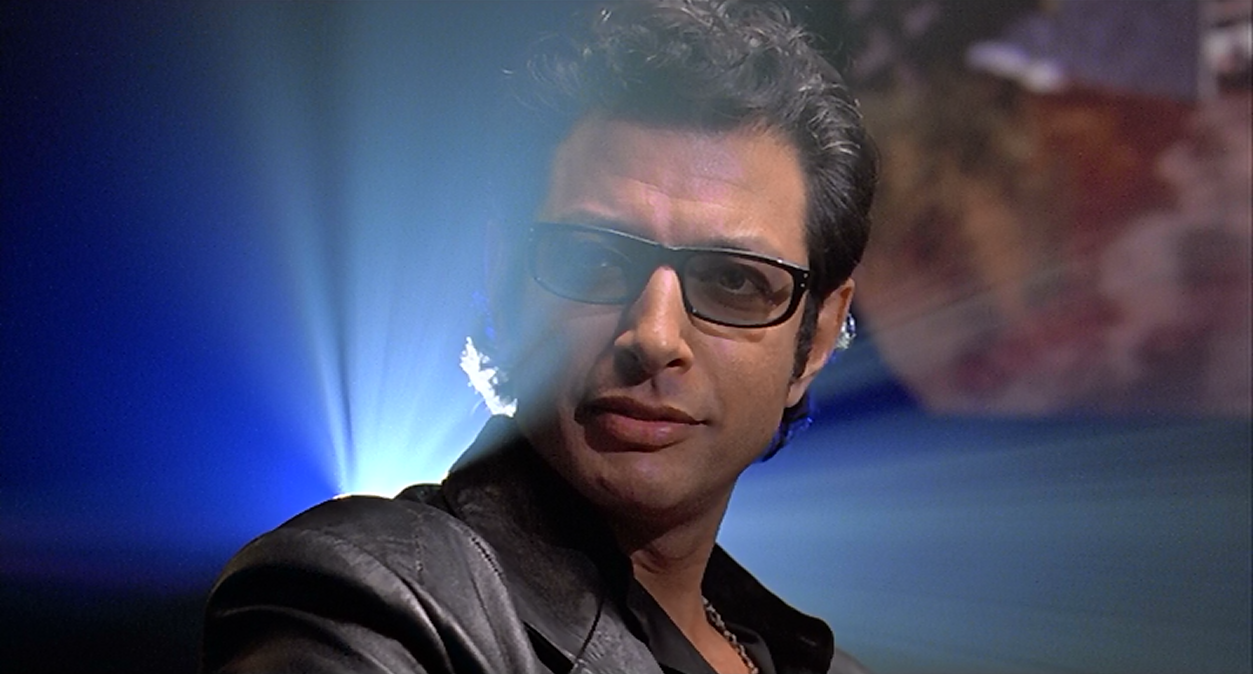
The upcoming Jurassic World sequel will see one important figure return to the franchise in Jeff Goldblum’s Dr. Ian Malcolm (who appears to be filming his part now if producer Frank Marshall’s tweet is accurate).

Speaking on the Happy Sad Confused podcast (via Screen Rant), producer and screenwriter Colin Trevorrow revealed that for Malcolm’s dialogue in the upcoming film he went back to the original source: Michael Crichton’s 1990 novel; with some input from Goldblum himself.

“You know, I did rely on [Michael] Crichton for a lot. I used a lot of Crichton dialogue. Maybe one of my highlights of this whole process is Goldblum. Jeff Goldblum called me – and I’m not going to do an impression – but he was like, ‘Look, I’ve added a couple of things, and I thought I’d perform it for you.’ [Laughs] Oh, great, okay. So, we sat on the phone for an hour as he ran these lines, and I talked about it. And, I mean, that’s – it was almost better than being there on set. It was great.”

Trevorrow went on to talk about the sequel as a whole and how it will differ from his 2015 film.

“It’s just deeper, more character-based, and it definitely leans into suspense, especially in the second half…It does have the big action in the middle. There’s a sequence in the middle that I’ve been watching – I mean, I watch dailies every day – but I’ve started to see stuff come together, and it’s just insane.”

He later quipped: “I apologize to those who thought they were never gonna need to see another Jurassic World movie because I think J.A. Bayona is gonna prove [them] wrong.”

Jurassic World 2 will see the return of Jurassic World‘s Chris Pratt and Bryce Dallas Howard alongside Toby Jones, Daniella Pineda, Justice Smith, Rafe Spall, Ted Levine, James Cromwell, Geraldine Chaplin and, reprising his Jurassic Park and The Lost World role, Jeff Goldblum as Dr. Ian Malcolm. The sequel arrives June 22, 2018.

Source: comingsoon.net

79 Interesting Facts About Dinosaurs

Saturday, June 17, 2017

Dinosaurs were reptiles that lived on Earth from about 230 million years ago to about 65 million years ago.

Dinosaurs lived during a period of Earth’s history called the Mesozoic (“middle life”) Era. They lived during all three periods of this era: the Triassic, Jurassic, and Cretaceous.

Meat-eating dinosaurs are known as theropods, which means “beast-footed,” because they had sharp, hooked claws on their toes. In contrast, plant-eating dinosaurs tended to have blunt hooves or toenails.

Dinosaur skulls had large holes or “windows” that made their skulls lighter. Some of the largest skulls were as long as a car.

Cast of a Carcharodontosaurus saharicus skull, Santa Barbara. Author: Franko Fonseca

Scientists estimate that there were over 1,000 different species of non-avian dinosaurs and over 500 distinct genera. They speculate there are many still undiscovered dinosaurs and that there may be as many as 1,850 genera.

Dinosaurs lived on all the continents, including Antarctica.

Colorado’s nickname is the Stegosaurus State. The first ever Stegosaurus skeleton was found near Morrison, Colorado.

Some of the biggest plant eaters had to eat as much as a ton of food a day. This is similar to eating a bus-sized pile of vegetation every day.

Though mosasaurs, ichthyosaurs, pterosaurs, plesiosaurs, and Dimetrodon are commonly believed to be dinosaurs, they are not technically dinosaurs. The term “dinosaur” refers to just land-dwelling reptiles that have a specific hip structure, among other traits.

While many people think dinosaurs were massive, dinosaurs were usually human sized or smaller. Scientists believe that the larger bones were just easier to be fossilized.

Some dinosaurs’ tails were over 45 feet long. Most dinosaurs had long tails that helped them to keep their balance when running.

The earliest named dinosaur found so far is the Eoraptor (“dawn stealer”). It was so named because it lived at the dawn of the Dinosaur Age. It was a meat eater about the size of a German shepherd. The first Eoraptor skeleton was discovered in Argentina in 1991. However, another dinosaur has recently been found in Madagascar that dates as being 230 million years old. It has not been named yet.

Dinosaurs are divided into two groups by the structure of their hipbones. In the hips of saurischian, or lizard hipped, dinosaurs, one of the bones pointed forward. In the hips of ornithischian, or bird-hipped, dinosaurs, all the bones pointed backward. Ironically, scientists believe that birds evolved from lizard-hipped dinosaurs, not bird-hipped dinosaurs.

The word “dinosaur” was coined by British paleontologist Richard Owen in 1842. It is Greek, meaning “terrible lizard.” Rather than implying that dinosaurs were fearsome, Owen used the term to refer to their majesty and size.

The first dinosaurs that appeared during the Triassic Period 230 million years ago were small and lightweight. Bigger dinosaurs such as Brachiosaurus and Triceratops appeared during the Jurassic and Cretaceous periods.

The dinosaur with the longest name is Micropachycephalosaurus (“small thick-headed lizard”). Its fossils are usually found in China.

Dinosaurs dominated Earth for over 165 million years. Humans have been around for only 2 million years.

Many scientists believe that a massive meteorite hit the Yucatan Peninsula of Mexico 65.5 million years ago and caused the extinction of the dinosaurs as well as the pterosaurs and plesiosaurs. The 112-mile-wide crater was caused by a rock 6 miles in diameter. It would have hit Earth’s crust with immense force, sending shockwaves around the world. No land animal heavier than a large dog survived. However, animals such as sharks, jellyfish, fish, scorpions, birds, insects, snakes, turtles, lizards, and crocodiles survived.

No one knows exactly how long a dinosaur’s lifespan was. Some scientists speculate some dinosaurs lived for as long as 200 years.

The mass extinction of the dinosaurs and other animals that took place 65.5 million years ago is known as the Cretaceous-Tertiary extinction event, or the K-T event. Scientists have several theories for this extensive die-off. One theory proposes that small mammals ate dinosaur eggs until the population became unsustainable. Other scientists believe the cause was dinosaurs’ bodies becoming too big for their small brains, a great plaque decimating the population, starvation, or climate change.

Mary Anning (1799-1847) was one of the most famous of all fossil hunters. However, she was never taken as seriously as she should have been because she was a woman from a poor background whereas most scientists were men from wealthy families.

Scientists believe that some dinosaurs were cold blooded, others warm blooded, and still others not fully one or the other. Small meat eaters may have been warm blooded. Plant eaters who were not as active were probably cold blooded. A warm-blooded animal needs about 10 times more food than a cold-blooded animal the same size.

Explorer Roy Chapman Andrews found the first dinosaur nest known to science in 1923 in the Gobi Desert of Mongolia. Before he found the nest, scientists were unsure how dinosaur babies were born.

The largest dinosaur eggs were as large as basketballs. The bigger the egg, the thicker the shell. So if the eggs had been larger, dinosaur babies probably would not have been able to get out.

This oviraptorid dinosaur, Citipati osmolskae, may have been protecting a nest of eggs.

The first dinosaurs were carnivores, or meat eaters. Later herbivores (plant eaters) and omnivores (both meat and plant eaters) appeared.

Triceratops had the biggest skull with a solid shield than any other dinosaur. It was up to 6½ feet (2 m) long, with a bony shield over its neck.

Most dinosaurs were vegetarians.

The Stegosaurus has the smallest brain for its body size of any known dinosaur. Its body was the size of a van, but its brain was the size of a walnut.

One tribe of Native Americans—the Peigan people of Alberta, Canada—thought dinosaur skeletons belonged to “the fathers of buffaloes.” Englishmen 300 hundred years ago believed dinosaur bones came from an elephant or even giant humans.

The first recorded description of a possible dinosaur bone discovery dates back to 3,500 years ago in China. At the time, people did not know about dinosaurs, so they thought their discovery, which was some dinosaur teeth, belonged to dragons.

Measuring 50 feet, Liopleurodon was the biggest aquatic reptile, half the size of the blue whale.

Most meat-eating dinosaurs had bones filled with air. Though their bones were huge, they weren’t as heavy as they looked. Birds have the same kind of hollow bones.

Baby Mussaurus (“mouse lizard”) are the smallest dinosaur skeletons ever found. They would fit inside a shopping bag.

Small meat eaters were most likely the smartest type of dinosaurs.

Humans’ eyes face forward so that they can see in 3D. Plant-eating dinosaurs, like the Triceratops, had eyes looking out to each side, so they could watch for danger while they fed.

A newborn human baby has a bigger brain than most adult dinosaurs had. Whales and dolphins have the biggest brains of all living animals.

Most meat eaters walked on two feet. This made them faster and left their hands free to grab their prey. Most plant eaters walked on four feet to better carry their heavy bodies. Some plant eaters could balance on two feet for a short time.

Snakes and lizards shed their skin when they grow. Researchers believe that dinosaurs may have done the same.

Some dinosaurs may have had colorful skin, but scientists don’t know for sure. It’s likely that most dinosaurs had green and brown scales to help them hide among trees and plants.

Tyrannosaurus rex had huge back legs, but its tiny front legs were not much longer than human arms.

While dinosaurs had the same set of leg bones, some had feet like a rhinoceros, elephant, bird, or a pig. The biggest footprints ever found were 3 feet (1 m) across and 4 feet long. Millipedes have more legs than any other animal—up to 750.

Dinosaurs often swallowed large rocks. These rocks stayed in the stomach and helped them grind up food.

Tyrannosaurus rex ate up to 22 tons of meat a year. It had jagged teeth 6 inches (15 cm) long. It couldn’t chew, so it swallowed its food in large chunks.

Deinosuchus was a huge prehistoric crocodile. It most likely had the strongest bite out of any dinosaur, including Tyrannosaurus rex. It weighed eight times as much as today’s crocodile.

Corythosaurus had a big, hollow crest connected to its nose. The crest worked like an echo chamber, letting it make a loud blast of noise.

Sauropods were the tallest animals that ever lived. Some were more than twice the height of a giraffe.

Struthiomimus (“ostrich mimic”), as well as other small hunters, made high-pitched, screechy noises similar to an ostrich.

Parasaurolophus had a crest that looked like half of a trombone. The male’s crest was up to 6 feet (1.8 m) long, which was the biggest out of all the dinosaurs.

Some scientists believe that Tyrannosaurus rex may have been able to run as fast as 18 mph (28 km/h). Other scientists believe it could not run at all because it was so big.

Slim dinosaurs such as Compsognathus and Ornithomimus were among the fastest dinosaurs. However, the cheetah can run faster than any dinosaur that existed.

Dinosaurs that could run on two legs were called bipeds.

Dinosaurs had different self-defense mechanisms. Some, like meat eaters, had sharp teeth. Plant eaters had long horns or sharp spikes. Other dinosaurs were covered in bony plates.

It is estimated that trillions of dinosaur eggs were laid during the Mesozoic era, though fossilized eggs containing embryos are rare.

All dinosaurs laid eggs. About 40 kinds of dinosaur eggs have been discovered.

Modern birds and reptiles have a single body opening for urination, defecation, and reproduction: a cloaca (Latin for “sewer”). Paleontologists believe that dinosaurs were similarly designed and reproduced by pressing their cloacas together in a “cloacal kiss.” Additionally, some dinosaurs may have had a penis like some birds do or other “intromittent organs” like crocodiles. Paleontologists believe a Tyrannosaurus rex male reproductive organ might have been up to 12 feet in length.

Like birds and reptiles today, dinosaurs built nests and laid eggs. Some even fed and protected their babies.

Plant-eating dinosaurs often lived together for protection, like herding animals today do. The herds ranged from just a few adults and their young to thousands of animals.

Sauropods (“Lizard-Footed”) could travel many miles a day on their huge legs. Their fossilized “trackways” or “superhighways” can still be seen today.

The Megalodon was the biggest prehistoric fish. It looked like a shark, though it was three times bigger.

Dinosaurs that lived near water often left the best fossils.

The biggest hunter was the Spinosaurus (“spine lizard”). It was up to 49 feet (15 m) long.

The biggest plant eater was the Argentinosaurus. It was up to 98 feet (30 m) long.

The tallest plant eater was the Brachiosaurus (Giraffatitan brancai). Its head was up to 39 feet (12 m) off the ground.

The dinosaur with the thickest skull was the Pachycephalosaurus. Its skull grew up to 8 inches (20 cm) thick.

The Pentaceratops had the biggest skull at 10 feet (3 m) long.

The toothiest dinosaur was the hadrosaurs. It could have over 1,000 teeth and it continually grew new ones.

The biggest flying reptile was the Quetzalcoatlus. It had a wingspan up to 39 feet (12 m).

Quetzalcoatlus by Prehistoric Wildlife

The dinosaur with the longest claws was the Therizinosaurus (“reaping lizard”). Its claws were up to 3 feet (1 m) long.

The tallest hunter was the Deinocheirus (“horrible hand”). Its head was up to 20 feet (6 m) off the ground.

The fastest dinosaur was the Ornithomimus. It could run up to 43½ mph (70 km/h).

The largest mounted dinosaur skeleton to be exhibited in a museum is a Brachiosaurus.

Stegosaurus had huge upright plates on its back that could grow as large as 30 inches. While scientists do not fully understand the function of these massive plates, they speculate that the stegosaurus could control its body temperature by regulating blood flow through them. A stegosaurus may have also been able to control its skin color this way, to either attract a mate or scare predators. Scientists call this color change “blushing.”

The smallest fully grown dinosaur fossil is Lesothosaurus (“Lizard from Lesotho”). It is only the size of chicken. Smaller fossils have been found, but they are of baby dinosaurs.

The smallest dinosaur egg ever found was only 3 centimeters long and weighed 75 grams. It is not known what kind of species it came from. The largest dinosaur eggs ever found belong to a meat eater in Asia called segnosaurus (“slow lizard”). The eggs are around 19 inches long.

The smartest dinosaur was probably the Troodon (“tooth that wounds”). It had a brain the size of a mammal or bird today. It also had grasping hands and stereoscopic vision.

The first known American dinosaur was discovered in 1858 in the marl pits in Haddonfield, New Jersey. Although other fossils were previously found, they were not correctly identified as dinosaur fossils.

There was such fierce rivalry between paleontologists Edward Cope and Othniel Marsh to find new dinosaurs fossils that they spawned what became known as the Bone Wars. The fight lasted for over 30 years. Marsh is said to have “won” the wars, in part because he found more fossils and he was better funded.

Paleontologists are not perfect. For example, Gideon Mantell (1790-1852) put Iguanodon’s thumb claw on top of its nose. It stayed that way for 40 years. Edward Cope (1840-1897) reconstructed Elasmosaurus (“thin plate”) with its head on the end of its tail. Until recently, Apatosaurus appeared in museums with the head of Camarasaurus (“chambered lizard”).

Current dinosaur fossil “hot spots” include South America (particularly Argentina) and China, where several feathered dinosaurs have been found.

Source: www.Wikipedia.org, www.NatGeo.com

Yangchuanosaurus

Thursday, June 15, 2017

Artist's impression of Yangchuanosaurus shangyouensis

Yangchuanosaurus is a genus of metriacanthosaurid theropod dinosaur that lived in China during the Bathonian and Callovian stages of the Middle Jurassic, and was similar in size and appearance to its North American relative, Allosaurus. It hails from the Upper Shaximiao Formation and was the largest predator in a landscape which included the sauropods Mamenchisaurus and Omeisaurus as well as the Stegosaurs ChialingosaurusTuojiangosaurus and Chungkingosaurus. It got its name after its discovery site in Yongchuan, in China.

The type specimen of Y. shangyouensis had a skull 82 cm (2.7 ft) long, and its total body length was estimated at about 8 m (26 ft). Another specimen, assigned to the new species Y. magnus, was even larger, with a skull length of 1.11 m (3.6 ft). It may have been up to 10.8 m (35.4 ft) long, and weighed as much as 3.4 metric tons (3.7 short tons). There was a bony ridge on its nose and multiple hornlets and ridges, similar to Ceratosaurus.

Yangchuanosaurus was a large, powerful meat-eater. It walked on two large, muscular legs, had short arms, a strong, short neck, a big head with powerful jaws, and large, serrated teeth. It had a long, massive tail that was about half of its length. Its feet had three toes, each with a large claw. Its arms were short.

Delaware Museum of Natural History Wilmington. Author: Jim, the Photographer

Yangchuanosaurus zigongensis is known from four specimens including ZDM 9011 (holotype), a partial postcranial skeleton; ZDM 9012, a left maxilla; ZDM 9013, two teeth and ZDM 9014, a right hind limb. It was first described by Gao (1993), and all specimens were collected from the Middle Jurassic Xiashaximiao Formation in the Dashanpu Dinosaur Quarry of Zigong, Sichuan. A phylogenetic analysis by Carrano et al. (2012) found Yangchuanosaurus to be the basalmost known metriacanthosaurid and the only non-metriacanthosaurine metriacanthosaurid.

10 Facts You Don’t Know About Spinosaurus

Saturday, June 10, 2017

Spinosaurus, National Geographic Kids

Spinosaurus is one mysterious critter. Why don’t we know more about it? Blame the British (seriously). Here are 10 remarkable factoids about this incredible dino.

1. It Was One of the Largest Carnivorous Dinosaurs of All Time.

Spinosaurus was big. Just how big, exactly? That’s difficult to ascertain, since, to date, no complete skeletons have been unearthed. Some estimate that a large adult could be almost 50 feet long, but the general consensus holds that a maximum length nearer to 41 to 43 feet is far more likely.

2. Spinosaurus was Chosen as the Villain in Jurassic Park III Because of Its Weird Profile.

“A lot of dinosaurs have a very similar silhouette to the T. rex,” said director Joe Johnston, who’d been looking for a new reptilian antagonist to replace Tyrannosaurus in the third film, “and we wanted the audience to instantly recognize this as something else.”

3. Some of the Creature’s Dramatic Spines Were Over Five Feet Tall.

Illustrations of the vertebrate “sail” bones of Spinosaurus that appeared in one of Stromer’s monographs. Courtesy of Munich Museum of Paleontology

When you’ve got accessories like these things—known scientifically as “neural spines”—sticking out of your vertebrae, nobody tells you to “show some backbone.”

4. Spinosaurus Wasn’t the Only Sail-Backed Dino.

Ouranosaurus nigeriensis, Royal Ontario Museum, Toronto, Ontario, Canada

Ouranosaurus (pictured above) was a majestic African herbivore complete with a series of similar-looking spines. Additionally, one enigmatic beast by the name of Deinocheirus appears to have had some too.

5. Paleo-Artists Mis-Drew Its Head For Almost Eighty Years.

A very 80’s Spinosaurus messily chows down on an Ouranosaurus carcass. Babble Trish

Dinosaur drawings have fairly short shelf-lives (at least in the accuracy department). Until some groundbreaking new discoveries were made in the 1990s and 2000s, paleontologists lacked any good Spinosaurus skull material. Some decently-preserved Spino remains had been found nearly eight decades earlier, but they didn’t include a head. Artists, therefore, gave an educated guess and largely portrayed it with a Tyrannosaurus-like skull for most of the 20th century. It was an honest mistake. We now know that Spinosaurus had, instead, a long, narrow snout—making these pictures obsolete.

6. Frustrated Paleontologists Named One of Its Close Relatives Irritator challengeri Out of Spite.

Reconstructed mount of Irritator challengeri

When dealing with fossils, some assembly is usually required. However, things got a bit extreme in 1995, when a team of scientists purchased the skull of an unknown dinosaur from a Brazilian fossil-poacher. The man had (most disingenuously) smothered the poor thing in a thick layer of car body filler to make his find look bigger than it actually was. As one can imagine, removing this substance proved highly “irritating” for the buyers, hence that strange scientific name.

7. Spinosaurus Has Been Featured on an Array of International Postage Stamps.

Spinosaurus stamps

It may be extinct, but Spinosaurus’ likeness sure does make for a great stamp—at least the governments of such countries as Liberia and Guyana seem to think so.

8. Spinosaurus Had Plenty of Menu Options.

Illustration of a Spinosaurus catching fish in a river. Thinkstock

Like an overgrown heron, Spinosaurus is generally thought to have snagged fishy treats from the North African mangroves it stalked some 97 million years ago. Having a mouth full of long, crocodile-like teeth certainly would’ve helped. But a 2013 paper argues that its diet would have allowed for a lot more variety. Since the animal’s jaws were imperfectly-designed for grappling with fish (at least compared to a modern alligator’s), Spinosaurus probably sought out other entrees as well.

9. Spinosaurus Had Some Really Big Competition.

Dinosaur in the Plants – Garfield Park Conservatory

No one knows exactly why Spinosaurus had that trademark sail on its back. However, with flesh-eating neighbors like the 26-foot Deltadromeus and the T. rex-sized Carcharodontosaurus sharing its habitat, this apparatus might’ve helped Spinosaurus scare off rival killers by making the creature look bigger or more intimidating than it actually was.

10. The Best Spinosaurus Fossils Ever Found Were Destroyed in World War II.

Ernst Freiherr Stromer von Reichenbach

In 1944, the most complete collection of Spinosaurus remains science has so far unearthed were obliterated by the British Royal Air Force. Thirty-two years earlier, they’d been sent to German paleontologist Ernst Freiherr Stromer von Reichenbach, who resided in Munich. Unfortunately, Stromer’s outspoken anti-Nazi sentiments doomed the fossils he cherished. In an act of retribution, Third Reich officials refused to let him move his collection to safer ground during the Second World War, and the museum that housed them was later bombed amidst an RAF raid.

Source: www.mentalfloss.com

Scientists Solve Mystery of Dinosaur Mass Grave

Friday, June 9, 2017

Cleveland-Lloyd Dinosaur Quarry

The abundance of allosaur fossils in the Cleveland-Lloyd Dinosaur Quarry has puzzled palaeontologists for decades, but a new study may have found the cause.

For paleontologists, the Cleveland-Lloyd Dinosaur Quarry in the US state of Utah has long been a site of broad abundance and deep mystery.

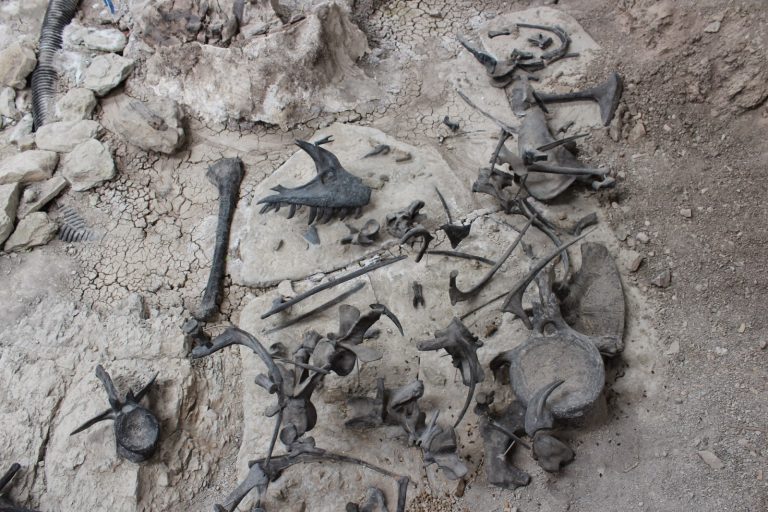
The quarry is crammed with Jurassic period fossils – in far greater quantity than those found at any other site so far discovered. If that wasn’t weird enough, the fossil debris is dominated by the massive predator species, Allosaurus.

Ever since the density of the fossil bed was first realized in 1927, scientists have been trying to work out why such an unusually large collection of dinosaurs – including more predators than should be feasible – died there.

Theories have included mass fatality events, perhaps caused by poisoned water or drought, or maybe a build-up over time caused by sucking, sticky mud.

Now two new and rigorous analytical approaches by a team led by Joseph Peterson, of the University of Wisconsin-Oshkosh, in Wisconsin, US, may at last have uncovered the answers.

Peterson and colleagues first subjected sediments in the quarry to X-ray fluorescence, and then minutely examined the abrasion patterns found on bone fragments scattered among the larger fossils.

Cleveland-Lloyd Dinosaur Quarry

The first approach yielded higher levels of barite and sulfide minerals, compared to the surrounding environment, and the second revealed that the bones had been damaged while being deposited on the site.

The appropriate conclusion, write the scientists in the journal  PeerJ, is that there was no mass fatality event – and no over-population of Allosaurus.

Instead, it is likely that most, if not all, of the dinosaurs died at different times some little distance from the quarry and were then washed into their final resting place by periodic flooding.

In Jurassic times, the team writes, the quarry was “an ephemeral pond”.

The finding neatly solves two other mysteries associated with the fossil site. The first is the lack of fish, turtle or crocodile fossils, which would be expected if the water body were permanent.

The second is the lack of gnaw marks on the dinosaur bones themselves. For some reason, the corpses weren’t attractive to carrion eaters.

The idea that the corpses, already rotting, were essentially washed into place, forming layer after putrid layer, suggests that the water, when present, was deeply foul.

The team confirmed potentially lethal levels of heavy metals in the old pond. In the past, these have been suggested as the cause of the dino deaths. Peterson and his colleague, however, suggest they were in fact a consequence of high levels of decomposition.

The Cleveland-Lloyd Dinosaur Quarry, it seems, was never a nice place to be.

Source: cosmosmagazine.com

‘Jurassic World 2’ Will Be the Franchise’s Scariest

Wednesday, June 7, 2017

We still don’t know very much about next year’s Jurassic World: Fallen Kingdom, but, however, what we already know is that director Juan Antonio Bayona (The OrphanageA Monster Calls) is bringing his horror sensibilities to the sequel, which is said to be both scarier than Jurassic World and packed with way more practical effects.

In a new chat with Cinema Blend, Jurassic World director Jurassic World 2 producer Colin Trevorrow spoke a bit about the sequel’s scary side, touching upon the reasons the dinosaurs will be more terrifying this time around.

J.A Bayona is very good at [creating scares],” he told the site. “There are things that he’ll just do with a shadow, or a rustling curtain on a wall. He’s so tapped into that kind of fear, especially the fear through the eyes of a child. He and I are just simpatico, as an American and a Spanish person. We may be the mirrors of each other. It is by far the most satisfying collaboration of my life.”

Trevorrow added, “First of all I think the mainstream loves being scared, and I think the scares in the first movie were made to make children think like they were seeing something horrifying, that their parents shouldn’t be allowing them to see. We have that a little bit here. But there’s also that same big, fun adventure, sweeping, romantic kind of action in part of the movie. That people seemingly responded really well to. We’re not throwing it all way, but we’re definitely going to some new places.”

Chris Pratt and Bryce Dallas Howard return for the sequel, which also stars Jeff Goldblum, Justice Smith, BD Wong, James Cromwell and Toby Jones.

Trevorrow wrote the script with Derek Connolly.

Producers Frank Marshall and Pat Crowley once again join executive producers Steven Spielberg and Trevorrow in the next chapter of the franchise. Belén Atienza is also producing.

We’ll return to the park on June 22, 2018.

Jurassic World Sequel Will Be A Better Movie

Wednesday, June 7, 2017

Colin Trevorrow directing Jurassic World

Jurassic World director Colin Trevorrow says the sequel – Jurassic World 2 – helmed by J.A. Bayona will be a better movie. Steven Spielberg launched the Jurassic Park franchise in 1993 with a film that has since become a classic in both the sci-fi and action/adventure genres – and is continued to be well-regarded for its use of practical effects, especially the movie’s lifelike animatronic dinosaurs. Trevorrow brought movie fans back to Isla Nublar in 2015 with Jurassic World, which picked up the story of Jurassic Park 20 years later at a point when John Hammond’s dinosaur theme park had become a reality.

Jurassic World received good reviews and was well received by movie fans, but its most outstanding success was at the box office. Jurassic World became one of the highest grossing films of all time, and the second top box office earner of 2015, only being surpassed by J.J. Abrams’ Star Wars: Episode VII – The Force Awakens, of course. A sequel to Jurassic World was announced not too long after the initial film hit theaters, with Trevorrow stepping down as director – though remaining on board as a co-screenwriter with Derek Connolly. It was later revealed A Monster Calls helmer J.A. Bayona will direct Jurassic World 2, which started filming earlier this year.

Now, in an interview with Screen Rant promoting his next upcoming feature, The Book of Henry, Trevorrow discusses the different style of Bayona compared to himself and how he was able to apply lessons learned on Jurassic World to its sequel:

He is a different director but it’s interesting, we have so many similar instincts as far as suspense and family and fears of childhood and the perspective that we want to tell the story from that even though I wrote the film, it’s J.A.’s movie from start to finish. He’s just – the film looks beautiful and is exciting. We’re using more animatronics because I learned so much about how they can be utilized, so I built scenes that would allow us to use them – because they can’t run, these are the lessons. Belén Atienza has been great as well, and it’s just been something that we’ve all delved in and tried to make something deeper and richer and ideally better. I’m going to be the hype man for this movie, I think it’s going to be a better movie – sorry.

Jurassic World 2 will see the return of Jurassic World heroes Owen Grady (Chris Pratt) and Claire Dearing (Bryce Dallas Howard), as well as the more villainous Dr. Henry Wu (B.D. Wong), who was responsible for creating the dangerous hybrid dinosaur Indominus Rex. In a return to Spielberg’s Jurassic Park, Jurassic World 2 will feature Jeff Goldblum, returning as the fan-favorite chaos theorist Dr. Ian Malcolm. The Jurassic World sequel has also added new characters played by James Cromwell, Justice Smith, Toby Jones, Rafe Spall, and Daniella Pineda.

In terms of plot, an official synopsis hasn’t been released yet, but those involved with the production have revealed Jurassic World 2 will deal with animal abuse and the sequel will be “scarier” than the first movie. The scarier tone of Jurassic World 2makes sense considering Bayona’s experience directing horror with The Orphanage and, as Trevorrow explains, he wrote the film to the director’s sensibilities:

That was by far the most rewarding creative experience of my life, just making a movie for another director who I respect. And I built it for him, so it’s different than maybe even the movie I would have written for myself. [It’s] a Spanish horror/thriller with dinosaurs in it. And I loved doing it.

So, although fans may not be sure what to expect from Jurassic World 2 in terms of plot, the Jurassic Park series installment is aiming for a unique tone – one that will no doubt intrigue fans of Bayona’s work as well as longtime fans of Universal’s dinosaur franchise. Of course, it remains to be seen if Jurassic World 2 is as big of a box office hit as its predecessor or as well liked by moviegoers. However, it seems Trevorrow is confident the sequel will outshine Jurassic World, which is certainly a good sign for Jurassic World 2.

Source: www.screenrant.com

10 Facts About Tyrannosaurus Rex

Thursday, May 25, 2017

April 14, 2014---The Nation's T. rex, one of the most complete Tyrannosaurus rex specimens ever found, is taking a 2,000-mile road trip from Montana to its new home in Washington, D.C. To prepare the dinosaur fossils for the journey, a team of experts from the U.S. Army Corps of Engineers, the Smithsonian's National Museum of Natural History, and the Museum of the Rockies packed and cataloged the hundreds of bones to ensure their safe arrival.

HOW MUCH DO YOU REALLY KNOW ABOUT TYRANNOSAURUS REX?

Tyrannosaurus rex is by far the most popular dinosaur, spawning a huge number of books, movies, TV shows, and even video games. What’s truly amazing, though, is how much about this carnivore that was once assumed as fact has lately been called into question, and how much is still being discovered. On the following slides, you’ll discover 10 fascinating facts Tyrannosaurus rex facts.

TYRANNOSAURUS REX WASN’T THE BIGGEST MEAT-EATING DINOSAUR

Most people reflexively assume that the North American Tyrannosaurus rex–at 40 feet from head to tail and eight  tons–was the biggest carnivorous dinosaur that ever lived, The fact is, though, that T. rex was outclassed by not one, but two, dinosaurs–the South American Giganotosaurus, which weighed about nine tons, and the northern African Spinosaurus, which tipped the scales at 10 tons. Sadly, these three theropods never had the chance to square off in combat, since they lived in different times and places.

THE ARMS OF TYRANNOSAURUS REX WEREN’T AS TINY AS YOU THOUGHT

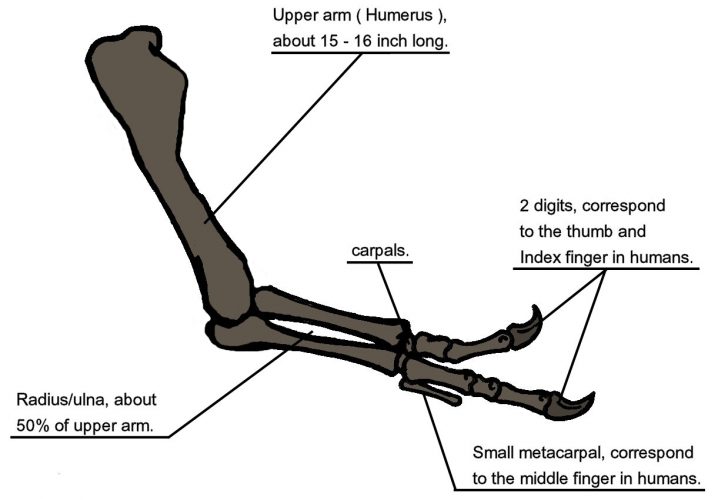
One feature of Tyrannosaurus rex that everyone likes to make fun of is its arms, which seem disproportionately tiny compared to the rest of its massive body. The fact is, thought, that T. rex’s arms were over three feet long, and may have been capable of bench-pressing 400 pounds each. In any event, T. rex didn’t have the smallest arm-to-body ratio of any carnivorous dinosaur; that honor belongs to the truly comical-looking Carnotaurus, the arms of which looked like tiny nubs.

TYRANNOSAURUS REX HAD VERY BAD BREATH

Granted, most of the dinosaurs of the Mesozoic Era didn’t brush their teeth, and very few of them flossed. Some experts think the shards of rotten, bacteria-infested meat lodged in its numerous, closely packed teeth gave Tyrannosaurus rex a “septic bite,” which infected (and eventually killed) wounded prey. The problem is, this process likely would have taken days or weeks, by which time some other lucky meat-eating dinosaur would have reaped the rewards!

FEMALE TYRANNOSAURUS REX WERE BIGGER THAN THE MALES

We don’t yet know for sure, but there’s good reason to believe (based on the size of existing fossils and the shapes of their hips) that female T. rex outweighed their male counterparts by a few thousand pounds, a trait known as sexual dimorphism. Why? The most likely reason is that females of the species had to lay clutches of T. rex-sized eggs, and thus were blessed by evolution with bigger hips, or perhaps females were simply more accomplished hunters than males (as is the case with modern lions).

THE AVERAGE TYRANNOSAURUS REX LIVED ABOUT 30 YEARS

It’s difficult to infer a dinosaur’s life span from its fossil remains, but based on an analysis of existing specimens, paleontologists speculate that Tyrannosaurus rex may have lived as long as 30 years–and since this dinosaur was on the top of its local food chain, it would most likely have been felled by old age, disease, or hunger rather than attacks by its fellow theropods. (By the way, some of the 50-ton titanosaurs that lived alongside T. rex may have had life spans of more than 100 years!)

TYRANNOSAURUS REX WAS BOTH A HUNTER AND A SCAVENGER

For years, paleontologists argued about whether T. rex was a savage killer or an opportunistic scavenger–that is, did it actively hunt its food, or did it tuck into the carcasses of dinosaurs that had already been felled by old age or disease? Today, this controversy seems rather quaint, as there’s no reason T. rex couldn’t have pursued both behaviors at the same time–as would any respectable carnivore that wanted to avoid starvation.

T. REX HATCHLINGS MAY HAVE BEEN COVERED IN FEATHERS

We all know that dinosaurs evolved into birds, and that some carnivorous dinosaurs (especially raptors) were covered in feathers. Hence, some paleontologists believe that all tyrannosaurs, including T. rex, must have been covered in feathers at some point during their life cycles, most likely when they first hatched out of their eggs, a conclusion supported by the discovery of feathered Asian tyrannosaurs like Dilong and the almost T. rex-sized Yutyrannus.

TYRANNOSAURUS REX LIKED TO PREY ON TRICERATOPS

You thought Mayweather vs. Pacquiao was a compelling fight? Just imagine an eight-ton Tyrannosaurus rex taking on a five-ton Triceratops, a not-inconceivable proposition since both of these dinosaurs lived in late Cretaceous North America. Granted, the average T. rex would have preferred to tackle a sick, juvenile or newly hatched Triceratops, but if it was hungry enough, all bets were off.

TYRANNOSAURUS REX HAD AN INCREDIBLY POWERFUL BITE

Back in 1996, a team of Stanford University scientists determined that T. rex chomped on its prey with a force of anywhere from 1,500 to 3,000 pounds per square inch, comparable to that of a modern alligator, and more recent studies put that figure in the 5,000-pound range. (For purposes of comparison, the average adult human can bite with a force of about 175 pounds). T. rex’s powerful jaws may even have been capable of shearing off a ceratopsian‘s horns!

TYRANNOSAURUS REX WAS ORIGINALLY KNOWN AS “MANOSPONDYLUS”

When the famous paleontologist Edward Drinker Cope excavated the first T. rex fossil, in 1892, he briefly considered naming his find Manospondylus gigax–Greek for “giant thin vertebrae.” After further impressive fossil finds, it was up to the then-president of the American Museum of Natural History, Henry Fairfield Osborn, to erect the immortal name Tyrannosaurus rex, the “tyrant lizard king.”

Source: www.thoughtco.com

Pages