Blogs

Postosuchus

Tuesday, July 25, 2017

Postosuchus | Walking With Wikis

Postosuchus, meaning “Crocodile from Post”, is a genus of rauisuchid reptiles comprising two species, P. kirkpatricki and P. alisonae, that lived in what is now North America during the Late TriassicPostosuchus is a member of the clade Pseudosuchia, the lineage of archosaurs that includes modern crocodilians (the other main group of archosaurs is Avemetatarsalia, the lineage that includes non-avian dinosaurs and their descendants, birds). Its name refers to Post Quarry, a place in Texas where many fossils of the type species, P. kirkpatricki, were found. It was one of the apex predators of its area during the Triassic, larger than the small dinosaur predators of its time (such as Coelophysis). It was a hunter which probably preyed on dicynodonts and many other creatures smaller than itself.

P. kirkpatricki compared to a human

The skeleton of Postosuchus is large and robust with a deep skull and a long tail. The total body length is about 4 to 5 metres (13 to 16 ft). The extreme shortness of the forelimbs relative to the hind limbs, the very small hands, and measurements of the vertebrae suggest that Postosuchus may have been committed to bipedal locomotion.

Postosuchus was one of the largest carnivorous reptiles during the late Triassic. Adults reached around 1.2 m (3.9 ft) in height, 4 m (13 ft) in length from snout to tail tip and their mass might have ranged from 250 to 300 kg (550 to 660 lb). It had a massively built skull bearing dagger-like teeth. The neck was elongated, expanding to a short torso and long tail. Along with remains of the skeleton, paleontologists also identify osteoderms, which were thick plates forming scales. These were on its back, neck, and possibly above or under the tail.

Postosuchus, a basal Triassic archosaur, at the Museum of Texas Tech University

Postosuchus lived in a tropical environment. The moist and warm region consisted of ferns, such as CynepterisPhelopteris and Clathropteris, gymnosperms, represented by PelourdeaAraucarioxylonWoodworthiaOtozamites and Dinophyton, and cycads like Sanmiguelia. Plants of the Dockum Group are not well known since the oxidizing of the environment has destroyed most of the plant fossils. However, some of them may provide information about the climate in Dockum Group during the late Triassic period. For example, the discovery of large specimens belonging to Araucarioxylon determine that the region was well watered. The fauna found in Dockum Group confirm that there were lakes and/or rivers containing fish such as the cartilaginous Xenacanthus, the lobe-finned Chinlea and the dipnoan Ceratodus. On the shores of these rivers lived labyrinthodonts (Latiscopus) and reptiles such as Malerisaurus and Trilophosaurus. Also living on the margins of the lakes were the archosaurs LeptosuchusNicrosaurus and RutiodonPostosuchus lived in the uplands along with Coelophysis and other archosaurs such as Desmatosuchus and TypothoraxPostosuchus was one of the largest animals in that ecosystem and preyed on herbivores such as Trilophosaurus and Typothorax.

Source: www.Wikipedia.org, www.NatGeo.com

Murusraptor

Monday, July 24, 2017

Murusraptor barrosaensis. Image credit: Jan Sovak.

With hollow hips, big body and a pair of savage claws, this newly discovered species refuses to fit neatly in the dinosaur family tree.

A new species of dinosaur – Murusraptor barrosaensis – was named in 2016 in the journal PLOS One, thanks to the discovery of one of the most complete fossils of a Megaraptorid on record.

Megaraptorid dinosaurs are medium-sized and walk on two legs. They’re characterised by large claws and bird-like features. The name “Megaraptor” translates to “giant thief” – a reference to their carnivorous ways.

The clad includes Megaraptor from modern-day South America, as well as Australian dinosaurs Rapator and Australovenator, among others.

The family’s newest addition, Murusraptor, was discovered in Sierra Barrosa, in the fossil-rich Patagonian region of Argentina. Murus is Latin for “wall” and refers to the location of the fossil, in the side of a sandy canyon in 80-million-year-old rocks.

“Although incomplete, the beautifully preserved bones of Murusraptor unveil unknown information about the skeletal anatomy of megaraptors, a highly specialised group of Mesozoic predators,” says Rodolfo Coria from Argentina’s National Scientific and Technical Research Council and co-author of the paper.

Skull and body reconstructions of Murusraptor barrosaensis. Discovered bones are in white. CREDIT: CORIA ET AL, 2016, PLOS ONE

The fossil, which included a significant portion of skull, 31 teeth, pelvis and tibia, belonged to an immature dinosaur, but the new species appears to be bigger than its cousin Megaraptor.

Murusraptor bears unique facial features in the details of its bone structure as compared to other Megaraptorid dinosaurs, as well as differently-shaped hip bones.

The researchers say the discovery could contribute to questions that still surround the Megaraptorid clan, including its positioning among the wider theropod group.

Source: www.cosmosmagazine.com

Jurassic World: Fallen Kingdom Cast List

Sunday, July 23, 2017

Rexy

Revisiting a franchise after many years is a tricky thing, as the follow-up can either flop or fly. In the case of Jurassic World, flying is a good word to describe the truckloads of money the film made back in 2015. That said, there is another phrase that comes to mind when thinking about that very film: sequel worthy. Which is why Jurassic World: Fallen Kingdom is coming to theater screens in June 2018, and with it some familiar faces. But it’s not all rank and file, as we have some fresh meat in the paddocks as well.

Listed here are the returning and debuting cast members in the Jurassic World franchise. With the film close to wrapping up its production, we don’t expect too many changes to this list. But should there be some sort of last minute arrival or departure, we’ll keep you posted as soon as possible. Now, prepare for a cast list 65 million and 25 years in the making!

Chris Pratt

This is probably a no-brainer, as Chris Pratt’s Owen Grady is one of the two major stars that anchored Jurassic World’sensemble cast of talent. But it wouldn’t be surprising if you thought his gig with Marvel’s Guardians of the Galaxy Vol. 2 and Avengers: Infinity War would have prevented him from taking part of Jurassic World: Fallen Kingdom. Well, you thought wrong, and along with Owen Grady’s return comes another important return to the Jurassic World fold.

Bryce Dallas Howard

Bryce Dallas Howard is returning as Claire Dearing, a vital figure to the operations of the now-defunct Jurassic World park, as well as a love interest/comedic foil for Owen Grady. We expect a wiser, and dare we say tougher, Claire to be around for this new expedition. At least, that’s the impression we get if her footwear in the new film is any indication. Whether she and Owen are a couple, or still just a bickering pair that’s friendly with each other, is yet to be seen.

B.D. Wong

Who would have thought that when B.D. Wong’s Dr. Henry Wu returned from the cast of Jurassic Park, he’d done so only to betray the folks of Jurassic World. As we saw him fly away on a helicopter at the end of 2015’s walk in the park, we knew there’s be a chance of him resurfacing, along with the ill-gotten gains he stole from the property. Sure enough, Wong’s supporting character-turned-important heel will be back for plenty of genetically engineered mayhem in Jurassic World: Fallen Kingdom.

Jeff Goldblum

You loved him in…pretty much anything he was in. You expected to see him in Jurassic World, but only got a book cover cameo. But now, life has found a way to bring back Jeff Goldblum for Jurassic World: Fallen Kingdom! Reprising his role as Dr. Ian Malcolm, Goldblum is excited to get back to work, as he admires how the series has always dealt with the themes of humanity’s struggle with not breaking the rules of nature. Whether he’ll still be in the leather jacket or if he’ll trade up to some more doctorly duds, is up in the air though. But we’ll accept him no matter how he shows up, especially with our last returning cast member in the mix.

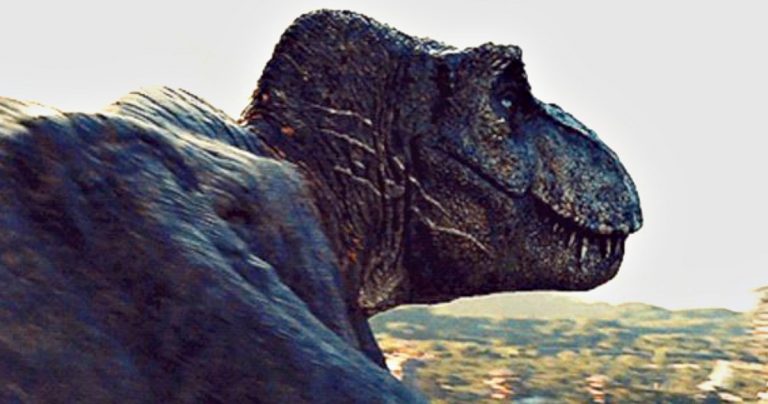
Rexy

No one really knew the name of the Tyrannosaurus Rex in Jurassic Park; all they knew was she kicked ass! Seriously, she’s so tough she survived decades in the wild, before being made a centerpiece to the Jurassic World park, which was another venue for her ass-kicking abilities. So bringing her back for Jurassic World: Fallen Kingdom was as easy as a lamb dinner and some conversation, but now we apparently have a name for our dear friend: Rexy. I’d have gone with Sue, or maybe Toni, but Rexy’s kinda cool. So yeah… Rexy’s back, kids!

James Cromwell

Our first newcomer is a pretty heavy hitter, as none other than James Cromwell himself has joined the Jurassic World: Fallen Kingdom team. Serving as a hint to what kingdom has fallen in the world of the Jurassic, Cromwell plays Benjamin Lockwood, the former partner of John Hammond. A man who helped develop the cloning capabilities that made the park what it is today, James Cromwell has said that his part is to deal with the blowback of the Jurassic Park legacy.

Toby Jones

An actor who’s no stranger to big ticket franchises, Toby Jones is another new addition to the Jurassic World: Fallen Kingdom roster. While no details have been provided in terms of the role he’s playing, which is a character presumably named Wheaton, the Captain America star could be another piece of the Hammond legacy. While this is totally speculation, it wouldn’t be a shock for Jones to be playing a relative of John Hammond’s, so as to further the connection between this new film and Richard Attenborough’s legendary businessman.

Rafe Spall

All we know about Rafe Spall’s potential character in Jurassic World: Fallen Kingdom is that he’s listed as having the name Mills. Other than that, we have no further details, but we do know that the man has had some experience in the world of movie science, as he was part of the ill-fated Prometheus mission back in 2012. Though you’d probably know him better as one of the two Andys from Hot Fuzz, which has us wondering if he’ll be the new comic relief, a la Jake Johnson’s Lowery from Jurassic World.

Ted Levine

If anyone was made out to be the new baddie in Jurassic World: Fallen Kingdom, it’d have to be Ted Levine. That’s not to say he’s a bad guy, but considering he’s best known as a villain in such films as Silence of the LambsShutter Island or even Flubber, it’s easy to see him fighting a T-Rex with his bare hands. So we won’t be surprised if Levine’s revealed to be a buddy of Vincent D’Onofrio’s Hoskins, looking to settle a score with some prehistoric beasties over the death of his friend.

Kevin Layne

Not too long ago, we learned about a pretty big set piece built into Jurassic World: Fallen Kingdom’s story: a submarine battle between man and dinosaur. This information was passed on by one of the actors playing a submarine pilot, Kevin Layne. A relative newcomer to the acting world, his only other major credit is a role on Showtime’s Guerilla. However, seeing as he’s credited as “Submarine Pilot,” we have a feeling this particular sea cruise isn’t going to end particularly well for Mr. Layne.

Justice Smith

What would a Jurassic World sequel be without the possibility of frightening young cast members with beastly dinosaurs? It’d be interesting, but not feel like a part of the family, to be honest. This is probably why The Get Down’s Justice Smith was announced as a cast member in Jurassic World: Fallen Kingdom. While we don’t have details on who he’ll be playing or what his function will be in the scheme of things, he just might be a student of archeology, or maybe theme park management, tagging along for a wild ride with the dinosaurs.

Daniella Pineda

Another youthful addition to the Jurassic World: Fallen Kingdom cast, Daniella Pineda comes from a background that includes shows like The Detour and The Originals. Once again, we’re not sure how this background will serve her in the context of the Jurassic World sequel, but we’re eager to see just what her addition to the cast will bring. Though if we were to venture an early guess, she’ll more than likely be linked to Justice Smith’s equally unknown character. Central characters to the Jurassicuniverse tend to come in groups.

Geraldine Chaplin

Rounding out the cast is somewhat of an acting legend, Ms. Geraldine Chaplin herself. The daughter of Charlie Chaplin, Geraldine is also a frequent collaborator of director J.A. Bayona, as she’s been in each one of his films. This doesn’t say anything about the importance of her role in Jurassic World: Fallen Kingdom. However, it does show that Bayona is going into this enterprise with only the best folks by his side. That being said, we’re still tempted to tie her into the Hammond legacy, what with a title like “Fallen Kingdom” being given to this adventure.

Jurassic World Slammed For Most Mistakes In A Movie

Sunday, July 23, 2017

No one can argue with the unprecedented success of Jurassic World in the summer of 2015. The nostalgia packed, Chris Pratt-led reboot of the popular dinosaur franchise continually smashed record after box office record, becoming the third highest grossing movie of all time – behind Avatar and Titanic. Just because a film performs well with critics and audiences, however, does not make it perfect.

According to Movie Mistakes, of all the Summer 2015 blockbuster releases, Jurassic World featured the most errors and mistakes. All told, the film features 18 mistakes – a combination of plot holes, continuity errors, and factual mistakes, among other issues. Some of these plot holes include the fact that two teenage boys were somehow able to take a 20-year-old derelict jeep and somehow make it run perfectly. A factual error comes towards the beginning of the film, when a raptor handler easily falls forty feet into the predators’ pen, and gets up as if he fell off a curb. Some of the more minor errors include crew and equipment being visible in certain shots, or props changing position without explanation between cuts. Another mistake comes while hunting the Indominus Rex: the soldiers hunting him in the jungle all seem to have identical heartbeats – which could very well be the case, but is highly unlikely.

In a way it’s certainly astonishing to see that Colin Trevorrow’s Jurassic reboot made the top of this list when we consider it was certainly one of the most enjoyable films of 2015. Jurassic World even featured more mistakes than the poorly executed – and frankly trite – Terminator: Genisys. This list also has the effect of making us question what truly constitutes a “mistake.” While Jurassic World has a count of 18 mistakes – and attempts to ground itself in a world of science – Furious 7 had only 3 recorded mistakes on the same list, despite the fact that the Fast and Furious franchise regularly defies (or flat out ignores) the laws of physics without any semblance of an explanation. While issues such as continuity errors can be consistently counted through films, plot holes and “factual errors” are an ever-changing concept in the realm of cinema that most certainly defy any metric that Movie Mistakes would seek to apply to them.

Perhaps that is a statement that we should judge films as more than the sum of their parts. While a film may not achieve technical perfection, their enjoyment factor and their pure entertainment value far outweigh their minor errors. Jurassic World’s ability to invoke pathos and entertain crowds more than made up for its wealth of minor technical errors. So while it’s entirely possible that Jurassic World 2 may feature a similar number of errors, it doesn’t mean that it will prove any less enjoyable.

Source: cinemablend.com

10 Cool Facts About “The Land Before Time”

Saturday, July 22, 2017

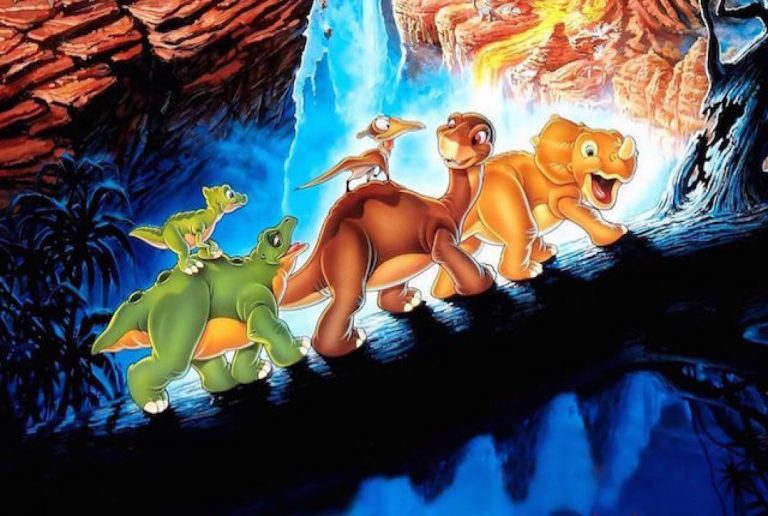
“The Land Before Time”

Five years before Jurassic Park roared into theaters, a gentler, more meditative dinosaur film endeared itself to audiences of all ages. Initially met with mixed reviews, The Land Before Time is now regarded as an animated classic. Here are 10 things you might not have known about the Steven Spielberg-produced film.

1. IT WAS CONCEIVED AS A DIALOGUE-FREE MOVIE.

In the mid-1980s, executive producer Steven Spielberg began toying with the idea of a Bambi-esque dinosaur film. “Basically,” he later said, “I wanted to do a soft picture … about five little dinosaurs and how they grow up and work together as a group.” Inspiration came from the “Rite of Spring” sequence from Disney’s Fantasia (1940)—a scene in which prehistoric beasts wordlessly go about their business. At first, Spielberg wanted his own dinosaur characters to follow suit and remain mum. Ultimately, however, it was feared that a non-verbal approach might bore or confuse the film’s intended audience. As such, the animals were given lines.

2. DIRECTOR DON BLUTH WAS AN EX-DISNEY EMPLOYEE.

Don Bluth grew up idolizing Disney’s work, and began working for the studio in 1955. Over the next two decades, he did various odd jobs until he was brought on as a full-time animator in 1971. Once on the inside, Bluth got to peek behind the magician’s curtain—and disliked what he found there. “I think [Walt Disney] would’ve seen that the pictures were losing their luster,” Bluth said. Frustrated by the studio’s cost-cutting measures, he resigned in 1979. Joining him were fellow animators Gary Goldman and John Pomeroy. Together the trio launched their own company, Sullivan Bluth Studios, and began working on The Land Before Time in 1986.

3. OVER 600 BACKGROUND PAINTINGS WERE MADE FOR THE FILM.

Most of these depicted beautiful but barren wastelands, which presented a real challenge for the creative team. As one studio press release put it, “The artists had to create a believable environment in which there was almost no foliage.” Whenever possible, Bluth’s illustrators emphasized vibrant colors. This kept their backdrops from looking too drab or monotonous—despite the desolate setting.

4. LITTLEFOOT’S ORIGINAL NAME WAS “THUNDERFOOT.”

This was changed when the filmmakers learned that there was a triceratops in a popular children’s book called Thunderfoot. Speaking of three-horned dinosaurs: Cera evolved from a pugnacious male character called Bambo.

5. THE FILMMAKERS HAD TO CUT ABOUT 10 MINUTES OF FOOTAGE.

“We compromised a lot with The Land Before Time,” admitted Gary Goldman. Nowhere was this fact more apparent than on the cutting room floor. Spielberg and his fellow executive producer George Lucas deemed 19 individual scenes “too scary.” “We’ll have kids crying in the lobby, and angry parents,” Spielberg warned. “You don’t want that.”

6. “ROOTER” WAS INTRODUCED AT THE URGING OF CHILD PSYCHOLOGISTS.

In Bambi, the title character’s mom dies off-screen. The same cannot be said for Littlefoot’s mother, whose slow demise goes on for several agonizing minutes. Naturally, there was some concern about how children would react to this. “A lot of research went into the mother dying sequence,” said John Pomeroy. “Psychologists were approached and shown the film. They gave their professional opinions of how the sequence could be depicted.” Thus, Rooter was born.

One scene after Littlefoot’s mom passes, the wise reptile consoles him, saying “You’ll always miss her, but she’ll always be with you as long as you remember the things she taught you.” Sharp-eared fans might recognize Rooter’s voice as that of Pat Hingle, who also narrates the movie.

7.  JAMES HORNER DID THE SOUNDTRACK.

The late, Oscar-winning composer behind Braveheart (1995), Titanic (1997), and Avatar (2009) put together a soaring score. Along with lyricist Will Jennings, he also penned the original song “If We Hold On Together,” which Diana Ross sings as the end credits roll.

8. THE ACTRESS BEHIND DUCKY PASSED AWAY BEFORE THE MOVIE’S RELEASE.

Judith Barsi’s career was off to a great start. By age 10, this daughter of Hungarian immigrants had already appeared in 70 commercials and voiced the leading lady in Don Bluth’s All Dogs Go to Heaven (1989). For The Land Before Time, Barsi voiced the ever-optimistic Ducky, which was reportedly her favorite role. Then tragedy struck: In July of 1988, Barsi’s father József murdered both her and her mother before taking his own life.

9. IT HAD A RECORD-SETTING OPENING WEEKEND.

From the get-go, The Land Before Time had some stiff competition. Universal released it on November 18, 1988—the same day that Disney’s Oliver & Company hit theaters. Yet, for a solid month, Bluth gave Oliver a box office beating. The Land Before Time enjoyed the highest-grossing opening weekend that any animated film had ever seen, pulling in $7.5 million to Oliver & Company’s $4 million. Since then, of course, The Land Before Time has long been dethroned; today, Shrek the Third (2007) holds this coveted distinction with a $121.6 million first-weekend showing.

10. THERE ONCE WAS TALK OF A LAND BEFORE TIME STAGE MUSICAL.

“The time has come for dinosaurs on Broadway,” the late theatrical producer Irving Welzer told The New York Times in 1997. Emboldened by the recent cinematic success of Spielberg’s The Lost World: Jurassic Park (1997), Welzer expressed an interest helping Littlefoot, Cera, Ducky, and the rest of the gang make their Big Apple debut. Soon, however, the idea faded.

Source: http://mentalfloss.com

T. Rex Linked to Chickens, Ostriches

Thursday, July 20, 2017

The closest living relatives of Tyrannosaurus rex are birds such as chickens and ostriches, according to research published today (2008) in Science (and promptly reported in the New York Times). Paleontologists used material discovered in a chance find in 2003 to pin down the link.

The dinosaur-ness of birds has been suspected for many years based on anatomical similarities, but the new research is the first molecular evidence. For decades, dinosaurs were thought to be reptiles: big ones, to be sure, but basically cold-blooded, slow-moving, and dim-witted. The movie Jurassic Park popularized the idea of dinosaurs as quick, smart and birdlike. (The movie’s ideas had been proposed in the 1970s–a book by paleontologist Robert Bakker, called The Dinosaur Heresies, nicely conveys this change in thinking and the controversy that accompanied it.)

T-Rex evolved into Chicken?

To get molecular evidence about dinosaurs, you need some actual molecules–a tall order for a group of animals that died out 65 million years ago. But in 2003, scientists Jack Horner and Mary Schweitzer discovered some unfossilized material inside a T. rex bone by a combination of luck, desperation, and sharp eyes (see Smithsonian, May 2006). Faced with flying a giant femur out of a remote Montana field site, they broke the bone in half so it would fit inside their helicopter. If they’d had a larger helicopter, we might never have known.

Unlike in Jurassic Park, the real-life researchers couldn’t recover any DNA from the ancient remains. But they did retrieve molecules of collagen, a structural protein that appears in slightly different forms in many animals. They compared the dinosaur version with 21 living animals, including humans, chimps, mice, chickens, ostriches, alligators and salmon. T. rex‘s collagen proved to be most similar to chickens and ostriches; its next closest match was to alligators.

Chickens and ostriches are only distantly related to each other, so the research says little about what kind of birds might be the closest relatives of the famous carnivore. The scientists noted that answering that question would require data from more molecules than just collagen. Whether they are currently cracking into any more giant fossils in search of material was not divulged.

(Images courtesy Science)

Source: smithsonianmag.com

Jurassic World 2 First Trailer Will Debut at San Diego Comic-Con

Friday, July 7, 2017

Universal just gave Jurassic World: Fallen Kingdom an official title, but they may also release the first trailer in but a few weeks. After sequels blemished the brand, the world of Jurassic Park came back in a big way in 2015. Jurassic World served as a long-awaited sequel and reboot of the franchise that no one could’ve guessed would be such a giant hit. It went on to make over $1.5 billion worldwide with Chris Pratt and Bryce Dallas Howard in the lead, and made it a total no brainer to green light a sequel.

J.A. Bayona (The ImpossibleA Monster Calls) is taking over directing duties on a sequel that will once again bring the world of dinosaurs back into theaters. Filming has been ongoing since early on this year, with the movie’s production crew having since moved to Hawaii to possibly complete principal photography. Set photos have offered up glimpses of the sequel so far, but there may be an actual Fallen Kingdom teaser out soon too.

Chronicle Collectibles co-founder Paul Francis may have revealed Universal’s marketing plans. His company is an official licensing partner on the Jurassic World sequel and he said in a recent Facebook stream (via Jurassic World 2 Movie) that the first trailer for Fallen Kingdom could come at San Diego Comic-Con:

Universal is gonna start rolling out some trailers, I think the first trailer will be sometime around Comic-Con?

As filming comes to a close, it makes sense for the studio to start turning their attention on marketing. In fact, it is now already underway thanks to the official Fallen Kingdom poster confirming the title, so having a trailer arrive within a matter of a few weeks seems plausible. Francis does not say specifically that the trailer will debut during SDCC and Universal’s presence at the convention has yet to be confirmed. Back in 2014, they released a SDCC exclusive poster for Jurassic World – but with a poster already out for the sequel, debuting a trailer could kick off the marketing in the right way.

That said, there’s not exactly a rush to start promoting the film, with close to a year still left until it arrives. Universal doesn’t have any other blockbusters hitting theaters this year – with Pitch Perfect 3 being their biggest film on the slate post-SDCC. Releasing a trailer in the next few weeks puts Fallen Kingdom in a position of competing with films like Thor: RagnarokJustice League, and Star Wars: The Last Jedi for headlines and trailer records. It could be better for Universal to wait a few months and release the Fallen Kingdom trailer after the summer season has died down. We will have a better idea of what the plan is either way, by this time next month.

Source: Chronicle Collectibles [via Jurassic World 2 Movie]

Jurassic World 2 Wraps Filming This Week

Friday, July 7, 2017

Producer Frank Marshall has confirmed that principal photography on the Jurassic World sequel, now known to be titled Jurassic World: Fallen Kingdom, wraps up this week. The Jurassic World followup has been shooting in Hawaii for some two months now, after spending its first few months of production shooting on sound stages based in London.

Fallen Kingdom builds on the events of its predecessor – itself, a semi-continuation/soft reboot of the Jurassic Park franchise – though plot details beyond that are being kept under lock and key, at the moment. That being said, it is known that Jurassic World protagonists Owen Grady (Chris Pratt) and Claire Dearing (Bryce Dallas Howard) are back in the second installment, as is BD Wong as the conspiring ex-Jurassic Park (and now, ex-Jurassic World) geneticist Henry Wu. Also returning to the Jurassic Park movie series for Fallen Kingdom is Jeff Goldblum, reprising his role as the mathematician/chaotician Ian Malcolm for the first time in twenty years (following his last appearance in 1997’s The Lost World: Jurassic Park).

Marshall, Fallen Kingdom director J.A. Bayona and co-screenwriter Colin Trevorrow (who directed the first Jurassic World) have all been keeping fans up-to-speed with developments on the new dinosaur adventure, via social media posts – updates that range from the official Fallen Kingdom poster/title confirmation to videos of Bayona bringing “practical effect” dinosaurs to life. It’s only fitting, then, that Marshall be the one to reveal when filming on the sequel will be coming to a close – as he has done, by way of the Twitter post.

With filming now confirmed to wrap up this week on the Jurassic World sequel (not including the inevitable pickup shoots down the road), it begs the question of when we can expect the first teaser trailer for the movie to arrive. It’s rumored that the Fallen Kingdom teaser trailer will premiere at San Diego Comic-Con later this month, and this new update from Marshall does nothing to negate that as a real possibility. Distributor Universal Pictures doesn’t have any upcoming summer tent pole release to debut the Fallen Kingdom teaser with in theaters this year, so the studio could plausibly use a major event like Comic-Con to kick-off promotion for the film, instead.

The Fallen Kingdom cast and crew, when asked during interviews, have been keen to emphasize that the Jurassic World sequel will be scarier than its predecessor – thanks in no small amount to the involvement of Bayona, an acclaimed filmmaker whose body of work includes the horror film The Orphanage and TV show Penny Dreadful, as well as the survival thriller The Impossible. A teaser that establishes Fallen Kingdom as being a more intense roller coaster ride than its immediate predecessor would both get the sequel’s marketing started on the right foot and support Trevorrow’s claim that Fallen Kingdom will be better than Jurassic World. Now, we just have to wait and see if/when such a teaser drops.

Source: screenrant.com

Eurypterids: Pioneers of The Land

Wednesday, July 5, 2017

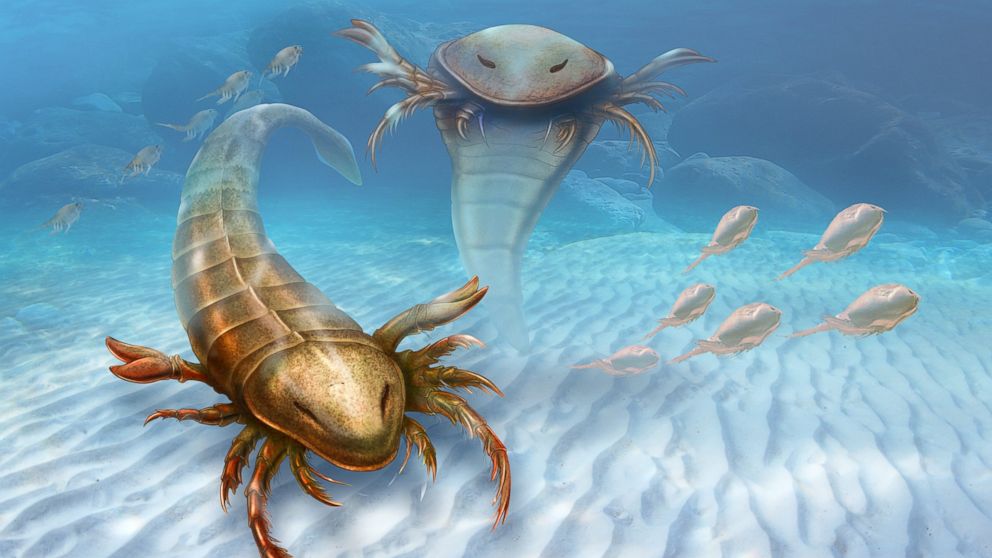
This rendering provided by Yale University shows a Pentecopterus decorahensis. Earth?s first big predatory monster was a weird water bug, newly found fossils show.

Eurypterids, often informally referred to as sea scorpions, are a group of arthropods that form the order Eurypterida. The earliest known eurypterids date to the Darriwilian stage of the Ordovician period 467.3 million years ago, though the group is likely to have first appeared either during the Early Ordovician or Late Cambrian period. The Eurypterida is the most diverse Paleozoic chelicerate order in terms of species, containing approximately 250 species. Following their appearance during the Ordovician, eurypterids would become major components of marine faunas during the Silurian, from which the majority of eurypterid species have been described. The Silurian genus Eurypterus accounts for more than 90% of all known eurypterid specimens. Though the group continued to diversify during the subsequent Devonian period, the eurypterids were heavily affected by the Late Devonian extinction event and would decline in numbers and diversity until they became extinct during the Permian–Triassic extinction event (or sometime shortly before) 251.9 million years ago.

Although popularly called "sea scorpions", only the earliest eurypterids were marine, with many later forms living in brackish or fresh water, and they were not true scorpions. Some studies suggest that a dual respiratory system was present, which would have allowed for short periods of time in terrestrial environments. The name Eurypterida comes from the Ancient Greek words εὐρύς (eurús), meaning "broad" or "wide", and πτερόν (pteron), meaning "wing", referring to the pair of wide swimming appendages present in many members of the group.
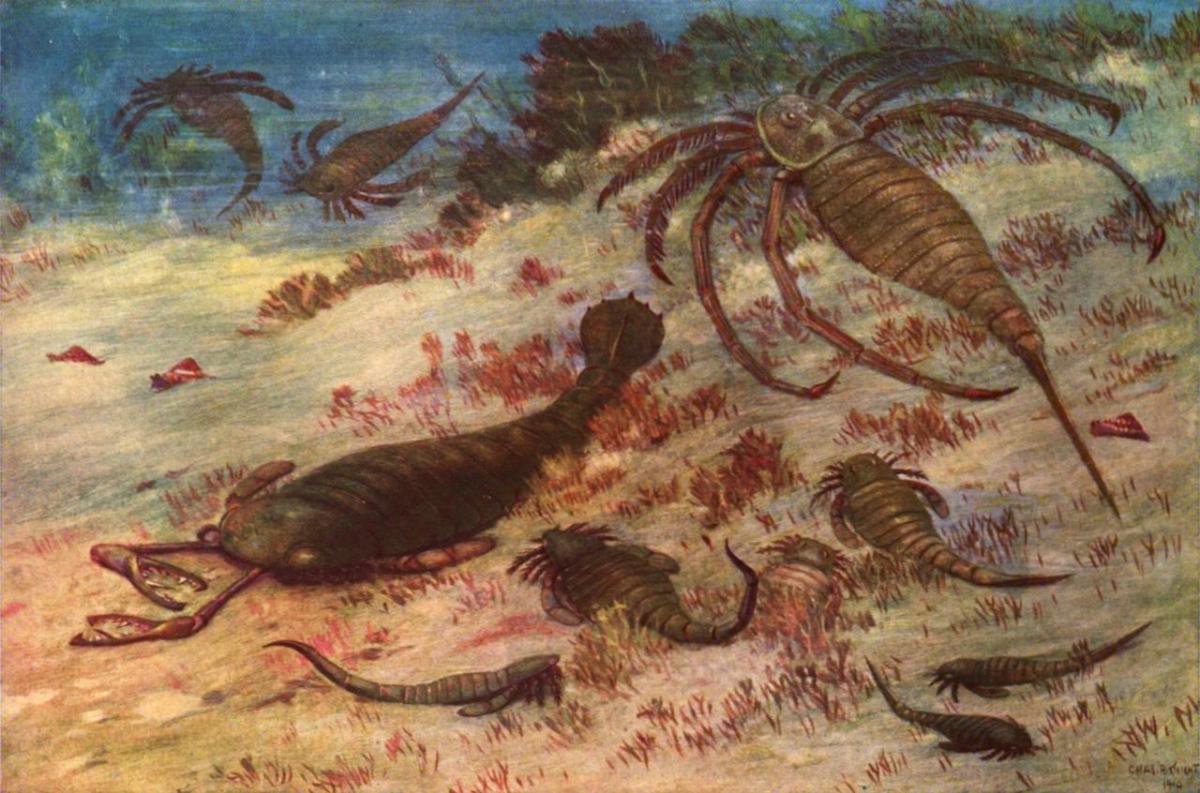
Genera found in New York, illustrated by Charles R. Knight

The eurypterids include the largest known arthopods to have ever lived. The largest, Jaekelopterus, reached 2.5 meters (8.2 ft) in length. Eurypterids were not uniformly large and most species were less than 20 centimeters (7.9 in) long; the smallest eurypterids, Alkenopterus and Eocarcinosoma, were only 3 centimeters (1.2 in) long. Eurypterid fossils have been recovered from every continent, though a vast majority of fossils are from fossil sites in North America and Europe due to the group primarily having lived in the waters around and within the ancient supercontinent of Euramerica. Only a handful of eurypterid groups spread beyond the confines of Euramerica and a few genera, such as Adelophthalmus and Pterygotus, achieved a cosmopolitan distribution with fossils being found worldwide.

Like all other arthropods, eurypterids possessed segmented bodies and jointed appendages (limbs) covered in a cuticle composed of proteins and chitin. As in other chelicerates, the body was divided into two tagmata (sections); the frontal prosoma (head) and posterior opisthosoma (abdomen). The prosoma was covered by a carapace (sometimes referred to as the "prosomal shield") on which the compound eyes and ocelli (simple eye-like sensory organs) were located.

Eurypterids were highly variable in size, depending on factors such as lifestyle, living environment and taxonomic affinity. Sizes around 100 centimeters (3.3 ft) are common in most eurypterid groups. The smallest eurypterids, Alkenopterus burglahrensis and Eocarcinosoma batrachophthalmus, measured just 3 centimeters (1.2 in) in length.
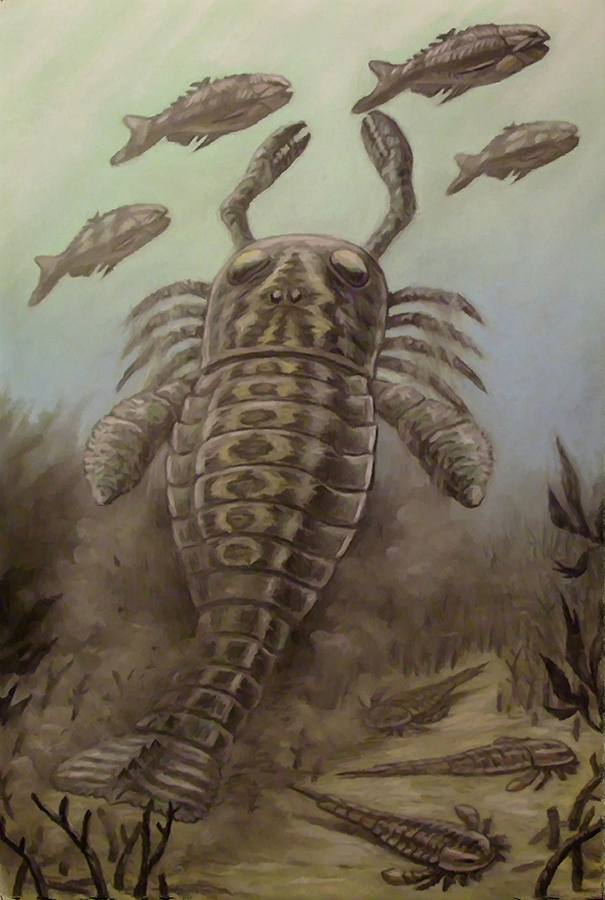
Pterygotus hunting Birkenia (an early fish).

The largest eurypterid, and the largest known arthropod to have ever lived, is Jaekelopterus rhenaniae. A chelicera from the Emsian Klerf Formation of Willwerath, Germany measured 36.4 centimeters (14.3 in) in length, but is missing a quarter of its length, suggesting that the full chelicera would have been 45.5 centimeters (17.9 in) long. If the proportions between body length and chelicerae match those of its closest relatives, where the ratio between claw size and body length is relatively consistent, the specimen of Jaekelopterus that possessed the chelicera in question would have measured between 233 and 259 centimeters (7.64 and 8.50 ft), average 2.5 meters (8.2 ft), in length. With the chelicerae extended, another meter (3.28 ft) would be added to this length. This estimate exceeds the maximum body size of all other known giant arthropods by almost half a meter (1.64 ft) even if the extended chelicerae are not included.

The family of Jaekelopterus, the Pterygotidae, is noted for several unusually large species. Both Acutiramus, the largest species A. bohemicus measuring 2.1 meters (6.9 ft), and Pterygotus, the largest species P. grandidentatusmeasuring 1.75 meters (5.7 ft), were gigantic. Several different contributing factors to the large size of the pterygotids have been suggested, including courtship behaviour, predation and competition over environmental resources.

Giant eurypterids were not limited to the Pterygotidae family. An isolated 12.7 centimeters (5.0 in) long fossil metastoma of the carcinosomatoid eurypterid Carcinosoma punctatum indicates that the animal would have reached a length of 2.2 meters (7.2 ft) in life, rivalling the pterygotids in size. Another giant was Pentecopterus decorahensis, a primitive carcinosomatoid, which is estimated to have reached lengths of 1.7 meters (5.6 ft).

Size comparison of six of the largest eurypterids (sea scorpions). They are (from largest to smallest): Pterygotus grandidentatus, Pentecopterus decorahensis, Acutiramus macrophthalmus, A. bohemicus, Carcinosoma punctatum, and Jaekelopterus rhenaniae.

The two eurypterid suborders, Eurypterina and Stylonurina, are primarily separated by the morphology of their final pair of appendages. In the Stylonurina, this appendage takes the form of a long and slender walking leg while in the Eurypterina, the leg is modified and broadened into a swimming paddle. The legs, other than the swimming paddle, of many eurypterines were far too small to do much more than allow them to crawl across the sea floor. In contrast, a number of Stylonurines had elongated and powerful legs that might even have allowed them to walk even on land (similar to modern crabs).

Some researchers have suggested that eurypterids may have been adapted to an amphibious lifestyle, using the full gill tract structure as gills and the invaginations within it as pseudotrachae, but this mode of life may not have been physiologically possible since water pressure would have forced water into the invaginations (leading to asphyxiation). Furthermore, most eurypterids would have been aquatic their entire lives and regardless of how much time was spent on land, organs for respiration in underwater environments must have been present. True gills, expected to have been located within the branchial chamber within the blatfüssen, remain unknown in eurypterids.

Like all arthropods, eurypterids matured and grew through static developmental stages referred to as instars. These instars were punctuated by periods during which eurypterids went through ecdysis (molting of the cuticle) after which they underwent rapid and immediate growth. Some arthropods, such as insects and many crustaceans, undergo extreme changes over the course of maturing. Chelicerates, including eurypterids, are in general considered to be direct developers, undergoing no extreme changes after hatching (though extra body segments and extra limbs may be gained over the course of ontogeny in some lineages, such as xiphosurans and sea spiders). Whether eurypterids were true direct developers (with hatchlings more or less being identical to adults) or hemianamorphic direct developers (with extra segments and limbs potentially being added during ontogeny) has been controversial in the past.

Eurypterus anatomy.

Fossils preserving digestive tracts have been reported from fossils of various eurypterids, among them Carcinosoma, Acutiramus and Eurypterus. Though a potential anal opening has been reported from the telson of a specimen of Buffalopterus, it is more likely that the anus was opened through the thin cuticle between the last segment before the telson and the telson itself, as in modern horseshoe crabs.

Eurypterid coprolites discovered in deposits of Ordovician age in Ohio containing fragments of a trilobite and eurypterid Megalograptus ohioensis in association with full specimens of the same eurypterid species have been suggested to represent evidence of cannibalism, similar coprolites referred to the species Lanarkopterus dolichoschelus from the Ordovician of Ohio contain fragments of jawless fish and fragments of smaller specimens of Lanarkopterus iteslf.

Until 1882 no eurypterids were known from before the Silurian. Discoveries throughout the twentieth century and modern times have expanded the knowledge of early eurypterids from the Ordovician period. The earliest eurypterids known today, the megalograptid Pentecopterus, date from the Darriwilian stage of the Middle Ordovician, 467.3 million years ago. There are also reports of even earlier fossil eurypterids in deposits of Late Tremadocian (Early Ordovician) age in Morocco, but these have yet to be thoroughly studied.

Restoration of the primitive Cambrian arachnomorph Fuxianhuia, one of the most basal members of the lineage that would eventually lead to both the chelicerates and the trilobites.

Eurypterids were most diverse and abundant between the Middle Silurian and the Early Devonian, with an absolute peak in diversity during the Pridoli epoch, 423 to 419.2 million years ago, of the very latest Silurian. This peak in diversity has been recognized since the early twentieth century; of the approximately 150 species of eurypterids known in 1916, more than half were from the Silurian and a third were from the Late Silurian alone.

Though the eurypterids continued to be abundant and diversify during the Early Devonian (for instance leading to the evolution of the pterygotid Jaekelopterus, the largest of all arthropods), the group was one of many heavily affected by the Late Devonian extinction. The extinction event, only known to affect marine life (particularly trilobites, brachiopods and reef-building organisms) effectively crippled the abundance and diversity previously seen within the eurypterids.

Only three eurypterid families–Adelophthalmidae, Hibbertopteridae and Mycteroptidae (whose fossil record at this time only covers the Late Carboniferous)–survived the extinction event in its entirety. All of these were compromised entirely of freshwater animals, rendering the eurypterids extinct in marine environments. With marine eurypterid predators gone, sarcopterygian fish, such as the rhizodonts, were the new apex predators in marine environments. The sole surviving eurypterine family, Adelophthalmidae, was represented only by a single genus, Adelophthalmus. Both the hibbertopterids and Adelophthalmus would survive into the Permian.

Source: https://en.wikipedia.org / www.natgeo.com

Is Jurassic World: Fallen Kingdom Just Another Jurassic Park in Steroids?

Sunday, July 2, 2017

 Jurassic Park

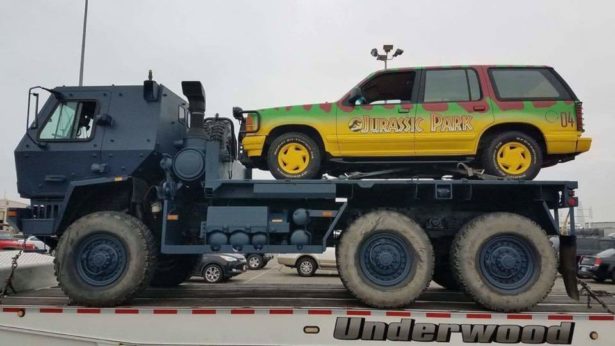
After the blockbuster destruction of an entirely new dinosaur theme park in Jurassic World, could the recently titled sequel be taking us back to more familiar ground? A set photo shared by Slashfilm from Jurassic Park Motor Pool, a Facebook group dedicated to the numerous vehicles from the world of Jurassic Park, seems to hint that Jurassic World: Fallen Kingdom will take place on the very same island as the first blockbuster installment–and may well explore the original dinosaur death trap, Jurassic Park.

Not only does the car in question have that iconic paint job but it’s also a Ford Explorer, the very make of the electronic Jeeps which were meant to show guests around in the first film. Even more intriguing than that is the fact that the car is numbered with a four. Our more eagle eyed readers may have already realized that’s the very same number as the car that John Hammond’s precocious grandchildren were unlucky enough to be in when Dennis Nedry’s nefarious plan failed. That left them scrambling in the mud as the T. rex, excited by its newfound freedom, tried to say an over enthusiastic hello by putting its entire face through the roof. It’s the very same car that almost crushed Sam Neill and Joseph Mazzello’s Tim after they tried to escape through the T. rex’s abandoned enclosure.

This could hint that the film will actually follow the tried and true route of returning to the scene of the first movie–both Jurassic Park and Jurassic World were set on Isla Nublar–on some kind of reconnaissance mission like The Lost World. Though in that movie Jeff Goldblum was very reluctant, so how on Earth would they get him back there this time? If this is the case, could Jurassic World: Fallen Kingdom explore the ruins of the John Hammond’s original passion project? There’s something unbelievably exciting about the possibility of returning to Isla Nublar now that it’s once again overrun with dinosaurs. The juxtaposition of the two parks, old and new, has the potential for some epic set pieces. It also ties into Fallen Kingdom‘s recently released tagline “life finds a way.” We know the T. rex from the original movie survived and was rehoused in Jurassic World, but the big question now is what else survived?

Jurassic World hinted at the original park as Ty Simpkins and his on screen kid brother Nick Robinson discovered the old visitors center and recommissioned an extinct staff Jeep from the park to escape the rampaging Indominus rex. This established that the skeleton of the old park still exists, but with this new set photo from Jurassic World: Fallen Kingdom we might get to discover just how much was left, and maybe even why the island’s new owners decided to leave certain parts of the park untouched. Maybe there were some prehistoric inhabitants who couldn’t or wouldn’t be moved?

Or could this point to something much bigger going on out there? Could the huge dinosaur museum we’ve seen in a recent set photo belong to a wealthy collector who’s obsessed with the legacy of the parks? Could this collector be rounding up the most iconic pieces of the parks’ troubled history for some kind of twisted memorial museum that may even include the most famous living relic of all, the T. rex from the first movie who we saw return in the end of Jurassic World?

With almost a year until the film’s released, we’ll have to wait and see if any of this comes to pass. But what do you think? Would you want to return to the wreckage of Jurassic World? Were you hoping for some real world dinosaur carnage? Or is it just a car that means nothing? Swerve into our comments and let us know!

Images: Universal

Pages