Blogs

Devonian Period: Climate, Animals & Plants

Wednesday, August 9, 2017

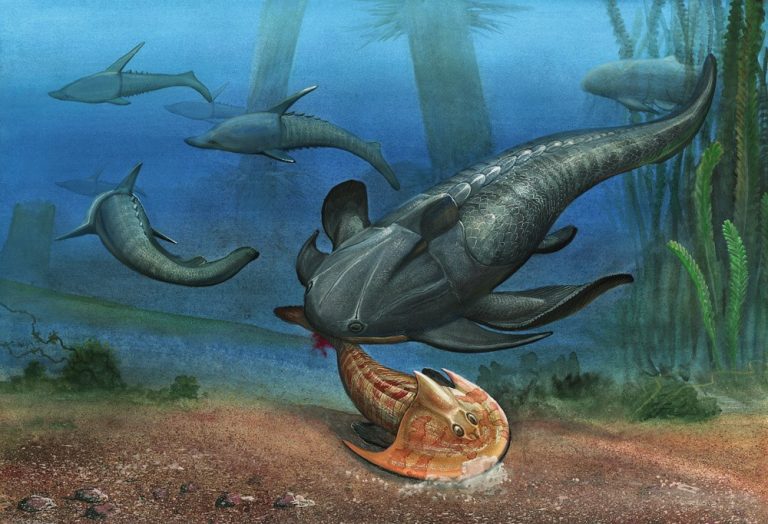
Devonian period--Prehistoric amphibians. The one looks very gatorish. By Masato Hattori

The Devonian is a geologic period and system of the Paleozoic Era spanning from the end of the Silurian Period, about 419.2 Mya (million years ago), to the beginning of the Carboniferous Period, about 358.9. It is named after Devon, England, where rocks from this period were first studied. The Devonian period experienced the first significant adaptive radiation of terrestrial life. Free-sporing vascular plants began to spread across dry land, forming extensive forests which covered the continents. By the middle of the Devonian, several groups of plants had evolved leaves and true roots, and by the end of the period the first seed-bearing plants appeared. Various terrestrial arthropods also became well-established. Fish reached substantial diversity during this time, leading the Devonian to often be dubbed the “Age of Fish”. The first ray-finned and lobe-finned bony fish appeared, while the placoderms began dominating almost every known aquatic environment.

Early Devonian Earth

The ancestors of all tetrapods began adapting to walking on land, their strong pectoral and pelvic fins gradually evolving into legs. In the oceans, primitive sharks became more numerous than in the Silurian and the late Ordovician. The first ammonite mollusks appeared. Trilobites, the mollusk-like brachiopods and the great coral reefs, were still common. The Late Devonian extinction which started about 375 million years ago severely affected marine life, killing off all placoderms, and all trilobites, save for a few species of the order Proetida.

Devonian by atrox1

The paleogeography was dominated by the supercontinent of Gondwana to the south, the continent of Siberia to the north, and the early formation of the small continent of Euramerica in between.
 

Late Devonian landscape. Artwork of wetland plants, and fumaroles during the ate Devonian Period (385 to 360 million years ago). The plants shown here include club mosses such as Aglaophyton. Bacterial mats (orange) surround the hot pools. A large millipede is at lower right.

The Silurian Period

Monday, August 7, 2017

Underwater life thrived during the Silurian Period, 443 million years ago to 416 million years ago. Credit: Alena Hovorkova

The Silurian (443.7 to 416.0 million years ago)* was a time when the Earth underwent considerable changes that had important repercussions for the environment and life within it. One result of these changes was the melting of large glacial formations. This contributed to a substantial rise in the levels of the major seas. The Silurian witnessed a relative stabilization of the Earth’s general climate, ending the previous pattern of erratic climatic fluctuations.

Distribution of landmasses, mountainous regions, shallow seas, and deep ocean basins during the Silurian Period by Encyclopedia Britannica

Coral reefs made their first appearance during this time, and the Silurian was also a remarkable time in the evolution of fishes. Not only does this time period mark the wide and rapid spread of jawless fish, but also the highly significant appearances of both the first known freshwater fish as well as the first fish with jaws. It is also at this time that our first good evidence of life on land is preserved, such as relatives of spiders and centipedes, and also the earliest fossils of vascular plants.

Life

The Silurian is a time when many biologically significant events occurred. In the oceans, there was a widespread radiation of crinoids, a continued proliferation and expansion of the brachiopods, and the oldest known fossils of coral reefs. As mentioned earlier, this time period also marks the wide and rapid spread of jawless fish, along with the important appearances of both the first known freshwater fish and the appearance of jawed fish. Other marine fossils commonly found throughout the Silurian record include trilobites, graptolites, conodonts, corals, stromatoporoids, and mollusks.

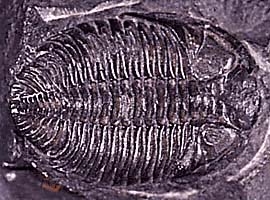
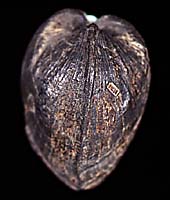
Dalmanites Grammysia  

On the left, Dalmanites limuluris, a trilobite from the Silurian of New York. To the right, Grammysia cingulata, a bivalve from the Upper Ludlow of England.

It is also in the Silurian that we find the first clear evidence of life on land. While it is possible that plants and animals first moved onto the land in the Ordovician, fossils of terrestrial life from that period are fragmentary and difficult to interpret. Silurian strata have provided likely ascomycete fossils (a group of fungi), as well as remains of the first arachnids and centipedes.

Perhaps most striking of all biological events in the Silurian was the evolution of vascular plants, which have been the basis of terrestrial ecology since their appearance. Most Silurian plant fossils have been assigned to the genus Cooksonia, a collection of branching-stemmed plants which produced sporangia at their tips. None of these plants had leaves, and some appear to have lacked vascular tissue. Also from the Silurian of Australia comes a controversial fossil of Baragwanathia, a lycophyte. If such a complex plant with leaves and a fully-developed vascular system was present by this time, then surely plants must have been around already by the Ordovician. In any event, the Silurian was a time for important events in the history of evolution, including many “firsts,” that would prove highly consequential for the future of life on Earth.

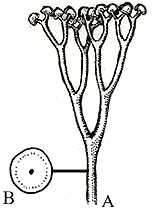
Cooksonia Baragwanathia

Cooksonia, on the left, has usually been considered the oldest known land plant. Fossils assigned to several species are known from North America, Europe, Asia, and Africa, and from both the Late Silurian and Early Devonian. The lycophyte Baragwanathia, on the right, is structurally more complex than Cooksonia, but Silurian fossils of this plant have been found in Australia, significantly earlier than in the Northern Hemisphere.

Stratigraphy

The Silurian’s stratigraphy is subdivided into four epochs (from oldest to youngest): the Llandovery, Wenlock, Ludlow, and Pridoli. Each epoch is distinguished from the others by the appearance of new species of graptolites. Graptolites are a group of extinct colonial, aquatic animals that put in their first appearance in the Cambrian Period and persisted into the early Carboniferous. The beginning of the Silurian (and the Llandovery) is marked by the appearance of Parakidograptus acuminatus, a species of graptolite.

The Llandovery (443.7-428.2 million years ago*) preserves its fossils in shale, sandstone, and gray mudstone sediment. Its base (beginning) is marked by the appearance of the graptolites Parakidograptus acuminatus and Akidograptus ascensus. The Llandoverian epoch is subdivided into the Rhuddanian, Aeronian, and Telychian stages.

At the close of the Telychian stage, the appearance of Cyrtograptus centrifugus marks the start of the Wenlockian epoch (428.2 to 422.9 million years ago).* The fossils are found in siltstone and mudstone under limestone. Missing from the fossil record of the Wenlock was the conodont Pterospathodus amorphognathoides, present in earlier strata. This is an epoch with excellent preservations of brachiopod, coral, trilobite, clam, bryozoan, and crinoid fossils. The Wenlock is subdivided into the Sheinwoodian and Homerian stages.

The Ludlow (422.9 to 418.7 million years ago)* consists of siltstone and limestone strata, marked by the appearance of Neodiversograptus nilssoni. There is an abundance of shelly animal fossils. The Gorstian and Ludfordian stages make up the Ludlow epoch.

Platy limestone strata rich in cephalopods and bivalves characterize the Pridolian (418.7 to 416.0 million years ago),* the final epoch of the Silurian. It is marked by the appearance of the index fossil Monograptus parultimus, and also by two new species of chitinozoans (marine plankton), Urnochitina urna and Fungochitina kosovensis, which appear at the base or just above the base of the Pridoli.

Tectonics and paleoclimate

Although there were no major periods of volcanism during the Silurian, the period is marked by major orogenic events in eastern North America and in northwestern Europe (the Caledonian Orogeny), resulting in the formation of the mountain chains there. The ocean basins between the regions known as Laurentia (North America and Greenland), Baltica (central and northern Europe and Scandinavia) and Avalonia (western Europe) closed substantially, continuing a geologic trend that had begun much earlier. The modern Philippine Islands were near the Arctic Circle, while Australia and Scandinavia resided in the tropics; South America and Africa were over the South Pole. While not characterized by dramatic tectonic activity, the Silurian world experienced gradual continental changes that would be the basis for greater global consequences in the future, such as those that created terrestrial ecosystems. A deglaciation and rise in sea levels created many new marine habitats, providing the framework for significant biological events in the evolution of life. Coral reefs, for example, made their first appearance in the fossil record during this time.

Distribution of landmasses, mountainous regions, shallow seas, and deep ocean basins during the Silurian Period by Encyclopedia Britannica

The Silurian Period’s condition of low continental elevations with a high global stand in sea level can be strongly distinguished from the present-day environment. This is a result of the flood of 65% of the shallow seas in North America during the Llandovery and Wenlock times. The shallow seas ranged from tropical to subtropical in climate. Coral mound reefs with associated carbonate sediments were common in the shallow seas. Due to reduced circulation during the Ludlow and Pridoli times, the process of deposition of evaporites (salts) was set in motion. Some of these deposits are found in northern Europe, Siberia, South China and Australia.

Source: www.ucmp.berkeley.edu

The Ordovician Period

Sunday, August 6, 2017

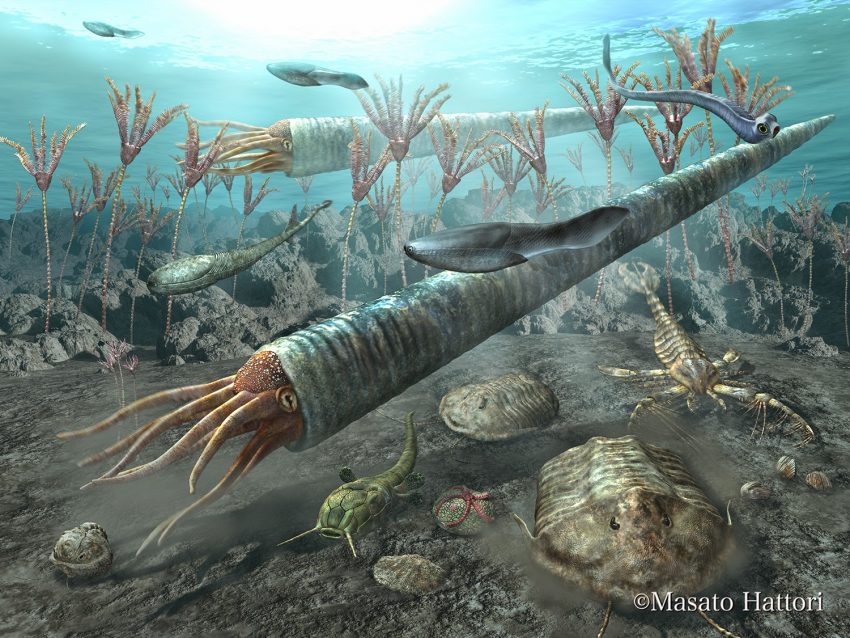
The Ordovician Period by Masato Hattori

The Ordovician Period lasted almost 45 million years, beginning 488.3 million years ago and ending 443.7 million years ago.* During this period, the area north of the tropics was almost entirely ocean, and most of the world’s land was collected into the southern supercontinent Gondwana. Throughout the Ordovician, Gondwana shifted towards the South Pole and much of it was submerged underwater.

Ordovician map

The Ordovician is best known for its diverse marine invertebrates, including graptolites, trilobites, brachiopods, and the conodonts (early vertebrates). A typical marine community consisted of these animals, plus red and green algae, primitive fish, cephalopods, corals, crinoids, and gastropods. More recently, tetrahedral spores that are similar to those of primitive land plants have been found, suggesting that plants invaded the land at this time.

From the Lower to Middle Ordovician, the Earth experienced a milder climate — the weather was warm and the atmosphere contained a lot of moisture. However, when Gondwana finally settled on the South Pole during the Upper Ordovician, massive glaciers formed, causing shallow seas to drain and sea levels to drop. This likely caused the mass extinctions that characterize the end of the Ordovician in which 60% of all marine invertebrate genera and 25% of all families went extinct.

Life

Ordovician strata are characterized by numerous and diverse trilobites and conodonts (phosphatic fossils with a tooth-like appearance) found in sequences of shale, limestone, dolostone, and sandstone. In addition, blastoids, bryozoans, corals, crinoids, as well as many kinds of brachiopods, snails, clams, and cephalopods appeared for the first time in the geologic record in tropical Ordovician environments. Remains of ostracoderms (jawless, armored fish) from Ordovician rocks comprise some of the oldest vertebrate fossils.

Ordovician period by redcode77

Despite the appearance of coral fossils during this time, reef ecosystems continued to be dominated by algae and sponges, and in some cases by bryozoans. However, there apparently were also periods of complete reef collapse due to global disturbances.

Source: www.ucmp.berkeley.edu

Top 10 T. Rex Discoveries

Sunday, August 6, 2017

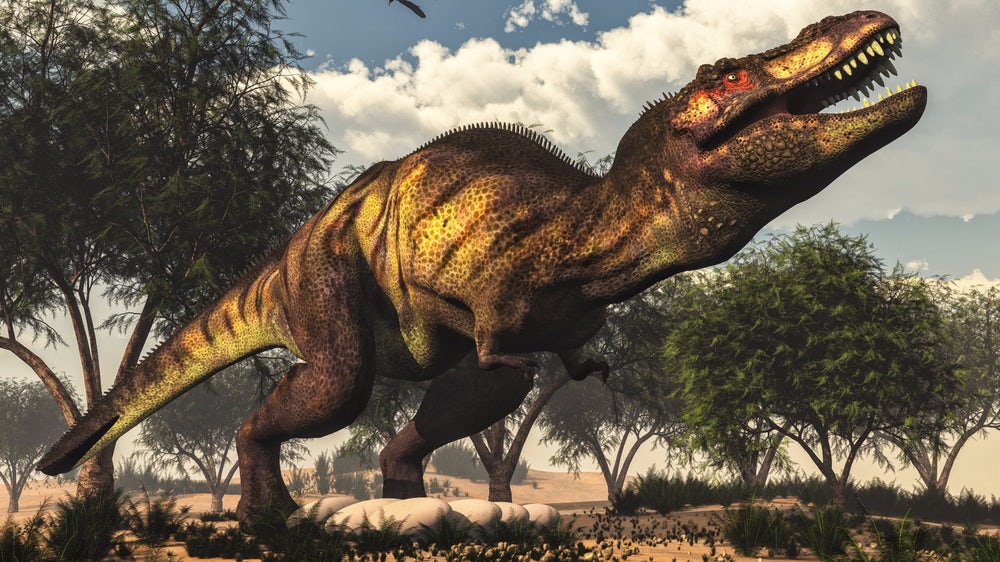
New computer modeling claims that the T. rex wouldn't have been able to run due to its size and weight (Credit: Elenarts/Depositphotos)

The Tyrannosaurus family, of which the most famous species is T. rex, were among the last dinosaurs to appear on the planet, around 80 million years ago. These large carnivorous theropods were only on the planet for a relatively short time, but they had a huge impact on our understanding of dinosaurs – partly because more specimens exist from these final stages than any earlier time in history.

10 - They Had Lips

T. rex may not have been so toothy. A new study suggests that the ferocious dinosaur might have had lips that completely covered its pearly daggers. Sadly, this could one day remove the popular image showing off the permanent croc-like grin.

The Cretaceous predator’s fearsome fangs had a thin coating of enamel. To avoid decay, especially when it is this fragile, enamel must remain moist. Today’s larger lizards support this face-changing theory. Land-dwelling species, like the Komodo dragon, all have enclosed teeth.

Their lip-lacking brethren, such as crocodiles, live in water, so they don’t need the extra moisture. Since T. rex scared everything on land, not water, it’s plausible that they also needed lips to keep those 10–15–centimeter (4–6 in) snappers in peak condition.

9 - They Ran In Packs

This is one moment in time that you don’t want to go back to. In western Canada, researchers found the tracks of three tyrannosaurs moving together. While they didn’t find a trail of destruction, interesting behaviors and hints about the dinosaurs themselves were uncovered.

These were life-scarred, successful adults. The trio clearly knew how to survive in a dinosaur-eat-dinosaur world. All three were about 30 years old, a grand age for T. rex. Skin imprints were still visible from the well-preserved tracks and even showed the severed claw from one T. rex‘s left foot.

They walked side by side but kept well out of each other’s reach. The 70-million-year old spoor is the first discovery of a stretch of T. rex tracks as well as the best evidence that the beasts did form herds.

8- Teenage Terrors

There’s a reason why the Canadian Three kept their distance from each other. From an early age, T. rex kids locked in vicious battles with each other. An adolescent fossil called “Jane,” although her gender is unknown, was bitten to the bone by another testy teen.

Her snout and upper jaw suffered a serious attack that broke her nose. The scrap was with a peer of similar age since her own teeth fit the shape and size of the scars. When Jane was about 12, she died. By then, her snout had already healed, although it was somewhat flattened. This means that the fight occurred when she was years younger.

At 12, Jane was already a tool of terror. Tiny compared to an adult T. rex, she measured 7 meters (22 ft) long and almost 2.5 meters (8 ft) at the hip. The youngster weighed a hefty 680 kilograms (1,500 lb).

7- The Gender Breakthrough

Paleontologists still struggle to separate the girls from the boys. Even species with frills, horns, plates, and spikes possess no clear gender traits, appearing for some reason to be identical.

Enter MOR 1125. The dull-sounding tag is attached to groundbreaking tyrannosaur remains—a definite female. Molecular biologists found a way to identify dino moms at least, all thanks to MOR 1125.

Her thighbone held evidence that she was pregnant at the time of her death. A special tissue was found inside, named medullary bone. In modern birds, it’s as good as a positive pregnancy test.

The scientists subjected the tissue to a multitude of tests to rule out a disease and succeeded. The tissue matched medullary bone both chemically and structurally. The discovery proves that, similar to birds, a sharp rise in estrogen laid down true medullary bone in pregnant dinosaurs.

6 - T. Rex Was On The Menu

The scary interspecies violence didn’t end with breaking each other’s noses. If the meat was available and T. rex was hungry, dinner was served—even if it meant crunching on cousin Bob.

The prehistoric predator needed a lot of meat to survive. Their fossilized poop contained half-digested bones and flesh, indicating a fast metabolism and perhaps quick tummy rumbles urging the dinosaur toward the next meal.

Scientific circles have known for a while that T. rex was a cannibal. Separate discoveries of tyrannosaur bones, carrying the trademark serrated teeth damage, show that they did indeed feed on each other. Researchers are unsure whether T. rex cannibalized their own by deliberately killing them or scavenging on the already dead. Most likely both.

5 - Tooth Folds

Anyone can see that tyrannosaur snappers belong in a slasher movie. Their blood-splattered purpose is hard to overlook. But the deadly bite didn’t just come from the obvious. T. rex‘s teeth were also built for killing on the inside.

Each tooth was serrated like a steak knife. These enamel points touched within what was first mistaken for cracks caused by high-impact grabbing and tearing. A fresh study determined that the “cracks” weren’t feeding damage but an internal type of fold.

Running deep into the tooth, the folds kept it sharp and stable, minimizing the chances of getting knocked out by feisty prey. This dental structure is unique to T. rex and other carnivorous theropods. The ability to hang onto highly effective fangs could be the reason that these dinosaurs successfully walked the planet as the largest meat eaters ever.

4 - Nanotyrannus

In 1988, paleontologist Robert Bakker declared a T. rex–type skull to be a new species, Nanotyrannus. Compared to the robust head of a tyrannosaur, the Cleveland Museum fossil was infinitely smaller, narrower, and had more teeth.

But was it really a dainty family member or a baby T. rex?

Few believed that T. rex could change so drastically while growing, and so the debate raged for years. In 2001, the most intact juvenile T. rex to date was discovered in Montana.

It was none other than Jane, which we discussed above. The half-grown dinosaur was the missing middle child that connected the Cleveland skull to her own breed. She possessed the jawbone gaps once thought to be unique to little Nano.

Nanotyrannus was made obsolete. But in its place, researchers now know that T. rex did indeed switch its looks big time during the different stages of its growth.

3 - Intelligence Made Them Apex Predators

Another gap existed in the T. rex time line, in this case within its evolution. Ironically, it also involves a smaller tyrannosaur. This one was a family member—an ancestor called Timurlengia euotica.

Previously, experts couldn’t understand how the earliest horse-sized forerunners developed into the most feared apex predator that would eventually weigh over seven tons. Timurlengia may be the answer. Its braincase indicates a math-nerd intelligence and could prove that smarts, not monstrous size, was behind T. rex‘s rise to dominance.

The tyrannosaur group played second fiddle for millions of years to larger carnivores. They only rose to the top of the food chain when T. rex‘s competition mysteriously went extinct.

When the apex predator position became available, they already possessed the intelligence and sharp senses to beat other takers. Interestingly, their famous bulk only evolved later, near the end of the dinosaur age.

2 - Decapitation Specialists

Researchers were intrigued by Triceratops‘ neck frills that revealed an unknown behavior from T. rex. Fang marks matched the predator biting and even pulling on the frills.

Each prey fossil examined was determined to be dead at the time that T. rexappeared to develop a fascination with the bony appendages. Wondering why they would nibble on something that had no meat, scientists looked deeper. What they found was horrifying.

Adult T. rex had the habit of decapitating Triceratops. The nibble was more of a violent tugging so that T. rex could pull off the head of its prey.

Triceratops‘ neck muscle appeared to have been the sought-after delicacy, and the bony frill was in the way. There were also slash marks on the neck joints of several Triceratops, something only possible if the herbivore’s head had been torn off.

1 - They Didn’t Roar

To discover what T. rex really sounded like, a study looked at the nearest thing to dinosaurs alive today. Examining how these so-called archosaurs—crocodiles and birds—vocalize, researchers concluded that bigger dinosaurs such as Tyrannosaurus didn’t perform theatrical bellows that shook the Earth.

If it was anything like its feathered descendants, it would not have had vocal cords but air sacs, perhaps even an avian syrinx. Without vocal cords, T. rex couldn’t roar.

When feeling the need to communicate, T. rex would have inflated the sacs to produce noises without opening its jaws, just like some of the larger bird species do. The real sounds of the most well-known dinosaur would have been disappointing—closed-mouth booms and coos.

Follow us on Facebook or Instagram.

Source: www.listverse.com, www.NatGeo.com

Trix, the T. rex

Sunday, August 6, 2017

Artist impression of T. rex Trix according to the latest scientific theories and showing her actual wounds. (Naturalis Biodiversity Center)

Trix is a Tyrannosaurus rex specimen excavated in 2013 in Montana, USA by a team of paleontologists from the Naturalis Biodiversity Center in Leiden in the Netherlands. It is the oldest known Tyrannosaurus specimen, with an age of more than thirty years, and has been considered the third most complete tyrannosaurus found, with between 75% to 80% of its bone volume recovered. The specimen was named Trix after the Dutch former Queen Beatrix and is the only Tyrannosaurus specimen on permanent exhibit in mainland Europe.

In 2012, Naturalis Biodiversity Center at Leiden, the largest natural history museum of the Netherlands, planned to open a new exhibition hall in 2017. In order to increase the structural number of visitors from 300,000 to 400,000 per annum, the management decided to try and procure an authentic Tyrannosaurus skeleton, preferably one excavated by the museum itself. In September 2012, a museum delegation travelled to the US to contact the Black Hills Institute, a company that had been involved in nine Tyrannosaurus excavations. As it happened, the BHI had just received a report from a farmer in Wyoming about a Tyrannosaurus discovery. Senior Naturalis paleontologist John Vos immediately visited the site and identified the remains as those of Tyrannosaurus. As it was late in the season, it was decided to postpone the excavation until the next Spring. In April and May 2013, the site was thoroughly excavated but apart from some foot bones, a skeleton proved to be absent. However, five Triceratops skeletons were present elsewhere on the farm land and procured by the museum for exhibition.

In the evening of 27 May 2013, Blaine Lunstad, an amateur paleontologist, with his wife Michele Lunstad who is of Dutch descent, stumbled upon some bones in the “East Pasture”, part of the land of farmer Lige M. Murray, fifty kilometres south of Jordan, Montana. Local fossil hunter Clayton “Dino Cowboy” Phipps confirmed that it was a tyrannosaur skeleton. Rumours of the find reached the BHI, which informed Naturalis. In August 2013, a team of paleontologists from the Naturalis Biodiversity Center, now headed by Anne Schulp, again travelled to the USA. From 29 August to 9 September they unearthed a big and remarkably complete Tyrannosaurus rex specimen. The fossil was found in the Hell Creek Formation. The pattern of geomagnetic reversal showed it had an age of at least 66.4 million years. The excellent preservation had been caused by the skeleton being surrounded by a three metres thick sandstone lens with a high chalk content, neutralizing damaging acids. The Black Hills Institute collaborated with the team in the excavation, which was also assisted by Phipps and the Lundstads. On 5 September, paleontologist Philip Manning of the University of Manchester performed a lidar-laserscan of the site surface to precisely determine the position of all bones.

Presentation of the Tyrannosaurus specimen RGM 792.000 in the 2016-2017 exposition “T. rex in town” of the Naturalis Biodiversity Center, Leiden, the Netherlands. Author: Rique

In May 2015, a CAT-scan of the skull was made in a large industrial scanner of the Fraunhofer Entwicklungszentrum Röntgentechnik of the Fraunhofer Institut at Fürth in Germany.

According to Peter Larson, director of the Black Hills Institute, Trix is the third most complete Tyrannosaurus found, after Sue and Stan. About half of the bones have been found. These represent between 75% and 80% of its bone volume. The main missing parts include the tip of the snout, the front lower jaws, at least seven vertebrae of the middle tail, the point of the tail, the right shoulder blade, the arms, the left hindlimb and the right foot. Parts never before discovered in a Tyrannosaurus fossil include a turbinal bone in the nasal cavity. A rare element present is the furcula and the stapes of the ear. There is some root damage from plant growth and some bones had been gnawed by scavengers. A smaller shed tooth was found, attributed to Nanotyrannus. Trix in 2016 was the most complete Tyrannosaurus specimen permanently exhibited outside of the USA. Tyrannosaurus skeletons part of the collection of the Natural History Museum, London, are more fragmentary.

Name

For formal use, the BHI referred to the skeleton as the “Murray T. rex”. Because of her age, gender and face injuries, the tyrannosaurus was nicknamed “grandma pusface”. Naturalis preferred Grand Old Lady. Wim Pijbes, the director of the Amsterdam Rijksmuseum, called the skeleton “the Nightwatch of Natural History”. She has also been called the “Mona Lisa of Naturalis”, because of her enigmatic smile. Both Larson and the museum concluded it was “the most beautiful tyrannosaurus of the world”. Naturalis decided that the skeleton needed an official name, as all main exemplars of Tyrannosaurus possess. In the press, it was speculated it would be called “Michelle” after its discoverer, as had happened with many specimens. Naturalis asked the Dutch public to suggest a name. On 23 June 2016 it was announced that the name overwhelmingly chosen was “Trix”, as both an allusion to “T-rex” and former Queen Beatrix of the Netherlands. Trix thus became known as the “Queen of the Cretaceous”.

T. rex in Town is a temporary exhibit from September 10, 2016 to June 5, 2017 in the Naturalis Biodiversity Center in Leiden, The Netherlands.

 Source. www.Wikipedia.org

What if Dinosaurs Were Still Alive Today?

Sunday, August 6, 2017

What if Dinosaurs Were Still Alive Today?

What would happen if dinosaurs roamed the earth today? Originally appeared on Quora – the knowledge sharing network where compelling questions are answered by people with unique insights.

Answer by Ben Waggoner, Ph.D in Integrative Biology, paleontologist, and evolutionary biologist, on Quora:

Massive devastation of trendy Manhattan wine bars.

Huh?

Okay, first of all, one subgroup of dinosaurs is still roaming the Earth today: the birds. So dinosaurs poop on your car, visit your feeders, and feed you well on Thanksgiving. But I assume you meant what would happen if the extinct, non-bird dinosaurs could somehow roam the Earth today.

That raises the point that different dinosaur species lived at different times and places. Tyrannosaurus never feasted on Stegosaurus, for example, because Steggy lived something like 100 million years before Rexy ever existed. Tyrannosaurus never got to taste Giraffatitan because they not only lived 80 million years apart, they lived on separate continents. (This is one of my beefs with Jurassic ParkDilophosaurusthe critter that spit poison in Wayne Knight’s face, lived about 120 million years and 6000 miles away from Velociraptor, the critters that ate Bob Peck.) So if all the extinct dinosaurs suddenly started roaming the Earth together at the same time … well, you’d have utter ecological chaos, as the Velociraptors discovered that their tactics for hunting Protoceratops were ineffective against unfamiliar Ankylosaurus, and Triceratops found out that it had no idea how to dodge Allosaurus. You might as well turn some polar bears, bison, tree sloths, and kangaroos loose on the Serengeti plain.

But let’s keep it simple. Suppose we could magically transport a decent sample of the dinosaurs from one place and time into the present day. Let’s pick up a herd of duckbills—say, Edmontosaurus or Maiasaura —and a herd of Triceratops, a few smallish predators like Dakotaraptor, and a couple of Tyrannosaurus. All of these lived in the same general area (western North America) in the same general time frame (late Cretaceous). So we plop all of these down in North America today, and …

There were flowering plants in the Late Cretaceous, but they didn’t yet dominate the landscape. The typical landscape in Cretaceous North America seems to have been “fern savannas”—somewhat like prairies, but dominated by small ferns, not grasses—broken up by tracts of forests dominated by conifers, ginkgos, ferns, and cycads. There were flowering plants, including decent-sized trees, but again, nothing like the diversity we have now.

And here’s the problem: Modern flowering plants have had ~100 million years to evolve anti-herbivore defenses, and just to evolve complex chemistry in general. We don’t know enough about dinosaur biochemistry to know exactly what they would find poisonous. Suffice it to say that as soon as the herbivores started eating the local plants, they would be exposed to a whole range of chemicals that they had no adaptations to handle. They might not even have the sensory receptors to taste them.

The actual effects are anyone’s guess. The simplest case would be that the herbivores would get sick and die, like modern sheep or cows in the West that eat death camas or lupine. Some might end up tripping out, like humans eating ergot-infected rye or jimsonweed, or livestock eating Oxytropis or Astragalus “locoweeds”. Survivors might fail to lay viable eggs, or lay eggs that would hatch into deformed offspring—like sheep and goats eating false hellebore and giving birth to lambs and kids with cyclopia.

The carnivorous dinosaurs might have easy pickings for a while, as they feasted on dead or incapacitated herbivorous dinosaurs. This wouldn’t last long, though. Sooner or later, Tyrannosaurus rex has to find living prey, or possibly fresh carrion, depending on whether it was a predator or scavenger (that’s another story). There were mammals alive at the same time and place as T. rex, but none very big—and for all we know, modern mammal flesh might be unpalatable. But recall that birds belong within the dinosaurian clade. T. rex may run out of Triceratops to eat, but if it can find large, relatively slow birds to munch, it might survive for a while, assuming that it can run fast enough to catch them (a controversial question). A T. rex that was lucky enough to find a turkey farm would probably eat the birds like so much popcorn. The few ostrich ranches in the America West could find their business nipped in the bud, if by “nipped” you mean “messily dismembered.”

The herbivores would be equally hard to manage. Imagine: a herd of Triceratops eats a patch of Datura stramonium and promptly levels downtown Bismarck, North Dakota, hallucinating like a Grateful Dead show gone horribly wrong. Twitching, retching, slobbering duckbills collapse across I-94, blocking traffic into Fargo for hours, after getting into a patch of Apocynum cannabinum (hemp dogbane). A photo of a poor baby Edmontosaurus whose mamma tried hellebore, with a single eye and adorably deformed face, threatens to displace the “I Can Has Cheezburger?” cat as the most viral meme on the Internet …

And a herd of Maiasaura, starving and desperate, wanders into Manhattan and discovers a wine bar decorated with lush ferns and rare tropical cycads. Minutes later, the wine bar is flattened, its greenery devoured. Newly invigorated by their first decent meal in weeks, the Maiasaura rampage from one fern bar to the next. Hundreds of Wall Street middle-management flunkies who were hoping to score that night are severely inconvenienced.

Follow us on Facebook, and Instagram.

Pliosaurus

Sunday, August 6, 2017

Liopleurodon rossicus, Dinosaurium exhibition, Prague, Czech Republic

Pliosaurus (meaning ‘more lizard’) is a genus of thalassophonean pliosaurid known from the Kimmeridgian and Tithonian stages (Late Jurassic) of Europe and South America. Their diet would have included fish, cephalopods, and marine reptiles. This genus has contained many species in the past but recent reviews found only six to be valid, while the validity of two additional species awaits a petition to the ICZN. Pliosaurus currently consists of the type species P. brachydeirus, and also P. brachyspondylusP. carpenteriP. funkeiP. kevaniP. macromerusP. rossicus and P. westburyensis, as well as the invalid P. portentificus. Most species of Pliosaurus are notable for their large body size, while the others, P. brachydeirusP. brachyspondylus and P. portentificus, are known exclusively from immature individuals. Species of this genus are differentiated from other pliosaurids based on seven autapomorphies, including teeth that are triangular in cross section.

Scale diagram, presenting three of the largest species

A specimen found in the Svalbard islands of northern Europe has been estimated to have been 15 metres (49 ft) long, 45,000 kilograms (99,000 lb) in weight and had teeth 30 centimetres (12 in) long. It is estimated to have lived approximately 147 million years ago and was named Pliosaurus funkei in Knutsen et al 2012, with estimated skull lengths of 160-200 cm and a forelimb legnth of 300 cm for the holotype (PMO 214.135), and an estimated skull length of 200-250 cm for the referred specimen (PMO 214.136), suggesting that the animal had proportionally bigger flippers than other pliosaurs compared to the skull size and dimensions of the vertebrae. Analysis of bones from the four flippers suggest that the animal cruised using just two fore-flippers, using the back pair for extra speed when pursuing and capturing prey. P. funkei’s brain was of a similar type and size, proportionally, to that of today’s great white shark, the team says.

Pliosaurus rossicus by Olorotitan on DeviantArt

Paleontologists believe that there were several reasons why this animal went extinct. First of all, Mosasaurs came on the scene at about this time and competed heavily with Pliosaurus for its main food source – fish. That’s because Mosasaurs were faster and agiler than Pliosaurus. They were also more vicious animals. This was just enough of an edge for them to out-compete Pliosaurus for fish. Second, water temperatures began to change during this time and this creature may not have been able to adapt quickly enough. Which is probably why this animal went extinct some 145 million years ago.

Source: www.WildNature.org, www.Wikipedia.org

Tarascosaurus

Sunday, August 6, 2017

Tarascosaurus salluvicus art by Sergey Krasovskiy. Stocktrek Images

Tarascosaurus (“Tarasque lizard”) is a genus of, perhaps abelisaurid, theropod dinosaur from Late Cretaceous of France.

After having in 1988 identified an upper jaw bone found near Pourcieux as belonging to a member of the Abelisauridae, French paleontologist Éric Buffetaut reviewed the known remains of larger theropods found in the Late Cretaceous of Europe concluding they all were of abelisaurid affinity. Most of these fossils, earlier named as Megalosaurus pannoniensisMegalosaurus hungaricus and Megalosaurus lonzeensis, he considered to be nomina dubia because of the paucity of the material. However, when in the collection of the University of Lyon he discovered some theropod bones once excavated by an unknown collector at the escarpment of the Lambeau de Beausset, Buffetaut and Jean Le Loeuff named and described these in 1991 as the type species Tarascosaurus salluvicus. The generic name is derived from the Tarasque or Tarasca, a devouring monster from Occitan and Spanish folklore. The specific name refers to the Salluvii, a Gallic tribe in Antiquity inhabiting the area near Marseilles.

Tarascosaurus salluvicus size comparison by MoriceMonkey93

The holotype PSL 330201 was found in the Fuvelian Beds, dating from the lower Campanian. It consists of the upper part of a thigh bone, 22 centimetres (8.7 in) long. PSL 330202, consisting of two dorsal vertebrae, was made a paratype; these bones may belong to the same individual. Referred was PSL 330203, a damaged tail vertebra. The femur, with an undamaged length estimated at 35 centimetres (14 in), indicates a body length of two and a half to three metres. Some fossils from Spain were also referred to the genus.

In 2003 Oliver Rauhut concluded that Tarascosaurus itself was also a nomen dubium because the material was not diagnostic.

Tarascosaurus was placed in the Abelisauridae in 1991. It was then seen as the only known abelisaurid from the Northern Hemisphere apart from Betasuchus of the Maastrichtian of the Netherlands. However, in 2003 Ronan Allain et al. concluded that the type lacked any uniquely abelisaurid traits.

Source: www.Wikipedia.org, www.NatGeo.com

Kronosaurus: The Sea Giant of Australia

Saturday, August 5, 2017

Kronosaurus: The Sea Giant of Australia

Kronosaurus (meaning “lizard of Kronos”) is a genus of short-necked pliosaur. With an estimated length of 9–10.5 metres (30–34 ft), it was among the largest pliosaurs, and is named after the leader of the Greek Titans, Cronus. It lived in the Early Cretaceous Period (Aptian-Albian). Fossil material has been recovered from Queensland in Australia, and from the Paja Formation in Boyacá, Colombia, and assigned to two species.

K. queenslandicus scale diagram, showing the size of the restored Harvard skeleton along with a more accurate estimate

Like other pliosaurs, Kronosaurus was a marine reptile. It had an elongated head, a short neck, a stiff body propelled by four flippers, and a relatively short tail. The posterior flippers were larger than the anterior. Kronosaurus was carnivorous, and had many long, sharp, conical teeth. A feature of the genus Kronosaurus is the first three maxillary teeth are enlarged to fangs. Current estimates put Kronosaurus at around 9–10.5 meters (30–34 feet) in length. In 2009, K. queenslandicus was estimated to weigh up to 11,000 kilograms (11 metric tons).

K. boyacensis in Villa de Leyva, Boyaca, Colombia

Body-length estimates, largely based on the 1959 Harvard reconstruction, had previously put the total length of Kronosauru sat 12.8 meters (42 feet). However, more recent studies, comparing fossil specimens of Kronosaurus to other pliosaurs suggests that the Harvard reconstruction may have included too many vertebrae, exaggerating the previous estimate, with the true length probably only 9–10.5 meters (30–34 feet).

Fossil stomach contents from Northern Queensland show that Kronosaurus preyed on turtles and plesiosaurs. Fossil remains of giant squid have been found in the same area as Kronosaurus; it may have fed on them, but no direct evidence for this exists.

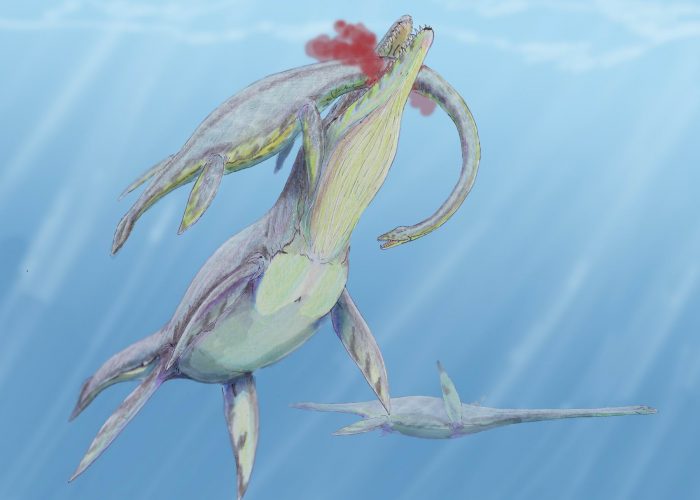
Life restoration of K. queenslandicus preying on Woolungasaurus by Dmitry Bogdanov, 2008.

Large, round bite-marks have been found on the skull of an Albian-age Australian elasmosaurid (Eromangasaurus) that could be from a Kronosaurus attack.

Kronosaurus is known from Australia and Colombia. Both areas were covered by shallow inland seas when Kronosaurus inhabited them.

Source: www.NatGeo.com, www.Wikipedia.org

Aegirocassis benmoulae: The Human-Sized ‘Lobster’ who Lived on Earth 480 MYA

Thursday, August 3, 2017

Reconstruction of Aegirocassis benmoulae. Image credit: Marianne Collins / ArtofFact.

Paleontologists have discovered fossils of a 2-m-long lobster-like animal that lived in the seas of what is now Morocco during the early Ordovician period, about 480 million years ago.

The newly-discovered animal, named Aegirocassis benmoulae in honor of the Moroccan fossil hunter Mohamed Ben Moula who discovered the fossils, belongs to the extinct family Anomalocarididae (or anomalocaridids), which first appeared 520 million years ago.

This marine monster attained a size of at least 7 feet (2 m), ranking it among the biggest arthropods that ever lived.

“This would have been one of the largest animals alive at the time,” said Dr Allison Daley of Oxford University, who is a co-author of the paper published in the journal Nature.

Aegirocassis benmoulae is a truly remarkable looking creature,” added co-author Dr Derek Briggs of the Yale Peabody Museum of Natural History and the Yale University’s Department of Geology and Geophysics.

While most anomalocaridids were apex predators, similar to present-day sharks that hunt other animals for food, Aegirocassis benmoulae is more like present-day whales, which filter seawater to find their food.

“These animals are filling an ecological role that hadn’t previously been filled by any other animal,” Dr Daley said.

“While filter feeding is probably one of the oldest ways for animals to find food, previous filter feeders were smaller, and usually attached to the sea-floor.”

“We have found the oldest example of gigantism in a freely swimming filter feeder.”

Lead author Dr Peter Van Roy of Yale University added: “giant filter-feeding sharks and whales arose at the time of a major plankton radiation, and Aegirocassis benmoulae represents a much, much older example of this trend.”

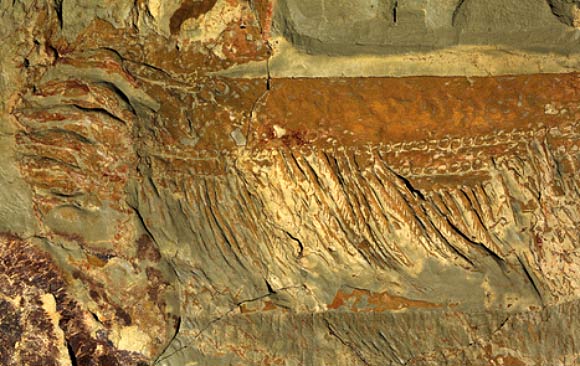
Aegirocassis benmoulae specimen. Image credit: Peter Van Roy et al.

Dr Van Roy excavated an exceptionally well-preserved 3D fossil of the new species. Most previous anomalocaridid fossils were flat, like a dried leaf pressed within the pages of a book.

“Without these 3D remains, we may never have got the insight into these animals’ anatomy that we did,” Dr Daley said.

Aegirocassis benmoulae had two pairs of swim flaps per body segment, rather than the one pair found in previous anomalocaridid fossils.

The paleontologists show that the two pairs of swim flaps correspond the two branches of the double branched legs found in present-day arthropods, but at a stage before they fused together into one leg.

“We were excited to discover that it shows features that have not been observed in older Cambrian anomalocaridids – not one but two sets of swimming flaps along the trunk, representing a stage in the evolution of the two-branched limb, characteristic of modern arthropods such as shrimps,” Dr Briggs said.

_____

Peter Van Roy et al. Anomalocaridid trunk limb homology revealed by a giant filter-feeder with paired flaps. Nature, published online March 11, 2015; doi: 10.1038/nature14256

Source: www.sci-news.com

Pages