Blogs

Study Reveals Link between Mass Extinction Events and Comet/Asteroid Showers

Sunday, August 13, 2017

Study Reveals Link between Mass Extinction Events and Comet/Asteroid Showers

According to a study, published in the journal Monthly Notices of the Royal Astronomical Society, mass extinctions occurring over the past 260 million years were likely caused by comet/asteroid showers.

For more than three decades, researchers have argued about a controversial hypothesis relating to periodic mass extinctions and asteroid/comet impact craters on Earth.

Dr Ken Caldeira of Carnegie Institution and Dr Michael Rampino of New York University offer new support linking the age of these craters with recurring mass extinctions of life, including the demise of the dinosaurs.

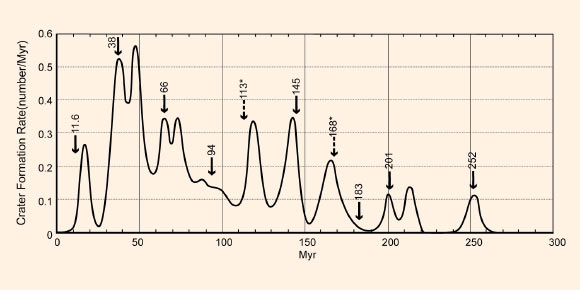
Specifically, they show a cyclical pattern over the studied period, with both impacts and extinction events taking place every 26 million years.

This cycle has been linked to periodic motion of the Sun and planets through the dense mid-plane of our Milky Way Galaxy.

Scientists have theorized that gravitational perturbations of the distant Oort comet cloud that surrounds the Sun lead to periodic comet showers in the inner Solar System, where some comets strike our planet.

To test their hypothesis, the team performed time-series analyses of impacts and extinctions using available data offering more accurate age estimates.

A graph showing how the rate of cratering has changed on Earth over time; the arrows indicate the dates of mass extinctions. Image credit: Michael Rampino / New York University.

“The correlation between the formation of these impacts and extinction events over the past 260 million years is striking and suggests a cause-and-effect relationship,” said Dr Rampino, who is the lead author on the study.

The scientists found that six mass extinctions of life during the studied period correlate with times of enhanced impact cratering on Earth.

“One of the craters considered in the study is the Chicxulub impact structure in the Yucatan, which dates to about 65 million years ago – the time of a great mass extinction that included the dinosaurs.”

“Moreover, five out of the six largest impact craters of the last 260 million years on Earth correlate with mass extinction events,” they said.

“This cosmic cycle of death and destruction has without a doubt affected the history of life on our planet,” Dr Rampino concluded.

_____

Michael Rampino & Ken Caldeira. Periodic impact cratering and extinction events over the last 260 million years. MNRAS, published online October 20, 2015

Source: www.sci-news.com, 2015

Sinraptor

Sunday, August 13, 2017

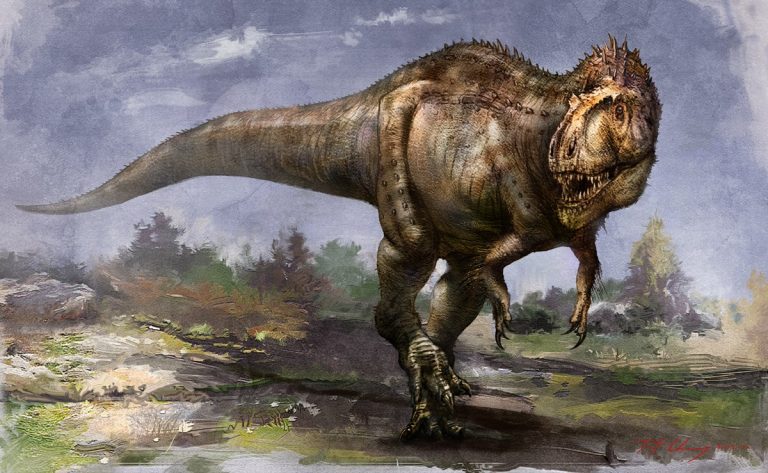
Sinraptor by Cheung Chung Tat

Sinraptor is a genus of theropod dinosaur from the Late Jurassic.

Sinraptor is a dinosaur which lived approximately 150 million years ago. It was first discovered by a joint Chinese and Canadian expedition in the Shishugou Formation of China in 1987. In 1994, it was named by Philip J. Currie and Xian Zhao, who gave it the name Sinraptor because it means “Chinese raptor”. The specific name dongi honours Dong Zhiming. Despite its name, Sinraptor is not related to dromaeosaurids (often nicknamed “raptors”) like Velociraptor.

This dinosaur was around 25 feet long, 10 feet tall and weighed approximately 2000 pounds or 1 ton. It was probably a fierce—albeit small—carnivore that probably hunted very well. Since many of the herbivores in this part of the world were giant, they probably hunted the juvenile members of them. Perhaps separating these young sauropods from their parents to hunt them. However, it probably also had to contend with other larger predators who may have given it some grief during the
course of its life.

Sinraptor dongi, Royal Tyrrell Museum

An interesting fact about Sinraptor is that it isn’t a true raptor. Sure, it was bipedal like a raptor but that is where the similarities end. It would be millions of years after the death of this dinosaur before raptors would come on the scene.

Paleontologists actually think that the Sinraptor was an Allosaur.

The skeleton of Sinraptor hepingensis (formerly referred to Yangchuanosaurus) is on display at the Zigong Dinosaur Museum, Zigong, China.

Source: www.Wikipedia.org

Clues to Rocky Mountain Formation in South America

Sunday, August 13, 2017

South American example illustrates Rocky Mountain formation

New work from an international team of researchers including Carnegie’s Lara Wagner improves our understanding of the geological activity that is thought to have formed the Rocky Mountains. It was published by Nature in August 2015.

Subduction is a geological process that occurs at the boundary between two of the many plates that make up the Earth’s crust. An oceanic crustal plate sinks and slides under another plate—either oceanic or continental—and is plunged deep into Earth’s mantle.

Usually the lower plate slides down into the mantle at a fairly steep angle, sinking rapidly into the warmer, less-dense mantle material. However, in a process called “flat-slab” subduction, the lower plate moves nearly horizontally underneath the upper plate, sometimes for great distances.

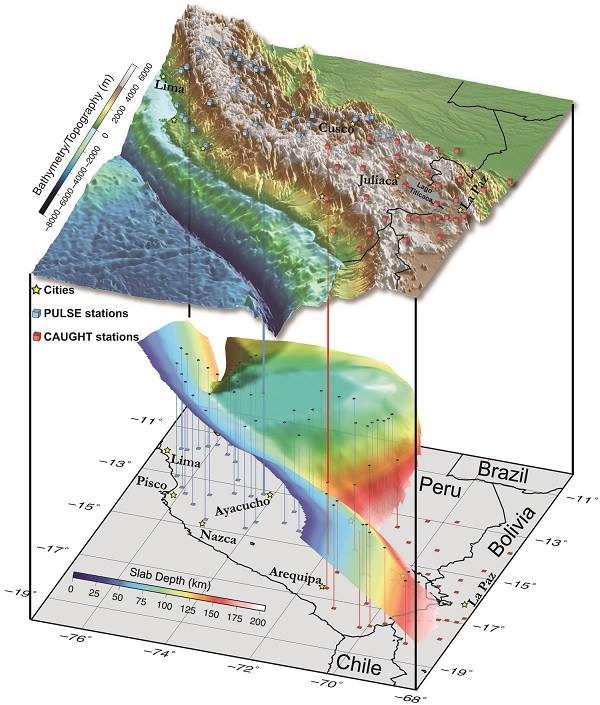
 The revised geometry of the downgoing Nazca plate beneath the Andean mountains in southern Peru and northern Bolivia. Seismic stations are shown as colored cubes. Vertical lines show the location of these stations projected onto the slab.

Flat-slab subduction is used to explain volcanism and mountain formation that occurs far from plate boundaries, because the lower, “flat” slab moves inland beneath the surface of a landmass and thereby transmits the friction of the plates sliding against one another far inland. The formation of the Rocky Mountains between 55 and 80 million years ago, according to sedimentary and volcanic records that have been studied in detail since the 1970s, often is attributed to flat-slab subduction as the plate beneath the Pacific Ocean at that time slid beneath the North American continent.

Today, the largest flat slab is found beneath Peru, where the oceanic Nazca Plate is being subducted under the continental South American Plate. An undersea mountain belt, called the Nazca Ridge, sits on the Nazca Plate, and has been subducted along with the rest of the plate for the past 11 million years, according to previous studies

Although scientists knew that a flat slab existed in this region, much about how and when it was formed has remained a mystery. Using an array of seismometers placed over the region of flat-slab subduction, the team was able to image the structure of the subducted plate in unprecedented detail. This allowed the team to study the evolution of the Peruvian flat slab over time and to better understand the forces that created and sustain it.

What they found is that the angle of subduction is shallowest where the Nazca Ridge is being subducted beneath Peru. The portion of the plate containing this ridge sinks about 90 kilometers (56 miles) down and then flattens out. Away from the ridge, older portions of the flat slab that are no longer supported by the thick crust of the Nazca Ridge are found to be sagging, and younger, more recently subducted oceanic crust has torn free of the old, flat slab and is subducting at a normal dip angle.

“This was surprising as we expected to image large, older flat slab to the north. Instead, we found that the flat slab north of the subducting Nazca Ridge tears and reinitiates normal, steep subduction,” said lead author Sanja Knezevic Antonijevic, a student at the College of Arts and Sciences at the University of North Carolina at Chapel Hill.

Suction and trench retreat previously were theorized to be sufficient to create a flat slab. Suction is created between the upper plate and the downgoing slab, because the surrounding mantle is too viscous to creep into the narrow space between the two plates. Trench retreat occurs when the subducting oceanic plate moves dominantly downward, not laterally forward, resulting in an oceanward migration of the continent and trench.

However the team’s model shows that the subduction of the ridge is necessary for the flat slab’s formation, presumably because the buoyancy of the volcanically thickened Nazca Ridge keeps this portion of the plate from plunging steeply into the mantle. What’s more, removing the ridge from the model causes the flat slab to become unstable.

“Our model provides insights into the way that the Peruvian flat slab formed and evolved over time that can be applied to the studies of other flat-slab subduction events, such as the one that formed the Rocky Mountains,” Wagner said.

The other team members were: Abhash Kumar, also a student in the College of Arts and Sciences at the University of North Carolina at Chapel Hill; Susan Beck and George Zandt of University of Arizona; Maureen Long of Yale University; and Hernando Tavera and Cristobal Condori of Instituto Geofisico del Peru.

Source: www.ineffableisland.com

Hypercarnivores Checked Massive Ancient Herbivores

Sunday, August 13, 2017

A pack of saber-tooth cats (Smilodon) fight with adult Colombian mammoths over a juvenile mammoth they've felled. A new analysis by a team of biologists concludes that 'hypercarnivores' such as these working in concert could have taken down juveniles of the largest herbivores. Credit: Mauricio Anton

When the largest modern-day plant-eaters — elephants — are confined to too small an area, they devastate the vegetation. So 15,000 years ago, when the herbivores like the Columbian mammoth, mastodons and giant ground sloths were even larger, more numerous and more widely distributed, how did the landscape survive?

A pack of saber-tooth cats (Smilodon) fight with adult Colombian mammoths over a juvenile mammoth they’ve felled. A new analysis by a team of biologists concludes that ‘hypercarnivores’ such as these working in concert could have taken down juveniles of the largest herbivores.

The answer was probably enormous predators, creatures called “hypercarnivores” by a team of evolutionary biologists appearing online the week of Oct. 26 in the Proceedings of the National Academy of Sciences.

These ancient carnivores would have been about twice as large as the wolves, lions and hyenas we know today.

Based on a series of mathematical models for the sizes of predators and prey in the late Pleistocene age (about 1 million to 11,000 years ago), the team concludes that the largest cave hyena might have been able to take down a 5-year-old juvenile mastodon weighing more than a ton. Hunting in packs, those hyenas could possibly bring down a 9-year-old mastodon weighing two tons, the authors conclude.

“From the present day, it seems that big animals like elephants are immune to predation,” said Duke University biologist V. Louise Roth. “In fact, Pleistocene ecosystems were a lot more complex and predators could have had a larger impact.”

It’s also true that humans have picked off most of the larger predators, changing our estimates pretty dramatically, said lead author and UCLA paleoecologist Blaire Van Valkenburgh. “So much of our science is based on the last 50 or 100 years,” she said, but populations of big cats and wolves would have been much larger before humans arrived on the scene.

The work grows out of a 2014 symposium on the consequences of megafauna extinctions in the Pleistocene. Most of the discussion at the conference in Oxford was on herbivores, Van Valkenburgh said.

Saber-tooth cats (Smilodon) working together may have been capable of taking down juveniles of the largest Pleistocene herbivores, such as this young hippo, according to a new analysis appearing in the Proceedings of the National Academy of Sciences.

“I’m a carnivore person,” so she wanted to make sure the superpredators had a seat at the table, too. “We’re all just trying to understand the Pleistocene and how rich that ecosystem was,” Van Valkenburgh said.Van Valkenburgh’s analysis estimated size ranges for Pleistocene predators based on the fossil record, including teeth. Well-established formulas allow researchers to make a reasonable estimate of an animal’s size based on just the first molar. “And in the fossil record, the one thing we’ve got a lot of is teeth,” she said.

Saber-tooth cats (Smilodon) working together may have been capable of taking down juveniles of the largest Pleistocene herbivores, such as this young hippo, according to a new analysis appearing in the Proceedings of the National Academy of Sciences. Credit: Mauricio Anton

This led to the question of how large their prey could have been. “Blaire came to me with the question, ‘How big was a baby mastodon?’” Roth said.

She developed formulas for the relationship of shoulder height to body mass from data published for modern captive elephants to estimate how large some of the herbivores found in fossil evidence would have been.

“It’s hard to weigh an elephant; you need a truck scale,” Roth said. And truck scales aren’t the easiest thing to lug around the African savannah, so field researchers monitor shoulder heights in tracing a growing elephant’s size.

The difficulty is that, even with the best measurements, modern adult elephants with the same shoulder height may vary by as much as two times in body mass, Roth said. Add to that the “age structure,” the mix of animals of different sizes in a given herd, and her calculations of mammoth sizes cover “a whopping range.”

Nonetheless, they developed a range for what some of these shaggy grass-eaters would weigh. From this, an analysis by Matthew Hayward of Bangor University, UK calculated whether these big predators might be able to capture an herbivore.

Because there is no way to infer from the scant fossil evidence whether predators hunted in packs, the researchers relied on estimated prey sizes and modeled the capacity of single predators and predators in groups to take them down.

They conclude that juvenile mastodons and mammoths would indeed have been susceptible, especially if the carnivores were socially organized.

Juvenile elephants do fall prey to lions in contemporary Africa, the study notes, but it usually involves a coordinated attack by a group of carnivores. “In Botswana, lions were observed to regularly use a strategy in which one to two lions leapt onto and bit the back of the victim while others on the ground worked to sever the relatively thin flexor muscles of the hind limb,” the study says.

Hunting in packs — as modern lions, hyenas and wolves still do — would have made even larger juveniles susceptible. Van Valkenburgh said that larger pack sizes, which may have been more common in the Pleistocene, further enhance hunting success.

Understanding the dynamics of predator, prey and grassland before humans were added to the mix is essential to properly guiding efforts to restore habitats, Roth said. “You can’t just make assumptions based on what we see today. The best way to understand community dynamics absent human influences is to look to the natural experiments in the fossil record.”

Van Valkenburgh’s work was supported by the National Science Foundation (EAR 1237928)

Duke University

Citation: “The Impact of Large Terrestrial Carnivores on Pleistocene Ecosystems,” Blaire Van Valkenburgh, Matthew Hayward, William Ripple, Carlo Meloro and V. Louise Roth. Proceedings of the National Academy of Sciences, Early Online, Oct. 26, 2015. DOI: 10.1073/pnas.1502554112.

Source: www.phys.org

Rajasaurus

Thursday, August 10, 2017

Rajasaurus by atrox1

Rajasaurus (‘Raja’ meaning “king” (derived from Sanskrit) here,”king of lizards”) is a genus of carnivorous abelisaurian theropod dinosaur with an unusual head crest. Between 1982 and 1984, its fossilized bones were discovered by Suresh Srivastava of the Geological Survey of India (GSI). Excavated from the Narmada River valley in Rahioli in the Mahisagar district of Gujarat, India, the find was announced as a new genus of dinosaur by American and Indian scientists on August 13, 2003.

Paleontologists Paul Sereno of the University of Chicago, Jeff Wilson of the University of Michigan, and Srivastava worked together as an Indo–American group to study the Narmada River fossils. The fossils represented the partial skeleton of the new species Rajasaurus narmadensis, which means “princely lizard from the Narmada Valley.” The fossilized bones of Rajasaurus have also been found in the upriver region of the Narmada, at Jabalpur, in the state of Madhya Pradesh.

Brontomerus mcintoshi v Rajasaurus narmadensis (Wikimedia Commons)

Rajasaurus was an abelisaurid, a member of a group of theropod predators known to have lived only on landmasses that were part of the supercontinent Gondwana, such as Africa, India, Madagascar, and South America. Rajasaurus closely resembles Majungasaurus, a contemporary abelisaur from Madagascar, an island that had separated from the Indian landmass about 20 million years earlier. It was found to be an abelisaurid through a phylogenetic analysis of anatomical characteristics, and was described as a carnotaurine abelisaurid (the subfamily including Carnotaurus) because of the configuration of its nasal bones and its possession of a growth (“excrescence”) on its frontal bone. Rajasaurus is distinguished from other genera by its single nasal-frontal horn, the elongated proportions of its supratemporal fenestrae (holes in the upper rear of the skull), and the form of the ilia (principle bones of the hip) which feature a transverse ridge separating the brevis shelf from the hip joint.

Cast of Rajasaurus skull (Wikimedia Commons)

Rajasaurus was identified from a partial skeleton including a part of the skull (braincase), backbone, hip bones, parts of the hind legs and tail. This specimen, GSI 21141/1–33, serves as the type specimen of the genus and species. In 2010, Gregory S. Paul estimated its body length at eleven metres, its weight at four tonnes. In 2016, its length was estimated to be 6.6 metres (21.7 ft) in a comprehensive analysis of abelisaur size. What is preserved of the skull shows it bore a distinctive low rounded horn, made up of outgrowths from the nasal and frontal bones.

The discovery of Rajasaurus could lead to additional information on the evolutionary relationships of abelisaurs, since previously described specimens from India were mainly isolated bones. At a press conference held in 2003 on the discovery of Rajasaurus, Sereno stated:

The discovery, which will be put for examination before global experts, was important since it would help in adding to the current knowledge of dinosaur belonging to the family of Abelisaur predators and adding a new angle to dinosaurs in the Indian subcontinent.

Rajasaurus miscellaneous

Rajasaurus is known only from the Indian Peninsula. At the time it was alive, the Indian landmass had recently separated from the rest of Gondwana and was moving north. While Rajasaurus had evolved along its own direction, it was still similar to other abelisaurids such as Majungasaurus from Madagascar and Carnotaurus from South America; these animals descended from a common lineage.

Rajasaurus has been found in the Lameta Formation. This rock unit represents a forested setting of rivers and lakes that formed between episodes of volcanism. The volcanic rocks are now known as the Deccan Traps. Rajasaur and sauropod fossils are known from river and lake deposits that were quickly buried by Deccan volcanic flows. Other dinosaurs from the Lameta Formation include the noasaurid Laevisuchus, abelisaurids Indosaurus and Indosuchus, and the titanosaurian sauropods JainosaurusTitanosaurus, and Isisaurus.

Coprolites have been recorded in the Lameta Formation, and the presence of fungi in coprolites indicates that leaves were eaten by the dinosaurs which lived in a tropical or subtropical climate. Another scientific study of similarities in egg taxa suggested close phyletic relationships that supports the existence of a terrestrial connection between dinosaurian fauna in India and Europe during the Cretaceous, and between two Gondwanan areas, Patagonia and India.

Source: www.Wikipedia.org

Skorpiovenator

Thursday, August 10, 2017

Skorpiovenator by Dinoraul

Skorpiovenator is a genus of abelisaurid theropod dinosaur from the late Cretaceous period of Argentina.

Skorpiovenator was estimated to have grown up to 6 m (19.7 ft) in length. In 2010, Gregory S. Paul gave larger estimations of 7.5 m (24.6 ft) and 1.67 tonnes (1.84 short tons). In 2016, a similar size to the original estimate at 6.2 m (20.3 ft) was estimated. It had short, stubby, near-useless arms, but strong legs with powerful thighs and sturdy shins over which its large body was balanced.

Skorpiovenator bustingorryi by Paleocolour

Skorpiovenator’s skull was short, stout and covered in the ridges, furrows, tubercles and bumpy nodules that are scattered over the heads of most abelisaurid theropods. Its slender jaws housed rows of razor-sharp teeth. Skorpiovenator may not have had a large bite force, as has been suggested for some other abelisaurids. Skorpiovenator may have used its deep skull as a club, arching its head back and swinging it down onto its prey to drive the teeth home with enough force to do some serious damage to its prey.

Cast of the holotype specimen Skorpiovenator

The type species, Skorpiovenator bustingorryi, is known from a single, nearly complete skeleton (MMCH-PV 48K) missing only sections of the tail and the majority of the forelimbs. The specimen was recovered from the lower part of the Huincul Formation in Patagonia, dating to the late Cenomanian stage, about 95 million years ago. It would have lived alongside other carnivorous dinosaurs such as the carcharodontosaurid Mapusaurus and another abelisaurid, Ilokelesia.

In 2008, Canale et al. published a phylogenetic analysis focusing on the South American carnotaurines. In their results, they found that all South American forms (including Skorpiovenator) grouped together as a sub-clade of Carnotaurinae, which they named Brachyrostra, meaning “short snouts”. They defined the clade Brachyrostra as “all the abelisaurids more closely related to Carnotaurus sastrei than to Majungasaurus crenatissimus.”

Ekrixinatosaurus

Thursday, August 10, 2017

Ekrixinatosaurus by Sergey Krasovskiy

Ekrixinatosaurus (‘explosion-born reptile’) is a genus of theropod dinosaur which lived during the Late Cretaceous. Its fossils have been found in Argentina. The type species, Ekrixinatosaurus novasi, was first described in 2004 by Argentinian paleontologist Jorge Calvo, and Chilean paleontologists David Rubilar-Rogers and Karen Moreno. It was discovered in the Candeleros Formation, a geologic formation that outcrops in Río Negro, Neuquén, and Mendoza provinces of Argentina. The formation dates from 100-97 mya.

Ekrixinatosaurus novasi is a large ceratosaur with a relatively large head and robust limbs, the only known specimen being between 7–8 m (23–26 ft) in length, some suggested that this specimen actually represented the largest ceratosaur yet described at 10–11 m (33–36 ft) in length, surpassing the type of Carnotaurus. However, it was later noted by other researchers that this estimate was based only on the absolute size of the skull, ignoring that limb bone comparisons clearly show Carnotaurus was larger, thus Carnotaurus was larger than Ekrixinatosaurus but with a proportionally smaller head. Most recently, a 2016 study again found it to be smaller (7.4 m) than Carnotaurus (7.8 m).

Explosion-born reptile (Ekrixinatosaurus novasi) by bLAZZE92

Ekrixinatosaurus shared its environment with the titanosaurian sauropod Andesaurus and the rebbachisaurid sauropods Limaysaurus and Nopcsaspondylus. Iguanodont ornithischian remains have reportedly also been found. The carcharodontosaurid Giganotosaurus was possibly the apex predator. Smaller predators also inhabited the area. These included the dromaeosaurid Buitreraptor, the alvarezsaurid Alnashetri, and the basal coelurosaurian Bicentenaria. The primitive snake Najash lived here as well, along with turtles, fish, frogs, and cladotherian mammals. Pterosaurs also lived in the area.

Afrovenator

Thursday, August 10, 2017

Afrovenator abakensis by atrox1 on DeviantArt

Afrovenator (“African hunter”) is a genus of megalosaurid theropod dinosaur from the middle Jurassic Period of northern Africa. It was a bipedal predator, with three claws on each hand.

There is one named species, Afrovenator abakensis. The generic name refers to its predatory nature, and its provenance from Africa. The specific name refers to Abaka, the Tuareg name for the region of Niger where the fossil was found. The original short description of both genus and species is found in a 1994 paper which appeared in the prestigious journal Science. The primary author was well-known American paleontologist Paul Sereno, with Jeffrey Wilson, Hans Larsson, Didier Dutheil, and Hans-Dieter Sues as coauthors.

“African Killer” and P. Sereno

The remains of Afrovenator were discovered in 1993 in the Tiourarén Formation of the department of Agadez in Niger. The Tiourarén was originally thought to represent the Hauterivian to Barremian stages of the early Cretaceous Period, or approximately 132 to 125 million years ago (Sereno et al. 1994). However, re-interpretation of the sediments showed that they are probably mid-Jurassic in age, dating Afrovenator to the Bathonian to Oxfordian stages, between 167 and 161 mya. The sauropod Jobaria, whose remains were first mentioned in the same paper which named Afrovenator, is also known from this formation.

Afrovenator is known from a single relatively complete skeleton, holotype UC OBA 1, featuring most of the skull minus its top (likewise the mandible, or lower jaws, are lacking apart from the prearticular bone), parts of the spinal column, partial forelimbs, a partial pelvis, and parts of the hind limbs. This skeleton is housed at the University of Chicago.

Afrovenator skull model

Most analyses place Afrovenator within the Megalosauridae, which was formerly a “wastebasket family” which contained many large and hard-to-classify theropods, but has since been redefined in a meaningful way, as a sister taxon to the family Spinosauridae within the Megalosauroidea.

Source: www.Wikipedia.org, www.NatGeo.com

Meet Patagotitan, the Biggest Dinosaur Ever Found

Wednesday, August 9, 2017

Meet Patagotitan, the Biggest Dinosaur Ever Found

A dinosaur that walked the Earth 100 million years ago but wasn’t discovered until 2012 was actually the largest to ever exist, according to a new study. The plant-eating behemoth averaged 122 feet long and weighed 76 tons.

The long-necked dinosaur was discovered by a shepherd in the Argentinian desert province of Chubut in 2012, after he noticed the tip of a large fossil bone sticking out of a rock.

Patagotitan size compared to a human

But the finding turned out to be more than just a big bone. In fact, it was an enormous discovery – on more than one level.

Scientists soon realized that a new species of dinosaur had been unearthed, and it was so big that its femur alone measured 7.8 feet (2.37 meters) in length.

The dinosaur – which scientists say was the biggest of a group of large dinosaur called titanosaurs – has now been officially named ‘Patagotitan mayorum’ after the Patagonia region where it was found and the Greek word ‘titan,’ which means ‘large.’

“There was one small part of the family that went crazy on size,” said Diego Pol of the Egidio Feruglio paleontology museum in Argentina, a co-author of a study which analyzed six fossils of the species, as quoted by AP.

The P. mayorum has now been given the award of largest dinosaur ever to walk the Earth, averaging a length of 122 feet (37 meters) and height of 20 feet (six meters) at the shoulders. It weighed around 76 tons (69 metric tons).

In short, the dinosaur was as heavy as a space shuttle or a Boeing 737.

Patagotitan reconstruction by Jorge Gonzalez

Those numbers make the Tyrannosaurus rex and other meat-eaters “look like dwarfs when you put them against one of these giant titanosaurs,” Pol said.

But despite their intimidating size, Pol believes the vegetarian P. mayorum was a gentle giant.

“I don’t think they were scary at all,” he said. “They were probably massive big slow-moving animals.”

“Getting up. Walking around. Trying to run. It’s really challenging for large animals,” he added.

Researchers aren’t quite clear on how the species became so big, but study co-author José Luis Carballido, from the Museum of Palaeontology Egidio Feruglio in Argentina, believes part of it had to do with available food.

“We do not know yet why we have such drastic change in body mass at this time here in Patagonia. There are some major events that are occurring at this time relating to weather and plant availability. Titanosaurs were herbivores, so certainly they had the food they needed, and plants are directly constrained by the weather. Probably the weather helped [cultivate] a particular group of plants living in Patagonia,” Carballido told Newsweek, adding that giant titanosaurs are thought to have only lived in Patagonia.

He went on to state that the P. mayorum, like other herbivores, likely grew to be very large so it could better avoid being attacked by predators.

“The bigger it was, the less predators will try to attack it,” he said.

A cast of the dinosaur’s skeleton is on display at the American Museum of National History in New York. However, it’s so big that its head sticks out into a hallway.

Reconstructed skeleton and fossils on display at the American Museum of Natural History, New York

Despite its impressive size, Carballido believes an even larger dinosaur could have walked the Earth, but it probably wasn’t much bigger than the P. mayorum.

“There could be [bigger], but probably we are pretty close to the size limit,” he said.

Prior to the discovery of the P. mayorum, scientists believed the title of world’s biggest dinosaur belonged to the Argentinosaurus, another titanosaur.

The study conducted by Pol and Carballido was published in the journal Proceedings of the Royal Society B: Biological Sciences on Tuesday.

- 2017

Thyreophora: The Armored Dinosaurs

Wednesday, August 9, 2017

Thyreophora: The Armored Dinosaurs

The Thyreophora are a group of small to quite large armored plant-eating dinosaurs. The most familiar are Stegosaurus and Ankylosaurus, though there were many others. Ornithopods are one of three major groups of Ornithischia, or “bird-hipped” dinosaurs.

Thyreophora Miscellany by PaleoGuy

The earliest Thyreophoran was Scutellosaurus, a slender-tailed beast known from the earliest Jurassic of western North America, and is among the earliest known Ornithischians. It is among the smallest of the armored dinosaurs, and grew to only one and one-half meters long. Like its kin, it had armor plates set into the skin of its back, though these were not as large as in later Thyreophorans.

The next known Thyreophoran is Scelidosaurus, which lived in western Europe a little over 180 million years ago. This dinosaur grew to about four meters long and a little over a meter tall, walking on all four legs. Like later armored dinos, it had spikes along its back, and hoof-like claws. Though this is a very important dinosaur for understanding the evolution of this group, it was not discovered until 1980!

Thyreophora

The remaining Thyreophorans consist of two major groups: the Stegosauria and the Ankylosauria. The stegosaurids had two rows of spikes or plates runnning along their backs and tails. They were most diverse in the late Jurassic, though the genus Dravidosaurus lived in southern India in the late Cretaceous, when the group went extinct. Stegosaurids are known from most of the globe.

The other group, the Ankylosauria, had more extensive armoring, and often whole patches of external bone were fused into plates. Early in the Cretaceous, most of these belonged to the Nodosaurid subgroup (though one genus, Sarcolestes, is known from the Jurassic). In the later Cretaceous, most are Ankylosaurids, distinguished by their broad heads, spikes extending from the backs of their skulls, and heavy club-like tails. It is generally believed that the club could be used as a defensive weapon against predators.

Source: www.NatGeo.com

Pages