Blogs

Yingshanosaurus

Sunday, August 27, 2017

Yingshanosaurus

Yingshanosaurus (meaning “Yingshan or Golden Hills reptile”) is a genus of stegosaurian dinosaur from the Late Jurassic, around 155 million years ago. It was a herbivore that lived in what is now China. The type species is Yingshanosaurus jichuanensis.

Like all stegosaurians, Yingshanosaurus was an herbivorous dinosaur. It was about four to five metres long. The thighbone has a length of 675 millimetres, the shinbone of forty-six centimetres. The humerus is forty centimetres long. Four vertebrae of the sacrum (S2-S5) were solidly fused to the ilia of the pelvis, the spaces between the sacral ribs being almost closed, reduced to oval depressions pierced from below by small openings, no more than a centimetre in cross-section. The neural arches are of medium height. The neural spines of the dorsal vertebrae are plate-like in side view and have a transversely expanded top.

Yingshanosaurus had a pair of about eighty centimetres long wing-like spines on its shoulders, similar in shape and relative size to those of Gigantspinosaurus. The shoulder spine has a large flat trapezoidal base; after a sudden kink, a more narrow straight shaft, flat but with a protruding ridge on the outer side, projects to behind from the lower base edge. The bony plates on its back were rather small and relatively low, triangular or fin-shaped. The largest plates, about fifteen centimetres high and with a base length of twenty centimetres, are similar in profile to those of Hesperosaurus, though of a more reduced relative size. They were not “splates”, i.e. featuring a thickened middle section, but almost uniformly flat, with a rough and veined surface.

Zhu placed Yingshanosaurus, within the Stegosauridae, in the Stegosaurinae.

Source: www.Wikipedia.org

Jurassic Park: Where Are They Now?

Saturday, August 26, 2017

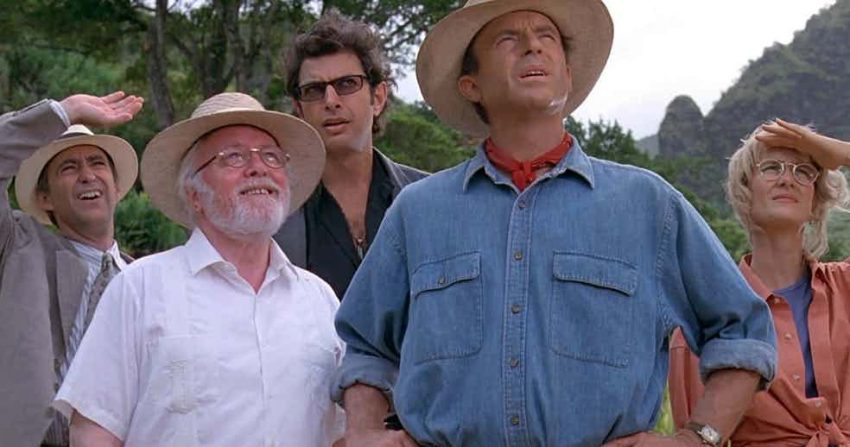
Jurassic Park main cast

On June 11, 1993, the sci-fi adventure Jurassic Park premiered in the United States to huge critical and commercial success. Directed by Steven Spielberg and based on 1990’s novel by Michael Crichton, Jurassic Park was about a group brought onto a remote island where a reclusive billionaire had created a theme park with genetically engineered dinosaurs. The exciting action and realistic dinosaur special effects captured the imagination, and the movie earned almost a billion dollars in its original release while launching a media franchise that included three sequels and a fifth (Jurassic World: Fallen Kingdom) scheduled for a June 2018 release. Jurassic Park also led to toys, video games, comic books and theme park rides. The movie was also a landmark in special effects that led to increased use of CGI, for better or worse.

Almost 25 years later, Jurassic Park’s cast has moved on to different projects while still carrying their roles with them. The ones who’ve passed away have almost always had a mention of their role in Jurassic Park, and the ones who continue to act are defined by it. CBR decided it was time to catch up with 15 cast members and see where they are now.

15. ARIANA RICHARDS (LEX MURPHY)

With an ear-splitting scream and a knowledge of Unix, Ariana Richards played Lex Murphy, one of the two grandchildren brought to the island to tour Jurassic Park. When the security system shut down, Lex was trapped along with her brother and forced to make her way to safety.

After Jurassic Park, Richards made a cameo as Lex in the 1997’s The Lost World: Jurassic Park. She also had a recurring role as Mindy Sterngood in 1990’s Tremors and Tremors 3: Back to Perfection. She’s been in other films such as Angus, where she played a high school cheerleader, and has appeared on TV with episodes of The Golden Girls and Boy Meets World. She dropped out of acting for years until she starred in the 2013 film Battledogs. In the meantime, she took up painting professionally. In fact, her official website is more about her art than acting.

14. JOSEPH MAZZELLO (TIM MURPHY)

In Jurassic Park, Joseph Mazzello was Tim Murphy, the second of the two grandchildren of Hammond who were trapped in Jurassic Park. Mazzello had one of the most memorable scenes in movie history when he noticed the vibration in a cup of water that signaled the approaching T-Rex’s footsteps. Having to escape the park with Alan Grant, Tim showed his knowledge of dinosaurs and eagerness to explore.

After Jurassic Park, Mazzello didn’t end up like many child stars. He carried on and continued to act as an adult, playing Eugene “Sledgehammer” Sledge in the HBO 2010 miniseries The Pacific. Most recently, he played Dustin Moskovitz, one of the co-founders of Facebook in The Social Network. He also became a director, making his debut with the short film Matters of Life and Death in 2007.

13. JEFF GOLDBLUM (IAN MALCOLM)

In Jurassic Park, Goldblum was the stylish and outspoken mathematician Dr. Ian Malcolm who explained chaos theory and argued with Hammond about the dangers of the park. He accurately predicted that the dinosaurs would escape and was forced to join the others in trying to escape from the prehistoric zoo.

Goldblum has had a thriving career before and after Jurassic Park, becoming an iconic figure in the series. In 1997, Goldblum played Malcolm again in The Lost World: Jurassic Park. He also had a string of other hits like Independence Day in 1996. On television, Goldblum played the quirky Detective Zack Nichols on Law and Order: Criminal Intent in 2009. In late 2017, he’ll be playing the Grandmaster in Thor: Ragnarok and you can also see Goldblum as Brad Bellflower, the tech wizard promoting Apartments.com.

12. RICHARD ATTENBOROUGH (JOHN HAMMOND)
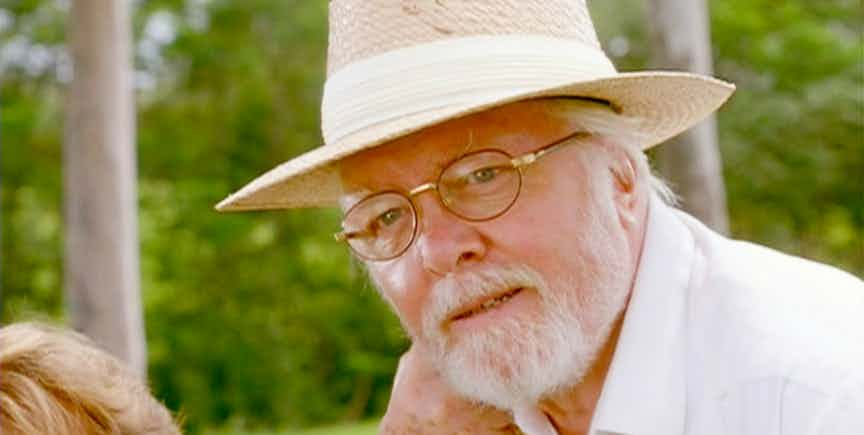
12. RICHARD ATTENBOROUGH (JOHN HAMMOND)

As far as the cast, Attenborough was without question the most critically acclaimed in Jurassic Park. A celebrated British actor, producer and director since the 1940s, he had two Academy Awards, four BAFTA Awards and four Golden Globe Awards by the time he appeared in Spielberg’s movie.

In the movie, he played John Hammond, the CEO and founder of Jurassic Park, serving as a counterpoint to Malcolm and aiding the others from the control room when they tried to escape. In 1993, Attenborough became a life peer with the title The Right Honourable Lord Attenborough, Commander of the Order of the British Empire. He continued to act in movies like The Lost World: Jurassic ParkMiracle on 24th Street and Joseph and the Amazing Technicolor Dreamcoat until his final movie in 2002 as the narrator in Puckoon. Attenborough died in a nursing home in 2014.

11. BOB PECK (ROBERT MULDOON)

Bob Peck was a classically trained Shakespearean actor known in the United Kingdom for his 1985 TV series Edge of Darkness before he played the gamekeeper Robert Muldoon in Jurassic Park. In his international debut, Peck was the staff member of the park who tried to keep the dinosaurs at bay and recognized the velociraptors were smarter than the others gave them credit for with his now-classic line, “Clever girl.”

After his role in Jurassic Park, Peck moved to television in 1993 as General Targo in The Young Indiana Jones Chronicles and played composer Giuseppe Verdi in 1994’s television movie Verdi. He also appeared in movies like 1997’s Chinese production The Opium War. His last film was the direct-to-TV movie The Scold’s Bridle in 1998. In 1999, he died relatively young at 53 from cancer.

10. GERALD MOLEN (GERRY HARDING)

If you remember the scene where the tour came across a sick Triceratops being treated for a mysterious illness, you saw Dr. Gerry Harding standing over the beast. Harding was the chief veterinarian of Jurassic Park, played by Gerald Robert “Jerry” Molen. The vet might seem like a minor role, but looks can be deceiving because Molen was way more important behind the camera than in front of it.

Molen was actually a movie producer who worked with director Steven Spielberg on five of his movies and won an Academy Award for being a co-producer of Schindler’s List. After Jurassic Park, Molen also produced 14 other movies, including The Flintstones in 1994, Twister in 1996, The Lost World: Jurassic Park and Minority Report in 2002. He’s currently in semi-retirement, producing documentaries.

9. MIGUEL SANDOVAL (JUANITO ROSTAGNO)

One of the main characters in Jurassic Park who never came up against a living dinosaur was Juanito Rostagno, the proprietor of the Mano de Dios Amber Mine in the park. He was there when Donald Gennaro came to discuss the inspection of Jurassic Park and an insect trapped in amber was found. Rostagno was played by Miguel Sandoval.

Before this role and after it, Sandoval has been a hard-working character actor in Hollywood. Since Jurassic Park in 1993, Sandoval has been in almost 30 movies, like Brüno and The Book of Life, as well as TV shows like 7th HeavenKingpin and as D.A. Manuel Devalos in Medium starting in 2005. He’s currently starring in Dirk Gently’s Holistic Detective Agency as Colonel Scott Riggins.

8. CAMERON THOR (LEWIS DODGSON)

If there was any villain in Jurassic Park that wasn’t a dinosaur, it was Lewis Dodgson, the head of research at the rival company Biosyn. Dodgson was the one who paid Dennis Nedry and met with him to give him a fake shaving cream can to store stolen dinosaur embryos. His act of corporate espionage was what led to the collapse of the park.

In real life, Dodgson was played by Cameron Thor, an actor, screenwriter and director. His career highlight has been his appearance in Jurassic Park and an earlier appearance in the movie Hook. After Jurassic Park, he and his wife started a business as an acting coach, but his career was cut short in 2016 when he was sentenced to six years in prison for lewd acts with a minor.

7. MARTIN FERRERO (DONALD GENNARO)

One of the most memorable deaths (and the only one to get a laugh out of audiences) in Jurassic Park was that of the “bloodsucking lawyer” Donald Gennaro. Sent to judge the park and see if it should be shut down, Gennaro was in the jeep when the T-Rex attacked and fled to a nearby restroom, where he was eaten while sitting on a toilet.

Gennaro was played by Martin Ferrero, who before Jurassic Park was known as the comic relief Izzy Moreno on the ’80s TV series Miami Vice. After Jurassic Park, he continued to act in movies like 1995’s Get Shorty and 1998’s Gods and Monsters. Most recently, Gennaro played Donald Gennaro again in a parody of Jurassic Park for CollegeHumor. Something tells us Gennaro won’t be coming back for any of the Jurassic World sequels, though.

6. BD WONG (HENRY WU)

6. BD WONG (HENRY WU)

When it came to actually creating the dinosaurs for Jurassic Park, the bold experiment was led by Dr. Henry Wu, a brilliant but ethically-challenged scientist. In the movie, Wu was calm and methodical about the process and seemingly had no concerns about the danger his team was unleashing. BD Wong was Wu, and he’s had a great career in television since the movie.

For most of the ’90s, Wong became known for his starring role as Dr. George Huang on Law & Order: Special Victims Unit. Recently, he had a recurring role on 2016’s Gotham as Hugo Strange. His performance as hacker Whiterose on Mr. Robot earned him nominations for a Critic’s Choice Television Award and an Emmy nomination for Outstanding Guest Actor in a Drama Series. Most recently, Wong returned to Dr. Henry Wu in Jurassic World.

5. WAYNE KNIGHT (DENNIS NEDRY)

If there’s one person you can blame for the disaster of Jurassic Park, it would definitely be Dennis Nedry, a nerd who programmed and designed the park’s computer network. To steal the embryos for Biosyn, he shut down the security systems to make his escape. His horrible death left the system down permanently, leaving the park open for the dinosaurs to escape.

As Nedry, Wayne Knight made a big impression and was nominated for a Saturn Award for Best Supporting Actor, but he went on to play a much bigger role as annoying mailman Newman on the hit TV ’90s series Seinfeld. After that, he had a recurring role on 3rd Rock From the Sun and Hot in Cleveland. We also can’t leave out his voice work on movies like Bee Movie and Kung Fu Panda.

4. SAMUEL L. JACKSON (RAY ARNOLD)

Hold onto your butts, because we’re going to talk about Ray Arnold, the chief engineer of Jurassic Park. He was the one who worked in the control room and tried to salvage the park after the system locked up. After Dennis Nedry locked down the network, Arnold was the only one to say it was a bad idea to restart the system. Arnold ended up being killed by a velociraptor after he went to the maintenance shed.

At the time of Jurassic Park, Jackson was a relative unknown, but he is now one of the biggest stars in Hollywood because his career skyrocketed after he starred in 1994’s Pulp Fiction. After that, he’s made a ton of movies like Unbreakable and Shaft in 2000, Snakes on a Plane (2006), and the Star Wars prequel trilogy. Most recently, he’s been Nick Fury in the Marvel Cinematic Universe.

3. GREG BURSON (MR DNA)

One of the unsung heroes of Jurassic Park was Mr. DNA, a talking, smiling cartoon mascot. Before the park tour, Mr. DNA appeared in the park’s Visitor Center in a movie with John Hammond that explained the process of creating the genetically engineered dinosaurs. Mr. DNA also showed up on signs like in the Geothermal Power Plant and on a roller coaster.

Greg Burson was the voice of Mr. DNA, and he did a lot of other voices, too. He was trained by the legendary Daws Butler and took over the voicing of Yogi Bear, Huckleberry Hound and most of Butler’s characters when his mentor died. Burson did the same thing for Mel Blanc, performing as Bugs Bunny, Daffy Duck and others. Burson died of complications from diabetes and arteriosclerosis in 2008.

2. LAURA DERN (ELLIE SATLER)

Dr. Ellie Sattler was a paleobotanist invited by Hammond to evaluate Jurassic Park. She was critical of how the park used extinct plants and helped restore the park to escape. Sattler was played by Laura Dern, who was already an Academy Award winning actress at the time of the filming. She went on to return in Jurassic Park III along with Neil. She’s also been a star in other movies like I Am Sam (2001) and The Master (2012). She’s set to make an appearance in 2017’s Star Wars: The Last Jedi.

She also made in-roads on TV, guest starring in the infamous “Puppy Episode” of 1997’s Ellen. She also won the Golden Globe Award for Best Supporting Actress on Television for her role in 2008’s TV movie Recount, and the 2012 Golden Globe Award for Best Actress in a Musical or Comedy Series in HBO’s Enlightened.

1. SAM NEIL (ALAN GRANT)

Arguably, the hero of Jurassic Park (not counting Jeff Goldblum with his shirt open) was Dr. Alan Grant, the palaeontologist who was brought to the park to evaluate it. His fascination with the dinosaurs was contagious and he became the savior when he led the stranded children to safety through the park with his knowledge of the animals.

Sam Neill was Alan Grant, and was a celebrated actor before and after Jurassic Park. The same year, he starred in the award-winning movie The Piano and returned as Grant in 2001’s Jurassic Park III. Neill also had notable roles in TV with 2008’s Merlin and 2007’s The Tudors. Grant is currently starring in TV’s Peaky Blinders as the corrupt Chief Inspector Chester Campbell.

Source: www.cbr.com

New Titanosaur Discovered: Shingopana songwensis

Friday, August 25, 2017

A new species of long-necked titanosaurian dinosaur has been unearthed in southwestern Tanzania.

The newly-discovered titanosaur is called Shingopana songwensis and lived between 100 and 70 million years ago (Cretaceous period).

A partial skeleton of the prehistoric creature was first excavated in 2002 and represents the first significant discovery by the Rukwa Rift Basin Project, an international collaborative effort led by Ohio University paleontologists.

Over the next few years of excavation, additional portions of the skeleton, including neck vertebrae, ribs, a humerus, and part of the lower jaw, were recovered.

“There are a couple of key anatomical features only present in Shingopana songwensis and several South American titanosaurs but that are absent in other African titanosaurs,” said team member Dr. Eric Gorscak, a postdoctoral researcher at the Field Museum of Natural History in Chicago.

Shingopana songwensis had siblings in South America, whereas the other African titanosaurs were only distant cousins.”

Detailed comparison of the new titanosaur with other known sauropod dinosaurs suggests that the species found in southern Africa are certainly more diverse than previously thought.

Dr. Gorscak and colleagues conducted phylogenetic analyses in order to understand the evolutionary relationships of these and other known titanosaurs.

What they discovered is that Shingopana songwensis was more closely related to South American titanosaurs than to any of the other species currently known from Africa or elsewhere.

“This discovery suggests that the fauna of northern and southern Africa were different in the Cretaceous period,” said Dr. Judy Skog, program director in NSF’s Division of Earth Sciences.

“At that time, Southern African dinosaurs were more closely related to those in South America, and were more widespread than we knew.”

During the Cretaceous period, Shingopana songwensis roamed the landscape alongside Rukwatitan bisepultus, another species of titanosaur the same team described in 2014.

The research on the new species appears today in the Journal of Vertebrate Paleontology.

_____

Eric Gorscak et al. A basal titanosaurian sauropod from Rukwa Rift Basin, southwestern Tanzania. Journal of Vertebrate Paleontology, published online August 24, 2017; doi: 10.1080/02724634.2017.1343250

This article is based on text provided by Ohio University.

Source: www.sci-news.com

Tyrannosaurs Were Violent Cannibals

Friday, August 18, 2017

Artists reconstruction of one Daspletosaurus feeding on another. (Tuomas Koivurinne )

Combat and cannibalism were no strangers to tyrannosaurs, suggest the remains of a tortured dino victim. 

Remains of a mutilated dino victim provide strong evidence for what has long been suspected: T. rex and his kin were violent animals that also practiced cannibalism.

The remains, described in the latest issue of the journal PeerJ, are of the large carnivorous tyrannosaur Daspletosaurus, which suffered numerous injuries during its lifetime and was partially eaten after it died.

The clincher is that paleontologists believe that members of Daspletosaurus’ own species inflicted all of the damage.

“This animal clearly had a tough life suffering numerous injuries across the head including some that must have been quite nasty,” lead author David Hone from Queen Mary, University of London, said in a press release.

He added, “The most likely candidate to have done this is another member of the same species, suggesting some serious fights between these animals during their lives.”

Daspletosaurus lived around 77 million years ago in North America. The victim studied by the researchers hailed from what is now Alberta, Canada. It was an older teenager when it bit the dust, so it hadn’t grown to full size yet. Still, this was a large animal. At death it measured about 20 feet long and weighed approximately 1,102 pounds.

The skull and mandible of Daspletosaurus shows facial injuries.

Analysis of this dinosaur’s skull uncovered numerous injuries that had previously healed.

Hone explained that, although not all of the injuries can be attributed to bites, several are close in shape to the teeth of tyrannosaurs. One bite to the back of the head had broken off part of the skull and left a circular tooth-shaped puncture though the bone.

According to the researchers, the fact that alterations to the bone’s surface indicate healing means that the injuries were not fatal and the animal lived for some time after they were inflicted.

The poor dinosaur’s life took a turn for the worse later, though. The preservation of the skull and other bones, as well as damage to the jaw bones show that the dinosaur died young and began to decay. Shortly thereafter, a large tyrannosaur – probably from the same species – chomped into the dead teen dino and presumably ate at least part of it.

The remains are unique in that they provide evidence for both combat between dinosaurs of the same species and cannibalism.

T. rex was closely related to Daspletosaurus. They essentially were cousins and grew to nearly the same sizes as adults. It’s therefore likely that T. rex and other large carnivorous tyrannosaurs engaged in similar behavior.

Source: www.seeker.com

Fossilised Dinosaur Footprints Found in China

Thursday, August 17, 2017

Giant dinosaurs called sauropods once roamed Scotland's coast, newly found footprints reveal.  ILLUSTRATION BY JON HOAD

It is believed to be the largest cluster of sauropod footprint fossils ever found in China dating from the early Jurassic period, Xinhua news agency reported.

More than 200 fossilised dinosaur footprints have been discovered in Maotai town of China, the media reported on Wednesday.

It is believed to be the largest cluster of sauropod footprint fossils ever found in China dating from the early Jurassic period, Xinhua news agency reported.

Sauropods were a group of huge, plant-eating, four-footed dinosaurs with long necks and tails.

“The tracks were discovered by accident,” said Xing Lida, a dinosaur footprint expert with China University of Geosciences.

Scientists have unearthed what they claim could very well be the largest cluster of Sauropod footprint fossils ever found in China.

In the summer of 2013, workers in Maotai found a group of dents, which looked like footprints, on the surface of a huge rock when building a workshop. They did not know what they were.

This summer, when workers saw media reports of dinosaur footprint fossils found elsewhere, they contacted researchers and a team of paleontologists came to the site.

Xing said the fossilised footprints were left by sauropods more than 170 million to 180 million years ago.

Several clusters of Sauropod footprint fossils had been found previously in China, though some contained few fossils and others had been severely eroded. The new discovery was well preserved.

“It can help with research on biological migration, behaviour and evolution of these ancient creatures in the early Jurassic period,” said Xing.

Chilesaurus: The ‘Missing Link’ Between Plant and Meat Eaters?

Thursday, August 17, 2017

Chilesaurus: The ‘Missing Link’ Between Plant and Meat Eaters?

A BIZARRE dinosaur which looked like a raptor but was in fact a vegetarian may be the ‘missing link’ between plant eaters and meat eaters such as Tyrannosaurus rex.

Researchers from Cambridge University and the Natural History Museum analyzed more than 450 anatomical characteristics of early dinosaurs and correctly place the creature, known as Chilesaurus, in the dinosaur family tree.

Their findings, published in the journal Biology Letters, suggest that Chilesaurus effectively fills a “large gap” between two of the major dinosaur groups, and shows how the divide between them may have happened.

Chilesaurus, which was discovered in southern Chile, was first described in 2015.

A report suggest the dinosaur effectively fills a ‘large gap’ between the two dinosaur groups

It lived during the Late Jurassic period, about 150 million years ago, and has an odd collection of physical characteristics, which made it difficult to classify.

Its head resembles that of a carnivore, but it has flat teeth for grinding up plant matter.

Study joint first author Matthew Baron, a PhD student in Cambridge’s Department of Earth Sciences, said: “Chilesaurus almost looks like it was stitched together from different animals, which is why it baffled everybody.”

Earlier research suggested that Chilesaurus belonged to the group Theropoda, the ‘lizard-hipped’ group of dinosaurs that includes Tyrannosaurus.

But the new study suggests that it was probably a very early member of a completely different group, called Ornithischia.

The researchers say that the shuffling of the dinosaur family tree has “major implications” for understanding the origins of Ornithischia – the ‘bird-hipped’ group of dinosaurs that includes StegosaurusTriceratops and Iguanodon.

The bird-hipped dinosaurs have several common physical traits: the two most notable being an inverted, bird-like hip structure and a beak-like structure for eating.

The inverted hips allowed for bigger, more complex digestive systems, which in turn allowed larger plant-eaters to evolve.

While Chilesaurus has a bird-like hip structure, and has flat teeth for grinding up plants, it doesn’t possess the distinctive ‘beak’ of many other bird-hipped dinosaurs, which is what makes it such an important find.

Mr Baron said: “Before this, there were no transitional specimens – we didn’t know what order these characteristics evolved in.

The Chilesaurus, which was discovered in southern Chile, was first described in 2015

“This shows that in bird-hipped dinosaurs, the gut evolved first, and the jaws evolved later – it fills the gap quite nicely.”

Co-author Professor Paul Barrett, of the Natural History Museum, said: “Chilesaurus is one of the most puzzling and intriguing dinosaurs ever discovered.

“Its weird mix of features places it in a key position in dinosaur evolution and helps to show how some of the really big splits between the major groups might have come about.”

Mr Baron added: “There was a split in the dinosaur family tree, and the two branches took different evolutionary directions.

“This seems to have happened because of change in diet for Chilesaurus. It seems it became more advantageous for some of the meat eating dinosaurs to start eating plants, possibly even out of necessity.”

Earlier this year, the same group of researchers argued that dinosaur family groupings need to be rearranged, re-defined and re-named.

In a study published in the journal Nature, the researchers suggested that bird-hipped dinosaurs and lizard-hipped dinosaurs such as T.rex evolved from a common ancestor, potentially overturning more than a century of theory about the evolutionary history of dinosaurs.

The research team believe there are probably “many more surprises” about dinosaur evolution to be found, once characteristics of later dinosaurs are added to their database.

Nuclear Lab Helps Scientists Peer Into Life of T. Rex Relative

Thursday, August 17, 2017

The skull of a tyrannosaur nicknamed the "Bisti Beast" is on display at the New Mexico Museum of Natural History and Science in Albuquerque, N.M., Aug. 15, 2017.

Researchers at a top U.S. laboratory announced Tuesday that they have produced the highest resolution scan ever done of the inner workings of a fossilized tyrannosaur skull using neutron beams and high-energy X-rays, resulting in new clues that could help paleontologists piece together the evolutionary puzzle of the monstrous T. rex.

Officials with Los Alamos National Laboratory and the New Mexico Museum of Natural History and Science said they were able to peer deep into the skull of a “Bisti Beast,” a T. rex relative that lived millions of years ago in what is now northwestern New Mexico.

The images detail the dinosaur’s brain and sinus cavities, the pathways of some nerves and blood vessels and teeth that formed but never emerged.

Never-seen-before views

Thomas Williamson, the museum’s curator of paleontology and part of the team that originally collected the specimen in the 1990s, said the scans are helping paleontologists figure out how the different species within the T. rex family relate to each other and how they evolved.

“We’re unveiling the internal anatomy of the skull so we’re going to see things that nobody has ever seen before,” he said during a news conference Tuesday.

T. rex and other tyrannosaurs were huge, dominant predators, but they evolved from much smaller ancestors.

The fossilized remnants of the Bisti Beast, or Bistahieversor sealeyi, were found in the Bisti/De-Na-Zin Wilderness Area near Farmington, New Mexico. Dry, dusty badlands today, the area in the time of the tyrannosaur would have been a warmer, swampy environment with more trees.

T. rex family member

The species lived about 10 million years before T. rex. Scientists have said it represents one of the early tyrannosaurs that had many of the advanced features, including big-headed, bone-crushing characteristics and small forelimbs, that were integral for the survival of T. rex.

Officials said the dinosaur’s skull is the largest object to date for which full, high-resolution neutron and X-ray CT scans have been done at Los Alamos. The technology is typically used for the lab’s work on defense and national security.

The thickness of the skull, which spans 40 inches (102 centimeters), required stronger X-rays than those typically available to penetrate the fossil. That’s where the lab’s electron and proton accelerators came in.

Sven Vogel, who works at the Los Alamos Neutron Science Center, said the three-dimensional scanning capabilities at the lab have produced images that allow paleontologists to see the dinosaur much as it would have been at the time of its death, rather than just the dense mineral outline of the fossil that was left behind after tens of millions of years.

The team, which included staff from the University of New Mexico and the University of Edinburgh, is scheduled to present its work at an international paleontology conference in Canada next week.

New Mexico Museum of Natural History and Science paleontology curator Thomas Williamson talks about the results of neutron and X-ray scans of a fossilized tyrannosaur skull at the museum in Albuquerque, N.M., Aug. 15, 2017. Williamson discovered the fossil remains of the “Bisti Beast” in 1996 and worked with researchers at Los Alamos National Laboratory last fall to scan the skull in hopes of gleaning new information about the evolution of the massive, bone-crushing dinosaurs.

More detail in new scans

Kat Schroeder, a Ph.D. candidate at the University of New Mexico who has been working on the project for about a year, said the scanning technology has the ability to uncover detail absent in traditional X-rays and the resulting three-dimensional images can be shared with fellow researchers around the world without compromising the integrity the original fossil.

Schroeder’s work centers on understanding the behavior of dinosaurs, so seeing the un-erupted teeth in the Bisti Beast’s upper jaw was exciting.

“Looking at how fast they’re replacing teeth tells us something about how fast they’re growing, which tells me something about how much energy they need and how active they were,” she said. “It’s those little things that enable us to understand more and more about prehistoric environments.”

Source: www.voanews.com

Cretaceous Flowers Found Preserved in Burmese Amber

Thursday, August 17, 2017

Tropidogyne pentaptera, holotype. Scale bars -1 mm. Image credit: George O. Poinar, Jr. / Kenton L. Chambers.

In a paper published recently in the journal Palaeodiversity, U.S. paleontologists described a new species of angiosperm flower, Tropidogyne pentaptera, found in seven pieces of 99-million-year-old (mid-Cretaceous) amber excavated from a mine in Myanmar (also known as Burma).

The amber fossils came from the Noije Bum 2001 Summit Site mine excavated in the Hukawng Valley and located southwest of Maingkhwan in Kachin State.

The flowers range from 3.4 to 5 mm in diameter, necessitating study under a microscope.

“The amber preserved the floral parts so well that they look like they were just picked from the garden,” said Professor George Poinar Jr., of Oregon State University.

“Dinosaurs may have knocked the branches that dropped the flowers into resin deposits on the bark of an araucaria tree, which is thought to have produced the resin that fossilized into the amber.”

“Araucaria trees are related to kauri pines found today in New Zealand and Australia, and kauri pines produce a special resin that resists weathering.”

Tropidogyne pentaptera, paratypes. Scale bars ~1 mm. Image credit: George O. Poinar, Jr. / Kenton L. Chambers

The new study builds on earlier research also involving Burmese amber in which the same team described another species in the same genus, Tropidogyne pikei.

Tropidogyne pentaptera has spreading, veiny sepals, a nectar disc, and a ribbed inferior ovary like T. pikei,” Professor Poinar noted.

“But it’s different in that it’s bicarpellate, with two elongated and slender styles, and the ribs of its inferior ovary don’t have darkly pigmented terminal glands like T. pikei.”

Both Tropidogyne pentaptera and T. pikei belong to the extant family Cunoniaceae, a widespread Southern Hemisphere family of 27 genera and about 330 species of woody plants.

Tropidogyne pentaptera was probably a rainforest tree,” Professor Poinar said.

“In their general shape and venation pattern, the fossil flowers closely resemble those of the genus Ceratopetalum that occur in Australia and Papua-New Guinea,” he added.

“One extant species is Ceratopetalum gummiferum, which is known as the New South Wales Christmas bush because its five sepals turn bright reddish pink close to Christmas.”

“Another extant species in Australia is the coach wood tree (Ceratopetalum apetalum), which like the new species has no petals, only sepals.”

“The towering coach wood tree grows to heights of greater than 120 feet, can live for centuries and produces lumber for flooring, furniture and cabinetwork.”

So what explains the relationship between a mid-Cretaceous Tropidogyne from Myanmar and an extant Ceratopetalum from Australia, more than 4,000 miles and an ocean away to the southeast?

“That’s easy, if you consider the geological history of the regions,” Professor Poinar said.

“Probably the amber site in Myanmar was part of Greater India that separated from the southern hemisphere, the supercontinent Gondwana, and drifted to southern Asia.”

“Malaysia, including Burma, was formed during the Paleozoic and Mesozoic eras by subduction of terranes that successfully separated and then moved northward by continental drift.”

_____

George O. Poinar, Jr. & Kenton L. Chambers. 2017. Tropidogyne pentaptera, sp. nov., a new mid-Cretaceous fossil angiosperm flower in Burmese amber. Palaeodiversity 10 (1): 135-140; doi: 10.18476/pale.v10.a10

Source: www.sci-news.com

Aquilops americanus: Oldest Horned Dinosaur From North America

Thursday, August 17, 2017

Reconstruction of Aquilops americanus in its environment. Image credit: Brian Engh / Raymond M. Alf Museum of Paleontology.

Scientists have discovered the fossil skull of a tiny horned dinosaur. The cat-sized dinosaur is the oldest known horned dinosaur from North America. It is named Aquilops americanus.

The artist’s reconstruction shows Aquilops in its environment in ancient Montana. The dinosaur skull, which was found in Montana, measures 84 mm long (about 3.3 inches). It features a beak-like structure and an elongated and pointed cavity over the creature’s cheek region. The Washington Post reports that researchers say Aquilops was about two feet long.

Aquilops americanus skull

Andrew Farke from Raymond M. Alf Museum of Paleontology says in a statement, “Aquilops lived nearly 20 million years before the next oldest horned dinosaur named from North America. Even so, we were surprised that it was more closely related to Asian animals than those from North America.”

Aquilops americanus restoration

Because Aquilops resembles some Asian dinosaurs the researchers say the finding supports a “complex set of migratory events for organisms between North America and Asia later in the Cretaceous.”

A research paper on Aquilops can be found here in PLoS One.

Photo: Andrew A. Farke

Artwork: Brian Engh, courtesy of Raymond M. Alf Museum of Paleontology. /2014

How Intelligent Were Dinosaurs?

Sunday, August 13, 2017

It is difficult to know how smart dinosaurs were because their brains rarely survive as fossils. Casts taken from the inside of fossil skulls show that some dinosaurs had large brains, while others had small ones. A big brain does not necessarily mean higher intelligence. Scientists look at the size of the brain in relation to the animal’s total body weight. They also take into account the animal’s behavior. A dinosaur’s intelligence was suited to its lifestyle and the tasks it needed to perform.

As smart as a cassowary?

Troodon was a keen-eyed hunter. It grew to 2 m (7 ft) long, and for its size, it had a large brain. This may have given it the mental capacity and sophistication to trap its prey. The cassowary has a similar build and brain size to Troodon, so it is possible the speedy dinosaur had the same level of intelligence as the modern bird.

Brain to body weight

Dinosaurs had smaller brains relative to their size than birds or mammals. Diplodocus had a brain weighing 100,000 times less than its body weight. Compare this with a small bird’s brain, which is only 12 times lighter than its overall weight. The brain of an adult human is about 40 times lighter than its body. This is about the same ratio as the brain to body weight of a mouse. These comparisons alone should not be used to indicate intelligence, which must also be judged on how animals behave in comparison with other animals in their environment.

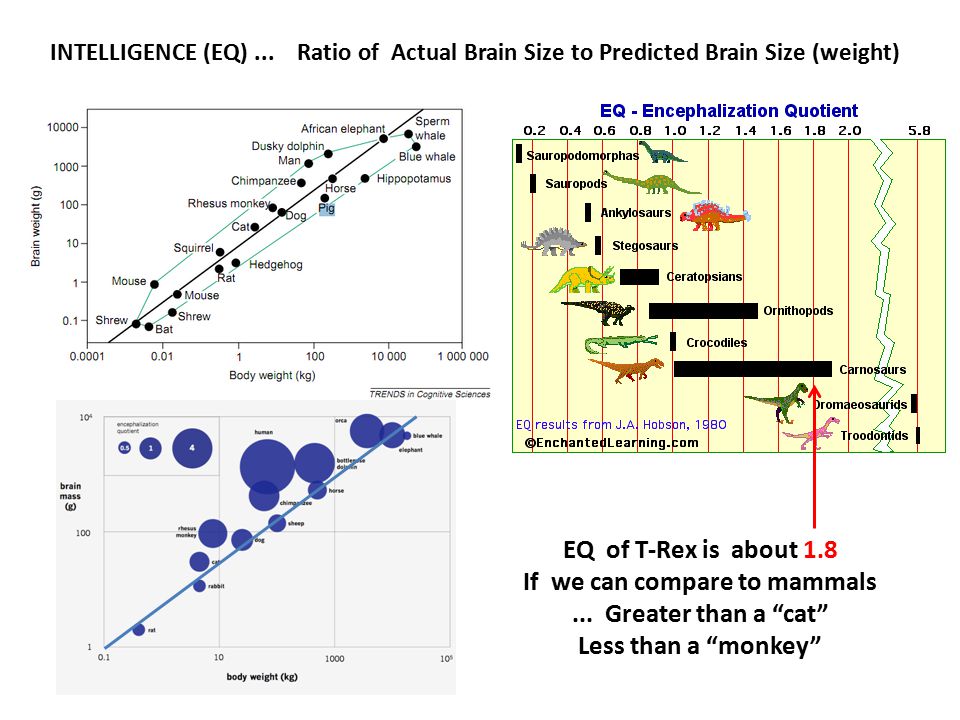
If we can compare to mammals, T. rex intelligence is greater than a cat...

Dinosaur brain power relative to a crocodile’s

The Encephalization Quotient (EQ) is the ratio of the brain weight of an animal to the brain weight of a similar animal of the same body weight. The scale is designed so that the expected score for an animal is one. Anything above this figure indicates a larger than predicted brain size. The EQ number can be used to compare extinct and living animals and may be helpful in suggesting how smart an animal was.

This diagram plots the range of EQ scores for different groups of dinosaurs (shown by the coloured bands). These scores are compared to the scores for their living relatives, the crocodiles. The diagram shows the sauropods had low EQs. They have a narrow range of scores because the body weights and brain sizes of the dinosaurs in this group were quite uniform. The carnosaurs had scores between about 1 and 1.9. This group had a variety of body weights and brain sizes, and these account for the wide EQ range. The troodontids were the smartest dinosaurs with an EQ of around 5.8.

Source: www.NatGeo.com

Pages