Blogs

Camo Might Have Helped This Armored Dinosaur Avoid Becoming Lunch

Tuesday, September 26, 2017

Borealopelta markmitchelli

Sometimes body armor just isn’t enough. A car-sized dinosaur covered in bony plates may have sported camo, too, a new study finds. That could mean this plant eater was a target for carnivores that relied more on sight than on smell to find their prey.

The dinosaur is named Borealopelta markmitchelli. It made headlines for being one of the best preserved armored dinosaurs ever unearthed. It had been entombed on its back some 110 million years ago. That was during the Cretaceous period. Soon, layers of fine marine sediments buried its bones. The conditions were ideal for turning this dino into a fossil, notes Caleb Brown. He is a paleontologist at the Royal Tyrrell Museum of Palaeontology in Drumheller, Canada.

He also was a coauthor of a new study that describes the dino’s looks. It appeared August 3 in Current Biology.

The fossil was found in western Canada in 2011. It was special because it showed large amounts of skin and soft tissue as well as the animal’s three-dimensional shape. “Most of the other armored dinosaurs are described based on the skeleton. In this case,” Brown explains, “we can’t see the skeleton because all the skin is still there.”

That skin offered clues to what the dino looked like, including its coloring. “We’re just beginning to realize how important color is. And we’re beginning to have the methods to detect color” in fossils, says Martin Sander. He is a paleontologist at Bonn University in Germany. He was not part of this study.

It took five and a half years for Royal Tyrrell Museum technician Mark Mitchell to carefully grind away the hard rock surrounding this fossil and expose the fragile preserved remains beneath. Here are two views of the partially encased dinosaur — Borealopelta markmitchelli — which now bears his name. Courtesy of the Royal Tyrrell Museum of Palaeontology, Drumheller, Canada

Melanosomes are cellular structures that often preserve evidence of pigment — coloring — in fossils of animals. But despite ample tissue, the researchers didn’t find any of these. So Brown and his colleagues scouted for less direct evidence.

They looked for molecules that appear when pigments break down. The researchers found about a dozen types of these. They included large amounts of benzothiazole (BEN-zoh-THY-uh-zoal). This is a by-product of the reddish pigment pheomelanin (FEE-oh-MEL-uh-nin). Finding this chemical might mean the dinosaur had been reddish-brown.

Where those pigment by-products were found offers clues to the dinosaur’s appearance. This dino had a thin film of organic (carbon-based) chemicals on its back. They hint of there once having been a pigment there. That layer wasn’t on the belly. Such a pattern suggests countershading. This is when an animal is darker on its back than its underside, Brown explains. Countershading is a simple form of camouflage. It helps animals blend in with the ground when seen from above (or with the sky when seen from below).

Dino coloring

This is not the first time countershading has been proposed for a dinosaur. But finding it on such a large plant eater is somewhat surprising, Brown says. Modern plant eaters that don similar camouflage tend to be smaller. And they’re usually at greater risk of becoming someone’s dinner. This dino’s skin patterning suggests that at least some top predators of its time might have relied more on eyesight than do today’s top carnivores. Modern meat eaters tend to favor smell when hunting, Brown says.

Some experts prefer stronger evidence for claims of coloration. Molecules like benzothiazole can come from melanin. However, they also can come from a number of other sources, such as oils, points out Johan Lindgren. He is a paleontologist at Lund University in Sweden. “What this paper nicely highlights is how little we actually know about the preservation of soft tissues in animal remains. There’s definitely something there. The question is, what are those [molecules], and where do they come from?”

Sander does accept the evidence for the reddish tint. However, it might not be the full story, he says. This dino could have displayed other colors that didn’t linger in the fossil record. But the countershading findings “point out the importance of vision” for dinosaurs, he says. In an era of sharp-eyed predators, camouflagewould have been an advantage for plant eaters — even ones built like tanks.

Source: www.sciencenewsforstudents.org
California Gets its Own Official State Dinosaur: Augustynolophus morrisi

Tuesday, September 26, 2017

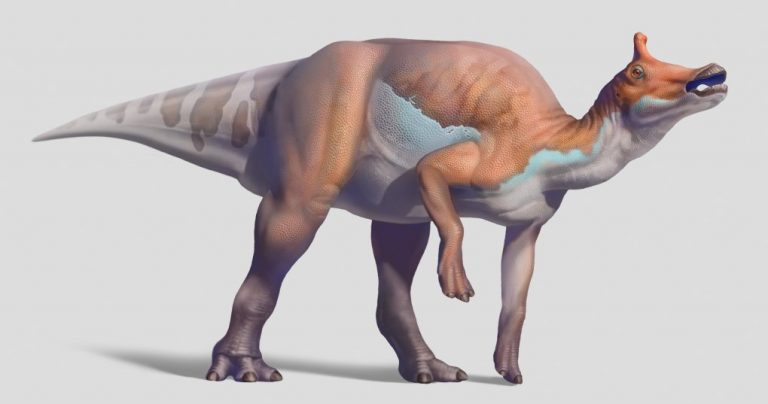
Augustynolophus morrisi

A year after adopting a state fabric, California is the latest state to get its own official dinosaur, although the honor comes about 66 million years too late to directly benefit the honoree.

The designated creature is Augustynolophus morrisi, which, according to a bill signed Saturday by Gov. Jerry Brown, is “a unique dinosaur that has only been found in California.”

This species is a type of hadrosaur, plant eaters known for their mouths shaped like duck bills. Because of geological and geographical factors, the record of dinosaurs within California is slim, but scientists report that this hadrosaur was contemporary to such other well-known dinosaurs as Triceratops and Tyrannosaurus — and perhaps an occasion meal for the latter.

The bill, put forward by state Sen. Richard Bloom (D-Santa Monica), states that a state dinosaur “is essential to California’s society because it nurtures an educational opportunity for the youngest Californians to become interested in paleontology,” and scientific fields in general.

Augustynolophus by cisiopurple on DeviantArt

Crews from the California Institute of Technology discovered specimens of Augustynolophus in 1939 and 1940 in the Moreno Shale Formation in the Panoche Hills of Fresno County.

It was originally presumed that these animals belonged to an already-known species, but careful study revealed a “vastly different” cranial structure, according to Assembly Bill 1540.

The Natural History Museum of Los Angeles County has timed this weekend’s Dino Fest with the governor’s bill signing. Visitors can meet paleontologists as they discuss historic and ongoing fossil discoveries and view rare specimens from the collection. There’s also a live science-themed band, life-size dinosaur puppets and a talk about the creation and interpretation of dinosaurs in film.

Like some other famous figures from the past, including Shakespeare, there is some confusion about the correct spelling of Augustynolophus. A post from the county has the hadrosaur’s second name as “Morris.” Another, with the second word spelled “morissi,” appears in the legislative analysis. A third version is in materials from the Natural History Museum, south of downtown, which has a specimen.

And, embarrassingly, seven states as well as the District of Columbia designated an official dinosaur ahead of California.

Yet at least this dino doesn’t have to share its laurels within state boundaries. Another bill that became California law this year makes the almond, walnut, pistachio and pecan each the official state nut.

Other official flora and fauna include: the saber-toothed cat, Smilodon californicus (state fossil); the California red-legged frog (state amphibian); the California desert tortoise (state reptile); and the golden poppy, Eschscholzia californica (state flower).

Source: www.latimes.com

Earliest Trilobites Had Stomachs

Monday, September 25, 2017

This photo is of a specimen of the trilobite Palaeolenus lantenoisi from the Guanshan Biota in southern Yunnan Province, China. Rarely are internal organs preserved in fossils, but this specimen shows the digestive system preserved as reddish iron oxides. The digestive system is comprised of a crop (inflated region at top of specimen), lateral glands, and a central canal that runs along the length of the body; the iron oxides that extend beyond the fossil are the remains of gut contents that were extruded during preservation. Credit: © F. Chen

Trilobites are a group of extinct marine arthropods that form the class Trilobita.

They appeared in ancient oceans in the Early Cambrian Period, about 540 million years ago — well before life emerged on land, and disappeared in the mass extinction at the end of the Permian, about 252 million years ago.

They were extremely diverse, with about 20,000 species, and their fossil exoskeletons can be found all around the world.

Previous studies suggest that two body plans existed for trilobite digestive systems: (i) a tube that runs down the length of the trilobite’s body with lateral digestive glands that would have helped process the food; or (ii) an expanded stomach, called a ‘crop,’ leading into a simple tube with no lateral glands.

Until now, only the first type had been reported from the earliest trilobites.

Iron concentrations in digestive tract of Palaeolenus lantenoisi. Scale bars – 1 mm. Top right and left panels show elemental maps of Fe (yellow), Si (pink), O (green), and Al (cyan) concentrations in the areas indicated by black rectangles in the central photography. All other panels show elemental maps of just Fe concentrations (yellow) in the indicated areas. Note that here and in elemental maps in other figures, some areas where iron concentrations are expected but not evident are in ‘shadow’ due to the orientation of the specimen or because that part of the specimen is outside of the width of detection, so no elemental composition is available (compare the top two panels showing Fe, Si, O, and Al with those just below showing only Fe). Image credit: Hopkins et al, doi: 10.1371/journal.pone.0184982

Based on this, paleontologists had proposed that the evolution of the crop came later in trilobite evolutionary history and represented a distinct type of digestive system.

“Trilobites are one of the first types of animals to show up in large numbers in the fossil record,” said Dr. Melanie Hopkins, an assistant curator in the Division of Paleontology at the American Museum of Natural History.

“Their exoskeletons were heavy in minerals, and so they preserved really well. But like all fossils, it’s very rare to see the preservation of soft tissues like organs or appendages in trilobites, and because of this, our knowledge of the trilobite digestive system comes from a small number of specimens.”

“The new material — 270 specimens from the Wulongqing Formation — really expands our understanding.”

Spherical aggregates of iron oxide in crop of Redlichia mansuyi: (A) photograph of entire specimen; (B) SEM image of crop outlined in (A); (C) SEM image overlain by elemental mapping: Ti, Al (fuchsia), N, K (red), C (dark blue), Cu (pink), S (violet), P (light blue), Ca (blue-green), Na (yellow-green), Mg (orange), Fe (yellow), Si (cyan), O (green); (D) elemental map of just iron in area shown in B and C; (E) SEM image of area outlined in (B); (F) SEM image overlain by elemental mapping: Fe (yellow), Si (cyan); (G) elemental map of iron in area shown in E and F. Scale bar for (A) – 5 mm, for (B-D) – 1 mm, for (E-G) – 500 microns. Image credit: Hopkins et al, doi: 10.1371/journal.pone.0184982.

The new Wulongqing specimens are dated to the early Cambrian, about 514 million years ago. They belong to two trilobite species, Palaeolenus lantenoisi and Redlichia mansuyi, and about 20% of them show soft-body preservation.

Contradictory to the previously proposed body plans, Dr. Hopkins and co-authors identified crops in Palaeolenus lantenoisiand Redlichia mansuyi.

In addition, at least one specimen of Palaeolenus lantenoisi has both a crop and digestive glands — suggesting that the evolution of trilobite digestive systems is more complex than originally proposed.

“This is a very rigorous study based on multiple specimens, and it shows that we should start thinking about this aspect of trilobite biology and evolution in a different way,” Dr. Hopkins said.

The study is published in the journal PLoS ONE.

_____

M.J. Hopkins et al. 2017. The oldest known digestive system consisting of both paired digestive glands and a crop from exceptionally preserved trilobites of the Guanshan Biota (Early Cambrian, China). PLoS ONE 12 (9): e0184982; doi: 10.1371/journal.pone.0184982

Source: www.sci-news.com

‘Jurassic World: Fallen Kingdom’: Familiar Dinosaurs Returning; Volcano Confirmed

Saturday, September 23, 2017

The volcano in “Jurassic World: Fallen Kingdom” has been confirmed, thanks to pictures of the official tie-in merchandise of the film. The familiar dinosaurs Rexy and Blue will also be back in the sequel.

As always, there will be a variety of merchandise that will be released alongside the upcoming film. Pictures of some of these products posted on Jurassic Outpost reveal the dinosaurs that will be seen in the movie. The key art also confirms a volcano in the film.

An eruption of a volcano will be seen as dinosaurs run for cover on the island. Will saving the dinosaurs from another extinction event on Isla Nublar be the main focus of the plot?

The familiar Tyrannosaurus rex known as Rexy will be back. The dinosaur appeared in the first “Jurassic Park” film, playing an important role in defeating the hybrid. A picture of Rexy running or chasing someone can be seen in the key art.

The other major dinosaur is Blue, the Velociraptor that Owen (Chris Pratt) trained. This dinosaur also played a key role in defeating the Indominus Rex. What new challenges will the smart and cunning dinosaur face? Readers will have to wait till the movie is released to find out.

Bryce Dallas Howard will be reprising her role as Claire Dearing. BD Wong will also be back as Dr. Henry Wu. Jeff Goldblum will finally be back, reprising his role as Ian Malcolm, the mathematician who specialises in chaos theory, and someone who warns about the dangers of man playing god.

Crazy Fan Theory Proves There Are No Dinosaurs in Jurassic Park?

Saturday, September 23, 2017

Next year will see the release of Jurassic World: Fallen Kingdom, which will be the fifth movie in what is easily, and arguably without any real competition, the biggest dinosaur franchise in the history of cinema. But what if Jurassic Park and the rest of the movies in the franchise aren’t actually dinosaur movies at all? A fan theory currently making the rounds online posits exactly that and it is pretty dang convincing.

This particular Jurassic Park fan theory started, as far as anyone can trace it back, on Reddit, as many of these things do, but Cracked recently released a video detailing the theory and laying it out really cleanly. Many fan theories are just fun to think about, but at the end of the day, they don’t really carry much weight. This one, on the other hand, is downright solid and pretty much reshapes the entire Jurassic Park franchise as we know it. That may sound a bit dramatic, but if the dinosaur movie everyone loves doesn’t have any actual dinosaurs in it, that’s a pretty big deal.

The basic theory states that the engineers in Jurassic Park never actually used dino DNA from the blood of ancient mosquitos to create the creatures in the park. Rather, they made these creations from scratch and based them on what the general public thinks, or at least thought, dinosaurs should look like. That explains why none of the dinosaurs have feathers and why, for example, the velociraptors are much larger than they actually were in nature. It also explains why the dilophosaurus spits the poison to blind its prey, as there is no actual evidence the real dinosaur ever did that.

But what about the presentation that we see in the movie from Mr. DNA that explains how John Hammond and the scientists made the dinosaurs? Well, that was all for show. As we know from the famous ice cream scene, Hammond is a total showman and used to run a flea circus. He deals in convincing deception. So the Mr. DNA bit is just a bit of showmanship in order to make things for more real for the visitors.

So why bring Alan Grant, Ellie Sattler and Ian Malcolm to the park to sign off on it? The theory claims that John Hammond wasn’t actually bringing them there to sign off on the safety of the park, even though that’s what the lawyers needed. He was bringing them there to see if they would believe that Jurassic Park had actual dinosaurs in it. If he could convince a paleontologist, surely he could convince the general public that these are real dinosaurs.

Part of this theory is even confirmed in Jurassic World by B.D. Wong’s character Dr. Henry Wu. At one point, he explains that the dinosaurs in the park aren’t as nature intended since they filled in the missing bits of DNA with other animals. All in all, this is a wild yet very plausible fan theory.

Source: movieweb.com

Study: Dinosaur-Killing Asteroid Accelerated Bird Evolution

Saturday, September 23, 2017

Dinosaur-Killing Asteroid Accelerated Bird Evolution

“Our hypothesis is that these important biological characters, which affect the rate of DNA evolution, may have been influenced by the K-Pg event,” said researcher Daniel Field.

According to a new study, bird biodiversity benefited from the asteroid that wiped out the dinosaurs approximately 66 million years ago.

The Cretaceous-Paleogene extinction event killed roughly 75 percent of all plants and animals. New research suggests the bird species that survived the event were likely smaller and had faster metabolic rates.

“There is good evidence that size reductions after mass extinctions have occurred in many groups of organisms,” Jacob Berv, a researcher and PhD candidate at Cornell University, said in a news release.

Scientists call the phenomenon the “Lilliput effect” — an ode to the Jonathan Swift novel Gulliver’s Travels.

In the latest study, published this week in the journal Systematic Biology, researchers argue smaller birds with shorter lifespans allowed for an accelerated rate of genetic evolution in the wake of the K-Pg extinction.

“Our hypothesis is that these important biological characters, which affect the rate of DNA evolution, may have been influenced by the K-Pg event,” said Daniel Field, a researcher at the University of Bath in Ireland.

The study’s findings could help resolve the so-called “rocks and clocks” debate. For some time, paleontologists and evolutionary biologists have been searching for a way to explain the discrepancies between fossil evidence and molecular clocks.

Molecular clocks estimate a species’ origin on the evolutionary timeline. They operate under the assumption that rates of genetic variation or change are constant. The clocks’ estimates often differ from species’ emergence in the fossil record.

Such differences could be explained by a brief acceleration of the avian molecular clock.

“The bottom line is that, by speeding up avian genetic evolution, the K-Pg mass extinction may have substantially altered the rate of the avian molecular clock,” Field said. “Similar processes may have influenced the evolution of many groups across this extinction event, like plants, mammals, and other forms of life.”

Many scientists have suggests the planet is on the verge of a sixth mass extinction, with large predators disappearing at an alarming rate due to climate change, hunting and habitat loss. The development could inspire a similar Lilliput effect.

“Right now, the planet’s large animals are being decimated — the big cats, elephants, rhinos, and whales,” said Berv. “We need to start thinking about conservation not just in terms of functional biodiversity loss, but about how our actions will affect the future of evolution itself.”

Source: www.upi.com

The Bad Hair, Incorrect Feathering, and Missing Skin Flaps of Dinosaur Art

Saturday, September 23, 2017

The Bad Hair, Incorrect Feathering, and Missing Skin Flaps of Dinosaur Art

Inside the pitfalls of illustrating prehistoric creatures.

Elephants, zebras, and rhinos would all look pretty different if they were interpreted the same way dinosaurs are. 

ILLUSTRATING LONG-EXTINCT CREATURES IS DIFFICULT, but important work. With no living specimens to observe, it’s up to “paleoartists” who draw, paint, or otherwise illustrate the creatures of prehistory as we think they might’ve been. Their work is the reason that when we talk about velociraptors, stegosaurs, or even woolly mammoths, we have some idea of what they looked like.

But since all we have to go on are fossils, deciding how a dinosaur would have looked is as much art as it is science. And there’s at least one paleoartist who thinks we might be getting things wrong.

C.M. Kosemen is an Istanbul-based artist and author (along with John Conway and Darren Naish) of the 2012 book, All Yesterdays: Unique and Speculative Views of Dinosaurs and Other Prehistoric Animals. A long-time creature designer, Kosemen had always had an interest in dinosaurs, but he embarked on his book with Conway after they began to realize that something was a bit off. “We were both dinosaur geeks, but the more we looked at these skeletons, and the more we looked at the pictures, we noticed that most mainstream dinosaur art didn’t look at dinosaurs as real creatures,” says Kosemen.

Most serious paleoart bases itself on the detailed findings of paleontologists, who can work for weeks or even years compiling the most accurate descriptions of ancient life they can, based on fossil remains. But Kosemen says that many dinosaur illustrations should take more cues from animals living today. Our world is full of unique animals that have squat fatty bodies, with all kinds of soft tissue features that are unlikely to have survived in fossils, such as pouches, wattles, or skin flaps. “There could even be forms that no one has imagined,” says Kosemen. “For example there could plant-eating dinosaurs that had pangolin or armadillo-like armor that wasn’t preserved in the fossil. There could also be dinosaurs with porcupine-type quills.”

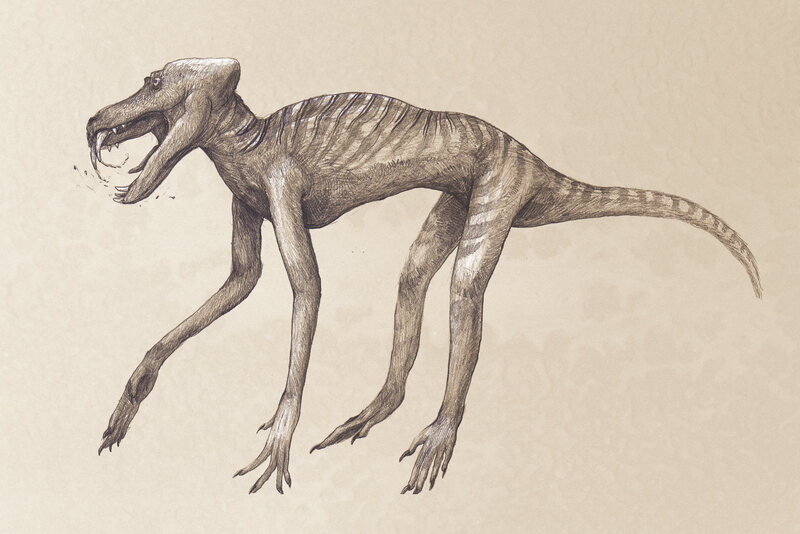
How a baboon skeleton might be interpreted by future paleoartists.

Rarely do we see that type of variation in depictions of dinosaurs. In many ways, there is a certain amount of uniformity in the way we think of dinosaurs, which creates some common tropes in paleoart that Kosemen thinks could improve.

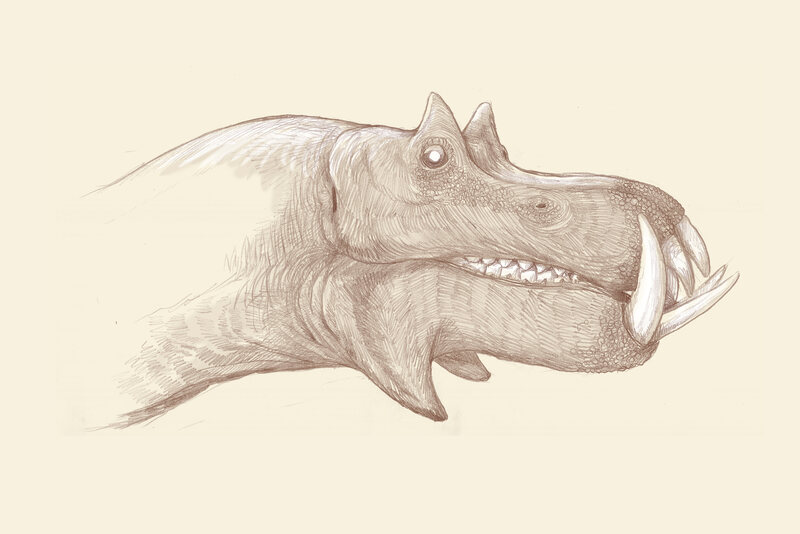
One of his main points of contention is the way that we consider dinosaur heads. “The reference has always been crocodiles,” says Kosemen. “The biggest thing is teeth and facial fat. Readers have to be aware that all dinosaurs they see in all media, and especially in popular culture, seem to have their heads flensed. They’ve always got these weird grins with only the teeth visible.” As he points out, most animals have lips and gums and lumps of facial fat that change the profile of the head, and cover the teeth. But in many predatory dinosaur illustrations, these are usually missing, making them look fierce, if improbable.

“Another trope is what I like to call the ‘roadkill hair’ trope,” says Kosemen. Some fossils show signs of hair, which Kosemen says can lead to artists illustrating their creatures with hair only on the parts where it was found on a fossil. However, it’s possible that some dinosaurs had much more hair that they are usually shown to have. “Imagine if you found a raccoon, and only half of the tail was covered in hair, so then you carry that over to a living reconstruction.”

A similar issue occurs with the relatively recent trend of giving dinosaurs feathers. While it is a good way to add some color and flare to an illustration, the placement and length of dinosaur feathers is often based more in fantasy than any past reality. “We have full-on wing feathers erupting from distinct places on the head. Or things like a raptor dinosaur jumping like a ninja and his feathers are coming out of his elbows or knee joint or those weird things,” says Kosemen. He thinks that sometimes dinosaurs are over-feathered, with plumage where it doesn’t belong, or under-feathered, being too conservative with the overall coverage.

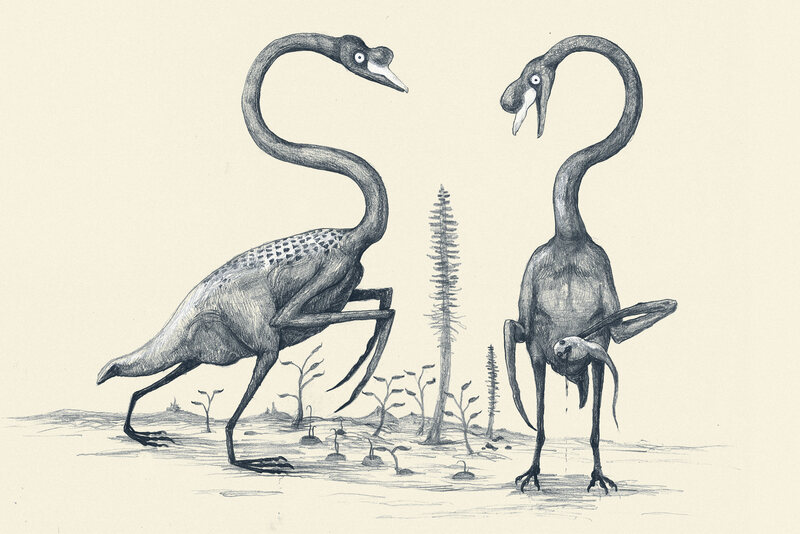
Swans imagined as though they were featherless dinosaurs.

There is also the practice of what he calls “feather dressing,” where an artist will transfer the color palette of a living bird’s feathers over to a dinosaur. Given the diversity and unique colorations that belong to single varieties of birds, it’s unlikely that any dinosaur shared the same hues. “The feathers of a green-headed mallard exist only once in nature,” says Kosemen. “There’s no way in the world that a specific bird’s clothing would be replicated in a dinosaur in the past.”

Then there is the issue of proportion. Kosemen says that there is a tendency to exaggerate the heads and claws of dinosaurs. Certainly many dinosaurs had large claws, and fearsome heads, but in many pictures, they seem to be almost cartoonishly huge. “Artists sometimes do this semi-unconsciously because they want to depict the head and the claws, the business end of the thing,” he says.

None of this is to say that paleoart is failing at its job. Many of the more improbable aspects of current dinosaur illustration make the beasts seem rather more sensational, and in some ways more attractive, helping to keep future generations interested in paleontology. Dinosaurs look cool.

If you tried to envision a hippo based only on its bones, it might look something like this.

And the problems with depicting the creatures of the past aren’t going anywhere. It’s likely that far-future paleoartists will have similar problems with creatures we take for granted today. It’s conceivable, for example, that future paleoartists will speculate that turtles once left their shells, or that frogs, with their weird legs, used to run around upright. “There’s going to be all sorts of reconstructions with reindeer antlers having strange membranes or juvenile reindeer jumping from cliffs, using their horns as paragliders,” says Kozeman.

Short of a Jurassic Park-style clone scenario, we might never know exactly what dinosaurs looked like. But until that day, we have artists like Kozeman to continue dreaming up the endless variations of the prehistoric animal world, by taking a cue from the creatures in our own backyards. “Do not imitate them, but see what other shapes they could take.”

ALL IMAGES COURTESY OF C.M. KOSEMAN

Source: atlasobscura.com


SUE to be Dethroned by ‘Titan’ of Evolution

Friday, September 22, 2017

SUE to be Dethroned by ‘Titan’ of Evolution

To some fans’ dismay and others’ excitement, the Field Museum of Natural History announced Aug. 30 that it will relocate iconic Tyrannosaurus rex fossil SUE from Stanley Field Hall to her own 5,800-square-foot room in “The Griffin Halls of Evolving Planet” exhibit.

That will leave room for a fossil cast of Patagotitan mayorum, aka the Titanosaur, a hulking, 122-foot-long herbivore, to assume SUE’s throne at the museum, 1400 S. Lake Shore Drive.

“Our decision to move SUE out of Stanley Field Hall isn’t one that we made lightly,” said Kate Golembiewski, public relations and science communications specialist at the Field Museum. “We gave it a lot of thought and did a lot of research into how that would affect our visitors’ experience.”

SUE has towered above visitors since coming to the hall in 2000. She is dwarfed by the Titanosaur—the largest dinosaur ever discovered. Visitors will be able to walk under and touch the cast.

The Titanosaur’s installation is nothing short of huge—literally and figuratively—said paleontologist Paul Sereno.

“Change can be invigorating,” Sereno said. “This should be a spot for new things to happen, not just the icons of the past.”

The Titanosaur’s placement was made possible by a donation from Illinois’ richest man, Kenneth Griffin, who previously made major donations to the museum, including to the popular “Evolving Planet” exhibit.

“Visiting the Field Museum has brought tremendous joy and wonder to my children and me over the years,” Griffin said in a Sept. 5 emailed statement. “I am proud to support [the museum].”

SUE will be removed in February 2018, and the Titanosaur will be unveiled later that spring. SUE’s reintroduction at her new home is slated for spring 2019.

SUE has her own Twitter account operated anonymously by Field Museum employees; it notes that SUE prefers they/them pronouns, but the museum still uses she/her. She has since amassed more than 30,000 followers.

SUE’s persona is sarcastic and excitable; she changed her account’s name to “Private Suite Haver” as she gushed over her new digs in between penning insulting tweets about Velociraptors.

In an Aug. 30 press release, SUE said she is excited for the move and should be able to better defend herself against Velociraptor attacks in the new room.

“[SUE] has always kind of had that personality,” Golembiewski said. “She’s funny. I like when she leads [Dungeons & Dragons] campaigns.”

Sarah Marren, Field Museum member and South Loop resident, said she is excited to see the Titanosaur up close with her 5-year-old son.

“[The Titanosaur] is so much bigger [than SUE],” Marren said. “Knowing that we’re going to be able to walk under it and touch it, my son is thrilled about that.”

However, Marren said she will miss SUE’s sharp smile greeting her in Stanley Field Hall. She made sure she told her son about the move in advance, so he will not be taken by surprise when there is a new dino in SUE’s place.

SUE could not be reached for comment as of press time. She is subject to a “strict no-interviews policy,” Golembiewski said in an Aug. 31 email.

Source: columbiachronicle.com

18mn yo Asexual Worm Could Unlock Secrets of Cloning Humans

Friday, September 22, 2017

18mn yo Asexual Worm Could Unlock Secrets of Cloning Humans

Scientists have revealed how an asexual worm that lived 18 million years ago has been cloning itself without sexual reproduction – solving a longstanding mystery.

The species of tiny, transparent roundworm, Diploscapter pachys, belongs to one of the oldest living lineages of asexual animals, researchers confirmed.

The research by New York University (NYU)’s Center for Genomics and Systems Biology and Duke University’s Center for Genomic and Computational Biology was published in Current Biology and revealed how the worm has lasted as an axsexual organism for so long.

“Scientists have been trying to understand how some animals can survive for millions of years without sex because such strict, long-term abstinence is very rare in the animal world,” NYU Biology Professor David Fitch, a co-author of the research said.

Fitch further explained that asexual survival is significant in evolutionary genetics as it “run[s] counter to the widely accepted view that sexual reproduction is required to eliminate deleterious mutations and for adaptation to a changing environment.”

Sexual reproduction produces offspring with copies of both parents’ genes, which, “usually provides good insurance against mutations that might kill the function of one of those gene copies – a process called complementation.”

When offspring are created through intercourse, complementation and genetic shuffling creates variation, which allows species to adapt to changing conditions. Asexual creatures tend to go extinct because they lack this adaptation strategy.

“It has been a longstanding mystery in biology how some asexual animals have survived for so many generations,” Fitch said.

Scientists used DNA to reveal D. pachys is a group of exclusively asexual species that originated 18 million years ago. They found the worm’s way of creating sperm or ova had been modified to stop recombination.

“Basically, the animals were cloning themselves,” Fitch said.

The research also revealed the worm only had one set of chromosomes. Similar species tend to have five to seven chromosomes. The only other species to have one set of chromosomes are ants and parasitic roundworms.

Researchers found D. pachys fuses six chromosomes of its ancestor into a single chromosome and skips the first division of meiosis [a type of cell division], where genes are recombined, so its offspring continues to have genetic diversity.

“Thus, the mystery of its longevity seems largely resolved,” Fitch concluded. “D. pachys overcomes the disadvantages of asexual reproduction by maintaining genetic variation, and with it, complementation.”

“Ironically, this is accomplished by making sure there is no recombination between the gene copies. If there were, the differences between the gene copies might be lost.”

Source: www.RT.com

Jurassic World 2: Mosasaurus, Dilophosaurus to join Rexy and Blue in Fallen Kingdom?

Friday, September 22, 2017

The franchise fans can look forward to some aquatic adventure in the upcoming Jurassic Park sequel.

Jurassic World 2, the upcoming science fiction adventure film, titled Fallen Kingdom, is darker, scarier and filled with lot of surprises. If there is something that the franchise fans are excited about the movie, it is the return of their favourite characters, including the Tyrannosaurus rex, popularly known as Rexy.

With the popular T. rex , Velociraptor Blue is confirmed to return in the new Jurassic Park sequel and the new concept art for upcoming Pez collection hints at the return of Mosasaurus and Dilophosaurus.

“A Jurassic World Gift Tin will be released June 1. This tin will feature Jurassic World Click and Play Pez and a Jurassic World board came in which the tops of the pez can be used as playing pieces. The mockups on display at the Expo feature a Tyrannosaurus, a Triceratops, a Mosasaurus, and perhaps an Edmontosaurus,” stated the company through a press release.

Meanwhile, a fansite called Jurassic Outpost stated that the Mosasaurus and Dilophosaurus are included in the collection just because of their popularity and they may not be featured in Fallen Kingdom.

“The Tyrannosaurus rex, Blue, and Triceratops also appeared on the recently unveiled Fallen Kingdom promo merch (in fact, the Triceratops sports a similar pose), and now the Mosasaurus and Dilophosaurus join them. While the first three are certainly part of the new film, as they have film renders and art, the Mosasaurus and Dilophosaurus remain unconfirmed. It’s very possible that they were simply included in the lineup due to their popularity with kids and fans alike (much like with many Jurassic World 2015 toys),” stated the website.

Pages