Blogs

Mammals Were Nocturnal Until Dinosaur Extinction, Then Emerged Into Daylight

Wednesday, November 15, 2017

With enormous predators like Tyrannosaurus rex skulking around in the daytime it is not surprising that the first mammals chose to live under the cover of darkness.

In fact, a new study, from University College London has found that our ancestors did not emerge from the shadows until after the dinosaurs became extinct, around 66 million years ago.

Before then, all mammals were nocturnal, sleeping in the daytime and hunting or foraging at night, new data suggests.

Researchers used computer algorithms to analyse details from 2415 species of living mammals to reconstruct the activity patterns of their ancestors.

The ancestors of gorillas were the first mammals to become diurnal, which is why their eyesight is so good

They found that following the comet strike which killed off the dinosaurs, mammals shifted to an intermediate stage of mixed day and night living, before primarily venturing into the daylight.

“We were very surprised to find such close correlation between the disappearance of dinosaurs and the beginning of daytime activity in mammals, but we found the same result unanimously using several alternative analyses,” said lead author, doctoral student student Roi Maor of UCL.

The team found that the ancestors of gorillas and gibbons were the first to give up their nocturnal activity, a discovery which fits in with the fact that their descendants – which include humans – are the only mammals that see well in daylight.

Their vision and color perception is comparable to those of diurnal reptiles and birds – groups which never left the daytime.

“It’s very difficult to relate behavior changes in mammals that lived so long ago to ecological conditions at the time, so we can’t say that the dinosaurs dying out caused mammals to start being active in the daytime,” added co-author Professor Kate Jones.

“However, we see a clear correlation in our findings.”

Ancestral reconstruction is the extrapolation back in time from measured characteristics of individuals, or species, to their common ancestors.

For example, if  a mammal had long fingers and its sibling also has long fingers  it is likely that a parent had long fingers.

The research was published in the journal Nature Ecology and Evolution.

Source: www.telegraph.co.uk

Nyctosaurus

Sunday, November 12, 2017

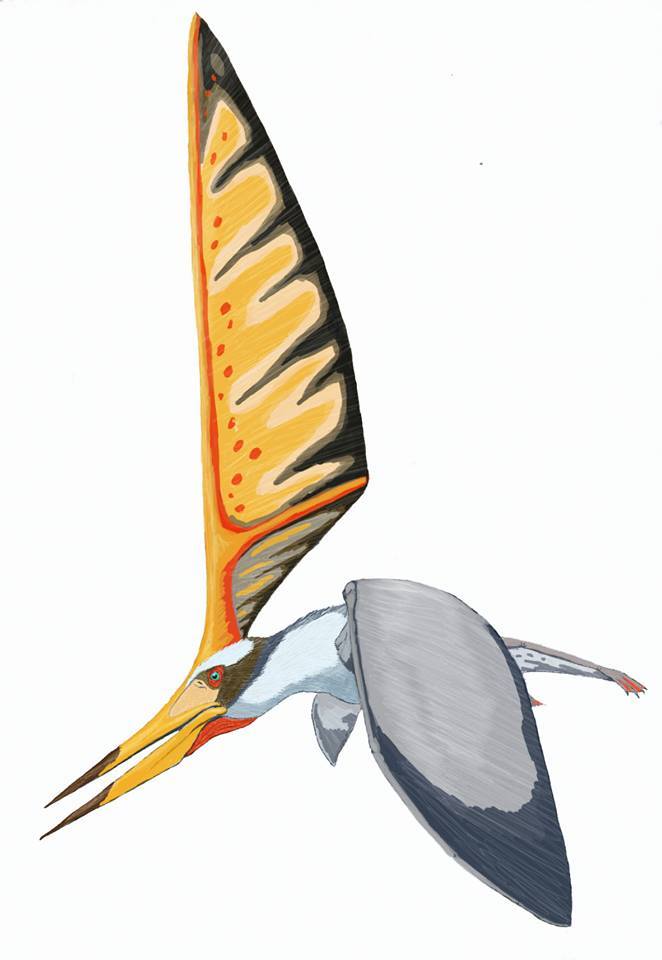
Nyctosaurus

Nyctosaurus is an extravagant Genus of Pterodactyloid Pterosaur. Pterodactyloids were the types of Pterosaurs that usually had small tails if any, and normally lacked teeth. Nyctosaurus have lived 85 million years ago during the late Cretaceous.

The first fossil evidence of Nyctosaurus was discovered in 1876 by Othniel Charles Marsh in the Smoky Hill River dig site in Kansas and since has undergone several taxonomical revisions as most every organism does.

Size of a mature, crested specimen (green) compared with a human

The name Nyctosaurus means “Night Lizard” or “Bat Lizard” since the wings of Pterosaurs are more like the wings of Bats than any other flying organism. In most respects Nyctosaurus is quite similar to Pteranodon, only much smaller and perhaps more specialized due to it’s large decorative head-crest. Nyctosaurus grew to a wingspan only 6-6 1/2 feet but it’s large crest was nearly as long as one of it’s wings and over 3 times the length of the skull! That must have been hard to maneuver at times. Nyctosaurus is also the only Pterosaur that has lost it’s clawed wing fingers. This means that it couldn’t have gripped surfaces and climbed like other Pterosaurs; it couldn’t climb tress or rocks and would have had to have hopped or flown to move over uneven surfaces.

It has been hypothesized that the large crest could have sported a membrane of skin between the two spurs and acted almost like a rudder, but so far, there has been no physical evidence of a membrane found to support it, although soft tissue does not always fossilize.

 Source: www.Wikipedia.org / www.NatGeo.com

Welcome to Gondwana: A Dinosaur Treasure Trove

Saturday, November 11, 2017

Welcome to Gondwana: A Dinosaur Treasure Trove

After the supercontinent Pangaea separated into the smaller supercontinents of Laurasia and Gondwana, evolution became dependent upon specific conditions of climate and habitat.

The dinosaur “collective” fragmented, leaving dinosaurs to evolve in isolated groups and develop traits distinctly different from their sundered cousins on other landmasses.

During the 19th century, naturalist Charles Darwin began speculating about the relationship between living and fossil species while developing his theory of natural selection and “descent with modification,” to explain why some species became extinct while others evolved.

But no one paid much attention to geology’s role in biological evolution until 1910, when geophysicist Alfred Wegener, curious about why identical plant and animal fossils were being found on separate continents, realized that the outline of the east coast of South America fit against the lower west coast of Africa like pieces in a massive jigsaw puzzle.

It was as if the two continents had once been joined — an insight later confirmed by modern geology.

Africa, the first landmass to separate from Gondwana, supported Cretaceous Period dinosaurs like Suchomimus, a three-ton, bipedal predator with a skull resembling a contemporary crocodile’s. It was also home to Nigersaurus, whose wide, flat, vacuum-cleaner-nozzle-shaped mouth was packed with 50 teeth each in its upper and lower jaws, making it perfect for gobbling low-growing plants. Each tooth position held nine replacement teeth, meaning that Nigersaurus replaced 80 to 100 teeth each month — without missing a single meal.

Meanwhile, in South America, Giganotosaurus roamed the badlands of what is now Argentina’s Patagonia region. Perhaps the largest land carnivore that ever lived, this 43-foot-long, 13,200-pound behemoth comes alive at the Denver Museum of Nature & Science special exhibition “Ultimate Dinosaurs,” where visitors can manipulate special screens to see what a creature’s skin and facial coloration might have looked like in “real life.”

T-Rex’s Short Arms Could Have Been Used For Slashing

Saturday, November 11, 2017

A paleontologist believes that the T. rex’s short forearms may have had more vicious purposes than previously thought. More than just grasping prey or mating, it’s possible the T. rex used the sharp claws to viciously slash its prey.

Grasping, Sex, Or Evolutionary Remnant?

Scientists still do not have a consensus as to the definite purpose of the T. rex‘s fairly short forearms. It’s a pretty defining feature of the prime predator, but experts still aren’t sure what the creature may have used it for. Some scientists believe that perhaps the claws were useful in grasping their prey, in pushing themselves up from the ground, or even to hold on to their mates when mating.

However, the current belief is that the short forearms may simply be a remnant of evolution, quite like wings on modern flightless birds. Some even believe that the short forearms were something of a compromise during evolution to make way for their large heads and necks.

Short But Vicious Arms

Steven Stanley, a paleontologist from the University of Hawaii in Maui, presented his findings at the Geological Society of America in Seattle. He believes that the T. rex may have used its claws for close-contact slashing, leaving its prey with deep slashes. Stanley states that similar to other dinosaur species, the T. rex possibly mounted on its victim or grasped it with its jaw while it repeatedly inflicted deep slashes in quick succession.

“Why should T. rex not have engaged in this activity?” asked Stanley.

Supporting this theory are the bones of the T. rex itself, with strong albeit short arm bones and ball-and-socket joints that allow it to move in various directions. What’s more, through the course of evolution, the T. rex lost one of three claws, leaving the remaining two claws with stronger slashing powers.

Short Reach And Stronger Jaws

Other scientists are skeptical of the hypothesis, stating that the T. rex’s arms are too short, and that the T. rex would have to practically push itself onto the other animal in order to cause a substantial slash. At that odd position, then the T. rex wouldn’t be able to use its powerful jaws to make a more effective attack.

That said, they agree that the T. rex’s forearms may have been bigger before it atrophied during the course of evolution where the powerful jaws took over as its prime weapon. However, Stanley believes that despite being atrophied, the forearms may still have had more function than just for mating, other minor purposes, or as a pre-evolution reminder.

Source: www.techtimes.com

On Isolated Madagascar, Even Prehistoric Evolution Was Unique

Saturday, November 11, 2017

Head restoration of Masiakasaurus knopfleri (Ceratosauria, Theropoda) by Lpanzarin.

More than 70 million years ago, the world’s fourth-largest island separated from Gondwana.

It has remained a loner ever since.

Situated off Africa’s southeastern coast, Madagascar’s continued geographical isolation means that today, about 80 percent of its wildlife — which includes zoologically primitive primates and hedgehog-like insectivores — is found nowhere else in the world.

That same isolation also greatly affected the evolution of Madagascar’s Cretaceous Period dinosaurs, bizarre creatures that included Masiakasaurus knopfleri, a predatory theropod or meat-eater that stood just 30 inches high, sported strange-looking, forward-pointing teeth at the front of its mouth, and was discovered by a team led by David W. Krause, senior curator of vertebrate paleontology at the Denver Museum of Nature & Science.

Equally unusual was Majungasaurus crenatissimus, a 4,400-pound, cannibalistic predator with a taste for sauropod flesh and “arms” — forelegs too small to have been useful for feeding or hunting.

Perhaps such limbs were a feather-covered factor in attracting a mate, says Joe Sertich, curator of dinosaurs at DMNS. He discovered the fossilized Majungasaurus skull and neck bones housed at the museum as part of its Madagascar Paleontology Project and displayed in the special exhibition “Ultimate Dinosaurs.”

Other oddities include rahonavis, the smallest Cretaceous Period dinosaur found thus far on Madagascar. Although this theropod probably had feathers and might have been capable of flight, rahonavis wasn’t a direct relative of birds, the living descendants of the dinosaurs. It might, instead, have been a genuine link between small theropod dinosaurs and “true” birds.

And then there’s Simosuchus, a stubby, blunt-snouted, and rather cute (to me, at least) creature that turned out not to be a dinosaur at all, but a land-dwelling, plant-eating crocodilian completely unlike any modern crocodile.

Amazing Goonies Easter Egg Discovered in Jurassic Park

Saturday, November 11, 2017

Amazing Goonies Easter Egg Discovered in Jurassic Park

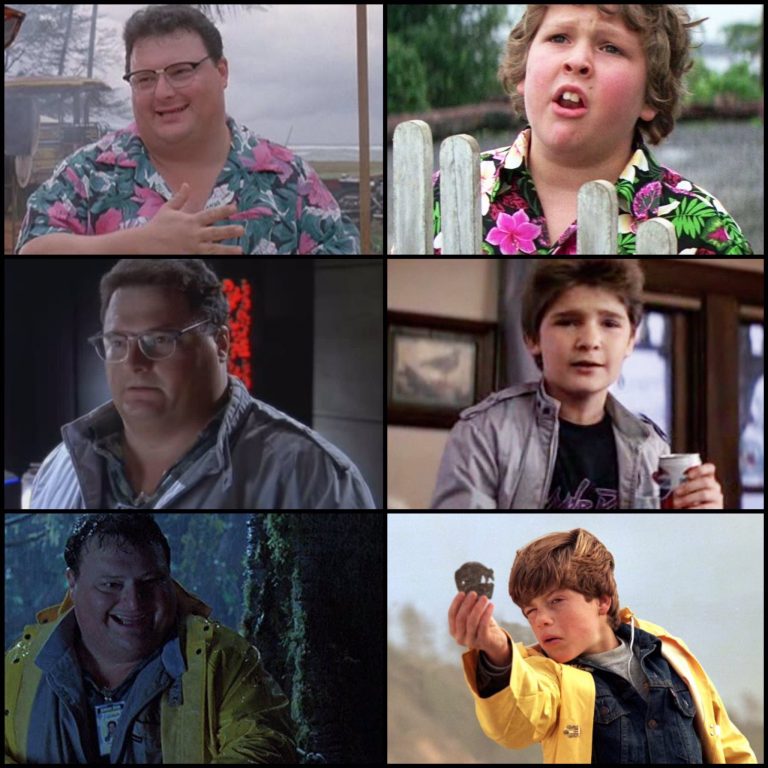
Steven Spielberg has had a legendary career. When all’s said and done, it’s quite possible he’ll be considered the greatest filmmaker who ever lived, if he isn’t already. Jurassic Park is unquestionably one of his most beloved directorial achievements and Dennis Nedry, the man responsible for the park’s disaster, is one of his more interesting supporting characters. Now, a new fan theory points out that, quite possibly, Dennis Nedry was paying homage to The Goonies in Jurassic Park.

This theory comes to us from Twitter user Shawn Robare. He took a look at the various outfits that Dennis Nedry, played by Wayne Knight, wears throughout the movie. It turns out that they just so happen to line up pretty remarkably with several members of The Goonies, which just so happens to be a movie that Steven Spielberg produces. Here’s what Robare had to say about it when he made his discovery.

“Guys, GUYS, is Dennis Nedry homaging the Goonies in Jurassic Park?!"

When we first meet Dennis Nedry, he’s sporting a Hawaiian shirt that, when looking at it side by side, closely resembles what Chunk (Jeff Cohen) is wearing in The Goonies. Later on, we see Nedry wearing a grey jacket before heading off to steal the dinosaur embryos he needs to get paid. This very closely resembles the Member’s Only jacket Mouth (Corey Feldman) wears in the movie. Lastly, after Nedry has the embryos in the famed Barbasol can, he’s seen sporting a yellow raincoat. Again, looking at it side by side, this shares an uncanny resemblance to what Mikey (Sean Astin) wears in Goonies.

There’s no shortage of Jurassic Park fan theories online. But this one, as far as we can tell, hasn’t even been brought forward prior to Shawn Robare bringing it up on Twitter recently. It could be pure coincidence, but it’s uncanny when looking at it together like this. It’s also possible that Steven Spielberg, or producer Kathleen Kennedy, who also worked on both movies, was just having a little bit of fun. Now, does this theory have any deeper meaning? Probably not. It’s likely just a fun callback, that nobody noticed for more than twenty years, to one of Spielberg’s other classic movies.


The Goonies, directed by Richard Donner, was released in 1985, just eight years prior to the release of Jurassic Park. So, at the time, Goonies was much more fresh in everyone’s minds. Perhaps that’s why Dennis Nedry was paying homage to Chunk, Mouth and Mikey. Or maybe he wasn’t paying homage and it’s just someone connecting dots that aren’t really there. Unfortunately, given Corey Feldman’s recent sexual harassment allegations, The Goonies has been present in people’s minds for less than favorable reasons. In any case, this is a pretty fun theory. You can check out the side by side images, courtesy of Shawn Robare’s Twitter, for yourself below.

Goonies easter egg found in Jurassic Park

Read more: 22 Jurassic Park References in Jurassic World

Source: movieweb.com

Unique Imaging of Dinosaur’s Skull Tells Evolutionary Tale

Saturday, November 11, 2017

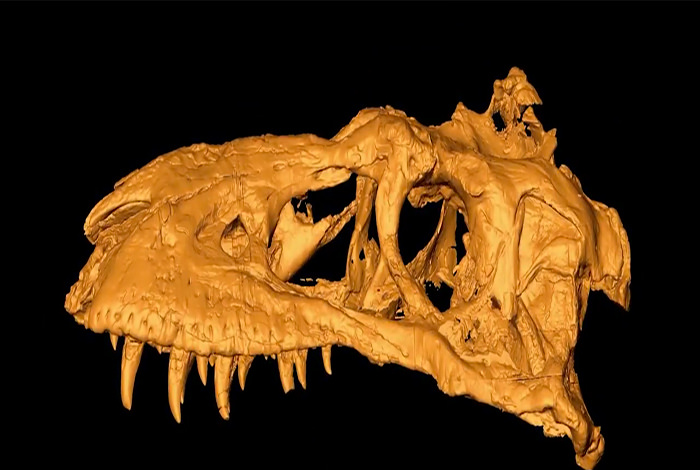
Researchers using Los Alamos’ unique neutron-imaging and high-energy X-ray capabilities have exposed the inner structures of the fossil skull of a 74-million-year-old tyrannosauroid dinosaur nicknamed the Bisti Beast in the highest-resolution scan of tyrannosaur skull ever done. The results add a new piece to the puzzle of how these bone-crushing top predators evolved over millions of years.

“Normally, we look at a variety of thick, dense objects at Los Alamos for defense programs, but the New Mexico Museum of Natural History and Science was interested in imaging a very large fossil to learn about what’s inside,” said Ron Nelson, of the Laboratory’s Physics Division. Nelson was part of a team that included staff from Los Alamos National Laboratory, the museum, the University of New Mexico, and the University of Edinburgh. “It turns out that high energy neutrons are an interesting and unique way to image something of this size.”

The results helped the team determine the skull’s sinus and cranial structure. Initial viewing of the computed tomography (CT) slices showed preservation of un-erupted teeth, the brain cavity, internal structure in some bones, sinus cavities, pathways of some nerves and blood vessels, and other anatomical structures. These imaging techniques have revolutionized the study of paleontology over the past decade, allowing paleontologists to gain essential insights into the anatomy, development, and preservation of important specimens.

To peer inside the 40-inch skull, which was found in 1996 in the Bisti/De-Na-Zin Wilderness Area near Farmington, NM, the Los Alamos team combined neutron and X-ray CT to extract anatomical information not accessible otherwise and without the risk of damaging the irreplaceable fossil. Los Alamos is one of a few places in the world that can perform both methods on samples ranging from the very small to the very large.

The thickness of the skull required higher energy X-rays than those typically available to adequately penetrate the fossil. The lab’s microtron electron accelerator produced sufficiently high-energy X-rays.

To provide an alternate view inside the skull, the team also used a newly developed, high-energy neutron imaging technique with neutrons produced by the proton accelerator at the Los Alamos Neutron Science Center. The neutrons interact with the nuclei rather than the electrons in the skull, as X-rays do, and thus have different elemental sensitivity. This provides complementary information to that obtained with X-rays.

The team’s study illuminates the Bisti Beast’s place in the evolutionary tree that culminated in Tyrannosaurus rex.

“The CT scans help us figure out how the different species within the T. rrex family related to each other and how they evolved,” said Thomas Williamson, Curator of Paleontology at the New Mexico museum. “The Bistahieversor represents the most basal tyrannosaur to have the big-headed, bone-crushing adaptations and almost certainly the small forelimbs. It was living alongside species more closely related to T-rex, the biggest and most derived tyrannosaur of all, which lived about 66 million years ago. Bistahieversor lived almost 10 million years before T. rex, but it also was a surviving member of a lineage that retained many of the primitive features from even farther back, closer to when tyrannosaurs underwent their transition to bone-crushing.”

Source: techbriefs.com

Dinosaurs and Modern Animals are Birds of a Feather

Saturday, November 11, 2017

Dinosaurs and Modern Animals are Birds of a Feather

I read with interest the Oct. 27 news article “Feathered dinosaur bore a mask like a raccoon’s,” about the fossil of Sinosauropteryx, the small dinosaur from the Cretaceous having “feathery fluff” that had been discovered in 1996. However, other than saying that the find “helped cement the idea that birds are living, avian dinosaurs,” the article made no mention of the fact that several fossils of other species of small, bipedal, feathered dinosaurs were subsequently found, some having actual wings with feathers that were very similar to those of present-day birds. Not mentioning that fact might have left some readers dubious about the idea that birds have dinosaur ancestry. In fact, even before those finds, Archaeopteryx, the first fossil of which was discovered in 1861, was actually a small, bipedal, feathered, winged dinosaur.

It should be made clear that the skeletons of these avian progenitors were still typically dinosaur-like. The only significant difference between their skeletons and those of other bipedal dinosaurs is that the digits of the forelimb — which were still separate instead of fused together as in present-day birds — were lengthened to form the wings. Most likely, though, because they did not have a sternum as modern birds do for muscle attachment, their mode of flight was likely gliding instead of powered.

Source: washingtonpost.com

A New Cretaceous Dinosaur from Utah with Origins in Jurassic of Europe

Saturday, November 11, 2017

A New Cretaceous Dinosaur from Utah with Origins in Jurassic of Europe

The collaboration of Utah paleontologists with Spanish and English researchers has led to identification of the correct familial relationships of the new Utah dinosaur.

Discovery.

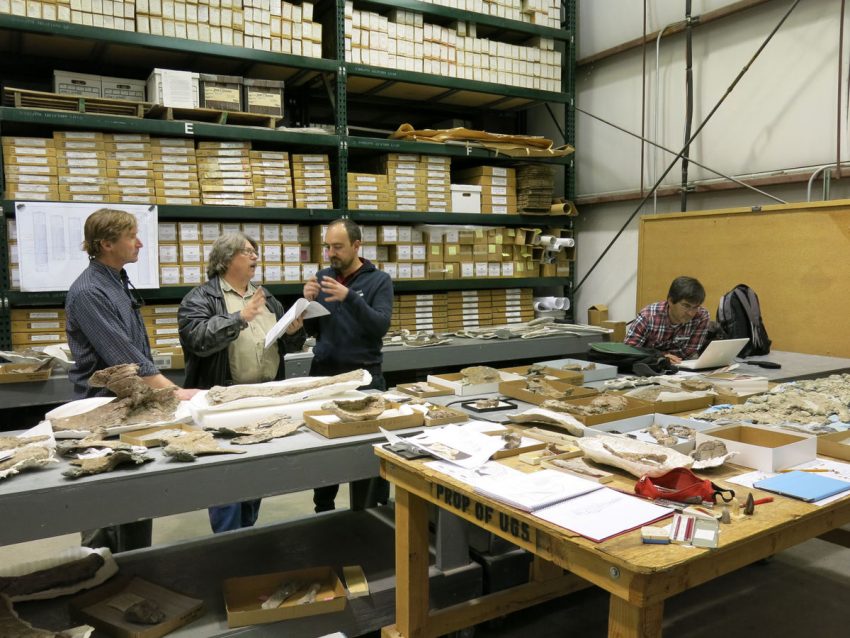
Although the Doellings Bowl Bonebed was first identified by Utah State Paleontologist James Kirkland in 1991, the age and great extent of skeletal remains at the site were not recognized until 2006. Following a flash flood in 2010, some large bones were observed by former UGS geologist Gary Hunt of Enterprise, Utah at the base of a dry wash adjoining the original dig site. Excavation of these bones revealed the skeleton of a mired sauropod or long-necked dinosaur with both a fore limb and hind limb extended down into the marsh deposit below the level of the rest of the skeleton. The excavation team, led by Dr. James Kirkland of the Utah Geological Survey, discovered and prepared two sauropod specimens, one of them very complete, including the skull.

Setting.

The Doellings Bowl Bone Bed is in the lower Yellow Cat Member of the Cedar Mountain Formation near the very base of Utah’s thick and very fossiliferous Cretaceous sequence. The Yellow Cat Member is divided into an upper and lower sequence as it preserves two non-overlapping dinosaur faunas separated by a well-developed fossil soil horizon representing significant time on the order of one to a few million years. It has been shown recently that the Yellow Cat Member in Grand County, Utah preserves the two oldest dinosaur faunas because Early Cretaceous salt movement induced subsidence, creating a protected depression in the northern Paradox “salt” Basin while the rest of western North America was undergoing erosion.

The presence of silicified peat, fern roots, tiny fish bones, rare turtles and rare crocodilian fossils suggests the Doellings Bowl Bonebed represents a marsh deposit. Mierasaurus coexisted in the same ecosystem as the ornithopod Iguanacolossus, an armored polacanthid ankylosaur, small “raptors” (carnivorous dinosaurs), such as Yurgovuchia, large allosaurid theropods, and a large, primitive therizinosaur. The environmental interpretation for the site where Mierasaurus was discovered was a marsh area with vegetation of ferns that was climatically wetter than that indicated for both the underlying Upper Jurassic Morrison Formation and overlying upper Yellow Cat Member.

The specific age of these rocks is controversial but new data is being published. Our best current estimates are approximately 130-135 Ma (millions of years ago).

Breakthrough.

The collaboration of Utah paleontologists with Spanish and English researchers led to identification of the correct familial relationships of the new Utah dinosaur. While it is obviously a new dinosaur species, without the collaboration Kirkland’s team would almost certainly have compared the new dinosaur with North America’s well-known Upper Jurassic sauropod Camarasaurus. As it turned out, Dr. Rafael Royo-Torres first recognized the more primitive turiasaurs as a distinct group of European Upper Jurassic sauropods.

During 2016 and 2017 the description and comparison of the new remains was conducted by an international multidisciplinary team composed of Doctors Rafael Royo-Torres, Alberto Cobos and Luis Alcalá from the Fundación Conjunto Paleontológico de Teruel-Dinópolis (Teruel, España), Paul Upchurch from the University College London (London, United Kingdom), James Kirkland and Donald D. DeBlieux from the Utah Geological Survey (Utah, USA), and John Foster from the Museum of Moab (Utah, USA).

This new paper, published in the journal “Scientific Reports” contains several milestones:

1.-Description of a new genus and species of sauropod dinosaur (quadruped, with long neck and tail and small skull);

2.- identification of a group of Upper Jurassic European dinosaurs, the Turiasauria, not identified in North America prior to this study;

3.-Given the evolutionary relationships of the Turiasauria, Mierasaurus is the most primitive sauropod identified in North America, though actually younger than many Jurassic N.A. sauropods

4.-Recognition that a second North American sauropod from the upper Yellow Cat fauna, Moabosaurus, also belonged to the group of Turiasauria;

5. Moabosaurus is more specialized than the older Mierasarus in having divided ribs along its neck; and

6.- Recognition that the Cretaceous turiasaurs in North America are the geologically youngest known so far.

Recovered fossils (from the skull, teeth, neck, back and tail, bones of the shoulder and hips, and bones of the front and back limbs, including the hands and feet) allow us to state that this new specimen, Mierasaurus, represents the most complete individual sauropod dinosaur from the Cretaceous of North America. In addition, Mierasaurus (as well as Moabosaurus) are sauropods with more primitive characteristics, when compared to other sauropods from North America. The length of Mierasaurus, estimated between 32-39 feet (10 and 12 meters), is much smaller than that of its European relatives, which in Turiasaurus could surpass 82 feet in length (25 meters).

How did the turiasaurs arrive to North America from Europe? The study indicates that none of the more than 430 examples of sauropods documented in North American sites from the Upper Jurassic are turiasaurs. The Turiasauria were well-represented in the Jurassic only in Europe. The discovery of the turiasaurs Mierasaurus and Moabosaurus in younger deposits, in the Lower Cretaceous Yellow Cat Member of the Cedar Mountain Formation in Utah, allows scientist to infer that representatives of this group of primitive sauropods migrated into North America via an intercontinental bridge, after the Upper Jurassic (between 145 and 130 million years ago) from Europe, during the final opening of the North Atlantic during a time of lower sea levels.

The name of the genus of the new dinosaur, Mierasaurus, is dedicated to the Spanish cartographer and chief scientist D. Bernardo de Miera y Pacheco (1713-1785), born in Santibáñez de Villacarriedo (Cantabria, Spain). Miera was the scientific leader of the 1776 Domínguez-Escalante Expedition. The purpose of the expedition was to establish a stable communication and trade route between Santa Fe, New Mexico, and Monterrey, California. For six months, they traveled 2,000 miles, establishing peaceful contact with numerous groups of native Americans (Hopis, Lagunas, Yutas and Apaches, among others). Bernardo de Miera y Pacheco made the first map of this territory, largely unknown to Europeans at this time.

This map stands out for its accuracy and artistic style, and for the numerous geographic, geological and ethnographic notes that it contains. This expedition was also the first known arrival of Europeans into what is now the state of Utah, where Mierasaurus was discovered. The name of the species, bobyoungi, is dedicated to the American geologist Robert Young, who conducted the first comprehensive work on the Early Cretaceous of the Colorado Plateau, where Mierasaurus was discovered.

 Source: www.ecprogress.com

Decennatherium rex: Ancient Giraffe Relative, Once Roamed Iberian Peninsula

Saturday, November 11, 2017

Decennatherium rex

A new large species of giraffid being named Decennatherium rex has been discovered by Dr. Maria Rios from the National Museum of Natural History of Spain and co-authors.

Decennatherium rex lived during the late Miocene epoch, approximately 9 million years ago, in what is now Spain.

The animal belongs to the family Giraffidae (giraffids), a group of ruminant artiodactyl mammals that includes modern day giraffes and okapis.

“Giraffids were much more diverse and widespread in the past, with more than 30 fossil species described,” Dr. Rios and colleagues said.

“For the past decades a number of studies intended to resolve the phylogenetic relationships of giraffids, but due to the lack of fossilized skulls no clear consensus was reached regarding the phylogenetic relationships amongst the different members of the family.”

“The exceptionally complete remains of Decennatherium rex allow us to improve and reassess giraffid systematics, offering a lot of new data, both anatomic and phylogenetic, on the large late Miocene giraffids.”

Skeletal and life reconstructions of an adult female Decennatherium rex. Image credit: Oscar Sanisidro.

The paleontologists conducted a phylogenetic analysis to help elucidate evolutionary patterns.

“The results suggest that the genus Decennatherium may have been the most basal branch of a clade of now-extinct giraffids containing both sivatheres, the largest known giraffids, and samotheres, whose appearance was somewhere in between that of okapis and giraffes,” they said.

“All giraffids in this group feature four horn-like skull protuberances known as ossicones, two over the eyes and two larger ridged ossicones at the back of its head.”

Decennatherium rex was likely the earliest-evolving example of this ossicone layout.”

“The inclusion of this species in the sivathere-samothere clade would extend its timespan back to the early late Miocene and its range as far as the Iberian Peninsula, making the clade one of the most successful and long-lived of all the giraffids.”

The discovery of Decennatherium rex is reported in the journal PLoS ONE.

_____

M. Ríos et al. 2017. A new giraffid (Mammalia, Ruminantia, Pecora) from the late Miocene of Spain, and the evolution of the sivathere-samothere lineage. PLoS ONE 12 (11): e0185378; doi: 10.1371/journal.pone.0185378

Source: sci-news.com

Pages