Blogs

World’s Longest Sauropod Trackway Found in France
Thursday, November 30, 2017

World’s Longest Sauropod Trackway Found in France

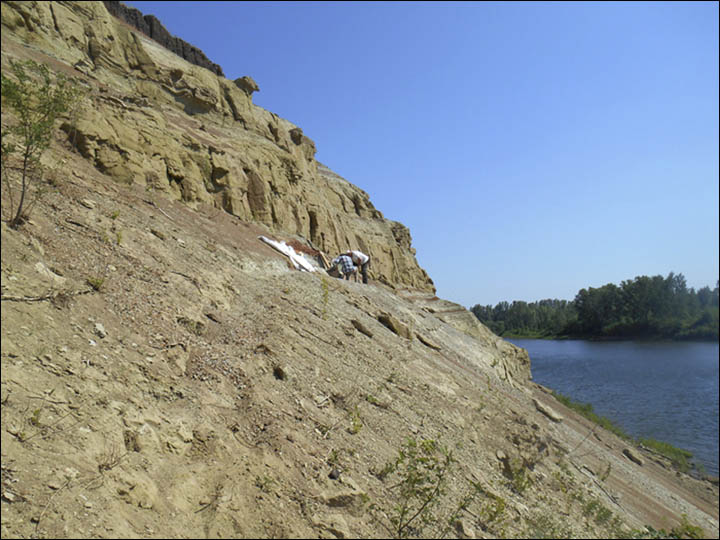
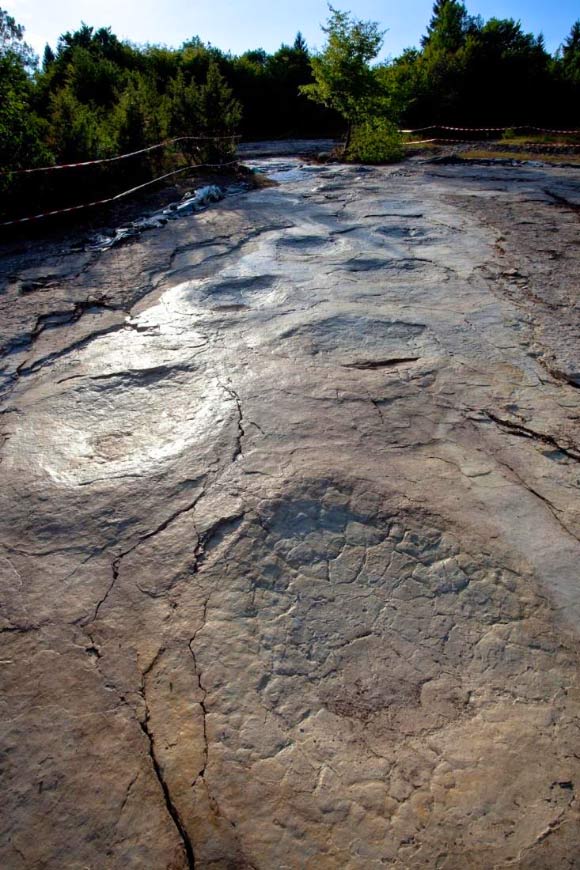
The dinosaur tracksite is located less a mile (1 km) west of the village of Plagne in the Department of the Ain, southern French Jura Mountains.

It was discovered by members of the ‘Société des Naturalistes d’Oyonnax,’ a group of amateur geologists specializing in the Jurassic, in 2009.

Paleontologists from the Paléoenvironnements et Paléobiosphère research unit at the Claude Bernard Lyon 1 University then confirmed that the Plagne trackway extends over 508 feet in length, which makes this specimen the longest sauropod trackway currently known in the world, a few feet longer than the Middle Jurassic sauropod trackways from Galinha, Portugal.

The trackway is composed of 110 successive paces, and is generally well-preserved. The prints measure between 3.3 and 10 feet (1-3 m) in diameter.

The footprints reveal five elliptical toe marks, while the handprints are characterized by five circular finger marks arranged in an arc.

They were made by a sauropod, or long-necked dinosaur, approximately 150 million years ago, during the Tithonian, the latest age of the Late Jurassic epoch.

“Paleogeographic reconstructions of Western Europe for this stage indicate an archipelago landscape, where the emergent islands were occasionally connected during periods of relatively low sea level, which presumably allowed faunal expansion or migration,” the researchers said.

Artist’s impression of the Plagne sauropod dinosaur superimposed on its tracks. Image credit: A. Bénéteau / Dinojura.

Biometric analysis suggests the Plagne sauropod dinosaur was at least 115 feet (35 m) long, weighted between 35 and 40 tons, had an average stride of 9.2 feet (2.8 m), and traveled at a speed of 2.5 mph (4 km/h).

“This new trackway site, alongside other Early Jurassic Swiss and French tracksites yielding thousands of sauropod and theropod tracks, can be considered as being the largest dinosaur megatracksite in Europe,” the paleontologists said.

They detailed their findings in the August 2017 issue of the journal Geobios.

_____

Jean-Michel Mazin et al. The dinosaur tracksite of Plagne (early Tithonian, Late Jurassic; Jura Mountains, France): The longest known sauropod trackway. Geobios 50 (4): 279-301; doi: 10.1016/j.geobios.2017.06.004

Source: www.sci-news.com

These Four Extinct Animals Could be Brought Back From the Dead

Thursday, November 30, 2017

It might sound like something straight out of Jurassic Park but there’s a growing scientific movement trying to bring back extinct creatures from the dead. Unfortunately (or maybe fortunately depending on how you look at it) they’ve not got onto dinosaurs yet; instead, researchers are looking into more recently killed-off creatures like the Tasmanian tiger and the quagga as prime ‘de-extinction’ candidates.

Although the process of ‘de-extinction’ is controversial, with some scientists questioning whether it’s a good use of resources, the idea has become popular in biotech and conservation circles, according to Quartz.

These are four of the creatures being considered for de-extinction:

Thylacine (Tasmanian tiger)

The thylacine looked like a large dog, with stripes, according to the Tasmania Parks and Wildlife Service. Fully grown it measured about 180 cm (6ft) from nose to tail tip, stood about 58 cm (2ft) high at the shoulder and weighed up to 30kg.

The arrival of European settlers marked the start of a tragic period of conflict that led to the thylacine’s extinction. In 1936, the world’s last captive thylacine died in Hobart Zoo and in 1986 the creature was declared officially extinct.

But in 2008, Dr Andrew Pask from the University of Melbourne revealed how he had extracted DNA from a preserved thylacine and injected it into mouse embryos, which grew normally, triggering hopes that the animal could be restored.

Quagga

The quagga was a mammal, closely related to horses and zebras, according to University of California Museum of Paleontology.

It had a yellowish-brown colour with stripes only on its head, neck and forebody. The quagga was native to desert areas of the African continent until it was exterminated in the wild in the 1870s. The last captive quaggas died in Europe in the 1880s.

The Quagga Project, started in 1987, is an attempt by a group of dedicated researchers in South Africa to bring back the animal from extinction by natural selection and reintroduce it into reserves in its former habitat.

Gastric-brooding frog

Southern gastric brooding frog, by Peter Schouten

This frog, native to Australia, went extinct in the mid 1980s. They were known for their strange reproduction method where the mother would convert her stomach into a womb, swallow her eggs and give birth through ‘propulsive vomiting’.

In 2013, scientists tried to clone the frog by implanting a cell nucleus from a dead gastric-brooding frog into a live egg from another frog species. They hope this will eventually lead to the resurrection of the creature.

Heath hen

The heath hen was a species of Prairie chicken found on the sand plains of the Northeast United States that went extinct in 1932.

There’s lots of DNA available from specimens in museums making it a good de-extinction candidate. A conservancy group founded by Stewart Brand and Ryan Phelan is now interested in restoring the bird through genetic technology.

(Images: iStock / Wikipedia / Biodiversity Heritage Library / Universal Pictures)

Source: www.shortlist.com

Mysterious Shark Caught, Called a ‘Living Fossil’ by Researchers

Thursday, November 30, 2017

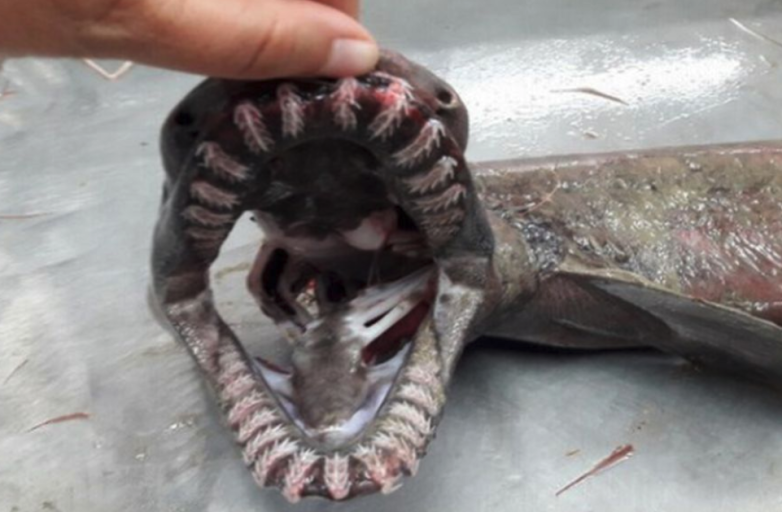
When the dinosaur-killing asteroid struck the Earth many millions of years ago it spelled doom for countless species, while allowing many others (like mammals) the chance to come out of hiding and gain dominance. However, some creatures were able to carry on largely unaffected by the trauma the space rock wrought, and some even still exist today. The frilled shark is one of those rare animals, and a fishing trawler accidentally snagged one of the very few specimens ever seen by human eyes.

The animal, which was snagged off the coast of Portugal, is considered a “living fossil” by scientists because the species is thought to have remained largely unchanged for the past 80 million years. After it was caught, the commercial fishermen reported their strange catch and the creature was transferred to a research vessel where scientists examined it.

According to the fishermen, the beast measured an impressive five feet in length and had been hauled in from a depth of around 2,300 feet. The odd sharks are thought to live at extreme depths, and have been caught as far as 5,150 feet, which is the primary reason humans very rarely encounter them. Old tales of sailors encountering “sea serpents” may have been inspired by the occasional spotting of the animals, but there’s really no way of knowing.

That’s not necessarily a bad thing, as the frilled shark is a pretty frightening creature to see. With a long, snake-like body, it hunts by lunging at its prey and snagging them with its rows of needle-like teeth. It has never been observed hunting at depths that would lead it to a face-to-face run-in with human divers, but with 80 million years of experience under its belt, the species most certainly knows how to make short work of its prey.

Researchers will take this rare opportunity to learn more about the frilled shark, as so little study has been done. The elusive species may date back to the time of the dinosaurs, but there’s still plenty it can teach us about how animals live and coexist in the dark depths of the oceans.

Source: bgr.com

How a Fossil–Finding Competition Ruined Two Paleontologists’ Lives

Sunday, November 19, 2017

A 19th-century scientific rivalry escalated to the point of espionage, and led to “fake” dino myths that persist

Toward the end of his life, the legendary 19th-century paleontologist Edward Drinker Cope was so broke that he sold his house and moved in with his fossil collection. Cope slept on a cot, surrounded by fossils and bones, financially ruined by his rivalry with fellow fossil hunter Othniel Charles Marsh. The fierce competition between the two men became something of a legend, and is known today as the Bone Wars.

Both Cope and Marsh were major players in early paleontology, a field of science concerned with fossilized remains. Although people had collected fossils throughout human history, the formal science of classifying and describing them really started in the 1700s, during the Age of Enlightenment. The word “paleontology” was first used in 1822, in a French scientific journal. While many dinosaurs had been studied in Europe, when Cope and Marsh entered the field there were only nine known dinosaur species in North America.

Edward Drinker Cope was born in 1840, to a wealthy Quaker family. He was a scientific prodigy at a young age, but didn’t pursue a formal education in the way you might expect. He took only one year of college, at the University of Pennsylvania. In his mention in “Dinosaurs, the Grand Tour,” Cope is described as a “dandyish character” with a fantastic mustache. He also apparently had a fiery temper. To keep him out of the Civil War, his father sent him for further studies in Europe, which led to him meeting a man who was nearly his opposite.

Othniel Charles Marsh was born in 1831, and came from more modest roots than Cope. His father was a farmer, but the young Marsh had the advantage of having a rich uncle, George Peabody. Peabody paid for Marsh’s education, sending him to Yale, and later financing the Peabody Museum of Natural History at Yale (where Marsh became the curator). Marsh later became the first professor of Paleontology in North America. He was a bit of a loner, and never married (though that may be in part due to his uncle’s controlling nature). Marsh met Cope in Berlin in 1864, and while many have said the two were friends, I think friendly colleagues is probably more accurate.

Perhaps because they were so different, and working in such a small field, competition was inevitable. However, there were two things that really set off their rivalry. In 1868, Cope was doing field work in New Jersey, where the first Hadrosaurus had been found by his mentor Joseph Leidy. Cope happily showed Marsh around the fossil bed. Unbeknownst to Cope, however, Marsh had bribed the New Jersey quarry owners to send fossil finds to him first, sabotaging Cope’s work.

Then, the same year, Cope discovered a brand-new plesiosaur (an ancient marine reptile). Naming rights were given to whoever first published a find, so he was in a hurry. He named the creature Elasmosaurus. It was Marsh who pointed out, perhaps a bit too gleefully, that in his haste Cope had made a serious error. Cope had mounted the creature’s skull on the tip of its tail, rather than the end of the neck. To add insult to injury, when Cope tried to hunt down and destroy all of the copies of the journal that his find had been published in, Marsh refused to let go of his copy.

The Bone Wars had begun. For Marsh, it would mean the discovery and naming of the TriceratopsStegosaurusDiplodocus, and ultimately a total of 80 new species of dinosaur. Cope named fewer dinosaurs — 64 species — but named more than 1,200 vertebrate species and published more than 1,400 scientific papers, more than anyone to this day.

The competitive spirit between the two likely led to more discoveries, but it also led to mistakes and some pretty unscientific behavior. Marsh mounted a Camarasaurus skull on an Apatosaurus body and called it a Brontosaurus, creating a classic fake dinosaur that haunts paleontology to this day. There were reports of both men filling dig sites with dirt, or even blowing them up, likely destroying priceless fossils simply to prevent the other from finding them. Marsh even went so far as to have unrelated bones deposited in one of Cope’s sites, in order to confuse him. The Bone Wars culminated in a vicious letter-writing campaign, in which both men rehashed their history and attempted to destroy the other’s reputation. With the prestige of Yale backing him, Marsh managed to inflict more damage to Cope’s reputation.

So how did the Bone Wars finally end? Well, Cope died at age 57 from renal failure. The Bone Wars had financially destroyed him, his wife had left him, and he was living alone with his fossils. Marsh died two years later at 68, in a similar, if less dramatic, state of financial ruin. The feud had consumed both of their lives, and death was the only release. But Cope wanted his body donated to science… and some think he was hoping that, after his death, his skull would be found to be larger than Marsh’s. For his part, Marsh left no specific instructions regarding his remains, so his skull was never measured.

Who won the Bone Wars? One answer is the field of paleontology itself: more than 130 North American dinosaurs were discovered vis-à-vis the Bone Wars, pushing scientific progress, and the whole ordeal served as a PR campaign for the nascent discipline.

On the other hand, much of the two men’s science was sloppy, irreplaceable fossils were destroyed in the name of their rivalry, and many finds (including the brontosaurus) were later reclassified. Ultimately, the Bone Wars serves as a cautionary tale: Everyone, even scientists, has an ego; but to do good science, it’s best to let your ego inspire you rather than destroy you.

Source: www.salon.com

First-Ever Dinosaur Egg Found in Russia ‘Helps Prove Evolution of Modern Birds’

Sunday, November 19, 2017

First-Ever Dinosaur Egg Found in Russia ‘Helps Prove Evolution of Modern Birds’

Seen here for the first time, it may look somewhat scrambled but Siberian discovery holds huge scientific importance, say experts. 

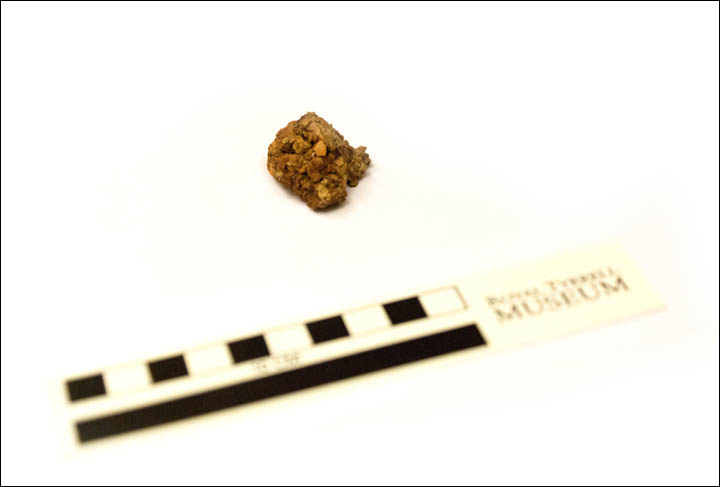
The 100 million year old egg from a predatory troodontid was discovered around a decade ago in a Jurassic necropolis in Kemerovo region,  but is seen here for the first time after the find was kept secret.

It has been revealed now in the publication of a major scientific article.

Stepan Ivantsov, researcher from the Laboratory of Mesozoic and Cenozoic Continental Ecosystems, Tomsk State University, said: ‘The egg of a troodontid was found by our colleague Yevgeny Mashchenko from the Institute of Paleontology in Moscow.

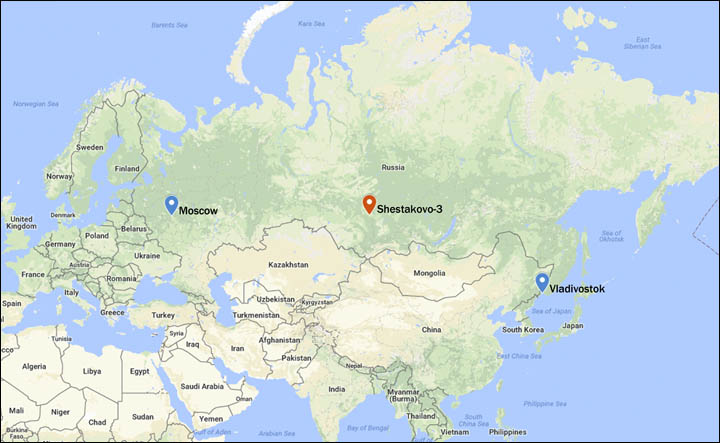
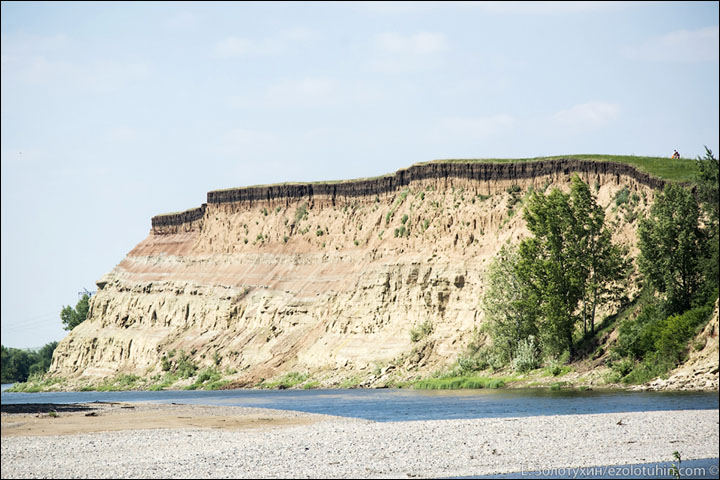
‘We were working on Shestakovo-3 site in Kemerovo region. The egg was in a layer of thick reddish coloured clays.

Dinosaur egg


Adult Troodontidae – a family of bird-like theropod dinosaurs – were quite modest in size, up to one metre in height. Pictures: Press-service of Saint Petersburg State University, Wikipedia

‘It was incredibly hard to notice it because only a contour of its shells was visible. This find is an enormous stroke of luck because this is the first and – so far – only one in Russia.’

It was found at the Shestakovo-3 site in Kemerovo region, southern Siberia.

The egg’s transversal diameter is only two centimetres.

Adult Troodontidae – a family of bird-like theropod dinosaurs – were quite modest in size, up to one metre in height.

The embryo of the egg did not preserve because the nest with the eggs, laid in the floodplain of an ancient river, was destroyed during a flood.


Stepan Ivantsov, researcher from the Laboratory of Mesozoic and Cenozoic Continental Ecosystems, Tomsk State University. Picture: TSU

‘Study of the shell’s thin sections under electric microscope show how similar it is to eggs of modern birds,’ said a statement from Tomsk State University.

‘Scientists believe that it confirms a theory of all birds currently living on Earth descending from predatory dinosaurs that lost their teeth and changed appearance as they evolved.’

The Shestakovo-3 site has seen the discovery of a number of Jurassic relics, for example, psittacosaurs, primitive horned dinosaurs.

The site has seen the discovery of small predators to 30-metre sauropods in the past 60 or so years.

The joint research had been performed by the scientists from Saint Petersburg State University, Tomsk State University, Zoological Museum and the Paleontological Institute of the Russian Academy of Sciences.

The Shestakovo-3 site has seen the discovery of a number of Jurassic relics, for example,  psittacosaurs,  primitive horned dinosaurs.  Pictures: Evgeny Zolotukhin, Kemerovo Museum of Local History

Map


Shestakovo


Shestakovo

Source: wwwsiberiantimes.com

Long-Necked Spanish Dinosaurs Emigrated to the U.S. to Avoid Extinction

Sunday, November 19, 2017

Long-Necked Spanish Dinosaurs Emigrated to the U.S. to Avoid Extinction

America has cultivated a reputation as being a place that offers new beginnings, especially when times get tough elsewhere—but now paleontologists think that tradition may actually date back 140 million years, to the days when dinosaurs roamed the Earth. That’s because they realized two dinosaurs dug out of the rocks of Utah bear a strange resemblance to a family that had only been spotted in Europe and Africa previously.

That makes them think the immigrants made use of a temporary land bridge to colonize new territory, in the process evading (or at least delaying) the extinction that wiped out their Old World relatives. The team of paleontologists announced their find in a paper recently published in the journal Scientific Reports. In the paper, they describe the movements of a group of dinosaurs called turiasaurs, which were vegetarians and had long, giraffe-like necks.

In particular, the paleontologists identify a new species of turiasaur, based on specimens found a bit northeast of Arches National Park. Their picture of the new species, now named Mierasaurus bobyoungi, is based in particular on three legs of a still growing dinosaur that had fallen into a pit of mud.

Cranial material of Mierasaurus

“This poor animal had been stuck in the mud,” James Kirkland, a paleontologist with the Utah Geological Survey and co-author on the new paper, told Utah Public Radio. “You hate to imagine how long it took to actually die, unless it was lucky and some meat-eating dinosaur came and put it out of its misery.”

But what was a very bad day for the young dinosaur about 135 million years ago became a very good day for the paleontologists in 2010, when they first spotted its remains sticking out from the rock. Puzzled by the find, Kirkland brought in experts on European dinosaurs, who tied the Utah specimen to animals that had died out in Spain about 145 million years ago.

The paleontologists think a few European individuals from the new species and other turiasaurs migrated over to America via a land bridge. That migration let turiasaurs carve out a new life for themselves in Utah, which has now become a dinosaur discovery hotspot.

That picture could still change as paleontologists continue to uncover new specimens. One possible alternative explanation is that there are other, older turiasaur remains in the U.S. still waiting to be discovered, which could rewrite the dinosaurs’ history. Chances are, there’s more immigration paperwork trapped in North America’s rock.

Source: newsweek.com

Places to See Real Dinosaur Tracks

Sunday, November 19, 2017

Places to See Real Dinosaur Tracks

At one point, this whole lousy planet was covered in dinosaurs of all sizes and descriptions. These days, if we want to see evidence of dinosaurs, we can go for a walk with a pair of binoculars aimed at the trees, or just spend some time scoping out a bird feeder.

And although it’s widely accepted that today’s birds are avian dinosaur descendants, part of the allure of the dinos of yore is their size and variety … and the fact that they’re not around anymore. That may be true, but there are nooks and crannies all over the globe where you can find evidence of the once-kings, straight out of Deep Time. Fossilized dinosaur tracks and footprints abound.

The Dinosaur Ridge in Jefferson County, Colorado, plays host to many fossilized prints. DANIELLE BEDER/GALLO IMAGES/GETTY IMAGES

Dinosaur Ridge, Morrison, Colorado

Around 150 million years ago, during the late Jurassic, what’s now central Colorado was a beach. These days you can see the tracks and skeletal remains of hundreds of ornithopod and theropod dinosaurs — including the long-necked Apatosaurus, armored Stegosaurus, and carnivorous Allosaurus — that used the beach as a freeway.

Dampier Peninsula, Australia

The largest dinosaur print we know about can be found at a site called Walmadany, off Australia’s western coast. Twenty-one species cavorted here during the Cretaceous period, including the owner of a 5.5-foot-long (1.7-meter-long) sauropod track that belonged to an animal so immense a giraffe’s face could probably only reach its withers.

Among the world’s longest dinosaur trackways are those left by a Titanosaurus at the Cal Orck’o site near Sucre, Bolivia. Over millions of years what was once level ground has become a near-vertical wall. TONY WALTHAM/ROBERT HARDING/GETTY IMAGES

Parque Cretácico, Cal Orck’o, Bolivia

Once, nearly 70 million years ago, a baby Tyrannosaurus rex and a herd of long-necked sauropods ranging from 26-65 feet (8-20 meters) long made their way across a vast, muddy flat. Now this mudflat is a 300-foot (90-meter) vertical wall inside a rock quarry, covered with more than 5,000 tracks representing eight species and more than 450 individual dinosaurs. It’s the largest collection of dinosaur tracks in the world; you can find it in Bolivia’s Parque Cretácico.

Denali National Park, Alaska

The theropod tracks found in Denali National Park aren’t particularly interesting in and of themselves, but thousands of herbivorous hadrosaur tracks in the park provided scientists with evidence that dinosaurs might have lived year-round in polar latitudes.

Staffin Beach, Island of Skye, Scotland

We don’t generally think of dinosaurs being great parents, but it’s possible Scotland’s own “Dinosaur Island”has evidence of just that. The small prints left by ornithopods around 170 million years ago seem to tell the story of a parent being followed by several juveniles down the shoreline of a lake.

Check out the following images for a few more places around the globe you can visit to see dinosaur footprints.

When construction on a dam spillway began, workers discovered dozens of dinosaur tracks in Utah’s Clayton Lake State Park. NATHAN MURPHY/ATOMIC LLC/FLICKR/CC BY-NC-ND 2.0
 
Footprints of a dinosaur are visible in the rocks of Sangjokam Park, South Korea, and in the nearby Goseong Dinosaur Museum. TOPIC IMAGES INC./GETTY IMAGES
 
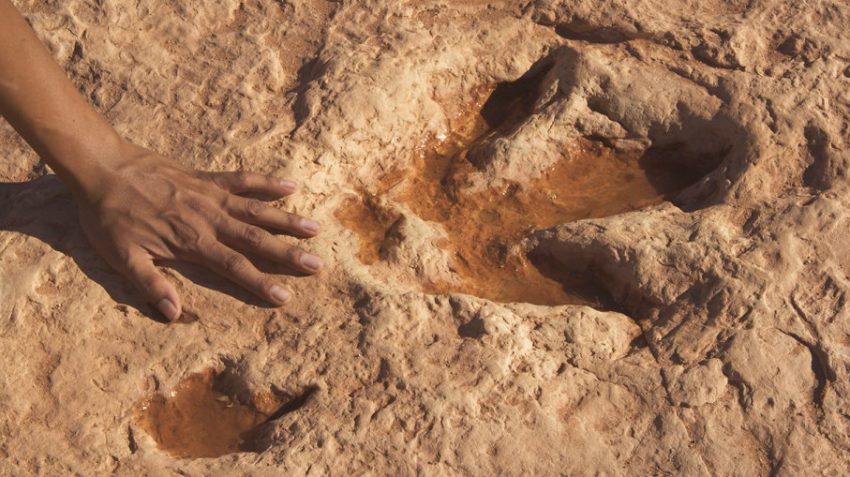
Dinosaur tracks continue to be discovered every year. These Allosaurus footprints were unearthed near Dinopark in Munchehagen, Germany, in 2015, and were found near Diplodocus footprints which paleontologists dated to the the upper Jurassic period, around 140 million years ago. ALEXANDER KOERNER/GETTY IMAGES
 
Source: science.howstuffworks.com

A Peek into What to Expect for Jurassic World: Fallen Kingdom

Friday, November 17, 2017

Jurassic World (2015) brought home a massive $1.6 billion paycheck, which is good considering it has all those carnivorous mouths to feed. Many of those same mouths will return for the inevitable sequel next year, officially titled Jurassic World: Fallen Kingdom. Here are just a few of the important details regarding casting and plot.

Obviously the key actors from the first movie, Chris Pratt and Bryce Dallas, will return as Owen and Claire. There’s also an early shot of a new character, a young girl revealed via Instagram photo. But the important thing is, Blue (the raptor) is expected to reprise her role as herself for the movie. Which brings us to the question of the plot.

What is Jurassic World: Fallen Kingdom going to be about? Colin Trevorrow, director of the first movie, promised that it won’t just be more of the same – dinosaurs chasing people around. “I don’t think that bigger, better dinosaurs or bigger, more epic-in-scope action sequences are what people are necessarily looking for.” Instead, Trevorrow hinted at a possible moral theme. The first Jurassic World showed us that man and dino are capable of getting along with some effort… a lot of effort. Perhaps we’ll get to see where that path leads us.

Trevorrow has another upcoming movie to direct (Star Wars), so he’s handed the prehistoric reigns over to AI Bayona for this one. And both have confirmed that this second installment will be much darker and more frightening than the last. Frightening from a human perspective, not from an oh-no-I’m-going-to-be-eaten one. They also spilled that the Jurassic World saga was planned as a trilogy, so there’ll also be a third movie after this one.

jurassic world

Now, let’s talk numbers. Budget numbers. There’s a two, a six, and about seven zeroes, in that order. In other words, $260 million. Holy indominus rex, a dino-sized budget for a dinosaur movie. Fans of ancient lizards can expect returns from that starting on June 22, 2018, in the U.S. when Fallen Kingdom hits theaters on our shores.

Male Woolly Mammoths More Often Fell into Natural Traps

Wednesday, November 15, 2017

Male Woolly Mammoths More Often Fell into Natural Traps

An international team of researchers led by the Swedish Museum of Natural History has discovered that fossilized remains of woolly mammoths (Mammuthus primigenius) more often came from males than females (69% versus 31%). The scientists speculate that this skewed ratio exists in the fossil record because inexperienced male mammoths more often traveled alone and got themselves killed by falling into natural traps that made their preservation more likely.

“Most bones, tusks, and teeth from mammoths and other Ice Age animals haven’t survived,” said senior author Dr. Love Dalen, from the Swedish Museum of Natural History.

“It is highly likely that the remains that are found in Siberia these days have been preserved because they have been buried, and thus protected from weathering.”

“Our findings imply that male mammoths more often died in a way that meant their remains were buried, perhaps by falling through lake ice in winter or getting stuck in bogs.”

For the study, Dr. Dalen and colleagues generated genomic data from 98 bone, tooth, and tusk samples collected at various locations throughout Siberia.

They then used these data to determine the sex of the mammoth specimens.

“We were very surprised because there was no reason to expect a sex bias in the fossil record,” said first author Dr. Patrícia Pečnerová, also from the Swedish Museum of Natural History.

“Since the ratio of females to males was likely balanced at birth, we had to consider explanations that involved better preservation of male remains.”

The findings suggest that woolly mammoths lived similarly to modern elephants, with herds of females and young elephants led by an experienced adult female.

In contrast, the authors suspect that male mammoths, like elephants, more often lived in bachelor groups or alone and engaged in more risk-taking behavior.

“Without the benefit of living in a herd led by an experienced female, male mammoths may have had a higher risk of dying in natural traps such as bogs, crevices, and lakes,” Dr. Dalen said.

The findings are published in the journal Current Biology.

_____

Patrícia Pečnerová et al. Genome-Based Sexing Provides Clues about Behavior and Social Structure in the Woolly Mammoth. Current Biology, published online November 2, 2017; doi: 10.1016/j.cub.2017.09.064

Source: www.sci-news.com

Prehistoric ‘Rat’ From Dinosaur Era Was Oldest Human Relative

Wednesday, November 15, 2017

Prehistoric ‘Rat’ From Dinosaur Era Was Oldest Human Relative

Fossil remains of two rat-like creatures understood to be the oldest known ancestors of humans have been discovered in Dorset.

The small furry animals scurried in the shadow of the dinosaurs 145 million years ago.

Scientists believe they can draw a direct evolutionary line from the ancient mammals to people living today.

Two teeth belonging to two different species were sifted out of samples of Cretaceous period rock collected from exposed cliffs near Swanage.

Dr Steve Sweetman, from the University of Portsmouth, said his “jaw dropped” when one of the university’s undergraduate students asked him to look at the specimens.

He said: “The teeth are of a type so highly evolved that I realised straight away I was looking at remains of Early Cretaceous mammals that more closely resembled those that lived during the latest Cretaceous, some 60 million years later in geological history.

“In the world of palaeontology there has been a lot of debate around a specimen found in China, which is approximately 160 million years old. This was originally said to be of the same type as ours but recent studies have ruled this out. That being the case, our 145 million-year-old teeth are undoubtedly the earliest yet known from the line of mammals that lead to our own species.”

The area where student Grant Smith found the teeth is known as the Jurassic Coast because it has produced so many dinosaur fossils.

Both the ancient mammals were probably nocturnal, Dr Sweetman and co-authors reported in the journal Acta Palaeontologica Polonica.

One was likely to have been a burrower that ate insects and the other larger creature may have consumed plants as well, the researchers believe.

Dr Sweetman added: “The teeth are of a highly advanced type that can pierce, cut and crush food. They are also very worn which suggests the animals to which they belonged lived to a good age for their species – no mean feat when you’re sharing your habitat with predatory dinosaurs.”

The animals are believed to be direct ancestors of most mammals living today including creatures as diverse as the blue whale and pigmy shrew, as well as humans.

One of the species has been named Durlstotherium newmani, after Charlie Newman, landlord of the Square and Compass pub in the village of Worth Matravers close to where the fossils were discovered. The other has been named Durlstodon Ensomi.

Pages