Blogs

‘Evolutionary Dead End’: Extinct ‘Stilt’ Horse Named for Canadian
Saturday, December 2, 2017

Haringtonhippus francisci

A newly-discovered branch of the horse family has been named after the Canadian who first studied its remains in the Yukon, where it lived until the end of the last ice age.

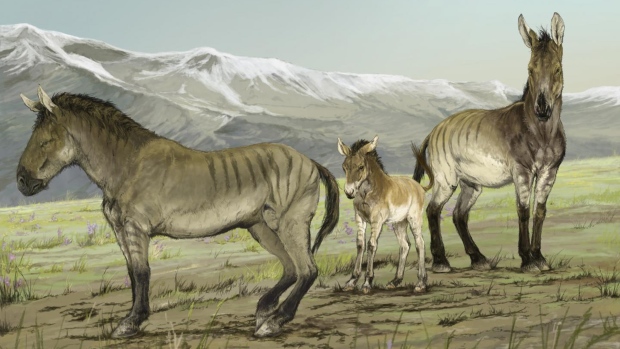
Close study of the North American stilt-legged horse has revealed that the ice age-era mammal was an “evolutionary dead end” in the horse family, which developed through the Equus genus to spawn modern-day horses, asses and zebras. The taller, thinner stilt-legged horse lived up until approximately 17,000 years ago and died out entirely after the last ice age, according to the new study published in the journal eLife.

The study authors have officially classified the stilt-legged horse as a separate genus from the Equus, based on differences observed at the DNA level. The stilt-legged horse was first described in the 1970s by Canadian paleontologist Richard Harington, but was thought at the time to be related to the Asiatic wild ass or onager.

The new genus has been dubbed Haringtonhippus francisci, after Harington. Harington did not work on the new study, but the study’s authors say they named the new genus after him as a tribute to his groundbreaking work on the ancient animal.

“I am delighted to have this new genus named after me,” Harington, emeritus curator of quaternary paleontology at the Canadian Museum of Nature, said in a news release from the study authors.

Co-author Grant Zazula said the discovery would not have been possible without Harington’s “life-long dedication” to studying the stilt-legged horse in Canada’s North.

“There is no other scientist who has had greater impact in the field of ice age paleontology in Canada than Dick,” Zazula, a paleontologist with the Yukon government, said in the news release.

A connection that goes way, way back

The discovery is expected to shake up long-held theories that horse evolution was fairly straightforward, by demonstrating that a divergent branch of the family tree emerged some 4-6 million years ago before dying out.

“The horse family, thanks to its rich and deep fossil record, has been a model system for understanding and teaching evolution,” first study author Peter Heintzman, of UC Santa Cruz, said in the news release. “Now, ancient DNA has rewritten the evolutionary history of this iconic group.”

The study authors say the Equus and Haringtonhippus genuses thrived alongside one another in North America, although they did not interbreed. They co-existed with such large ice-age mammals as the woolly mammoth and the sabre-toothed cat, which also died out when the glaciers receded. The North American Equus and Haringtonhippus died out around the same time, but the Equus survived though a number of ancient horses that remained in Eurasia.

The stilt-legged horse discovery was made based on DNA taken from fossils in the Yukon’s Klondike gold fields, as well as from Natural Trap Cave in Wyoming and Gypsum Cave in Nevada.

Source: en.brinkwire.com

Fluffy Four-Winged Creature Resembling a Muppet Is Actually a Dinosaur

Saturday, December 2, 2017


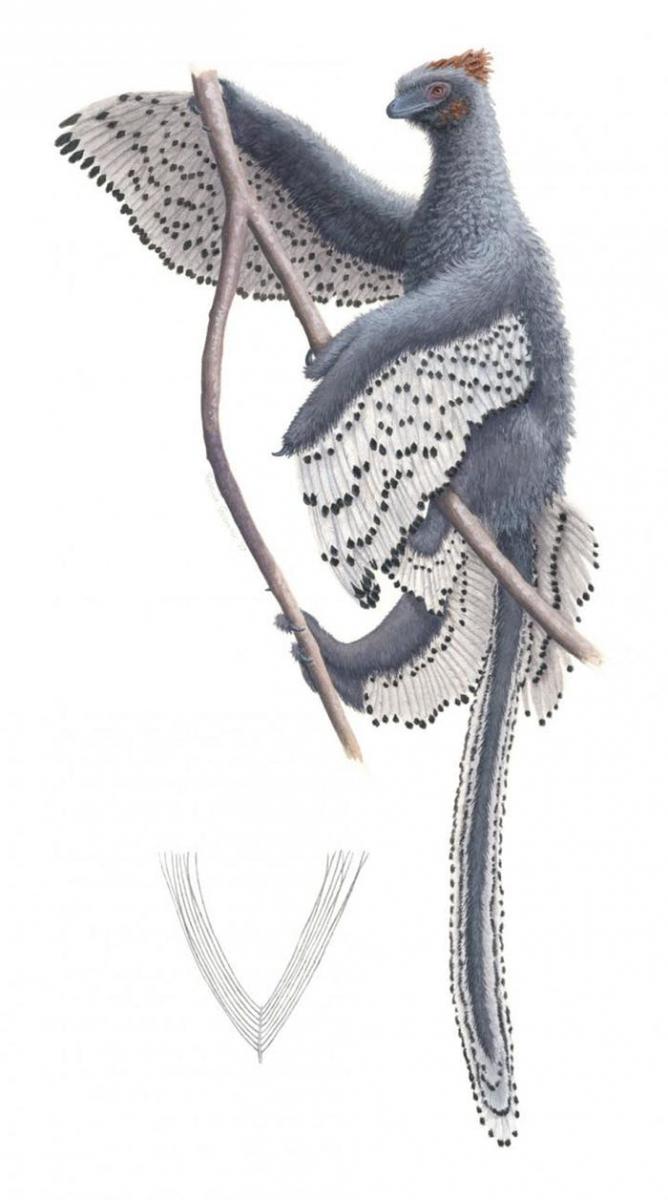
The researchers got lucky with their Anchiornis specimen, which died under conditions that left its feathers separated from the body before they were fossilized. Using high-resolution imaging equipment to examine it, they were able to determine what function the strange feathers served.

They certainly weren’t good for flying. The researchers write that the fluffy feathers probably didn’t afford Anchiornis much protection from water or cold temperatures and furthermore, may have increased aerodynamic drag as it glided through the air. Additionally, since the barbs on the feathers didn’t zip together, they couldn’t have been used for flying anyway.

To compensate, Anchiornis had four wings as well as multiple rows of feathers that could have helped provide some aerodynamic lift.


The new paper, which presents a new illustration of how Anchiornis may have behaved in its habitat, builds on previous research that identified the color of this dinosaur, as well as the fact that its wings had multiple layers of feathers. The illustration, drawn by scientific illustrator Rebecca Gelernter depicts Anchiornisclimbing a branch — not perching like a bird, as past illustrations have. This illustration represents not just a culmination of multiple studies on the dinosaur, but also a little bit of imagination.

Anchiornis and its previously undescribed contour feather.

“Paleoart is a weird blend of strict anatomical drawing, wildlife art, and speculative biology. The goal is to depict extinct animals and plants as accurately as possible given the available data and knowledge of the subject’s closest living relatives,” said Gelernter in a statement.

“As a result of this study and other recent work, this is now possible to an unprecedented degree for Anchiornis. It’s easy to see it as a living animal with complex behaviours, not just a flattened fossil.”

Source: www.inverse.com

Ankara’s New Mayor Removes Gökçek’s Controversial Dinosaur Statue

Saturday, December 2, 2017

Ankara’s New Mayor Removes Gökçek’s Controversial Dinosaur Statue

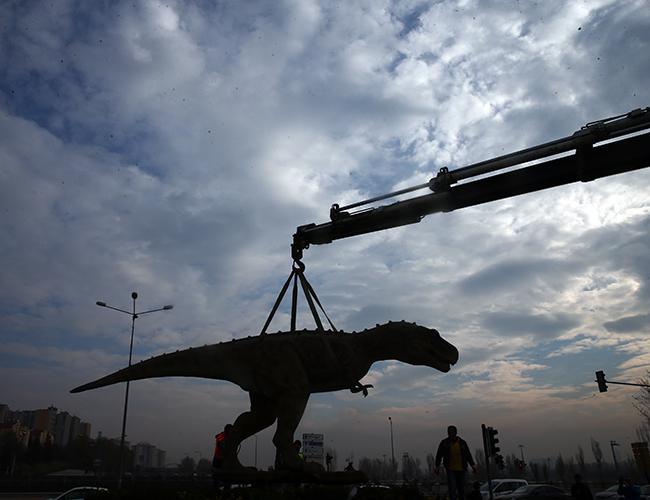
A controversial three-meter high, 10-meter long dinosaur statue, which had greeted Ankara residents at a main road intersection from 2015, was quietly removed on the morning of Nov. 27 upon the instructions of new Ankara Mayor Mustafa Tuna.

Since coming to office in November, Tuna has moved to erase some of the more eccentric traces of previous Ankara Mayor Melih Gökçek.

Officials from the Ankara Greater Municipality completed the removal of the statue early on Nov. 27 and transferred it to storage. Last week, a large and equally contentious fountain in front of the Ankara Greater Municipality building was also removed.

Gökçek, who first became mayor in 1994, was forced to resign in late October by President Recep Tayyip Erdoğan, the head of the ruling Justice and Development Party (AKP). Tuna, who had been the mayor of the capital’s Sincan district, was elected by the municipality chamber in early November.

The dinosaur statue was installed at the road intersection to replace a controversial Transformers-esque robot in early 2015, as part of promotion for a new theme park, AnkaPark, which Gökçek had described as a “prestige project.”

Gökçek installed several dinosaur statues at the planned amusement park, reportedly costing a total of 9 million Turkish Liras ($2,250,000).

The construction of the park was partly halted after a court ruling declared it illegal following an objection by the Ankara Chamber of Architects.

Tuna has suggested that a referendum could be held in the Turkish capital to decide on the fate of the AnkaPark.

Source: www.hurriyetdailynews.com

Scientist Finds Microfossils In India That Are 2 Billion Years Old

Saturday, December 2, 2017

Scientist Finds Microfossils In India That Are 2 Billion Years Old

A geologist in India found “prokaryotic” microfossils that are considered to be 2 billion years old. Microfossils are a group of small fossil remains that can only be studied microscopically. It can either be a part of a larger organism or a whole minute organism. Microfossils are said to be the most important group of fossils.

Naresh Ghose, a Bengaluru-based geologist, first discovered the microfossils in a carbonaceous shale in central India. Ghose, who is also a former geology professor at Patna University, reported his findings at the Indian Geological Congress in Nagpur, an annual convention for Indian scientific discoveries.

“The present study reports for the first time the presence of “organogenic” microfossils—derived from living organisms—in black shale immediately underlying the volcanic rock of the Gwalior basin,” Ghose said at the convention, according to Doonwire. “Therefore, the microfossils (Prokaryotic-RNA cell) in the Gwalior basin may be regarded as the confirmed oldest existence of life dated about 2,000 million years ago ever to be recorded from the Indian subcontinent.”

Prokaryotic microfossils consist of the remains of bacteria, fungi, plants, planktons and animals. They are considered to be the earliest indicator of life’s existence on the planet. The small fossil, which is smaller than one millimeter in length, are comprised of carbonates and a combination of iron-bearing material.

“This important discovery was made using a simple and inexpensive device like a microscope without the aid of any sophisticated instrument,” Ghose said, according to the New Indian Express. “The USA is utilizing black shale as an alternative source for hydrocarbons and is a leading exporter due to its technological advancement.”

Microfossils have also proven to be very crucial in the fields of geology, biology and paleontology.

“Billions of dollars have been made on the basis of microfossil studies,” an article published to the University of California Museum of Paleontology’s website claimed. “Because they usually occur in huge numbers in all kinds of sedimentary rocks, they are the most abundant and most easily accessible fossils.”

In May, the world’s oldest microfossil was previously found in Quebec, Canada, by a group of researchers from the University College London. The research team initially considered the microfossils to be about 4.3 billion years old. The microfossil would have emerged more than 200 millions years ahead of when the earth first formed.

An Indian geologist discovered a microfossil that is said to be 2 billion years old. A paleontologist is pictured uncovering a fossil in central Bulgaria on June 07, 2017. Photo: Getty Images


Source: www.ibtimes.com

Kansas to Open $6.5 Million Dinosaur Theme Park

Saturday, December 2, 2017

Kansas to Open $6.5 Million Dinosaur Theme Park

A $6.5 million dinosaur theme park is expected to open next year in southern Kansas.

The 14-acre theme park is scheduled to open in the Wichita suburb of Derby with more than 30 life-size animatronic dinosaurs, The Wichita Eagle reported . Featured dinosaurs will include a Tyrannosaurus rex, Triceratops and Stegosaurus.

The park will be set up like a scientific expedition, said the park’s executive director Guy Gsell. Visitors will be able to dig for fossils, walk past the life size dinosaur models and participate in events, he said.

Kansas was a fitting location for the park because the state has a long history with modern paleontology, Gsell said.

“Kansas is like the birthplace of modern paleontology,” Gsell said. “You had your Bone Wars here, your most famous discoverers were here. Paleontology as a science should resonate with Kansas.”

Private financing and money from Sales Tax Revenue bonds are funding the project. The bonds are meant to incentivize businesses to create destinations to attract out-of-state visitors.

“Wichita has so many science attractions — Exploration Place, the Sedgwick County Zoo, the Kansas Aviation Museum, Tanganyika Wildlife Park,” Gsell said. “We think this is a great place for family science tourism, which is exactly what I do. We think this creates synergy for a number of top notch science attractions.”

The park is expected to open on Memorial Day. Gsell said ticket prices will likely be about $15 per person, though there will be specials, group rates and season tickets.

Derby officials plan to use additional bond money to develop a hospital, hotel, restaurants and retail shops.

___

Source: www.sfchronicle.com

‘Jurassic World 2’ Reveals First Footage Showing Chris Pratt, Baby Dinosaur

Saturday, December 2, 2017

In honor of the Thanksgiving holiday, one of the minds behind the upcoming sequel to “Jurassic World” has gifted fans with the very first footage of the new film.

The brief five-second clip of “Jurassic World: Fallen Kingdom” was shared on Wednesday by producer and co-writer Colin Trevorrow, who diehard fans may know as the director of the 2015 return to the land of genetically manufactured dinosaurs. The clip shows Chris Pratt’s character, Owen, returning to greet what looks like a new baby raptor, similar to the blue one he befriended in the first movie.

“From our Jurassic family to yours,” Trevorrow wrote on Twitter before tagging stars Pratt, Bryce Dallas Howard, producer Frank Marshall and “Fallen Kingdom” director J.A. Boyana.

Details about the sequel are scarce and fans are still waiting for both official plot details and a complete trailer. However, Entertainment Weekly notes that details such as the cast, which includes original franchise star Jeff Goldblum, have been revealed. In addition to Pratt, Howard and Goldblum, Ted Levine, Rafe Spall, Toby Jones, Geraldine Chaplin, Daniella Pineda and Justice Smith will help round out the sequel’s leads.

Previously, the outlet reports that Trevorrow told the crowd at the Sitges Film Festival in Spain that the dinosaurs will be used as a metaphor for the treatment of animals in lab and zoo settings.


Source: foxnews.com

This Chinese City is Where Most of the World’s Dinosaur Replicas are Made

Saturday, December 2, 2017

Dinosaur Replicas

A multitude of different manufacturing towns have sprouted up over the years in China, each with its own speciality, helpfully providing the world with most of its socks, fake shoes, Christmas decorations, denim, buttons, and bras. Apparently, there’s even one for animatronic dinosaurs.

dino_town3.jpg

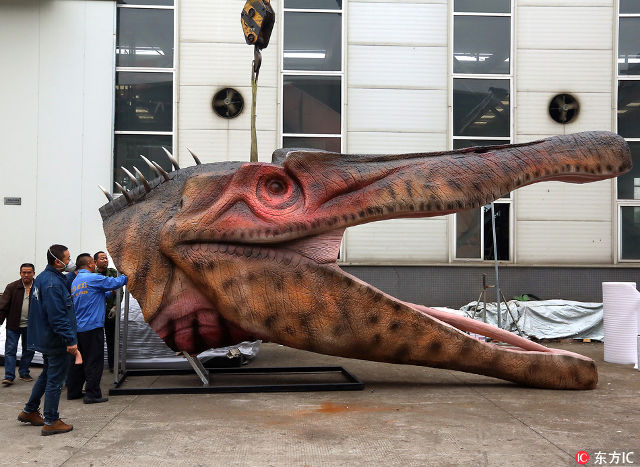
Outside of the Sichuan city of Zigong there is a massive development zone which has become known as China’s “Dinosaur City.” Here, there are more than 30 different companies busy producing full-scale dinosaur models that can move, growl, and frighten small children. The robo-dinos are exported to countries all around the globe. According to China Plus, Zigong provides about 90% of the world’s fake dinosaurs.

dino_town4.jpg

Apparently, this unusual specialization arose from the city’s very real connection to the prehistoric reptiles. Back in the 1970s and 80s, Chinese paleontologist Dong Zhiming and his team excavated a tremendous wealth of unique and intact dinosaur fossils from the Dashanpu Formation about 7 km outside of town.

dino_town5.jpg

In 1987, the city itself decided to celebrate its former famous residents by establishing the first dinosaur museum in Asia, built on top of the excavation site. The Zigong Dinosaur Museum is one of the largest in the world, and also features numerous animatronic dinos, made by local companies.

[Images via IC, h/t Adam Minter]

[Images via IC, h/t Adam Minter]

Source: www.shanghaiist.com

Reptiles Who Ruled the Earth Before Dinosaurs Expected to Bring More Tourists to Russia

Friday, December 1, 2017

Reptiles Who Ruled the Earth Before Dinosaurs Expected to Bring More Tourists to Russia

The first two skeletons of the ancient reptiles were unearthed near Kotelnich in 1933

The Kirov Region, central Russia, is planning to create a new tourist route to tell its visitors about the history of Pareiasaurs, fossil reptiles who roamed the Earth some 260 million years ago, long before dinosaurs emerged.

Archaeologists have been founding Pareiasaur fossils near the town of Kotelnich, on the clay bank of the Vyatka River, for several decades.

“They flourished in the Permian period in just two regions, Kotelnich and Karoo plateau in South Africa,” said Natalia Spitsyna, the head of the local museum of paleontology.

According to Spitsyna, most paleontologists travel to the Kirov Region as the fossils here are better preserved than in South Africa.

Tourists will be offered to visit excavation sites as part of a two-day trip to Kirov and Kotelnich.

“On the first day they will visit Kotelnich, the sites where fossils were found, its museum with a unique collection of fossils and the local Dino Park,” said Irina Bazhina of the regional tourism development center. “On the second day they will travel to Kirov and visit the modern paleontological museum and a park featuring life-size sculptures of dinosaurs.”

The Kotelnich museum has no replicas. Therocephalians, cynodonts, gorgonopsians, anomodonts, dicynodonts, a Mastodonsaurus, Tarbosaurus and Ankylosaurus – all of these fossils were discovered near Kotelnich.

The Kotelnich museum also boasts a unique item, a skeleton of a baby Pareiasaur.

The first two skeletons of the ancient reptiles were unearthed near Kotelnich in 1933 by a local hydrogeologist who was drilling for water wells.

An expedition led by prominent paleontologist Alexandra Gartman-Veinberg arrived in the Kirov Region next year.

“The South African plateau was considered the only place on Earth where Pareiasaur fossils had been found but Gartman-Veinberg found two skulls and took them to Moscow. She thought that the reptiles migrated to the Kirov Region from South Africa,” Spitsyna said.

Eleven full Pareiasaur skeletons were unearthed in the region by Moscow paleontologists in the next 14 years but none of them was preserved.

Pareiasaurs were large and awkward herbivores who measured to 2.5 meters in length, who most likely lived in damp lowlands. Sometimes they got trapped in mud and slowly died.

According to Spitsyna, the fossils are so well-preserved due to these mud traps.

Most fossils were found at the so-called Sokolya Gora, a site on the steep bank of the Vyatka River. All excavation work is carried out here from May to October when the water level declines.

Archeologists are also planning to come to Sokolya Gora, which was inhabited from the 5th century BC.

An environment-friendly tourist center is currently under construction near Sokolya Gora.

“The visitors will be able to see the scientists at work and even take part in the process,” said Irina Bazhina.

Source: www.tass.com

Russian Scientists Hope to ‘Bring Back’ 50,000-Year-Old Cave Lion in Jurassic Park-style Experiment

Friday, December 1, 2017

Scientists are excited to further study the pre-historic creature.

Cub from extinct specie was found ‘perfectly preserved’ in freezing conditions in Siberia.

The discovery of an extinct cave lion cub from the Ice Age has raised hopes that it could be cloned and its species brought back to life some 50,000 years after it disappeared.

The tiny animal was found “perfectly preserved” with its paw resting on its head on the bank of Tirekhtykh River in the Abyisky district of Yakutia in Siberia in Russia.

Investigators says the small creature was about eight weeks old but cannot say how it died in the area that is permanently frozen – in conditions that helped keep its remains from decaying.

Cave lions were native to regions in the northern hemisphere before they became extinct, and the only knowledge of the animals that hunted in packs is from cave paintings left by early man.

Dr Albert Protopopov, of the Academy of Sciences of the Republic of Sakha, in Yakutia, unveiled the discovery.

“It is a perfectly preserved lion cub, all the limbs have survived. There are no traces of external injuries on the skin,” he told The Siberian Times.

“The preservation is so good that it raises hopes of cloning the species back to life,” he added.

The extraordinary find - which raises hopes of cloning the long-gone species back to life - was unveiled today in Yakutsk, capital of Russia's largest and coldest region, the Sakha Republic

Tests so far have found that the cub is 45 centimetres long and weighed almost 9lbs. It is not known whether it is male of female because newborn lions do not have noticeable sex characteristics.

Studies of its teeth are underway to find out its exact age – but could take up to three years.

Siberian resident Boris Berezhnov discovered the remains of the “unrecognisable animal” when the level of the Tirekhtykh River dropped to reveal the carcass lying on the bank of the water.

It comes after a similar discovery of two newborn cave lion cubs – named Uyan and Dina – found in the same region in 2015. Research found they were up to 55,000 years old.

“Everyone was amazed then and did not believe that such a thing is possible, and now, two years later, another cave lion has been found in the Abyiski district,” Dr Protopopov said.

“The preservation degree is even better,” he added.

One of the two cubs was found with its mother’s milk in its remains and scientists are hoping that by analysing it they can determine the diet of the adult creatures.

They hope that could shed light on how cave lions became extinct if they discover, for example, that a particular animal it preyed upon itself disappeared from the planet around the same time.

Source: www.independent.co.uk

A Sub-Desert Savanna Spread Across Madrid 14 Million Years Ago

Thursday, November 30, 2017

A Sub-Desert Savanna Spread Across Madrid 14 Million Years Ago

The current landscape of Madrid city and its vicinity was really different 14 million years ago. A semi-desert savanna has been inferred for the center of the Iberian Peninsula in the middle Miocene. This ecosystem was characterized by a very arid tropical climatic regime with up to ten months of drought per year, according to a recent paper. Scientists reached such conclusions after comparing mammal fauna with Africa and Asia ones.

The Central Iberian Peninsula was characterised by a very arid savanna during the middle Miocene, according to a study led by the Complutense University of Madrid (UCM) that compares the mammal assemblages from different localities in Africa and South Asia with those that inhabited the Iberian central area 14 million years ago.

The results of this study, recently published in PLOS ONE, are the product of more than fifteen years of fieldwork and previous paleontological studies of the fossil vertebrate remains found at the Somosaguas paleontological site (Madrid), which allowed paleontologists to infer the type of environment that existed in the middle Miocene in the central part of the Iberian Peninsula. This fossil site is located at the Somosaguas Campus of the UCM, a particular feature as only two paleontological sites have been discovered up to now at university campuses worldwide (the other one being located in the USA).

The body size of every species is largely influenced by the environmental conditions of the habitat where each species lives. For example, elephants that inhabit humid places (such as those in Asian jungles) are smaller than elephants that live in dry places (such as those that inhabit in African savannahs).

“Based on this premise, the distribution of sizes within a mammal community can offer us valuable information about its climatic context,” explains Iris Menéndez, a researcher at the Department of Paleontology of the UCM and the Institute of Geosciences (UCM and CSIC).

In this study paleontologists have been able to infer that the centre of the Iberian Peninsula witnessed a very arid tropical climate with a high precipitation seasonality. After a brief wet period, the annual dry season could last up to 10 months. “These results confirm the previous inferences on the Savannahs environment of Somosaguas in the Miocene, but placing this habitat at their driest estimated, within the limits between the savanna and the desert,” says Menéndez.

This study compiled the information of climatic parameters for more than 60 current localities from Africa and Asia, including information of the body size of the mammalian species that inhabit these localities.

“For this purpose, we made a compilation of information on mammalian fauna lists, their body sizes, and climatic parameters for these localities, such as temperatures and precipitation. Based on this data, we developed statistical models suitable for the inference of different climatic parameters in the past,” says the UCM researcher.

“We included the information on the 26 mammal species found in the Somosaguas site, which allowed us to infer the environment by comparison with the extant assemblages,” she adds.

Somosaguas is a particularly interesting fossil site in the context of paleoecological and paleoclimatic studies because it was located at a turning point during the Miocene. At this time, there was a marked change from warm and relatively humid global conditions to colder and arid environments. This inflection point eventually led to the beginning of the Pleistocene glaciations.

Moreover, the Somosaguas fossil site, due to its location within a university campus, gives to the general public the opportunity to visit it and learn all the details of the investigations that have been carried out from the data collected in the successive excavation campaigns.


Story Source: Materials provided by Universidad Complutense de MadridNote: Content may be edited for style and length.


Journal Reference:

  1. Iris Menéndez, Ana R. Gómez Cano, Blanca A. García Yelo, Laura Domingo, M. Soledad Domingo, Juan L. Cantalapiedra, Fernando Blanco, Manuel Hernández Fernández. Body-size structure of Central Iberian mammal fauna reveals semidesertic conditions during the middle Miocene Global Cooling EventPLOS ONE, 2017; 12 (10): e0186762 DOI: 10.1371/journal.pone.0186762

    Source: www.sciencedaily.com

Pages