Blogs

Ancient Penguins Were Giant Waddling Predators

Sunday, December 17, 2017

An artist’s rendering compares Kumimanu biceae, an extinct giant penguin, to a human diver. Kumimanu stood 5 feet 7 inches and weighed 220 pounds. It is among the earliest known penguin species. Credit G. Mayr/Senckenberg Research Institute

The 57 million-year-old fossil is both fearsome and comical: a long-beaked penguin that stood 5 feet 7 inches tall and weighed about 220 pounds.

“It was as tall as a medium-sized man,” said Gerald Mayr, a paleontologist at the Senckenberg Research Institute in Frankfurt, Germany, and lead author of a report in Nature Communications on Tuesday announcing the discovery.

By comparison, the tallest living species, the emperor penguin, reaches about four feet in height. Kumimanu biceae, as the fossil was named, would have towered above the emperor, and above just about all other known ancient penguins.

(In 2014, another team of researchers estimated that a 34-million-year-old species stood six feet tall, but they based that estimate only on two bone fragments.)

Kumimanu wasn’t just exceptionally big; it also ranks among the oldest penguin fossils yet found. Both its age and its size make Kumimanu important to understanding the astonishing transformation that turned a lineage of flying birds into flightless swimmers.

The 18 modern species of penguin, ranging from the coast of Antarctica to the Galápagos Islands at the Equator, are impressively adapted to aquatic life. Rigid, blade-shaped wings enable them to shoot through the water at up to 22 miles an hour. Record-setting human swimmers don’t even reach six m.p.h.

But their adaptations to water have also left them unable to fly. When penguins haul out to rest or rear their young, they can only waddle about on stumpy legs. “They’re so unbirdlike that many people would not know they are birds,” Dr. Mayr said.

While penguins may look profoundly different from other birds, their DNA points to a close kinship to such species as albatrosses and petrels. These birds all fly over water to hunt for prey, hinting that the ancestors of penguins may have, too.

Auks, which can dive over a hundred feet underwater, may be a living model of the first penguins.

Birds accumulate mutations in their DNA at a roughly clocklike rate, allowing scientists to estimate when their lineages branched apart. Studies suggest that penguins diverged around the time of the mass extinction that struck the planet about 66 million years ago.

A combination of massive volcanic eruptions and an asteroid impact are believed to have been responsible for the global catastrophe. Among the victims were giant marine reptiles and dinosaurs (with the exception of birds, which are feathered dinosaurs). The mass extinctions marked the end of the Mesozoic Era and the beginning of the Cenozoic, which continues today.

The first penguin fossils were uncovered in 1859, and since then more than 50 species have been identified. The oldest of these, found in New Zealand, date back about 60 million years. Known as Waimanu, the oldest known penguins lived just a few million years after the mass extinctions.

The new fossil penguin, Kumimanu, was discovered from bones packed in a rock on a New Zealand beach. Realizing that it was almost as old as Waimanu, Dr. Mayr and his colleagues eagerly studied Kumimanu for a better picture of early penguin evolution.

To see how it was related to other species, the scientists drew an evolutionary tree and found that Kumimanu and Waimanu belonged to its farthest branches. Their lineages have been extinct for tens of millions of years.

By contrast, all living penguins belong to a young branch of the tree. They share a common ancestor that lived only about 15 million years ago.

Kumimanu and Waimanu were already flightless, but they still held onto some primitive traits not found in living penguins.

“Their beak looked much more like a stork’s,” Dr. Mayr said. “Probably they speared their prey.”

The early penguin wing was not yet the short, stiff blade found on living penguins. “They were probably able to bend it a little farther than penguins can today,” Dr. Mayr said. “There was more possibility for flexing.”

Where Waimanu and Kumimanu differ from each other is in their height. Waimanu stood just two and a half feet high. Kumimanu was more than twice as tall.

“We already knew penguins were around, and flightless, just a few million years after the extinction,” said Daniel T. Ksepka, a paleontologist at the Bruce Museum in Greenwich, Conn., who was not involved in the new study. “The new fossil shows they achieved immense sizes very rapidly as well, which is cool.”

Dr. Mayr speculates that the dramatic origin of penguins was sparked by the mass extinctions that marked the dawn of the Cenozoic. Suddenly the oceans were emptied of many of their biggest predators. Penguins could adapt to catching prey underwater without much competition, or fear.

“It’s an educated guess that makes sense, but there’s no rock-solid evidence,” said Dr. Mayr.

One way to test that hypothesis would be to uncover earlier fossils. “What would be cool would be to have a flying ancestor of penguins,” Dr. Mayr said.

The early Cenozoic oceans didn’t just open up the way for the evolution of flightless aquatic birds, Dr. Mayr speculated. It may have also fostered the evolution to big sizes.

Natural selection favors lightweight flying birds because they have to work so hard to stay aloft. Penguins don’t pay that cost. Getting bigger might have brought advantages, as well. A large body makes prey harder to kill.

The tree drawn by Dr. Mayr and his colleagues also shows that penguins became giants many times over. While Kumimanu belonged to an early lineage of big penguins, other lineages produced their own giants as recently as 27 million years ago.

The rise of marine mammals may have doomed giant penguins. As mammals moved into the oceans and evolved into whales and seals, they may have outcompeted the birds.

Both seals and penguins need to find safe beaches where they can mate and raise their young, for example. It’s possible that the seals pushed the giant penguins out, while smaller penguins survived.

“The big question for me is not why there were so many penguins in the early Cenozoic, but why there are no giant penguins today?” Dr. Mayr said.

Source: www.nytimes.com

Top 10 Ceratopsians

Wednesday, December 13, 2017

Ceratopsia by atrox1 on DeviantArt


Ceratopsia or Ceratopia is a group of herbivorous, beaked dinosaurs that thrived in what are now North America, Europe, and Asia, during the Cretaceous Period, although ancestral forms lived earlier, in the Jurassic.


10 – Einiosaurus

Daspletosaurus Attacking The Herd of Einiosaurus by WillDynamo55

Einiosaurus has rapidly become one of the more popular ceratopsian dinosaurs thanks mostly to the unusual nasal horn that curves around like a can opener. How the horn grew though is also interesting. In hatch lings the horn would have been a small upwards facing point, and then as juveniles grew the horn would not only increase in length, but would also begin to curve forwards. In the most mature individuals, the horn would curl almost right round upon itself into the distinctive can opener shape.

9 – Centrosaurus

At the Coast of Inland Sea — Centrosaurus apertus by cheungchungtat

Centrosaurus is the type genus of the Centrosaurinae, a group of large quadrupedal ceratopsians that are noted for their extensive spiky growths, but reduced neck frills. Centrosaurine ceratopsians like Centrosaurus are noted for being more common earlier in the late Cretaceous around the early Campanian. Fossil beds of many hundreds of individuals of the same genus, including Centrosaurus also indicates that centrosaurines gathered in vast herds.

8 – Chasmosaurus

Chasmosaurus by PaleoGuy

The main group of ceratopsian dinosaurs that are separate from the centrosaurines are the chasmosaurines, of which Chasmosaurus is the type genus. Chasmosaurus and relative genera are noted for having less elaborate horn displays than centrosaurines, but at the same time they had far larger and more elaborate neck frills. Modern interpretations of the horns and neck frills are that they were for display, and since chasmosaurines became more common during the Late Campanian and proceeding Maastrichtian, it seems that ceratopsians began to favour larger crests over horns.

7 – Pachyrhinosaurus

Pachyrhinosaurus speculative coat by Raph04art

Not all horned ceratopsians had spiky growths on their nose, and Pachyrhinosaurus is proof of this. Instead of a spiky horn, Pachyrhinosaurus had a clumpy growth instead. Pachyrhinosaurus lived during the later stages of the Cretaceous, after and during relative genera were still sporting horns. This is against the old notion that the horns of ceratopsian dinosaurs were weapons for defense, as if this were the case, why did genera like Pachyrhinosaurus lose them? Instead it seems that the crest and horns (or even growths) of ceratopsians were for display.

6 – Zuniceratops

Zuniceratops by deskridge

Zuniceratops makes the list for being the earliest occurrence of a horned ceratopsian in North America. This has raised fresh questions over whether horned ceratopsians evolved in North America or Asia first, though while we might have an idea, in all likelihood the early horned ceratopsians probably radiated out across both continents and back again several times. Zuniceratops was named in honour of the Zuni tribe.

5 – Achelousaurus

Achelousaurus horneri by atrox1

Achelousaurus is an interesting genus as it seems to represent a transitional form linking genera like Einiosaurus with genera like Pachyrhinosaurus. This has helped portray a line with Einiosaurus known from the Campanian stage, and Pachyrhinosaurus known from roughly the late Campanian/early Maastrichtian, it would seem that as the horns of genera like Einiosaurus curved over they eventually formed the large mass on the snouts of genera like Pachyrhinosaurus. This is yet a further indication that the horns of ceratopsian dinosaurs were less for defence and more for display.

4 – Psittacosaurus

Psittacosaurus sibiricus by Olorotitan

Out of all the dinosaurs on this list, Psittacosaurus is the one that looks least like the classic depiction of a ceratopsian that would spring into the minds of most people, yet paradoxically it is a genus that has made some of the largest contributions to our understanding of ceratopsians. Psittacosaurus lived in the early Cretaceous long before the appearance of the larger ceratopsians that were among the dominant fauna of the later Cretaceous. Psittacosaurus is known from several hundred individuals, many of which are complete. Some Psittacosaurus even had a row of long feather quills that ran down their tail, and a juvenile found inside the stomach area of a Repenomamus is the first proof that some mammals ate dinosaurs! On an additional note, as of early 2014, Psittacosaurus has the largest number of confirmed species out of any other dinosaur genus.

3 – Protoceratops

Velociraptor and protoceratops by Olorotitan

Protoceratops means first horned face, a reference to the primitive looking hornless skull that Protoceratops has become well known for. The truth of the matter though is that Protoceratops lived towards the end of the Cretaceous period, many tens of millions of years after more likely ancestors such as the previously mentioned Psittacosaurus. Unfortunately there are still people who take the name too literally and make false claims about Protoceratops being the first ceratopsian dinosaur. Protoceratops is best described as a late surviving form of the ceratopsians that was around before the appearance of horned forms such as the previously mentioned Zuniceratops. Protoceratops probably retained its primitive form because it had no requirement to evolve into a different one.

Fossil evidence shows that Protoceratops had an antagonistic relationship with the famous dromaeosaurid dinosaur Velociraptor. The specimen known as the ‘fighting dinosaurs’ shows a Velociraptor and a Protoceratops, which has the arm of the Velociraptor in its mouth locked in a death struggle when they were believed to have been buried by a sudden landslide. Also the oviraptorid Oviraptor was so named when the type specimen was believed to have been raiding a Protoceratops nest, though later it turned out that the nest actually belonged to the Oviraptor.

2 – Styracosaurus

Styracosaurus B n’ W by damir-g-martin

Easily one of the more popular ceratopsian dinosaurs that has been appearing in popular science and fiction for over a hundred years now, Styracosaurus is one of the best known of the type of ceratopsians that are classed as centrosaurines. Styracosaurus was on the larger end of a mid-sized ceratopsian, though in the past it has often been depicted as being much larger than it actually was, particularly in films. Like with some other centrosaurine genera, vast bone beds in North America indicate that Styracosaurus would congregate in large herds of several hundred, perhaps several thousand individuals.

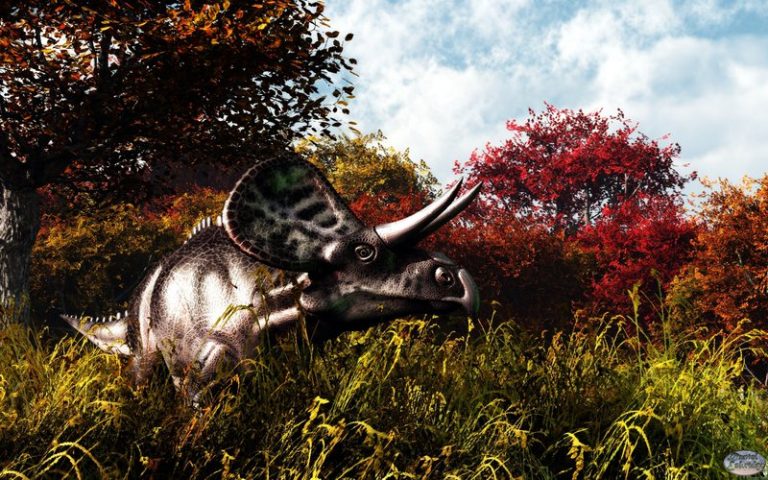
1 – Triceratops

Triceratops in the forest by Swordlord3d

For most people this is ‘the’ ceratopsian dinosaur of choice, and the one that is by far the most popular of them all. Triceratops had three large horns (hence the name Triceratops which means ‘three horned face’), a robust neck frill, and a larger than average size, all things that have confirmed its place in popular culture. Triceratops has often been shown in opposition against large predatory dinosaurs such as tyrannosaurs, usually charging at them like a rhino. However the skull of Triceratops has been proven to be incapable of withstanding the stresses that impacts from charging would inflict. Also while there is fossil evidence that shows tyrannosaur tooth marks on Triceratops fossils, no tyrannosaurs have been proven to have been hurt by Triceratops. With that said, tyrannosaurs did have other kinds of dinosaurs to target such as hadrosaurs that would have been far easier prey than ceratopsians. Some Triceratops crests show damage that some paleontologists have interpreted as being caused by the horns of other Triceratops. It has been considered that rather than charging at predators, Triceratops may have used their horns on each other in dueling contests in order to assert dominance over rivals that could not be intimidated by just a visual display.

Triceratops would have lived alongside other types of ceratopsian dinosaurs, though not the previously mentioned Styracosaurus as it is often depicted since this genus lived much earlier in Campanian stage of the Cretaceous, whereas Triceratops is late Maastrichtian. In 2010 it was claimed that another genus of ceratopsian named Torosaurus was not only a synonym to Triceratops, but actually represented the true adult form. Torosaurus is noted for having a very similar body and horn arrangement to Triceratops, but a much larger neck frill with openings, whereas the frill on known Triceratops is relatively short and solid. Others have not been convinced however noting that a lack of known Torosaurus individuals at different ages makes a comparison to Triceratops difficult to establish. Differences in the skulls of Triceratops and Torosaurus are also pointed out, as well as to date there is no known occurrence of holes appearing in frills of adult ceratopsians when sub adults and even juveniles do not have them (holes in the frill usually start developing very early on in life). Either Triceratops and Torosaurus are indeed separate, or Triceratops would be the first known ceratopsian where frill holes suddenly appear upon adulthood.

*cover: Ceratopsia by atrox1

Source: www.NatGeo.com, www.Wikipedia.org

A 100 Million-Year-Old Dinosaur Fossil Found in Haman County, S. Korea

Sunday, December 10, 2017

A 100 Million-Year-Old Dinosaur Fossil Found in Haman County, S. Korea

The largest skin impression ever found a on dinosaur footprint has been discovered in South Korea.

A South Korean research team says it has recently uncovered a large skin impression on a sauropod dinosaur footprint from the Early Cretaceous period in floodplain deposits in southeastern South Korea.

The team led by Paik In-sung, an earth and environmental science professor at Pukyong National University, exposed the polygonal skin impression and its cast at the Gunbuk deposits in the town of Haman, South Gyeongsang Province.

The find, measuring over 50 centimeters in diameter, is the largest-ever skin impression on a sauropod dinosaur footprint on record worldwide, providing archaeologists with clues on the ecology of dinosaurs in the Early Cretaceous Epoch, or the geologic time epoch 146 to 100 million years ago in Cretaceous Period geochronology.

“Up until now, a number of fossilised dinosaur footprints have been found worldwide. But the case of a skin impression preserved in a dinosaur footprint is very rare,” Paik said.

The discovery of the skin impression suggests that some sauropod dinosaurs in the Cretaceous had a well-developed polygonal skin texture covering nearly the whole of their foot pads, as seen in modern elephants, which would increase stability when walking on muddy and wet ground.

The team’s findings are published in the latest edition of Scientific Reports, part of the international journal Nature.

Source: AAP

Meet Halszkaraptor, the Strangest New Dinosaur You’ve Ever Seen

Sunday, December 10, 2017

This illustration of the Halszkaraptor escuilliei dinosaur. The creature, about 18 inches (45 centimeters) tall. (Source Image: Lukas Panzarin and Andrea Cau via AP)

It looks like a duck, it walks like a duck, and it swims like a duck—but it’s a predatory dinosaur unlike any scientists have seen before.

A study published this week in the journal Nature has introduced the world to the Halszkaraptor escuilliei, the first amphibious dinosaur ever discovered. It’s believed to have lived some 75 million years ago in the Ukhaa Tolgod area of Mongolia’s Gobi Desert, known as a treasure trove of Cretaceous-era dinosaur bones. The unusual creature came to light in recent years after its fossil was purchased by a private French collector named François Escuillié, who contacted paleontologist Pascal Godefroit in 2015 for an expert opinion.

This illustration provided by Lukas Panzarin, with Andrea Cau for scientific supervision, shows a Halszkaraptor escuilliei dinosaur. The creature, about 18 inches 45 centimeters) tall, had a bill like a duck but teeth like a croc’s, a swan-like neck and killer claws.

The creature was clearly a small predator, much like Velociraptor. Its feet even had the distinctive sickle-shaped claws that clinked across the kitchen floor in Jurassic Park. But its long neck and tapering snout resembled those of a swan. Its arms and hands also had unusual proportions—something halfway between the grasping limbs of other raptors and the flattened flippers of modern penguins. It looked like a Velociraptor that had adapted for life in the water—that is, if it was even an actual dinosaur.

Lead author Andrea Cau, a paleontologist at the Geological Museum Capellini in Bologna, Italy, said he was at first highly suspicious about the fossil’s authenticity, both because of its appearance and the fact that the rock containing the skeleton had been smuggled out of Mongolia and left in a private collector’s hands.

“I asked myself, ‘Is this a real, natural skeleton, or an artifact, a chimera? If this is a fake, how could I demonstrate it?'” Cau said in an email. “Assuming it was a fake instead of starting assuming that the fossil is genuine was the most appropriate way to start the investigation of such a bizarre fossil.”

So researchers used the Synchrotron to create three-dimensional images of the fossil, which showed the creature was indeed a single animal and not a concoction built up from several sources. For example, an arm hidden in the rock perfectly matched the visible left arm, and lines indicating growth matched up across the bones.

Even though the creature wasn’t dreamed up by Dr. Seuss, it got a blessing from a Dr. Sues.

Hans Sues, a paleontologist at the Smithsonian Institution who wasn’t part of the research, praised the work and said it “shows again how amazingly diverse dinosaurs were.”

Source: www.history.com / www.theatlantic.com / www.newsobserver.com

Wakaleo schouteni: The Dog-Sized Marsupial Lion that Once Lived in Australia

Sunday, December 10, 2017

Reconstruction of Wakaleo schouteni challenging the thylacinid Nimbacinus dicksoni over a kangaroo carcass in the late Oligocene forest at Riversleigh, Australia. Image credit: Peter Schouten.

Paleontologists have discovered a new species of carnivorous marsupial lion that lived 26 to 18 million years ago (late Oligocene to early Miocene) in Australia’s rain forests.

The newly-discovered marsupial lion, named Wakaleo schouteni, was the size of a dog and weighed around 23 kg.

The species was about a 1/5th of the weight of the largest and last surviving marsupial lion, Thylacoleo carnifex, that weighed in at 130 kg and which has been extinct for 30,000 years.

“The identification of this species has brought to light a level of marsupial lion diversity that was quite unexpected and suggest even deeper origins for the family Thylacoleonidae,” said Dr. Anna Gillespie, a paleontologist at the University of New South Wales, Australia.

The fossilized remains of Wakaleo schouteni — a near-complete skull, teeth, and humerus (upper arm bone) — were found in the Riversleigh World Heritage Area of remote north-western Queensland.

“With the new find, we believe that two different species of marsupial lions were present in the late Oligocene at least 25 million years ago,” the paleontologists said.

“The other, originally named Priscileo pitikantensis, but renamed Wakaleo pitikantensis, was slightly smaller and was identified from teeth and limb bones discovered near Lake Pitikanta in South Australia in 1961.”

The new species exhibits many skull and dental features of the genus Wakaleo, but it also shared a number of similarities with Priscileo pitikantensis — particularly the presence of three upper premolars and four molars, previously the diagnostic feature of Priscileo.

Further similarities of the teeth and humerus which are shared with Wakaleo schouteni indicate that Priscileo pitikantensis is a species of Wakaleo.

“These dental similarities distinguish Wakaleo schouteni and Priscileo pitikantensis from later species of this genus, all of which show premolar and molar reduction, and suggest that they are the most primitive members of the genus.”

“This latest finding raises new questions about the evolutionary relationships of marsupial lions,” Dr. Gillespie concluded.

The team’s findings are published in the Journal of Systematic Palaeontology.

_____

Anna K. Gillespie et al. A new Oligo–Miocene marsupial lion from Australia and revision of the family Thylacoleonidae. Journal of Systematic Palaeontology, published online December 6, 2017; doi: 10.1080/14772019.2017.1391885

Source: sci-news.com

Scientists Shocked by Huge Discovery of 215 Pterosaur Eggs in China

Saturday, December 9, 2017

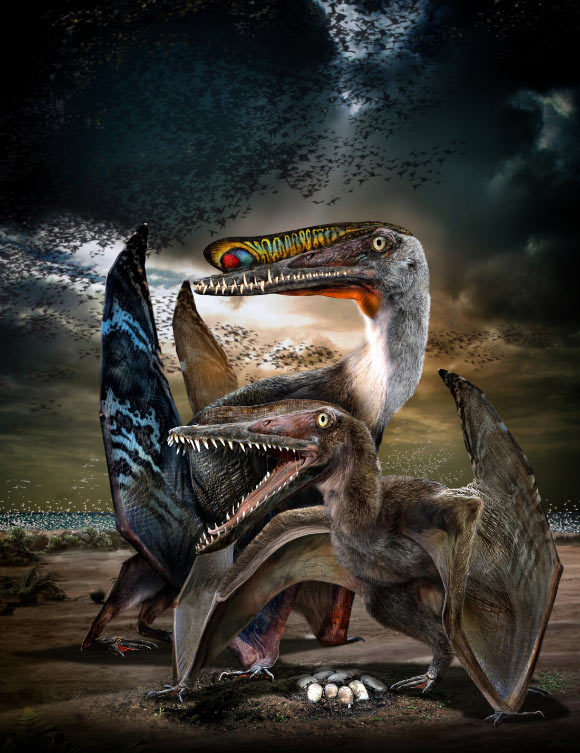
Hamipterus tianshanensis

An international team of paleontologists has discovered a fossil-rich site with more than 200 fossilized eggs of the Cretaceous pterosaur species Hamipterus tianshanensis in China.

To date, only a small handful of pterosaur eggs with a well-preserved 3D structure and embryo inside have been found and analyzed: three eggs from Argentina and five from China.

This sparse sample size was dramatically increased upon the discovery of 215 fossilized eggs of Hamipterus tianshanensis, a species of pteranodontoid pterosaur that lived about 120 million years ago (Cretaceous period) in what is now northwestern China.

Dr. Xiaolin Wang from the Institute of Vertebrate Paleontology and Paleoanthropology, Chinese Academy of Sciences, and colleagues from China and Brazil used CT scanning to peer inside the eggs, 16 of which contain embryonic remains of varying intactness.

The most complete embryo contained a partial wing and cranial bones, including a complete lower jaw.

“The samples of thigh bones that remain intact are well-developed, suggesting that the species benefited from functional hind legs shortly after hatching,” the paleontologists said.

“However, the structure supporting the pectoral muscle appears to be underdeveloped during the embryonic stage, suggesting that newborns were likely not able to fly.”

“Therefore, we propose that newborns likely needed some parental care.”

“Based on growth marks, we estimate one of the individuals to be at least 2 years old and still growing at the time of its death, supporting the growing body of evidence that pterosaurs had long incubation periods.”

“Lastly, the fact that a single collection of embryos exhibits a range of developmental stages hints that pterosaurs participated in colonial nesting behavior.”

The discovery is reported in the journal Science.

_____

Xiaolin Wang et al. 2017. Egg accumulation with 3D embryos provides insight into the life history of a pterosaur. Science 358 (6367): 1197-1201; doi: 10.1126/science.aan2329

Source: www.babwnews.com

‘Jurassic World: Fallen Kingdom’: Watch the First Trailer

Friday, December 8, 2017

‘Jurassic World: Fallen Kingdom’: Watch the First Trailer

On Thursday, the prehistoric death trap of Jurassic World beckoned visitors back with a new trailer during Thursday Night Football.

“Jurassic World: Fallen Kingdom” is the sequel to “Jurassic World,” Colin Trevorrow’s 2015 reboot of the “Jurassic Park” franchise. Chris Pratt and Bryce Dallas Howard reprise their roles as Owen and Claire, and Jeff Goldblum’s return as Ian Malcolm from the original film.

“These creatures were here before us,” Goldblum says in the new footage. “And if we’re not careful, they’re gonna be here after us.”

teaser trailer was released on Sunday, which showed Owen and Claire running amid a stampede of dinosaurs as the island of Isla Nublar erupted around them in volcanic flames and smoke. On Tuesday, another teaser was released featuring Pratt and Howard trying to upload the trailer during a raptor attack and contained many references to the original “Jurassic Park” film.

Trevorrow previously teased fans with footage of Owen interacting with a young Velociraptor.

J.A. Bayona is directing “Fallen Kingdom,” which also stars Justice Smith, James Cromwell, and Toby Jones. Trevorrow, who helmed “Jurassic World,” wrote the script for the sequel with Derek Connolly. The executive producers are Steven Spielberg and Trevorrow. Producers are Frank Marshall and Pat Crowley, along with Bayona’s producing partner Belén Atienza.

“Jurassic World: Fallen Kingdom” is set to release on June 22, 2018.

The Best Dinosaur Museums in the U.S.

Wednesday, December 6, 2017

The Best Dinosaur Museums in the U.S.

Natural history museums across the country are full of spectacular dinosaur fossils. But they’re usually set behind velvet ropes and glass walls, to keep small children (and their sticky fingers) at bay. If your pint-sized paleontologists are eager to get more up close and personal with their favorite giant lizards, here are a few places to explore.

Dinosaur National Monument
Colorado, Utah

Littered with dinosaur bones, the 210,000 acres of this glorious national park are a junior paleontologist’s dream. The Fossil Discovery Trail, which reopens April 1, allows visitors to see dinosaur bones naturally exposed in a cliff wall. The park also has Junior Ranger and Junior Paleontology programs available for children at no cost. Kids receive booklets of age-appropriate activities and are given a Junior Ranger or Junior Paleontologist badge upon completion.

Wyoming Dinosaur Center
Thermopolis, Wyoming

Kids can dig for fossils on the 500-acre Warm Springs Ranch, where the dino center is located. Sediments here are from the Late Jurassic—meaning they are more than 140 million years old. These hold many of the most famous dinosaurs: Allosaurus, Apatosaurus (also known as Brontosaurus), Camarasaurus, Diplodocus, and Stegosaurus. Eight- to 12-year-olds can go on a daylong, guided Kids’ Dig in a nearby canyon to look for fossils. Bones from apatosaurs, barosaurs, and six other species have been uncovered. Children of any age can take part in family digs. The center exhibits 30 full-size dinosaur mounts and has the only skeleton of an Albertaceratops (a horn-faced, plant-eating dino) on display in the world.

Dinosaur World
Plant City, Florida
Cave City, Kentucky
Glen Rose, Texas

Kids can clamber on top of dinosaur replicas at the three outdoor museums of Dinosaur World. The park has a walking trail with more than 150 life-size casts of dinosaurs, as well as several sculptures to play on. Nearby signs explain the names of the dinosaurs and offer interesting facts about them. Tucked among a lush assortment of native vegetation, the dinosaurs are so lifelike that some visitors have claimed to see them moving. The parks also offer classes, birthday parties, and digs (kids can keep the fossils they find!).

The Academy of Natural Sciences
Philadelphia, Pennsylvania

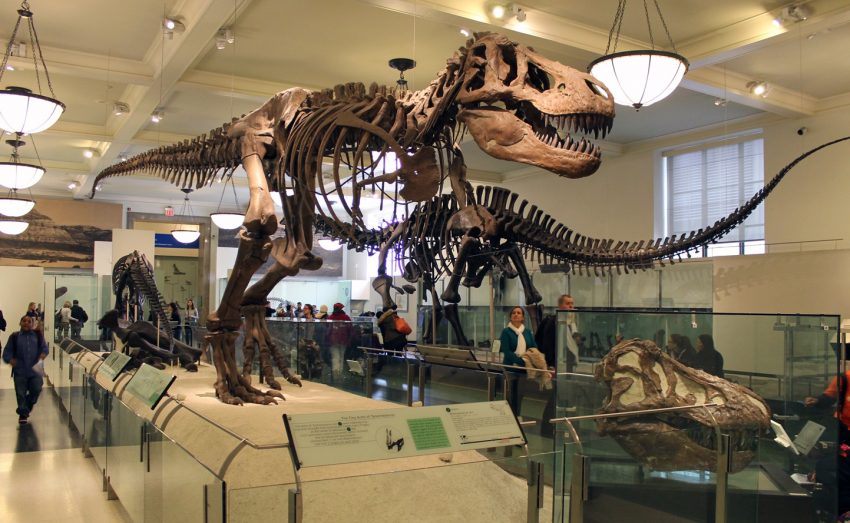
A giant Tyrannosaurus rex greets visitors to this museum, which has a lab where kids can watch scientists prepping dinosaur fossils. Skeletons of more than 30 species are on display in the Dinosaur Hall and a hands-on exhibit allows kids to dig for dino bones. On the third weekend in February the Academy hosts the annual Paleopalooza, a weekend filled with crafts, fossil hunts, dino tours, and games. Children can also talk with real paleontologists.

Dinosaur State Park
Rocky Hill, Connecticut

This state park is home to one of the largest dinosaur track sites in North America, which includes early Jurassic footprints made 200 million years ago. Five hundred of the tracks are enclosed within the Exhibit Center’s geodesic dome and another 1,500 are buried for preservation. The tracks were discovered in 1966 when the area was excavated. Guided walks, dinosaur arts and crafts, and an outdoor scavenger hunt are also available.

The Field Museum
Chicago, Illinois

If there’s one dinosaur your kid absolutely has to see at a museum, it’s Sue, the largest, most complete, and best-preserved Tyrannosaurus rex skeleton in the world. The 42-foot-long, 67-million-year-old dinosaur (named after the paleontologist who found her) is on display here. If that’s not enough for your little ones, they can participate in Dozin’ with the Dinos, a program that allows kids to have a sleepover with Sue and her friends. The evening includes tours and activities and sleeping under the belly of the beast.

Sources: Parents.com / rd.com

Teaser Trailer of ‘Jurassic Park: Fallen Kingdom’ Sets Prequel to Trailer

Wednesday, December 6, 2017

Teaser Trailer of ‘Jurassic Park: Fallen Kingdom’ Sets Prequel to Trailer

Teaser trailer of the American movie ‘Jurassic World: Fallen Kingdom’ has been released by Universal Pictures as a sequel to $1.6 grossing Jurassic World. J.A Bayona is directing the movie.

The story revolves around Chris Patt and Bryce Dallas Howard finding new dinosaurs to encounter who are more fiery and dangerous than the last time they were on-screen.

Dinosaurs aren’t the only things that they are trying to escape but an erupting volcano is also one of the big concerns.

The 15 second teaser trailer is set to get all the fans together as the trailer is going to be released on Thursday December 7.

The sequel reveals stars James Cromwell, ted Levine, Geraldine Chaplin, Justice Smith, Toby Jones, Rafe Spall and BD Wong.

They’re joined by a host of newcomers, including Toby Jones, Rafe Spall, Justice Smith, Daniella Pineda, Ted Levine, Geraldine Chaplin, and James Cromwell.

Jeff Goldblum, who starred in the original 1993 Jurassic Park and its 1997 sequel The Lost World: Jurassic Park will make his long-awaited return to the series as quirky chaos theory mathematician Dr Ian Malcolm.

Scientists Essentially Just Created a New Life Form

Saturday, December 2, 2017

There’s a pretty clear dividing line in the scientific community between those who belief that Jurassic Park is a cautionary tale, and those who think that instead, the movie is something to aspire to.

After all, the real mistake in the original Jurassic Park was not investing in a better IT support team.

A group of scientists, no doubt inspired by the actions of the fictional John Hammond, have created a brand new synthetic set of instructions that can survive harmoniously within DNA. The result is an E. Coli cell that contains genetic coding which has been designed by a human, and which could lead to scientists being able to design and grow organic life forms that are completely of our own design.

According lead scientist Floyd Romesburg, “I would not call this a new life form—but it’s the closest thing anyone has ever made.”

Essentially, the scientists have bio-engineered a pair of amino acids that can be spliced into existing DNA strands within a cell, dramatically changing the coding within a cell in order to make a wholly original creation.

This is very different from recent experiments to repair DNA within patients who suffer from genetic diseases, because instead of simply correcting a mistake within a person’s genetic code, this process involved inventing a completely original set of instructions through the use of a lab-made protein.

Initially, this has been tested on E.Coli, a bacteria with a very different genetic structure to humans, so this can’t be used to make the X-Men a reality just yet.

Whether fiddling around with their genetic makeup or blasting them into space, scientists love experimenting with E.Coli essentially because it’s easy to keep track of simple organisms as they adapt in different environments—even if it does often run the risk of accidentally creating a dangerous zombie plague.

Rather than using this technology to create the Indominus Rex of E.Coli strains, scientists are hoping that their synthetic DNA will be useful in developing new kinds of drugs that will be more effective thanks to their being specifically tailored to help with human health concerns.

As antibiotic-resistant diseases continue to grow and thrive, modern medicine needs a way to avoid seeing all penicillin becoming utterly useless in the face of human-bred germs that laugh at our most powerful medicines.

While progress has been made towards perfecting this technology, there are still some drawbacks, so it’ll still be a while before scientists are able to synthesize a cure for the Common Cold.

The biggest problem with this process of creating new life is that the synthetic strands of DNA can only be produced in a laboratory, which means that scientists can’t set them going within cells and expect them to multiply naturally.

Until this problem is solved, it’s going to be a long wait for someone to finally make the dream of owning a pet Velociraptor a reality.

Source: www.outerplaces.com

Pages