Blogs

World’s oldest Moths also Roamed Jurassic Period, says Research

Saturday, January 13, 2018

Examples of the oldest wing and body scales of primitive moths from the Schandelah-1 core photographed with transmitted light (magnification 630x). The scales are part of palynological preparations and occur together with fossil pollen grains and other organic plant remains. Size of the images (h) approx. 85 micrometer (w) approx. 65 micrometer.  CREDIT Bas van de Schootbrugge, Utrecht University

An international team of scientists led by researchers from Utrecht University have found the oldest fossil remains of moths and butterflies known to date.

The fossil remains are more than 70 million years older than the oldest fossils of flowering plants and shed new light on the co-evolution between flowering plants and pollinating insects, researchers Timo van Eldijk and Bas van de Schootbrugge claim.

The fossil remains – wing and body scales – were isolated from a core of sediment drilled in northern Germany which straddles the mass-extinction event.

The researchers say the butterflies and moths seemed to have avoided the impact of the mass extinction event at the end of the Triassic era.

‘As the super continent Pangea started to break apart, biodiversity on land and in the oceans suffered a setback with many key species becoming extinct,’ says Master’s student Van Eldijk.

‘However, one major group of insects, the Lepidoptera moths and butterflies, appeared unaffected. Instead, this group diversified during a period of ecological turnover.’

Palaeontologist Bas van de Schootbrugge says the fossil remains contain distinctive hollow scales, and provide clear evidence that there was a group of moths sucking mouth-parts, as have the vast majority of living moths and butterflies.

Modern day butterflies are well known for their association with flowering plants and the butterfly ‘tongue’ has long been assumed to be an important adaptation for feeding on flowering plants.

‘This evidence has transformed our understanding of the evolutionary history of moths and butterflies as well as their resilience to extinction,’ says Van Eldijk.

‘By studying how insects and their evolution was affected by dramatic greenhouse warming at the start of the Jurassic era, we hope to provide insight into how insects might respond to the human-induced climate change challenges we face today.’

Source: www.dutchnews.nl

Diluvicursor pickeringi: Turkey-sized dinosaur discovered in Australia

Saturday, January 13, 2018

Artist's impression of two Diluvicursor pickeringi foraging on the bank of a high-energy river within the Australian-Antarctic rift valley. Credit: Peter Trusler.

The partial skeleton of a new species of turkey-sized herbivorous dinosaur has been discovered in 113 million year old rocks in southeastern Australia. As reported in open access journal PeerJ, the fossilized tail and foot bones give new insight into the diversity of the small, bipedal herbivorous dinosaurs called ornithopods that roamed the great rift valley that once existed between Australia and Antarctica. The new dinosaur has been named Diluvicursor pickeringi, which means Pickering's Flood-Running dinosaur.

Lower Cretaceous rocks of the deep sedimentary basins that formed within the Australian-Antarctic rift are now exposed as wave-cut rock platforms and sea-cliffs along the south coast of Victoria. The skeleton of Diluvicursor pickeringi was discovered in 2005 by volunteer prospector George Caspar, eroding from such a rock platform at a locality called Eric the Red West, near Cape Otway.

"Diluvicursor shows for the first time that there were at least two distinct body-types among closely related ornithopods in this part of Australia," Dr Matt Herne, lead author of the new study said.

"One was lightly built with an extraordinarily long tail, while the other, Diluvicursor, was more solidly built, with a far shorter tail. Our preliminary reconstruction of the tail musculature of Diluvicursor suggests this dinosaur was a good runner, with powerful leg retracting muscles," Dr Herne said.

"Understanding the ecology of these dinosaurs—what they ate, how they moved, where they roamed—based on the interplay between anatomy and the environment presents exciting challenges for future research."

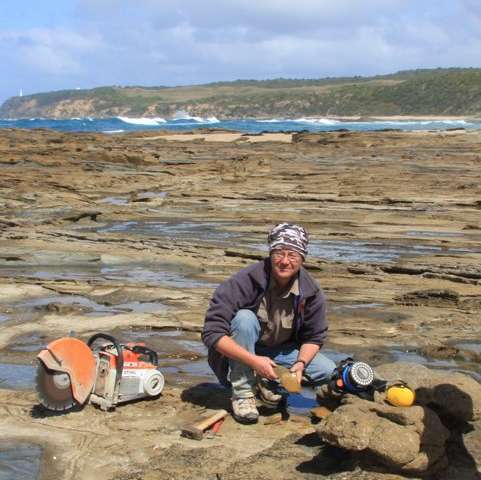
The late David Pickering on the coastal shore-platform near the fossil vertebrate locality of Eric the Red West, where Diluvicursor pickeringi was discovered. Credit: Matt Herne

The species name honors the late David Pickering, who was Museums Victoria's Collection Manager, Vertebrate Palaeontology. David contributed significantly to Australian paleontology in the lab and field, and tirelessly assisted countless students of paleontology and researchers to achieve their goals. Sadly, David passed away just over a year ago on Christmas Eve 2016.

The site of Eric the Red West has additional importance as it helps build a picture the ancient rift valley ecosystem. Fossil vertebrate remains at this site were buried in deep scours at the base of a powerful river, along with flood-transported tree stumps, logs and branches.

"The carcass of the Diluvicursor pickeringi holotype appears to have become entangled in a log-jam at the bottom of this river," explained Dr Herne. "The sizes of some of the logs in the deposit and the abundance of wood suggest the river traversed a well-forested floodplain. The logs preserved at the site are likely to represent conifer forests of trees within families still seen in Australia today."

"Much of the fossil vertebrate material from Eric the Red West has yet to be described, so further  and other exciting animals from this site are now anticipated."

The holotype partial skeleton of Diluvicursor pickeringi after it was prepared from several blocks of sandstone by Lesley Kool of Monash University The fossil preserves most of the tail along with the right ankle and foot. Credit: Steve Poropat and Museums Victoria (CC-BY).

Source: phys.org

Chicago's Field Museum to add Flying Reptiles, Gardens and World's Largest Dinosaur

Thursday, January 11, 2018

Chicago's Field Museum to unveil flying reptiles and world's largest dinosaur

The huge central hall at Chicago's Field Museum won't only soon be home to the touchable cast of a titanosaur, the biggest dinosaur ever discovered.

The museum said Wednesday that Stanley Field Hall also is getting a flock of life-size giant flying reptile replicas and a hanging garden. A T. rex named Sue has occupied the hall and will be moved upstairs starting Feb. 4. The gardens, flying reptiles and titanosaur will start going up soon afterward. Final installation is expected in May.

Related NEWS: SUE to be Dethroned by ‘Titan’ of Evolution

The 122-foot-long titanosaur will take up a third of the museum's main hall and its head will peek over a 28-foot, second-floor balcony. Two of the flying reptile replicas have wing spans of 35 feet. The gardens will be made of 3D-printed plastic and more than 1,000 live plants.

The gardens, pterosaurs, titanosaur, and renovations to SUE are all made possible by Citadel CEO Kenneth C. Griffin, who's recently been in the news for purchasing Chicago's most expensive home ever.

Griffin's gift of $16.5 million signals the beginning of groundbreaking changes coming to the Museum in its 125th year. “Visiting The Field Museum has brought tremendous joy and wonder to my children and me over the years,” says Griffin. “I am proud to support such an outstanding institution so that children and families can better understand and appreciate dinosaurs and their history.”

The flock of pterosaurs (flying reptiles, NOT dinosaurs) will give visitors a lifelike look at the animals that shared the planet with the dinosaurs.

The pterosaur replicas include nine hawk-sized Rhamphorhynchus (ram-foh-RINK-us), two Pteranodon (teh-RAN-oh-don) with 18-foot-wingspans, and two giant Quetzalcoatlus (ket-zal-co-AHT-lus), whose spread wings stretch 35 feet. For context, 35 feet is about the length of a bus.

Read about: 10 Terrifying Flying Reptiles

In addition to the pterosaurs, Stanley Field Hall will also be home to new state-of-the-art hanging gardens. The gardens, which will be made of 3D-printed plastic and were co-designed by architect Daniel Pouzet and Field Museum Design Director Àlvaro Amat, will contain over 1,000 live plants, as well as additional lighting for the space. The four garden structures, the largest of which is 35 feet across, will be suspended from the hall’s ceiling and can be lowered to the ground during special events. The plants themselves will be hydroponic, growing in inert volcanic rock and receiving water and fertilizer from the ceiling.

Fallen Kingdom Director Confirms: Bryce Dallas Howard Won't Run In Heels This Time

Wednesday, January 10, 2018

Claire's high heels in Jurassic World (2015)

Although Jurassic World: Fallen Kingdom won’t arrive in theaters until June, the director is reassuring viewers about one of the few things they probably already knew about.

Speaking to CinePop last week, director J.A. Bayona addressed the elephant in the room about the upcoming sequel. It wasn’t about whether the film will have practical effects after Jurassic World’s CGI use was criticized by fans —it will, according to Bayona—but if the first film’s heroine, Claire Dearing (Bryce Dallas Howard), would be forced to run around in heels again.

He said she will not be running around in heels during the second movie, saying:

No, no. Definitely, she's more prepared in this one. In the first movie it was more like she was caught by surprise. But in this one she's totally ready and prepared for the adventure.

The director also noted that the events in the movie will be propelled forward by Bryce Dallas Howard's character. As we've seen briefly in the trailer for Jurassic World: Fallen Kingdom, it's Claire who really sets off the chain of events in the sequel, and it's all part of making sure the character does have a full role in the new movie. J.A. Bayona said that Claire can be "emotional" but that she's "strong" too, noting,

Also she's very physical and tough. I think she's a very complete character. When the film starts, the story starts with Claire looking for Owen. She's the one convincing him to join her and go back to the island to rescue the dinosaurs. So, she has as much of an important role as Owen has in the story this time.

As for Bryce Dallas Howard, when Jurassic World initially came out, the actress did defend wearing heels, noting her character was a person who lived and worked in tall shoes and would be equipped to move quickly in them. (As for the actress herself, running in heels was difficult.) She also said the jungle is not conducive to going barefoot, and theme parks with a ton of rubble and mess presumably wouldn't be the best fit, either.

We'll find out exactly how Claire comes off when Jurassic World: Fallen Kingdom hits theaters on June 22, 2018.

Source: www.cinemablend.com

Jurassic World 2 cast speculations: Ian Malcolm reunites with Alan Grant in Fallen Kingdom?

Sunday, January 14, 2018

Sam Neill as Alan Grant in Jurassic Park.

Some of the eagle-eyed franchise fans seem to have seen the Jurassic Park cast member secretly filming a scene from the upcoming sequel.

Jurassic World: Fallen Kingdom might feature a reunion between Dr Ian Malcolm and Dr Alan Grant. Speculations are rife that Jurassic Park cast member Sam Neill will be reprising his role in the upcoming sequel.

Some of the eagle-eyed franchise fans seem to have seen the 70-year-old actor at the filming location of Jurassic World 2. Since his arrival and departure were reportedly kept under wraps, there are several speculations doing the rounds that he secretly filmed his role in the movie.

The report initially appeared on an entertainment news website called iHorror. Quoting a YouTube show called Mr Sunday Movies, the website stated that industry insiders confirmed Neill's arrival on set.

Also read Jurassic World 2: Here's everything to know about Ellie Sattler's return in Fallen Kingdom

Here's what the website reported:

According to the Youtube show Mr Sunday Movies, there's a good chance that fellow Jurassic Park star Sam Neill will also return to reprise his role of Dr. Alan Grant. According to the show's source, Neill was recently seen arriving on set, after being dropped off in a blacked-out SUV.

While Neill could have been simply visiting the set to catch up with friends like Goldblum or B.D. Wong, the secured nature of his arrival suggests that there's more to the story than a friendly visit. If Alan Grant does indeed return to the franchise, here's hoping he gets to interact with Malcolm, as they haven't shared a scene since the original film.

Now, the question is if the franchise fans really get a chance to see Dr Alan Grant in Fallen Kingdom. Well, the followers of the science fiction film series will have to wait for an official announcement from Universal Pictures or wait for the movie release to know more about it.

Meanwhile, the new packaging art for Jurassic World 2 indicates that Velociraptor Blue will be the star of the movie. The upcoming product packages feature a profile photo of Blue along with the film's official logo.

According to a fansite called Jurassic Outpost, it could be a general format for the products, including toys and dispensers. "This design seems to be the general format for other products – such as those being released by LEGO and Mattel – with Blue being the centrepiece for all of the packaging," stated the website.

"This marks the first time that a Tyrannosaurus or other large, headlining dinosaurs (like the Spinosaurus from Jurassic Park III) has not been the focus of packaging art for the franchise," added the fansite.

Source: www.ibtimes.co.in

13 Best Places in Britain to See Dinosaurs and Fossils

Friday, January 19, 2018

University of Manchester museum T. rex

Before humans, dinosaurs ruled the world, prowling the land, sea and air for around 165 million years. Here’s our pick of some of the best museums to see these spectacular creatures and spark your imagination, in no particular order…

New Walk Museum
Leicester

© Leicester City Council

The impressive Rutland Dinosaur, a Cetiosaurus oxoniensis, takes centre stage at the New Walk’s famous Dinosaur Gallery which is also home to some of the oldest fossils in the world. Displays include the Plesiosaur, the giant fish and the 540 million-year-old Charnia fossil. There are also dinosaur interactives and cutting edge reconstructions of marine reptiles.

Dinosaur Isle
Isle of Wight

© Dinosaur Isle Museum. Photograph by Thearle

The Isle of Wight is one of the richest dinosaur locations in Europe, with more than 20 species from the Cretaceous period found on the island. The interactive Dinosaur Isle Museum has reconstructions of five local dinos; Neovenator, Eotyrannus, Iguanodon, Hypsilophodon and the giant sauropod. Displays use clever lighting, sounds, smells and animatronic technology to create an exciting and at times scary experience for visitors. They also lead very popular fossil walks throughout the year.

Lyme Regis Museum
Lyme Regis

Courtesy of Lyme Regis Museum

Housed in her former home, Lyme Regis Museum celebrates the pioneering fossil hunter and palaeontologist Mary Anning, who discovered the Ichthyosaur on the local beaches in 1811. The Geology Gallery contains a wealth of fossils and for the real thing you can join one of their famous fossil walks along a historic stretch of Dorset coast.

Manchester Museum
Manchester

‘Empty’ © jev55 (CC BY-NC 2.0)

Stan the Tyrannosaurus rex is the towering centrepiece to this impressive palaeontology collection of more than 100,000 fossils. Search out the giant Plesiosaur and marvel at the massive fossil tree. The museum is home to dinosaurs, mummies and live animals and is an engaging place to visit to learn how our planet has changed over millions of years.

Natural History Museum
London

© The Trustees of the Natural History Museum

The terrifying animatronic T. rex and the one-of-kind Stegosaurus skeleton make the NHM a must-see museum for any dinosaur enthusiast. The museum is packed full of facts, figures, fossils, reconstructions and engaging interactives that explore an ever-developing knowledge of dinosaurs.

Dorset County Museum
Dorchester

© Jurassic Coast Trust

The Jurassic Coast Gallery is a walk through time charting 95 miles of coastline from Exmouth in Devon to Old Harry Rocks in Dorset. The giant jaws of a huge marine reptile are on display here, with a 2.4 metre long skull and razor-sharp teeth, the Weymouth Bay Pliosaur is aptly named ‘The World’s Biggest Bite’.

The Dinosaur Museum
Dorchester

Dinosaur Museum

Just a couple minutes’ walk away, The Dinosaur Museum is devoted to the fascinating world of dinosaurs and is the perfect place for younger visitors. Life-size reconstructions and real fossils and dinosaur skeletons make for an exciting visit with hands-on displays that feature everything prehistoric.

Rotunda Museum
Scarborough

Image courtesy of Scarborough Museums Trust

Scarborough’s bastion of geology is a must-visit for anyone wanting to understand the dino-history of Yorkshire. The Dinosaur Coast Gallery offers a bright, colourful and resolutely family-friendly experience which explores the coastline and its treasures.

World Museum
Liverpool

© Mark McNulty

Lifesize casts of famous dinosaurs including a Megalosaurus and the fearsome Allosaurus await visitors to the Dinosaur Gallery of the World Museum in Liverpool. There are also fossilised reptile footprints, dinosaur poo and bones – and the occasional visit from a young T. rex.

The Great North Museum: Hancock
Newcastle

Image: Colin Davison © Tyne & Wear Archives & Museums

A full size T. rex skeleton in Fossil Stories makes this museum great for dinosaur enthusiasts. Have a go at being a palaeontologist by re-building prehistoric creatures and explore hundreds of exciting fossil plants and animals.

Oxford University Museum of Natural History
Oxford

‘Oxford University Museum of Natural History’ © Magnus D (CC BY 2.0)

Visitors to Oxford University’s gothic-style natural history museum are greeted by the towering skeletons of an Iguanodon and T. rex, who guard the museum’s centre aisle. As well as these imposing specimens the museum is also home to four dinosaurs found within Oxfordshire – including two very rare complete skeletons – and a variety of other species of prehistoric reptiles.

Kelvingrove Art Gallery and Museum
Glasgow

‘Snappy’ © Ianan (CC BY-NC-ND 2.0)

Amid the many wonders in this something-for-everyone museum is the Creatures of the Past Gallery, which puts the dinosaurs that once roamed Scotland into context. The museum has 8000 astonishing objects and dinosaur and fossil lovers will be pleased to know the collection includes a 2.6 metre skeleton of Stenopterygius, crocodilian remains and an almost complete shell of a Jurassic turtle.

Sedgwick Museum of Earth Sciences
Cambridge

‘Sedgwick Museum of Earth Sciences, Cambridge’ © Miles Banbery (CC BY-NC 2.0)

Iggy the enormous Iguanodon skeleton guards the entrance to this museum, which is home to 1.5 million fossil, rock and mineral specimens from around the world. Explore 12 different galleries from the Ice Age to the Cambrian period and journey more than 500 million years through the history of life on Earth.

Source: http://museumcrush.org

Will Fallen Kingdom Feature Tyrannosaurus rex, Baryonyx Fight?

Wednesday, January 10, 2018

Angry Rexy: Jurassic World

Speculations are rife that a fan-favourite character from Jurassic Park will meet its demise in Fallen Kingdom. Will it be Rexy?

Jurassic Park fans may get a chance to watch an epic dinosaur battle in Jurassic World: Fallen Kingdom. The movie could feature a fight between fan favourite Tyrannosaurus rex, Rexy and new comer Baryonyx.

Ever since creator Colin Trevorrow, director JA Bayona and lead cast Chris Pratt described the plot for Fallen Kingdom as dark, the franchise fans have started speculating the death of a fan favourite character.

The latest buzz is about the demise of Rexy. A section of fans believe that the dinosaur will bid adieu to all during a fight with Baryonyx, which is known as one of the dangerous pre-historic animal.

According to the official Jurassic World website, the Tyrannosaurus rex is nearly 30 year old, as it was born in late 1989 or early 1990. So, it is believed to be much weaker than Baryonyx, who has "twice as many teeth as" Rexy.

"Rexy could meet her end during an intense battle with the Baryonyx, the newcomer to the big screen that has shown up in books before and other pieces of the franchise. The Baryonyx is said to have twice as many teeth as a T. rex and isn't weakened like Rexy, so this seems like the most plausible way for her to die," stated MovieWeb.

However, the franchise fans will have to wait a little more to know the fate of Rexy, as the cast and crew of Jurassic World 2 are tight-lipped about it.

Meanwhile, Bayona revealed that Bryce Dallas Howard's character Claire Dearing will not be running on her heels in Fallen Kingdom.

"No, no. Definitely, she's more prepared in this one. In the first movie ... it was more like she was caught by surprise. But in this one she's totally ready and prepared for the adventure," the filmmaker said in an interview with Brazilian website CinePop.

Recently, Trevorrow also shared some details on his upcoming science fiction adventure film.

"At the end of this movie, it's not a cliffhanger, but it's designed for people to want to know what's going to happen next, whereas the earlier Jurassic Park movies had pretty clear definitive endings. They were much more episodic. In working with Derek Connolly, my co-writer, we were also thinking about where it was gonna go in the future," he said in a Youtube interview with Sebas Tabany.

The creator of Fallen Kingdom also said that the franchise fans can expect to watch a character-based film in June.

"I remember telling Steven [Spielberg] even while we were making the first movie. 'This is the beginning. Here is the middle. And here's the end of the end.' This is where we want to go. I feel like that kind of design is crucial to a franchise like this if you really want to bring people along with you and make sure they stay interested. It needs to be thought through on that level. It can't be arbitrary, especially if we want to turn this into a character-based franchise with people who you lean in to follow what they're going to do," Trevorrow said.

Research finds lizard inside fossilised dinosaur to be a new species

Sunday, January 7, 2018

The fossil of Compsognathus longipes dinosaur found in Germany.

The dinosaur is estimated to have lived around 150 to 145 million years ago.

A new research report has concluded that a lizard whose fossils were found inside a dinosaur skeleton in 1859 is indeed a new species, putting to rest a puzzle that has baffled scientists for more than 150 years.

Prior to this finding, the gekho-like creature, which was found inside the gut of a fossilised carnivorous dinosaur Compsognathus longipes, was thought to be an extinct lizard in Germany (Bavarisaurus macrodactylus).

The author of the new report is Dr. Jack L. Conrad of the American Museum of Natural History, whose findings have been published posthumously in the Zoological Journal of the Linnean Society last month.

The report points to the unique shape of the lizard's skull stitchings and skull bones. Dr. Conrad named the lizard Schoenesmahl dyspepsia, which roughly means ‘beautiful meal that is difficult to digest’.

The dinosaur skeleton was discovered in Bavaria, Germany, by Dr. Joseph Oberndorfer in 1859. The dinosaur is estimated to have lived in the Late Jurassic era—around 150 to 145 million years ago.

This is not the first time a fossil has been found within a fossil. In 2016, there was a report in Palaeobiodiversity and Palaeoenvironments about an insect inside a lizard inside a snake fossil. There have been several reports of fish inside fish fossils. These findings help us know more about their dietary preferences.

Source: www.thehindu.com

Jurassic World 3 is Already Being Planned Says Director Colin Trevorrow

Thursday, January 4, 2018

Well it’s about time a movie director is having some foresight and giving fans of the Jurassic Park franchise reason to have something to look forward to. Director Colin Trevorrow who is working on the second installment of Jurassic World, Jurassic World: Fallen Kingdom, is reported to be setting the end of the movie to transition into the third part of the trilogy. Previous movies in the franchise were more like individual episodes, each having its own linear, beginning to end, storyline. Treverrow sees more of a long term future for the trilogy and its fans.

In the projected third movie in the trilogy, it would likely be the end of the Jurassic Park franchise. The original Jurassic Park movie actress Laura Dern, has already said she definitely wants to be in the grand finale. She would be 53 or so when production would begin, which means that finding a significant role for her would be problematic. At this point it would seem the best she could hope for would to be added in a small role. Dern would like to forget Jurassic Park 3, which was pretty close to an epic fail.

There are also rumors that Sam O’Neill wants to return for the finale as well, which is a problem of a different sort. The original was done in 1993, making people who were the original fans of the movie mostly in the over-40 demographic. When the first installment of Jurassic World was initially released, the average age of the box office buyer was about 38. After the first 5 days that number dropped closer to 35. In other words, the original fans were uninspired to go after the Jurassic Park 3 disaster that had one movie critic writing, “A clumsy, and poorly written farce with irritating characters I prayed for imminent death to arrive to.” O’Neill and Dern were both present in the mess. Did I mention O’Neill is over 70 now?

Why O’Neill and Dern fail to realize their time is past is probably because their egos won’t allow for the possibility. They were great in Jurassic Park  but the franchise having been episodic, maybe they should have met their demise at the beginning of Jurassic Park 2. Dern said in an interview about wanting in on the Jurassic World finale, “If you guys make a last one, you gotta let Ellie Sattler come back.”

Uh, no, we don’t. The numbers show that there is about as much interest in your originals fans wanting to see you as there is of the original Top Gun fans wanting to see Kelly Mc Gillis return in the reboot. Maybe Dern was trying to get some media attention other than her romance with Baron Davis.

The obvious reality is that this run of Jurassic World is for the younger audiences. It is doubtful anyone wants to see a couple of 50 year olds (remember, they were an item in the first Jurassic Park) hanging around and likely detracting from the storyline to perform an “Auld Lang Syne” number. It could be suggested that the writers borrow a scene from Star Trek Beyond where Spock was shown a picture of the TOS Star Trek crew to memorialize the old franchise. It lasted about 20 seconds. It’s actually easier to fit in the memorial given the fact that the theme of the Jurassic Park franchise is dinosaurs.

Source: tvovermind.com

‘Jurassic Park’ Trilogy Getting New Blu-rays With Awful New Art

Thursday, January 4, 2018

‘Jurassic Park’ Trilogy Getting New Blu-rays With Awful New Art

With Jurassic World: Fallen Kingdom headed our way this summer, it makes sense that Universal is re-releasing the original trilogy on Blu-ray this year. On January 9Jurassic Park, The Lost World and Jurassic Park III return to Blu-ray with individual releases.

Unfortunately, the new art for the releases is absolutely abysmal.

Rather than commissioning artists to whip up exciting new art that would entice fans of the franchise to double dip, Universal instead decided to go the Photoshop route, making for butt-ugly cover art that gets worse with each film; note the way Alan Grant isn’t even *looking* at the T-Rex in the Jurassic Park art, for starters.

As for special features, they’re the same as previous releases. Yawn.


Source: bloody-disgusting.com

Pages