Blogs

The Ever-Changing Aspect Ratios of the Jurassic Park Franchise

Saturday, February 3, 2018

Aspect ratios killed the dino-awe.

Note that all screenshots were captured on a 1.6:1 laptop screen. We’ve left the letterboxing (the black bars at the top and bottom of the frame) in to help visualize the difference between the aspect ratios.

Few franchises have undergone as many aesthetic changes as Jurassic Park. Yes, other series have switched from film to digital and new cinematographers and directors have altered the visual style over time, but the Jurassic films have changed the very frame of the action… twice.

Ten years after E.T. the Extra-Terrestrial had surpassed Star Wars to become the highest-grossing film of all time (unadjusted for inflation), Steven Spielberg was looking to assemble another world-beating blockbuster: Jurassic Park.

But, as with E.T., he wanted something different to the action spectacular 2.39:1 aspect ratio (the ratio of image width to height) that audiences were used to. Most importantly, he wanted to be able to fit humans and dinosaurs in the frame together, so he decided to use the height offered by 1.85:1 (the cinematic standard closest to 1.78:1 modern television screens). Without the distortion of anamorphic 2.39, it also made achieving the groundbreaking computer effects easier for the VFX artists.

Still Jp

It’s a relatively simple creative choice, but it made such a difference. A beautiful shot like this emphasizes the extraordinary height of the brachiosaurus. It allows for dinosaurs in both the foreground and the background at different relative heights. It also accommodates dynamic framing of the human characters, with Dr. Grant (Sam Neill) sitting above the children. Lex looks up to Grant in the same way Tim looks out at the animals: with wonderment. He may be hostile at first, but Grant will come to develop a paternal bond with the children. This shot foreshadowed that relationship beautifully and was only made possible by the additional vertical space of 1.85.

And, as always, the outer frame is merely a canvas on which other internal frames can be created. The 1.85 shape is particularly adaptable and allows directors and cinematographers more room to play. They can use the sizable frame as if it were 2.39, 1.37:1 Academy ratio or even a circle.

Spielberg was so pleased with the results that he kept the aspect ratio for his sequel, The Lost World: Jurassic Park and Joe Johnston picked up the mantle with Jurassic Park III. When the time came for Jurassic World, the story goes that Spielberg, who remains an executive producer, wanted the fourth installment to follow suit and be shot and released in 1.85. Director Colin Trevorrow and his cinematographer, John Schwartzman, had a different idea. This was Trevorrow’s first blockbuster, and he wanted to shoot in epic 2.39 widescreen. The compromise? 2:1 — an infrequently used format, but one that maintained some degree of consistency with the previous films, while adding the widescreen scope Trevorrow desired.

Still Jw

Even the fourth highest grossing film of all time worldwide didn’t change the fledgling aspect ratio’s fortunes on the big screen. Jurassic World remains in a relatively small medley of films to use the format. 2:1’s biggest proponent remains master cinematographer Vittorio Storaro (Apocalypse Now), who created “Univisium” in the late 90s. Interestingly, the format has had far more luck on the small screen.

Netflix, Amazon, and Hulu have all released high-profile original content in 2:1 – Stranger ThingsThe CrownThe Handmaid’s Tale and Transparent, to name just a few. And more traditional networks are starting to take notice, including the likes of FX’s Fargo, which made a move to 2:1 for season 3. The general feeling is that Univisium adds a widescreen cinematic quality to television without alienating audiences with a heavily letterboxed image.

Still Jw

But now, with Jurassic World: Fallen Kingdom, that crucial element of Spielberg’s original cinematographic vision has been lost entirely, as new director J.A. Bayonahas opted for a blockbuster standard 2.39:1. The first trailer was greeted with indifference last month, and it’s possible the more conventional blockbuster aspect ratio has something to do with it.

Still Jp

The change in aspect ratio alters the way the films feel. Consider these three shots of aerial vehicles approaching Isla Nublar: one from Jurassic Park, one from Jurassic World and one from Fallen Kingdom. In Spielberg’s shot, the camera is traveling behind the helicopter and tilting (a vertical up or down movement) to reveal the island.

Still Jw

Whereas, in Trevorrow’s shot, the camera is traveling beside the helicopter and combines the tilt with a pan (a horizontal left or right movement). This flashy swoop lacks the wonder (or the impending doom) of a creeping look up. The Jurassic Parkshot also utilizes a wider angle lens. Not only does this make the helicopter feel smaller, but it also emphasizes the vastness of the island. Whereas, the longer lens used by Trevorrow has the effect of flattening the image. This, plus the fact that Trevorrow leaves little headroom between the helicopter and the greenery of the island, makes it unclear just how far away the vehicle is from land.

Still Jw

Finally, in Bayona’s shot, without the height of the 1.85 frame allowing for natural tilts, he has to resort to just using a pan. He shoots across the coast and then follows the plane’s banked turn towards the island. He has to be commended for making the shot feel natural and altering the vehicle’s movement to match the confines of a wider aspect ratio, but it’s an example of the sense of wonder of Jurassic Park being slowly eroded from a thrilling reveal shot to a casual shrug.

Still Jw

Still Jw

Similarly, compare these two shots of Chris Pratt’s Owen interacting with Blue the velociraptor. The 2:1 of Jurassic World allows for visible shadows to be cast on the ground. That immediately connects Owen and his raptor buddies and further sells the fact that Owen’s interacting with prehistoric beasts. Despite benefiting from three years of visual effects advancements, the shot from Fallen Kingdom feels less real because the grounding shadows are lost below the frame.

Still Jw

But how about the all-important T-Rex money shot? All we’ve got to go off from Fallen Kingdom is this climactic shot from the trailer. Now, hold that against this iconic shot from Spielberg’s original.

Still Jp

Although the frame’s bigger in Jurassic Park, old Rexy seems to be roaring out of the screen. Bayona’s action, on the other hand, feels contained, despite taking place in a more open environment. In his attempt to fill the width of the frame, Bayona has blocked the dinosaur parallel to the lens. It suits the shape of the beast, in a way, but it makes the image feel far flatter. Spielberg however, places Rexy diagonally in the frame, with her tail disappearing into the darkness and her huge skull dominating the image.

He also captures scale far more effectively. With two identical, and (crucially) recognizable, objects in the frame – the 4x4s, one placed in the foreground and one in the background – Spielberg’s providing us with a system of measurement. As viewers, our brains subconsciously know roughly how big jeeps are, and we can deduce the size of this fearsome beast accordingly. In Fallen Kingdom, the Gyrosphere lacks that immediate audience recognition and it’s even unclear just how proximate Owen and the vehicle are to each other and the T-Rex. The mise en scène combines with the two aspect ratios to create one image of visceral horror and one of distant action.

It’s interesting because IMAX, which most regard as the pinnacle of “big” filmmaking, emphasizes the height of the image. IMAX’s native aspect ratio is 1.43:1, so taller ratios fit more naturally on these large format screens. And I think we can agree that being overshadowed vertically by an object (or screen) is usually more impressive than being swamped horizontally.

Jurassic World commented on modern audiences’ desensitization to dino-awe through its narrative. With the move to a 2.39:1 aspect ratio, Jurassic World: Fallen Kingdom seems to have succumbed to that thinking. The terrifying and mesmerizing creatures of Jurassic Park have become fodder for a generic action movie.

Source: https://filmschoolrejects.com

Dinosaur Age Meets the Space Age

Saturday, February 3, 2018

Detail view of a cast from the sandstone slab imprinted with more than 70 dinosaur and mammal tracks discovered at NASA's Goddard Space Flight Center in Greenbelt, Maryland. Credit: NASA's Goddard Space Flight Center/Rebecca Roth

A slab of sandstone discovered at NASA's Goddard Space Flight Center contains at least 70 mammal and dinosaur tracks from more than 100 million years ago, according to a new paper published Jan. 31 in the journal Scientific Reports. The find provides a rare glimpse of mammals and dinosaurs interacting.

The tracks were discovered by Ray Stanford—a local dinosaur track expert whose wife, Sheila, works at Goddard. After dropping off Sheila at work one day in 2012, Stanford spotted an intriguing rock outcropping behind Shelia's building on a hillside. Stanford parked his car, investigated, and found a 12-inch-wide dinosaur track on the exposed rock. Excavation revealed that the slab was the size of a dining room table and examination in the ensuing years found that it was covered in preserved tracks.

The remarkable Goddard specimen, about 8 feet by 3 feet in size, is imprinted with nearly 70 tracks from eight species, including squirrel-sized mammals and tank-sized . Analysis suggests that all of the tracks were likely made within a few days of each other at a location that might have been the edge of a wetland, and could even capture the footprints of predator and prey.

"The concentration of  tracks on this site is orders of magnitude higher than any other site in the world," said Martin Lockley, paleontologist with the University of Colorado, Denver, a co-author on the new paper. Lockley began studying footprints in the 1980s, and was one of the first to do so. "I don't think I've ever seen a slab this size, which is a couple of square meters, where you have over 70 footprints of so many different types. This is the mother lode of Cretaceous mammal tracks."

By Jonathan Corum | Photograph by (and slab illustration modified from) Stanford et al., Scientific Reports

After Stanford's initial find, Stephen J. Godfrey, curator of paleontology at the Calvert Marine Museum, coordinated the excavation of the slab and produced the mold and cast that formed the basis of the scientific work.

The first track Stanford found was of a nodosaur—"think of them as a four-footed tank," Stanford said. Subsequent examination revealed a baby nodosaur print beside and within the adult print, likely indicating that they were traveling together. The other  include: a sauropod, or long-necked plant-eater; small theropods, crow-sized carnivorous dinosaurs closely related to the Velociraptor and Tyrannosaurus rex; and pterosaurs, a group of flying reptiles that included pterodactyls.

"It's a time machine," Stanford said. "We can look across a few days of activity of these animals and we can picture it. We see the interaction of how they pass in relation to each other. This enables us to look deeply into ancient times on Earth. It's just tremendously exciting."

The dinosaur tracks are impressive, but it is the collection of mammal tracks that make the slab significant. At least 26 mammal tracks have been identified on the slab since the 2012 discovery—making it one of two known sites in the world with such a concentration of prints. Furthermore, the slab also contains the largest mammal track ever discovered from the Cretaceous. It is about four inches square, or the size of a raccoon's prints.

Lockley and Stanford said most of these ancient footprints belong to what we would consider small mammals—animals the size of squirrels or prairie dogs. Most Cretaceous mammals discovered to date have been the size of rodents, their size usually determined only from their teeth. "When you have only teeth, you have no idea what the animals looked like or how they behaved," Lockley said.

Lockley and Stanford believe the wide diversity and number of tracks show many of the animals were in the area actively feeding at the same time. Perhaps the mammals were feeding on worms and grubs, the small carnivorous dinosaurs were after the mammals, and the pterosaurs could have been hunting both the mammals and the small dinosaurs.

Detail view of a cast from the sandstone slab imprinted with more than 70 dinosaur and mammal tracks discovered at NASA's Goddard Space Flight Center in Greenbelt, Maryland. Credit: NASA's Goddard Space Flight Center/Rebecca Roth

The parallel trackway patterns made by four crow-sized carnivorous dinosaurs suggests they were hunting or foraging as a group. "It looks as if they were making a sweep across the area," Lockley said.

Several of the mammal tracks occur in pairs, representing hind feet. "It looks as if these squirrel-sized animals paused to sit on their haunches," Lockley said. The team gave the new formal scientific name of Sederipes goddardensis, meaning sitting traces from Goddard Space Flight Center, to this unusual configuration of tracks.

"We do not see overlapping tracks—overlapping tracks would occur if multiple tracks were made over a longer period while the sand was wet," said Compton Tucker, a Goddard Earth scientist who helped with the excavation, coordinated bringing in multiple scientists to study the tracks, and has worked to create a display of the cast in Goddard's Earth science building. "People ask me, 'Why were all these tracks in Maryland?' I reply that Maryland has always been a desirable place to live."

What is now Maryland would have been a much hotter, swampier place in the Cretaceous, when sea levels would have been hundreds of feet higher than today. As scientists continue to study the slab and compare the tracks to others found in the area and around the world, they will continue to discover more about prehistoric life that existed here.

"This could be the key to understanding some of the smaller finds from the area, so it brings everything together," Lockley said. "This is the Cretaceous equivalent of the Rosetta stone."

Source: https://phys.org

Young Tourist Helps Edmonton Researchers in Discovery of Rare Colombian Fish Fossil

Saturday, February 3, 2018

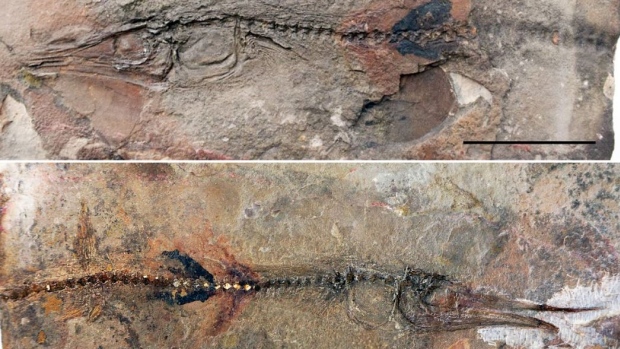
This perfectly-preserved ancient fish fossil was discovered embedded in the flagstones of an old Colombian monastery by a young boy. (Oksana Vernygora)

Edmonton paleontologists are crediting a keen-eyed tourist for spotting a never-before-seen fish fossil in flagstones outside a Colombian monastery.

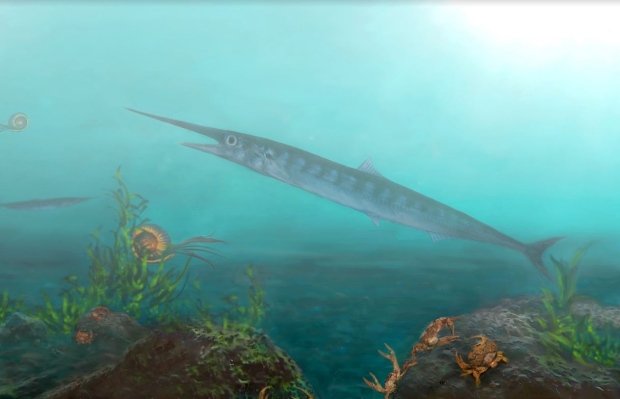
The perfectly-preserved "lizard fish" specimen is an estimated 90 million years old and has no modern relatives. The extremely rare specimen is the first fossil of its kind to ever be found in South America. 

"This fossil was one of those serendipitous, unexpected findings," said paleontologist Javier Luque, a PhD candidate at the University of Alberta's biological sciences department and co-author of the research paper on the find.


'Once in a lifetime discovery'

"It was kind of a once-in-a-lifetime discovery, in many ways."

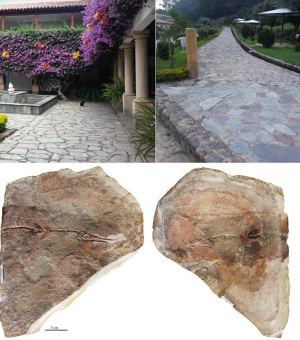
The discovery was made in 2015 at the Monastery of La Candelaria by a young boy who spotted the outline of a fish in one of the flagstones outside the 17th-century building.

Curious about the strange rock, the boy snapped a photo and shared it with staff at Centro de Investigaciones Paleontologicas, a museum in nearby Ráquira, Boyaca. Workers there recognized it as a fossil right away and shared the discovery with the University of Alberta.

The long-jawed 'lizard fish' would have thrived in the oceans that once covered Colombia. (Oksana Vernygora)

The flagstone had been part of the busy pathway for more than 15 years, said Luque. 

"A kid was just walking around saw what he thought was a fish and sure enough, he took a photo with the inquiring mind of a child," Luque said.

"It was a fossil fish, perfectly preserved in two dimensions, just laying down, weathering as people were walking on top of it for so many years."


'Shocking to see'

The museum and the university often partner on fossil finds in the area, said Luque.

After getting the call, a team of U of A researchers joined the local paleontologists in retracing the boy's steps to locate and lift the stone for further examination.

Researchers were able to trace the origins of the fossil-bearing flagstone to a nearby abandoned quarry from where locals extracted slabs for construction several years ago.

The research paper on the fossil was recently published in the Journal of Systematic Paleontology.  It was co-authored by Oksana Vernygora, a fellow PhD candidate at the U of A led the research with assistance from her supervisor, and Allison Murray, a professor of biological sciences.

The rocks date from the Late Cretaceous period, and were deposited at a time when most of the northern Andes was underwater, which accounts for a rich record of marine life in the heart of the Andes mountains. 

"It's an entirely new group of fossil fish from the Cretaceous period in South America," Luque said. 


It has been named Candelarhynchus padillai, which combines  'Candelaria,' the name of the monastery where the fossil was discovered, and the Greek word for nose 'rhynchos,' due to its peculiar long and slender needle-like face.


And while the fossil's backstory has largely been explained, the fish tale has one more mystery.

Researchers lost touch with the boy who found the fossil. They have only his name.

They are hoping, with the recent publication of the research, the boy might eventually come forward, so they can give him proper credit.

"We certainly will make sure we properly acknowledge this discovery," Luque said. "It was the keen eye of a young kid that was able to recognize the shape of a fossil that we were not able to see for so many years. 

"It gives a beautiful message about keeping curious … and being able to see the world with fresh eyes."

Source: www.cbc.ca


Pittsburgh Paleontologist Says New Dino Discovery Disrupts A Major Biodiversity Theory

Friday, February 2, 2018

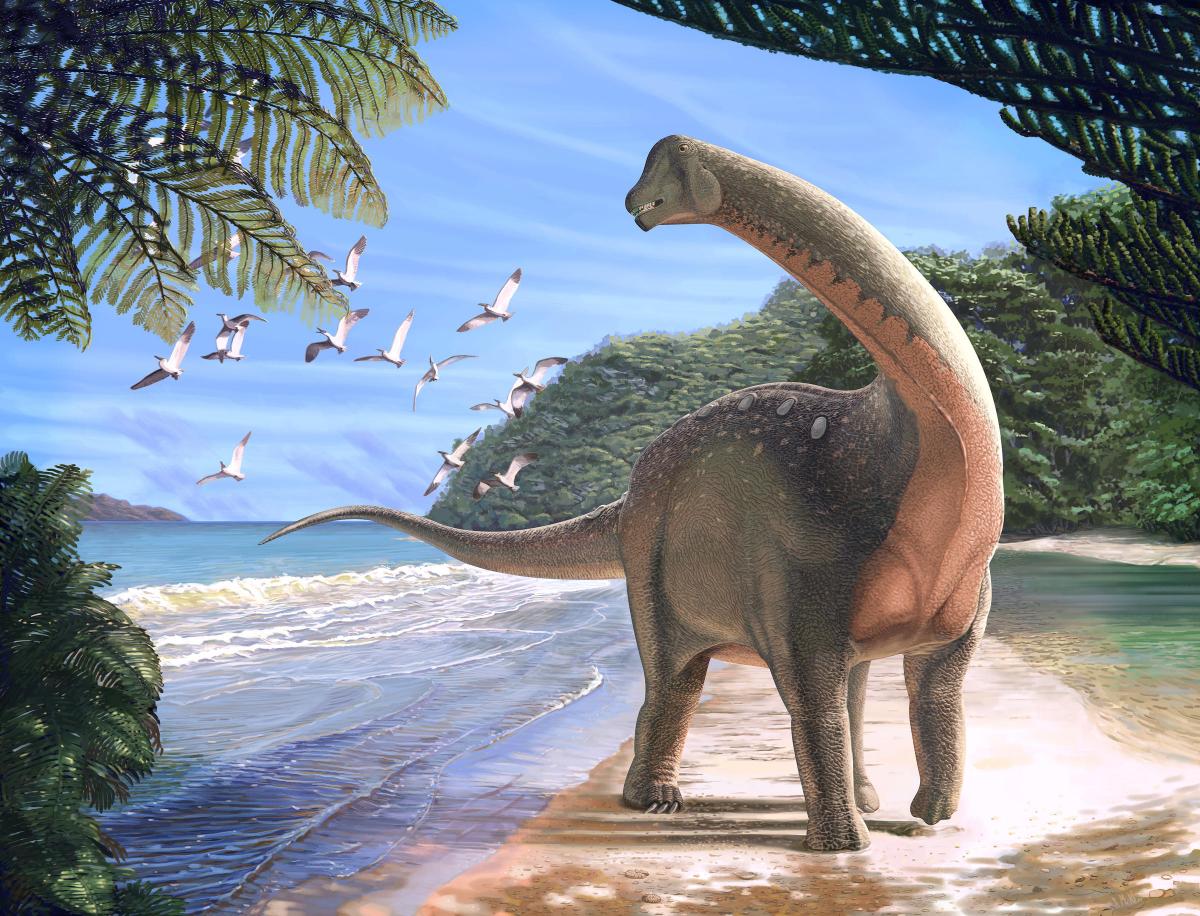
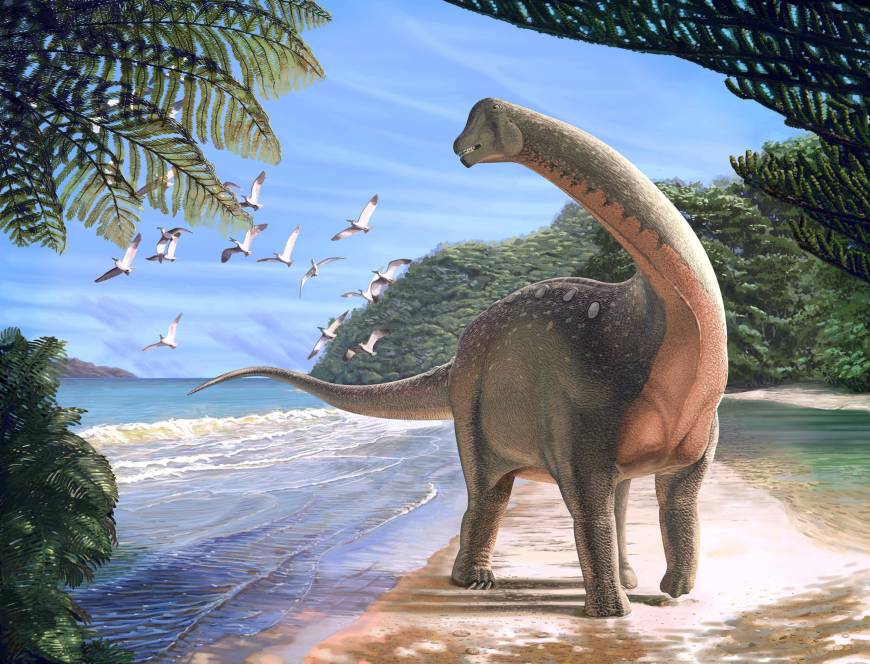
An artist's rendering of the Mansourasaurus shahinae, an African elephant-sized sauropod that lived about 80 million years ago. ANDREW MCAFEE / CARNEGIE MUSEUM OF NATURAL HISTORY

Mansourasaurus shahinae was a long-necked, plant eating dinosaur that lived during the late Cretaceous period, about 80 million years ago, and its discovery is disrupting a major theory in the field of paleontology.

Uncovered recently by a team of Egyptian paleontologists in the Sahara Desert, researchers believe the dinosaur would have resembled a smaller, Elephant-sized version of its cousin, the brontosaurus. The group published their findings Monday in the journal Nature Ecology and Evolution.

Matt Lamanna, paleontologist and principal dinosaur researcher at the Carnegie Museum of Natural History, helped study the skeleton after its discovery. He said fossils of more recent dinosaurs, like those that appeared 30 million years or less before going extinct, are rarely found in Africa -- but this one was remarkably well-preserved. 

"In fact, this is definitely the best dinosaur skeleton that's been found, probably within that entire time span in Africa," Lamanna said.

Parts of the Mansourasaurus shahinae's skull, ribs, shoulder and hind foot were found at the dig site.

Lamanna said it bears striking similarities to sauropods found in Europe, refuting a big theory in the field of paleontology that Africa was once an isolated continent. Mansourasaurus' discovery seems to prove that the creatures traveled between the two continents, and were not genetically isolated.

"To find a dinosaur from the end of the age of dinosaurs in Africa and have it be closely related to European dinosaurs was really exciting," Lamanna said. "It showed that this island continent hypothesis was at least not entirely correct, if not completely off base."

Lamanna said there's no current plan to move Mansourasaurus shahinae from Egypt at this time, though casts could be made to show parts of the specimen in other museums.

Source: http://wesa.fm

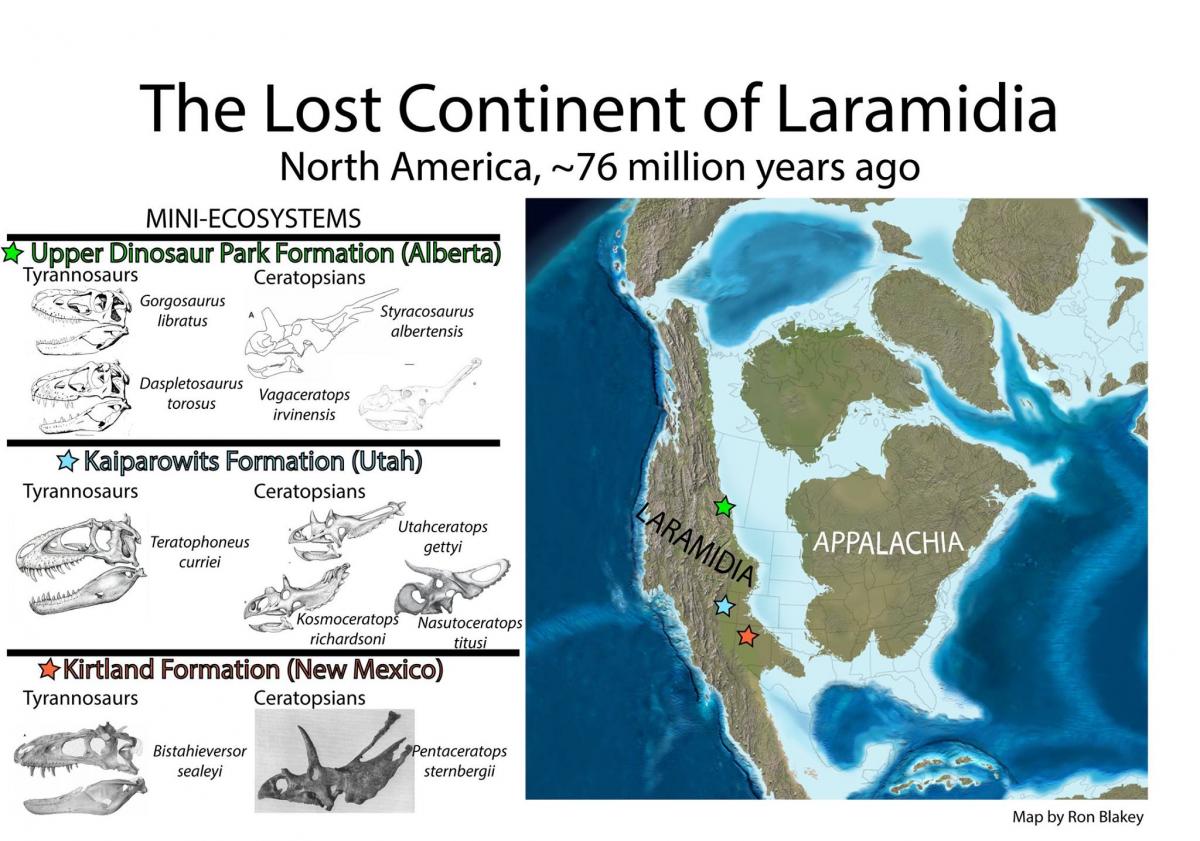
The Lost Continent of Laramidia

Tuesday, February 13, 2018

North America, 76 million years ago

In this article, we discuss the nature of North America in the Late Cretaceous Period. Between 100 and 70 million years ago, the entire continent was divided by a shallow sea. This sea was once filled with colossal marine lizards, long-necked plesiosaurs, toothed birds, and the occasional diving Pteranodon. The sea divided the land into two smaller continents: Appalachia in the east and Laramidia in the west. As residents of the eastern United States, we are saddened by the meager dinosaur fossils (so far) discovered in the east. However, the vast and exposed formations in the west tell an amazing story.

Fossil-bearing formations dot the landscape of Laramidia, from the North Slope of Alaska down into Mexico. Each formation exhibits a similar ecosystem to the other: there are always tyrannosaurs, horned dinosaurs (ceratopsians), duck-billed dinosaurs (hadrosaurs), and raptors (dromaeosaurs) among other creatures. However, there are always different species belonging to each group. Even formations of the same age, or nearly the same age, differ in their species when they occupy different latitudes on the continent. This suggests that there were multiple “mini-ecosystems” throughout Laramidia some seventy-five million years ago.

Around seventy million years ago, as continents shifted and climates grew colder, the sea began to dry up. This linked the mini-continents of Laramidia and Appalachia once again and opened vast new regions for land animals to inhabit. The fossils of this age suggest that the divided mini-ecosystems began to blend together. It was into this great new world that Tyrannosaurus rex appeared on the scene, occupying the role of top predator until the extinction of the dinosaurs sixty-five million years ago.

The divided continent of North America. Note that the column on the left displays only a small number of the dinosaurs in each ecosystems. Also note that the Kirtland Formation is slightly younger than the others displayed.

Jurassic World: Fallen Kingdom's New Trailer Looks Downright Terrifying

Monday, February 5, 2018

Image: Universal

In Jurassic World: Fallen Kingdom, your worst nightmare comes true. Dinosaurs can hunt you while you sleep.

A new trailer for the film ran during the Super Bowl and it gave us a better idea of the plot away from the island, including some kind of new dinosaur. A dinosaur that ends up in someones’s bedroom. Check it out.

Of course, we also see Owen (Chris Pratt) and Claire (Bryce Dallas Howard) heading back to Jurassic World, some new characters, lots of teeth and more. This is definitely better and more interesting than the first trailer. We dig it.

Directed by J.A. Bayona, Jurassic World: Fallen Kingdom opens June 22.

Source: io9.gizmodo.com

Earlier Burgess-Shale-Type Fossils Found in Greenland

Wednesday, January 31, 2018

Graham Budd has been critical of associations between Ediacaran fauna and Cambrian animals, and has also debunked alleged Precambrian animal ancestors such as Vernanimalcula (Stephen Meyer, Darwin’s Doubt, pp. 85, 90-91). Budd also was in attendance at the Darwin-doubting Altenberg 16 conference in 2008 (p. 292), confessing that the fossil record tells little about the origin of biological forms. This Cambrian expert from Uppsala University has a new paper in Geology describing new exquisitely-preserved fossils of the Burgess Shale type, but earlier. Along with lead writer Ben Slater, Graham Budd’s team unveils photographs of tiny but exquisite parts of arthropods, worms and other animals that burst into appearance in the Cambrian Explosion. What’s amazing is that these fossils were collected not in Canada or China, but in the northern reaches of Greenland.

The location, called Sirius Passet in Peary Land in the far north of Greenland, has been known as an early Cambrian fossil site, but it lies close to a geological fold belt. Having been heated to 200° C or more by metamorphism, most of the fossils at Sirius Passet have suffered thermal alteration and are difficult to interpret. Not far to the south, however, the team found sites in the same formation that escaped most of the alteration. News from Uppsala University describes how they found a “treasure trove of highly detailed fossils” of the Burgess Shale type.

The ‘Cambrian explosion’ of animal diversity beginning ~541 million years ago is a defining episode in the history of life. This was a time when the seas first teemed with animal life, and the first recognisably ‘modern’ ecosystems began to take shape.

Current accounts of this explosion in animal diversity rely heavily on records from fossilised shells and other hard parts, since these structures are the most likely to survive as fossils. However, since most marine animals are ‘soft-bodied’ this represents only a small fraction of the total diversity.

Rare sites of exceptional fossilisation, like the world-famous Burgess Shale, have revolutionised palaeontologists understanding of ‘soft-bodied’ Cambrian life. Because of the special conditions of fossilisation at these localities, organisms that did not produce hard mineralized shells or skeletons are also preserved. Such sites offer a rare glimpse into the true diversity of these ancient seas, which were filled with a dazzling array of soft and squishy predatory worms and arthropods (the group containing modern crustaceans and insects). [Emphasis added.]

Also important is that these fossils date earlier than the Burgess Shale by 10 million years (518 million instead of 508 million), and yet are recognizable as the same animals. This indicates that the Cambrian animals had a global distribution at the time they were fossilized. The same animals are found many thousands of miles apart on three continents.

Instead of the large, articulated fossils from China and Canada, those at the Greenland sites are made up of tiny fragments. So rich were the deposits, they often found 100 specimens in a 50-gram sample.

A team of palaeontologists from Uppsala (Ben Slater, Sebastian Willman, Graham Budd and John Peel) used a low-manipulation acid extraction procedure to dissolve some of these less intensively cooked mudrocks. To their astonishment, this simple preparation technique revealed a wealth of previously unknown microscopic animal fossils preserved in spectacular detail.

Most of the fossils were less than a millimetre long and had to be studied under the microscope. Fossils at the nearby Sirius Passet site typically preserve much larger animals, so the new finds fill an important gap in our knowledge of the small-scale animals that probably made up the majority of these ecosystems. Among the discoveries were the tiny spines and teeth of priapulid worms — small hook shaped structures that allowed these worms to efficiently burrow through the sediments and capture prey. Other finds included the tough outer cuticles and defensive spines of various arthropods, and perhaps most surprisingly, microscopic fragments of the oldest known pterobranch hemichordates — an obscure group of tube-dwelling filter feeders that are distant relatives of the vertebrates. This group became very diverse after the Cambrian Period and are among some of the most commonly found fossils in rocks from younger deposits, but were entirely unknown from the early Cambrian. This new source of fossils will also help palaeontologists to better understand the famously difficult to interpret fossils at the nearby Sirius Passet site, where the flattened animal fossils are usually complete, but missing crucial microscopic details.

The photos of the small carbonaceous fossils (SCFs) in the paper show exquisite details of identifiable Burgess Shale type animals. Pieces of trilobite cuticles were also found. Trilobites are among the most complex of Cambrian animals, possessing articulated limbs, eyes and multiple body systems for locomotion, digestion and survival. The authors seem most excited about finding the earliest pterobranch hemichordates (a type of filter feeder known in the Burgess Shale), recognizing that the worldwide distribution indicates an even earlier origin. The paper says,

Our report of early Cambrian pterobranch fragments confirms this hypothesis [of early origin], and their potential affinities to Graptolithina also suggest that the divergence and radiation of the pterobranch clades containing cephalodiscids and graptolites had a somewhat deeper, early Cambrian origin.

Nowhere do they suggest evidence for evolution or transitional forms. On the contrary, these new fossils confirm the picture of abrupt appearance and stasis. The best the team can say is that this fossil site offers “new insights” into the fossilization process and may “reshape our view” of this ‘episode’ known as the Cambrian explosion:

“The sheer abundance of these miniature animal fossils means that we have only begun to scratch the surface of this overlooked resource, but it is already clear that this discovery will help to reshape our view of the non-shelly animals that crawled and swam among the early Cambrian seas more than half a billion years ago,” says Sebastian Willman, researcher at the Department of Earth Sciences, Uppsala University.

Marshall Is Back

In 2013, U.C. Berkeley paleontologist Charles Marshall published a critique of Darwin’s Doubt in the journal Science that Stephen Meyer considered the first critical review to actually address the main argument in the book: the inability of standard evolutionary mechanisms to explain the origin of morphological novelty in the Cambrian period. Meyer wrote a four-chapter response to Marshall in the follow-up book, Debating Darwin’s Doubt (2015).

Late last year, Marshall wrote an article in Science (November 29, 2017) called “A tip of the hat to evolutionary change,” in which he reviewed another paper in the same issue that claims to reveal “an unexpectedly simple pattern of driver action in peak evolutionary success.” That paper by Žliobaitė et al concludes from the fossil record of herbivorous mammals that species rise toward success and decline toward extinction in a “hat shape” graph (thus his title).  In passing, Marshall admits that “one of the challenges of studying evolution … is the hierarchical structure of the evolutionary process.” What drives innovation: abiotic (environmental) processes or biotic processes, like competition? How do they work together? How simple is the rise to “evolutionary success”?

Though only peripherally related to evolutionary processes in the Cambrian explosion, Marshall’s article shows what he thinks these days about the origin of biological novelty. Old-fashioned Darwinian competition is a driver of extinction, he agrees, but what drives innovation?

The results of Žliobaitė and colleagues’ work also provide insight into the drivers of evolutionary innovation. The authors’ data for North America and Europe show that, although both biotic and abiotic factors contribute roughly equally to genus origination rates, neither contribution is statistically significant. As the authors note, this provides evidence that evolutionary innovation is not driven by biotic or abiotic external changes. Instead, the data support the idea that evolutionary innovation is influenced by intrinsic factors — the less-predictable origin of the ‘right’ variants at the right time, able to exploit either existing or new resources.

This statement indicates that nothing much has changed in his thinking. It appears Marshall still has no better tool for innovation than lucky mutations that just happen to arrive at the right time to be exploited. How this solution can possibly address the “hierarchical structure of the evolutionary process” leading to body plans with hierarchical levels of morphological innovation seems lost in academic jargon and generalizations.

The Greenland fossils are observational facts. Graham Budd’s team in that cold, remote, northern wasteland could look at those cold, hard facts under a microscope, seeing complexity that shouldn’t be there by any unguided natural process. If Charles Marshall had a better mechanism for innovation than sheer dumb luck, he has had years to announce it. Until and unless he does, Meyer’s thesis remains unchallenged: only intelligent design can account for the functional hierarchical organization revealed by the Cambrian animals.

Photo: Location in Greenland where fossils were found, by John S. Peel, via Uppsala University.

Source: Evolution News @DiscoveryCSC

Spectacular Dinosaur Stomping Grounds Discovered Just Outside D.C.

Wednesday, January 31, 2018

Photo: NASA/GSFC/Rebecca Roth.

Following Ray Stanford's 2012 discovery, a NASA volunteer works to excavate the slab containing the fossil footprints.

Some 110 million years ago, in the swamp that would become the Washington suburbs, a hulking, armored nodosaur trudged along a riverbank, leaving a telltale print in the mud. Offspring scrambled after it, while nearby, a long-necked sauropod squelched through the muck. Other dinosaurs crowded the setting. Several theropods - smaller cousins of the fearsome T. rex - may have been in pursuit of small, rodent-like creatures hopping about.

Within days, a flood covered the many footprints with rock, preserving them. Millennia passed, an asteroid struck, the continents shifted, sea levels fell, mammals rose, humans climbed down from trees and launched toward the stars. Finally, on a summer day in 2012, a self-taught fossil hunter named Ray Stanford noticed the unmistakable shape of the nodosaur's track as he drove out of a parking lot at what is now NASA's Goddard Space Flight Center in Greenbelt.


Years of excavation and analysis revealed the contours of that fossil print and dozens more on a single 10-foot-long slab of sandstone, Stanford and his colleagues announced Wednesday. It is the largest and most diverse assemblage from the dinosaur age found in the Mid-Atlantic region - and it ranks among the best fossil trackways in the world.

"I like to call it the Rosetta Stone," said Martin Lockley, a dinosaur track expert at the University of Colorado at Denver who participated in the research. The evidence on that slab surface preserves animals as they lived rather than as they died - revealing the ecology of their age in exquisite detail, he said.


And because no prints overlap, Lockley thinks the tracks were laid down and preserved in a "geologic instant" - no longer than a few days, but more likely during just a few hours. In such a contained setting, herbivore and carnivore, reptile and mammal, predator and prey all intersected and potentially interacted.

"One could literally make a movie about everything going on in this slab," said Stanford.

The retiree had no idea of the scale of his discovery when he stumbled upon the nodosaur footprint six years ago. He had come to Goddard to eat lunch with his wife, a NASA information specialist. He was heading home when he decided to take another look at an interesting bit of exposed sandstone stained brilliant red by large amounts of oxidized iron. Such rocks are ideal for preserving footprints, Stanford knew.

The scalloped impression of a nodosaur's four-toed foot validated his hunch, and a paleontologist from Johns Hopkins University confirmed the find.

But NASA was about to start construction on a new building in precisely that spot. Eager to get the fossil out of the way, the agency asked Compton Tucker - a climate scientist with experience using ground-penetrating radar - to survey the area and determine the extent of the sandstone. Then, over two chilly winter weekends, a cadre of volunteers from Goddard unearthed the whole hunk of rock.

At one point during the excavation, a NASA employee sheepishly confided that he walked past the outcrop every day without noticing what was embedded in it. "Look, you're an astrophysicist," Stanford recalls telling him. "Your mind is out there," he said, pointing to the sky. "I'm a dinosaur hunter. My mind is down here."

Stanford's keen attention to the ground beneath his feet is legend in the paleontology community. In a quarter-century of searching, he has tripled the number of dinosaurs and winged reptiles identified in Maryland. He discovered a nodosaur hatchling that is now on display at the Smithsonian and has filled his living room with so many fossils that his insurance company demanded he install extra supports to keep the house from collapsing beneath their weight.

But none of that, the 79-year-old Stanford maintains, can compare to his Goddard find: "It is more than I ever expected."

The excavated slab weighed more than four tons, so the space flight center arranged to have paleontologist Stephen Godfrey make a fiberglass cast that would be easier to study. The model was installed in Stanford's basement in fall 2015, where he would meticulously brush fine silt grains into the mold's dips and divots to reveal the prints. Then came hours of staring at the slab and attempting to divine what happened 110 million years ago from the faint impressions on its surface.

"I could not sleep," he recounted this week. "It was a time of total amazing discovery."

"Every time you came down and looked at it and turned the light at a different angle, you'd see something new," added his wife, Sheila, who often joined him in surveying the slab. Like her husband, she has no formal paleontology training. But she spotted some of the slab's more interesting features, including the impression of a winged pterosaur dipping its pointed jaw into the earth in search of food, then pushing off from the ground to take flight.

In all, the slab contains some 70 footprints from at least eight types of animal, the Stanfords and their colleagues report in an article published Wednesday in the journal Scientific Reports. Just one other discovery from the Mesozoic era (the 200 million-year span during which dinosaurs roamed the Earth) bears as many mammal prints.

The report highlights additional oddities: a dark, bulbous lump called a "coprolite," otherwise known as fossilized dinosaur poop, and a tubular structure that was probably the body of some prehistoric worm.

Two days before the find was to be announced, Stanford paid a visit to the fiberglass model, which Goddard installed on a wall in its Earth Science building. (The actual sandstone slab sits in a warehouse in Maryland.) Running his hand along its rugged surface, he pointed to a set of mammal prints.

"Our ancestors," he said. And then, "look how close his steps are." That proximity suggests the mammal was sitting on his haunches to search for food, much the way a squirrel might pose upright while nibbling a nut.

"They're foraging," Stanford said. He floated his hand over to the footprints of carnivorous theropods that appear nearby. "But someone else is foraging on them."

Looking with him, Tucker pointed out how the size, shape and spacing of the theropod tracks looked almost synchronized. "We think they could be hunting the mammals as a group," he said. "That shows some kind of social behavior."

Though the question of pack hunting among dinosaurs is still debated in the paleontology community, recent discoveries in Utah and China lend credibility to the theory.

The fiberglass cast will remain on display at Goddard for the foreseeable future. Its reception by NASA scientists depends on their background. Tucker, a climate researcher, looks at the fossils and considers whether the planet is headed toward a repeat of the Mesozoic, when high-atmospheric carbon dioxide levels heated the Earth. His colleague Melissa Trainer, who studies the environments on other planets, imagines a day when scientists uncover traces of life on alien worlds.

As for Stanford, he finds poetry in the fact that dinosaurs once walked the same landscape as astronomers and rocket scientists. Even in the Space Age, he said, the Earth "still has surprises."
 

Source: www.ctpost.com

Mansourasaurus shahinae: Egyptian Dinosaur Discovery Fires up Paleontology World, Shows Ties to Europe

Tuesday, January 30, 2018

The titanosaurian dinosaur Mansourasaurus shahinae is depicted in an artist's drawing. The dinosaur lived on the coast of what is now the western desert of Egypt approximately 80 million years ago. | REUTERS

A long-necked dinosaur unearthed in Egypt has yielded the first evidence of contact between African and European dinosaurs shortly before the creatures disappeared for good about 66 million years ago, scientists said Monday.

Given a dearth of dinosaur skeletons from Africa, paleontologists have battled to reconstruct a map of how the animals spread across the world after the “supercontinent” Pangea broke up into different land masses some 200 million years ago.

Many believed Africa’s dinosaurs were completely isolated from cousins on other continents by the time their heyday was brought to an abrupt end, possibly by an asteroid strike.

The new specimen, an elephant-sized plant-eater given the name Mansourasaurus, sheds new light on Afro-European dinosaur ties, its discoverers said.

Looking at its physiology, the team concluded that Mansourasaurus was “more closely related to dinosaurs from Europe and Asia than it is to those found farther south in Africa or in South America,” according to a statement from Ohio University.

“This, in turn, shows that at least some dinosaurs could move between Africa and Europe near the end of these animals’ reign. Africa’s last dinosaurs weren’t completely isolated.”

Very few dinosaur fossils from the late Cretaceous period, about 100 to 66 million years ago, have been unearthed on the African continent.

Much of the land where fossils may be found is today covered in lush vegetation, unlike the exposed rock in which bones are frequently found in Patagonia, for example.

Discovered in the Sahara Desert, Mansourasaurus is the most complete dinosaur skeleton from the late Cretaceous ever found in Africa.

The remains include scattered bits of the creature’s vertebrae, skull, lower jaw, ribs, and leg bones.

Mansourasaurus is a titanosaur, a group that also included some of the biggest land animals ever to have lived, such as Argentinosaurus, Dreadnoughtus, and Patagotitan.

“When I first saw pics of the fossils, my jaw hit the floor,” said study co-author Matt Lamanna of the Carnegie Museum of Natural History.

“This was the Holy Grail — a well-preserved dinosaur from the end of the Age of Dinosaurs in Africa — that we paleontologists had been searching for for a long, long time.”

Source: AFP-JIJI, www.japantimes.co.jp

This Velociraptor Sculpture is Now in Plane View at Heathrow Terminal 5

Tuesday, January 30, 2018

Prehistoric crowd-pleaser: The Velociraptor sculpture on display at T5 Gallery London Heathrow David Dyson

A stainless steel dinosaur sculpture has gone on display at Heathrow Airport. 

The artwork, by New Forest-based Michael Turner, is in a private gallery inside Terminal 5, which members of the public can enter even if they do not have a flight booked.

Turner, who once made a life-size gorilla acquired by chef Gordon Ramsay, created his Velociraptor from marine grade recycled metal.

The £45,000 work stands at 6ft 6in tall and nearly 12ft wide, and has been “delighting” passers-by.

T5 Gallery London Heathrow co-director Anne Aldridge said: “What I like about Mike’s pieces generally is that they are unusual ... the reception has been amazing.”

The Velociraptor will remain on display in the gallery until it is sold.


Source: www.standard.co.uk

Pages