Blogs

3D Printing Paleontology

Wednesday, February 14, 2018

CT scans of Massospondylus

For anyone who has a keen interest in dinosaurs and has a 3D printer to hand – admittedly, likely a small subset of people – January has provided an opportunity to recreate a little bit of the Early Jurassic period.

Kimberley E.J. Chappelle, a PhD student at the Evolutionary Studies Institute at the University of the Witwatersrand, Johannesburg has made it possible, using computed tomography (CT) methods, to print a little bit of palaeontology in your own home. Her paper: ‘A revised cranial description of Massospondylus carinatus Owen (Dinosauria: Sauropodomorpha) based on computed tomographic scans and a review of cranial characters for basal Sauropodomorpha’ not only goes into much greater detail on the cranial anatomy of the extinct species, but also makes the details needed to 3D print a model skull of your own freely available to all.

It’s not quite Jurassic Park, Massospondylus is going to stay very much extinct for the time being, but the findings from the study do allow researchers to understand more about these dinosaurs. Despite Massospondylus being one of the better represented species in the fossil record – including egg clutches, and the oldest fossilised embryos found to date – little is known about them.
 

Related: It's Time to Print a 200-mln-year-old Dinosaur Skull at Home!

What is known is that they lived in what is now South Africa, Lesotho, and Zimbabwe, in the early Jurassic period. They have been discovered frequently in the upper Elliot to lower Clarens Formations. It was not a behemoth of a dinosaur: measuring between 4-6m in length and being not much taller than a human, with a long neck and tail, and a small head in relation to body size. It is likely that it was herbivorous, however there are currently arguments that the species may have been an omnivore.

CT scans of Massospondylus allow researchers to understand a lot more about this species, including the anatomy of the internal cranium, which had not yet been described despite the relative abundance of fossil specimens available. Understanding the internal structure of the skull can increase understanding of the growth patterns of the species – the specimen used was found to be not fully grown, as the bones of the brain case had not yet fused. Equally, looking at the arrangement and relationship between the bones of the inner ear allow for a further understanding of how the dinosaur may have moved, current theories postulate it was probably bipedal. Further CT scans will likely be carried out in the future on other specimens to help answer these questions.

We are certainly a long way from walking with dinosaurs, but with research techniques like this, it is much easier to model what they would have been like, and let our imaginations do the rest.


Source: www.inquirelive.co.uk

Watch This 49-Minute ‘Jurassic Park’ Documentary From 1995

Thursday, February 15, 2018

This year marks the 25th anniversary of Jurassic Park, one of the most iconic blockbusters of the modern era. Having delivered state-of-the-art special effects with a team of technical wizards, everyone wanted to know how director Steven Spielberg was able to bring these extinct, larger than life creatures to back from the dead to make us believe in movie magic. Thankfully, a 49-minute documentary from 1995, narrated by James Earl Jones, goes behind the scenes to show us how it was accomplished.

For the biggest fans of Jurassic Park, there’s not much new here. But even so, it’s a fantastic time capsule that looks back at a time in filmmaking when it wasn’t anywhere near as easy to conjure a creature on screen from scratch. This extensive behind the scenes documentary shows how they were created at a time when computer animation was nowhere near as sophisticated as it is today, and it features key interviews with Steven Spielberg and everyone else who made this movie possible.

Source: www.slashfilm.com

Flowering Plants Originated Between 149 and 256 Million Years Ago, Researchers Say

Sunday, February 11, 2018

Flowering plants likely originated between 149 million years ago (Jurassic period) and 256 million years ago (Permian period). Image credit: Ilona Ilyés.

Angiosperms (flowering plants) are neither as old as suggested by previous molecular studies, nor as young as a literal interpretation of their fossil record, according to new research.

“The discrepancy between estimates of angiosperm evolution from molecular data and fossil records has caused much debate,” said co-author Dr. Jose Barba-Montoya, of University College London.

“Even Darwin described the origin of this group as an ‘abominable mystery’.”

“To uncover the key to solving the mystery of when flowers originated, we carefully analyzed the genetic make-up of flowering plants, and the rate at which mutations accumulate in their genomes.”

Through the lens of the fossil record, angiosperms appear to have diversified suddenly, precipitating a Cretaceous Terrestrial Revolution in which pollinators, herbivores and predators underwent explosive co-evolution.

Molecular-clock dating studies, however, have suggested a much older origin for angiosperms, implying a cryptic evolution of flowers that is not documented in the fossil record.

“In large part, the discrepancy between these two approaches is an artifact of false precision on both paleontological and molecular evolutionary timescales,” said co-lead author Professor Philip Donoghue, from the University of Bristol.

Paleontological timescales calibrate the family tree of plants to geological time based on the oldest fossil evidence for its component branches.

Molecular timescales build on this approach, using additional evidence from genomes for the genetic distances between species, aiming to overcome gaps in the fossil record.

“Previous studies into molecular timescales failed to explore the implications of experimental variables and so they inaccurately estimate the probable age of flowering plants with undue precision,” said co-lead author Professor Ziheng Yang, of University College London.

“Similarly, interpretations of the fossil record have not fully recognized its shortcomings as an archive of evolutionary history, that is, that the oldest fossil evidence of angiosperms comes from very advanced, not primitive flowering plant lineages,” Professor Donoghue said.

The team compiled a large collection of genetic data for many angiosperm groups including a dataset of 83 genes from 644 taxa, together with a comprehensive set of fossil evidence to address the timescale of angiosperm diversification.

“By using Bayesian statistical methods that borrow tools from physics and mathematics to model how the evolutionary rate changes with time, we showed that there are broad uncertainties in the estimates of flowering plant age, all compatible with early to mid-Cretaceous origin for the group,” said co-author Dr. Mario dos Reis, from Queen Mary University of London.

This research was presented in a paper published in the journal New Phytologist on February 5, 2018.

_____

Jose Barba-Montoya et al. Constraining uncertainty in the timescale of angiosperm evolution and the veracity of a Cretaceous Terrestrial Revolution. New Phytologist, published online February 5, 2018; doi: 10.1111/nph.15011

Source: www.sci-news.com


A Method for Studying Dinosaurs Can Also Help Fight the Spread of the Flu

Sunday, February 11, 2018

Mark Garlick/Science Photo Library via Getty Images

Dinosaurs and influenza would seem to have nothing in common, but a powerful new method of analyzing biogeographical data can be applied to both — helping to solve mysteries about long-extinct animals, while also preventing flu's spread.

Non-avian dinosaurs and flu viruses would appear to share few, if any, characteristics. After all, one group consisted of large animals that went extinct millions of years ago, while the other includes pathogenic particles that are unfortunately still very much with us.

The evolutionary histories of dinosaurs and viruses have more in common than one might expect. And a new method for studying the animals is already being recruited in the fight against influenza and additional viruses that can infect humans and other species. The groundbreaking technique is described in the journal Nature Ecology & Evolution.

The breakthrough involves projecting shifting rates of evolutionary change onto the surface of a sphere, instead of on a flat plane. This allows biogeographical data to be analyzed within an Earth-resembling model that captures speed, direction, and distance moved over short to long periods of time.

"As long as a group of organisms can be placed in a phylogenetic tree, which describes how species are related to each other, or a single species of interest can be placed in the context of its close relationships within a phylogenetic tree, and has geographical data — longitudes and latitudes of where the organisms have occurred on the Earth — the method we develop can reconstruct where the organisms’ ancestors existed on the globe," co-author Andrew Meade of the University of Reading told Seeker.

On the dinosaur side of the research, the technique has already revealed new insights concerning the origin and dispersal of dinosaurs.

Meade, lead author Ciara O'Donovan, and senior author Chris Venditti plugged extensive information on dinosaurs and their fossil record into their model. The data came from the Paleobiology Database, an online resource curated by numerous scientists around the world.

The information shows that dinosaurs first evolved in what is now South America at close to the beginning of the Mesozoic Era, which lasted in its entirety from about 252–66 million years ago.

"Prior to the dinosaurs’ origination there was an extreme extinction event," O'Donovan told Seeker. "This happened 252 million years ago, at the Permian-Triassic boundary and is the largest extinction event to have occurred in Earth’s history."

"This decimated the majority of life on Earth and therefore may well have provided the dinosaurs with a blank canvas to colonize," she added. "This fairly ‘empty Earth’ would have been totally open and up for grabs, and the dinosaurs were able to spread across the globe quickly, taking every ecological opportunity in their path."

Pangea — the single, giant landmass that later broke up to form the continents — was additionally whole when the dinosaurs originated about 231 million years ago. This meant that there were few, if any, geographical barriers preventing the dinosaurs' movement.

O'Donovan and her team suspect that the dinosaurs must have had some beneficial biological predisposition, enabling them to take advantage of the "blank canvas" they found themselves on. This aided their moving, dispersing, and colonizing new habitats. The remains of dinosaurs have remarkably been found on every continent, from what are now the polar regions to nearly every place in between.

The researchers tracked the movements through evolutionary time of the four major groups of dinosaurs — Ornithischians, Sauropods, Theropods, and birds — as well as certain individual species, like Tyrannosaurus rex.

Six reconstructed evolutionary paths for the dinosaur species a) Rhoetosaurus brownei, b) Archaeopteryx lithographica, c) Stegosaurus stenops, d) Andesaurus delgadoi, e) Dromaeosaurus albertensis, f) Tyrannosaurus rex. | Ciara O'Donovan et al., Nature Ecology & Evolution

At the start of their research, the scientists thought that each of the four dinosaur groups would exhibit different dispersal patterns. They especially thought that would be the case for birds.

The researchers determined, however, that all of the animals shared a rapid initial expansion whereby the dinosaurs speciated quickly and moved over great distances. This was followed by a continual and gradual slow-down as the animals approached the critical Cretaceous-Tertiary boundary 66 million years ago.

Venditti explained: "As time went on, dinosaurs both moved less, and fewer new species were produced. The less they could move, the more likely it would have been that any speciation that did occur would be by specialization in the environment the dinosaurs were already living in."

"The idea that the dinosaurs were running out of space fits here," he continued. "The lack of space explains why the dinosaurs were less able to speciate to replace species that were going extinct. And species may have been going extinct owing to becoming specialized and therefore being vulnerable to changes within the environment."

The new information supports the conclusions of a prior University of Reading study that was published in 2016 in the journal Proceedings of the National Academy of Sciences. It found that 50 million years before the asteroid impact that occurred in the Yucatan peninsula 66 million years ago, dinosaurs were already in decline.

Nevertheless, the ancestors of today's birds survived.

"Where avian ancestors were not able to move to new environments owing to the lack of space by that time, they specialized to take advantage of a type of space previously unoccupied by dinosaurs — aerial space," O'Donovan said. "They were able to do this because they had feathered wings. In doing this, they would have been able to explore ecological opportunities that were previously inaccessible and would have been able to evade competition with their relatives on the ground."

It is possible that birds benefitted from the die-off in the same way that non-avian dinosaurs did after the Permian-Triassic extinction event.


Source: www.seeker.com

New Study Findings: Dinosaur-killing Asteroid Also Triggered Massive Magma Releases Beneath the Ocean

Saturday, February 10, 2018

Scientists Say Dinosaur-Killing Asteroid Made Earth's Surface Act Like Liquid

The asteroid that hit Earth 66 million years ago appears to have caused huge amounts of magma to spew out of the bottom of the ocean, a new study of seafloor data finds.

The discovery, described in the journal Science Advances, adds to the portrait of an extinction event that was as complex as it was deadly.

For decades, researchers have pointed to a cataclysmic asteroid smashing into the planet as the reason the dinosaurs, and many other species of life on Earth, were wiped out during what's formally known as the Cretaceous-Paleogene extinction event (named for the periods that came before and followed after it). That impact, which scientists think left the roughly 110-mile-wide Chicxulub crater in the Gulf of Mexico, would have vaporized living things nearby and sent choking clouds of debris into the air, obscuring the sun.

But scientists have also pointed to another culprit: the Deccan Traps in present-day India, one of the largest volcanic provinces in the world, which just happened to be going gangbusters at the time of the extinction event. The ash and noxious gases from the Deccan Traps are really what killed the dinosaurs, some scientists say, downplaying the asteroid's role.

"People still argue about which one was actually the primary driver of environmental changes that resulted in the death of dinosaurs," said senior author Leif Karlstrom, an earth scientist at the University of Oregon in Eugene.

Researchers have also suggested that perhaps the two were connected — perhaps the asteroid triggered Deccan Trap volcanism, producing a brutal one-two punch that ultimately knocked out roughly three-quarters of the Earth's plant and animal species. But recent work has shown that the traps started spewing roughly a quarter-million years before the asteroid hit, Karlstrom said.

Still, scientists have wondered if there might indeed be some kind of connection between the two. And lead author Joseph Byrnes, a geophysicist at the University of Minnesota in Minneapolis, realized something: If the asteroid impact had had a major impact on volcanism at the time, that effect should have shown up in the activity along the Earth's mid-ocean ridges. So he and Karlstrom went looking for it.

The mid-ocean ridges are long cracks in the Earth's crust at the bottom of the ocean floor where tectonic plates meet. As the plates pull apart, hot magma rises up between them, flowing out on either side of the crack before cooling, creating new seafloor in the process. With more than 40,000 miles of ridges, this network of cracks forms the longest mountain chain on Earth.

This graph shows a spike in the creation of new seafloor about 66 million years ago. That's when the Chicxulub asteroid struck the Earth, wiping out the dinosaurs. The impact also instigated the release of massive amounts of magma, a new study argues. (Byrnes and Karlstrom / Science Advances)

The youngest rock is always right at the ridge (where fresh magma keeps producing new rock) and gets older the farther away it is from the ridge on either side. And scientists can date the age accurately thanks to the Earth's magnetic field, which reverses itself every so often, as it has throughout the planet's history. That magnetic polarity gets locked into a newly formed rock as it cools and solidifies. By tracking the sequence of polarity flips in the rock near these ridges, researchers are able to tell how old a given section of the seafloor must be.

The two scientists used this data compiled by other researchers and combined it with another data set showing the gravitational field of the surface beneath the ocean. The stronger the gravitational field in a given spot, the more mass there is. (It's a substitute for actually being able to see the surface topography of the ocean floor, much of which still remains a mystery, the researchers pointed out.)

"We have a topographic map of the Earth's surface and we have topographic maps of Mars and Venus, but we don't have that for the ocean floor," Byrnes said. "We have it for places where people have taken ships, but it would take something like 900 years to survey the whole ocean floor. It's just too resource-intensive — so we have to use the gravitational anomalies as a proxy."

Sure enough, the scientists found that at the time the asteroid hit the Earth, there was a sudden surge in the magma pouring out of these mid-ocean ridges, which put out on the order of a hundred thousand to a million cubic kilometers of volcanic material. That's not too far behind the estimated several million cubic kilometers or so of magma produced by the Deccan Traps.

It's possible that the powerful seismic waves produced by the impact triggered the release of reservoirs of magma beneath the surface, Karlstrom said. And if it affected the mid-ocean ridges this way, it could have played a similar role in the Deccan Traps, triggering even more volcanism than before.

The mid-ocean ridges, then, could be a bellwether for a similar phenomenon occurring in the already-active Deccan Traps.

But did that marine magma release do any damage of its own? While it's unclear whether this extra load of ocean floor magma worsened the extinction event, it could potentially have played a role by further acidifying the oceans. Previous work indicates that marine species that were more sensitive to ocean acidification were worse hit by the extinction event. But probing that possibility will take more research, the scientists added.

"That's what we need to work on next, I would say: trying to tease out what the effects on the environment were of the volcanic activity," Byrnes said.

Colored and black points mark portions of the seafloor that may have spread faster than usual as a result of the impact of the Chicxulub asteroid. (Byrnes and Karlstrom / Science Advances)

Source: www.latimes.com

Dinosaurs Were so Good at Living that it Might Have Caused Their Demise

Saturday, February 10, 2018

Image Source: Camera Man

When you think of the end of the dinosaurs you likely envision an asteroid striking Earth, creating a massive explosion and plunging the planet into a dark, cold haze from which the mighty creatures had no chance of emerging. New research suggests that the biggest challenge in the history of the dinosaurs might have gone a bit differently if they hadn’t been so darn good at living in the first place.

The study, which was published in Nature Ecology and Evolution, proposes that the incredibly rapid spread of dinosaurs across all of the Earth was actually a major reason for their ultimate fate. The idea being that, because dinosaurs had pushed into every corner of the planet, they had very little room for adaptation which stunted the emergence of new species, and ultimately forced the creatures to become one-trick ponies, so to speak.

“The dinosaurs exploded out of South America in a frenzy of movement to cover the planet. It was during this time that diverse forms evolved and eventually led to species such as the fearsome Tyrannosaurus rex, Archaeopteryx (the earliest bird) and the gigantic, long necked Diplodocus,” lead author Ciara O’Donovan of the University of reading explains. “This honeymoon period could not last forever though, and the dinosaurs eventually filled every available habitat on Earth.”

When that happened, the various dinosaur species gradually stopped exploring and became very, very good at living in their own specific areas. Over many generations, the creatures may have lost their ability to adapt, and a lack of new species hampered the progress of the dinosaurs as a whole.

“There was nowhere new for species to move to, which may have prevented new species from arising, contributing to the dinosaurs’ pre-asteroid decline,” O’Donovan says. “In essence, they were perhaps too successful for their own good.”

Then, when the asteroid struck, the planet changed almost overnight. Species which had known nothing but one way of living for millions of years were suddenly forced into an unfamiliar world of darkness and cold. Needless to say, the vast majority of dinosaurs simply couldn’t deal with the change and were wiped off the face of the Earth.

Source: http://bgr.com

Landmark Dinosaur Discovery in Egypt Could be Tip For Other Desert Finds

Saturday, February 10, 2018

Hesham Sallam, head of Mansoura university's Center for Vertebrate Paleontology, displays bones of a Cretaceous period dinosaur in Mansoura, Egypt. The new species of long-necked herbivore is around the size of a city bus and could be just the tip of the iceberg of other finds.  (AMR NABIL / THE ASSOCIATED PRESS)

“As in any ecosystem, if we went to the jungle we’ll find a lion and a giraffe. So we found the giraffe, where’s the lion?” said Hesham Sallam, the leader of the excavation team.

A skeleton has been unearthed in Egypt’s Western Desert, whose ancient sands have long helped preserve remains, but unlike most finds this one isn’t a mummy — it’s a dinosaur.

Researchers from Mansoura University in the country’s Nile Delta discovered the new species of long-necked herbivore, which is around the size of a city bus, and it could be just the tip of the sand dune for other desert dinosaur discoveries.

“As in any ecosystem, if we went to the jungle we’ll find a lion and a giraffe. So we found the giraffe, where’s the lion?” said Hesham Sallam, leader of the excavation team and head of the university’s Center for Vertebrate Paleontology.

Sallam, along with four Egyptian and five American researchers, authored an article in the journal “Nature Ecology & Evolution” published Jan. 29 announcing the discovery.

Researchers don?t know how Mansourasaurus lived and died, except for the fact that it was a plant eater.  (AMR NABIL / THE ASSOCIATED PRESS)

Experts say the find is a landmark one that could shed light on a particularly obscure period of history for the African continent, roughly the 30 million years before dinosaurs went extinct, between 70 and 80 million years ago.

Named “Mansourasaurus shahinae” after the team’s university and for one of the paleontology department’s founders, the find is the only dinosaur from that period to have been discovered in Africa, and it may even be an undiscovered genus.

In the article the authors say the team’s findings “counter hypotheses that dinosaur faunas of the African mainland were completely isolated” during the late Mesozoic period. That is, previous theories were that Africa’s dinosaurs during that time existed as if on an island and developed independently from their northern cousins.

But Mansourasaurus’ fossilized skeletal remains suggest an anatomy not very different from those discovered in Europe from the same period, an indication that a land connection between Africa and its northern neighbour may have existed.

The news was welcomed by other paleontologists, who now see the desert to the west of the Nile as fertile ground for new information about the Earth’s former residents.

Kristi Curry Rogers, an associate professor of geology and biology at Macalester College who specializes in large long-necked dinosaurs like the Mansourasaurus, said Tuesday that the find’s strong pronounced chin and other unique anatomical quirks will help piece together the evolutionary history of dinosaurs in Africa once more fossils have been found to compare it with.

“This highlights how much there is left out there to discover,” she wrote by email. “And I’m excited that people like Dr. Sallam and colleagues are on the ground searching for fossils.”

While Egypt has a long history of archeology, paleontology has not enjoyed the same popularity — or had the same success.

In 1911, the German paleontologist Ernst Stromer led an exhibition to the oasis of Bahriya, also in Egypt’s Western Desert. There, he discovered four species of dinosaurs, including a predatory type known as the Spinosaurus, all from the Cretaceous period. But all of his findings were later lost in Allied bombing of the Munich Museum during World War II.

There?s no indication whether the Mansourasaurus lived alone or in a herd.  (AMR NABIL / THE ASSOCIATED PRESS)

Sallam said researchers don’t know how Mansourasaurus lived and died, except for the fact that it was a plant eater. There’s no indication whether it lived alone or in a herd.

The bones bear a resemblance to another dinosaur discovery in Egypt, that of the Paralititan Stromeri, excavated by an American team from the University of Pennsylvania, whose findings were published in 2001. Both were long-necked herbivores grazers, but the Paralititan Stromeri was much larger. It was among the largest known dinosaurs, weighing in at 75 tons and over 30 metres long.

The Mansourasaurus’ smaller size is more typical of the Mesozoic era, when dinosaurs’ time was running out, geologically speaking, according to Sallam. With a long neck and tail, his torso would’ve been similar to that of an African elephant and measuring tip-to-tale over 10 metres and weighing several tons.

The Western Desert would have more closely resembled a coastal jungle during the dinosaur’s lifetime, with half of what is the country today under water.

Finding the dinosaur remains in the vast desert was the product of back-breaking work. The team scoured the area of the find more than 750 kilometres southwest of the capital for five years before they found the partial skeleton of the Mansourasaurus in 2013.

Sallam said he and a group of doctoral and master’s degree students were heading to give a lecture at a local university when they stumbled on a desert road with the appropriate geological outcroppings that they hadn’t noticed before. The next morning, the team returned to survey it, covering an area of several kilometres. It wasn’t long after they started that one of the students called him on the phone, saying that he should come see the number of bones she’d found.

Sallam said he knew from the first small piece of fossil he was shown that it was a big deal.

“When I first saw it I told them, if this comes out as I expect, your names will go down in history,” he told his students.

There is now some hope the discovery could bring more funding for the paleontology field in Egypt and financing for ongoing studies, Sallam said.

But he said he’s most proud of making science real for people who otherwise aren’t exposed to it as much.

“I mean, we’ve made the average Egyptian man, or the Arab man, talk about dinosaurs,” he said.


Source: www.thestar.com


Portugal’s Answer to Jurassic Park Opens in Lourinhã

Saturday, February 10, 2018

Opened February 9th,  in Lourinhã, an hour’s drive from Lisbon, is Dino Park, “one of Europe’s largest dinosaur theme parks”, expected to attract at least 200,000 people in its first year.

Says director general Luís Rocha, the park is certain to put Lourinhã on the touristic map.

It already has over 12,000 followers on Facebook and “around 15,000 reservations” from schools, he added.

Projections for the year ahead put 80% of visitors as nationals, with around 3000-4000 expected every day during the summer, and roughly 2,000 a day in the spring and autumn.

“People have been waiting for this project for 20 years”, he told reporters this week - stressing he is quite sure the attraction will bring new investment to the area and create “even more jobs” than the 30 or so currently in place.

Lourinhã was considered the best spot for this initiative as it is in this area in which paleontologists have discovered the most impressive dinosaur fossils, including the largest dinosaur nest with “the oldest embryos ever found”.

The park includes a garden “considered to be the largest outdoor museum in Portugal” and containing 120 life size models of dinosaurs from various periods.

The largest is a Lourinhasaurus - a 5-ton long-tailed, long-necked dino 23 metres tall - followed by a diplodocus (herbivore), more than 20-metres tall from the Higher Jurassic period, 150 million years ago.

Tickets to the park, opening just in time for Carnival holidays, will cost €12.50 for adults, €9.50 for children.


Source: http://portugalresident.com

Funko is Making a Sexy Ian Malcolm Pop

Thursday, February 8, 2018

Sexy Ian Malcolm Pop

Funko, you’ve outdone yourselves this time.

Funko just announced that it’s doing a line of its popular Pop! figures of characters from Jurassic Park for the film’s 25th anniversary. And they are all pretty cool. But, really, it’s all about this.

Yup. That’s a Target exclusive Pop of Jeff Goldblum’s Dr. Ian Malcolm in his iconic, post T-rex encounter, sexy pose. Here’s a photo for reference because we want to make your Friday even better than it is right now.

Sexy Ian Malcolm in Jurassic Park. Image: Universal Pictures

Related: First Look at Jurassic Park FUNKO POP Concept Art Revealed

And there are others characters coming too, all of which will be available in February. Here they are.

That Nedry set is an Entertainment Earth exclusive, by the way.

And as good as the sexy Ian Malcolm Pop is, it’s criminal that there’s no Pop for Dr. Ellie Sattler, played by Laura Dern. There are images out on the web of her but no mention in the official release. However, the Funko Twitter account has assured fans she’s coming.

For more on the Jurassic Park Pops, visit the below links.

All Images: Funko

Source: https://io9.gizmodo.com

Chimerarachne yingi: Spider-like Arachnid With a Tail Sheds New Light on Origin of Spiders

Wednesday, February 7, 2018

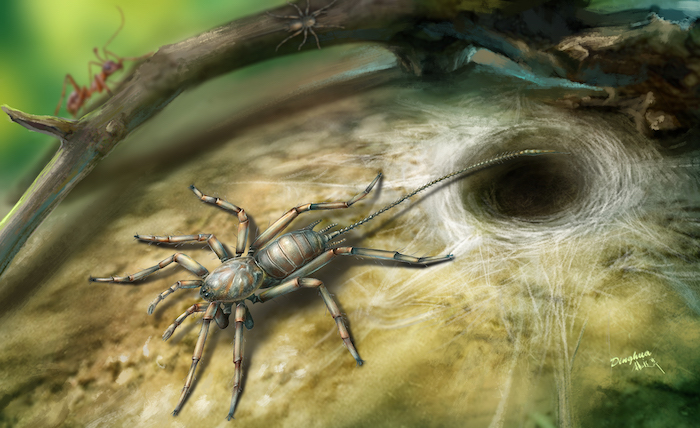
The new animal resembles a spider in having fangs, male pedipalps, four walking legs and silk-producing spinnerets but also bears a long flagellum or tail. Credit: Dinghua Yang

Paleontologists have identified an ancient and peculiar spider-like arachnid with a whip-like tail. Although this 100-million-year-old creature has eight legs, fangs, and could spin silk, it was not a spider, but rather a relative that lived alongside spiders. Scientists believe that the ancient species may resolve many loose ends in arachnid evolution.

Specimens belonging to the newly identified species called Chimerarachne yingi were collected from the amber markets of Myanmar, where paleontologists have time and time again come across invaluable fossils. Amber is nature’s time capsule, providing a glimpse of whatever plants or animals became trapped in resin before it fossilized. What’s amazing is that the amber process preserves parts that wouldn’t be conserved through regular fossilization. This is why scientists have been able to find, for instance, things like ticks dining on the feathers of dinosaurs, insects during a courtship dance, 30-million-year-old pristine-looking flowers, or even the oldest mammal blood still preserved in a chubby, 30-million-year-old tick.

“There’s been a lot of amber being produced from northern Myanmar and its interest stepped up about ten years ago when it was discovered this amber was mid-Cretaceous; therefore, all the insects found in it were much older than first thought,” said co-author Paul Selden, a paleontologist at the University of Kansas. “It’s been coming into China where dealers have been selling to research institutions. These specimens became available last year to Nanjing Institute of Geology and Paleontology.”

The C. yingi amber fossils are exquisitely preserved, allowing two different teams of researchers to identify the creature’s morphological features in striking details.

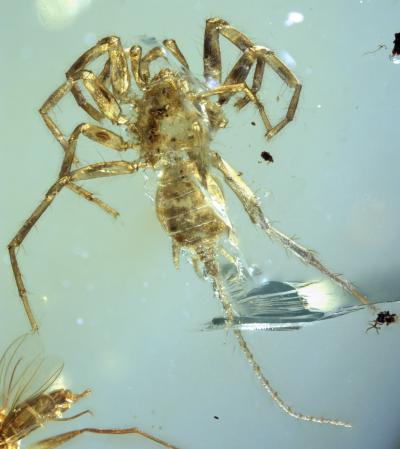
The dorsal view of entire Chimerarachne yingi specimen. Note the long tail-like appendage. Credit: University of Kansas.

Very much like today’s black widows and huntsman spiders, C. yingi had silk-producing spinnerets. And like modern spiders (the Araneae),  C. yingi males had two modified appendages called pedipalps near the head which were used to inseminate females. Unlike the Araneae, however, these creatures possessed a long tail, similar to those of modern scorpions.

It’s this peculiar feature that led the researchers to suspect that C. yingi belongs to a long-extinct arachnid order, known as the Uraraneida, which are differentiated by their tail-like appendage called a telson. Another distinctive feature is that uraraneids had plates on their bellies instead of the squishy abdomens seen in spiders.

These are tiny arachnids, measured about 2.5 millimeters body length, excluding the nearly 3-millimeter-long tail. Selden says the flagelliform appendage acted like a sort of antenna, allowing the creature to sense the environment.

But it’s not entirely certain that C. yingi is a Uraraneid, judging from the silk-producing organs which were more similar to those of modern spiders. The 100-million-year-old spider-like creature may actually belong to its own branch of the evolutionary tree, positioned between spiders and uraraneids. A rather unexpected way scientists could confirm this hunch is by discovering some of C. yingi‘s tailed descendents in the jungle.

“We know a lot about the Burmese biota during the Cretaceous,” he said. “It was a pretty good tropical rainforest, and there are a great many other arachnids we know were there, particularly spiders, that are very similar to the ones you find today in the southeast Asian rainforest. It makes us wonder if these may still be alive today. We haven’t found them, but some of these forests aren’t that well-studied, and it’s only a tiny creature.”

The two studies were published the journal Nature Ecology and Evolution.

Source: www.zmescience.com

Pages