Blogs

Permian Reptiles Could Detach Their Tails to Escape from Predators

Friday, March 9, 2018

This is an illustration of Captorhinus, a captorhinid reptile that lived during the Permian period, showing breakable tail vertebrae. Image credit: Robert Reisz.

A new study shows how a group of ancient reptiles called captorhinids could detach their tails to avoid predation.

Captorhinids, also known as cotylosaurs, are a group of small to very large lizard-like reptiles.

They first occured in the Late Carboniferous of North America. In Late Permian times they gained a near global distribution but dissapeared from the North American fossil record, and finally they became extinct by the end of the Permian.

As small omnivores and herbivores, captorhinids had to scrounge for food while avoiding being preyed upon by large carnivorous amphibians and early mammals.

“One of the ways captorhinids could do this was by having breakable tail vertebrae,” said study first author Aaron LeBlanc, a Ph.D. student at the University of Toronto Mississauga.

Like many present-day lizard species, such as skinks, that can detach their tails to escape or distract a predator, the middle of many tail vertebrae had cracks in them.

It is likely that these cracks acted like the perforated lines between two paper towel sheets, allowing vertebrae to break in half along planes of weakness.

“If a predator grabbed hold of one of these reptiles, the vertebra would break at the crack and the tail would drop off, allowing the captorhinid to escape relatively unharmed,” said University of Toronto Mississauga’s Professor Robert Reisz, senior author on the study.

“Being the only reptiles with such an escape strategy may have been a key to their success, because they were the most common reptiles of their time, and by the end of the Permian period 251 million years ago, captorhinids had dispersed across the supercontinent Pangea,” the paleontologists said.

“This trait disappeared from the fossil record when these reptiles died out; it re-evolved in lizards only 70 million years ago.”

The researchers were able to examine more than 70 tail vertebrae (both juveniles and adults) and partial tail skeletons with splits that ran through their vertebrae.

They compared these skeletons to those of other reptilian relatives of captorhinids, but it appears that this ability is restricted to this family of reptiles in the Permian period.

Using various paleontological and histological techniques, the team discovered that the cracks were features that formed naturally as the vertebrae were developing.

Interestingly, the scientists found that young captorhinids had well-formed cracks, while those in some adults tended to fuse up.

This makes sense, since predation is much greater on young individuals and they need this ability to defend themselves.

The study was published online this week in the journal Scientific Reports.

_____

A.R.H. LeBlanc et al. 2018. Caudal autotomy as anti-predatory behaviour in Palaeozoic reptiles. Scientific Reports 8, article number: 3328; doi: 10.1038/s41598-018-21526-3

Source: www.sci-news.com

New Research Sheds Light on Dinosaurs of ‘Lost Landmass’ of Appalachia

Thursday, February 22, 2018

Paleogeography of North America during the late Campanian Stage of the Late Cretaceous (~75 Ma). Modified after Blakey.

Around 90 million years ago, eastern and western North America were isolated from each other by a salty sea, creating two landmasses: Appalachia and Laramidia. The ancestors of Triceratops and Tyrannosaurus strutted about on the latter in what would one day become Utah and Alberta, leaving plentiful bones behind. A lack of fossils from eastern North America, however, has obscured Appalachia, leading to it being called a ‘lost landmass.’ Now, new research is broadening our knowledge of the dinosaurs that lived and died near the major metropolises of the eastern United States and Canada.

Dinosaurs from eastern North America have always been regarded as rather strange by scientists.

One relative of Tyrannosaurus rex from New Jersey has gigantic hands tipped with giant claws, a far cry from the notoriously puny arms of its western cousin. Giant duck-billed dinosaurs, more than 35 feet long from beak to tail, left their remains in the sediments of North Carolina.

All named eastern North American dinosaurs are known only from incomplete or fragmentary skeletons. Unlike the world-class fossil deposits of the American West, eastern North American sediments usually produce only the stray bone shard or tooth.

Unfortunately, this lack of fossils from eastern North America has hindered attempts at better understanding the distribution and evolution of dinosaurs during a period known as the Cretaceous, which lasted from about 140-65 million years ago.

For the past few years, Chase Brownstein, a research associate of paleontology at the Stamford Museum & Nature Center in Stamford, Connecticut, has been investigating this issue.

The paleontologist tallied up reports of dinosaurs from across the eastern part of the continent as presented in publications spanning over 150 years of scientific inquiry.

“This is, to my knowledge, the most complete review of eastern North American dinosaurs out there,” he said.

Additionally, Brownstein compared the compiled Appalachian dinosaur faunas to each other and to those from the American West to understand how the former changed from the latter during the 30 million year period of their separation.

The results suggest that eastern North American dinosaur faunas were not only distinct from those of the west, but also that the former were by-and-large composed of species rather more ‘primitive’ than their relatives from western North America and Asia, a hypothesis that has been gaining ground in recent years.

Additionally, the new research may show that the dinosaur wildlife from different parts of Appalachia differed from that of other areas of the landmass.

“A phenomenon known as faunal provincialism, in which different regions of a larger area have distinct assortments of species, may have occurred on Laramidia, and only recently has it been proposed for Appalachian dinosaurs,” Brownstein said.

“The new data does seem to indicate limited provincialism may have occurred among Appalachian dinosaur faunas, but future research will be needed to better substantiate this hypothesis.”

This research was published in the journal Palaeontologia Electronica.

_____

Chase D. Brownstein. 2018. The biogeography and ecology of the Cretaceous non-avian dinosaurs of Appalachia. Palaeontologia Electronica 21.1.5A: 1-56; doi: 10.26879/801

Source: www.sci-news.com

How Colourful and Feathery Were the Dinosaurs?

Saturday, February 17, 2018

Kulindadromeus: An example of a plant-eating dinosaur with feathers and scales

Dinosaurs are depicted as naked, scaly reptiles, but evidence shows they were much more bird-like

Jurassic Park (1993) featured Velociraptors hunting park visitors, depicting them as wily lizard-like predators. Time and science, however, have been unkind to the filmmakers. Velociraptors and most other dinosaurs were bird-like creatures. Even Tyrannosaurs rex is believed to have sported a plume (more “terrible emu” than “terrible lizard”).

“Over the past 10 to 15 years we have come to realise that dinosaurs possessed feathers. Not just some, but lots of them,” says Dr Maria McNamara at University College Cork. All sorts of feathered dinosaurs lived during the Jurassic – 201 to 145 million years ago (mya) – with feathers evolving first for insulation and display, not flight.

“Dinosaurs were depicted as these naked, scaly reptiles. Jurassic Park did that. But discoveries in China changed our perception. They were much more bird-like,” says palaeontologist Dr Jakob Vinther at the University of Bristol. Though there are no fossils of Velociraptors with feathers, Chinese fossils prove their relatives were covered in them.

Dinosaurs experimented with feather designs and shapes. Vinther recently re-examined fossils of a dinosaur called Anchiornis, from the Jurassic. Whereas modern birds have a long central shaft, barbs and then filaments that seal feathers together, Anchiornis was different: “[It] had a short shaft, but then long barbs coming off and bundles of filaments. It would have given the dinosaur a much fluffier appearance; more like a shaggy mammal than a bird,” Vinther says.

In 2017, lasers were used to study traces of soft tissue from Anchiornis and revealed a four-winged dinosaur with drumstick shaped legs, padded feet, a slender tail and an arm similar to a modern bird’s wing. The crow-sized dinosaur may have glided through its woodland home.


Upending science

The first bird is still seen by many as Archaeopteryx (150 mya), a famous fossil discovered in the 19th century in a limestone quarry in Germany. Dublin Zoo put a cast of an Archaeopteryx fossil in its Zoorassic World gallery where visitors can see feather impressions, teeth and a long bony tail, a hodgepodge of dinosaur and bird.

But it was discoveries in China that upended dinosaur science. “We went from a dozen specimens of Archaeopteryx to tens of thousands of feathered specimens, each of which was as amazing,” says Prof Mike Benton, senior dinosaur expert at the University of Bristol. “The level of detail just blew away the field because of the richness of data.”

At the start of his career in the 1980s, Benton was taught Archaeopteryx had about 30 features that set them apart from dinosaurs, including feathers, hallowed bones, reduction of teeth and a wish bone. “All these have been now found in dinosaurs, except one: Powered flight,” says Benton. All parts of the dinosaur family tree had feathers. At a minimum, feathers evolved with early theropod dinosaurs about 200-250 mya, two-legged flesh-eating dinosaurs that gave rise to T. rex.


Feather colour

By examining the shape of granules holding the pigment melanin, scientists such as McNamara have helped decipher the colour of feathers. The first reconstruction of colour was carried out by scientists at the University of Bristol and palaeontologist Dr Patrick Orr at University College Dublin in 2010, reported in the journal Nature. It revealed Sinosauropteryx had a feather-like covering of orange and brown and a striped white and orange tail, probably for display purposes.

In 2014, McNamara co-authored a paper in the journal Science describing a Jurassic dinosaur from Siberia that resembled a flightless bird such as an emu or ostrich (except it had a long tail). This was the first ever example of a plant-eating dinosaur with feathers and scales. Before that, it was only the flesh-eating theropods that were found with feathers. Today, palaeontologists suspect large dinosaurs lacking feathers lost them during evolution, similar to how large mammals such as elephants lost fur.

“If we didn’t have all these fossils from China, our understanding of dinosaurs would be very different today,” says Vinther. “Birds are dinosaurs.”


A land of feathered dragons

Northeast China is ground zero for a revolution in how we see dinosaurs. A huge area in Liaoning province has well-preserved fossils of feathered dinosaurs and early birds, which are remarkably widespread. “The area is huge, probably about 1,000 square kilometres,” says Benton. “It is a little unclear why the fossils are so exceptionally preserved, but lots of the sediment has volcanic ash. For some locations, it seems fossils were captured in ash, a little like Pompeii.”

Most seem to be buried in lake beds or marshes, and many people dig them out to sell to museums and collectors.

The fossils have shifted scientists’ views on how dinosaurs looked and behaved. Many apparently had bright feathers, like birds today, which could have driven sexual selection. Benton says: “There are so many species of these small theropod dinosaurs. It may be that sexual selection was spinning up the number of species.”

Source: www.irishtimes.com

What we Know About Dinosaurs will Probably Change

Wednesday, February 21, 2018

Everything we know about dinosaurs is connected to fossil records and, if the last decade is anything to go by, all of that could change dramatically over the next 20 years.

Much of what we know about dinosaurs is nascent by nature. It's difficult to study something that's been buried in the ground for 65 million years, right?

But a recent study from scientists at the University of Cambridge and Imperial College London has put some numbers behind our collective acquired knowledge of dinosaurs. It appears that much of what we know about dinosaurs could potentially change over the next 20 years.

The science is simple. Everything we know about dinosaurs is essentially derived from the fossil record. And over the last ten years there has been a dramatic increase in additions to that fossil record. In layman's terms: we're discovering more dinosaurs at rapid rate, which means we're constantly acquiring new, concrete examples of how dinosaurs actually lived.

Just take a look at this handy graph.

PeerJ

More dinosaur findings equals more knowledge, equals a better, broader understanding of how the scientific community understands dinosaurs as a whole.

In a blog post Jonathan P. Tennant tried to explain his findings.

"This has profound impacts on our understanding of dinosaur diversity, especially as these discoveries are unevenly spread over time and space," he wrote. "There are still huge gaps in our knowledge of the fossil record, and areas in space and geological time where the rapid pace of discovery is changing much of what we thought we knew about dinosaurs." 

Source: www.cnet.com

Paleontologists Find First Placodont Fossil in the Algarve

Friday, February 23, 2018

Paleontologists from Lisbon’s Universidade Nova have found the first placodont fossils in Portugal, they have announced.

Paleontologist Hugo Campos and Octávio Mateus told Lusa that they found the placodont “ribs and a Shell” in 2016, but only now disclosed the discovery by publishing a study in the catalogue for an exhibition “Loulé: Territories. Memories. Identities”, on display at the National Archeology Museum.

“Placodonts are a group of marine reptiles that had not been identified in Portugal, but are known in other parts of the world”, said Octávio Mateus, who supervised Hugo Campos’s paleontology Master’s thesis about Triassic vertebrates in the Algarve.

The study “Loulé more than 220 million years ago: the fossil vertebrates of the Algarve in the Triassic”, published now, describes that the placodonts lived in the sea during the Triassic period between 250 million and 200 million years ago, feeding on mollusks and they had boney plates that made them look a bit like turtles.

A large number of these boney plates, which the scientists call ‘osteoderms’, were found around Loulé and Silves in the Algarve in 2016 and 2017.

The researchers believe that these placodonts were of the ‘Henodus’ type because of the long, flat, hexagonal shape and without ornamentation of the shell and the lack of teeth.

The village of Penina, near Loulé, has what is considered to be the main deposit from the upper Triassic in Portugal and one of the most important for vertebrate paleontology in the country.

The deposit has turned up ten ‘Metoposaurus algarvensis’ (an amphibian similar to a salamander), bivalves and fish scales, phytosaurs (similar to crocodiles) and placodonts, but there may be as many as 20 animals.

The Triassic period, the first period of the Mezoic era, was a period in history when the continents were still all jo9ined together in a super-continent (Pangeia) and when the dinosaurs and other animals appeared and spread round the world.


Source: www.theportugalnews.com

"Black Beauty"

Saturday, February 24, 2018

"Black Beauty" specimen

Black Beauty (specimen number RTMP 81.6.1) is a well preserved fossil of Tyrannosaurus rex. The nickname stems from the apparent shiny dark color of the fossil bones, which occurred during fossilisation by the presence of minerals in the surrounding rock. The specimen is housed in the Royal Tyrrell Museum in Drumheller, Alberta, Canada. Black Beauty is the 14th most complete known skeleton of Tyrannosaurus rex, featuring 85 original bones (28% complete). Casts are on display in museums around the world, like the display at Naturhistoriska Riksmuseet in Stockholm, Sweden. In 2009, a paper by Jack Horner and colleagues illustrated the concept of parasitic infections in dinosaurs by analysing the lesions found on the cranial bones of Black Beauty. The specimen has been used to study comparative morphology between tyrannosaurids and Tyrannosaurus individuals, and some have suggested that Black Beauty should be classed as Dynamosaurus (=Tyrannosaurus). It has been claimed to be the smallest adult T. rex specimen known, even though a number of other adults have skeletal measurements that are similar to or smaller than those of Black Beauty.

Black Beauty was found in 1980 by Jeff Baker, while on a fishing trip with a friend in the region of the Crowsnest Pass, Alberta. A large bone was found in the riverbank and shown to their teacher. Soon afterward, the Royal Tyrrell Museum was contacted, and excavation of the sandstone matrix surrounding the fossils began in 1982.

Replicas of Black Beauty have been shown in some exhibitions and museums, including both simple skull montages and complete skeletons. The Naturhistoriska riksmuseet in Stockholm has a mounted complete skeleton of Black Beauty as one of their primary exhibitions called 4 ½ miljarder år, featuring the history of earth and life. Black Beauty has also been displayed in Paleozoological Museum, and a replica of the skull is on display at the Museum of African Culture. It was also part of the traveling exhibit Dinosaur World Tour in the 1990s.

Source: Wikipedia.org, NatGeo.com

10 Reasons to Celebrate Darwin Day

Wednesday, February 14, 2018

Why, each and every year, do scientists, humanists, and scholars from all around the world pay special attention to the life and work of Darwin on his birthday — February 12, 1809? (He was born the same day as Abraham Lincoln, by the way.)
 
Why do groups like the Hudson Valley Humanists literally make shrines to Darwin and bake evolution-themed cookies in his honor this time of year?
 
His work brings to our understanding of the human condition. Following are 10 reasons why you should celebrate Darwin Day.
______________________
 
 
10 Reasons to Celebrate Darwin Day
 
1. The field of biology did not exist until after Darwin’s ideas on natural selection were published (see Allmon, 2011).
 
2. Our understanding of modern medicine is improved exponentially as a result of medical professionals understanding and applying Darwinian principles (see Nesse & Williams, 1995).
 
3. Darwin was an abolitionist, supporting equality among people regardless of regional or ethnic background, way before being an abolitionist was in style. In fact, in many ways, he was more of an abolitionist than was his contemporary Abraham Lincoln (see Desmond & Moore, 2014).
 
4. Darwin’s perspective led to research that has shed extraordinary light on issues that are specific to women’s health (see Reiber, 2009).
 
5. Darwin’s perspective has led to advances in how we understand elementary education (see Gruskin & Geher, 2017).
 
6. Darwin’s ideas paved the way for the advanced understanding we now have regarding the evolutionary history of modern humans (e.g., Hodgson et al., 2010).
 
7. Darwin’s ideas have been applied to help us better understand how humans can live in urban settings (see Wilson, 2011).
 
8. Darwin’s ideas paved the way for the field of paleontology, helping us understand how fossils from across the world fit together to explain the history of the earth (e.g., Bose & Bartholomew, 2013).
 
9. Darwin’s ideas sparked an extraordinary number of additional academic fields, such as ethology, ecology, immunology, Darwinian Literature, evolutionary psychology, behavioral genetics, and more (see Wilson, Geher, Gallup, & Head, in production).
 
10. Darwinian ideas have dramatically improved our understanding of the positive aspects of the human experience, such as art, music, happiness, gratitude, spirituality, community, and love (see Geher & Wedberg, in production).
 
____________
 
This list is incomplete in many ways; Darwin's influence on our modern world extends well beyond the 10 points demarcated here.
 
Darwin’s impact on our modern world is simply extraordinary and hard to quantify. Without the publication of his ideas on the nature of life, we’d be without such academic fields as biology and paleontology. Our medicine would be far behind where it is now. And our entire understanding of what it means to be human would lack a science-based foundation.
 
Happy Birthday, Charles Darwin. And on behalf of hominids everywhere, thank you.


Source: www.psychologytoday.com


Here's Why 'Jurassic World: Fallen Kingdom' Looks Like A Terrible Idea

Wednesday, February 14, 2018

Jurassic World: Fallen Kingdom is just another Jurassic Park sequel that shouldn't be made. Credit: Universal

Jurassic Park was the first movie I saw three times in the theater. I was just about to turn 12 when it came out. I ended up watching it in two different countries. It remains one of my favorite movies of all time still to this day.

I can still recall almost every scene in the film since each scene is so memorable. Even before things went to hell, the movie was captivating. The moment when Dr. Grant and Ellie see the dinosaurs for the first time, I remember feeling that same sense of awe. Even the film's dialogue is impossible to forget. "Where's the goat?" "Clever girl..." "Life uh.... finds a way." "Hold on to your butts."

So many great lines.

Meanwhile, the scary scenes are palpable. The T. rex smashing the jeep with Lex and Tim inside. The kids hiding in that kitchen with the velociraptors hunting them, cruel and calculated and terrifying. Ellie turning on the back-up power (after finding Arnold's arm) and then running, limping, from the terrifying creatures. Scattered throughout these terrifying moments are bits of silliness, as well, like when Tim gets zapped by the electric fence. And bits of sentimentality, like when Hammond describes his flea circus.

Jurassic Park was a masterpiece. Excellent characters, clever writing, and some of the best, most frightening and tense scenes ever for a family-friendly horror movie. Oh, and a score that has become one of the most iconic ever written. I suspect you can hum it to yourself right now without even trying. The horns cascading over one another as the image of a helicopter flying over dense jungle and swelling waves floats across your mind's eye.

It's the last, and only, Jurassic Park movie that should have ever been made.

Jurassic Park used jello to create tension. Credit: Universal


A Long History Of Mediocre Sequels

None of the sequels have lived up to the greatness of the original. Neither of the original two sequels captured either the frights or the heart of the first movie. They're generic and forgettable. Neither Jurassic Park: The Lost World or Jurassic Park III seem to remember what made the first film so great.

It was a story of both wonder and terror, of incredible beauty and horrifying monsters, of scientific achievement and man's tendency to meddle too much in things we don't fully understand. It was science-fiction doing what it does best: Warning us of our own hubris. But it was also the story of a rag-tag family surviving impossible odds. There were no real villains or heroes, either. Hammond was arrogant but not wicked. Nedry was greedy but not dastardly. And the good guys, from Grant and Ellie to the slimy (but never wrong) Malcolm were all heroic simply because they had to be.

So the original sequels were terrible misfires. But then came Jurassic World, a film that---at first blush---appeared to learn from the past two films' mistakes. Jurassic World took the story back to the island, back to the original park itself. Now, years later, the mistakes of its original founders have been fixed. The park flourishes, teaming with visitors. But a new arrogance has overtaken the park's operators. In an effort to keep visitors from becoming bored (as if this would actually be a problem for the world's only dinosaur park) they've begun genetically engineering new dinosaurs.

In a lot of ways, Jurassic World does tap into the original's greatness. Once again, scientists and businessmen are meddling with the natural world in ways they don't fully understand, playing god and suffering the consequences. Once again, kids visiting the park are placed in grave danger. And once again, it's a traitor within the company that is to blame for most of the terrible things that happen, only this time it's Wu (B.D. Wong is the only actor who reprises a role from the original film.)

So in some ways Jurassic World simply copied the template from the original, hoping to rekindle that magic by following in its footsteps, much the same way The Force Awakens tried to harness A New Hope. And in some ways Jurassic World succeeds---certainly more than the first two dreadful sequels. But in other ways it falls short. Replacing Sam Neill's reluctant hero, Dr. Grant, is the strapping young superstar, Chris Pratt, as Owen. I'm a fan of Pratt's work, and he's fine in Jurassic World, but it's his character, and his character's occupation, that begins our rapid descent into stupidity.

Owen is a dino mommy. Credit: Universal

Credit; Universal

You see, Owen is a velociraptor trainer. The most terrifying creature from the original has been domesticated in Jurassic World. The film's producers learned nothing from the first film's horror elements. They create, instead, a genetically engineered super Tyrannosaurus rex that's basically all the brawn of the first film's T. rex with all the brains of the first film's velociraptors.

Unfortunately, this does not make the 'Indominus rex' twice as scary as either. In a film, fear and tension aren't created simply by making monsters bigger or more absurd. These things are products of careful storytelling and editing. The kitchen scene in Jurassic Park is frightening because two small children are being hunted by creatures we've seen kill much more capable adults. It's a frightening sequence because of how it was shot, how the kids were so believably terrified, and because the velocirpators were so well established as deadly and intelligent beasts.

The fact that Jurassic World devolves into Owen essentially sending his trained velociraptors into battle against the Indominus rex says pretty much everything you need to know about the film's approach to storytelling. It's a call-back to the original, but it's one of those call-backs that exposes a deep misunderstanding about what made the original great. Rather than evoking nostalgia, it helps us see how much the later film pales in comparison.

In Jurassic Park, our heroes are saved in the end by the T-rex. Not because it's out to save the humans; the creature is a hunter, driven by instinct. It just happens to cross paths with the velociraptors at precisely the right moment and while the dinosaurs fight, the surviving characters make their escape. Contrast this with Jurassic World. In that movie it's not enough to let the dinosaurs fight each other due to mere proximity, they clash because Owen is smart and talented and brave enough that he can order vicious predators to do his bidding. Like a superhero.

Fallen Kingdom

Now we have a Jurassic World sequel, Fallen Kingdom. It's the story of Claire (Bryce Dallas Howard) attempting to save the dinosaurs after the debacle that destroyed the park in the previous film. Naturally, Owen is back and so is Wu and a conspiracy and, of course, everything goes to hell. Sounds familiar enough. Here's the second trailer:

You can already see where Fallen Kingdom is plucking little ideas from the original and attempting to harness their power. The girl in bed as the monster lurks above is a truly terrifying prospect, but later we see that Owen is there as well. That he has found Blue, his pet velocirpator, and will once again use it to fight the monsters. There will be lots of guns, even though in Jurassic Park we learned that guns are pretty much useless.

It looks like another action blockbuster dinosaur movie. It doesn't look at all like Jurassic Park.

Yes, the original was an action movie. But it was also a horror movie and a character movie and funny and endearing. It was a movie about regular people in extraordinary circumstances and it was made with an eye to creating tension and release, not just jump scares and things blowing up. Jurassic Park is Stephen Spielberg at his best. It's more like E.T. than it is Trasnformers. But Colin Trevorrow's Jurassic World is like Stephen Spielberg dosed up on Michael Bay. That the next film is being directed by J.A. Bayona rather than Trevorrow does little to appease my doubts.

Everything about Jurassic World is bigger and flashier than Jurassic Park, and everything will undoubtedly be even bigger and even flashier in Fallen Kingdom.

Spare No Expense

Go big or go home. Credit: Universal


There's an irony to it, of course. The premise of Jurassic World was that park-goers had grown bored of "normal" dinosaurs. They sit around on their phones and yawn at the larger-than-life creatures (because apparently all the park-goers have already been there dozens of times already or something.) It's somewhat clumsy commentary on our current culture of sound-bites, tweets and Instagram, where everyone has screen-induced ADHD and we need increasingly poignant stimuli to grasp our attentions. So the people running the park have to keep upping the ante to keep the visitors engaged. Their hubris is their downfall.

Oddly enough, this is pretty much exactly what the movie itself has done, taking everything from Jurassic Park and amping it up to eleven. Bigger explosions, bigger dinosaurs, bigger (hotter) stars. More technology, more guns, more razzle-dazzle. The makers of these films have learned the same lessons as the operator of Jurassic World itself: nothing at all.

And sure, Jurassic World ended up being one of the biggest box-office successes of all time. By the numbers it's a massive success. But for all its bigness and all the money it made, it's still a pale shadow of Jurassic Park. There is nothing clever or ingenious or special about it. For all its CGI wizardry, it feels less real than its 1993 predecessor, every bit as shallow and unreal as its fake dinosaurs. Where Jurassic Park had heart and compassion, Jurassic World is a hollow shell.

I want to be excited for Fallen Kingdom but I'm having a hard time mustering much beyond apathy at this point. Jurassic Park should have been a stand-alone film. Not every movie needs a sequel, let alone four of them. Some stories are sagas. It makes sense to have a Star Wars trilogy. It makes sense to adapt each of the Harry Potter books into a film (though not to adapt the last book into two films) or the three Lord of the Rings novels into three movies (though not the singular Hobbit into three movies!) It makes no sense to do the same with Jurassic Park.

Jeff Goldblum as Ian Malcolm. Credit: Universal

In fact, the story of just how preposterous the sequels are can be traced all the way back to the second novel by Michael Crichton.

In the first novel, Jurassic Park, Ian Malcolm dies at the end. However, he survives in the movie version and Jeff Goldblum's character was so popular with audiences that Chrichton went back and retconned his death in The Lost World, which was already bound for the big-screen.

Turns out Malcolm was only mostly dead. Mostly dead is slightly alive.

In any case, this allowed Universal to cast Goldblum as the lead character in The Lost World. But Malcolm was only popular precisely because he was a funny secondary character; he never made sense as a lead. Anyone with half a mind for storytelling could have seen that---although, to be fair to Crichton, a great pile of money hung in the balance.

And that's really the story of all of Jurassic Park's sequels. They don't make sense. They don't belong. They're not very good. They're only here because they create great big piles of money for everyone involved. If Fallen Kingdom bucks this trend I'll eat my hat.

Oh, and Ian Malcolm is back, by the way. Jeff Goldblum returns to the fray. Once you've mostly died in a movie, you're never really gone for good.


Source: www.forbes.com

China's Dinosaur County Restores 813 Fossils

Tuesday, February 13, 2018

Protoceratops and Velociraptor

China's dinosaur county, Jiayin, in northeast China's Heilongjiang Province has restored a total of 813 dinosaur fossils since 1902.

A 15 meter long, 6 meter tall dinosaur skeleton will be pieced this year, according to Shen Fengbin, director of the research department of Jiayin Shenzhou Dinosaur Museum.

So far, more than 10 species of dinosaur fossils have been found in Jiayin and places nearby, said Shen.

Jiayin is in the north of Heilongjiang Province. Hundreds of dinosaur skeletons are believed to be buried underground.


Source: www.xinhuanet.com

Prehistoric Rainforest Collapse Dramatically Changed the Course of Evolution

Tuesday, February 13, 2018

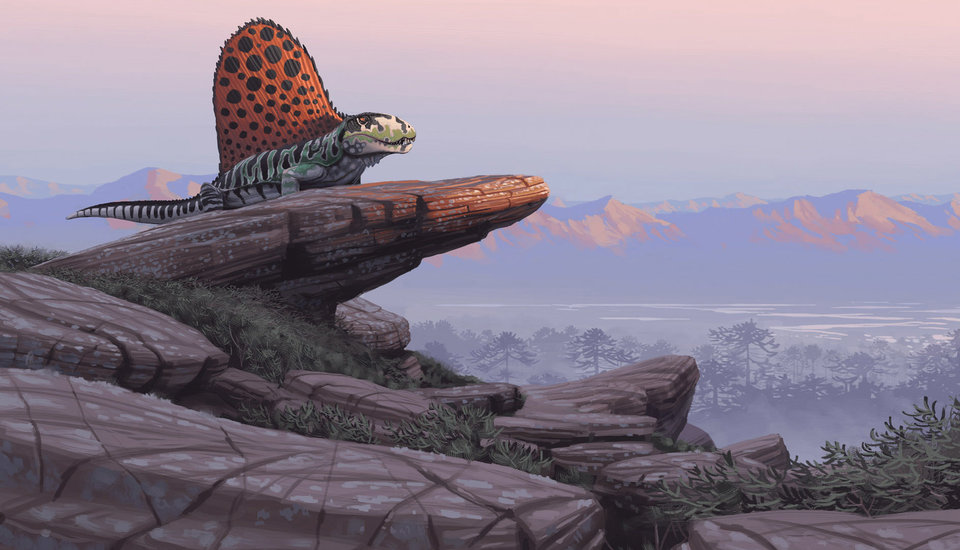
Artist's recreation of Dimetrodon in its habitat | Simon Stalenhag

The collapse of rainforests during the Carboniferous period 300 million years ago triggered great changes in the evolutionary paths of plants and animals.

It is estimated that more than 150 acres of rainforest are lost each minute of every day, totaling some 78 million acres of loss annually. Should this current rate of tropical deforestation continue, NASA's Earth Observatory projects that rainforests will vanish within a century, "causing unknown effects on global climate and eliminating the majority of plant and animal species on the planet."

Although the present level of human-caused deforestation is unprecedented, this is not the first time that rainforests have dramatically shrunk in size. Tropical rainforests collapsed around 307 million years ago, toward the end of the Carboniferous period (359–299 million years ago).

New research on this prehistoric rainforest collapse, published in the journal Proceedings of the Royal Society B, finds that it forever changed the course of evolution for terrestrial species, with effects still felt today.

"There have been several studies over the last 40 years on how diversity has changed through time, but it is only in the last few years that researchers have begun to acknowledge the limitations of fossil data," lead author Emma Dunne of the University of Birmingham told Seeker.

She added, "Newly developed methods have been allowing researchers to look for genuine patterns of diversity amongst this patchy fossil data, and we thought it was time to look more closely at diversity patterns of the first vertebrates to live on land."

A key source of information for Dunne and her colleagues is the ever-growing Paleobiology Database, which is the largest international collaborative project among paleontologists all over the world. It has already supported more than 300 papers and is being used now more than ever by scientists.

Throughout her work on the new study, Dunne actually updated, and added to, the database's information on early tetrapods: vertebrates with two pairs of limbs, including those that lost one or both pairs over evolutionary time, such as whales and snakes.

Around 310 million years ago, before the early rainforest collapse, North America and Europe were part of a single landmass located at the equator. There, dense tropical rainforests flourished. This was at a time before the first dinosaurs and mammals evolved.

The ample vegetation and warm, humid climate supported amphibian-like early tetrapods, which quickly diversified into many different species. Giant dragonflies, millipedes, the first amniotes — egg-producing animals that lay them on land or within the mother — and even early cockroaches were also around then.

But the tropical paradise began to change.

"Carbon dioxide levels dropped in the late Carboniferous, and this led to the cooling and drying of the climate," Dunne explained.

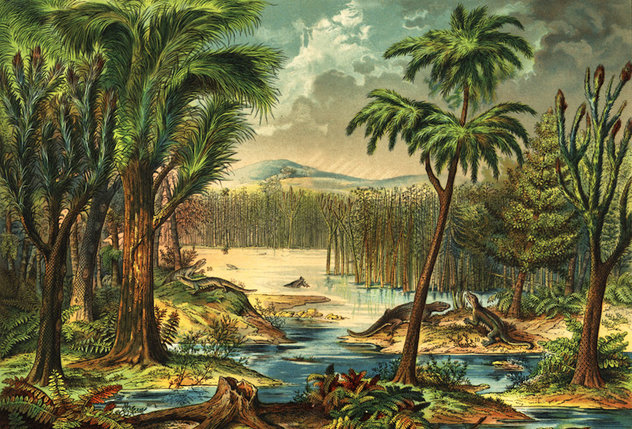
Artist's recreation of a forest during the Carboniferous period |Mark Ryan

The event proved to be catastrophic to plants, and rainforests began to disappear. What happened to animals has been debated for many decades.

A prevailing theory has been that tetrapod diversity reduced markedly before endemism occurred. Endemism refers to species evolving in defined geographic locations, such as on an island, in a particular country, or in some other defined zone. In short, the species are basically confined to a certain place where they evolve to live.

Source: www.seeker.com

Pages