Blogs

Ancient Fish Species Discovered in Nova Scotia
Thursday, May 17, 2018

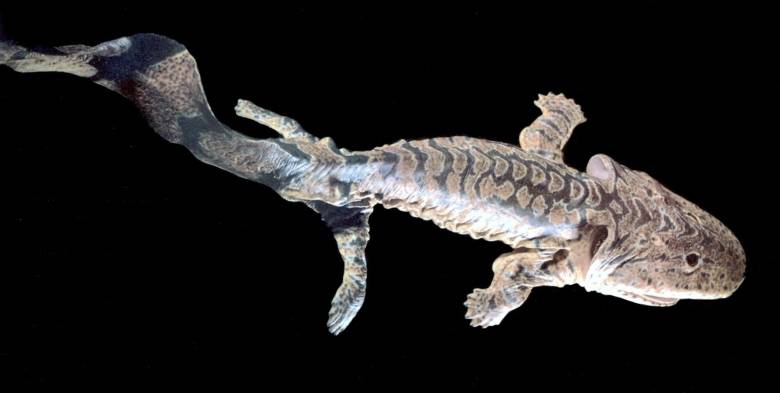
Fish fossils found at Blue Beach, N.S., can help fill in evolutionary gaps between fish and four-legged creatures, such as this early tetropod which was fish-like, with tail fins, gills and up to eight fingers. (Richard Hammond)

A species of fish that lived 350 million years ago has been discovered in Nova Scotia, casting new light on a little-understood time period.

The discovery was made in 2015 by Jason Anderson, a vertebrate paleontologist at the University of Calgary, at Blue Beach, N.S., and announced Wednesday.

Chris Mansky, fossil researcher and curator of the Blue Beach Fossil Museum, says Anderson located the skull of the early Carboniferous fish and was able to compare it to the family tree of better-known relatives of the fish.

Mansky says the research of Anderson and his team show the fish’s lineage appears to be a survivor of the Devonian extinction, which contradicts the notion that the extinction wiped out that group.

The species — Avonichthys manskyi — was named after the nearby Avon River and for Mansky, in honour of his years of collecting and exhibiting the fossils of Blue Beach.

The findings were published Wednesday in the United Kingdom’s peer-reviewed Royal Society Open Science journal.

Mansky said the fish is unique, and the discovery means that researchers may start looking at evolution differently.

“It paves the way for future researchers. It gives us new theory and it upsets the old theory,” he said.

“The old politics of the Devonian extinction is very much in debate. This is essentially a road map of new opportunities for young researchers who can work at this for many years… The actual shape and patterns of evolution are not so clear. To gain an understanding of how it really was, we still have a lot of work.”
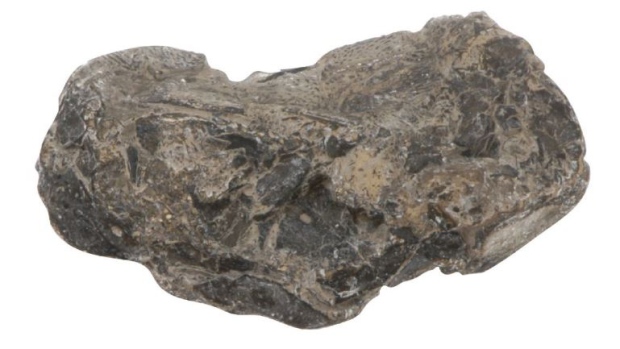
A skull of the early Carboniferous fish, found in Nova Scotia, is seen here. (Source: Royal Society Open Science)

Anderson said he came across the specimen by chance during a stroll on Blue Beach.

“There’s nothing extraordinary about that moment at all. I was just literally walking along looking at the ground, kicking rocks, and I found one that was the shape of a bone. I didn’t even know it was a fossil,” said Anderson from a conference in Ottawa.

“It wasn’t until a few months later that I actually put it under a microscope.”

Anderson said there are many lingering questions, including how many of these fish species survived the extinction.

“Or is it an artifact of preservation, the fact that we just don’t have very many fossils of this age? Now that we’re actually actively exploring, will we start filling in more of these lineages? Or is this one real lucky one that managed to squeak through?” he said.

“We need to get a better idea of what other fish lived at that time, and in other places at the same time, and that will tell us more about how severely vertebrates were impacted by the mass extinction.”

He said that research has already taken him back to Blue Beach.

The site where the fossil was located is on the Bay of Fundy’s Minas Basin, which has the highest tides in the world. The sea has eroded into the shoreline, uncovering 350-million-year-old fossils.

“This highly dynamic environment, over four kilometres in length, creates unique opportunities for discoveries that would otherwise be very difficult to make,” said Mansky.

“Nature does the digging here.”

Mansky said his museum has a collection of roughly 10,000 fossils, weighing roughly 100,000 pounds. He described it as “busting at the seams,” making it impossible for researchers to examine and catalogue the material properly.

“These were findings and a paper generated from a single fossil, so we can only imagine how much more there is to be learned in the upstairs of Blue Beach Fossil Museum,” said Mansky.

“There needs to be a new paleontology centre developed here to establish a permanent foothold for this fossil collection. It’s a world-class collection and right now we have a private home-based, ma-and-pa museum. The collection has outgrown its home.”

Conrad Wilson and Jason Pardo were also authors of the article published Wednesday.

Source: http://canoe.com

Fallen Kingdom Promises More Dinosaurs Than Every Jurassic Park Movie Combined

Wednesday, May 16, 2018

Jurassic World: Fallen Kingdom

Jurassic Park’s original trilogy was never at a shortage for dinosaurs (except when one got loose here and there), but the sequel to the franchise’s expansion to Jurassic World is flexing its sheer numbers when it comes to the extinct creatures.

Not only will Jurassic World: Fallen Kingdom have a man-made dinosaur (genetically-modified to be even more man-made than the rest of the dinosaurs made by foolish scientists), it’ll have “more dinosaurs than you’ve ever seen in all the other Jurassic movies combines,” according to producer Pat Crowley. He’s speaking to that point in a newly-released behind-the-scenes featurette on the dinosaurs of the park, which highlights the creation of the dinos and the vast array of species the film will bring to the screen.

Take a look:

Director J.A. Bayona assures fans that they’ll see the specific T-Rex and velociraptor from the first film while adding on a slew of others, including a mosasaurus, baryonyx, carnotaurus (which fights a sinoceratops, according to star Bryce Dallas Howard), and the comic relief-giving stygimoloch. That’s enough creatures to please any kid entering their dino phase and enough to make saving them from the exploding island a tricky proposition.

The animatronic details and creature design will seem even cooler in hindsight after seeing it in motion when Fallen Kingdom hits theaters on June 22, 2018.

Source: www.syfy.com

How Giant Dinosaurs Sat on Their Eggs Without Crushing Them?

Wednesday, May 16, 2018

A fossilized nest from an oviraptorosaur found in China displays a ring-shaped clutch with a large central opening, where the brooding dinosaur would have rested most of its weight.  PHOTOGRAPH BY KOHEI TANAKA

Imagine a hummingbird sitting on a tiny nest filled with even teenier eggs. Adorable, right? Now picture a dinosaur the size of a fully grown hippopotamus settling onto its eggs—sounds like a recipe for a dinosaur omelet.

But a new study of dinosaur nests, along with a stunning, newly revealed fossil of a dinosaur that died tending its eggs, shows that heftier dinosaurs did have a strategy to avoid squashing their young: carefully stacking their eggs in a ring around themselves in the nest.

The findings, published today in the journal Biology Letters, provide a rare glimpse into how nesting behaviors seen in today’s birds got a start among their dinosaur ancestors.

“Most likely this behavior of sitting on the nest evolved first in dinosaurs,” says study coauthor and paleontologist Darla Zelenitsky of the University of Calgary in Canada.

CRUSH-PROOFING 101

Zelenitsky’s team studied 40 nests built by oviraptorosaurs, birdlike dinosaurs that lived more than 65 million years ago. These animals ranged in weight from a few pounds to about 4,000 pounds, with the largest among them similar in bulk to a modern hippopotamus or rhinoceros. Their nests in turn could be anywhere from about a foot wide to a colossal 10 feet.

In smaller nests, Zelenitsky says, eggs were clustered with little or no open space in the center. As the dinosaurs and their nests got bigger, the creatures left more and more space in the middle to sit, creating elaborate piles of eggs.

“The photos don’t do these clutches of eggs justice,” she says. “They’re two to three layers of eggs, and they’re stacked in a spiral that inclines up toward the center of the nest.”

As for why the dinosaurs built nests in the first place, Zelenitsky says it’s hard to know for sure. “Most birds sit on eggs to provide heat to the eggs,” she says. “But we don’t know if that was the case with oviraptorosaurs—we don’t know if to provide shelter or protection, or for warmth.”

An illustration shows what a larger oviraptorosaur probably would have looked like nesting.  ILLUSTRATION BY ZHAO CHUANG

A RARE FIND

In April, another team unveiled a spectacularly preserved example of a dinosaur in a nest, found in Mongolia’s Gobi desert and described by the American Museum of Natural History.

“This is the rarest of the rare,” says paleobiologist Greg Erickson of Florida State University in Tallahassee, who collaborated with study leader Mark Norell of the AMNH. The National Geographic Society partly funded the 1995 expedition that discovered the specimen.

The dinosaur, known as Citipati osmolskae, was a roughly emu-sized oviraptorosaur. It was most likely either buried alive by a collapsing sand dune, or it died in a sandstorm and was then covered by sand, Erickson says, preserving its position on the nest. Consistent with the other new findings, the eggs were arranged in a ring with a central opening that could have carried at least some of the adult’s weight.

It’s not clear whether the dinosaur was male or female, and Erickson points out that males tend the nests of some modern birds. Either way, “it was a very good parent,” he says. The animal died with its winglike arms still stretched over 12 eggs. Today’s birds use the same pose to camouflage their eggs or protect them from the elements.

EARLY BIRDS

“All of this is more evidence of the fact that birds evolved from dinosaurs,” says paleontologist and National Geographic grantee Stephen Brusatte of the University of Edinburgh in Scotland.

“A lot of us were brought up on this idea that dinosaurs were big overgrown lizards, lumbering and dimwitted, and that’s just not the case at all.” Instead, he says, many dinosaurs were very birdlike.

In fact, adds Erickson, “you can walk outside today and see 10,000 species of dinosaurs fluttering about.”

Source: https://news.nationalgeographic.com

Dinosaurs Arrive at Rosamond Gifford Zoo for Summer Long Exhibit

Tuesday, May 15, 2018

T. rex was one of the first dinosaurs to arrive at the zoo Monday. The Dinosaur Invasion! exhibit officially opens May 25.( photos by Maria Simmons)

Five tractor-trailers full of animatronic dinosaurs arrived Monday from Texas-based Billings Productions to be installed at the Rosamond Gifford Zoo for a summer-long exhibit beginning May 25.

A total of 13 dinosaurs are being stationed around the zoo with help from exhibit sponsor C&S Companies Monday and Tuesday. Some outdoor areas of the zoo may be off limits during the install, but the public will be able to see some dinosaurs being moved and readied for exhibit over the next 10 days.

The first dinosaurs off-loaded Monday included Tyrannosaurus rex, the armored dinosaur Edmontonia and an interactive T. rex robot that guests will be able to operate via a control panel.

The huge, lifelike dinosaurs are equipped with sounds and movement, but will remain stationary until Friday, May 25, when the Friends of Zoo officially opens Dinosaur Invasion! 101 Days of Dinosaurs through Labor Day Sept. 3.

Dinosaur Edmontonia was among the first dinosaurs unloaded at the zoo Monday.

"We have been excitedly working for several months to bring dinosaurs to the zoo," said Friends of the Zoo President Janet Agostini. "Now that they're here, we are even more eager to see the impact they will have on our guests and to reinforce our conservation message about saving animals from extinction."

Friends of the Zoo will open the exhibit on May 25, when the dinosaurs will "come alive and be fully operational," Agostini said. 

She said several other zoos have exhibited Billings' dinosaurs to great success. Dinosaur Invasion! offers many opportunities to talk about zoo animals that share characteristics with dinosaurs, the link between dinosaurs and birds, and the zoo's active role in saving today's endangered species from extinction, she said.

Several events are in the works to make the most of the prehistoric presence at the zoo. They include this year's Brew at the Zoo, the Friends' biggest annual fundraiser, on Friday, August 3, dubbed 'Brew at the Zoo & Dinos Too' for 2018.

The zoo will offer other special events such as Donuts with Dinos for an added fee, but the summer-long display itself is free for zoo members or with zoo admission during zoo hours. A special pass also will be available for sale for guests who would like to participate in dino activities at a Paleo Tent in the zoo courtyard.

Source: www.syracuse.com

Dig Up Dinosaurs at These Family-Friendly Paleontology Sites

Tuesday, May 15, 2018

Photo: Dylan Otto Krider

Looking for a fun, educational summer activity the whole family can get in on? How about digging up actual dinosaur bones and other fossils! Here are a few of the best dig sites across the country that welcome newcomers who want to learn about paleontology.

You don’t need to go on an official dig with real dino pros to find fossils out in the world, but it’s better if you do. You’re able to learn more about what you’re digging up, and you do so in an ethical fashion so researchers can actually use what you find. Best of all, these types of expeditions are often fairly affordable, and they can be enjoyed kids and adults alike.

Tara Lepore, a field paleontologist and science educator, offers a few vertebrate paleontology dig recommendations over at Outbound Adventurer:

This isn’t all that’s out there, though—not even close! If you’ve got some money, time, and body that’s in decent shape, you can volunteer to participate in almost any paleontological dig. Do some research on your local colleges with paleontology programs, or contact your local natural history museum to see what they have planned. You can learn more about the digs listed above at the link below.

The Dig On Paleontology Digs In the United States | Outbound Adventurer

Source: https://lifehacker.com

Real Life Jurassic Park: Scientists Hope Discovery Will Lead to MAMMOTH-ELEPHANT Hybrid

Tuesday, May 15, 2018

GETTY BREAKTHROUGH: Scientists hope cloned mammoths will be introduced to a Siberian park

AN ASTONISHING breakthrough has raised hopes that a real-life Ice Age Jurassic Park could be just around the corner.

Scientists working in the frozen tundra of Siberia have been able to successfully reintroduce a species not seen in the area for 1,000s of years to the area.

This week a yak calf born as part of the epic experiment took its first steps after the herd was introduced to northern Yakutia.

Russian scientists are aiming to recreate the Ice Age ecosystem of Siberia in Pleistocene Park.

It was a time when woolly mammoths roamed the area as well as many other prehistoric creatures long extinct.

EXTINCT: Woolly mammoths used to roam the frozen tundra of Siberia. NIKITA ZIMOV

But the scientists believe that by reintroducing these creatures, they will not only restore the landscape, but they also believe it could reverse global warming.

By sealing in leaking methane, they believe the new inhabitants of Siberia will prevent further melting of the permafrost.

A herd of bison are also expected to be moved to the park.

Over 20 square kilometres of land, the scientists hope one day they will be able to bring back the woolly mammoth.

 WILD: Pleistocene Park in Siberia is recreating the Ice Age natural landscape & wildlife. NIKITA ZIMOV

A team at Harvard University are using DNA recovered from a long-extinct beast after it was found perfectly preserved in the Arctic ice 42,000 years after it died.

By combining this DNA with that of an elephant, the team will create a new hybrid creature and introduce it to Pleistocene Park.

Chief scientist George Church said: "Cold-resistant elephants would flatten the insulating snow and supporting trees in winter and favour the highly heat reflective grass in summer.

"They would also help capture new carbon by enhancing the photosynthetic capacity of the vegetation," he added.

FAMILY: Sergey Zimov (left) and son Nikita are the park's directors. NIKITA ZIMOV

The park is run by father and son team, Sergey and Nikita Zimov.

Explaining the importance of the work to introduce mammoths, Nikita said: "Arctic permafrost is melting. It will trigger catastrophic global warming.

"We're creating a northern Serengeti to stop that from happening.

"Here in the most remote corner of Siberia my father, Sergey Zimov, and I are reviving the Ice Age "Mammoth Steppe" ecosystem."

MIGRATION: Pleistocene Park is flying bison from Alaska to Siberia

He added: "Natural grasslands, maintained by numerous grazing animals, have the capacity to both slow climate warming and prevent permafrost from melting".

It's been revealed to Daily Star Online that new mammoths could be cloned as soon as this year.

Is the planet headed for another mini Ice Age?

Source: www.dailystar.co.uk

Fossil Tail From Jurassic Could Shed Light on Crocodiles’ Family Tree

Friday, May 18, 2018

Fossil Tail, Jurassic Crocodile Family Tree

A fossil tail was discovered by paleontologists, who believe it could be the missing link in the evolution of crocodiles.

Ancient crocodiles in the Jurassic period (200-145 million years ago) were split into two groups. One group of crocodiles had an armored skin – like dinosaurs, and used their limbs to walk. The second group looked more like a dolphin: they had tail fins, flippers and no armors like the land group.

The fossil is 180 million-years-old, and researchers believe that it belonged to an intermediary species of the two groups. Mark Young, with the University of Edinburgh’s School of GeoSciences, explains their findings:

“This fossil provides a unique insight into how crocodiles began evolving into dolphin and killer whale-like forms more than 180 million years ago.”

The tail fossil points towards a crocodile that had both the tail fin and the armor, meaning that crocodiles were highly diverse in the Jurassic era.

Young and his colleagues at the university have discovered the tail in 1996. They dug it up in a mountain in Hungary and called it Magyarosuchus fitosi – after Attila Fitos.

Not So Different from Their 30 Million-Years-Old Ancestors

Young and his colleagues published the study in the journal PeerJ. Their study points out that the fossil belongs to a species of crocodiles that is different from the other ones. The tail contained a weird looking vertebra, writes the report:

“The unique combination of retaining heavy dorsal and ventral armor, while having a slight hypocercal tail, on the other hand, highlights the mosaic manner of marine adaptations in Metriorhynchoidea.”

Evan Whiting is a doctoral student at the University of Minnesota and studies crocodiles. He explains why discovering a new species of crocodiles back in the past is so rare:

“If we could step back in time 8 million years, you’d basically see the same animal crawling around then as you would see today in the Southeast. Even 30 million years ago, they didn’t look much different.”

Source: https://greatlakesledger.com

Paleontologist Discovered a Crocodiles Transitional Fossil that Back in Jurassic time

Monday, May 14, 2018

Paleontologists have actually found a Jurassic fossil tail, which could be the missing out on web link in the family tree of crocodiles.

Jurassic duration

Throughout the Jurassic duration in between 200 to 145 million years back, old crocodiles had 2 standard kinds. One team had dino-like shield and also utilized arm or legs for strolling ashore. The various other team was much more dolphin-like, having tail fins and also fins as well as no shields.

Scientist claimed that the 180 million-year-old fossil came from an intermediary types that included both shield and also tail fins.

”This fossil gives a special understanding right into just how crocodiles started advancing right into dolphin and also awesome whale-like types greater than 180 million years back,” stated Mark Youthful, from the College of Edinburgh’s College of GeoSciences.

The scientist claimed that the visibility of both the tail fin as well as bony shield reveals the amazing variety of crocodiles throughout the Jurassic duration.

Youthful and also coworkers, that collected the tail in a hill in Hungary in 1996, called the brand-new types Magyarosuchus fitosi after Attila Fitos.

Odd-Looking Vertebra Attributes
Researchers differentiated the fossil to be various from various other varieties due to an odd-looking vertebra that developed part of the animal’s tail fin.

In a research study released in the journal PeerJ, Youthful and also coworkers defined the varieties that included sharp teeth that were most likely made use of for realizing victim as well as a body gauging 5 meters long.

” The special mix of maintaining hefty dorsal and also forward shield, while having a minor hypocercal tail, on the other hand, highlights the mosaic fashion of aquatic adjustments in Metriorhynchoidea,” the scientists wrote in their research.

Basically Unblemished By Advancement
Crocodiles are one-of-a-kind animals because they hardly altered during countless years. Unlike a lot of pets that live today, these prehistoric-looking animals stayed practically unblemished by significant transformative modifications for a minimum of 8 million years.

” If we can go back in time 8 million years, you ‘d primarily see the very same pet creeping around after that as you would certainly see today in the Southeast. Also 30 million years back, they really did not look a lot various,” claimed Evan Whiting, a doctoral pupil at the College of Minnesota, that examines crocodiles.

Why Scientist Research Crocodiles As Well As Alligators?
Examining crocodiles supply scientists chance to research various other pets such as to find out just how birds could have advanced from dinosaurs as well as to recognize feasible qualities of the currently vanished dinosaurs.

Scientists additionally research alligators and also crocodiles to locate much more reliable antibiotic therapies because of these animals’ durable body immune system.

Source: https://dailyenterpriser.com

Canon City Stegosaurus Fossil Basis of New Display at Royal Gorge

Monday, May 14, 2018

COURTESY PHOTO This close-up photo of the spiked tail and back places of a stegosaurus hints at the immense size of the fossil to be unveiled May 19 at the Royal Gorge Dinosaur Experience in Canon City.

A Stegosaurus skeleton believed to be the first of its kind in the world to be created from three-dimensional scanning and printing is set to be unveiled Saturday at the Royal Gorge Dinosaur Experience, 44895 U.S. 50, eight miles west of here.

The Stegosaurus, modeled after the fossil unearthed in Garden Park Dinosaur Fossil Area just north of Canon City in 1936, will be the subject of a homecoming gala dubbed "Stego Mania." The event will run from 1 to 3 p.m. Saturday.

The original stegosaurus fossil was found by Professor Fred Kessler, a local high school geology teacher who was accompanied by a group of his students. That 82-year-old find is on display at the Denver Museum of Nature and Science and, in the spirit of sharing, the museum granted dinosaur cast builder Mike Triebold permission to create a three-dimensional digital scan of the bones.

Triebold, of Triebold Paleontology Inc., is "a world leader in dinosaur casts and has built the entire cast-skeleton collection at the Royal Gorge Dinosaur Experience," said Zach Reynolds, museum director.

"The Stego Mania event will welcome the newest and most high-tech member of our cast-skeleton collection. This new display gives us a great excuse to welcome our friends to the museum for a day of fun-filled activities, games and giveaways," Reynolds said.

Kessler's stegosaurus is one of three stegos unearthed in the fossil area here. The stegosaurus was officially named the state fossil in 1982.

Ironically, Reynolds' maternal grandfather, Pete Allen, was a local high school teacher who worked with Kessler to excavate dinosaurs in the 1950s and 60s in Garden Park.

"All told, this project took two years to complete and represents one of the crown jewels in our collection," said Reynolds. "Once unveiled, the unique stegosaurus casting will reside on its own custom-built, permanent display on the southwestern corner of our main exhibit hall."

Stego Mania will include Diana Biggs, a museum adventure guide, presenting "Stego 101" for children ages 4 and up in the museum's Kids Interactive Area. Children also will be making stegosaurus-themed crafts on the patio.

Light refreshments will be served and food trucks will be selling heartier fare.

Reynolds said a fire that engulfed the museum's outdoor animatronic Tyrannasaurus rex was caused by an isolated electrical issue in late March. The unexpected fire drew a lot of attention to the museum.

"The T. rex quickly turned it into a roaring, 30-foot wall of flames. Video and photographs of the blaze was seen by tens of millions of people around the world on countless television news programs, in newspapers and on websites," Reynolds said.

The T-Rex at the Royal Gorge Dinosaur Experience was destroyed by a fire that was ignited by an electrical issue in March. The museum plans to replace the animatronic. (Zach Reynolds / Royal Gorge Dinosaur Experience)

"We have already ordered a replacement animatronic T. rex, and our nearby ropes course was thoroughly inspected and reopened a week after the fire. The now-iconic photograph should soon be gracing the cover of an upcoming rock 'n' roll album -- they just liked our image and licensed it -- plus we plan to make the image available on official gift shop merchandise in coming months."

The museum's summer hours starting May 24 will be 10 a.m. to 5 p.m. Monday through Thursday and 10 a.m. to 6 p.m. Friday through Sunday.

Source: www.chieftain.com

How A 50 Million Year Old Fossil Could Shed Light On The Origins Of Certain Mammals

Saturday, May 12, 2018

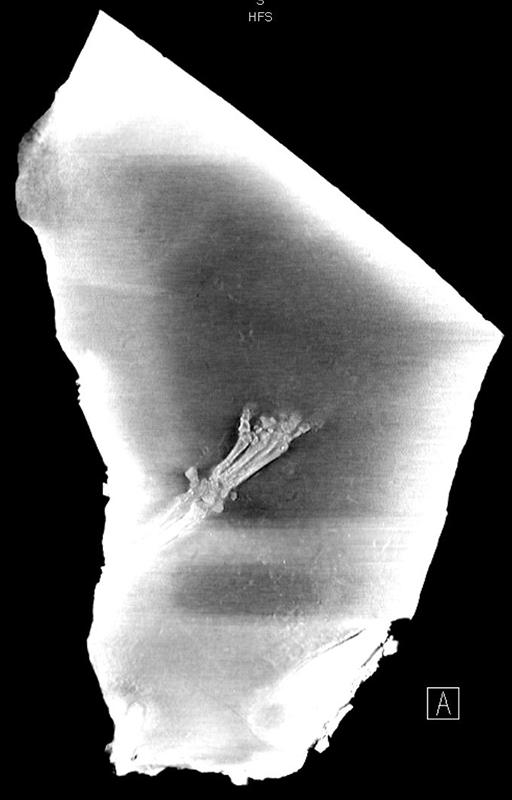
CT scan imagery taken at Ivinson Memorial Hospital & Foundation shows what is potentially the complete foot, ankle, and lower leg bone structure of the tapiromorph specimen discovered near Kemmerer, Wyoming. Modern tapirs have four toes on their front feet and three on their back feet. If modern analogies are representative of this specimen, this image shows what appears to be a four-toed front foot. CREDIT WYOMING STATE GEOLOGICAL SURVEY

On a bright, cloudless day in southwest Wyoming, Rick Hebdon, a commercial fossil collector, drove over a steep dirt road to one of his quarries within the Green River Formation. He’s been uncovering fossils for most of his life, but it still holds a thrill for him.

"Like… what my dad said, ‘It’s like digging in the crackerjacks looking for the prize'," he said, laughing.

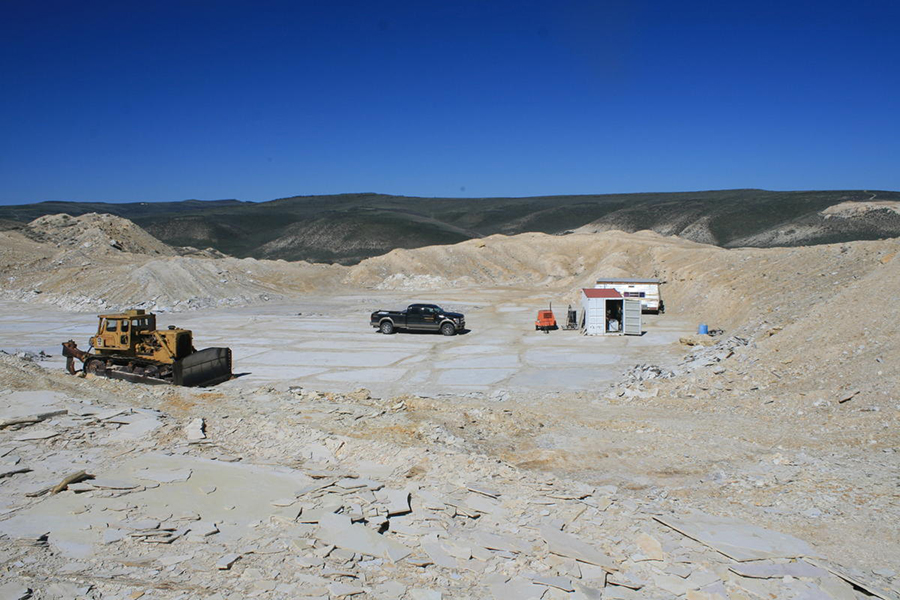
Hebdon stepped into the crater-like formation and pointed to small black fish imprints on the ground. He explained the Green River Formation used to be covered in big lakes. 50 million years ago, Wyoming had a climate closer to Florida, so Hebdon is used to uncovering fish fossils.

"99 out of a 100 times you’re going to find a fish. And then sometimes you get a little insect or a leaf, something that gives you a little surprise. But to find a mammal," Hebdon said, "it’s crazy rare to even have them out here."

Finding a mammal is so rare because 50 million years ago mammals were just taking off. They were evolving to become the modern animals we know today, albeit a little smaller. So, when Hebdon found one, he was excited.

"Up in this layer, right there. And that’s where this new mammal was found. And it was right here," he said, pointing to a rectangle on the ground.

Hebdon found well-preserved hooves, a long femur bone, a tooth, and a mostly put together rear-half. He reached out to a paleontologist nearby who couldn’t find a match for the species. But, Hebdon did find out it might be the largest mammal ever found in the Green River formation.

One of Rick Hebdon’s state-leased quarry where the tapiromorph fossil was originally found. CREDIT COOPER MCKIM

Hebdon’s quarry was state-leased. Soon after he found the fossil, it went to the Wyoming State Geological Survey (WSGS) in Laramie. A paleontologist in North Carolina narrowed down what it could be based off of a molar image, finding it was likely a tapiromorph - the group that gave rise to modern rhinos and tapirs.

Mark Clementz, director of the University of Wyoming’s Geological Museum, said this fossil could help answer long-held questions about where tapiromorphs came from.

"Which continent was their home is a big question and there’s a lot of debate surrounding it because their fossils are found all over those different continents," he said. "It may be it’s a North American origin for either tapirs, rhinos or tapirs and rhinos based on this fossil."

An advisory board organized a search for a preparator, someone who frees a fossil from the rock. Many, like Hebdon, have been anxious for the preparation to find out what animal it is. Now, that person has been chosen: Mike Eklund.

Eklund is a specialist located in Illinois. He’s just begun preparing the specimen.

"The pieces I’m working on today, according to the X-ray, has a very nice articulated leg with all of the footbone and everything," Eklund said.

He said the bones look almost black and are encased in tan colored rock. He uses small needles, mini air jackhammers, and hand tools to remove the bone. But he’s also been setting up technology to see what the naked eye cannot.

"I’ve been working on using fluorescent illumination and getting images of the specimen before work has begun, but also I’ve spent a fair bit today getting the time-lapse photography set up," he said.

Time-lapse photography, special lighting, extra magnification -- those are all special skills Wyoming’s small advisory board wanted in a preparator, because they can help Eklund find biological information that might otherwise be lost.

"There’s a lot more tissues and other things present that get missed very often that we just need to look closer for to have a chance of finding them," he said.

Soft tissue is the name of the game, here. It’s pretty rare, but Eklund and WSGS expect to find it given how well the fossil has been preserved. Soft tissue can shed light on how the animal looked, the size of its snout, shape of its ears, or its diet.

It’s not guaranteed to find all that information, but it could, "put a better picture together of the environment it was from as well as the actual biologic details of this mammal,” Eklund said.

He said he's still around two months away from fully removing the fossil from its rock surroundings. Once it’s prepared, the specimen will be housed within the Wyoming State Geological Survey in Laramie with the chance to be on loan for display or research elsewhere.

Back at the quarry in the Green River Formation, Rick Hebdon stood by the site where this special fossil was originally discovered. He’s found crocodiles, bats, and palm leaves in his lifetime of fossil hunting. But he says this is something brand new, and that’s exciting. Both for him and for science.

"It opens a whole other chapter in mammals. It does."

Source: http://wyomingpublicmedia.org

Pages